Shared posts

17 Feb 00:49

X Marks The Genetic Mystery

by Carl Zimmer

In today’s New York Times, I have a feature about the X chromosome. The X chromosome is one of those things that we learn about early on in school, and yet it still contains mysteries–ones that potentially have a direct impact on our health. Men have one X chromosome and one Y, while women have two X’s. This imbalance has led to all sorts of remarkable things–most remarkable of which is the fact that women shut down one of their X chromosomes–but which chromosome (mom or dad’s) depends on the cell.

I explore several lines of research in this piece, but the original nudge came from one new study in particular. Jeremy Nathans of Johns Hopkins and his colleagues came up with a way to light up cells based on which X chromosome they used. The complexity is gorgeous.

Here are three images that we didn’t have room for in the news article. Red cells use the father’s X, green cells the mother’s. Bear in mind that each chromosome carries different versions of the 1,000+ genes on the X. What these patterns mean for female biology is anyone’s guess.

First, an auditory hair cell from the inner ear of a mouse:

Jeremy Nathans and Hao Wu/Neuron

Jeremy Nathans and Hao Wu/Neuron

Then the tongue in cross-section (note the side-to-side differences):

Jeremy Nathans and Hao Wu/Neuron

Jeremy Nathans and Hao Wu/Neuron

And, finally, the heart:

Jeremy Nathans and Hao Wu/Neuron

Jeremy Nathans and Hao Wu/Neuron

24 Jan 03:42

Drawing of the day: Eleanor (detail)


Drawing of the day: Eleanor (detail)

23 Jan 16:07

Hypercube. That is all.

Tertiarymatt

Hypercube, bitches.


Hypercube. That is all.

23 Jan 01:52

Today’s sketchbook page!

Tertiarymatt

Dylan loves her some Odysseus.


Today’s sketchbook page!

22 Jan 00:58

Random sketchbook page o’ the day: Margaret sketches!

Tertiarymatt

Moar Dylan


Random sketchbook page o’ the day: Margaret sketches!

22 Jan 00:56

Suspicious Events

by Christopher Wright
Tertiarymatt

Don't ever read the comments.

21 Jan 21:09

Benjamin Bratton Explains “What’s Wrong with TED Talks?” and Why They’re a “Recipe for Civilizational Disaster”

by Dan Colman
Tertiarymatt

This again, but with money quote highlighted.

TED Talks — they give your “discovery-seeking brain a little hit of dopamine;” make you “feel part of a curious, engaged, enlightened, and tech-savvy tribe;” almost giving you the sensation that you’re attending a “new Harvard.” That was the hype around TED Talks a few years ago. Since then, the buzz around TED has mercifully died down, and the organization has gone on, staging its conferences around the globe. It’s been a while since we’ve featured a TED Talk whose ideas seem worth spreading. But today we have one for you. Intriguingly, it’s called “What’s Wrong with TED Talks?” It was presented by Benjamin Bratton, Associate Professor of Visual Arts at UCSD, at none other than TEDxSanDiego 2013. Bratton makes his case (above) in 11 minutes — well within the 18 allotted minutes — by arguing that TED doesn’t just help popularize ideas. Instead, it changes and cheapens the agenda for science, philosophy and technology in America. He begins to frame the problem by telling a story:

I was at a presentation that a friend, an astrophysicist, gave to a potential donor. I thought the presentation was lucid and compelling…. After the talk the sponsor said to him, “you know what, I’m gonna pass because I just don’t feel inspired …you should be more like Malcolm Gladwell.”

Think about it: an actual scientist who produces actual knowledge should be more like a journalist who recycles fake insights! This is beyond popularization. This is taking something with value and substance and coring it out so that it can be swallowed without chewing. This is not the solution to our most frightening problems – rather this is one of our most frightening problems.

Bratton then concludes, “astrophysics run on the model of American Idol is a recipe for civilizational disaster.” If “our best and brightest waste their time – and the audience’s time – dancing like infomercial hosts,” the cost will be too high, and our most difficult problems won’t get solved.

In watching Bratton’s talk, I found myself agreeing with many things. Sure, TED Talks are often “a combination of epiphany and personal testimony … through which the speaker shares a personal journey of insight and realization, its triumphs and tribulations.” Yes, the talks offer viewers a predictably “vicarious insight, a fleeting moment of wonder, an inkling that maybe it’s all going to work out after all.” Maybe TED Talks sometimes provide nothing more than “middlebrow megachurch infotainment.” But is TED really changing the agenda for scientists, technologists and philosophers? Are scholars actually choosing their intellectual projects based on anything having to do with TED (or TED-inspired ways of thinking)? Is someone at the NIH doling out money based on whether a project will eventually yield 15 good minutes of diversion and entertainment? Short of empirical evidence that actually applies to TED (the anecdote above doesn’t), it feels like Bratton is giving TED way too much credit. Maybe TED matters on YouTube. But let’s get real, it’s pull largely starts and ends there. You can read a complete transcript of Bratton’s talk here.

via The Guardian

Don’t miss anything from Open Culture in 2014. Sign up for our Daily Email or RSS Feed. And we’ll send cultural curiosities your way, every day.

Benjamin Bratton Explains “What’s Wrong with TED Talks?” and Why They’re a “Recipe for Civilizational Disaster” is a post from: Open Culture. You can follow Open Culture by signing up for our Daily Email. That is the most reliable and convenient option. You can also find us on Facebook, Twitter, and Google Plus.

21 Jan 20:06

Disagreeing on notation with your co-authors

Tertiarymatt

Dolphins are dicks.

image

by Nikolaj

21 Jan 09:56

LA REH 012: 1. LAST ONE / VALENTINE'S DAY

Tertiarymatt

For snork, whose spawning day approaches.

track art
21 Jan 07:54

Authors popping up to be listed for a project dissemination paper

image

by Andrei

21 Jan 07:00

On Crossing Effect

by Ian
Tertiarymatt

Two Great Flavors?

On Crossing Effect

20 Jan 22:05

New Site- The Silmarillion Project

by Aaron
Tertiarymatt

Okay, cool n'shit, but the rate at which the motherfucker updates his main project is already glacial. And yet he brought down crazy money on his Kickstarter compared to people of comparable talent.

One should not underestimate the power of fan-service, I guess.

Happy New Year, everybody! I’ve got some great news upcoming Dresden Codak in the next couple weeks, but for now I’d like to announce a new official side gig: The Silmarillion Project. I’m essentially illustrating every chapter of J.R.R. Tolkien’s Silmarillion, but also developing a comprehensive world and design that nobody else has yet to attempt. Not only am I looking to create an aesthetic unique from the Peter Jackson films (which are great, but far too ubiquitous), but I’m also trying to draw attention to the potential for racial and gender diversity in a genre that’s too often dominated by “more white dudes.” For more details on the project, check out the Q&A.

It’s something I unofficially started about a year ago, but public interest in the whole thing kind of spurred me on to continue it and really put something fun together. As it’s something I’m just doing when I have a free hour here and there, this won’t interfere with Dresden Codak updates. In fact I’m looking to double the amount of Dresden Codak updates this year, as I don’t have a massive Kickstarter to manage anymore!

2014 is the Year of Codak, we’re gonna make it happen. Stay tuned.

Share/Save/Bookmark

20 Jan 19:57

Intelligence Reform

by Christopher Wright
Tertiarymatt

Rearrange the furniture, put a new sign on the door, change the name.

20 Jan 04:46

Why Not a MOOC?

by Greg Wilson
Tertiarymatt

Mooks.

We got mail yesterday asking us whether we were going to run Software Carpentry as a MOOC. The short answer is, "No." The full answer has several parts:

  1. One of the fundamental principles of engineering is, "Change one thing at a time." We're already trying to revolutionize the way scientists build software and use the web; if we try to change the educational system at the same time, we'll probably fail to do either. (Our instructor training does introduce people to modern evidence-based teaching techniques, but that's only revolutionary because most universities do such a poor job of teaching researchers how to teach.)
  2. MOOCs are expensive. It took more than a thousand hours over the course of a year to record the videos we currently have, and I believe it would take a thousand more (i.e., six months of full-time work) to create robo-graded exercises for just our core curriculum. They might reach more people, but there's no point discussing how cost-effective they would be if we can't afford to create them. (And no, I don't believe we can crowdsource it.)
  3. MOOCs don't work well yet. Many studies have found that user engagement and completion rates are low, and while 2% of 100,000 people is 2,000 people, it's still only 2%. It also seems that most of those who complete have done the material before and are using the MOOC as a refresher, which isn't a good fit for us.

The web will revolutionize education some day—how could it not? We're keen to see how this space evolves, as there are definite opportunities in online, distributed learning, but while online education and MOOCs are still working out the kinks, we're going to continue to watch, listen, and learn.

Originally posted 2014-01-19 by Greg Wilson in Teaching, Opinion.

20 Jan 01:18

Feedback from the First Cambridge R Bootcamp

by Aleksandra Pawlik
Tertiarymatt

The deeper I go into scientific computing, the fewer reasons I have to use Windoze.

The first R Software Carpentry bootcamp in Cambridge took place on January 7 and 8, 2014. Hosted by the Centre for Mathematical Sciences, the bootcamp was organised by two SSI Fellows, Stephen Eglen and Laurent Gatto. There were 24 participants and a long waiting list of those who wanted to learn R, version control and make.

The bootcamp had a broad coverage of using R, from analysing data to building your own packages and sharing them on GitHub. The three modules on programming, packaging and testing were tied together by the usage and examples from the Camweather package. The teaching material for R was based on the material which Laurent and Stephen have developed for the R courses that they run in Cambridge.

Overall the bootcamp received some very positive feedback from the attendees. In the post-bootcamp questionnaire they were asked to say what they learnt that would be useful for them and here is what they said:

I know now how to use R, Git, GitHub and where to look for info. I've seen examples of make and I think I would be able to generate Makefiles with a bit of patience.

Overview of commands and language syntax and how/where to look up additional information for future use. Knowledge on how to setup repository and deal with new versions and perform central updates. Good mix of lecture and hands-on examples. Etherpad was good as it allowed the course to stay on topic.

The idea behind version control and how to implement it in GitHub was a crucial learning for my programming practise from now on. The presenter make it sound very easy and I will definitely start using that not only for version control in codes but also for shared research and writing papers. I will also lean how to create and check packages in R, in a straightforward way demistifying packing creation. Vignettes and markdown will certainly be very useful for future research practice.

There were several challenges that we faced during the bootcamp. The main issue was the pace of teaching which, for the majority was "just right", but for a few attendees turned out to be "too fast" or "too slow". This is a problem that most bootcamps have. In the questionnaire before the bootcamp we asked the participants about their programming experience. All attendees said they have programmed and most of them selected R as their main programming language. Only three said that they write code once a year or less often. But even for that advanced audience there was definitely too much material squeezed into two days and some of the exercises had to be skipped. The good thing is that they are still available online together with solutions.

The shell-on-Windows-issue also came up in Cambridge. One of the attendees was unalble to work with Make on mysysGit (Git Bash). There were also problems with Git. These problems have been known before and it seems that with every new version of Windows, mysysGit and Cygwin, there may be different solutions.

But despite these struggles, the bootcamp was a good start for Software Carpentry in the UK in 2014, and both Stephen and Laurent are keen to run another event in the future.

See also this news item about the Cambridge R bootcamp on the Software Sustainability Institute's website.

Originally posted 2014-01-18 by Aleksandra Pawlik in Bootcamps, Cambridge University.

18 Jan 21:04

This short promo video for artist Gary Greenberg's microscope...

by rion
Tertiarymatt

Not all sand is this interesting.


This short promo video for artist Gary Greenberg's microscope photography is a great introduction to exploring the tiny, ancient rocks that we call sand. Check out how diverse their details can be:

Related watching: turn your smartphone into a digital microscope, and then perhaps explore the sand, dirt, leaves, and other microscopic worlds near you.

via Tinybop.

18 Jan 21:03

In this time lapse video, nature history and prehistoric life...

by rion
Tertiarymatt

Each scale painted by hand.


In this time lapse video, nature history and prehistoric life modeler Gary Staab studies, welds, sculpts, and paints to create a large crocodile sculpture with his team. Staab has worked for clients like National Geographic, the American Museum of Natural History, Walt Disney Animation, and the Smithsonian. This sculpture will tour the United States in an exhibition called “Crocs — Ancient Predators in a Modern World.”

Related watching: paleo-artist John GurcheFlorentijn Hofman’s Feestaardvarken (Partyaardvark), and The Secret Story of Toys.

Thanks, Michael.

18 Jan 20:23

Palette Offers a Modular, Lego-like Device for All of Your Input Hardware Needs

Tertiarymatt

This is pretty spiffy.

Palette-HERO.jpgPalette buttons can be re-arranged and customized by the user.

As any artist, designer or technologist will tell you, we rely on a wide variety of software in our day to day lives, from the Adobe Creative Suite to some sort of office bundle, as well as music and movie editing software. Each of these programs has custom controls on the software side, but on the hardware side we have the same set of tools: a keyboard and a mouse.

And while the multiple buttons of a keyboard are endlessly adaptable, that same sort of logic doesn't apply in other interactive environments. Think, for instance, about the vast difference between driving a car and riding a motorcycle, or playing a video game on Playstation vs. operating a remote control for a television. Although the input devices and mechanisms share some obvious, similarities, the hardware experience varies substantially.

Palette-Overhead.jpg

Which is why I was excited to learn about Palette, a "freeform controller" made of movable, interchangeable parts. Starting with the building blocks of buttons, dials and sliders, Palette allows users to create custom controllers based on how they want to interact with the computer.

The minimal aesthetic belies the original inspiration behind Palette. "Looking back at old transistor radios and war era type machines," noted CEO Calvin Chu, who observed that these devices were "really robust." "Why not make a way that even with all these different use cases, we could abstract these elements and rearrange them in different ways, just like Lego blocks?"

(more...)
17 Jan 07:33

This is Francis (or at least that’s what his mother calls...

Tertiarymatt

Dangerous and Complicated Women are the best kind.


This is Francis (or at least that’s what his mother calls him. He has a title somewhere).

He’s a loyal, responsible fellow, and, like most good-hearted males in the stories I write, falls into entanglements with Dangerous And Complicated Women. 

17 Jan 01:55

Production Methods: An Articulated Bandsaw!

Tertiarymatt

This ridiculous. In a good way.

0articulatedbandsaw-001.jpg

A bandsaw is the go-to shop fixture if you're cutting an intricate shape out of wood. But there's a size limit as to what you can get up onto the bed and maneuver with your hands, in a manner that's safe for both you and the machine. Imagine if you had to cut a 16-foot beam or a log for a log cabin, for instance.

To get around this, Italian production-tool manufacturer MD Dario has come up with an ingenious solution: Mount an entire bandsaw on a two-section arm with ball-bearing joints at all three connection points.

MDDario2.jpg

By taking this moutain-comes-to-Mohammed approach, a single operator can quickly and accurately move the saw around while the workpiece remains mobile. In the video below, fast-forward to 1:07 to get to the good part:

(more...)
17 Jan 01:44

It's Not Just the Tools that Differ Between the Two Cultures

by Paul Wilson
Tertiarymatt

This is pretty insightful, I think.

In the conversation that followed Philip Guo's blog post on the two cultures of computing, most on focused comparing the tools used by those two cultures, as discussed by Philip to create a contract. Some even wondered if Software Carpentry instructors should perhaps become more versed in MS Excel to meet potential students where they are. In so doing, we lost the fact that even with the same tools, the two cultures would likely use them differently. It's not about the tools, but about the users.

The convenient and powerful interactive interfaces available for many tasks do more than enable users to easily accomplish those tasks. They also rely on a separation between the model and the view that creates a sense of magic for the user. In fact, I would argue that software vendors trade on this sense of magic: marketing increasingly complex capability to users without requiring any additional understanding of the underlying models. I believe this has fundamental consequences in how those users approach computers and how they approach the community of programmers:

  1. It allows cognitive disconnects about how things actually work (my own teenage daughter still believes that shaking her iPod will cause her browser to load faster), especially with respect to determinism in how the computer behaves. I know many users who are not convinced that a computer will give identical output each time it is provided with identical input. They may agree that it should when pressed because they have been told so and they don't want to appear foolish, but their personal experience as seen through these advanced interfaces does not always support that.
  2. It perpetuates the myth that the programmer community is made up of "magicians" with skills that are unattainable by themselves. For those of us that identify with the programmer community, most (all?) of us can imagine the code and/or algorithms that allow the magic to happen. Even if we couldn't reproduce the magic trick exactly, we have a deep understanding of the slight of hand that enables it to happen.
  3. In combination, these two issues create a bifurcated sense of the robustness/fragility of their computing platforms: all tasks for which a sophisticated interface is provided are presumed to be robust while all tasks that require lower level interaction are presumed to be fragile. Moreover, since users rely so heavily on their computer for so many aspects of their lives, they are reluctant to try anything that might break the system. Hence my rallying cry to "awaken the hacker within" a few years ago to my own research group.

I raise these points because if we really want to understand how to better motivate our audiences, we need to better understand how they think about computers beyond their preference for easy-to-use tools. We need to understand that today's new graduates students have always lived in a world in which computers were tools for the masses and not specialized tools for science and engineering. Many of us, lived through a time when nearly every use of a computer required some understanding of how it worked.

So it's not just about the tools... in my experience, members of the programmer community use high-level tools like Excel in fundamentally different ways than members of the user community. We have mental models for the data and operations that are different than the mental models used by others. Perhaps we need to understand the differences between those mental models, be sure which differences really matter (some may not), and start thinking about how to revise and extend learners' mental models to enable them to embrace the tools we are presenting to them... and all in a 2-day bootcamp!

Originally posted 2014-01-10 by Paul Wilson in Research, Teaching.

17 Jan 01:35

From 0 to 1 to 10

by Greg Wilson

Andromeda Yelton has written a great blog post about her experiences teaching a bootcamp for librarians in Toronto earlier this week. It includes this insightful observation:

I believe...that the kinds of problems you are engaged with fundamentally change with every order of magnitude of the size of program you write...:

  • 0→1 line. "What the heck is this?!" What is a programming language; if applicable, how does it differ from other related things you may be familiar with, like markup languages or Excel formulae; what do "function" and "control flow" mean and why do you care.
  • 1→10 lines. "How can I do something useful with a programming language?" And by "something", I mean one atomic task, but one that runs from beginning to end with correct syntax and employs those fundamental conceptual building blocks.
  • 10→100 lines. "How do I break a task down into subtasks?" Modularity, reuse, DRYness, planning.

...The 3am realization is that many, many "introduction" to programming materials start at the 1→10 transition. But learners start at the 0→1 transition—and a 10-line program has the approachability of Everest at that point.

I'm going to be quoting this in future instructor training sessions. The question is, how do we act on it? In particular, how can we translate the model we've developed for Software Carpentry—volunteer instructors, two-day workshops, and authentic tasks—into something that will help librarians get from 0 to 1 to 10?

Originally posted 2014-01-15 by Greg Wilson in Teaching.

16 Jan 23:37

How’s your bee IQ?

by Rusty
Tertiarymatt

Native bees!

If you are anything like me, January finds you eagerly awaiting the appearance of foraging honey bees. But for most of us, other kinds of bees will appear many weeks before the honey bees. Although many bees, such as bumbles and carpenters, are large and easy to see, others are so small we hardly notice […]
16 Jan 19:38

Suntory Bids For Beam

by Lew Bryson
Tertiarymatt

More on the Japanese buying Kentucky.

Author - Lew Bryson

It was revealed today that Beam, the all-spirits company spun off by Fortune Brands in 2011, has agreed to be acquired by Suntory for $13.62 billion, upon approval from Beam Inc. shareholders. Suntory already distributes Beam’s products in Japan, and Beam distributes Suntory’s products in several other Asian markets. The deal is targeted for completion in the second quarter of 2014.

Given numbers from the Impact Databank, the deal will make Suntory the world’s fourth-largest spirits company, behind Diageo, India’s United Spirits Limited, and Pernod Ricard; Bacardi will now be fifth. By dollar amount, this is a bigger deal than the Fortune Brands/Pernod takeover of Allied Domecq in 2005.

Assuming the deal goes through, this will put a lot of new whiskeys under Suntory’s roof. In addition to their own Suntory, Yamazaki, and Hakushu brands, and Scottish brands Bowmore, Auchentoshan, Glen Garioch, and McClelland’s, they will now own all the associated Jim Beam brands, Maker’s Mark, Canadian Club, Laphroaig, Ardmore, Teacher’s, Alberta Distillers, Cooley, and the Spanish DYC brand. They’ll also own the still-growing Pinnacle flavored vodkas, Courvoisier cognac, Sauza and Hornitos tequilas, Gilbey’s, and Skinnygirl cocktails.

What’s this mean to you, the whiskey drinker? Probably not much. Beam CEO Matt Shattock and the current management team will be left in place to run the business. Bourbon, Irish, Canadian, and Scotch whisky are all growing strongly. Given Suntory’s record with Morrison Bowmore, it seems unlikely that they’d change anything with their new acquisitions. Should we worry about Suntory owning both Bowmore and Laphroaig, and possibly closing one Islay distillery as unwelcome internal competition? Not for now, when both are selling well, though it may become a factor if there’s a downturn; but in that case, everything is going to be in play anyway.

The deal will increase Suntory’s debt load considerably; Moody’s Investors Service indicated that they would be evaluating the company for a re-grading in light of it. Should we worry about prices going up to cover the debt? Realistically, at this point in the whisky market…would we notice?

This was a sale that everyone interested in the industry had been expecting, at least on the “Beam sold” end. As a purely spirits company that was neither family-owned nor large enough to fend off purchasers, Beam was widely considered as a very likely takeover target. The “Suntory acquired” part was more of a surprise, in that one company is swallowing them whole. That’s the only potential downside; that a richer purchaser might have been able to put more into the new brands than Suntory will, but that’s all speculation.

In the end, it looks like a ‘move along, nothing to see here’ moment. Just another swapping in the game that has gone on for decades. Suntory has a good track record; rest easy. We might even see more Suntory whiskies in the world market.

Meanwhile, in a much, much smaller deal that was also announced today, two Tasmanian distilleries are merging. Lark distillery will acquire Old Hobart distillery and the Overeem brand. Both companies will remain as separate brands and entities, Overeem becoming a wholly owned subsidiary of Lark. Perhaps more importantly, Bill Lark will be reducing his time at the distillery and becoming the Lark global brand ambassador, and Casey Overeem will be doing the same. We’ll wait to see if this means more Tasmanian whisky in America.

The post Suntory Bids For Beam appeared first on Whisky Advocate.

16 Jan 19:29

Philips Figures Out How to Make a Cheaper LED Bulb: Go Skinny

Tertiarymatt

I'll be on the lookout for these to replace our CFLs.

0philipsslimstyle-001.jpg

In design school in the '90s, they taught us that products about to become obsolete change their form factor to imitate their successors shortly before dying out. In other words, the lesson went, landline telephones would start to look like cell phones in a desperate attempt to stay relevant, and then they would disappear.

Twenty years later, we see an almost opposite phenomenon with LED bulbs, which have oddly tried to mimic the physical appearance, in broad strokes, of the incandescent bulb. But finally Philips has realized this is silly—and expensive, as LEDs occupying a lightbulb-sized volume require pricey heat sinks. Thus they've designed these cool, new SlimStyle LED bulbs.

0philipsslimstyle-002.jpg

They've got the efficiency you've come to expect from LEDs—a 60-watt equivalency wrung from just 10.5 watts—and because they're so skinny, and made from plastic rather than glass, the bulky heat sink can go away. That's good news for consumers' wallets, as the price-per-bulb has finally dropped below the $10 threshold. And yep, they're dimmable.

(more...)
16 Jan 07:39

Knoll Thy Enemy: Combatting Chaos with Carefully Arrayed Items

Tertiarymatt

Adam Savage does this with the contents of his pockets and what not on a daily basis apparently.

I don't really get it.

knolled-typewriter-880.jpg

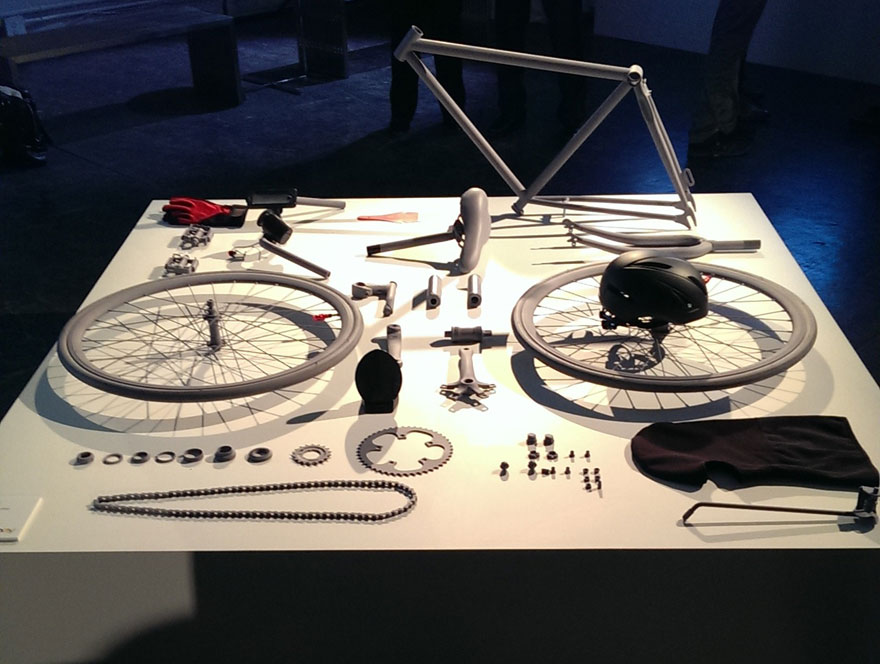
To some, an art form. To others, common sense. To the messy outsider, pointless de-jumbling. As a savvy designer or design enthusiast, you're most certainly familiar with the principles and outcomes of knolling, even if you had no idea it deserved its own word. As the story goes, knolling got verbed by the fastidious janitor at Frank Gehry's furniture shop, who would make sure all tools and materials were 90-degreed at the end of the day, mirroring rigid angles and clean lines of Knoll furniture they produced. It was picked up by the artist Tom Sachs while he worked there. Sachs institutionalized the principle in his own work and defined in his virally adored "10 Bullets":

But knolling means more than just tidying a space by aligning tools to each other or their creative confines. Through neatness, it suggests an improvement to functionality, accessibility and efficiency. In a way it's like making your workspace into a 3D exploded diagram. Which is awesome.

Although well-organized spaces and prettily arranged items are in no way new, the hyper tidy appeal of knolling is definitely on the rise. It's seeped into every visual form you can imagine. Infographics, advertising, fashion blogs, cookbooks, whole dedicated tumblrs, merchandising, photography collections. And Pinterest... Pinterest everywhere.

knolled-tree-880.jpgBig Improvement

knolledbike-880.jpgSo much easier to use!

(more...)
16 Jan 06:05

Coming Soon to the Theatre of the Mind: A Miyazaki Film Never Made

Tertiarymatt

Does seem a shame.

pippi2-880.jpg

Hayao Miyazaki is leaving us, and there's a new (old) reason to be upset. Socially speaking, it is common law that you must enjoy Miyazaki. This is not optional. Doesn't matter if you're "just not into anime" or "can't stand two dimensional characters" or were "born without any sense of joy or wonder." Still required. This is the man who brought us the high-quality weirdness of Spirited Away and Nausicaa, innumerable excruciatingly beautiful nature scenes, and the gigantic pillowy monster that is Totoro. While we're obviously grateful and can probably all agree that the man has earned his retirement, I've just learned that two of my all-time-favorite magical childhood worlds could have been woven into one beautiful whole but weren't: Hayao Miyazaki wanted to do an animated version of Pippi Longstocking, called Pippi Longstocking: Strongest Girl In the World. Given his proclivity towards badass animal-loving ladies with slightly impossible hair, the absurdity of the Pippi stories, and the bucolic loveliness of the Swedish countryside, I'm positive it would have been a great fit. If you're not familiar with the original Pippi character, get thee to the internet and then imagine the childish glee we were all denied.

PippiMiyazaki-1.jpg

PippiMiyazaki-5.jpg

PippiMiyazaki-2.jpg

(more...)
16 Jan 05:57

Production Methods: CNC Wire Machines Can Cut Crazy Shapes Out of Stone

Tertiarymatt

Coming soon to GN's workshop...

0cncwirestone-001.jpg

After reading our entry on multi-bladed jigsaws, Art Director and Coroflotter Juan Cano tipped us off to a similar machine, this one used to cut stone. By swapping out jigsaw blades for diamond-crusted wires, and switching the axis of cut from vertical to horizontal, the massive GoldBreton 2000 Multi-Wire Machine can cut massive chunks of granite into neat slabs.

0cncwirestone-002.jpg

0cncwirestone-003.jpg

That was cool enough, but it turns out Breton makes more machines than the relatively basic 2000. By attaching a cutting wire to pulleys that can swivel, then mounting those pulleys on arms that can move, they've created some very bad-ass CNC stone-cutting machines, like this two-axis model:

(more...)
16 Jan 05:55

History Repeats Itself: Uber-Luddites Attack Hacks

Tertiarymatt

Super mixed feelings about Uber.

0uberluddites-001.jpg

If you think these guys are scary, just imagine
if they all knew how to sew French cuffs

In 1829, a French tailor named Barthelemy Thimonnier invented the first French sewing machine. It was primitive, looking more like a big wooden drill press than anything, but it worked, and together with an engineer buddy he cranked out several dozen of them. They then set up the world's first clothing mass-manufacturing facility and won a contract to produce military uniforms.

0uberluddites-002.jpg

Business ended quickly—and badly. In 1831 a gang of unemployed French tailors (arguably not the most frightening demographic by modern standards) stormed Thimonnier's factory, destroyed all the machines and burned the place to the ground.

The pissed-off French seamsters weren't unique in this, of course. Five decades earlier, over in England, a tradesman named Ned Ludd had reportedly smashed up a couple of primitive knitting machines that he felt were putting him out of work. Ludd's name gave rise to the term "Luddites," which was then synonymous with machine destroyers and nowadays means people who hate technology.

(more...)
16 Jan 05:13

After watching this video on how to eat a cupcake, you may never...

by rion
Tertiarymatt

Close, but not quite. You eat the torn off bottom section first, allowing you to taste the cake on its own. Then you eat the top half with the frosting.


After watching this video on how to eat a cupcake, you may never look at a cupcake in the same way again.

Related food videos: how to make a pineapple upside-down cake, s’meaches, and chocolate from nothing.