Shared posts

02 Jun 07:07

Worsted’s & Super Numbers…

by Tom Mahon

There are all kinds of cloth material out there- wool, cashmere, vicuna etc. But for the moment I just want to let you know about the most widely-used cloth in the business, the classic “Wool Worsteds”. This is the main cloth bespoke customers need to know about. These are used for about 90% of our business. The exotics I’ll cover at a later date.

English Wool Worsted is mostly woven in Yorkshire, Northern England and the English West Country. Like all crafts, there are smaller independents dotted around the UK, however the town of Huddersfield in Yorkshire has the big slice of the business.

Wool worsteds are usually made from Merino wool (which usually means Australian and New Zealand Merino sheep) and are supplied by all of the top cloth merchants.

Wool Worsteds are very popular for a reason- they make up very well, and with a little care they can last for years. I and most of our customers wear them for this very same reason.

They come in a wide range of qualities- but when you’re buying a suit, make sure you know what definition of “quality” you’re using.

Is it “quality” in terms of texture and design? Or is it about durability and strength? Again, always ask yourself “What’s the suit for?” Remember this, or you could end up spending a lot more money and feeling sorely disappointed.

Worsted cloth is rated by numbers. Super 100’s, Super 150’s and higher. These numbers refer to the count, or fineness of the yarn used in the cloth. The finer the count (measured in microns), the more wool is used per square inch of the cloth. Hence the higher the number, the finer and softer the cloth.

To qualify as a good, hard-wearing and attractive wool worsted, it must be rated at least in the upper 80’s and 90’s.

The Super 120’s and higher are beautiful cloths, but there’s a price to pay, and not only financial. Although they do feel wonderful, the simple fact is they don’t wear very well. They’re simply not as durable as their lesser-numbered cousins.

I know this seems a little tragic, but still, if money is no object and you want to feel the finest stuff against your skin, go for the Super 150’s. Or if it’s something special that you won’t wear too often, then go treat yourself.

The other advantage of high-number wool worsteds is, because of the finer yarns used, the weavers are able to get more colours and intricate designs into the fabric. This can make them wholly tempting as you gaze at them and stroke them, when the tailor is showing you a sample.

Rest assured, no Savile Row tailor is going to sell you an inferior cloth, as the result to his reputation would be utterly disastrous. But just remember the cost of cloth can differ vastly, and not all for the same reasons.

In summary, Super Numbers look and feel fantastic, but don’t wear as well, and can add 20-30% to the cost of your suit. Your more affordable, classic worsteds are usually made into the timeless designs- pin stripes, chalk stripes, Prince of Wales checks etc. So you’ll always have room for them in your wardrobe. They make up well and last for years.

A word of advice. It’s very easy for some obscure manufacturer to produce a sample bunch with all sorts of fancy numbers and claims on it. And you’ll find out the hard way, a year down the line when the suit starts falling apart, how exaggerated these claims were. No tailor will know all of the manufacturers in the world. But if you look out for these familiar names you can be pretty confident of what you’re getting:

London-based to note are Scabal, Dormeuil and Holland & Sherry.

An excellent out-of-town company who have expanded greatly over the past few years is Lear Browne & Dunsford (LBD) – who also own H.Lesser, Harrisons, Porter & Harding, W.Bill and Smith Woollens.

Other great merchants include H.E. Box and Dugdale Bros.

29 May 21:35

This beautiful stop-motion paper forest was made by Kelli...

by rion


This beautiful stop-motion paper forest was made by Kelli Anderson and Daniel Dunnam for Plants, a new app by our friends at Tinybop. Inspired by the app’s original illustrations by Marie Caudry, the intricacy of the all-paper diorama is stunning: 400 tiny leaves, 500 blades of grass, 25 squirrels, and a total of 6,000 photos help to put everything together.

Below, how they did it: Paper to Plants: Behind the Scenes by Wild Combo.

In the archives, more amazing storytelling with paper: Østersøen (Ödland, Sankta Lucia), The Animated Life of A.R. Wallace, and Whale Fall (After Life of a Whale).

25 May 07:19

hobbitfeminism: This family won best costume at our local...


hobbitfeminism:

This family won best costume at our local RenFest. And they CLEARLY deserved it LOOK AT THIS

haha oh man, that kid’s face 

Just looking right at you and daring you to have cooler parents right now

24 May 20:16

America: Europe and Canada’s Willing Chump

by Yves Smith
Tertiarymatt

Yuppo. I've made this argument about the Keystone pipeline many, many times.

Yves here. This post makes an important point: neoliberals often like to depict America as having no choice but to participate in a race to the bottom in worker wages “because markets,” as Lambert likes to say. But in fact, as Dan Fejes points out, America is conveniently playing a leading role in the erosion of wage and environmental protections relative to key advanced economy (and in the case of Mexico, not so advanced) trading partners.

By Dan Fejes, who lives in northeast Ohio. Cross posted from Pruning Shears

One of the more memorable turns of phrase I’ve heard in the past few years came during the effort to unionize an Ikea plant in Virginia. In the same way that Mexico became an attractive location for American capitalists because of lower wages and less stringent environmental standards, some European employers began finding America more to their liking. Or, put more colorfully:

During its successful campaign to organize the Danville workers, the International Association of Machinists (IAM), through its Machinists News Network, produced a web video called “Same Rules, Same Respect.” It charged that “when on American soil, IKEA is playing by a very different set of rules than when at home.” In the video, IAM Woodworking Division director Bill Street says, “We’ve become Sweden’s Mexico.”

That isn’t Europe’s approach across the board, of course; heaven knows Volkswagen did its best to give its American workers more of a voice. But there has definitely been a willingness for other Western nations to take advantage of America’s willingness to put itself at risk or a disadvantage. This has been especially pronounced with fossil fuels.

For instance, Canada has been at best ambivalent about building pipelines for its Alberta tar sands. On the one hand, its political and media elite is not only firmly in favor but vigorously lobbying for them. On the other, the combination of grassroots activism and court challenges has made building them in-country dicey. So it looks like Ottawa might just decide it’s easier to build what Charles Pierce called a death-funnel down the spine of the United States. Since Keystone has the enthusiastic support of climate science-denying cretins in both the House and Senate, it just might succeed.

(Post intermission #1: Canadians’ flattering image of themselves as unfailingly reticent and polite is wearing a bit thin lately. The actions above are not those of a reserved and self-effacing people but an aggrandized and obnoxious one. Please own your new identity and stop insulting our intelligence, thanks.)

A similar dynamic is playing out with fracking. It turns out there is a new trade agreement under negotiation called the Transatlantic Trade and Investment Partnership (TTIP), not to be confused with the Trans-Pacific Partnership (TPP) except to the extent that both are awful. The TTIP would, among other things, greatly increase American energy exports to the European Union. Since Europe is still acting like Hamlet on fracking, the effect is basically this: Let America bear all the hazard with unconventional extraction and let EU countries get the benefit. And since fracking enjoys roughly the same political constituency as Keystone, there are plenty of takers in Washington.

(Post intermission #2: These international pacts have gone from going from “free trade agreements” to “partnerships.” Maybe that’s because free trade agreements now have such a foul odor, but in any event the change of nomenclature is useful. Monstrosities like TTIP and TPP have less to do with trade than with forcing all participants to abide by individual signatories’ worst practices.)

Incidentally, the push to get Europe off of Russia’s energy supply line is also leading to some fairly scary developments in Ukraine. While it would be lovely to think Hunter Biden’s recent employment with a Ukrainian gas giant is a noble attempt to beat back creeping isolationism in the States, there is unfortunately a more plausible and disturbing explanation.

Since neither Keystone XL nor fracking are long term job creators, it isn’t even like the US is selling out on these issues. “Selling” would imply some kind of profit. American workers will have virtually nothing to show for either, and the economy will be similarly unmoved. Extraction industry executives will make out like bandits, and that’s about it.

Anyway, let me conclude by being very clear on something: The point here is not to demonize Europe or Canada. Neither Keystone nor TTIP will happen without the substantial, ongoing support of America’s political system. No one is pulling a fast one on us here. We know exactly what’s happening. But here’s what I find curious: There are a whole lot of “my country right or wrong” types who bristle with indignation if they believe America is being taken advantage of – yet they have been silent on both of these issues. Apparently it’s no longer a stain on the national honor to play us for a fool. I’ve never been a fan of that antediluvian notion, but it sure picked a bad time to fall by the wayside.

24 May 20:10

Credit Suisse’s Guilty Plea: The WSJ Uses the Right Adjective to Modify the Wrong Noun

by Yves Smith
Tertiarymatt

Blech.

Yves here. I generally avoid Wall Street Journal editorials because they are designed to make readers stupider (op eds are a different matter, some decent pieces get published). Bill Black does yeoman’s work in deconstructing the Journal’s attempt to depict Credit Suisse as a victim of Department of Justice overreach.

By Bill Black, the author of The Best Way to Rob a Bank is to Own One and an associate professor of economics and law at the University of Missouri-Kansas City. Originally published at New Economic Perspectives

The Wall Street Journal has editorialized about Credit Suisse’s guilty plea in a piece entitled “If Credit Suisse really is a criminal, why protect it from regulators?”  More precisely, and confusingly, the full title is:

“Holder Convicts Switzerland

If Credit Suisse really is a criminal, why protect it from regulators?”

The U.S. Saved Switzerland and Its Banks

I’ll begin by responding to the WSJ’s weird claims about Switzerland.  Far from “convict[ing] Switzerland,” the U.S. Fed bailed out the Swiss Central Bank at the acute phase of the crisis (by making large unsecured loans to it in dollars) so that it in turn could provide dollars to its two massive, insolvent, and fraudulent banks (UBS and Credit Suisse).  The Treasury, with the support of Secretaries Paulson and Geithner, used AIG to secretly bail out not only Goldman Sachs but also UBS (to the tune of $5 billion).  The unconscionable deal was so toxic that the heads of each of the three U.S. financial regulatory agencies involved (Treasury, the Fed, and the NY Fed) deny that they had any involvement in the decision – it’s the Virgin Bailout.

UBS was contemporaneously negotiating a deal with the U.S. to pay a fine of $780 million to settle its criminal liability for aiding and abetting tax fraud by wealthy U.S. tax cheats – so we, in economic substance, paid their entire fine and added a bonus of $4.22 billion that rewarded the frauds.  As always, the fine was assessed solely on UBS, not the controlling officers who grew wealthy through UBS’ frauds, so the senior officers got even wealthier through the massive tax fraud and the secret AIG bailout and they overwhelmingly got to keep their jobs and bonuses that their frauds and our bailouts maximized.  (The secret U.S. bailout of UBS is considerably larger than the fines assessed to UBS and now Credit Suisse – combined – so the claim of U.S. hostility to Switzerland that the WSJ is pushing on their editorial pages is refuted by the facts.)

That secret Treasury bailout via AIG was in addition to the Fed bailout that kept UBS and Credit Suisse from collapsing in 2008.  Herr Dr. Hummler, the head of Switzerland’s oldest private bank – the man who propagated the claim throughout Europe that the financial crisis was caused by making home loans to black Americans – bragged in my presence at a conference in Switzerland that the only reason his bank existed was to aid tax evasion by wealthy U.S. citizens.  His bank, being small and unprotected by “too big to prosecute” was eliminated by U.S. criminal sanctions.  He was up front about the fact that Switzerland’s fundamental strategy was to encourage and aid and abet the wealthiest people in the world evading their nations’ tax laws.

UBS and Credit Suisse’s idea of how to repay the U.S. for saving them and the Swiss economy was to continue to aid and abet wealthy U.S. tax cheats’ crimes and to lie about it to our investigators while working behind the scenes to try to get the Swiss government to derail the U.S. investigations and prosecutions.  Far from being vigorous, Attorney General Holder was rightly excoriated by Senate investigators for his unwillingness to prosecute clear violations of U.S. law even when Credit Suisse stone walled U.S. investigators.

But the WSJ Does, Almost, Ask the Right Question

Once we get past the faux U.S. war on Switzerland meme, the WSJ does manage to ask a question that uses the correct word.  Unfortunately, it uses it to modify the wrong nouns.  The second part of the WSJ article’s title asks:  “If Credit Suisse really is a criminal, why protect it from regulators?”  “Really” is exactly the right word, but the accurate title would have been:

If the agency leaders were really regulators and DOJ’s leaders were really prosecutors why would they be protecting the senior bankers who led the frauds that caused the financial crisis from prosecution?

The answer to the question would also be obvious – they aren’t really regulators and prosecutors.  They do not represent the interests of the banks; they represent the interests of the controlling bankers.  Credit Suisse’s tax frauds enriched both the banks and the bankers, but the faux U.S. regulators and prosecutors fail to act against the controlling officers even when they grow wealthy by looting “their” banks.  The guilty plea continues DOJ’s shameful practices.

None of what we are seeing is being done to protect the “banks” (as opposed to the controlling bankers).  DOJ could have always prosecuted, and the banking regulatory agencies could have sanctioned, the bankers responsible for the crimes.  That would have posed zero risk to the banks.  Instead, the sole sanction is to the banks – the CEO (who was the COO and General Counsel during Credit Suisse’s pervasive criminal strategy of aiding and abetting tax fraud by wealthy Americans) keeps his job and his bonuses that were largely funded by our bailouts and Credit Suisse’s tax fraud strategy.  (The low-level UBS officer committing some of their tax frauds has the distinction of both being imprisoned for his/UBS’ crimes – and receiving $104 million as a whistleblower.  Some low-level Credit Suisse staffers have pleaded guilty.)

The WSJ as Criminal Defense Lawyer for Wall Street (and Bankers Everywhere)

The WSJ cannot be condemned for home town biases in this editorial – it loves all bankers – worldwide.  It turns out that in addition to the Virgin Bailout the WSJ is peddling the idea that this is the first U.S. financial crisis in modern history that is a Virgin Crisis conceived without sin in the C-suites.

The problem is that indicting individuals requires finding actual criminal intent and behavior and then proving it to a jury when so much of what happened during the financial crisis was simply bad judgment.

Yes, the difficulty of proving fraud against elite defendants is typically demonstrating their intent because they are so good at hiding their intent behind pretense.  The WSJ’s “so much” phrase becomes a way of assuming away fraud.  I will not repeat my many columns demonstrating that the financial crisis was driven by fraudulent bankers and that their crimes could be prosecuted effectively as we did during the S&L debacle and as others did in response to the Enron-era accounting control frauds.  If our regulators today (and under Clinton and Bush II) had “really” been regulators and made the criminal referrals essential to prosecuting the elite bankers leading the frauds and if our prosecutors were “really” prosecutors there would have been thousands of senior bankers convicted and the crisis could have been prevented.  Note that the WSJ never seeks to refute the evidence that the three most financially destructive epidemics of accounting control fraud drove the current crisis.  If they were “really” regulators and prosecutors they would be demonstrating this point on a daily basis through their criminal referrals, enforcement actions, and criminal prosecutions of the elite bank officers that led the frauds.

The WSJ Proposes that Businesses Be Immune from Prosecution

The WSJ also has an interesting standard for prosecuting businesses:  it is “appropriate only if … the entire bank is a criminal enterprise.”  So, if there are any honest operations at a massive bank one cannot prosecute it.  Yes, the WSJ just called for making it impossible to prosecute any bank.  It didn’t have the courage to write that openly, of course, but that’s the effect of its proposed standard for prosecuting a bank (or any other business entity).  Seeming legitimacy will grant the firm total immunity from being sanctioned criminally.

Indeed, because, as the WSJ correctly states it is impossible that the Department of Justice (DOJ) could have believed that Credit Suisse was “entire[ly] … a criminal enterprise” it follows logically (?) that DOJ’s prosecution of Credit Suisse must be “political.”   The possibility that DOJ might not agree with the WSJ that businesses should not be immune from prosecution unless every aspect of their operations is criminal (which would require the rejection of well over a century of U.S. legal doctrine) does not enter the WSJ’s analytical process.

24 May 20:08

Financial Times Finds “Many” Errors in Piketty Analysis, Argues They Undermine His Thesis

by Yves Smith
Tertiarymatt

For those who have read Piketty.

On what would normally be a very quiet Friday evening, the Financial Times has managed to stir up a significant controversy involving Thomas Piketty’s widely-lauded book, Capital in the 21st Century. Unlike many economists, Piketty provided an online annex and his spreadsheets, which showed the sources he relied on.

According to authors Chris Giles and Ferdinando Giugliano:

An investigation by the Financial Times, however, has revealed many unexplained data entries and errors in the figures underlying some of the book’s key charts.

These are sufficiently serious to undermine Prof Piketty’s claim that the share of wealth owned by the richest in society has been rising and “the reason why wealth today is not as unequally distributed as in the past is simply that not enough time has passed since 1945”.

After referring back to the original data sources, the investigation found numerous mistakes in Prof Piketty’s work: simple fat-finger errors of transcription; suboptimal averaging techniques; multiple unexplained adjustments to the numbers; data entries with no sourcing, unexplained use of different time periods and inconsistent uses of source data.

Together, the flawed data produce long historical trends on wealth inequality that appear more comprehensive than the source data allows, providing spurious support to Prof Piketty’s conclusion that the “central contradiction of capitalism” is the inexorable concentration of wealth among the richest individuals.

Once the data are cleaned and simplified the European results do not show any tendency towards rising wealth inequality after 1970.

The US source data are also too inconsistent to draw a single long series. But when the individual sources are graphed, none of them supports the view that the wealth share of the top 1 per cent has increased in the past few decades. There is some evidence of a rise in the top 10 per cent wealth share since 1970.

The article discusses the sorts of errors it found in more detail, including what look like data entry errors, unexplained one-off adjustments to data, weightings used in averaging different data sets, and inconsistent time periods used in comparisons. The pink paper argued that two major claims in Piketty’s book, that the concentration in wealth had increased after 1970, and that the share held at the top was greater in the US than in Europe, was absent when his data was corrected.

The Financial Times story had more of a “gotcha” tone that one expects to see in the mainstream media, and compared the mistakes to the famous spreadsheet errors in Carmen Reinhart’s and Kenneth Rogoff’s work on debt to GDP ratios. But at least so far, there is a key difference: only one other study had found results similar to the those claimed by Reinhart and Rogoff. By contrast, Piketty is far from alone in finding rising concentrations of wealth at the very top; Demos points out that a new study published by Garbriel Zucman and Emmanuel Saez paints a post-war picture similar to Piketty’s. Thus the FT’s assertion that their corrections of Piketty’s data show no increase in wealth concentration is an awfully bold claim, and will likely be scrutinized as much as the errors and possible methodological shortcomings that Giles found.

Piketty issued a response that may strike some readers as unduly general, but it isn’t clear whether the Financial Times gave him a complete list of their errors and points of disagreement. But his response isn’t defensive (a contrast with Reinhart and Rogoff), so he at least gets points for being willing to engage in a discussion.

My bet is that the Lance Taylor critique will in the end do much more to undercut Piketty’s findings than the Financial Times corrections and recalibrations, as useful as those are. Taylor challenged the widely-touted Piketty’s assertion that r > g (the rate of return on capital exceeds the growth rate of the economy). NC reader Ben Johannson provided a helpful summary of Taylor’s paper:

1) Taylor makes the point that Picketty’s determinations of the rate of profit and the capitalists’ share of those profits assume a fully employed global labor force due to his use of the neoclassical production function (the one trashed back in the 1950s during the Cambridge capital controversies). This is THE critical error in Picketty’s work, that capital can be aggregated and differences simply assumed away while the reality of effective demand is ignored.

2)The rate of profit and share of net profits will vary over time depending on the business cycles, employment level, monetary policies, technical changes, etc. The neoclassical production function referenced above does not take this into account.

3) The accumulation of wealth at the top is not an autonomous product of “capital”, some natural law of economics which states that it will always produce growing inequality, but rather a product of specific policies which can be reversed. Altering the ratio of output/capital and the share of profits taken by the capitalist class is the better and more easily implemented choice for reducing inequality rather than taxation. In other words rising real wages is more effective in sustaining aggregate demand and attenuating capitalist power, while relying on taxation will fail to address stagnating wages and continue the current trends.

While it is critically important that errors be unearthed and examined for their seriousness, some of the FT’s “gotchas” are clear mistakes, while others appear to be disagreements about how to deal with complex and inconsistent data sets. For instance, as Neil Irwin at the New York Times notes (boldface original):

Some of the issues identified by Mr. Giles appear to be clear-cut errors, and others are more in the realm of judgment calls in analyzing data that may not be fully explained by Mr. Piketty but are not necessarily wrong….

But does it matter? Mr. Giles attempts to reconstruct estimates of wealth inequality, correcting for what he describes as Mr. Piketty’s errors. He finds significantly less evidence of a rising disparity.

Speaking of Britain, for example, Mr. Giles writes, “There seems to be little consistent evidence of any upward trend in wealth inequality of the top 1 percent.” He further writes that if one incorporates the different British data into numbers for Europe as a whole, and weights by population instead of weighting Britain, France and Sweden equally, “there is no sign that wealth inequality in Europe is rising again.”

That is a damning conclusion, and if it holds up to scrutiny, would significantly undermine the case Mr. Piketty mounts. But Mr. Giles himself writes that “while this post is clear about what is wrong with Piketty’s charts, it is much less certain about the truth.”

The two most serious-looking types of errors that the Financial Times found were arbitrary data adjustments and data with no source and no explanation as to why/how it was created. This may be simple failure to document adequately or in a worse-case scenario could look a lot like data-diddling.

With Piketty’s book having gotten so much attention over the last few weeks, it’s a given that there will be a lot of eyes on the Giles findings and considerable debate over how much of an impact they have on Piketty’s conclusions. So hold tight and see how this shakes out.

24 May 20:05

Global Food Security Needs States to Ally with Family Farmers

by Yves Smith

Yves here. If you live in an advanced economy, and are at least middle income, you probably don’t give much thought to the availability of food. These countries, on the whole, suffer more from the consequences of excess, in the form of diabetes and orthopedic issues among the aging that are exacerbated by being heavy, than from hunger or nutritional deficiencies. Yet food prices are rising. With weather and even seasons moving considerably out of line with historical norms, and with the oceans already suffering from overfishing, access to food and the relative cost in the form of inputs of various types of food is likely to become a much bigger political issue than it has been for decades. The driver of the Arab Spring revolts were rising food and fuel costs that pushed significant numbers from being on the right side to the wrong side of survival. Even in the sheltered US, the drought in California means more costly meals or trading “down” in terms of finding cheaper substitutes.

One of the issues that is seldom discussed is food security. I find it curious the degree to which national leaders have become comfortable with making their countries less self-sufficient in the name of promoting trade. That is not to say that trade is bad, but neither is trade inherently virtuous. The gains from trade need to be weighed against costs and risk. Small countries, or ones in regions with short growing seasons may never have been self-sufficient, particularly in food (Jared Diamond in his book Collapse uses Montana as an example of an society inherently dependent on imports from the rest of the world). But for ones that were reasonably close to self-sufficiency, the choice to accede to the demands of agricultural exporters like the US and hollow out domestic food production may prove to have been short-sighted. Our house Japan expert Clive points out that Japan’s long-standing insistence of protecting most of its generally uncompetitive agricultural industry isn’t simply about catering to a powerful voting block. Japan still remembers the “starving times” of the later days of World War II and its immediate aftermath and does not want to take any more risk on the food front than it needs to.

This post focuses on agribusiness as a driver of food insecurity. Many studies have found that even with global population at its present level, the driver of hunger isn’t the amount of food production but its distribution. And as NC readers regularly point out, more emphasis on local food production also reduces the use of other resources, like fuel for transport and often packaging.

By Sylvia Kay, a researcher at Transnational Institute (TNI). She works on a wide range of issues including land grabbing, water, and agricultural investment. Cross posted from Triple Crisis

South Africa’s most famous cleric, Desmond Tutu, in his inimitable style, once said, “If an elephant has its foot on the tail of a mouse, and you say that you are neutral, the mouse will not appreciate your neutrality.” His blunt speaking has particular relevance to important negotiations taking place in Rome this week at the United Nations Committee on World Food Security, which will define principles for “responsible agricultural investment” (known as RAI) in the context of an ongoing food crisis and an unprecedented wave of land grabbing.

When it comes to agriculture and food, the elephant is agribusiness. Just three companies control 50% of the commercial seed market; only four companies control 75% of the global trade in grains and soya. Their argument is that the state’s role should be that of a neutral broker, encouraging primarily private investment in agriculture. They are willing to accept guidelines for “responsible investment,” but within a model that sees ever increasing levels of foreign direct investment and the deepening and further integration of national agricultural sectors into global commodity chains and markets. Theirs is essentially a business-as-usual approach which seeks to retrofit the RAI principles to existing agribusiness initiatives.

While such principles will boost the profits of some corporations, the evidence shows that it will not deliver on the CFS mandate to realise the right to adequate food for all. One in eight people in the world are currently undernourished—and this has worsened in recent years. In fact, reliance on global markets led to global food prices in 2007 rising to levels in real terms not witnessed since 1846. This has not only added between 130 to 150 million people to those living in extreme poverty, it has also fueled an unprecedented wave of land grabbing across the global South by governments seeking security from food riots and corporations seeking profits from perceived scarcity.

The mice in this case are the small-holder farmers who often had their land seized or appropriated. But they are not just victims; they also provide the most progressive solutions for food security. There are an estimated 500 million smallholder farms in the developing world which provide livelihoods for 2 billion people and produce about 80% of the food consumed in Asia and sub-Saharan Africa. It is these small farmers who truly contribute to global food security.

Any international negotiation that looks at “responsible agricultural investment” should start with how to support rather than dispossess these small-scale food producers. A report by Transnational Institute, Reclaiming Agricultural Investment, recently studied working alternatives of state-peasant collaboration from Brazil to Ghana, the United States to Thailand. The studies show that when the state sets the right policies and provides investment in support of small-scale food producers, it can have remarkable results.

Brazil’s Zero Hunger programme, which combines elements of public health, nutrition, social protection, education, and livelihood promotion, has been one of the major factors behind the country’s impressive improvement in the standard of living over the past decade. The Zero Hunger programme successfully opened up new markets for smallholder farmers and championed national food security. Under the School Meals programme for example, each Brazilian municipality receives a daily subsidy for each student with the requirement that 70% of the municipalities’ procurements should be staple, non-processed foods, with 30% of the food coming from local family farms.

Government support for sustainable, agro-ecological farming techniques, practiced by small farmers, can also reduce the impact of agriculture on the environment and climate. Indian government support for the system of sustainable rice intensification (SRI), which involves the use of organic fertiliser and a diversified set of agro-ecological practices, has led record yields. Despite this, SRI has been ignored by the conventional rice research establishment and the private R&D industry, as it threatens the interests of agribusiness suppliers.

It is often presumed that state support for small-scale food producers entails higher prices and costs for consumers. However, using public policy tools in a flexible manner can ensure that both groups benefit. Some of the most effective strategies for dealing with the food crisis, for instance, have involved the use of public stocks and the setting of minimum farm prices for producers and maximum consumer prices for key staple commodities. In Indonesia, these measures ensured that the price of rice actually decreased in 2008 while it was escalating in neighbouring countries.

Business as usual is not an option. It is time for states to end a false neutrality and take sides. Instead of investing in a model which is at its core anti-democratic and likely to further entrench a state of “agropoly” in which a handful of the largest processors, traders, and retailers control the world food system, governments should commit to RAI principles that strengthen the position of the world’s family farmers and advance the cause of food sovereignty.

24 May 20:04

Links 5/24/14

by Yves Smith
Tertiarymatt

Random assortment of linkage.

World’s Prettiest Tarantula Takes Best in Show 2014 Natural Geographic. A Richard Smith find.

Do biologists really need dead animals? Article inflames debate. Christian Science Monitor

5 food additives more disgusting than ‘pink slime’ MarketWatch

Apple in Gigantic marketing cock up TechEye (EM)

Did the internet prevent all invention from moving to one place? VoxEU

China cannot follow America’s route to world leadership Financial Times

U.S. Gains in a Spat With China Over Tariffs New York Times

Thai coup leader tightens grip Asia Times

Is troubled Thailand tumbling into civil war? Aljazeera

European Parliament Elections: Our choice between Euro-loyalists, Euro-sceptics & Euro-critics Yanis Varoufakis

Suddenly The EU’s Break-Up Has Moved From A Possibility To A Near-Certainty Forbes (Bob H)

Iran Offers Data on Detonators, Atomic Agency Says New York Times

Ukraine

Bad U.S. Policy Pushes Russia, China and Iran Closer Together George Washington

Crimea: an EU-US-Exxon Screwup CounterPunch

THE CHAOS ENGULFING EASTERN UKRAINE New Yorker

Putin Says Russia Will Work With New Ukrainian President Bloomberg

Russia’s central bank chief deems crisis over as capital flight is halted Ambrose Evans-Pritchard, Telegraph

How Putin’s comrades washed their money in Switzerland and the UK Tax Justice Network (Richard Smith)

Twitter “micro-censors” Ukrainian neo-nazi accounts at Russia’s request Yasha Levine, Pando

Big Brother is Watching You Watch

Peter Watts on the Harms of Surveillance Bruce Schneier

FBI withdraws national security letter following Microsoft challenge ars technica (Chuck L)

Government Treating Peaceful Left Activists Like Terrorists–Again American Prospect

US ‘must force-feed Gitmo inmate’ Guardian

Single Payer Advocates: How Do We Defeat Health Care for Profit? Truthout

Elon Musk says he lost a multi-billion-dollar contract when SpaceX didn’t hire a public official Quartz (Chuck L)

FACING THE TRUTH: THE CASE FOR REPARATIONS Bill Moyers with Ta-Nehisi Coates.

Oregon’s GMO Sellout Rebekah Wilce, Firedoglake (jo6pak)

Hillary Clinton’s Speaking Circuit Payday: $5 Million (and Counting) Economic Policy Journal (rich)

Geithner Pants on Fire

Macho Bullshit and Bailouts Matt Stoller

Geithner’s Stress Test Failure Barry Ritholtz, Bloomberg

New Home Sales “Better, Not Strong”, and Regionally Very Uneven: US +6.7%, Midwest +47.4%, Northeast -26.7% Michael Shedlock

Class Warfare

Poor Americans Direct 40% of Their Spending to Housing Expenses Wall Street Journal

New technology: who wins, who loses? Pieria. On a different sort of class line.

Dispute Arises Over Number of Mortgage Denials to Blacks New York Times

Dear Graduates: Don’t Follow Your Dreams (A Commencement Speech For the Mediocre) Alternet. Personally, I have long thought that the corporate exhortations for passion of the non-romatic kind in the workplace is merely a way to tell potential hires that they need to be so dedicated that they will convince themselves that submitting to abuse is a proof that they have what it takes to succeed.

The myth of the omnipotent central bank Frances Coppola

The threat facing online comments Financial Times. Hah, FT Alphaville struggles with comment moderation too, and they have way more staff than we do!

Antidote du jour (Lance N):

Chameleon

See yesterday’s Links and Antidote du Jour here.

24 May 09:15

The Roots of Autism Are in the…Skin?

by Virginia Hughes
Tertiarymatt

Hard to say what direction causation is really going here.

The skin is our gateway to the physical world. Below its surface are oodles of nerve fibers relaying different types of messages to the brain. At the ends of the fingertips, for example, fat and fast Aβ nerves help you fish for keys at the bottom of a messy purse, or feel the difference between cotton and polyester. Nearby those big nerves are thinner and slower C-fiber nociceptors, which transmit pain, and others that relay itchiness.

What I didn’t know until this week is that there is yet another type of nerve, found only under hairy skin, that carries information about our social interactions. These nerves, known as C-tactile (CT) afferents, respond to slow, gentle stroking — the soft touch you’d give to a baby’s forehead or a lover’s arm. And some researchers believe that these fibers are crucial for the development of the social brain.

“A hand on the shoulder, a pat on the back — these things anchor and cement social relationships in a meaningful way,” says Francis McGlone, a cognitive neuroscientist at Liverpool John Moores University in the U.K.

In today’s issue of Neuron, McGlone and his colleagues published a commentary reviewing what’s known about these nerves, including some provocative studies suggesting they play a role in autism.

“This C-tactile system is not there to sense the physical world, it’s there to feel the physical world,” McGlone says. “It’s coding something very important, particularly during early development.”

McGlone et al., Neuron 2014

Nerve fibers in hairy skin (left) and smooth skin (right), from McGlone et al., Neuron 2014

CT nerves were first described in 1939. Swedish physiologist Yngve Zotterman found that in a cat’s leg, certain thin nerve fibers would fire electrical signals in response to slow stroking with the edge of a round wooden pin. “The complex response to stroking naturally raises the question whether the different groups of spikes are derived from groups of fibres with different sensory functions,” Zotterman wrote.

Subsequent studies confirmed that these nerves exist in cats (1957), as well as in monkeys (1977) and rats (1993). They weren’t reported in people until the late 1980s and ‘90s, thanks to a technique called microneurography pioneered by two Swedish scientists, Karl-Erik Hagbarth and Ake Vallbo. With this method (which Hagbarth and Vallbo first perfected on their own arms to prove its safety) a metal electrode tungsten microelectrode is poked through the skin of an awake person to record electrical signals from the nerves underneath.

Deciphering the code of these nerves is difficult and takes a lot of patience. “It’s like putting a microphone into a United Nations convention — there’s lots of different languages you’re going to be hearing,” McGlone says. “I think five people on this planet can record from C-tactile afferents.” These trained scientists can hear the language (that is, a certain pattern of electrical waveforms) of the CT afferents only when the skin is gently stroked.

McGlone’s lab has done a series of fascinating studies on CT afferents. His team uses a robotic stimulator to deliver gentle brush strokes in a steady, consistent way. Here’s a quick video of how it works:

The person in the video is rating how pleasant (or unpleasant) the touch feels on different parts of his body. In 2009, McGlone’s team published a study in Nature Neuroscience in which this robotic brush stroked volunteers at different velocities. Turns out that the velocities that volunteers rated as most pleasant are the same ones that activate CT nerves. “They matched up perfectly,” McGlone says.

OK, so there are nerves that selectively respond to a soft touch. The real question is, why? What are they for?

“We’re still asking that question,” McGlone says. “What I hope I’ve done in this new paper is put a few more pieces of the jigsaw puzzle in place.”

Several puzzle pieces come from brain imaging studies. In 2012, for example, McGlone and collaborators in Montreal scanned volunteers’ brains while slowly stroking two skin areas: a hairy patch of the forearm, which holds CT fibers, and the hairless palm, which does not have CT fibers. Stroking CT fibers triggered activity in the posterior insular cortex and mid-anterior orbitofrontal cortex, which are both part of the brain’s limbic system, deep circuits that process emotion. Stroking the palm, in contrast, activated the somatosensory cortex, the outer layers of brain that process our physical sense of touch.

Stroking CT fibers also activated a brain region called the angular gyrus, which is involved in our internal representation of our body. (In studies of epileptic patients, stimulating this region leads to dramatic out-of-body experiences.) This result is intriguing, McGlone says, because it suggests that CT afferents are involved not only in our awareness of others, but in our physical sense of self.

The same brain regions activated by CT afferents — the insular cortex, orbitofrontal cortex, and angular gyrus — have also been implicated in autism and related disorders. Could autism be the result of an impaired touch system?

“I think it’s very believable,” says Kevin Pelphrey, a neuroscientist at Yale who is known for his brain-imaging studies of children with autism. In 2012, Pelphrey’s team scanned the brains of 19 healthy adults while they received either slow or fast strokes on their forearm. The slow touch activated brain regions involved in social behaviors, as shown before. But this brain activation was lowest in participants who scored high on tests of autistic traits.

Pelphrey is most interested in one of those brain regions, the superior temporal sulcus, or STS. This area is sensitive not only to social touch, but to socially meaningful sights and sounds. “We’re working on smells now as well,” Pelphrey says. His earlier work has shown that children with autism have abnormally low activity in the STS.

Pelphrey has also scanned the brains of children with autism while they felt slow or fast arm-stroking. “We wanted to know if the brain response to social versus non-social touch is present in autism or not, and to what degree it’s disrupted,” he says. “We found something,” he says, but wants to keep the results under wraps because the study is currently under review.

There are other reasons to suspect that CT afferents may be involved in autism, Pelphrey says. Many individuals with autism, such as autism advocate Temple Grandin, have sensory sensitivities. Pelphrey notes that some of the earliest descriptions of the disorder mention that babies with autism don’t react to being picked up in way that most babies do. “Touch is the first sensory system to develop,” Pelphrey says. “The brain response to C-tactile afferents should be present well before birth.” So if the system is disrupted in autism, it could become a very early biomarker of the disorder.

The question of why these afferents exist is still open. They could be vestigial, useless leftovers of our evolutionary past, the skin’s appendix. But McGlone doesn’t think so. He believes that affective touch is crucial for our brain development, and worries about what will happen as we transfer more and more of our social lives online.

“We live in a touch-deprived world,” he says. “You can see sort of an Armageddon scenario, where the affective touch system may well become vestigial. And what would the consequences be for the social brain?”

*

The text has been slightly modified: The electrode used in microneurography is made of tungsten, not metal. 

24 May 08:29

The Wild Hunt (2009) directed by Alexandre Franchi written by...

Tertiarymatt

#neverLARP #notevenonce


The Wild Hunt (2009)
directed by Alexandre Franchi
written by Alexandre Franchi and Mark Antony Krupa

Recommended? A hesitant yes.
Bechdel Test: Fail

The Wild Hunt is a Canadian drama-thriller that tells the story of a LARP-turned-Stanford-Prison-Experiment gone dreadfully wrong. A non-gamer crashes his brother’s Live-Action Role-Playing (LARP) game to “rescue” his girlfriend, and the situation spirals into a Shakespearean tragedy reminiscent of grotesque, gut-wrenching emo music. The movie is dark. Dark, dark, dark. Did I mention it’s dark? When you look up its IMDB movie keywords, the third is “attempted rape.” Consider that a major trigger warning.

All that aside, I’ve watched this movie three times in the past three months. I’m attracted to The Wild Hunt‘s affecting cinematography, its exploration of an unsettling human nature, and, of course, its rad LARP gameworld.

Read the rest at anarchogeekreview.com

24 May 08:23

Goodbye World 2013Director: Denis HennellyWriters: Denis...

Tertiarymatt

I have never heard of this movie.


Goodbye World
2013
Director: Denis Hennelly
Writers: Denis Hennelly and Sarah Adina Smith

Recommended? Yes
Bechdel Test? I think fail, somewhat surprisingly

There ain’t no justice, just us.

That’s always been one of my favorite anarcho-cliches. And it’s one of the central themes of this low-key apocalypse romantic drama.

Yes, that’s right. It’s an apocalypse movie about thirty-something mostly-white all-hetero couple drama. And I kind of loved it.

For a long time I’ve been saying the problem with movies is they try to be like OMG it’s the biggest deal ever and everything is explosions! and so I’ve been advocating for a post-apoc rom-com. This isn’t very post the apocalypse and it’s not much com in its rom, but I still kind of feel like I got what I was hoping for.

The movie puts four men and four women, old college pals, in a hippy-ish tech yuppie’s dream home in the redwoods. And then all the technology goes bye-bye and maybe some terrorists destroyed all the tractor trailers, or enough to cause system-wide failure.

But I love, love, love how the movie isn’t about that. It’s about stopping people from taking power on a local scale, about learning to get your head out of your ass and help the people around you, about learning what an animal-liberationist convicted arsonist has in common with a christian libertarian.

Read the rest at anarchogeekreview.com

23 May 18:56

May 23, 2014

Tertiarymatt

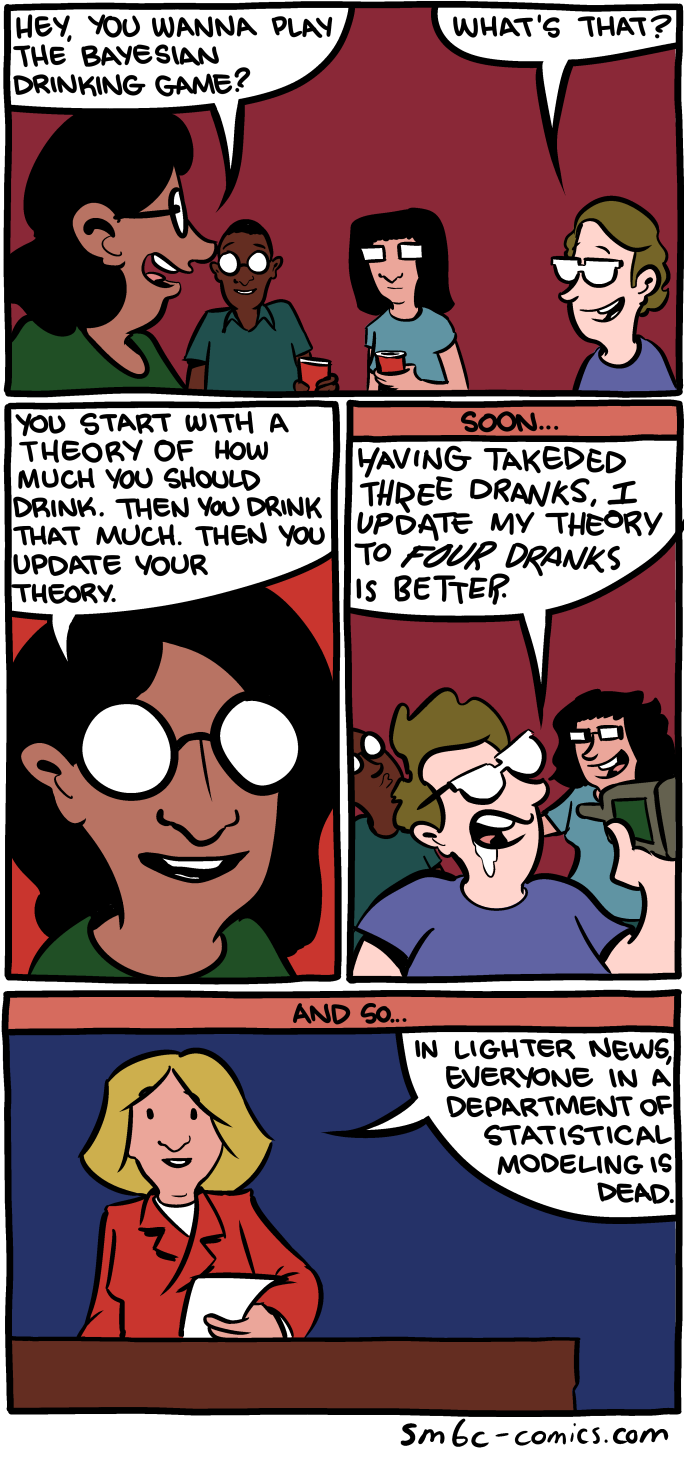
Bah. When I update my prior on inebriation, I usually find that the data strongly supports it.


New awesome thing, launching very shortly!
22 May 16:19

The Book

by Erika Moen
Tertiarymatt

So, this is pretty much funded by now, which Erika was super anxious about, but still, i imagine there are plenty of folks here who would enjoy it.

The Book
Do you love sex? Do you love books?

Me too!

That’s why I’m raising money on Kickstarter to print the first year’s worth of Oh Joy, Sex Toy comics into a beautiful book to hold and cherish and lick and cuddle.

It’s over 220 pages, collecting the hundreds of pages my guest cartoonists and I drew in the last year, plus dozens of pages of brand new comics and bonus content that’s been created just for the book. This new content includes a comic reflecting on the last year of OJST and why I created it, an essay on my first sex store and orgasm, answers to some of our most frequently asked questions, and my first journal comic that I’ve made in years that covers a day in the life of a couple who runs a sex blog. Oh! Plus an introduction written by Dr. Emily Nagoski, a sex educator and writer.

We’re raising the funds to self-publish the book and then if we’re overfunded, we’ll be using that extra money to retroactively back pay our guest cartoonists a higher page rate for the work they did and increase our page rate for all future cartoonists going forward.

I believe strongly in making sex education and positivity accessible and friendly to the average person, and OJST is my attempt to help people realize and enjoy their sexual desires and have healthy sex lives. Being online has allowed thousands of people to find and share my work, and my hope is that with a printed book I’ll be able to reach the people who don’t want anything with ‘sex toy’ in the URL to show up in their browser history or whose work places have banned my site (It’s been banned from a lot of work places!).

If you would like in on this sweet action, direct your dollars this’a way!

22 May 02:31

Dates And Times


Ads by Project Wonderful! Your ad could be here, right now.

VanCaf is this weekend! I will be there! I hope you will be there too!

20 May 21:29

http://fuckyeahreactions.tumblr.com/post/85909304170

Tertiarymatt

A treasure.

20 May 17:17

When Laughter Isn’t Funny

by Virginia Hughes
Tertiarymatt

Brains are really weird things.

This Sunday is World Laughter Day, a 16-year-old holiday puffed into existence by the guy who created something called “laughter yoga.” That means that all weekend long we’re going to be bombarded with articles about the benefits of laughter. Didn’t you know? Laughter is good for your arteries, it boosts the success rate of IVF, and even treats cancer!

I have nothing against laughing, I even do it occasionally. But when it comes to the science of laughter, some of the most interesting studies are those describing medical cases in which laughter foretold sickness.

I’ll describe three of them here, all published last year:

Take the case of a 52-year-old woman who had been suffering from intense laughter-induced headaches for 32 years. A scan of her brain revealed three “giant Pacchionian granulations,” or pockets of pooled cerebrospinal fluid. This is an example of what the researchers call a “circumstantial headache.” It wasn’t caused by anything special about laughter, per se, but presumably something about the changes in fluid pressure that the laughter caused. Tellingly, when the woman sneezed or coughed it also led to headaches. She refused any further treatment for the granulations, “given that her laughing headache was avoidable.” (Bitter pill!)

Or how about the 43-year-old man with bipolar disorder who had seizures after laughing at comedy shows on television. “In each instance, he started laughing, then his arms started shaking and he felt like ‘his consciousness was being vacuumed away’,” his doctors write. “He had had a variable number of seizure episodes; five times a day on average, based upon the length and intensity of the comedy shows.” His doctors couldn’t find anything overtly wrong with him, so at first they attributed the seizures to his bipolar disorder. But then they monitored him for two days with electroencephalography (EEG), which measures brain-wave activity through harmless scalp electrodes. The EEG charts showed that the seizures were caused by his “deep-belly laughing.”

Laughter is thought to come about from activity in two distinct brain areas: the temporal lobe, which processes the emotional aspects, and the frontal cortex, which handles the motor component. The researchers hypothesized that the man’s laughter spurred seizures in the motor area, but couldn’t be sure. They put him on a new seizure medication and it fixed the problem. If that hadn’t worked, though, the man would have had to stop watching TV. “As only limited data exist, clinicians must recommend a multimodal treatment,” they write, including “laugh-provocation avoidance.”

Finally, consider the 58-year-old man who was playing charades with his family one night when he suddenly couldn’t stop laughing. He didn’t worry about it too much until the next time it happened — at a funeral. “He laughed throughout the service without any cause, and was profoundly embarrassed,” his doctors write. It happened a third time when he was visiting his sick mother. These incidents, known in the medical literature as “pathological laughter” or PL, “caused him to retire from social contact.”

Pathological laughter, it turns out, has been linked to multiple sclerosis, brain tumors, Alzheimer’s disease, Pick’s disease and Wilson’s disease. It can also be a delayed sign of a stroke, which was the case for this man. Brain imaging showed lesions in white matter, which connects brain cells, as well as in the midbrain and the temporal lobe. Nobody knows what causes pathological laughter, but because of the delayed response, researchers speculate that it’s not simply the result of the lesions. “Delayed PL reflects the time required for the formation of autonomous motor centres,” they write. “It has been suggested that there is formation of new neuronal activity or new laughter control centres.”

The man’s laughing fits went away, somewhat ironically, after he began taking citalopram, an antidepressant.

20 May 11:05

How 10 Minutes of Mild Exercise Gives Your Brain a Boost

by Virginia Hughes

I’m an exercise procrastinator, as I’ve admitted before on this blog. Rationally I know that daily exercise will be good for me in the long run. But it’s hard to get motivated by vague health benefits that are years or even decades away.

Like any good American I like my instant gratification. I found some today in a new brain-imaging study reporting that 10 minutes of mild exercise dials up the brain’s arousal system, making you think faster and smarter.

A team of sports scientists in Japan recruited 25 healthy young people to come into the laboratory on two occasions; in one session they rode a stationary exercise bike for 10 minutes, and in the other they rested instead.

The volunteers took two tests before and after the exercise/rest periods. One of the tests, the Two-Dimensional Mood Scale, measures mood and arousal states: energetic or lethargic? Relaxed or nervous? And so on.

The other was the famous Stroop test, which measures attention and brain-processing speed. The researchers showed volunteers words that describe color (such as red, blue, and green), but asked them to name the color of the letters rather than read the word. It’s a difficult test: When the color of the letters doesn’t match the word [red, blue, green], it takes your brain some time to register the mismatch. (You can try the test for yourself here).

But here’s the cool part of the study: The researchers measured the volunteers’ brain activity while taking the Stroop test (both before and after exercise). They used an imaging technology called functional near-infrared spectroscopy, or fNIRS, in which a cap of harmless optical probes detects color changes in superficial blood vessels. When brain cells respond to a stimulus they use a fresh supply of red blood, replete with oxygen. This activity displaces blue, deoxygenated blood from the region. By measuring these color changes, fNIRS offers an indirect measure of neuronal activity in the brain’s outer layers.

The researchers found that during the exercise session, volunteers showed a significant drop in Stroop reaction time after exercise. In contrast, the same people did not show this improvement in the rest session.

Exercise also triggered a surge of brain activity on the left side in two regions: the dorsolateral prefrontal cortex and the frontopolar area (see image above). Both regions are known to be involved in attention and executive function. And the extent of exercise-induced brain activity correlated with the volunteers’ gains in processing speed.

OK, but why? Why does exercise cause these extra buzzings in the frontal cortex?

The researchers suspect the answer lies in the so-called “fight or flight” system — the network of chemical messengers that regulate our arousal patterns and stress responses. Previous studies in rodents have shown that exercise causes the brain to release more acetylcholine, noradrenalin, and dopamine, neurotransmitters that are involved in arousal and are known to activate the frontal cortex. Bolstering this idea, the volunteers in the new study showed higher arousal scores on the mood test after exercising, and these scores correlated with frontal brain activity.

The same group of researchers published a very similar paper in the same journal, NeuroImage, in 2010. In the older study, however, volunteers performed “moderate” exercise: 10 minutes of biking at an intensity requiring 50 percent of their peak oxygen uptake. The new study finds the same benefits with “mild” exercise, defined as requiring just 30 percent of peak oxygen uptake. This is an important distinction, the researchers say. As our lifestyles become more and more sedentary, they write, “it is of considerable importance to determine the lowest level of physical activity required to maintain mental and physical health.” (How about that for a low bar?)

So with that, I’m going to drag myself outside for a run. Hopefully it will make for a cognitively productive afternoon.

20 May 06:11

Resveratrol Redux, Or: Should I Just Stop Writing About Health?

by Virginia Hughes

(Update, 5/13: This post generated a lot of discussion on Twitter, which you can see Storify-ed here. I also talked about these issues on NPR’s On the Media, which you can listen to here.)

The science of health is so, so confusing, I almost wonder if it wouldn’t be better for journalists to stop writing about health altogether. Or at least to dramatically change the way we do it.

Take one of the biggest health stories of the last decade: resveratrol, a compound found in certain red wines that has been shown to extend lifespan and/or curb disease in yeast, fruit flies, fish, worms, and mice.

Searching the New York Times archives for “resveratrol” gets you 156 items. Here’s a sampling of the headlines:

August 2003: Life-Extending Chemical Is Found in Certain Red Wines

November 2006: Yes, Red Wine Holds Answer. Check Dosage.

January 2011: Doubt on Anti-Aging Molecule as Drug Trial Stops

August 2011: Longer Lives for Obese Mice, With Hope for Humans of All Sizes

January 2012: University Suspects Fraud by a Researcher Who Studied Red Wine

November 2012: Resveratrol Ineffective in Normal-Weight Women

March 2013: New Optimism on Resveratrol

Is your head spinning yet?

From what I can tell, there’s nothing overtly wrong with the journalism in any of these stories. Most are based on a new study (or studies), and include varied perspectives of scientists who had nothing to do with the research. The reason the stories contradict each other is because the studies contradict each other.

This happens in science all the time; it’s even supposed to happen. Think of all those models of the atom you learned in chemistry class: from Thomson’s plum pudding to Rutherford’s nucleus to Bohr’s energy orbits to Pauli’s electron spin. Two steps forward, one step back, science moves along.

But when it comes to writing health stories, it’s hard — really, really hard — to include that slow scientific progression in a way that a reader will absorb. And I think that’s because readers don’t seek out health stories to satisfy abstract intellectual curiosities. They want to glean some kind of practical knowledge. How can I avoid sickness / lose weight / feel better / live longer?

For some messy health issues — such as whether it’s dangerous to drink while pregnant, say, or whether to get screened for cancer — the stakes are high. Resveratrol is not as serious. For most people, drinking a glass of wine or taking a daily resveratrol supplement is not going to do any biological harm. But there are other kinds of harm. Searching amazon.com for “resveratrol” gets you 2,186 health and personal care items, including supplements costing dozens or even hundreds of dollars.

I got thinking about this because of a study on resveratrol that came out today in a solid medical journal, JAMA Internal Medicine. Fifteen years ago, researchers collected urine samples from 783 older people who live in the Chianti region of Italy, where drinking red wine is common. It turns out that the level of resveratrol in the participants’ urine could not predict anything about their health outcomes. Those with the highest levels were just as likely to have inflammatory markers in their blood, and just as likely to get heart disease, cancer, and to die.

So I read that study and thought, this is important: My readers who buy or are thinking of buying resveratrol might appreciate knowing that its benefits haven’t panned out in people, at least not yet. Sure, a future study in people might report some benefit of resveratrol, but for now all I can do is offer the current state of knowledge. And that’s better than nothing, right?

But then…maybe it’s not. Take a look at those headlines again. I suspect a general reader is not coming away from those saying, “Gee whiz, look at the long and bumpy road to scientific progress!” They’re more likely to be saying, “When will those scientists get their act together?” Or worse, “Why do we keep dumping money into this capricious discipline?”

I don’t have any grand solution to this. I’ll undoubtedly keep covering health stories, because I believe in the public’s right to accurate information. And I believe in the process of science, however slow, to ultimately figure things out.

Still, is there a way that journalists could do this better?  How should I have covered the latest resveratrol study? Should we switch to a more explanatory, wiki-like model, so that a single study’s results are more fully contextualized? Should we be writing stories about batches of studies — maybe the last 10 studies of resveratrol, as opposed to the single newest one? Are headlines the real problem?

If you have any preferences or suggestions I’d love to hear them. I’m not likely to change the Health Journalism machine, but I’m more than happy to experiment on this blog.

20 May 00:45

The Legend of I Am Legend

by David Konow
Tertiarymatt

I can't say I feel great to hear that a remake of the Incredible Shrinking Man is in the works.

As science fiction and fantasy fans can attest, the late Richard Matheson was one of the greatest writers in genre storytelling. His works include The Incredible Shrinking Man, Duel, many classic episodes of The Twilight Zone (including Nightmare at 20,000 Feet), Somewhere in Time, and I Am Legend, just to name a few. And for that last work, Matheson was able to see his story turned into three movies before he passed last year. He considered the first two unsatisfactory, but the last one, starring Will Smith, ultimately pleased Matheson with the end result.

“It’s really not my novel, but it was very well done,” Matheson said. “And I thought Will Smith was excellent. He conveyed the sense of loss for his family that I had in the book, I thought he did that very well.” Although a cult favorite story like I Am Legend seems like a no-brainer to remake, it took about twenty- five years for it to finally hit the big screen in its last incarnation. Before the Will Smith version, it came very close to getting made with Arnold Schwarzenegger in the lead and Ridley Scott directing, but the project fell apart over budget and script issues.

The inspiration for I Am Legend came when Matheson saw Dracula at the age of sixteen. Like many classic genre stories, Matheson used the question of “what if” as a launching point. “When I left the theater, I thought, Gee, one vampire is scary…what if the whole world was full of vampires?” He didn’t get around to writing Legend until 1952, and it was published as a short story in 1954. “When I set it in the future, 1976, that was the future.”

Matheson tried to put himself in the position of the main character of all his stories, and he placed I Am Legend in the tract-housing neighborhood he lived in at the time in Gardenia, California. He also tried to make the story realistic by explaining the vampires in a scientific way.

Several years after Legend was published, Matheson was contacted by Hammer Films, the classic British horror studio, who wanted to turn it into a movie. Matheson flew to England, and wrote his own screen adaptation. Hammer had just done their versions of Frankenstein and Dracula, which starred Christopher Lee and Peter Cushing. Both were very bloody films for their time, and when Hammer submitted the script for Legend to the British censors, they replied “Absolutely not!,” and the project died.

Hammer then sold the script to a producer in Hollywood, and Matheson wasn’t pleased with the finished film, The Last Man on Earth, which starred Vincent Price, but if he took his name off the film, he wouldn’t get residuals. “I had four children, and I couldn’t afford that, so I invented a pen name: Logan Swanson,” he recalled.

In 1971 came the next big-screen adaptation, The Omega Man, which is now a camp classic starring Charlton Heston at his scenery chewing best. Before The Omega Man, Matheson tried to get another adaptation of the story going again with Hammer, who wanted the movie to stay close to the original story. Dan Curtis, the producer of the classic horror shows Dark Shadows and Kolchak The Night Stalker, was also interested in making a version of Legend that would have been faithful to the book.

The problem was the rights got mixed up when Hammer sold the script way back in the day. The rights for the script were owned by one business entity, and the rights to the short story was owned by another. Once The Omega Man was up and running, Matheson wasn’t even told about it, but it didn’t matter. The finished film was so ridiculous, and so far removed from the story, “it didn’t even bother me because nobody would even recognize it.”

In the late nineties, Legend almost got remade with Schwarzenegger and Ridley Scott.

Then in the late nineties, Legend almost got remade with Schwarzenegger and Ridley Scott. Schwarzenegger was at tail end of his time on the Hollywood A-list, and he was still a few years away from reinventing himself as a politician. Ridley Scott was an inspired choice for director, although with Schwarzengger playing the lead character, it took away his vulnerability. Just the Schwarzenegger name alone guaranteed he’d be kicking some serious vampire ass, but Scott’s sensibilities as a director probably would have kept Legend from turning into another Ah-nold one liner fest. (Matheson’s personal choice to play the hero Neville was Harrison Ford, which would've been a good pick at the time.)

Mark Protosevich (The Cell) and John Logan (Rango), took passes at the script, which Matheson read when Legend was in development. “The script wasn’t bad,” Matheson said. “It just wasn’t my book. But I’m sure Ridley would have done a great job, he’s a brilliant director.”

This incarnation of Legend was set in San Francisco in the year 2000, and the first hour of the film had no dialogue. A report on Wikipedia called the script “a bold, artistic mash of sci-fi action and psychological thriller,” and The Huffington Post, who wrote a report on this incarnation of Legend, also called the screenplay “delightfully dark and thoughtful.”

Yet the film reached a crisis point in December 1997. Warner Brothers was under pressure to keep their budgets under control by shareholders, and Scott couldn’t shave $15 million off the Legend budget, which would have come out to a little under $100 million. As Scott told writer Paul M. Sammon, “To do this kind of film today, which shows one man living in a desolate, deserted city, costs a certain amount of money. You just can’t do it on the street with the budget I was given. I said, ‘Look, it can only be done with this budget.’ Interestingly, we weren’t that far apart on the question of how much was needed to do this properly. But then Warners suddenly said shut it down.” (The film went as far as make-up tests for the vampires, which you see below.)

Legend finally fell apart at Warner Brothers in March 1998, and Scott went on to direct Gladiator instead. Finally, less than ten years later, I Am Legend hit the big screen again, with a reported budget of $150 million, and it was a huge smash, making nearly $600 million world-wide.

I Am Legend made the best-seller lists again, and Matheson was amazed that at the age eighty-two he was a hot author in popular culture. “There seems to be something about my stories that hang on,” Matheson told me at the time. “I wrote this over fifty years ago, and it’s still valid. Not to pat myself on the back, but maybe my stories are timeless. I never knew that The Twilight Zone was going to last so long. It just sort of hung on year after year. People had to write letters back then saying, ‘Don’t cancel it,’ but they’re still showing it.”

With the renewed popularity of Legend, the story got turned into a video game and a graphic novel, and Matheson was pleased with both, especially the graphic novel, which followed his story word for word.

Richard Matheson passed away on June 23, 2013 at the age of eighty-seven. He was not only in the ironic position of seeing I Am Legend being made three times in his lifetime, but he also thankfully got to see a decent version of his classic story get made before he died.

Matheson’s son, Richard Christian Matheson, is now in charge of his father’s estate, and he’s currently working on the remake of The Incredible Shrinking Man for MGM. Both Legend and Shrinking Man have been two of his father’s longest lasting stories, and as Richard Christian tells us, “One of the things my father had a unique gift for was placing a single character in a situation that was extraordinary, and watching them try to save themselves. Where it’s Duel, I Am Legend, or Shrinking Man, that particular algebra was really his gift.

“The story of I Am Legend is pure, simple, and visceral at the same time,” Richard Christian continues. “There’s a melancholia, a loneliness, there’s a great emotional despair and loss in Legend and Shrinking Man. That sense of losing everything is part of what makes these stories so powerful. They’re not just horror stories, they’re great studies of human loneliness. With both stories, he stumbled into a central concept that was overwhelming, and he wrote it brilliantly in both cases.”

19 May 18:39

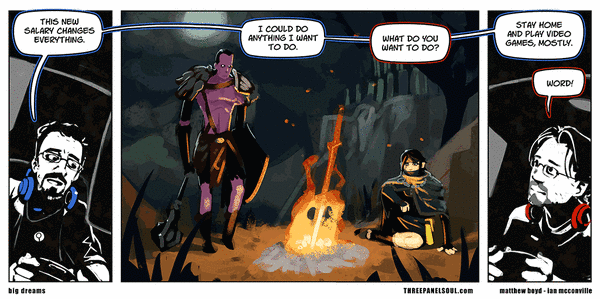
Big Dreams

by Ian
Tertiarymatt

The simple life.

Big Dreams

17 May 04:28

Review: James E. Pepper 1776 Bourbon (15 Year)

by Jason Pyle
Tertiarymatt

Was kinda disappointed by the 1776 Rye.

Thank you for your patience with me and my “time” excuses. I hope things are well with all of you and that you’ve been sipping some excellent whiskey. While I’ve not been posting about it, I sure have! Again, thanks for your patience as I work through many reviews.

Today let’s take a look at James E. Pepper 1776 Bourbon, a 15 year old whiskey bottled by James E. Pepper & Co, but distilled by the folks at MGP in Lawrenceburg Indiana. It’s interesting that the folks at James E. Pepper were able to secure such old stock, but age isn’t anything but a number. How does this juice taste…..

James E. Pepper 15James E. Pepper 1776 Straight Bourbon (15 Years), Barrel 46% abv (92 proof), $100/bottle
Color: Deep Amber/Copper
Nose: Quite light and restrained for a 15 year old – very elegant. Sweet caramel, golden apple, and vanilla cover much of any barrel notes. Hints of clove and soft mint (rye) perk up with more time.
Palate: Again, light and elegant. Brittle caramel and barrel spices prickle on the tongue. Vanilla and a baked apple fruitiness as well. Finishes a tad flat. With a splash of water the spice notes are more pronounced, the soft sweetness lessens.
Overall: This is a very good whiskey, if not a touch flat. Tasted blind I’d never guess this was 15 years old. It has aged gracefully, perhaps somewhere shielded from the extremes. Overall it’s balanced and composed from sniff to sip, but it carries a big price tag.
Sour Mash Manifesto Rating: 8.5 (Very Good)

16 May 22:45

Detail from page 332 of Family Man.


Detail from page 332 of Family Man.

16 May 07:26

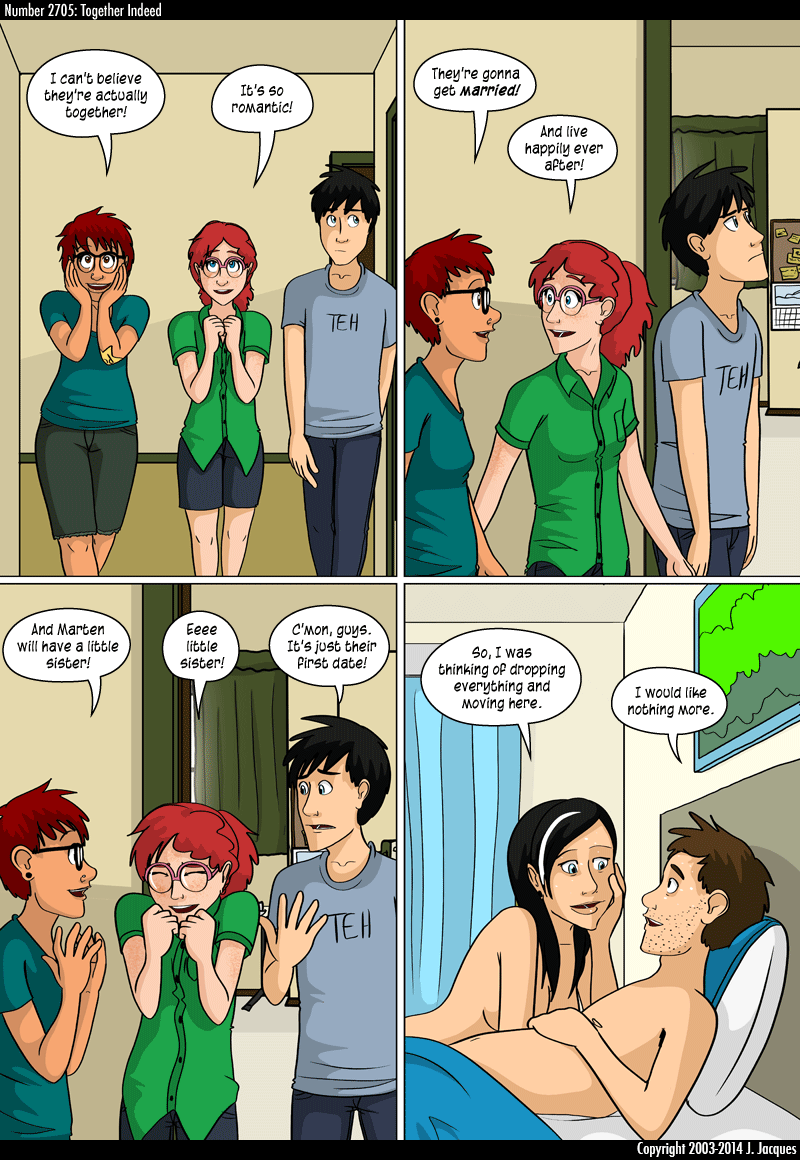
Together Indeed

Tertiarymatt

Marten's mom is maybe the sexiest lady in QC.


Ads by Project Wonderful! Your ad could be here, right now.

Reminder that there is still time to get a SIGNED AND SKETCHED COPY of QC Volume 4! At least, until they are all gone. See you Monday!

16 May 05:10

Spritz Integration

Tertiarymatt

So, uh, get spritzed?

A couple months ago we came across a new technology called Spritz. It’s a tool that helps you read faster. Given how far behind I typically am in my Old Reader queue, we thought it would be a good thing to try out in the application. We were so happy with the results that we’ve decided to roll out the beta Spritz integration to our users today.

To enable Spritz, you’ll need to go into your settings and click the Spritz checkbox. You’ll then see the Spritz icon in your feeds which you can click on (or use the ‘i’ hotkey). The first time through you’ll need to create a Spritz account, but after that it should be clear sailing and fast reading.

Here’s an article about the new functionality on TNW.

Let us know what you think!

15 May 23:58

3d Printing help?

Tertiarymatt

Yup. Partially knobless. Deknobed. I guess I could even do the sintered metal option from shapeways?

Hello there kids. I recently got me an old Graflex Speed Graphic (3.25” x 4.25”), and it is missing a wee knob. 

A replacement part is pretty unlikely to turn up, so I am thinking about using 3D printing or maybe just casting to make a new one (the knob on the other side is present, so I can just copy that). 

Printing one in ABS would be the most direct process, and once-upon-a-time I could do most of the modeling required (even at my best, I think getting the thread size and pitch right would have been beyond me), but I don’t know if that’s the case these days. I could probably model something with a hole that I then tapped threads into once it was printed, in some program or other. 

Advice? 

14 May 13:52

Pilot Metropolitan Fine Nib (Glorious!!)

by Brian Goulet
Tertiarymatt

This is a really crazy good deal.


The Pilot Metropolitan is one of the best starter fountain pens out there, hands down. It's a great value at $15 (with a converter!). The one downside for it previously was that it was only available in a medium nib, but that's not the case anymore. Pilot has now released the pen in a fine nib, and it is smooth, and very very fine.

In this video I compare the Pilot Metropolitan fine nib with the medium nib, as well as the Pilot Prera fine, and Lamy extra-fine and fine nibs.

12 May 20:59

poker face

by Ian
Tertiarymatt

Everyone has a different perspective on these things.

poker face

12 May 20:58

Product Branding

by Christopher Wright
Tertiarymatt

Only a matter of time.

05 May 06:34

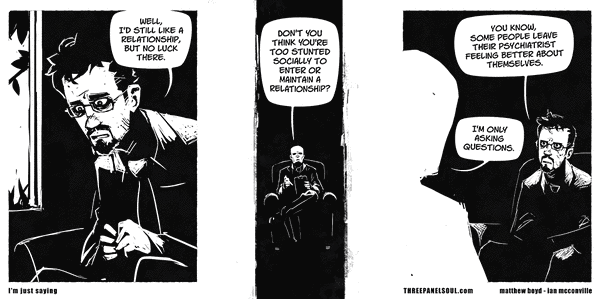
I’m just saying

by Ian
Tertiarymatt

zing!

I’m just saying

05 May 05:16

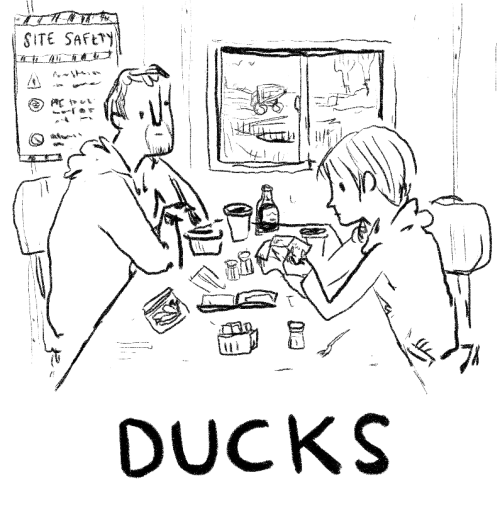
Here is a sketch comic I made called Ducks, in five parts. Part...

Tertiarymatt

Very good.


Here is a sketch comic I made called Ducks, in five parts.

Part One

Part Two

Part Three

Part Four

Part Five

Ducks is about part of my time working at a mining site in Fort McMurray, the events are from 2008.  It is a complicated place, it is not the same for all, and these are only my own experiences there.  It is a sketch because I want to test how I would tell these stories, and how I feel about sharing them.  A larger work gets talked about from time to time.  It is not a place I could describe in one or two stories.  Ducks is about a lot of things, and among these, it is about environmental destruction in an environment that includes humans.  Thank you for taking the time to read it.

-Kate