Shared posts

02 Jun 07:08

The three main fittings…

by Tom Mahon

Ideally your new tailor should be recommended to you . But if not, you’ve probably been persuaded by good PR in the magazines or perhaps discussions in an online forum. Alternatively, you may just be making a leap of faith. Which ever route you’ve taken, the process should go something like this:
First off, make sure you let your cutter know what the suit is to be used for. Sounds obvious, but when a huge array of cloths are presented for the first time, it’s tempting to go wild.

So you order that 20oz, double-breasted black chalk stripe. Like De Niro wore in the Goodfellas. Great, and why not, you’ve always wanted a suit like that….

Sadly, the suit was supposed to be for your Mother-in-Law’s second wedding…. Oh, and its on the beach in Tahiti. It does happen, so think about it.

After you’ve made a wise decision on cloth under guidance of a professional, the measurements and style details will be taken. A bespoke Savile Row suit for a customer based in the UK, usually takes around eight to twelve weeks to complete. If you want the suit for a special date, let the cutter know. But give him a date a week earlier. Unless you’re middle name is Methusalah don’t tell the cutter to take his time. Or else it’s STRAIGHT to the bottom of the cutting pile for you.

1. The First Fitting

This will be the second time you meet your tailor. Some customers may refer to the first meeting as a the ‘first fitting’ but that is not correct. More often than not, your garments for your first real fitting will be a ‘Skeleton Baste’ – a fitting is used by about 99% of the world’s tailors. This basically means that the basic parts of the suit are sewn together. Simply using a white cotton “basting thread”. Using only the minimal interior construction, canvas and shoulder pads/wadding etc.

Although first fittings are quite basic, they are popular, as they allow for more and larger inlays (seams) to be used.

This enables the cutter to check the basic fit of your pattern, and also allows more chances for later alteration, should he need to correct any major errors in the pattern. Also, you the customer get an idea of feel and fit of the suit. This is also the stage where style details can be seen and perhaps altered if your unsure on the style choices you made at the first meeting.

After the first fitting, alterations are made to your suit and pattern. And any necessary re-cutting.

2. Then we have the “forward” (The Second Fitting).

Your suit will now have all the major construction, including pockets and facings etc. The collar will not be fitted and the sleeves will be the at the same stage as the skeleton baste. Again, this will give you a truer picture of how your suit will look. Again, any alterations needed are made to the suit and pattern.

The suit is then usually completely finished after this stage, minus a few tweaks.

3. Sometimes we have an extra – Third Fitting.

This is called “finish bar finish” (fin bar fin). At this stage the suit will be completely finished apart from buttonholes and hand felling (sewing) etc.

This is used if time is limited or perhaps if the cutter is unable to see the customer for a final fitting. This may happen when the suit is to be shipped ahead to the customer. Very common for Savile Row tailors.


When final adjustments are made, you should both be delighted. You can now go off and enjoy the pleasures of bespoke. But remember, cloth is almost fluid. And none of us can tell how it’s going to react after its been worn a few times. Your cutter should always ask to see you again in a few months. Then he can make sure your new suit has settled properly. And most importantly, you are delighted with the result.

Of course these three fitting stages is the typical process. However, once an ongoing relationship has been established with your tailor, and your pattern perfected, some of these stages may not be required.

Remember tailoring is very personal. Try to give your cutter every chance to get to know exactly what you want, but also take advantage of their expert knowledge of cloth, construction and style to guide you in the right direction.

clothbook

24 May 21:40

The death of American myth

by Eric Garland
Recent developments in the U.S. economy have no meaning. Breathtaking inequality of wealth, brazen financial fraud, a Congress with approval ratings lower than gonorrhea, the disappearance of the Middle Class, the wholesale abandonment of the rural and the young – none of it means anything. It’s just what’s happening. Things like this are normal, really. The sentiment above is described ...
05 May 03:57

Young Blood May Hold Key to Reversing Aging

by By CARL ZIMMER
After scientists found that blood from young mice rejuvenated the muscles and brains of old mice, experts said the research could lead to treatments for illnesses like Alzheimer’s disease.


05 May 03:56

New Ideas in Lighting Get Closer to Market

by By DIANE CARDWELL
Tertiarymatt

Both of which mentioned aren't really new technologies at all.

Two start-ups will offer light bulb choices that meet updated energy standards, but they will face consumers who are reluctant to change.


04 May 20:33

Sleep - Dopesmoker (by Mark Turkali)


Sleep - Dopesmoker (by Mark Turkali)

04 May 08:33

Bill Moyers: Obama’s Latest Assault on Democracy – Undermining Net Neutrality

by Yves Smith

“Net neutrality” is one of those brilliant coinages, like chained CPI, with a technocratic sheen designed to deter ordinary citizens from taking interest in policy proposals of fundamental importance to them.

Bill Moyers interviews David Carr of the New York Times and Susan Crawford, a visiting professor at Harvard Law School, about the how the biggest service providers like Comcast and Verizon have been pushing hard to balkanize the Internet by creating more stratified service tiers based on speed of access. This change is anticipated to hurt both lower income consumers and specialized websites, like not-for-profits, cultural and scientific sites, and…independent blogs.

So who did Obama put in charge of the FCC? Tom Wheeler, a former cable lobbyist. And of course, Wheeler hand-waves and professes that he just can’t oppose those powerful operators, he lost in court. Susan Crawford debunks that idea:

BILL MOYERS: And Tom Wheeler says that, look, the FCC’s tried twice to rewrite the rules of Net neutrality. And the appeals court, federal appeals court, has turned thumbs down twice. He’s saying, I’m only doing what I can do to write rules that are consistent with what the court has said.

SUSAN CRAWFORD: What’s not right about that is that he can do something. The FCC has tried to simultaneously deregulate by not labeling these guys as utilities. And yet, adopt Net neutrality rules. All he has to do is relabel these services as utility services. And then he stands on firm legal footing. He can forebear from any details of those rules. He doesn’t want to apply. The courts have struck this down because it’s incoherent. That’s the problem. If he marches forward on a clear legal path, he’ll be fine. But he wants to avoid World War III on the cable institutions.

So the real issue isn’t that public interest couldn’t prevail but that the Administration isn’t about to declare war on communication providers. And this almost-certain death net neutrality isn’t bad just in terms of diversity of content and democratic processes, it’s also bad for the health of the Web as system. The intent is to produce a more balkanized Internet, with the various local monopolist creating nodes that they increasingly control. Craig Heimark’s remarks in a recent post on high frequency trading apply here:

The old exchange system was a hub and spoke model, which was a stable system architecture. The internet was an outgrowth of a DARPA project to make a communication system so decentralized that it could not be taken out by a nuclear strike. Hub and spoke models are stable, but subject to an outage, say by a nuclear bomb or electrical failure. What chaos theorists have found is that highly decentralized networks are stable, as are single node networks (like exchanges), but that slightly decentralized networks are fragile…So regulators have left investors with the worse possible market structure.

And they are about to do that to the Internet.

Please call or write your Congresscritters, particularly if they are up for reelection this November, and tell them that this is a make-or-break issue as far as your support of Democratic party candidates is concerned.

You can read the transcript here. Please circulate this video widely.

04 May 08:31

The Rare Earth Hypothesis:

by Leanne Wendy Sharp
ET

From E.T. Extraterrestrial (Source)

A Question For Everyone: Is the truth out there?

The discovery of extra-terrestrial life would be something that would change all our lives forever. Actually seeing life from a different planet would be something that would, no doubt, terrify, shock, excite, and intrigue us like nothing else could. But then again, what are the chances of finding it?

There are various factors any hypothetical life-form would need to overcome in order for life to start. Developing is a whole other issue all together (as the universe is an ever-evolving place).

The “Rare Earth” hypothesis puts forth the notion that life like our own may be a very rare (if not singular), occurrence throughout all of time and space.

Why Life *Might* Be Rare:

The planet or moon (perhaps a number of moons orbiting other planets hold the potential for life) would need to be at the ideal distance from its parent star, this is called the habitable zone. Also, the star itself must meet a stringent list of requirements. It would need to be the right size and luminosity to help support the life as it evolves. It would also need to have the right sort of atmosphere and temperature, so that water wouldn’t boil or freeze over. (On this note, a stabilized orbit is also a necessity. If the planet veers too far off course, the temperatures would be all over the place, which again, isn’t conductive to life)

The Galactic Habitable Zone (Source)

The Galactic Habitable Zone (Source)

The habitable planet would benefit from having a gas-giant like Jupiter nearby to knock any potential harmful meteors off-course. It would need to have the right size, mass, axial tilt and rotational speed to have ideal exposure for photosynthesis and the right gravitational pull.

It would need to be in the galactic habitable zone, so it would need to be far enough from the heavily populated galactic center – or an other highly-populated area, for that matter – to avoid any collisions, or to prevent the planet from being bombarded with gamma radiation streaming from exploding stars, or from the outbursts of a central black hole.

Taking all this into consideration, when I was first reading about the “Rare Earth” hypothesis my hope started to fade a little as it dawned on me that the checklist is quite demanding for a planet to be given even the most remote consideration of it potentially harboring life like ours.

Having said that, these are only ideal conditions for us as we are now. This seems to put aside a massive part of evolution:

Adaptability:

Over millions of years, species have evolved to adapt to their environment. We have fish and other exotic forms of life that can survive under immense pressures within the deepest depths on the ocean floor. We have algae that can survive in boiling temperatures. Then, we have the lovely tardigrades (also known as water bears), which can survive IN THE VACUUM OF SPACE.

So life could thrive in environments much different than that of our own blue marble. On top of this, there are more and more Earth-like exoplanets being discovered each day, just within our galaxy alone. This doesn’t necessarily mean that Earth-like life has a fighting chance on any of them, but it also doesn’t mean that there never will be!

The Principle of Mediocrity suggests that there is nothing special about us whatsoever, there’s nothing uncommon about our particular position… to think that there isn’t life in the depths of the cosmos would be crazy.

On a final note:

All of the potentially habitable planets were found within this small scope of space (Credit: Jon Lomberg)

All of the potentially habitable planets were found within this small scope of space (Credit: Jon Lomberg)


This article is merely meant to spike a sense of wonder, not to encourage you to wear tin foil hats and have Mulder and Scully on speed-dial!

“The human race is just a chemical scum on a moderate-sized planet, orbiting around a very average star in the outer suburb of one among a hundred billion galaxies.”

~ Stephen Hawking

03 May 01:01

Family Man Page 331

by Dylan

Family Man Page 331

01 May 23:23

Detail from page 331 of Family Man! Rock and a hard place, these...


Detail from page 331 of Family Man!

Rock and a hard place, these two.

30 Apr 17:59

Part 2 of a series in which I redraw characters from MASK, the...


Part 2 of a series in which I redraw characters from MASK, the superheroine league I created in middle school. Part One here.

CODE NAME: T’LALET

REAL NAME: EAGLE MQUOIT

POWERS: ENERGY ABSORPTION-DISTRIBUTION (FLIGHT)

BIO:

T’lalet came to MASK as a young girl and was one of the core members, sort of like the original X-Men team. Her vaguely defined energy-displacement powers meant that she was bad-ass at levitating herself into flight, and she could throw shiny, concussive energy bursts. She also developed a reputation for being a team leader willing to make tough sacrifices. 

At one point she gave up twenty years of her own biological energy – that is, aging herself by twenty years – in order to bring an important but not-yet-born character from the future back into the present in order to save the world (etc). Out of active duty, she became the team’s counselor and mission coordinator. (She later got her time back.)

MY RECOLLECTIONS:

I grew up in Seattle and spent a lot of time on the coast – areas rich in tribal history, and I really wanted to have a cool and powerful character from that background. 

Online language resources for the Salishan language group (which I grew up hearing the most words from) are still hard to come by, so I don’t have any idea now whether I derived this character’s names from a school worksheet, a tribal tourism education handout, my time wandering aimlessly around the coast in jelly sandals and a skort, or (probably most likely) if I was just trying to bend together some familiar regional sounds. Tiny Dylan’s well-intentioned but idiosyncratic research methods are lost to the ages. 

If I were coming up with this character now (with the power of a car, the internet, and 18 additional years of experience), I’d have her be a member of the Quinault Indian Nation, which includes several different tribes and lines of ancestry. She’d be one of the girls who gets crowned the Quinault Princess for the year and represents the nation’s tribes in all the parades and festivals. (Maybe her powers emerged during the Chief Taholah Days festivities! Everybody was distracted by the salmon bake and thought it was just fireworks.) 

You can learn more about the QIN here. If you’re ever in the Pacific Northwest coastal area, be sure to visit!

At any rate: T’lalet’s background was never a particularly big deal. No dumb faux-mystical storylines or Very Special Episodes. She was just a team-member, and a particularly important, powerful, committed and cool one.

DESIGN NOTES: check the sweet attempt at a chrome effect on the outfit. Just about everybody had chromed costumes in the 90’s, and clearly I was making my best attempt to replicate the effect using colored pencils and a ballpoint pen that I probably snaffled from the pen-jar next to the family telephone. I’m not sure why I chose purple and brown, but I actually think it works okay. 

I’m favorably impressed by the pose I managed to draw for this character at the time. That left hand extended behind her is pretty tricky, but I went for it. 

In the updated version: I didn’t mess around with this one too much. I just stepped back from the chrome cliff. But, like I said - if I were creating a character from scratch, I might revamp her uniform to be red, white, and black, which are traditional motif colors for many of the QIN tribes.

UP NEXT: FIREFOX! (…no, not the browser. Shush.)

30 Apr 17:56

For all my people everywhere. (via Sinfest: The Webcomic To...


For all my people everywhere.

(via Sinfest: The Webcomic To End all Webcomics)

28 Apr 22:18

folding paper

by Ian

folding paper

28 Apr 00:14

Lorn - ‘Weigh Me Down’ (Official Video) (by Ninja...


Lorn - ‘Weigh Me Down’ (Official Video) (by Ninja Tune)

27 Apr 21:49

Lorn - ‘Diamond’ (by Ninja Tune)

Tertiarymatt

Current status:


Lorn - ‘Diamond’ (by Ninja Tune)

26 Apr 17:25

Lorn - Until There Is No End (Official Video) (by Bartosz Wojda)


Lorn - Until There Is No End (Official Video) (by Bartosz Wojda)

26 Apr 17:10

Matt Stoller: No, America Is Not an Oligarchy

by Yves Smith
Tertiarymatt

"The lesson here is to organize. Citizens can matter, but only if they make themselves matter. Change won’t be distributed like consumer products, wherein high polling numbers just seamlessly translate into policy change."

By Matt Stoller, who writes for Salon and has contributed to Politico, Alternet, Salon, The Nation and Reuters. You can reach him at stoller (at) gmail.com or follow him on Twitter at @matthewstoller. Originally published at Observations on Credit and Surveillance

200

The rich have been doing it to the poor since the beginning of time. The only difference between the Pyramids and the Empire State Building is the Egyptians didn’t allow unions. – Martin Sheen in the movie Wall Street

A lot of people are misreading this Princeton study on the political influence of the wealthy and business groups versus ordinary citizens. The study does not say that the US is an oligarchy, wherein the wealthy control politics with an iron fist. If it were, then things like Social Security, Medicare, food stamps, veterans programs, housing finance programs, etc wouldn’t exist.

What the study actually says is that American voters are disorganized and their individualized preferences don’t matter unless voters group themselves into mass membership organizations. Then, if people belong to mass membership organizations, their preferences do matter, but less so than business groups and the wealthy.

Furthermore, the study says that the only mass groups that truly represent citizen preferences are labor unions and advocacy groups like the AARP. Another implication from the study is that citizens can get what they want if they want the same things that business groups or the wealthy want, or if they want to preserve the status quo. Change is hard for everyone, even the rich. Citizens helped stop cuts to Social Security that the elites wanted, and may derail trade agreements.

The lesson here is to organize. Citizens can matter, but only if they make themselves matter. Change won’t be distributed like consumer products, wherein high polling numbers just seamlessly translate into policy change.

There are a number of other implications. One is that the decline of labor unions doesn’t just reduce economic bargaining power, it reduces the political representation of ordinary citizens. If mass membership organizations are the only way for ordinary Americans to represent themselves, and labor unions are the only mass membership organizations that express the preferences of ordinary Americans, then labor unions are popular democracy. This makes sense. The groups pushing for broadly popular policies – equal pay, foreclosure relief, preserving Social Security and Medicare, etc – are unions. Unions want more stuff for normal people.

Anyway, that’s what the study says. America is not an oligarchy. But it is becoming one as unions die.

I’m not sure I agree with the methodology of the study. There are a lot of acknowledged gaps, like the influence of ordinary people on the elites, and vice versa, and unacknowledged ones, like the importance of the security state or ideological competitiveness. The study doesn’t distinguish between policies that are important, like TARP or the bailouts, and those that are not, like the cap on credit union lending. It doesn’t distinguish between policies in the news, and those not in the news. It doesn’t deal with media consolidation, or examine the link between economic elites and ordinary citizens. I mean the New Deal financial system worked really well because it established such a political alignment, while deregulation snapped this political unity. And it doesn’t address change over time – clearly there was more influence from ordinary citizens in the 1930s and 1940s. Why? The American political system isn’t static. Different leaders have different styles and believe different things.

Really, though, the biggest issue with the study is that it is both obvious and derivative work – political scientist Tom Ferguson has been writing about this problem since the early 1980s. And anyone with eyes, ears, or any observational skill knows that the rich matter. Money is power, as Adam Smith noticed a few hundred years ago. This study is part of the whole Piketty movement, wherein what Chris Hedges calls the liberal class begins to notice that the distribution of resources matters to them. One could argue it’s good that people notice the obvious, but I’m not so sure. If it takes Princeton political scientists six years after the biggest financial crisis in history to notice that money is a thing, that’s not really progress. Real progress would be a wholesale rejection of political science and economics as blind and corrupt. But then, I suspect that would require people to organize.

26 Apr 17:01

Did Canada’s Middle Class Just Get More Affluent Than the US’s, or Did that Happen Long Ago?

by Yves Smith
Tertiarymatt

Well. This is depressing if not exactly news.

By Joe Firestone, Ph.D., Managing Director, CEO of the Knowledge Management Consortium International (KMCI), and Director of KMCI’s CKIM Certificate program. He taught political science as the graduate and undergraduate level and blogs regularly at Corrente, Firedoglake and Daily Kos as letsgetitdone. Cross posted from New Economic Perspectives

The New York Times and Dave Leonhardt’s Upshot section made a big splash a few days ago by reporting on a study showing that the Canadian middle class had caught the US middle class in median income and likely surpassed it since. The study is based on an effort to measure median income per capita after taxes, and its results are presented as something truly significant.

However, I think the study is biased in that in median income per capita after taxes, it selected the wrong measure. What is needed is a measure of income or affluence that takes account of the value of cross-national variations in Government benefits delivered to the middle classes. Since the United States has lower taxes than most comparable nations, but delivers much less in safety net and entitlement benefits, it’s pretty clear that the measure used in the study reported on by The Times overestimates the real median income of the US middle class in comparison with the middle classes of other comparable nations and provides a misleading impression of the relative affluence of the American middle class.


In fact, it is likely that if real median income or median wealth per capita were measured in a more valid way that the study would have found that the US has lost its lead over other nations in Net Median Income Per Capita (median income per capita after taxes minus the cost per capita of benefits the State does NOT provide relative to the nation with the most generous safety net benefits), or per adult long before 2010. This is suggested by an earlier post of mine which I’ll now reproduce in full and then briefly discuss to conclude this one.

We’re No. 24! We’re No. 24! (As of July 2012)

We keep hearing bad news about where the US stands on various social and economic indicators. The US’s ranking in math capability is 27th in the world. Our health care system is ranked 37th. Our 2011 life expectancy is 51st in the world. Our estimated 2012 infant mortality rate is 49th in the world. So we’re pretty far down in a number of international statistical comparisons of performance. Some here point to better performance on economic indicators. For example, GDP per capita is often cited as an area where the US performs much better. But even here the latest CIA world handbook estimate shows the US ranked 19th on this measure at $48,400.

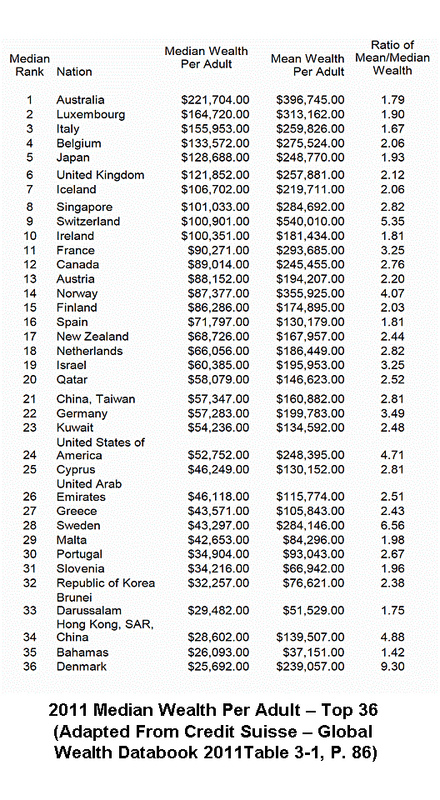
It gets even worse if you take a look at the recent Credit Suisse Global Wealth Databook 2011. Dylan Matthews, writing on Ezra Klein’s Wonkblog, did that on July 18th in a blog entitled “Are Canadians Richer Than Americans?” Matthews says yes, based on the Credit Suisse data on 2011 Median Wealth per Adult, and he goes on to also point out that:

”So not only does Canada beat the United States on median net worth. Just about every developed country save Sweden and Denmark does. The UK, Japan, Italy (!) and Australia more than double the U.S. Median.”

This important conclusion of Matthews gets a bit lost in the post’s central focus on a US/Canada comparison and his attempt to answer his lede question. A few days later, wigwam posted at MyFDL blogging on the Matthews piece, and presenting a table wigwam developed from the graphic used in the Matthews piece.

Wigwam’s numbers are approximate because he developed his table, from Matthews’s graphic, but his emphasis on the context of where the US stands relative to other nations is much greater than in Matthews’s post, and he also ties it into other issues such as foreign aid to Israel, the 99% vs. the 1%, and rising poverty in the United States. Wigwam’s money lines are:

“This is a chart that I’m going to show when Mitt Romney fans talk about “what makes American exceptional.” It vividly documents how badly America’s 99% are being screwed by its 1%. We’re a wealthy nation only when you count the trillions controlled by the 1% but not so wealthy when you look at the net worth of the median household.”

So, that’s what got me looking at the Credit Suisse Report. When I did, I found that Matthews had truncated the Credit Suisse data, and that in doing so he had missed some important aspects of US economic performance compared to other nations when viewed from the perspective of a “middle” US economic position. Wigwam, as well, in basing his post on Matthews’s, also reflects the same problems.

Specifically, Matthews and wigwam both included only 19 nations in their analyses, and ranked the US 17th out of 19th. In addition, in approximating the numbers in his table he departed a good bit from the actual median wealth per adult numbers in a number of cases. Here’s a chart that includes the first 36 ranks in the Credit Suisse data.

I’ve included more than Rank, Nation, and 2011 Median Wealth per Adult in the chart. There’s also, Credit Suisse’s data on 2011 Mean Wealth per Adult and values I’ve computed giving the ratio of the mean to the median. I’ve included the last measure because I think the ratio is revealing as a measure of inequality in each of the nations. The Credit Suisse Databook does give the GINI index which is a better measure of inequality than the ratio I’ve used here, from a strict social science point of view; but I don’t think it’s as intuitive as the ratio of the mean to the median.

7673327922_7bb0d837ba_c

Looking at the results, you can see that the United States isn’t 17th on Median Wealth per Adult, it’s 24th. Now Luxembourg, Belgium, Iceland, Singapore, Austria, Qatar, and Kuwait, are all also ahead of the US in median Wealth. The “median person” is more than three times as wealthy in Luxembourg, more than two-and-a-half times as wealthy in Belgium, and more than twice as wealthy in Iceland and Singapore than in the US. Among nations that were included in the original WaPo and MyFDL comparisons, the “median Australian” is nearly 4.5 times as wealthy as the “median American; the “median Italian” is three times as wealthy. Japan and the UK have medians in the neighborhood of 2.5 times the US median, while Switzerland and Ireland have medians in the range of double the US number.

In short, the comparison with 36 nations included, shows that the US stands even worse, relatively speaking, than in the 19 nation comparison. The numbers show that many nations with recent and current severe banking/financial problems still have median wealth numbers that greatly exceed ours.

These include: Italy, Belgium, Iceland, Ireland, and Spain. The first four show more than double the median wealth of US adults and the last has a 40% greater median wealth figure. The US Fed is being called upon to use US nominal financial resources “created out of thin air” to bail out the financial systems of these nations, and will probably continue to provide such backing to “save the financial system.” The irony of our doing that when we refuse to use vigorous fiscal policy to help our own middle and working class people to remain employed, get new jobs, and work for a living wage, is another of those outrages to our democracy we experience every day.

The mean-to-median ratio numbers are also interesting to say the least. Nations with a ratio under 2.00 include Australia, Luxembourg, Italy, Japan, Ireland, Spain, Malta, Slovenia, Brunei, and the Bahamas. A majority of nations have ratios between 2.00 and 3.00. Nations over 3.00 include: Switzerland (5.35), France (3.25), Norway (4.07), Israel (3.25), Germany (3.49), the US (4.71), Sweden (6.56), China (4.88), and Denmark (9.30). So, the US is among the most unequal nations in the world on this measure. Among the nations that exceed it in inequality, the numbers for Sweden and Denmark may be statistical artifacts. The World Bank Gini number for Denmark is 24.9 and for Sweden is right behind at 25 with Norway coming in at 26, while the Gini is 41 for both the US and China, and 34 for Switzerland. This suggests that there may be something about the way welfare state transfer payments are accounted for that doesn’t get into the Credit Suisse Median Wealth per Adult statistics. Wigwam suggests:

“One of the anomalies in this data is that personal retirement plans (e.g., IRAs) usually count toward “net worth,” while general retirement plans (e.g., a public employee’s defined-benefit plan and/or Social Security) don’t. I’m told that Sweden and Denmark have excellent plans that take care of the elderly. Not only don’t those plans count toward their citizens’ “net worth,” but the excellent quality of those plans encourage their citizens not to save. If you had super-excellent government coverage to care for you in your elder years, would you set aside as much as the typical American? My point is that the median American is really at the bottom of this graph.”

Finally, I think the Credit Suisse Report gives the best picture yet of the failure of the US political/economic system to progress as rapidly as the systems in other modern nations. The jingoistic beating of our chests, insisting that the US is “the richest nation in the world”, with an unequaled political/economic system, just doesn’t square with reality. It may make a great many Americans feel good. But it’s not true and it doesn’t help us to face and adapt to our circumstances. In the end “all life is problem solving;” and you can’t keep on living well if you won’t recognize and then solve your problems.

Our system hasn’t produced the advantages for most Americans that other systems have produced for the citizens of their nations. How long will we continue to deny this in the face of mountains of cross-national data, and instead insist that our way is best? It may be best for 1% of us, but for the overwhelming majority, it is close to the worst among advanced modern industrial nations. Other nations produce better health for their citizens, healthier children and seniors, better education for their citizens, better work lives, less stress, more happiness, low cost universities. You name it; they’ve got it!

What we’ve got, instead, is an ideology about the free market that works for very few of us and makes the rest us less free, less wealthy, less secure, and less happy, as time goes on. Our economic system isn’t delivering for us. Our political system isn’t delivering for us either, it’s corrupt through and through, and our leaders won’t prosecute the rampant control fraud in the financial sector. And, finally, all we get from our representatives is excuses and rationalizations about why we can’t adapt to the changes, we, ourselves, had a great part in bringing to the world.

So, what can we do about it? I’m afraid this post isn’t about that. But, I think what we have to do is to create a new web-based Information Technology platform we can use to create a meta-layer of political activity that will take control of the major parties and either make our representatives accountable to the 99%, or replace them with new people who will be responsive to them. I’ve written about this a number of times previously. See here, here, and here, for example; and yes, it can’t be done in time for the 2012 election. Sorry about that, but what we have to do can’t be done in three months, and we should have started doing it three years ago if we wanted to be ready now.

That ends the previous post. Here’s the conclusion.

The Significance of Variations in Median Wealth Per Adult for Net Median Income Per Capita

Median Wealth Per Adult isn’t a direct measure of Net Median Income Per Capita. In fact, if we had a better measure of Net Median Income Per Capita, than Median Income Per Capita after taxes, we’d probably want to use it to test to see whether stagnant Net Median Incomes Per Capita after taxes lead to rapid declines in Median Wealth Per Capita. That is, to see whether trends in the flow of income impact stocks of wealth.

Lacking such a measure, however, and assuming that where the US stands on the stock of Median Affluence is more important in the first instance than where it stands on the flow of Median Income, it’s hard to avoid the conclusion that Median Wealth Per Adult is a better indicator of relative affluence of the middle class than Median Income Per Capita after taxes. Since that’s the case, it’s hard to justify all the attention this study is getting from the MSM and a good part of the blogosphere.

It’s now old news that the United States has been surpassed by other nations in Median Wealth Per Adult, and as my post shows, its Median Wealth Per Capita was less than 25% of Australia’s while the distribution of wealth in the US is far more unequal than the distribution in that and many other (including other English-speaking) nations as measured by the ratio of the Mean Wealth Per Adult to Median Wealth Per Adults.

So, one question which immediately comes to mind is if that’s old news, then would we not expect that such a result could only have happened if the United States had long since lost its lead in what I’ve been calling Net Median Income after Taxes, since that kind of result in Median Wealth Per Capita could have come about only primarily through an accumulation of Higher Net Median Incomes Per Capita over a period of years? If so, then the real news from the Times Report is that Median Income Per Capita is just a poor measure of affluence and has propped up the notion that the US middle class is especially affluent long past the time when this ceased to be the case.

In other words, the Times Report says more about the shortcomings of The Times when it comes to economic analysis, than it says about the real changing position of the US Middle Class when it comes to affluence. Oh, and to underline the point, the above table suggests that Canada hasn’t just passed the US relative affluence of its middle class, but that this happened some time ago, since in 2011 Canada’s Median Wealth Per Adult exceeded the US’s by nearly $36,000 per adult, or by roughly 69%, a change in relative affluence that had to be developing over a relatively long period of time, long before The Times decided to proclaim this as “news.”

26 Apr 05:20

Art of the day: I don’t know either, lady. I don’t...


Art of the day: I don’t know either, lady. I don’t know either.

26 Apr 05:20

Here’s an art project I’ve been wanting to do for...

Tertiarymatt

Apparently people on tumblr was have claiming that Dylan "whitewashed" her own character, after she posted this.


Here’s an art project I’ve been wanting to do for ages.

From fifth grade (when I was friends with a girl who had a prodigious Marvel comics habit, and the X-Men cartoon was on TV) through middle school, I created a league of superheroines and supervillainesses.

(No dudes; they were boring, and there were enough of them already.)

The league was called MASK, after the mysterious founding superheroine, who we see here.

The first character drawings I created (with outlines traced from How to Draw the Marvel Way!) vanished at some point, but I still have the later, more original drawings, dating from 1995 - 1997.

I actively roleplayed these characters with various friends over the years. There were no comics, per se, but the games were dreadfully fun. 

In sixth grade I went on to a new school and lost touch with my X-Men expert friend, whom I’ll call “Erin.” A fellow member of our little superhero friend-group wound up in my class, and one day she brought Erin along for a visit. Erin had always been a little snarky and edgy (as much as is possible in fifth grade…), and by seventh grade she had apparently completed her metamorphosis into full-blown Sullen 90’s Teen. 

I approached her, nervously engaged with her withering glare, and told her that I still drew superheroes. 

"That’s really sad," she snarled.

I promptly shriveled up and blew away. 

Erin’s remark hurt me terribly, although it didn’t deal a mortal blow. How could it? I was the kid who drew cartoon strawberries on her jeans with fabric markers while the other girls were discovering purple lipstick. My own superpower was a total inability to edit my behavior in order to mimic my peers.  

By ninth grade I had moved on from superheroes. But I didn’t stop drawing, or reading comics, or playing pretend, or caring. And, in retrospect, I can look past the personal wound of that moment, scan for clues, and feel some worry for Erin; no happy kid adopts a defensive crouch that deep.

Recently there’s been a wonderful trend of superhero comics starring strong, cool, smart, appealing-but-not-fetishized female characters, who probably would’ve thrilled my middle-school self to the core. Kelly Sue DeConnick and G. Willow Wilson in particular are creating heroes that I’m certain are inspiring a new generation of girls. 

I’m not normally a superhero artist, but I felt this was as good a time as any to pull out this old work and try redrawing it. A time-travel tribute to the spunky, passionate, weird little kid who hung in there and kept going with this stuff, and who has plenty of supportive company these days. 

I’ve got a couple dozen of these profile drawings, and I’ll see how many I can get through in my spare time.

To kick off, I’ll give a brief account of the superlady you see before you.

CODE NAME: MASK

REAL NAME: ???

POWERS: CLASSIFIED

MY RECOLLECTION: Mask is the founding member of the superheroine league, also called MASK, but with capital letters for some reason. Although she recruited every member (most of them as teenagers, a la Xavier’s School for the Gifted), nobody in the league knows Mask’s real name or background. She seems to be a telepath, and maybe telekinetic, but the full extent of her powers remains a mystery.

Secretly, she was an embodiment of Lachesis, one of the three Fates from ancient Greek mythology (the OTHER thing I was obsessed with at the time). I can’t recall how this actually impacted the storyline other than her ability to foresee major events and a kind of Doctor Who ability to regenerate in a new body, but it was a big reveal. 

DESIGN NOTES: I think this is the earliest of all the drawings I still have. The pose is very stiff, although the character was also very emotionally understated, so I think I was partially trying to convey her reserve. It looks like I colored it entirely with felt markers; later drawings have a lot more colored pencil in them.

Mask’s “mask” is a relic from fifth grade drawings. As I recall, originally the mask extended way off her face, a bit like Jean Grey’s. The graphic yellow streak was the emblem of the league. 

The fact that Mask is wearing a choker just proves that it was the 90’s and, although I still wore tapered jeans from Lands End, I wasn’t completely impervious to girl fashion trends of the moment. Man, I wanted a choker. 

I think you can see the influence of Star Trek in her bodysuit. I grew up in a Trekkie household during Next Gen years, so geometric shoulder patterns were a known aesthetic. 

In other news, look at Little Dylan, not afraid of drawing hands! Or kneecaps.

In the updated version: I got rid of the choker because it is now 2014. The only other substantive change I made was to add some of that bright yellow to her boots so the mask and the suit aren’t completely unrelated, and add a LITTLE energy into her pose. In terms of body-type, I decided my younger self was going for a look that was fit but not super-sexy or extra muscular, so I decided she’s a bit like a gymnast.

I also made her sleeves a little over-long; I imagine her tugging them down over her knuckles when she wants to looks extra mysterious. The choker of 2014, perhaps.

NEXT UP: T’LALET.

22 Apr 17:34

casual acquaintances

by Ian
Tertiarymatt

Guy gets a bad rap.

casual acquaintances

22 Apr 16:33

Active malware campaign steals Apple passwords from jailbroken iPhones

by Dan Goodin

Security researchers have uncovered an active malware campaign in the wild that steals the Apple ID credentials from jailbroken iPhones and iPads.

News of the malware dubbed "unflod," based on the name of a library that's installed on infected devices, first surfaced late last week on a pair of reddit threads here and here. In the posts, readers reported their jailbroken iOS devices recently started experiencing repeated crashes, often after installing jailbroken-specific customizations known as tweaks that were not a part of the official Cydia market, which acts as an alternative to Apple's App Store.

Since then, security researcher Stefan Esser has performed what's called a static analysis on the binary code that the reddit users isolated on compromised devices. In a blog post reporting the results, he said unflod hooks into the SSLWrite function of an infected device's security framework. It then scans it for strings accompanying the Apple ID and password that's transmitted to Apple servers. When the credentials are found, they're transmitted to attacker-controlled servers.

Read 6 remaining paragraphs | Comments

21 Apr 20:48

The Real Problem with High Frequency Trading

by Yves Smith
Tertiarymatt

Much of this seems obvious to me.

From Craig Heimark, a recovering derivatives trader, and Yves Smith

The media firestorm over high frequency trading has flagged some legitimate concerns but misses the real issues. While Michael Lewis’ book Flash Boys is sensationalistic and simplistic, it may goad regulators into action, particular since many knowledgeable observers have been making similar arguments for years.

At its foundation, high frequency trading is time-based arbitrage (which is different that statistical arbitrage which involves the real assumption of risk) and that is simply front running. It has become popular to demonize the high frequency trading crowd, but they aren’t the proper targets. The fact that high frequency trading exists at all is the result of poor regulation.

Now some would argue that regulators shouldn’t interfere with high frequency trading – as they also argue that all insider trading rules should be eliminated, since that help ensure that market prices reflect the latest news. While there may be an economic argument for the elimination of insider trading rules, it comes at the expense of a level playing field. Michael Lewis’ claim that “The markets are rigged” has gotten press play precisely because trust in the integrity of the public markets is critical for them to function properly. That implies that equal access to order execution is more important than the academic arguments of greater efficiency.

Perversely, much of the regulation of the last twenty years has been nominally in the interest of “market efficiency” but has come at the expense of market integrity. Far too many of the arguments and studies saying the promotion of competition among exchanges (and dark pools) has led to greater efficiency look at the efficiency as measured by the bid ask spread (plus fees) only of trading in the top stocks (because if they are trade weighted so that is where all the volume is). But this greater efficiency comes at the expense of no reciprocal liquidity obligation (witness the flash crash) as well as reduced liquidity in less frequently traded stocks.

The societal benefit of trading is to reduce cost to raise capital for actual companies. Does anyone really think that narrowing the spread on Google by a penny or two makes any difference to its weighted average cost of capital? In contrast, incidents like the flash crash and the feeling the market is rigged keep many small investors away from the market. The penalty for reduced liquidity in small stocks may actually be material to small company capital formation.

And these small investors are right to be concerned. The old exchange system was a hub and spoke model, which was a stable system architecture. The internet was an outgrowth of a DARPA project to make a communication system so decentralized that it could not be taken out by a nuclear strike. Hub and spoke models are stable, but subject to an outage, say by a nuclear bomb or electrical failure. What chaos theorists have found is that highly decentralized networks are stable, as are single node networks (like exchanges), but that slightly decentralized networks are fragile. And that is what we have now thanks to the SEC’s misguided efforts to “modernize” the stock market via Regulation NMS.

So regulators have left investors with the worse possible market structure. We no longer have liquidity obligations to make orderly markets as we had with the old model. Our current system is more complex due to some decentralization, but it is not so decentralized that it is robust (in technology-speak, a synchronized mesh network). The complexity of keeping the slightly decentralized model synchronized is what makes the system unpredictable and more fragile. This is not just an academic network construct. It is why we saw some exchange crashes recently (like Nasdaq) that were due to code changes in the linkages and feeds between exchanges.

Similarly, the value high speed traders provide is reestablishing the integrity of a single price in a centralized market after Reg NMS fragmented the market. But in reality, the buy side and all brokers are already sophisticated enough to use electronic routing to reestablish that centralized market, but not at sub-second speed. So the only service HFT time-based arbitrage provides is a sub second service. We’ve yet to see anyone make a credible case for the social utility whatsoever of sub-one-second execution. So since sub-second order execution fails to provide any social utility, it follow that any profits they extract are a dead weight loss on stock transactors. Those strategies, with the complex order types and the payment for order flow, should be eliminated.

While exchanges are a natural monopoly like any network, there are, better ways to prevent monopoly abuse than the route US regulators have taken. The SEC should impose minimum resting time for order (which is the equivalent of the IEX 38-mile fiber optic spool that slows down incoming orders). This would not put the high frequency traders out of business; they’d still have statistical arbitrage and other high-value services, but it would eliminate the riskless time-based arbitrage of front running at sub-second intervals.

20 Apr 19:20

Outreach

Tertiarymatt

I think if I was going to cosplay, it would be as a Sithrak cultist.

http://oglaf.com/outreach/

20 Apr 03:01

Joe Firestone: Using Generational Warfare to Divert Attention from Oligarchy and Corporatism

by Yves Smith

Yves here. Even though the pitched battle to cut, erm, reform Social Security and Medicare has died down, don’t kid yourself into thinking it’s over. Neoliberals keep stoking generational warfare to drive a wedge between the young and old so as to keep them from noticing who is behind the campaign to have old people die faster.

By Joe Firestone, Ph.D., Managing Director, CEO of the Knowledge Management Consortium International (KMCI), and Director of KMCI’s CKIM Certificate program. He taught political science as the graduate and undergraduate level and blogs regularly at Corrente, Firedoglake and Daily Kos as letsgetitdone. Cross posted from New Economic Perspectives

Some of the favored children of the economic elite who have a public presence, work hard in their writing and speaking to divert attention from inequality and oligarchy issues by raising the issue of competition between seniors and millennials for “scarce” Federal funds. That’s understandable. If millennials develop full consciousness of who, exactly, has been flushing their prospects for a decent life down the toilet, their anger and activism might bring down the system of wealth and economic and social privilege that benefits both their families and the favored themselves in the new America of oligarchy and plutocracy.

Here and here, I evaluated Abby Huntsman’s arguments for entitlement “reform,” and, of course, Pete Peterson’s son, Michael fights a continuing generational war against seniors in pushing the austerian line of the Peterson Foundation. Now comes Catherine Rampell, who, in a recent column, sets forth the position that seniors haven’t paid for their Social Security and Medicare because they “generally receive” more in benefits out of these programs than they pay into them. I’ll reply to all of the main points in Rampell’s argument, by quoting liberally and then replying to the points she makes in each quote. She says:

”Yes, seniors paid into Social Security and Medicare during the years they worked, if they worked. But they generally receive much more out of the entitlement system than they paid into it.”

She continues by citing an Urban Institute study and pointing out that earlier age cohorts received much more in benefits from Social Security than they paid in, and also says:

”But let’s consider the average worker who turned 65 in 2010. Generally speaking, the people in this cohort will, more or less, break even on Social Security, according to Eugene Steuerle, an Urban Institute fellow who co-authors the annual report. (Earlier generations made out like bandits; for example, members of an average one-earner couple who turned 65 in 1990 receive twice as much in Social Security benefits as they paid in taxes.)

Medicare, on the other hand, is pretty much a steal no matter when you turned 65.”

After citing some details documenting “what a steal” Medicare is, Rampell concludes the first part of her argument with this:

”It boils down to this: Despite all the “we already paid for it” rhetoric popular among seniors, seniors did not pre-pay for their entitlements. If anything, they paid for their parents’ entitlements, which were more modest than the benefits today’s retirees receive.”

This argument of Rampell’s is disingenuous, because it takes the claim that seniors have already paid for their entitlements as saying that they’ve paid dollar-for-dollar, more or less, for what they’re getting in benefits. But seniors who know how SS and medicare works certainly don’t mean this when they say they’ve already paid for it. What they surely mean instead, is that Congress has legislated the SS and Medicare safety nets, and the benefits that currently exist, for the purpose of seeing to it that seniors have a minimum of economic insecurity during the period of their lives when a large proportion of them no longer have the capability to earn a decent living due to illness, other infirmities, or an extreme reluctance of private sector employers to hire them even when they are very skilled.

To draw on the benefits of these programs seniors were required to pay FICA contributions during their working lives. These payments, according to the law, give them the right, in other words, entitle them, to receive the benefits of SS and Medicare that were mandated by Congress.

No one ever said to today’s seniors that there was some rule in the SS and Medicare programs requiring that their payments needed to, or ought to, correspond to the amount of their total benefits, since that was never the deal legislated by Congress. No, the deal was: “You pay your FICA contributions, and you get your benefits at retirement.” Simple as that!

So, people who followed the SS and Medicare rules and made their payments over the years rightly view themselves as having paid for their entitlement benefits, regardless of whether their cumulative FICA payments fall short of or exceed the cumulative sum of those benefits. Why shouldn’t they, and why is Rampell implying that the deal implicit in our major entitlement programs is anything different?

Additionally, I’m afraid that Rampell is also wrong when she says that today’s seniors “paid for” their parents’ entitlements. They certainly paid FICA and Medicare-related contributions, of course; but it is not true that these revenues paid for anything, in spite of Federal reports that appear to link the two, or the accounting that shows that the Social Security Administration has built up a $2.8 Trillion credit against future expenditures, and that Medicare has a much smaller volume of credit to be used for such expenditures.

The reality of Federal monetary operations is that Congress mandates the spending for all Federal programs and then spending occurs through the Treasury keystroking reserves into recipients’ accounts. Where do those reserves come from? They come from the Federal Reserve, of course, which has the delegated authority from Congress to credit reserves into Treasury accounts.

When, where, and why does it do this? The main trigger events are 1) tax and FICA contribution revenues, 2) sales of Treasury securities, 3) credits from coin sales and deposits at the Fed (coin seigniorge), 4) sales of Federal property, and 5) return of Fed profits to the Treasury. Tax and FICA payments cause the Fed to credit Treasury Tax and Loan (TT & L) accounts with reserves. Treasury coin sales and deposits at the Fed cause it to credit the Mint’s Public Enterprise Fund (PEF) account with reserves, and Fed profits and asset sales cause it to credit other Treasury accounts with reserves. So that’s how reserves get into what might be called Treasury income accounts.

From there, the Fed and the Treasury co-ordinate to ensure that there are sufficient reserve credits in Treasury spending accounts to allow Treasury to keystroke reserves into private sector accounts in fulfillment of all Treasury spending obligations. This occurs through the Treasury informing the Fed about its scheduled payments and peak reserve balance needs for a particular time period, and then the Fed and Treasury ensuring that the reserves will be there, if necessary through the issuance and sale of debt instruments, or even if Treasury would choose to do so through its creation (through the Mint), and deposit at the Fed, of platinum coins with face values specified by the Secretary (of course, this last option hasn’t yet been used).

So, two important points emerge from this account that Catherine Rampell and all who think that entitlement benefits are “paid for” by taxes and/or FICA contributions need to learn. First, once Congress mandates spending, there is no way that the Treasury can be forced into insolvency or an inability to pay its obligations as long as it is willing to make use of all the ways it can cause the Fed to create reserve credits in Treasury spending accounts which can then be used for its keystroking activities.

And second, there is no way, in the Federal Government spending context, to link any specific category of tax revenues or FICA contributions to benefit spending. There is no way to accurately say that this tax pays for that spending. Or that this spending is “paid for” by that tax. Or that millennials, and other age cohorts, are paying for seniors’ entitlement benefits, or for the difference between what seniors’ payments were before they began to receive benefits and what they are now getting paid afterwards.

The whole neoliberal construction of Government finance which assumes that the Government is a currency user with limited financial resources is false. The Government is a high-powered money creator of reserves, currency, and coins. It is the only high-powered money creator. It is the high-powered money monopolist.

So, Catherine Rampell, as well as all the conservative and/or austerian, and most of the progressive pundits and politicians of all stripes, are wrong to spend time debating who does or should “pay for” entitlement benefits with their taxes. Federal taxes don’t pay for anything. So, payments made to the Government “for” entitlement benefits should be, required, if at all, only for other purposes than “paying for” such benefits.

They have only the following functions. Some unknown level of taxation gives a national fiat currency its value, by ensuring that people will need that currency to pay their taxes. Taxes also can drain excessive reserves and net financial assets from the financial system, reducing aggregate demand when this is desirable. They can also be used to reduce levels of behavior society believes is undesirable, or to incentivize behavior it considers desirable, and to reduce the accumulation of wealth across generations, or to drive resources to charities, and for other purposes as well.

But, what they cannot do in a fiat currency system is to function as the actual effective means of “paying for” sovereign spending. The instrument that, in fact, enables such spending day-to-day is the sovereign and sole authority of the Government to create high-powered money. In the United States. This means it is the whole process of interaction among Congress, the Fed, and the Treasury that creates such high-powered money which determines the amount of spending we have and not the specific taxes we collect from any specific generational cohorts.

And this brings us to Rampall’s next point:

”So who’s making up the difference between what seniors paid yesterday and what they receive today? “Spoiled millennial [expletives]” like me, as well as Gen-Xers and both groups’ children. And absent a major influx of working-age immigrants, the burden per worker stands to grow enormously in the coming years. That’s because the bloated baby-boomer cohort is aging into retirement, Americans are living longer and health-care costs per person are rising.”

The facts of fiat money operations described earlier, make clear that nobody is making up that difference between seniors’ current benefits and seniors’ payments prior to their receiving entitlement benefits with their tax payments. What is happening instead, is that the Government is paying all benefits using established monetary operations, and its authority to create high-powered fiat money.

So, Rampell has nothing to worry about. Her money isn’t going to baby boomers or other seniors like me. Its destruction by the Government through taxation is fulfilling public purposes other than providing baby boomers and other seniors with their benefits.

But while on this subject, what’s the point of the reference to “the bloated baby boomer-cohort”? Are the boomers to blame for the size of their cohorts? Should they have increased their suicide and murder rates to bring the size of their cohort more in line with others? Do they bear a moral responsibility for continuing to live?

Full disclosure: I’m a senior, though not a boomer, but I don’t see what the point or the justification is for referring to them as “bloated” because their parents decided to celebrate the end of the Great Depression and World War II by having lots of children. In fact, I don’t think referring to the boomer cohort as “bloated” makes any more sense than referring to the millennial generation as “spoiled.” It’s the kind of thing that in days of more simplistic philosophy people used to call “cognitively meaningless,” and that we have always called ad hominem argument.

As for health care costs rising enormously, and “the extra burden” that will place on other generations, there are many ways of handling that other than reducing benefits to seniors. For example, we could begin by recognizing that increasing health care costs are not a burden for a Government that can create high-powered money to buy anything for sale within its own borders, and that the REAL financial problem of rising health care costs isn’t a government solvency problem, but a financial hardship problem for most Americans. It’s they who need both lower costs and good health care outcomes, not the Government.

So, rather than implying that Medicare benefits need to be cut, why doesn’t Rampell propose that HR 676, enhanced Medicare for All, be immediately passed by Congress? We know from experience in other nations that HR 676 or similar legislation would reduce the rate of increase of health care spending much below today’s levels.

In addition, if we can get down to the same percent of GDP Canada spends for health care with such legislation, then we will spend roughly $1 Trillion per year less than we spend now on health care. Since health care involves no deficit spending right now, that means $1 Trillion per year left in the pockets and bank accounts of sectors of the economy other than health care insurers and providers.

That’s an awful lot of new jobs created, along with better health care outcomes, if the experience of other nations with single-payer systems is any guide. So, why isn’t Rampell advocating that kind of solution, instead of saying things like “Look over here at that greedy old codger” and “Don’t tax you, don’t tax me; tax that senior standing under the tree”?

Maybe we can find an answer to that question by looking at the last paragraph in her column.

“But as a society, we must decide exactly how much we’re willing to subsidize the growing ranks of the elderly. Republicans argue that we should control entitlement spending because (I’m paraphrasing here) deficits are evil. They should be joined by Democrats, but for a different reason: Money for other worthy, traditionally liberal causes — education, infrastructure, children, the deeply poor — is being gobbled up by increasingly expensive and unfunded promises to the old.”

So, here we have everything in a nutshell. Rampell, consistent with her false belief that entitlements are “paid for” by inherently limited Government fund raising through taxing or borrowing, also appears to believes the falsehood that Federal money is limited by the Government’s ability to tax and borrow, and that the needs for a quality education for the young, infrastructure for a healthy economy, a good life and equal opportunity for children, the deeply poor, and, implicitly, opportunities for good jobs and a good life for her own millennial age cohort, are in competition for Federal money with the needs of seniors.

However, Federal money sufficient to fulfill all these needs can easily be made available if Congress is willing to appropriate it. For example, the faux entitlement solvency crisis that Rampell worries about can easily be fixed by passing legislation providing for annual automatic funding of expected costs for all SS and Medicare trust funds.

Congress does that now for Supplementary Medical Insurance (Medicare Part B), and Prescription Drug Benefits (Medicare Part D), and the same practice, using similar legislative language, can be extended to the SS Old Age and Survivors Insurance (OASI) and Disability Insurance (DI) trust funds. Solving the crisis can be done this way in an afternoon if Congress really wants to do it. End of faux problem; almost end of story, apart from possible debt limit problems.

Once legislation like this is passed, no gaps between SS revenue and benefits can be projected by institutions such as CBO, or other Petersonian deficit warriors. Because under current law, once those appropriations are set on automatic renewal annually, the Treasury will then have the obligation to spend those appropriations by using one or more of the various tools listed earlier to generate credits in the Treasury General Account (TGA).

Again, the Treasury has no fiscal solvency problem, under current law, provided it has an appropriation mandating it to spend, since it can always use its authority to create the reserves in the Treasury spending accounts to pay all its bills including all those exceeding its revenues. The customary way of creating such reserves is to sell Treasury debt instruments, destroying reserves in the private sector, while adding the net financial asset of Federal debt to that sector, and getting the Fed to place an equal amount of reserves in its accounts. But, this way of getting the necessary reserves can be interrupted by debt ceiling crises.

However, there are other ways it can be done that get around any refusal to raise the debt limit, if it wants to fulfill its obligations and pay all the benefits guaranteed by the change in the law to provide automatic appropriations that would solve this faux problem. The best way any gap appropriated by Congress can be closed under current law, is to use Platinum Coin Seigniorage (PCS) to do it. I’ve explained how this would work in my kindle e-book, as well as http://neweconomicperspectives.org/category/joe-firestone-2 in many blog posts.

The basic idea is that its platinum coin seigniorage authority can be used by the Treasury to require the Fed to use its reserve creation authority to place reserves in Treasury accounts, without Treasury engaging in any additional taxing or borrowing. If Treasury doesn’t want to do this, then it can use a type of debt instrument which isn’t counted toward the debt limit such, as consols (See here).

Just as Congress, along with the Federal Reserve and the Treasury, can work together to solve faux self-created entitlement crises, it can also legislate the deficit spending needed to fulfill all the needs Rampell is worried about. It is a question of will and intention, not a question of financial capability. Rampell should not write disingenuously as if a future entitlement funding crisis is an inevitable fact of nature, rather than an aspect of “shock doctrine” and a political choice.

Entitlement benefits aren’t in competition with other needs for scarce Federal funds, and what seniors have paid in FICA taxes aren’t important for the level of benefits we decide to allocate to them. The whole debate over what’s been paid in and what seniors get out is all sound and fury signifying nothing but neoliberal madness and moral bankruptcy.

The proper frame to use when evaluating the question of how much the Government ought to subsidize one generational cohort as opposed to another isn’t the competitive neoliberal framing used by Rampell at all. The framing Rampell should be using is this:

”We don’t let old folks sleep on the street. We take care of our own. We don’t let children go hungry. We take care of our own. We don’t exclude the 47%. We take care of our own.

We’re all stakeholders in this great nation. We take care of our own. White, black, brown, yellow and red, we take care of our own. Young or old, healthy or sick, we take care of our own.”

Contrary to what Rampell advocates, the Democrats shouldn’t join with the Republicans to cut entitlements or any other spending, just for the sake of deficit reduction. Instead, they should embrace the framing of FDR’s last years and his Second (economic) Bill of Rights. That is the heart and soul of the Democratic Party: its reason to continue to exist.

It must turn away from corporatism and neoliberalism and turn again to this vision, or face its own death. Because if it won’t undertake and complete the great work FDR set out for it in 1944, creating renewed political, and new economic and social democracy, and ending the new American oligarchy, then the American people need it no more. And it may as well consign itself to history, and give a new “party of the people” a chance to do what it will not.

19 Apr 21:04

In Brief: Amazon's Smartphone May Have 3D Interface

by Norman Chan
Tertiarymatt

Eye-gaze tracking, coming to a cellphone near you.

First tablets, then a settop box, and now a smartphone. Amazon is increasingly becoming not only a services company, but a devices one as well. There have been many rumors in the past few weeks indicating that Amazon is almost ready to reveal its first smartphone, with the Wall Street Journal claiming a June announcement for a product release before the end of the year. BGR today posted not only many more details about this potential upcoming phone, but also what they claim are photos of the device. The high-end phone will run a heavily-forked version of Android, run on hardware similar to that found in other new Android phones, and have a 4.7-inch 720p screen. That relatively low resolution is likely to its big differentiating feature: four IR cameras on the front of the phone used for face and eye tracking. Ostensibly, these cameras will track the user to facilitate a glasses-free 3D interface. BGR's sources claim that this 3D effect will not be like the parallax filters used in the Nintendo DS. Instead, it'd be more like the faux 3D parallax effect (and nauseating side effects) of iOS 7's wallpaper, but one that responds based on where you head is instead of how you tilt your phone. The increased battery drain from processing and rendering this effect is likely why the phone would have a 720p display (also likely heavily subsidized), and my guess is that this novel interface effect is a trojan horse to let Amazon track user behavior when using their phones. Amazon wants to know not only how you're browsing the web and using your phone, but where your attention is, as well. More scary than exciting stuff.

19 Apr 18:56

Awesome Jobs: Meet Linda Gormezano, Polar Bear Poop Tracker

by Erin Biba

Understanding the changing dietary habits of polar bears is the key to seeing how climate change and shrinking polar ice is affecting their lifestyles. And the best way to know what’s happening with their diet? Look at their poop, of course! Linda Gormezano, an ecologist at the American Museum of Natural History in New York City, has trained her dog Quinoa to help her find the best samples left by bears as they cross the frozen Canadian tundra. Gormezano chatted with us about why poop is such a useful scientific specimen and what it’s like to spend months living in a camp in the heart of polar bear country.

A grouping of adult male polar bears along the coast of western Hudson Bay in summer (photo credit: Robert F. Rockwell)

What’s ecology and how does it apply to polar bear research?

Ecology is the interaction between animals and the environment. What we’re studying is how polar bears behave on land with respect to available food -- what they eat and where they eat it. What I’m particularly interested in is how they hunt other animals and how the calories they gain from consuming them are going to affect their annual energy budget as their access to ice becomes more limited.

We collect scat and hair samples non-invasively. After consuming food on the ice or on land some bears leave scat. Also some bears rest right along the coast, bedding down in sand and grass where they leave hairs behind, while others head further inland and leave hair in dens.

Linda Gormezano and her dog, Quinoa. (photo credit: AMNH)

What, exactly, is an energy budget?

Nobody really knows how often polar bears in western Hudson Bay capture seals, but they get a certain amount of energy from consuming seals they hunt out on the ice and that energy allows them to survive on land for 4-5 months each year. If the ice melting earlier each year causes polar bears to have less time to hunt seal pups in spring, they may be taking in fewer calories over the course of the year.

What we want to know is, now that they’re eating more of certain types of foods on land, what kind of energetic benefits might polar bears be experiencing? Up until now many have thought what they were eating on land wasn’t really helping them at all. To evaluate this, we are examining the energetic costs and benefits of capturing and consuming those foods as well as how often the behavior occurs. Only then can we determine whether these foods could help alleviate nutritional deficits that polar bears may come ashore with.

What do they eat on land?

They’ve always eaten food on land. From historical records, we know they’ve eaten grasses, marine algae, moss, rodents, eggs and birds, even muskoxen. Some of these records date back to the 1800s. Although they’ve always eaten food on land, polar bears are believed to currently be in poorer condition because they have less time to access seals on the ice.

But what we’re finding is they’ve switched their diet. I analyzed 642 polar bear scats collected from 2006 to 2008 and created an inventory of the foods they were eating. We compared our results to a study performed in the late 1960s to see how the frequency of certain foods has changed. We see that they’re eating more of what’s available on the landscape today – especially caribou, snow geese and their eggs.

A polar bear scat collected on land in summer in western Hudson Bay containing caribou fur, goose egg shells, a hatching membrane and marine algae (photo credit: Linda J. Gormezano)

Populations of caribou and nesting snow geese have both exploded since the 1960s. Also, because the polar bears are coming ashore earlier, they’ve started overlapping the incubation period of the snow geese. When the females are sitting on their nests polar bears can just wander through the colonies, scare off the females and eat their eggs. They occasionally capture the females as well.

The increased availability of these foods coincided with the climate-related changes to the ice, which have only become apparent in the last 30-40 years in the region. If eating these novel foods provides an energetic benefit to bears coming ashore hungry then they may compensate for calories that they lose from not being able to hunt seals. This could increase their chances of surviving on land as the ice-free period expands.

Would it be a surprise if you found out the new eating behavior was beneficial for them? After all, If it wasn’t helping them would they still eat it?

You would think any animal would engage in a behavior that’s going to benefit them otherwise it would be maladaptive. There are questions, however, as to whether a polar bear can energetically benefit from chasing after prey on land. That is, would they gain more calories from consuming an animal than they would spend in the chase to capture it?

A polar bear eating a freshly killed caribou along the coast. (photo credit: Robert F. Rockwell)

We’ve observed polar bears repeatedly chasing and capturing geese when they’re flightless in July and August. We have also found that they use energy-conserving techniques such as ambushing and stalking to hunt birds and caribou, which may allow the some bears to energetically profit, whereas a long chase might not.

Eggs are an important exception to this because very little energy is expended to obtain them. They just need to walk through a nesting colony.

How do you figure out what they’re eating?

We collected roughly 1,500 piles of polar bear scats in summer as the bears were coming ashore. We poke through them and see what remains we can identify.

We collected roughly 1,500 piles of polar bear scats in summer as the bears were coming ashore. We performed morphological analysis. In other words, we poke through them and see what remains we can identify. That involved removing different items like plants, hairs, bones and feathers and identifying them under a microscope or comparing them to a reference collection.

Right now we’re taking it further by doing genetic analysis. For example, we’re using sex markers to match up the diets with the sex of the animal and using barcoding techniques to see if there were certain animals we missed. A lot of times we just saw black substances in the scat and it wasn’t clear what it was. With the barcoding, which we are doing in collaboration with a lab in France, we can see how much of that unknown substance was really whale blubber, seal, or fat or muscle of a land animal. I’m in the process of analyzing those data right now.

Where do you stay when you’re collecting samples?

One thing I didn’t mention is I don’t find the scat, my dog Quinoa finds it. During a good portion of the summer we lived out of a camp, Nestor 2, in Wapusk National Park in Manitoba. It’s pretty remote and only accessible by helicopter. Some of the research is done by foot near the camp, but mostly we get transported down the coast and further inland by helicopter, which is based out of the nearest town, Churchill, Manitoba.

Nestor 2 camp, located in Wapusk National Park (photo credit: Robert F. Rockwell)

It’s a series of eight buildings, some recently built, others that have been there for many years. There’s a sleeping area, a cooking area, storage, and workspace. It’s right off the shore of the Mast river. We filter water and we’re mostly self-sustaining out there.

It’s a very small community. There are no more than 16 people there at one time. It’s in the middle of polar bear country so we have an electric fence around it and very strict protocols on how to deal with bears.

Like what?

We have ladders that go up on the buildings so when bears are sighted (we have a rotation of lookouts for bears) everyone gets on top of a building. Even in the middle of the night. The protocols are for the dog also. We made a special ladder for him so he went up on the roof as well. He fell in line.

If a bear is adamant and remains near the fence, we load our shotguns with cracker shells, which are basically noise makers. We have magnum slugs ready to go but we’ve never had to use them. In 46 years of the camp being in existence we’ve never had to destroy a bear.

These protocols are pretty amazing. When they come near the fence we shoot off these cracker shells and hopefully they learn to associate the shock with the loud noise and it scares most of the bears away. There have been exceptions. A cub was able to squeeze through the fence so that the mother and the cub were separated. We eventually got the cub out and no one got hurt.

After the summer work is completed, we close up the camp and take down the fence so bears can access the camp anywhere. Even though it’s locked up during winter, sometimes the bears get curious and try to get in. When opening it up in spring to do a series of projects, we have had damage from bears entering buildings -- very often they’ll just plow through the walls.

They’re attracted to all types of things. They’ve been known to eat SOS pads and cleaners and things that are oil-based. They’re also just curious. Even though there’s no food left and the place is cleaned well, any lingering scents or just curiosity can draw them in.

How many bears live nearby?

There’s a lot of movement of bears around the area. In summer when they’re coming off the ice, they move up and down the coast. Females with cubs and younger bears tend to move further inland and the adult males stay closer to the coast. So we tend to have more family groups and subadults around the camp, wandering around and possibly looking for food.

Ice flows along the coast as the ice breaks up in summer in western Hudson Bay (photo credit: Linda J. Gormezano)
Although other researchers are tracking movements with GPS collars on some of the females, we prefer to gather this information noninvasively so that the bears don’t experience the stress of being captured.

The number of bears coming ashore and passing through varies depending on the pattern and speed of ice-breakup in Hudson Bay. Some females are attracted to certain denning spots so they may cross the area where the camp is to go to those areas. By collecting passively shed hair from beds and dens we’re hoping to track movement patterns of bears traveling while they are on land and examine the relatedness of bears that hang out together along the coast or den near each other further inland.

Although other researchers are tracking movements with GPS collars on some of the females, we prefer to gather this information noninvasively so that the bears don’t experience the stress of being captured. (You can’t put collars on males because their necks are bigger then their heads and they just fall off.)

How did you train Quinoa to find bear scat?

I got him when he was six months old at a kennel in Rhode Island. His mother was trained for drug detection work and his father for bite work -- attacking and holding people. The people who raised Quinoa wanted to train him for bite work but he wasn’t aggressive enough. They said he was a lover not a fighter. So I thought he’d be perfect for finding scat because he had a strong play drive. He’s a Dutch Shepherd, very agile and high energy. When he was young I got him obsessed with playing ball and hid his toys to teach him to find things. As soon as he found the toy we would play ball.

Quinoa doing a passive alert at a pile of polar bear scat. (photo credit: Robert F. Rockwell)

Then I expanded it to scat. He’s trained on polar bear and coyote scat.

Where did you get the scat to train him?

I got it from zoos around the country, but also local zoos in the Bronx and Queens that housed polar bears. I trained him to do a passive alert when he smelled his target scent – in this case, polar bear scat. That is, he sits down quietly and waits for his reward, which is 5 tosses of a rubber ball or tug of war.

I trained him off of other scents like grizzly, black bear, and red fox to make sure he understood the difference. He knows he only gets the reward when he finds coyote and polar bear.

Does he mostly work in the woods?

In the National Park in Canada where we sample for polar bears the landscape is mostly open tundra. He does work in the woods, too. We work locally finding coyote scat in and around New York City. We were actually in the woods yesterday.

What’s a day like with Quinoa out in the tundra?

We woke up, packed both the collection and dog gear, brought lots of food and water and got ready to fly to study area. If I was working with the dog I often did not carry a shotgun. My PhD advisor at the time, Robert Rockwell, acted as bear warden as well as hair collector and there was usually one other person with a shotgun helping out while I was handling the dog.

Playing tug of war with Quinoa as a reward for finding polar bear scat. (photo credit: Robert F. Rockwell)

We took the helicopter to different spots, landed, and I would put the dog on a 30-foot line to begin sampling. He would weave back and forth along the coast, looking for scat while the others would collect hair or work on other projects that were currently going on. The helicopter would stay in the spot and listen by radio for when to pick us up or fly down the coast to the end of our transect and wait for us (usually half a mile away).

We were always in contact for situations where bears might approach.

What kinds of gear do you bring with you?

For a day of sampling we would bring food for me and the dog, water, reward balls, plastic bags, markers, GPS, and radios to keep in contact with everybody on the ground. We would also bring extra layers in case the temperature drops. In the summer it occasionally goes below freezing, but for the most part it was pretty warm.

If the wind picks up and shifts to the north, it could be 50 degrees and the temperature could drop 20-30 degrees in a matter of minutes. It gets horribly, bitingly cold. Even the dog now has a lot of clothing and booties.

Does he enjoy it?

He’s a working dog. Most Dutch Shepherds just enjoy working and pleasing their owner. He absolutely loves it. When we get close to working, if he sees me pack up the gear, he starts whining and crying and he gets very excited.

Quinoa and Linda searching for polar bear scat along the shore of an inland lake. (photo credit: Robert F. Rockwell)

How long did you typically stay out in the park?

For the three years that we were collecting scat we would arrive at the end of May and stay until the middle of August. Rather than fly the dog the entire way from NY to Churchill, which was traumatic for him, we drove the dog to Winnipeg, parked our car, and then flew in from there. We usually did the drive in record time. Most normal humans would have taken longer, but we drove around the clock and could do it in three days from New York.

What are you working on now?

There have been sightings of coyotes in Central Park in New York City, as well as different areas of the Bronx, Manhattan and even in Queens. And we know for sure there are plenty of coyotes in Westchester. I’m collecting coyote scat as part of a collaborative project to track how coyotes are moving into and through the city. Are they staying in these parks and how many are there?

The idea is to collect scat and use genetic analysis to confirm that it’s definitely coyote. If the scat is viable enough we can identify individual coyotes and estimate the minimum number that are residing in a specific area.

Remote cameras were first set up and indicated that coyotes have begun to move in. It’s exciting to have the dog signal on scat in areas of New York City where you wouldn’t expect it.

You wouldn’t think of it as a place that’s wild enough to have coyotes, but they are very adaptable and can survive almost anywhere – even NYC parks apparently.

Photos courtesy Linda Gormezano

Not all science is done in a lab by guys in white coats staring into microscopes. Lots of discoveries require brave men and women to put their boots on the ground and get down and dirty in dangerous environments. Every month we’ll profile one of these field scientists, tell you how they do their job, and explain the science behind what they do. If there’s a scientist or field of science you’re dying to hear more about shoot us an email or a tweet: erin at erinbiba dot com, @erinbiba

17 Apr 03:43

Links 4/16/14

by Lambert Strether
Tertiarymatt

Link dump

Is that you, Polly? The amazing experiment that proves parrots give their children names Daily Mail

Rancher in land dispute is a bully, not a hero Las Vegas Sun

3 reasons the economy has some spring in its step Fortune

Flash In the Pan: On ‘Flash Boys,’ Michael Lewis’s Baffling New Book Maureen Tkacik, New York Observer (furzy mouse). Look! Over there! High frequency trading! 

Wall Street’s wily front group: Inside story of a rental scheme’s secret facelift David Dayen, Salon

Matt Taibbi: ‘Hands Down’ Bush Was Tougher On Corporate America Than Obama (VIDEO) Talking Points Memo. Democratic house organ feints left for the mid-terms.

Trillion-Dollar Firms Dominating Bonds Prompting Probes Bloomberg

“We are in great danger”: Ex-banker details how mega-banks destroyed America Salon

Intuit Does Subterfuge To Combat Free-Filing Tax Returns TechDirt

NY financial services regulator deepens probe into Credit Suisse FT

Cuomo to be ‘honorary chair’ of pro-charter retreat Capital New York

Defending Kickbacks Baseline Scenario

C.E.O. Pay Goes Up, Up and Away! Times

The lost promise of progressive taxes Reuters

Are ATMs the Right Channel for Serving the Underbanked? American Banker

Cannabis Goes Corporate The American Conservative

Winter Wheat Hit Hard by Widespread Cold Snap AgWeb

Why is Involuntary Part-Time Work Elevated? FEDS Notes

Losing Benefits Isn’t Prodding Unemployed Back to Work FiveThirtyEight. Chattel slavery has its advantages.

Private ownership of public infrastructure… A doom of inequality Angry Bear. “Don’t be caught without cash.”

Study: American policy exclusively reflects desires of the rich; citizens’ groups largely irrelevant Boing Boing

ObamaCare

Insurers see brighter Obamacare skies Politico

Abortion Coverage Details Hard To Find On Marketplace Plans KHN

Morning Plum: On Obamacare, the conversation is changing WaPo. “Conversation” is a favorite word for the Democratic nomenklatura because it implies equality while concealing power relations.

Health IT: The Coming Regulation The Health Care Blog

In Medical Decisions, Dread Is Worse Than Fear The Atlantic

Big Brother Is Watching You Watch

Accusation of FBI spying stalls 9/11 hearing Miami Herald

New York police end Muslim surveillance program Newsday

School Officials Bully Student into Deleting Recording of Bullying, Threaten him with Felony Wiretapping Photography is Not a Crime

FBI Uncovers Al-Qaeda Plot To Just Sit Back And Enjoy Collapse Of United States The Onion

Ukraine

Ukrainian forces move to dislodge separatists in the east FT

WH backs Ukraine crackdown The Hill

‘We Will Shoot Back’: All Eyes on Russia as Ukraine Begins Offensive in East Der Spiegel

Escalation of conflict in Ukraine puts country on brink of civil war – Putin Voice of Russia

Ukraine leader says Russia wants to set southeast ‘on fire’ Agence France-Presse

How to Save Ukraine Foreign Affairs

Radioactive Waste Is North Dakota’s New Shale Problem Online WSJ

Asian air pollution strengthens Pacific storms BBC

Manipulate Me: The Booming Business in Behavioral Finance Bloomberg

Struggling Dems waiting for Hillary in 2014 Politico

The Warren Brief The New Yorker. A biography. Unlike Obama, Warren’s written just one.

Can You Lie in Politics? Supreme Court Will Decide Roll Call

Why We’re in a New Gilded Age Paul Krugman, NYRB. Piketty.

‘Capital in the Twenty-First Century’, by Thomas Piketty Martin Wolf, FT.

Comprehensive Disobedience: Occupying the Sharing Economy in Spain Shareable (diptherio)

Antidote du jour:

huskies_snow

See yesterday’s Links and Antidote du Jour here.

16 Apr 23:03

Tested Explains: How Google's Project Ara Smartphone Works

by Norman Chan
Tertiarymatt

So, this looks like it's totally going to happen.

Project Ara is real, and Google has its fingers on the pulse of the technologies required to make modular smartphones a reality. Given the overwhelming public response to the Phonebloks concept, it's something that users seem to want, too. But whether or not Project Ara modular phones have a future in the smartphone marketplace will largely depend on whether or not there's a strong hardware ecosystem to support it. The custom PC market wouldn't have flourished a decade ago if component manufacturers weren't making user-friendly video cards, storage drives, motherboards, and power supplies--the building blocks of a PC. That's the point of this week's Ara Developers Conference: getting partners excited and educated about how they can build hardware to support that vision for a modular phone.

The two-day conference, which was also streamed online, coincided with the release of the Project Ara MDK, or Module Developers Kit. This MDK provides the guidelines for designing Ara-compatible hardware, and along with the technical talks presented at the conference, offer the first clear look in the technologies that make Ara possible, if not completely practical. I attended the conference and read through the MDK to get a high-level understanding Google's plans for Ara, which goes far to address the concerns we and experts have had about the modular phone concept. I'm not yet a believer, but at least this clearly isn't a pipe dream. The following are what I consider the important takeaways from what Google has revealed so far.

A brief note: the conference was also the first public showing of a Project Ara working prototype (past photos have been of non-functioning mockups), though the unit was unable to boot up and had a cracked screen. A little appropriate, given that both the main processing unit and screen are replaceable modules.

Project Ara is two core components: the Endoskeleton and the Module

On the hardware side, Google has laid out specific guidelines for how Project Ara phones can be built. The most important piece of hardware is the chassis, or what Project Ara leads are calling the "Endoskeleton." Think of this as an analogue to a PC case--it's where all the modular components will attach. In fact, it reminds me a lot of the design of Razer's Project Christine, in that a central "spine" traverses the length of Project Ara phones, with "ribs" branching out to split the phone into rectangular subsections. In terms of spatial units, the Endoskeleton (or Endo) is measured in terms of blocks, with a standard phone being a 3x6 grid of blocks. A mini Ara phone spec would be a 2x5 grid, while a potential large phone size would be a 4x7 grid.

Fitting into the spaces allotted by the Endos structure would be the Project Ara Modules, the building blocks that give the smartphone its functionality. These modules, which can be 1x1, 2x1, or 2x2 blocks, are what Google hopes its hardware partners will develop to sell to Project Ara users. Modules can include not only basic smartphone components like the display, speakers, microphone, and battery, but also accessories like IR cameras, biometric readers, and other interface hardware. The brains of a Project Ara phone--the CPU and memory--live in a primary Application Processor module, which takes up a 2x2 module. (In the prototype, the AP was running a TI OMAP 4460 SoC.) While additional storage can be attached in separate modules, you won't be able to split up the the AP--processor, memory, SD card slot, and other core operational hardware go hand-in-hand.

Project Ara's prototype Application Processor module, which house the CPU, memory, SD card slot, and other core hardware.

Three new technologies make Project Ara work

Project Ara is only viable because its a confluence of new technologies that have been in development for years, and are almost ready to be put in consumer hardware. These three are the most important:

The first is UniPro, which is a high-speed interface protocol that Project Ara uses to allow its modules to speak to each other, though the hardware of the Endo. They share a common low-level language for communicating and building a network. The UniPro protocol has been in development for several years as a way to build a standard for mobile phone accessories--think of it like the USB protocol, but optimized for mobile. Its development is overseen by the MIPI Alliance, an organization composed of over 250 mobile companies, and Project Ara is tapping into the latest UniPro 1.6 spec, which offer high-bandwidth and low power connections between the modules.

Even though the modules know how to speak to each other, they need a way to physically connect to the Endo. The second technology Project Ara uses is capacitive M-PHY, a physical layer spec also developed by the MIPI Alliance and made to work with UniPro. For Project Ara, M-PHY is a capacitive interface, which means that the connection points won't be worn down over time from swapping modules in and out of the phone. Ara's implementation of the M-PHY interface block calls for 10 connection points, eight of which are for data (four pairs of lanes), one for power, and one for ground.

The final technology in Project Ara's module design is the use of electropermanent magnets for affixing the modules in place in the Endo. This is really cool--normal electromagnets magnetize depending on if current is running through them. That would be a battery drain, but electropermanent magnets only use current to flip magnetization on and off; it's able to retain its magnetized state without draining additional power. Project Ara engineers are hoping that electropermanent magnet design can be further miniaturized before modules go into production, since every bit of PCB space in the module is precious.

Google expects the Endoskeleton cost to be under $100

When users buy a Project Ara phone, they'll start by buying just the Endoskeleton and basic components, which Google has priced at around $50 for what they call a basic "grey" phone. That includes $15 for the Endo frame, $15 for the display, $5 for a battery, $10 for the main Application Processor module, and $5 for a Wi-Fi unit. These are just the bill of materials cost, and aren't what users will actually pay for modules, but Google is confident that getting started with a working Project Ara phone will cost well under $100. In terms of overall pricing for building a full-featured Project Ara phone, Google says that the only real cost overhead for Ara modules are Unipro technology and the electropermanent magnets. In addition, they expect that a flourishing component ecosystem will drive down prices and offer users more options for pricing.

Endoskeletons will last 5-6 years

Once you buy an Endo, Google expects that it should last you 5-6 years. The capacitive pads for the modules go a long way to keeping the metal Endos durable, and the UniPro/M-PHY interface has enough bandwidth for futureproofing (10Gb/s for most modules, 20Gb/s for large modules). The Endo will have a small battery built-in to supply reserve power, and that's one of the limiting factors for the lifespan of a Project Ara shell.

Modules are hot swappable

That built-in battery in the Endo is separate from the battery that will normally power the phone, and is needed to support hot swapping. Users will be able to swap out almost every module type without having to power down or reset their phone, the display and AP notwithstanding (for obvious reasons). That means that you'll be able to replace the main battery when it's low without turning off your phone, something that no smartphone can do today, even with external power attached.

Modules can have multiple functions

Google showed several prototype modules, including a Wi-Fi unit, biometric sensor (which measured pulse using an IR camera), and a dummy module that does nothing. The dummy module showed that developers will have about 40% of the PCB add their own hardware, with the rest dedicated to Ara-specific chips and tech, such as the magnets and UniPro processing. For larger modules, developers are able and encouraged to maximize their use of space, meaning that modules can have multiple functions. In fact, to build the display module, the Project Ara team used a Samsung screen that didn't take up all of the space available, so they packed in another small battery. Batteries everywhere, please.

3D Printing will get a boost from Project Ara

Even if Project Ara doesn't work out, there's one industry that may benefit from the R&D conducted for it: 3D printing. Google is working with 3D Systems in developing a new 3D printing machine that can print efficiently at volume, something that existing printers are not very good at. 3D printing will be used for Ara phone users to customize the casings for their modules, which are user-serviceable and snap fit around the PCB and safety shield.

The 3D printer in developing will print acrylic-based plastic, similar to what Shapeways calls its Detailed Plastic material. It'll be able to print cases in CMYK color (plus clear) with detail at 600DPI, and a sub-micron surface finish. The new printer, which is expected to be completed for Alpha testing mid-summer, prints using an assembly line track that goes in oval, like a racetrack. Unlike 3D printers like the MakerBot, the print head or build platform doesn't move back and forth across two axes--multiple heads and platforms work in unison, moving in just one direction to increase print efficiency.

Google is also working with Carnegie Mellon to develop conductive ink printing, so 3D printers can print electronics, like a Wi-Fi antenna while making a module casing. This technology is still a ways off, and won't make the 2015 Project Ara launch. There will also be a second Project Ara developers conference the July for artists and 3D printing companies to get involved.

Project Ara will not run stock Android

Because of the driver code required to support UniPro modules and other accessories, Project Ara phones will run a fork of Android for the foreseeable future, less the core Android team deems those features worthy to include in the mainline release. The software stack for Project Ara is one of the development threads that needs to be resolved before these phones can work, since Android doesn't support dynamic hardware configurations today. Ara will introduce generic class driers for UniPro modules (similar to how USB is processed), and some hardware drivers will be to be downloaded through a software distribution system like Google Play.

Project Ara isn't for the Internet of Things

Project Ara's leads made it very clear that they were not trying to build a jack-of-all-trades platform that would serve to be the hardware for the Internet of Things. That is, don't expect to plug Project Ara modules into watches or refrigerators. They want to build a viable smartphone platform first. But that doesn't mean that Project Ara devices have to be used as phones. You could imagine giving a child an Ara Endo with basic media and camera functionality but no Wi-Fi or cellular modules, allowing them access only when they're ready. It's like buying someone an iPod Touch that could later be upgraded to an iPhone.

Project Ara will launch early next year

As part of Google's ATAP (Advanced Technologies and Products) division, Project Ara is only given 24 months to go from concept to real product that users can buy--or at least one that demonstrates market viability. That urgency, along with the fact that only three Googlers are working Ara full-time, allows the team to take more risks and recruit technologists without having to commit them to a long-term tenure. It's a model that Google is adapting from DARPA, where Project Ara lead Paul Eremenko worked before Motorola and Google. Eremenko will take Project Ara through fruition in April 2015, which means Project Ara phones are much closer to reality than concept. Two more developer conferences are planned before the year is out, and pre-production prototypes are scheduled for December. That basic "Grey" Endo may be available for early-adopters to tinker with as early as January 2015.

Got any questions about Project Ara you didn't see answered here? Post your thoughts in the comments below and I'll do my best to address them based on what I know so far.

16 Apr 22:57

The Science of Caffeine

by Will Smith
15 Apr 20:16

Planned Obsolescence Disguised as Innovation, Oligopoly Disguised as a Free Market, and the Enrichment of Oligarchs

by Yves Smith

Yves here. We are delighted to feature this post from Roy Poses, who with his colleagues at Health Care Renewal, have been providing consistently high quality analysis of the often dubious practices and economics of the health care system.

By Roy Poses, MD, Clinical Associate Professor of Medicine at Brown University, and the President of FIRM – the Foundation for Integrity and Responsibility in Medicine. Cross posted from the Health Care Renewal website

The New York Times published another article in its series on the high cost of US health care.  This one, focused on the care of type 1 diabetes mellitus and other chronic diseases, shines some light on the business management practices that now determine how our health care system functions, or not, and implies who benefits the most from them.

Planned Obsolescence Disguised as Innovation

The article first discussed the brave new world of type 1 diabetes treatment.  The introductory theme was:

Today, the routine care costs of many chronic illnesses eclipse that of acute care because new treatments that keep patients well have become a multibillion-dollar business opportunity for device and drug makers and medical providers.

Much of modern diabetes treatment seems to depend on medical devices and disposable medical supplies:

That captive audience of Type 1 diabetics has spawned lines of high-priced gadgets and disposable accouterments, borrowing business models from technology companies like Apple: Each pump and monitor requires the separate purchase of an array of items that are often brand and model specific.

A steady stream of new models and updates often offer dubious improvement: colored pumps; talking, bilingual meters; sensors reporting minute-by-minute sugar readouts. [Diabetes patient] Ms. Hayley’s new pump will cost $7,350 (she will pay $2,500 under the terms of her insurance). But she will also need to pay her part for supplies, including $100 monitor probes that must be replaced every week, disposable tubing that she must change every three days and 10 or so test strips every day.

Of course, the device and supply manufacturers claim that the high prices reflect the value of the wondrous new innovations:

Companies that produce the treatments say the higher costs reflect medical advances and the need to recoup money spent on research.

Yet now the Times reporter was able to find physicians who claim the “innovations” are really just the latest version of planned obsolescence:

Diabetes experts say a good part of what companies label as innovation amounts to planned obsolescence. Just as Apple customers can no longer buy an iPhone 3 even if they were content with it, diabetics are nudged to keep up with the latest model.

For example,

Those companies spend millions of dollars recruiting patients at health fairs, through physicians’ offices and with aggressive advertising — often urging them to get devices and treatments that are not necessary, doctors say. ‘They may be better in some abstract sense, but the clinical relevance is minor,’ said Dr. Joel Zonszein, director of the Clinical Diabetes Center at Montefiore Medical Center.
People don’t need a meter that talks to them,’ he added. ‘There’s an incredible waste of money.’

Pharmaceutical companies have also discovered this model.

insulin … has been produced with genetic engineering and protected by patents, so that a medicine that cost a few dollars when Ms. Hayley was a child now often sells for more than $200 a vial, meaning some patients must pay more than $4,000 a year.

In particular,

Synthetic human insulin is safer for patients, who sometimes developed reactions
to animal insulin. But it is made by only three companies: Eli Lilly, Sanofi and Novo Nordisk. Manufactured in microbes, each one’s product has minor dissimilarities that reflect the type of cell in which it was made. Since the companies owned the cell lines, it is nearly impossible for other companies to make exact copies or even similar versions that would be cheaper, even once the patents expire. And the pharmaceutical companies defend the patents ferociously.

What’s more, the three companies continued to refine their product, adding chemical groups that made the insulin absorb somewhat more quickly or evenly, for example. They are called insulin analogues, and their benefits are promoted tirelessly to doctors and patients.

Of course, the pharmaceutical companies also claim that it’s all about innnovation,

Dr. Todd Hobbs, chief medical officer of Novo Nordisk, defended the rising prices of insulin, linking them to medical benefits. ‘The cost to develop these new insulin products has been enormous, and the cost of the insulin to the consumer in developed countries has risen to enable these and future advancements to occur,’ he wrote in an email.

 Not everyone is convinced,

‘The insulins are tweaked for minor benefits that may help a small number of patients with difficult-to-control diabetes, and result in major price increases for all,’ [Kings College, London, UK Professor] Dr. Pickup said. Because of analogues, he added, Britain’s National Health Service has had to spend 130 percent more on insulin in the past five years.

In the United States, said Dr. Zonszein at Montefiore, the price of Humalog, Lilly’s analogue insulin, was typically two to four times that of its older human insulin line, called Humulin. ‘There is not a lot of difference between Humulin and analogues,’ he said, but he noted that Humulin was getting ‘hard to find.’ Sanofi Aventis has stopped selling its older product in the United States, and Mr. Kliff, the financial analyst, said other companies were likely to follow suit, effectively forcing patients to use the costlier versions.

The arguments about valuable innovation also do not explain why the prognosis of diabetes in the US does not seem to reflect all the money we spend on the disease,

Complication rates from diabetes in the United States are generally higher than in other developed countries. That is true even though the United States spends more per patient and per capita treating diabetes than elsewhere, said Ping Zhang, an economist at the Centers for Disease Control and Prevention.
The high costs are taking their toll on public coffers, since 62 percent of that treatment money comes from government insurers. The cumulative outlays for treating Type 1 and Type 2 diabetes reached nearly $200 billion in 2012, or about 7 percent of America’s health care bill.

So to summarize, there is considerable evidence that companies that make drugs and devices to manage type 1 diabetes constantly provide “innovations,” yet most are minor changes that encourage obsolescence of previous products, but do not provide important increases in benefits or reductions in harm for patients. 

Oligopoly Disguised as a Free Market

Many in the US sing the praises of our supposed free-market health care system.  As noted above however, the insulin market is an oligopoly, dominated by three companies.  The diabetes device market is also dominated by a few companies, and in particular, the insulin pump market is dominated by a single company,

Medtronic is the dominant insulin pump manufacturer, serving 65 percent of American patients and the majority of those worldwide. Though smaller companies sell cheaper pumps, it is hard to make inroads: Once familiar with the Medtronic system and its extensive support network for troubleshooting problems, patients are reluctant to switch. Doctors are leery of prescribing equipment from a new company that may be out of business in a year; their office computer may not sync with the new software anyway.

Of course, Medtronic public relations will justify it all again based on innovation,

Medtronic declined to talk about specific prices, but said a core tenet was to make only ‘a fair profit.’ Amanda Sheldon, a spokeswoman, added: ‘We are committed to reinvesting in research and development of new technologies to improve the lives of people with diabetes, and our current pricing structure ensures that we can bring new products to market.’

The article also discussed the prices of treating chronic diseases other than diabetes.  For example, see how a nominally non-profit hospital priced treatments for chronic diseases,

Dr. Kivi was on high doses of steroids for debilitating joint pain that left him unable to walk at times.

But when his last three-hour infusion at NYU Langone Medical Center’s outpatient clinic generated a bill of $133,000 — and his insurer paid $99,593 — Dr. Kivi was so outraged that he decided to risk switching to another drug that he could inject by himself at home. 

However,  this pricing appears to have been facilitated by the hospital’s increasing market domination generated by its purchase of physician practices,

He had moved his care to NYU Langone to follow his longtime doctor, who had moved her practice from a nearby hospital where the same infusion had been billed at $19,000. The average price that hospitals paid for Dr. Kivi’s dose of Remicade late last year was about $1,200, according to Medicare data.

So in summary, a few companies now dominate the production of drugs and devices for the management of diabetes, and a few large hospitals may increasingly dominate the treatment of particular chronic diseases.  Such oligopolists are able to increase prices without improving treatment to or outcomes of patients.

Enrichment of the Oligarchs

This example shows how the current US health care system is dominated by huge organizations, mostly for-profit corporations but including some nominally non-profit corporations that act similarly.  They loudly proclaim innovation, but much of that innovation seems to provide few benefits to patients, and actually appears to be planned obsolescence.  The result is high and ever-rising prices. So if patients do not benefit from this, who does?

It does not appear to be the health care professionals,

Meanwhile, as the price of supplies rises, endocrinologists remain among the lowest-paid specialists in American medicine, meaning severe physician shortages in many areas and long waits to see a doctor.

We  have seen other examples of how leaders of the big health care organizations have become as rich as royalty.  Therefore, let us consider the pay of the leaders of the organizations mentioned above.  I will focus on the two US based corporations, Eli Lilly and Medtronic, and the New York hospital, NYU Langone Medical Center.

Eli Lilly

According to the company’s 2014 proxy statement, the 2013 total compensation of its five highest paid hired executives was

- John C Lechleiter PhD, CEO                                      $11,217,000

- Derica W Rice, CFO                                                   $5,176,822

- Jan M Lundberg, PhD, EVP, Science and Technology   $4,774,535

- Michael J Harrington, General Counsel                          $3,174,222

- Erico A Conterno, President Lilly Diabetes                    $3,009,041

Note that all of these executives save Mr Harrington have also amassed more than 100,000 shares of company stock, and Dr Lechleiter has amassed more than 1,000,000.

It should be no surprise, given our recent discussion (e.g., here) of the currently symbiotic relationship among top health care corporations and academic medicine, that several of the members of the Lilly board of directors that has exercised stewardship over the company, and is thus responsible for these gargantuan compensation packages and the business practices discussed above are top academic leaders.  These include,

- Alfred G Gilman, MD, PhD, Regental Professor Emeritus, recent (until 2009) executive vice presdient, provost, and dean of medicine, University of Texas Southwestern 

- William G Kaelin Jr, MD, Professor of Medicine, Associate Director of Basic Science, Dana-Farber Cancer Center, Harvard University

- Marschall S Runge MD, Executive Dean and Chair of the Department of Medicine, University of North Carolina Medical School

- Katherine Baicker PhD, Professor of Health Economics, Harvard University School of Public Health  (I must note that Prof Baicker is also – amazingly – on the Medicare Payment Advisory Committee, MEDPAC).

- Ellen R Marram, Trustee, New York-Presbyterian Hospital

- Ralph Alvarez, President’s Council, University of Miami

- R David Hooper, Trustee, Children’s Hospital of Colorado

- Franklyn G Pendergast MD PhD, Professor, Mayo Medical School

All but the newest directors were paid at least $250,000 a year by the company (and thus by the executives the directors are supposed to supervise), and all but the newest directors had accumulated tens of thousands of shares of stock or the equivalent as pay for their services.

Medtronic

Similarly, according to the company’s 2013 proxy (the latest now available), CEO Omar Ishrak made $8,975,866 in 2013, and the next four highest paid executives all made over $2,500,000 each.   Mr Ishrak owned or could acquire the equivalent of more than 500,000 shares of stock, and the other top paid executives owned of could acquire from over 100,000 to over 1,000,000 shares of stock.

Again, the executives were nominally supervised by a board of directors that included an academic and non-profit leader, Dr Victor J Dzau, MD former chancellor for health affairs at Duke University, and president-elect of the Institute of Medicine (note that we discussed Dr Dzau’s conflicts of interest most recently here).  It also included a former government leader, Michael O Leavitt, former US Secretary of Health and Human Services; and a hospital leader, Preetha Reddy, Managing Director of Apollo Hospitals Enterprise Limited (India). 

NYU Langone Medical Center

The Medical Center’s 2011 US form 990 is old, but the latest available, and is remarkably obscure, omitting, for example, mentioning the titles of any of the people listed as highest paid officers and employees.  The current CEO, was listed as receiving total compensation of just over $2.000,000.  Four individuals then received over $1,000,000.  The 990 form also mentioned that the Medical Center provided some individuals with first class travel, tax gross-up payments, housing allowances, and reimbursement for personal services.  Neither the 990, nor the center’s web-site makes all the possible conflicts of interest of its trustees obvious.   

So in summary, the large organizations, for-profit and non-profit, that are able to greatly increase their prices through planned obsolescence disguised as innovation, and oligopoly disguised as free markets, are able to make their top executives very rich, and also enrich those who are supposed to exercise stewardship over them. 

Summary

An extensive journalistic investigation revealed how certain aspects of chronic care in the US health care system are dominated by a few large organizations.  These organizations are able to charge very high prices, mainly through market domination, and with the aid of marketing and public relations that tout planned obsolescence as valuable innovation.  The leaders of these organizations have become wealthy, often fabulously so.  This state of affairs has not been challenged by those who are supposed to provide stewardship, including many prominent academics.

The US health care system is the most expensive, on a per capita basis, in the world, and far more expensive than that in any other developed country.  Yet there is no evidence that its results are superior to those of other countries.  What evidence there is suggests in fact that our results are mediocre at best.

The current example suggests how the US system differs from those of other countries.  It has an ostensible free market focus.  Yet the system appears more to be an oligopoly, with most of its market components dominated by a few large organizations, run as an oligarchy, by a small, overlapping in-group of managers, executives and their cronies, with elements of corporatism, that is with the cooperation of, rather than regulation by government entities and leaders

A real free market health care system would include a level playing field.  This could only be achieved by the government acting as a fair umpire, not a crony.  Anti-competitive practices would have to end.  Oligopolies would have to be broken.  Deceptive marketing and public relations would have to be exposed.  Leaders would have to be made accountable, especially for putting patients’ and the public’s health ahead of their own enrichment.  All this would be horribly difficult, as the oligarchs have amassed much money and control, and would oppose, possibly violently, any effort to challenge them.  If we do not challenge them in the US, however, not only will our health care continue to become ever more expensive, less accessible, and less beneficial to patients, but we will all cease to be citizens of one of the first real democracies, and end up serfs instead.