Shared posts

27 Feb 15:23

David Hockney’s Cubist photography

yekcohdivadrenioj.jpg
 
It was during a discussion for a planned exhibition of his personal photographs that artist David Hockney hit upon a new way of making pictures. Alain Sayag, of the Pompidou Center in Paris, had visited Hockney at his LA home, and was looking through the 100-odd photo albums, when Hockney realized the photographs had “cheated,” as they had not captured a true sense of the events they depicted.

“I had become very, very aware of this frozen moment that was very unreal to me. The photographs didn’t really have life in the way a drawing or painting did, and I realized it couldn’t because of what it is.

“Compared to a Rembrandt looking at himself for hours and hours of scrutinizing his face, and putting all these hours into the picture you’re going to look at, naturally there’s many more hours there than you can give it.

“A photograph is the other way round, it’s a fraction of a second, frozen. So, the moment you’ve looked at it for even four seconds, you’re looking at it far more than the camera did.

“It dawned on me this was visible, actually, it is visible, and the more you become aware of it, the more this is a terrible weakness; drawings and paintings do not have this.”

That night, after Sayag had left, Hockney started taking Polaroids of his home and studio. He took multiple pictures, concentrating on some areas, and ignoring others. Hockney then selected the photos he wanted to use, placed these onto a board, arranging them by the same decisions of “line and form” that he used when drawing a picture. The end result Hockney called a “Joiner,” a multiple photographic portrait of a place or individual, which gives the viewer a better sense of space and time than any ordinary snapshot.

“Joiners” owed much to Cubism—an association Hockney found to be a “turn-on.” It was the beginning of a new phase in his career, one which helped develop Hockney’s artistic vision.

In 1983, Melvyn Bragg’s art series The South Bank Show visited Hockney at his LA home, where the artist was filmed as he created a “Joiner” portrait especially for the documentary. Hockney used this “Joiner” to show the difference between a single snap or a filmed sequence.
 
donchrishockjoi111.jpg
Don Bachardy and Christopher Isherwood
 
444celhocj.jpg
Celia Birtwell
 
555kasdivko.jpg
Kasmin
 
222hockgregjo.jpg
Gregory and David
 
666picoiddvdstu.jpg
 
333kcohpic.jpg


18 Feb 03:21

Ellen Page Comes Out at LGBTQ Benefit

by Luke O Neil
ellen

Speaking at a Time to THRIVE benefit for LGBTQ  youth in Las Vegas last night, actress Ellen Page gave an emotional and revealing speech in which she came out as gay, the Hollywood Reporter writes:

“I’m here today because I am gay,” Page, 26, told the audience  ”And because maybe I can make a difference. To help others have an easier and more hopeful time. Regardless, for me, I feel a personal obligation and a social responsibility.”

“I am tired of hiding and I am tired of lying by omission,” Page proudly and defiantly declared. “I suffered for years because I was scared to be out. My spirit suffered, my mental health suffered and my relationships suffered. And I’m standing here today, with all of you, on the other side of all that pain.”

“This world would be a whole lot better if we just made an effort to be less horrible to one another,” she said.

Watch the video of her speech below.

17 Feb 13:00

22 Inspiring Acts of Kindness That No One Ever Talks About

By CRACKED Readers  Published: February 17th, 2014  While we here at Cracked consider it our duty to shatter the illusions that hold your fragile life together, we also try to spread some good vibes to make up for it. Our readers have gathered a collection of inspirational acts of kindness that will m
08 Feb 19:16

This Awesome Dance Routine Will Make You Hate Dubstep Less

Submitted by: Unknown

07 Feb 06:22

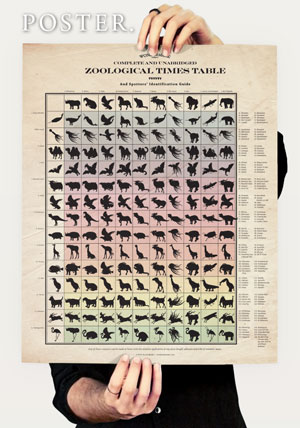
The Zoological Times Table

by David Malki !

Any of these creatures can be made at home with the simplest application of any store-bought adhesive and a bit of romantic music.

05 Feb 05:15

Opinions on Economic Inequality Driven by Ideology, not Income

by Lisa Wade, PhD

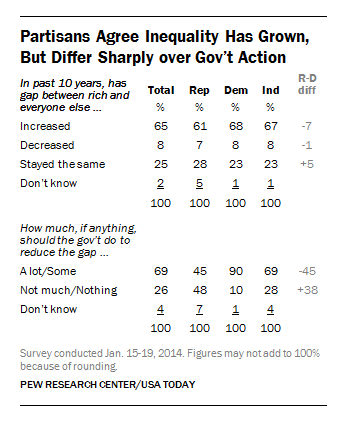
A majority of both Democrats and Republicans believe that economic inequality in the U.S. has grown, but they disagree as to its causes and the best solutions, according to a new survey from the Pew Research Center.  While 61% of Republicans and 68% of Democrats say inequality has widened, only 45% of Republicans say that the government should do something about it, compared to 90% of Democrats.  A study using the General Social Survey has confirmed the findings.

Screenshot (24)

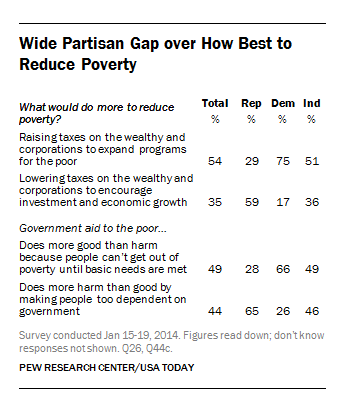
Republicans and Democrats also disagree about what the best interventions would be.  At least three-quarters of Democrats favor taxes on the wealthy and programs for the poor, but 65% of Republicans think that helping the poor does more harm than good.Screenshot (25)

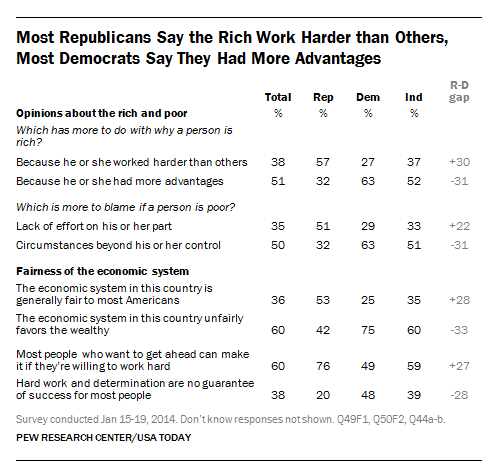
The differences may be related to beliefs about the cause of poverty.  Republicans are much more likely to endorse an individualist explanation (e.g., people are poor because they are lazy), whereas Democrats are more likely to offer a structural explanation (e.g., it matters where in the class structure you begin and how we design the economic system).

Screenshot (27)

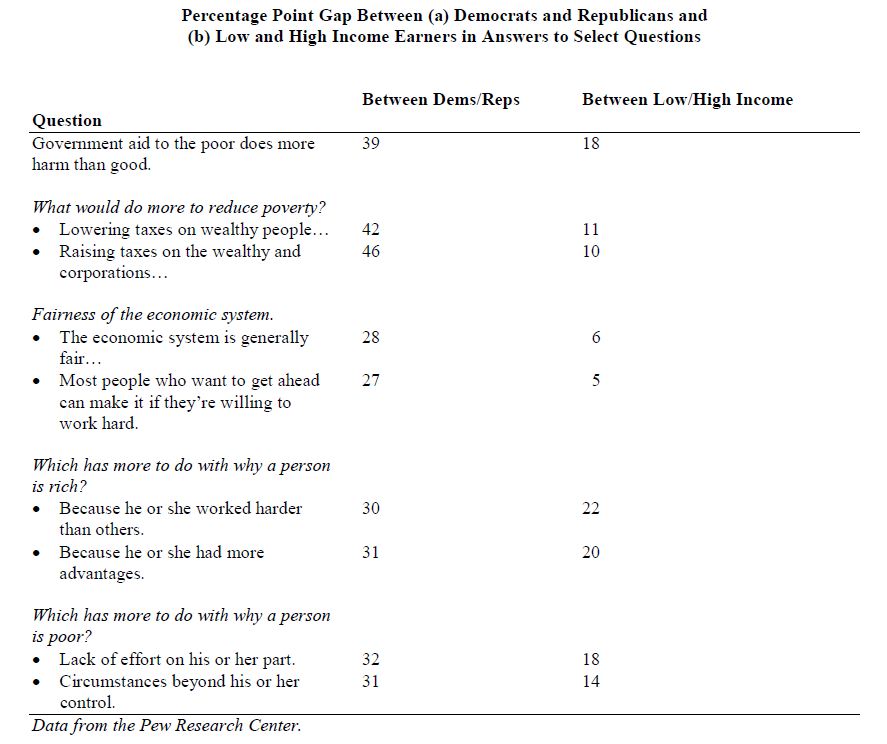
Interestingly, answers to these questions vary much more by political affiliation than social class.  Using data from the survey, I put together this table comparing the number of percentage points that separated the average answers to various questions.  On the left is the difference by political party and, on the right, income (click to enlarge).

1

Clearly political affiliation drives opinions on the explanation for and right solutions to income inequality more so than income itself.

This is a great example of hegemony.  A hegemonic ideology is one that is widely supported, even by people who are clearly disadvantaged by it.  In this case, whatever you think of our economic system, it is pretty stunning that only there is only a six point gap between the percent of high income people saying it’s fair and the percent of low income people saying so.  That’s the power of ideology — in this case, political affiliation — to shape our view of the world, even going so far as to influence people to believe in and perhaps vote for policies that are not in their best interest.

Lisa Wade is a professor of sociology at Occidental College. You can follow her on Twitter and Facebook.

(View original at http://thesocietypages.org/socimages)

31 Jan 12:07

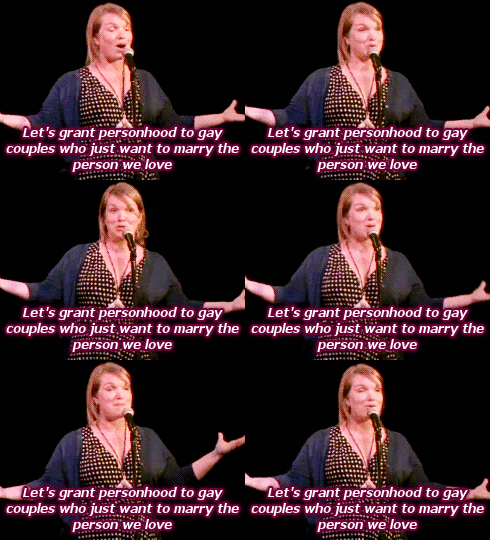
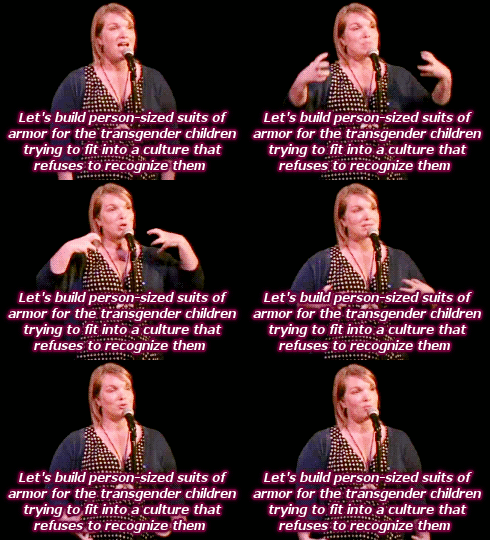
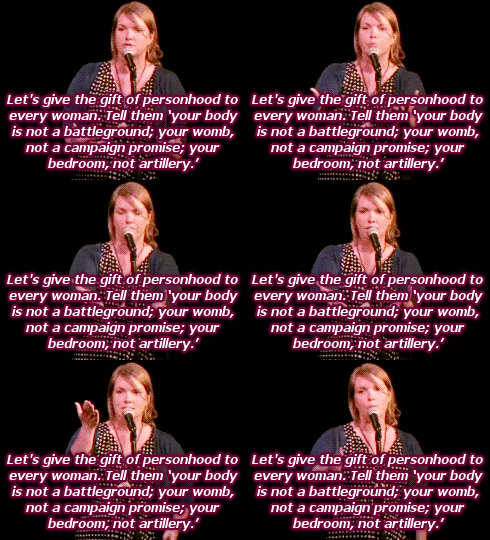
Above is an excerpt from ‘Personhood’ by Lauren Zuniga, which...


Above is an excerpt from ‘Personhood’ by Lauren Zuniga, which can  be viewed here

28 Jan 04:36

"Imagine this: Instead of waiting in her tower, Rapunzel slices off her long, golden hair with a..."

Imagine this:
Instead of waiting in her tower, Rapunzel slices off her long, golden hair with a carving knife, and then uses it to climb down to freedom.
Just as she’s about to take the poison apple, Snow White sees the familiar wicked glow in the old lady’s eyes, and slashes the evil queen’s throat with a pair of sewing scissors.
Cinderella refuses everything but the glass slippers from her fairy godmother, crushes her stepmother’s windpipe under her heel, and the Prince falls madly in love with the mysterious girl who dons rags and blood-stained slippers.

Imagine this:
Persephone goes adventuring with weapons hidden under her dress.
Persephone climbs into the gaping chasm.
Or, Persephone uses her hands to carve a hole down to hell.
In none of these versions is Persephone’s body violated unless she asks Hades to hold her down with his horse-whips.
Not once does she hold out on eating the pomegranate, instead biting into it eagerly and relishing the juice running down her chin, staining it red.
In some of the stories, Hades never appears and Persephone rules the underworld with a crown of her own making.
In all of them, it is widely known that the name Persephone means Bringer of Destruction.

Imagine this:
Red Riding Hood marches from her grandmother’s house with a bloody wolf pelt.
Medusa rights the wrongs that have been done to her.
Eurydice breaks every muscle in her arms climbing out of the land of the dead.

Imagine this:
Girls are allowed to think dark thoughts, and be dark things.

Imagine this:
Instead of the dragon, it’s the princess with claws and fiery breath
who smashes her way from the confines of her castle
and swallows men whole.


-

'Reinventing Rescuing,' theappleppielifestyle. (via justawordshaker)

Yes. Yes. Angela Carter would be proud. Yes.

11 Jan 22:24

10 Honest Thoughts on Being Loved by a Skinny Boy

by Lisa Wade, PhD

Today is Love Your Body Day and is this is our favorite body positive post of the year, re-posted in celebration. 

Rachel Wiley delivers a provocative poem about her experience as a “fat girl” loved by a skinny boy.  My favorite part:

My college theater professor once told me
that despite my talent,
I would never be cast as a romantic lead.
We put on shows that involve flying children and singing animals
but apparently no one
has enough willing suspension of disbelief
to buy anyone loving a fat girl.

Watch the whole thing (transcript here):

If you liked, we also recommend Kara Kamos’ confession that she’s ugly, but can’t think of a good reason to care.  Hat tip to Polly’s Pocket.

Lisa Wade is a professor of sociology at Occidental College and the co-author of Gender: Ideas, Interactions, Institutions. You can follow her on Twitter and Facebook.

(View original at http://thesocietypages.org/socimages)

11 Jan 22:24

Llama Problems

Llama Problems

Submitted by: Unknown

27 Dec 18:52

Why Are People Changing Their Minds about Same-Sex Marriage?

by Lisa Wade, PhD

We’re celebrating the end of the year with our most popular posts from 2013, plus a few of our favorites tossed in.  Enjoy!

We’ve seen a real shift in support for the issue and acceptance of homosexuality in general.  Since 2011, the majority of Americans are in favor of extending marriage to same-sex couples and the trend has continued.

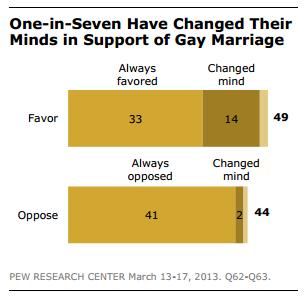
What is behind that change?  The Pew Research Center asked 1,501 respondents whether they’d changed their minds about same-sex marriage and why.  Here’s what they found.

The overall trend towards increasing support is clear in the data.  Fourteen percent of Americans say that they used to oppose same-sex marriage, but they now support it.  Only 2% changed their mind in the other direction.

2

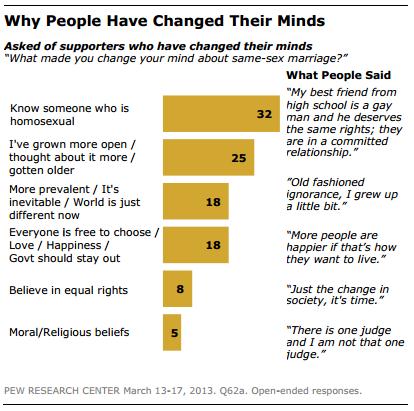
People offered a range of reasons for why they changed their minds.  The most common response involved coming into contact with someone that they learned was homosexual.  A third of respondents said that knowing a gay, lesbian, or bisexual person was influential in making them rethink their position on gay marriage.  This is consistent with the Contact Hypothesis, the idea that (positive) experiences with someone we fear or dislike will result in changes of opinion.

3

As you can see, lots of other reasons were common too.  A quarter of people said that they, well, “evolved”:  they grew up, thought about it more, or more clearly.  Nearly as many said that they were simply changing with the times or that a belief that everyone should be free to do what they want was more important than restricting the right to marry.

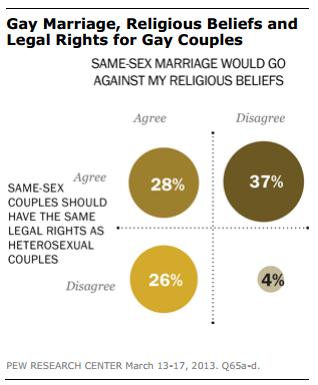
I thought that the 5% that said they’d changed their minds for religious reasons were especially interesting.  Support for same-sex marriage is rising in every demographic, even among the religious.  Following up on this, Pew offers an additional peek into the minds of believers.  The table below shows that 37% of the religious  both believe that same-sex marriage is compatible with their belief and support it, but an additional 28% who think marriage rights would violate their religious belief are in favor of extending those rights nonetheless.

1


While we’ve been following the trend lines for several years, it’s really interesting to learn what’s behind the change in opinion about same-sex marriage.  Contact with actual gay people — and probably lovable gay and lesbian celebrities like Ellen and Neil Patrick Harris — appears to be changing minds. But the overall trend reflects real shifts in American values about being “open,” valuing “freedom” and “choice,” extending “rights,” and accepting that this is the way it is, even if one personally doesn’t like it.

Cross-posted at BlogHer and Pacific Standard.

Lisa Wade is a professor of sociology at Occidental College. You can follow her on Twitter and Facebook.

(View original at http://thesocietypages.org/socimages)

27 Dec 17:01

If You Are in a Shell, A Story About Shyness Told by Ze Frank

by Kimber Streams

If You Are in a Shell” is a thoughtful story about living with and overcoming shyness told by Ze Frank and choreographed and performed by Harry Shum, Jr.

27 Dec 04:04

Jennifer Lawrence Talks About a Hotel Maid Finding Her Stash of Sex Toys on ‘Conan’

by Kimber Streams

On a recent episode of Conan, actress Jennifer Lawrence talks about the time a hotel maid found her stash of butt plugs, which were given to her as a gag gift and hidden under the bed so the maid wouldn’t find them.

26 Dec 01:59

The Future of Life on Earth and Capitalism: Are they compatible?


Scientist and Canadian broadcaster David Suzuki’s environmental non-profit foundation works to “design a vision of Earth in which humans live within the planet’s productive capacity.” He’s got a very direct and simple way of explaining what that means, particularly in relation to exponential population growth in a 2010 video that’s only just started to be discovered and passed around.

If you understand the concept of how “compound interest” works, and have even slightly more than half a brain in your head, be prepared to have a deflating “Oh shit…” moment when he gets to the not so amusing punchline.

No matter what your political persuasion might be, there is nothing to gloat over here, I can assure you. Nothing at all!
 

26 Dec 01:55

Amazing ‘Doctor Who’ Animation Mashed Up With the Song ‘Take on Me’ by A-ha

by Kimber Streams

TheFlixx took Richard Swarbrick’s amazing “50 Years in Time and Space” Doctor Who animation and added “Take on Me” by A-ha because of the animation’s resemblance to the song’s sketchy music video. It fits perfectly, transforming the haunting animation into upbeat fun with the power of 80s synthpop.

Here’s A-ha’s “Take on Me” music video:

And here’s the original Doctor Who animation by Richard Swarbrick:

via Geekosystem, UPROXX

25 Dec 07:53

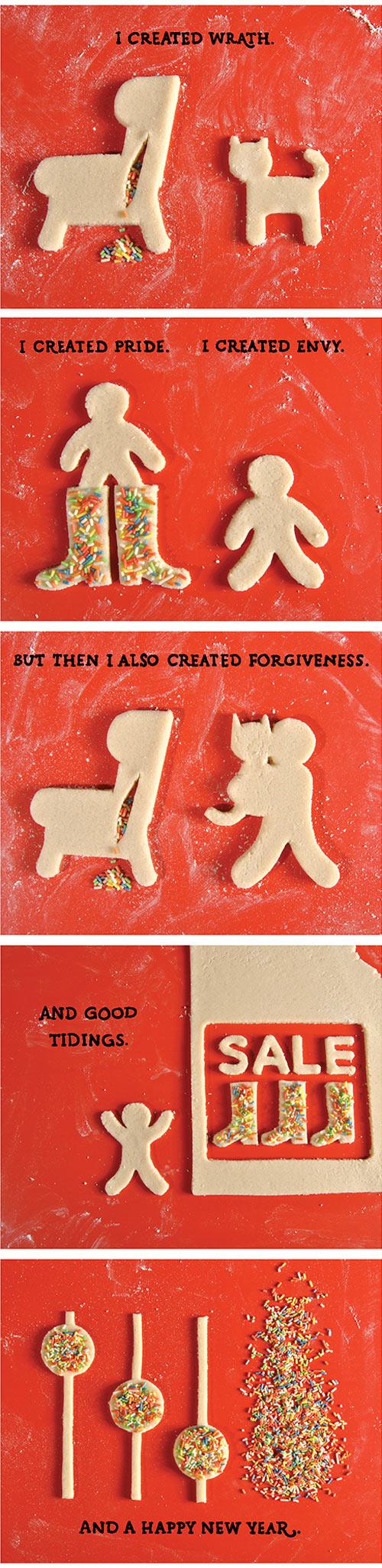
The Creation of Earth Illustrated With Christmas Cookies

by Jeff Wysaski
According to one festive baker, this is how it all began… [via metapicture]

Have you visited Pleated Jeans today?

21 Dec 15:48

If you don't sin, Jesus died for nothing.

21 Dec 15:48

impostoralice: askfordoodles: smearedlipstick: ghdos: illran...


impostoralice:

askfordoodles:

smearedlipstick:

ghdos:

illrandomocity:

majin-k:

Did a bunch of dogs breakup a fight between two cats? Am I seeing this right??

Having none of that shit today.

“Ay man, y’all chill the fuck out. Y’all fucking up the party.”

I CAN’T BELIEVE WHAT I’M SEEING

Pack animals like dogs don’t tolerate dissent in their group because it weakens the pack’s social structure… There are similar clips on youtube of them breaking up rabbit and rooster fights… They don’t care what species you are, they just want you to CUT THAT SHIT OUT.

They don’t differentiate species because dogs think everything else is just a weird dog. 

21 Dec 15:47

sweaterkittensahoy: djlegz: I don’t like sports, but the...


sweaterkittensahoy:

djlegz:

I don’t like sports, but the Bearcats are my new favorite team.

I love how it gets more elaborate each time. These boys are thinking this through.

21 Dec 15:47

Photo


21 Dec 15:36

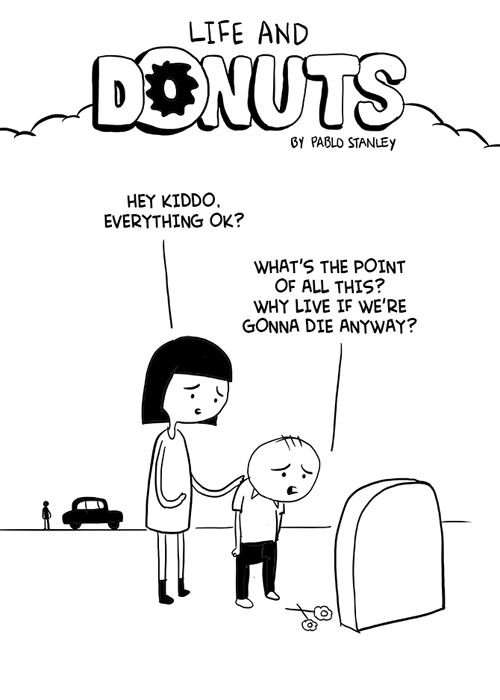
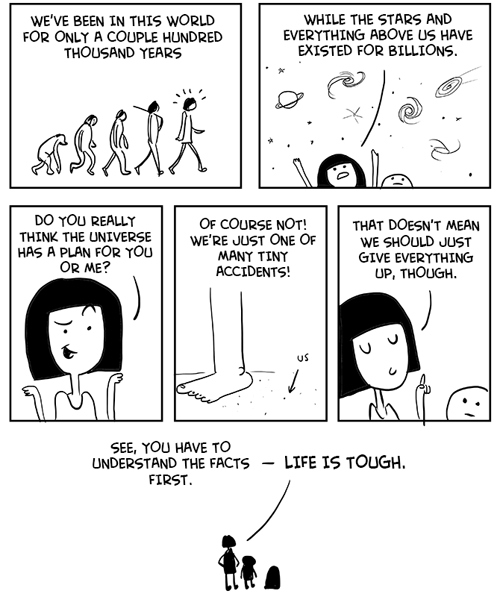
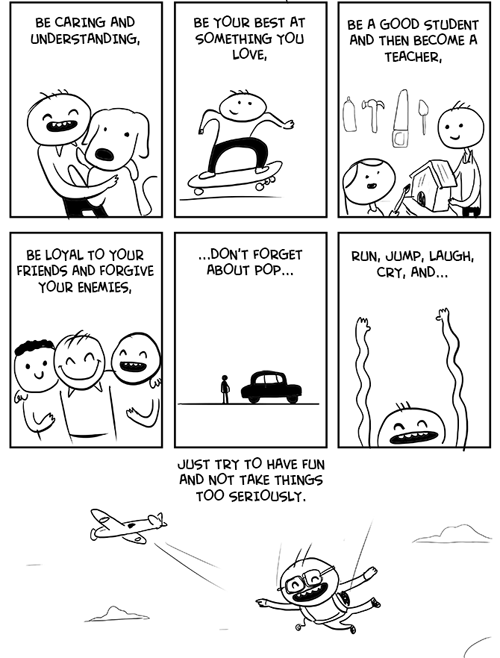
Life and Donuts by Pablo Stanley


Life and Donuts by Pablo Stanley

15 Dec 19:11

Carol Channing delivers a beautiful feminist tirade against housework (you know, for the kids)

Miss Piggy and Carol Channing
Channing with a glitzy showbiz colleague (and possibly her only worthy rival)

Free to Be… You and Me was second-wave feminist consciousness-raising at its simplest, and at its finest. The brainchild of Marlo Thomas (yes, the Marlo Thomas of That Girl fame) the 1972 album and accompanying book was produced in conjunction with the Ms. Foundation for Women with the express purpose of giving children some gender-neutral, identity-affirming entertainment. A lot of FTBYAM’s success could be attributed to the many high-profile celebrities who participated in the project. The kids might not have known who they were, but it probably made their parents more comfortable with it.

For example, former NFL defensive tackle Rosey Grier sang a song called “It’s All Right to Cry.” Marlo Thomas and Alan Alda (who directed much of the album) sang “William’s Doll,” the surprisingly emotional tale of a little boy who wants to play with dolls. Thomas actually had to fight to keep “William’s Doll” in the 1974 FTBYAM television special because ABC expressed concern that playing with dolls could make little boys gay (if only!). She also had to fight to keep her duet with Calypso legend and black activist Harry Belafonte, as ABC was worried Southern viewers would see an interracial couple and all hell would break loose. (We’d like to think things have changed, but…)

But my favorite segment of FTBYAM is the contribution of the immortal Carol Channing. Below you can hear Dolly herself talking the sweetest line of smack on advertisements, bullshit depictions of Hollywood femininity, and the very idea of housework as “women’s work.” It’s not patronizing or preachy, but it’s perfectly sweet and subtly clever.

Channing may seem like a left-field candidate for a project like FTBYAM, but I assure you, she’s an inspired choice. Think about it.

Who better than the glamorous Carol Channing to remind kids that housework isn’t glamorous? And who better than Carol Channing (a lady so feminine that only the most talented of women, Muppets, and drag queens can even attempt to emulate her), to tell little girls that femininity isn’t contingent on a perpetually sunny disposition and a dutiful commitment to drudge-work? Gender is something that you can navigate and mold to your liking—to put it in terms a child could understand—gender should be fun. And no one has more fun being a girl than the great Carol Channing!


Bonus clip: Michael Jackson and Roberta Flack sing “When We Grow Up” in the 1974 FTBYAM television special:
 

13 Dec 18:43

The Best Fitness Tracking Apps for Every Type of Exercise

by Thorin Klosowski

The Best Fitness Tracking Apps for Every Type of Exercise

If you peruse the health and fitness category on Google Play or the iTunes App Store, you'll see thousands of activity trackers that track your location, steps, runs, cycling, and more. It's a bit overwhelming, so here are a few of our favorites in different categories.

Read more...


03 Dec 21:29

Russell Brand on The Revolution: ‘We no longer have the luxury of tradition’


Shepard Fairey’s New Statesman cover

[TL;DR takeaway? Watch the video. Just watch it. Watch it all the way to the end because it builds towards an amazing climax in the final minute.]

Admittedly, upon my first exposure to British comedian Russell Brand, he did not win me over. He was a panelist on Rob Brydon’s Annually Retentive sitcom, a Larry Sanders-esque pisstake of UK panel shows like Mock the Week or Nevermind the Buzzcocks. I asked a Scottish friend of mine who the arrogant prick with the long hair and the large vocabulary was and he told me that Brand was a “human punchline” who had something to do with Big Brother. Tabloid tales of his drug and sex exploits were a bore to me. And a comic who looks like a member of The Libertines? Not for sir.

But over the intervening seven years, I’ve grown from a grudging respect for Brand to something resembling outright admiration for the articulate way he expresses his disdain—even hatred—for the world’s ruling elites. He’s a bit of a sleazy dude, sure—that’s part of his smarmy charm—but he’s got a first rate mind and he’s fucking fearless, as only a man who has emerged from the very depths of drug addiction (and fucking one—if not actually several—of the world’s most desirable women) could be. I don’t think he’s a guy who ever thought he’d be living in a mansion in the Hollywood Hills, let’s just say.

This morning everyone is talking about the absolutely smoking hot interview Brand gave to veteran BBC broadcaster Jeremy Paxman promoting the issue he guest-edited of The New Statesman, Britain’s long-running socialist journal. Paxman, a formidable man who has been the public undoing of many a politician, is nearly helpless at the barrage of words that Russell Brand sprays him with. It’s a riveting piece of television and everyone seems to be freaking out about it on Facebook this morning. It’s well worth your time, trust me.

And so is the Brand-edited issue of The New Statesman, which features contributions from Oliver Stone, Noam Chomsky, Naomi Klein, Judd Apatow, Graham Hancock, Noel Gallagher, Alec Baldwin, Rupert Everett, David Lynch and many others (you can buy a pdf of the issue at The New Statesman website)

Here’s an excerpt from Brand’s long, but beautifully composed letter from the editor:

I have never voted. Like most people I am utterly disenchanted by politics. Like most people I regard politicians as frauds and liars and the current political system as nothing more than a bureaucratic means for furthering the augmentation and advantages of economic elites. Billy Connolly said: “Don’t vote, it encourages them,” and, “The desire to be a politician should bar you for life from ever being one.”

I don’t vote because to me it seems like a tacit act of compliance; I know, I know my grandparents fought in two world wars (and one World Cup) so that I’d have the right to vote. Well, they were conned. As far as I’m concerned there is nothing to vote for. I feel it is a far more potent political act to completely renounce the current paradigm than to participate in even the most trivial and tokenistic manner, by obediently X-ing a little box.

Total revolution of consciousness and our entire social, political and economic system is what interests me, but that’s not on the ballot. Is utopian revolution possible? The freethinking social architect Buckminster Fuller said humanity now faces a choice: oblivion or utopia. We’re inertly ambling towards oblivion, is utopia really an option?

The letter is a rambling thing of gorgeous beauty and power. Read the entire thing at The News Statesman.

Below, the full Paxman-Brand dust-up… it’s riveting television
 

03 Dec 21:28

Why I Wear What I Do

by John Scalzi

This very interesting essay on the financial choices of the poor got me thinking about what I wear and why I wear it. Which caused me to haul out the camera and take a picture of what I was wearing today. Today, specifically, I am wearing the following:

A blue polo shirt, which I got at JC Penney. It’s the house brand polo, and I think it cost me $20 or thereabouts;

A pair of Levi’s 505 Regular Fit Jeans, which cost around $40;

Fruit of the Loom underwear, not from the Breaking Bad collection, which I think are like $15 for five;

No shoes and socks at the moment, but if I were wearing them, they would be standard athletic socks ($10 for 10 pair) and the casual brown shoes I bought at Sears about a month ago for about $60.

And that’s it, unless you include the wedding ring; as a rule I don’t usually wear other jewelry or accessories.

What I am wearing today is generally representative of what I wear on any day, both for work (writing and also making appearances) and for just existing. Occasionally I will swap out the polo for a henley or a t-shirt (if I am at a convention and/or not planning to leave my house that day the latter is more likely), but the Levi’s tend to be a staple, and I tend to wear jeans for more than any other type of trouser. I do have suits and other more formal clothes, but I wear them rarely.

Why do I wear what I do? There are several reasons.

1. I am by no stretch of the imagination a clothes horse, nor do clothes really interest or engage me beyond the most cursory way. So I tend to buy clothes that are basic, non-flashy, easy to find and replace and, to a certain extent, status-neutral (which actually means “generically North American middle-class”).

2. With that said, I dislike being a billboard for clothesmakers, which means when it comes to shirts in particular, I actively avoid clothes with brand identifiers on them. This tends to direct me toward house brands, which also have the advantage of generally being cheaper.

3. With that said, I do have one strong brand preference: Levi’s. This is entirely due to early childhood brand indoctrination, since in the world of late-70s, early-80s Southern California elementary and middle schools, there was a definite hierarchy of jeans, which went: Levi’s, Lee, Wrangler and everything else (hot tip: Don’t get caught dead in Tuffskins) (There were designer jeans too, but those were for girls, and there was an entirely different hierarchy there).

As an adult, I recognize this brand identification is largely garbage, but at the same time I still can’t bring myself to put on a pair of Lee or Wrangler jeans. So well done, Levi’s marketers.

4. This get-up has been the basic male uniform for every job I’ve had as an adult: Journalist in the early 90s, AOL minion in the mid-90s, and freelance writer/author from 1998 onward. Additionally, in the business circles I currently frequent — publishing, tech and film/TV — the jeans-and-polo look works just fine, especially because in each case there I am identified as a “creative,” and creatives are given credit if they show up in clothing without obvious food stains on them.

There is a whole discussion to be had here about why “casual” is the standard uniform for all these industries (short form: it’s intentional sartorial messaging from these industries that they are status-less meritocracies concerned only about contribution, not class or other social hierarchies — which, incidentally, is contemptible nonsense) but I will avoid going too much into detail about that at the moment and simply note that since it works for my own clothing choices, I’m happy it’s there.

5.  Indeed, because this is the basic uniform for a middle-class male and several high-value industries have adopted it as a standard look, short of events where formal business wear is explicitly requested or expected, as a middle-aged, generally non-skeevy-looking white dude, this look it gains me entry to almost everywhere I want or need to go. Conversely, almost anywhere I am, no one would argue that I didn’t have a right to be there.

I know this is true because this is my experience in the world. I go to meetings in this get-up and am taken seriously; I go out to meals in this get up and get a table. If being more dressed up is expected, I will do so; clothes are not my thing but I know enough to dress well when I have to. But on a day-to-day basis, this look, coupled with society’s baseline assumptions when it comes to race/gender/class, works for me I’d say 95% of the time.

6. And that other 5% of the time? Well, here’s the thing with that: I don’t have to care what people think — which is to say that other people’s negative social judgment of me based on appearance is almost entirely immaterial to how I get to live my life. This is also due to race/gender/class signaling; some of it is also due to my personal situation and me being who I am as a person.

Now, as it happens, I am interested in when people look me up and down, take in the sartorial gestalt, and make choices about how to respond to me based on it. I think it’s fascinating, and frequently amusing, and sometimes I have fun playing with it. This is particularly the case when, from time to time, I go out looking like a slob — unshaven, hair askew to varying degrees, wearing a some crappy t-shirt — and lose the advantages of the “middle class casual” look.

But it’s well worth noting that the reason I find it interesting and amusing is that by and large it doesn’t have any real negative effect on me. My systematic and personal advantages mean that nearly all disadvantages posed by someone judging me on my appearance are temporary and light. This is also why I find it amusing to post deeply unflattering pictures of myself online (see the one to the right as an example); I don’t have to worry about the negative side-effects of doing so. People who actually are judged on their appearance, and for whom that judgment will have a material effect on their life, don’t have the same luxury to be unconcerned as I do. What’s interesting and amusing to me is a matter of stress and anxiety for others.

A much shorter version of all the above is that I can put on $120 worth of clothes and shoes and be taken seriously almost anywhere I might want to go. So that’s what I do. Not everyone gets to do it. These facts are worth thinking about.


03 Dec 21:26

Photo


06 Nov 23:42

bloodredorion: slavicinferno: What SciFi Movies Would REALLY...


bloodredorion:

slavicinferno:

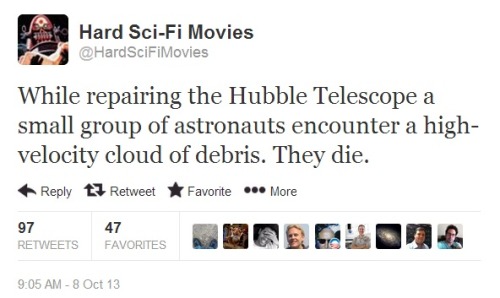
What SciFi Movies Would REALLY Be Like…

Source

Im laughing so hard

06 Nov 23:42

Photo


06 Nov 23:40

John Cleese Explains the Difference Between Serious and Solemn

by Lori Dorn

John Cleese, the legendary English actor, comedian, writer and film producer, explains the very “basic misunderstanding” between being serious and being solemn in a 1991 presentation for Video Arts, a British production company that produces training videos for companies.

Now I suggest to you that a group of us could be sitting around after dinner, discussing matters that were extremely serious like the education of our children, or our marriages, or the meaning of life (and I’m not talking about the film), and we could be laughing, and that would not make what we were discussing one bit less serious.

Solemnity, on the other hand, I honestly don’t know what it’s for. I mean, what is the point of it? The two most beautiful memorial services that I’ve ever attended both had a lot of humor and it freed us all and made the services inspiring and cathartic. But solemnity, it serves pomposity and the self-important always know, at some level of their consciousness, that their egotism is going to be punctured by humor. That’s why they see it as a threat.

via Viral Viral Videos

06 Nov 23:37

Glove and Boots Puppets Sing ‘All Together Now’ by The Beatles

by Justin Page

A joyful group of internet puppets from Glove and Boots join together and have a blast while singing The Beatles’ classic 1969 song “All Together Now.”