Carrie Fisher explains to a little boy what ‘bipolar’ means, at Indiana Comic Con 2015.
Carrie Fisher explains to a little boy what ‘bipolar’ means, at Indiana Comic Con 2015.
Step 1: Problematic media is created by adults and aggressively marketed toward young girls.
Step 2: Young girls consume the media. Many of them enjoy it without realizing that it promotes unhealthy ideas.
Step 3: Adults realize that the media is problematic.
Step 4: Adults ridicule the hell out of young girls for unknowingly consuming and enjoying the media. They completely ignore that fact that the media was created by adults, and that those adults purposefully designed the media for young girls.
Step 5: ????????????????????????????????????
Step 6: What????? The fuck????????????????

This is the best explanation of gerrymandering you will ever see.
Reminder: this is how you steal an election.
k2e4:
johnlockinthetardiswithdestiel:
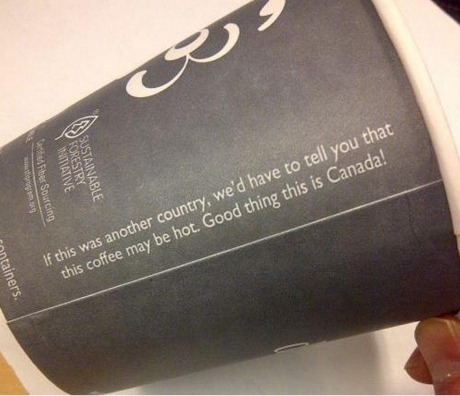
whoa canada
someone needs to turn down that sass level
Two things to know about Canada!
- We are smart enough to know hot things should be hot.
- We are sorry if you don’t
fun story about the reason they do that (at least in America)
once this lady spilled her McDonald’s coffee on herself and ended up getting like 3rd degree burns and since there was no warning on the cup she was able to claim she didn’t know it would be hot (or at least that hot) and won a lawsuit against McDonald’s for $1 million
That’s what the media smear campaign against her would have you believe, anyway. The truth of the matter is that the McDonald’s in question had previously been cited - on at least two separate occasions - for keeping their coffee so hot that it violated local occupational health and safety regulations. The lady didn’t win her lawsuit because American courts are stupid; she won it because the McDonald’s she bought that coffee from was actively and knowingly breaking the law with respect to the temperature of its coffee at the time of the incident.
(I mean, do you have any idea what a third-degree burn actually is? Third-degree burns involve “full thickness” tissue damage; we’re talking bone-deep, with possible destruction of tissue. Can you even imagine how hot that cup of coffee would have to have been to inflict that kind of damage in the few seconds it was in contact with her skin?)
Yeah I’m tired of people joking about either the “stupid” woman who didn’t know coffee was hot or the “greedy” woman making up bullshit to get money.
She was hideously injured by hideous irresponsibility, it was an absolutely legitimate lawsuit and the warning on the cups basically allows McDonalds to claim no responsibility even if it happens again. Every other company followed suit to cover their asses.
So they can still legally serve you something that could sear off the end of your tongue or permanently demolish the front of your gums and just give you a big fat middle finger in court. “The label SAID it would be HOT, STUPID.”
obligatory reblog for the great debunking of the usual ignorance spouted about this case
obligatory mention that the media smear campaign to twist teh facts on this case and get public opinion against the victim was deliberate and fueled by the right wing tort reform movement
it was seized upon to limit the rights of consumers to hold giant corporations accountable for wrongdoing
watch the documentary Hot Coffee, it lays out all of the facts and examines the response to this case and explains why everything you think you know about this case is bullshit, and explains why tort reform is bullshit in an entertaining and informative manner
The woman injured in Liebeck v. McDonald’s Restaurants was 79 years old at the time of her injuries, and suffered third-degree burns to the pelvic region (including her thighs, buttocks, and groin), which in combination with lesser burns in the surrounding regions caused damage to an area totaling a whopping 22% of her body’s surface. These injuries that required two years of intensive medical care, including multiple skin grafts; during her hospitalization, Stella Liebeck lost around 20% of her starting body weight.
She was uninsured and sued McDonald’s Restaurants for the cost of her past and projected future medical care, an estimated $20,000. The corporation offered a settlement of $800, a number so obviously ridiculous that I’m not even going to dignify it with any further explanation.
The settlement number most often quoted is not the amount that the corporation actually paid; the jury in the first trial suggested a payment equal to a day or two of coffee revenues for McDonald’s, which at the time totaled more than $1 million per diem. The judge reduced the required payout to around $640,000 in both compensatory and punitive damages, and the case was later settled out of court for less than $600,000.
Keep in mind that at the time, McDonald’s already had over 700 cases of complaints about coffee-related burns on file, but continued to sell coffee heated to nearly 200 degrees Fahrenheit (around 90 degrees Celsius) as a means of boosting sales (their selling point was that one could buy the coffee, drive to a second location such as work or home, and still have a piping hot beverage). This in spite of the fact that most restaurants serve coffee between 140 and 160 degrees Fahrenheit (60 to 71 degrees Celsius), and many coffee experts agree that such high temperatures are desirable only during the brewing process itself.
The Liebeck case was absolutely not an example of litigation-happy Americans expecting corporations to cover their asses for their own stupidity, but we seem determined to remember it that way. It’s an issue of liability, and the allowable lengths of capitalism, and even of the way in which our society is incredibly dangerous for and punitive towards the uninsured, but it was not and is not a frivolous suit. Please check your assumptions and do your research before you turn a burn victim’s suffering into a throwaway punchline.
#don’t fricking get me started on Liebeck v. McDonald’s Restaurants the level of misinformation floating around is staggering#I know that it’s an older case but it still makes me really mad that people treat it as this big dumb thing?#the fact that the media took a serious case and turned it into what it is to us today should piss people off#the level of distortion of facts is astonishing and upsetting and nobody seems to hear about it?#sorry I’m done I just#it upsets me when a legal travesty like this is just dragged out for some#’haha americans are sOOOOOOOo dumb!!1!’ humor#I MEAN GODDAMN IF YOU’RE GOING TO MAKE FUN OF AMERICANS AT LEAST MAKE FUN OF US WITH FACTS OKAY
jesus, i actually didn’t know about any of this, thanks for clearing that up
So someone mentioned the documentary Hot Coffee, which I watched just last night, and I want to share some tidbits with you:
In the US, people’s right to sue has been getting steadily eroded and things like making people believe the hot coffee case were frivolous are part of it. That’s how they get people to actually vote for limitations on their own rights to sue, or for caps on damages, when in fact ‘tort reform’ laws usually end up, e.g., reducing the amount you can get in a malpractice suit.
And there’s also a lot of sneaky shit like people unknowingly signing away their right to sue in the fine print (or being told they have in a ‘supplementary package’ of fine print delivered to them AFTER they signed the contract), and ending up in ‘binding mandatory arbitration’. You’ve probably signed dozens of contracts like this, e.g., for your cellphone and credit card. You have basically ‘agreed’ that is you have any dispute for any reason you cannot sue for damages, you have to have a secret meaning with an arbitrator hired by the person / entity that harmed you to act as judge.
There was some really striking examples in the documentary. One was a kid born with severe brain damage because he wasn’t delivered properly, resulting in oxygen deprivation for about 8 minutes during birth; professional estimates for his cost of living (including numerous surgeries and physical therapy, starting at just one year old) for the rest of his life was about $6 million. The jury awarded $5.6. That’s doable, right?
Well, except in that state (Nebraska) there was an award cap of $1.25 million, which, after paying legal bills and the already accrued medical expenses, left the kid with just a few hundred thousand. So, he’s now on medicaid to pay for his therapy, surgeries, and basic living expenses. The cost of his treatment has basically been transferred to the taxpayer, and should anything happen to his parents they have no idea what would happen to him or who would take care of him.
Another was a Haliburton employee who went to Iraq as part of Operation Iraqi Freedom, Miss Jamie Leigh Jones. (Warning for the next paragraph: discussion of rape.)
Long story short: she was lied to about her accommodations and ended up housed in barrack with 400 men. She was sexually harassed and threatened. She complained about it, twice, and was told she’d ‘get over it’. She ended up being drugged and gang raped. She needed reconstructive surgery for anal and vaginal tearing. What do you think happened next?She was locked in a shipping container with two armed guards for days, until one of them, out of sympathy and in defiance of orders, let her borrow his cellphone. She called her father who called some congressman and got her out of there.
She then spent 4 years fighting for her day in court, because unbeknownst to her she’d signed a binding mandatory arbitration agreement. She was 19 when all of this happened.
So, conclusion: the myth of frivolous lawsuits is kinda like the myth of the welfare queen. There have probably been a few that occurred sometime, somewhere, sure, but I bet you’d be hard-pressed to find them. Most people who file a suit have damn good reasons, and if they don’t the suit usually gets thrown out of court by a judge before they even waste time assembling a jury.
(Oh, another bit of shady shit discussed in the movies: big businesses trying to influence judge elections, or defame / dethrone already elected judges, if it seems they’re actually in favour of the common people’s right to civil litigation. During Judge Oliver Diaz’s election, he was subject to a massive, multi-million dollar smear campaign. When he won anyway, he was subject to another smear campaign: because a friend had co-signed a loan with him, he was accused of accepting a bribe, even though he had never presided on any case having to do with this friend or his law firm. In effect, his reputation was ruined and he couldn’t get elected again. This was not an isolated incident.)Meanwhile, laws and ‘reforms’ to curb ‘litigation abuse’ do more harm than good. If you hear a politician talking about ‘lawsuit lotteries’ and a need for ‘tort reform’, think of Reagan talking about ‘welfare queens’; think about how the vast majority of people on welfare do, desperately, need it.
What we’re really looking at is people eroding our social safety net, because they’re lucky / wealthy enough to view it as inconvenient.
So, my friend sent me a picture of me with cats all over my head and it turns out that there’s an app that lets you paste cat’s faces over any flaws you want to hide. I find it very helpful because I can hide my face and add some text and then use it to send angry messages to people I don’t like.
Here are a few of my favorites:

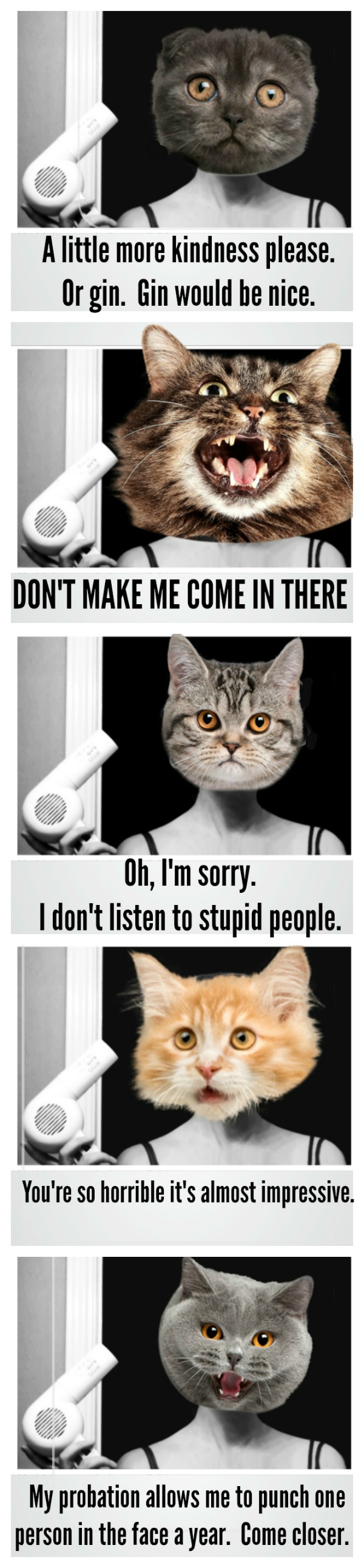

Related: Victor says this is all a bit creepy and would like me to stop texting him unsettling cat pictures. Too late, Victor. I can’t be stopped now.

PS.That last one was a bit creepy even for me. Sorry about that.

no one ever says that Rome needed help from aliens to build their empire
#l laughed for days when i found out that #ancient egyptians used water to reduce friction and move blocks for distances #and that this was literally DEPICTED ON THEIR HIEROGLYPHICS #but ~western archaeologists~ #thought that the pouring of water depicted ~superstitious rituals~ #jfc
As an archeology major, I can vouch for this being absolutely true:
Any time we see something we don’t understand, we mark it down as ritual purposes. It’s actually a catch-all euphemism for “We have absolutely no clue what these people were doing here yet so until we work it out we’ll pretend it was something to do with their religion.”
And yeah, sometimes it is a white people thing. When white people went into Canada the natives introduced them to the delights of maple syrup. The white people asked “Well, how did you ever work out this sap was edible and delicious.”
The native people responded, “Oh, well, Squirrel showed us.”
White people: Hahahaha They’re off on that totem animal spirit guide thing again.
It wasn’t until this century that scientists actually observed squirrels in that area cutting holes in sugar maples, waiting for the sap to crystallize, and eating it.
The native people were actually being literal and the white people thought they were being metaphorical. Sigh.


[x]
i did not expect this movie to actually have captain america throw shade at american imperialism while attempting to look at it from the point of view of the maximoffs.
for all we know about the twins in this iteration, they have grown up in an active war zone. living day after day in fear and terror, not unlike what steve and co. experienced with the possibility of the war crossing the atlantic.


TDS, May 26, 2015
Jon Stewart wonders why some Republicans are okay with big government when it comes to surveillance, but not when it comes to healthcare
 There was a great article in The Nation last week about social media and ad hoc credit scoring. Can Facebook assign you a score you don’t know about but that determines your life chances?
Traditional credit scores like your FICO or your Beacon score can determine your life chances. By life chances, we generally mean how much mobility you will have. Here, we mean a number created by third party companies often determines you can buy a house/car, how much house/car you can buy, how expensive buying a house/car will be for you. It can mean your parents not qualifying to co-sign a student loan for you to pay for college. These are modern iterations of life chances and credit scores are part of it.
It does not seem like Facebook is issuing a score, or a number, of your creditworthiness per se. Instead they are limiting which financial vehicles and services are offered to you in ads based on assessments of your creditworthiness.
One of the authors of The Nation piece (disclosure: a friend), Astra Taylor, points out how her Facebook ads changed when she started using Facebook to communicate with student protestors from for-profit colleges. I saw the same shift when I did a study of non-traditional students on Facebook.
You get ads like this one from DeVry:
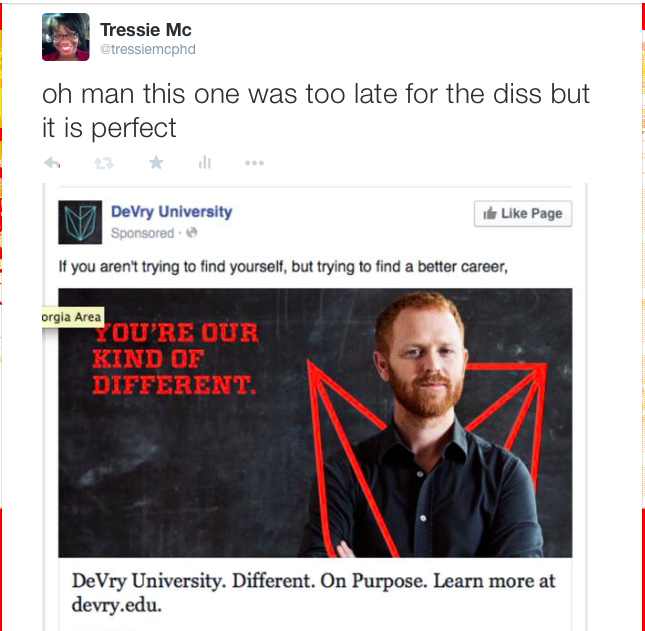
Although, I suspect my ads were always a little different based on my peer and family relations. Those relations are majority black. In the U.S. context that means it is likely that my social network has a lower wealth and/or status position as read through the cumulative historical impact of race on things like where we work, what jobs we have, what schools we go to, etc. But even with that, after doing my study, I got every for-profit college and “fix your student loan debt” financing scheme ad known to man.
Whether or not I know these ads are scams is entirely up to my individual cultural capital. Basically, do I know better? And if I do know better, how do I come to know it?
I happen to know better because I have an advanced education, peers with advanced educations and I read broadly. All of those are also a function of wealth and status. I won’t draw out the causal diagram I’ve got brewing in my mind but basically it would say something like, “you need wealth and status to get advantageous services offered you on the social media that overlays our social world and you need proximity wealth and status to know when those services are advantageous or not”.
It is in interesting twist on how credit scoring shapes life chances. And it runs right through social media and how a “personalized” platform can never be democratizing when the platform operates in a society defined by inequalities.
I would think of three articles/papers in conversation if I were to teach this (hint, I probably will). Healy and Fourcade on how credit scoring in a financialized social system shapes life chances is a start:
providers have learned to tailor their products in specific ways in an effort to maximize rents, transforming the sources and forms of inequality in the process.
And then Astra Taylor and Jathan Sadowski’s piece in The Nation as a nice accessible complement to that scholarly article:
Making things even more muddled, the boundary between traditional credit scoring and marketing has blurred. The big credit bureaus have long had sidelines selling marketing lists, but now various companies, including credit bureaus, create and sell “consumer evaluation,” “buying power,” and “marketing” scores, which are ingeniously devised to evade the FCRA (a 2011 presentation by FICO and Equifax’s IXI Services was titled “Enhancing Your Marketing Effectiveness and Decisions With Non-Regulated Data”). The algorithms behind these scores are designed to predict spending and whether prospective customers will be moneymakers or money-losers. Proponents claim that the scores simply facilitate advertising, and that they’re not used to approve individuals for credit offers or any other action that would trigger the FCRA. This leaves those of us who are scored with no rights or recourse.
And then there was Quinn Norton this week on The Message talking about her experiences as one of those marketers Taylor and Sadowski allude to. Norton’s piece summarizes nicely how difficult it is to opt-out of being tracked, measured and sold for profit when we use the Internet:
I could build a dossier on you. You would have a unique identifier, linked to demographically interesting facts about you that I could pull up individually or en masse. Even when you changed your ID or your name, I would still have you, based on traces and behaviors that remained the same — the same computer, the same face, the same writing style, something would give it away and I could relink you. Anonymous data is shockingly easy to de-anonymize. I would still be building a map of you. Correlating with other databases, credit card information (which has been on sale for decades, by the way), public records, voter information, a thousand little databases you never knew you were in, I could create a picture of your life so complete I would know you better than your family does, or perhaps even than you know yourself.
It is the iron cage in binary code. Not only is our social life rationalized in ways even Weber could not have imagined but it is also coded into systems in ways difficult to resist, legislate or exert political power.
Gaye Tuchman and I talk about this full rationalization in a recent paper on rationalized higher education. At our level of analysis, we can see how measurement regimes not only work at the individual level but reshape entire institutions. Of recent changes to higher education (most notably Wisconsin removing tenure from state statute causing alarm about the role of faculty in public higher education) we argue that:
In short, the for-profit college’s organizational innovation lies not in its growth but in its fully rationalized educational structure, the likes of which being touted in some form as efficiency solutions to traditional colleges who have only adopted these rationalized processes piecemeal.
And just like that we were back to the for-profit colleges that prompted Taylor and Sadowski’s article in The Nation.
Efficiencies. Ads. Credit scores. Life chances. States. Institutions. People. Inequality.
And that is how I read. All of these pieces are woven together and its a kind of (sad) fun when we can see how. Contemporary inequalities run through rationalized systems that are being perfected on social media (because its how we social), given form through institutions, and made invisible in the little bites of data we use for critical minutiae that the Internet has made it difficult to do without.
Tressie McMillan Cottom is an assistant professor of sociology at Virginia Commonwealth University. Her doctoral research is a comparative study of the expansion of for-profit colleges. You can follow her on twitter and at her blog, where this post originally appeared.
(View original at https://thesocietypages.org/socimages)
empowerment is such a useless concept tbh.
your personal feelings on make-up really don’t matter when you’re talking about structural oppression. feminism doesn’t give a shit whether you are ~empowered~ from wearing eyeliner or not.
what feminism cares about is the fact that girls are pressured and groomed to wear make-up from their childhood on, that employers are less likely to hire you or pay you well if you don’t wear make-up, that the beauty industry is largely controlled by men and focused on making women feel insecure about their natural body so they can advance capitalism, that the beauty industry spends billions of dollars each year to contribute to the idea all girls are raised into that it’s only their looks that matter and give them worth.
i don’t think that wearing make-up or lingerie invalidates someone’s feminism, no. i do think that, regardless of your personal feelings on the matter, you have to be able to criticize make-up and femininity in general on a structural level though. you have to recognize that femininity is compulsory and imposed on women from the patriarchy. you have to recognize that women who don’t or can’t perform femininity the way it is dictated, especially disabled, lbpq+ and trans women and women of colour, are punished for it. and if you can’t do that because you’d rather cling to useless liberal concepts like empowerment then yes, that does invalidate your feminism.
“People who work 40 hours a week shouldn’t have to live in poverty”.
NO ONE should have to live in poverty regardless of how many hours, if any, they work.
“People who work hard don’t deserve to go hungry”.
NOBODY deserves to go hungry.
Instead of aiming to help a few who you deem to be “worthy” enough of being lifted out of poverty, eliminate poverty. Nobody deserves to be poor. Nobody deserves to be homeless or starve. Nobody should have to work to prove they should be allowed to escape the system.
As much as I’m happy that Ireland has legalized Same-Sex marriage, I think it’s important to remember that: A) Irish law doesn’t even recognize the existence of trans people. B) Teachers in Ireland can still be fired for being gay. C) there is no Hate Crime Legislation and homophobic and transphobic crimes go widely unreported because of this.
So yeah, go and be happy for marriage, but this is kind of what we mean when we say “Homophobia doesn’t end with marriage equality.”
The old gods are dead
Zeus sits at the bar, he’ll buy a thousand and one drinks and the girls who he smiles at will raise their eyebrows and think of the pepper spray tucked into their sleeves.
Hera waits at home. She knows the numbers of all the girls and she has their facebooks open on the computer. Her hands hover over the keyboard., She wants to tell them that men will always lie. She wants to take her own advice. She never will.
Apollo and Artemis travel the world. They are chasing the sun. Chasing the moon. They will never catch up. Their hand are curled around each others hip bones. Never in public though. They look too similar for that now. Society has learned judgement and so they keep their caresses safe in the shadows.
Poseidon wanders the shore. He wears a plastic poncho and carries a bag of trash. His tears mix with the salt water. No one can tell the difference. A girl with hair that moves like serpents trails after him, retribution in her eyes.
Hades lies in bed, his wife curled around him. He smiles because people will always believe in death and finally, finally he has beaten his brothers at something.
Athena paces through college campuses, handing out pamphlets on architecture. She scoffs at professors who are simply going through the motions. She carries signs in her hands as she marches through the streets with the students, screaming about the newest problem. She laughs wild, these children, these fearless children are her people.
Hestia wants her family to come home. She waits in the doorway, arms outstretched and a smile like forgiveness waiting to embrace the siblings whom she knows will never return.
Demeter counts down the days until her daughter returns. She smiles when children cheer over the snow days she gives them. There was a time when she had a child like that.
Persephone kisses her husband and grins when people tremble. She is vengeful and wears flowers in her hair and she will make damn sure that the world will never forget her name.
Ares walks through the Middle East, picking his way around the ruins of an elementary school. He stopped understanding war a long time ago. This was not brave, this was not heroic. This was senseless.
Aphrodite narrows her eyes at boys in cars who yell obscene things. She’s long since stopped romanticizing love. She is gaunt and over worked but sometimes she sees a teenage girl handing her baby over to an older couple who had tried for years and she feels young again. Sometimes, she sees Ares from across the room as soldiers embrace their loved ones and they smile at each other.
Hephaestus limps through his shop, his hands are worn down, his back is still twisted but people don’t seem to notice anymore. He makes their furniture, their toys and trinkets and they thank him, they pay him.
Hermes runs through the streets of New York, Tokyo, London. He is young in this time, young and beautiful and slipping between business men, his hands finding their way into their pockets. He never stops laughing.
Dionysus mixes Zeus his drinks. He watches his family grin and cry and get sick in the back room of the bar. He holds back their hair and hands them another drink before they even ask. He’s been here a long time. He’s seen them drunk more often then he’s seen them sober. He is watching them flicker out and fade.
The gods are dying. The gods are dead. The gods are us.


“Growing up, a lot of my friends parents didn’t want me around their children because of my personality and the way I looked and dressed. They thought I was trash but I really was not a trashy person. It stemmed from the fact that I had absolutely nothing as a child and I just wanted so badly to be noticed. When I finally made some money, I went over the top. But why not? I don’t look the way I do out of ignorance, I look this way because I like it. Anybody can look like a common Joe. I look like I came out of a fairy tale.”


But who listens though?
Reblogging again for recent events.
Bruh he even brought in the kkk line this is gold
(via fatoutloud)
“never use this word because it’s common, instead use all of these things that i’ll call synonyms even though they carry different connotations and will change the meaning of your dialogue if you use them” — very bad and unfortunately very common writing advice
“Do you want this sandwich?” she elaborated, acquiring the sandwich from her rucksack with a set of fingers.
His visage was set aflame with a smile. “Sure,” he postulated.
Yeah, what is with that writing advice? Where did it come from? Why would anyone with any knowledge of fiction whatsoever give anyone that advice?
Good stories do literally the exact opposite of this. Never use a more complicated word when a simpler one will do. Always use the simplest word that will convey your exact meaning. Don’t try to fool your reader into thinking you’re smarter than you are by using vocabulary you’re not very comfortable with. Focus on conveying your story and all the emotions therein, not on cluttering up your sentences with 50 cent words.
Words are only tools, they’re just a means to an end. Words are not the end product of writing fiction. Story is. The simpler the words, the easier it will be for your story to sink into your reader. Fancy words are a distraction.
I wonder where this terrible advice came from. Is it a distortion of “don’t use cliches?” Maybe someone was feeling threatened by a new writer and told them to use a thesaurus in order to ruin them, I dunno.
True but, we have a very large and extended vocabulary of words, very nice words, that we could use. I mean, not all the time, but sometimes the simple words are boring. You don’t have to go all Shakespeare but you can still use larger words.
Well, yeah! I mean, this toolbox has EVERYTHING in it, it’s AMAZING! It’s got a screwdiver, a hammer, and a bunch of allen keys, of course, but it also has a rollercoaster, the jaws of life, and a flamethrower! When a particular task requires a screwdriver, it’s totally cool to use a flamethrower instead. Everyone loves a flamethrower! Will it do the job? Hell, no! It will probably set everything on fire! But fuck the story, screwdrivers are BORING. I want to use the most EXCITING tools!
The flamethrower is in the toolbox for a reason. It can be used well in service to a story. If you want to use it, you’re going to have to create a situation where flamethrower is the best possible tool to serve your story. But you can’t use it to “liven up” your words. Words are tools. If the same words are the only appropriate ones over and over again, liven up your story.
In particular: Just use “said”. Don’t be afraid of the word, or of boring anybody with it. Its purpose is to make your dialogue stand on its own two feet.
…Assuming that it can. If it can’t, that by itself should tell you something.

11/2 Today Goofus the Peacock killed a mouse and instead of eating it right away, decided to wander around the pasture carrying it in his beak. The feral cats always appreciate dead-rodent-based performance art, so they followed behind Goofus single file to make a Very Exciting Dead Rodent Parade.
At one point Goofus stopped and put down his rodent and one of the feral cats dared to sniff at it, and Goofus unleashed The Most Terrifying Honk, something along the lines of I WILL END YOU AND EVERYONE YOU LOVE AND YOUR BONES WILL BE FORGOTTEN ON THE FROZEN EARTH WHEN I SNUFF OUT THE SUN AND SING THE STARS TO DARKNESS I AM THE DEVOURER AND DESTROYER OF ALL THINGS
The feral cats, previously unaware that the Death Of The Universe And End Of All Things is currently living as a peacock, ran off at about fifty miles an hour and hid under the barn for the rest of the day. They didn’t even come out at milking time to beg for goat milk, which is a first.
We probably should not have named the Death Of The Universe And The End Of All Things “Goofus,” actually.
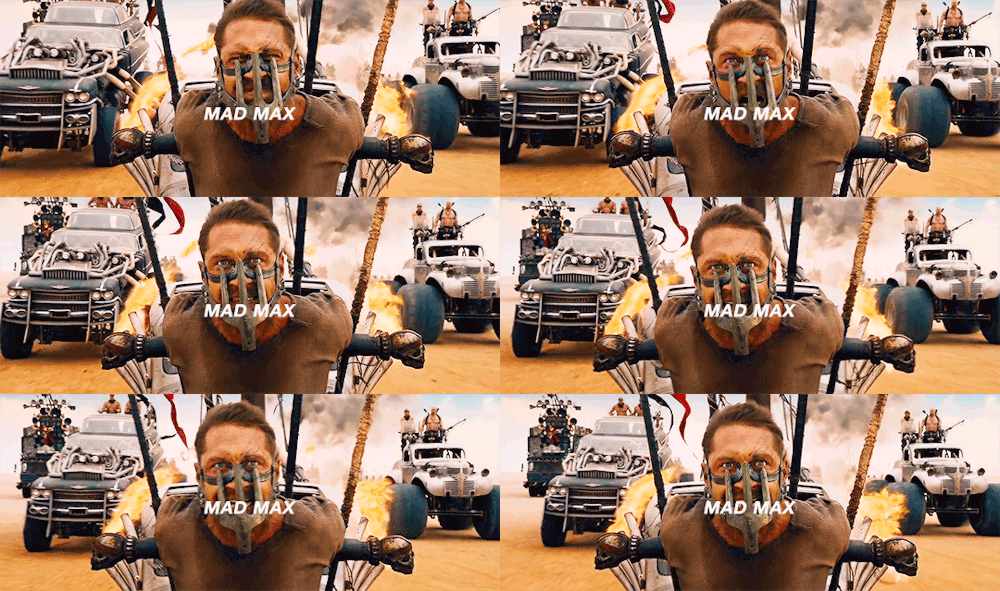
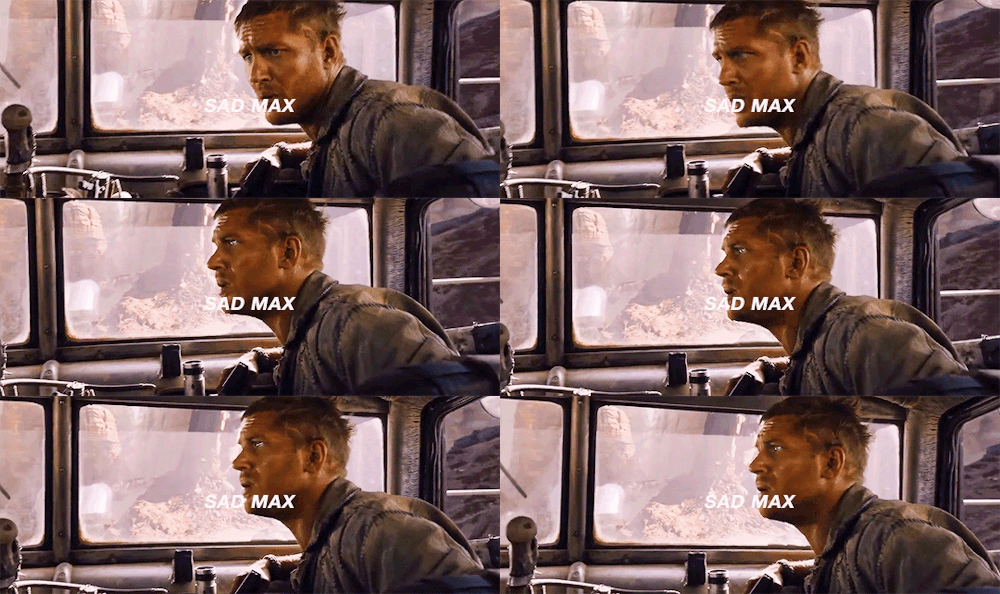
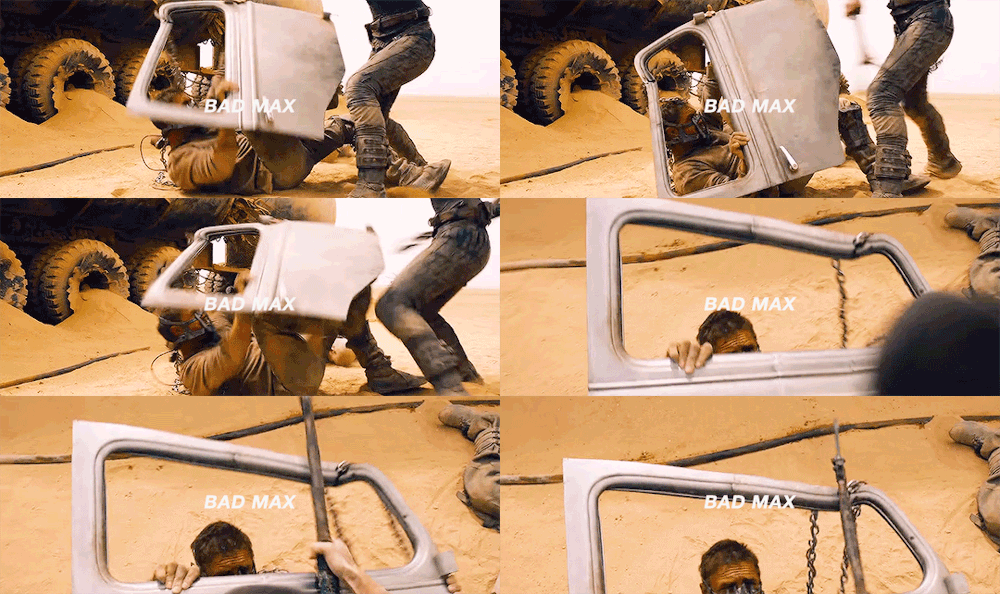
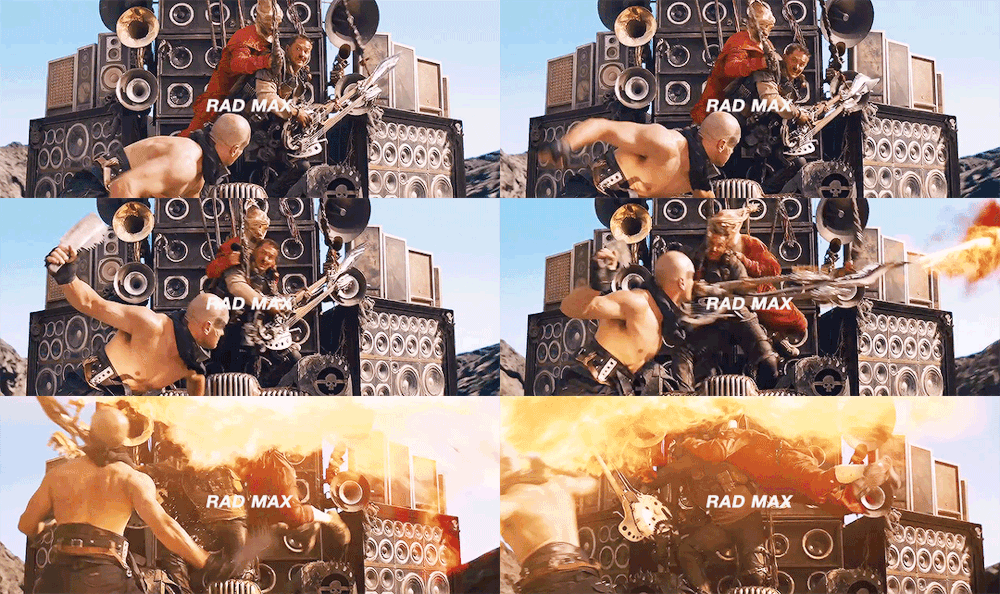
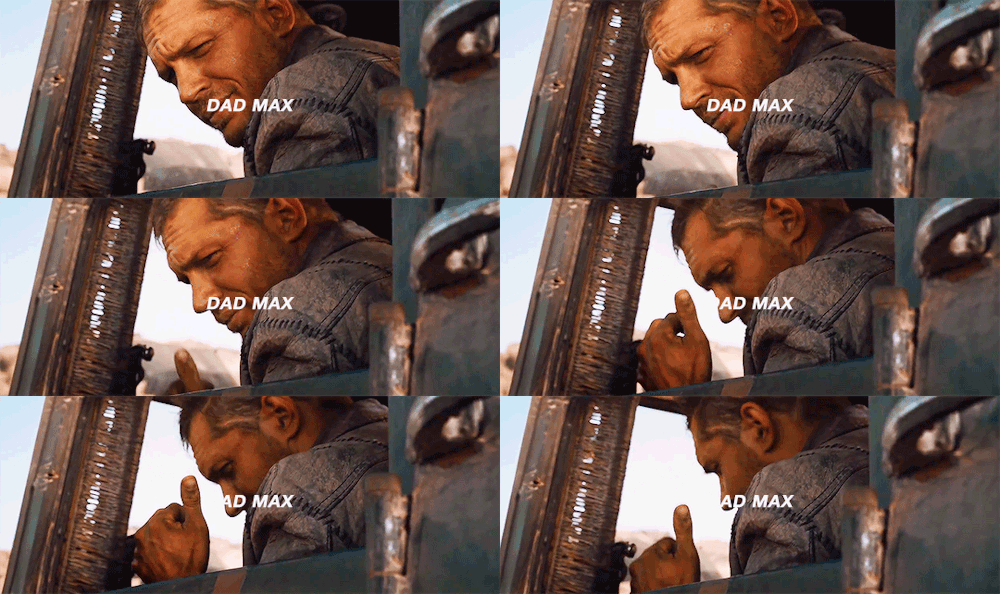
Dear Hollywood: Isn’t it amazing how Fury Road’s Max is a tough-as-nails, guilt-ridden, distrustful lone wolf with a dark past and the movie manages to convey that without having him treat everyone he meets like crap?
Does this mean you never really needed to write your ‘edgy’ antiheroes as abusive assholes after all?? That maybe you could have given them ‘emotional complexity’ without resorting to lazy, thinly-veiled power fantasies about white dudes who treat everyone else as inferior??? Thoughts????

Persephone’s Flower Shop
Modern AU of Greek deities??? I’d think Persephone runs a flower shop next to her mother’s all-natural grocery store and gets really distracted when the pawn shop guy comes to visit.
Oh I adore this.