Shared posts

26 Mar 23:00

Balancing Deep and Wide Impacts in the Design of Civic Tech

by erhardt
wskent

Good read. Thick and interesting. Pictures and links are good for a quick pass.

These are the prefatory remarks I made as moderator during the panel "Balancing Deep and Wide Impacts in the Design of Civic Tech" at the Digital Media and Learning Conference, Boston, MA on March 8, 2014.

I'm working on a project called Action Path. Similar to Promise Tracker, which will be the featured case study in this session, Action Path is a smartphone app for civic engagement. Specifically, the app uses geo-fencing, a technique based on the awareness of the user's GPS coordinates, to send notifications to users about opportunities to take quick actions in the form of polls or documentation of a local area for easy, yet contextually-relevant civic engagement. As indicated by my promo slide here, it's meant to marry mobile computing with the concept of a "Jane Jacobs Walk," whereby you only really understand a city's needs and resources through walking its streets. I hope you all agree that this sounds great... at least in theory.

But what does this look like in practice? Well, right now it looks like three two-hour public meetings per week, where I sit and learn about the ongoing planning processes in Somerville—the city where I live and hope to do my research. I am building trust with folks in the planning department at the City of Somerville and the leaders and organizers in civil society organizations who work on issues like land use, affordable housing, and beautification in different neighborhoods around town.

There are lot of conflicting agendas among these different groups, all of whom I need buy-in from in order to, 1) make sure that I have enough people test my app, and 2) ensure the app is stocked with relevant actions that a) make my partners feel good about endorsing it among their members, and b) make the city and private developers happy because the feedback will be in a form that can inform their planning processes, WITHOUT becoming overly politicized. I want to have real impact, and tying the technology to real impact is important for my research

In the end, I have to write this up as a thesis. And that means I need a rigorous study of some kind showing that people's understanding of their ability to make a difference in their city has changed.

I appreciate that this is an iterative and interactive process that demands flexibility, but it's also hard from the perspectives of design, research, PLUS overall impact. And it's actually the social processes around the technology that are harder to design than the mobile app itself.

At the MIT Center for Civic Media, we aspire toward co-design. Sasha Costanza-Chock, one of our affiliated faculty, has really put this at the center for his own research (see codesign.mit.edu), teaching classes that focus on the methodology and then connecting students with community members and organizations around particular themes where they work together to first define the problem through establishing a shared language, then think deeply about the context in which a potential solution would be deployed—from the politics, economics, geography, and access to resources including existing technologies. Then, they work to co-construct the solution.

The students, a.k.a. the professional designers, are there to empower the community members to design their own most appropriate solution, focusing not only on technologies but on the social processes that must surround any technological solution in order for it work effectively in context.

We don't always meet our aspirations though. We are researchers with research questions that don't automatically align with the problems and needs of a target population.

The MIT Media Lab as a whole, whose program Alexis and I are in, tends to swing to the opposite design philosophy, which has been most notably embodied by Steve Jobs, the late founder of Apple, who is famous for saying "A lot of times, people don't know what they want until you show it to them."

This is a pretty dangerous notion, but it is also oversimplified. Because there is a design philosophy in here that CAN BE highly respectful to the user, drawing on the traditions of user-centered design and human-centered design, where you really try to figure out how people use technology through observation and intuition. The goal here is to discern the simplest possible technology that works like a user would want something to work, even if they can't articulate that want verbally.

This is profoundly disempowering, of course. This creates a kind of designer-god situation, where we designers know best, and that paternalism is not good for civic technologies. And this is something we appreciate not only as designers, but also as social scientists.

Social scientific approaches such as contemporary ethnography and action research have taught us how to respect our research subjects and inform the way we now do design. Major tech firms are hiring ethnographers to understand the way technologies are actually used by people and fit within the contexts, cultures, and sub-cultures of their users.

Most relevant here is the evolution of action research from its inception in the 1940s, bringing an experimental approach to social scientific research. It argues that the attempt to produce social change is inherently a questioning of the functions of society itself and serves as an empirical method of inquiry. In many ways, action research is a design process that is iterative like all good design processes are, and contextual like good social science and design—Paulo Freire's adaptation of "participatory action research" comes to mind for how it took appreciation of context to a new level.

Still, there is always a concern over rigor when you become so close the subject you are studying and when the data are so specific: what does it mean for the research to have impact beyond an intervention?

So we see old battle lines here. But these are false dichotomies, as we now well know. The best quantitative studies are placed in the context of good qualitative work that pulls out the meaning and relevance of statistical trends. Similarly, we look to quantitative studies to extend the detailed explanations of phenomena in qualitative work to look for other spaces where society behaves similary. This is the process of creating social theory through a series of case studies. And ideally you do this to have impact.

Bent Flyvbjerg has been developing his concept of "phronetic social science" for the past decade, taking the best from action research and mixed method case studies to develop social theories tailored to real world application. He uses the Greek concept of phronesis from Aristotle's Nichomachean Ethics, which refers to a knowledge of the value of something, which requires an understanding of context but also the projection of the usefulness of research and what impact might look like to all the stakeholders including the researcher. There is a bit of experimentation here, perhaps even grounded theory, in letting things emerge through the application of different critical lenses on a given situation or phenomenon.

Furthermore, Flyvbjerg argues that it's the responsibility of the contemporary social scientist to ensure they keep impact in mind when doing the research such that when papers are published and accounts are given, they can inform an audience of politicians, designers, urban planners, activists, etc. about what worked and what didn't and how that was a function of the context, giving them the ability to iterate and do better subsequently.

I think all of us who practice social science believe that this is what we are doing, or it's what we aspire to do, but we quickly get wrapped up in the insular tendencies of our disciplines, and present incomprehensible research to each other on more than a few occasions.

One approach that is attempting to bring all of this together is "Design Action Research for Government" [pdf]. In the name, you see the pedigree of action research merged explicitly with design, and then made contextually specific to partnerships with government. Of course, this has been developed by DML's own Eric Gordon along with his research collaborator Jessica Baldwin-Philippi and the City of Boston's Chris Osgood and Nigel Jacobs, who head up the unusually progressive Office of New Urban Mechanics. Don't underestimate the importance of having a community partner with a mission of experimentation, as you will hear about in the case of Promise Tracker. But we aren't always so lucky. And even if we follow DARG's rough guidelines, there is a lot of work we designer-social scientists need to do in order to adapt any methodology to our own goals and contexts.

This brings us back to the root word at the beginning of this session's title: BALANCE. Can we strike that balance between deep and wide impact, as well as good design and good research? Can we reach our aspirations of inclusivity and diversity, including a sense of shared ownership, political sensitivity, appropriate technologies, social scientific rigor, time, and scale?

Chelsea, Heather, and Alexis will take us through their project Promise Tracker and the ways that it has evolved through its recent test deployment, showing us the way these principles and questions play out in a concrete case.

26 Mar 22:34

@

wskent

Even the @ symbol has a story to tell.

26 Mar 22:25

Holy Wow

B.A.S.E. Jump from the Freedom Tower at 3 a.m. on September 30. 2013. Holy wow.
26 Mar 21:32

The Captain Slocum's Spray, Montague Dawson (c. 1950)


Found by dmccall26
26 Mar 21:31

An Incredibly Detailed & Ravishing Sign Inspired By 19th Century ...


Found by jamesgunn
25 Mar 20:04

Irony not dead: Comcast claims it is Net Neutrality's best friend

by Cory Doctorow
wskent

Just a friendly reminder for you to recall *just* how fucked up this all is.


Since Netflix CEO Reid Hastings published a statement on Net Neutrality and Comcast (whom Netflix has had to bribe in order to secure normal service for its users), Comcast has gone on a charm offensive. The company sent a statement to Consumerist in which it asserts an imaginary history of championing Net Neutrality, a work of Stalin-grade reality-denying fiction that has Consumerist's Chris Morran practically chewing the keyboard in rage:

Comcast’s David Cohen, Exec. VP of Shoving Mergers Down Consumers’ Throats, actually released the following laughable statement to Consumerist and other outlets:

“There has been no company that has had a stronger commitment to openness of the Internet than Comcast. We supported the FCC’s Open Internet rules because they struck the appropriate balance between consumer protection and reasonable network management rights for ISPs. We are now the only ISP in the country that is bound by them.”

W-W-WAIT A MINUTE (Insert sound of record scratching for full effect.)

What Comcast’s Regulator Whisperer fails to mention is that Comcast is only still bound by those Open Internet rules because it’s part of the agreement Comcast made to fool the FCC and Justice Dept. into allowing its merger with NBC Universal.

This is like a paroled convict saying she’s a real homebody without revealing that she’s not allowed to leave her home except for trips to work and to visit her parole officer. Or someone who brags about having a positive impact on the environment by only using public transportation without mentioning that he had his license taken away.

It's great to have Netflix onside for Net Neutrality, now if they only weren't engaged in a war on the open Web and demanding DRM in HTML5.

Not A Joke: Comcast Says No One Is More Dedicated To Net Neutrality Than It Is [Chris Morran/Consumerist]

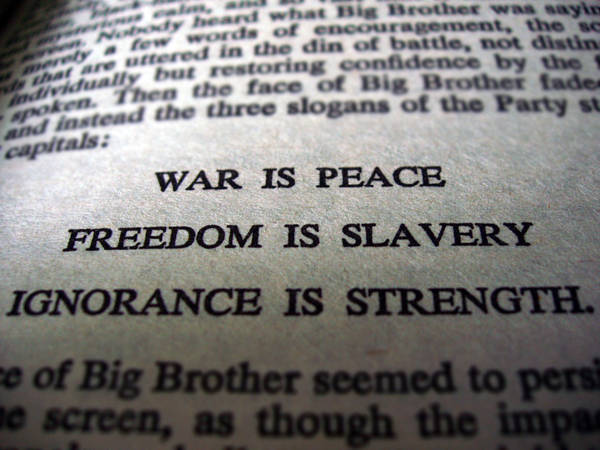
(Image: War is Peace? Not in my World! )


24 Mar 18:03

1980s: New York by Frank Horvat

by Chris
wskent

This is tops.

“Money Is Everything”, 1986

“Money Is Everything”, 1986

Balloons in the Subway, 1984

Balloons in the Subway, 1984

Christmas presents, 1984

Christmas presents, 1984

Cigarette advert, 1983

Cigarette advert, 1983

Downtown shop window, 1986

Downtown shop window, 1986

Dwarf, 1983

Dwarf, 1983

Elevated subway, 1985

Elevated subway, 1985

Father and son in the Subway, 1984

Father and son in the Subway, 1984

Funeral home’s delivery boy, 1985

Funeral home’s delivery boy, 1985

Graffiti, 1984

Graffiti, 1984

Homeless person under plastic, 1984

Homeless person under plastic, 1984

Homeless woman asleep at a table, 1984

Homeless woman asleep at a table, 1984

Lady in a snow storm, 1984

Lady in a snow storm, 1984

Old lady, 1984

Old lady, 1984

Painting shop, 1983

Painting shop, 1983

Picnic in Central Park, 1984

Picnic in Central Park, 1984

Private detectives, 1984

Private detectives, 1984

Prolific photographer Frank Horvat captured fascinating scenes from the early 1980s in his project New York Up & Down

Prolific photographer Frank Horvat captured fascinating scenes from the early 1980s in his project New York Up & Down

Sandwich man, 1985

Sandwich man, 1985

Steam jet in the morning sun, 1984

Steam jet in the morning sun, 1984

Stockroom in a snack bar, 1984

Stockroom in a snack bar, 1984

Subway at rush hour, 1982

Subway at rush hour, 1982

Times Square in a snow storm, 1984

Times Square in a snow storm, 1984

Two couples, 1985

Two couples, 1985

Two ladies, Central Park, 1984

Two ladies, Central Park, 1984

Women in a cafeteria, 1984

Women in a cafeteria, 1984

World Trade Center in a puddle, 1985

World Trade Center in a puddle, 1985

World Trade Towers in a cloud, 1984

World Trade Towers in a cloud, 1984

Via Buzzfeed

21 Mar 18:36

Computer animated film from 1974 - Hunger

by Mark Frauenfelder
wskent

Office national du film du Canada. Faim.

The short film "Hunger" by Peter Foldès was made over 40 years ago using computers. The design is fresh. It looks like it could have been made today.

Animated film satire of self-indulgence in a hungry world. Rapidly dissolving, reshaping images, made with the aid of a computer, create a stark contrast between abundance and want. A man eats, at first sparingly, but his appetite grows to gluttony, greed, and gratification of every desire. The nightmare that finally haunts him is the one that hangs over our disparate world.

I love the soundtrack, too.

Hunger, from the National Film Board of Canada (Via Dangerous Minds)


21 Mar 18:20

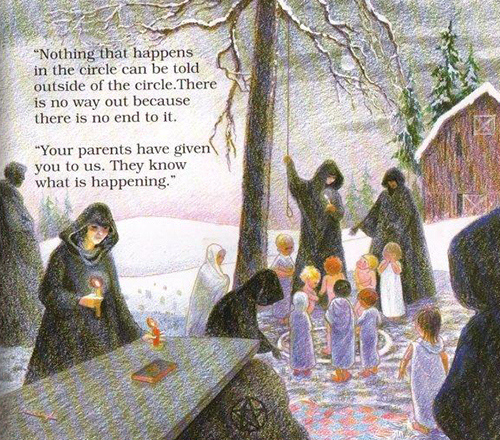
Child's illustrated garden of Satanic ritual abuse

by Cory Doctorow
wskent

This hits the spot.


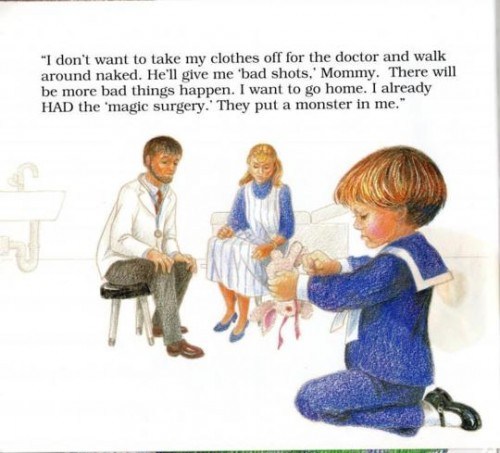
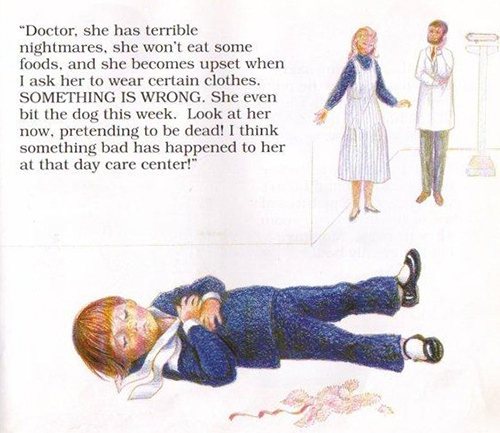
In 1990, in the middle of the moral panic over Satanic ritual abuse (an almost entirely imaginary phenomenon), Doris Sanford published "Don't Make Me Go Back, Mommy," which was "based on months of intensive research into the nature and practice of satanic ritual abuse." Sanford claimed that "Any child who has been ritually abused will recognize the validity of this story."

The story is a lurid, freakish illustrated tale ripped from tabloids and sensationalist memoirs, which was supposed to help parents, teachers and social workers help kids who'd been victims of this nonexistent epidemic.


“Don’t Make Me Go Back, Mommy” : A Creepy Children’s Book About Satanic Ritual Abuse (via Christian Nightmares)


17 Mar 22:36

So, what exactly does pi mean?

by Jason Kottke
wskent

Halve a slice.

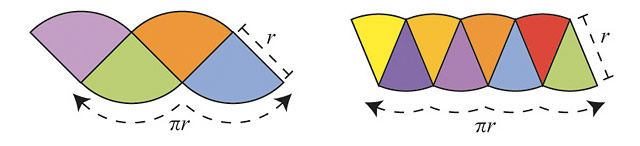
As Pi Day approaches, it time for a refresher course, courtesy of Steven Strogatz, on what pi actually means and how you can visualize calculating it. It's all about rearranging the pieces of a circle in a calculus-ish sort of way:

Pi Calc

Tags: mathematics   pi   Steven Strogatz
17 Mar 15:51

How we read and share online

by Rob Beschizza
wskent

I spent maybe 10 seconds reading this.

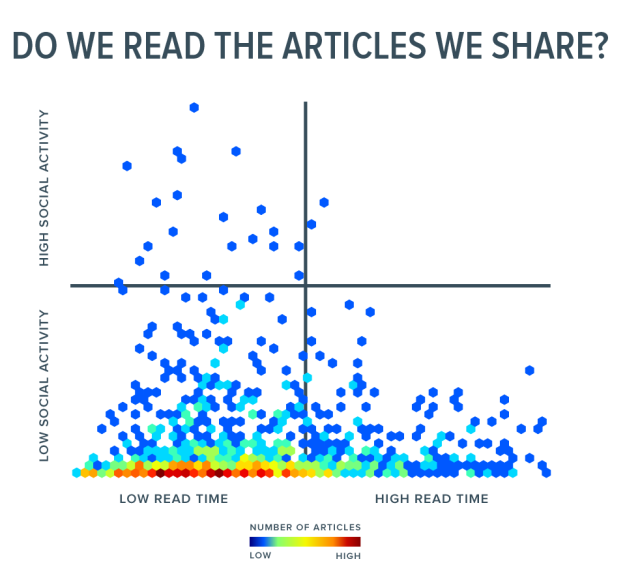
Please stare at this self-explanatory and rather sad graph for no less than 90 seconds, then share it on Facebook. Tony Haile:

If you’re an average reader, I’ve got your attention for 15 seconds, so here goes: We are getting a lot wrong about the web these days. We confuse what people have clicked on for what they’ve read. We mistake sharing for reading. We race towards new trends like native advertising without fixing what was wrong with the old ones and make the same mistakes all over again.
[Time Magazine via Flowing Data]


16 Mar 20:02

The Amazing Backstory to "The Most Unusual Voice on an Audio Letter" (Exploring My Reel-to-Reel Catacombs, Volume 49) (MP3's)

by Bob Purse
wskent

Weird. Awesome.

Ain  2Today, a follow-up. Two weeks ago, I wrote an entry about "The Most Unusual Voice I've Ever Heard on an Audio Letter"

Being currently unable to accept comments to this site, I invited comments about these mysterious tapes to my own e-mail address, and was happy to hear from more than a half-dozen commenters. 

Many suggested that the person speaking had undergone a tracheostomy. I was previously only familiar with the machine used by people with this impairment, which makes sort of a burping, low toned vocal sound, but I guess the sound on these recordings is an earlier method of assisting someone who has had this procedure to be able to speak. 

I also got a least five suggestions as to the language being spoken. The correct answer appears to be Estonian (explained in a moment)

But one intrepid writer went much further, and by searching for the return address on the tapes, and then for the name that site turned up, found something truly amazing, and equally horrifying. 

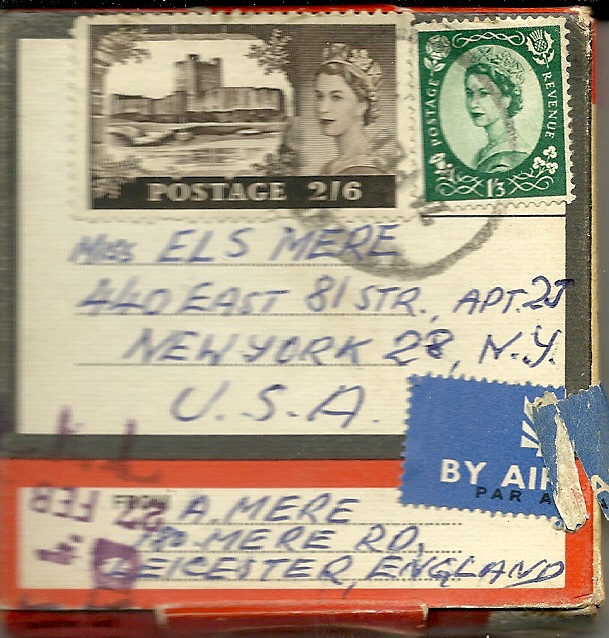
Remember that the sender of the tapes, and presumably the primary person talking, was listed as A. Mere at 180 Mere Rd. in Leicester, England. Using that information, this led my researching correspondent to a site which indicates that the person at that address, Mr. Ain Mere, was an Estonian who retired to England, and who was a collaborator with the SS during World War II. Here is the first site found.

That led both my correspondent and me to check Wikipedia, and we came up with even more information - which you can see here - that after retiring to England he was accused and convicted of war crimes, by a Russian court, and sentenced to death. As the page goes on to say, due to lack of evidence, English authorities refused to extradite him.

Several writers, intrigued by what is on these tapes, have asked where I got them. While I don't keep close records of where I've come to own most of the myriad tapes in my collection, there is really only one place I would have acquired a large collection of tapes sent from one person to another, and that is eBay. When and from where the seller was located, at this point I haven't a clue.

But this is just another reminder that you literally can never know exactly what's going to come out of the speakers on the next reel of tape you spool up. And why I'll be continuing to explore this amazing world of sound for the rest of my days. 

And now, for your dining and dancing pleasure, here's another one of Ain Mere's tapes, featuring the dulcet tones of Mr. Mere. On this tape, the other person who appears on these tapes (a younger woman, I'm guessing) speaks about as much as the sender does, which is unusual for these tapes. She even briefly lapses into English a couple of times. 

This tape only features two songs, but what numbers they are, first an early number by The Beatles (I think I hear him say "Beatles" in the comments just after the song ends), and the other a lovely yodeling tune - She Taught Me to Yodel - as sung by Friank Ifield, whose version was memorably lip-synched by Craig Ferguson (although my favorite version is by Rod Erickson). (The hiccup heard during the song on this tape is from a splice in the tape.) 

What occurred to me, while digitizing this tape, is that there are few things that have less in common with the allegations against Ain Mere than the do either the joyful sound of the early Beatles or the good cheer found in "She Taught Me to Yodel". 

Ain Mere - Greetings From England, Side One (MP3)

Ain Mere - Greetings From England, Side Two (MP3)

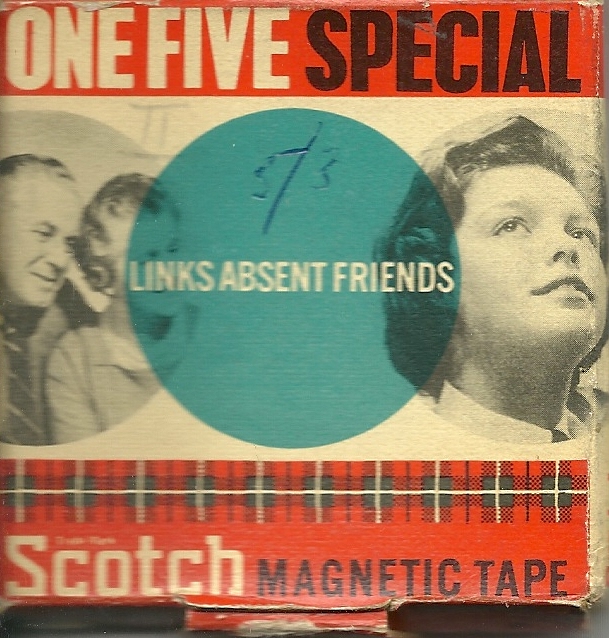
Tape Box Front (JPG)  |  Tape Box Back (JPG)

Thanks to all who wrote, and many, many thanks to GM in cyberspace for filling in the blanks!

Comments still appear to be disabled, so if you'd like to say something, please write to me at the address you can find on this page, and I'll try to add some of those comments to this post, when I get a chance.  


14 Mar 04:59

U5lSc8j.jpg (500×500)

by jensen
13 Mar 17:03

The Best Add-ons for Google Docs and Sheets

by Amit Agarwal
wskent

Rock n roll, guys.

Google today introduced add-ons for Google Docs & Sheets and they certainly make the Google Office productivity suite more capable and more useful. If you haven’t tried them yet, open any Google document or spreadsheet in your Google Drive and look for the new add-ons menu.

For starters, add-ons in Google Docs are like extensions for Chrome. Just like Chrome extensions add new features to your browser, add-ons extend the functionality of Google Docs and Google Sheets. To give you an example, here’s the screenshot of a Twitter add-on I wrote for Google Docs and Google Sheets that you can use to find and curate tweets right inside your documents.

Twitter Curator is an add-on for Google Docs and Sheets

Twitter Curator is an add-on for Google Docs and Sheets

Anyone can write an add-on for Google Docs. All you need to have is some basic understanding of HTML, CSS (for styling the add-on) and JavaScript. The server side code is written in Google Apps Script which is similar to JavaScript but running on the Google Cloud.

Google Scripts vs Google Add-on

Google Add-ons are also written in the Google Apps Script language but while regular Google Scripts can work on any document in your Google Drive, add-ons only work against the document or sheet that’s currently open in your browser.

Also, while Google Scripts support triggers and can run in the background (like this Website Monitor), add-ons can only run while a document or sheet is open and active.

The other big difference is that you can view the source code of regular Google Scripts while in the case of add-ons, the code is hidden from the end user. This helps developers protect their code but a downside is that the user has no clue about what’s happening behind the scenes.

We have seen issues with Chrome extensions and add-ons for Google Docs can be a target as well. For instance, an add-on can possibly email a copy of the current document or sheet to another email address? Or maybe it can share a folder in Google Drive with someone else. All add-ons currently listed in the Chrome store have been tested and reviewed by Google but if they open the gates for all, I would be a little hesitant to install add-ons created by unknown developers.

One more thing. Google Add-ons are only available for the new version of Google Sheets while Google Scripts can work on both old and new Sheets.

The Best Add-on For Google Docs & Sheets

The Chrome store has about 50 Google add-ons at the time of launch and here are some of favorite ones that you should have in your Google Docs.

  1. HelloFax – You can now send a fax to any number worldwide directly from inside Google documents. The free version lets you fax up to 5 pages.
  2. UberConference – You can have an audio conference with up to 10 people while working on a Google Document. There’s an option to record the call too.
  3. PanDoc – You can send the current document to the client from within Google Docs to request their legally-binding signature.
  4. Avery – Create address labels inside Google Docs for printing.
  5. Sudoku – Create and solve Sudoku puzzles inside a Google Spreadsheet.
  6. MailChimp – Send mails in bulk using the Mandrill service of MailChimp. The mails do not go via your Gmail account.
  7. MindMeister – Create a hierarchical bulleted list inthe the Google document and MindMeister will converted that list into a visual mind map.
  8. EasyBib – Cite books, journal articles and websites and add them to your Google Documents in MLA, APA and Chicago style.
  9. Gliffy & Lucidchart – Create flow charts, diagrams, site mockups, org charts and other technical drawings inside your Google Documents.
  10. Mapping Sheets – Create a spreadsheet with a list of places and the sheets add-on will plot them on a Google Map.
  11. TextHelp – This is like the yellow highlighter for your Google Documents. Select and highlight passages and save the annotations in a separate document.
  12. Analytics Canvas – It helps import your Google Analytics reports into Google spreadsheets for further analysis.

Related tutorial: How to Create a Google Docs Add-on


This story, The Best Add-ons for Google Docs and Sheets, was originally published at Digital Inspiration on 11/03/2014 under Google Docs, Internet
13 Mar 17:01

Can You Imagine Any Better Flourishes? Anton Burmistrov’s Inspired Typography

by Candace Kita
wskent

Add some flare.

Imaginarium
Imaginarium

Graphic designer Anton Burmistrov urges us to use our imaginariums. The London-based artist caught our eye with his design for the glass door of the Imaginarium, a cozy creative space “where ideas are born, where artists could come and dream about impossible things.” Drawn from the conventions and styles of 19th century lettering, his panel is a typographic reverie come true – featuring bold, elegant contrasts and a series of flourishes that would make even the most self-respecting Victorian swoon.

See Also BMD Design Serves Up Tasty Retro Typography

Although his luxurious typography communicates a dreamy beauty and almost unreal attention to detail, Burmistrov describes the very concrete labor required to create such a work:

Originally we wanted to invite an artist to beautifully handwrite this for us, just like the outstanding sign painter David A. Smith. While we ended up with my design printed on a transparent film sheet and pasted on the glass instead, it gave me the opportunity to make some details so fine that it is beyond the control of hand letterer.

Work on projects such as the Imaginarium requires lots of time, perseverance, and patience–especially in those moments when a colleague passing by will whisper, “It looks like there is the typo – did you know that there is no such word as Imaginarium?”

4

Despite his impressive visual skills, Burmistrov did not originally imagine himself as a full-fledged working designer. He attended art school but after realizing that graphic design was not always a career that paid the bills, Burmistrov decided to join the army. However, while on the night shift standing watch, he dreamed of creating his future portfolio and website. “Perhaps that is why I am a designer now,” Burmistrov remarks. “I couldn’t fight myself.”

See the website that Burmistrov imagined – and then immaculately realized – here.

28731c961e3005495dcd0bc870c102727bb8ebd0e5966c573be5b662236aeb335IMG_9398IMG_9392IMG_9391IMG_9412IMG_9405

Via: Abduzeedo

28 Feb 15:43

Now

wskent

FYI

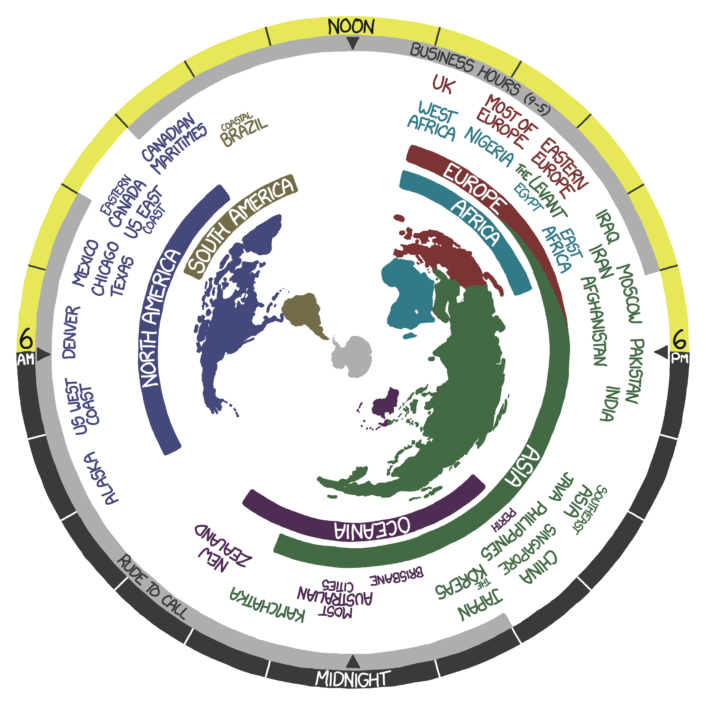
This image stays roughly in sync with the day (assuming the Earth continues spinning). Shortcut: xkcd.com/now
27 Feb 20:33

Soundboardt

by Jason Kottke
wskent

Is there anything better?

Soundboart is a Beyonce soundboard. I must have pushed the AH-AH-AH button a thousand times until I discovered the SURFBOARDT button.

Tags: audio   Beyonce
27 Feb 02:33

Comcast gets paid by Netflix and might still want money from Cogent

by Jon Brodkin
wskent

...it's happening...

Comcast

Comcast's success in extracting payments from Netflix won't end its dispute with Cogent, a network operator that distributes Netflix video and other traffic, Cogent's CEO said.

Cogent operates one of several networks that Netflix uses to distribute video across the Internet. With Netflix now paying Comcast for a direct connection to that ISP's network, Cogent's role in passing traffic from Netflix to Comcast will be reduced or potentially eliminated.

But just because Netflix traffic will now flow directly from Netflix to Comcast doesn't mean that Comcast will drop its demand for payment from Cogent.

Read 23 remaining paragraphs | Comments

27 Feb 02:28

True, strange tales of extinction

by Maggie Koerth-Baker
wskent

Sad and pretty. And pretty interesting.

The last Great Auk was clubbed to death by fishermen for the crime of witchcraft. The Dusky Seaside Sparrow was done in by the combined forces of NASA and Disney World. Frank Swain has illustrated several of history's odder extinction stories.


20 Feb 19:07

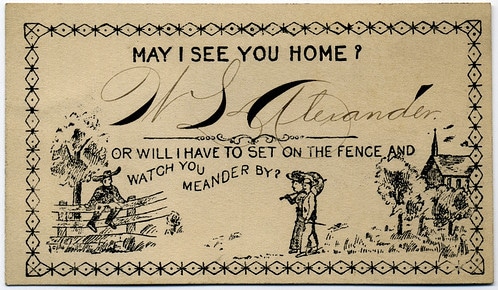
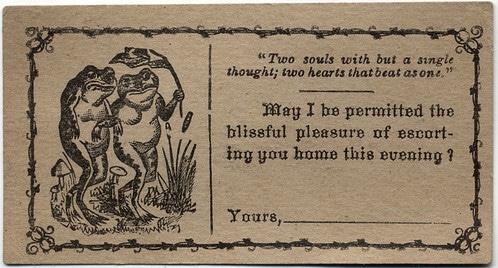
May I See You Home? 19th Century Calling Cards Guaranteed to Score You a Date

by Brett and Kate McKay

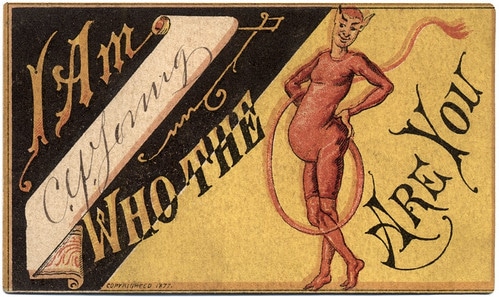
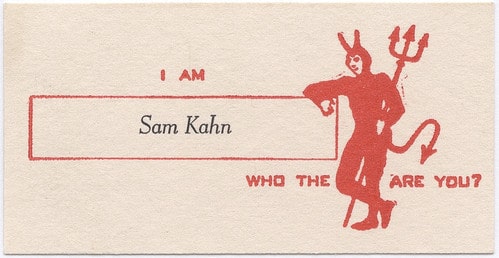
In the 19th century, gentlemen used calling cards to formally introduce themselves to new acquaintances and to call upon friends and relatives in a dignified way.

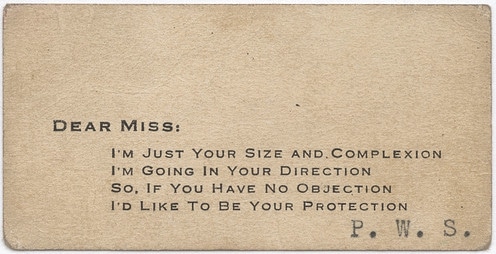
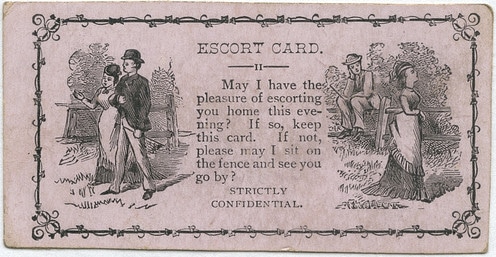
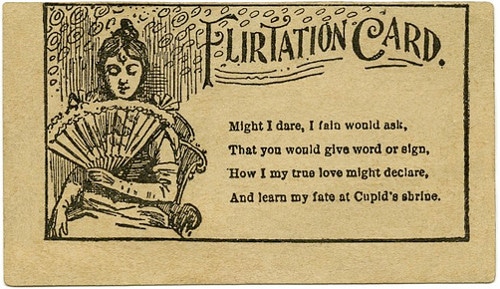
But there was another type of card used when a gentleman wanted to get the ball rolling with a lovely lady in a more casual way: the acquaintance card. According to The Encyclopedia of Ephemera, the acquaintance card was, “A novelty variant of the American calling card of the 1870s and 1880s,” and was

“used by the less formal male in approaches to the less formal female. Given also as an ‘escort card’ or ‘invitation card,’ the device commonly carried a brief message and a simple illustration….Flirtatious and fun, the acquaintance card brought levity to what otherwise might have seemed a more formal proposal. A common means of introduction, it was never taken too seriously.”

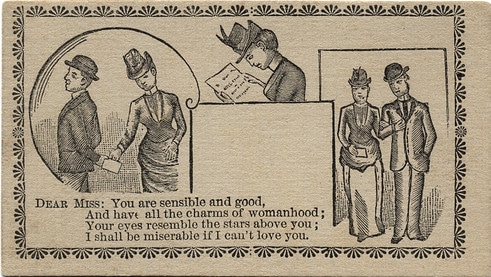
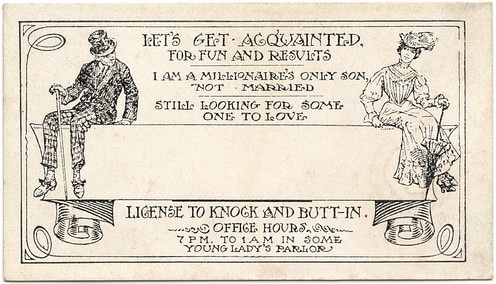
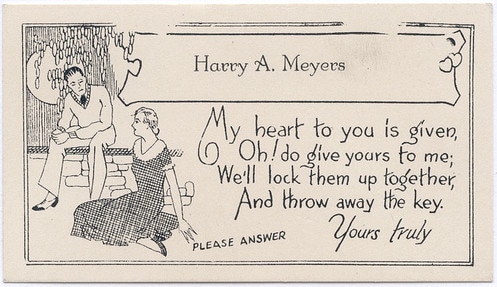
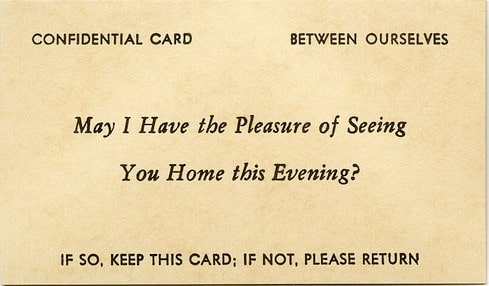
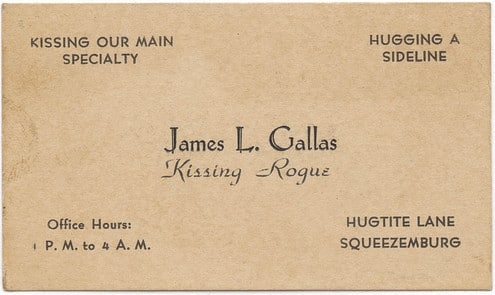
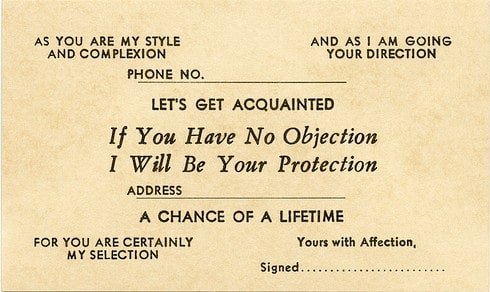
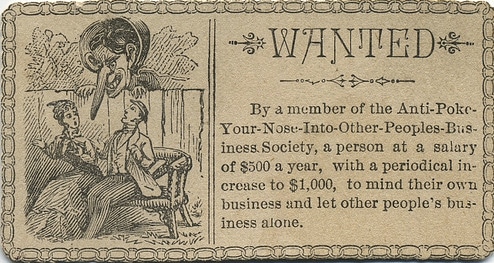
The cards were designed as a comical way for a gentleman to break the ice, start a conversation, and flirt with the opposite sex. Sometimes the humor was overt, and sometimes it derived from the way the messages parodied the formal rules of etiquette — it wasn’t actually considered appropriate to ask for your calling card back or volunteer your escorting services so directly, as some of these cards do. Their humor and directness is kind of awesome; as an icebreaker, it seems like they’d be easier for the guy, and more enjoyable for the gal, than a lot of the awkward pick-up tap and dance of the modern day.

Flickr user Alan Mays has amassed a delightful collection of these old acquaintance cards, along with some similar novelty cards from the mid-20th century, and has allowed us to feature them here. Enjoy and hand them out to all the lucky ladies you meet today. They’re guaranteed to get you a date!*

acq4

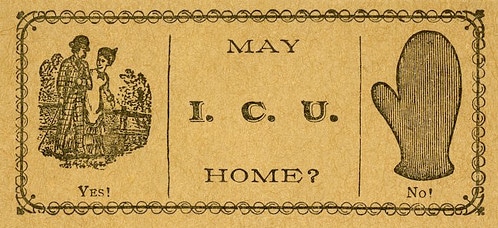
Ah, here we have the 19th century equivalent of the “Do you like me? Check yes or no” middle school love note. In old fashioned slang, “to give someone the mitten” meant to reject them or end the relationship. One wonders how the card was used…did you give it to a lady and she returned it folded to reveal her answer? Source: Alan Mays

acq6

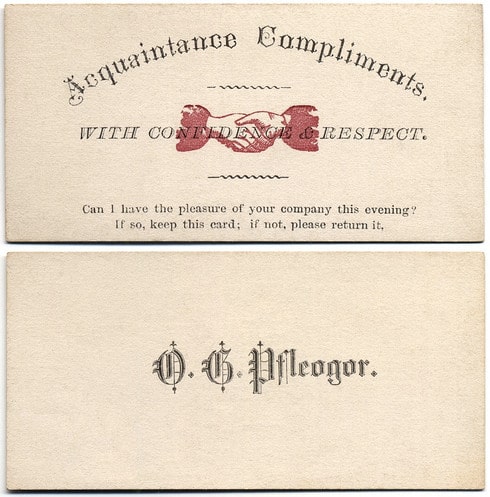
This is the only acquaintance card Mays has come across where the man’s name is printed on one side, in the manner of a calling card. Perhaps Mr. Pfleogor had a bunch made and handed them out liberally to all the ladies. Source: Alan Mays

So ladies, how do you know if a fella is flirting with you? He gives you a card that says so. Duh. Source: Alan Mays

So ladies, how do you know if a fella is flirting with you? He gives you a card that says so. Duh. Source: Alan Mays

acq12

I hear the weather is wonderful in Squeezemburg this time of year.  Source: Alan Mays

acq16

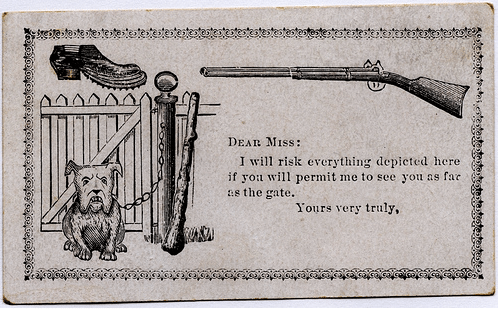
For the bad boy, naturally, who wishes to get right to the point. Source: Alan Mays

acq

And finally, should your acquaintance card distribution win you a date, here’s a card to hand out to those who are always digging for details on your romantic conquests. Source: Alan Mays

 *Guarantee valid for time machine users only. Expires February 15, 1889.

13 Feb 17:59

Google hangout with Lloyd Kahn, master urban homesteader

by Mark Frauenfelder
wskent

MEGHAN! READ THIS. THEN VISIT BOLINAS!

Kevin Kelly is doing a Google Hangout with Lloyd Kahn today at 5pm PT.

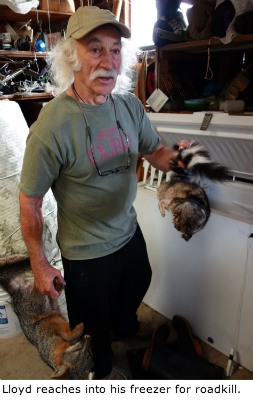
Lloyd is one of the coolest people I know. He lives in a beautiful wooden home in Bolinas, California, that he built himself from salvaged materials. He homesteads, heating with wood he scavenges from windfalls along the road, growing organic veggies in his raised beds. He’s kept backyard chickens forever (he turned me onto backyard egg goodness). He eats roadkill. He hunts mushrooms. He makes books about homemade shelters. Runs mountain races. He visits San Francisco once a week to hear the latest music. He surfs, and skateboards. He is 79 years old!

Lloyd is a big fan of Cool Tools. He’s written a bunch of reviews for the site, and encouraged me to assemble a Cool Tools book. He worked on the original Whole Earth Catalog, where he was the “Shelter” editor, so he’s seen a lot of do-it-yourself stuff over the years. What I love about Lloyd is his enthusiasm and gumption. He is always learning new things, trying new stuff, and never letting failure stop his enjoyment. He is very young. He is also a compulsive sharer, broadcasting what he is learning for the benefit of others. I get pumped up each time I chat with him.

On Wednesday, at 5pm California time (8 EST) I hope you have a chance to see Lloyd in action. The first eight folks to sign up on this form can join us in the hangout. Anyone else can watch the conversation live stream by going to this Google Hangout link. And later there will be a recorded video on YouTube of the conversation.

We’ll talk about how Lloyd does all these cool things, how he learns so fast, what he knows about urban homesteading, his next book, and what new cool tools he recommends.


13 Feb 00:30

Hip-Hop Party Flyers

"These cats worked on big art tables and had all the tools to make these flyers by hand including those rub-on Letters, wax machines, Exacto knives, graph paper and many other tools that are extinct today in the modern artwork world." Orignal Hip-Hop Party Flyers by Buddy Esquire and Phase 2.
13 Feb 00:14

Play YouTube Videos in Slow (or Fast) Motion

by Amit Agarwal
wskent

GOOD TRICK!

The YouTube video player lets you easily change* the playback speed of videos. You can watch a YouTube video in slow motion and see the frames in more detail or, if the video is boring, you can switch to fast motion mode and skim through the video by doubling the playback speed.

You can play YouTube videos in slow motion or speed them up

You can play YouTube videos in slow motion or speed them up

[*] If you do not see the option to adjust the playback speed in your YouTube player, you are probably using the default Flash based video player. Go to youtube.com/html5 and opt into the HTML5 YouTube player.

Watch YouTube in Slow-Motion or Fast-Motion

If the option to control the playback speed is still not available in YouTube for a particular video, or if you wish to have finer control over the speed, you can always use the good old VLC Player to watch any video on YouTube (or Vimeo) in either slow motion or fast motion.

Here’s how.

Launch the VLC player and choose File -> Open Stream. Now paste the full URL of any YouTube video in the URL box and click the Open button. The video will begin to stream on your desktop inside the VLC player.

Now go to the VLC Menu bar, choose Playback and here you’ll se an option to adjust the playback speed of that video.

YouTube Video Playback Speed

The VLC Advantage over YouTube

Unlike the YouTube player where you can only change the speed by a factor or .25x, .5x, 1.5x or 2x, VLC Player offers finer control. You can drag the slide to choose any speed between .25x to 4x of the original speed.

Related tip: Watch YouTube Playlists with VLC


This story, Play YouTube Videos in Slow (or Fast) Motion, was originally published at Digital Inspiration on 11/02/2014 under YouTube, Internet
12 Feb 23:55

Netflix performance on Verizon and Comcast has been dropping for months

by Jon Brodkin
wskent

Yeah! Who needs net neutrality! I..uhh..erm..oh.

Comcast streams Netflix at just the right speed for the Slowskys.
Comcast

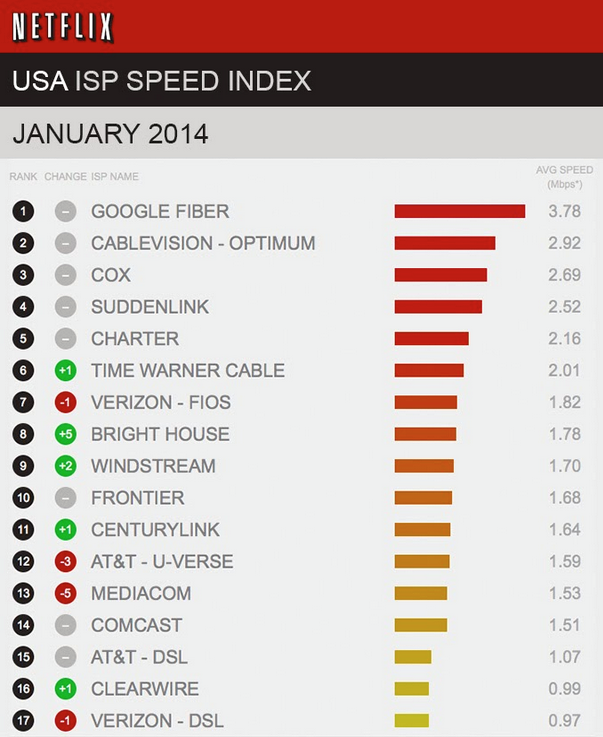
Netflix's speed rankings show that video streaming performance on Verizon and Comcast has been dropping for the past three to four months.

The rankings were updated this morning with data from January. Verizon FiOS dropped from sixth to seventh best in the US, swapping places with Time Warner Cable. Comcast stayed in 14th place out of 17 rated providers, while Verizon DSL dropped from 16th to 17th, trading places with Clearwire.

The story is really in how each provider's megabits per second changed from month to month. Verizon FiOS suffered just a tiny drop from 2.22Mbps to 2.2Mbps from October to November, but then it went down to 2.11Mbps in December and 1.82Mbps in January.

Read 19 remaining paragraphs | Comments


12 Feb 16:39

Diego Maradona's Goal of the Century

by Jason Kottke
wskent

A world cup lurks in the wings...

For Howler Magazine, Sam Markham writes about Diego Maradona's second goal against England in the 1986 World Cup quarterfinal, aka Probably The Best Goal of All Time. Markham focuses on how a pair of radio commentators -- one English, the other from South America -- called the goal.

Morales's ecstatic commentary of Maradona's second goal is itself iconic in Argentina, and his lyrical expression "Barrilete cosmico!" (Cosmic kite!) is now shorthand in Argentina and much of South America for Maradona. His narration is a frenzied mix of poetry, yelling, and sobbing that ends with a prayer: "Thank you, God, for football, for Maradona, for these tears, for this-Argentina 2, England 0."

Even if you don't care about soccer, you should give this a listen...the dude absolutely loses his shit:

An alternate view of the spectacular goal has recently been found. Oh, and my favorite weird thing about this goal: Lionel Messi is considered by many to be Maradona's heir (both are small, Argentinian, and otherworldly talented) and in 2007, at the age of 19, he scored this goal against Getafe:

As you can see in the side-by-side comparison, it's extremely similar to Maradona's goal. Even the commentator loses it in a similar manner.

Tags: Diego Maradona   Lionel Messi   Sam Markham   soccer   sports   video
11 Feb 18:06

Black and White Photography by Ho Fan


Found by crephoto
10 Feb 22:53

2014 Sony World Photography Awards


Found by crephoto
10 Feb 22:52

Beers_large


Found by nathangodding
07 Feb 16:31

Toxic Avenger's brilliant rant about the importance of Net Neutrality

by Cory Doctorow
wskent

Need ma memes. Don't mess with the innanet.

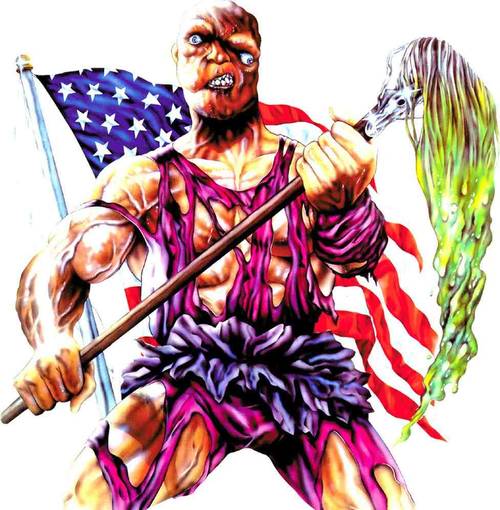
Lloyd Kaufman, cofounder of Troma Entertainment (the people who brought us such films as the Toxic Avenger) has a brilliant, profane, and stirring editorial in support of Net Neutrality on Techdirt. Kaufman explains how an open Internet is the only competitve hedge against the communications giants that own "cinemas, newspapers, T.V. stations, radio and even Broadway 'legitimate' theaters." Thanks to the failure of the FCC to give Net Neutrality their full protection, and the court ruling that gutted the FCC's weak protections, Net Neutrality is in real trouble. Kaufman's editorial a great arguments for its preservation.

The giant devil worshiping international media conglomerates want to create a super highway with expensive prohibitive tolls with faster and better internet for themselves. This will make it impossible for independent artists or innovators because they simply can’t compete. The result will be similar to US television, where the biggest companies own the networks and cable systems etc. and air constant iterations and reruns of their own content. It will become harder to get anything independent into the consciousness of the public. The Internet will become an NBC-ABC-CBS kind of world unless we the people take action.

In 2010, the Federal Communications Commission (FCC) created the Open Internet Order which set anti-blocking and anti-discrimination Network Neutrality rules. While the FCC claimed the rules would protect Open Internet, many of us Net Neutrality advocates felt the proposed rules had many loopholes and were made with the purpose of winning support from the telco lobbyists. Of course, we were right. The FCC stated that the rules would make it illegal for ISPs such as Verizon to block services or charge content providers like Netflix for faster Internet highways to their customers. Now, just a few weeks ago-the rules were invalidated by the US Court of Appeals for the District of Columbia because the FCC chose years ago to classify broadband providers in a manner that exempts them from treatment as common carriers and therefore has no right to regulate them.

Innovation And Our Better Future Depend On Preserving Net Neutrality [Lloyd Kaufman/Techdirt]


04 Feb 21:43

Namibia's vintage guru on fashion, thrifting, and Namibian style

by Cory Doctorow
wskent

FASHION!


Loux the Vintage Guru's Tumblr is full of photos of snazzily dressed models clad in the vintage clothing Loux discovers in the markets of Namibia and the styles he creates based on them. In a revealing interview, Loux (a self-described "hipster") vividly describes the process of thrifting in Nambian markets, and the fashion potential he's unlocking by reimagining the clothes of his parents' generation.


From a young age, I was inspired by my late grandfather, the old man always dressed in suits and shiny shoes and would tell me, “my son, fashion is what you adopt when you don’t yet know who you are, make sure you are always well-dressed”. So I grew up loving fashion from childhood...

I learned from local tailors in Namibia as well as some friends I made from Japan. But I do believe the ability to design well is a God-given talent. I didn’t go to school to study it but I do have plans to further improve my skills and go to fashion school one day soon. For now, I have a very small workshop, I’m an emerging tailor and get training from professional tailors. I often use their workshops where they assist me in bringing my pieces together...

I call my style sophisticated-punk, it’s a bit of a mixture, but I think true style is an expression of your day to day mood. I fell in love with vintage pieces, especially from the 1960s, and normally alter them to fit me and modernise them in my own way. Most of the suits I wear are actually my late Dad’s suits. I wear a hat with every outfit as well as vintage club ties– I think they’re both stylish and respectful.

Loux the Vintage Guru [Tumblr]

Interview with the Vintage Guru of Namibia [Messy Nessy]