The Tom Waits Map.Click on a pindrop to see the Tom Waits lyric associated with the location. (Thanks, Colin!)
wskentThis is cool. You don't have to like Tom Waits to see what a geo-nerd he is.
The Tom Waits Map.Click on a pindrop to see the Tom Waits lyric associated with the location. (Thanks, Colin!)
wskenthaha he's so crazy.

Louie Gohmert (R-Tex.) (gageskidmore / Flickr)
It was a fairly sleepy congressional hearing, the last in a two-week marathon of appearances by Federal Communications Commission Chairman Tom Wheeler before lawmakers to defend his agency's net neutrality rules. But then Louie Gohmert chimed in.
Gohmert (R-Tex.), an outspoken critic of the agency's rules that prevent Internet providers from blocking Web sites or speeding some of them up over others, exploded during a House Judiciary Committee hearing Wednesday. His voice rising to a shout, Gohmert threw a stream of accusations at Wheeler, complaining that the FCC had cut off Internet providers' ability to find new ways of making money.
"Before the FCC came in, everybody could explore new business models," Gohmert said. "You're playing God with the Internet … That's not your job.
"Congress wasn't asking you to take over the Internet," he added, referring to the FCC's congressional charter.
Wheeler didn't respond directly to Gohmert. But during the hearing, he defended the FCC's new net neutrality rules. He also noted that some Republicans agree that there is a need to put some limits on Internet providers, pointing to a bill backed by Reps. Greg Walden (R-Ore.) and Fred Upton (R-Mich.), as well as Sen. John Thune (R-S.D.).
"Mr. Walden and Mr. Upton and Sen. Thune have [proposed] legislation to ban blocking, ban throttling, and ban paid prioritization — the things we ban" in the net neutrality rules, said Wheeler. "So I think there's suggestion that people other than us" believe there is a problem.
Last month, the FCC passed strict new rules for Internet providers, voting to regulate them using the same legal tools it uses to police legacy phone service. Those rules have now been challenged by two lawsuits — one from a trade group representing Internet providers, and another from a small, Texas-based broadband company.
Catch video of the hearing here.

wskentI like this too. Blur those lines. Confuse those subjects. Keep being Finnish.
Finland is planning on phasing out teaching by subject (math, geography, etc.) and replace it with a teaching-by-topic approach.
Subject-specific lessons -- an hour of history in the morning, an hour of geography in the afternoon - are already being phased out for 16-year-olds in the city's upper schools. They are being replaced by what the Finns call "phenomenon" teaching -- or teaching by topic. For instance, a teenager studying a vocational course might take "cafeteria services" lessons, which would include elements of maths, languages (to help serve foreign customers), writing skills and communication skills.
More academic pupils would be taught cross-subject topics such as the European Union -- which would merge elements of economics, history (of the countries involved), languages and geography.
As a generalist, wannabe polymath, and obvious fan of a scattershot approach to knowledge gathering & dissemination, I approve. (via qz)
Update: From the Finnish National Board of Education: Subject teaching in Finnish schools is not being abolished.
The news that Finland is abolishing teaching separate subjects has recently hit the headlines world-wide. Subject teaching is not being abolished although the new core curriculum for basic education will bring about some changes in 2016.
(via @adamcreen)
Tags: education Finlandwskentturking is strange. #InternetEconomy
wskentlove it

You can be mad that it’s raining or you can dance in the rain! The people of Seattle have grown accustomed to a lot of rain, but rather than letting it bring them down, they have a new reason to embrace the rain. Rainworks are street art stencils made by Peregrine Church that only show up when it rains. They feature positive messages and even a rainy day hopscotch game. With the sole purpose of making people smile on rainy days, Church is accomplishing his mission and creating new works often.
To create Rainworks, Peregrine Church uses superhydrophobic coatings, which are biodegradable and safe for the environment. Each piece lasts four months to a year, depending on how heavily trafficked the area is. Check out more rain activated street art on the Rain.Works website. You can also follow them on Facebook.


wskentthe 1s and 0s in me bristle with excitement.
wskentPerfect black friday post.
Dear god.
wskentfuture
wskentthis looks fun. and orange.
wskentfuture
3D printing, or additive manufacturing, has the potential to revolutionize how we make things, enabling custom production of almost anything you could want. Researchers are looking into applications of 3D printing ranging from printing entire houses to artificial human organs. But 3D printing hasn’t fully caught on yet, in part due to the time-consuming nature of the process—it typically relies on building items up through a layer-by-layer approach that can take many hours. For additive manufacturing to become more generally useful, printing speeds need to increase by an order of magnitude.
A team of researchers at UNC-Chapel Hill have developed a new 3D printing process that may be fast enough to change the tide for 3D printing. Their process allows for the continual printing of objects using a liquid interface in a single step, unlike the previous step-wise processes.
To accomplish this, these scientists took advantage of a problem typically associated with 3D printing methods that relies on light to initiate polymerization (photo-polymerization): the ability to control oxygen levels. When present, oxygen reacts with the polymerizing chains, which significantly slows down the reaction. Oxygen must therefore be limited for the curing process, which hardens the product. In 3D printing, the material is typically printed in air and cured under a UV light; since oxygen is likely present, this process is slower than it could be.
Read 7 remaining paragraphs | Comments
wskentIt's kind of impossible - but I wish this article would have talked about the broader implications of these linguistic differences - like the Peru one - does lying exist? Is there less miscommuncation because of "more accurate" expectations (ie never being absolutely sure of anything you can't see)?
Oh, the things we'll never know.

I went to my neighbor’s house for something to eat yesterday.
Think about this sentence. It’s pretty simple—English speakers would know precisely what it means. But what does it actually tell you—or, more to the point, what does it not tell you? It doesn’t specify facts like the subject’s gender or the neighbor’s, or what direction the speaker traveled, or the nature of the neighbors’ relationship, or whether the food was just a cookie or a complex curry. English doesn’t require speakers to give any of that information, but if the sentence were in French, say, the gender of every person involved would be specified.
The way that different languages convey information has fascinated linguists, anthropologists, and psychologists for decades. In the 1940s, a chemical engineer called Benjamin Lee Whorf published a wildly popular paper in the MIT Technology Review (pdf) that claimed the way languages express different concepts—like gender, time, and space—influenced the way its speakers thought about the world. For example, if a language didn’t have terms to denote specific times, speakers wouldn’t understand the concept of time flowing.
This argument was later discredited, as researchers concluded that it overstated language’s constraints on our minds. But researchers later found more…
Read More…
wskenta pleasing find.
wskentThe good on the dance floor.
It was a big day for anti-bullying and body positivity today on the gool ol’ internet.
Free Thought Project writer and prominent organizer in the fight against police brutality Cassandra Fairbanks took a stand against the body-shaming of this man by 4chan users, calling on fellow anti-bullying crusaders to help her track down the dancing man in the photo so she and a group of almost 2,000 other southern California women could throw him a huge, awesome dance party. They helped, he was found, and the party is on.
“Dancing Man,” read the invite. “We don’t know much about you, but a photo on the internet suggested that you wanted to dance and were made to feel like you shouldn’t be.
We want to see you dance freely, and if you would have us, we would love to dance with you.
We are prepared to throw quite the dance party just for you, if you’d have us.
To be clear, it’s 1,727 of us. And we are all women.
If this isn’t appealing, we are ok with taking no for an answer, but we’d like you to know- the offer stands.
May we have this dance?”
Dancing Man’s real name is Sean and he lives in London. When he saw the invite and realized he was an overnight internet darling he immediately responded that he’d love to join Cassandra and co. in LA for a dance-off. Cue tears. Cue his bullies feeling like jerks and hopefully learning from their mistakes. Cue Pharrell asking for an invite to the party.
Never forget the day that #dancingman was found and the internet wept with tears of cyberjoy. The web may often feel like a breeding ground for hate, but its equally proven potential for viral positivity and support is a happy antidote.
wskenthumanity's list of exploratory badassery:
dwarf planet: check
pluto & moons (july)
wskentFINALLY.
Map maker Javier Arce created a world map locating 212 cities referenced in 7,681 pop songs. Click on a city and you can instantly play the related songs through Spotify.
Read the restwskentI really enjoyed this too: http://www.theguardian.com/commentisfree/2015/mar/06/harrrison-ford-movies-hans-solo-indiana-jones-star-wars?CMP=share_btn_fb
Larger than life: "Look: I don’t just want Harrison Ford to successfully land his malfunctioning plane on a golf course; I need Harrison Ford to successfully to crash land his malfunctioning plane on a golf course."
wskentguys this is as good as it is important which is to say IMMENSELY.
The voices we generally hear on public radio reflect only a narrow range of experiences, particularly with regards to race. There’s a cost to that.
wskentHey, guys. LUMBER! All your questions answered!
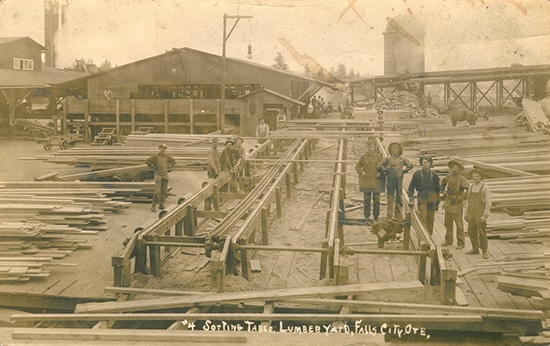
As I’ve mentioned in previous posts over the years, while I’m not the handiest or craftiest guy, I do make an effort to expand my DIY skills when I can. One thing that often leaves me scratching my head is purchasing lumber whenever I take on a project that requires it.
You’d think lumber would be simple; it’s just going and buying a piece of wood, right? But it’s surprisingly complex. There are so many choices that, even with a supply list in hand, I often find myself wandering the lumber section at the home improvement store for 20 minutes trying to figure out which pieces of wood I should buy. Common board? Structural? C or D grade plywood? Pressure treated?
Whenever I’ve done research on lumber, I could find some of the information that I needed in one place, and some of it in another. But I could never find one comprehensive resource that offered all the nitty gritty in a single location. So to consolidate everything for my own purposes, and for our readers, I decided to write this article. I realize most of you won’t be reading through this for enjoyment; what I hope is that you’ll be able to file it away, and refer to it whenever you have a lumber-related question of any kind.
Strap on your tool belt, and let’s do this.
There are two types of lumber: softwoods and hardwoods. Softwood lumber comes from conifer trees like pine, fir, spruce, and cedar. These woods get their classification for a reason; they can be easily dented with just your fingernail. Softwood lumber also absorbs and loses moisture much easier than hardwoods, so extra care must be taken to maintain the wood’s stability over a lifetime. Pressure treating softwood is one way to maintain its soundness when exposed to the elements. More on that later.
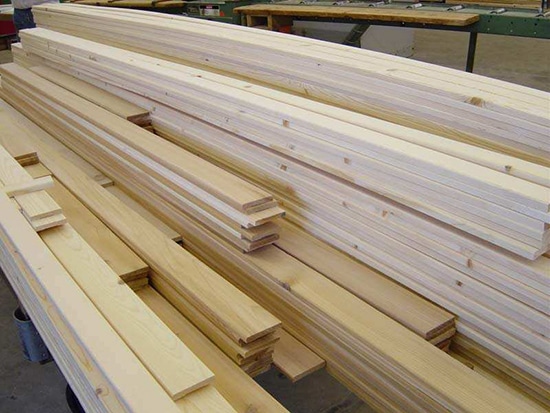
Softwood lumber
Softwood lumber is cheaper because conifer trees grow faster than hardwoods. Consequently, softwood lumber is primarily used in construction, like in framing a house or building a deck. If you’re going to do a home DIY project, you’re likely going to use softwood lumber. You can find it aplenty at your local big box home improvement store.
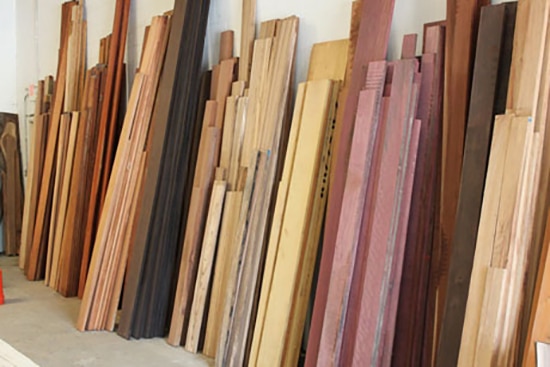
Hardwood lumber
Hardwood lumber comes from deciduous trees, which have broad leaves that fall off in the cold months. The most common trees you’ll see hardwood lumber come from are oak, maple, walnut, hickory, and mahogany. As you can gather from the name, most hardwoods are harder than softwoods (with the exception of balsa wood), and they aren’t as easily dented.
Hardwood trees take a much longer time to grow to maturity, so the lumber they’re turned into is much more expensive than the softwood variety. Consequently, hardwood lumber is typically used in fine woodworking, furniture construction, cabinetry, and flooring. If you want to get into woodworking, you’ll primarily be using hardwoods. Big box hardware stores don’t stock much of it though, so you’ll often have to visit a specialty woodworking store or a lumberyard to purchase it.
With the basic distinction between softwood and hardwood lumber out of the way, let’s get into the nitty gritty of each type.
Because every tree is different, individual pieces of lumber will show a wide range of quality in strength. To ensure that the right kind of lumber is used for the right job, the U.S. Department of Commerce established the American Softwood Lumber Standard.
There are three broad classifications of softwood lumber: Yard, Structural, and Shop and Factory. Let’s take a look at each of them in detail.
Yard Lumber
Lumber intended for ordinary construction and building purposes. Yard lumber is usually graded visually, meaning that an inspector looks at the lumber’s appearance to give it a grade. Yard lumber is broken down into two further categories: common and select.
Common Yard Lumber. Common lumber is suitable for construction and utility purposes, and is graded using a number classification:
Select Yard Lumber. Select yard lumber looks much nicer than common lumber because it has no or very few knots. Because of the fine appearance of select yard lumber, it is intended for natural and painted finishes.
Select yard lumber is graded using a letter classification:

Visual of the various grades. Note how they get uglier and uglier. No. 3 can still be a good piece of wood, it’s just not as pretty as No. 1.
Structural Lumber
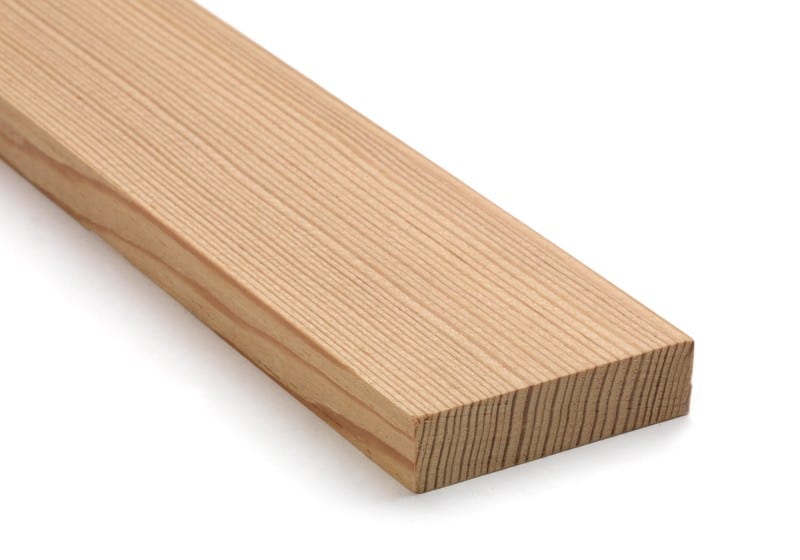
If you’ve ever bought a 2×4 or a 4×4, you’ve bought structural lumber. Structural lumber follows a standard dimension for thickness and width. In America the “two-bys” (2x4s, 2x6s, 2x8s, 2x10s) and the 4×4 are the most common structural lumber sizes (though we’ll see in a bit that a 2×4 really isn’t 2 inches thick and 4 inches wide). While the thickness and width is standard, the length is not. You can have a 2×4 that’s six, eight, or even ten feet long. It’s still a 2×4. The standard pre-cut sizes allows carpenters and house framers to buy lumber without having to do as much cutting when they get it to the construction site.
Because structural lumber is heavily used in construction, it’s often machine stress graded so that builders know the bending stress of the board. It can be visually graded, too.
Structural lumber is classified into seven categories:
1. Light Framing. Lumber that’s 2 to 4 inches thick, 4 inches wide. Graded as either Construction, Standard, or Utility. Here’s what those designations mean:
| Nominal Width | Anywhere on Wide Face | Unsound or Loose Knots & Holes |
| 2″ | 3/4” | 5/8” |
| 3″ | 1-1/4” | 3/4” |
| 4″ | 1-1/2” | 1” |
| Nominal Width | Anywhere on Wide Face | Unsound or Loose Knots & Holes |
| 2” | 1” | 3/4” |
| 3” | 1-1/2” | 1” |
| 4” | 2” | 1-1/4” |
| Nominal Width | Anywhere on Wide Face | Unsound or Loose Knot & Holes |
| 2” | 1-1/4” | 1” |
| 3” | 2” | 1-1/4” |
| 4” | 2-1/2” | 1-1/2” |
2. Structural Light Framing. Lumber that’s 2 to 4 inches thick, 2 to 4 inches wide. Graded as Select Structural, 1, 2, or 3. Here’s what those designations mean:
3. Studs. Lumber that’s 2 to 4 inches thick, 2 to 4 inches wide. Graded as Stud.
4. Structural Joists and Planks. Lumber that’s 2 to 4 inches thick, 6 inches and wider. Graded as Select Structural, 1, 2, or 3.
5. Beams and Stringers. Lumber that’s 5 inches or thicker with a width more than 2 inches greater than the thickness. Graded as Select Structural, 1, or 2, with Select Structural being the strongest.
6. Posts and Timbers. Lumber that’s 5 inches by 5 inches. Graded as Select Structural, 1, or 2.
7. Appearance Framing. Broad category of structural lumber that’s at least 1 inch thick and 2 inches wide. Aesthetics govern the grading of appearance framing. The highest grades are clear or nearly clear of any knots or blemishes. Appearance framing lumber is used in paneling and siding.There are two primary grades of appearance framing: Finish and Select. Finish grade is higher quality than Select.
Finish grading is only available in lumber from Douglass Firs and Hem-Firs. The grades are Supreme, Choice, and Quality.
Select grading applies to all Western softwood species. The grades are A, B, C, and D:
Shop and Factory Lumber
This is lumber that’s selected for “remanufacturing purposes and intended for non-structural applications.” Doors, ladders, pencils, molding, and boxes are typically made from shop and factory lumber. The grading will vary depending on how it’s going to be used. So shop lumber that’s used for doors will have a different grading system than shop lumber used to make pencils. While each use has a different grading nomenclature, the grading is typically based on how much high-quality wood you can get from that piece of lumber for an intended use.
In addition to grading the quality of the lumber, lumber grading associations also report the moisture content at the time the wood was turned into lumber (“surfaced”). This is important to know because as a piece of softwood lumber dries, it shrinks. That can change plans for how it’s used on the job site.
Next time you’re at the hardware store picking up some wood for your project, look for a stamp on the lumber that looks like this:

STAND & BTR means it’s graded “Standard and Better” light framing. So at a minimum this piece of lumber is standard, but it could be Construction grade, too.
S-DRY means the lumber was surfaced dried.
The Triangle with D-FIR in it lets us know that this piece of lumber came from a Douglas fir.
That little stamp contains all the information that we just talked about above. So with just a glance you can know the type of tree the lumber came from, its classification, its grade, and its moisture content. Pretty cool, huh?
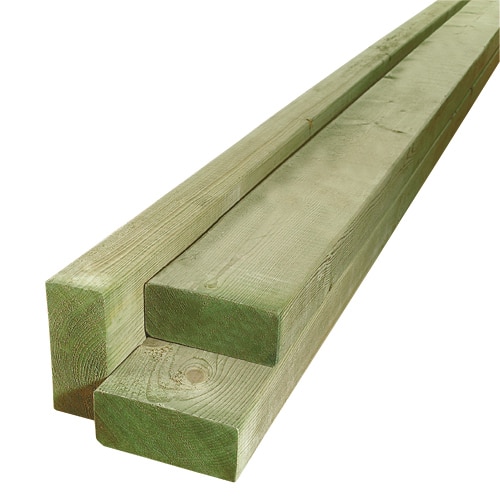
Because softwoods are susceptible to rotting from water and fungus, softwood lumber that will be exposed to the elements is often pressure treated with a chemical that preserves the wood. Things like decks, light posts, swing sets, mailbox posts, picnic tables, etc., are often made from pressure-treated lumber.
The pressure treating process is pretty simple. The wood that’s to be treated is stacked into a sealed tank. All the air is vacuumed out, causing the wood’s pores to open. A preservative chemical is pumped into a tank, and pressure is applied to force it deep into the wood’s cells. After the treatment, the wood is removed and left to dry. When you’re at the hardware store, you can tell lumber has been pressure treated by its green hue and slight dampness.
Many of the chemicals used in pressure treating lumber are classified as pesticides by the Environmental Protection Agency, so care should be taken when handling it. Never burn pressure-treated wood in your fireplace or campfire and don’t use it for mulch or compost. And you should consider washing your hands after handling it to get rid of any testosterone-sapping xenoestrogens that may be left on your skin.
There aren’t any standard widths for hardwood lumber like there are with structural softwood lumber, but there are standard thicknesses. Hardwood is cut into quarter-inch increments. Below is a chart of the standard thickness of hardwood lumber:
| Rough Size | Nominal Size/Name | Actual Dimension (in) | |
|---|---|---|---|
| (Inches) | (Fraction In) (“quarter”) |
S1S1) | S2S2) |
| 1/2″ | 3/8″ | 5/16″ | |
| 5/8″ | 1/2″ | 7/16 | |
| 3/4″ | 5/8″ | 9/16″ | |
| 1″ | 4/4 | 7/8″ | 13/16″ |
| 1 1/4″ | 5/4 | 1 1/8″ | 1 1/16″ |
| 1 1/2″ | 6/4 | 1 3/8″ | 1 5/16″ |
| 2″ | 8/4 | 1 13/16″ | 1 3/4″ |
| 3″ | 12/4 | 2 13/16″ | 2 3/4″ |
| 4″ | 16/4 | 3 13/16″ | 3 3/4″ |
Hardwood lumber classification and grading is much simpler than softwood lumber. For hardwoods, appearance is the primary factor in grading. The National Hardwood Lumber Association governs the standard grading system of hardwoods in the United States.
There are four possible hardwood lumber grades. Grade is determined by the amount of clear surface area a particular board has on its poorest looking side (with hardwoods one side will look better than the other). A higher grade board is long and wide with a large percentage of its area defect-free. The clear lumber can be removed from the board with a few large cuts.
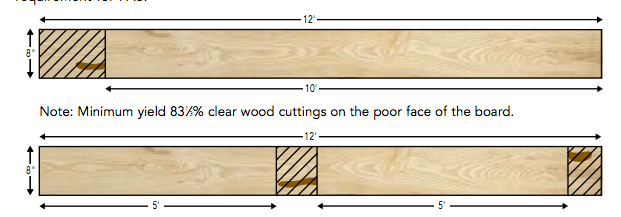
Example of a piece of FAS hardwood lumber
Different hardwoods have different criteria you look for when giving the above grades. You’ll want to check the National Hardwood Association’s website for details.
Both softwood and hardwood lumber will have defects because of the way the tree it came from grew or from how it was machined during the milling process. While lumber defects can be worked with and incorporated into fine woodworking projects, defects in structural lumber should be kept to a minimum. Be on the lookout for the following common defects:
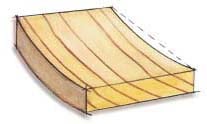
Bow. Warp on the face of a board from end to end.
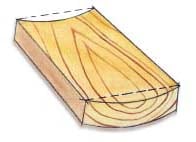
Cup. Hollow across the face of the board.
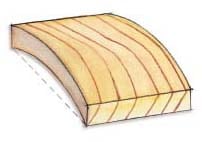
Crook. Warp along the edge line, also known as a crown. This is most common in lumber cut from the center of the tree.
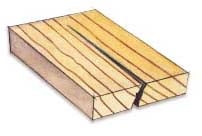
Split. Crack going all the way through the piece of wood, commonly at the ends.
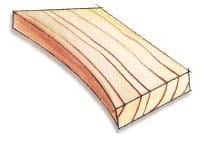
Twist. Warping in lumber where the ends twist in opposite directions.
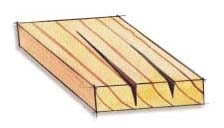
Check. Crack along the wood’s annual growth rings, not passing through the entire thickness of the wood.
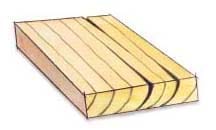
Shake. Separation of grain between the growth rings, often extending along the board’s face and sometimes below its surface.
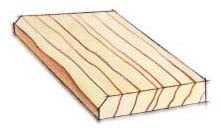
Wane. Missing wood or untrimmed bark along the edge or corner of the piece.

Knots and knotholes. Tight knots are usually not a problem. They’ll stay there. Loose knots may fall out and affect the integrity of the wood.
The most common pieces of lumber that you’ll use for projects around the house are “two-bys” and 4x4s. Again, those numbers refer to the thickness and the width of the board. So a 2×4 is a piece of lumber that’s 2 inches thick and 4 inches wide.
Except, not really.
The 2×4 (and the other two-bys) uses what’s called a “nominal” measurement. Mills typically cut a tree into lumber shortly after the tree has been felled, so there’s a lot of moisture in that piece of wood. When the mill cuts a piece of lumber into a 2×4 it actually is 2 inches thick by 4 inches wide. But as the lumber dries during its travel to the lumberyard, it shrinks. By the time you buy that 2×4 it’s actually about 1-1/2” x 3-1/2”, give or take.
So take that into account next time you’re building a project with and buying lumber.
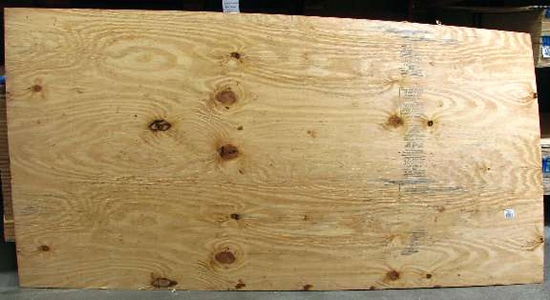
An article about lumber wouldn’t be complete without discussing plywood. Plywood is heavily used in construction jobs like flooring, roofing, and siding. If you ever decide to make your own plyometrics box for your garage gym (coming soon on AoM!), you’re going to use plywood.
The reason plywood is such a go-to material is that it’s strong, lightweight, and rigid. Due to the way it’s constructed, a single panel of plywood can span great distances without bending. Even if it does crack, it doesn’t crack all the way through.
Plywood is made by layering thin pieces of wood veneer called “plies.” Each layer is alternated 90 degrees from the layer beneath it and then glued together. This layered construction is what gives plywood its strength.
Because only one side of the plywood is seen whenever it’s installed, only one side looks nice and smooth. This side is called the “face.” The rough side is called the “back.”
Plywood can be made from softwood, hardwood, or a combination of the two. Most of the plywood you’re buying from the hardware store for projects around the house is made from softwood lumber.
There are a few plywood grading systems out there, but most of them follow an A-D classification with A being the best. Plywood is also classified as Exterior, Exposure 1, Exposure 2, and Interior. The type of plywood you choose will depend on economics, how much exposure to the elements the wood will get, and whether looks are important to you.
If you don’t have a lot of money and you don’t care if your plywood is baby smooth on the surface, go for a lower grade. It’s just as strong as the nicer looking grades.
You’ll often see plywood with two grades as in “A-C.” This means that the face side is an A grade and the back side is a C grade.
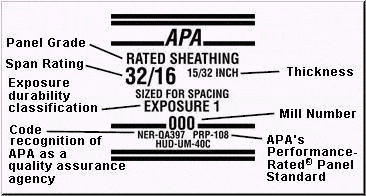
In addition to the above two classifications, plywood is also rated as Sheathing, Stud I-Floor, and siding. This just specifies what a particular end use a piece of plywood was designed for. Most of the plywood you buy from the hardware store for projects around the house like a workbench will be classified as sheathing.
As with softwood lumber, plywood will have a stamp with all this information somewhere on the board. It looks like this:
Well, there you go. Pretty much everything you’ll ever want to know about lumber. Bookmark it so you can come back to it next time you need to go to the lumberyard to buy some wood. I hope you found this useful!
Happy hammering!
______________
Sources
Michigan Technological University
Western Wood Products Association
wskent"It’s a tantalizing question in the nascent field of meme theory." Stop it. I don't know if I should fall in love or roll my eyes.
What causes a particular meme to take the Internet by storm, dominating image boards and inspiring hundreds of variations, while another one languishes?
It’s a tantalizing question in the nascent field of meme theory, and not just because the answer could shed light on our collective online subconscious. It’s also possible that research into it could eventually explain broader aspects of cultural consumption—why an entire work, perhaps even a novel or a painting, might gain a following, flop, or eventually fade into obscurity.
So far, the bulk of research into why a meme goes viral examines how its current position in a social network can be used to predict how it will continue to spread. The idea is that if you look at how influential the people are who have already shared it, their relationships to other people, and whether they shared it at a time when others are likely to see it, then you can crunch the numbers and make an educated guess as to whether it will continue to spread or peter out.
Read 13 remaining paragraphs | Comments
wskentknow your probes.

The Spaceprob.es site tracks the active probes in operation in and around our solar system, from Voyager I (19.56 billion km from Earth) to the Artemis probes (358,000 km away). (via @BadAstronomer)
Tags: astronomy science spacewskentI dig it. Let's keep dancing, shall we, internet?

The FCC voted today to change the way it regulates internet providers in the United States. Net Neutrality advocates say it's a major victory for the internet.
The post The FCC’s Vote to Protect Net Neutrality Is a Huge Win for the Internet appeared first on WIRED.

wskentEurope leads. Your move, everyone else.
wskentNB: Coffee, Massachusetts, Equal Pay.
You’re reading Significant Digits, a daily digest of the telling numbers tucked inside the news. To receive this newsletter in your inbox, subscribe.
“Birdman” took home the Academy Award for best picture last night, and it won other trophies for original screenplay, direction and cinematography. It won the most Oscars on the night, but tied with “The Grand Budapest Hotel,” which won four prizes in score, costume design, production design and makeup/hairstyling. [USA Today]
Apple’s annual R&D costs. The company has a mighty war chest of $178 billion in cash, which may be prompting the smartphone juggernaut to move into the automotive space. [Bloomberg Business]
If you haven’t already, you really need to sign up for the newsletter to be the first to learn about the numbers behind the news. I finally did, and since then I’ve lost 5 pounds, slept better and felt more confident at work. Results not guaranteed.
And, as always, if you see a significant digit in the wild, tweet it to me @WaltHickey.