Hayato is a 19-year-old Nichibi beauty school student who caught our eye on the street in Harajuku.
In addition to his short blonde hair, Hayato’s look features a sleeveless Sonic Youth shirt, Levi’s pants, and Valentino loafers. Accessories include sunglasses, a belt work as a choker, and a tote bag with the track list form New Order’s album “Unlearn This Hatred”.
Hayato’s favorite fashion brand is Vejask and he is active on Instagram.
While a lot of long-running video game series tend to be fairly high profile for most of their existence, some of them can creep up on you. In the case of A-Train (A Ressha de Ikou), Japanese company Artdink’s railway simulation game, you might be shocked to find that the series has been going since 1985 — 32 years of building a city off the back of the rails. While immensely popular in Japan, the series has rarely risen above cult status in the West — its highest profile outing was back in 1992 when the third game in the series was published in America by Maxis (and Ocean in Europe) as, simply, A-Train. A lot of its other outings in the West have weirdly been on consoles — the PlayStation got the fourth game, AIV: Evolution, as a launch title, there was a very poorly received version of A-Train HX for the Xbox 360, and there’s been a couple of handheld releases in recent times. However, the series has returned once again with Artdink announcing A-Train PC Classic for release on the Steam platform in roughly two weeks’ time.
The new A-Train is notable for having considerably older aesthetics than more recent installments such as A-Train HX that have usually gone with full 3D (often resulting in them being panned for substandard 3D graphics).. Instead, railway building in the new game is done in the classic isometric style, with a look that’s reminiscent of the earlier games in the series as well as the likes of SimCity 2000. You can choose to view your city in 3D by taking a tour of your rail track, but most of the game will be played in good ol’ 2D — this is a decision that may well help the series as it takes it away from competing with the successful and graphically intensive likes of Cities: Skylines.
The look of the new A-Train is closer to the modern handheld installments — probably wiser than trying to imitate ol’ Skylines.
Of course, A-Train isn’t just your average city building sim — it is very much based around mass transit, particularly the rail. As you build an ever more complex and efficient railway system and develop the land around your stations, your city will gradually grow with the help of the computer as important resources such as coal, iron and people are funneled in — slowly turning your area from a wet patch of grass with a railway line through it into a sprawling modern cityscape. The game can be tricky to get at first, and the actual aim of the game hasn’t always been communicated too well by Artdink — which in many ways has contributed to A-Train games often getting rather poor receptions in the West. If the game is approached as a more traditional city building sim, people are likelier to be confused and annoyed by the game — instead, the focus is on combining rails, roads and trams in a way that makes sense and helps your city to grow in terms of size and population.
The first A-Train game in the West, with glorious high-rise buildings all over. Often misunderstood then, but hopefully not now.
The new A-Train promises to do what the series has largely always been known for: There will be multiple scenarios introducing competitors who will build their own networks, the chance to develop both an overground and an underground transport system, the ability to play through various different ages from the modern era to the days of steam locomotion, the sort of intensive tutorial that hasn’t always featured in these games, integrated Steam Workshop support so you can share your creations with others, and of course — lots and lots of trains. More trains than Sabin can physically suplex, in fact. If you fancy yourself as a capable Fat Controller then barring the presence of any leaves on the line, A-Train PC Classic will hit the virtual shelves on June 8th — and who knows? Maybe people will actually get the game this time and not immediately dismiss it as just another city builder.
Oh, wow, Derek is absolutely furious here and I love it. “We left the States to get some peace… only to get this! My wife was briefly unable to open a bathroom door, which is definitely the worst thing to ever happen to an American overseas! Fuck foreign countries, man! I’m going home and running for Congress on a ‘Build A Protective Dome Around America Which Neither Heat Nor Light Can Penetrate’ platform!”
Blondie, 5/21/17
I’m giving you the whole comic for context, but mostly I’m posting this so you can understand why the phrase “WOO-HOO! BABY CAMEL GONNA CHUG SOME H₂0” will be haunting my nightmares — and, presumably, yours — for years to come.
Barney Google and Snuffy Smith, 5/21/17
But … Barney, you’re wearing a bowler cap and a vest and white gloves and you’re riding a horse and … oh, God, he doesn’t know, he can recognize that others are trapped forever in time like a fly in a spider’s web but can’t recognize that he’s in the same prison, this is a nightmare
It's okay, Switch early adopters: there's more coming. So much more coming. But, yes, software for Nintendo's new hybrid console remains a little thin, coming up for three months after launch.
And that's fine, because there's Breath of the Wild, and Wonder Boy: The Dragon's Trap, and Mario Kart 8 Deluxe, and Snipperclips, and Shovel Knight, and I am Setsuna, and Snake Pass. They're all anywhere between amazing and worth a pop. Then there are those Neo Geo oldies to explore, too. But few of these are brand new, exclusive to the system, or—just imagine—both. (Shout out Snipperclips, holding down that single-platform availability.)
Thumper isn't brand new, nor is it a Switch exclusive, having come out last year for the PS4 and PC. But it is out, now (now being May 18), for the system, and let me tell you something, Switch owner with a hankering to stick something fresh into that please, oh please, oh please don't get scratched screen: Thumper is freaking awesome.
Made by two-person indie studio Drool, Thumper is a rhythm-action game unlike most. To look at it, it appears simple: you steer a metallic beetle down a testing track that's full of sweeping twists and deadly traps. Press the right buttons at the right times to maintain the momentum, stick those sweet spots, and avoid blowing apart into hot beetle chunks.
And it's not like you need the game to appreciate its brilliant soundtrack, given its availability on streaming services and the like. As one of the two people behind Drool, beside programmer and designer Marc Flury, Lightning Bolt bassist Brian Gibson has realized an OST that pounds with the kind of primal energy his band is so famous for, yet exhibits a restraint, a very delicately balanced sense of control, that prevents it from ever freewheeling into chaotic cacophony.
But it's really when these elements are combined, the mesmerizing art and sheer speed of the experience with the senses-rattling audio—all of its do something cues appropriate thumps and clangs, screeches and drones—that what looks like a cool little game becomes a crucial addition to anyone's catalogue.
Assuming, that is, that person has an occasional penchant for music games—much as I'd like to say that anyone from shooter mainstays to puzzle fiends will get a kick out of this, you do need an (at least elementary) understanding of rhythm to get ahead.
Play with the sound quiet, barely there, and you'll do okay for a couple of stages. After that, though—Thumper demands to be cranked up, its volume pushed as high as polite society will allow on a commute, 'til the Switch's own left and right rumbles are drowned out by the crashing and the crunching. Otherwise you may not hit those beats, those pulses, those little lights of hope and salvation—and you need to hit them, or you'll be taken by the beasts that lurk at every level's end.
It's just… Damn, when it's hitting that flow point, that perfect space where the player and the played click into harmony, and spikes are soared across and bends taken like a champion racer, Thumper just sizzles. It spits. It sings. And your hands, they get sweaty. Like, been-caught-stealing sweaty.
Taken out in handheld mode, for a commute, Thumper boils the blood like no amount of miss-your-meeting delays ever could—in a good way. It's never as intense as the PlayStation VR version (I mean, little is)—but after 30 minutes with Thumper, my Switch needed a couple of minutes to cool down, and wipe the perspiration away from its still-shuddering Joy-Cons.
If you've not (and you now can), you should probably play this game, is what I'm saying. There's a reason why Thumper was one of Waypoint's most celebrated games of 2016—it featured in Patrick's top ten of the year (at two!), and my own. It rocks, so hard, so fast; so let it rumble and tumble you and your Switch for a while, until you're suitably sweated out.
People familiar with the matter said the company's upcoming Animal Crossing app will hit shelves in the second half of 2017, and will be followed up by the rumored Zelda title. ...
The Singles Jukebox is home to a talented roster of writers from around the globe with passionate, critical voices dedicated to the spectrum of modern music. We are an unpaid collective with a friendly community and many writers and alumni writing professionally elsewhere. If you’re a writer interested in exploring diverse genres and unfamiliar sounds we want to hear from you.
The site is seeking applications from writers with bold ideas and a willingness to tackle new subjects. We are particularly interested in writers whose voices are under-represented in music criticism and strongly encourage women and people of color to apply. All are welcome to apply, including those who have previously expressed interest in writing for the website.
If you are accepted, you will be free to choose how often you write for the site and on which songs, but as a guide we are looking for those able to write about at least two songs a week.
If you’d like to be considered, please submit the following as an email to info@thesinglesjukebox.com(no attachments, please) by midnight at the end of May 27th:
1. Two blurbs on songs of your choosing from the following list:
2. A blurb on one of your least favorite songs of the year so far.
3. A blurb on a song from this year that we haven’t covered.
4. A sample of your writing — this could be anything from a published review to a blog post you’re proud of — anything you think represents the best of your work. If you don’t have anything suitable, please add a blurb for a third song from the list.
All blurbs should be up to 250 words of clean, concise copy (there is no minimum word limit) and include a score from 0-10 that is well justified by the writing. If you have questions, send an email to info@thesinglesjukebox.com. All submissions will be considered, and we will respond to all applicants.
In Harajuku, we met Patty Toyama, the drummer for the popular band, MJR-Cookie. Her red and yellow decora street fashion caught our eye.
Patty’s look features a yellow and orange print hoodie, and a red skirt over pants, all of which are from popular kawaii fashion brand, 90884. Yellow boots, a pink backpack, and colorful decora accessories from Claire’s, Yoshida Beads, and SOL x Kurebayashi x Miyamo complete her ensemble.
Patty’s favorite brand/shop is Listen Flavor and she listens to Trix. She is active on Twitter and Instagram.
Sat surrounded by a clamor of whirring gears and juddering motors, Tim Hunkin is quietly prodding his wrist with a finger of his other hand.
"Me and a friend from America realized it would be a good idea to have a machine where you put your hand in, and some little rod comes down onto your wrist, and pokes away, up and down, before leaving a sort of fake bloody mark, and telling you 'chip implanted'. Only thing is, I haven't got a clue what to do with that idea," he says quietly, before breaking into an understated grin.
Hunkin is the engineer, designer, mischief-maker and perhaps-reluctant artist behind Novelty Automation, a central London arcade where the last thing you'll find is clutches of fighter players nosily trash-talking rivals.
That's because Novelty Automation happily eschews the video game form in favor of a more traditional type of coin-operated machine: The mechanical amusements that dominated fairgrounds and bowling alleys until their pixelated cousins arrived with the Atari era. The iconic Zoltar fortune-teller machine remains the most famed example of automated amusements, largely thanks to its role in Tom Hanks' movie Big.
But Novelty Automation is no public collection of vintage contraptions. Instead, it is a place where Hunkin installs his own coin-operated creations, which in most cases offer a mix of comedy, satire, and absurdity.
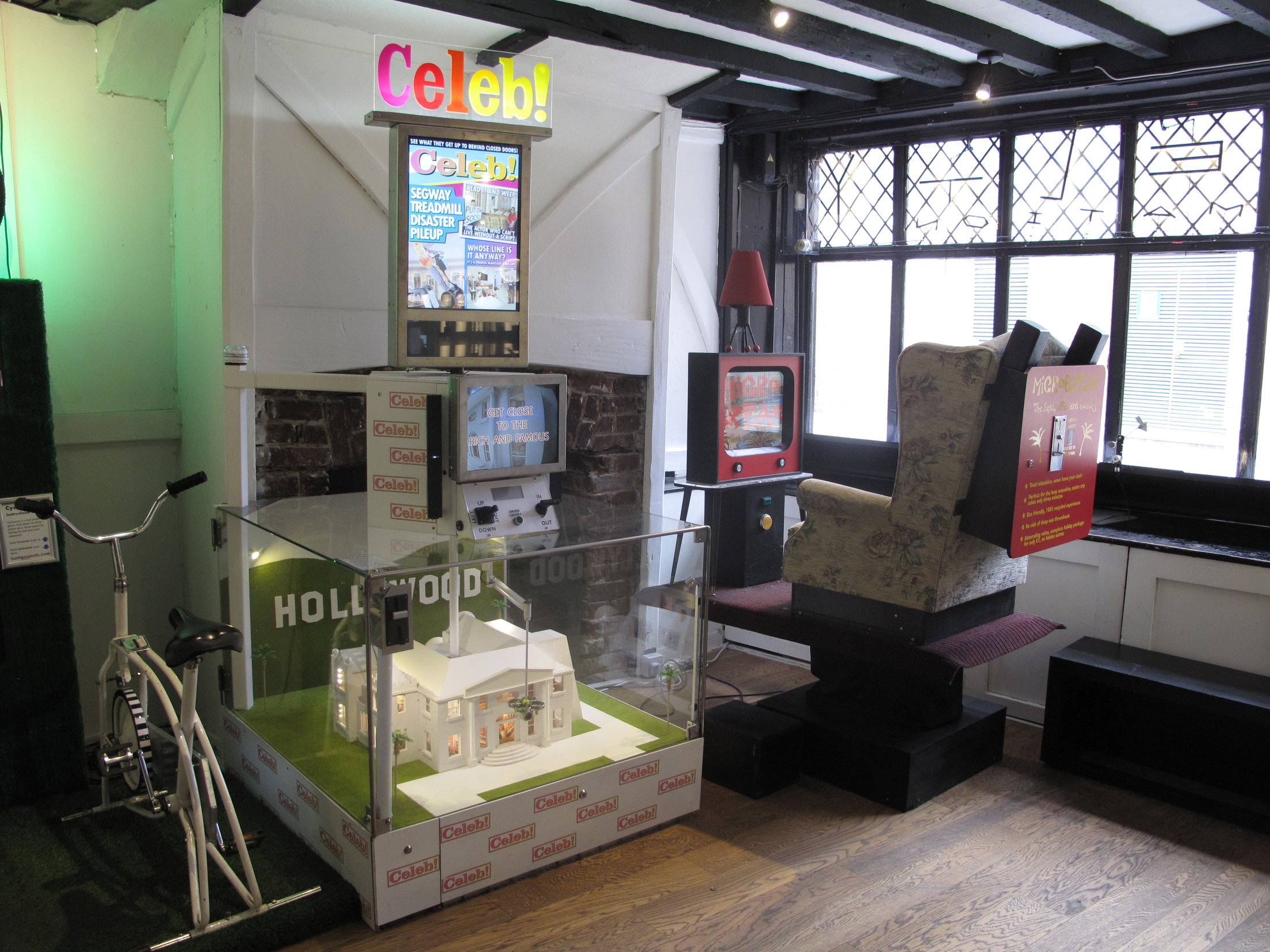
Immediately inside the door of Novelty Automation is a hulking cabinet named Celeb, where a monitor sits atop a glass box, inside of which is model of a Hollywood mansion. A tiny mock drone on a robotic arm hovers around the mansion with a camera, sending what it sees to the monitor. With a joystick and lever, players must pilot the drone and explore the structure using the viewpoint provided on the screen, zooming in through windows to secure photos for the cover of a parody of celebrity magazines.
Amidst a barrage of eccentric cut-out animations, there is a point being made. Celeb is Hunkin's exploration of issues around celebrity, privacy and aspiration, and it is unashamedly silly and cynical at the same time.
For the player, meanwhile, it is a work of magic. To steer a tiny vehicle around a dolls house, and see with its eyes, and take pictures? It's something a video games arcade can't compete with.
"The idea of coin operation just appealed to me as a way of, in theory, bypassing the art world." — Tim Hunkin
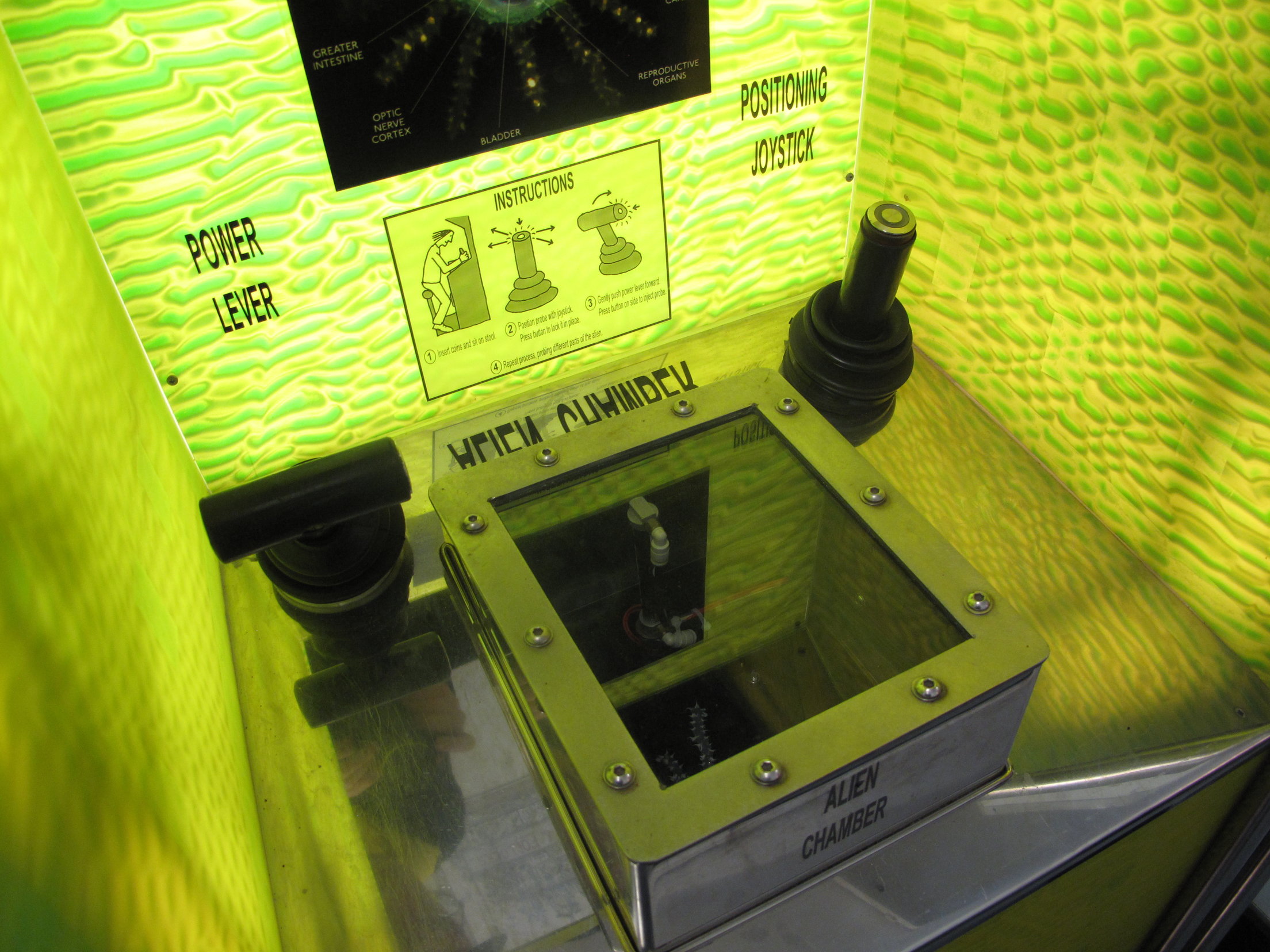
Elsewhere at Novelty Automation, which is situated in a timber-framed building on a quiet Holborn backstreet where coffee shops and office blocks rub shoulders, there are myriad other contraptions.
Instant Weightloss parodies coin-op weighing scales, and is largely an excuse to demonstrate a ridiculous, captivating mechanism that—after analyzing the player's physique via a traditional "bendy mirror"—selects, heats, pops and distributes a single kernel of popcorn as a suggested diet.
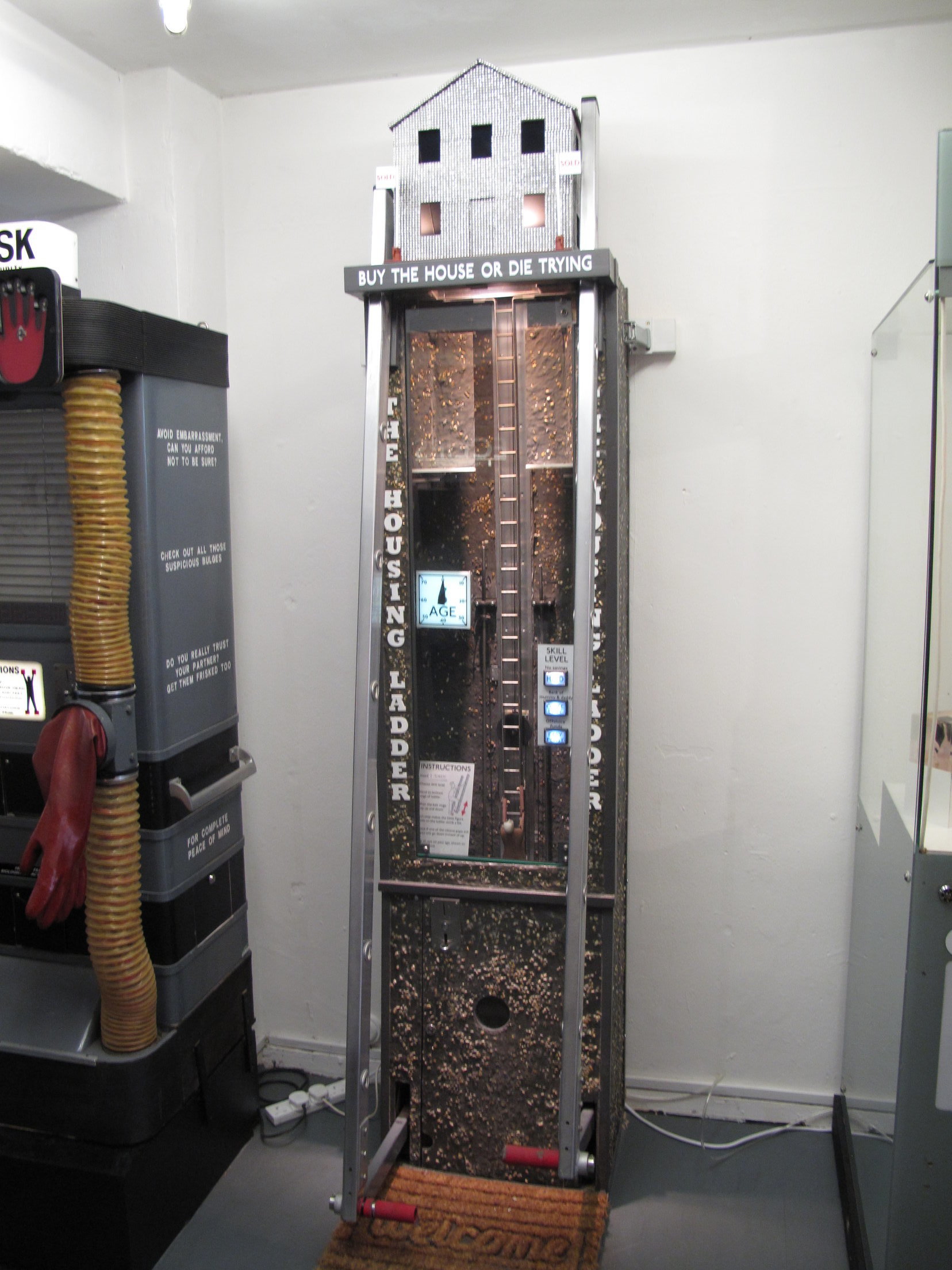
A few machines along, The Housing Ladder requires users to climb on the cabinet, and pump up and down the rungs of a ladder. Inside the machine, a small figure exactly mimics your movements, scaling a tiny ladder that leads to a model of a diamond-studded home. Investors, estate agents and others will pop out and try to prevent the ascent, making clear nods to the struggle of buying a home today.
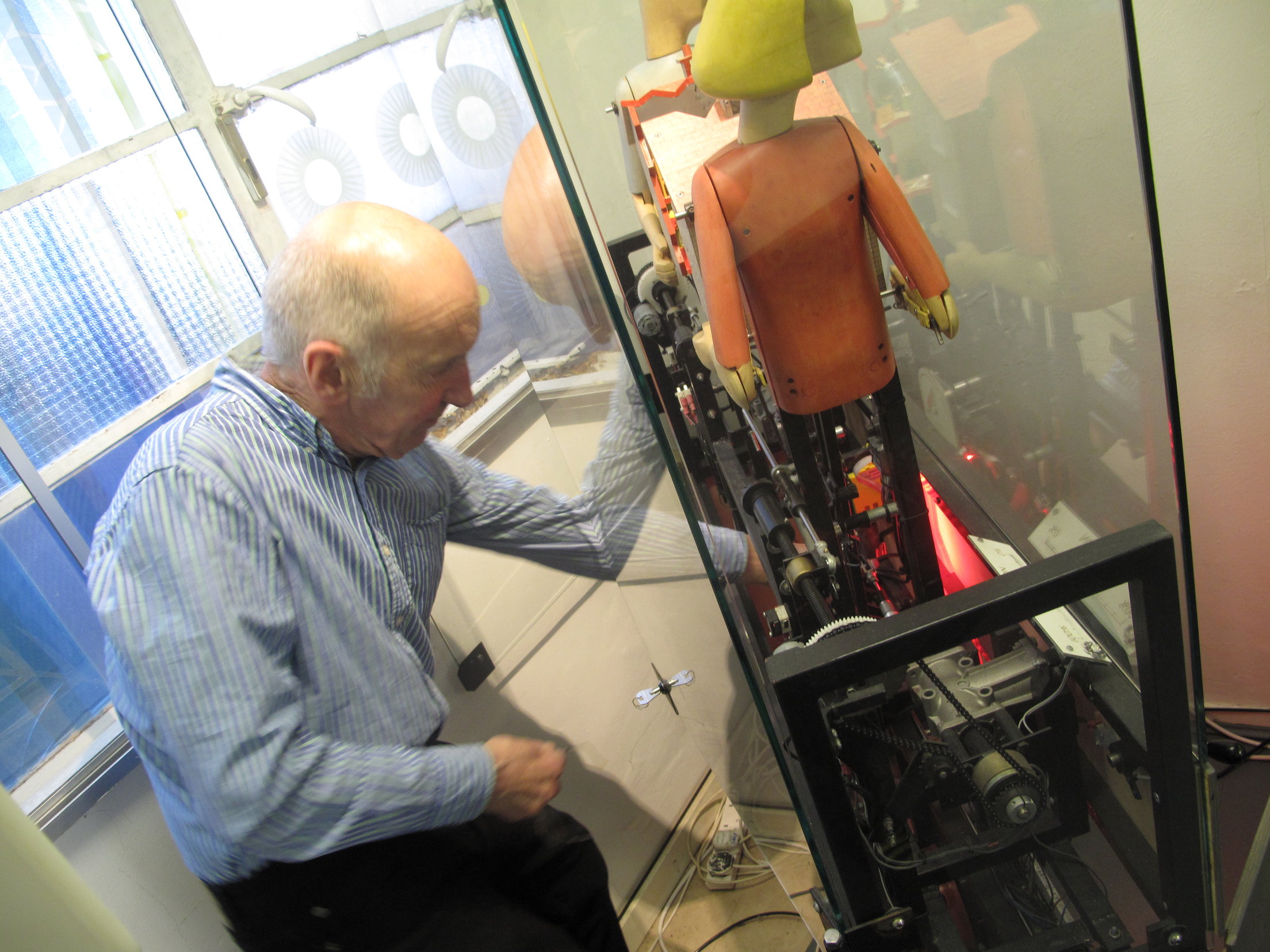
Tim Hunkin, tinkering with one of his machines at London's Novelty Automation.
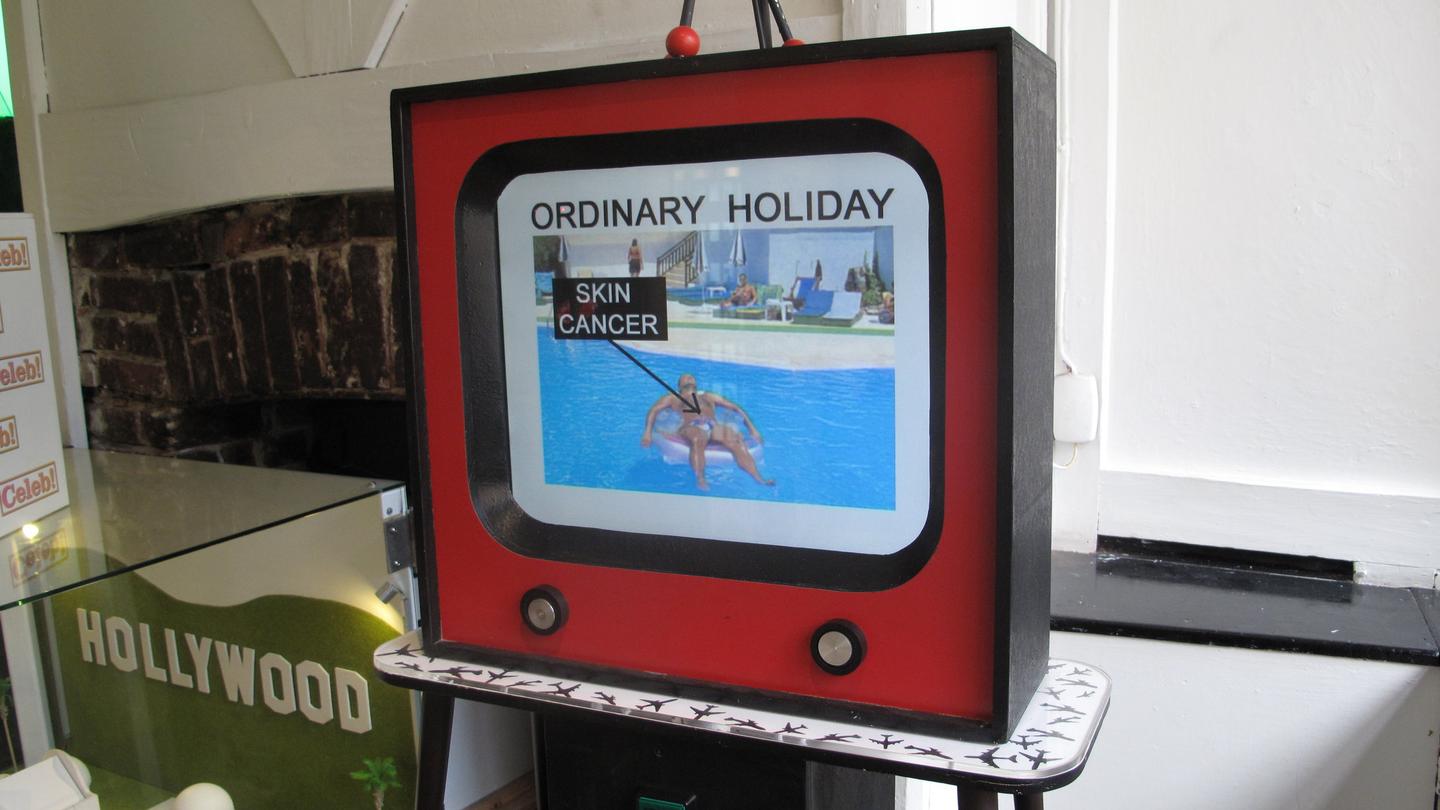
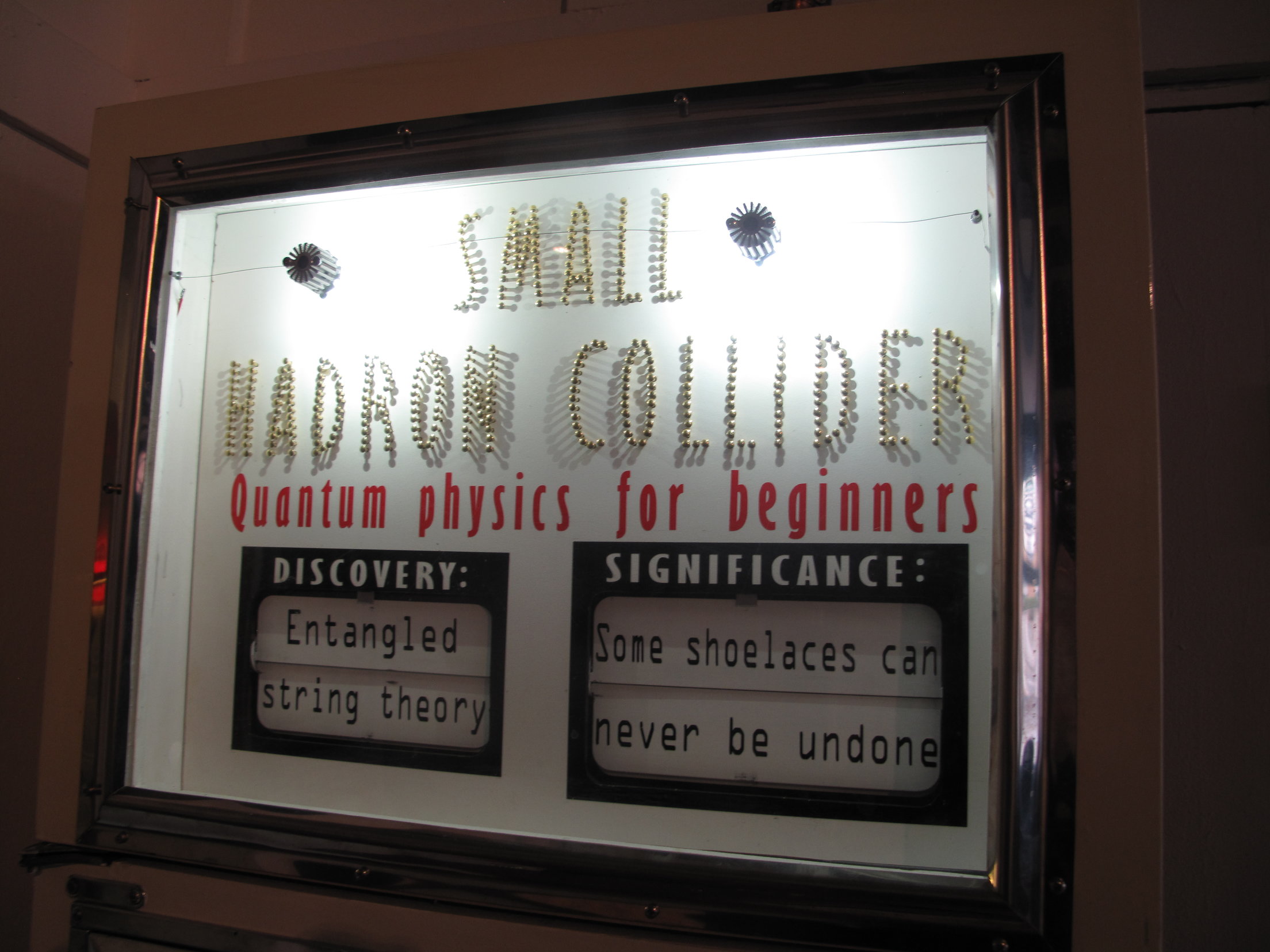
Looking around the room, there are photo booths that trick users into silly poses, chances to operate simple robotic arms to pluck fake nuclear waste from chests, and a pachinko machine rebuilt as a Small Hadron Collider which distributes its own Nobel prizes.
As for what these machines are, Hunkin can't quite accept that they are works of art. Novelty Automation, he insists, is a place to have fun and be social. It's absolutely a venue that fills with laughter and cheers when the crowds arrive, but it's equally a business for Hunkin, who has a similar operation on Southwold Pier in Suffolk. While he does specially commissioned pieces for the likes of museums, it is coins through slots that put food on Hunkin's table.
And Hunkin's motivation to toil over these contraptions? He isn't quite sure, but it is certainly in part a rejection of what he has previously described as the "elitism" of the art world.
"I just like making things, really," he explains. "I had a go at putting arty things in galleries in my 20s, but I didn't really feel I fitted in that world. I trained as an engineer, and so the art world was strange to me; there's a lot of 'emperor's new clothes' about that space, whereas I really just liked being in my workshop making things. And the idea of coin operation just appealed to me as a way of, in theory, bypassing the art world."
As well as side stepping the economy of contemporary art, Novelty Automation seems to deliberately blow a raspberry at the culture of high-end creativity. While some of the contraptions house wonderfully ornate mechanisms, plenty have knowingly lo-fi aesthetics. And while others are exquisitely crafted, there is too much of the harebrained here to trigger a chin-stroking critique. Novelty Automation is a place where feet are tickled, water is squirted, robotic rubber gloves frisk players, and being made to jump is a celebrated act.
Hunkin cites the content of Private Eye as being a significant influencer, but there's as much of the spirit of Beano and the anarchic joy of Viz in the air at Novelty Automation, which is palpable as customers squeal and gasp. And it is just that—getting a reaction from people—that seems to bring Hunkin the most joy from his work.
"There's something else about coin-op that has huge potential. If you do tempt somebody to part with their money, they're putty in your hands, because they want to get their money's worth," he muses. "And I've found you can have a lot of fun with that. With my Chiropodist machine, for example, people do take their shoe off and put it in this black hole—the treatment bay—knowing something will happen, and it's even a little bit frightening."
To give away exactly what Chiropodist does in that black hole might be to spoil things, though, because Hunkin's arcade plays with on surprise and discovery at every turn.
"I've got a good friend called Paul Spooner, and I love the [non-interactive] automata he makes, but I saw that people would smile at Paul's work. I wanted to do more than that. And it turned out, if you squirted water at [the people], they laughed. I think I just enjoyed getting that reaction."
Hunkin is an unpretentious man, but equally, he is notably mischievous. There's a glint in his eye as he watches players tackle his machines, and a smile creeps across his face whenever he talks about startling or surprising people.
And he is clearly excited about Novelty Automation's coming arrival, i-Zombie, which is due to arrive in London in June. Shaped as a giant iPhone, it provides a portal to an interactive automata that passes comment on the rise of the "phone zombie" at the expense of human interaction. You have to separate yourself from your phone to play it, by placing your precious device inside the cabinet.
"You might get your phone back," says Hunkin with a smile. "You might. Come along, and you'll find out."
Japan-based Columbus Circle is mostly a seller of clone consoles and accessories for ancient hardware, but their greatest claim to keeping gaming’s history alive is the trio of brand-new Famicom games they’ve released over the last year. Yesterday, they announced their intention to continue on this track by publishing NCS’s Kaizō Chōjin Shubibinman Zero (sometimes spelled Schbibinman Zero). But unlike 8Bit Music Power and its ilk, this isn’t an all-new game: NCS, under their Masaya brand, originally released it for the Super Famicom in 1997. But it’s not a reproduction of the game’s initial print run, either. In fact, Shubibinman Zero has never had a physical release at all until now, originally debuting as a download title for Nintendo’s Satellaview service.
If you’re reading this, your knowledge of the Satellaview is probably passing at best; it did, after all, comprise a lot of moving parts and never see release outside Japan. The heart of it was a Super Famicom peripheral supported from 1995 to 2000 in a joint venture between Nintendo and radio company St.GIGA. St.GIGA would broadcast data for games and even digital magazines from their satellite servers, which the Satellaview unit would then download into a Memory Pack slotted into a custom Super Famicom cartridge, not unlike the Super Game Boy. The distribution model was comparable to Sega’s Sega Channel and also recalled the Disk Writer kiosks Nintendo had previously placed in stores throughout Japan, where players could download Famicom Disk System games to rewritable media. But the crucial difference with the Satellaview was that you could pull games out of thin air from the comfort of your own home… Just imagine!
Some Satellaview games were designed around a concept called SoundLink, where a game could only be played during a specific time slot each week, throughout which it would be accompanied by music and voice acting streamed live over satellite radio. The logistics of this made for a bit of a disjointed experience, with the player’s time limited by the length of the performance, but it was a fascinating experiment in relating the medium of games to the shared experience of tuning in to a weekly TV show.
In addition to the main Satellaview interface cartridge, some Satellaview-compatible games were released as slotted cartridges unto themselves, using the Memory Pack to download additional content such as new stages and modes. Nintendo is known for staying behind the curve technologically, but here they were doing DLC in 1995!
As you might begin to suspect, though, all these extra features have since made the Satellaview a game preservationist’s nightmare. All the modern anxieties surrounding the lifespan of digital games locked down to proprietary systems have already come to pass here, and then some. Many games survive in emulation thanks to their ROMs being dumped, but this still leaves out the content that was never in the ROM in the first place. More ephemeral aspects of the experience, such as the broadcast music and voice acting, only endure if someone in Japan thought to make a VHS recording back in the ’90s.
Shubibinman Zero, for better or worse, didn’t explore the Satellaview’s more esoteric possibilities. But like many downloadable games, it did come built-in with a limited number of uses, similar to demos on Wii U and 3DS. Once these games were booted up a certain number of times, they would be rendered inoperable until the player re-downloaded them, and Shubibinman Zero was only available in four scattered months between 1997 and ’98. After that, any Memory Pack loaded with it had its days numbered, effectively making emulation the only sound solution…until now.
As for the game itself? It’s a two-player co-op beat-’em-up platformer, the culmination of a series that steadily evolved from the late ’80s through the mid-’90s. (The second game was localized as Shockman for the TurboGrafx-16.) It’s a bit tonally ambiguous, never quite deciding if it’s a parody of the outlandish costumes and plots of the tokusatsu genre (even the title is a joke: Chōjin sounds like the Japanese word for “superhuman” but is written with the kanji for feudal Japan’s merchant class) or merely a cute but straightforward example of it. But the confusion seems to be part of the joke to some extent, as the cutesy aesthetic occasionally gets juxtaposed with the kind of gruesome visuals found in more hardcore NCS games like Gynoug. Zero, for its part, tends toward the more lighthearted side.
Shubibinman Zero bears a copyright date of 1994 on its title screen, implying it was initially slated for a cartridge release before getting cancelled and resurrected years later for a limited run on Satellaview. No one could ever have guessed it would circle back to its original format after so many years, but that’s precisely the miracle Columbus Circle is working here. Come June 30, anyone will be able to own an official hard copy with its own cartridge, box, and all. Even if it’s unlikely to change anyone’s life, it’s nice to know it’s finally come home—no strings attached.
In Harajuku, we ran into this trio of girls – three of the producers of the new Japanese street fashion magazine FANATIC Tokyo - wearing bright and bold street styles. They are 19-year-old student Fuki Nishiya (right), 19-year-old student Haruka Kado (middle), and 19-year-old fashion student Rizna (left).
Rizna is wearing a red pleated dress from Chicago, a handmade red and black cropped top with hearts at the front, red and white striped knee-high socks, and Chinese embroidered ballet flats. Her accessories include large hoop earrings, a plaid handmade tote bag, and a bonnet with the same plaid print as her bag. Rizna loves to shop at Punk Cake and she likes listening to drum and bass music. She is active on Instagram.
At the middle, Haruka’s outfit features a leopard print top from Kilo Shop, a used/resale red knit dress, and a leopard print coat from daidai. Red socks and Dr. Martens mary jane shoes completed her outfit. Accessories include a vintage gold necklace and a red cowboy hat. Haruka’s favorite brand/shop is Punk Cake and her favorite bands include Judy and Mary, Plastics and The Rogues. Follow her on Twitter and Instagram for her social media updates.
Twin-tailed Fuki’s colorful ensemble includes pink tights, a lace and velvet onesie she bought in Shimokitazawa, and a geometric print jacket gifted by a friend. Pink ankle socks, Tokyo Bopper platforms, and a remake canvas tote bag, and accessories such as a pink ruffle scarf and knitted gloves completed her look. Fuki loves to listen to Chara, Yura Yura Teikoku and Sakanaction. Catch her on Twitter and Instagram for her updates.
Sunflower Niko and Shinkaigyo are two fun girls we met on the famous Takeshita Dori shopping street in Harajuku.
In addition to their shironuri makeup, they are both wearing McDonald’s inspired outfits that were handmade by Shinkaigyo (on the right). The items in their looks include McDonald’s hats, fast food t-shirts, and a McDonald’s french fry bag. Some accessories came from the Harajuku shop Thank You Mart.
Shinkaigyo told us that her favorite fashion designer is Vivienne Westwood and she likes Anime music and Vocaloids. Follow her on Twitter for more of her handmade fashion and art.
Introduction Please Body Don’t Conclusion Roll You are better off with essentially any Godfest as GFE are still incredibly powerful and highly in demand outside of Dark Athena requirements. Also, Godfests have a chance at Gemstone Princesses due to the fact that an appropriate Gala occurs alongside. We should also be having a Player’s Choice … Continue reading God Carnival: To Roll or not to Roll →
Ayumu and Shota are two Japanese high school students who we often see around the streets of Harajuku in 2017. They are part of a group of four young friends who are quickly gaining popularity in the Tokyo street fashion scene.
Ayumu – on the left in a cap – is wearing a UNIQLO coat with cuffed GU skinny jeans and WARP boots. Accessories include his “Exciting Territories” cap and a Gucci ring. Ayumu likes Gucci fashion and the music of Big Bang. Follow Ayumu on Instagram or Twitter.
Shota – on the right in sunglasses – is wearing a Yang Li oversized shirt over another Yang Li top with Rick Owens sarueru pants and Dr. Martens boots. In addition to his split sunglasses, accessories include silver rings by Tokyo Human Experiments and Vivienne Westwood. Shota’s favorite boutique is Sullen Tokyo. Follow him on Instagram or Twitter to see more of his personal fashion.
Dennis Beswick had always loved science, nature, and painting. After being hypnotized by Bob Ross' instructional television program in the 80s—it taught him how to use different brushes—he made his first oil painting in sixth grade. The itch hasn't left since, but there's no way Beswick could have predicted Ross would not only influence his decision to become a visual artist, but the 46-year-old would spend his spare hours modding trees for the city simulation game Cities: Skylines.
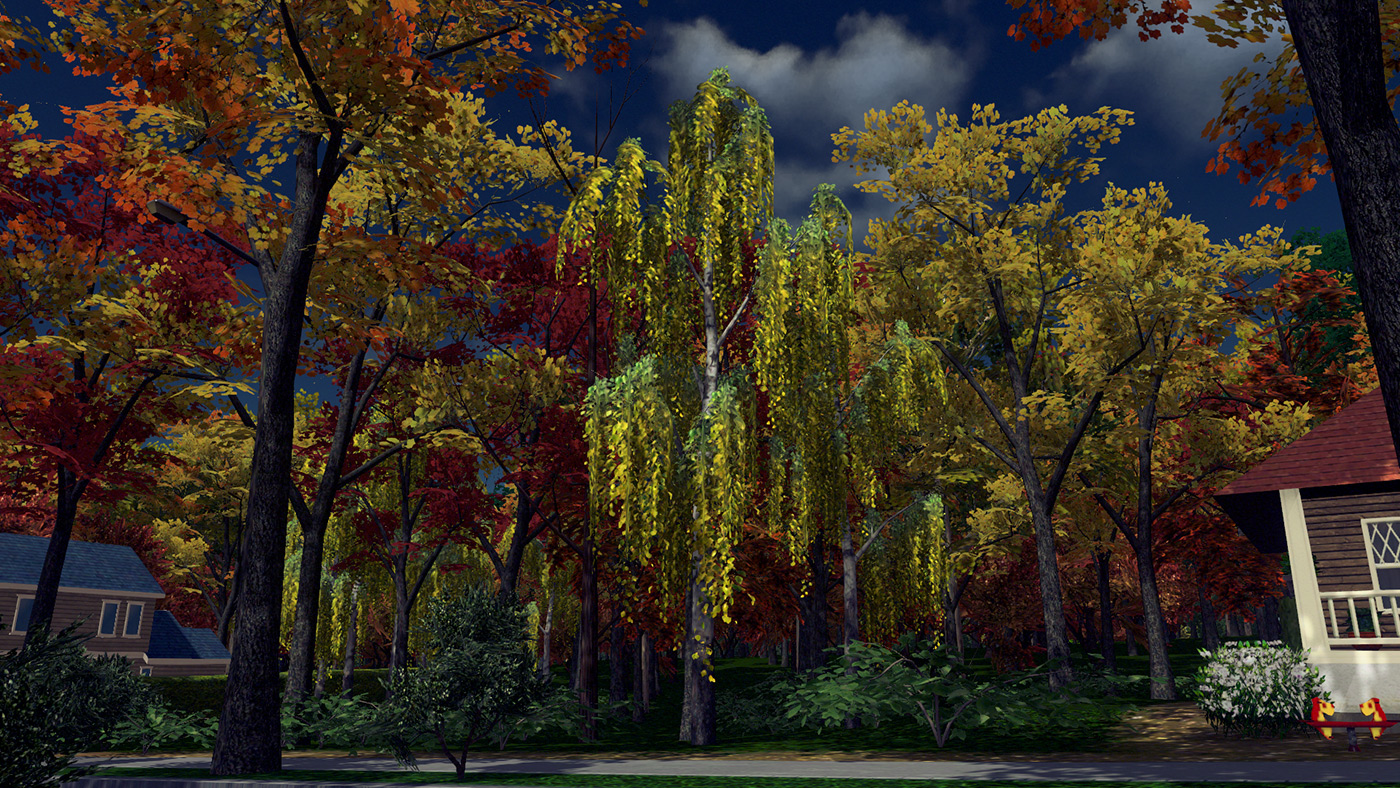
From white willows to cherry blossoms, Beswick is careful, meticulous, and thorough in his approach to crafting the often ignored but crucial accessories for other people's city design. His work is largely quiet and invisible, meaning most players who download them will, most likely, never remember who made the mod in the first place. Beswick is fine with this. In fact, he relishes being a mystery.
When he publishes a new tree, Beswick doesn't just release the model and textures. He also tries to give people downloading the mod some details on the real tree they'll be downloading, the result of the research he does while building:
Introducing the 50th tree to my collection, Roystonea regia aka Royal Palm tree! it's native to south Florida and found in central America, the Caribbean and many other tropical places around the world. It's a great ornamental tree. This is a 2 piece set with large and small versions. More Info here https://en.wikipedia.org/wiki/Roystonea_regia
"I love all of the trees you have contributed to this game," said one user about the Royal Palm. "You have made my experience with this game 300% better."
Though Beswick is primarily a Cities: Skylines modder, as a player, it might not shock you to learn he's lost countless hours to the Civilization games, too. To learn more about what makes a tree modder tick, driving them to build dozens of tree for the game, I asked Beswick to answer some questions. Thankfully, he agreed.
(This interview has been lightly edited for clarity.)
Waypoint: Though you've done visual mods of other objects, including trains and storefronts, you've made a shit load of trees. Why trees?
Beswick: My love for city building games started with SimCity 2000 and 3000. Then, SimCity 4 was my main PC game. I've been a member at Simtropolis since 2003, and been through all the heartbreaks as we waited for a new city builder to fill some of the voids we were missing. Then came Cities: Skylines. It had many features SimCity 4 was missing (like more flexible road networks, dynamic water at any height full 3D, etc.), though not as aesthetic and deep in simulation.
But the fact they supported modding out the gate gave me a lot of optimism because I know this city builder crowd. They are some of the most creative geniuses in the gaming world, and have the tendency to dig into code and bring new features—some that were thought to be impossible—and make the game almost unrecognizable from its vanilla launch. We witnessed it happen to SimCity 4 over a decade.
The biggest word for me when it comes to city builders is "creativity." Not only can we create worlds, we can immerse ourselves in Cities: Skylines via a first-person camera mod, take rides within anything that moves, as well as get some awesome screenshots. I didn't make anything for SimCity 4, but the freedom of how many tools we can use for Cities: Skylines made it so easy for me to jump right in. There's always a player posting on Reddit, Facebook, Simtropolis and Paradox that raises the bar of realism, giving a lot of inspiration not only for gameplay, but for making new assets.
Beswick's appreciation for trees extends beyond his 3D modeling work in Cities: Skylines.
Why trees? Well, not only because I love nature, but the vanilla trees just didn't cut it for me. Most trees tower over small homes and dominate the landscape in real-life, and the tree section on Steam was very much lacking in quantity, until recently, to give us more choices. Realistic looking trees are harder to make than a building with straight walls, so not many 3D artists get into the organic modeling action. When I make trees, I feel like I'm painting with the game and pushing to get a more realistic looking landscape.
Also, I look at this fact: a building can be placed once, if it's unique, or [will be] constrained to certain districts. But a tree is like clouds. They can be placed everywhere. For example, I haven't seen my Colossal Mills factory, Regal Theater or VIMs Jeans and Sneakers in a screen shot in a very long time, but I get to see my trees every day in a very large percentage of screen shots.
Waypoint: I'm guessing you must have a tree that is a particular favorite?
Beswick: It's hard to say which tree is my favorite, but I would have to say the Live Oak tree is way up there. Not only does it fill space nicely, but it's one of my big trees with a low tri count. And it's so fluffy. To be honest, I didn't know if it was gonna look good or not while I was making it. All I knew is I wanted to make a big tree that stood out in the landscape.
The reaction when it was published surprised me, and the growing subscriptions to this day makes me feel good. When I was making the Live Oak, the Bald Cypress was my favorite because it's exotic. The Live Oak was more simple, like one of those dishes you cook when you don't have much but turned out better than when you have plenty.
Waypoint: Can you talk me through some of your process? How long does it take to build a single tree?
Beswick: Making trees is fun but sometimes very challenging. The most important thing to do is find good images for texture material, which is surprisingly difficult for some species, even coconut trees, [which] you would think is all over the internet.
I end up extracting bits and pieces from images and assembling leaves bit by bit in Photoshop for many trees—painful but worth it. At first I would use Xfrog [a 3D modelling program specifically for trees and plants] to make a simple branch/trunk, export into Blender [another 3D computer graphics program] and do clean up. Then, create the leaves/branches billboards from scratch, placing them one-by-one. It's slower, but very rewarding and gives more accuracy. Lately, I have been making trees from scratch right in Blender.
The biggest challenge is getting the closest look to the real-life reference. Pine trees are the hardest because of the shapes of the branches and needles. Realistic pines are also hard to keep low poly.
I'm mostly driven by what in-game projects I have planned. I'm currently building a huge botanic garden on one map and a tropical resort on another. That's the main thing that drives my decisions in what to make next. I do take requests that just feeds me ideas for new trees in my projects, anyway. Win win for all.
Waypoint: Do you remember the first tree you worked on? Anything notable about it? And what's changed since then?
Beswick: Before making trees for Cities: Skylines, my first trees were done for architectural renders, where they are in the tens of thousands (sometimes hundreds of thousands) of polygons, with texture maps for each component and variation on the tree to look realistic.
My first tree for the game was my first game asset ever. So when I made it (the Willow Tree), it was a whole new way of 3D modeling for me, as I had to learn to do a tree super, super low poly while only using one texture map. I laugh at that tree now but it will always be my first. I have Matt Crux, a fellow modder, to thank for pushing me into the workshop and helping me with modeling techniques for the game. I hesitated to publish it, then he asked. "Are you gonna publish that?? It looks good."
Waypoint: When you release a mod, what's your next step? Do you track down people using it?
Beswick: When I release a tree or any asset, I have a drink, do my promos in various forums, think about the next project, and hope people will rate it up as they subscribe. I have a trophy folder for those that get featured.
I do watch Steam, but my biggest hunt is seeing the first screen shots from other players, which usually take a few days. I have a folder where I collect the first "spottings" of screen shots with my new trees. It's one thing to make stuff, but it's another to see what talented players do with them.
Follow Patrick on Twitter. If you have a tip or a story idea, drop him an email here.
On Thursday, 27 April, I attended a public meeting of the Somerville Redevelopment Authority (SRA) at the High School library. The SRA voted to pass the Union Square Master Land Disposition Agreement (MLDA), transferring 12 acres of property to US2, the master developer of the Union Square project. The SRA, an un-elected body appointed by the Mayor, voted to approve the transfer, despite objections raised by community groups regarding accountability on the part of US2.
The result of this vote is a disappointment, but not a surprise. Another turn of events that evening was very shocking: our city government meeting was “astroturfed” — attended by a large group of non-Somervillens expressing support for the developer’s agenda. Several pro-developer attendees claimed outright that they were not Somerville residents. One asked me where the Seventh Ward is when I told him I live here. The person handing out signs and stickers to the dozens of pro-developer attendees — a Malden resident — is an associate at The Novus Group, a firm specializing in “Disruptive lobbying for the innovation economy.” Novus’s other clients include DFER, a Wall Street-funded group working to privatize public schools and weaken teachers’ unions, and Airbnb, a corporate middleman that profits from making rental apartments more scarce — maybe you saw Novus’recent astroturf petition to the city of Cambridge on behalf of Airbnb.
They held signs made by a paid consultant, checked their phones, and clapped tepidly when the un-elected board voted to transfer public land to a private corporation. Immediately after the vote the astroturfers filed out together, a few dozen crossing the lawn and disappearing up Highland Avenue. Why had they come, these out-of-towners? Our guess: they were assembled by US2, to give the impression that the community supports the land transfer, when in fact multiple well-established groups spoke out against it. The MLDA specifically helps US2 avoid true accountability to our community in the form of a strong and enforceable Community Benefits Agreement.
Whether or not we support the Union Square development plan as written, Somervillens should be aware that outside groups who stand to profit from it are trying to play tricks on members of our planning board. We hope that the Mayor and Board of Aldermen are as insulted by this tactic as we are, and will publicly say so.
It’s well worth the nine minutes to watch. Just stunning animation (and sound). It’s crafted with a level of precision, but also whimsy, that mesh in surprising and fascinating ways.









 People familiar with the matter said the company's upcoming Animal Crossing app will hit shelves in the second half of 2017, and will be followed up by the rumored Zelda title. ...
 Strategy specialist Paradox Interactive has opened a new studio that will focus solely on mobile development. ...