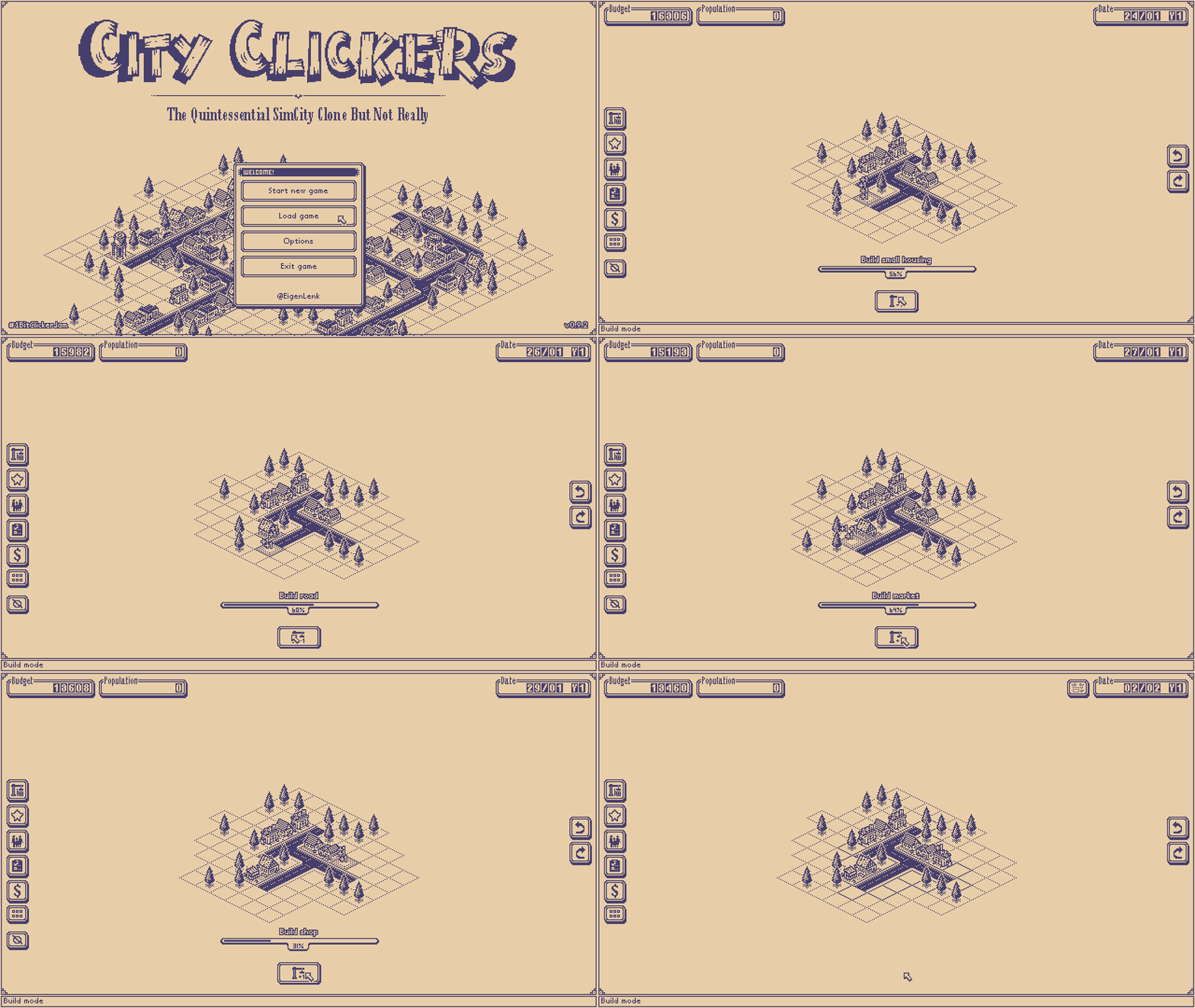
"The Quintessential SimCity Clone But Not Really" - Author's description
Download on itch.io (Windows, Mac)
"The Quintessential SimCity Clone But Not Really" - Author's description
Download on itch.io (Windows, Mac)
We often see 19-year-old art student Pyon on the street in Harajuku. Pyon was just announced as the newest shop staff at the popular Harajuku boutique 6%DOKIDOKI.
Pyon’s style on this day features a ripped sweatshirt from Faith Tokyo over a collared shirt from Chaps (used), resale Adidas striped pants, and Tokyo Bopper platform sandals. Pyon’s bag is by the Korean streetwear brand Chance Chance.
Pyon’s favorite fashion brand is MYOB NYC. Follow Pyon on Instagram for more pictures.



Click on any photo to enlarge it.
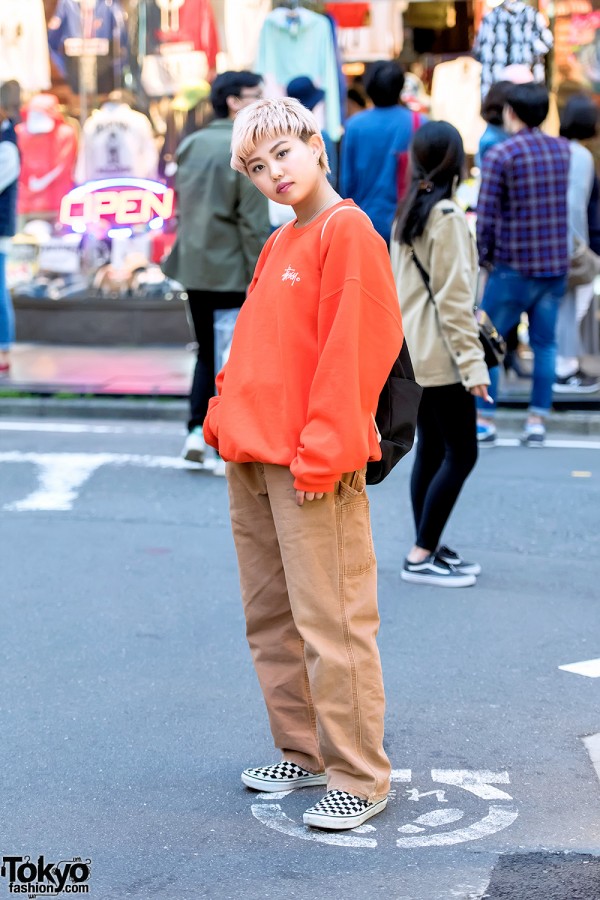
Terumi is a 20-year-old staffer at Stussy Harajuku who we met on the street in Harajuku.
Her look includes an orange Stussy sweatshirt with Carhartt pants and classic Vans checkerboard slip-on sneakers. Terumi’s backpack is also by Carhartt.
Follow Terumi on Instagram for more pictures of her Harajuku life and style.


Click on any photo to enlarge it.
lovely exploration game for iOS, recommended for fans of Windosill
 Kirby creator Masahiro Sakurai reportedly said he used a Twin Famicom console to develop the game, and had to rely on a trackball to punch in code via a sort of on-screen keyboard. ...
A little something different for Good Nintentions NES Works Gaiden this week: It’s a look at a Japanese release per usual — three Japanese releases, in fact — but these are not classic games. They run on Famicom hardware, yes, but all three have shipped within the past year. The third title in this episode shipped this month, in fact! I had to make room for it at the last minute, because the episode was already in production when my copy arrived
8Bit Music Power, Kira Kira Star Night DX, and the shiny new 8Bit Music Power Final all have their quirks, but that’s mostly to do with production issues. Rather than re-flash existing NES donor ROMs the way most publishers who produce posthumous carts do, Columbus Circle seems to have fabricated their own, and the results are rather dubious. While these carts theoretically run on original hardware, there seem to be even odds of the games either running without an issue, simply not working, or frying your hardware. The latter outcome hasn’t been corroborated, but I’m willing to believe it after my own experiences. Fortunately, the Analogue Nt Mini works great — which is not an inexpensive solution, admittedly, but I’ve come to regard the Mini as an essential piece of gaming hardware. So it’s nice that it can handle these quirky carts
That being said, however, if you ever do have the means to play them (or let them play, as the case may be), I highly recommend all three. As you can see in the video, only one of these is a proper game, but all three are really lovingly assembled and feature some spectacular music. In fact, you can look forward to hearing more of 8Bit Music Power Final on the next episode of Retronauts Radio.
Anyway, please give the video a look, and let’s hope that we’ll see more releases of similar ambition and quality (build notwithstanding) for NES and Famicom in the future.
 In order to create a fan translation free of typographical errors, a Final Fantasy V fan dove into game's code and ultimately revolutionized the unofficial translation community. ...

I didn’t really play much of Mario Kart 8 in its first run on Wii U. Much as I liked the Wii U console — that poor, benighted thing — sandwiching the joyless mundanity of Mario Kart Wii between the excellence of Mario Kart DS and Mario Kart 7 helped turn the series irrevocably into a portable experience for me. And while Mario Kart 8 proved to be every bit the equal of its immediate predecessor, if not better, its being on Wii U meant I had to play it on a television. Alas, Nintendo, I just can’t go back.
As it turns out, my reticence worked out for the best: I was, it turns out, simply saving myself for Mario Kart 8 Deluxe. Not only does the Switch’s “remastered” version compile the entirety of the Wii U’s original release and downloadable updates into a single package (along with some new content), it does so in that all-important portable format.
Yes, I know: Technically, Switch isn’t a “handheld” system. Nintendo has gone to great pains to present Switch as the Wii U’s successor to the console market, leaving ample room for 3DS as its portable offering — not surprisingly, given the remarkable 3DS lineup they’ve laid out for the remainder of 2017. And Switch’s on-the-go fluidity remains its strongest feature. It feels capable if somewhat underpowered as a console, but its makes for an extraordinary portable device.
I’m not sure if you could reasonably call Mario Kart 8 Deluxe the Switch’s killer app when (1.) Switch also has Breath of the Wild and (2.) MK8D is ultimately a marginally tweaked version of a game that launched four years ago. Technicalities aside, though, what MK8D offers is an intoxicating glimpse of the play experiences capable with Nintendo’s new handheld. Console. Handheld-console hybrid. Whatever.
Docked, MK8D doesn’t really do much to sell itself. That’s how I first experienced it at Nintendo’s pre-launch event back in January, and it didn’t do much for me then. If you skipped owning a Wii U, sure, you finally have a chance to play the excellent latest entry in this long-running racing series. And if, like me, you never bothered with the Wii U version’s extensive DLC offerings, it’s pretty nice to have all those extras available and unlocked from the start.
The moment you launch the game, it offers four dozen tracks, each playable in five different difficulty levels (including mirror mode), with enough characters to choose among to inspire envy among Capcom’s “Vs.” fighters. The DLC material included here contains some reused vintage content, of course; about half the tracks you can play on are legacy remasters from older games, spanning from the Super NES original to the dreaded Mario Kart Wii. (Turns out the Wii tracks are pretty fun when divorced from the game itself.) And you could easily cull about half the character lineup and never miss them. Does anybody really want to play as Metal Mario or Pink Gold Peach? But, on the other hand, you can also choose from a decent selection of non-Mario characters, which breathes some new life into the lineup. Some are new to this version — Splatoon‘s Inklings, for example — while others showed up as DLC add-ons to MK8. Of them all, I think Isabelle from Animal Crossing may be my new favorite Mario Kart racer, if only because she spouts her in-race taunts entirely in Animal Crossing gibberish.

The new, non-Mario material goes a long way toward freshening up the MK8D package, especially when it comes to courses. We’ve been racing through Ghost Houses, Bowser’s Castles, Luigi Speedways, and Rainbow Roads for 25 years now. And while it’s amusing to have a Yoshi-themed race track in which the speedway is shaped in the outline of the baby-voiced dino itself, I find myself drawn far more to the opportunity to cruise through, say, Hyrule (at least on something faster that a grumpy pony). It helps that these excursions beyond the Mushroom Kingdom demonstrate some of the liveliest attention-to-detail MK8D offers, such as the way the F-Zero course’s “damage zones” create drag on your kart or the fact that your coin indicator icon is temporarily replaced by a bag of bells for the duration of the Animal Crossing track.
Great as all of these details may be, though, none of this really gets to the heart of what makes MK8D so momentous: Its flexibility. It’s the first major release for Switch that takes full advantage of the system’s dynamic nature. Bomberman was fine, Snipperclips was amusing, and 1-2-Switch made for a decent icebreaker, but with MK8D we have a Switch title with near-universal appeal, a ridiculous amount of content, and substantial mechanics — and it’s been heavily revamped to allow players to enjoy competitive racing under an enormous variety of circumstances.

Fundamentally, Mario Kart games haven’t changed all that much since the Super NES original. Still, a few key moments in the series’ history stand out. Mario Kart 64‘s addition of proper 3D geometry to course designs allowed for more complex track designs and the wild unpredictability that comes in uneven race surfaces. Mario Kart DS added proper online multiplayer. And now, this: The freedom to play with others, anywhere, at a moment’s notice.
MK8D shines brightest when you play with others, and Nintendo has added in a huge number of multiplayer format options. That’s true in terms of content — the Battle Mode this time around is excellent — but more importantly, it affects how you play as well. Console-based Mario Karts have always allowed split-screen multiplayer and, more recently, online racing as well; portable Mario Kart games have always included local competitive play, along with online support beginning with Mario Kart DS. MK8D incorporates all of those options, too. But then it ups the ante. In addition to both handheld and docked wireless play, splitscreen docked play, and multi-system local wireless play, you can also play splitscreen on the handheld itself by disconnecting the controllers and using them for impromptu head-to-head racing.
Of course, this has been Switch’s sales pitch all along. But it’s one thing to watch stylish 20-somethings grinning through a manicured promotional video and quite something else to prop up a Switch on a kitchen counter, hand the Joycons to a couple of kids, and let them get to racing against one another with a single, self-contained game system. And while it’s not the 100% frictionless experience Nintendo’s demo reel would suggest, it’s nevertheless quick, easy, and completely engrossing.
I could play MK8D and weigh in on it with the perspective of a seasoned adult, but I found far more value in putting it to the test by letting my young nephews and cousins give it a go over the weekend. What I found was that, yes, the game and system both were instant hits with a gaggle of kids who until then had been aware of Switch but had little real interest in it.

The impromptu multiplayer setup isn’t without its minor snags, of course. The Joycons don’t slide as freely off the system’s core as Nintendo would like them to, and the wrist strap attachments are always a hassle to attach and remove. And even with the attachments, the Joycons are much too cramped for extended play sessions for all but the youngest of players. On top of that, the Switch’s screen itself seems pretty tiny when you’re playing at a distance greater than holding the screen directly in front of your face; arguments nearly broke out every time one of the kids tried to surreptitiously nudge the screen closer to them. But after the initial two minutes of setup (and once I laid down the law about placing the screen in between players, to be fair to everyone), MK8D remained in active use for the rest of the night. We started off with standard races, but once the younger kids with the shorter attention spans wandered off to find other amusements, the two older teens switched over to battle mode for the remainder of the evening.
It’s not difficult to imagine extending this use case to dozens of other games on Switch. Instant-match fighting games? Infuriating New Super Mario Switch multiplayer sessions? Cooperative Contra III on Virtual Console? Sign me up, for all the above.
Due to its necessary technological restrictions, handheld gaming has always felt like a format that lags a generation behind the cutting edge of console play. Switch doesn’t change that — while Microsoft and Sony are delving into 4K visuals in an attempt to remain competitive with personal computers, Nintendo’s new system doesn’t even output 1080p on a consistent basis. In handheld mode, though, MK8D‘s small-screen 720p resolution looks sharper than the game did on Wii U. And above all, MK8D delivers an experience you can enjoy anywhere, anytime, with anyone. For perhaps the first time, handheld gaming (even if the company’s marketing doesn’t refer to it necessarily as such) doesn’t feel so far behind consoles. Switch may not have the horsepower of PS4 Pro, but it breaks handheld gaming away from the one-to-one system-to-player ratio that’s always been one of the format’s greatest drawbacks and allows for an impromptu session of console-caliber gaming with almost no friction.

Granted, this potential has always been there, ever since Nintendo first showed off the Switch. It’s just that MK8D is the first release to feel like it truly makes good on it. Zelda may have been the system-seller, but MK8D demonstrates why Switch might actually live up to all those Wii-sized sales aspirations and predictions. If the kids’ reactions to my weekend play sessions are any indication, a head-to-head countertop Mario Kart race is the kind of game experience that makes true believers out of skeptics. As a game, Mario Kart 8 Deluxe perfects a long-running series; as an experience, it defines a new standard for how multiplayer portable games should work.
Not bad for warmed-over material.
playing wav files from a ramdisk gave best soundthen moved on to memory play, initially SQ was worse.
found that a function called memcpy was the culprit, most memory players use memcpy and this is one of the reasons why memory play sounds worse ie digital sounding. Fortunately there is an optimised version of memcpy, using this version removes the hard edge produced by memcpy. the other thing I did was to close the file after reading into the buffer.
also most players use malloc to get memory while new is the c++ method and sounds better.
The Patriot Ledger reports that state Rep. David Linsky (D-Natick) has filed a bill to make Roadrunner by Jonathan Richman and the Modern Lovers the Official Rock Song of the Commonwealth.
This is the third time the legislature will consider the measure. The first time, in 2013, the bill was sponsored by then state Rep. Martin Walsh (D-Dorchester).
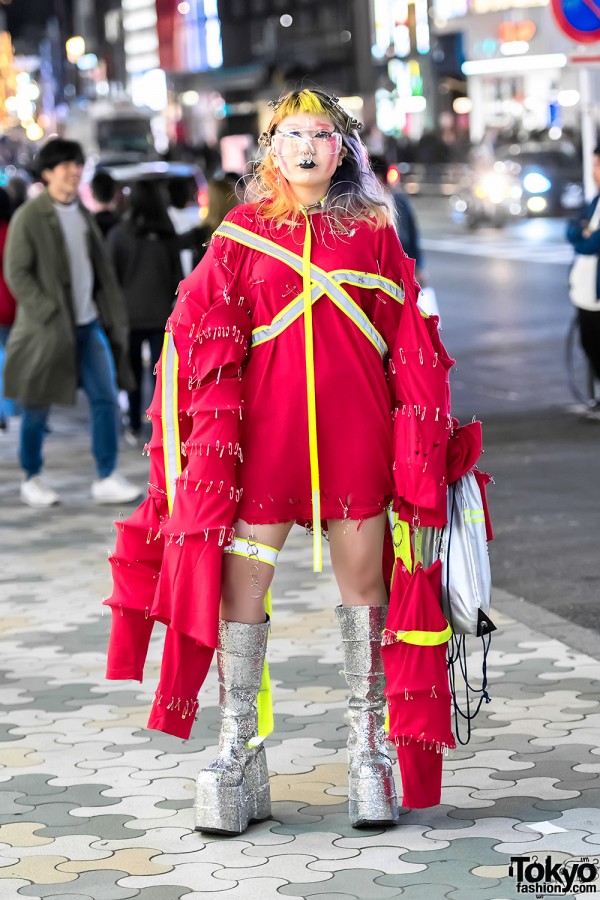
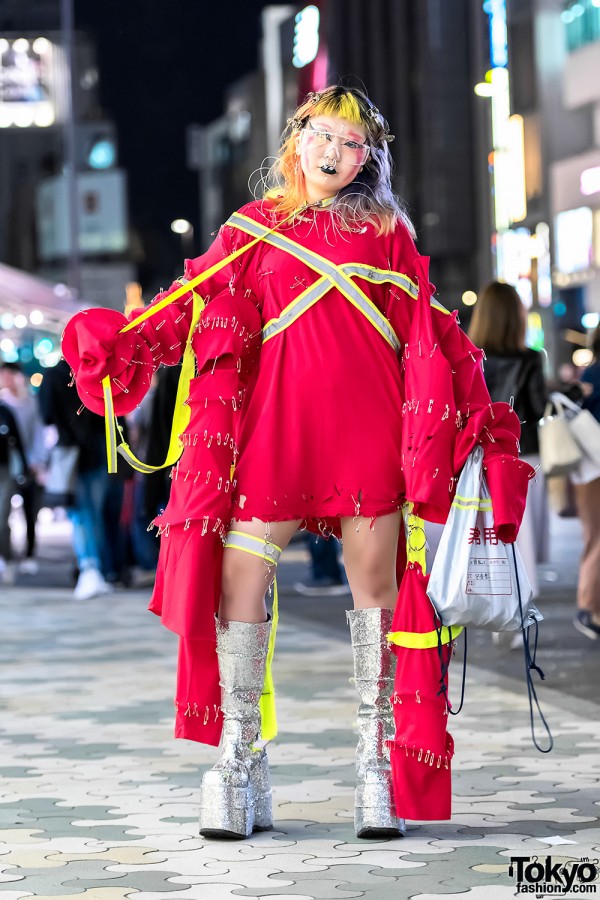
Sakuran is a 17-year-old student with yellow hair whose handmade fashion not only caught our eye, but the eyes of just about everyone on the street in Harajuku! We found out that she is from Hokkaido and she plans to go to fashion school after graduating from high school.
Sakuran’s look features a handmade dress with a tubular structure, reflective tape, wire, and lots of safety pins along with tall platform glitter boots by Demonia. Her accessories – which include piercings, sunglasses, and a silver bag – are all either handmade, remake, or from a 100 Yen Shop.
Sakuran’s favorite shops are the avantgarde Harajuku boutique Dog as well as Namilia. She listens to 80KIDZ and The Young Punx. Follow Sakuran on Instagram or Twitter to follow her adventures in Hokkaido, Tokyo, and beyond.


Click on any photo to enlarge it.
Taylor SwiftI am honestly dumbfounded.
While walking on the street in Harajuku, our eye was caught by 20-year-old Fumiya wearing a pink and black ensemble along with his light pink hair.
Fumiya’s street style fashion features black skinny pants from LHP (Lazy Hazy Planet), a black button down shirt, a pink Never Mind the XU jacket, Yosuke platform boots, and a black handbag from Gypsy Cloth. His accessories – some from Never Mind the XU – include a black and white beret, a transparent ear clip, a bracelet cuff, an O-ring cocktail ring, and a brown belt.
Fumiya likes Korean fashion brands and shops and he listens to K-pop music. He is active on Twitter and Instagram.


Click on any photo to enlarge it.
Crusader Kings II is a sprawling, ambitious strategy game set in the Middle Ages, one known for its stories of intrigue, backstabbing, and other plots spinning out of its central premise: relationships. The choices you make regarding, like the decision to have children—or, if it seems to advance your interests, deciding to kill your own children—are what move the game forward.
As such, Crusader Kings II tends to attract a specific type of person, and that extends to the folks who decide to make mods for the game, as well. It's no great shock that someone has crafted an extensive Game of Thrones mod for Crusader Kings II, but those aren't the mods that started catching my eye, as I looked around the game's still-robust community of creators.
Jewish Kings, which intends "to make Jewish characters more interesting and historically accurate,"comes from 16-year-old Canadian high school student Jonathan, who goes by the name Gefilte Fish online. (Jonathan asked for his last name to be kept out of his story.) His interest in ancient and Medieval history is what drew him to Crusader Kings II, an experiment in exploring his Jewish identity and applying lessons from some programming courses he's taken.
The online discussions surrounding the mod are fascinating, with other amateur Jewish experts weighing in with thoughts on his use of language, terms, and other elements of Jewish history. If Crusader Kings II already attracts a specific type of person, Jonathan's mod is even more specific.
It also draws trolls dishing out anti-Semitic comments, one of topics I covered when I chatted with Jonathan about the work put into his Jewish Kings mod.
(This interview has been lightly edited for clarity.)
Waypoint: What got you interested in playing Crusader Kings II ?
Jonathan: Being a fan of strategy games, especially games based in a historical setting, I was easily drawn to Crusader Kings II. I always found myself being drawn by realistic, historical games, and repulsed by unrealistic, fictional, fantastical games. There is something very amazing in being immersed in a Medieval lord simulator such as Crusader Kings.
What's your relationship to Judaism? Is it a central part of your life?
Jonathan: I was born into a secular Jewish family. (There is a Jewish religion, and a Jewish ethnicity. The two usually go together but not always.) Though recently I have become more interested in Judaism. It is not a central part of my life; if it was, I probably wouldn't be wasting any time playing video games.
Your mod, Jewish Kings, aims to "make Jewish characters more interesting and historically accurate." For the laymen among us, what does that mean and how big of an undertaking was it?
Jonathan: Crusader Kings II does have Jewish characters, but most of them are not playable, and the few who are are—the Khagan of Khazaria and the Duke of Semien, to be specific— easily get destroyed by neighboring empires, and anyway are not very fun to play. I decided to add more options for playing as a Jewish character, such as new and unique decisions and events. In addition to making the Jewish character experience more in-depth, I added events for non-Jewish characters. For example, different kinds of Jewish courtiers can arrive at the court of a non-Jewish character. A non-Jewish ruler might be confronted with a migration of Jews to one of his provinces, and will have to choose either to accept them or not. Historically, sometimes European lords had to face tough decisions like this one. I added this event and others like it to make the experience more extensive and immersive.
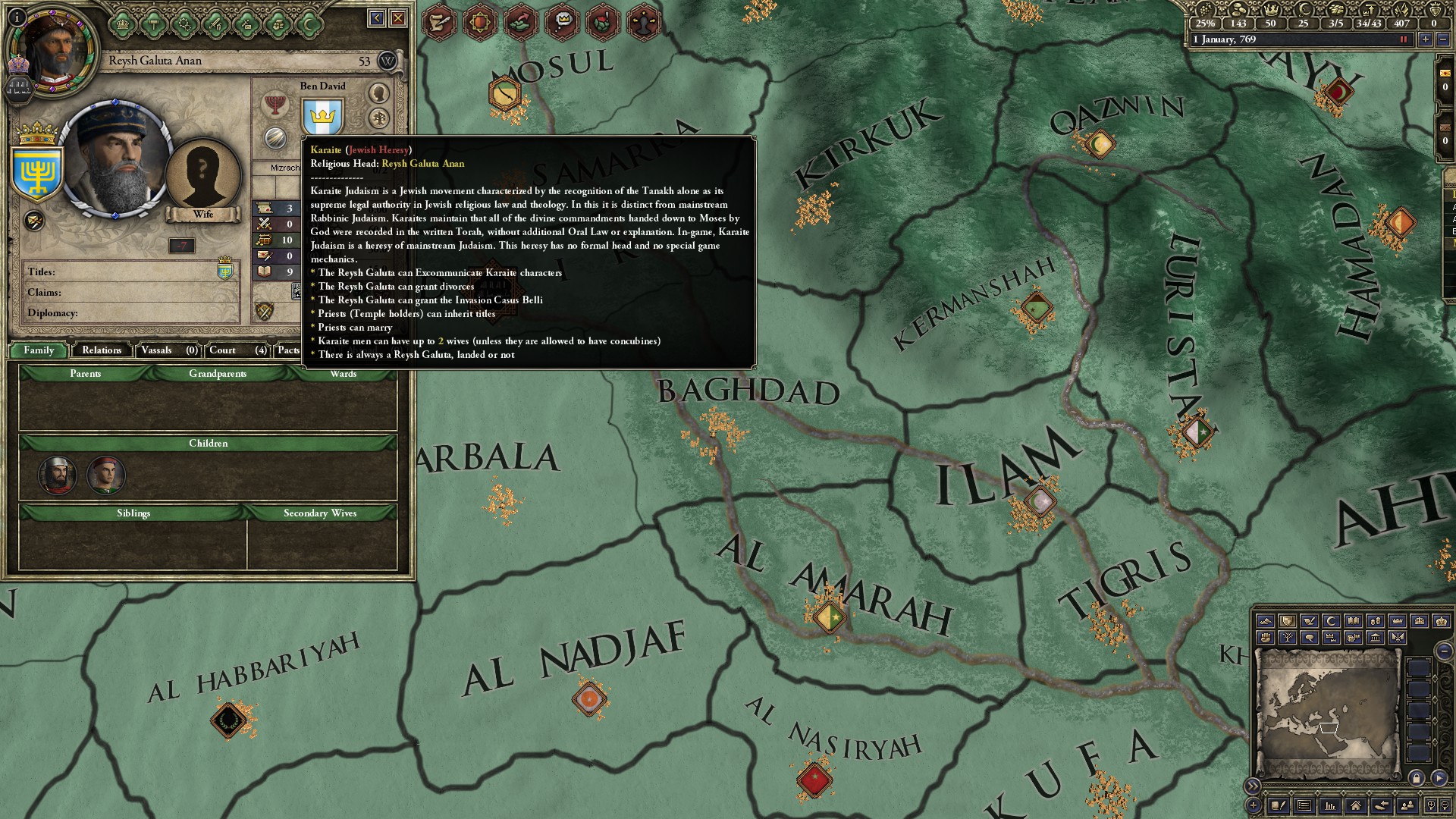
Images courtesy of Jonathan
In comparison to big Crusader Kings II mods such as CK+, my mod is not so big. However, for people such as myself, the changes that I made were sufficient. An interesting fact: Originally, I wanted to name my mod "Idishe Melkhim," the Yiddish form of "Jewish Kings," but since no one would understand the meaning of it, I translated it to English.
The game includes Jewish characters, events, and references already, but you wanted to go deeper. What motivated you to actually spend the time building a mod?
Jonathan: Originally, I was perfectly content with the Jewish characters and events already in the game, and I just wanted to correct a few historical inaccuracies here and there, but as I got better at modding, I decided to add more. First, I slightly modified small things such as names of scriptures and priestly titles for the various Israelite religious sects, to make it more historically accurate. Much later I added big things such as new decisions and events. Then, I started to experiment, and I was curious to see where I could take this mod. I spent many hours writing and testing new events and decisions. I suppose that what motivated me was the possibility that I could improve the game and make it more enjoyable to play.
"Originally, I wanted to name my mod 'Idishe Melkhim,' the Yiddish form of 'Jewish Kings,' but since no one would understand the meaning of it, I translated it to English."
Talk to me about the big additions you made to the game, such as the new cultures and events. What'd you draw from?
Jonathan: Most of my changes to the game are small, but a few are relatively large, in my opinion. I added two new Israelite cultures: Mizrachi, the culture of the Jews who lived in the Middle East, and Hebrew, which is the predecessor of Ashkenazi and Sephardi Jews. I changed the names of people in each culture and I gave them different bonuses to make them more historical and distinctive. For example, characters of Hebrew culture get +1 piety, and Sephardi get +1 learning. I gave all characters of the Jewish religion +1 learning to reflect how historically Judaism always emphasized the importance of studying religious texts. At first, I thought that it would be wrong to give Jewish cultures and religion so many (arguably over-powered) bonuses, but then I saw that in the base game, Buddhism has +4 learning (which is objectively overpowered)! I lost all shame and decided to proceed with the addition of said bonuses.
I made Ashkenazi and Sephardi culture nonexistent in the early game, but then develop in and diverge from their predecessor the Hebrew culture around the 9th Century, as it did historically. I gave the Karaite sect a head of religion: the Exilarch, and also one for the Samaritans: the Kohen Gadol (High Priest). I added events which only fire when a character restores the Jewish High Priesthood: The Sanhedrin restores the punishment of known murderers and adulterers. I added events where rabbis and other zealous Jews try to encourage other Jews to lose bad traits such as jealousy, pride, greed, and develop good traits instead. I added event chains where a Jew and a non-Jew discuss theology, and one of the two (possibly) develops sympathy for the other religion: A rare friendly interaction between Jews and non-Jews in the Medieval World. I added a decision for Jewish characters to observe the holiday of Yom Kippur with other vassals.
Of course, during all the event chains I mentioned (and the ones I did not), a wide variety of different outcomes might occur depending on the characters' traits, your decisions and chance.
Do you find that most people who are adding the mods are Jewish, as well?
Jonathan: I assume that most (though not all) people who add my mod are Jewish or have a very strange fascination with Jewish culture or history. Normally, if someone wants to add more events and decisions to the game, they download CK+ or some other big mod. I think that it's only Jews who would want a mod that focuses specifically on Jewish events and decisions, and the kinds of people I meet who download my mod seem to confirm that belief.
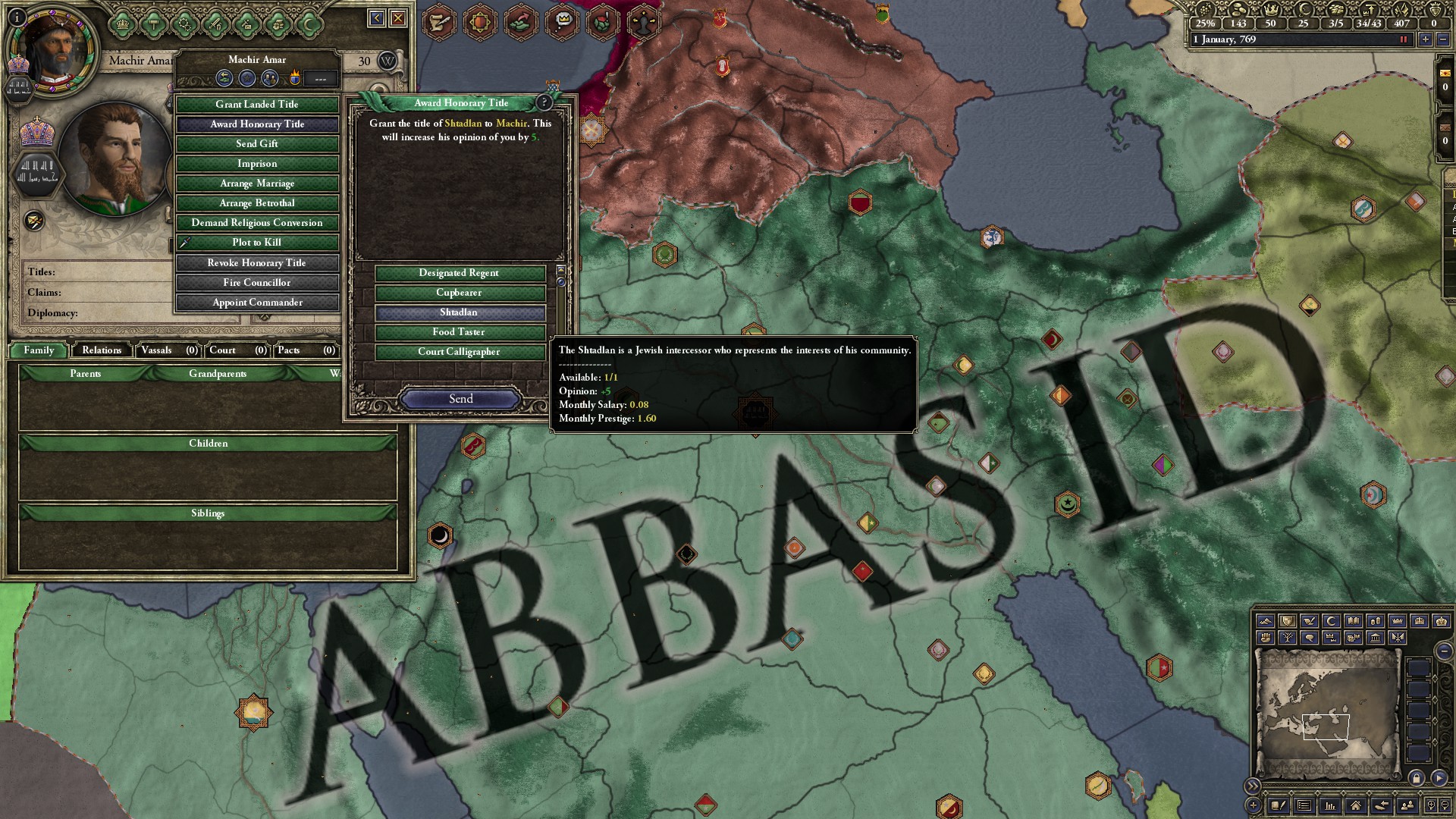
There aren't many video games that invoke religion, let alone ones practiced in real-life. But Crusader Kings is an exception. Did the fact that Crusader Kings makes religion important play a role in why you hoped to deepen its Jewish representation?
Jonathan: Crusader Kings certainly is unique in that it invokes religion. I must say, much of my mod makes changes and additions to the Jewish religion, though I would not say that I did it because of the importance of religion in the game itself. Religion in my mod is simply a tool through which I deepen the Jewish representation, but my goal is not just to deepen religion, but to deepen the broader Jewish experience (and that just so happens to include religion). However, I find it difficult to imagine what my mod would look like if religion was not an important mechanic in Crusader Kings II. The game takes place in the Middle Ages, so naturally religion is a major factor. And because religion is a major factor in the game, it had to be a major factor in my mod as well.
People often talk about how their identity influences how they play and interpret games. Is that true for you, as well? Does being Jewish have any impact on how you play video games?
Jonathan: For many people, their identity has little if any influence on the way they play it, but for some it makes a big difference, especially if the game portrays the player's nation, culture or religion. Obviously, no one wants to see their culture or religion portrayed badly or inaccurately, but I think that it goes beyond that. When a person plays a game with their own culture or religion, the player feels more immersed and invested in the game. It becomes more personal, more relatable. The player's imagination takes over, and they tend to read into the game on a deeper level. Needless to say, this does have an impact on how a person plays and interprets a game. For example in my case, when I play as a Jewish character in Crusader Kings II, I have a slightly different mindset. I think that the events that take place in the game relate to me differently. This sounds absurd but it's true.
Just looking through Steam, it's clear people have tried to deploy anti-Semitic comments in an effort to upset you and people who are fans of the mod. Has that been a big distraction?
Jonathan: The Anti-Semitic comments made on my mod's page are a bit upsetting, but only for a few seconds. I believe that people who make foolish comments about any culture or religion are not worth being upset about, so no, it has not been a big distraction.
Follow Patrick on Twitter. If you have a tip or a story idea, drop him an email here.
Shochim is a Japanese guy with a kawaii sense of style who we often see around the streets of Harajuku.
His look on this day featured a long mint colored top that picked up at a resale shop over a t-shirt from his own brand Pinky Magic, pink plaid pants from WC Harajuku, and Jeffrey Campbell platform shoes. Accessories include pink flower sunglasses from the Harajuku vintage boutique G2?, a mirror-shaped handbag from Dolls Kill, and a Lina Stores mint striped tote bag.
Shochim’s favorite fashion brands are Neon Moon and Honey Mi Honey. He likes K-Pop music. Follow Shochim on Instagram for more Harajuku fashion pictures.


Click on any photo to enlarge it.
Taylor Swift:(

The influential US noise rock label gasps its last
The Providence, Rhode Island based label that released music by underground darlings such as Lightning Bolt, Black Pus, Arab On Radar, Ultralyd, Khanate, Excepter, Metalux, Landed, Six Finger Satellite, Sightings, Noxagt, Prurient and more, has folded.
“After 24 years of Load Records its [sic] time to move on,” said a message circulated via the label’s Facebook and Twitter accounts.“Will be contacting bands to arrange next steps. Thanks for a great ride.”
Founded by Ben McOsker and Laura Mullen in 1993 to release the Just Like Anybody Else Would/Bender 7" by Boss Fuel, Load soon established a reputation for brilliance with a steady stream of cutting edge noise, rock and electronics, much of which was harvested from the fertile Providence underground scene.
The label’s final release was, aptly enough, an album by the band Finished.

I’ve been stressed out for a while for obvious reasons if you’re familiar with the goings on in Hassle land. Positive stress, but it’s still stress. Can feel the hairs turning grey. At times like these music can be the richest of oases. For me it’s been L/F/D/M’s UNDER THE EYES OF AUGUSTUS (there he is on the cover, I think? not my area of expertise, sorry).
“An epic journey thru Techno, Electro, Noise, Acid and even Disco.” promises the excellent Glasgow label, CLAN DESTINE RECORDS, that released UNDER THE EYES OF AUGUSTUS both digitally and as a sold out cassette last fall. I’d say that is right on. The album is a sampler of sorts, of many and varied electronic music styles being mastered in relative brief. Rhythms routinely engage across the 15 tracks and 60 minutes from L/F/D/M. “Untitled (The Will of Woman)”, first off, that title? Oxymoron much? Won’t matter once this gets in your head though. The dancing synthesizer found here is a hypnotist of some kind. I feel like the cobra that’s in the basket, and this song is the one that turban’d guy is playing on that ancient flute looking instrument. I am wiggling in strange ways AGAINST MY WILL. Oooh, back to the “title”, hmmmm, yes.
The first cut “Cutting Limes” remains one of the more memorable of the album, despite the availability of many choice offerings. Techno, pulsing with a noisy edge that’s easy easy easy to get lost in. It seems cheap to only the mention 2 tracks, but that’s all I got time for. Be assured however that it’s just the tip of the iceberg on this one, as this is one artist that can’t seem but to cross “genre boundaries” (much to this listener’s d-lite). Sounds run deeeeeep. LOVE’S FLACID DISCO MUSCLE (aka Richard Smith), I just met you, but I want to get to know you.
On a Sunday night at the Middle East Upstairs, locals gathered to hear the jagged, jangly rock of Philadelphia’s Palm, supported by local rock band Kal Marks and Boston indie pop band Bat House. The edgy guitar riffs and sporadic drum beats cut through the hum of locals laughing and swaying along to the music. The small dark room filled with the smell of cigarette smoke coming through the door tucked away in the back, as the resident show promoter, Alex Pickert, looked on at Bat House’s guitarist, Ally Juleen, who soloed to an applauding crowd. The show was electric, but the local bands responsible for generating these energetic shows in Boston have been changing.
A year before, the bill might have been complemented by IAN SWEET, a melodic art pop band hailing from Boston. The three-piece would play a show what seemed like every other week, whether it was in a dim, grimy basement in Allston, or on the humble stage of the longstanding pub, the Great Scott. Nowadays, IAN SWEET playing a show in Boston is a celebratory homecoming rather than a usual installment in the weekend’s events. This is due to a recent exodus of Boston DIY bands to other cities.
In the past year, Boston lost bands like Steep Leans (Philadelphia), IAN SWEET (NYC), Ursula (Philadelphia), Guerilla Toss (NYC), and the now-defunct TeleVibes (who had planned to move to Austin, Texas shortly before taking an indefinite hiatus). Some say this is making the scene slowly lose its characteristic eclecticism. Between the expensive costs of living and booking shows in Boston and artists feeling like art and culture is being undervalued, the city has started becoming less and less of a musician’s haven.
“There was a lot more wacky, wild, extreme music happening five years ago than there is right now,” said Jeff Somers of the band Steep Leans.
Somers started playing as Steep Leans in 2013. His first album, Grips on Heat, came out in 2015. A few months and one U.S. tour later, he moved to Philadelphia. A Temple University graduate, he knew the city and wanted to go back and try playing music in the more “human” scene there.
“[In Boston] everything is so safe and so controlled—there’s no room for punk rock. You need some sort of lack of structure for that to exist,” said Somers. “Philly’s DIY scene, there’s less paranoia about noise complaints, pissing off your fancy neighbors. You can just play music in your basement all night.”
Jilian Medford of IAN SWEET also felt that Boston had been losing some of its “weirdness” the past few years and, as a result, has become less musically accessible.
“After a lot of the house shows shut down, a lot of the weirder, avant-garde generally slightly out-of-reach music started to disappear. I feel like a lot of people did move to New York, or get out of Boston,” said Medford. “People were discouraged and didn’t want to go to shows and stuff anymore.”
For Medford, a Berklee College of Music graduate, New York City was the logical next step in her creative musical career after graduating in 2015. She said she has been able to meet other people in the music industry helping her to “acknowledge everyone that has a part in music, even if it’s not on the creative side.”
“Boston is an incredible place to start a creative project, because people will really hop on and support it no matter what, but…at a certain point you do feel like you’re in a loop and coming back to the same place, playing at the same venues, playing with the same bands,” said Medford.
Venues like Shea Stadium—a show space up some creaky stairs in an abandoned warehouse building in the hidden depths of Brooklyn—that are not quite a DIY basement venue or a legitimate club venue, blur rather somewhere in between, allowed for Medford to see a lot of different music” and “constantly be playing with new bands and creating new things” which wasn’t necessarily possible in Boston.
Despite the advantages of other cities’ music scenes, some say Boston’s still has its perks.
Like Medford, Somers appreciated the musical community and opportunities that were available in Boston. In fact, he returned to Boston in the latter half of 2016 after his third tour with Steep Leans to continue making music.
“I realized I had way more connections and just more accessibility to playing music, and devices, tools, spaces,” said Somers. “All the things you need to play music were actually here in Boston.”
However, Chris DeCarlo, a promoter who books shows through the collective and blog Kids Like You and Me (KLYAM), noted how money, or the lack thereof, is making it difficult for anyone involved in the city’s music scene to be able to make art while simultaneously being able to live in Boston.
“I think, unfortunately, the city really doesn’t value art, at least in a monetary sense. It boils down to that. It’s tough in general, even booking shows, where a lot of the places have these huge rental fees you have to pay for,” said DeCarlo. “And then most of the bands don’t really make that much money, because they’re constantly spending money on different things, like recording and buying instruments and everything. It’s tough.”
The average rental price for an apartment in Boston averages around $2,700 a month, up nearly $1,000 since 2011, according to Zillow. To compare, apartments in Philadelphia rent for just under $1,500 a month on average.
Paying rent, working a job to pay for that rent and then still having the time and energy to make art is a near impossible feat, according to Somers. But the musicians who have remained here have relocated to areas just outside the city like Somerville and Jamaica Plain, where Somers currently resides, to be able to take advantage of what the city still has to offer. Or it’s become increasingly likely that they relocate to more affordable cities altogether.
Though the housing market is projected to be just as difficult for musicians moving forward, there continues to be local artists who are sticking it out. And with organizations and promoters like Boston Hassle, Allston Pudding, KLYAM, Illegally Blind and Deep Shred (to name only a few) that are dedicated to supporting Boston’s DIY artists in any way possible, perhaps musicians will hold their ground despite the otherwise unfavorable changes the city has been undergoing.
“The community is definitely strong,” said Medford. “It’s a very special place.”
Taylor SwiftThis is so good.

"Every day, 1001 Rogues generates a new adventure for you to play. It can take place anytime and anywhere." - Author's description
Play here (Browser)

Robin S. – Show Me Love
Lords of Acid – Hey Ho!
Utah Saints – Something Good
Snap – Rhythm is a Dancer
Basement Jaxx – Red Alert
Moby – Move (You Make Me Feel)
Orbital – Halcyon + On + On
Janet Jackson – Escapade
Madonna – Deeper and Deeper
Underworld – Born Slippy
Cher – Believe
Bjork – Violently Happy
Quad City DJs – C’Mon ‘N Ride it (The Train)
Altern8 – Armageddon
Everything But the Girl – Future of the Future
Lisette Melendez – Together Forever
The Prodigy – Voodoo Beats
Crystal Waters – 100% Pure Love
Stardust – Music Sounds Better with You
Whitney Houston – It’s Not Right but It’s Okay (Thunderpuss Radio Mix)
Stereo MCs – Connected
808 State – Cubik
Fatboy Slim – Praise You
Clivilles & Cole – A Deeper Love
Cathy Dennis – Touch Me (All Night Long)
The Shamen – Move Any Mountain
CeCe Peniston – We Got a Love Thang
Baby D – Let Me Be Your Fantasy
Opus III – It’s a Fine Day
Sonique – It Feels So Good
Black Box – Strike It Up
Technotronic feat. Ya Kid K – Move This (Shake That Body)
Fingers feat. Roula – Lick it
Acen – Trip II The Moon
The KLF & The Children of the Revolution – What Time is Love?
Kristine W. – One More Try – Kristine W.
Future Sound of London – Papua New Guinea
Left field – Not Forgotten
Deee-Lite – Power of Love
Jennifer Lopez – Waiting For Tonight
Corina – Temptation


Taylor SwiftNet Yaroze is the best and this author clearly doesnt know about the big .rar compiling a shitload of it that's been floating around the internet for a long time.
Above: Blitter Boy, by Chris Chadwick.
Remember demo discs? I've been in love with them ever since I received my first, fixed to the front of issue 33 of Official UK PlayStation Magazine.
Said issue was in shops in June 1998, as excitement was reaching fever pitch over that summer's World Cup in France. England lost to Argentina on penalties, and my mum's boyfriend was so angry he broke the TV remote. She bought me the magazine after breaking the bank on a brand-new PlayStation, figuring that a disc full of playable games might keep me entertained on the cheap.
She was mostly right. The majority of the games bundled onto demo discs were garbage, but this disc also contained a Net Yaroze title, Rocks 'N' Gems. I adored it, playing it on a tiny TV in the living room not just during England's loss to Argentina, but for the rest of that summer, too.
It was the first video game to capture my imagination. I spent several hours spelunking through underground mines, collecting all the different colored gems, avoiding all the rocks that would fall and crush you if you lost your concentration for a second.
As a nine year old, I wasn't good at concentrating on much. But I was smitten. Rocks 'N' Gems was a near-clone of 1995's Rocks'n'Diamonds, but I didn't know this—just that if I bought a copy of OPM each month, I'd probably get a cool new game bundled beside a pile of rubbish demos.
These unexpected gifts were made possible by Net Yaroze, a dev kit that allowed indie programmers to create games for the PlayStation. Launching in March 1997, it tore up the established rules of console development, which until that point had been tightly controlled, with developers requiring licensing agreements, expensive development kits and the okay from the console creators to get to work. In contrast, Net Yaroze was well under $1,000, and Sony also made it available to universities in the UK, France and Japan.
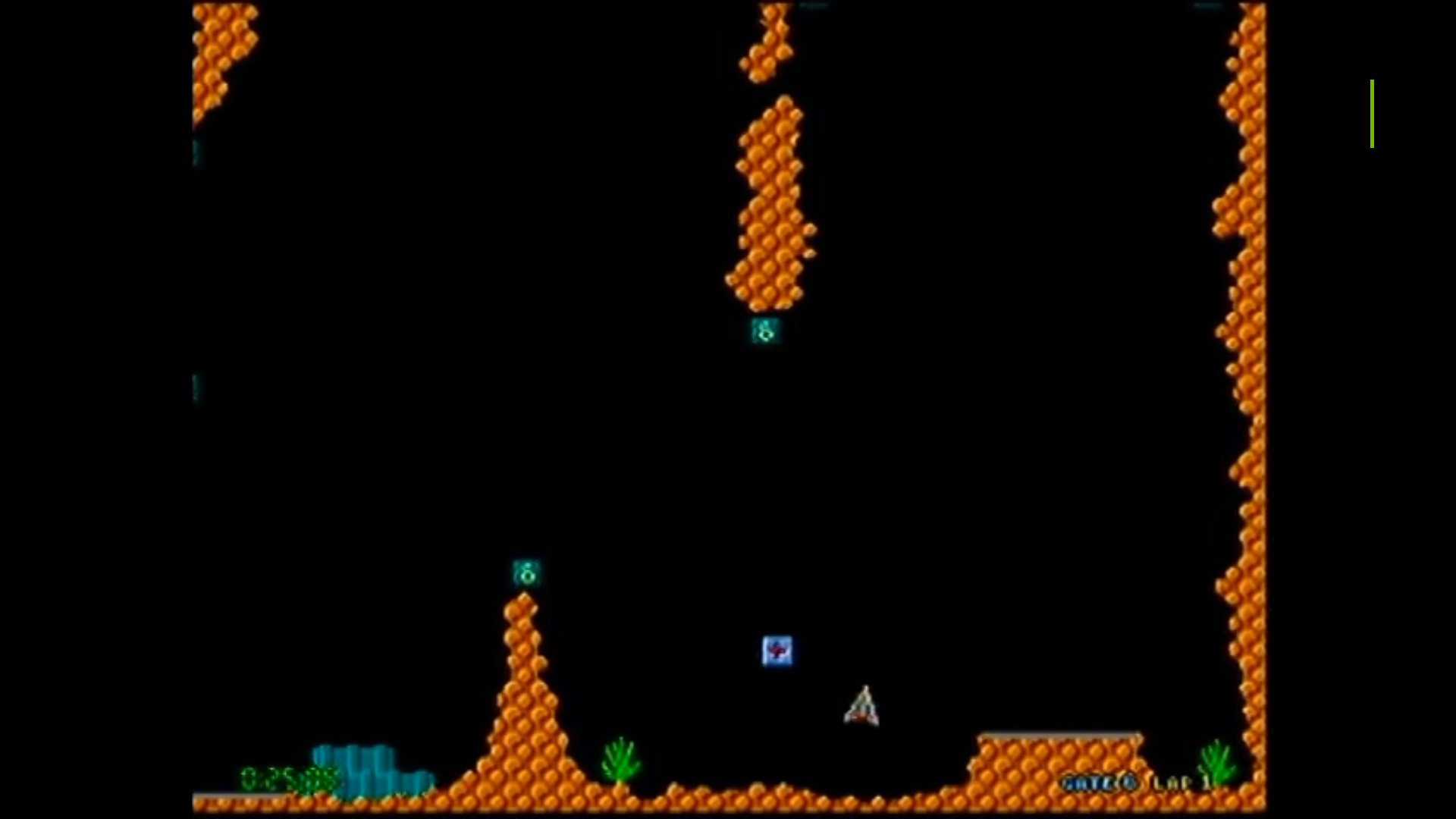
Gravitation screen courtesy of James Shaughnessy.
To celebrate Net Yaroze's 20th birthday, I tracked down the creators of three of my all-time favorite games made using the mythical Black PlayStation: Gravitation, Psychon and Blitter Boy.
"The Net Yaroze was cooler than cool," says James Shaughnessy, creator of space-based racer/shoot 'em up Gravitation. "The PlayStation was the first console to be seen as cool by the masses, not just gamers. Sony put them in nightclubs, so it was no longer nerdy to be a gamer, it was cool. And a black PlayStation? Sub-zero cool."
Chris Chadwick, creator of the award-winning Blitter Boy: Operation Monster Mall, remembers Net Yaroze as "full of surprises" for a programmer, some good, and some bad. "The lack of ability to burn games to disc was a topic that came up frequently on the forums," he tells me. "Also, there was no Z-buffer, so 3D had to be rendered using the 'painter's algorithm'."
"On the good side, there was a pretty comprehensive library of functions to facilitate game creation," he continues. "True, they were a cut-down version of the libraries available on the full dev kit, but I don't remember feeling I was missing out on something I really needed."
Ben James created Psychon, which he describes as "an obvious Alien Breed clone," a top-down shooter full of darkened corridors stacked with bloodied corpses. For him, Net Yaroze seemed like a golden ticket into the games industry. He'd recently left a job developing Windows applications that was killing his enthusiasm for both his choice of career and programming in general. Net Yaroze couldn't have come at a better time.
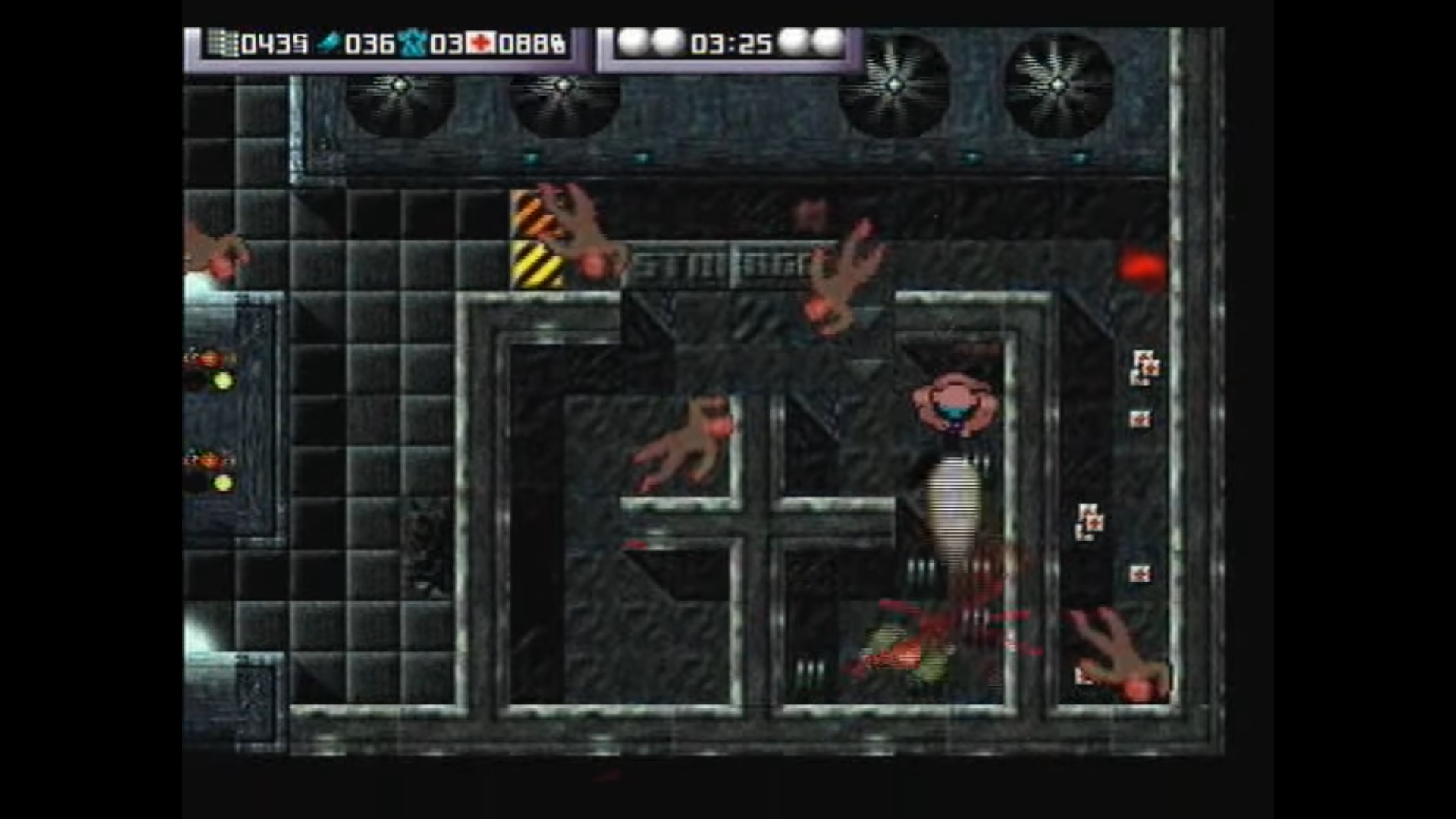
Psychon screen courtesy of Ben James.
When Net Yaroze launched, online communities weren't as prevalent as they are now, and watching a YouTube how-to or Googling for a solution wasn't possible (Google didn't officially incorporate until September 1998). Sony used this to its advantage, creating a private web space for the community to form around. The portal had a private forum and a place for registered members—those who had dropped the $750 (£550) on membership into the Net Yaroze club—to create pages to share their games, which would be dissected by the enthusiastic crowd in the forums.
Sony's nascent Net Yaroze community was one of the first dedicated spaces for indie development, coming at a time when there was no way to distribute homebrew games efficiently.
"It was such an integral part of the system, and of course why they put 'Net' in the name," said Shaughnessy. "Having a single focal place where all Yarozers could go to discuss ideas and get feedback on their early prototypes was priceless.
"There was a real sense of community there, which was much friendlier than you see on public forums now. Seeing other people's awesome work would really inspire you to try and compete, but everyone ultimately had the same goals and was always willing to help each other out."
"Pac-Man is a long-standing favorite game of mine, so I see the ghosts of Blitter Boy more as an 'homage.' I hope that keeps the lawyers happy!" — Chris Chadwick
Sony's only real misstep was that it separated the European, Japanese and US regions into different forums and sites, segregating the growing communities and making cross-territory collaboration difficult. However, having a crowd of people and a safe space to help you make sense of the Net Yaroze was incredibly useful.
While each of the trio had experience with programming before they turned their hands to developing on Sony's black box, they all remember having their own issues, mostly due to quirks with the C programming language or the Net Yaroze's hardware limitations.
Shaughnessy, describing himself as "not quite John Carmack, but fairly competent with programming" after previous adventures in game development, tells me about the biggest problem about Net Yaroze game development. To maintain Gravitation's pixel-perfect collision detection, essential for what is essentially physics-based racer, he had to get technical.
Related, on Waypoint: How Flash Games and Newgrounds Foretold Today's Indie Experimentalism
"Gravitation's maps were all 640 by 512 pixels, so the whole map could fit uncompressed in the 1024 by 512 VRAM, acting as one huge back buffer while still leaving space for the 320 by 256 main display buffer plus all of the sprites. It was pretty much the only way I knew how to do it at the time, to support two-player split-screen and to be able to use the actual VRAM data for the collision detection."
With help from others on the forum, he managed to find a way to get this to work, and admitted that he would have quite easily been able to support four player—except Net Yaroze games didn't support Sony's L-shaped Multitap. There were other problems, too—James briefly mentions something about constantly frying serial cards, due to the Yaroze's fondness for what he simply calls static.
Developers on the Yaroze had access to the full power of the PlayStation, but they struggled with the inability to load files from a CD in real time. This limitation, not a problem for regular PlayStation releases, meant that Yaroze games had to fit onto the console's 2MB of RAM. Factor in the 500k of memory that the kit needed to make the magic happen, and a title produced using it had just 1.5MB to make everything work. For comparison, last year's iPhone 6 shipped with a thousand times that much RAM. These games really were running on next to nothing.
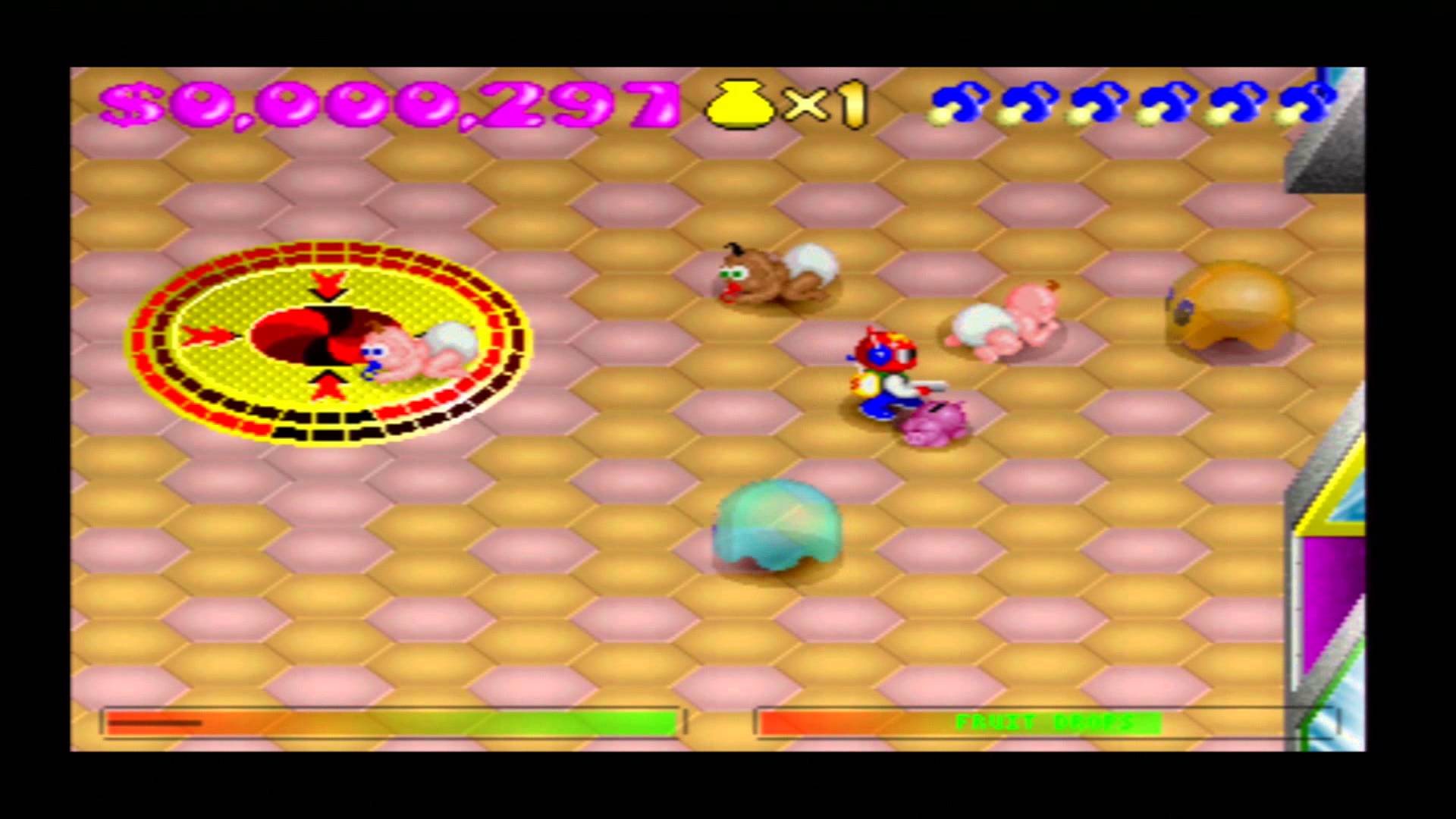
Blitter Boy
Chadwick was 29 and out of work due to health complications when the Net Yaroze was released. Concentrating on learning all the intricacies of the system was a good way for him to focus his energy. The result of his efforts was Blitter Boy, a "bit of a mishmash of ideas and inspiration" that wasn't supposed to be a game, starting out as a way for Chadwick to simply learn the system.
The result is a psychedelic romp through a shopping mall, blasting ghosts while you try to rescue crying babies and lead them to an escape portal. No, really. Design choices were made based on what looked cool. Babies followed the titular Blitter Boy around because Chadwick loved the way that tiny chicks would follow Flicky around, in the game of the same name.
And about those ghosts that float around as the game's enemies. "They were a blatant rip-off of Pac-Man," Chadwick admits, with a shrug. "The back story to Blitter Boy was something about all the baddies from the games in the shopping mall arcade escaping and running amok. Pac-Man is a long-standing favorite game of mine, so I see it more as an 'homage'."
He laughs, adding: "I hope that keeps the lawyers happy!"
The game went on to win the 1998 Game Developer UK Competition, after Chadwick was persuaded to put it forward by Sarah Bennett, a member of Sony's Net Yaroze support team. "Without her encouragement, I doubt I ever would have entered, so thanks to her for that."
"It was all pretty surreal," he continues, "like a bit-part actor suddenly finding themselves accepting an award at the Oscars. I was genuinely shocked to win, and it felt great. I'd dreamed about making games for a living since I was a teenager, and all of a sudden I felt like I really may be able to make it happen."
"When I spotted an advert for the Net Yaroze in a magazine, I found my calling. I instantly knew that not only was it what I wanted to do, but I now suddenly believed I could do it." — James Shaughnessy
Shaughnessy's Gravitation was the runner-up in the same competition. But he was unsure of where to go next once the game, which he'd made right after graduating from university, was out there. "I'm more of a petrol-head, and I actually wanted to work in Formula 1," Shaughnessy admits. "That was probably to do with the computer side of things. But I hadn't worked it out, so my vague, non-specific speculative letters to all the F1 teams came to nothing."
"When I spotted an advert for the Net Yaroze in a magazine, I found my calling," he continues. "I instantly knew that not only was it what I wanted to do, but I now suddenly believed I could do it—and what I couldn't do, I'd simply teach myself."
Shaughnessy adored Gravity Force on the Amiga, and saw a gap on the PlayStation for a game that recreated its exacting physics, and its two-player racing and dogfighting. So, that's what he set out to make on his own.
This do-it-yourself attitude, the spirit of developers overcoming any and all challenges put in their way, came to be emblematic of Net Yaroze. The disc mounted to the front of OPM44 in February 1999 featured a demo of Metal Gear Solid alongside the Net Yaroze hall of fame, containing 14 different titles developed on the kit. They're not all gold, naturally—but to a much younger me, with so much time on his hands, they were priceless. I still have the disc—and my partner's PlayStation to play it on—to this day.
Ironically, the "bedroom" vibe that permeates not just the three titles I've profiled here, but the entire library of Yaroze games running on the PlayStation, lead to many people moving into the groaning machine that the games industry was becoming in the late 1990s. Both James and Shaughnessy went on to work for Codemasters, while Chadwick landed a role at doomed PlayStation developer Eighth Wonder, a second party studio that was shuttered before releasing a single game.
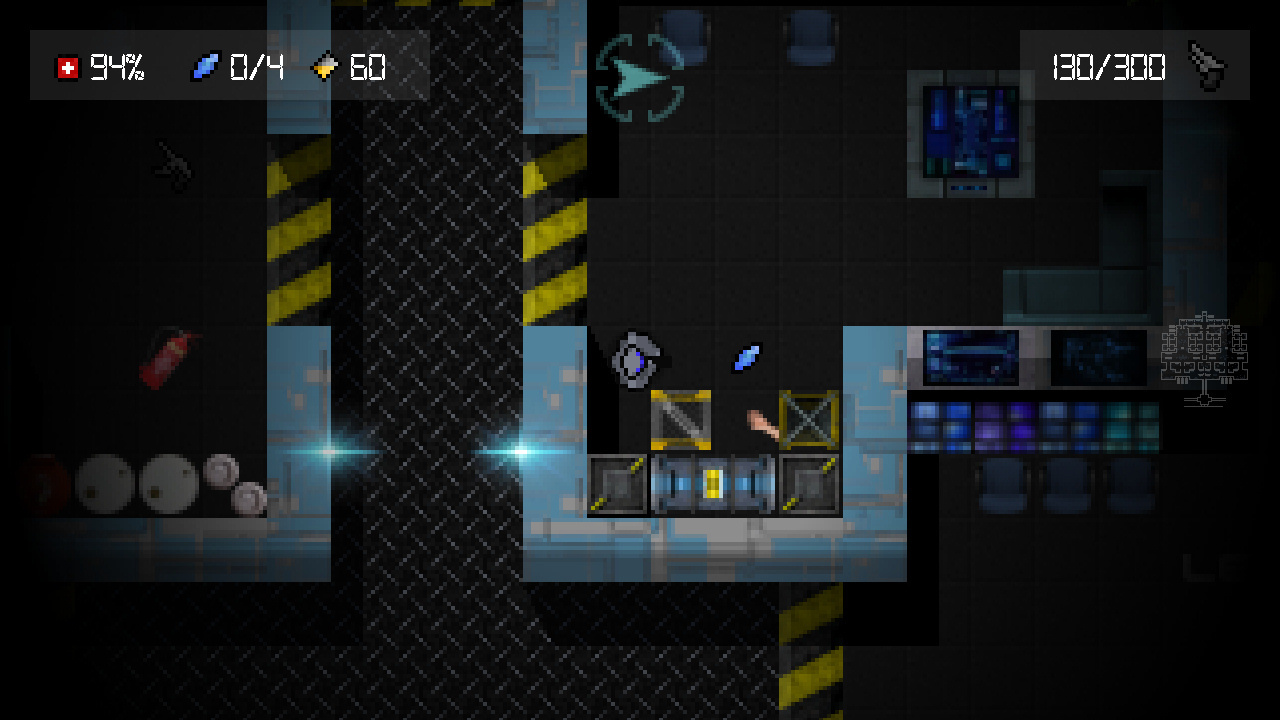
Psychon 2
James and Shaughnessy have made their way back to indie development, with Psychon 2 and Super Grav respectively—both came out in 2016. Chadwick admits he's thought about reviving Blitter Boy, but isn't sure how best to go about it—he tells me that the console he came closest to working with was the ill-fated Ouya.
Twenty years on from the release of their forefathers, these newer titles feel weirdly out of place. Psychon 2 is brightly light, with clean lines and slick AI replacing grim corridors and "infected" enemies who charged from side to side with little thought for their self-preservation. It's not worse than the original Psychon, but it's different. For James, it's an excuse to finally finish the game he wanted to make back in '98.
"The levels [of Psychon 2] are more varied, there's more to do in the game, and it's more polished than the predecessor," he says. "Hardware and development tools are more powerful now, so the actual development was smoother, and much more pleasant."
Sadly, most Net Yaroze games are consigned to history. Video games, as a medium, often age poorly, and the technological limitations of many Yaroze titles mean they've aged worse than most. While the demo discs are currently easy enough to find on eBay and similar sites, they are, inevitably, slowly vanishing into retro-gaming collections. And as they do, they take with them evidence of one of video gaming's most interesting, and important, indie development communities.
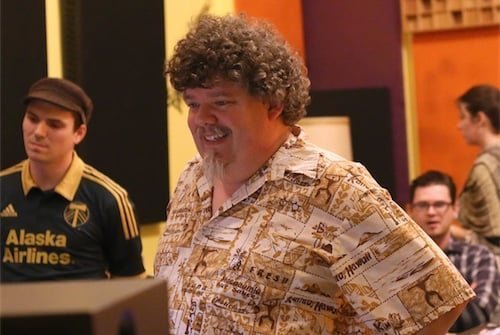
My name is Larry Crane. I am the editor and founder (1996) of Tape Op Magazine; a mag about the art of recording music. I founded Jackpot! Recording Studio in 1997 and have produced, recorded, and mixed many artists, including Elliott Smith, Sleater-Kinney, The Go-Betweens, She & Him, and many more. I am also a musician, and have made records and toured as a band member. I also do instructional videos about music recording and mixing for lynda.com.
Many analog recording devices. A 32 channel Rupert Neve Designs 5088 console allows analog mixing and monitoring, even of digitally recorded music. I have three Otari tape decks set up for 24- and 16-track on 2-inch tape and a 1/4-inch deck for mixing to. I have BURL and Avid converters for taking the sound from analog to digital and back. A vintage EMT 140 plate reverb provides great effects. I have over 100 microphones of all types.
I use Pro Tools 12 HD as it’s the most commonly used in music recording. I am a huge fan of iZotope RX5 which allows detailed sound restoration and editing. The Universal Audio UAD platform hosts some of my favorite plug-ins for mixing use.
After 20 years of running a commercial studio I feel I have surrounded myself with amazing tools. I wouldn’t mind a Pro Tools HDX system in order to cut out latency issues, but the cost is ridiculous and it also limits your system from running other DAW software, like Logic. Annoying. Buying and maintaining computer systems for a pro studio is frustrating and not very satisfying compared to buying and using quality analog gear, but it is how the marketplace works now.
Thanks for reading! If you're enjoying the interviews, you can help keep this nerdy lil' site independent for as little as $1 a month!

To attempt to understand the spirit of Tampopo, directed by Jûzô Itami, is to understand the spirit of food. In a movie with a sprawling, free-flowing structure, the heart of the movie, and the heart of the lives that we briefly see in the film, is located in their relationship with food. The main storyline revolves around a weathered trucker, Gorō (Tsutomu Yamazaki), who is persuaded by the eponymous widowed ramen-ya owner, Tampopo (Nobuko Miyamoto), to help her transform her lackluster ramen recipe and business. Accompanied by his sidekick Gun (pre-Hollywood Ken Watanabe), they venture for the perfect ramen recipe. Between scenes in this main storyline, the film very casually segues into various food-themed scenes that are narratively unrelated to this main quest. But once I knew what to expect, the miscellaneous stories being shown played an important role in understanding the world that Tampopo takes place in. This is a world where the experience of food (I say experience, because often it does not only involve eating), be it the symbolic form or in a more sensually corporeal way, is able to subvert occupation, social class, and even death.
One of these side stories is the “How to Eat Ramen” scene that opens the movie:
In this hypnotic scene, the young man, clueless about the proper way of eating a bowl of ramen, closely follows the expert’s instructions. His instructions are either abstract or seemingly absurd: “appreciate its gestalt” or “apologize to the pork by saying…see you soon.” But at one point, the scene presents a lucidity about the nonsensical instructions — that tapping the pork at the side of the bowl is merely to drain it of the broth, which the expert states with a satisfied smile on his face.
Like the side story, there seem to be set rules about food in the scenes that might seem created to operate as dramatic devices in these comedic scenes. Among many examples are the act of finishing the broth to signify the ramen’s quality. Another is the scene where a group of young women, in what seems to be a women’s etiquette class, are being taught the ‘right’ way to eat pasta, only for the instructions to be drowned and replaced with a western man’s loud and indulgent slurping from across the room. The existence of these rules is what elevates this movie from funny to heartily hilarious. The characters in each scene take these rules very seriously, without a sign of irony. It is satirical, but sincere. It takes the various tropes that it parodies and, through the characters’ sincerity towards food and the journey for the perfect ramen, leaves you not only in tears from laughter but also with a unique sense of warmth that wholesome filmmaking brings. This film will leave you satisfied, warm and makes you miss it the moment it’s gone. Just like a good bowl of ramen.
Tampopo
1985
dir. Jûzô Itami
114 min.
Screens Monday, 04/10, 7:00PM @Coolidge Corner Theatre
Part of the ongoing series: Big Screen Classics
State Sen. Bruce Tarr (R-1st Essex and Middlesex) has filed a bill that would bar Internet service providers from selling customers' Internet browsing and connection data to third parties without the customers' consent.
Tarr's bill would also bar the companies from charging customers a fee to keep their data private.
Taylor SwiftI was JUST wondering this!!!!!!
Taylor SwiftYay!
Taylor SwiftI had NO IDEA there was an "infinite heart containers" exploit in ANY version of Zelda 1?!?!?!
Last year, Nintendo released miniature versions of the Famicom and NES systems that came with a number of classic games pre-installed on them. Nintendo often makes small changes to its classic games without saying anything, so I enjoy hunting for those tiny changes whenever I can. And this time I was especially interested in how Zelda 1 changed this time around. I managed to borrow both systems from a friend and streamed both games earlier this week while searching for changes.
 |
| For simplicity, I call these the 'Famicom Classic Mini' and 'NES Classic Mini' |
The quick summary: there were a surprising number of changes made, although they’re mostly insignificant changes that most players will never notice or think about. Essentially, these new releases are strange hybrids of previous versions, with a few new changes of their own sprinkled in too. More than anything, I think these changes offer a neat example of how a translated game can affect its source material – usually it works the opposite way.
First, I should point out that there already exist multiple versions of Zelda 1. On the Japanese side, there used to be 3 main, distinct versions: the original Famicom Disk System version (1986), a bugfixed Famicom Disk System version (year unknown, likely 1986), and the Famicom cartridge version (1993). All re-releases and ports afterward were based on one of these three versions.
On the English-language side, there were multiple versions as well. The original NES cartridge release (1987), a slightly updated version that changed the save screen (year unknown, likely 1987 or 1988), and a version with a slightly revised script (2003). All releases ever made were based on one of these three versions. Naturally, most of the modern re-releases and ports have been the 2003 version, but not all.
 |
Anyway, if you’re curious about all of the differences between all of these versions, I wrote a book that goes into great detail comparing all the version changes, translation changes, gameplay changes, and a whole lot more here.
To answer a number of common questions I’ve gotten: the Famicom Disk System screen still displays when you start the game. The game still has loading time and loading messages. There are no simulated loading sounds. Disk flipping is handled automatically. The music and sound effects are from the Famicom Disk System version and not the very different-sounding cartridge version.
Now, let’s look at the actual changes:
The game’s title screen has seen a number of tiny changes over the years. The 2016 release appears to have the 1986 release’s title screen (notice the ダ and the big 1 in particular) but with a minor text edit added.
 |
 |
 |
| 1986 version | 1993 version | 2016 version |
The original 1986 version of the game featured a slim English font. This was replaced with the chunkier NES English font when it was re-released on cartridge in 1993. The Famicom Classic Mini version uses the original slim font.
Additionally, the Japanese intro has featured bad English since its very first release. This intro was re-written for the 2003 English revision, however, and the Famicom Classic Mini version is the first Japanese release to use this newer text.
 |
 |
 |
| 1986 version | 1993 version | 2016 version |
The “Rupy” spelling remained the same across all the Japanese releases until the Famicom Classic Mini version, which uses the 2003 English revised spelling of “Rupee”. The Famicom Classic Mini version also uses the 2003 English text “All Treasures”, unlike all of the previous Japanese releases.
 |
 |
 |
| 1986 version | 1993 version | 2016 version |
The original “Bible” item was changed into the “Book of Magic” for the NES release. This name was adopted by the 1993 Famicom cartridge release. But the name is back to “Bible” in the Famicom Classic Mini release.
 |
 |
 |
| 1986 version | 1993 version | 2016 version |
In short, the Famicom Classic Mini version so far is a strange chimera of the original release, the 1993 release, the 2003 English release, and some new stuff.
In the original Famicom version of Zelda, you could easily defeat the Pols Voice enemies by using the microphone built into the Famicom’s second controller:
Of course, this was a problem when the game was re-released and ported later on, because none of the later systems had a Controller 2 microphone. So Nintendo updated the game each time to support this feature. For example, in the Game Boy Advance port, pressing Select four times kills the Pols Voices. In the Wii Virtual Console release, twirling the right analog stick of a Wii Classic Controller kills them. Every release has had its own unique solution to the Famicom microphone problem… until now.
 |
The Famicom Classic Mini comes with two controllers attached to the system, but Controller 2 doesn’t have a microphone. Instead, it’s just molded to look like it has a microphone. The official site also mentions that microphone functionality isn’t supported. Given this, I assumed that the programmers would’ve given the player a different way to do the Pols Voice instant death trick, but it appears not. After a lot of Internet searches and rumor-testing, it seems that the Pols Voice trick can’t be done. They can still be killed with a sword, like always, but a memorable part of the game’s mechanics has been lost.
Most Virtual Console games tend to have some sort of flashing screen countermeasures that seem to be automatically handled by the emulator running the games. Zelda seems to have been affected less than other games so far, but the Famicom Classic Mini’s flash mitigation is clearly different. Here’s the original game and the Famicom Class Mini version side by side:
 |
 |
| Original | Famicom Classic Mini |
The Famicom Classic Mini version also ends on a gradient fade that probably wouldn’t be possible on an actual Famicom/NES.
In the original version of the game, there’s a room in Level 4 and a room in Level 5 with a key and nothing else. These lonely rooms were filled with bats in the NES release, and this found its way into the 1993 Japanese version of the game too. In the Famicom Classic Mini version, though, the bats are absent again.
The very first Japanese version of Zelda (often known as 1.0) had a programming oversight that let players get lots of extra Heart Containers just by using the flute. This was fixed for the bugfix release (often known as 1.1) that came out shortly after.
In this instance, the Famicom Classic Mini version appears to behave the same way as the 1.1 release. No extra Heart Containers for anyone.
The ending has a few changes too. First, the flashing screen after Link and Zelda hold up the Triforces is less flashy and purpler than the original game. Link and Zelda disappear also from the screen afterward, just as they do in the 1986 version of the game. (Note: Link is a weird color on purpose in the screenshot below and isn’t a result of the Famicom Classic Mini)
 |
Most interesting, though, is that the final screen has a typo of sorts. I assume it happened when someone tried to edit a previous version’s copyright info.
 |
 |
 |
| 1986 version | 1993 version | 2016 version |
The NES Classic Mini version of Zelda 1 is a hybrid of previous versions as well. In particular, it appears to be the original release with the 2003 version’s script inserted and a few minor changes made elsewhere.
The title screen is the one thing that has had clear changes over time, but even then there were only three versions. The NES Classic Mini ignores the two most recent updates and uses the very first title screen.
 |
 |
 |
 |
| NES release | GameCube version | GBA version | NES Classic Mini version |
The infamous hint man in Level 1 used to talk about an “eastmost penninsula” in the English translation. It took almost 30 years and two script revisions, but the typo is finally fixed.
 |
 |
 |
| 1986 script | 2003 script (GBA screenshot) | 2016 script |
This is the only text change that I’ve found so far. The rest of the script appears to be from the 2003 revision, which means there are still some genuine translation issues.
The NES Classic Mini version of Zelda has the same screen flashing change found in the Famicom Classic Mini version. The screen also flashes various shades of purple after rescuing Zelda exactly the same way the Famicom Classic Mini does.
 |
The final screen underwent a tiny change for the 2003 script revision, but the Famicom Classic Mini version reverts it back to the original version.
 |
 |
 |
| 1986 version | 2003 version (GBA screenshot) | 2016 version |
I found the above changes after one playthrough of the Famicom Classic Mini and NES Classic Mini versions of Zelda. It’s very likely I’ve missed some other changes, especially given that I haven’t tried the Second Quest yet. I’d bet there are other changes to the programming as well.
The only way to reliably find these differences is to look at the game’s ROM data, but I haven’t found a way to dump the ROMs from the Mini systems yet. But even if it is possible, I assume the ROMs will end up being identical to the original games. This is because the Virtual Console systems patch games in RAM at runtime, so it’s very likely that the same thing happens here. In which case, we’d need to find a way to dump the system’s RAM whenever a game is running. That sounds even harder, though. Still, if anyone out there with technical know-how can help, please let me know. I’d love to take a look at Zelda II in a similar way too sometime.
 |
Anyway, that’s all I’ve found for now, but if you happen to discover anything else that I’ve missed, let me know in the comments or on Twitter. Sometime in the near future I’m going to summarize all this for my Zelda book’s “patch page” chapter, so if you’ve already bought the book, keep an eye out for that!
With the help of rhester72 and ewwzy, we’ve been able to determine that the mini consoles do indeed patch the games at runtime, and that the patching information is stored inside the emulators themselves. For more info and IPS files, see here.

 Do Zelda’s “Like Likes” Come From a Japanese Proverb?
 Zelda’s Audio & Graphical Differences Live on in Famicom Remix!
 You Got Disco in My Zelda!