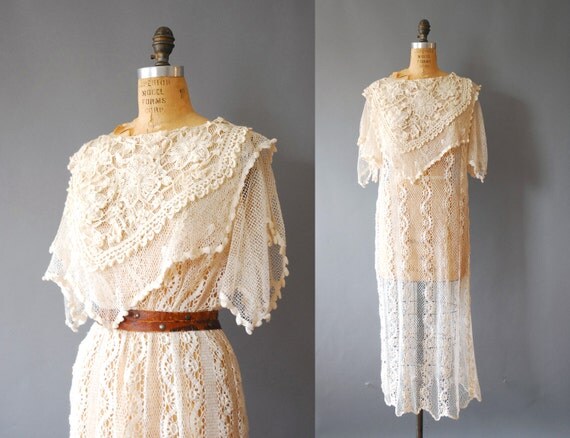
Fabulous 80s crochet dress by Lim of Shanghai, the sleeves are such a great shape and the neckline detail is wonderful! Quite free through the body and easily belted if desired, would make a good 1920s-style outfit!, material is Ramie. Please check the measurements for best fit and condition notes below. Item ships first class worldwide.
c o n d i t i o n Very nice!
size: large-XL (plenty of give) bust 36-50" (measures 36" when flat) waist 32-50" length 48" hip 36-54"
shop previews on instagram @wildfellhall
★visit our vintage lingerie shop right here! http://www.etsy.com/shop/theslipperie
by Inda Lauryn Alternative is not a word I would have ever used to describe myself at any point in life. Alternative is not a word I would have used to describe any Black woman or girl, no matter how closely she aligned with an "alternative" aesthetic. Like most people, I believed that alternative culture was the property of whiteness, so I either hid or denied all my alternative inclinations. I told no one that I loved groups like the Red Hot Chili Peppers and Third Eye Blind, or that I fed myself on art house films. This denial made it difficult for me to see that my attraction to artists such as Kelis and the late Lisa "Lefteye" Lopes lied in the fact that they presented themselves in the same way as many whites in the alternative scene. Black girls simply were not alternative. Being alternative in some way meant being white, so Black women and girls in these scenes were not only seen as embracing whiteness, but also eschewing their blackness.
There are many reasons I finally realized Black girls could indeed be alternative and were in fact catalysts behind many alternative trends and movements. One of them was that I realized a lot of the indicators for alternative lifestyles were taken from Black cultures and the cultures of other people of color: tattoos, piercings, scarification, and other forms of body modification, as well as alternative fashion and music almost always originate from Black and Brown people.
Yet I was in grad school in the mid-2000s before I ever heard of Afropunk. The documentary brought to light the struggles of Black musicians and fans to be accepted in the punk scene, as they could not get away from the racism that permeated a predominantly white male alternative culture. (Laina Dawes discusses many of the same struggles in her book on Black women in heavy metal, What Are You Doing Here?)
Afropunk was one of the few spaces I ever heard of that embraced Blackness as part of an alternative scene. This was the space in which Black girls could wear their multi-colored hair, their leather, their spikes, their not-so conforming makeup and clothes. This was the space where it was okay for Black girls to be "different." However, with its growing audience, the Afropunk festival may still provide a safe space for Black alternatives during the summer, but it also allows mainstream audiences to attend the festival and pilfer the Black alternative aesthetic, once again taking Black coolness and claiming it alternative for white consumption.
This is why social media spaces such as Tumblr are so important when it comes to curating safe spaces for Black people who embrace an alternative perspective. While it is possible for them to be infiltrated, these spaces not only acknowledge how alternative looks and sounds, but they also recognize the struggles that come with being a Black girl who goes against convention. There are blogs that celebrate Black goth girls, Black girls in rock and heavy metal, Black girls who color their hair in ostentatious colors, and other types of alternative Black girls.
Not only do these blogs celebrate those who do not conform, but they also point out that we still struggle with race issues (and other marginalizations) within our own alternative scenes. They bring to light the struggle that many of us face when we bring our visibly alternative inclinations out of cyberspace and into physical public space. We understand that there are places in which it is still unacceptable to be alternative. I may get away with black lipstick and a goth aesthetic at a feminist sci-fi convention like WisCon but will still get judgmental looks when I walk about town in a goth style.
We’re also aware that sometimes only specific kinds of Black girls are allowed to embrace an alternative aesthetic in a way that hinges upon colorism and other marginalizations, such as body size and ability. For instance, Nicki Minaj once embraced loud pink hair and other visible signs that would have been read as alternative on a white person. However, on her it was seen as embracing whiteness, rather than a desire to play with and own her own identity. The same happened to Lil Kim, whose multi-color and blond wigs were read as a desire to be white. Perhaps the reluctance to label them as alternative occurs because of the specific genre in which they work, but also darker-hued Black girls are usually not given as much license to freely embrace an alternative aesthetic.
The animosity thrown at Kim and Nicki shows a contradiction in the ways we police blackness. We keep the lines of what constitutes “authentic” blackness within rigid boundaries and those, especially women and girls, who step out of those boundaries are scrutinized heavily and assumed to reject blackness in playing with styles and aesthetics outside of the accepted ones. What other explanation could there be for a Black woman who decides to wear blond hair?
Of course colorism is not the only way we hinder Black women and girls from exploring alternative styles. As someone recently pointed out in a Tumblr post, Afropunk was first primarily attended by Black people who did not fit into able-bodied expectations. However, these days we primarily see photos of thinner, able-bodied people, erasing those who may have first attended the festival looking for a safe space to be seen without ridicule or derision. At least Nicki and Kim were seen and given some validity because of their beauty, but Black women with larger bodies that do not conform to the thin waist, heavy bottom expectation are not only ridiculed, but also ignored.
Only recently do we see Black girls celebrated for their willingness to go against conventions of what it means to be "black." FKA twigs can be considered alternative and has garnered a mainstream following with her music and videos. Many are now recognizing Jada Pinkett Smith as an alternative Black girl, not only because of her visual aesthetic but also for the ways she allows her children to be themselves, as well as her tenure in the heavy metal band Wicked Wisdom. Zoe Kravitz has also become the go-to girl for those who need an example of what it means to be an alternative Black girl. All these women have a degree of light-skin and beauty privilege, but they do not get the same vitriol once tossed at Kim and Nicki.
Even with these restrictions, many who do not fit the light-skin, thin, able-bodied aesthetic still play with alternative styles and lifestyles. Part of this is because we more easily see summer festivals like Afropunk and Coachella that bring out the freak in almost everyone. We'll see Black girls with shaved heads, Black girls with blond locs, Black girls in Sex Pistols tees, Black girls cosplaying as Harley Quinn, Black girls displaying their inner wood fairy, and Black girls with henna tattoos on their hands. I definitely trot out all my boho chic for the local summer street festivals.
This does not mean all is well with Black alternative girls. We find solace in our Tumblr communities, but we must still reassure our blackness at every turn. We carefully navigate spaces where we know our blackness may be questioned. Or, on the flip side, we are seen as the “token” Black girl on the scene. However, we find ways to embrace our identities and passions, so that we all make it safer to be an alternative Black girl not only in designated alternative spaces, but in the world.
Photo: Instagram
Inda Lauryn has previously been published in Blackberry, A Magazine, Interfictions, The Toast, and Callaloo, as well as had her work featured on blogs such as Black Girl Nerds, Bitch Flicks, and AfroPunk. She is currently working on a novel and countless other unfinished writing projects, occasionally blogs at Corner Store Press and shares music playlists at MixCloud.
Anti-vax Twitter consists of several thousand vaccine denialists whose present project is stopping California's mandatory vaccine bill, through campaigns of lockstep tweeting to lawmakers, workplace and home-based harassment of dissenters, and coordinated SEO campaigns that muddy the waters for concerned parents who try to research the subject.
Read the rest
This cool image comes from the Harry Ransom Center at the University of Texas at Austin, and this card belonged to Andrew Leland, who was managing editor of The Believer. David Foster Wallace heard about the magazine, and not content with just filling out the subscription card and sending it in, he seemed to use the card this as a two-way communication device.
I still miss David. He would hate Twitter, I think.
Before the hearing, hundreds of opponents gathered for a rally on the Capitol steps and cheered raucously for a group of Republican lawmakers urging them on. It was the most public instance yet of legislators joining advocates to speak against the measure.
“This bill, in my opinion, is not vaccines,” Assemblyman Devon Mathis, R-Visalia, told attendees. “It is about combating an overreaching government that is infringing on our constitutional rights.”
Assemblyman Jim Patterson, R-Fresno, invoked “concentration camps” and “internment camps” in suggesting non-vaccinated children would be set apart by not being allowed to attend school.
I guess I should never tell ryan walsh that these masks take me less than an hour each
To make a cool music video, you mostly just need a good idea. Forget about fancy camera equipment and model-hot actors. All that is required is an iPhone, some 3D animal masks ordered from Etsy and a lunchtime epiphany.
Ryan Walsh, the frontman for Boston indie rock band Hallelujah the Hills, concocted the music video for their song “We Are What We Say We Are” based on what he describes as a “series of images” that came to him while he was eating lunch one day. The result is a whimsical animated glimpse into the adventures of Bear Boy, a man with a giant bear head (cue the aforementioned Etsy mask), as he wanders the streets, bars and supermarkets of Boston encountering anti-Bear Boy bigotry from seemingly every person he meets. Eventually he summons his kindreds—a menagerie of animal-headed humans with the larger-than-life likenesses of wolves, foxes and dogs—and they all gather for a group hug and a cheer. The animation, which was accomplished with the help of a $2 iPhone app and is slightly reminiscent of the flickering, Impressionistic style of the 2001 film “Waking Life,” lends the tale a dreamlike quality.
The video, which debuts exclusively here on ARTery, is Walsh’s final bit of promotion the band’s 2014 album “Have You Ever Done Something Evil?” (They open for the Sheila Divine at the Sinclair in Cambridge on June 19.) Hallelujah the Hills will celebrate their 10th birthday this winter. Over the course of that time, they have released four full-length albums and cemented themselves as Boston indie rock stalwarts. They have particularly honed a talent for playful, absurdist videos: a tour through made-up Boston rock ‘n’ roll landmarks in “I Stand Corrected” (which won “Best Video” at the 2014 Boston Music Awards), a satirical takedown of social media commenter culture in “Destroy This Poem.”
Walsh’s not-trying-to-please-anyone-but-yourself sensibility is partly a reaction to professional disappointments. After a buzzy reception to their first two albums, Hallelujah the Hills floundered on their third, “No One Knows What Happens Next,” released in 2012.
“I couldn’t really get anyone to give two shits about that album,” says Walsh. “And I was so disappointed because I thought it was so much better than the second one we had put out, that got plenty of attention. So I was pretty disillusioned and got to the point where it was all about creativity again—we’re obviously going to put [the album] out and hope people like it, but I had far less invested in making something happen.” The strategy, if you can call it that, paid off. “Have You Ever Done Something Evil?” garnered praise on PopMatters and Stereogum, and helped earn Hallelujah the Hills “Rock Artist of the Year” at the 2014 Boston Music Awards.
“We Are What We Say We Are” ends with a swelling, triumphant refrain of the title lyric. The song is a celebration of difference and being yourself, for sure, but it has resonances with Hallelujah the Hills’ own journey as well. Forming a band is not unlike founding your own tribe of like-minded, animal-headed people.
Not that such creatures are necessarily easy to come by. The masks, massive Cubist-esque creations, were made with templates printed from the Wintercroft Etsy site, and they involved hours of careful assemblage.
“I thought, ‘Oh, this sounds easy, you print them out,’ ” Walsh says. “So I assigned Nick [Ward] in the band, I was like ‘Nick, can you just make the first one, see what we’re dealing with?’ And he wrote back, he was like, ‘Guys, they take like five hours each.’ And we needed a lot of them. So we had this mask-making party, where all of us went over to Nick’s and started building these masks. And they do take a long time, and you can’t understand how they’re all going to come together—and then it’s really rewarding at the end.”
Greg Eow has been named as the new Associate Director for Collections in the MIT Libraries. Eow is currently the Charles Warren Bibliographer for American History at Harvard. In that role he has provided vision and leadership of the English Team in Widener Library’s Western Languages Division, helping to steward a $3.5M collections budget to build humanities and social sciences collections in all formats.
Voici une sélection peu ordinaire de photographies en couleurs datant de 1863-1877 réalisées par Felice Beato. Des clichés de l’époque d’Edo au Japon, montrant courtisanes, samouraïs, geishas dans des scènes de la vie quotidienne. Coloriées à la main par l’artiste, cette sélection est considérée comme l’une des premières séries de photojournalisme.
For background, I saw Fury Road under ideal conditions: in the glorious Somerville Theatre, in a rowdy sold-out showing, with some of my favorite art weirdos on the planet (including horror burlesque troupe Slaughterhouse Sweethearts, steamCRUNK heroes Walter Sickert & the ARmy of BRoken TOys, and other unaligned miscreants). The bunch of us pre-gamed by watching Road Warrior and Beyond Thunderdome in a private theater (leading to many jokes about Mel Gibson’s antisemitism, 80s hair, and starting our own Mad Max daycare center).
There was no joking during Fury Road–only screaming, sobbing, and white-knuckling our armrests, desperately holding on for the ride.
We left the the theater shell-shocked and babbling about the movie IN ALL CAPS (it has that effect–see SB Nations’ review). HEDGEHOG TRUCKS. FURIOSA. DECONSTRUCTION OF TOXIC MASCULINITY. MAD MAX AS HUMAN GUN TRIPOD. FURIOSA. WAR BOYS ON POLES ON CARS. BADASS OLD LESBIAN SEPARATISTS ON BIKES. WE ARE NOT THINGS. NO ROMANTIC SUBPLOT FTW. FIRE GUITAR. WITNESS ME. FURIOSA.
Because I’m me, I obsessively read other reviews to dig up things I had missed during my first viewing (Fury Road basically blows up in your face, so you end up poking around in the shrapnel to find more clues). Most were overwhelmingly positive and both appreciated the cinematic beauty and “got” its genre/gender-breaking plot.
But I am disappointed to see a number of lefty critics insist that Fury Road is not feminist (see The New Statesman and In These Times). Anita Sarkeesian, whose intellect and bravery in the face of GamerGate trolls I very much respect, tweeted that the movie was not feminist because it played into a “glorified” “masculine” violence.
On the question of feminism, I quote Meff of the BRoken TOys: “The theme of the film is literally female liberation and overthrow of a very concrete patriarchy with a matriarchy. They drive a fucking truck full of mother’s milk to a utopian matriarchal motherland, killing literal patriarchs on the way. They then turn around and drive *back* into to the patriarchal Citadel to *overthrow the patriarchal power structure*. If this isn’t feminist (and anarchist), then I musta fell asleep in feminism school.”
On the question of violence: violence does not belong to men alone. It’s not “guy stuff.” All living creatures have the instinct for survival, which including fighting for resources and fighting off predators. Women are not magical beings devoid of this trait. Women have always fought. Violence is not always a tool of oppression–it is also a tool to stay alive.
All kills carried out by the women (and their male allies) of Fury Road are justified–they are directly defending themselves against combatants bent on either murdering them or kidnapping them back into sexual slavery. The heroes do not just use physical weapons to defend themselves–the Wife Splendid uses her pregnant body as a human shield to protect Furiosa. They have mercy on the fanatical War Boy Nux, and the Wife Capable converts him to their side through tenderness and understanding.
(As an aside, I can’t help but wonder if part of the acting fire that fuels Charlize Theron in her portrayal of Furiosa is her own past. One night when Theron was in her teens, her alcoholic father attacked her and mother, shooting up the house and threatening to murder both of them. Theron’s mother fatally shot him–her actions were ruled as self-defense by the courts.)
Is violence always justifiable? No, of course not. But saying that violence is never justifiable is a (metaphorical) slap in the face to every woman who has fought off a rapist, every person of color who has “resisted” arrest by an abusive police officer, every LGBT person who struck back at a queer-basher–in short, every David who knocked out their Goliath.
There are some who may say, “Well, fighting against your attacker is fine in real life, but why have it onscreen? Why have the violence in Fury Road look ‘cool’ rather than horrible?”
Because victims of sexual violence are allowed their cathartic fantasies, too.
If people watch Reese Witherspoon romantic comedies, I’m not going to knock them for watching something that might be unrealistic. I don’t begrudge gamer dorks who imagine themselves in the sandals of Conan the Barbarian. For clarification, I’m not one of those annoying twits who insist “it’s just a movie.” Of course a movie is the product of human minds, with all of its quirks and prejudices. I just think we’re smarter in seeing the layers of real/unreal than we are given credit for.
Years ago, I was sexually assaulted in my sleep, in my own bed, by a stranger. He went to jail (which is a rare occurrence–most rapists never see a day in jail). Some time afterwards, I became obsessed with home invasion movies: The Purge, The Strangers, You’re Next. They were bloody and terrifying, and I watched them like I could actually pick up tips on how to survive such an attack (note: not recommended).
Watching these fictional depictions of home invasions gave me a feeling that a legit personal safety instruction video never could–a feeling of control. A feeling of power. A feeling that I could hold my own against an assailant, rather than cowering in fear.
To cite real-life furious women: in India in 2004, gang leader Akku Yadav was on trial–he faced 24 criminal charges. He had terrorized the community of Kasturba Nagar for years. He and his associates busted into homes to extort money. He kidnapped girls as young as 12 to be gang-raped by his goons to punish and control the girls’ families. He had murdered at least 3 neighbors. Previous times when charges were brought against him, he paid out bribes to authorities and walked. Women who reported Yadav’s crimes to local police told were told that it was their fault and turned them away (“You’re a loose woman. That’s why he raped you.”).
“On the day of Yadav’s hearing, 200 women came to the court armed with vegetable knives and chilli powder. As he walked in, Yadav spotted one of the women he had raped. He called her a prostitute and threatened to repeat the crime against her. The police laughed. She took off her sandal and began to hit him, shouting, ‘We can’t both live on this Earth together. It’s you or me.'”
Right there on the floor of the Nagpur district court, 200 women stabbed Yadav to death.
You tell me that those women should have figured out a “gentler” alternative.
If it’s wrong to feel a rush from an unstoppable rapist-murderer gangster getting torn apart by his victims, then I don’t want to be right.
***
(Note: I was inspired to do a “Fury Road outlaws find the ocean” photoshoot for this blog. My partner E. Stephen was the photographer.)
A prisoner behind bars and thick plastic looks at a corrections officer in an enhanced supervision housing unit on Rikers Island in New York.
Seth Wenig/AP
Kalief Browder, the young man who was held for years in a New York jail without a trial, killed himself on Saturday.
Browder was the subject of a profile in The New Yorker. He was 16 years old when he was arrested for allegedly stealing a backpack. Because his family was unable to raise his $10,000 bail, Browder languished at Rikers Island for three years awaiting trial.
The teen says he endured beatings by officers and other inmates. He tried to commit suicide and spent more than 400 days in solitary confinement.
Eventually, in 2013, his case was dismissed. The publicity surrounding his case led to a plan to try to curb the violence at Rikers. But as Browder told the New Yorker, he emerged from the ordeal broken.
"People tell me because I have this case against the city I'm all right," he told the magazine. "But I'm not all right. I'm messed up. I know that I might see some money from this case, but that's not going to help me mentally. I'm mentally scarred right now. That's how I feel. Because there are certain things that changed about me and they might not go back."
" 'I think what caused the suicide was his incarceration and those hundreds and hundreds of nights in solitary confinement, where there were mice crawling up his sheets in that little cell,' Prestia said in a phone interview Sunday evening. 'Being starved, and not being taken to the shower for two weeks at a time ... those were direct contributing factors. ... That was the pain and sadness that he had to deal with every day, and I think it was too much for him.'
"Prestia then became emotional, his voice wavering as he recalled Browder, whom he said hadn't had mental health problems before he was arrested and jailed in 2010.
" 'He was a good friend of mine — I wasn't just his attorney, you know?' Prestia went silent for a few seconds, then continued: 'He was a really good kid.' "
Browder's mother told Gonnerman that she spoke to her son Friday night.
He told her: "Ma, I can't take it anymore." His mother reminded him that he had people in his corner.
Gonnerman reports:
"[On Saturday afteroon], at about 12:15 P.M., he went into another bedroom, pulled out the air conditioner, and pushed himself out through the hole in the wall, feet first, with a cord wrapped around his neck. His mother was the only other person home at the time. After she heard a loud thumping noise upstairs, she went upstairs to investigate, but couldn't figure out what had happened. It wasn't until she went outside to the backyard and looked up that she realized that her youngest child had hanged himself.
"That evening, in a room packed with family members, Prestia said, 'This case is bigger than Michael Brown!' In that case, in which a police officer shot Brown, an unarmed teen-ager, in Ferguson, Missouri, Prestia recalled that there were conflicting stories about exactly what happened. And the incident took, he said, 'one minute in time.' In the case of Kalief Browder, he said, 'When you go over the three years that he spent [in jail] and all the horrific details he endured, it's unbelievable that this could happen to a teen-ager in New York City. He didn't get tortured in some prison camp in another country. It was right here!' "
It's all over the internet these days: a floating boom to be set out in 2016 between Korea and Japan to collect improperly discarded plastics. The two-kilometer float, to be deployed off Tsushima Island in the Korea Strait, is a bit of a test run for much larger versions the creators hope to moor in open oceans around the world within the next five years.
The team behind the project, The Ocean Cleanup, claims that their floating booms will be able to rid the oceans of plastic pollution such as found in the Great Pacific Garbage Patch, at minimal cost and effort, without posing undue risk to wildlife, within a few years. But since young inventor Boyan Slat first began, at about age 18, to get attention for his idea, marine biologists and oceanographers have been fairly pulling their hair out at the Ocean Cleanup's huge social media popularity.
It makes sense that Slat's idea has become popular. Vague but persuasive sales pitches that promise to solve problems without us having to change our behavior? They're always popular. But here's what's got those scientists in a cranky mood: Slat's idea almost certainly won't make enough of a dent in the ocean plastic pollution to be worth the effort, it will almost certainly injure wildlife already struggling from an ocean with too much of our stuff in it, and the rigs may end up becoming more shredded pieces of plastic in an ocean already literally awash in plastic.
Story Continues Below
Support KCET
One of the most disheartening things about the response to those scientific second thoughts is a common public response along the lines of "at least Slat is doing something about the problem, unlike these scientists who can't do anything but tear down his good idea instead of helping." That's being said about people who have, in some cases, been sounding the alarm about plastic pollution since before Slat was born. Some groups critical of Slat's idea, such as the organization 5 Gyres (about whom more in a moment), have been working feverishly to come up with workable solutions to the ocean plastics problem. Many of the critics have lauded Slat's enthusiasm, merely suggesting that it be tempered by a bit of real-world thinking.
That's not to say that big ideas might not be perfectly appropriate tools with which to tackle the problem of plastics pollution in the ocean. It's a big problem. There are five distinct "garbage patches" in the world's oceans, where discarded plastic has accumulated as a result of finding relatively stable spots between oceans' currents. The largest known of these, dubbed the "Great Pacific Garbage Patch," is usually compared in area to the state of Texas.
And that's a problem, because that plastic doesn't just sit there and float around. It gets eaten by marine life, and can cause them serious health problems -- including starvation from having a belly full of indigestible plastic. It leaches chemicals into the ocean water, and can disrupt the normal ecological functions of the open ocean, blocking sunlight that plankton depend on for photosynthesis, among other things.
In order to remedy this, Slat and his crew say they want to place as many as 24 floating booms about 1,000 kilometers long (621 miles) at strategic spots in the ocean. The booms would be designed to funnel pieces of floating plastic into collectors, from which it would be hauled elsewhere for recycling.
Slat says that his boom designs could rid the world's oceans of plastic garbage in five years, while posing minimal risk to the oceans' wildlife.
That's got a lot of people who may not have much experience with actual conditions on the open ocean pretty excited. Marine biologists, oceanographers, and engineers with experience with offshore infrastructure aren't jumping on the bandwagon quite as enthusiastically. It's great to chase bold visions, but the devil, as they say, is in the details.
Here are some of those details.
1. Ocean plastic doesn't behave the way the project's backers say it does.
Technical details of The Ocean Cleanup's design are sparse, but it looks as though the group plans to funnel plastic into collectors using long baffles that extend three meters below the ocean surface. Their contention is that the majority of plastic debris will be floating in the top three meters of ocean.
The Ocean Cleanup conducted a study of the water column in an area in the Atlantic that they say backs up this contention. That study found that the amount of plastic dropped off "exponentially" deeper than three meters below the surface.
But as oceanographers Kim Martini and Miriam Goldstein pointed out in their review of that study, The Ocean Cleanup's team did no sampling deeper than five meters below the surface. That despite the fact that winds have been proven to mix surface ocean waters as deep as 100 meters, with plastic documented at least that deep.
Martini and Goldstein also point out that the project's June 2014 feasibility study mentions that the array won't be able to collect pieces of plastic smaller than two centimeters across. If your impression of the oceans' plastic contamination is that it's all intact grocery bags and water bottles, that may not seem like a big deal. But the vast majority of plastic in the ocean is made up of particles one centimeter and smaller, remnants of larger pieces broken up by ultraviolet light, the corrosive effects of seawater, and physical abuse from wave action and marine creatures.
In fact, as the ocean pollution activist group 5 Gyres Institute suggests, The Ocean Cleanup's plans seems to be based on a notion of ocean plastic that just isn't true. As the group's Anna Cummins wrote in January:
The idea that there are "patches" of trash in the oceans is a myth created 15 years ago that should be abandoned in favor of "clouds" of microplastics that emanate out of the 5 subtropical gyres. Our recent publication in the journal Plos One estimates 269,000 tons of plastic from 5.25 trillion particles, but more alarming than that is it's mostly microplastic (>92 percent in our study) and most of the plastic in the ocean is likely not on the sea surface. Recent research has shown microplastics in ice cores, across the seafloor, vertically throughout the ocean, and on every beach worldwide. The little stuff is everywhere.
If you follow the life of plastic in the oceans, as we have done for 50,000 miles since 2009, you find the large items leaving coastlines in droves, then it rapidly shreds as it migrates toward the calmer waters of the subtropical gyres where sunlight, waves and nibbling fish rip it to micro-size particles smaller than a grain of rice. Microplastic then flow [s] through the bodies of billions of organisms, making their way out of the gyres to deeper currents, and ultimately the seafloor. That's the end-life of plastic.
In other words, if 98 percent of the problem plastics in our oceans are the size of grains of rice or smaller, building a plastic collector that takes only pieces larger than 2 centimeters from the top three meters of the ocean would seem a fairly useless exercise.
2. The collectors will break really, really quickly.
So far, we've taken one gyre cleanup advocate across the South Atlantic, from Brazil to South Africa. We had 22 days of storms with seas in excess of 30 feet at times. By the time we got to the other side, some 30-plus days later, he'd abandoned his hope of cleaning the gyres once he realized how big a "place" we're talking about... the sea is one giant corrosive force. Even on just a month-long sail across The South Atlantic, we tore our sails twice, broke some rigging, and utterly destroyed a wind-powered generator -- all due to the force of nature. Any blue water sailor will tell you about how destructive the sea is to anything with moving parts. That's why sailors say, "a boat is a hole you fill with money." Heck, outer space is less corrosive to machines than the ocean is.
Promotional photos offered by the Ocean Cleanup folks show the booms floating on a nearly flat, glassy sea, where it's easy to imagine them remaining intact for months on end. In 30-foot seas, how long would those booms last before breaking apart? Martini and Goldstein, in their review of the project's June 2004 feasibility study, express serious doubts whether the structures would withstand bluewater stresses for very long.
In that review, Martini and Goldstein pointed out that the study "severely underestimated" the stresses to which the booms would be subject under typical ocean storm conditions. The designers modeled their study on average ocean currents rather than likely peak currents, raising the possibility that the booms would be exposed to tougher currents than they could handle as much as half the time. (It's the extremes, not the averages, that break equipment.)
In order to keep the booms stably placed within the currents they're intended to clean, they'd need to be securely moored. Slat and company say that some of the booms would be deployed in water as much as 4,000 meters deep. That's twice the current maximum depth at which ships or other structures have ever been moored.
And when the currents in which the booms are moored shift, point out Martini and Goldstein, the booms could deform, seriously reducing their ability to collect plastic -- or even spilling collected plastics back into the ocean.
And then there's the issue of "biofouling," the term of art used to mean "marine critters using your expensive equipment as a place to live." Place a rigid object in the ocean and within 24 hours, bacteria and diatoms will have attached to it, creating a "biofilm" that then provides habitat for algae and protozoans. That in turn provides a place for larger organisms like tunicates, sponges, mollusks, and crustaceans -- barnacles being the most familiar example of the latter.
And that adds weight to the structure. The Ocean Cleanup's feasibility study itself says that biofouling could add tens to hundreds of kilograms of extra weight per square meter of submerged surface. That could sink the booms. It would change the way currents flow along that three-meter-deep skirt beneath the booms, altering the efficiency with which the booms funnel plastic into the collection area.
There's also potential for damage from a very specific kind of biofouling: larger fish "vandalizing" the structures. "Fish bite" damage to submerged equipment, from sensors to mooring lines, is a real thing.
Slat's test next year will deploy a boom that's one five-hundredth the length of the proposed booms that are his ultimate goals. It remains to be seen how well that far shorter model holds up in the relatively protected waters of the Korea Strait. As currently described, it seems likely that the larger versions would, after the first winter storm, become part of the floating ocean plastic problem -- 600 miles of plastic per boom.
3. The project will harm wildlife.
Slat's team says in its feasibility study that they don't have a workable solution to the biofouling issue, saying that mechanical cleaning of 24,000 kilometers of boom floating in the open ocean would be too expensive. Martini and Goldstein point out that
the only other approach that's even close to workable would be for The Ocean Cleanup to use so-called anti-biofouling coatings on their equipment, to slow down the rate at which the structures are colonized by marine life.
Though research is being done into new surfaces that are resistant to biofouling, using nanomaterials technology, the standard anti-biofouling coatings in use these days are chemical treatments that contain "biocides." Biocides are pretty much what they sound like: substances that kill living things. The idea is that biocides incorporated into the coatings will deter organisms from forming that biofilm that starts the biofouling process.
The problem is, anti-biofouling coatings have a finite effective lifespan. And that's in part because the biocides leach out of the coatings.
Imagine 24,000 kilometers of boom coated with anti-biofouling coatings leaching biocides into the ocean -- from a project intended to benefit marine life.
The most effective biocidal coatings, and the most widely used, are compounds in the tributyltin family, which are known to leach into seawater and pose documented risks to microorganisms and larger marine life. Some governments have moved to phase out tributyltin, but there aren't many economical alternatives.
The booms pose physical threats to marine life as well. The designers claim that neutrally buoyant microorganisms such as plankton will merely flow beneath the three-meter skirts. That may be true for some species, but marine biologists point out that the North Pacific gyre (for instance) has planktonic organisms that don't stray from the highly oxygenated waters found right at the surface of the ocean, and that such species would likely be swept up in large numbers. Any plankton that's swept up into the collectors will be separated out by centrifuge, the effects of which Miriam Goldstein described thusly in a marine scientists' email list server conversation:
Most zooplankton don't survive being caught in a standard manta net, never mind being spun in a centrifuge. They might still be twitching, but they have lost a lot of their important parts, like antennae and feeding apparatus. When we want to capture live zooplankton, we use special live-collection nets and are very, very careful. For gelatinous zooplankton like salps, the only way to bring them up in good condition is to individually capture them in glass jars on SCUBA. I am highly skeptical that any significant proportion of zooplankton are viable after caught in a net and spun at 50 RPM.
As for larger organisms, the feasibility study itself says this:
Highly migratory species will be highly affected by this project. Swordfish, marlin, sailfish, sharks, tuna-like species are all highly susceptible to being caught in the holding tanks, and possibility diverted by the booms into the platform.
The Ocean Cleanup makes much of the fact that their booms are unlikely to directly ensnare large wildlife due to the skirt's smooth surfaces. Due to biofouling, those smooth surfaces may not last long. Among the pieces of plastic floating in the ocean are "ghost nets," discarded pieces of fishing net sometimes hundreds of meters long. With 24 1,000-kilometer booms scattered across the oceans, the possibility that such ghost nets would get hung up on patches of barnacles growing on the skirts is significant. And since the boom would be moored and the ghost nets would suddenly stop moving with the current, animals that do move with the current would face greater threats from those nets.
As mentioned above, the public image of plastic pollution in the oceans differs greatly from reality: only a tiny percentage of discarded plastic is found in large floating pieces that would be easily swept up by Slat's booms. Ironically, such floating plastic is highly likely to have itself been "biofouled," adopted as a home by marine organisms that would be injured or killed during the collection process.
In 2014, Charles Moore -- original discoverer of the "Great Pacific Garbage Patch" -- found a floating island in the North Pacific thought to mainly consist of trash washed out to sea by the 2011 Japanese tsunami. The 50-foot island was home to an apparently permanent population of sea anemones, algae, clams, and mussels. That's just an indication of how readily wildlife will colonize every available surface in the ocean -- including floating plastic. And that means that the plastic Slat's design can collect is the plastic most likely to have wildlife stowaways.
One wonders just how much help from The Ocean Cleanup the oceanic wildlife of the world can withstand.
4. Recyclers don't want the plastic.
Slat and his colleagues say that the end destination of the collected plastic is land-based plastics recyclers. This is unlikely to turn out to be the case. Unlike glass and aluminum and high-quality paper, which can be recycled a number of times into products similar to the original.
But when you put your plastic water bottle in the recycling bin, you won't be getting a recycled plastic water bottle at the other end of the process. Plastics' polymer chains break down too readily when melted, meaning that your water bottle becomes a lower-grade plastic product, and usually not a disposable one.
That means that plastics recycling is actually better called "downcycling," and it's not a solution to the problem of disposable plastics. And that's assuming that plastics recyclers have access to a supply of clean, sorted, high-quality discarded plastic, such as you might find in a residential or office recycling bin.
Slat's machines, on the other hand, will be collecting plastic that's been drifting in the ocean for who knows how long, its polymer chains under attack from dissolved salts and ultraviolet light, and absorbing environmental contaminants from random industrial harbors. Instead of being readily sortable bottles and bags, much of the collected plastic will be in small pieces, and that means recyclers would need to use spectrographs to determine whether the salvaged plastic is polyethylene, polyproplylene, polystyrene, or something else altogether.
Plastic recycling is a completely marginal industry, with supply of scrap plastic far outstripping demand. It's only a de facto subsidy by recycling collection programs, which provide a mostly clean, mostly sorted source of scrap plastic at low cost, that makes plastic recycling even slightly feasible. Offer to truck hundreds of tons of contaminated mixed plastic to those recycling facilities, and it's doubtful you'd get a polite response.
5. There's a far more effective way to clean large plastic pieces from the ocean's gyres.
It's called "beach cleanup." Current thinking (no pun intended) has it that as much as half the plastic in a gyre is jettisoned in each rotation, where it then follows ocean currents wherever they lead. often enough, those currents lead to beaches, where the plastic can be removed by volunteer labor with minimal harm to wildlife. If it's not picked up off the beach, the next storm can wash it back out to sea, where it may eventually rejoin a gyre.
That makes our beaches a very accessible part of the ocean plastic garbage cycle, and it just makes sense to focus our ocean plastic cleanup efforts on that low-hanging fruit.
In 2014 on one Beach Cleanup Day in California alone, 66,292 volunteers collected 564 tons of trash, some 80 percent of which was single-use disposable plastic items. That's 564 tons of trash that won't be joining the Garbage Patch.
6. It's far more efficient, cheaper, and safer to keep the plastic out of the ocean in the first place.
In a way, it's ironic that supporters of Slat's project in social media have been accusing critics of not contributing to solutions to the issue of plastic pollution, because the net effect of The Ocean Cleanup may well be to persuade regular folks that the problem has been solved, and they don't need to take action to limit the amount of plastic that goes into the world's waterways.
There are initiatives already taking place that promise to significantly reduce the amount of plastic trash making its way into our oceans. More and more places are enacting bans on disposable plastic grocery bags, a major component of plastic pollution. Single-use plastic water bottles are another bit of low-hanging fruit just asking to be banned, a move some national parks have already taken. As mentioned above, bills to ban plastic microbeads are advancing, including Assembly Bill 888, which passed the California Assembly in May and is now being considered by the California State Senate.
We're not discounting the importance of clever technological approaches; they just don't belong on the ocean. Some municipalities have had good results from putting screens on strom drains and collecting the accumulated plastic. Baltimore operates a "Water Wheel" where the river Jones Falls flows into the city's Inner Harbor. In the last year, that device has filled dumpsters with almost 200 tons of trash that would have flowed into Chesapeake Bay.
But the ultimate solution to the problem of ocean plastics is to stop using so much single-use, disposable plastic in the first place, whether as packaging or in single use items such as drinking straws. Once that plastic gets to the ocean, there's no technological quick fix, no matter how much we might want there to be one. We've got to stop counting on some bright young inventor to save the planet and start doing it ourselves.
These shapes and colors are evocative in a way that tea leaves and tarot are: they don't actually tell you much about what you're looking at, but they allow you an emotional response confirmed or denied once you come to discover what the image "really" is.
The methods themselves you've seen before, but probably not used in this way.
Santorum described himself as a "huge fan" of the pope and said he appreciates the pontiff's commitment to family issues, but he wants the church to stay out of science.
“The church has gotten it wrong a few times on science, and I think that we probably are better off leaving science to the scientists and focusing on what we're really good at, which is theology and morality,” Santorum said. "When we get involved with political and controversial scientific theories, I think the church is not as forceful and credible."
Update: we’ve since been pointed toward twoother catuerreotypes from approximately the same period, but we don’t yet know (if we ever will) which is the earliest.
“It’s a totally ridiculous, impractical idea, which is why we were drawn to it,” says Bit Fest co-organizer Rob Hall as he describes “moving literally tons of fun” for the sake of a single event. “The machines are 200, 300 pounds each. We thought it would be fun to turn [a brewery] into a pop-up arcade.”
Reading with dyslexia can be a frustrating experience, but explaining that experience can also be incredibly frustrating. So graphic designer Dan Brittoncreated a typeface designed to replicate his emotional experience as a person with dyslexia reading text.
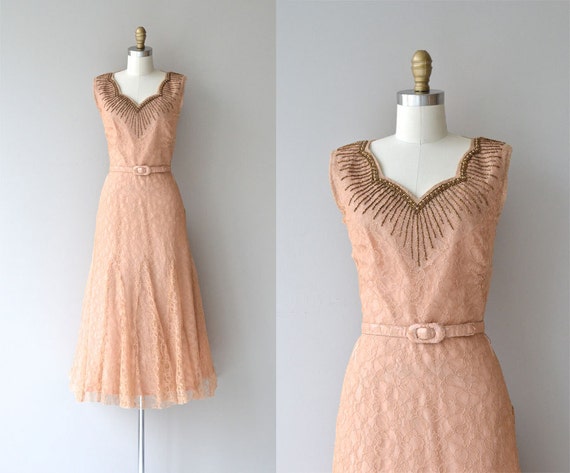
Vintage late 1940s, early 1950s blush pink lace dress with bronze bead embellished sweetheart neckline, fitted waist, matching belt and metal side zipper.
--- M E A S U R E M E N T S ---
fits like: xs bust: 34" waist: 24" hip: free length: 49" brand/maker: n/a condition: great, a few scattered breaks in the lace
to ensure a good fit, please read the sizing guide: http://www.etsy.com/shop/DearGolden/policy
✩ more vintage dresses ✩ http://www.etsy.com/shop/DearGolden?section_id=5986725




 Super Opinionated.
























9())
 OnlyMrGodKnowsWhy