Shared posts

08 Dec 17:47

Graphene and the innovation gap

by Joerg Heber

This week some rather pessimistic articles on graphene’s commercial potential appeared in the UK press. On Tuesday, Aditya Chakrabortty commented in the Guardian on “How UK wonder substance graphene can’t and won’t benefit UK“, highlighting some pretty poor statistics when it comes to the innovation in graphene here in the UK, where Andrei Geim and Kostya Novoselov carried out their pioneering research:

Our record with graphene has been similarly dismal. Consultants calculate that China has taken out more than 2,200 patents on the material; the US more than 1,700; South Korea is closing in on 1,200. And the country that discovered it? Just over 50.

One of the problems, Geim is quoted in the article, is that there isn’t industrial sponsorship for his research:

Here is one of the world’s great scientists, pointing out that British businesses are either incapable or unwilling to use his inventions. The effect is rather like James Watt complaining that he can’t find any takers for his new steam engine.

This negative picture from a research perspective has been contrasted from the industrial side with a commentary by Jonathan Ely in the Financial Times this Saturday, saying there is too much investment into graphene: “The growing graphene investment bubble” (reading this link requires free registration at the FT). For Ely it seems the problem is not the industrial side – several companies now are on the market aiming to commercialize graphene – but that there is just nothing interesting about graphene (even though the Guardian continues to call it a ‘wonder’ material):

Graphene has been around since 2004, and many patents connected with it have been filed around the world (the Koreans are especially interested). Bill Gates has suggested it be used to make indestructible condoms to prevent the spread of disease in the developing world. But so far there are no widespread commercial uses for it.

How to consolidate these contrasting views? Perhaps the problem is that companies do not see the potential of graphene in the same way as Geim does. Graphene came from blue sky innovative research done by Geim and Novoselov, born more out of curiosity than because of commercial aspirations. Still, when the Nobel prize was awarded to these pioneers, commercial applications featured prominently in the comments of the Nobel Prize committee. This even caused me to call for caution on the technological potential. And it is fair to say that the promised broad-sweeping applications particularly based on graphene’s electronic properties have not yet materialized.

But this does not mean that all is bleak.

First of all, there is commercial interest. The Financial Times mentions several companies that aim to commercialize graphene and to sell it such as Applied Graphene Materials, which have developed a promising fabrication process for graphene.  Others such as Cientifica aim to focus on practical applications. All these companies are based in the UK. And innovation in the UK in graphene is continuing, as Matin Durrani points out in his  response to Chakrabortty’s Guardian article, when he points out the £61m National Graphene Institute that has been set up at the University of Manchester.

Still, in comparison to many other countries, the lack of more a solid manufacturing and innovation industrial base is of disadvantage to the UK. I have briefly discussed this innovation gap on twitter with Richard Jones, who is Pro-Vice-Chancellor of Research and Innovation at Sheffield University:

@joergheber Yes, the gap is the problem. It’s a big one. See also http://t.co/RGw9pDIxPY

— Richard Jones (@RichardALJones) December 3, 2013

The problem of an innovation deficit and the lack of a matching industrial policy is treated in great and very educating detail in Jones’ paper that he highlights in his tweet. Anyone interested in this issue should read this. As he summarizes there:

…when necessary, accepting responsibility for technological innovation will on occasion mean that Government will need to intervene directly to make technological innovation happen.

This is certainly a great point Jones is making there, particularly for the case for huge technological efforts, as was the case for the sequencing of the human genome. Examples that Jones mentions include also the airline industry, computers and pharmaceuticals.

For graphene, the situation might be slightly different. Here, small companies may have a chance. Graphene is cheap to make, and consists of carbon, one of the most abundant chemical elements on the planet. Its commercial potential continues to appeal and includes applications ranging from batteries, small electrical contacts to sensing and many other applications that may not require multi-billion dollar investments on the scale of new pharmaceutical drugs or new generations of silicon electronics.

In the US, financing entrepreneurial companies is comparatively easy, and taking a risk is not seen as a disadvantage. Even younger huge corporations such as Google or Amazon started out as very small businesses. In other words, major technological progress does not necessarily need a national research program. The company that started out as a web search portal a mere 15 years ago is now about to introduce driverless cars. Bottom-up innovations can achieve a lot. In countries such as Germany or Japan, it is often established small and medium-sized companies that commercialize new technology, which often have close relationships with academic researchers and institutions. Such relationships could be developed much better in the UK.

Either way, I believe the same small-scale early commercialization might well be possible for graphene. Closing the innovation gap in graphene may not require a major national programme beyond initiatives such as the National Graphene Institute. However, it will need a change in mindset. It does not help if risk-taking entrepreneurs in the UK are not taken seriously or their efforts prematurely criticised.

Failure should not be a blemish for those trying, and it must be possible that (realistic) visions are backed by sufficient venture capital funding. The government cuts that we have seen to research funding will of course have a dramatic impact on the UK’s ability for innovation. The next breakthrough like graphene may not come from the UK also because of these cuts. Supporting entrepreneurs, however, is not only a structural or political issue, but also requires vision.


Filed under: Materials Science, Nanotechnology, Science Policy
07 Dec 18:02

On Creativity

by Riccardo

Ken Robinson gives great talks about Creativity and Education. Everyone should see this talk, his humour is amazing:

How Schools Kill Creativity

I believe that Creativity is at the heart of Physics education, together with Curiosity is the driving motivation of any scientist. Modern efficiency-oriented education risks to kill creativity. One of the most important and deep message we try to pass to our youngest students is to be inquisitive, and to create, instead of learning by hard and being repetitive. Real creativity is learnt with open-ended projects and questions, which are hard to be included in our taught curricula. In King’s we do it for third and fourth year projects, and for my experience students loves the challenge of an open end to their work.

I also fear in many aspects our education and research system is afraid of real Creativity, which is quite hard to understand, and manage. Much of the funding is given to very secure projects, which do not dare to really create and risk but instead add a little to the state of the art, or even have already been done in some part. Can we really stimulate creativity in our graduate students if we do not dare and risk with out of the blue projects?

Only the most successful companies, like the old Bell labs, the old IBM or modern Google, grow by testing and refining unconventional ideas, or they are they the most successful enterprises because of that willingness to dare?

580601_379906212116046_1774219627_n

28 Nov 22:35

Interpreting Chiral Nanophotonic Spectra: The Plasmonic Born–Kuhn Model

by Xinghui Yin, Martin Schäferling, Bernd Metzger and Harald Giessen

TOC Graphic

Nano Letters
DOI: 10.1021/nl403705k
28 Nov 19:59

Inelastic scattering puts in question recent claims of Anderson localization of light

by Georg Maret

Nature Photonics 7, 934 (2013). doi:10.1038/nphoton.2013.281

Authors: Georg Maret, Tilo Sperling, Wolfgang Bührer, Andreas Lubatsch, Regine Frank & Christof M. Aegerter

28 Nov 19:59

Inelastic scattering puts in question recent claims of Anderson localization of light

by Frank Scheffold

Nature Photonics 7, 934 (2013). doi:10.1038/nphoton.2013.210

Authors: Frank Scheffold & Diederik Wiersma

27 Nov 21:58

PhD Thesis Defense MARTA CASTRO 'Nanophotonic Structures for Light Control at the Nanoscale'

by webmaster@icfo.eu (ICFO Seminars)
Tuesday December 17, 11:00. ICFO Auditorium
20 Nov 22:17

Shoot for the Moon

Shoot for the Moon. If you miss, you'll end up co-orbiting the Sun alongside Earth, living out your days alone in the void within sight of the lush, welcoming home you left behind.
17 Nov 18:39

Workshop "Waves in complex media" - Jun 2014

by admin@wavefrontshaping.net (Administrator)

Workshop "Waves in complex media"

Dec 11th - 13th, 2013

Institut Scientifique de Cargèse, Corsica, France

Organized by: Sergey Skipetrov (Grenoble), Frank Scheffold (Fribourg) and Diederik Wiersma (Florence)

GDR Mesoimage

Link: here

13 Nov 10:33

Degree Distribution in Quantum Walks on Complex Networks

by Mauro Faccin, Tomi Johnson, Jacob Biamonte, Sabre Kais, and Piotr Migdał

Author(s): Mauro Faccin, Tomi Johnson, Jacob Biamonte, Sabre Kais, and Piotr Migdał


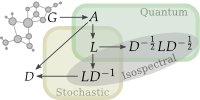
Creative Commons Google’s search engine algorithmically determines the relative importance of the world’s webpages by exploiting the physics of a classical random walker on the complex network of nodes (pages) and links (hyperlinks). What happens if the classical random walker is replaced by a quantum one? Researchers develop and investigate a simple model of a quantum walker on a complex network, uncovering interesting quantum-classical correspondence as well as fundamentally intriguing differences.
[Phys. Rev. X 3, 041007] Published Thu Oct 24, 2013

13 Nov 10:33

Do Cloaked Objects Really Scatter Less?

by Francesco Monticone and Andrea Alù

Author(s): Francesco Monticone and Andrea Alù


Creative Commons Known metamaterial-based “invisibility cloaks” have been observed to work only for narrow ranges of electromagnetic waves, for example, making an object invisible to red light, but highly visible to blue light. With a comprehensive and quantitative theoretical analysis, researchers now provide a concrete understanding of the observations and also propose a design for broadband cloaks using diamagnetic or superconducting thin cloaking layers.

[Phys. Rev. X 3, 041005] Published Mon Oct 21, 2013

03 Nov 12:55

Experimental Observation of a Fundamental Length Scale of Waves in Random Media

by S. Barkhofen, J. J. Metzger, R. Fleischmann, U. Kuhl, and H.-J. Stöckmann

Author(s): S. Barkhofen, J. J. Metzger, R. Fleischmann, U. Kuhl, and H.-J. Stöckmann

Waves propagating through a weakly scattering random medium show a pronounced branching of the flow accompanied by the formation of freak waves, i.e., extremely intense waves. Theory predicts that this strong fluctuation regime is accompanied by its own fundamental length scale of transport in rando...

[Phys. Rev. Lett. 111, 183902] Published Fri Nov 01, 2013

30 Oct 11:26

Multimode Plasmon Excitation and In Situ Analysis in Top-Down Fabricated Nanocircuits

by Peter Geisler, Gary Razinskas, Enno Krauss, Xiao-Fei Wu, Christian Rewitz, Philip Tuchscherer, Sebastian Goetz, Chen-Bin Huang, Tobias Brixner, and Bert Hecht

Author(s): Peter Geisler, Gary Razinskas, Enno Krauss, Xiao-Fei Wu, Christian Rewitz, Philip Tuchscherer, Sebastian Goetz, Chen-Bin Huang, Tobias Brixner, and Bert Hecht

We experimentally demonstrate synthesis and in situ analysis of multimode plasmonic excitations in two-wire transmission lines supporting a symmetric and an antisymmetric eigenmode. To this end we irradiate an incoupling antenna with a diffraction-limited excitation spot exploiting a polarization- a...

[Phys. Rev. Lett. 111, 183901] Published Mon Oct 28, 2013

29 Oct 20:44

Accusations of misconduct regarding a condensed matter paper

by Douglas Natelson
I had heard some gossip about this from a couple of my colleagues last week, and now it would appear that the news has broken in the English-language media.  The paper at hand is this one, which reports that, in one of the iron pnictide superconductors, there can be phase separation between regions of one composition (K0.68Fe1.78Se2) and regions of another composition (K0.81Fe1.6Se2).  This is important because in trying to understand the superconducting properties of samples with some nominal composition, it's a big deal to know whether you're looking at a homogeneous system or one where some other composition is actually dominating the properties.

The accusation is reported here and here, and comes from Prof. Mu Wang at Nanjing University (also the home institution of the accused, Prof. Hai-Hu Wen).   There are at least two scientific ethics issues.  First, there is a question about co-authorship (did all of the authors on the paper actually contribute, and did they even see the paper prior to submission).  Second, from what I can gather, there are concerns about data selection in Fig. 4 of the paper.  People who know more about this, please feel free to chime in, since it's a good idea to understand specifically what the concerns are regarding the validity of the scientific claims of the article.  The added dimension to all of this is the claim that both the accuser and the accused were up for membership in the Chinese Academy of Sciences (though apparently the accuser has withdrawn his candidacy - see my second link in this paragraph).  Interesting, particularly since accusations like this in the physical sciences remain relatively rare.
28 Oct 17:39

If people do not believe that mathematics is simple, it is only because they do not realize how complicated life is

by but does it float
Scanning Electron Micrographs of Diatoms Title: John von Neumann Folkert
26 Oct 11:41

Heat Superdiffusion in Plasmonic Nanostructure Networks

by Philippe Ben-Abdallah, Riccardo Messina, Svend-Age Biehs, Maria Tschikin, Karl Joulain, and Carsten Henkel

Author(s): Philippe Ben-Abdallah, Riccardo Messina, Svend-Age Biehs, Maria Tschikin, Karl Joulain, and Carsten Henkel

The heat transport mediated by near-field interactions in networks of plasmonic nanostructures is shown to be analogous to a generalized random walk process. The existence of superdiffusive regimes is demonstrated both in linear ordered chains and in three-dimensional random networks by analyzing th...

[Phys. Rev. Lett. 111, 174301] Published Tue Oct 22, 2013

26 Oct 11:38

10/21/13 PHD comic: 'Time'

Piled Higher & Deeper by Jorge Cham
www.phdcomics.com
Click on the title below to read the comic
title: "Time" - originally published 10/21/2013

For the latest news in PHD Comics, CLICK HERE!

24 Oct 16:11

Minifigs

The LEGO Group is already the world's largest tire manufacturer.
15 Oct 19:56

Makerwise: comparing 3d printers

by L.

makerwise

3D printing is a great tool. However, I still don’t recommend buying your own 3D printer. Use a service instead (e.g., Ponoko, Shapeways, or Quickparts). Here’s why:

1. The technology moves fast.

What you buy today will be primitive technology in very short order.

2. Individual machines are limited in what materials they can use.

Want to try out 3D printed metal? And plastic? You’ll probably need two different machines.

3. Maintenance & materials.

The materials aren’t free, and there’s a lot that can go wrong with these machines. Their reliability isn’t typically amazing.

That said, if you have one material you can commit to, and you have a lot of tinkering to do that requires a short turnaround time, then maybe buying your own machine makes sense. At that point, Makerwise, a site that compares 3D printers, might come in handy.

PrintFacebookTwitterGoogle BookmarksSlashdotemailLinkedInReddit

10 Oct 18:41

Measuring Large Optical Transmission Matrices of Disordered Media

by Hyeonseung Yu, Timothy R. Hillman, Wonshik Choi, Ji Oon Lee, Michael S. Feld, Ramachandra R. Dasari, and YongKeun Park

Author(s): Hyeonseung Yu, Timothy R. Hillman, Wonshik Choi, Ji Oon Lee, Michael S. Feld, Ramachandra R. Dasari, and YongKeun Park

We report a measurement of the large optical transmission matrix (TM) of a complex turbid medium. The TM is acquired using polarization-sensitive, full-field interferometric microscopy equipped with a rotating galvanometer mirror. It is represented with respect to input and output bases of optical m...

[Phys. Rev. Lett. 111, 153902] Published Thu Oct 10, 2013

10 Oct 09:56

Average light velocities in periodic media

by Peter Kaspar
Peter Kaspar, Roman Kappeler, Daniel Erni, Heinz Jäckel
Electromagnetic Bloch modes are used to describe the field distribution of light in periodic media that cannot be adequately approximated by effective macroscopic media. These modes explicitly take into account the spatial modulation of the medium and therefore contain the full physical information ... [J. Opt. Soc. Am. B 30, 2849-2854 (2013)]
09 Oct 12:33

Quantum Amplification by Superradiant Emission of Radiation

by Anatoly A. Svidzinsky, Luqi Yuan, and Marlan O. Scully

Author(s): Anatoly A. Svidzinsky, Luqi Yuan, and Marlan O. Scully


Creative Commons Light amplification in lasers usually relies on populating higher energy levels with more light emitters than lower energy levels. Scientists propose a new way of amplifying light without such population inversion, based on their discovery of resonant superradiant emission from an atomic ensemble interacting with a driving light field.

[Phys. Rev. X 3, 041001] Published Tue Oct 08, 2013

04 Oct 07:54

Controlling Subnanometer Gaps in Plasmonic Dimers Using Graphene

by Jan Mertens, Anna L. Eiden, Daniel O. Sigle, Fumin Huang, Antonio Lombardo, Zhipei Sun, Ravi S. Sundaram, Alan Colli, Christos Tserkezis, Javier Aizpurua, Silvia Milana, Andrea C. Ferrari and Jeremy J. Baumberg

TOC Graphic

Nano Letters
DOI: 10.1021/nl4018463
03 Oct 16:48

Three-dimensional imaging of localized surface plasmon resonances of metal nanoparticles

by Olivia Nicoletti

Three-dimensional imaging of localized surface plasmon resonances of metal nanoparticles

Nature 502, 7469 (2013). doi:10.1038/nature12469

Authors: Olivia Nicoletti, Francisco de la Peña, Rowan K. Leary, Daniel J. Holland, Caterina Ducati & Paul A. Midgley

The remarkable optical properties of metal nanoparticles are governed by the excitation of localized surface plasmon resonances (LSPRs). The sensitivity of each LSPR mode, whose spatial distribution and resonant energy depend on the nanoparticle structure, composition and environment, has given rise to many potential photonic, optoelectronic, catalytic, photovoltaic, and gas- and bio-sensing applications. However, the precise interplay between the three-dimensional (3D) nanoparticle structure and the LSPRs is not always fully understood and a spectrally sensitive 3D imaging technique is needed to visualize the excitation on the nanometre scale. Here we show that 3D images related to LSPRs of an individual silver nanocube can be reconstructed through the application of electron energy-loss spectrum imaging, mapping the excitation across a range of orientations, with a novel combination of non-negative matrix factorization, compressed sensing and electron tomography. Our results extend the idea of substrate-mediated hybridization of dipolar and quadrupolar modes predicted by theory, simulations, and electron and optical spectroscopy, and provide experimental evidence of higher-energy mode hybridization. This work represents an advance both in the understanding of the optical response of noble-metal nanoparticles and in the probing, analysis and visualization of LSPRs.

03 Oct 16:48

Attractive photons in a quantum nonlinear medium

by Ofer Firstenberg

Attractive photons in a quantum nonlinear medium

Nature 502, 7469 (2013). doi:10.1038/nature12512

Authors: Ofer Firstenberg, Thibault Peyronel, Qi-Yu Liang, Alexey V. Gorshkov, Mikhail D. Lukin & Vladan Vuletić

The fundamental properties of light derive from its constituent particles—massless quanta (photons) that do not interact with one another. However, it has long been known that the realization of coherent interactions between individual photons, akin to those associated with conventional massive particles, could enable a wide variety of novel scientific and engineering applications. Here we demonstrate a quantum nonlinear medium inside which individual photons travel as massive particles with strong mutual attraction, such that the propagation of photon pairs is dominated by a two-photon bound state. We achieve this through dispersive coupling of light to strongly interacting atoms in highly excited Rydberg states. We measure the dynamical evolution of the two-photon wavefunction using time-resolved quantum state tomography, and demonstrate a conditional phase shift exceeding one radian, resulting in polarization-entangled photon pairs. Particular applications of this technique include all-optical switching, deterministic photonic quantum logic and the generation of strongly correlated states of light.

01 Oct 22:07

Complex media: Subtle sensing

by David Pile

Nature Photonics 7, 763 (2013). doi:10.1038/nphoton.2013.266

Author: David Pile

30 Sep 17:44

[Report] Real-Space Identification of Intermolecular Bonding with Atomic Force Microscopy

by Jun Zhang
26 Sep 18:21

Viewpoint: Putting “Quantumness” to the Test

A machine consisting of nearly 100 quantum circuit elements can compute the solution to a classic problem in mathematics, but is it a quantum computer?

Published Wed Sep 25, 2013
26 Sep 07:36

Carbon nanotube computer

by Max M. Shulaker

Carbon nanotube computer

Nature 501, 7468 (2013). doi:10.1038/nature12502

Authors: Max M. Shulaker, Gage Hills, Nishant Patil, Hai Wei, Hong-Yu Chen, H.-S. Philip Wong & Subhasish Mitra

The miniaturization of electronic devices has been the principal driving force behind the semiconductor industry, and has brought about major improvements in computational power and energy efficiency. Although advances with silicon-based electronics continue to be made, alternative technologies are being explored. Digital circuits based on transistors fabricated from carbon nanotubes (CNTs) have the potential to outperform silicon by improving the energy–delay product, a metric of energy efficiency, by more than an order of magnitude. Hence, CNTs are an exciting complement to existing semiconductor technologies. Owing to substantial fundamental imperfections inherent in CNTs, however, only very basic circuit blocks have been demonstrated. Here we show how these imperfections can be overcome, and demonstrate the first computer built entirely using CNT-based transistors. The CNT computer runs an operating system that is capable of multitasking: as a demonstration, we perform counting and integer-sorting simultaneously. In addition, we implement 20 different instructions from the commercial MIPS instruction set to demonstrate the generality of our CNT computer. This experimental demonstration is the most complex carbon-based electronic system yet realized. It is a considerable advance because CNTs are prominent among a variety of emerging technologies that are being considered for the next generation of highly energy-efficient electronic systems.

26 Sep 07:36

Electronics: The carbon-nanotube computer has arrived

by Franz Kreupl

Electronics: The carbon-nanotube computer has arrived

Nature 501, 7468 (2013). doi:10.1038/501495a

Authors: Franz Kreupl

The most complex electronic device yet built from carbon nanotubes has been demonstrated. The system is a functional universal computer, and represents a significant advance in the field of emerging electronic materials. See Letter p.526

25 Sep 13:26

Effects of classical nonlocality on the optical response of three-dimensional plasmonic nanodimers

by Cristian Ciracì
Cristian Ciracì, Yaroslav Urzhumov, David R. Smith
We examine the optical scattering from a variety of axially symmetric plasmonic nanoparticle dimers separated by nanoscale gaps, quantifying the role of classical nonlocality on their optical properties. Due to the rotational symmetry of the analyzed structures, a high degree of accuracy is ... [J. Opt. Soc. Am. B 30, 2731-2736 (2013)]