Shared posts

06 Oct 15:13

Asymmetric surface plasmon polariton emission by a dipole emitter near a metal surface

by J. P. Balthasar Mueller and Federico Capasso

Author(s): J. P. Balthasar Mueller and Federico Capasso

We show that the surface plasmon polariton (SPP) radiation patterns of point-dipole emitters in the vicinity of a metal-dielectric interface are generally asymmetric with respect to the location of the emitter. In particular rotating dipoles, which emit elliptically polarized light, produce highly a…


[Phys. Rev. B 88, 121410(R)] Published Mon Sep 23, 2013

05 Oct 08:31

A new kind of solid - why "q-glass" really is weird and interesting

by Douglas Natelson
As long-time readers here know, I'm not a big fan of hype and press releases.  While it is very important to let people know what academic scientists and engineers are doing, not everything needs to be trumpeted from the rooftops as a huge breakthrough or a paradigm-altering thunderbolt.  However, this new result (the actual paper is here) is genuinely weird, unexpected, and exciting (at least to me).  The authors claim to have discovered a truly new kind of solid.  Let me break down what this means and why it's surprising.

A solid is a material that resists shear deformation - if you exert a certain force horizontally across the top surface of the material, the material will deform a bit until it's internal forces balance your applied force, and then deformation will reach some constant amount.  (In contrast, a fluid will keep deforming continuously!)  The most ordinary solids people know about are either crystalline (this includes polycrystalline materials made up of many crystal grains) or glasses.  In a crystalline solid, the atoms have taken on highly symmetric spatial arrangements.  That is, the atoms aren't separated by random distances, but integer multiples of certain particular spacings; similarly, crystals are not isotropic - there are particular directions along which atoms are arranged.   In contrast, simple liquids are isotropic, and except for some typical nearest-neighbor distance set by the atomic or molecular size, there is no other spatial ordered arrangement.   When a solid crystallizes from a liquid, it is a collective phenomenon, a phase transition, and this happens on cooling when the free energy of solid phase becomes lower than that of the liquid phase.  Quasicrystals (see 2011 Nobel for Chemistry) are in these senses crystals - their symmetries are just more subtle than those of ordinary crystals.

Glasses (including those made from polymers) are different.  They resist shear, too, but they do not have the long-range, periodic/anisotropic arrangement of constituents seen in crystals.  Instead, upon cooling, glasses become solid (meaning that their viscosity diverges toward infinity) because the constituents become "kinetically hindered".  At the risk of dragging up controversy, the simple description is that there is no true glass phase in the thermodynamic sense - glasses are rigid because the constituents can't readily move out of each others' ways, not because there is some true collective thermodynamic stability (involving free energies) at work. 

The authors of this new work have found something special that they have termed a "q-glass" while looking at what happens in the solidification of a molten mixture of aluminum, iron, and silicon.  In the resulting solids, they find nodules of a new material (Al91Fe7Si2, approximately) that is definitely not crystalline or polycrystalline (no preferred lattice spacings; completely isotropic).  At the same time, the material does form out of the melt through a genuine first-order phase transition (!), and therefore appears to be highly ordered in some sense (both distinguishing it from a glass).  It will be very interesting to learn exactly what is going on here, and whether there are other materials that have these peculiar features.

01 Oct 21:57

Experimental evidence of nanometer-scale confinement of plasmonic eigenmodes responsible for hot spots in random metallic films

by Arthur Losquin, Sophie Camelio, David Rossouw, Mondher Besbes, Frédéric Pailloux, David Babonneau, Gianluigi A. Botton, Jean-Jacques Greffet, Odile Stéphan, and Mathieu Kociak

Author(s): Arthur Losquin, Sophie Camelio, David Rossouw, Mondher Besbes, Frédéric Pailloux, David Babonneau, Gianluigi A. Botton, Jean-Jacques Greffet, Odile Stéphan, and Mathieu Kociak

We report on the identification and nanometer scale characterization over a large energy range of random, disorder-driven, surface plasmons in silver semicontinuous films embedded in silicon nitride. By performing spatially resolved electron energy loss spectroscopy experiments, we experimentally de…


[Phys. Rev. B 88, 115427] Published Mon Sep 23, 2013

01 Oct 21:57

Quantum-Coherence-Enhanced Surface Plasmon Amplification by Stimulated Emission of Radiation

by Konstantin E. Dorfman, Pankaj K. Jha, Dmitri V. Voronine, Patrice Genevet, Federico Capasso, and Marlan O. Scully

Author(s): Konstantin E. Dorfman, Pankaj K. Jha, Dmitri V. Voronine, Patrice Genevet, Federico Capasso, and Marlan O. Scully

We investigate surface plasmon amplification in a silver nanoparticle coupled to an externally driven three-level gain medium and show that quantum coherence significantly enhances the generation of surface plasmons. Surface plasmon amplification by stimulated emission of radiation is achieved in th…


[Phys. Rev. Lett. 111, 043601] Published Tue Jul 23, 2013

27 Sep 16:38

The laminar–turbulent transition in a fibre laser

by E. G. Turitsyna

Nature Photonics 7, 783 (2013). doi:10.1038/nphoton.2013.246

Authors: E. G. Turitsyna, S. V. Smirnov, S. Sugavanam, N. Tarasov, X. Shu, S. A. Babin, E. V. Podivilov, D. V. Churkin, G. Falkovich & S. K. Turitsyn

25 Sep 13:34

Surface Plasmons and Nonlocality: A Simple Model

by Yu Luo, A. I. Fernandez-Dominguez, Aeneas Wiener, Stefan A. Maier, and J. B. Pendry

Author(s): Yu Luo, A. I. Fernandez-Dominguez, Aeneas Wiener, Stefan A. Maier, and J. B. Pendry

Surface plasmons on metals can concentrate light into subnanometric volumes and on these near atomic length scales the electronic response at the metal interface is smeared out over a Thomas-Fermi screening length. This nonlocality is a barrier to a good understanding of atomic scale response to lig...

[Phys. Rev. Lett. 111, 093901] Published Mon Aug 26, 2013

25 Sep 13:29

09/18/13 PHD comic: 'Should you ask a question during Seminar?'

Piled Higher & Deeper by Jorge Cham
www.phdcomics.com
Click on the title below to read the comic
title: "Should you ask a question during Seminar?" - originally published 9/18/2013

For the latest news in PHD Comics, CLICK HERE!

23 Sep 12:34

Transverse localization of sound

by Alice Bretagne, Mathias Fink, and Arnaud Tourin

Author(s): Alice Bretagne, Mathias Fink, and Arnaud Tourin

Rapid Communication We show how disorder can be used to guide a broadband ultrasonic wave. The idea is to exploit the transverse localization regime that has been reported for light. Our waveguide consists of a set of parallel cylindrical scatterers randomly distributed in the transverse plane. An ultrasonic beam propa...

[Phys. Rev. B 88, 100302] Published Fri Sep 20, 2013

18 Sep 12:13

Vernier + Arduino

by AMCDawes

VernierI have been teaching with Vernier hardware for at least 10 years, so it is great to see them supporting work on the Arduino platform (another passion of mine). I’ll keep an eye out for the Sparkfun boards this fall, this is a great way to get more sensors available for use in our electronics class projects.

They have a very nice guide to interfacing with their sensors:
http://www.vernier.com/engineering/arduino/

And more announcements in the newsletter:
http://www2.vernier.com/newsletters/fall13.pdf

Vernier + Arduino


17 Sep 10:48

Observing Light-by-Light Scattering at the Large Hadron Collider

by David d’Enterria and Gustavo G. da Silveira

Author(s): David d’Enterria and Gustavo G. da Silveira

Selected for a Synopsis in Physics Elastic light-by-light scattering (γγ→γγ) is open to study at the Large Hadron Collider thanks to the large quasireal photon fluxes available in electromagnetic interactions of protons (p) and lead (Pb) ions. The γγ→γγ cross sections for diphoton masses mγγ>5  GeV amount to 12 fb, 26 pb, and 35 n...

[Phys. Rev. Lett. 111, 080405] Published Thu Aug 22, 2013

17 Sep 10:47

Microscopic origin of the ‘0.7-anomaly’ in quantum point contacts

by Florian Bauer

Microscopic origin of the ‘0.7-anomaly’ in quantum point contacts

Nature 501, 7465 (2013). doi:10.1038/nature12421

Authors: Florian Bauer, Jan Heyder, Enrico Schubert, David Borowsky, Daniela Taubert, Benedikt Bruognolo, Dieter Schuh, Werner Wegscheider, Jan von Delft & Stefan Ludwig

Quantum point contacts are narrow, one-dimensional constrictions usually patterned in a two-dimensional electron system, for example by applying voltages to local gates. The linear conductance of a point contact, when measured as function of its channel width, is quantized in units of GQ = 2e2/h, where e is the electron charge and h is Planck’s constant. However, the conductance also has an unexpected shoulder at ∼0.7GQ, known as the ‘0.7-anomaly’, whose origin is still subject to debate. Proposed theoretical explanations have invoked spontaneous spin polarization, ferromagnetic spin coupling, the formation of a quasi-bound state leading to the Kondo effect, Wigner crystallization and various treatments of inelastic scattering. However, explicit calculations that fully reproduce the various experimental observations in the regime of the 0.7-anomaly, including the zero-bias peak that typically accompanies it, are still lacking. Here we offer a detailed microscopic explanation for both the 0.7-anomaly and the zero-bias peak: their common origin is a smeared van Hove singularity in the local density of states at the bottom of the lowest one-dimensional subband of the point contact, which causes an anomalous enhancement in the Hartree potential barrier, the magnetic spin susceptibility and the inelastic scattering rate. We find good qualitative agreement between theoretical calculations and experimental results on the dependence of the conductance on gate voltage, magnetic field, temperature, source–drain voltage (including the zero-bias peak) and interaction strength. We also clarify how the low-energy scale governing the 0.7-anomaly depends on gate voltage and interactions. For low energies, we predict and observe Fermi-liquid behaviour similar to that associated with the Kondo effect in quantum dots. At high energies, however, the similarities between the 0.7-anomaly and the Kondo effect end.

17 Sep 10:47

Research impact: Altmetrics make their mark

by Roberta Kwok

Research impact: Altmetrics make their mark

Nature 500, 7463 (2013). doi:10.1038/nj7463-491a

Author: Roberta Kwok

Alternative measures can yield useful data on achievement — but must be used cautiously.

09 Sep 07:34

07/24/13 PHD comic: 'Academically'

Piled Higher & Deeper by Jorge Cham
www.phdcomics.com
Click on the title below to read the comic
title: "Academically" - originally published 7/24/2013

For the latest news in PHD Comics, CLICK HERE!

09 Sep 07:29

Digital tools for science 2.0

by Riccardo

After a very stimulating debate at the Complex Nanophotonics Science Camp I have decided to try to move all data management, project management, backup and data sharing from paper, emails zip files, to a digital platform.

Future Science

I think there is no single solution to all our research needs. I would like to be able to:
1. data sharing within the research team, we use now Dropbox and Google Drive.
2. project sharing, among collaborators who are often in a different continent? We use now emails, shared folders and even mail.
3. coordinate the effort of many team members, each of them focussing on a different aspect of the project. Google Drive with its multi-user editing facility is the best we have tried so far. We even organised a conference with it.
4. keep track changes, especially of the software we develop. For this we are starting to use Github
5. bring order into the large amount of literature we have to go through every day. I use Papers which is great, but unfortunately not great for sharing within a project. A common alternative is Mendeley, which stronger on the sharing side, but not as quick to be used like Papers.
6. share recent literature, to form a modern version of a reading club bringing together researcher with similar interests. I used to do this with Google reader before it was unpolitely shut down. Now Theoldreader is  offering a similar service, but it is still in beta version and very slow.

Also we are discussing moving to a “tablet-based” lab book, for example from an app that would allow quick note/photo/verbal note taking and uploading to a project. At the moment the only possibility I am considering is Evernote. On the tablet side, only Samsung Galaxy allows for real handwriting and pdf editing, but I am still not convinced is the right solution. I hope a future iPad or even a flexible pad would be much better.

I have recently tried Projects form DigitalScience, which has great potentialities, but at this first sight I fear is just a data visualiser, with integrated notes. It supports local backups but not on a remote server, and no direct project sharing. On the other hand it integrates nicely with figshare to upload and share data (it can be used privately up to 1Gb or more for a small fee).

How will science 2.0 be done?

08 Sep 08:19

Three-Dimensional Plasmonic Nanoclusters

by Alexander S. Urban, Xiaoshuang Shen, Yumin Wang, Nicolas Large, Hong Wang, Mark W. Knight, Peter Nordlander, Hongyu Chen and Naomi J. Halas

TOC Graphic

Nano Letters
DOI: 10.1021/nl402231z
21 Aug 08:13

Nonequilibrium Chaos of Disordered Nonlinear Waves

by Ch. Skokos, I. Gkolias, and S. Flach

Author(s): Ch. Skokos, I. Gkolias, and S. Flach

Do nonlinear waves destroy Anderson localization? Computational and experimental studies yield subdiffusive nonequilibrium wave packet spreading. Chaotic dynamics and phase decoherence assumptions are used for explaining the data. We perform a quantitative analysis of the nonequilibrium chaos assump...

[Phys. Rev. Lett. 111, 064101] Published Wed Aug 07, 2013

21 Aug 07:51

Coherent control of total transmission of light through disordered media. (arXiv:1308.0781v2 [physics.optics] UPDATED)

by S. M. Popoff, A. Goetschy, S. F. Liew, A. D. Stone, H. Cao

We demonstrate order of magnitude coherent control of total transmission of light through random media by shaping the wavefront of the input light. To understand how the finite illumination area on a wide slab affects the maximum values of total transmission, we develop a model based on random matrix theory that reveals the role of long-range correlations. Its predictions are confirmed by numerical simulations and provide physical insight into the experimental results.

21 Aug 07:49

Surface Plasmons and Nonlocality: a Simple Model. (arXiv:1308.1708v1 [cond-mat.mes-hall])

by Yu Luo, A. I. Fernandez-Dominguez, Aeneas Wiener, S. A. Maier, J. B. Pendry

Surface plasmons on metals can concentrate light into sub-nanometric volumes and on these near atomic length scales the electronic response at the metal interface is smeared out over a Thomas-Fermi screening length. This nonlocality is a barrier to a good understanding of atomic scale response to light and complicates the practical matter of computing the fields. In this letter, we present a local analogue model and show that spatial nonlocality can be represented by replacing the nonlocal metal with a composite material, comprising a thin dielectric layer on top of a local metal. This method not only makes possible the quantitative analysis of nonlocal effects in complex plasmonic phenomena with unprecedented simplicity and physical insight, but also offers great practical advantages in their numerical treatment.

21 Aug 07:41

Light-matter decoupling in the deep strong coupling regime: The breakdown of the Purcell effect. (arXiv:1308.2812v2 [quant-ph] UPDATED)

by Simone De Liberato

Improvements both in the photonic confinement and in the emitter design have led to a steady increase in the strength of the light-matter coupling in cavity quantum electrodynamics experiments. This has allowed to access interaction-dominated regimes in which the state of the system can only be described in terms of mixed light-matter excitations. Here we show that, when the coupling between light and matter becomes strong enough, this picture breaks down, and light and matter degrees of freedom totally decouple. A striking consequence of such a counter-intuitive phenomenon is that the Purcell effect is reversed and the spontaneous emission rate, usually thought to increase with the light-matter coupling strength, plummets instead for large enough couplings.

21 Aug 07:38

Functional plasmonic nano-circuits with low insertion and propagation losses. (arXiv:1308.3261v1 [physics.optics])

by Arian Kriesch, Stanley P. Burgos, Daniel Ploss, Hannes Pfeifer, Harry A. Atwater, Ulf Peschel

We experimentally demonstrate plasmonic nano-circuits operating as sub-diffraction directional couplers optically excited with high efficiency from free-space using optical Yagi-Uda style antennas at \lambda = 1550 nm. The optical Yagi-Uda style antennas are designed to feed channel plasmon waveguides with high efficiency (45 % in coupling, 60 % total emission), narrow angular directivity (< 40{\deg}) and low insertion loss. SPP gap waveguides exhibit propagation lengths as large as 34 {\mu}m with adiabatically tuned confinement, and are integrated with ultra-compact (5 \mu m x 10 \mu m), highly dispersive directional couplers, which enable 30 dB discrimination over {\Delta}{\lambda} = 200 nm with only 0.3 dB device loss.

21 Aug 07:22

Subdiffraction-limited quantum imaging within a living cell. (arXiv:1305.1353v3 [physics.optics] UPDATED)

by Michael A. Taylor, Jiri Janousek, Vincent Daria, Joachim Knittel, Boris Hage, Hans-A. Bachor, Warwick P. Bowen

We report both sub-diffraction-limited quantum metrology and quantum enhanced spatial resolution for the first time in a biological context. Nanoparticles are tracked with quantum correlated light as they diffuse through an extended region of a living cell in a quantum enhanced photonic force microscope. This allows spatial structure within the cell to be mapped at length scales down to 10 nm. Control experiments in water show a 14% resolution enhancement compared to experiments with coherent light. Our results confirm the longstanding prediction that quantum correlated light can enhance spatial resolution at the nanoscale and in biology. Combined with state-of-the-art quantum light sources, this technique provides a path towards an order of magnitude improvement in resolution over similar classical imaging techniques.

20 Aug 12:40

Observation of trapped light within the radiation continuum

by Chia Wei Hsu

Observation of trapped light within the radiation continuum

Nature 499, 7457 (2013). doi:10.1038/nature12289

Authors: Chia Wei Hsu, Bo Zhen, Jeongwon Lee, Song-Liang Chua, Steven G. Johnson, John D. Joannopoulos & Marin Soljačić

The ability to confine light is important both scientifically and technologically. Many light confinement methods exist, but they all achieve confinement with materials or systems that forbid outgoing waves. These systems can be implemented by metallic mirrors, by photonic band-gap materials, by highly disordered media (Anderson localization) and, for a subset of outgoing waves, by translational symmetry (total internal reflection) or by rotational or reflection symmetry. Exceptions to these examples exist only in theoretical proposals. Here we predict and show experimentally that light can be perfectly confined in a patterned dielectric slab, even though outgoing waves are allowed in the surrounding medium. Technically, this is an observation of an ‘embedded eigenvalue’—namely, a bound state in a continuum of radiation modes—that is not due to symmetry incompatibility. Such a bound state can exist stably in a general class of geometries in which all of its radiation amplitudes vanish simultaneously as a result of destructive interference. This method to trap electromagnetic waves is also applicable to electronic and mechanical waves.

19 Aug 07:17

[Report] All-Optical Switch and Transistor Gated by One Stored Photon

by Wenlan Chen
Optical transmission through a cesium-filled cavity can be controlled by a single stored photon. [Also see Perspective by Volz and Rauschenbeutel] Authors: Wenlan Chen, Kristin M. Beck, Robert Bücker, Michael Gullans, Mikhail D. Lukin, Haruka Tanji-Suzuki, Vladan Vuletić
13 Aug 21:02

Two-Color Laser Printing of Individual Gold Nanorods

by Jaekwon Do, Michael Fedoruk, Frank Jäckel and Jochen Feldmann

TOC Graphic

Nano Letters
DOI: 10.1021/nl401788w
13 Aug 21:01

Wavelength-Tunable Spasing in the Visible

by Xiangeng Meng, Alexander V. Kildishev, Koji Fujita, Katsuhisa Tanaka and Vladimir M. Shalaev

TOC Graphic

Nano Letters
DOI: 10.1021/nl4015827
13 Aug 21:00

A reconfigurable plasmofluidic lens

by Chenglong Zhao

Article

Plasmonics offers sub-diffraction limit optical devices, but multiple functionalities are difficult to build in the solid state. By combining it with fluidics, Zhao et al . present a tunable and reconfigurable plasmonic lens using laser-controllable bubble formation in a microfluidic environment.

Nature Communications doi: 10.1038/ncomms3305

Authors: Chenglong Zhao, Yongmin Liu, Yanhui Zhao, Nicholas Fang, Tony Jun Huang

17 Jul 07:32

Stopped Light and Image Storage by Electromagnetically Induced Transparency up to the Regime of One Minute

by Georg Heinze, Christian Hubrich, and Thomas Halfmann

Author(s): Georg Heinze, Christian Hubrich, and Thomas Halfmann

Selected for a Viewpoint in Physics The maximal storage duration is an important benchmark for memories. In quantized media, storage times are typically limited due to stochastic interactions with the environment. Also, optical memories based on electromagnetically induced transparency (EIT) suffer strongly from such decoherent effect...

[Phys. Rev. Lett. 111, 033601] Published Mon Jul 15, 2013

15 Jul 20:14

Pump-Controlled Directional Light Emission from Random Lasers

by Thomas Hisch, Matthias Liertzer, Dionyz Pogany, Florian Mintert, and Stefan Rotter

Author(s): Thomas Hisch, Matthias Liertzer, Dionyz Pogany, Florian Mintert, and Stefan Rotter

The angular emission pattern of a random laser is typically very irregular and difficult to tune. Here we show by detailed numerical calculations that one can overcome the lack of control over this emission pattern by actively shaping the spatial pump distribution. We demonstrate, in particular, how...

[Phys. Rev. Lett. 111, 023902] Published Fri Jul 12, 2013

14 Jul 20:53

Synopsis: Constraining the Photon Lifetime

Photons could conceivably decay, but new analysis of the cosmic microwave background shows that a visible wavelength photon is stable for at least 1018 years.

Published Thu Jul 11, 2013
10 Jul 08:01

Redesigned Window Stops Sound But Not Air, Say Materials Scientists

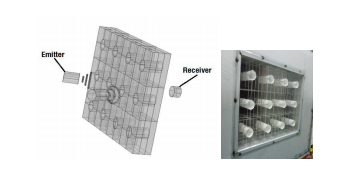
By exploiting some exotic acoustic techniques, researchers have built a window that allows the passage of air but not sound