Shared posts

15 Aug 15:52

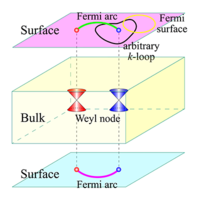
Experimental Discovery of Weyl Semimetal TaAs

by B. Q. Lv, H. M. Weng, B. B. Fu, X. P. Wang, H. Miao, J. Ma, P. Richard, X. C. Huang, L. X. Zhao, G. F. Chen, Z. Fang, X. Dai, T. Qian, and H. Ding

Author(s): B. Q. Lv, H. M. Weng, B. B. Fu, X. P. Wang, H. Miao, J. Ma, P. Richard, X. C. Huang, L. X. Zhao, G. F. Chen, Z. Fang, X. Dai, T. Qian, and H. Ding

Weyl fermions possess exotic properties and can act like magnetic monopoles. Researchers show that TaAs is a Weyl semimetal, demonstrating for the first time that Weyl semimetals can be identified experimentally.

[Phys. Rev. X 5, 031013] Published Fri Jul 31, 2015

26 Jun 09:27

Time- and Site-Resolved Dynamics in a Topological Circuit

by Jia Ningyuan, Clai Owens, Ariel Sommer, David Schuster, and Jonathan Simon

Author(s): Jia Ningyuan, Clai Owens, Ariel Sommer, David Schuster, and Jonathan Simon

The surface states of topological insulators are protected from backscattering, making them a promising resource for computing and materials science. This topological protection is now demonstrated in a radio-frequency circuit.


[Phys. Rev. X 5, 021031] Published Mon Jun 22, 2015

10 Jun 12:14

Viewpoint: A Boost for Superconducting Logic

by Jason Robinson

Author(s): Jason Robinson

A new choice of materials leads to more practically useful superconducting spin valves.


[Physics 8, 49] Published Tue May 26, 2015

23 Apr 11:35

Amplitude/Higgs Modes in Condensed Matter Physics

by David Pekker et al
Annual Review of Condensed Matter Physics Volume 6, Page 269-297, March 2015, ISSN 1947-5454, eISSN 1947-5462.
26 Jan 17:28

High Pressure Paving the Way?

by JCCMP

Conventional superconductivity at 190 K at high pressures.
Authors: A.P. Drozdov, M. I. Eremets, and I. A. Troyan.
arXiv:1412.0460

Recommended with a commentary by Zachary Fisk, UC Irvine and J. D. Thompson, Los Alamos National Laboratory
|View Commentary|

JCCM_DECEMBER_2014_01

26 Jan 13:03

Viewpoint: Orbital Engineering, By Design

In transition-metal oxides, the ability to control which atomic orbitals are occupied by electrons could be used to develop materials with new functionalities.


Published Mon Jan 12, 2015
26 Jan 13:02

Focus: Why Language Exceptions Remain the Rule

Interaction among speakers of a language may explain why frequently used verbs tend to remain irregular even as language evolves over generations.


Published Fri Jan 09, 2015
25 Nov 10:58

Sizing up bacteria

by Mark Buchanan

Nature Physics 10, 788 (2014). doi:10.1038/nphys3149

Author: Mark Buchanan

03 Mar 14:29

Evidence for quantum annealing with more than one hundred qubits

by Sergio Boixo

Nature Physics 10, 218 (2014). doi:10.1038/nphys2900

Authors: Sergio Boixo, Troels F. Rønnow, Sergei V. Isakov, Zhihui Wang, David Wecker, Daniel A. Lidar, John M. Martinis & Matthias Troyer

09 Jan 04:08

Amid Superconductor Debate, Clash of Physics Titans Resumes [NEWS ANALYSIS]

by Cho, A.
Robert Laughlin is back with a vengeance. After a decade away from physics, the Nobel laureate at Stanford University in Palo Alto, California, argues in a pair of soon-to-be published papers that most physicists' basic assumptions about the origins of high-temperature superconductivity--the ability of certain materials to carry electricity without resistance at still frigid, but unusually high temperatures--are wrong. Instead, Laughlin argues, the biggest mystery in condensed matter physics can be explained starting from the conventional theory of metals, a tack most theorists abandoned decades ago. Laughlin has spent recent years writing popular science books and had a turbulent tenure from 2004 to 2006 as the president of the Korea Advanced Institute of Science and Technology in Daejeon. He declined to answer questions about his papers, which are in press at Physical Review Letters and Physical Review B, saying they ...
21 Nov 02:48

Quantum information: From bits to solids

by Renato Renner

Nature Physics 9, 697 (2013). doi:10.1038/nphys2779

Author: Renato Renner

Information theory was originally developed to study the fundamental limits of telecommunication. But thanks to recent extensions it can now also be applied to solid-state physics.

09 Oct 17:13

Viewpoint: Materials Prediction Scores a Hit

Calculations predicting a new high-pressure superconductor are borne out by experiment.

Published Mon Oct 07, 2013
01 Oct 16:11

Viewpoint: Putting “Quantumness” to the Test

A machine consisting of nearly 100 quantum circuit elements can compute the solution to a classic problem in mathematics, but is it a quantum computer?

Published Wed Sep 25, 2013