GULPO IS HERE! And, he's here in a limited quantity.

(Seriously, these were a little difficult to get made, so if you don't get one of this batch it might be tricky to get more for a while.)
Have you ever used a formal lab-book to keep track of your experiments? I mean the old-fashion one made of a kg of paper to be signed every day.

With a growing research group I am facing the need for a reliable data tracking systems that ensure:
Can modern technology help us?
My wish is a semi-automatic video recording system, with minimal action from the user and with automatic keywords generation. When the user is involved, as we all have a different way to archive our research, confusion is inevitable. The best way to have a standard is to make it intrinsic in the system, like the 140 characters of twitter. We also need to have a searchable index and even better a grouping of the data according to the experiment they belong to. What better than automatic keywords? Maybe GPS and radio location can tag each video?
I dream of video lab books, with voice control, automatic location and intelligent archiving. If you want to learn how to make a specific research step, what better than seeing a scientist doing it on video? If you want to record exactly how the sample looked like, or how you mounted a certain item, a photo can tell much more than a wordy description.

Will ever Google Glass or even a simple wearable camera like GoPro step in the research labs to help us coordinate and augment our research?
I would add, what aren’t they already in our labs? Are we missing computing power to arrange such a large amount of data or the research community is simply to small to convince the developers? Digital Science is working on various project to enhance our laboratory work, will the digital/video lab-book be one of them?
Mosaic two-lengthscale quasicrystals
Nature 506, 7487 (2014). doi:10.1038/nature12938
Authors: T. Dotera, T. Oshiro & P. Ziherl
Over the past decade, quasicrystalline order has been observed in many soft-matter systems: in dendritic micelles, in star and tetrablock terpolymer melts and in diblock copolymer and surfactant micelles. The formation of quasicrystals from such a broad range of ‘soft’ macromolecular micelles suggests that they assemble by a generic mechanism rather than being dependent on the specific chemistry of each system. Indeed, micellar softness has been postulated and shown to lead to quasicrystalline order. Here we theoretically explore this link by studying two-dimensional hard disks decorated with step-like square-shoulder repulsion that mimics, for example, the soft alkyl shell around the aromatic core in dendritic micelles. We find a family of quasicrystals with 10-, 12-, 18- and 24-fold bond orientational order which originate from mosaics of equilateral and isosceles triangles formed by particles arranged core-to-core and shoulder-to-shoulder. The pair interaction responsible for these phases highlights the role of local packing geometry in generating quasicrystallinity in soft matter, complementing the principles that lead to quasicrystal formation in hard tetrahedra. Based on simple interparticle potentials, quasicrystalline mosaics may well find use in diverse applications ranging from improved image reproduction to advanced photonic materials.
Author(s): Michel Castellanos Muñoz, Alexander Yu. Petrov, Liam O’Faolain, Juntao Li, Thomas F. Krauss, and Manfred Eich
We demonstrate indirect photonic transitions in a silicon slow light photonic crystal waveguide. The transitions are driven by an optically generated refractive index front that moves along the waveguide and interacts with a signal pulse copropagating in the structure. We experimentally confirm a th...
[Phys. Rev. Lett. 112, 053904] Published Thu Feb 06, 2014
Author(s): Michael A. Taylor, Jiri Janousek, Vincent Daria, Joachim Knittel, Boris Hage, Hans-A. Bachor, and Warwick P. Bowen

 Quantum effects may help devise new imaging schemes that can overcome classical constraints posed by noise and diffraction. By using squeezed states of light in photonic force microscopy (PFM), scientists have demonstrated a 14% quantum enhancement of PFM’s spatial resolution, imaging details of living yeast cells with a resolution of 10 nm.
[Phys. Rev. X 4, 011017] Published Tue Feb 04, 2014
Author(s): A. Aubry, L. A. Cobus, S. E. Skipetrov, B. A. van Tiggelen, A. Derode, and J. H. Page
We report on ultrasonic measurements of the propagation operator in a strongly scattering mesoglass. The backscattered field is shown to display a deterministic spatial coherence due to a remarkably large memory effect induced by long recurrent trajectories. Investigation of the recurrent scattering...
[Phys. Rev. Lett. 112, 043903] Published Tue Jan 28, 2014
Author(s): Matthieu Dupré, Mathias Fink, and Geoffroy Lerosey
In this Letter we propose to use subwavelength diffraction gratings as very good semitransparent mirrors for electromagnetic waves to design open cavities. To do so, we replace part of the walls of a cavity by such a grating. We numerically and analytically link the grating characteristics to the sp...
[Phys. Rev. Lett. 112, 043902] Published Wed Jan 29, 2014
Author(s): Jingyu Zhang, Mindaugas Gecevičius, Martynas Beresna, and Peter G. Kazansky
We demonstrate recording and retrieval of the digital document with a nearly unlimited lifetime. The recording process of multiplexed digital data was implemented by femtosecond laser nanostructuring of fused quartz. The storage allows unprecedented parameters including hundreds of terabytes per dis...
[Phys. Rev. Lett. 112, 033901] Published Thu Jan 23, 2014
Author(s): J. Roßnagel, O. Abah, F. Schmidt-Kaler, K. Singer, and E. Lutz
We consider a quantum Otto cycle for a time-dependent harmonic oscillator coupled to a squeezed thermal reservoir. We show that the efficiency at maximum power increases with the degree of squeezing, surpassing the standard Carnot limit and approaching unity exponentially for large squeezing paramet...
[Phys. Rev. Lett. 112, 030602] Published Wed Jan 22, 2014
Author(s): Francisco J. Rodríguez-Fortuño, Ashkan Vakil, and Nader Engheta
The ability to manufacture metamaterials with exotic electromagnetic properties has potential for surprising new applications. Here we report how a specific type of metamaterial—one whose permittivity is near zero—exerts a repulsive force on an electric dipole source, resulting in levitation of the ...
[Phys. Rev. Lett. 112, 033902] Published Wed Jan 22, 2014
I am just back from a very stimulating EPSRC INSPIRE meeting, where leading scientists have offered some of their time to mentor early-career scientists like me. The discussions have been vibrant and interesting, the questions very often centered on the quest for the “recipe for success”.
Which is the best way to become great and successful scientists? Is it better to become a scientific manager, grabbing all the funding possible, increasing the group size, with the idea of expanding your group up to an Institute, or an ascet, isolated to search for the best and most innovative research path, which often means looking beyond what is hyped (and funded)? Provocative as usual, Ad Lagendijk asked at the Science Camp, if we wanted to become successful scientists or good scientist.
I am also wandering if science is better served by queen-bee scientists surrounded by minions developing the boss ideas, or by an organic team of independent scientists supervised by a more senior figure but allow to follow their own instinct and scientific interest.

The winner-takes-all model of modern science is very effective in focusing the research activity and funding around winning figures and research topics. Governments likes it as it promotes leading positions in a specific fields, which they can easily advertise and promote. I doubt this can be the only model, great scientific breakthrough often comes from small teams, from young individuals when their creativity is unleashed.
The UK research structure in my opinion reached a balance between research stars and early career researchers in a way that both can coexist and grow. I hope the new trends in centralising science such as CDT, large research centres and hyped thematic funding will not disrupt this equilibrium. The situation is much worse in countries like Spain where funding depends on the size of the research group or France where early-careers are expected to be managed by a senior for many years before they can try to be independent.
Events like the EPSRC INSPIRE meeting are what we need to strengthen the position of early-career researcher by mentoring and exchanging personal experiences, to develop an effective career strategy.
Author(s): Jianyong Cen, Ping Yuan, and Simin Xue
Ball lightning (BL) has been observed with two slitless spectrographs at a distance of 0.9 km. The BL is generated by a cloud-to-ground lightning strike. It moves horizontally during the luminous duration. The evolution of size, color, and light intensity is reported in detail. The spectral analysis...
[Phys. Rev. Lett. 112, 035001] Published Fri Jan 17, 2014
Il 14 gennaio lo European Research Council annunciava con un comunicato stampa l'assegnazione di 312 ERC Consolidator Grants 2013. Si tratta di fondi di ricerca attribuiti a scienziati nel pieno della loro carriera per progetti piuttosto onerosi. Si arriva a un finanziamento massimo di 2,75 milioni di euro, per una media di 1,84. E un totale di 575 milioni di euro di finanziamento.
Numeri da brividi. Come già ha fatto notare Sylvie Coyaud, 575 milioni di euro sono una cifra vertiginosa, rispetto agli 0 euro (zero) stanziati nel 2014 per i Progetti di ricerca di interesse nazionale, i PRIN. E questa è già una notizia. Evidentemente non esistono progetti di ricerca di interesse nazionale. O, meglio, la ricerca in sé non è di interesse nazionale.
Eppure questo paese fino a oggi ha sfornato scienziati bravi e ostinati. Che non trovando fondi in patria li cercano all'estero. Così, dei 312 grant assegnati su quasi 3700 domande presentate (già questo indica l'eccellenza dei vincitori), 46 sono andati a ricercatori italiani. Quarantasei. Il 15 per cento, o giù di lì.
C'è di che essere orgogliosi.
Se poi si guarda al grafico delle borse assegnate per nazionalità dei candidati, c'è da fare i salti mortali.

La Germania ci supera di appena due grant. Francia e Regno Unito sono molto più indietro. Un risultato eccezionale, considerando il numero assoluto di ricercatori dei quattro paesi. Un risultato che certifica l'eccellenza della nostra scienza, senza se e senza ma. Una roba che, fossi ministro, premier, leader politico di qualsiasi schieramento, mi segnerei con un nodo al fazzoletto: oltre alla moda, al design, ai prodotti tipici, insomma, oltre a tutti quei settori che ogni giorno sentiamo celebrare fino alla nausea, in Italia c'è una risorsa pazzesca. È la ricerca scientifica.
Peché quei 46 grant (complessivamente un centinaio di milioni di euro, o giù di lì) non è che se li intasca lo scienziato. Li usa. Ci fa ricerca e la fa fare ai suoi allievi, crea un indotto che, potenzialmente s'intende, può persino portare a innovazione tecnologica e, pensa, a nuovi prodotti, nuovo lavoro, nuova economia.
Quarantasei grant sono uno di quei sogni, a fare il ministro della ricerca, da svegliarsi tutti sudati nel cuore della notte e, increduli, darsi pizzicotti alle guance per convincersi di essere svegli.
E infatti. Perché i grant italiani sono 46, ma in Italia ne arriveranno solo 20. Ecco, i soliti trucchetti dell'Europa che ci affama. Le sanguisughe di Bruxelles. I tedeschi che ci soffocano.
No, niente di tutto questo. È solo la sacrosanta ricompensa della nostra cialtronaggine. Il de profundis del "sistema paese", come lo chiamano quelli che la sanno lunga.
Il grafici successivi messi a disposizione dall'ERC lo spiegano fin troppo bene. Il primo mostra dove i ricercatori di ogni nazionalità condurranno le ricerche con i fondi messi a disposizione.

E mentre francesi e britannici se ne staranno in prevalenza al loro paese, 15 tedeschi su 48 lavoreranno all'estero. E noi? Noi peggio: 26 scienziati italiani su 46 porteranno i loro due milioni di euro, con tutto ciò che ne consegue, fuori dall'Italia. Fanno 50 milioni, in tutto, che generosamente regaliamo ai ricchi, più i 500.000 euro a testa che è costata la loro formazione. In tempi di crisi nera, una dannata emorragia.
A parziale consolazione, si dirà, anche i tedeschi se ne vanno. E giù a massacrare la Merkel. Ma non è così.
Il perché lo spiega il terzo grafico. L'ultimo, giuro, perché poi l'incazzatura arriva a vette inesplorate.

Qui si vede dove i vincitori dei grant condurranno le loro ricerche. E se gli inglesi hanno vinto un terno al lotto (il numero dei fondi investiti nel Regno Unito sarà esattamente il doppio dei grant vinti dai britannici), i tedeschi si riportano quasi in pari, con 43 grant. Pochi meno dei 48 assegnati a ricercatori tedeschi.
E noi? [di nuovo con 'ste domande…] Sì, noi rimaniamo fermi a venti. Di cui 19 sono fondi assegnati a ricercatori italiani che lavorano già in Italia, e uno, uno solo a un ricercatore che, presumibilmente, rientrerà dall'estero. Nessuno dei ricercatori di nazionalità diversa da quella italiana userà i suoi fondi per fare ricerca in Italia. Nemmeno da Malta, per dire.
Prima di andare a misurarmi la pressione, vi lascio con la frase che la senatrice a vita Elena Cattaneo ha recentemente scritto nella sua lettera aperta a Enrico Letta e Giorgio Napolitano.
Così il paese muore.
Nature Photonics 8, 58 (2014). doi:10.1038/nphoton.2013.307
Authors: T. Chaigne, O. Katz, A. C. Boccara, M. Fink, E. Bossy & S. Gigan
Author(s): Efi Efrati and William T. M. Irvine
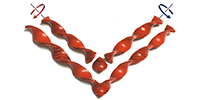
The handedness of an object has always been a binary concept: either left handed or right handed. Scientists now show that quantifying handedness as direction-dependent properties actually makes fundamental physical sense and can guide both our understanding of known handedness phenomena and design of materials with novel handed-response properties.
[Phys. Rev. X 4, 011003] Published Thu Jan 16, 2014
Author(s): Thomas Brunet, Kevin Zimny, Benoit Mascaro, Olivier Sandre, Olivier Poncelet, Christophe Aristégui, and Olivier Mondain-Monval
An original approach is proposed here to reversibly tune Mie scattering resonances occurring in random media by means of external low induction magnetic fields. This approach is valid for both electromagnetic and acoustic waves. The experimental demonstration is supported by ultrasound experiments p...
[Phys. Rev. Lett. 111, 264301] Published Fri Dec 27, 2013
Author(s): Andreas Rottler, Malte Harland, Markus Bröll, Matthias Klingbeil, Jens Ehlermann, and Stefan Mendach
We experimentally demonstrate that hybrid plasmon-photon modes exist in a silver-coated glass bottle resonator. The bottle resonator is realized in a glass fiber with a smoothly varying diameter, which is subsequently coated with a rhodamine 800-dye doped acryl-glass layer and a 30 nm thick silver l...
[Phys. Rev. Lett. 111, 253901] Published Wed Dec 18, 2013


Most of us freak out at the mere sight of a bug — let alone a photo! But there’s something about biologist Sam Droege’s pictures of insects that has hundreds of thousands of people marveling at them. Sam’s photostream offers viewers a detailed and rare look at bees; comparing these little, hairy creatures to mesmerizing works of art.
Sam Droege is the head of the U.S. Geological Survey’s Bee Inventory and Monitoring Laboratory in Maryland and for the past seven years he’s been photographing bees and other insects. The purpose is to create online reference catalogs to help researchers identify the thousands of bee species across North America.
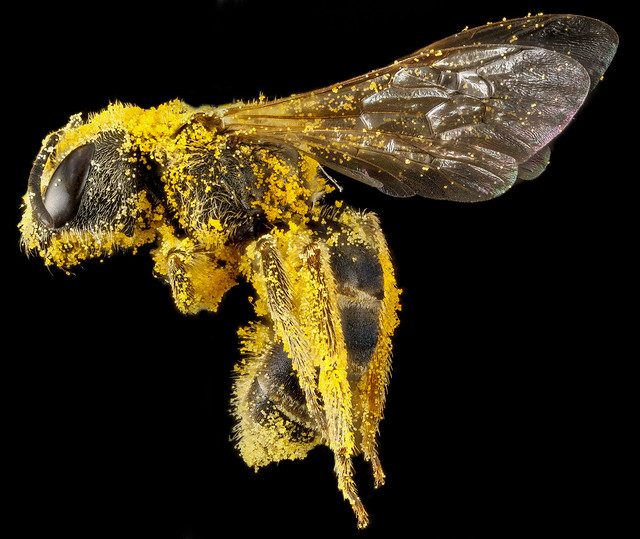

“We have to take a lot of pictures because many of these species vary only by very subtle characteristics,” Sam explains. “For some it might be the tiny pits on the surface of the top of the bee, and others it might be the pits within the pits. It’s important to take as many pictures as possible allowing our specialists to look at anything they might be interested in.”
For years, Sam and his team took pictures using simple point-and-shoot cameras. The level of detail, however, was extremely limiting.
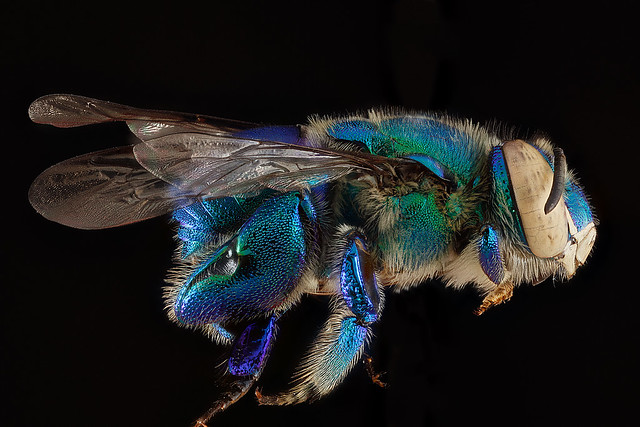
“We were taking pictures of bees through microscopes,” Sam says. “We literally attached cameras to microscopes, often with plumbing fixtures. But in the end, we were disappointed with the number of pixels and the amount of resolution of the photos. After a while, we largely stopped pictures through microscopes because the quality wasn’t up to our standards.”
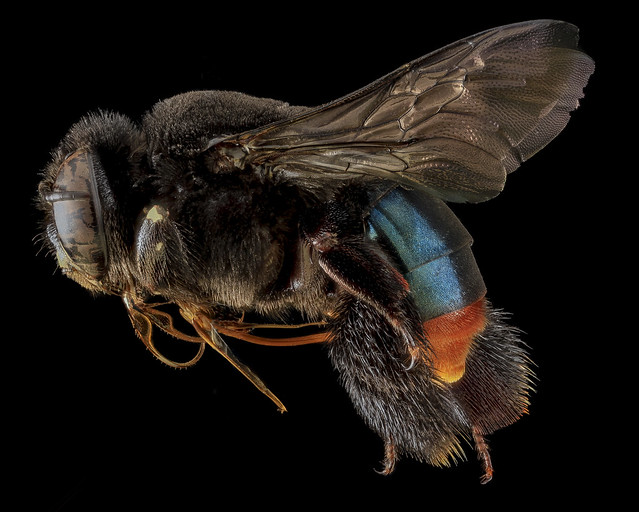
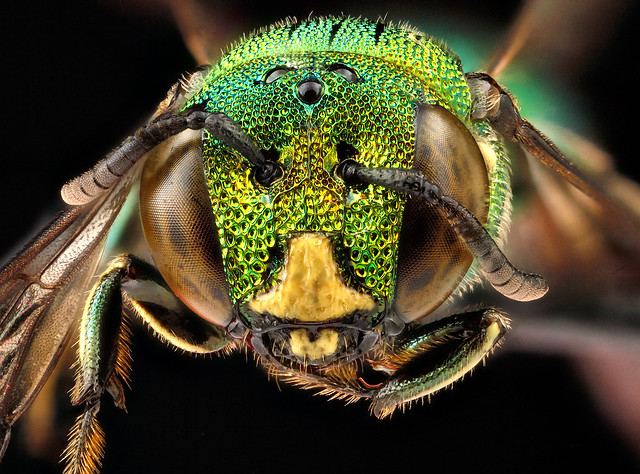
But all that changed in 2010 when Sam’s team was approached by the U.S. Army. They had developed techniques using macro photography to take photos of insect infestations from foreign bases (Iraq, Afghanistan, etc.). Macro photography allowed the army to get high-quality pictures that, in turn, helped them to identify these insects and treat those affected. When Sam first saw these photos, the level of detail blew his mind.
“The army’s novelty here was the portraiture,” Sam admits. “It was the solid, black background, the off-centeredness, the flash, just everything helped provide a portrait of a bee, rather than a documentation of a bee.”
It was from that point onwards, Sam and his team adopted and modified this technique and resumed photographing their specimens.
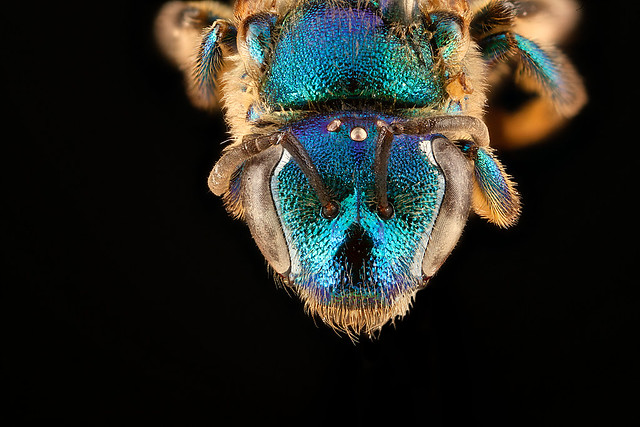
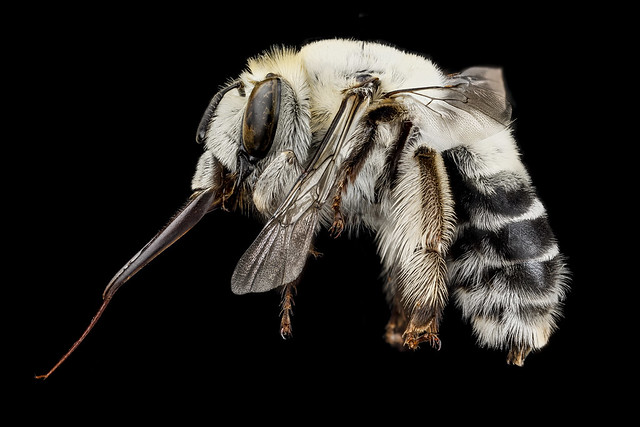
To capture the bees with such detail, Sam and his team take several different shots of the (already dead) insect and combine them together to form one image using a special software. This software creates detailed macro images which can be blown up to five feet by eight feet without pixelating.
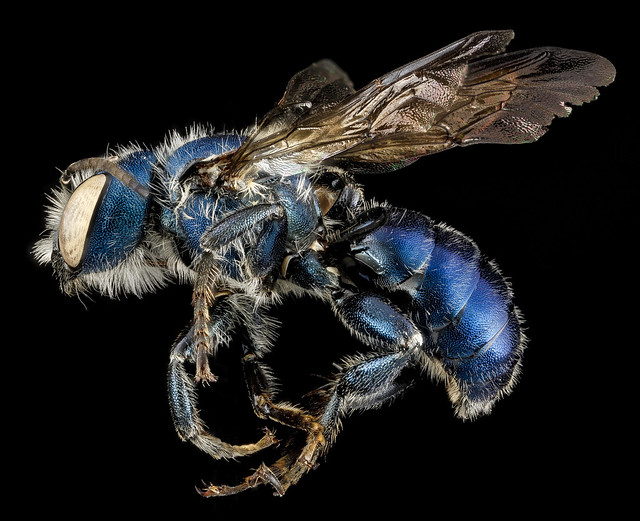
“When we started looking at these pictures, I just wanted to gaze at these shots for long periods of time,” Sam says. “I had seen these insects for many years, but the level of detail was incredible. The fact that everything was focused, the beauty and the arrangement of the insects themselves — the ratios of the eyes, the golden means, the french curves of the body, and the colors that would slide very naturally from one shade to another were just beautiful! It was the kind of thing that we could not achieve at the highest level of art.”
Sam began to show these pictures to several colleagues who also found them visually appealing. They encouraged him to share the photos on Flickr, as a means to transfer these images to other scientists and researchers.
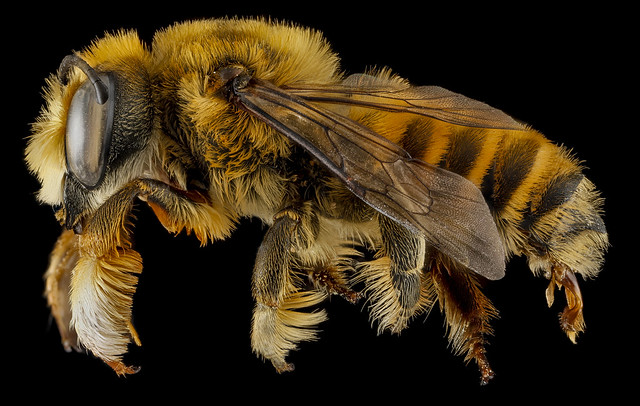
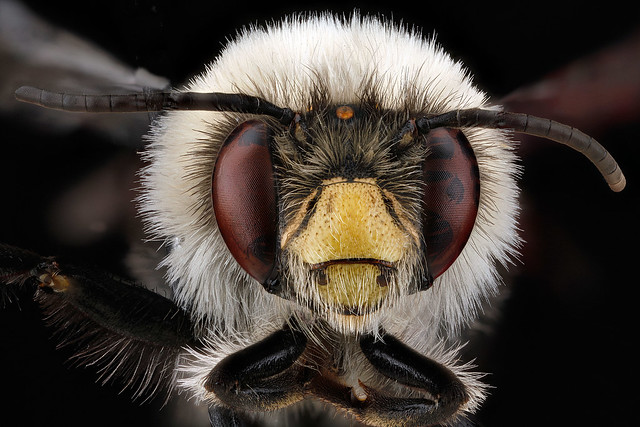
“At some point we found out that someone had posted the Flickr pictures onto Reddit, and it got a huge number of views,” Sam says. “I think it was 200,000 views in two days. I couldn’t believe it! It was at that point we realized that there is interest in these kinds of pictures outside of our scientific circles, and that people just like looking at them.”
Sam says he’s always tried to attract people to what he does but admits it’s been difficult because many us have a preconceived notion that bugs are bad or gross. With these pictures, all of a sudden people were attracted to these insects because of their beauty. People described the bees as “fluffy” with “stained-glass wings.” It’s an entirely new way of reaching people Sam never thought was possible.
“I feel honored as a public servant to bring these pictures to people,” Sam admits. “They’re all public for anyone to see. And the fact that it’s not just important scientifically, but also beautiful… it makes me feel good. It reaches my soft side of my hard-scientist body. And I smile every day when I look at the number of views we’re getting on Flickr.”
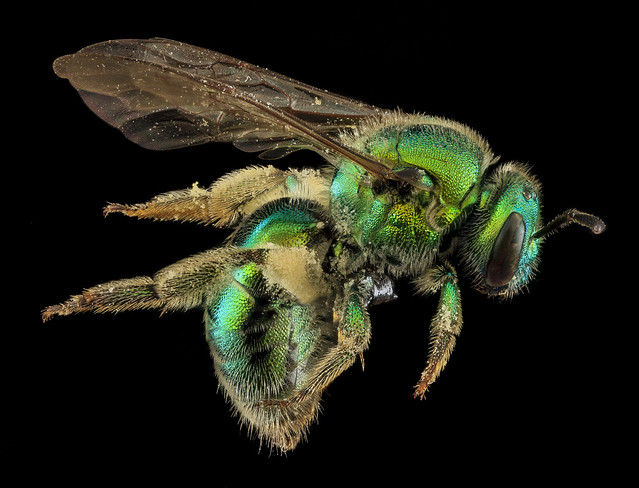
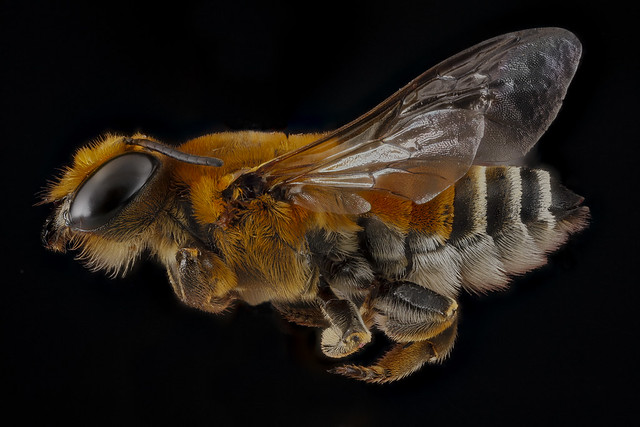
Visit Sam’s photostream to see more of his photography.
Previous episode: Beautiful worlds hidden in tiny drops
 Do you want to be featured on The Weekly Flickr? We are looking for your photos that amaze, excite, delight and inspire. Share them with us in the The Weekly Flickr Group, or tweet us at @TheWeeklyFlickr.


Author(s): T. Zhang, Y. Ruan, G. Maire, D. Sentenac, A. Talneau, K. Belkebir, P. C. Chaumet, and A. Sentenac
We present a marker-free microscope that records the phase, amplitude, and polarization state of the field diffracted by the sample for different illumination directions. The data are processed with an appropriate inversion method to yield the sample permittivity map. We observe that the full-polari...
[Phys. Rev. Lett. 111, 243904] Published Thu Dec 12, 2013
Author(s): M. Gullans, D. E. Chang, F. H. L. Koppens, F. J. García de Abajo, and M. D. Lukin
We show that it is possible to realize significant nonlinear optical interactions at the few photon level in graphene nanostructures. Our approach takes advantage of the electric field enhancement associated with the strong confinement of graphene plasmons and the large intrinsic nonlinearity of gra...
[Phys. Rev. Lett. 111, 247401] Published Wed Dec 11, 2013
Author(s): Youngwoon Choi, Timothy R. Hillman, Wonjun Choi, Niyom Lue, Ramachandra R. Dasari, Peter T. C. So, Wonshik Choi, and Zahid Yaqoob
Multiple scatterings occurring in a turbid medium attenuate the intensity of propagating waves. Here, we propose a method to efficiently deliver light energy to the desired target depth in a scattering medium. We measure the time-resolved reflection matrix of a scattering medium using coherent time-...
[Phys. Rev. Lett. 111, 243901] Published Mon Dec 09, 2013