10 May 20:15
by Jianji Yang, Mathias Perrin, and Philippe Lalanne
Author(s): Jianji Yang, Mathias Perrin, and Philippe Lalanne
Hybrid nanostructures composed of both typical atoms and metallic nanoparticles such as nanoresonators host a variety of optical properties. Analytical modeling is used to derive the optical responses of such materials in a computationally feasible way.
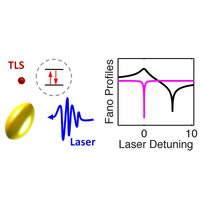
[Phys. Rev. X 5, 021008] Published Fri Apr 17, 2015
05 May 15:59
by Zhou Shi, Azriel Z. Genack
Chapter 2 in the book "Light localisation and lasing Random and Pseudo-random
Photonic Structures" eds by Mher Ghulinyan and Lorenzo Pavesi
05 May 15:59
by Zhou Shi, Matthieu Davy, Azriel Z. Genack
Fundamental concepts in the quasi-one-dimensional geometry of disordered
wires and random waveguides in which ideas of scaling and the transmission
matrix were first introduced are reviewed. We discuss the use of the
transmission matrix to describe the scaling, fluctuations, delay time, density
of states, and control of waves propagating through and within disordered
systems. Microwave measurements, random matrix theory calculations, and
computer simulations are employed to study the statistics of transmission and
focusing in single samples and the scaling of the probability distribution of
transmission and transmittance in random ensembles. Finally, we explore the
disposition of the energy density of transmission eigenchannels inside random
media.
05 May 09:44
by Gleb M. Akselrod, Tian Ming, Christos Argyropoulos, Thang B. Hoang, Yuxuan Lin, Xi Ling, David R. Smith, Jing Kong and Maiken H. Mikkelsen

Nano Letters
DOI: 10.1021/acs.nanolett.5b01062

03 May 20:21
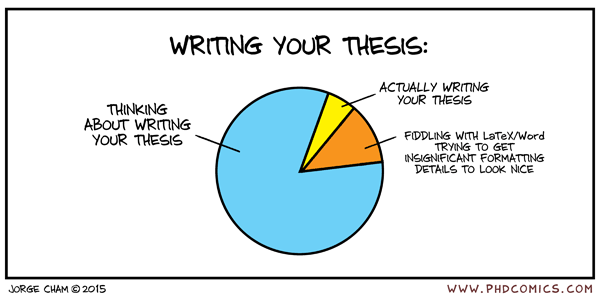
| Piled Higher
& Deeper by Jorge
Cham |
|
www.phdcomics.com
|
 |
|
|
03 May 08:41
by Christian Steuwe, Miklos Erdelyi, G. Szekeres, M. Csete, Jeremy J. Baumberg, Sumeet Mahajan and Clemens F. Kaminski

Nano Letters
DOI: 10.1021/acs.nanolett.5b00405

01 May 12:54
by Li Ge, David Liu, Steven G. Johnson, Stefan Rotter, Hakan E. Tureci, Alexander Cerjan, Hui Cao, A. Douglas Stone
We demonstrate that due to strong modal interactions through cross-gain
saturation, the onset of a new lasing mode can switch off an existing mode via
a negative power slope. In this process of interaction-induced mode switching
(IMS) the two involved modes maintain their identities, i.e. they do not change
their spatial field patterns or lasing frequencies. For a fixed pump profile, a
simple analytic criterion for the occurrence of IMS is given in terms of their
self- and cross-interaction coefficients and non-interacting thresholds, which
is verified for the example of a two-dimensional microdisk laser. When the
spatial pump profile is varied as the pump power is increased, IMS can be
induced even when it would not occur with a fixed pump profile, as we show for
two coupled laser cavities. Our findings apply to steady-state lasing and are
hence different from dynamical mode switching or hopping. IMS may have
potential applications in robust and flexible all-optical switching.
Donate to arXiv
01 May 12:54
by A. Femius Koenderink
The study of light at the nanoscale has become a vibrant field of research, as researchers now master the flow of light at length scales far below the optical wavelength, largely surpassing the classical limits imposed by diffraction. Using metallic and dielectric nanostructures precisely sculpted into two-dimensional (2D) and 3D nanoarchitectures, light can be scattered, refracted, confined, filtered, and processed in fascinating new ways that are impossible to achieve with natural materials and in conventional geometries. This control over light at the nanoscale has not only unveiled a plethora of new phenomena but has also led to a variety of relevant applications, including new venues for integrated circuitry, optical computing, solar, and medical technologies, setting high expectations for many novel discoveries in the years to come.
Authors: A. Femius Koenderink, Andrea Alù, Albert Polman
01 May 10:03
by Michael Luck
Parallel Practices from
Crafts Council on
Vimeo.
Matthew Howard and Thrishantha Nanayakkara of the
Department of Informatics at King's College London worked in the Parallel Practices project to demonstrate the mutual benefits and value of collaboration between medical and scientific academics and makers through four residencies. These residencies took place from 22 September to 22 December 2014 at King's College London.
The project stimulated learning and innovation through a focus on the body, materials and processes that inform clinical outcomes and artistic practice. Each residency involved a team of at least one maker and one medical and scientific academic.
30 Apr 17:36
by Adam M. Gilbertson, Yan Francescato, Tyler Roschuk, Viktoryia Shautsova, Yiguo Chen, Themistoklis P. H. Sidiropoulos, Minghui Hong, Vincenzo Giannini, Stefan A. Maier, Lesley F. Cohen and Rupert F. Oulton

Nano Letters
DOI: 10.1021/acs.nanolett.5b00789

28 Apr 08:46
by I.M. Khaymovich
Article
The work fluctuations of systems driven out of equilibrium are governed by the same large-deviation theory as wavefunction amplitudes close to the Anderson localization transition. Exploiting this analogy, the authors generalize the Jarzynski equality, verifying their relation on a single-electron box.
Nature Communications doi: 10.1038/ncomms8010
Authors: I.M. Khaymovich, J.V. Koski, O.-P. Saira, V.E. Kravtsov, J.P. Pekola

27 Apr 18:40
by Radwanul Hasan Siddique
Article
The transparent wings of the glasswing butterfly have a low reflectance over the visible spectrum thanks to the nanopillars distributed across them. Siddique et al . show that this behaviour still works at high angles of incidence because of the random height distribution of the pillars.
Nature Communications doi: 10.1038/ncomms7909
Authors: Radwanul Hasan Siddique, Guillaume Gomard, Hendrik Hölscher

25 Apr 16:26
by Suk-Won Hwang, Chi Hwan Lee, Huanyu Cheng, Jae-Woong Jeong, Seung-Kyun Kang, Jae-Hwan Kim, Jiho Shin, Jian Yang, Zhuangjian Liu, Guillermo A. Ameer, Yonggang Huang and John A. Rogers

Nano Letters
DOI: 10.1021/nl503997m

24 Apr 11:13
by Mark Kasperczyk, Steven Person, Duarte Ananias, Luis D. Carlos, and Lukas Novotny
Author(s): Mark Kasperczyk, Steven Person, Duarte Ananias, Luis D. Carlos, and Lukas Novotny
We use the magnetic field distribution of an azimuthally polarized focused laser beam to excite a magnetic dipole transition in Eu3+ ions embedded in a Y2O3 nanoparticle. The absence of the electric field at the focus of an azimuthally polarized beam allows us to unambiguously demonstrate that the n…
[Phys. Rev. Lett. 114, 163903] Published Thu Apr 23, 2015
20 Apr 20:56
by Juan de Torres, Petru Ghenuche, Satish Babu Moparthi, Victor Grigoriev, Jérome Wenger
Zero-mode waveguides (ZMWs) are confining light into attoliter volumes,
enabling single molecule fluorescence experiments at physiological micromolar
concentrations. Among the fluorescence spectroscopy techniques that can be
enhanced by ZMWs, F\"{o}rster resonance energy transfer (FRET) is one of the
most widely used in life sciences. Combining zero-mode waveguides with FRET
provides new opportunities to investigate biochemical structures or follow
interaction dynamics at micromolar concentration with single molecule
resolution. However, prior to any quantitative FRET analysis on biological
samples, it is crucial to establish first the influence of the ZMW on the FRET
process. Here, we quantify the FRET rates and efficiencies between individual
donor-acceptor fluorophore pairs diffusing in aluminum zero-mode waveguides.
Aluminum ZMWs are important structures thanks to their commercial availability
and the large literature describing their use for single molecule fluorescence
spectroscopy. We also compare the results between ZMWs milled in gold and
aluminum, and find that while gold has a stronger influence on the decay rates,
the lower losses of aluminum in the green spectral region provide larger
fluorescence brightness enhancement factors. For both aluminum and gold ZMWs,
we observe that the FRET rate scales linearly with the isolated donor decay
rate and the local density of optical states (LDOS). Detailed information about
FRET in ZMWs unlocks their application as new devices for enhanced single
molecule FRET at physiological concentrations.
20 Apr 20:54
by Marta Autore, Fausto D'Apuzzo, Alessandra Di Gaspare, Valeria Giliberti, Odeta Limaj, Pascale Roy, Matthew Brahlek, Nikesh Koirala, Seongshik Oh, Francisco Javier Garcìa de Abajo, Stefano Lupi
The great potential of Dirac electrons for plasmonics and photonics has been
readily recognized after their discovery in graphene, followed by applications
to smart optical devices. Dirac carriers are also found in topological
insulators (TI) --quantum systems having an insulating gap in the bulk and
intrinsic Dirac metallic states at the surface--. Here, we investigate the
plasmonic response of ring structures patterned in Bi$_2$Se$_3$ TI films, which
we investigate through terahertz (THz) spectroscopy. The rings are observed to
exhibit a bonding and an antibonding plasmon modes, which we tune in frequency
by varying their diameter. We develop an analytical theory based on the THz
conductivity of unpatterned films, which accurately describes the strong
plasmon-phonon hybridization and Fano interference experimentally observed as
the bonding plasmon is swiped across the promineng 2\,THz phonon exhibited by
this material. This work opens the road for the investigation of plasmons in
topological insulators and for their application in tunable THz devices.
20 Apr 20:54
by Hugo Defienne, Marco Barbieri, Ian A. Walmsley, Brian J. Smith, Sylvain Gigan
Multi-photon propagation in connected structures - a quantum walk - offers
the potential for simulating complex physical systems and provides a route to
universal quantum computation. Increasing the complexity of quantum photonic
networks where the walk occurs is essential for many applications. Here, we
implement a quantum walk of indistinguishable photon pairs in a multimode fiber
supporting 380 modes. Using wavefront shaping, we control the propagation of
the two-photon state through the fiber in which all modes are coupled.
Excitation of arbitrary output modes of the system is realized by controlling
classical and quantum interferences. This experiment demonstrates a highly
multimode platform for multi-photon interference experiments and provides a
powerful method to program a general high-dimensional multiport optical
circuit. This work paves the way for the next generation of photonic devices
for quantum simulation, computing and communication.
Donate to arXiv
20 Apr 14:12
by Christopher Jobson

In early 2014, Vancouver-based graphic artist Joey Camacho set out to learn more about rendering images using Cinema 4D and Octane Render, with the goal of creating a new piece each day. His first attempts were pretty rudimentary, but it wasn’t long before his exploration and experimentation began to pay off with increasinly subtle details inspired by biology, sound, and geometry. Only several months into his ‘Progress Before Perfection‘ project, he started getting requests for prints as his images were shared widely around Tumblr and elsewhere. You can see more of his work on Behance and prints of many pieces are available through his website.


ZC and -1 others like this
20 Apr 12:55
by Christopher Jobson
In early 2014, Vancouver-based graphic artist Joey Camacho set out to learn more about rendering images using Cinema 4D and Octane Render, with the goal of creating a new piece each day. His first attempts were pretty rudimentary, but it wasn’t long before his exploration and experimentation began to pay off with increasinly subtle details inspired by biology, sound, and geometry. Only several months into his ‘Progress Before Perfection‘ project, he started getting requests for prints as his images were shared widely around Tumblr and elsewhere. You can see more of his work on Behance and prints of many pieces are available through his website.
19 Apr 20:45
by Jianji Yang, Mathias Perrin, and Philippe Lalanne
Author(s): Jianji Yang, Mathias Perrin, and Philippe Lalanne
Hybrid nanostructures composed of both typical atoms and metallic nanoparticles such as nanoresonators host a variety of optical properties. Analytical modeling is used to derive the optical responses of such materials in a computationally feasible way.
[Phys. Rev. X 5, 021008] Published Fri Apr 17, 2015
17 Apr 20:50
by Natalia M. Mishina, Alexander S. Mishin, Yury Belyaev, Ekaterina A. Bogdanova, Sergey Lukyanov, Carsten Schultz and Vsevolod V. Belousov

Nano Letters
DOI: 10.1021/nl504710z

17 Apr 20:50
by Mengxin Ren, Mo Chen, Wei Wu, Lihui Zhang, Junku Liu, Biao Pi, Xinzheng Zhang, Qunqing Li, Shoushan Fan and Jingjun Xu

Nano Letters
DOI: 10.1021/nl5047973

12 Apr 21:56
by Montacer Dridi George C. Schatz
Montacer Dridi, George C. Schatz
We study the effect of nanoparticle (NP) array spacing on plasmon-enhanced lasing using a computational model that combines classical electrodynamics for arrays of gold NPs interacting with a four-level model of the laser dye photophysics. Parameters of the model are related to a laser system that ... [J. Opt. Soc. Am. B 32, 818-823 (2015)]
12 Apr 21:56
by Kendall Powell
The future of the postdoc
Nature 520, 7546 (2015). http://www.nature.com/doifinder/10.1038/520144a
Author: Kendall Powell
There is a growing number of postdocs and few places in academia for them to go. But change could be on the way.

12 Apr 21:55
All that glitters
Nature 520, 7546 (2015). doi:10.1038/520131a
A review of the United Kingdom’s progress towards ‘gold’ open-access research is instructive — for funders, publishers and scientists both at home and abroad.

12 Apr 21:51
by admin@smbc-comics.com
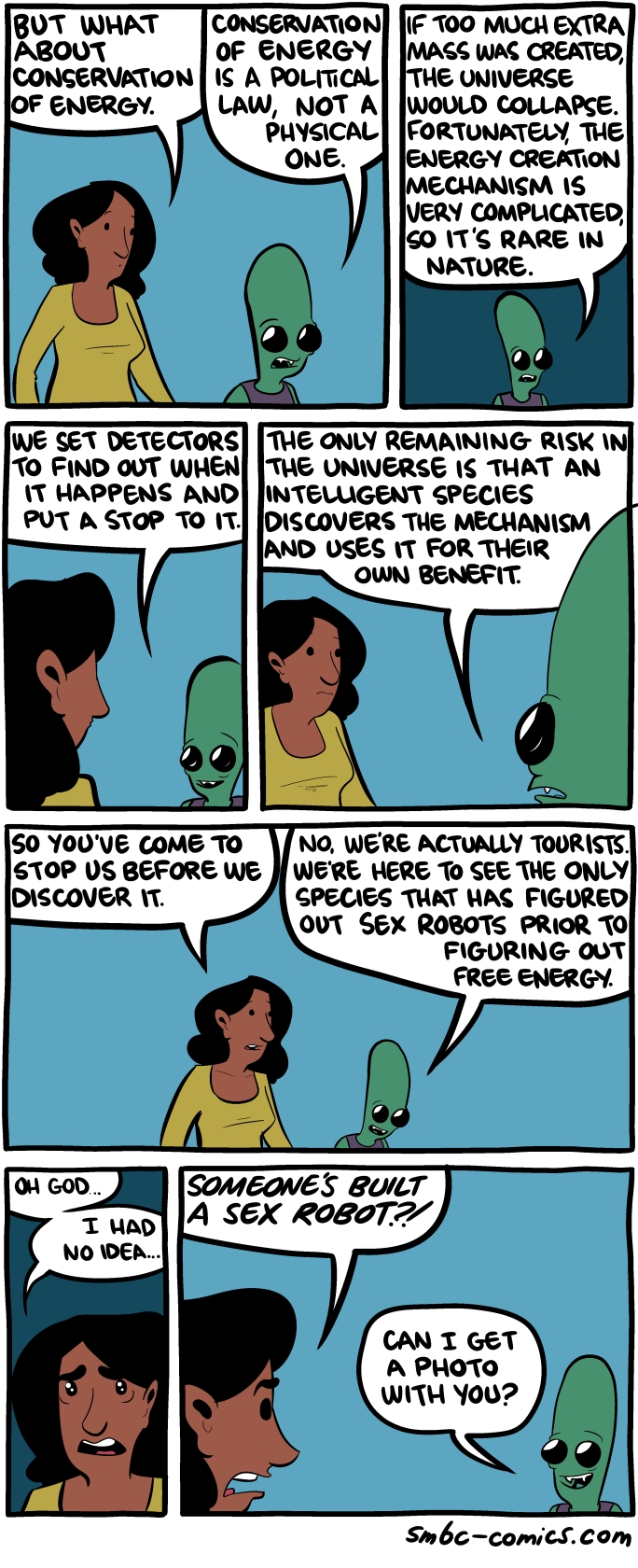
Hovertext: Keep your hands above my waist, human.
New comic!Today's News:
Only three days left to get your monocle!
12 Apr 19:15
by T. Iffländer, S. Rolf-Pissarczyk, L. Winking, R. G. Ulbrich, A. Al-Zubi, S. Blügel, and M. Wenderoth
Author(s): T. Iffländer, S. Rolf-Pissarczyk, L. Winking, R. G. Ulbrich, A. Al-Zubi, S. Blügel, and M. Wenderoth
The electronic charge distribution at the iron/gallium interface is imaged directly with high spatial and energetic resolution. The metal-semiconductor electronic barrier properties are found to be dependent on both the charge distribution and chemical bonds between the metal and semiconductor atoms.
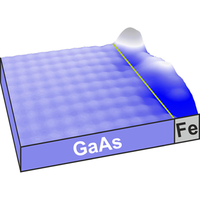
[Phys. Rev. Lett. 114, 146804] Published Thu Apr 09, 2015
04 Apr 10:04
by Borislav Naydenov, Ivan Rungger, Mauro Mantega, Stefano Sanvito and John J. Boland

Nano Letters
DOI: 10.1021/nl5045154

02 Apr 09:55
by Christopher Jobson


A trio of researchers at Stanford recently published an article in Nature that explains the curious attraction found in droplets of everyday food coloring. The paper is the culmination of hundreds of experiments that began in 2009 when Nate Circa was working on an unrelated experiment as an undergraduate at the University of Wisconsin. Circa noticed that when drops of food coloring were placed on a slide they exhibited bizarre behaviors: identical colors would find matches while different colors would seemingly hunt each other.
Circa soon teamed up with Manu Prakash and Adrien Benusiglio who began working on a series of increasingly refined studies to understand why these single droplets appeared to mimic biological processes, resulting in behaviors that looked like chasing, dancing, or avoidance. One of the keys was the interaction of two different compounds found in food coloring: water and propylene glycol. Tom Abate writing for Stanford explains:
The critical fact was that food coloring is a two-component fluid. In such fluids, two different chemical compounds coexist while retaining separate molecular identities. The droplets in this experiment consisted of two molecular compounds found naturally in food coloring: water and propylene glycol. The researchers discovered how the dynamic interactions of these two molecular components enabled inanimate droplets to mimic some of the behaviors of living cells.
This complex behavior is something called artificial chemotaxis which Manu Prakash explains in layman’s terms in the video above:
The physical properties of these fluids give rise to this immense complexity of behavior. For example, chasing and sensing each other, and very much what we call artificial chemotaxis. Chemotaxis is the idea in biology that one single cell can sense where its enemy is, and it brings up all its machinery, and it chases that enemy to try to eat it.
If you really want to get into the nitty gritty of fluid dynamics and molecular physics you can read the full paper in Nature and a bit of a summary on Stanford News. (via, appropriately, F*ck Yeah Fluid Dynamics)