via http://cinemagorgeous.com/post/110815151425/engine-maintenance-by-concept-artist-mac-rebisz
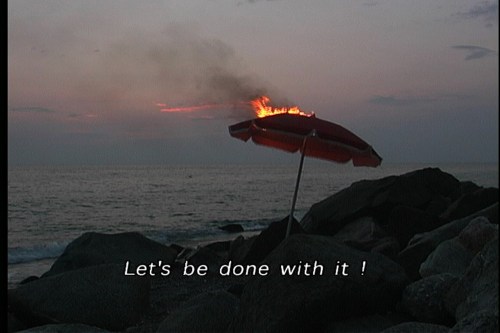
BERNADETTE CORPORATION | STILL FROM GET RIDE OF YOURSELF | 2003 | STRIP-PROJECT | ARCHIVE | SEPTEMBER 2015
Mattalyst!!!

Avoid Humans is a new web app that helps users avoid other people using Foursquare and Instagram check-in data to identify crowded places. The app puts locations into nightlife, food, coffee, and refuge categories and uses simple icons to show how crowded a place is.

images via Avoid Humans
via reddit

Hovertext: As of this year, knowing is 95 percent of the battle.
Augie and the Green Knight, the kids' book written by me and illustrated by Boulet is ON SALE NOW! Thank you for supporting this project, and for supporting independent media!

This is a good opportunity to tell you something about myself.
This is from the episode where Ami is playing video games for the first time ever, shortly after meeting Usagi (if I remember correctly, it did show her just going ham on these monsters, briefly) and her score got PHENOMENAL. She got the high score before bouncing to cram school.
Anyway, whenever anyone played this game, it always showed their active score BUT on the game over screen the score was always “6850″. I realize this is an oversight and that its just reused footage and it doesn’t mean anything, but I like making up deeper meanings, partially as a joke, partially because my brain just always goes dark. So, no matter how well you do, how high your score, in the end its always going to be the same as everyone else. You die. 6850.
I have this number tattooed on my left second knuckle joints. :)
MattalystSo here's an uncomfortable comparison:
https://en.wikipedia.org/wiki/Yukio_Mishima

Vester Lee Flanagan went by Bryce Williams on camera. Via YouTube
Around 7 AM on Wednesday, Vester Lee Flanagan II texted a friend. "I'm sorry," he wrote. "I had no other choice."
The 41-year-old, who at the time was being chased by police after killing two former coworkers at a local news station and uploading the footage to social media, told Robert Avent not to respond.
And at first, he didn't. Avent was still asleep, and couldn't call back for a few hours, when he was at work. When the friends finally connected, Flanagan told his former gym buddy to check CNN and promptly hung up. Moments later, Flanagan was dead.
Since the August 26 shooting of Alison Parker and Adam Ward, a bevy of lawsuits, manifestos, suicide notes, and other documents have emerged to tell the story of how Flanagan went from being a male escort to a failed TV anchor to a disgruntled shooter. In them, he claimed variously that he was depressed over his failing looks and enraged over perceived racial injustices perpetrated by people he'd worked with over the years.
After the shooting, authorities discovered that the decor in Flangan's apartment consisted almost entirely of headshots and pictures of him working as a TV anchor.
Flangan's outrage seems to go all the way back to his high school days, according to one of his suicide notes, which were sent to ABC News. In it, he claims that he was kicked off the football team by coaches who were jealous of his good looks.
His life seemed to hit a high point around 1996, when he took his first job in Savannah, Georgia. It was there that he fell in love with a guy named Kenny, according to the note.
"Ken was there for me in ways I cannot even describe," Flanagan wrote. "What a great experience that was—all around. A scenic/romantic city...a new romance...a career hitting on all cylinders. Sadly, we only had a short period of 'happiness' as it related to my career, anyway."
His life started unraveling again after he moved to Florida. In a 2000 lawsuit, Flanagan claimed that after taking a job in Tallahassee, he was bullied and profiled. He would repeat similar allegations in Roanoke, Virginia, after he was fired from a job there in 2013 for being difficult. In another harassment case, Flanagan called the situation "nothing short of vile, disgusting, and inexcusable," according to the New York Times. Flanagan reportedly reacted to that firing by killing and ceremoniously burying his two cats.
Even after he was terminated and working a series of insurance jobs, Flanagan continued to live in a drab apartment, right across from the TV station. His neighbors there say he was combative and sometimes flung cat feces onto peoples' porches. (And video has emerged of a July road rage incident that took place after another driver confronted Flanagan for driving erratically.)
In the weeks leading up to the shooting, Flanagan started calling ABC in advance of faxing his suicide notes. In his final missive, he claimed was responding to South Carolina church shooter Dylann Roof and wanted to start a race war.
But a separate manifesto eventually delivered to his friend Robert Avent—who passed it along to the New York Daily News—offers alternative motivations that center on his previous employment as a male escort. According to Avent's account, Flanagan was more concerned with his fleeting looks than with racism.
"I totally CANNOT score right now. . .," Flanagan wrote his friend. "And this is from a man who used to be paid hundreds an HOUR to sleep with men." In the letter, he claimed that he was upset about getting old, and was afraid that heads would "stop turning" at his appearance.
During his final conversation with Avent, Flanagan remained calm. "Oh, I did something this morning," he apparently said. "I shot and killed two people."
"How come you're talking to me in a calm voice?'" Avent told the Daily News he remembered saying.
"Well, you know, I just feel, I didn't like those people," Flanagan reportedly replied.
The disgruntled former newsman then told his friend he wasn't going to prison, and that he loved him. He abruptly terminated the call and shot himself in the head.
Follow Allie Conti on Twitter.

my entry for the rick and morty contest!
“M-Morty you gotta stop screaming Morty, there’s noth-BURP-nothing we can do now, we’ve almost reached terminal velocity. Just keep your arms and legs inside the portals if you like being attached to them while grandpa figures something out.“
Sometime in late 2013, a mosquito-borne virus called chikungunya appeared for the first time in the Western Hemisphere. Chikungunya, or “chik,” as it’s called, rarely kills its human hosts. But it can cause fever, rash and debilitating joint pain. In the two years since it first arrived in the Caribbean, chik has spread wildly across the Americas. It is now suspected of having infected over 1 million people in 44 countries and territories, creating a hemisphere-wide horde of mosquito-borne suffering.
The same biological quirks that have contributed to chik’s success are showing researchers how to fight it — and other viruses like it. Chik is an RNA virus, just like influenza, West Nile virus, hepatitis and Ebola, among others. Unlike DNA viruses, which contain two copies of their genetic information, RNA viruses are single-stranded. When they replicate, any errors in the single strand get passed on. As a result, copying is sloppy, and so each new generation of RNA viruses tends to have lots of errors. In only a few generations, a single virus can become a mutant swarm of closely related viruses.
This viral genetic jumble has given Marco Vignuzzi, a virologist at the Pasteur Institute in Paris, a way to predict the future evolution of RNA viruses like chik. Vignuzzi has re-created a single mutation in chik that occurred early in the virus’s around-the-world adventure, work that illuminated how the virus was able to spread so widely in such a short amount of time. Now Vignuzzi is trying to predict chik’s future. This past June, at the annual meeting of the American Society for Microbiology in New Orleans, Vignuzzi showcased the two mutations in chik that are most likely to develop next.
Viruses are tricky and complex beasts; no one can predict exactly what they will do. But if researchers are ever to get a step ahead of the rapidly shifting world of viruses around us, they will need to deconstruct the viral swarm.
A Viral Potluck
For almost 40 years, scientists have worked to understand how RNA viruses can have so many mutations and still be so successful.
In the late 1970s, the virologist Esteban Domingo of the Autonomous University of Madrid was trying to measure the sloppiness of replication using an RNA virus that infects bacteria. He found that one mutation occurred every time the virus copied its genome, on average. As a result, a single virus produces an array of daughter viruses that are almost, but not quite, identical. Every generation spawns another array of viruses, leading to what Domingo called a “mutant cloud” of viruses.
However, most of the mutations in viral clouds create problems for the virus. Researchers assumed that any single mutated version of a healthy virus was likely destined for extinction. But then in 2006, scientists published an account of a thriving dengue virus in Myanmar with what should have been a catastrophic error in the middle of a vital gene.
When a virus infects a cell, it begins to copy the cell’s genome, incurring mutations as it does so. When daughter viruses assemble themselves in the cytoplasmic soup of genes and proteins, the overall virus that results is often a mash-up of these mutated copies. If one mutation creates a dud protein, as happened with dengue, the virus can survive because of other viruses in the swarm that have a good copy. Think of it as a potluck, Domingo said. The host asks people to bring many types of dishes. That way, if any one person arrives late or burns a pie, a single missing item won’t ruin the dinner.
For a virus, a variety of options allows it not only to infect different hosts, as chik and dengue do with humans and mosquitoes, but also to infect different tissues within the same host. “This cloud of mutations makes it easier for viruses to explore new tissues and new hosts,” Domingo said.
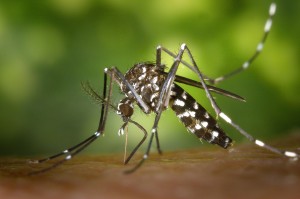
The Asian tiger mosquito (Aedes albopictus) doesn’t usually carry chikungunya. But a mutation in the viral swarm allowed chik to spread to areas where the tiger mosquito is dominant.
In 2005, Vignuzzi was studying polio, another RNA virus, as a researcher in the lab of the virologist Raul Andino at the University of California, San Francisco. Polio infections tend to start in the gut and move to the brain; Vignuzzi wanted to study the role that viral diversity plays in the leap. He started by engineering a polio virus that copied its genome with fewer errors than usual. The virus could infect the brain just fine — as long as it was directly injected and didn’t have to travel to get there. But without a swarm of diversity, the virus couldn’t move from the gut to the brain.
Next, Vignuzzi and his colleagues used chemicals to induce mutations in this polio virus, enlarging the size of the mutant cloud. The polio traveled from the gut and into the brain, which it then infected quite well. The virus needed a large swarm in order to do its job.
“This was the first time we could control the number of mutations and see whether the mutant swarm was biologically relevant or just an accident,” Vignuzzi said. “And we found that when you have a more restricted swarm, you can’t adapt as well.”
On the flip side, too many mutants aren’t good for a viral swarm either. Domingo and Vignuzzi pointed out that the popular antiviral medication ribavirin pushes viruses to develop a swarm that is so big and so full of mutations that the resulting viral potluck is missing vital components. “Viruses have to optimize the size of the swarm to have enough mutants that you can adapt to new conditions, but not making too many mistakes, which would then kill your population,” Vignuzzi said.
Viral variants also let viruses evolve and spread themselves to new species. In 2009, a rabies outbreak in gray foxes in Humboldt County, north of San Francisco, was traced back to skunk virus that had jumped to foxes. To see when this jump may have occurred, Monica Borucki, a virologist at the Lawrence Livermore National Laboratory in California, used advanced next-generation genetic sequencing to examine the viral swarms of rabies-infected animals going all the way back to 1995. This type of deep sequencing lets researchers search for minor variants in a virus that can acquire mutations and ultimately take over. And indeed, Borucki found genetic traces of the outbreak virus even in the earliest samples.
The results, published in PLOS Neglected Tropical Diseases in 2013, showed that rare viral variants in an individual provide crucial reservoirs of genetic diversity that can help a virus jump species and evolve. It also offered some of the first clues that could help scientists begin to predict what might happen in the future, if they could only deconstruct the viral swarm.
One Mutation, and a Huge Jump
Half a world away from Borucki’s California lab, Vignuzzi had turned his attention to chikungunya, which had gained popular and scientific interest after an outbreak on Reunion, a French island off the east coast of Madagascar, sickened more than one-third of the population. Chikungunya is frequently found on the east coast of Africa, where it is transmitted by Aedes aegypti mosquitoes, but Reunion had very few of those mosquitoes. Instead, the island had a closely related species known as the Asian tiger mosquito (Aedes albopictus). Chik didn’t typically fare very well in Asian tiger mosquitoes, but on Reunion, the virus seemed to be thriving. Researchers eventually realized that a single mutation in one of the proteins that coat the virus allowed chik to pick the lock of the Asian tiger mosquito cells and enter much more easily.
When researchers compared the original strain, from Kenya, to the Reunion one, they found that the Reunion strain was 40 to 100 times better suited to the Asian tiger mosquito — an amazing jump for just one mutation. Subsequent work revealed that similar mutations had happened at least three more times as the chik outbreak spread throughout countries along the Indian Ocean.
Related Articles:
Scientists Map 5,000 New Ocean Viruses
In the few decades since viruses were first found in the oceans, scientists have only been able to identify a handful of species. A new survey has uncovered nearly all the rest.The New Science of Evolutionary Forecasting
Newly discovered patterns in evolution may help scientists make accurate short-term predictions.
Since this mutation was so simple and so advantageous, Vignuzzi decided to see if it would happen again in the lab while he watched. If it did, it would provide some of the first evidence that researchers could watch a viral swarm as it adapted, and maybe even predict its future. He took the original chikungunya strain circulating in Kenya and infected a group of Asian tiger mosquitoes with it.
Like polio, chik moves from one place to another in the body. It starts replicating in the mosquito’s midgut before making its way to the salivary glands and then into the saliva, a process that takes around a week.
On the seventh day of this process, Vignuzzi and his postdoc Kenneth Stapleford dissected the mosquitoes, extracting virus from the midgut, salivary glands and saliva, and sequencing the viruses found in each sample. In the midgut, they found many random mutations, but no single mutation appeared in more than one mosquito. The saliva, however, told a different story. The saliva in three of four mosquitos contained the Reunion mutant. In one of these, the Reunion mutant made up 99 percent of the total virus population.
“We were able to create, within seven days, the emergence in the swarm of an epidemic strain that took at least several years to occur in nature,” Vignuzzi said.
The virus didn’t stop evolving in Reunion. A continuing outbreak meant ongoing opportunities to evolve further. The first mutation had popped up so quickly in the lab that Vignuzzi and Stapleford began to wonder if they could predict further changes to the virus. So they repeated their experiments, but this time they started by infecting the mosquitoes with the Reunion strain. They let the virus percolate in the mosquitoes for 10 days, to give it more time to acquire new mutations. Again they sequenced the viruses they found in the various mosquito tissues, and they identified two new mutants, both with mutations in the same lock-picking coat protein as the original Reunion mutant, results they published last year in Cell Host and Microbe. Ongoing work, which Vignuzzi presented at the microbiology meeting in June, has involved tracking how these mutations were selected in mice, a stand-in for chik-infected humans.
A New Measure of Fitness
The swarm concept is forcing some scientists to rethink some of the basic tenets of population genetics. Typically, the fitness of a virus is measured by how many copies of itself it can make compared to another virus, according to Andino. But, he said, that doesn’t capture the full picture. Virologists like Andino and Domingo argue that the evolutionary fitness of a virus should include its ability to mutate. “If an infection is a process of adaptation, a fitter virus is better able to adapt,” Andino said.
Furthermore, you can’t measure the fitness of a single virus. Since individual virus variants can cooperate and interact, readily swapping proteins in their final product, the smallest unit evolution can select for is the swarm itself. Only by considering the whole mutant cloud of viruses can scientists hope to understand how they behave and what they might do in the future.
“If you look back at all the viruses in historical samples, you can see how it changed to get where it is today, which you can also use to, say, predict a new host,” Borucki said.
As Vignuzzi continues to work on identifying chik’s next mutations, the inherent unpredictability of viral behavior has become clear. No one was surprised when chik reached the Americas. What was unexpected was the viral strain that arrived. “Everyone thought that it was going to be the Reunion strain that reached the Americas,” said Scott Weaver, a virologist at the University of Texas Medical Branch.
Instead, it was an Asian strain of chik that had been circulating at low levels for decades, producing its own mutant swarms. The Reunion strain continues to circulate, but with a million infected in the Americas and millions more at risk, the urgency to understand chik has shifted to the Asian strain. Vignuzzi and Stapleford have begun their mosquito experiments anew to try and predict what chik might do in Central and South America, as the swarm continues its inexorable evolution.
MattalystFor fuck's sake, France.

Marine Richard lives in a barn in the mountains of deep southwestern France. It's here that she's able to live healthy and free from the omnipresence of the electromagnetic waves emanating from any and every electronic device, from cell phones (definitely cell phones) to microwaves (especially microwaves) to light bulbs (even light bulbs). As a sufferer of electromagnetic hypersensitivity (EHS), this is how it has to be, and, according to a Toulouse court, she is entitled to three years of disability payments for her affliction.
In fairness, the court didn't formally recognize EHS in its award—citing instead the presence of disabling symptoms, whatever the underlying cause may be—but Richard and her lawyer were quick to hail the ruling as a victory for EHS sufferers around the world—a "breakthrough," she said, according to Agence France-Presse. So, whatever the court's intent, the result is validation of a disorder that's been refuted ad infinitum, and what's commonly considered to be the result of a "nocebo" effect.
The court's indirect validation isn't anything all that unusual. EHS as a disorder is recognized fairly widely, including by the WHO, but always in the sense of patients have these symptoms and saying they're because of electromagnetic waves and not patients have these symptoms because of electromagnetic waves. Which is a huge distinction, but also one that allows for misinterpretation, intentional or otherwise. This is more or less the bread and butter of the whole health-conspiracy movement.
Like many health conspiracies, EHS revolves around a set of non-specific symptoms, including headaches, nausea, fatigue, etc, which are symptoms that describe virtually any malady including those psychological in nature. It's tricky because the symptoms really do exist and warrant serious attention, whatever their source, and bunk diagnoses do nothing but throw up barriers to actually getting to the bottom of things, which is a scenario that's pretty widespread across the alt medicine realm.
For a court, the trickiness is in acknowledging a syndrome without acknowledging EHS, even though acknowledging the syndrome might as well be acknowledging the EHS. Denying disability isn't the answer, of course, but what is?


Opening tomorrow - Saturday, August 29th, 2015 - at Hashimoto Contemporary is the much anticipated solo show from artist Dan Quintana. “Diffused” is comprised of nearly a dozen new paintings and several charcoal drawings by the Los Angeles based artist. Dan is known for his symbolism, muted colors and haunting renderings. This show is certain to please, if you have a chance stop by be sure and do it.

A piracy group known as “iON” has reportedly released the first episode of Netflix’s Ultra HD version of Breaking Bad on a private BitTorrent website. This would mark the first time that Netflix’s Ultra HD content, which is protected by a previously unbroken form of digital rights management (DRM), has appeared online in a pirated format.
At 17.73 GB, the file is roughly 50 times the size of an equivalent standard definition video.
While Ultra HD content is still somewhat rare—Netflix and Amazon only stream select programming in Ultra HD, which is also known as 4K—the release of Breaking Bad could represent a dramatic escalation in the battle between Hollywood and tech-savvy pirates. Before now, pirated Ultra HD content was primarily limited to niche content like pornography.
It remains unclear how iON was able to circumvent the DRM protecting the Ultra HD file. The licensing agreement between Sony (which produces Breaking Bad) and Netflix notes that the Ultra HD file is digitally watermarked to identify the account that leaked the file.
In response to the incident, Netflix noted that piracy is a “global problem,” and that it is “actively working” on ways to protect its content.
MattalystHuh, I'll be damned.
cool limitation of your brain: try to rotate your ankle clockwise and simultaneously draw a 6 in the air with your hand. Realize then that your ankle is now going counterclockwise.
Yesterday, the 19th-century market building in London’s Covent Garden was transformed. French artist Charles Pétillon used twenty-five workers over five days to fill the building with 100,000 giant white balloons in an installation called “heartbeat.” The project is part of Covent Garden’s ongoing cultural program that strives to transform the district into an ever-changing art gallery, and will run until September 27th.
“The balloon invasions I create are metaphors,” Pétillon told Design Boom. “Their goal is to change the way in which we see the things we live alongside each day without really noticing them. with ‘heartbeat’ I want to represent the market building as the beating heart of this area – connecting its past with the present day to allow visitors to re-examine its role at the heart of London’s life.”
More info: charlespetillon.com | coventgardenlondonuk.com | londondesignfestival.com (h/t: designboom)

Image credits: Paul Grover

Image credits: Aridley88

Image credits: Tracey Burfield

Image credits: Alanisko

Image credits: Paul Grover

Image credits: Paul Grover

Image credits: Facundo Arrizabalaga

Image credits: Paul Grover

In an unassuming building in an unassuming industrial park south of Los Angeles, nuclear physicists are smashing together rings of plasma at one million kilometers per hour, producing temperatures on the order of a hundred-million degrees Celsius. The goal is nothing less than practical nuclear fusion, the long-sought energy holy grail: no sketchy nuclear waste and self-limiting meltdown-proof reactions.
The physicists are employed by a company called Tri Alpha, a small outfit established in 1997 by University of California researcher Norman Rostoker, who passed away last December. At a symposium held this week in Rostoker's honor, Tri Alpha CTO Michl Binderbauer announced a major advance in the company's fusion efforts, based on what's known as a field-reversed configuration (FRC): 5 milliseconds of decay-free stability. And within a 100,000,000 °C plasma, 5 milliseconds is an eternity.
Tri Alpha isn't big on announcements or PR, despite the presence of Buzz Aldrin and author Frank Braun within its leadership ranks. It doesn't even have a website. The symposium, held at a hotel in Newport Beach, CA and hosted by the University of California, Irvine's physics department, hasn't been that much less shadowy, with Science mag's news blog grabbing an exclusive on this week's announcement. The firm was at least kind enough to provide a few minutes of video content explaining its work.
A bit of background: Fusion is sort of the opposite nuclear reaction to fission. Rather than harvest energy released as atomic nuclei break apart, fusion depends on, well, fusing atomic nuclei together. In fission, the resulting nuclei fragments wind up with less mass than they had when joined together, with the difference being released as energy. As smaller nuclei fuse together, the new nuclei winds up with less mass than the components had separately and, once again, this mass is released as energy.
The difference is that in fusion there isn't shit flying out all over the place—again, it's a process of joining together. This is appealing for many obvious reasons, not the least of which is its relative lack of waste. It is also quite difficult to accomplish in a way that releases more energy than is used to create the reaction. Fusing stuff together is easy, relatively, but as a viable energy source it's taken us nearly a century just to get to this point of just barely, almost using it to harvest real power.
High temperatures are needed in order to give atomic nuclei enough juice to crash into each other hard enough to fuse. That's the basic idea. This is done using a super-high energy plasma in which atoms have been stripped clean of their electrons and exist as positively charge ions in a hot stew of naked nuclei and confused electrons. Electrons and positively-charged nuclei don't like this state at all and would much prefer being again joined together into neutral atoms, which makes the plasma a very unstable arrangement requiring extreme heat and/or extreme pressures to not collapse. Unfortunately, this heat is so extreme that we can't just stash it in some physical container because it would melt right away.

The National Ignition Facility's preamplifiers, which the first place laser beams are boosted on route to the target chamber. Image: Damien Jemison/LLNL
There are two main ways to get around this, with each one being pursued by one of the two big-name global fusion experiments: the US Department of Energy’s $4 billion National Ignition Facility (NIF) and the under-construction $20 billion International Thermonuclear Experimental Reactor (ITER). The NIF setup uses brute force, imploding the plasma to the point that inward pressure becomes the plasma container, maintaining the needed conditions for just a moment. ITER uses what's known as a tokamak configuration, which is a plasma-filled donut that uses powerful magnetic fields as a containment mechanism.
Tri Alpha's project uses sort of a combination of the two. A pair of plasma donuts are separated across a wide 23-meter-long tunnel, with each one containing a rotating stream of particles. This rotation creates a strong magnetic field, which then works to maintain the structure of the donut. This is the FRC.
These two opposing donuts are then blasted at each other at a million kilometers per hour, colliding in the middle and creating one great big FRC. The required heat comes from the kinetic energy of the collision, but that's not quite it. Two problems threaten to destabilize the arrangement.
Previous attempts to create long-lasting FRCs were plagued by the twin demons that torment all fusion reactor designers. The first is turbulence in the plasma that allows hot particles to reach the edge and so lets heat escape. Second is instability: the fact that hot plasma doesn’t like being confined and so wriggles and bulges in attempts to get free, eventually breaking up altogether. Rostoker, a theorist who had worked in many branches of physics including particle physics, believed the solution lay in firing high-speed particles tangentially into the edge of the plasma. The fast-moving incomers would follow much wider orbits in the plasma’s magnetic field than native particles do; those wide orbits would act as a protective shell, stiffening the plasma against both heat-leaking turbulence and instability.The solution is described in the video above. High-energy ions are fired from various points around the tunnel at tangential angles to the FRC, which they begin to tightly orbit. These orbiting ions act as an additional stabilizing protective shell. The results still weren't perfect, however.
Last year, an earlier version of this setup, dubbed C-2, accomplished 5 milliseconds as well, but with the very significant catch that the plasma decayed over that time. C-2 was reconstructed last fall with help from Russia's Budker Institute of Nuclear Physics, boosting the energy from 2 megawatts to 10 megawatts readjusting the angle of the beams. The upgrade, now known as C2-U, offers five decay-free milliseconds, but at least a full second is required to make the reaction produce more energy than was put into it—"fusion gain," in other words. C-2U will soon be almost completely rebuilt as C-2W, a version of the experiment offering temperatures 10 times as hot as its predecessor and the hope of sparking conventional fusion reactions, e.g. those involving the hydrogen isotopes known as deuterium and tritium.
Tri Alpha's goal is still loftier: fusion with hydrogen-boron. This compound requires much more energy to fuse, but has the advantage of being widely available. And, unlike deuterium and tritium, the hydrogen-boron reaction doesn't release neutrons, which means the reactor doesn't have to be shielded.
So, we are still a ways away from proper, useful fusion, but this seems to be a tantalizing taste. An anonymous (of course) investor told Science, “for the first time since we started investing, with this breakthrough it feels like the stone is starting to roll downhill rather than being pushed up it.”