
Mattalyst
Shared posts
20 Jan 20:34

Yuri Shwedoff | shwedoff.tumblr.com | society6.com/yurishwedoff

Yuri Shwedoff | shwedoff.tumblr.com | society6.com/yurishwedoff

Yuri Shwedoff | shwedoff.tumblr.com | society6.com/yurishwedoff

Yuri Shwedoff | shwedoff.tumblr.com | society6.com/yurishwedoff
It wasn’t meant to end like this, Yuri Shwedoff
Yuri Shwedoff | shwedoff.tumblr.com | society6.com/yurishwedoff
Yuri Shwedoff | shwedoff.tumblr.com | society6.com/yurishwedoff
Yuri Shwedoff | shwedoff.tumblr.com | society6.com/yurishwedoff
Yuri Shwedoff | shwedoff.tumblr.com | society6.com/yurishwedoff
It wasn’t meant to end like this, Yuri Shwedoff
Felixherve likes this
20 Jan 20:30


/cdn0.vox-cdn.com/uploads/chorus_asset/file/2940988/google-magic-leap-patents-0029.0.jpg)
/cdn0.vox-cdn.com/uploads/chorus_asset/file/2940992/google-magic-leap-patents-0039.0.jpg)
/cdn0.vox-cdn.com/uploads/chorus_asset/file/2940998/google-magic-leap-patents-0040.0.jpg)
/cdn0.vox-cdn.com/uploads/chorus_asset/file/2941004/google-magic-leap-patents-0045.0.jpg)
/cdn0.vox-cdn.com/uploads/chorus_asset/file/2941008/google-magic-leap-patents-0050.0.jpg)
/cdn0.vox-cdn.com/uploads/chorus_asset/file/2941022/google-magic-leap-patents-0057.0.jpg)
/cdn0.vox-cdn.com/uploads/chorus_asset/file/2941024/google-magic-leap-patents-0058.0.jpg)
/cdn0.vox-cdn.com/uploads/chorus_asset/file/2941026/google-magic-leap-patents-0059.0.jpg)
/cdn0.vox-cdn.com/uploads/chorus_asset/file/2941038/google-magic-leap-patents-0060.0.jpg)
/cdn0.vox-cdn.com/uploads/chorus_asset/file/2941040/google-magic-leap-patents-0062.0.jpg)
/cdn0.vox-cdn.com/uploads/chorus_asset/file/2941042/google-magic-leap-patents-0065.0.jpg)
/cdn0.vox-cdn.com/uploads/chorus_asset/file/2941088/google-magic-leap-patents-0067.0.jpg)
/cdn0.vox-cdn.com/uploads/chorus_asset/file/2941092/google-magic-leap-patents-0068.0.jpg)
/cdn0.vox-cdn.com/uploads/chorus_asset/file/2941096/google-magic-leap-patents-0072.0.jpg)
theverge: Google’s ideas about a Magic Leap-inspired augmented...
MattalystTotal nightmare fuel. The lawsuit the first time a gamified lawnmower runs over a child for a score multiplier will be good, though.
Google’s ideas about a Magic Leap-inspired augmented reality future are seriously wild
The URL is actually http://www.theverge.com/tldr/2015/1/17/7559473/google-magic-leap-patents-drawings. Get your shit together, Verge.
See the beautiful, nightmarish patent illustrations for a Google-funded augmented reality device
- By Sean O’Kane
- on January 17, 2015 11:00 am
- @sokane1
It’s been almost three months since Google lead a $542 million [≈ box office sales of Jurassic Park, 1993] round of funding for the Magic Leap, an augmented reality project shrouded in mystery. Aside from vague claims about a “biomimetic Dynamic Digitized Lightfield Signal,” the CEO of Legendary Pictures calling it ”jaw-dropping,” and Neal Stephenson becoming the project’s “Chief Futurist,” we still don’t know much at all.
That changed this week when a massive Magic Leap patent application appeared on the US Patent and Trademark Office’s website. Patent filings are inherently broad in scope, especially for big companies like Google. (Apple is notorious for this.) Many of the ideas at play here may never make it to the final version of Magic Leap, but that doesn’t mean what’s inside isn’t fun to dream about.
It starts off innocently enough with some seemingly obvious drawings of what the device could look like, how it might work, and the general applications it could be used for:
That’s where it starts getting weird. Everything from the gamification of cucumber chopping to interactive charm bracelets gets theorized:
Then, the Magic Leap dystopia appears. The drawings reveal a possible future where Magic Leap will allow a bachelor to not only interact with and photograph a football game from his couch (something tells me the NFL would have a problem with this), but also “hang” a virtual Quantum of Solace poster for on his wall for some reason, probably because he likes loneliness.
In the supermarket, a mother’s shopping experience will be enhanced and augmented with things like a virtual grocery list displayed right on the handle. (Gender roles appear to be the one thing no one thought to develop in this version of the future.) Meanwhile, her child can play a brand-sponsored virtual game in which a monster pops out from behind the cereal boxes — because if there’s one thing that can enhance everyone’s shopping experience it’s hallucinatory children screaming in terror.
The Twilight Zone/Black Mirror-ish world expands from there, with doctors (male, of course) showing a patient a 3D-model of her heart before she stares off into a beachy abyss, her gaze unbroken.
The more things change, though, the more they stay the same. Elsewhere in the future, an AR-assisted Carl Spackler is still chasing that gopher:
Jokes aside, Magic Leap has revolutionary potential, which is why we’re all anxious to see it in action. But while the possibilities are the stuff of dreams, I now know for sure what my nightmares are about to look like.


20 Jan 18:31
FBI Seeks To Legally Hack You If You're Connected To TOR Or a VPN
by timothy
MattalystWhile they're at it, they should probably break into the glove box of everyone with a car alarm and rifle through the closet of everyone who locks their door.
SonicSpike writes The investigative arm of the Department of Justice is attempting to short-circuit the legal checks of the Fourth Amendment by requesting a change in the Federal Rules of Criminal Procedure. These procedural rules dictate how law enforcement agencies must conduct criminal prosecutions, from investigation to trial. Any deviations from the rules can have serious consequences, including dismissal of a case. The specific rule the FBI is targeting outlines the terms for obtaining a search warrant. It's called Federal Rule 41(b), and the requested change would allow law enforcement to obtain a warrant to search electronic data without providing any specific details as long as the target computer location has been hidden through a technical tool like Tor or a virtual private network. It would also allow nonspecific search warrants where computers have been intentionally damaged (such as through botnets, but also through common malware and viruses) and are in five or more separate federal judicial districts. Furthermore, the provision would allow investigators to seize electronically stored information regardless of whether that information is stored inside or outside the court's jurisdiction. 


Read more of this story at Slashdot.
Ronald.phillips, Scott Weigand likes this
20 Jan 17:56


RideGuru Compares Fares for Taxis, Uber, Lyft, and Other Rideshares
by Melanie Pinola
MattalystIn NYC, Uber X is like 5% cheaper than a taxi (as in their screenshot). In Boston, it's 1/2-1/3 the cost. Local politics up ins.

Uber. Lyft. Sidecar. Curb. And the good old taxi. It's getting increasingly more convenient to get around these days, but fares can vary widely depending on your pickup and dropoff locations. RideGuru shows you your cheapest options.
Daniel likes this
20 Jan 17:29
Bill Maher is right about religion: The Orwellian ridiculousness of Jesus, and the truth about moral progress
MattalystNot actually about Maher at all, but delightful nonetheless.
"Most religions were pulled into the modern Enlightenment with their fingernails dug into the past"


20 Jan 15:42
Farewell, 'Bizarre' Magazine, You Fucking Weirdo
by Denise Stanborough
Who can say they nearly got their boss sacked for writing a feature on menstruation porn? Who can win pub chats with tales of interviewing a dude from Hull who fantasises about being cannibalised by women in angora sweaters? Who suffers at least one sleepless night a week due to flashbacks from researching videos of men shoving live worms down their bellends? Me, that's who.
Writing for alternative culture magazine Bizarre has given me and my comrades enough effed up brain material to last a lifetime. But after 18 years of newsagents across the land muttering things like, "Where the fuck do I put a magazine with a Charles Manson blow-up doll giveaway on the front cover?", the freak show has been run out of town.
The first issue of Bizarre went out in February 1997. It was hailed as Britain's first alternative publication and its job was to muscle into a mag scene dominated by the likes of Loaded and Maxim cracking the lad culture whip over Donna Air's back. "It was a more extreme Fortean Times, a brasher Sky, a weirder FHM," says former Deputy Editor, Kate Hodges. "It covered the counterculture and the counter-counter-culture. It was the only place you could read an interview with Edward Bunker next to an A-Z of voodoo, followed by a poster of a pin-up dressed in an inflatable, latex frog head."
[body_image width='620' height='410' path='images/content-images/2015/01/19/' crop='images/content-images-crops/2015/01/19/' filename='farewell-bizarre-magazine-denise-stanborough-body-image-1421672043.png' id='19087']
Photo from a Bizarre Ball, 2011, by John Hoang
The internet spoils us now. You can search "Lactation Porn" and get 1,530,000 Google results in under 0.33 seconds. But remember, kids, there was a time when you couldn't hunt down a snap of a milky tit fuck for love nor money. For a while, Bizarre was the only British publication brave enough to dedicate whole features to topics like this and delve unflinchingly into the underworld of pretty much everything your mother warned you about.
Jonathan Ross and Kevin Smith were fans, Louis Theroux and Courtney Love wrote for us, Vic Reeves drew for us and, allegedly, Charles Bronson perused our pages in the clink. We built an incredible family of regular contributors, like trans porn pioneer, Buck Angel, Lauren Harries and Harold Ivey, a kindly pensioner who lived in the Biloxi woods and wore ridiculous leather outfits.
"If you'd ever flicked through Bizarre in passing, you might have thought it was weird, gross, shocking, or all of the above," says former Production Editor, El Goodman. "But if you paid attention to the ink on its pages, you'd realise that, like all good magazines, it was about people and their stories. We covered weightier subjects, such as the practical, emotional and financial aspects of what it's like for men to be gay for pay, transgender issues and government legislation on porn."
[body_image width='617' height='411' path='images/content-images/2015/01/19/' crop='images/content-images-crops/2015/01/19/' filename='farewell-bizarre-magazine-denise-stanborough-body-image-1421672094.png' id='19088']
Photo from a Bizarre Ball, 2011, by John Hoang
Former Front Section Editor, Alix Fox, never shied away from trying out the more extreme stuff to give a first-person perspective. "One of the most intense things I've ever done in my life was a report on underwater bondage for
Bizarre," she recalls. "I was dressed as a mermaid in a suit that had lead weights in the tail, fitted with a SCUBA tank, tied up by a shibari [Japanese rope bondage] expert at the bottom of a swimming pool and then had my air supply taken away. I was utterly dependent upon my captors to swim over and give me oxygen when I shook my head to indicate that my lungs were going to burst. It was the ultimate in submission. I lived and breathed my job on that magazine. Even when I couldn't breathe."
[body_image width='502' height='660' path='images/content-images/2015/01/19/' crop='images/content-images-crops/2015/01/19/' filename='farewell-bizarre-magazine-denise-stanborough-body-image-1421674682.png' id='19092']
Bizarre freelancer, George Binning, reading the mag in a cockroach outfit (Photo by Etienne Gilfillan)
Readers' letters fantasised about us hammering away on our keyboards, ball-gags in mouths, casually dildoing ourselves silly at lunch in between bites of a Pret sandwich. The reality? A dysfunctional version of Press Gang, with the strains of Christopher Lee singing opera on the stereo and shouting out things like, "Dave... can you add in that picture of the girl licking the bloody pig's head on page 42?"
A typical day would see us lurking in the darkest recesses of the internet, casually striking up an email exchange with a guy into eating his own shit, or venturing outside to attend a sex party in Kent, or sit in on a gory facial scarification session.
[body_image width='619' height='409' path='images/content-images/2015/01/19/' crop='images/content-images-crops/2015/01/19/' filename='farewell-bizarre-magazine-denise-stanborough-body-image-1421672130.png' id='19089']Photo from a Bizarre Ball, 2011 by John Hoang
Answering the work phone and opening the post became a game of Russian roulette. While I imagine the offices of Cosmo were bombarded with complimentary pots of fancy face cream and fashion week invites, we got biro sketches of men being tossed off, tortured and killed by aggressive female Nazi soldiers and an envelope of dried skin scabs from an amateur death metal band.
Every week for a year, I was plagued by phone calls from an annoying old guy called "Little Ken" who begged me to do a feature on "tall, strong, powerful women". He liked the idea of paying an Amazonian dame to pick him up and throw him across the room. I'd have fucking done it for free. Alix found herself talking to a Jackass fan who had a cunning plan to catapult his way into the aeons of fame.
"I ended up having to explain to him why it would be unwise to circumcise himself with a pair of nail scissors, wrap his severed foreskin in a condom, swallow it, shit it out, and attempt to stitch it back on using a sewing needle," she remembers.
[body_image width='373' height='532' path='images/content-images/2015/01/19/' crop='images/content-images-crops/2015/01/19/' filename='farewell-bizarre-magazine-denise-stanborough-body-image-1421672421.png' id='19090']
Bizarre Cover, from the Bizarre Facebook
Up until the death knell, only four staff members had been bravely battling to keep the mag afloat, painfully aware that the end was nigh. One of them was Bizarremag.com editor, Stephen Daultrey. "The closure is very sad, but certainly not unexpected," he says. "What pains me most is that the Bizarre brand never got a chance to adapt with the changing times and consequently, evolve, grow and flourish into something really big, new and spectacular – a digital portal of weirdness, individuality and subversive culture."
The stories, characters and experiences are endless, but I can't wrap this up without mentioning our community of readers. If it made us laugh, we knew it would make them laugh. Serious features like the self-harm one we put together were constructed entirely from their own letters and experiences. They sent us homemade cookies, wedding snaps, 20 pages of geeking out on how to improve the mag. Hell, they even had portrait tattoos of staff members etched in their flesh.
Our readers got firmly behind our Proud To Be Different campaign, in support of the
S.O.P.H.I.E. charity, set up after Sophie Lancaster was murdered because she dared to dress differently. We even got to meet over 2000 readers in the sweaty flesh at our now-legendary live events; the Bizarre Balls. The mag also entertained the British and American troops on tour in Afghanistan. They took the time to write to us, pose for silly pictures and try to charm us into sending them free copies, begging, "It's the only thing that keeps us going in this shit hole!"
[body_image width='618' height='408' path='images/content-images/2015/01/19/' crop='images/content-images-crops/2015/01/19/' filename='farewell-bizarre-magazine-denise-stanborough-body-image-1421672528.png' id='19091']Photo from a Bizarre Ball, 2011, by John Hoang
I felt like Brooks Hatlen leaving Shawshank when I said goodbye to the mag in 2012. Spat out into "civilian" life and awkwardly trying to fit into a normal working routine that didn't involve test driving a pneumatically powered dildo before breakfast. So long, Bizarre. In the grand scheme of things, you were just a magazine. But to a tribe of outsiders, misfits, deviants, freaks, perverts and open-minded souls, you were a lifeline, a celebration of the flipside, a nod of recognition and a smack in the mainstream's kisser.
More stuff about magazines:
This Ex-Bank Robber Edits the UK's National Prison Paper
20 Jan 15:39


Wish Feet Had Vaginas For Banging? Your Dreams Have Finally Come true!
by Mark Shrayber

For all those people out there who feel a fleshlight just isn't enough, there's now a Vajankle, which, yes, is exactly what it sounds like: a replica of a dismembered foot with a vagina stuffed right up into the ankle. It's an art piece, it's a fuck toy, it's very very conspicuous.








19 Jan 17:33

Photo
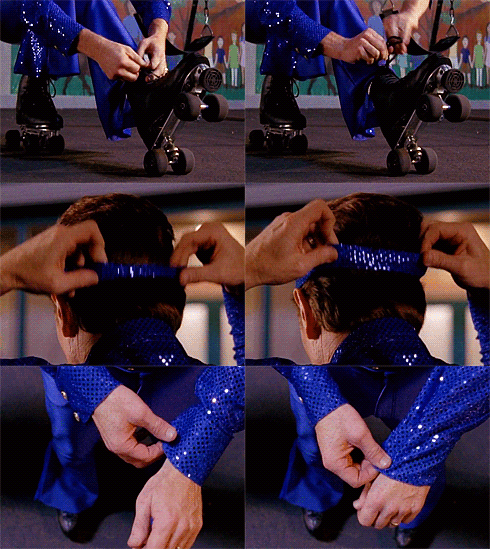
MattalystCat seraphim, the reason why the Japanese version of Bayonetta was such a drag.
19 Jan 06:27

sixpenceee: Each September the Alaskan wood frogs...
MattalystIncredible
Each September the Alaskan wood frogs freeze. Two-thirds of their body water turns to ice. If you picked them up, they would not move. If you bent one of their legs, it would break. Their hearts stop beating, their blood no longer flows and their glucose levels sky rocket. BUt then during the spring, they thaw out and return to normal. (Source)

18 Jan 23:47

"The Proposal" by Scott G. Brooks
MattalystSo....live together for a while first, is what he's saying.
"The Proposal" by Scott G. Brooks
18 Jan 22:52

This QVC segment devolved into a mind-blowingly dumb argument about the moon
by Amanda Taub
"What even is the moon?"
If the QVC shopping network is not the first media resource you would turn to in trying to answer that question, then congratulations: you make good life decisions.
On Monday, QVC hosts Isaac Mizrahi and Shawn Killinger accidentally waded into a discussion of the moon's status as "a planet" or "a star" in the course of trying to sell some cardigans. It did not go well for them.
You probably already know that the moon is in fact a natural satellite orbiting the earth. But for Mizrahi and Killinger, that information was mind-blowingly new.
The segment is basically uninterrupted perfection from 7:17 to 8:52, but the following lines stand out as particularly amazing:
- "The moon is a planet darling. The mooooon is a plaaaaahhnet honeyyyy."
- "I don't know what the sun is."
- "Chuckie. If you're listening to me, I need you to GOOGLE THE MOON OKAY."
- "The moon is such a planet I can't even STAND it."
- "Well what else is it if it's not a planet?"
- "I believe it's a star! Or...something."
- "Didn't you ever do that thing in grade school with the planets where there's Uranus, and Saturn, and then the one with the rings, and then the earth and then THE MOON IS NEVER IN THERE DUDE."
- "What is it then, a baseball? Cheese?"
- They discover the truth at 8:36: "The moon is WHAT? A natural satellite? What does THAT mean?"
- "But THINGS LIVE ON IT! That means it's a planet!"
- "Is that what Google said? No, I don't like that at all. At all. I don't even know what that means!"
- "I use Google all the time. I feel bad. I feel bad for Yahoo because they're good too! I just don't use them."
- "Well, it's an education."
And thank goodness for that.


16 Jan 22:15
Section: Health and Wellbeing
Tags: Colorado State University, Hearing Aid, Hearing Impaired, Tongue
Related Articles:
Mouthpiece could let the deaf "hear" through their tongues
by Ben Coxworth
MattalystBrainport (http://www.wicab.com/en_us/)! One of my favorite demonstrations of neural plasticity.

Section: Health and Wellbeing
Tags: Colorado State University, Hearing Aid, Hearing Impaired, Tongue
Related Articles:
- Cochlear implants may be losing their awkward external hardware
- Hybrid device combines hearing aid and cochlear implant
- Middle ear microphone aims to improve cochlear implants
- Cochlear implant enhances patient experience through gene therapy
- New tech allows quadriplegics to discreetly control wheelchairs using their tongues
- Electronic tongue gets a taste for beer
16 Jan 21:16
Perceived Sexiness of Creativity (larger)
MattalystReally what this graph shows is that women care what you do, and men care about...something else.

16 Jan 20:54
Supreme Court to Decide Marriage Rights for Gay Couples Nationwide
by By ADAM LIPTAK
MattalystIn the words of Ana Marie Cox, "REALLY looking forward to Scalia's dissent."
The court, after declining to take up the issue in October, is now likely to resolve one of the great civil rights questions of the age before its current term ends in June.


16 Jan 17:22

"Women became the metaphor for mother nature as wild and sexual...
"Women became the metaphor for mother nature as wild and sexual thing exploited" ~ Hannah Yata
Read more: https://beautifulbizarre.net/2015/01/08/the-beautifully-imperative-world-of-hannah-yata/
16 Jan 17:15
Ritual and the Consciousness Monoculture
MattalystA dollop of woo, but also some valid points. And as someone who read Julian Jaynes: don't.
Ritual and the Consciousness Monoculture:
Sarah Perry is a guest blogger who blogs at Carcinisation and is the author of Every Cradle is a Grave: Rethinking the Ethics of Birth and Suicide. A selective sweep occurs when a new, beneficial gene mutation appears and quickly
Ritual and the Consciousness Monoculture
by EDITOR on JANUARY 8, 2015
Sarah Perry is a guest blogger who blogs at Carcinisation and is the author of Every Cradle is a Grave: Rethinking the Ethics of Birth and Suicide.
A selective sweep occurs when a new, beneficial gene mutation appears and quickly sweeps across a population, erasing the genetic diversity that existed prior to the sweep. Similarly, languages have “swept” across continents as the cultures they belonged to gained unbeatable advantages (often agricultural or military), resulting in losses of language diversity from earliest human history to the present day. Today, half the population of the world speaks one of only thirteen languages.
These are not controversial claims. More controversial is the idea that human prehistory (and even history) hosted a wide variety of human consciousness, not just language, and that these disparate kinds of subjective consciousness were destroyed upon contact with new forms of consciousness. Most dramatically, Julian Jaynes famously argued (in The Origin of Consciousness in the Breakdown of the Bicameral Mind) that human consciousness changed drastically in the past few thousand years, from an archaic bicameral form in which one side of the brain shouted orders and the other obeyed, to a modern, introspective form. My claim is not so extreme: I simply argue that there are and have been many forms of human consciousness, varying in particular ways, that we retain the “hardware” capability for many forms of consciousness, and that humans are constrained into particular mental states by their cultures, especially through group ritual (or lack thereof). In order to explore this claim, it is helpful to think about our own form of consciousness in detail – a form of consciousness that is novel, contagious, and perhaps detrimental to human flourishing compared with more evolutionarily tested forms of consciousness running on the same hardware.
Scholastic-Industrial Consciousness
The form of consciousness that you and I share (if you are reading this) was likely not the only one to sweep across new territory, erasing previous variation. But it is the most recent such sweep, and it has been a dramatic one. It provides particular ways of subjectively experiencing time, identity, the self, other people, external reality, and the divine. (E. Richard Sorenson lists the consciousness variants as sense-of-name, sense-of-space, sense-of-number, sense-of-truth, and sense-of-emotion.) Ours is a literate kind of consciousness, gathering momentum with the advent of printing and achieving its ultimate realization (though with some subversion) in the form of the internet. Since it appears to be transmitted by schooling and since it is the form of consciousness most conducive to industrialization, it may be thought of as scholastic-industrial consciousness.
Axes of Variation of Consciousness
Here I will explore a few of the most dramatic variations in the determinants of human experience. They are difficult to notice because they form the unquestioned background of our experience; our present senses of time, identity, and the self seem to be immutable aspects of human experience, but historical and cross-cultural study reveals that they do vary significantly.
Time
Nick Szabo writes that the time-rate wage – selling one’s time as a measure of sacrifice, as opposed to serfdom or piece work – accelerated around the fourteenth century in Europe, as “mechanical clocks, bell towers, and sandglasses provided the world’s first fair and fungible” measure of time. Increasingly reliable, precise, and accessible measurement of time increased productivity and material well-being in Europe even prior to the printing press. But submitting to the new form of time was itself a sacrifice. Coordinated punctuality comes at the cost of each person living most of his hours aware of the wider world’s standard time, which is a novel way of being human. In fourteenth-century France and for many centuries after, when human labor was irreplaceably valuable and there were many gains available from increased coordination, the trade-off made sense. Now that human labor is becoming less valuable and more replaceable, forcing people to live bound by world standard time might be becoming harder to justify.
Identity
In the scholastic-industrial world, each person is assigned a legal name at birth, and carries that same name and identity until death. A modern government identity accumulates reams of information, now easily attached to it via electronic databases. From preschool to college, educational information becomes attached to one’s identity, and this process does not stop at employment; information about experience, taxes, consumption, credit, medical involvement, and more accumulates on one’s “permanent record.”
Maintenance of reputation is not novel; it is a key element of human nature, common to all societies. But not all societies even have fixed names; those outside the reach of complex governments experience more flexible identities. Sorenson says:
In these preconquest regions of New Guinea names were rarely binding. What one was called varied according to time, place, mood, and setting. Names were improvised, not formally bestowed, and naming (much like local language flexibility) was often a kind of humorous exploratory play. New names could be quickly coined, often whimsically from events and situations, with a new one coming up at any time….One girl was called “Aidpost” following her excitement about the first one in the region; another was called “Sleepgood” by a new friend who liked sleeping with her.
Daniel Everett reports a similar laxity toward identity among the Pirahã (hunter-gatherers in the Amazon), and notes that the Pirahã often trade names with spirits that they meet in the jungle (at p. 9).
Certainly, the volume of information attached to a modern identity is novel. The internet at first seemed to provide escape from invasive surveillance through anonymous or at least pseudonymic identities; unfortunately, privacy is inimical to the interests of government and consumer product distributors, and is rapidly being eroded.
The Self
Mirrors only became common in the nineteenth century; before, they were luxury items owned only by the rich. Access to mirrors is a novelty, and likely a harmful one.
In Others In Mind: Social Origins of Self-Consciousness, Philippe Rochat describes an essential and tragic feature of our experience as humans: an irreconcilable gap between the beloved, special self as experienced in the first person, and the neutrally-evaluated self as experienced in the third person, imagined through the eyes of others. One’s first-person self image tends to be inflated and idealized, whereas the third-person self image tends to be deflated; reminders of this distance are demoralizing.
When people without access to mirrors (or clear water in which to view their reflections) are first exposed to them, their reaction tends to be very negative. Rochat quotes the anthropologist Edmund Carpenter’s description of showing mirrors to the Biamis of Papua New Guinea for the first time, a phenomenon Carpenter calls “the tribal terror of self-recognition”:
After a first frightening reaction, they became paralyzed, covering their mouths and hiding their heads – they stood transfixed looking at their own images, only their stomach muscles betraying great tension.
Why is their reaction negative, and not positive? It is that the first-person perspective of the self tends to be idealized compared to accurate, objective information; the more of this kind of information that becomes available (or unavoidable), the more each person will feel the shame and embarrassment from awareness of the irreconcilable gap between his first-person specialness and his third-person averageness.
There are many “mirrors”—novel sources of accurate information about the self—in our twenty-first century world. School is one such mirror; grades and test scores measure one’s intelligence and capacity for self-inhibition, but just as importantly, peers determine one’s “erotic ranking” in the social hierarchy, as the sociologist Randall Collins terms it. Of the school sexual scene “mirror,” he says:
…although the proportion of the population whose sex lives are highly active is small, this prestige hierarchy nevertheless has an effect on persons ranked throughout. Particularly among young persons living in public sexual negotiation scenes, there is a high level of attention paid to erotic stratification criteria, and acute awareness of who occupies what rank in the community’s ratings….
The popular crowd is the sexual elite. Being in the center of attention gives greater solidarity, closer identification with the symbols of the group, and greater self-confidence. Conversely, those on the outskirts of the group, or who are excluded from it, manifest just the opposite qualities. Being part of the sociable/erotic elite produces an attitude of arrogance; the elite know who they are, and the enclosed, high-information structure of the scene makes visible the ranking of those lower down as well.
(Interaction Ritual Chains, p. 253; citations omitted; emphasis mine.)
There are many more “mirrors” available to us today; photography in all its forms is a mirror, and internet social networks are mirrors. Our modern selves are very exposed to third-person, deflating information about the idealized self. At the same time, say Rochat, “Rich contemporary cultures promote individual development, the individual expression and management of self-presentation. They foster self-idealization.”
Roy Baumeister (Meanings of Life, chapters five and six) traces the modern obsession with self to the erosion of other sources of value and meaning in life, such as religion, shared morality, and tradition:
When people say they need to find themselves, often what they really mean is that they want a meaningful life….People have always had selves, but selves have not always had to carry the burden of supplying meaning to life in such a far-reaching fashion. The reason for the modern fascination with the self, then, is that the self has been made into a fundamental and powerful source of value in modern life.
(Baumeister, pp. 77-78)
Since sources of meaning and value are now so rare, the self has had to take on the novel burden of providing value and fulfillment (an idealized future state that justifies unpleasantness in the present), as in the novel modern idea of the “career”:
The assumption is that your work will elevate you to a position of eminence that will elicit respect, admiration, and acclaim from others, as well as allowing you to feel self-respect and self-esteem. Many people hold some mythical view of career success that promises personal fulfillment. They imagine that reaching certain goals will be automatically accompanied by living happily ever after. (Baumeister, p. 125)
The novel function of the self as the primary locus of meaning, especially in an environment offering increasing amounts of accurate (which is to say painful) information about the self, is hard on modern humans. One popular option is self-deception; normal, healthy people tend to have an unrealistically positive self image, to exaggerate or overestimate the control they have over their lives, and to be unreasonably optimistic. “Illusions, distortions, and self-deception appear to be integral to the way normal, well-adjusted people perceive the world,” says Baumeister (p. 224). “Seeing things as they really are is associated with depression and low self-esteem.” Where self-deception fails, there are other routes to escape the painful self. Elsewhere, Baumeister argues that behaviors such as alcoholism, binge eating, sexual masochism, charismatic religion, spirituality, and even suicide function as escapes from the overburdened, embarrassed, shameful modern self.
In the rest of this essay I will propose a rudimentary sketch of a more salubrious escape plan from the novel modern self and the hardships that scholastic-industrial consciousness imposes upon us.
Constrained Toward Consciousness
Human consciousness is not one singular experience shared by all; there are varieties of human consciousness. Entering altered states of consciousness demonstrates that there are many possible states, and the ordinary, everyday consciousness of different people also varies.
Many animals experience consciousness in the form of awareness of the outside world and of self. The form of consciousness unique to and universal among humans, as explained in Philippe Rochat’sOthers In Mind mentioned above), is the awareness of oneself from the imagined perspective of other minds. During development, we are constrained toward this form of consciousness by the words and behavior of others: we are forced, by others, to be aware of ourselves from their perspective—to have others in mind. Others influence our mental states down to the existence of human consciousness itself. We may expect that groups have great power to affect our mental states. Indeed, group presence, group awareness, and group expectations are necessary ingredients for the induction of certain ritual mental states.
As scholastic-industrial consciousness has made our selves more weighty and painful, increasing the need for the loss of self through ritual, the opportunity for such rituals has decreased. As we have become more literate and rational, a process begun during the Enlightenment and accelerating throughout the twentieth century, group rituals and the mental states that they induce have been lost. Those rituals that are left tend to be of the spectacle variety rather than participatory – listening to music rather than making it, watching rather than dancing. It is a great loss. Rituals function, on theone hand, as “social vitamins” – necessary ingredients for human flourishing that are provided by ancestral social “diets” but frequently left out of modern lives. On the other hand, rituals are necessary social glue, connecting small communities and helping their members to cooperate and feel a sense of social belonging.
Hiving and Rhythmic Entrainment
One proponent of the theory that group ritual is a necessary ingredient for achieving desirable states of consciousness is the psychologist Jonathan Haidt. Haidt refers to this as “the hive hypothesis,” explored in his essential book The Righteous Mind as well as a recent paper. (Also see this excellentexploration of hiving through the loss of self in religion and politics by fellow Ribbonfarm guest blogger Kevin Simler.) The hive hypothesis states that “people need to lose themselves occasionally by becoming part of an emergent social organism in order to reach the highest levels of human flourishing.” The joy of synchronized motion, and the loss of self in something greater, he argues, lead to stronger social cohesion and greater personal well-being for participants.
Humans are some of the only animals capable of rhythmic entrainment, synchronized motion to a musical beat. It has a special place in human culture, from dancing to military drilling, from children’s rhythm games to North Korea’s Mass Games. Synchronized, rhythmic motion eases the pain of strenuous effort, facilitates cooperation, makes people braver in the face of formidable opposition, and (on a darker note) makes them more willing to engage in aggression against a perceived out-group. Rhythmic entrainment is a powerful hack that allows the painful self (and self-interest) to be put aside in favor of the joy of solidarity. And, to our detriment, we have ever fewer opportunities to engage in rhythmic rituals today.
Donald Brown’s celebrated list of human universals, a list of characteristics proposed to be common to all human groups ever studied, includes many entries on music, including “music related in part to dance” and “music related in part to religion.” The Pirahã use several kinds of language, including regular speech, a whistling language, and a musical, sung language. The musical language, importantly, is used for dancing and contacting spirits. The Pirahã, Everett says, often dance for threedays at a time without stopping. They achieve a different consciousness by performing rituals calibrated to evoke mental states that must remain opaque to those not affected.
There is something important in rhythmic rituals that cannot be fully captured in scholastic-industrial rational thought; it must be experienced to be understood. Nonetheless, it is not magical in the sense of being supernatural or outside the bounds of scholastic-industrial-style inquiry.
Authenticity, Sincerity, and the Suspicion of Ritual
When we identify something as a ritual, it is often to say that it is just a ritual, an empty behavior with no meaning. The performance of a ritual tells us nothing about the sincere feelings of the person performing it; rituals strike us as inauthentic. Shaking hands or saying “bless you” when someone sneezes are performed automatically, and in that way inauthentically. Randall Collins, cited above (inInteraction Ritual Chains), notes that hugging as a greeting did not emerge in the United States until the 1970s; this “more sincere” ritual has started edging out handshakes as the demonstrative greeting of choice. I have noticed the emergence of a new and even more conspicuously sincere ritual, the 20-second hug—which can be a very pleasant ritual, but imposes a great deal of intimacy (sincerity) within the space of a greeting.
Adam Seligman and Robert Weller, in their books Ritual and Its Consequences: An Essay on the Limits of Sincerity (2008) and Rethinking Pluralism: Ritual, Experience, and Ambiguity (2012), propose that the elevation of the sincere and authentic, and the distrust of ritual, is an important feature of modern consciousness. They trace the focus on personal intent (as opposed to ritual performance) to Immanuel Kant, for example. To be an atomized individual self, whose actions are under one’s rational control and express one’s sincere, authentic intent at all times is a peculiar, modern way to be human. Ritual is the normal way to be human. Our disdain for “empty rituals” is our loss: rituals are what help us navigate the necessary ambiguities of social life, into which rational codification can never fully penetrate.
So imagine “ritual,” but with a positive connotation. Rather than dismissing these behaviors as meaningless, look instead at how they elaborate meaning. And, perhaps more importantly, enjoy them without the sneaking suspicion that you’re not being authentic enough when you perform them.
Distracting the Watcher at the Gates of the Mind
Keith Johnstone describes a process of mental censorship that arises from an excessive cultural focus on the individual self as the locus of meaning. I apologize for the length of the quotation, but I promise it is necessary:
Suppose an eight-year-old writes a story about being chased down a mouse-hole by a monstrous spider. It’ll be perceived as ‘childish’ and no one will worry. If he writes the same story when he’s fourteen it may be taken as a sign of mental abnormality. Creating a story, or painting a picture, or making up a poem lay an adolescent wide open to criticism. He therefore has to fake everything so that he appears ‘sensitive’ or ‘witty’ or ‘tough’ or ‘intelligent’ according to the image he’s trying to establish in the eyes of other people. If he believed he was a transmitter, rather than a creator, then we’d be able to see what his talents really were.
We have an idea that art is self-expression—which historically is weird. An artist used to be seen as a medium through which something else operated. He was a servant of the God. Maybe a mask-maker would have fasted and prayed for a week before he had a vision of the Mask he was to carve, because no one wanted to se his Mask, they wanted to see the God’s. When Eskimos believed that each piece of bone only had one shape inside it, then the artist didn’t have to ‘think up’ an idea. He had to wait until he knew what was in there — and this is crucial. When he’d finished carving his friends couldn’t say ‘I’m a bit worried about that Nanook at the third igloo’, but only, ‘He made a mess getting that out!’ or ‘There are some very odd bits of bone about these days.’ These days of course the Eskimos get booklets giving illustrations of what will sell, but before we infected them, they were in contact with a source of inspiration that we are not. It’s no wonder that our artists are aberrant characters. It’s not surprising that great African sculptors end up carving coffee tables, or that the talent of our children dies the moment we expect them to become adult. Once we believe that art is self-expression, then the individual can be criticised not only for his skill or lack of skill, but simply for being what he is.
Schiller wrote of a ‘watcher at the gates of the mind’, who examines ideas too closely. He said that in the case of the creative mind ‘the intellect has withdrawn its watcher from the gates, and the ideas rush in pell-mell, and only then does it review and inspect the multitude.’ He said that uncreative people ‘are ashamed of the momentary passing madness which is found in all real creators … regarded in isolation, an idea may be quite insignificant, and venturesome in the extreme, but it may acquire importance from an idea that follows it; perhaps in collation with other ideas which seem equally absurd, it may be capable of furnishing a very serviceable link.’
Keith Johnstone, Impro, p. 78-79.
What is this “watcher at the gates of the mind” that crushes spontaneity, originality, and fun? A small study recently concluded that an explanation will be perceived as more satisfying if it has a neuroscience angle, even if the neuroscience angle is completely non-probative of its claims. So I am happy to say that I have a neuroscience explanation to offer: the censorious “watcher” likely lives in the dorsolateral prefrontal cortex.
An even smaller study, for example, studied the brains of rappers, both reciting memorized verses and “freestyling” – inventing new lyrics on the fly. Under fMRI, subjects freestyling showed decreased activation in the dorsolateral prefrontal cortex (DLPFC). Another study, measuring jazz musicians either playing previously memorized music and improvising new music, demonstrated the same pattern of activation: decreased DLPFC activity in improvising musicians.
So we have a candidate for the watcher at the gates of the mind. Arne Dietrich named this the“transient hypofrontality hypothesis”, proposing that what altered states such as “dreaming, endurance running, meditation, daydreaming, hypnosis, and various drug-induced states” have in common is a pattern of inhibition in the prefrontal cortex. Group rituals, especially rhythmic rituals (like endurance running), have the power to inhibit ordinary self-conscious social rumination and provide pleasurable ego-loss as well as social connection and bonding.
Finally, if that is not convincing enough, another line of research has suggested that any picture whatsoever – even one that is not probative of any fact – increases people’s confidence in facts when they are presented alongside them. I therefore present the most convincing argument in the world:

The Institutional Power of Rhythmic Ritual: Evidence from Self-Flagellation
In sixteenth century France, a new form of Catholic worship was rising in popularity. Penitential confraternities, brotherhoods of Catholic laymen, began to spread throughout France; by the end of the seventeenth century, every tiny village had its own chapter. But by the mid-eighteenth century, the penitential societies were beginning to lose social cohesion and break down. What made these societies so popular, and why did they decay after 1750?
At first, the penitential societies were based around a very strong and powerful ritual: that of self-flagellation. In the early days, members performed the rite of self-flagellation every week, and three times per week during Lent. By the early eighteenth century, however, the focus of the confraternities had shifted to emphasize meditation and community service; they dropped the rite of self-flagellation in favor of contemplation and charitable acts. Andrew Barnes explains:
Research on altered states of consciousness suggests that the performance of rituals generates a different psychological experience from that of practice of meditation. Ritual performance generates experiences of communitas. It rewards corporate religious activity in ways that meditation does not. It can be argued that the rituals performed by confraternities early in their existence were crucial for the maintenance of group and organizational cohesion.
Andrew Barnes, “From Ritual to Meditative Piety: Devotional Change in French Penitential Confraternities from the 16th to the 18th Century.” Journal of Ritual Studies 1:2:1-26, Summer 1987.
Toward the end, around 1731, the brothers perceived their problem as being one of internal discordand strife; their solutions were more regulation and more intricate statutes, rather than a return to rhythmic ritual. “The one trend in confraternal statutes more eye-catching than the decrease in ritual devotions is the increase in procedures to regulate and reduce internal discord,” says Barnes. “Internal discord was not a main concern in the statutes of earlier confraternities.”
Self-flagellation, in our scholastic-industrial society, is mostly mentioned as a punch line, if at all. That, I think, is scholastic-industrial consciousness undermining the power of other modes of consciousness that it can’t readily explain or understand. It is the kind of group rhythmic ritual that has the power to help us lose ourselves in something greater, and to bind us to each other more deeply – if that is what we want.
Some Words of Caution
I have analogized ritual to vitamins: we have need of them, our ancestral cultures provided them for us, and we suffer a kind of malnutrition without them. But even vitamins are dangerous in the wrong doses and under the wrong conditions. Ritual is very powerful, and should be regarded with the same respect as powerful psychoactive drugs.
In our hypermobile age, in which few people live among committed, long-term community members, we experience a chicken-egg problem: ritual is required to support community, but a community is required to support ritual (see diagram, elaborated from an analogy suggested by my husband). The subjective experience of ritual, divorced from a real community, may be pleasurable but ultimately unfulfilling.

Another danger is that the old rituals may not survive contact with us hungry ritual zombies. The Oaxacan shamaness María Sabina shared her hallucinogenic mushroom ritual with the ethnomycologist R. Gordon Wasson, and shortly after (during the 1960s and 70s) her village was overrun with tripping hippies running through the village naked with live turkeys dangling from their mouths. In María Sabina’s words, the mushrooms began to lose their power after the coming of the foreigners. Rituals are complex things, and their efficacy depends not only on chemical disinhibition, but on the beliefs and practices of the community within which they are performed.
Finally, ritual mental states sneak up on you; mere demonstration is often enough to transmit them. The anthropologist Felicitas Goodman, in her book Speaking in Tongues: A Cross-Cultural Study of Glossolalia, describes being overtaken by an intense ritual mental state herself:
Not even the ethnographer is immune. In one of my first conversations with the minister in Utzpak, he said that of course he would like me to receive the blessing and the promise of the Holy Spirit while I was in Utzpak; he would pray for me when I was ready. “However,” he continued, “the Spirit may come to you without either one of us actually asking for it.” And he was right.
…The last conscious memory I have of the episode to follow is that of thinking, “At home when I was a child, we were taught a little prayer to say before we sat down in church.” Then someplace in the church, I do not remember where, I leaned against something, I do not know what. I saw light, but then I was surrounded by light, or perhaps not, because the light was in me, and I was the light. In this light I saw words in black outline—or were they just letters?—descending upside down as if on a waterfall of light…. Never before had I felt this kind of luminous, ethereal, delightful happiness.
…I think I was obeying a cultural expectation: I had seen demonstrated many times how people went into dissociation. I was in the proper place at the proper time, thinking of prayer, and then it happened to me quite spontaneously and without any conscious effort on my part. It did not happen again because I intentionally blocked subsequent occurrences. I needed at all times to be in complete control of my faculties.
Most of the time, in most cultures, not just our own, we do need to be in complete control of our faculties. But we also need, sometimes, to dissolve into our groups, which presupposes the existence of such a group. While I think we are socially and emotionally starving without participatory group rituals, especially rhythmic rituals, I also think we must be very cautious in adding new or old rituals to our diet. The rebirth of ritual is the most deadly serious play.
Especially Recommended Readings
Johnstone, Keith. Impro: Improvisation and the Theatre. New York: Routledge, 1987.
Kavanagh, Aidan. On Liturgical Theology. New York: Pueblo Publishing Company, 1984.
Rochat, Philippe. Others In Mind: On the Social Origins of Self-Consciousness. Cambridge University Press, 2009.
Seligman, Adam, and Robert Weller. Rethinking Pluralism: Ritual, Experience, and Ambiguity. Oxford University Press, 2012.
16 Jan 15:09


Former TSA officer reveals widespread misery there
by Mark Frauenfelder
Image: Shutterstock
Being a TSA officer is a dream job for sadistic sociopaths, but for people who are able to sympathize, it's a nightmare. "I hated it from the beginning," writes former TSA officer Jason Edward Harrington, in an essay published in Politico Magazine. He recounts the daily shame of having to confiscate nail clippers from pilots (to prevent the pilots from using them to "hijack the very planes they were flying"), jars of homemade apple butter ("on the pretense that they could pose threats to national security") and a bottle of champagne from some Marines returning home from Afghanistan who wanted to share it with a young soldier who'd lost his legs to an I.E.D. Read the rest