

Mahmoudi don't think i loathe death quite this much, but the whole series is good.
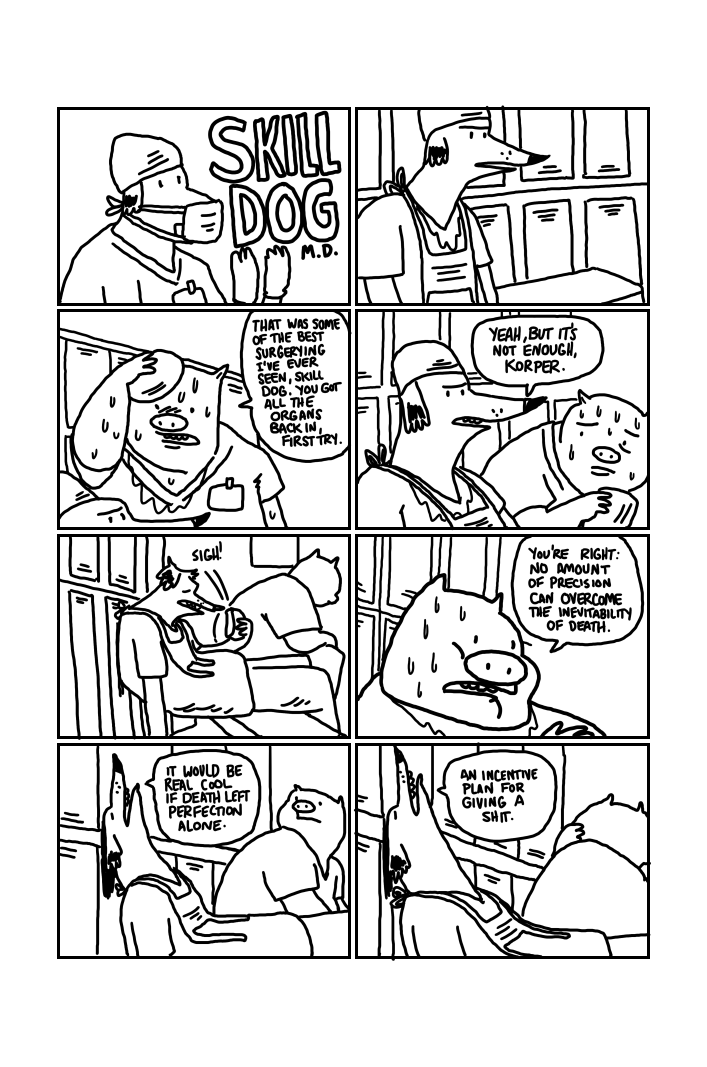
Mahmoudthis is how stephen spends his sundays
Mahmoudi thought about this again today for some reason


Read more of this story at Slashdot.
Mahmoudi was just thinking "these used to be depressing" and then i got to this one
Mahmoudhmmmm, I still like Internet for the specific network, but internet for the adjective makes sense. #hottakes
Read more of this story at Slashdot.
Mahmoudapproved
Mahmoudhad to check the date. fucking timely.
Mahmoudpwnt
Mahmoudhttp://www.stickk.com/ some commitment goals are :|ol

‘Might a commitment strategy allow you to pay yourself to go to the gym?’
How are those resolutions going? Still going to the gym? If not, you’re not alone.
Let’s think about incentives. If some benevolent patron had paid you a modest sum — a few pounds a day, perhaps — for keeping your resolution throughout January, would that have helped you keep fit now that January is behind us?
The answer is far from clear. An optimistic view is that by paying you to look after yourself in January, your mysterious patron would have encouraged you to form good habits for the rest of the year. The most obvious case would be if you were trying to give up cigarettes; paying you to get through the worst of the withdrawal period might help a lot. Perhaps diet and exercise would be similarly habit-forming.
Yet some psychologists would argue that the payment is worse than useless, because payments can chip away at our intrinsic motivation to exercise. Once we start paying people to go to the gym or to lose weight, the theory goes, their inbuilt desire to do such things will be corroded. When the payments stop, things will be worse than if they had never started.
The idea that external rewards might crowd out intrinsic motivation is called overjustification. In a celebrated study in 1973 conducted by Mark Lepper, David Greene and Richard Nisbett, some pre-school children were promised sparkly certificates as a reward for drawing with special felt-tip pens. Others were given no such promise. When the special pens were reintroduced to the nursery classrooms a week or so later, without any reward on offer, the researchers found that the children who had previously been promised certificates for their earlier drawing now spent half as much time with the pens as their peers. Only suckers draw for free.
There’s a big difference between exercising and colouring, however: while many children like felt-tips, many adults do not like exercising. A payment can hardly crowd out your intrinsic motivation if you don’t have any intrinsic motivation in the first place. Systematic reviews of the overjustification effect suggest that incentives do no harm for activities that people find unappealing anyway.
So perhaps the idea of paying people to exercise is worth thinking about after all. In 2009, two behavioural economists, Gary Charness and Uri Gneezy, published the results of a pair of experiments in which they tried it. Some of their experimental subjects were paid $100 to go to the gym eight times in a month, while those in two alternative treatment groups were either paid $25 for going just once, or weren’t asked to go to the gym at all.
The results were a triumph for the habit-formation view. The payments worked even after they had stopped. In one study, the subjects were exercising twice as often seven weeks after the bonus payments stopped than before they started; in the other, the increase was threefold 13 weeks after payments had stopped. People who were already regular gym-goers didn’t change their behaviour — so there was no crowding-out — but there was a surge in exercise from people who hadn’t previously done much. A later study by Dan Acland and Matthew Levy found a similar habit-forming effect among students, although, alas, the good habits often failed to survive the winter vacation. In other experiments, incentive payments have been shown to be modestly successful at helping smokers to give up.
There is much to be said for a benign patron who pays you to stay healthy while you form good habits. But where might such a person be found? Take a look in the mirror — your patron might be you.
Inspired by the ideas of Nobel laureate Thomas Schelling, economists have become fascinated by the idea of commitment strategies, where your virtuous self takes steps to outmanoeuvre your weaker self before temptation strikes. A simple commitment strategy is to hand £500 to a trusted friend, with instructions that they are only to return the cash if you keep your resolution.
Might a commitment strategy allow you to pay yourself to go to the gym? It might indeed. Economists Heather Bower, Mark Stehr and Justin Sydnor recently published the results of a long-term experiment conducted with 1,000 employees of a Fortune 500 company. In this experiment, some employees were initially paid $10 for each visit to the company gym over a month. Some of them were then offered the opportunity to put money into a commitment savings account: if they kept exercising, the money would be returned; otherwise it would go to charity. The approach was no panacea: most people did not take up the option, and not everyone who did managed to stick to their goals. But even three years later, those who had been offered commitment accounts were 20 per cent more likely to be exercising than the control group.
That chimes with my experience. I once wrote a column about sending $1,000 to a company called Stickk, which promised to give it away if I didn’t exercise regularly. The contract was for a mere three months — and I succeeded. Eight years after my money was returned, I’m still sticking to the habit.
Written for and first published at ft.com.
(You can unsubscribe at any time)
Email Address
Mahmoudthis is a lot of words around one key term: "Bayes"
‘Would you say that someone reading the FT is more likely to have a PhD or to have no college degree at all?’
What’s the likelihood that the British economy will fall into recession this year? Well, I’ve no idea — but I have a new way to guess.
Before I reveal what this is, here’s a totally different question. Imagine that you see someone reading the Financial Times. Would you say that this individual, clearly a person of discernment, is more likely to have a PhD or to have no college degree at all?
The obvious response is that the FT reader has a PhD. Surely people with PhDs better exemplify the FT reader than people with no degree at all, at least on average — they tend to read more and to be more prosperous.
But the obvious response is too hasty. First, we should ask how many people have PhDs and how many people have no college degree at all? In the UK, more than 75 per cent of adults have no degree but the chance that a randomly chosen person has a PhD is probably less than 1 per cent.
It only takes a small proportion of non-graduates to read the FT before they’ll outnumber the PhD readers. This fact should loom large in our guess, but it does not.
Logically, one should combine the two pieces of information, the fact that PhDs are rare with the fact that FT readers tend to be well educated. There is a mathematical rule for doing this perfectly (it’s called Bayes’ rule) but numerous psychological experiments suggest that it never occurs to most of us to try. It’s not that we combine the two pieces of information imperfectly; it’s that we ignore one of them completely.
The number that gets ignored (in this example, the rarity of PhDs) is called the “base rate”, and the fallacy I’ve described, base rate neglect, has been known to psychologists since the 1950s.
Why does it happen? The fathers of behavioural economics, Daniel Kahneman and Amos Tversky, argued that people judge such questions by their representativeness: the FT reader seems more representative of PhDs than of non-graduates. Tversky’s student, Maya Bar-Hillel, hypothesised that people seize on the most relevant piece of information: the sighting of the FT seems relevant, the base rate does not. Social psychologists Richard Nisbett and Eugene Borgida have suggested that the base rate seems “pallid and abstract”, and is discarded in favour of the vivid image of a person reading the pink ’un. But whether the explanation is representativeness, relevance, vividness or something else, we often ignore base rates, and we shouldn’t.
At a recent Financial Times event, psychologist and forecasting expert Philip Tetlock explained that good forecasters pay close attention to base rates. Whether one is forecasting whether a marriage will last, or a dictator will be toppled, or a company will go bankrupt, Tetlock argues that it’s a good idea to start with the base rate. How many marriages last? How many dictators are toppled? How many companies go bankrupt? Of course, one may have excellent reasons to depart from the base rate as a forecast but the base rate should be the beginning of the journey.
On this basis, my guess is that there is a 10 per cent chance that the UK will begin a recession in 2016. How so? Simple: in the past 70 years there have been seven recessions, so the base rate is 10 per cent.
Base rates are not just a forecasting aid. They’re vital in clearly understanding and communicating all manner of risks. We routinely hear claims of the form that eating two rashers of bacon a day raises the risk of bowel cancer by 18 per cent. But without a base rate (how common is bowel cancer?) this information is not very useful. As it happens, in the UK, bowel cancer affects six out of 100 people; a bacon-rich diet would cause one additional case of bowel cancer per 100 people.
Thinking about base rates is particularly important when we’re considering screening programmes or other diagnostic tests, including DNA tests for criminal cases.
Imagine a blood test for a dangerous disease that is 75 per cent accurate: if an infected person takes the test, it will detect the infection 75 per cent of the time but it will also give a false positive 25 per cent of the time for an uninfected person. Now, let’s say that a random person takes the test and seems to be infected. What is the chance that he really does have the disease? The intuitive answer is 75 per cent. But the correct answer is: we don’t know, because we don’t know the base rate.
Once we know the base rate we can express the problem intuitively and solve it. Let’s say 100 people are tested and four of them are actually infected. Then three will have a (correct) positive test, but of the 96 uninfected people, 24 (25 per cent) will have a false positive test. Most of the positive test results, then, are false.
It’s easy to leap to conclusions about probability, but we should all form the habit of taking a step back instead. We should try to find out the base rate, or at least to guess what it might be. Without it, we’re building our analysis on empty foundations.
Written for and first published at ft.com.
(You can unsubscribe at any time)
Email Address
Mahmoudlives up to the hype

You’ll find many a bold claim on Wikipedia, even on the page for Bert Haanstra’s Glass, a 1958 short documentary on glassmaking in the Netherlands, which, as of this writing, mentions that the film “is often acclaimed to be the perfect short documentary.” Just the sort of thing you’d want to take with a grain of salt, right? But if you watch Glass itself, which won the 1959 Academy Award for Documentary Short Subject, you might find yourself joining in on that supposed chorus of acclaim.
Prashant Parvatneni at The Essential Mystery calls Glass “at once a passionate celebration of human labour and craftsmanship and a biting critique of the mechanistic mass-production of objects. On the very surface this documentary can appear as a demonstrative film keenly elucidating the very basic processes that go into the making of handmade glassware and juxtaposing it with the process of bottle-making in a mechanised factory. Yet this very juxtaposition coupled with a Haanstra’s strong stylistic intervention takes the film into a polemical space.” Taking a slightly different tone, Colossal’s Christopher Jobson highlights the jazz of the traditional half, and the “whimsical score of more synthesized music” in the modern half. “Also,” he adds, “there’s a ton of great smoking!”
Jobson doesn’t mention that these guys also somehow manage to keep smoking even while blowing glass — an impressive feat indeed, and just one of the impressive qualities on display in Glass’ brief runtime. Eventually, the footage turns back from the factory to the workshop, and soon it begins oscillating between the two, cutting to the jazzy rhythm and even making the machines and workmen into musical instruments of a kind. The Dutch glassmaking industry has surely changed in the past half-century, but students of Dutch film can’t ignore the work of Haanstra, who in addition to this and other documentaries short and long, directed features including Fanfare, still one of the most popular films in the Netherlands ever. But as any film historian might suspect — and here comes another bold claim — Glass will outlive them all.
Glass will be added to our list of Free Documentaries, a subset of our collection 725 Free Movies Online: Great Classics, Indies, Noir, Westerns, etc..
via Colossal
Related Content:
Why Man Creates: Saul Bass’ Oscar-Winning Animated Look at Creativity (1968)
Oscar-Winning Animated Short, The Dot and the Line, Celebrates Geometry and Hard Work (1965)
36 Free Oscar Winning Films Available on the Web
Based in Seoul, Colin Marshall writes and broadcasts on cities, language, and style. He’s at work on a book about Los Angeles, A Los Angeles Primer, the video series The City in Cinema, the crowdfunded journalism project Where Is the City of the Future?, and the Los Angeles Review of Books’ Korea Blog. Follow him on Twitter at @colinmarshall or on Facebook.
Glass: The Oscar-Winning “Perfect Short Documentary” on Dutch Glassmaking (1958) is a post from: Open Culture. Follow us on Facebook, Twitter, and Google Plus, or get our Daily Email. And don't miss our big collections of Free Online Courses, Free Online Movies, Free eBooks, Free Audio Books, Free Foreign Language Lessons, and MOOCs.
Mahmoudhappy hashtag user

Emily Temple-Wood has written approximately one Wikipedia article every ten days since she was 12 years old, totaling around 330. The work of the 21-year-old undergraduate, studying molecular biology at Loyola University of Chicago, unabashedly exposes sexism—and in the process, has exposed her to some of it. Temple-Wood’s output has made her the target of Internet trolls: Emboldened by anonymity, they deluge her inbox with cruel emails about her body, intelligence, and sexual decision-making.
Until recently, Temple-Wood simply ignored them. When their numbers jumped recently (she receives dozens a week), she finally responded: For every harassing email she receives, she has pledged to immortalize another female scientist on Wikipedia. It was a simple, elegant solution to a problem: Fight ignorance with enlightenment.
All told, Temple-Wood’s impact on Wikipedia’s gender gap in science has been praised as “epic” by Siko Bouterse, a former Wikimedia Foundation staff member. “Most importantly,” she told the Huffington Post, “Emily has taught and inspired others to do the same.”
Nautilus caught up with Temple-Wood to chat about her passion to showcase women’s contributions to science.
What prompted you to write your first article?
I actually started writing by writing a mean article…
Read More…
MahmoudFUCK
too late

Meringue is delicious, but only if it’s airy, fluffy, and sweet, so add the sugar after you’ve added your eggs and started whipping. It’s a simple technique to get the fluffiest meringue possible.

Bernie Sanders won sweeping victories Saturday and more are sure to come over the next couple months. Can he win the nomination? And is that what really even matters?
Mahmoudjfc
Absolutely no one can make sense of the United States' infatuation with firearms.…
Mahmoudmakin headlines
Bookmarking site Pinboard has discovered one of the downsides of the so-called “API economy”: that moment when lawyers get in the way of a service.…
Mahmoudanother above average entry from straub

Batman v Superman: Dawn of Justice (2016)
Synopsis. When Batman and Superman first meet, they don’t like each other so much that they have a fight.
Tagline. When Batman and Superman first meet, they don’t like each other so much that they have a fight.
Trivia
Mistakes
Memorable Quotes
Clark Kent. So this is Metropolis, the city I just moved to. And this must be the Daily Planet, where I’ll be working with Lois Lane.
Lois Lane. Say, you’re handsome for a new reporter. I’ll be giving you a handjob in the break room.
Clark Kent. (classic Christopher Reeve wink to camera, as a respectful nod to his legacy)
Batman. As long as vigilantes with abilities beyond those of normal people are allowed to operate in secrecy, there can never be a dawn of justice.
Lex Luthor. Poo poo coo coo. Bobo mo mo mo mo.
Superman. An extraordinary foe.
Bruce Wayne. So you must be the new reporter for the Metropolis newspaper. I’m from Gotham City but I had a building here that fell down.
Clark Kent. So that’s why you’re here and not there.
Bruce Wayne. I don’t like your attitude, Kent.
Clark Kent. Prepare to be murdered by Superman.
Wonder Woman. I’m here.
Superman. I kill for fun but think we should make some kind of a, you know. A league of adjudicators.
Batman. For justice. A league, you say?
Superman. Yeah, I like the sound of that… a Justice L —
Wonder Woman. (interrupting, looking into camera) To be continued.
MahmoudBoeing, Beijing, what's the difference?
A Chinese national has pleaded guilty to charges that he funneled US military aircraft secrets back to his controllers in the Middle Kingdom.…


