Imagine if your sewer pipe started demanding that you make major changes in your diet.
Now imagine that it got a lawyer and started asking you to sign things.
You would feel surprised.
This is the position I find myself in today with IFTTT, a form of Internet plumbing that has been connecting peacably to my backend for the past five years, but which has recently started sending scary emails.
If you've never heard of it, If-This-Then-That is a service that lets you connect websites together, so that things that happen in one place automatically trigger some regrettable action someplace else. For example, you might write an IFTTT ‘recipe’ that tweets anything you post on Facebook, because you are a monster.
A lot of Pinboard people use IFTTT. Yesterday, they received the following form letter:
Dear username,
We're working on a new IFTTT platform for developers that makes building Channels and Recipes a breeze.
Recently, we've worked with our partners to migrate to the improved platform, but some have chosen not to do so. Unfortunately, the Pinboard Channel did not migrate to the new platform and will be removed on April 4th.
Pinboard is one of our favorite services and we're all sad to see it go. We hope down the road it may be back.
Stay tuned to the latest Channels launching on IFTTT!
— The IFTTT Team
Because many of you rely on IFTTT, and because this email makes it sound like I'm the asshole, I feel I should explain myself.
In a nutshell:
IFTTT wants me to do their job for them for free
They have really squirrely terms of service
1. Working for Free
A service like IFTTT writes "shim code" that makes it possible to connect online services together like Legos. Everything slots into everything else. This is thankless, detailed work (like developing TurboTax or Dropbox) that when done right, creates a lot of value.
IFTTT has already written all this shim code. They did it when they were small and had no money, so it's difficult to believe they have to throw it away now that they have lots of staff and thirty million dollars.
Instead, sites that want to work with IFTTT will have to implement a private API that can change without warning.
This is a perfectly reasonable business decision. It is always smart to make other people do all the work.
However, cutting out sites that you have supported for years because they refuse to work for free is not very friendly to your oldest and most loyal users. And claiming that it's the other party's fault that you're discontinuing service is a bit of a dick move.
I am all for glue services, big and small. But it's better for the web that they connect to stable, documented, public APIs, rather than custom private ones.
And if you do want me to write a custom API for you, pay me lots of money.
2. Squirrely Terms of Service
The developer terms of service don't seem to be available by a public URL, so I will quote the bits that stung me. I invite IFTTT lawyers to send me a takedown notice, because that will be the funniest part of this fracas so far.
To begin with, IFTTT wants me to promise never to compete with them:
2.You shall not (and shall not authorize or encourage any third party to), directly or indirectly: [...] (xii) "use the Developer Tool or Service in conjunction with a product or service that competes with products or services offered by IFTTT. You hereby make all assignments necessary to accomplish the foregoing.”
Pinboard is in some ways already a direct competitor to IFTTT. The site offers built-in Twitter integration, analogous to IFTTT’s twitter->Pinboard recipe. I don’t know what rights I would be assigning here, but this is not the way I want to find out.
Next, they make a weird claim about owning not just their API and service, but the content that flows through it:
3. Ownership.
IFTTT shall own all right, title, and interest (and all related moral rights and intellectual property rights) in and to the Developer Tool, Service, and Content.
They require that I do custom development work for them, for free, on demand:
11. Compatibility.
Each Licensee Channel must maintain 100% compatibility with the Developer Tool and the Service including changes provided to you by IFTTT, which shall be implemented in each Channel promptly thereafter.
And they assert the right to patent any clever ideas I have while doing that free work for them, even though I hate software patents:
12. Patent License.
Licensee hereby grants IFTTT a nonexclusive, sublicensable, perpetual, fully-paid, worldwide license to fully exercise and exploit all patent rights with respect to improvements or extensions created by or for Licensee to the API
Finally, they reserve the right to transfer this agreement to anyone at all, without my consent:
17.This Agreement is personal to Licensee and may not be assigned or transferred for any reason [...]. IFTTT expressly reserves the right to assign this Agreement and to delegate any of its obligations hereunder.
I say nuts to all that.
I'm sorry your IFTTT/Pinboard recipes are going to stop working.
It's entirely IFTTT's decision to drop support for Pinboard (along with a bunch of other sites). They are the ones who are going to flip the switch on working code on April 4, and they could just as easily flip the switch back on (or even write an IFTTT recipe that does it for them). Weigh their claims about Pinboard being a beloved service accordingly.
For users left stranded, I recommend taking a look at Zapier or Botize, which offer a similar service, or at one of the dozens of new sites that will spring up next week to capture the market that IFTTT is foolishly abandoning.
Jacques Derrida could enjoy a good movie like anyone else. In a 2002 interview with TIME, he declared “I have watched The Godfather 10 times. I must watch it whenever it’s on.” Who couldn’t?
Coppola films were one thing. Apparently sitcoms quite another. In another 2002 interview, a journalist asked the French philosopher whether, in so many words, deconstruction shared anything in common with Seinfeld and the ironic/parodic way it looks at the world. This was taking things too far. “Deconstruction, as I understand it,” said Derrida, “doesn’t produce any sitcom. If sitcom is this, and people who watch this think deconstruction is this, the only advice I have to give them is just stop watching sitcom, do your homework, and read.” The cringeworthy scene originally appeared in the documentary, Derrida, directed by Kirby Dick and Amy Ziering Hoffman.
FYI: Early last week, Colin Marshall gave you a heads up that Studio Ghibli, the animation studio behind Hayao Miyazaki’s My Neighbor Totoro, Princess Mononoke, and Spirited Away, was preparing to release an open source version of the animation software used to create its films. This weekend, the software–called OpenToonz–officially became available for download. And we can now tell you where to find it. OpenToonz is available on Github, in versions made for both Window and OSX. This link will jump you straight to the download area.
If you make anything great with it, please share it with us.
Follow Open Culture on Facebook and Twitter and share intelligent media with your friends. Or better yet, sign up for our daily email and get a daily dose of Open Culture in your inbox. And if you want to make sure that our posts definitely appear in your Facebook newsfeed, just follow these simple steps.
At OC HQ you will find two Bialetti espresso makers on the stove–one small, the other large–and together they power us through the day. Invented by Alfonso Bialetti in 1933, the octagonal, Art Deco-designed coffee maker eventually became a staple in Italian homes (90% of them), thanks to his son Renato, who died last week at the age of 93. A savvy marketer to the end, Bialetti went to the grave with his product, buried, as he was, in an espresso maker that doubled as an urn. All in all, I can’t think of much better ways to spend eternity.
Follow Open Culture on Facebook and Twitter and share intelligent media with your friends. Or better yet, sign up for our daily email and get a daily dose of Open Culture in your inbox. And if you want to make sure that our posts definitely appear in your Facebook newsfeed, just follow these simple steps.
By now we all know the name of Studio Ghibli, the operation responsible for such animated-feature-film-redefining productions as Grave of the Fireflies and Hayao Miyazaki’s My Neighbor Totoro, Princess Mononoke, and Spirited Away. But unless we’ve paid a visit to the Ghibli Museum, seen the documentary The Kingdom of Dreams and Madness, or taken part in the close scrutiny to which Ghibli fans subject the studio’s every public move, we won’t know much about their methods for crafting such visually and emotionally captivating stories. Soon, though, we’ll be able to use their tools ourselves. On March 26, you will be able to download OpenToonz, an open source version of the Toonz software used by Studio Ghibli.
“Included in the OpenToonz are many of Ghibli’s custom tools, specially designed to capture trees waving in the breeze, food that looks too delicious to eat, and the constant running Miyazaki’s films are known for,” writes The Creators Project’s Beckett , who quotes Ghibli’s Executive Imaging Director Atsushi Okui on why they started using the Italian-developed package in the first place: “We needed a software enabling us to create a certain section of the animation digitally. Our requirement was that in order to continue producing theatre-quality animation without additional stress, the software must have the ability to combine the hand-drawn animation with the digitally painted ones seamlessly.” Toonz, evidently, could pull it off.
Ghibli began using the software in 1995, during the production of Princess Mononoke, and has kept using it since. In fact, reports Amid Amidi at Cartoon Brew, “the new OpenToonz is dubbed ‘Toonz Ghibli Edition’ because of all the custom-features that Toonz has developed over the years for the legendary Japanese studio.” With Miyazaki retired, at least from feature-film animation, and nobody quite sure whether 2014’s When Marnie Was There will be the studio’s last picture, as good a time as any has come for successors to the Ghibli tradition. If you’d like to throw your own hat into that enormous ring, you can download OpenToonz for free on March 26 (or, for a price, buy Toonz Premium) from the official Toonz web site.
satanaista means satanist in italian, but 100 women in finnish. Sata btw is almost certainly protoindoeuropean, as Sat means 100 in farsi and hindi and others. Same word as latin Centum, and germanicized Hundred. language is fuckin wild.
Every Wikipedia edit is accompanied by an edit summary, a short description of the changes made in each revision. If you include a hashtag in the edit summary, you will see your edit appear on the search page alongside other similar edits.
One year later, hashtags are providing vital insight into Wikipedia editing events in over a dozen languages. This post explores some of the success stories made possible by dedicated volunteers using hashtags on Wikipedia.
Mobilizing the world’s librarians
One of Wikipedia’s biggest movements has been the Wikipedia Library’s #1lib1ref. In January 2015, the Wikipedia Library (@WikiLibrary) asked librarians and Wikipedia volunteers around the world to imagine “if every librarian added one more reference to Wikipedia.”
Hashtags not only spur interest, but are prove effective in archiving contribution history and gauging editor reach. Previously editors would report their edits to organizers, who really had to work to maintain complete records. Now, new editors need little to no explanation and, The Wikipedia Library organizers can watch the contributions roll in.
That said, even the most experienced editors need a reminder. Getting remote participants around the world to write useful edits summaries continues to be a challenge — and we expect the 1250 edits with the hashtag to underestimate participation in the campaign by as much as 50%. For our notes on best practices and and more about the #1lib1ref campaign, check out our lessons learned.
So easy a robot can do it
Wikipedia editing never stops, and volunteer automation in the form of bots help keep the edits going around the clock. These bots fill tedious gaps, usually with small edits that add up to make a big difference, allowing more editors to work on harder problems.
One of these tireless bots is User:Cyberpower678’s Cyberbot II. This bot fixes dead links on English Wikipedia by pointing to backups provided by the Internet Archive. But in its thousands of edits per day, Cyberbot II also has other jobs, like fighting spam. By simply adding #iabot to its archive link edits, the bot keeps a record of the deadlink task within its other work, and everyone can see it has replaced links on almost 90,000 pages—over 200,000 links saved!
Similarly, on Wikidata, Wikipedia’s structured data sister project, there have been a number of tools transforming the tedious into something easy and fun, like Magnus’s Wikidata Game. The Wikidata Game and other similar tools now use hashtags to show how different people contribute to Wikidata.
Organizers asked the event’s 100+ participants, many of whom were new editors, to use the hashtag #satanaista, meaning “100 Women” in Finnish. One of the event’s organizers, Teemu Perhiö of Wikimedia Finland (Suomi), said, “hashtags were easy to teach to the audience as it is something they are used to in other social media.” For the organizers, hashtags provided an easy way to explain a very particular part of Wikipedia’s design and culture: “the edit summary is sometimes confusing; people don’t know what to write, so now at least they had simple guideline to it, just add the hashtag!”
For Finnish Wikipedia, the visibility of the hashtags makes them a catchy convention. Bigger Wikipedias see dozens of edits per minute, often burying hashtagged summaries. Perhiö writes “edits with hashtags were visible on our Recent Changes feed, making the hashtag more meaningful in Finnish Wikipedia due to the smaller editor base.” For them, the right hashtag signified a well-meaning edit: “Experienced Wikipedians noticed the hashtag and could easily realise when edits were related to the event. Knowing this, Wikipedians could tune their approach and assume good faith more easily.”
Ultimately, we hope to see the hashtag become useful for a whole range of Wikimedia communities and projects, and you can help. In the short term, experiment with the hashtags in your own language community! If you use the hashtag in a new or novel way, let us know!
If you plan to use hashtags on a currently unsupported Wikimedia wiki or discover a bug, report an issue to Hatnote on Github. Also, if you care as much about community organization as we do, join the conversation about making hashtag support an integral part of Mediawiki!
Alex Stinson, Project Manager, The Wikipedia Library
Stephen LaPorte*
*While Stephen works with the Wikimedia Foundation, his involvement here has been only in his volunteer capacity.
All screenshots in this article are from Stephen LaPorte and Mahmoud Hashemi, public domain/CC0.
But there was one I missed: new developers interested in professional
software development.
Really I should have seen it coming. For the better part of a decade,
Python has provided me the best vocabulary for answering questions
from motivated individuals looking for programming productivity. It's
only logical that once they got the basics down, they'd want to take
it to the next level.
It's got something for everyone, but really it's designed with three
groups in mind:
Recently-graduated and self-taught developers, looking for a holistic
introduction to enterprise software.
Experienced developers at large organizations, looking for a relatable
orientation to Python industry standards.
Technical team leaders with priorities, looking to quickly get
groups on the same page of vocabulary, expectations, and practice.2
As the title suggests, ESP is more than a Python class. While the
perspective is Pythonic and there are several examples in Python, this
is a full software development course. You will find a serious effort
has been made to set expectations and develop the soft skills large
organizations demand. You need architectural skills to form a
technical opinion, engineering skills to implement and maintain it,
and managerial skills to defend it all along the way. I can't resist a
good table of contents, so this is how the course is factored to
address all of these:
Introductions and definitions - A bit about me, a bunch about the course.
Overview
Prerequisites and viewing guide
Definitions and foundations - Know your domain, know your platform.
What is Enterprise Software? - 9 Hallmarks of the Enterprise
What is Python? 3 Perspectives for the Organization
What is Python Not? 4 Common Misconceptions
When to Use Python? Motivations and Applications
Architecture and design - Do your research, present your findings.
Designing Architectures: Professional Planning
Gathering Requirements: Understanding the 6 Aspects of Software
Researching Environments: From Production to Development
Choosing Dependencies: Evaluating Building Blocks
Getting Assistance: Finding Help in the Software World
Presenting Designs: Navigating the Organizational and Interpersonal
Engineering practices - Execution and delivery with minimal regret.
Development Environments: Editors and Dev Tools
Source Control, Issue Tracking, and Continuous Integration
Workflow: Starting a Python Project
Design Patterns: Idioms for Python Projects
Debugging: Solving Problems in Python projects
Security: Software Risk Management Fundamentals
Code Review: Python Antipatterns and Collaboration
Testing: Practical Python Quality Engineering
Logging and Monitoring: Introspectable Python Projects
Profiling and Performance: Strategies for High-Speed Python
Documentation: Preserving the Legacy
Packaging and Deployment: Going Live
Career development and further study - A good end offers a dozen new beginnings.
Project Ideas: Building Experience
Technology Evangelism: Building a Community
Other Resources: Building Skills
Closing
Yes, it is a lot. I never pass on an opportunity to give a
comprehensive treatment, but I'll save the whole motivation and process
essay for later. For now, keep in mind that most segments are under 20
minutes, and the longest, Profiling and Performance, is only 45
minutes — shorter than most orgs' tech talks. It's all compact and
practical, right down to the example repo.
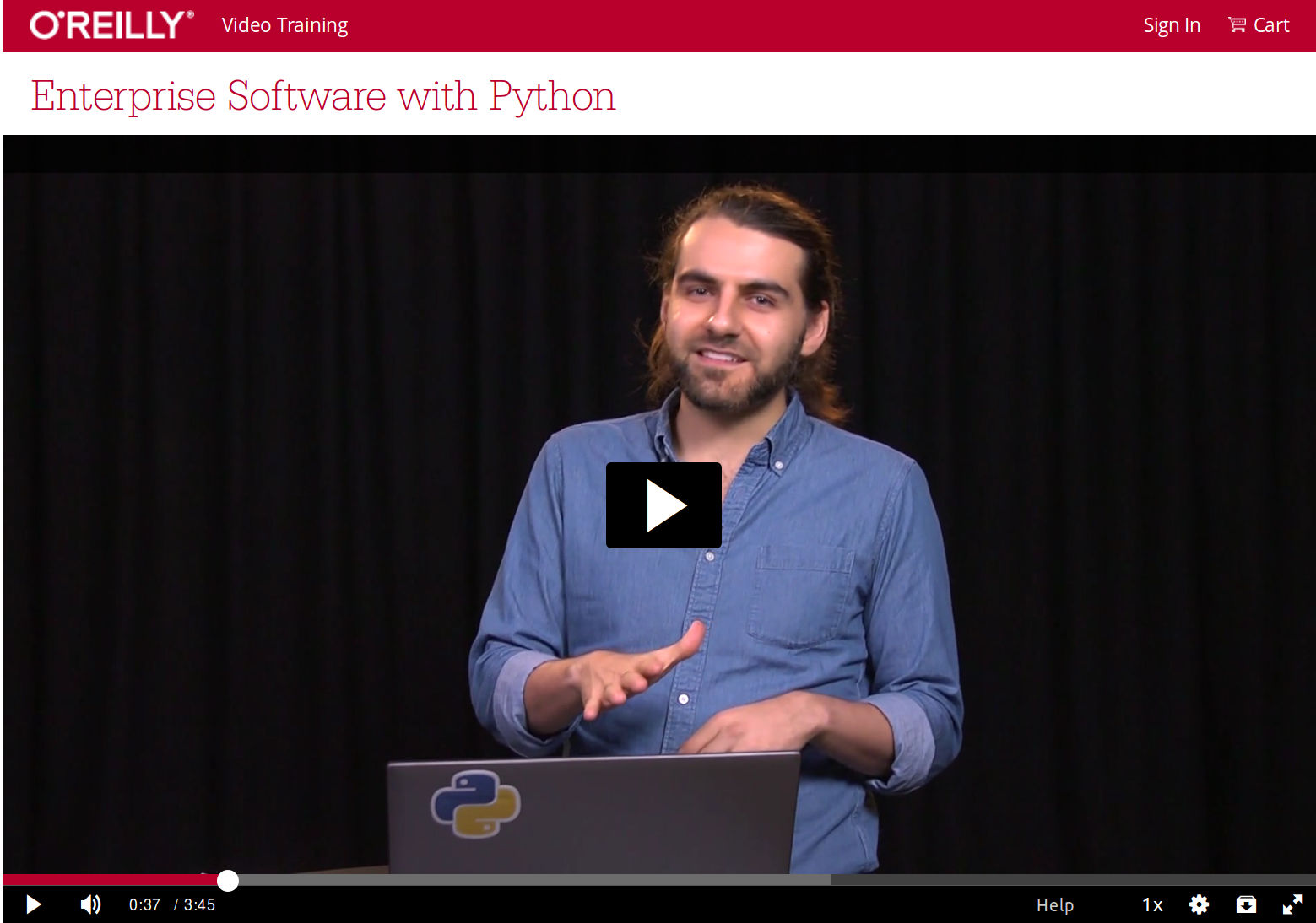
Actual footage from the intro. Not a prerelease render.
The first three parts are free, and will give you a good sense of the
format, tone, and content. I kept it pretty light and approachable,
complete with dozens of illustrations. Purchasers can stream the rest,
and download DRM-free copies whenever you want (my personal
favorite). If you have any questions or concerns, don't hesitate to
reach out to me, personally, or
O'Reilly Media.
I hope you'll take a look! It's already making waves at PayPal,
and chances are there's someone you know who could use it, too.
This link has a 50% off coupon code, applied at checkout. Check
if your organization has Safari, first. If not, use
this coupon-less link and expense it! :) Safari
users, try the SBO site. If you're not
sure if you have Safari access, contact your technology
education and training department. ↩
This target audience is me, but I know there are others out
there. Send me your tiring, huddled masses yearning to learn
Python. Seriously though, I can't fully quantify how much
time it saves me to send a new Python initiate to a video,
then have them come back with the foundations necessary to
have a productive conversation. ↩
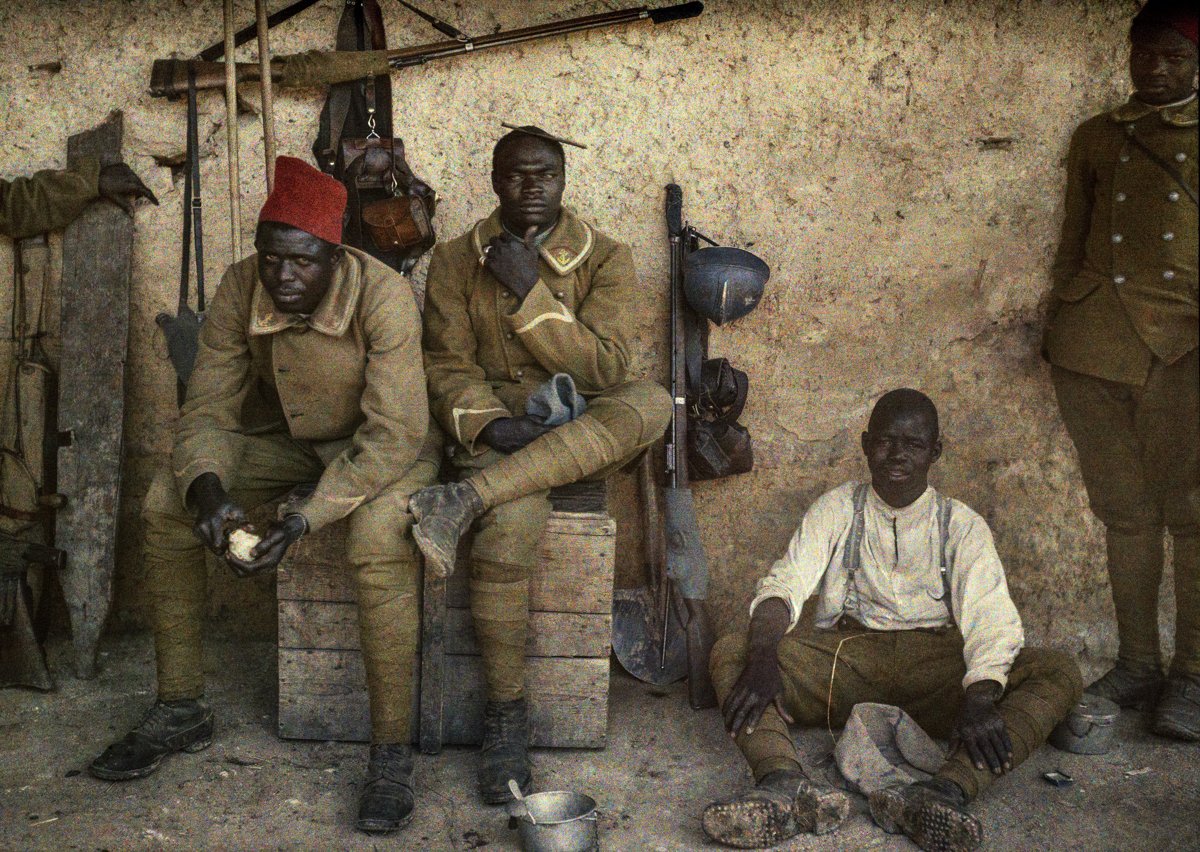
In his preface to The First World War: Unseen Glass Plate Photographs of the Western Front, Geoff Dyer writes: “The shock is not the shock of the new so much as the shock of the old made new—and the new made suddenly old.” The book, a curation by Carl De Keyzer and David Van Reybrouck, features high-resolution, expertly-restored photographs from the Western Front. Dyer’s dichotomy is at play in the image of four Senegalese soldiers below. Taken by Paul Castelnau, who himself served in the war, the image gives viewers a visceral sense of the subjects’ unique personalities—they are not generic soldiers from sepia-soaked history.
“Four Senegalese Soldiers” (not dated.)
(Paul Castelnau / Ministère de la Culture et de la Communication / The First World War)
fucking lemay man. i feel dumb for not knowing he was in charge of the north korean campaign.
From our overstocked archives Sam Smith, 2011 - Recent news that the last American veteran of World War I had died didn’t get a lot of attention because the war he fought in had long ago been forgotten by most Americans and is ignored by historians and the media. In my book, Why Bother, I wrote about it:
|||| How many school children are taught that, worldwide, wars in the past century killed over 100 million people? In World War I alone, the death toll was around ten million. Much of this, including the later Holocaust, was driven by a culture of modernity that so changed the power of institutions over the individual that the latter would become what Erich Fromm called homo mechanicus, “attracted to all that is mechanical and inclined against all that is alive.” Becoming, in fact, a part of the machinery — willing to kill or to die just to keep it running.
Thus, with Auschwitz-like efficiency, over 6,000 people perished every day during World War I for 1,500 days. Richard Rubenstein recounts that on the first day of the Battle of the Somme, the British lost 60,000 men and half of the officers assigned to them. But the internal bureaucratic logic of the war did not falter at all; over the next six months, more than a million British, French and German soldiers would lose their lives. The total British advance: six miles. ||||
To me this is more than a history lesson. Death at an early age hung like a shroud over my family. My mother’s brother had died while serving in World War I. Trained as a flying observer at Fort Sill, he was killed by a shell as he went to help with the liaison between the airplanes and the artillery. His first cousin was an aviator with the famed Lafayette Escadrille. He lost his life while on a scouting mission over German territory just a few months before his cousin died in France.
Another uncle, married to my mother’s sister, came back from the war, where he had helped move dead bodies from the front. He never smiled again. Suffering from what we would call post traumatic stress syndrome, he committed suicide ten years later.
And one of my father’s brothers was lost near Lisbon while serving in WWI as an officer aboard Admiral William Halsey’s first command.
All this in a war that one hears little about anymore, yet in an important way would shape the next century of violence. As I noted:
|||| No one in that war was a person anymore. The seeds of the Holocaust can thus be found in the trenches of World War I. Individuals had became no better than the bullets that killed them, just part of the expendable arsenal of the state. . . Some of the most important lessons of the Holocaust are simply missed. Among these, as Richard Rubenstein has pointed out, is that it could only have been carried out by “an advanced political community with a highly trained, tightly disciplined police and civil service bureaucracy.”
In The Cunning of History, Rubenstein also finds uncomfortable parallels between the Nazis and their opponents. For example, in 1944 a Hungarian Jewish emissary meets with Lord Moyne, the British High Commissioner in Egypt, and suggests that the Nazis might be willing to save one million Hungarian Jews in return for military supplies. Lord Moyne’s reply: “What shall I do with those million Jews? Where shall I put them?” Writes Rubenstein: “The British government was by no means adverse to the ‘final solution’ as long as the Germans did most of the work.”
For both countries, it had become a bureaucratic problem, one that Rubenstein suggests we understand “as the expression of some of the most profound tendencies of Western civilization in the 20th century.”
These tendencies were not alien to America. General Curtis LeMay ran the air war against both Japan and North Korea, became head of the sacrosanct Strategic Air Command, and was one of the military heroes of his time. Here are just a few of his accomplishments as reported by Richard Rhodes in the New Yorker:
– The destruction of nearly 17 square miles of Tokyo with the loss of at least 100,000 civilian lives. – The destruction of 62 other Japanese cities. Only Hiroshima and Nagasaki were spared — reserved for their own special horror. In sum, more than a million Japanese civilians were killed. LeMay himself would admit years later, “I suppose if I had lost the war, I would have been tried as a war criminal. Fortunately, we were on the winning side.” – The bombing of North Korean cities, dams, villages and rice paddies. Civilian deaths: more than two million.
In short, with the enthusiastic blessing of the American government, LeMay was directly responsible for the slaughter of about half as many civilians as died in the Holocaust. And LeMay had even grander schemes. His plan for defeating the Soviet Union included the obliteration of 70 Soviet cities in thirty days with thirty-three atomic bombs and the deaths of 2.7 million citizens. ||||
No time in history can match the century of mechanization of violence that began with World War I. Only when you add up all of China’s wars from the 8th to 19th century do you come up with anything comparable.
And like so many important things that made us what we are, we don’t even talk about it anymore. Except when you come from a family where so many uncles had died as part of the story.
At 8:15 on the morning of August 6, 1945, a person sat on a flight of stone stairs leading up to the entrance of the Sumitomo Bank in Hiroshima, Japan. Seconds later, an atomic bomb detonated just 800 feet away, and the person sitting on the stairs was instantly incinerated. Gone like that. But not without leaving a mark.
As the Google Cultural Institute explains it, “Receiving the rays directly, the victim must have died on the spot from massive burns. The surface of the surrounding stone steps was turned whitish by the intense heat rays. The place where the person was sitting became dark like a shadow.”
That shadow lasted for years, until eventually rain and wind began to erode it. When a new Sumitomo Bank was built, the steps were relocated to the Hiroshima Peace Memorial Museum, where they’re now preserved. You can see the “Human Shadow Etched in Stone” above.
Follow Open Culture on Facebook and Twitter and share intelligent media with your friends. Or better yet, sign up for our daily email and get a daily dose of Open Culture in your inbox. And if you want to make sure that our posts definitely appear in your Facebook newsfeed, just follow these simple steps.
Have you ever looked at your food—let’s say you’re eating a sandwich—and thought, “Whoa, what if the bread and the turkey and tomato were fucking right now, like having a threesome or whatever? Oh wait, the lettuce is there too. It’s a fucking like, uh, a fucking foursome. HAHAHA WAIT THERE ARE TWO SLICES OF FUCKING BREAD. IT’S A FUCKING FOOD ORGY OH MY GOD,” and laughed so hard you couldn’t finish your sandwich? If so, Sausage Party might be right up your alley.
An anonymous reader writes with an intriguing story at Quanta Magazine, which begins: Two mathematicians have uncovered a simple, previously unnoticed property of prime numbers — those numbers that are divisible only by 1 and themselves. Prime numbers, it seems, have decided preferences about the final digits of the primes that immediately follow them. Among the first billion prime numbers, for instance, a prime ending in 9 is almost 65 percent more likely to be followed by a prime ending in 1 than another prime ending in 9. In a paper posted online today, Kannan Soundararajan and Robert Lemke Oliver of Stanford University present both numerical and theoretical evidence that prime numbers repel other would-be primes that end in the same digit, and have varied predilections for being followed by primes ending in the other possible final digits. "We've been studying primes for a long time, and no one spotted this before," said Andrew Granville, a number theorist at the University of Montreal and University College London. "It's crazy."
Katherine Maher has been chosen as interim executive director of the Wikimedia Foundation. Photo by Sebastiaan ter Burg, freely licensed under CC BY-SA 2.0.
Katherine Maher, the chief communications officer of the Wikimedia Foundation, has been chosen as interim executive director of the San Francisco-based nonprofit by its board and executive team. She replaces Lila Tretikov, who announced her resignation from the chief executive post two weeks ago.
In announcing this move, the board chair Patricio Lorente wrote:
In choosing an interim ED, the [executive team] started by identifying immediate priorities for the coming months, including building trust, improving communications, and filling key leadership positions. They felt, and we agree, that Katherine is the right person to lead the organization while it addresses these and other important issues. Additionally, this will allow the rest of the executive team to focus on critical organizational functions, including community and engineering management, fundraising, and strengthening our human resources function.
…
With interim leadership in place, our next step as the Board is to move quickly to plan and implement the search for a permanent Executive Director. We will be working together over the coming weeks to clarify roles and responsibilities in this search, and identify the best way for community and staff to participate. We want this process to be inclusive and incorporate many voices.
We will share more information on this change in a Wikimedia blog post next week.
Juliet Barbara, Senior Manager of Communications Wikimedia Foundation









 And we should own up to it. The post BART's Righteous Tweetstorm Reminds Us Its Problems Are Our Fault appeared first on WIRED.