Shared posts

04 Dec 19:51

Prime Video pulls eerily emotionless AI-generated anime dubs after complaints

by Scharon Harding

Amazon Prime Video has scaled back an experiment that created laughable anime dubs with generative AI.

In March, Amazon announced that its streaming service would start including “AI-aided dubbing on licensed movies and series that would not have been dubbed otherwise.” In late November, some AI-generated English and Spanish dubs of anime popped up, including dubs for the Banana Fish series and the movie No Game No Life: Zero. The dubs appear to be part of a beta launch, and users have been able to select “English (AI beta)” or “Spanish (AI beta)” as an audio language option in supported titles.

“Absolutely disrespectful”

Not everyone likes dubbed content. Some people insist on watching movies and shows in their original language to experience the media more authentically, with the passion and talent of the original actors. But you don’t need to be against dubs to see what’s wrong with the ones Prime Video tested.

Read full article

Comments

04 Dec 19:51

Rare win for renewable energy: Trump admin funds geothermal network expansion

by Phil McKenna, Inside Climate News

The US Department of Energy has approved an $8.6 million grant that will allow the nation’s first utility-led geothermal heating and cooling network to double in size.

Gas and electric utility Eversource Energy completed the first phase of its geothermal network in Framingham, Massachusetts, in 2024. Eversource is a co-recipient of the award along with the city of Framingham and HEET, a Boston-based nonprofit that focuses on geothermal energy and is the lead recipient of the funding.

Geothermal networks are widely considered among the most energy-efficient ways to heat and cool buildings. The federal money will allow Eversource to add approximately 140 new customers to the Framingham network and fund research to monitor the system’s performance.

Read full article

Comments

04 Dec 00:12

Understand Me

by Reza
03 Dec 17:50

DOGE Isn’t Dead. Here’s What Its Operatives Are Doing Now

by Makena Kelly, Vittoria Elliott
Contrary to popular reports, DOGE has “burrowed into the agencies like ticks,” government sources tell WIRED.
03 Dec 17:50

A Fentanyl Vaccine Is About to Get Its First Major Test

by Emily Mullin
ARMR Sciences of New York is trialing a vaccine in the Netherlands to protect against fentanyl-related overdose and death.
03 Dec 17:49

The Trump Administration Wants Immigrants to Self-Deport. It’s a Shit Show

by Vittoria Elliott
The Trump administration has been virtually begging immigrants in the US to self-deport, even offering money. But some immigrants say it’s been nearly impossible.
03 Dec 17:49

Supreme Court hears case that could trigger big crackdown on Internet piracy

by Jon Brodkin

Supreme Court justices expressed numerous concerns today in a case that could determine whether Internet service providers must terminate the accounts of broadband users accused of copyright infringement. Oral arguments were held in the case between cable Internet provider Cox Communications and record labels led by Sony.

Some justices were skeptical of arguments that ISPs should have no legal obligation under the Digital Millennium Copyright Act (DMCA) to terminate an account when a user’s IP address has been repeatedly flagged for downloading pirated music. But justices also seemed hesitant to rule in favor of record labels, with some of the debate focusing on how ISPs should handle large accounts like universities where there could be tens of thousands of users.

Justice Sonia Sotomayor chided Cox for not doing more to fight infringement.

Read full article

Comments

03 Dec 17:49

Meet CDC’s new lead vaccine advisor who thinks shots cause heart disease

by Beth Mole

When the federal vaccine committee hand-picked by anti-vaccine Health Secretary Robert F. Kennedy Jr. meets again this week, it will have yet another new chairperson to lead its ongoing work of dismantling the evidence-based vaccine recommendations set by the Centers for Disease Control and Prevention.

On Monday, the Department of Health and Human Services announced that the chairperson who has been in place since June—when Kennedy fired all 17 expert advisors on the committee and replaced them with questionably qualified allies—is moving to a senior role in the department. Biostatistician Martin Kulldorff will now be the chief science officer for the Office of the Assistant Secretary for Planning and Evaluation (ASPE), HHS said. As such, he’s stepping down from the vaccine committee, the Advisory Committee on Immunization Practices (ACIP).

Kulldorff gained prominence amid the COVID-19 pandemic, criticizing public health responses to the crisis, particularly lockdowns and COVID-19 vaccines. He was a co-author of the Great Barrington Declaration that advocated for letting the deadly virus spread unchecked through the population, which was called unethical by health experts.

Read full article

Comments

03 Dec 17:48

Trump Helps Ellison Fight Off Netflix In Bid For Warner Brothers By Pretending To Care About ‘Antitrust Reform’

by Karl Bode

Last election season you might recall that the Trump administration lied repeatedly and pretended to be really interested in reining in corporate power and shoring up antitrust reform. And while this line was propped up by a lot of useful idiots (like Matt Stoller) who insisted there was common cause to be made with fascists, the whole thing was bullshit, designed to cover up widespread corruption and generational damage to regulatory independence and U.S. corporate oversight.

Despite having followed up on none of their antitrust reform promises, Trumpland is back again pretending it’s an important policy arena for them. This time by leveraging a fake interest in antitrust reform to start seeding the idea that Netflix shouldn’t be allowed to buy Warner Brothers. Who, coincidentally, is fielding a rival bid from Trump’s billionaire right wing friend, Larry Ellison.

“Somebody” leaked word to Republican ally Charles Gasparino at the New York Post, who dutifully presents the idea that the Trump administration actually cares about corporate consolidation as if it’s a serious thing:

“Senior White House officials recently discussed antitrust concerns surrounding Netflix’s interest in acquiring the Warner Bros. studio and the HBO Max streaming service – raising doubts whether such a deal would give Netflix too much power over Hollywood, The Post has learned.

The high-level meeting that took place about 10 days ago hasn’t been previously reported. Several White House officials also suggested during the sitdown that a broader investigation is necessary focusing on Netflix’s market power, a government official who attended the confab said.”

It’s not clear if the administration, Comcast, or Paramount insiders leaked word to Chuck, but it should be reiterated that the Trump administration obviously does not actually care about unchecked “market power.” With one hand, this administration has taken a hatchet to all meaningful regulatory oversight of corporate power, setting back labor rights, consumer protection, and public safety generationally, while with its other hand, it is dismantling what remains of U.S. media consolidation limits.

Most media coverage of these rival bids won’t have the backbone to make it clear that while Netflix ownership of Warner Brothers would most certainly probably be bad for the market, the Trump administration doesn’t actually care about that. It cares about helping billionaire allies and punishing “woke” companies that platform too many minorities and gay people for their liking.

Netflix ownership of HBO likely wouldn’t be good for the brand, but it’s not like Warner Brothers Discovery or AT&T were good for the brand (or market health) either. David Zaslav has been notorious for mismanaging the home of CNN and HBO. And Netflix, as the New York Times noted last September, is possibly the least overtly compromised of the three companies when it comes to kissing MAGA ass (which isn’t saying much, and certainly isn’t guaranteed to last).

In this case, the options here are all bad. The other bidders for Warner Brothers, HBO, and CNN include Comcast (NBC Universal) and Larry Ellison (CBS). Neither would be good stewards of the HBO brand, clearly don’t give much of a shit about healthy market competition, and have shown they’re more than willing to throw any remaining principles in the trash to curry favor with the administration.

The best and correct play for a government that actually cared about antitrust reform, consumer protection, and healthy markets would be no additional consolidation at all. But good faith media reform is not, and has never been, what the Trump administration is after.

03 Dec 17:48

Mapping the most dangerous intersections for pedestrians

by Nathan Yau

For the Washington Post, Ian Duncan, Emmanuel Martinez, and Dylan Moriarty analyzed traffic fatality data from the National Highway Traffic Safety Administration:

The Post analysis documents, for the first time, a sharp increase in places with clusters of pedestrian deaths, revealing the deadliest neighborhoods and stretches of road in hundreds of cities. The number of locations with at least three recent pedestrian deaths clustered within a mile of one another tripled during this period, from more than 275 in 2010 to more than 825 in 2023, The Post found. Those hot spots increased most in states in the southern half of the country such as Tennessee, North Carolina and Arizona.

A searchable map lets you see incident counts in places of interest, which is unsettling when you see dots and hexagons not far from where you live.

Tags: fatal crashes, traffic, Washington Post

03 Dec 17:46

Towards zero traffic fatalities

by Nathan Yau

Speaking of traffic fatalities, Helsinki is doing things differently. Amanda Shendruk for Not-Ship has the charts:

This past summer, Helsinki made an astonishing announcement: as of August, the Finnish capital went an entire year without any traffic deaths. Not a single pedestrian, cyclist or driver died on the city’s roads. Not. One.

And this wasn’t an outlier year. Helsinki’s traffic deaths have been steadily declining for decades.

Lower speed limits and income-based speeding fines helped the city get to this point. Maybe others should give this a try.

Sidenote: Not-Ship is a new data-focused newsletter from Shendruk that is worth a sub.

Tags: Amanda Shendruk, Not-Ship, traffic

03 Dec 17:40

Once Again, The Trump Administration Is Caught Lying About Deportation Options For Kilmar Abrego Garcia

by Tim Cushing

The Trump administration just lies and lies and lies. Those in charge assume they can just bluster their way past the system of checks and balances. For everything else, there’s AI generated memes depicting Trump taking a shit on the people he serves. Win-win, I guess.

But things haven’t exactly been running smoothly for Trump’s mass deportation program — one that seems to run entirely on his cabinet’s hatred for anyone who may not be entirely on board the MAGA bus. That has resulted in an unprecedented number of talented government employees resigning or being fired. And there aren’t enough Trump loyalists around to offset this attrition rate.

The same thing goes for Trump’s amped-up, fueled-by-hate mass deportation program. Trump advisor Stephen Miller wants 3,000 arrests per day. Former Trump lawyer/current appellate judge Emil Bove told DOJ lawyers to say “fuck you” to federal courts seeking to limit the administration’s refusal to respect a rather large number of constitutional rights during its “immigration enforcement efforts.” Bove also was apparently behind the administration’s “murder people in boats” program.

As the combined forces of federal officers still somehow fail to rack up the number of daily arrests that would make Stephen Miller erect, the DOJ continues to deal with a single arrest that has been irritating it ever since immigration officers first performed it.

That would be the arrest of Kilmar Abrego Garcia — someone who has refused to back down despite the government tossing him into El Salvador’s dictator-run maximum security hell hole (CECOT) and being brought back to the United States (following a judge’s orders) just to be given the unappetizing “choice” of pleading guilty to highly imaginative criminal charges dreamed up by Trump’s vindictive DOJ or being dumped into the nearest hell hole or hell hole-adjacent country (to date: Liberia, Uganda, Ghana, and Eswatini).

The DOJ continues to claim it has to dump Garcia in a country where his chances of survival are incredibly slim because no country less war-torn or with an El Salvadoran-esque history of rampant human rights violation is willing to allow an alleged criminal like Garcia to call their country home.

But this has never been true. The government of Costa Rica — a destination far more preferable than those the US government claims are the only places willing to take custody of Garcia — has repeatedly made it clear that it is a willing host for someone the government continues to pretend is a dangerous person with ties to violent criminals.

The government won’t listen to this because it would rather send Garcia where it wants than grant any accommodations to someone who has constantly fought back against the administration’s bullying.

Once again, the federal court system is being given a chance to right this wrong. Here’s reporting from ABC News that reflects the facts laid out in Garcia’s latest filing challenging the government’s vindictive prosecution.

A top Costa Rican official said the country is still willing to accept Kilmar Abrego Garcia, contradicting statements made by U.S. government officials in court earlier this week.

“Costa Rica’s offer to receive Mr. Abrego Garcia for humanitarian reasons remains in place,” Mario Zamora, Costa Rica’s minister of security, told ABC News in a statement. “My letter dated August 25, 2025, is the official position of the government.”

Garcia’s motion [PDF] says the same thing, although it quotes [PDF] (in its entirety) slightly earlier reporting by the Washington Post. That reporting names the Costa Rican official offering an official welcome to Kilmar Abrego Garcia:

Security Minister Mario Zamora Cordero told The Washington Post that he had informed the U.S. Embassy in San José in August that the government would accept Abrego on humanitarian grounds and provide him legal residency. He reiterated that Costa Rica has the “highest human rights standards” and would receive Abrego “under humanitarian conditions that guarantee the full respect for his rights and liberties.”

“That position that we have expressed in the past remains valid and unchanged to this day,” Zamora Cordero said in a statement, responding to questions from The Post.

So, you can see how that won’t work from the Trump administration and the ghouls it employees. This government has promised to give Garcia “full respect for his rights and liberties.” The United States — under Donald Trump — certainly can’t be expected to do the same.

And it can’t even be bothered to explain why it won’t allow Costa Rica to become Garcia’s new home. Back to the ABC reporting:

“Mr. Cantu, when you say Costa Rica is not an option for removal … where does that come from?” U.S. District Judge Paula Xinis interjected.

“Counsel,” [ICE Field Office Director John] Cantu said, referring to a State Department attorney. 

During the hearing, Cantu also struggled to answer questions about a sworn declaration he signed regarding the government’s communications with Costa Rica.

“Sitting here today, you could not tell me whether anyone from the State Department has been in touch with Costa Rica since Aug. 21, to determine whether communications have changed?” asked Sascha Rand, an attorney for Abrego Garcia. 

“That’s right,” Cantu replied. 

In other words, ICE (and the DOJ) aren’t interested in talking to anyone who might give Garcia an option that’s less cruel and vindictive than the Trump administration desires. And if it has to take the phone off the hook to accomplish this, it will — even if that means administration officials (and any remaining DOJ prosecutors) will have their whole asses exposed repeatedly by judges and opposing counsel.

This administration is incapable of being both smart and cruel. Perhaps we should be thankful for this small grace, no matter how inadequate it often seems.

03 Dec 15:59

Lawmakers Want To Ban VPNs—And They Have No Idea What They’re Doing

by Rindala Alajaji

Remember when you thought age verification laws couldn’t get any worse? Well, lawmakers in WisconsinMichigan, and beyond are about to blow you away.

It’s unfortunately no longer enough to force websites to check your government-issued ID before you can access certain content, because politicians have now discovered that people are using Virtual Private Networks (VPNs) to protect their privacy and bypass these invasive laws. Their solution? Entirely ban the use of VPNs. 

Yes, really.

As of this writing, Wisconsin lawmakers are escalating their war on privacy by targeting VPNs in the name of “protecting children” in A.B. 105/S.B. 130. It’s an age verification bill that requires all websites distributing material that could conceivably be deemed “sexual content” to both implement an age verification system and also to block the access of users connected via VPN. The bill seeks to broadly expand the definition of materials that are “harmful to minors” beyond the type of speech that states can prohibit minors from accessing—potentially encompassing things like depictions and discussions of human anatomy, sexuality, and reproduction. 

This follows a notable pattern: As we’ve explained previously, lawmakers, prosecutors, and activists in conservative states have worked for years to aggressively expand the definition of “harmful to minors” to censor a broad swath of content: diverse educational materialssex education resources, art, and even award-winning literature

Wisconsin’s bill has already passed the State Assembly and is now moving through the Senate. If it becomes law, Wisconsin could become the first state where using a VPN to access certain content is banned. Michigan lawmakers have proposed similar legislation that did not move through its legislature, but among other things, would force internet providers to actively monitor and block VPN connections. And in the UK, officials are calling VPNs “a loophole that needs closing.”

This is actually happening. And it’s going to be a disaster for everyone.

Here’s Why This Is A Terrible Idea 

VPNs mask your real location by routing your internet traffic through a server somewhere else. When you visit a website through a VPN, that website only sees the VPN server’s IP address, not your actual location. It’s like sending a letter through a P.O. box so the recipient doesn’t know where you really live. 

So when Wisconsin demands that websites “block VPN users from Wisconsin,” they’re asking for something that’s technically impossible. Websites have no way to tell if a VPN connection is coming from Milwaukee, Michigan, or Mumbai. The technology just doesn’t work that way.

Websites subject to this proposed law are left with this choice: either cease operation in Wisconsin, or block all VPN users, everywhere, just to avoid legal liability in the state. One state’s terrible law is attempting to break VPN access for the entire internet, and the unintended consequences of this provision could far outweigh any theoretical benefit.

Almost Everyone Uses VPNs

Let’s talk about who lawmakers are hurting with these bills, because it sure isn’t just people trying to watch porn without handing over their driver’s license.

  1. Businesses run on VPNs. Every company with remote employees uses VPNs. Every business traveler connecting through sketchy hotel Wi-Fi needs one. Companies use VPNs to protect client and employee data, secure internal communications, and prevent cyberattacks. 
  2. Students need VPNs for school. Universities require students to use VPNs to access research databases, course materials, and library resources. These aren’t optional, and many professors literally assign work that can only be accessed through the school VPN. The University of Wisconsin-Madison’s WiscVPN, for example, “allows UW–‍Madison faculty, staff and students to access University resources even when they are using a commercial Internet Service Provider (ISP).” 
  3. Vulnerable people rely on VPNs for safety. Domestic abuse survivors use VPNs to hide their location from their abusers. Journalists use them to protect their sources. Activists use them to organize without government surveillance. LGBTQ+ people in hostile environments—both in the US and around the world—use them to access health resources, support groups, and community. For people living under censorship regimes, VPNs are often their only connection to vital resources and information their governments have banned. 
  4. Regular people just want privacy. Maybe you don’t want every website you visit tracking your location and selling that data to advertisers. Maybe you don’t want your internet service provider (ISP) building a complete profile of your browsing history. Maybe you just think it’s creepy that corporations know everywhere you go online. VPNs can protect everyday users from everyday tracking and surveillance.

It’s A Privacy Nightmare

Here’s what happens if VPNs get blocked: everyone has to verify their age by submitting government IDs, biometric data, or credit card information directly to websites—without any encryption or privacy protection.

We already know how this story ends. Companies get hacked. Data gets breached. And suddenly your real name is attached to the websites you visited, stored in some poorly-secured database waiting for the inevitable leak. This has already happened, and is not a matter of if but when. And when it does, the repercussions will be huge.

Forcing people to give up their privacy to access legal content is the exact opposite of good policy. It’s surveillance dressed up as safety.

“Harmful to Minors” Is Not a Catch-All 

Here’s another fun feature of these laws: they’re trying to broaden the definition of “harmful to minors” to sweep in a host of speech that is protected for both young people and adults.

Historically, states can prohibit people under 18 years old from accessing sexual materials that an adult can access under the First Amendment. But the definition of what constitutes “harmful to minors” is narrow — it generally requires that the materials have almost no social value to minors and that they, taken as a whole, appeal to a minors’ “prurient sexual interests.” 

Wisconsin’s bill defines “harmful to minors” much more broadly. It applies to materials that merely describe sex or feature descriptions/depictions of human anatomy. This definition would likely encompass a wide range of literature, music, television, and films that are protected under the First Amendment for both adults and young people, not to mention basic scientific and medical content.

Additionally, the bill’s definition would apply to any websites where more than one third of the site’s material is “harmful to minors.” Given the breadth of the definition and its one-third trigger, we anticipate that Wisconsin could argue that the law applies to most social media websites. And it’s not hard to imagine, as these topics become politicised, Wisconsin claiming it applies to websites containing LGBTQ+ health resources, basic sexual education resources, and reproductive healthcare information. 

This breadth of the bill’s definition isn’t a bug, it’s a feature. It gives the state a vast amount of discretion to decide which speech is “harmful” to young people, and the power to decide what’s “appropriate” and what isn’t. History shows us those decisions most often harm marginalized communities

It Won’t Even Work

Let’s say Wisconsin somehow manages to pass this law. Here’s what will actually happen:

People who want to bypass it will use non-commercial VPNs, open proxies, or cheap virtual private servers that the law doesn’t cover. They’ll find workarounds within hours. The internet always routes around censorship. 

Even in a fantasy world where every website successfully blocked all commercial VPNs, people would just make their own. You can route traffic through cloud services like AWS or DigitalOcean, tunnel through someone else’s home internet connection, use open proxies, or spin up a cheap server for less than a dollar. 

Meanwhile, everyone else (businesses, students, journalists, abuse survivors, regular people who just want privacy) will have their VPN access impacted. The law will accomplish nothing except making the internet less safe and less private for users.

Nonetheless, as we’ve mentioned previously, while VPNs may be able to disguise the source of your internet activity, they are not foolproof—nor should they be necessary to access legally protected speech. Like the larger age verification legislation they are a part of, VPN-blocking provisions simply don’t work. They harm millions of people and they set a terrifying precedent for government control of the internet. More fundamentally, legislators need to recognize that age verification laws themselves are the problem. They don’t work, they violate privacy, they’re trivially easy to circumvent, and they create far more harm than they prevent.

A False Dilemma

People have (predictably) turned to VPNs to protect their privacy as they watched age verification mandates proliferate around the world. Instead of taking this as a sign that maybe mass surveillance isn’t popular, lawmakers have decided the real problem is that these privacy tools exist at all and are trying to ban the tools that let people maintain their privacy. 

Let’s be clear: lawmakers need to abandon this entire approach.

The answer to “how do we keep kids safe online” isn’t “destroy everyone’s privacy.” It’s not “force people to hand over their IDs to access legal content.” And it’s certainly not “ban access to the tools that protect journalists, activists, and abuse survivors.”

If lawmakers genuinely care about young people’s well-being, they should invest in education, support parents with better tools, and address the actual root causes of harm online. What they shouldn’t do is wage war on privacy itself. Attacks on VPNs are attacks on digital privacy and digital freedom. And this battle is being fought by people who clearly have no idea how any of this technology actually works. 

If you live in Wisconsin—reach out to your Senator and urge them to kill A.B. 105/S.B. 130. Our privacy matters. VPNs matter. And politicians who can’t tell the difference between a security tool and a “loophole” shouldn’t be writing laws about the internet.

Republished from the EFF’s Deeplinks blog.

03 Dec 15:58

Trump Follows Up Murdering Dozens In ‘Drug’ Boat Strikes By Pardoning Ex-President Involved In Drug Trafficking

by Tim Cushing

For weeks, we’ve been told the threat posed by the trafficking of illegal drugs is indistinguishable from an outright declaration of war on the United States by foreign drug cartels. Trump and his toadies insist traffickers are bringing drugs across the border to “kill” Americans, which would be an entirely self-defeating business plan no self-respecting cartel would ever engage in. Obviously, he’s lying, as are those who speak for him.

But those lies are being used to buttress something even more awful than our usual War on Drugs: the extrajudicial murders of people only suspected to be moving drugs from Venezuela to… well, anywhere else but Venezuela. There are plenty of people between the United States and Venezuela who might be interested in purchasing/trafficking drugs. To insist that these drugs (if they exist at all) are headed to the US border with the intent of “killing” cartels’ customer bases is a lie so stupid it shouldn’t be given the dignity of a one-sentence debunking.

Trump is playing hardball in international waters, straight up murdering people simply because their boats have departed from Venezuelan shores. And while he keeps constructing his “Savior of America” facade, he’s so self-interested he can’t stop himself from undercutting his own narratives.

The man is a blend of involuntary muscle movements and brain stem-level thinking. “DRUGS ARE KILLING US” he screams into the bullhorn he owns (TruthSocial). Meanwhile, back at the Oval Office, he’s letting the drug dealers he personally likes off the hook.

President Trump announced on Friday afternoon that he would grant “a Full and Complete Pardon” to a former president of Honduras, Juan Orlando Hernández, who, as the center of a sweeping drug case, was found guilty by an American jury last year of conspiring to import cocaine into the United States.

The news came as a shock not only to Hondurans, but also to the authorities in the United States who had built a major case and won a conviction against Mr. Hernández. They had accused him of taking bribes during his campaign from Joaquín Guzmán, the notorious former leader of the Sinaloa cartel in Mexico known as “El Chapo,” and of running his Central American country like a narco state.

As several current and former government officials noted in that preliminary reporting, Trump’s actions were not only harmful to foreign relations and ongoing anti-drug trafficking efforts, but also made a mockery of Trump’s other statements about going hard on drugs.

A day later, nothing had changed but the status of Juan Orlando Hernandez’s pardon, which was now a fact, rather than a threat. And, of course, it was Classic Trump™, all the way down to the New York Times’ coverage of it.

Mr. Trump signaled on Saturday that he was ratcheting up his campaign against drug cartels, saying in a social media post that airspace above and surrounding Venezuela should be considered “CLOSED IN ITS ENTIRETY.”

Less than 24 hours earlier, Mr. Trump had announced on social media that he was granting a full pardon to Juan Orlando Hernández, a former president of Honduras who had been convicted in the United States of drug trafficking charges in what was seen as a major victory for authorities in a case against a former head of state. That pardon has not yet been officially granted.

The two posts displayed a remarkable dissonance in the president’s strategy, as he moved to escalate a military campaign against drug trafficking while ordering the release of a man prosecutors said had taken “cocaine-fueled bribes” from cartels and “protected their drugs with the full power and strength of the state — military, police and justice system.” In fact, prosecutors said that Mr. Hernández, for years, allowed bricks of cocaine from Venezuela to flow through Honduras en route to the United States.

Oh NYT, that’s not “remarkable dissonance.” And it certainly isn’t the “display” of “contradictions” claimed in the headline.

The word the NYT is looking for (in both cases) is “hypocrisy.” These are hypocritical acts performed by a president who resolutely does not care that he’s the embodiment of hypocrisy. There’s no “contradiction” or “dissonance.” This is how Trump operates. His “shut down the borders” yelling obviously clashes horribly with his decision to pardon a foreign drug trafficker, but everything about it is entirely consistent with all known Trump actions/statements to date. It may look like dissonance to someone who just emerged from a 12-year coma today, but it looks exactly like Trump business as usual to everyone else.

This doesn’t mean this hypocrisy should be ignored. It absolutely shouldn’t. It just means we shouldn’t use nicer words that suggest an error of judgment might have taken place, because that just gives a deliberately hypocritical act (one of several!) by Trump a veneer of plausible deniability it certainly goddamn doesn’t deserve.

Trump will continue to engage in baseless fraud prosecutions of political opponents while simultaneously pardoning the fraudsters he likes. He’ll demand the FBI investigate Democratic representatives for sedition while pardoning hundreds of MAGA true believers who engaged in a literal insurrection attempt back in January 2021. Pardoning a politician with ties to drug cartels while murdering Venezuelans in international waters is so on brand it may as well be backed by Trump trademark applications. This is just Trump being Trump. To suggest it’s merely “dissonant” is to miss the point entirely.

01 Dec 18:11

The US Military Wants to Fix Its Own Equipment. Defense Contractors Are Trying to Shoot That Down

by Boone Ashworth
A push by military contractors could alter pending legislation that would have empowered servicemembers to repair equipment. Lobbyists are pitching a subscription service instead.
01 Dec 17:00

Growing political contributions from billionaires

by Nathan Yau

The Washington Post examined political contributions from the 100 wealthiest Americans, which have shown big swings the past few years.

What changed? Republicans long characterized Silicon Valley as a bastion of liberalism. But over the past half-decade, many of tech’s wealthiest titans rebelled against the Biden administration’s criticism and policing of their industry. Last year, many tech barons threw their support behind the GOP, which they saw as more aligned with their often-libertarian ideals and their companies’ economic interests. Trump and his party actively wooed influential tech leaders, embracing cryptocurrency and promising to limit AI regulation. His vice president, JD Vance, formerly worked as a venture capitalist in San Francisco, forging ties to Thiel, former Google CEO Eric Schmidt and venture capitalist Marc Andreessen.

It’s all about the money, as usual.

Tags: billionaires, contributions, elections, politics, Washington Post

26 Nov 00:02

Larry Ellison Met With Trump To Discuss Which CNN Reporters They Plan To Fire

by Karl Bode

Trump’s right wing billionaire friend Larry Ellison (and his nepobaby son, David) recently acquired CBS and likely co-ownership of TikTok. Like Elon Musk’s acquisition of Twitter, the goal isn’t really subtle: rich, thin-skinned right wingers want to own the entirety of U.S. new and old media, then convert it into a giant propaganda and lazy infotainment bullhorn that blows smoke up their asses.

The Ellisons have since set their sights on Warner Brothers, CNN, and HBO. It won’t be cheap; it’s estimated that Larry and company will have to pay upwards of $60 billion for the acquisition. The Trump administration has openly signaled that they’d very much like the Ellisons to succeed here, in part to force a dying cable news channel (CNN) to be even friendlier to Trump than it already is.

While Ellison has some competing suitors with names like Comcast NBC Universal and Netflix, the winning bidder will need approval from the Trump DOJ and FCC. Knowing that they likely have a distinct tactical advantage via corruption, Ellison and Trump appear to be already measuring the drapes, discussing programming changes (and CNN hirings and firings) that will please the president:

“Ellison often speaks to connections at the White House and in at least one phone call engaged in a dialogue about possibly axing some of the CNN hosts whom Donald Trump is said to loathe, including Erin Burnett and Brianna Keilar, the people said.”

You might recall that during the first Trump administration, Trump tried very hard to offload Time Warner (and CNN) to Rupert Murdoch, who worked behind the scenes to scuttle the AT&T Time Warner deal. Trump has repeatedly filed unsuccessful lawsuits against CNN trying to silence critical voices at the network. With those gambits having failed, buying and destroying CNN from the inside is the next step.

The great irony is these networks that offend Trump weren’t exactly what you’d call bastions of hard-nosed journalism to begin with. Under the ownership of Trump fan David Zaslav, CNN is already know for flinging softball questions at Trump authoritarians, failing to challenge obvious lies on air, and generally airing a sort of safe, infotainment-centered pseudo-journalism.

But even that’s too much critical thinking for America’s thinnest skinned billionaires.

Ellison is already hard at work turning whatever was left of CNN into a right wing propaganda mill. If he acquires ownership of TikTok and CNN as well; the potential exists to create a propaganda empire that’s arguably larger and much worse than Fox News.

But given the recent failures of efforts to dominate U.S. media through consolidation (again, see AT&T) it’s also equally likely that this weird assortment of trolls and nepobabies simply creates a mountain of unsustainable debt and hubris crushed by the weight of its own incompetent ambition.

26 Nov 00:01

Landlords’ go-to tool to set rent prices to be gutted under RealPage settlement

by Ashley Belanger

RealPage has agreed to settle an antitrust lawsuit raised by the Department of Justice, alleging that landlords used its tools to coordinate efforts to artificially raise rental prices across the US.

In a press release, the DOJ promised the proposed settlement “would help restore free market competition in rental markets for millions of American renters.”

For years since the pandemic started, rental prices outpaced inflation, and the DOJ suspected that RealPage was the dominant force driving a market that never favored renters. Recent Bureau of Labor Statistics data covering a 12-month period ending this September showed rents are still rising by 3.5 percent amid an affordability crisis, leaving some US renters in fear of housing instability.

Read full article

Comments

25 Nov 23:35

There may not be a safe off-ramp for some taking GLP-1 drugs, study suggests

by Beth Mole

The popularity of GLP-1 weight-loss medications continues to soar—and their uptake is helping to push down obesity rates on a national scale—but a safe, evidence-based way off the drugs isn’t yet in clear view.

An analysis published this week in JAMA Internal Medicine found that most participants in a clinical trial who were assigned to stop taking tirzepatide (Zepbound from Eli Lilly) not only regained significant amounts of the weight they had lost on the drug, but they also saw their cardiovascular and metabolic improvements slip away. Their blood pressure went back up, as did their cholesterol, hemoglobin A1c (used to assess glucose control levels), and fasting insulin.

In an accompanying editorial, two medical experts at the University of Pittsburgh, Elizabeth Oczypok and Timothy Anderson, suggest that this new class of drugs should be rebranded from “weight loss” drugs to “weight management” drugs, which people may need to take indefinitely.

Read full article

Comments

25 Nov 22:56

Plex’s crackdown on free remote streaming access starts this week

by Scharon Harding

Plex is starting to enforce its new rules, which prevent users from remotely accessing a personal media server without a subscription fee.

Previously, people outside of a server owner’s network could access the owner’s media library through Plex for free. Under the new rules announced in March, a server owner needs to have a Plex Pass subscription, which starts at $7 per month, to grant users remote access to their server. Alternatively, someone can remotely access another person’s Plex server by buying their own Plex Pass or a Remote Watch Pass, which is a subscription with fewer features than a Plex Pass and that Plex started selling in April for a $2/month starting price.

Plex’s new rules took effect on April 29. According to a recent Plex forums post by a Plex employee that How-To Geek spotted today, the changes are rolling out this week, with a subscription being required for people using Plex’s Roku OS app for remote access. The Plex employee added:

Read full article

Comments

24 Nov 19:14

My 7 year old was asked what he's thankful for in the classroom

Please check out the amazing artwork by Miguel at www.mafe.foundation. His artwork has inspired a new foundation that seeks to connect families with artists and creative teachers to create hands-on, screen free experiences that nurture connection and creativity.

The other night, my son was playing at his desk before bed. When I went to see what he was up to, he was writing in a workbook he never finished from grade 1 (he’s currently in grade 2). The workbook was meant to make him think about what he’s grateful for. The page he was working on said, “What are you grateful for in your classroom and why?”

His answer?

I’ll be honest, I had to try really hard not to verbalize my immediate thoughts, which were along the lines of, “Come on, dude! You have so many other things to be grateful for at school!” and, “Here I am trying to educate everyone about the impacts of technology, and of course my son loves it!”

But then I caught myself… Duh Alison, of course he loves it!

Typically when kids are using Chromebooks in grade 2, they’re using gamified learning apps… and sometimes, according to my son, they’re already getting off-task by finding random YouTube videos. And these things are fun for their little brains.

But it got me thinking… What is technology in the classroom really doing for learning? For focus? For social skills? Is it helpful, harmful, or somewhere in between?

I’d like to make a disclaimer at this point, because I completely understand the constraints on classrooms right now- budget cuts, limited access to photocopying, not enough teachers. I want to focus here on the technology, and the push to use it from the top-down, not the actual implementation within the classroom. I want to focus on how technology in the classroom is shaping how our children are learning.

So first of all — does my son love Chromebooks because they help him learn?

I know quite clearly that he doesn’t. He loves them because he gets to click around, chase stars, and “level up” in gamified “educational” apps that deliver dopamine hits at every tap.

And that’s not always bad. At home, he watches TV shows and occasionally plays video games with his dad — both fun, engaging ways to unwind. These learning programs, if nothing else, do motivate him.

But year over year, kids are using Chromebooks more and more, and I can’t help but wonder how this actually de-motivates them to do pencil-and-paper work — especially as they move into the later grades. It’s hard enough getting my son to do homework on paper; but he actually begs to use Reflex, an online math program, insisting, “We have to use it!”

(We tried it once. It ended in big emotions. I am not sure we will use it again this year.)

There’s a term for this: motivational interference. When learning becomes gamified — or when it’s constantly interrupted by non-academic apps — kids’ intrinsic motivation to learn begins to erode. The more their attention is hooked by bright rewards and easy wins, the harder it becomes to engage with slower, more effortful forms of learning, like handwriting or long-form reading.

Which raises an uncomfortable question: Has technology in classrooms actually improved academic achievement over time?

The Google Chromebook was released in 2012. Since then, it has become a classroom staple, thanks to its affordability and seamless integration with Google Classroom. The COVID-19 pandemic accelerated that shift, embedding screens even deeper into daily learning.

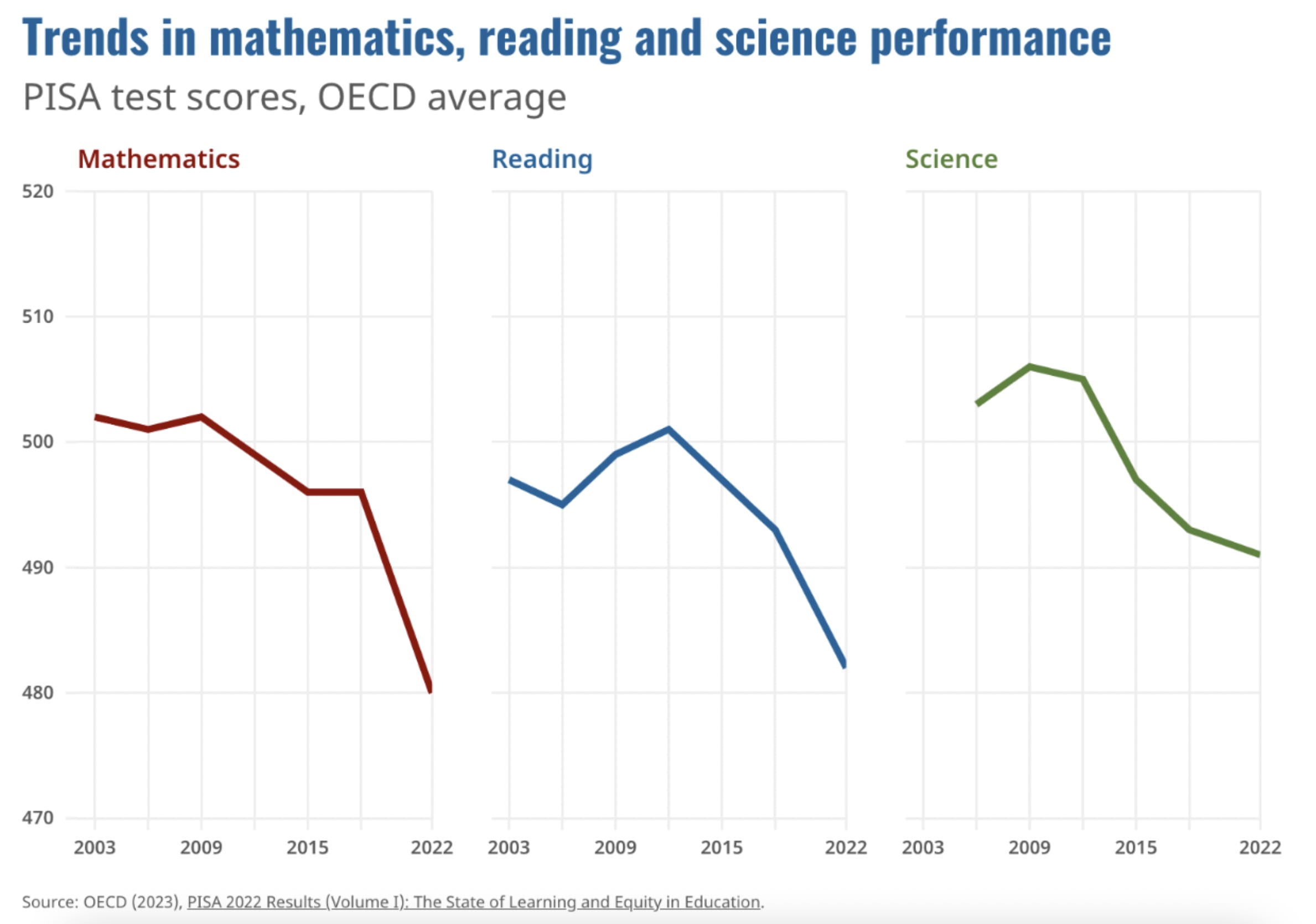
But here’s the twist: global academic performance has actually declined since 2012.

According to PISA data, 30% of students report being distracted by digital devices during class — and the more screen time they log, the lower their academic scores tend to be.

One core issue is that humans don’t truly multitask. We “switch-task” — rapidly toggling between tabs, chats, and searches. Each switch fractures focus and drains cognitive energy. For a child trying to learn, that’s like trying to read in the middle of a carnival.

Younger kids are especially vulnerable. Gamified programs don’t just divide attention; they can also be emotionally dysregulating. When a child loses a streak, runs out of stars, or can’t level up fast enough, it can trigger frustration and tears — not learning.

And it’s unrealistic to expect children to self-regulate in these environments. We wouldn’t hand a child a candy store and say, “Only eat what’s good for you.” Yet that’s effectively what 1:1 Chromebooks create: every student with a personal portal to distraction, supervised by one overwhelmed teacher.

As kids move through school, they use their Chromebooks in nearly every class, switch-tasking all day long. If technology were limited to one period — say, coding or digital literacy — it would make more sense to me, like the computer lab days of the 1990s. After all, learning digital skills is important. But when these digital tools dominate every subject, distraction becomes baked into the school day.

It’s like note-passing in the ’90s — on steroids.

My biggest concern, though, isn’t just attention — it’s connection.

To me, the purpose of school isn’t simply to master content. It’s to learn how to connect, collaborate, and navigate social dynamics. When my kids come home, they tell me about who they played with or what they talked about — less often about what they learned.

Technology interrupts that. EdTech tools can quietly erode teacher–student and peer–peer relationships simply by consuming the time and attention that used to belong to those interactions. Screens are being woven into curricula, shows are played during lunch, and iPads are even used to regulate behaviour.

The result? Less collaboration. Less conversation. Less community.

I’m not anti-technology. But I am pro-child — and skeptical of anything that promises engagement while quietly draining motivation, focus, and connection.

If Chromebooks truly helped children learn better, we’d see it reflected in outcomes. Instead, we’re seeing the opposite: rising distraction, declining scores, and growing disconnection.

The question isn’t whether technology belongs in schools — it’s how much, and in what form. Maybe it’s time we take a page from the past: fewer screens, more teachers, more paper, more play.

Because sometimes the best learning happens offline.

Thank you for taking the time to read! If you regularly read my content, consider becoming a paid subscriber. The vast majority of my content is free, and I spent a considerable amount of time researching and writing on this topic. If you appreciate my work, subscribing would go a long way to helping me continue to make more content! ~Alison

23 Nov 13:27

The Climate Impact of Owning a Dog

by Claire Elise Thompson
My dog contributes to climate change. I love him anyway.
21 Nov 22:33

Google tells employees it must double capacity every 6 months to meet AI demand

by Benj Edwards

While AI bubble talk fills the air these days, with fears of overinvestment that could pop at any time, something of a contradiction is brewing on the ground: Companies like Google and OpenAI can barely build infrastructure fast enough to fill their AI needs.

During an all-hands meeting earlier this month, Google’s AI infrastructure head Amin Vahdat told employees that the company must double its serving capacity every six months to meet demand for artificial intelligence services, reports CNBC. The comments show a rare look at what Google executives are telling its own employees internally. Vahdat, a vice president at Google Cloud, presented slides to its employees showing the company needs to scale “the next 1000x in 4-5 years.”

While a thousandfold increase in compute capacity sounds ambitious by itself, Vahdat noted some key constraints: Google needs to be able to deliver this increase in capability, compute, and storage networking “for essentially the same cost and increasingly, the same power, the same energy level,” he told employees during the meeting. “It won’t be easy but through collaboration and co-design, we’re going to get there.”

Read full article

Comments

21 Nov 12:48

“We’re Broken”: As Federal Prisons Run Low on Food and Toilet Paper, Corrections Officers Are Leaving in Droves for ICE

by Keri Blakinger

After years of struggling to find enough workers for some of the nation’s toughest lockups, the Federal Bureau of Prisons is facing a new challenge: Corrections officers are jumping ship for more lucrative jobs at Immigration and Customs Enforcement. 

This is one of the unintended consequences of the Trump administration’s focus on mass deportations. For months, ICE has been on a recruiting blitz, offering $50,000 starting bonuses and tuition reimbursement at an agency that has long offered better pay than the federal prison system. For many corrections officers, it’s been an easy sell. 

Workers at detention centers and maximum-security prisons from Florida to Minnesota to California counted off the number of co-workers who’d left for ICE or were in the process of doing so. Six at one lockup in Texas, eight at another. More than a dozen at one California facility, and over four dozen at a larger one. After retirements and other attrition, by the start of November the agency had lost at least 1,400 more staff this year than it had hired, according to internal prison data shared with ProPublica.

“We’re broken and we’re being poached by ICE,” one official with the prison workers union told ProPublica. “It’s unbelievable. People are leaving in droves.”

The exodus comes amid shortages of critical supplies, from food to personal hygiene items, and threatens to make the already grim conditions in federal prisons even worse. Fewer corrections officers means more lockdowns, less programming and fewer health care services for inmates, along with more risks to staff and more grueling hours of mandatory overtime. Prison teachers and medical staff are being forced to step in as corrections officers on a regular basis. 

And at some facilities, staff said the agency had even stopped providing basic hygiene items for officers, such as paper towels, soap and toilet paper.

“I have never seen it like this in all my 25 years,” an officer in Texas told ProPublica. “You have to literally go around carrying your own roll of toilet paper. No paper towels, you have to bring your own stuff. No soap. I even ordered little sheets that you put in an envelope and it turns to soap because there wasn’t any soap.”

The prisons bureau did not answer a series of emailed questions. In a video posted Wednesday afternoon, Deputy Director Josh Smith said that the agency was “left in shambles by the previous administration” and would take years to repair. Staffing levels, he said, were “catastrophic,” which, along with crumbling infrastructure and corruption, had made the prisons less safe.

Smith said that he and Director William Marshall III had been empowered by the Trump administration to “confront these challenges head-on.” “Transparency and accountability are the cornerstones of our mission to make the BOP great again, and we’re going to expose the truth and hold those responsible accountable.”

ICE, meanwhile, responded to a request for comment by forwarding a press release that failed to answer specific questions but noted that the agency had made more than 18,000 total tentative job offers as of mid-September.


The BOP has long faced challenges, from sex abuse scandals and contraband problems to crumbling infrastructure and poor medical care. It has repeatedly been deemed the worst federal workplace by one analysis of annual employee surveys, and in 2023 union officials said that some 40% of corrections officer jobs sat vacant.

That dearth of officers helped land the prison system on a government list of high-risk agencies with serious vulnerabilities and attracted the eye of oversight officials, who blamed chronic understaffing for contributing to at least 30 prisoner deaths.

The bureau tried tackling the problem with a long-term hiring push that included signing bonuses, retention pay and a fast-tracked hiring process. By the start of the year, that effort seemed to be working.

Kathleen Toomey, then the bureau’s associate deputy director, told members of Congress in February that the agency had just enjoyed its most successful hiring spree in a decade, increasing its ranks by more than 1,200 in 2024. 

“Higher staffing levels make institutions safer,” she told a House appropriations subcommittee. 

But the costly efforts to reel in more staff strained a stagnant budget that was already stretched thin. Toomey told Congress the bureau had not seen a funding increase since 2023, even as it absorbed millions in pay raises and retention incentives. As inflation and personnel costs rose, the bureau was forced to cut its operating budgets by 20%, Toomey said. 

And despite some improvement, the staffing problems persisted. In her February testimony, Toomey acknowledged there were still at least 4,000 vacant positions, leaving the agency with so few officers that prison teachers, nurses and electricians were regularly being ordered to abandon their normal duties and fill in as corrections officers. 

Then ICE rolled out its recruiting drive. 

“At first it seemed like it was going to be no big deal, and then over the last week or so we already lost five, and then we have another 10 to 15 in various stages of waiting for a start date,” an employee at one low-security facility told ProPublica in October. “For us that’s almost 20% of our custody staff.”

He, like most of the prison workers and union officials who spoke to ProPublica, asked to remain anonymous for fear of retaliation — a concern that has grown since the agency canceled the union’s contract in September following an executive order. Now union leaders say they’ve been warned that without their union protections, they could be punished for speaking to the media.

After the contract’s cancellation, many of the current staff who had originally spoken on the record asked to have their names withheld. Those who still agreed to be identified asked ProPublica to note that their interviews took place before the agency revoked the union agreement.

Earlier this year, Brandy Moore White, national president of the prison workers union, said it’s not unprecedented to see a string of prison staffers leaving the agency, often in response to changes that significantly impact their working conditions. Prior government shutdowns, changes in leadership and the pandemic all drove away workers — but usually, she said, people leaving the agency en masse tended to be near the end of their careers. Now, that’s not the case.

“This is, from what I can remember, the biggest exodus of younger staff, staff who are not retirement-eligible,” she said. “And that’s super concerning to me.”
ICE’s expansion has even thrown a wrench into BOP’s usual training program for rookies. Normally, new officers have to take a three-week Introduction to Correctional Techniques course at the Federal Law Enforcement Training Centers in Georgia within their first 60 days on the job, according to the prisons bureau’s website. In August, FLETC announced that it would focus only on “surge-related training,” pausing programs for other law enforcement agencies until at least early 2026, according to an internal email obtained by ProPublica. Afterward, FLETC said in a press release that it was “exploring temporary solutions” to “meet the needs of all partner agencies,” though it’s not clear whether any of those solutions have since been implemented. The centers did not respond to emailed requests for comment.


At the same time, the effects of the budget crunch were starting to show. In recent months, more than 40 staff and prisoners at facilities across the country have reported cutbacks even more severe than the usual prison scarcities.

In September, Moore White told ProPublica some prisons had fallen behind on utility and trash bills. At one point, she said, the prison complex in Oakdale, Louisiana, was days away from running out of food for inmates before the union — worried that hungry prisoners would be more apt to riot — intervened, nudging agency higher-ups to address the problem, an account confirmed by two other prison workers. (Officials at the prison complex declined to comment.) Elsewhere, staff and prisoners reported shortages — no eggs in a California facility and no beef in a Texas lockup where staff said they were doling out smaller portions at mealtimes.

Earlier this year, a defense lawyer complained that the Los Angeles detention center ran out of pens for prisoners in solitary confinement, where people without phone or e-messaging privileges rely on snail mail to contact the outside world. One of his clients was “rationing his ink to write letters to his family,” the attorney said. The center didn’t respond to requests for comment.

Personal hygiene supplies have been running low, too. Several prisoners said their facilities had become stingier than usual with toilet paper, and women incarcerated in Carswell in Texas reported a shortage of tampons. “I was told to use my socks,” one said. The facility did not answer questions from ProPublica about conditions there.

Fewer staff has meant in some cases that inmates have lost access to care. At the prison complex in Victorville, California, staff lodged written complaints accusing the warden of skimping on the number of officers assigned to inmate hospital visits in order to cut back on overtime. (The complex did not respond to a request for comment.) In some instances, the complaints alleged, that left so few officers at the hospital that ailing inmates missed the procedures that had landed them there in the first place.

Chyann Bratcher, a prisoner at Carswell, a medical lockup in Texas, said she missed an appointment for rectal surgery — something she’d been waiting on for two years — because there weren’t enough staff to take her there. She was able to have the procedure almost two months later, after another cancellation.

Staffers say several facilities have started scheduling recurring “blackout” days, when officers are banned from working overtime in an effort to save money. Instead, prison officials turn to a practice known as “augmentation,” where they direct teachers, plumbers and medical staff to fill in as corrections officers.

“That’s why I left,” said Tom Kamm, who retired in September from the federal prison in Pekin, Illinois, after 29 years with the bureau. “My job was to try to settle EEO complaints, so if somebody alleged discrimination against the agency it was my job to look into it and try to resolve it.”

When he found out earlier this year that he would soon be required to work two shifts per week as a corrections officer, he decided to retire instead.

“I hadn’t been an officer in a housing unit since like 2001 — it had been like 24 years,” he said. “I had really no clue how to do that anymore.”

Augmentation isn’t new, but staff and prisoners at some facilities say it’s being used more often than it once was. It also means fewer medical staff available to address inmates’ needs. “Today we had a Physical Therapist as a unit officer so all of his PT appointments would have been cancelled,” Brian Casper, an inmate at the federal medical prison in Missouri, wrote in an email earlier this year. “Yesterday one of the other units had the head of Radiology for the unit officer so there would have been one less person doing x-rays and CT scans.” The prison didn’t respond to emailed questions.

When the government shutdown hit in October, it only made the situation worse, exacerbating the shortages and increasing the allure of leaving the bureau. While ICE agents and corrections officers continued bringing home paychecks, thousands of prison teachers, plumbers and nurses did not. 

The so-called One Big Beautiful Bill Act, the domestic policy megabill that Trump signed into law on July 4, could offer some financial support for the agency’s staffing woes, as it will route another $5 billion to the prisons bureau over four years — $3 billion of which is specifically earmarked to improve retention, hiring and training. Yet exactly what the effects of that cash infusion will look like remains to be seen: Though the funding bill passed more than four months ago, in November the bureau declined to answer questions about when it will receive the money or how it will be spent.

The post “We’re Broken”: As Federal Prisons Run Low on Food and Toilet Paper, Corrections Officers Are Leaving in Droves for ICE appeared first on ProPublica.


21 Nov 12:40

Source: Earth.com

21 Nov 12:36

Pornhub is urging tech giants to enact device-based age verification

by Jason Parham, WIRED.com

In letters sent to Apple, Google, and Microsoft this week, Pornhub’s parent company urged the tech giants to support device-based age verification in their app stores and across their operating systems, WIRED has learned.

“Based on our real-world experience with existing age assurance laws, we strongly support the initiative to protect minors online,” reads the letter sent by Anthony Penhale, chief legal officer for Aylo, which owns Pornhub, Brazzers, Redtube, and YouPorn. “However, we have found site-based age assurance approaches to be fundamentally flawed and counterproductive.”

The letter adds that site-based age verification methods have “failed to achieve their primary objective: protecting minors from accessing age-inappropriate material online.” Aylo says device-based authentication is a better solution for this issue because once a viewer’s age is determined via phone or tablet, their age signal can be shared over its application programming interface (API) with adult sites.

Read full article

Comments

20 Nov 23:33

With the Rise of AI, Cisco Sounds an Urgent Alarm About the Risks of Aging Tech

by Lily Hay Newman
Generative AI is making it even easier for attackers to exploit old and often forgotten network equipment. Replacing it takes investment, but Cisco is making the case that it’s worth it.
20 Nov 22:20

Massive Cloudflare outage was triggered by file that suddenly doubled in size

by Jon Brodkin

When a Cloudflare outage disrupted large numbers of websites and online services yesterday, the company initially thought it was hit by a “hyper-scale” DDoS (distributed denial-of-service) attack.

“I worry this is the big botnet flexing,” Cloudflare co-founder and CEO Matthew Prince wrote in an internal chat room yesterday, while he and others discussed whether Cloudflare was being hit by attacks from the prolific Aisuru botnet. But upon further investigation, Cloudflare staff realized the problem had an internal cause: an important file had unexpectedly doubled in size and propagated across the network.

This caused trouble for software that needs to read the file to maintain the Cloudflare bot management system that uses a machine learning model to protect against security threats. Cloudflare’s core CDN, security services, and several other services were affected.

Read full article

Comments

20 Nov 18:39

RFK Jr.’s loathesome edits: CDC website now falsely links vaccines and autism

by Beth Mole

With ardent anti-vaccine activist Robert F. Kennedy Jr. as the country’s top health official, a federal webpage that previously laid out the ample evidence refuting the misinformation that vaccines cause autism was abruptly replaced Wednesday with an anti-vaccine screed that promotes the false link.

It’s a move that is sure to be celebrated by Kennedy’s fringe anti-vaccine followers, but will only sow more distrust, fear, and confusion among the public, further erode the country’s crumbling vaccination rates, and ultimately lead to more disease, suffering, and deaths from vaccine-preventable infections, particularly among children and the most vulnerable.

On the Centers for Disease Control and Prevention’s website titled “Autism and Vaccines,” the previous top “key point” accurately reported that: “Studies have shown that there is no link between receiving vaccines and developing autism spectrum disorder (ASD).”

Read full article

Comments

20 Nov 01:25

Name mentions in Epstein email cache

by Nathan Yau

Congress released a cache of Jeffrey Epstein’s email threads. For the Wall Street Journal, Brian Whitton, John West, and Kara Dapena show name drops through a series of beeswarm charts, with one dot per email thread.

Not surprisingly, President Trump and former President Bill Clinton are both referenced hundreds of times in what was released this week, according to a Wall Street Journal analysis. Former President Barack Obama’s name appears as well. The Journal’s analysis didn’t identify messages that any of the U.S. presidents wrote directly to Epstein or received emails from him, just references to them by Epstein or his conversation partners.

There is something to be gleaned, no matter how incomplete the release may be.

Tags: email, Jeffrey Epstein, Wall Street Journal