Lindsey
Shared posts
4 Clever Tricks That Make It Worth Switching to Proton Mail
Trump admin axed 383 active clinical trials, dumping over 74K participants
When the Trump administration brutally cut federal funding for biomedical research earlier this year, at least 383 clinical trials that were already in progress were abruptly canceled, cutting off over 74,000 trial participants from their experimental treatments, monitoring, or follow-ups, according to a study published today in JAMA Internal Medicine.
The study, led by researchers at Harvard, fills a knowledge gap of how the Trump administration’s research funding cuts affected clinical trials specifically. It makes clear not just the wastefulness and inefficiency of the cuts but also the deep ethical violations, JAMA Internal Medicine editors wrote in an accompanying editor’s note.
In March, the National Institutes of Health, under the control of the Trump administration, announced that it would cancel $1.8 billion in grant funding that wasn’t aligned with the administration’s priorities. The Harvard researchers, led by health care policy expert Anupam Jena, used an NIH database and a federal accountability tracking tool to find grants supporting clinical trials that were active as of February 28 but had been terminated by August 15.
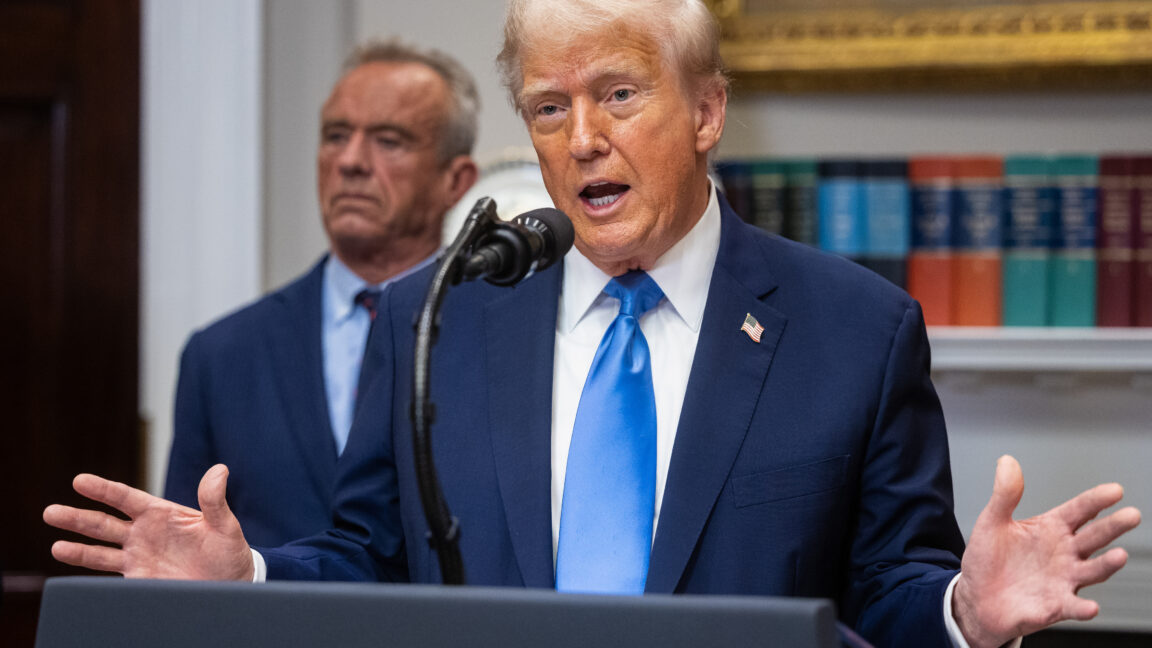
Trump Administration Still Trying To Send Kilmar Abrego Garcia To Anywhere But Where He Wants To Go
For all its talk about trimming down government spending, an untold amount of money has been blown just to keep one person from getting one over on the Trump administration.
That man would be Kilmar Abrego Garcia. He became the poster boy for the regime’s bigotry when he fought back against his sudden deportation to El Salvador’s most infamous prison.
Abrego Garcia is Salvadoran. He fled that country and sought asylum in the United States. There were reasons he didn’t want to be sent back there. Not that the Trump administration cared. It just wanted him out and was willing to send him to a torture prison run by a self-admitted dictator. The administration made a lot of questionable claims about Garcia’s supposed MS-13 gang activity to justify flying him out to a receptive hellhole.
Abrego Garcia fought back. And he has proven to be a constant embarrassment for a government overrun by mouth-breathing bullies. Garcia managed to get un-ejected from the country, exposing multiple lies told by the government while doing so. For that, he was punished further. The administration brought him back just so it could throw him in an American prison, claiming he was involved in all sorts of hideous crimes.
A court reasonably found that this was vindictive prosecution. It also ordered Abrego Garcia’s release. But the government fought back with an absurd (and hideous) trial tax: Garcia could either plead guilty to the (pun intentional?) trumped-up charges or get hurled into a war-torn country where human rights are nearly nonexistent.
This happened despite the fact that Costa Rica agreed to have Abrego Garcia delivered there, as per his request. The legal battle continues, and the Trump regime appears fully committed to the bit. It will dump Garcia into whatever hellhole it can talk a court into, rather than allow him to leave the country peaceably for the destination of his choice.
The Trump administration has moved to dissolve the ban on Kilmar Abrego Garcia’s removal so that it can proceed with his deportation to Liberia.
In a series of filings overnight, government attorneys said that the Salvadoran native’s claim of fear of torture or persecution in the African nation was denied after he was interviewed by U.S. Citizenship and Immigration Services last week.
The attorneys for the Department of Justice argued that the preliminary injunction blocking Abrego Garcia’s removal to Liberia should be dissolved because the government received assurances from the government of the West African country that he will not be persecuted or tortured.
Yep, that’s how it’s going in the purported Land of the Free that has spent the past few days stroking itself off in celebration of Veterans Day. American troops, who have done everything they can to prevent foreign countries from becoming what the Trump administration desires to be, are being celebrated for protecting the freedoms this regime considers to be mere privileges.
And let’s all enjoy a long disgusted LOL at the government’s assertions. Liberia’s government is corrupt AF and any assurances it might make about some rando should not be trusted. And, again, if the real reason (as stated multiple times by the administration) is to remove this “dangerous criminal” from the US, what’s wrong with sending him to Costa Rica? The government has already said it will take custody of Abrego Garcia, and it would be another “win” for the administration to add another person to its “self-deportation” column.
But we all know what’s really happening here. The Trump administration wants to punish Abrego Garcia for making them look bad. And sending him to a country he’s agreed to go to doesn’t do that. They need him to feel endangered to make it clear to others who might stand up to having their own civil liberties and rights violated, that they, too, may face similar risks. Abrego Garcia spoke out against the injustices the Trump administration rained down upon him, and for that he must pay.
This constant hate-on is considered a feature, not a bug, by the so-called representatives of the Free World. It’s abhorrent and it should be a constant stain on their legislative histories. Unfortunately, there are no adults with any semblance of a conscience left in the GOP, so we’ll get what we get for as long as people who stroke themselves off to the National Anthem continue to believe this nation’s path to greatness involves destroying everyone’s humanity, including their own.
GOP Threatened To Keep The Government Shut Down If 8 GOP Senators Couldn’t Profit From Being Investigated
Last night the House passed, and then Donald Trump signed, the funding bill that reopened the government after the longest government shutdown in history. Amazingly, the Republican’s sketchy demands to fill their personal bank accounts with undeserved taxpayer money almost scuttled the deal. But, don’t worry: those Senators got their corrupt boondoggle and they plan to enrich themselves.
The party of pure fucking garbage just keeps being awful. Government employees went without paychecks, families went without medical and food benefits, and no one in the GOP really appeared to care how long an entire nation suffers so long as it got what it wanted.
“Ask not what this country can do for you” is apparently too woke to be considered an aspiration. Under Trump’s GOP, the operative phrase is “Don’t even ask whether or not it can. Make the country do for you and fuck them if they complain.”
Enjoy what is probably only the fourth or fifth example of GOP ghoulishness you’ll see today, courtesy of the New York Times’ Devlin Barrett:
A spending package expected to be approved as part of a deal to reopen the government would create a wide legal avenue for senators to sue for as much as half a million dollars each when federal investigators search their phone records without notifying them.
The provision, tucked into a measure to fund the legislative branch, appears to immediately allow for eight G.O.P. senators to sue the government over their phone records being seized in the course of the investigation by Jack Smith, the former special counsel, into the riot at the Capitol on Jan. 6, 2021.
To be clear, legitimate concerns have been raised about warrantless access to Americans’ phone records, especially when the FBI utilizes the NSA’s collections to engage in “backdoor” searches.
But there’s nothing legitimate about what is happening here. Congressional reps have sought carve-outs that only serve themselves and have expressed almost zero concern about how this same warrantless access affects the people they serve.
So, not only have GOP legislators placed themselves above the people they serve by only seeking to exclude themselves from the reality that affects the rest of us, they went further by holding the entire government hostage with a demand that has no business being tacked onto a federal funding bill, and one that only serves to give those eight Senators the freedom to grab hundreds of thousands of dollars of taxpayer money.
If they want to give themselves extra privileges, they should have the strength of character to introduce this in an actual bill that would be forced to stand on its own merits (read: lack thereof), rather than force the Democratic party to comply as federal government websites (illegally!) pillory them on a daily basis as the people who are keeping American citizens from collecting paychecks and benefits.
It gets even worse when you look at the details:
Because the provision is retroactive to 2022, it would appear to make eligible the eight lawmakers whose phone records were subpoenaed by investigators for Mr. Smith as he examined efforts by Donald J. Trump to obstruct the results of the 2020 presidential election.
Each violation would be worth at least $500,000 in any legal claim, according to the bill language. The bill would also sharply limit the way the government could resist such a claim, taking away any government claims of qualified or sovereign immunity to fight a lawsuit over the issue.
This isn’t even about the FBI’s abuse of NSA collections, which would actually be something worth limiting further. It’s specifically and only about eight GOP Senators whose phone records were sought under the Third Party Doctrine — something that few people in the government would attack because that court-created doctrine has proven extremely useful to law enforcement at every level.
But it also adds a payout for those “victimized” by a legitimate investigation into the attack on the Capitol building following Trump’s loss in the 2020 election. And guess who these people are:
Lindsey Graham of South Carolina, Marsha Blackburn and Bill Hagerty of Tennessee, Josh Hawley of Missouri, Dan Sullivan of Alaska, Tommy Tuberville of Alabama, Ron Johnson of Wisconsin and Cynthia Lummis of Wyoming.
Citation[s]: Lindsey Graham, Marsha Blackburn, Bill Hagerty, Josh Hawley, Dan Sullivan, Tommy Tuberville, Ron Johnson, Cynthia Lummis
Yep, it’s the expected collection of boot-lickers. These are people unfit to serve who may see themselves raking in at least a half-million for stroking Trump’s ego and repeating his lies about the 2020 election.
Lindsey Graham has already said he plans to make people pay for having his phone records accessed, which is rich, because Graham has been one of the most vocal proponents in the Senate of giving the DOJ vast and unlimited surveillance powers. Also, when he says “make people pay” he means that you, the taxpayer, needs to give him money because he got caught up in the DOJ’s investigation into the attempted insurrection.
These Senators who have no problem expanding surveillance on you, the little people, also simultaneously are awarding themselves a special provision to sue for your tax money to go straight into their bank account. It’s about as corrupt as it can be. Incredibly, they even screwed over a colleague in the House, Mike Kelly, who was the one member of the House whose phone records were part of the same investigation. The funding bill only allows for Senators to sue over this.
No one else will benefit from this but these eight GOP senators. The rest of the nation can continue to get fucked on the regular.
“The Senators may not like being treated like the rest of America, but these phone-record subpoenas and non-disclosure orders are routine in grand jury investigations at the state and federal level,” he said. “No one has an absolute right to be notified that their call records have been subpoenaed, much less the right to a million bucks if it happens. This provision would not give any Americans other than U. S. Senators these rights.”
Passing a law that only applies to eight Senators, which only serves to enrich them at the expense of the taxpayer seems like a perfect encapsulation of the state of the modern GOP: fuck the little guy and do anything to get money for yourself. The MAGA mantra.
While Speaker Mike Johnson has said that they’ll bring up a separate bill next week to strip this provision, Republicans in the House refused to strip it during negotiations over the funding bill, where it would have actually mattered. What is now likely to happen is that Johnson will allow a vote on a bill next week in a symbolic gesture that will not pass. And Senator Graham and his buddies will cash in.
What a job, when you get to vote yourself the ability to just take a bunch of taxpayer money in response to being investigated.
Weight-Loss Drug Zepbound Is Being Tested as a Treatment for Long Covid
Inside the Multimillion-Dollar Plan to Make Mobile Voting Happen
When Will the US Finally Get $15K EVs?
Shifts back to the left for Hispanic voters

In 2024, Hispanic voters in New Jersey took a hard shift to the right compared to 2020 voting. In the recent 2025 election, they shifted back to the left. Christine Zhang and Shane Goldmacher report for the New York Times:
The Times analyzed data from more than 500 townships in the 19 of New Jersey’s 21 counties where results data was available, accounting for over 90 percent of votes cast in the governor’s race. (Union and Warren Counties have not yet reported township-level results.)
The two cities that shifted the most toward Democrats were those with the highest percentage of Hispanic voters in the state: Union City and Perth Amboy.
The maps show a mirror image. A bubble chart also suggests townships with a higher Hispanic population shifted back more towards Democrat.
Tags: election, Latino, New Jersey, New York Times

A Proposed Federal THC Ban Would ‘Wipe Out’ Hemp Products That Get People High
Chuck Schumer Doesn’t Know What Time It Is
After forty days. Forty days of the longest government shutdown in American history. Forty days of Democrats saying this is the line—healthcare for twenty-two million Americans. Forty days of holding firm while Republicans bet Democrats would break first.
Chuck Schumer just taught Donald Trump that hostage-taking works.
Not because he had to. Because the framework he operates within cannot imagine doing what this moment requires: actually fighting power instead of managing accommodation to it.
Eight Democratic senators voted to end the shutdown last night. The deal they cut? A “guaranteed vote” next month on ACA subsidies that everyone—including Chuck Schumer—knows won’t pass. They traded their only leverage for a promise they know is worthless. They held the line for forty days, then surrendered for nothing.
The base is in open revolt. Gavin Newsom’s response was one word: “Pathetic.” JB Pritzker called it “an empty promise.” AOC reminded everyone that “working people want leaders whose word means something.” Chris Murphy admitted plainly: “There’s no way to sugarcoat what happened tonight.”
And Ro Khanna did what needed doing: he called for Schumer’s removal as Senate minority leader.
This isn’t just fury at a bad deal. This is recognition that the Democratic establishment is operating within a dead framework that keeps producing the same result: managed decline wrapped in sophisticated justifications.
Schumer’s calculation was pure technocratic management. The shutdown polls badly. Healthcare polls well. Get a vote scheduled, minimize political damage, trust that Republicans will take the blame when premiums skyrocket. Classic establishment thinking: read the focus groups, calculate the risk, optimize for damage control.
What he cannot see—what the framework literally prevents him from seeing—is that the fight itself mattered more than any deal. That people weren’t asking for better negotiating tactics. They were asking for proof that Democrats would hold the line on something. Anything. After Chicago. After ICE raids. After warrantless mass detentions. After watching Trump systematically dismantle constitutional constraints.
This was the test. Forty days to prove Democrats could fight power instead of accommodating it. And Schumer folded.
Symone Sanders got it immediately: “The hostage taking worked.” That’s the lesson Trump learned last night. That’s why Chris Murphy is right to fear Trump gets stronger, not weaker. When you teach authoritarians that threatening to hurt people produces Democratic capitulation, you haven’t minimized damage—you’ve guaranteed more hostage situations.
The establishment will produce sophisticated analysis explaining why this was actually strategic. They’ll point to the guaranteed vote, the federal worker protections, the political positioning for next month. They’ll treat this as a temporary setback in normal political competition.
But this isn’t normal political competition. This is one side attempting regime change while the other pretends it’s just another negotiation requiring careful positioning.
The base understands what Schumer cannot: you cannot manage your way out of authoritarian consolidation. You cannot focus-group your way to resistance. You cannot optimize yourself into fighting power when your entire framework is built on accommodating it.
The governors get it. Newsom fighting homeowner cartels in California. Pritzker calling out empty promises. They’re not waiting for Senate leadership to figure out what time it is. They’re building the alternative: liberal populism that actually fights concentrated power instead of explaining why fighting is unstrategic.
The progressive caucus gets it. AOC reminding everyone that people’s lives depend on Democrats keeping their word. Khanna calling for new leadership. James Talarico declaring “this moment demands fighters, not folders.”
Even establishment voices like Murphy understand something fundamental broke last night. When your own senator has to record a video saying “there’s no way to sugarcoat this” and “I’m angry—like you”—that’s not spin control. That’s recognition that the base has decided the framework is dead.
Forty days was long enough to prove Democrats could fight. Long enough to make Trump pay a political price for hostage-taking. Long enough to show working people that their leaders’ word means something.
Chuck Schumer surrendered all of that for a vote next month that won’t pass.
He doesn’t know what time it is. But the base does. The governors do. The progressive caucus does. And they’re done waiting for him to figure it out.
The dead framework just folded. Time to storm the castle.
Mike Brock is a former tech exec who was on the leadership team at Block. Originally published at his Notes From the Circus.
Stopgap spending bill clears Senate, heads to House for vote
The 60-40 vote sends the updated funding package back to the House, where lawmakers in that chamber are expected sometime during the next few days to clear the legislation for President Donald Trump’s signature.
Shortly before the vote, Trump said he plans to follow the agreements included in the revised measure, including the reinstatement of thousands of federal workers who received layoff notices during the shutdown.
“I’ll abide by the deal,” Trump said. “The deal is very good.”
Republicans, he added, will soon begin work on legislation to provide direct payments to Americans to help them afford the rising cost of health insurance, one of the core disagreements between the political parties that led to the shutdown.
“We want a health care system where we pay the money to the people instead of the insurance companies,” Trump said from the Oval Office. “And I tell you, we are going to be working on that very hard over the next short period of time.”
House members told to head to D.C.
Earlier in the day, House Speaker Mike Johnson urged representatives to begin traveling back to Capitol Hill as soon as possible to ensure they arrive in time to vote on the bill to reopen the government, after the measure arrives from the Senate.
The Louisiana Republican’s request came as airlines were forced to delay or cancel thousands of flights on the 41st day of the shutdown, a situation that could potentially impact a House vote on the stopgap spending bill if members don’t follow his advice.
“The problem we have with air travel is that our air traffic controllers are overworked and unpaid. And many of them have called in sick,” Johnson said. “That’s a very stressful job and even more stressful, exponentially, when they’re having trouble providing for their families. And so air travel has been grinding to a halt in many places.”
Johnson then told his colleagues in the House, which hasn’t been in session since mid-September, that lawmakers from both political parties “need to begin right now returning to the Hill.”
Trump threatens air traffic controllers
Trump took a markedly different tone over the challenges air traffic controllers have faced during the shutdown in a social media post that he published several hours before he spoke to reporters about the deal to reopen government.
“All Air Traffic Controllers must get back to work, NOW!!! Anyone who doesn’t will be substantially ‘docked,’” Trump wrote, without explaining what that would mean for workers who had to take time off since the shutdown began Oct. 1.
Trump added that he would like to find a way to provide $10,000 bonuses to air traffic controllers who didn’t require any time off during the past six weeks.
“For those that did nothing but complain, and took time off, even though everyone knew they would be paid, IN FULL, shortly into the future, I am NOT HAPPY WITH YOU. You didn’t step up to help the U.S.A. against the FAKE DEMOCRAT ATTACK that was only meant to hurt our Country,” Trump wrote. “You will have a negative mark, at least in my mind, against your record. If you want to leave service in the near future, please do not hesitate to do so, with NO payment or severance of any kind!”
An end in sight
The Senate-passed package will provide stopgap funding for much of the federal government through January 30, giving lawmakers a couple more months to work out agreement on nine of the dozen full-year spending bills.
The package holds several other provisions, including the full-year appropriations bills for the Agriculture Department, the Legislative Branch, military construction projects and the Department of Veterans’ Affairs.
Seven Democrats and one independent broke ranks Sunday on a procedural vote that advanced the package, drawing condemnation from some House members and outside advocacy groups unhappy that no solution was arrived at to counter skyrocketing health insurance premium increases for people in the Affordable Care Act marketplace.
Republicans hold 53 seats in the Senate, where bipartisanship is required for major bills to move forward under the 60-vote legislative filibuster.
Senate Majority Leader John Thune, R-S.D., said during a floor speech Monday he was “grateful that the end” of the stalemate was in sight.
“We’re on the 41st day of this shutdown — nutrition benefits are in jeopardy; air travel is in an extremely precarious situation; our staffs and many, many other government workers have been working for nearly six weeks without pay,” Thune said. “I could spend an hour talking about all of the problems we’ve seen, which have snowballed the longer the shutdown has gone on. But all of us, Democrat and Republican, who voted for last night’s bill are well aware of the facts.”
Schumer bid for deal on health care costs fails
Senate Minority Leader Chuck Schumer, D-N.Y., was far less celebratory after his bid to get Republicans to negotiate a deal on health care costs by forcing a shutdown failed.
“The past few weeks have exposed with shocking clarity how warped Republican priorities truly are. While people’s health care costs have gone up, Republicans have come across as a party preoccupied with ballrooms, Argentina bailouts and private jets,” Schumer said. “Republicans' breach of trust with the American people is deep and perhaps irreversible.”
“And now that they have failed to do anything to prevent premiums from going up, the anger that Americans feel against Donald Trump and the Republicans is going to get worse,” Schumer added. “Republicans had their chance to fix this and they blew it. Americans will remember Republican intransigence every time they make a sky-high payment on health insurance.”
Schumer was insistent throughout the shutdown that Democrats would only vote to advance a funding bill after lawmakers brokered a bipartisan deal to extend tax credits that are set to expire at the end of December for people who purchase their health insurance from the Affordable Care Act marketplace.
That all changed on Sunday when Democratic Sens. Dick Durbin of Illinois, John Fetterman of Pennsylvania, Maggie Hassan and Jeanne Shaheen of New Hampshire, Tim Kaine of Virginia, and Catherine Cortez Masto and Jacky Rosen of Nevada voted to move the bill toward a final passage vote.
Maine independent Sen. Angus King of Maine, who caucuses with Democrats, also voted to advance the legislation.
Jeffries still supports Schumer
House Democratic Leader Hakeem Jeffries said during a press conference Monday afternoon that he still believes Schumer is effective and should keep his role in leadership, despite the outcome.
“Leader Schumer and Senate Democrats over the last seven weeks have waged a valiant fight on behalf of the American people. And I’m not going to explain what a handful of Senate Democrats have decided to do. That’s their explanation to offer to the American people,” Jeffries said.
“What we’re going to continue to do as House Democrats, partnered with our allies throughout America, is to wage the fight, to stay in the coliseum, to win victories in the arena on behalf of the American people notwithstanding whatever disappointments may arise,” he said. “That's the reality of life, that’s certainly the reality of this place. But we’re in this fight for all the right reasons.”
Speaker Johnson said earlier in the day that the “people’s government cannot be held hostage to further anyone’s political agenda. That was never right. And shutting down the government never produces anything.”
Johnson reiterated that GOP lawmakers are “open to finding solutions to reduce the oppressive costs of health care,” though he didn’t outline any plans to do that in the weeks and months ahead.
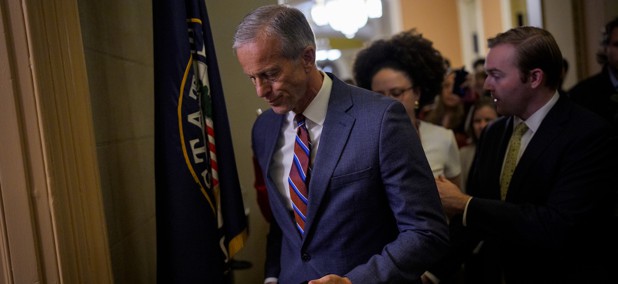
Shutdown fight in the Senate likely to drag through the weekend
A vote on a package of spending bills could come either Saturday or Sunday that would partially fund the government, Senate Majority Leader John Thune told reporters.
“Our members are going to be advised to be available if there's a need to vote,” Thune said. “We will see what happens and whether or not, over the course of the next couple of days, the Democrats can find a way to reengage again.”
Meanwhile, Senate Minority Leader Chuck Schumer offered a proposal from Democrats to agree to reopen the government if health care tax subsidies are continued for a year.
As open enrollment begins, people who buy their health insurance through the Affordable Care Act marketplace are seeing a drastic increase in premium costs.
“We’d like to offer a simple proposal,” the New York Democrat said. “To reopen the government and extend the [Affordable Care Act] tax credits simultaneously.”
Republicans have maintained that any discussion on extending the health care tax credits set to expire at the end of the year will only happen after government funding resumes. House Speaker Mike Johnson, R-La., this week said he would not promise a vote on the GOP-controlled House floor regarding the issue.
The nonpartisan Congressional Budget Office in September found that if lawmakers permanently extend the enhanced tax credits for certain people who buy their health insurance through the ACA marketplace, it would cost the government $350 billion over 10 years and increase the number of those with health insurance by 3.8 million.
But it was unclear how much traction Schumer would get. Several Republicans called the proposal a “nonstarter,” such as Sen. Mike Rounds, R-S.D.
Rounds also questioned if the stopgap spending bill that Democrats agreed to support is the House-passed version that would extend government funding only to Nov. 21 or another that would run longer.
“It’s good that they’re recognizing that we have to open up the government,” Rounds said of Democrats.
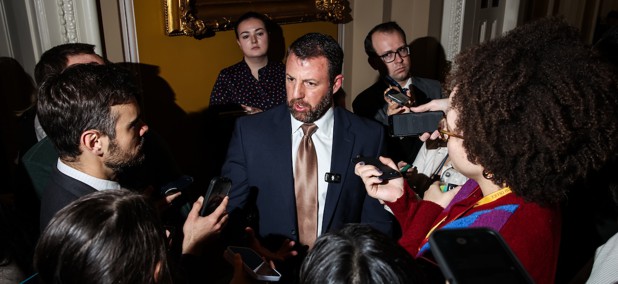
Sen. Markwayne Mullin, R-Okla., called the proposal from Democrats “absurd,” and said there was no way senators could negotiate a deal on health care quickly.
He added that Trump also wants to be part of the negotiations on health care.
“Whatever we do as Republicans, we've got to really work close with the president,” Mullin said. “The president wants to be involved in this negotiation.”
Separately, senators failed Friday in a 53-43 vote to move forward on a bill from Sen. Ron Johnson, R-Wis., to pay federal workers who Friday missed their second paycheck. Georgia’s Democratic Sens. Jon Ossoff and Raphael Warnock voted with Republicans. Sixty votes were needed.
President Donald Trump on social media said, “The United States Senate should not leave town until they have a deal to end the Democrat shutdown. If they can’t reach a deal, the Republicans should terminate the filibuster immediately and take care of our great American workers!”
Flight cutbacks, food aid disruption
The Senate has failed 14 times to move forward on approving a stopgap spending measure to fund the government until Nov. 21.
As the government shutdown has dragged on for nearly seven weeks, major airports have been hit as they struggle to maintain flight schedules, with air traffic controllers now more than a month without pay.
Meanwhile, federal courts have forced the Trump administration to release billions in emergency funds to provide critical food assistance to 42 million people. On Friday, the U.S. Department of Agriculture said it would issue full November benefits for food assistance in compliance with a court order.
As the debate in Congress goes on, Democrats have refused to back the House-passed version of the GOP stopgap measure over their concerns about the expiration of health care subsidies.
Democrats also want to see federal workers laid off by the Trump administration amid the shutdown rehired. Major wins across the country for Democrats in Tuesday elections bolstered their resolve to reject efforts to end the government shutdown that do not include certain policy wins.
Historically, lawmakers who have forced shutdowns over policy preferences have not been successful.
In 2013, the GOP tried to repeal or delay the Affordable Care Act, which did not happen, and in the 2018-19 shutdown, Trump, in his first term, insisted on additional funding for a border wall. But that shutdown — which set a record exceeded only by the ongoing shutdown — concluded 35 days later with the same amount of money included in the original appropriations bill.
Thune lament
Thune told reporters Friday that he thought progress was being made on striking a deal to resume government funding, but he said after Democrats’ Thursday caucus meeting, their tune changed.
“Right now, we've got to get the Democrats kind of back engaged,” Thune said.
Following Thursday’s meeting, Democrats remained tight-lipped and did not seem any closer to an internal agreement on how to move forward with resolving the government shutdown.
“I thought we were on a track,” Thune, a South Dakota Republican, said. “We'd give them everything they wanted or had asked for.”
Senate Republicans have agreed to allow a floor vote on the Affordable Care Act subsidies and have opened the door to rehiring federal workers but have not gone further.
“At some point ... they have to take yes for an answer, and they were trending in that direction,” Thune said. “And then yesterday, everything kind of, the wheels came off, so to speak, but it's up to them.”
Democratic Sen. Chris Murphy of Connecticut told reporters Thursday that voters this week made a strong showing in rebuking the Trump administration and that Democrats need to continue their fight amid the government shutdown.
“On Tuesday, all of us in the caucus heard that loud and clear,” Murphy said. “We want to stay together and unified. I think everybody understands the importance of what happened on Tuesday and wants us to move forward in a way that honors that.”
Bill to pay federal workers
Federal workers going without salaries for more than a month now remains a concern, and Johnson tried to pass his bill through unanimous consent that would send them paychecks. Employees are paid after the end of a shutdown, under the law.
Michigan’s Gary Peters objected to Johnson’s bill over concerns that the Trump administration would not use the funds to pay federal workers and that the measure would not prevent the firing of federal workers.
Peters pointed to how the Trump administration initially appealed a federal court order that compelled the U.S. Department of Agriculture to pay $9 billion in Supplemental Nutrition Assistance Program, or SNAP, benefits.
Peters offered his own bill to set “guardrails” on the president’s authority to ensure that the funds are used to pay federal workers and not moved around. The Trump administration has moved around billions in multiyear research funds within the Defense Department to ensure that troops are paid.
“He walks over Congress all the time,” Peters said of the president while on the Senate floor.
Johnson objected to Peters’ bill. He argued that his bill does not expand presidential powers.
“We were very careful that it wouldn't do that,” Johnson told reporters of his bill.
The American Federation of Government Employees, a union that represents 800,000 federal workers, urged Democrats Friday to support Johnson’s bill.
AFGE National President Everett Kelley said in a letter to senators Friday that with Thanksgiving in less than three weeks, Congress needs to come to an agreement on funding the government.
“Every missed paycheck deepens the financial hole in which federal workers and their families find themselves,” Kelley said. “By the time Congress reaches a compromise, the damage will have been done to their bank accounts, their credit ratings, their health and their dignity.”
]]>
Trump Admin Blocking Billions In Already Awarded Broadband Grants To States That Enforce Net Neutrality Or Engage In Telecom Oversight
The Trump administration is promising to block billions in already-awarded infrastructure bill broadband grants to any states that enforce net neutrality or try to impose any sort of meaningful oversight on the country’s unpopular, predatory broadband monopolies.
That was the promise of Commerce Department official Arielle Roth, a former Ted Cruz staffer now in charge of the National Telecommunications and Information Administration (NTIA). Roth made the comments about the Broadband, Equity, Access, and Deployment grants (BEAD) at a recent speech at the Hudson Institute, a far right wing think tank:
“Specifically, any state receiving BEAD funds must exempt BEAD providers throughout their state footprint from broadband-specific economic regulations, such as price regulation and net neutrality.”
The infrastructure bill set aside $42.5 billion in BEAD broadband grants to be doled out and managed by individual states. It took several years to get this money rolling out, in part, because state and federal governments had to remap the entirety of broadband access in the United States in a bid to avoid repeating past subsidy scandals and make sure the money was spent semi-wisely.
Again, this money was already awarded, and states were just about to start deploying broadband using this money when Republicans began retooling the whole program earlier this year. By both stripping out requirements that the resulting taxpayer-funded broadband be affordable, and redirecting as much of the money as possible to billionaire Elon Musk for expensive satellite broadband he already planned to deploy.
This introduced all manner of new delays to the program, ironically after Republicans (with Ezra Klein’s help) spent much of last election season whining very loudly about the fact this BEAD program was taking too long to deliver broadband.
Again, this money had already been awarded after years of expensive planning. States have already been forced to spend even more money to revamp plans to make Trump officials happy. Yet the Trump administration keeps fiddling with the rules and weakening core definitions (for stuff like “broadband” and “unserved,”) ensuring that fewer and fewer locations qualify for assistance and states are left constantly on their heels trying to please our mad king and his army of weird zealots.
Now, the Trump administration is also trying to leverage the funding to bully states away from engaging in even basic oversight of companies like Comcast, AT&T, Charter, or Verizon.
If you recall, the Trump administration destroyed net neutrality (some modest rules trying to keep telecom monopolies from abusing their market power to harm competitors and consumers). And they’re destroying whatever was left of FCC oversight of telecom monopolies. With federal oversight gutted, now they’re taking aim at the handful of states that have tried to fill the consumer protection void.
The original Trump net neutrality repeal also tried to ban states from imposing net neutrality rules. But even our broken-ass courts repeatedly found that to be patently illegal (the federal government can’t abdicate its responsibility on consumer protection, then tell states what to do). You know, the very sort of “state rights” Republicans and Libertarian “free market” think tankers used to pretend to support.
But while a handful of states do have net neutrality rules, nobody has bothered to enforce them. In part because states — already facing a cavalcade of legal battles in the Trump era — aren’t keen to pick yet another major fight with big corporations they might lose. And they’re even less likely to do so now, with billions in potential infrastructure funding on the line.
But the key point I’ve always made is that this goes well beyond net neutrality. ISPs don’t want to just kill “net neutrality,” they want zero oversight whatsoever. So they can rip off U.S. consumers with impunity and face absolutely zero meaningful federal or state repercussion. And it’s a fight the telecom lobby is most certainly winning. Trump 2.0 is delivering the killing blow.
The United States is, it cannot be overstated, literally too corrupt to do the absolute bare minimum on corporate oversight, consumer protection, antitrust reform, or health market protection. This fact gets buried by a lot of bluster and bullshit about how fabulously innovative we are.
And because there’s so much other terrible shit going on, and because the press and public generally find infrastructure boring, this sort of rank corruption and regulatory capture is allowed to fly under the radar. But the long term impact, like most Trump policies, will be decidedly ugly.
In a stunning comeback, Jared Isaacman is renominated to lead NASA
President Trump announced Tuesday evening that he is renominating private astronaut Jared Isaacman to lead NASA.
“Jared’s passion for space, astronaut experience, and dedication to pushing the boundaries of exploration, unlocking the mysteries of the universe, and advancing the new space economy make him ideally suited to lead NASA into a bold new era,” Trump wrote on his social media network, Truth Social.
In his statement, Trump did not offer an explanation for why he found Isaacman acceptable now after pulling his original nomination in late May.

Blood Tests for Alzheimer’s Are Here
Mamdani’s Win Shows That Believing In Something Beats Performative Hatred
Last week, I wrote about how the Trump administration has replaced any sort of concept of governance with governance-by-trolling—a government optimized purely for making a huge segment of the country angry while the base cheers them on. The entire apparatus of federal power has been repurposed into a machine for generating engagement through cruelty, with no actual governing philosophy beyond “own the libs.”
The usual response from Democrats has been to offer… nothing. Safe, poll-tested blandness. That kind of vacuum is exactly what allows governance-by-trolling to thrive—at least MAGA offers some vision, however deranged.
Tuesday night, New York City voters delivered a decisive rebuke to both MAGA nihilism and the traditional Democratic technocratic blandness. Zohran Mamdani, a 34-year-old Democratic Socialist who was polling at literally 1% in February, won the election for mayor. And he did it by doing exactly what conventional political wisdom from the Democratic political consultants says you’re not supposed to do: he ran on an authentic vision of what he actually believes in, rather than running away from anything the consultants deemed a “political third rail.”
He didn’t shy away from his support for trans New Yorkers or immigrants. He stood side by side with them proudly throughout the campaign. He didn’t play down his own religion, background, or policy ideas, even as some of them challenged Democratic Party orthodoxy.
The contrast couldn’t be starker. On one side, you had another version of the politics of cynical spite and traditional political backroom king-making—Andrew Cuomo’s campaign, backed by at least $22 million from 28 different billionaires, running attack ads calling Mamdani a dangerous radical, questioning whether he “understood New York culture” because he was born in Uganda, and quite literally suggesting he would cheer for another 9/11. Pure governance-by-baseless concern trolling, optimized to generate fear and anger.
On the other side, you had someone who said “this is who I am, this is what I believe in, and here’s my positive vision for making your lives better.” Free buses. Universal childcare. Frozen rent for rent-stabilized apartments. City-run grocery stores in food deserts. Simple, clear policies that people could understand and see themselves benefiting from.
Guess which one won?
Even if you don’t agree with his policies or political leanings, you have to be able to see that he offered quite the contrast to traditional politics these days. Even publications staffed with Never Trumper former Republicans, like the Bulwark, pointed out that Mamdani’s “socialist” policies are well within the confines of modern liberal democracy, while Donald Trump’s are not. For all the baseless fear that Mamdani will “seize the means of production,” Donald Trump is literally doing it.
Leadership Means Leading, Not Following the Polls
As Anil Dash wrote in his excellent piece “Turn the Volume Up,” one of the defining features of Mamdani’s campaign was that it started with principle:
You have to start with the principle. You must have a politics that believes in something. You can’t win unless you know what you’re fighting for. Something specific, that people can see and believe. Something that people will know when it’s been achieved. It can’t just be a vague platitude, and it can’t just be “root for our team” or “the other guy is bad”. Zohran and his team understood this profoundly well, and made a campaign focused on substance — grounded in humanist principles, and tied to extremely clear, understandable and specific policy deliverables.
This is exactly what the Trump administration—and Cuomo’s campaign—completely lack. They don’t believe in anything except their own power and the validation that comes from making their opponents angry. There’s no vision beyond “give us power” and “watch the other side cry.”
Every week, we see another crop of Democratic political consultants pushing out their big plan to win elections. And almost all of them involve the same basic strategy: ditch what they claim are “unpopular” wedge issues. Embrace “popularism”—just supporting the policies we know poll well, and avoiding anything else. Don’t talk about trans rights. Downplay your support for progressive economic policies. Take a harsh stance against immigration. Don’t talk about diversity. Find the safest, most poll-tested positions possible and stick to those.
Indeed, last week, before this election, we saw the launch of yet another of these (there have to have been at least a dozen similar things this year, it’s hard to keep track of them all) called “Deciding to Win.” It had a bunch of big-name political consultant types (David Plouffe! Matt Stoller! Nate Silver! James Carville!) sign onto it. Yet it urged the same fucking thing this group of strivers always says: “play down anything that is seen as a culture war, political third rail.” What that usually means is “throw marginalized groups like trans people and immigrants under the bus.”
It’s running scared. Not running to lead.
Mamdani did the opposite. He was a strong, vocal supporter of trans rights, immigrants, and Palestine from day one, and it didn’t hurt him one bit. The consultants from the sidelines seemed to be screaming about how he had to minimize his Muslim faith and his membership in the Democratic Socialists of America. Instead, he leaned into both.
And rather than hurt him, this authenticity became a core part of his appeal. Even voters who disagreed with specific policies responded to someone offering a genuine vision over consultant-approved talking points.
Leadership is about leading people by convincing them of your vision. Not just feeding them what the polls say will work. If you want people to follow you, it means you need to be worth following. You need to present a vision of a world they can believe in, that they want to help achieve. That’s leadership. Campaigning just on focus groups and polls gives you a median campaign, with nothing that excites people. It gives them nothing to believe in.
Worse, the popularism approach cedes all the framing to your opponents. They’re going to call you a radical communist Marxist socialist anyway—just ask Kamala Harris, who got labeled all of those things despite mostly running a campaign so cautious it could have been designed by the most risk-averse consultant imaginable. She started with energy and authenticity, then let the consultant class convince her to pivot away from anything even remotely appealing, to emphasize traditional Republican talking points on guns and immigration, and to downplay support for trans rights, Palestine, and other “divisive” issues.
And she lost.
Meanwhile, Mamdani got called all the same things—communist, radical, dangerous extremist who doesn’t understand America—and he just… floated above it. He didn’t waste time trying to prove he wasn’t those things. He just kept talking about free buses and childcare and what he actually believed in. He showed people what he stood for rather than spending all his energy explaining what he wasn’t. And he made it clear that he believed in his vision not because he thought it would get him elected, but because he thought it was actually the best platform to actually help New Yorkers.
As Dash notes, this required a kind of courage that’s become rare in Democratic politics:
If you run from who you are, you have already lost.
Coming on stage for a political victory to Ja Rule’s New York (I had bet that there would be some Jadakiss involvement in whatever walk-on music he picked), and walking off to Dhoom Machale, while saying with his full chest that he’s a Muslim, a New Yorker, and a young Democratic Socialist — these are the moves of a person who knows that those who are motivated by hate will never back down if you try to hide or be evasive about who you are. A coward dies a thousand deaths, and a politician who hides their identity loses a thousand elections before a single vote is cast. We see Vivek Ramaswamy tap-dancing around his faith every day, and the white supremacists that he’s cozied up to will never let him win. But fourteen years ago, the racist and hateful media falsely called President Obama’s private birthday party a “hip-hop BBQ”. And as I said years later, you should just have the damn hip-hop BBQ — they’re going to accuse you of it anyway. Lean into who you are, own it, and let the haters stay mad.
This gets at something fundamental about how to actually beat back today’s fascism and the politics of spite. You don’t do it by accepting their framing and trying to prove you’re not what they claim you are. You do it by offering a compelling alternative vision that people actually want to vote for.
The Cowardice Is Coming From Within
That kind of courage is rare in Democratic politics for a reason. Unfortunately, the consultant and donor class’s grip on Democratic politics remains so strong that even the party’s own leaders couldn’t bring themselves to support their most dynamic candidate. Senate Majority Leader Chuck Schumer and Senator Kirsten Gillibrand—both representing New York—refused to endorse Mamdani at all. House Minority Leader Hakeem Jeffries, also from New York, only gave his endorsement in the final days before the election and then claimed he didn’t think Mamdani was the future of the Democratic party.
Think about what that says. You have a candidate who is energizing voters, bringing new people into the process, winning a massive grassroots campaign against a billionaire-backed opponent—and the Democratic leadership is too scared to publicly support him until it’s basically over, if at all.
Why? Because they’re terrified that Trump will call them communists too? Or that the billionaire donors who supported Cuomo won’t keep supporting them? They’ve internalized the consultant wisdom that says you can’t be seen anywhere near a Democratic Socialist, that you have to keep your distance from anyone who actually believes in progressive policies, that the safest play is always to hedge your bets and play it safe.
They’re Going to Call You a Communist Anyway
The Democratic consultant class never seems to understand one simple thing: Republicans are going to call any Democratic politician an extreme leftist radical communist no matter what they actually believe or say—or how they actually lead. They called Joe Biden a socialist. They called Kamala Harris a Marxist. It’s just blatant baseline name-calling that gets deployed against literally anyone with a (D) after their name.
So if they’re going to call you that anyway, you might as well actually stand for something and give people a reason to vote for you rather than just trying to prove you’re not what Fox News and MechaHitler1488 on X says you are.
Mamdani understood this intuitively. When they called him a communist, he didn’t waste time explaining why Democratic Socialism is actually different from communism or how his policies are really quite moderate. He just kept talking about concrete things that would make New Yorkers’ lives better. He worked to front-run and mock the typical GOP tried-and-tested criticisms. Literally a day before the election, he posted a video about Vito Marcantonio, a popular NYC politician in the 1940s who was regularly called a communist, who delivered for New Yorkers.
Traditional political consultants would have told him to hide from and denounce anyone who was investigated by the FBI for his “leftist” views. But Mamdani reminded people that these kinds of scare tactics and nonsense are often used against legitimately popular politicians who deliver for their constituents.
The consultants told Harris to run away from trans rights and progressive economics. She largely did, and lost. The same consultants would have told Mamdani to do the same thing. He ignored them completely and won by a massive margin.
When Both The Message And The Messenger Are Authentic
Cuomo had everything the consultants say you need: name recognition, political dynasty, massive funding, endorsements from establishment figures like Bill Clinton. And he had the benefit of running against a young, relatively unknown candidate who by all traditional metrics should have been easy to defeat.
But Cuomo didn’t have a message beyond “I should be in charge” and “the other guy is scary.” That’s not a vision. That’s just entitlement wrapped in fear-mongering. And when you don’t believe in anything yourself, you can’t make anyone else believe in you.
Mamdani, by contrast, is an exceptionally skilled communicator who understood how to meet people where they are. His campaign’s mastery of social media—from TikTok to Instagram to YouTube—wasn’t just about being “very online.” It was about authentically connecting with voters in the spaces they actually occupy, rather than demanding they come to him. He also showed it daily, all over New York City. Over and over again, the clips you saw of him showed him walking the streets in all five boroughs, happily talking to people all over.
Mamdani kept reinforcing a clear, simple, positive message that people could understand and see themselves benefiting from. As Dash explained:
They have to be able to talk about us without us.
This is one of the refrains that comes up most when I’m talking to people about communications, in almost any context from organizing to business to building a community. A message has to be simple enough, memorable enough, and clear enough that even someone who’s just heard it for the first time first time can repeat it — in high fidelity — to the next person they talk to. The Mamdani campaign nailed this from the start, focusing not just on “affordability” in the abstract, but specific promises around free buses, universal childcare, and frozen rent in particular. The proof of how effective and pervasive those messages have been is that detractors can recite them, verbatim, from memory.
That’s a message. That’s something people can understand and repeat. “Free buses, universal childcare, frozen rent.” You don’t need a focus group to tell you whether people want their rent frozen or free bus rides.
Compare that to the typical consultant-approved Democratic campaign message, which usually amounts to “we’re going to fight for working families by implementing sensible, pragmatic solutions that move us forward, not backward.” What does that even mean? How do you repeat that to your neighbor? How do you know when it’s been achieved?
Hope Beats Hate
There’s one more element to Mamdani’s success that’s worth highlighting: joy. As we’ve written about before, Mamdani’s citywide scavenger hunt wasn’t just a campaign stunt—it was a demonstration of what politics could be when it’s about creating something positive rather than just attacking opponents.
Thousands of New Yorkers came out not because they were angry at Cuomo, but because Mamdani offered them something joyful to participate in. He showed them a vision of NYC where politics isn’t just about endless grievance and combat, but about building community and celebrating what makes the city great.
Indeed, this vision even meant that he won by a huge margin among young men, a group that many consultants have written off as permanently MAGA fans of Joe Rogan-style podcasts. Mamdani got people excited across the board in nearly every age group and demographic.
This stands in stark contrast to the politics of spite that defines MAGA. As I wrote last week, Trump’s entire governing strategy is optimized around one question: how mad can we make the other side? There’s no vision beyond that. No positive agenda. Just endless trolling and performative cruelty designed to generate engagement from the base.
Mamdani proved you can beat that by offering something better. Not by trying to out-troll the trolls or by running away from who you are to avoid their attacks, but by presenting an authentic, positive vision that gives people something to vote for rather than just against.
The New Republic’s Ellie Quinlan Houghtaling captured this at Mamdani’s victory party:
Hope over tyranny, hope over big money and small ideas, hope over despair. We won because New Yorkers allowed themselves to hope that the impossible could be made possible, Mamdani said. We won because we insisted that no longer would politics be something that is done to us. Now, it is something that we do.
The Path Forward
Mamdani’s victory doesn’t solve all of the Democratic Party’s problems. One mayoral election in New York City isn’t a national political revolution. But it does offer a clear roadmap for how to actually beat back the politics of spite and fascism. Especially given that across the country, in almost every election where Democrats were on the ballot, they won handily. They took the New Jersey and Virginia gubernatorial elections, with Virginia’s being against an actively transphobic Republican campaign. They even won elections in surprising places like Georgia and Mississippi.
Running campaigns where you show what you’re for, instead of cowering in the face of attacks, can work. People want a positive vision of the future. They don’t like the constant attacks. But they also want authenticity and a vision for the future.
The roadmap is sitting right there: Don’t accept your opponents’ nonsense culture war framing. Don’t waste time trying to prove you’re not what they claim you are. Don’t let consultants talk you into abandoning the issues and constituencies that need you most. And definitely don’t try to out-troll the trolls.
Articulate a clear, positive vision of what you actually believe in. Be authentic about who you are. Give people concrete reasons to vote for you, not just against the other side. Be joyful about the opportunities of the future for everyone. Trust that voters are smart enough to see the difference between someone who believes in something and someone who’s just performing for engagement metrics.
The politics of nihilism and spite, whether it’s Trump posting videos of himself dumping shit on citizens or Cuomo running racist attack ads, is ultimately hollow. It has no vision, no substance, nothing to offer beyond the temporary satisfaction of making your opponents angry, scared or both.
Mamdani proved that the politics of belief—of actually standing for something, of offering people hope and a positive vision—can win decisively. The Democratic Party establishment probably won’t learn that lesson. They’re too invested in the consultant and billionaire donor class that keeps feeding them the same failed playbook.
But candidates don’t need the party establishment’s permission. And voters don’t need to wait for the consultants to catch up. Mamdani won because he ignored the people telling him to play it safe and instead trusted voters to respond to something real. That option is available to anyone willing to take it. The blueprint is right there, proven and tested. All it takes is the courage to actually believe in something beyond politics.
There is bipartisan interest in federal worker layoff protections in any deal to reopen government
Lawmakers in both parties are floating a mandate the Trump administration walk back the more than 4,000 reductions in force agencies issued in October as part of the potential deal currently taking shape. That proposal would provide full-year appropriations for a select few agencies, while offering stopgap funding for the rest of government through a to-be-determined date.
A bipartisan group of lawmakers have been discussing the proposal in recent days, as well as a separate plan to avoid large increases to health care premiums for millions of Americans next year. Senate Majority Leader John Thune, R-S.D., said on Thursday Republicans had sent over to Democrats a proposal on the spending provisions of an agreement, but did not lay out the details. Politico first reported that the deal include federal workforce layoff protections.
The Senate is considering three full-year appropriations bills—to fund the Veterans Affairs Department, the Agriculture Department and the legislative branch—marking one-fourth of the twelve spending bills Congress must pass each year. The chamber approved that package earlier this year and negotiators have been working on a version that could clear the House and be attached to a continuing resolution to temporarily fund the rest of government. A vote on the updated “minibus”-and-CR combined bill could be brought up for a vote as soon as Friday.
Sen. Chris Van Hollen, D-Md., previously introduced a bill that would prevent layoffs going forward at federal agencies, in addition to ensuring that those who are currently working get paid on time. Van Hollen said on Thursday he was “aware of” the proposal from Republicans and that it would be consistent with the objectives of his bill, but noted the layoffs are currently enjoined by a federal court. Sen Bernie Sanders, I-Vt., said protections for federal workers should be part of any deal to reopen government and “there’s been some movement” on that front.
The court injunction applies to the duration of the shutdown and the Trump administration mostly had not indicated whether it would seek to move forward with the RIFs after the government reopens. In the interim, the employees remain on the rolls in a paid leave status. Some agencies, such as the Interior Department, have suggested the shutdown had no bearing on their layoffs plans.
Senate Democrats held an extended caucus meeting on Thursday, but were reluctant afterward to disclose what demands they would make going forward. Sen. Andy Kim, D-N.J., a former federal civil servant, said he was seeking as many assurances for the federal workforce as possible but did not want to delve into details of any negotiations.
“I'm doing everything I can to get that protection,” Sen. Ron Wyden, D-Ore., said of the federal workforce. “There's a debate about when and where.”
Asked whether Democrats could get RIFs reversed, Sen. Mark Warner, D-Va., said, “I hope so.”
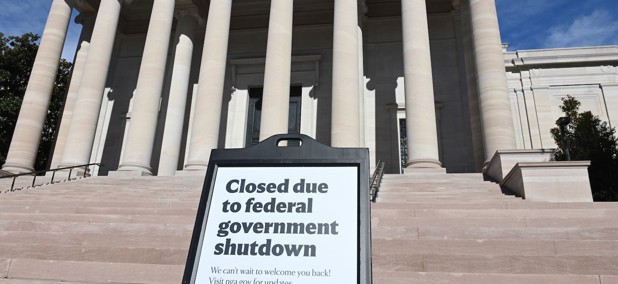
IRS Notifies States There Will Be No Direct File Program For 2026
We knew this was coming, but it doesn’t make it any less stupid. The road to the IRS’ Direct File program was long and hard-fought. We here at Techdirt have been talking about, and advocating for, something like the Direct File program for at least 15 years. The concept behind the program is a simple one. For a class of citizens with very simple income and tax payments, the IRS already has all the information it needs to process a tax return. In those cases, the IRS can simply mail the information it has to a taxpayer, ask them to sign off verifying the information is complete and accurate, and then process the return. The problem with this is that it cuts out the tax-prep industry that absolutely adores preying on these very same people to milk them for tax-prep services they don’t actually need.
For decades, the industry did exactly that. Even as the government partnered with private tax preparation companies like Intuit to provide federally backed “free” tax-prep websites and platforms, those same companies did everything they could to hide those free services and, in lieu of that, try to sell add-on services to those who were supposed to be able to file for free. While this eventually led to massive FTC fines for Intuit, this was the Faustian bargain that came from years and years of lobbying: The government would work with private industry for free filing programs in exchange for those same companies getting the government to line vulnerable citizens up like cattle headed to slaughter.
The IRS’ Direct File program came directly in the aftermath of the shady shit companies like Intuit did. It piloted in 2023, was a resounding success, and went live in 12 states in 2024. In April of this year, reports of Trump’s plans to end the program filtered into the news, even as the reviews by users of Direct File were overwhelmingly positive. Then, in August, IRS Commissioner Billy Long, himself a tax-prep industry player, said the program would be gone.
And, if you were holding onto any hope that this administration would keep a program in place that citizens love and ultimately reduces the overhead on the IRS, consider your hopes dashed. The IRS has begun notifying the states that had Direct File programs that the program will not be available for 2026 tax filings.
In an email sent from the IRS to 25 states, the tax agency thanked them for collaborating and noted that “no launch date has been set for the future.”
“IRS Direct File will not be available in Filing Season 2026,” says the Monday email, obtained by Nextgov/FCW and confirmed by multiple sources. It follows reports that the program was ending and Trump’s former tax chief, Billy Long, remarking over the summer that the service was “gone.”
Instead, that whole big beautiful bill we have heard so much about contained directions for the IRS to once again partner with private industry in a Free File program. The exact situation we were in that led to so much outrage at the behavior of those private companies, which in turn led to the creation of Direct File to begin with. This is simply winding the clock backwards to something people hated and calling it “progress.”
“It’s not surprising since the Trump administration sabotaged Direct File all through this year’s filing season, at the urging of tax prep monopolies like TurboTax,” Adam Ruben, the vice president of the Economic Security Project, told Nextgov/FCW. “Trump’s billionaire friends get favors while honest hardworking Americans will pay more to file their taxes.”
This isn’t something that can even be argued, honestly. It’s exactly what is happening. And, frankly, actions like this put the lie to Donald Trump’s claim to be fighting for the “little guy”. It’s all a bullshit grift, you see, with middlemen who are as wealthy as they are needlessly having Americans queued up to be conned.
This was a good program. The people who used it liked it. No serious negative consequence was experienced in its use.
And Trump did away with it so that mega-corporations like Intuit can continue skimming money from citizens in order to tell the IRS what it already knows.
Google, Microsoft, and Meta Have Stopped Publishing Workforce Diversity Data
Mark Zuckerberg’s illegal school drove his neighbors crazy
The Crescent Park neighborhood of Palo Alto, California, has some of the best real estate in the country, with a charming hodgepodge of homes ranging in style from Tudor revival to modern farmhouse and contemporary Mediterranean. It also has a gigantic compound that is home to Mark Zuckerberg, his wife Priscilla Chan, and their daughters Maxima, August, and Aurelia. Their land has expanded to include 11 previously separate properties, five of which are connected by at least one property line.
The Zuckerberg compound’s expansion first became a concern for Crescent Park neighbors as early as 2016, due to fears that his purchases were driving up the market. Then, about five years later, neighbors noticed that a school appeared to be operating out of the Zuckerberg compound. This would be illegal under the area’s residential zoning code without a permit. They began a crusade to shut it down that did not end until summer 2025.
WIRED obtained 1,665 pages of documents about the neighborhood dispute—including 311 records, legal filings, construction plans, and emails—through a public record request filed to the Palo Alto Department of Planning and Development Services. (Mentions of “Zuckerberg” or “the Zuckerbergs” appear to have been redacted. However, neighbors and separate public records confirm that the property in question belongs to the family. The names of the neighbors who were in touch with the city were also redacted.)

Questions swirl after Trump’s GLP-1 pricing deal announcement
At a White House event Thursday, President Trump announced deals with drugmakers Novo Nordisk and Eli Lilly to offer their popular GLP-1 obesity and diabetes drugs at lower prices for some Americans, namely some on Medicare and Medicaid plans. But questions linger about the significance of the deal.
According to the announcement, Medicare and state Medicaid programs will be able to purchase a month’s supply of Ozempic, Wegovy, Mounjaro, and Zepbound at $245 each for eligible patients. Eligible people on Medicare will have a $50 co-pay.
The negotiated price is a significant cut from the drugs’ list prices: The list price for Ozempic is $997, Wegovy is $1,350, Mounjaro is $1,080, and Zepbound is $1,086. But, of course, purchasers rarely pay drug list prices. It’s unclear how much Medicare and Medicaid would have paid for the drugs without this deal and what the savings will be.

Fox News Desperately Tries To Repair The Broken Simulation
Within twenty-four hours of Republicans getting crushed in elections they’d convinced themselves were winnable, Fox News deployed the counter-move.
Not denial—the losses were too visible for that. Bret Baier had already explained to Fox & Friends viewers how bad it was. “It’s a big loss,” he said. Not just the results, but “the spreads are surprising.”
Not acceptance—that would threaten the narrative that MAGA represents the inevitable American future.
Instead, on Wednesday night’s edition of The Ingraham Angle, Laura Ingraham offered viewers a reframe so brazen it became an on-screen graphic:
“By Winning, Democrats Are Actually Losing.”
The emperor has no clothes. And what makes this moment pedagogically valuable is that lots of people are noticing simultaneously. The propaganda is at its most naked. Which means we can analyze how it works precisely when it’s failing to work.
When You Can See It
Propaganda works by being invisible. The best propaganda doesn’t feel like propaganda—it feels like common sense, like the way things obviously are, like what everyone already knows.
When propaganda becomes visible as propaganda, it loses most of its power. Once you can see the strings, the puppet stops being convincing.
Ingraham just made the strings visible. Not through some subtle slip, but by putting “By Winning, Democrats Are Actually Losing” on screen as a graphic. This is propaganda’s nightmare scenario: the mechanism exposed precisely when it’s most desperately needed.
Let’s break down the structure so you can recognize it when it’s less obvious:
The Core Move: Reality Inversion
When observable reality contradicts your narrative decisively, you have limited options. Denial becomes impossible when the contradiction is too visible. Acceptance destroys the narrative you need to maintain.
So you invert: acknowledge the reality while controlling what it means. Transform the evidence that contradicts your narrative into evidence that confirms it.
Ingraham’s version:
- Democrats won—can’t deny.
- But their policies will fail—contestable.
- So people will flee to red states—contestable.
- Which means Democratic victory produces Republican benefit—inversion complete.
- Therefore by winning, they’re actually losing—reality inverted.
Good propaganda makes this subtle. It spends weeks establishing premises. It lets viewers do the inversion themselves through implication.
But Ingraham had twenty-four hours. The fracture was fresh. The narrative needed immediate repair. So she just… said it. Put it on screen. Made it a graphic.
That’s not sophisticated propaganda. That’s desperate propaganda. And desperate propaganda exposes its mechanics because it doesn’t have time for subtlety.
The Terror of Being Seen
Here’s what you need to understand about what this moment means for Laura Ingraham, for Fox News, for the entire propaganda infrastructure:
Their power depends on invisibility.
Not invisibility of the network—everyone knows Fox News exists, knows it’s conservative. That’s not the invisibility that matters.
The invisibility that matters is the machinery itself. The mechanisms through which they shape perception, manufacture consensus, control interpretation. Those need to be invisible or they stop working.
When you can see someone trying to make you believe something, you become resistant to believing it. Persuasion operates through the illusion of discovery—you think you’re arriving at conclusions independently when really you’re being guided there. Once you see the guidance, the spell breaks.
Ingraham just made the guidance visible. And this is terrifying for propagandists because once people see the machinery, they start seeing it everywhere.
If you can see Ingraham inverting reality to maintain narrative, you might start asking: what else has been inverted? When they said the economy was terrible while data showed recovery—was that reality inversion too? When they said protests weren’t representative—was that the same move? When they said Trump’s felony conviction would help him—was that the same desperate gymnastics?
One visible instance threatens to illuminate the entire structure. Recognition cascades backward through everything you’ve believed. This is the propagandist’s nightmare.
But it gets worse for them. Because propaganda doesn’t just require individual belief—it requires collective suspension of disbelief. It needs to be socially reinforced. Your family believes it, your neighbors believe it, your social media feed confirms it. When everyone around you accepts the frame, questioning it feels crazy. That social reinforcement is what makes propaganda sticky.
But when lots of people simultaneously notice the emperor has no clothes, that reinforcement fractures. If you think you’re alone in seeing the absurdity, you might doubt yourself. But if you suspect lots of people are simultaneously recognizing it—if Twitter is mocking it, if even conservative commentators seem skeptical, if your Fox-watching uncle texts you “that was weird”—then the collective suspension of disbelief cracks.
That’s what propagandists fear most. Not individual disbelief—that can be isolated, dismissed. But mass simultaneous recognition that the machinery is visible, the narrative is constructed, the consensus is manufactured.
When lots of people at once see the strings, the puppet show ends.
The Prostrators and the Propagandists
Laura Ingraham trying to convince viewers that Democratic victories are actually defeats would be merely pathetic if it existed in isolation. But it doesn’t.
She’s performing this desperate reality inversion while Tim Cook presents a gold-plated tribute in the Oval Office like some feudal vassal paying homage to his lord. While Zuckerberg congratulates Trump. While Bezos killed the Post endorsement then offered “extraordinary” praise. While Marc Andreessen proclaims “morning in America”—liberation from the terrible oppression of having to pretend to care about other people at dinner parties.
The propagandists and the prostrators serve the same master: the simulation of MAGA inevitability. Ingraham maintains it through reality inversion. The tech oligarchs maintain it through strategic submission.
And both have soiled their reputations into the annals of history with the same calculation: that bending the knee is wisdom, that accommodation is strategy, that surrendering dignity is just being realistic about power.
They’re wrong. And Tuesday night proved it.
The Economic Royalists Chose This
Let’s be clear about what happened after November 2024. These weren’t small business owners protecting their livelihoods. These were some of the wealthiest, most powerful people on the planet—people with resources to resist, with platforms to speak truth, with security that ordinary people don’t have—choosing to prostrate themselves.
Tim Cook didn’t need to perform feudal tribute. Apple has more cash reserves than most countries’ GDP. Cook could have maintained dignified distance. He chose submission instead.
Bezos owns the Washington Post—a paper with “Democracy Dies in Darkness” as its motto. He killed their endorsement, then offered extraordinary praise to Trump. He has wealth that makes him effectively untouchable. He chose to touch his forehead to the ground anyway.
These aren’t victims. These are people who looked at Trump’s explicit authoritarianism and decided their wealth and power would be safer if they signaled submission early.
They made a bet: MAGA represents the inevitable future, resistance is futile, accommodation is wisdom.
Tuesday night, reality called that bet. And they lost.
The Sociopaths Are Shocked
What links Ingraham’s desperate propaganda and Cook’s feudal tribute is the same fundamental miscalculation: they thought everyone would become what they are.
The propagandists thought everyone would accept obvious inversions if delivered confidently enough. The prostrators thought everyone would bend the knee once they demonstrated it was safe to do so. Both groups convinced themselves that cynicism is realism, that principles are obstacles, that most people are just waiting for permission to abandon dignity.
They were shocked to discover: no. Most people aren’t sociopaths. Most people won’t accept that winning means losing. Most people won’t prostrate themselves to authoritarians just because billionaires did it first.
The propagandists control the platforms. The prostrators control the wealth. Together they manufacture consensus, shape information flows, fund the campaigns, own the infrastructure.
And they still lost. Because manufactured consensus only works until lived experience contradicts it. Because reality has veto power. Because most people can still recognize that two plus two equals four even when Laura Ingraham explains otherwise and Tim Cook nods along.
What Tuesday Night Means for the Prostrators
The propagandists are scrambling to repair the simulation because their credibility depends on narrative maintenance. But what about the prostrators?
It means their bet is failing. The calculation that MAGA inevitability made accommodation wise—that’s looking shaky.
Because here’s the thing about authoritarian systems: they don’t reward early submission. They despise it. Trump publicly humiliated Musk despite Musk’s hundreds of millions in support. You think Tim Cook’s golden tribute bought him security? It bought him contempt—Trump’s and ours.
The prostrators thought they were being strategic. They were being cowards. And now they’re trapped. Having soiled their reputations through public submission, they can’t easily reverse course. Having signaled that they’ll bend to power, they’ve marked themselves as bendable.
And the simulation they bent to support is fracturing. Which means they prostrated themselves to a future that might not arrive. They surrendered dignity for security in an order that’s proving less inevitable than claimed.
What This Teaches Us About All Propaganda
This moment is valuable precisely because the propaganda is so naked. When you can see the machinery clearly in one instance, you can start recognizing it everywhere:
Watch for acknowledgment followed by inversion. “Yes that happened, but it actually means the opposite because…”
Notice predictions stated as certainties. “Will fail” becomes “are failures.” Grammar converts uncertainty into inevitability.
Track coherence debt. How many special exceptions does accepting this require? How much explaining away of observable reality?
Test predictions. Inversions depend on future consequences. Did those consequences happen? When they don’t, does the framework adjust or create new explanations?
Check alternative frameworks. Does this interpretation require believing this source exclusively? What would someone outside this information silo conclude?
Ask what’s being protected. Inversions happen when reality threatens something desperately needed. What narrative does this inversion protect?
These aren’t just tools for analyzing Fox News. They’re tools for analyzing all propaganda—including propaganda that aligns with your values, that comes from sources you trust, that feels like common sense.
Because left-wing propaganda exists too. Technocratic propaganda. Progressive propaganda. The structure is the same even when the content differs.
Learning to see propaganda when it’s naked—when it’s obviously desperate—teaches you to see it when it’s sophisticated.
Two Plus Two Equals Four
There are truths that survive every inversion, every sophisticated reframing, every attempt to make reality mean its opposite.
Democrats won elections in New Jersey, Virginia, and New York. That’s what winning is—getting more votes, your candidates taking office.
You can predict those victories will lead to bad governance. You can work to defeat those officials in future elections. You can argue their policies will fail.
But you cannot make victory into defeat through definitional gymnastics. You cannot invert observable reality through prediction about what it might eventually mean.
When Fox News puts “By Winning, Democrats Are Actually Losing” on screen, they’re not offering analysis. They’re attempting reality maintenance for viewers whose framework just got contradicted.
The sophistication of the attempt doesn’t make it true. The confidence with which it’s delivered doesn’t make it coherent. The fact that some people accept it doesn’t make it correspond to reality.
Two plus two equals four. Democrats winning elections means Republicans lost. And no amount of propagandistic inversion changes that, no matter how desperately the simulation needs it to.
The Wire Still Holds
The simulation fractured when Republicans lost decisively. Laura Ingraham’s attempt to repair it through naked reality inversion is evidence of fragility, not strength.
You don’t need to tell people that winning is actually losing unless losing threatens your entire framework. You don’t make the propaganda machinery visible unless you’re desperate enough that visibility is worth the risk.
The terror for propagandists isn’t that this particular inversion might fail. It’s that lots of people are simultaneously seeing the machinery. That once you see propaganda as propaganda, you start seeing it everywhere. That recognition cascades backward through everything you’ve believed.
The wire is holding. Not because Fox News isn’t powerful—they are. The inversion will work on some viewers. The simulation will partially reconstruct.
But when propaganda becomes naked, when the machinery is visible, when lots of people simultaneously notice the emperor has no clothes—that’s when resistance becomes possible. Not because you’ve won, but because you can finally see clearly what you’re fighting.
And understanding their desperation—seeing how scared they are—is strategic intelligence. They’re not operating from strength. They’re scrambling. The propagandists are deploying naked reality inversion. The prostrators are doubling down on bets that are already failing.
That’s when they’re most dangerous. Desperation produces escalation. But it’s also when they’re most vulnerable. Because every desperate move that fails to restore the simulation reveals further fragility.
May Love Carry Us Home
The cognitive technology for recognizing propaganda isn’t just intellectual—it’s grounded in love for what’s real.
Love for truth that withstands inversion. Love for your own capacity to see clearly even when powerful forces try to make you doubt what you observe. Love for people trying to maintain coherence in hostile information environments.
That love is what makes you resist when Laura Ingraham explains that winning is losing. Not because propaganda doesn’t work on you—it works on everyone sometimes. But because when it becomes visible, when you can see someone trying to make you believe the impossible, love for truth is what lets you say: no. I see what you’re doing. And I choose reality instead.
The machinery is visible. The emperor has no clothes. Lots of people are noticing simultaneously. And that recognition—that moment when propaganda reveals itself as propaganda—is where resistance begins.
Not in never being manipulated. But in seeing manipulation when it happens. Not in being immune to propaganda. But in recognizing it when the machinery becomes visible and choosing truth over the inversion.
Two plus two equals four. Winning means winning. And we can see you trying to tell us otherwise, Laura. We can see the strings. And once you see them, you can’t unsee them.
The circus continues. But this time, we’re watching the performance with clear eyes. And that clarity—that refusal to accept obvious inversion—is how the wire holds.
Mike Brock is a former tech exec who was on the leadership team at Block. Originally published at his Notes From the Circus.
Trump’s Hatred of EVs Is Making Gas Cars More Expensive
So long, Assistant—Gemini is taking over Google Maps
Google is in the process of purging Assistant across its products, and the next target is Google Maps. Starting today, Gemini will begin rolling out in Maps, powering new experiences for navigation, location info, and more. This update will eventually completely usurp Google Assistant’s hands-free role in Maps, but the rollout will take time. So for now, the smart assistant in Google Maps will still depend on how you’re running the app.
Across all Gemini’s incarnations, Google stresses its conversational abilities. Whereas Assistant was hard-pressed to keep one or two balls in the air, you can theoretically give Gemini much more complex instructions. Google’s demo includes someone asking for nearby restaurants with cheap vegan food, but instead of just providing a list, it suggests something based on the user’s input. Gemini can also offer more information about the location.
Maps will also get its own Gemini-infused version of Lens for after you park. You will be able to point the camera at a landmark, restaurant, or other business to get instant answers to your questions. This experience will be distinct from the version of Lens available in the Google app, focused on giving you location-based information. Maybe you want to know about the menu at a restaurant or what it’s like inside. Sure, you could open the door… but AI!

Ikea’s Smart Home Reset Goes Back to Basics
Foreign Food Safety Inspections Hit Historic Low After Trump Cuts
American inspections of foreign food facilities — which produce everything from crawfish to cookies for the U.S. market — have plummeted to historic lows this year, a ProPublica analysis of federal data shows, even as inspections reveal alarming conditions at some manufacturers.
About two dozen current and former Food and Drug Administration officials blame the pullback on deep staffing cuts under the Trump administration. The stark reduction marks a dramatic shift in oversight at a time when the United States has never been more dependent on foreign food, which accounts for the vast majority of the nation’s seafood and more than half its fresh fruit.
The stakes are high: Foreign products have been increasingly linked to outbreaks of foodborne illness. In recent years, FDA investigators have uncovered disturbing lapses in facilities producing food bound for American supermarkets. In Indonesia, cookie factory workers hauled dough in soiled buckets. In China, seafood processors slid crawfish along cracked, stained conveyor belts. Investigators have reported crawling insects, dripping pipes and fake testing data purporting to show food products were pathogen free.
In 2011, Congress — concerned about the different standards of overseas food operations — gave the FDA new authority to hold foreign food producers to the same safety standards as domestic ones. Although the agency’s small team remained unable to visit every overseas facility, inspections rose sharply after the mandate — sometimes doubling or tripling previous rates.
Now, the U.S. is on track to have the fewest inspections on record since 2011, except during the global pandemic.
Foreign Food Inspections at Lowest Point in Over a Decade, Excluding Pandemic Years
Fewer inspections have taken place than at any time since 2011, excluding 2020 to 2022, when inspections slowed significantly because of the coronavirus pandemic.

Inspections began to decline early in the administration, after 65% of the staff in the FDA divisions responsible for coordinating travel and budgets left or were fired in the name of government efficiency.
Investigators suddenly had to book their own flights and hotels, obtain diplomatic passports and visas, and coordinate with foreign authorities, former and current FDA staffers told ProPublica. After workers tasked with processing expenses were laid off, investigators waited as a backlog of unfulfilled reimbursements climbed to more than $1 million, a former staffer said. (Investigators are responsible for paying off their own credit cards.) Senior investigators close to retirement also took the opportunity to get out.
Played out on a large scale, this combination of firings and voluntary departures has left the agency scrambling to make up for the loss of 1 out of every 5 of its workers responsible for ensuring the safety of America’s food and drugs.
Susan Mayne, the former director of the FDA’s Center for Food Safety and Applied Nutrition and an adjunct professor at Yale School of Public Health, expressed alarm at the drop in foreign inspections.
“It’s very concerning that we are seeing these kinds of reductions,” said Mayne, who emphasized the administration’s cuts have hamstrung an agency that has long struggled to retain investigators who conduct both foreign and domestic inspections. In an attempt to maintain its numbers, the agency had been working on initiatives to elevate pay and adopt specialized training for investigators. “The plans that were in place to address staffing have now been undermined.”
Help Us Report on Food Safety
We are still reporting. Do you know anything about how the current administration is approaching food safety? We want to talk to current and former federal workers — from the FDA, USDA and CDC — as well as food safety experts and industry professionals. You can reach Annie Waldman on Signal at 347-549-0332 or by email at annie.waldman@propublica.org.
The gutting of the workforce coincides with other actions the administration has taken that are poking holes in the nation’s food safety net. In March, the FDA announced it was delaying compliance with a rule to speed up the identification and removal of harmful products in the food system, to give more time for companies to follow the rules. The next month, it suspended a quality control program that ensured consistency and accuracy across its 170 pathogen and contaminant labs as a result of staffing cuts.
Then in July, the administration quietly scaled back the Foodborne Diseases Active Surveillance Network, also known as FoodNet, shrinking its surveillance to just two pathogens: salmonella and a common type of E. coli. The program — a partnership between the FDA, the Centers for Disease Control and Prevention, the Department of Agriculture and state health departments — was responsible for the critical monitoring of eight foodborne illnesses, including infections caused by the deadly bacteria listeria. In response to the change, a CDC spokesperson previously claimed that the program’s surveillance had been duplicative.
The administration did not respond to ProPublica’s questions about these actions.
“There are going to be things that fall through the cracks, and these things aren’t negligible,” said a current FDA investigations official who spoke on the condition of anonymity, fearing reprisal. The same was true of other current and former agency staffers; those who still had jobs risked losing them, while former employees worried about their chances of being rehired or the security of their severance or retirement packages.
The Department of Health and Human Services refused to respond to any of ProPublica’s questions about the decrease in foreign food inspections, citing the government shutdown. “Responding to ProPublica is not considered a mission-critical activity,” said Emily Hilliard, the department’s press secretary. The FDA and the White House also did not respond to requests for comment.
“Basic regulatory oversight functions have been decimated,” said Brian Ronholm, the director of food policy at Consumer Reports. “There’s an enhanced risk of more outbreaks.”
An Agency Already Struggling
The FDA has long been one of the main protectors of the American food supply. The federal agency oversees about 80% of what people eat, including fruits, vegetables, processed goods, dairy products and infant formula and most seafood and eggs. It regulates more than 220,000 farms, food plants and distributors, inspecting facilities, testing for pathogens, tracing outbreaks and issuing recalls.
Only 40% of the facilities that the FDA regulates are within the nation’s borders. While the agency examines some products at ports of entry, those reviews are often cursory; workers cannot manually inspect every import or uncover whether a foreign plant properly cleans its equipment, conducts adequate salmonella testing or has a rat infestation. In-person facility inspections are necessary for that kind of insight.
For example, in 2023, an FDA investigator inspected a Chinese manufacturer of soy protein powder, a common additive in shakes and other beverages. While the company had previously imported its products into the United States without scrutiny, the investigator’s thorough visit found numerous violations, according to an agency report obtained through a federal records request.
Live insects crawled through the facility’s production workshop, while dead ones lay on the floor. Condensation from rust-covered pipes dripped into a water tank waiting to be mixed with raw ingredients. Just outside the plant, the investigator found processing waste and stagnant water coated with a green biofilm, attracting a swarm of bugs too numerous to count.
When the investigator reviewed the firm’s bacteria testing records, which purportedly verified the products were free of salmonella and E. coli, he discovered the company was providing fake data to “satisfy the customer specifications,” according to his inspection report.
Company officials also tried to obstruct his inspection, blocking him from entering a packaging room when he tried to photograph the pest infestation. After the three-day review, the federal agent censured the company, Pingdingshan Tianjing Plant Albumen Co. Ltd., which promised to take corrective actions. The company did not respond to ProPublica’s emailed questions.
If investigators find a foreign food facility is unable to comply with American safety requirements or refuses to permit the FDA to inspect its establishment, the agency can block its products from entering the country.
These crucial foreign inspections are neither easy nor cheap. They typically last longer than domestic ones and cost nearly $40,000 a visit, and they can require months of logistical planning, special visas and diplomatic approval from the host country.
In part because of these challenges, there was a time when the FDA conducted only a few hundred foreign inspections annually.
Then Congress passed the Food Safety Modernization Act of 2011, which set firm targets for the agency: It needed to conduct more than 19,000 foreign food inspections annually by 2016 and increase the number of food field staff to no fewer than 5,000 workers.
The FDA has never fulfilled this congressional mandate. Even before the second Trump administration, the agency was inspecting less than 10% of its target each year.
Dr. Stephen Ostroff, a former acting commissioner of the FDA who also served as the deputy commissioner for foods and veterinary medicine, said that the agency’s foreign food inspections have long been hindered by a lack of resources.
“It’s not because the agency isn’t interested in doing more overseas inspections — they are,” said Ostroff, who retired from the agency in 2019. “They simply don’t have the resources to be able to meaningfully do large numbers of overseas inspections.”
One major obstacle has been a lack of financial support. “Congressional appropriators have never provided the funding that FDA has determined it would need to do those foreign inspections,” said Mayne, who retired from the agency in 2023. Before the food safety act passed, the Congressional Budget Office estimated that the agency would need about $1.4 billion over five years to comply with the new requirements, which included the expansion of field staff and foreign inspections. But lawmakers approved only a fraction of that amount.
As of last year, the agency had about 430 employees conducting both foreign and domestic food inspections, with only 20 investigators dedicated solely to international assignments.
With such limitations, the agency’s inspections have often been reactive instead of proactive. In 2023, for example, FDA investigators did not descend on a Mexican strawberry farm until about 20 people had been hospitalized with hepatitis A, a highly contagious infection that causes liver inflammation and, in some cases, liver failure and death.
Hepatitis A is spread through the consumption of small or even microscopic bits of feces. Farm workers can shed the virus when picking fruit, or it can be transmitted through contaminated water.
At the Mexican berry farm, federal investigators found significant safety violations, including sanitation facilities with hand-washing water that was dirty, gray and leaking throughout the growing area; one toilet offered no ability to wash one’s hands. The FDA censured the company, citing 11 violations of American food safety regulations. According to public data, the agency did not reinspect the farm to ensure it had made corrections even as its products kept entering the United States.
In January, less than two weeks before the second Trump administration came in, a report by the Government Accountability Office rebuked the FDA for consistently falling short of its foreign food inspection targets. The oversight office, recognizing the vital importance of the FDA’s food safety mission, urged Congress to direct the agency to assess how many foreign inspections are needed to keep the country’s food supply safe.
The FDA said in response that, in 2025, it would increase staffing levels and prioritize the training and development of investigators.
Then Donald Trump was inaugurated.
Reversing a Decade of Gains
During the first few weeks of the new Trump administration, foreign inspections carried on as usual. But the sudden hemorrhaging of FDA workers through firings, retirements and buyouts quickly foiled the agency’s plans to ramp up staff and inspections.
While the administration had vowed that food safety inspectors would be spared, it began to cut critical investigative support staff in March, a move that would eventually incapacitate foreign inspections, current and former FDA staffers told ProPublica.
As the agency lost support staff, their responsibilities shifted to investigators, who were quickly overwhelmed by the new burdens. Passports, visas and travel were all delayed.
“Support staff are not just there to bide time — they have a meaningful role,” said Sandra Eskin, who served as a top USDA food safety official in the Biden administration and is now the CEO of advocacy group Stop Foodborne Illness. “It’s like a game of Jenga: If you pull out one from the middle or the bottom, the whole tower collapses.”
In recent years, the agency has typically been able to conduct about 110 foreign food inspections each month, but in March, the number of inspections dropped almost in half compared with the monthly average in the previous two years.
As specialists who handled reimbursements were also fired, some investigators waited months for repayment, which made them reluctant to take on other foreign assignments, former and current staffers said.
The cuts and growing work burden quickly collapsed morale across the investigative division, leading many senior investigative officials with decades of experience to retire.
“We already had a significant percentage of our workforce that was eligible for retirement,” said a current FDA employee in the investigations division, “so reading the writing on the wall, they decided to exit.” These departures also interrupted the development of new investigators, as some of the senior staff members who left had been tasked with training new hires, a process that can take up to two years.
“There’s been such a brain drain,” said food safety expert Jennifer McEntire, founder of consulting firm Food Safety Strategy, “when inspectors do go out and are observing things, there’s no phone-a-friend.”
Instead of addressing the shortfall, in May, FDA Commissioner Dr. Marty Makary announced that the agency would expand the number of unannounced foreign inspections, in which investigators show up at facilities without alerting them first. Given the limited staff and resources, several current and former staffers told ProPublica that the prospect of conducting unannounced visits was impractical and even “comical.”

“A foreign unannounced trip is like an accelerated coordination process,” said a current FDA investigations official. “If you’re going to increase the number and not increase the staff, we don’t know how to make some of that stuff work.”
By the end of July, the number of foreign food inspections conducted by the agency was nearly 30% lower compared with similar periods in the previous two years. The administration refused to provide ProPublica with up-to-date inspection numbers, so we relied on data from the FDA’s public inspection dashboard to conduct this analysis.
Foreign inspections are not the only tool for overseeing food from abroad. The agency has developed partnerships with counterparts in other countries to ensure comparable oversight and required importers to verify that their foreign suppliers are following American standards. However, former and current agency staffers said that these initiatives also have been impacted by the administration’s cuts and recent departures.
While the administration’s cuts were ostensibly ordered to maximize efficiency and productivity, they have had an opposite effect, several former and current FDA employees said, reversing years of progress.
“The goal is to accomplish as much and more with less resources,” said a former high-level FDA investigations official. “Less inspections translate to less regulatory oversight, and that, from a public health perspective, never benefits the public.”
Scott Faber, senior vice president for government affairs at the nonprofit advocacy organization Environmental Working Group, said the fallout is simple:
“When you take a wrecking ball to the federal government, you are going to wind up undermining important government functions that keep all of us safe, especially our food,” he said. “It’s only a matter of time before people die.”
How We Calculated Foreign Food Inspections
To understand how inspections of foreign food facilities have changed, we used a publicly available dashboard where the FDA publishes the results of those inspections. This database also includes inspections for manufacturers of drugs, medical devices, cosmetics, tobacco, biologics and veterinary products.
Beginning in May, we downloaded the entire database weekly and tracked the number of newly added foreign food facility inspections.
The dashboard is continually updated, with data added after inspections are finalized. That typically occurs 45 to 90 days after the close of an inspection, though some reports may not be posted until the agency takes a final enforcement action. Through an analysis, we determined that few reports are added more than 90 days after an inspection date.
Our story therefore only includes inspections through July. In an accompanying chart, we show the more provisional data through September. We asked HHS for recent figures, but the department refused to share them.
We considered the possibility that the downtrend in foreign food inspections was solely due to a lag in inspections being added to the dashboard. To check this, we performed the same analysis on domestic inspections. This analysis showed that while the rate of foreign inspections had significantly decreased, domestic inspections have continued almost uninterrupted.
The post Foreign Food Safety Inspections Hit Historic Low After Trump Cuts appeared first on ProPublica.
‘We’re closer to the end': Lawmakers signal some progress in bipartisan talks to end shutdown
Senators are getting closer to an agreement on a package of full-year appropriations bills for certain agencies and an accompanying stopgap bill to reopen the rest of government until a to-be-determined date. Lawmakers in both parties suggested many details still needed to be ironed out and there was not yet any broad agreement, but suggested the two sides were having ongoing conversations that have proven productive.
Sen. Gary Peters, D-Mich., declined to discuss the nature of the negotiations, saying only that they are in a pivotal moment.
“I don't want to characterize conversations,” Peters said. “We're in a sensitive time right now. It's important to say we're still talking and hopefully progress will be made.”
In a note of barely perceptible optimism, Sen. Mark Kelly, D- Ariz., said the Senate has inched closer to a resolution.
“Maybe we're moving.” Kelly said. “We're closer to the end of this than we are to the beginning.”
Sen. Susan Collins, R-Maine, said progress has been made in those conversations.
“The talks are more productive,” Collins said. “It's still a challenge, and there are issues to be solved.”
The senators are considering three full-year appropriations bills—to fund the Veterans Affairs Department, the Agriculture Department and the legislative branch—marking one-fourth of the twelve spending bills Congress must pass each year. The Senate approved a package earlier this year, but negotiators are working on a version that could clear the House and, potentially, be attached to a continuing resolution to temporarily fund the rest of government.
Republican senators noted that issues on the three-bill “minibus” have mostly been ironed out, though details remained under wraps. The Senate and House have passed vastly different fiscal 2026 appropriations bills, with the latter measures introducing significant cuts that the upper chamber largely avoided in its bipartisan legislative proposals.
Senate Democrats held a lengthy, two-plus hour meeting Tuesday afternoon, though they did not announce any strategy once it concluded.
“We had a very good caucus, and we're exploring all the options,” Senate Minority Leader Chuck Schumer, D-N.Y., told reporters after the lunch.Peters said after the meeting that conversations on how to end the shutdown were “still a work in progress,” adding the meeting was so long because “there was a lot to discuss.”
While the Senate rejected the House-backed continuing resolution that would fund agencies through Nov. 21 for the 14th time on Tuesday, it appears the legislation is no longer operative. Senate Majority Leader John Thune, R-S.D., said a new CR—for agencies not otherwise funded by full-year spending bills, should such a deal come together—with a later expiration has become necessary.
“The Nov. 21 deadline no longer makes a lot of sense, so clearly it would need to be extended,” Thune said. He added the new deadline was still being discussed but the goal was to avoid another year-long CR.
]]>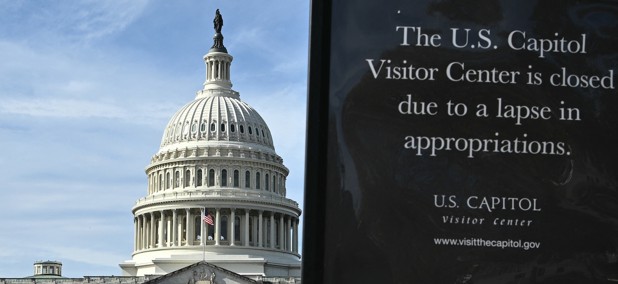
FBI Warns of Criminals Posing as ICE, Urges Agents to ID Themselves
Big drop in Kennedy Center ticket sales

For the Washington Post, Travis M. Andrews, Jeremy B. Merrill, and Shelly Tan with the analysis:
According to the spending data, drawn from 40 million credit and debit cards analyzed by the consumer data and analytics company Consumer Edge, less than half as much money was spent on tickets in September and the first half of October 2025 as during that same period in 2024. This is less than people spent on the center during any other year since 2018, except 2020, when the venue was locked down for most of the year.
Nice touch with the square pies as seats. That’s a lot of empties.
Tags: Kennedy Center, sales, tickets, Washington Post