Shared posts

08 Feb 19:29

The Supreme Court’s newest attack on voting rights, explained

by Ian Millhiser
Activists rally for voting rights outside the Supreme Court on June 23, 2021. | Drew Angerer/Getty Images

The Court’s median justice just made it much harder to stop attacks on the right to vote.

On Monday night, the Supreme Court handed down a deeply alarming decision that suggests that the Court’s Republican majority is about to cut away one of the few parts of the Voting Rights Act that it hasn’t already gutted or killed.

The immediate impact of the Court’s 5-4 decision in Merrill v. Milligan is that Alabama’s new congressional maps, which a three-judge panel that includes two Trump appointees determined to be an illegal racial gerrymander, will take effect in the 2022 election. Under those maps, only one of the state’s seven districts — or 14 percent of the US House seats — has a real shot of electing a Black lawmaker. African Americans make up about 27 percent of the state’s population.

The lower court ordered the state to draw at least two districts “in which Black voters ... have an opportunity to elect a representative of their choice.” Thus, had the lower court decision taken effect, it is likely that the racial composition of Alabama’s congressional delegation would closely match that of the state as a whole.

Monday’s order only suspends the lower court’s decision until the Court can give this case a full hearing. But the allegedly racially gerrymandered map will be in effect for the 2022 election — and it could become permanent after the Supreme Court hears and decides the full case.

One reason the Court’s order in Merrill is disturbing is that Alabama’s lawyers offered an exceptionally weak legal argument when they asked the justices to block this lower court order. Their argument could potentially neutralize an important safeguard against racist gerrymanders. The Voting Rights Act provides fairly robust protections against racial gerrymanders — legislative maps that target voters of a particular race — but Alabama asked the Supreme Court to impose a new burden on plaintiffs challenging racial gerrymanders that may be impossible to overcome.

Justice Brett Kavanaugh wrote a separate concurring opinion that would impose a novel new restriction on all voting rights cases. More on the specific convoluted restriction later. But in creating his new restriction, Kavanaugh relied heavily on Purcell v. Gonzalez (2006), a decision which held that courts should be reluctant to change a state’s election rules as an election draws close. “Federal courts ordinarily should not enjoin a state’s election laws in the period close to an election,” Kavanaugh wrote.

There’s still a fairly obvious problem with Kavanaugh’s opinion. Alabama will not elect its new slate of US House members until November. It’s now February — nine months before the date of the general election and more than three months before the state’s next primary election. The state simply is not in a “period close to an election,” unless we count the entirety of 2022, and therefore the entirety of any year in which an election is held, as “close to an election.”

Technically, Kavanaugh’s opinion is not a binding precedent. It was joined only by Justice Samuel Alito, not by a majority of the Court. But Kavanaugh is also the median vote on this Republican-dominated Supreme Court — in politically charged cases, there are normally four justices to Kavanaugh’s left, and four to his right. That means that his words carry an unusual amount of weight, since it is unlikely that a litigant will find five justices willing to contradict him.

The bottom line is that Merrill — even in its temporary form — is a disaster for voting rights. It suggests that the Court is going to escalate its assault on the Voting Rights Act — and on voting rights more broadly. And it suggests that even exceedingly weak legal arguments offered by red states have a very good shot of prevailing in this Supreme Court.

 Chip Somodevilla/Getty Images
Hundreds of protesters rally outside the Hart Senate Office Building in Washington, DC, on August 2, 2021.

Kavanaugh would strip the federal judiciary of much of its power to protect voting rights

When Purcell was handed down in 2006, it largely went unnoticed by anyone who isn’t an election lawyer. Purcell warned that “court orders affecting elections ... can themselves result in voter confusion and consequent incentive to remain away from the polls,” and that this risk increases “as an election draws closer.”

No justice dissented in Purcell, and its warning about court orders that disrupt elections is best read as a note of caution. Purcell was correct that voters might be confused about how to vote if, say, a court were to order a bunch of polling precincts to be relocated on the eve of an election. So the Court asked judges to be careful about such last-minute orders without actually forbidding them in especially compelling cases.

But as the Court grew more conservative, it seemed to treat Purcell less as a reason for caution and more like a firm command. The Court’s Republicans relied on Purcell, for example, to halt lower court orders that would have made it easier to cast a ballot at the height of the pandemic.

Kavanaugh’s opinion in Merrill would expand Purcell even further if adopted. Alabama enacted its congressional maps on November 4, 2021, and the lower court handed down its decision striking down those maps on January 24, 2022 — well more than nine months before the general election.

Moreover, as Justice Elena Kagan notes in a dissenting opinion, the lower court heard “over seven days of testimony” and received “more than 1,000 pages of briefing.” The lower court opinion striking Alabama’s maps is 225 pages long. It’s unclear how these three judges could have moved any faster and still worked through the complicated factual questions in Merrill in a careful and judicious manner.

So one upshot of Kavanaugh’s opinion is that the Purcell window — the period that counts as “close to an election” — should extend for more than nine months. That’s such a long period of time when courts cannot hand down “orders affecting elections” that it would be helpful if Kavanaugh informed us when, exactly, a judge is allowed to hand down an order impacting a state’s election laws.

In fairness, Kavanaugh does write that there are some cases when Purcell should not apply, even if an election is about to happen. But he writes that lower courts are bound by Purcell unless “the underlying merits” of a case “are entirely clearcut in favor of the plaintiff.

 Chip Somodevilla/Getty Images
Then-Supreme Court nominee Judge Brett Kavanaugh holds up a small copy of the U.S. Constitution while answering questions before the Senate Judiciary Committee during the second day of his Supreme Court confirmation hearing on Capitol Hill on September 5, 2018.

Here as well, his opinion goes off the rails. As Chief Justice John Roberts writes in dissent, “the District Court properly applied existing law in an extensive opinion with no apparent errors for our correction.” (Roberts isn’t exactly known as a champion of voting rights. The fact that he accuses his Court of going too far in a voting rights case is itself remarkable.)

The underlying merits of Merrill are clear under existing law. Kavanaugh’s suggestion that the proper outcome is unclear only makes sense if you presume that longstanding Supreme Court precedents should be tossed out.

Thus, the upshot of Kavanaugh’s opinion appears to be two-fold. First, Kavanaugh would extend the Purcell window so that it apparently encompasses the entire election year. And, second, he would forbid judges from ruling in favor of voting rights plaintiffs during this window, even if those judges faithfully apply existing law, if Kavanaugh personally believes that this law should be changed.

How else should we understand Kavanaugh’s implication that this relatively straightforward case is not clear-cut?

Alabama seeks an unprecedented new restriction on the Voting Rights Act

The Court’s precedents governing racial gerrymandering are, admittedly, quite messy.

When a plaintiff alleges that a state’s legislative maps violate the Voting Rights Act — like the plaintiffs in the Alabama case are alleging — courts typically must apply the multi-step analysis that the Court laid out in Thornburg v. Gingles (1986). The last step of this analysis requires judges to weigh at least nine different factors before striking down a state’s legislative map.

In Merrill, however, Alabama did not attack any of the more confusing parts of the Gingles framework. Indeed, it made the baffling decision to attack what may be the most straightforward part of this framework.

Under Cooper v. Harris (2017), a fairly recent decision applying Gingles, a plaintiff who believes that a state should have an additional district where a particular minority group is in the majority must show that this group is “sufficiently large and geographically compact” that it is actually possible to draw a new district where they “constitute a majority.”

The purpose of this requirement, as Justice Kagan explains in her Merrill dissent, is to require voting rights plaintiffs to prove from the outset that “what they are asking for is possible.” There’s no point allowing a lawsuit to move forward if a court cannot actually give the plaintiffs what they seek.

In any event, the plaintiffs in Merrill cleared this very low bar. One set of plaintiffs, for example, hired a mathematician to produce four sample maps that feature compact districts, and that include two Black-majority districts.

 US District Court for the Northern District of Alabama
Four maps produced by mathematician Moon Duchin show how Black-majority congressional districts could be drawn in Alabama.

Alabama, however, asked the Supreme Court to impose a new restriction. According to the state, the Merrill plaintiffs erred because, in order to produce these sample maps, the plaintiffs had to “prioritize race first and consider other race-neutral factors second” — something the state claims is not allowed.

But this objection makes no sense. Again, Gingles and Cooper require a plaintiff who alleges that a state should have two Black-majority districts to first produce sample maps with two Black-majority districts. How is it even possible to complete that task without paying close attention to race?

As Kagan writes, “at no time has this Court held that plaintiffs must answer the race-infused question of the first Gingles condition without any awareness of race.”

Kagan does acknowledge one other possibility: “Plaintiffs can now use technology to generate millions of possible plans, without any attention to race,” she writes, and some of these randomly drawn maps would presumably contain two Black-majority districts.

But really, what’s the point of imposing such a burden on voting rights plaintiffs? Asking these plaintiffs to produce millions of random maps and then hunt through them to find some that include two Black-majority districts is a bit like asking Vox Media to fire its writers and replace them with a million monkeys banging away at a million typewriters.

Eventually, those monkeys would produce an analysis of the Supreme Court’s decisions that is just as trenchant as anything I could write — but only after churning out countless pages of gibberish.

In any event, Kavanaugh appears to believe that it is not “entirely clearcut” whether the Voting Rights Act requires the Merrill plaintiffs to use the monkeys-banging-on-typewriters method to produce sample maps.

While the Court figures that out, a total of five justices agreed to halt the lower court’s order and allow a racial gerrymandered map to be used in Alabama in 2022.
08 Feb 16:58

Kia and Hyundai warn 485,000 SUV owners to park outside due to fire risk

by Jonathan M. Gitlin
Kia and Hyundai warn 485,000 SUV owners to park outside due to fire risk

Enlarge (credit: Aurich Lawson)

Hyundai and Kia have issued a recall for nearly 485,000 SUVs (and a handful of sedans) due to the risk of engine bay fires, warning owners to park the vehicles outside until the repair work has been completed.

The problem affects 126,747 Kias—certain K900 sedans from model years 2016–2018 and all Sportage SUVs from model years 2014–2016.

Hyundai has a bigger task, as it's recalling 357,830 vehicles split between the Santa Fe (model years 2016–2018, not equipped with smart cruise control), the Santa Fe Sport (model years 2017-2018, not equipped with smart cruise control), the Santa Fe XL (model-year 2019, not equipped with smart cruise control), and the Tucson (model years 2014–2015).

Read 3 remaining paragraphs | Comments

08 Feb 12:34

IRS stops requiring selfies after facial recognition system is widely panned

by Jon Brodkin
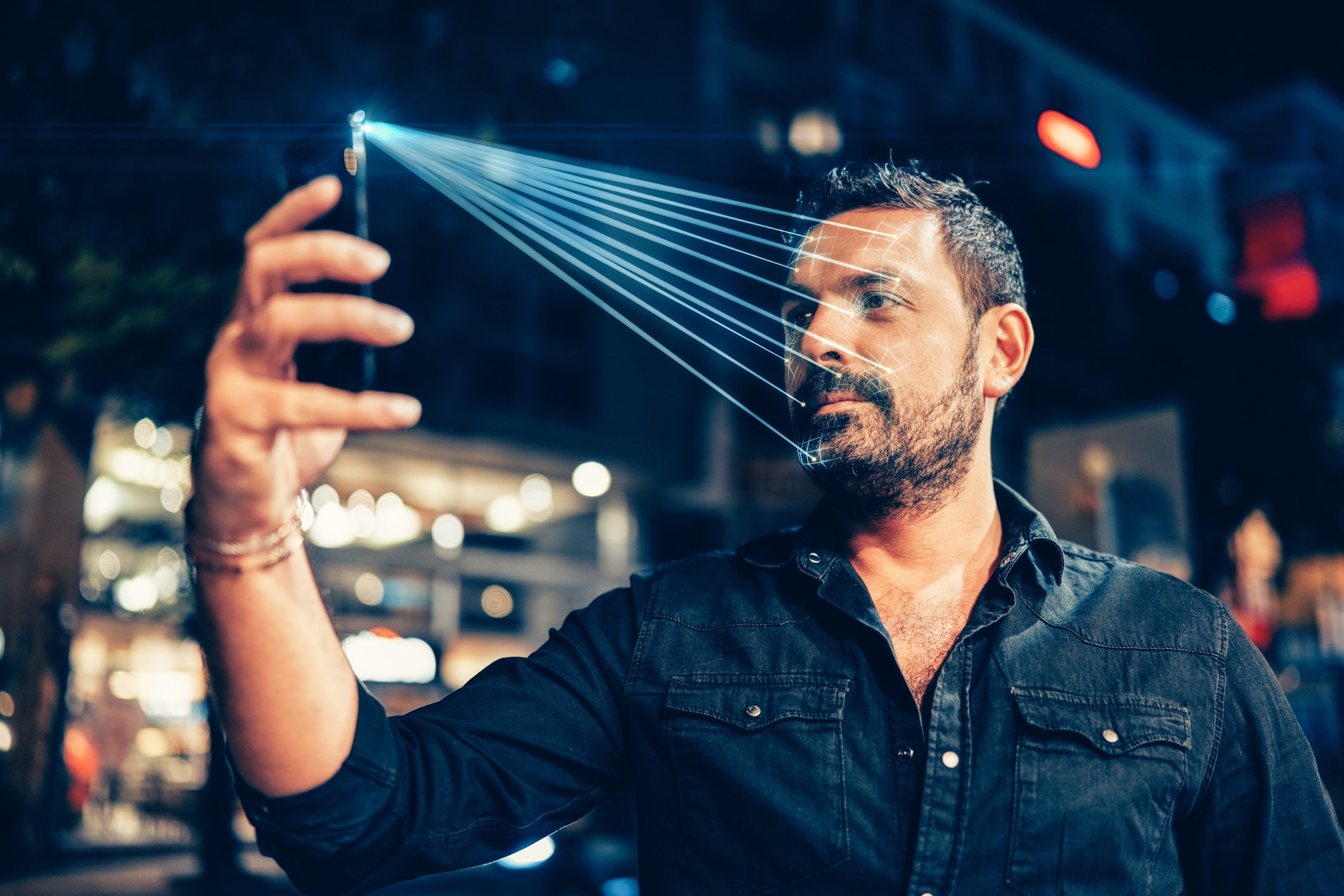
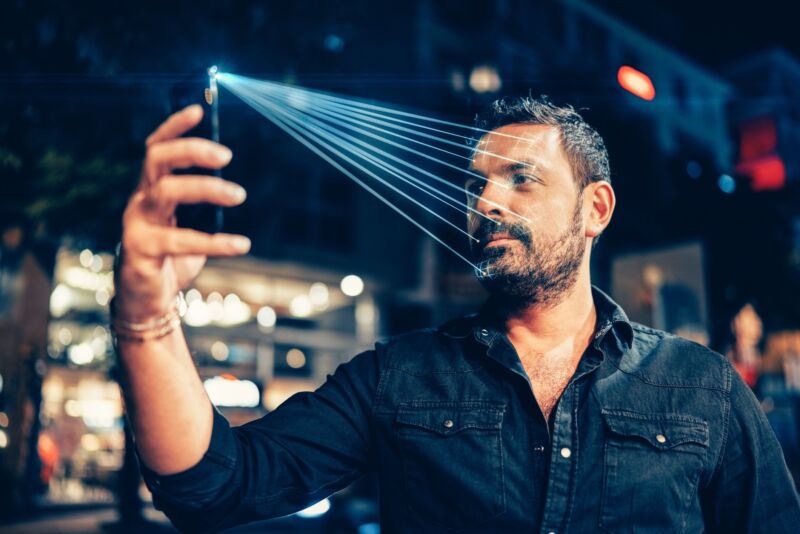
A man using a smartphone to take a selfie. The illustration has lines extending from the phone to his face to indicate that facial recognition is being used.

Enlarge (credit: Getty Images | imaginima)

The Internal Revenue Service is dropping a controversial facial recognition system that requires people to upload video selfies when creating new IRS online accounts.

"The IRS announced it will transition away from using a third-party service for facial recognition to help authenticate people creating new online accounts," the agency said today. "The transition will occur over the coming weeks in order to prevent larger disruptions to taxpayers during filing season. During the transition, the IRS will quickly develop and bring online an additional authentication process that does not involve facial recognition."

The IRS has been using the third-party system ID.me for facial recognition of taxpayers. Privacy and civil rights advocates and lawmakers from both major parties have objected to the system. The IRS wasn't demanding ID.me verification for filing tax returns but was requiring it for accessing related services, such as account information, applying for payment plans online, requesting transcripts, and the Child Tax Credit Update Portal.

Read 11 remaining paragraphs | Comments

08 Feb 12:33

Moderna’s omicron booster was only as good as current vaccine in monkey study

by Beth Mole
Extreme close-up photo of a gloved hand holding a tiny jar.

Enlarge / A vial of the current Moderna COVID-19 vaccine. (credit: Getty | Ivan Romano)

In a small group of monkeys, an omicron-specific version of Moderna's COVID-19 vaccine did not protect against the omicron variant better than Moderna's current, highly effective booster. This finding casts doubt on whether a switch to variant-specific doses is necessary.

The study was led by researchers at the National Institutes of Health and posted on a preprint server last Friday. The study has not been peer-reviewed or published in a scientific journal. It also has all the limitations of an animal study and only involved eight monkeys. The study's findings will have to be verified in human trials, which are currently underway.

Still, there's good reason to think the finding will hold up. As the authors of the study note, this isn't Moderna's first variant-specific booster. The company had previously developed a booster against the concerning variant beta. As with the omicron-specific booster, the beta-booster didn't outperform the original vaccine at protecting primates from beta. And that finding later held up in human trials.

Read 9 remaining paragraphs | Comments

08 Feb 12:33

$66 billion deal for Nvidia to purchase Arm collapses

by Financial Times
Extreme close-up promotional image of computer component.

Enlarge (credit: Arm)

SoftBank’s $66 billion sale of UK-based chip business Arm to Nvidia collapsed on Monday after regulators in the US, UK, and EU raised serious concerns about its effects on competition in the global semiconductor industry, according to three people with direct knowledge of the transaction.

The deal, the largest ever in the chip sector, would have given California-based Nvidia control of a company that makes technology at the heart of most of the world’s mobile devices. A handful of Big Tech companies that rely on Arm’s chip designs, including Qualcomm and Microsoft, had objected to the purchase.

SoftBank will receive a break-up fee of up to $1.25 billion and is seeking to unload Arm through an initial public offering before the end of the year, said one of the people.

Read 10 remaining paragraphs | Comments

08 Feb 12:31

German Court Fines Site Owner For Sharing User Data With Google To Access Web Fonts

by Tim Cushing

The European Union's data privacy law, the GDPR (General Data Protection Regulation), has caused all sorts of problems since its debut. Its debut was itself a mess, something that immediately resulted in a whole lot of websites simply refusing to allow European users to connect with them.

Since it was unclear how to avoid running afoul of the law, it was easier to avoid potential fines by simply cutting European users out of the equation. For everyone else, it was being greeted with a new warning about cookies at nearly every website they visited -- a small hassle to be sure, but a hassle nonetheless.

Then there were the truly unexpected consequences of the new law that imposed data-gathering and data-sharing restrictions on any business, whether they were internet-based or not. In some areas, GDPR was read as requiring retailers to notify purchasers of items when the items were returned -- something that would make the exchange of unwanted Christmas gifts extremely awkward.

In another weird case, post offices in Ireland removed waste bins from their facilities because customers were throwing out unwanted mail and receipts, resulting the offices' unintentional collection of personal data. When the waste bins went missing, customers resorted to throwing their trash on post office counters and floors, leaving it even more unregulated than it was when the waste bins were still in place.

Yet another side effect no one saw coming: the use of Google's Font API was enough to get a website fined by a German court. (via Slashdot)

Earlier this month, a German court fined an unidentified website €100 ($110, £84) for violating EU privacy law by importing a Google-hosted web font.

The decision, by Landgericht München's third civil chamber in Munich, found that the website, by including Google-Fonts-hosted font on its pages, passed the unidentified plaintiff's IP address to Google without authorization and without a legitimate reason for doing so. And that violates Europe's General Data Protection Regulation (GDPR).

The court says whether or not Google did anything with the forwarded IP address is beside the point. The fact is the website engaged in the unauthorized transmission of this IP address to Google by using its font API to access a font to render the text on the site. The court's decision points out this can be avoided by self-hosting the font and notes that the website operator has chosen to do this going forward. That being said, the court still feels a fine is the only way to ensure future compliance with GDPR.

Risk of repetition is to be affirmed. It is undisputed that the plaintiff's IP address was forwarded to Google when the plaintiff visited the defendant's website. Previous unlawful impairments justify an actual assumption of the risk of repetition, which was not refuted by the defendant. The risk of repetition is not eliminated by the fact that the defendant now uses Google Fonts in such a way that the IP address of the website visitor is no longer disclosed to Google. The risk of repetition can only be eliminated by a declaration of discontinuance with a penalty.

The fine here may have been minimal, but the law allows a penalty of €250,000 ($286,000) per violation, which the court warns the website operator is not only possible, but probable, if the problem doesn't go away. There's also the (very slim) chance the improper use of Google Fonts could result in prison time, because that's also a potential GDPR violation penalty.

While the solution here appears to be simple enough -- self-host fonts -- the reality of the situation is that this decision will lead to yet another pop-up asking for consent that will stand between site users and the content they're trying to access, and that no one will read before clicking "accept." It won't make the web a better place and it won't do much to limit the sharing of personal data with off-site entities. It will just make everything a little more annoying.

08 Feb 12:30

Consolidation Strategies Emerge For The Big 3 In Gaming: Nintendo Looks Like It Doesn't Want To Play

by Timothy Geigner

We've been talking a bit about industry consolidation through mergers and acquisitions (M&As) in the video game industry as of late. The impetus for that discussion has been a series of high-profile acquisitions for several notable companies, namely Microsoft and Sony. Microsoft acquired Zenimax for $7 billion and Activision Blizzard King for a bonkers $69 billion recently, while Sony jumped into the game by acquiring Bungie for $3.6 billion. Of interest for these pages is the different approaches these companies have taken with these acquisitions. Microsoft hemmed and hawed about whether it would start building Microsoft exclusivity for products from its acquisitions, eventually landing on very much embracing exclusivity, while Sony took a much more hands-off approach and stated plainly that Bungie games would still be cross-platform. For those of us interested in digital and technology economies and business models, this is interesting stuff.

But there is a name missing here. The traditional "Big 3" in gaming has long been Microsoft, Sony, and Nintendo. Well, if you like real-world experiments when it comes to business strategies, this looks like it's going to get even more fascinating, as Nintendo is making noises about going an entirely different route.

While Xbox and Sony are entering an acquisition arms race, Nintendo isn’t so eager to snap up a slew of game studios. In a recent investors’ meeting, Nintendo president Shuntaro Furukawa was asked about acquiring game companies—a timely question, that’s for sure.

“Our brand was built upon products crafted with dedication by our employees, and having a large number of people who don’t possess Nintendo DNA in our group would not be a plus,” Furukawa replied, as reported by Bloomberg and Reuters.

Now, this shouldn't exactly come as a shock to anyone who knows the industry and how Nintendo operates. Whatever I might want to say in my series of posts about how "Nintendo hates you", the company has also built a successful business in the space that relies on first-party game titles and franchises compared with Sony and Microsoft. Whatever success those others have had, for instance, Microsoft and Sony simply don't have a version of the Super Mario Bros. franchise. Nintendo has several of these: Super Mario Bros., Zelda/Link, Star Fox, etc. So Nintendo has always been less reliant on 3rd party titles compared with its competitors.

But the open question is whether this more insular focus will work in the post-pandemic period where industry consolidation is not just for the video game industry, but for many others. The Harvard Business Review had a study released in 2021 that predicted what many others have as well: the mid- and post-pandemic economic space will be one that heavily incentivizes mergers and acquisitions. Consolidation is the order of the day/year.

So now we have three distinct strategies from the Big 3 of the video game industry: Microsoft will do M&As and try the exclusivity route, Sony will do M&As and be more open and permissive or cross-platform releases, and Nintendo will simply choose largely to not play this game at all.

At its core, Nintendo is not an enterprise built on corporate consolidation. It’s a company that makes hardware and games for said hardware. That is etched in its DNA.

And now we get to sit back and see how that works in a post-pandemic world.

07 Feb 19:27

Australia Pays $20 Million To Buy The Copyright Of Aboriginal Flag, But It's Still Not Public Domain

by Mike Masnick

Over a decade ago, we wrote about how Google had to edit out the Australian Aboriginal flag from a logo because of copyright concerns. An 11-year-old girl had won a contest to design a Google logo for Australia Day, and her logo included a simple drawing of the popular Aboriginal flag. Harold Thomas created a (fairly simple) flag design "as a symbol of unity and national identity" for the Aboriginal people in Australia. The flag became quite popular... and then Thomas basically became a copyright landlord, demanding payment for pretty much any usage.

In 2019, Thomas did a big licensing deal with a clothing company and proceeded to send out a bunch of cease-and-desist letters to others. It got so bad that the Australian Senate sought to have the government figure out a way to make sure the public could use the flag.

Apparently it took over two years, but the "deal" has been worked out -- and it involves the Australian government paying over $20 million to basically buy out the copyright and the former licensing deals, but that still doesn't mean the flag is truly in the public domain:

Mr Thomas will retain moral rights over the flag, but has agreed to give up copyright in return for all future royalties the Commonwealth receives from commercial flag sales to be put towards the ongoing work of NAIDOC.

A commercial company will keep its exclusive licence to be able to manufacture Aboriginal flags for commercial use, but the government said the company would not stop people from making their own flags for personal use.

So, given that he retains the moral rights, that suggests he will still have the power to stop anyone from using the flag in a way that he, personally, disapproves of. And the fact that there's still a license for commercial use, means that the government is still effectively enforcing the copyright.

So, in the end this was $20 million of taxpayer money... to basically pledge not to go after people for personal use.

Prime Minister Scott Morrison said the flag would be managed in a similar manner to the Australian national flag, where its use is free, but must be presented in a "respectful and dignified way".

"All Australians can now put the Aboriginal Flag on apparel such as sports jerseys and shirts, it can be painted on sports grounds, included on websites, in paintings and other artworks, used digitally and in any other medium without having to ask for permission or pay a fee," Mr Morrison said.

"We’ve freed the Aboriginal Flag for Australians."

With a whole bunch of caveats. If it's used in a manner that someone disapproves of, you better believe that it won't be seen as "free" for use. Hell, even the Google example from a decade ago probably wouldn't work, because I would bet the Australian government would argue that was a "commercial" use.

Mr Thomas said the flag's design was his dreaming story.

"The Flag represents the timeless history of our land and our people’s time on it. It is an introspection and appreciation of who we are," he said.

"It draws from the history of our ancestors, our land, and our identity and will honour these well into the future."

Seems just slightly ironic for a landlord who claimed ownership of a concept and then locked people out would call that a representative sample of "the timeless history of our land."

07 Feb 19:23

Why Tesla won’t stop

by Rebecca Heilweil
A Tesla car in a Boring tunnel.
Ethan Miller/Getty Images

Cars are computers now, but the government hasn’t caught up.

Tesla announced two massive recalls this week related to issues with its vehicles’ software. One of the recalls ordered Tesla to roll back a self-driving feature that caused the company’s cars to break the law. While Elon Musk said “there were no safety issues,” federal regulators disagree. But it’s also increasingly clear that government pressure is unlikely to change Tesla’s brazen approach.

In fact, these recently recalled features are just the latest examples of the company selling potentially dangerous software. This trend is especially concerning because the National Highway Traffic Safety Administration (NHTSA), the agency that will oversee the recalls, can only take action after the Tesla software has been released to drivers. Tesla typically pushes these updates to its vehicles when they’re connected to the internet, so they don’t come at a significant cost to the company. That’s left Tesla free to release and test new features with drivers on the road — until the government catches up and intervenes, or Tesla identifies issues on its own.

Tesla’s first recall this week involved a feature that enabled users to program their Teslas to slow down but not completely stop at all-way intersections with stop signs, under very specific conditions. The company first introduced the so-called “rolling stop” feature back in October 2020 as part of an update to its Full Self-Driving beta software. This advanced version of Tesla’s Autopilot driver-assistance technology is only available to a limited number of Tesla owners who pay $12,000 for the upgrade and is famously controversial. Despite the name, the Full Self-Driving software doesn’t actually turn Teslas into fully autonomous vehicles, but it does give drivers access to semi-autonomous features. The recent recall of the rolling stop feature affected all 53,822 Teslas that had upgraded to Full Self-Driving.

It’s unclear exactly how dangerous Tesla’s “rolling stop” feature was in practice. No warranty claims or injuries were reported to Tesla, and the system only worked if the car was driving at very slow speeds. Elon Musk claims that speed was 2 miles per hour, while official NHTSA notes say it was 5.6 miles per hour. Regardless, rolling through stop signs is illegal in most places, no matter how slow you’re going. As NHTSA noted in a letter to Tesla, “Failing to stop at a stop sign can increase the risk of a crash.” Tesla has now released a software update to address the recall.

Tesla’s second recall came on Thursday after NHTSA said that more than 817,000 Teslas could have a faulty seat belt feature. The agency said that these vehicles, in certain cases, wouldn’t produce an audible chime when people forget to put on their seat belts, a problem that Tesla says it will, again, fix with a software update.

A driver with their hand touching the Tesla screen beside the car’s steering wheel. Andy Cross/The Denver Post via Getty Images
One software update released by Tesla allowed drivers to play video games while their cars were in motion.

These are just the two most recent Tesla safety-related software updates. The automaker has initiated nine recalls within the past three months, and federal safety regulators opening investigations into the company now feel like this is a regular occurrence. At the same time, some of the problems that the software updates are meant to address seem to be ongoing or, in some cases, worsening.

For example, Tesla issued a recall — and a software update — following reports last fall that vehicles using Autopilot would brake without warning after their computers detected hazards that didn’t actually exist. But this “phantom braking” issue actually appeared to get worse in the months following the recall, possibly because Tesla decided to stop using radar-based sensors, in favor of cameras, on some vehicle models, according to a recent report from the Washington Post. Federal regulators are again consulting the company about how to address the problem.

“NHTSA has kind of been playing a game of cat and mouse with Tesla for a number of years now,” explained Michael Brooks, the acting director of the Center for Auto Safety. “Right now, NHTSA seems to be playing a little more active version of a cat.”

Yet Tesla shows no sign of stopping. Again, car recalls don’t work the way they once did. Car owners used to take their recalled vehicles to a dealer or auto shop for a repair, or they would get a replacement or a refund. But in recent years, automakers have had the option of fixing some flaws with an over-the-air software update, just like Tesla has done with all of the aforementioned recalls. Because these recalls are akin to releasing an app update, they’re easier and faster for car owners to address. But they’re also relatively cheap for automakers to execute. So some might argue that, if recalls simply lead to software updates, they’re little more than a slap on the wrist from regulators.

It looks as though Tesla is also using software updates to preempt potential recalls, too. This past summer, the company released a feature called Passenger Play that let people play video games on Teslas’ touchscreens while the vehicles were in motion. But after NHTSA announced an investigation into the feature, Tesla issued a software update in December to disable Passenger Play while the car is in motion. Last August, the agency similarly announced a formal investigation into 11 crashes involving Tesla vehicles with Autopilot or Traffic-Aware Cruise Control engaged that hit stopped emergency vehicles with their lights flashing, and then Tesla pushed a related software update a few weeks later. That prompted NHTSA to ask the company in October why it didn’t file a formal recall notice, implying that Tesla may have used the update as a “stealth recall.”

Other than formal recalls, regulators don’t currently have many other tools at their disposal. NHTSA could update its Federal Motor Vehicle Safety Standards, but that’s a yearslong process, a fact that might help explain why regulations haven’t kept pace with new car technologies. The National Transportation Safety Board can also focus on car safety, but the agency is mostly limited to conducting investigations into crashes and making recommendations. While states are slowly developing their own rules, there still isn’t a nationwide consensus on how to approach vehicles like Teslas.

Secretary of Transportation Pete Buttigieg looking under the open hood of a Tesla car. Drew Angerer/Getty Images
The Department of Transportation is still wrestling with how to approach increasingly autonomous vehicles.

That’s why some think it’s time for the government to do more. Last May, Reps. Bobby Rush (D-IL) and Larry Bucshon (R-IN) proposed the Crash Avoidance System Evaluation Act, which would force the Department of Transportation to study how well car crash avoidance tech, like Tesla’s Autopilot and Full Self-Driving, actually works. Meanwhile, Sens. Ed Markey (D-MA) and Richard Blumenthal (D-CT) urged the Federal Trade Commission in August to investigate Tesla for false and misleading advertising related to those semi-autonomous features. Along with Sen. Amy Klobuchar (D-MN), they’ve also proposed the Stay Aware for Everyone Act, which would mandate that the DOT analyze driver assistance systems and require carmakers to install driver-monitoring tools.

“These latest developments with Tesla’s Autopilot and Full Self-Driving systems are exactly why we’ve long expressed our concerns with this flawed technology,” Blumenthal and Markey told Recode. “Although automated driving and driver assistance systems have the potential to enhance safety, they must be implemented with strong safeguards that will ensure our cars follow the rules of the road and drivers are fully engaged.”

But the reason strong safeguards for semi-autonomous cars don’t exist is that there’s no consensus about how these vehicles should be regulated. Is the driver or the car manufacturer responsible when a software-assisted vehicle does something dangerous? Should autonomous and semi-autonomous cars be programmed to follow the letter of the law, or to drive the way most people actually drive? Regulators haven’t fully answered these questions, and Tesla is taking advantage of the ambiguity.

This all comes at what should be a moment of opportunity for Tesla and its commitment to safety. In the first nine months of last year, the number of US road fatalities rose at the fastest rate since the Transportation Department started tracking them in 1975. Musk has repeatedly argued that Tesla’s AI-powered vehicles save lives and that his vehicles could be a solution to worsening highway safety problems. But the company’s insistence on releasing features that deliberately play with safety, instead of promoting it, seems to be undermining this larger goal.

07 Feb 16:24

Kia, Subaru Disable Useful Car Features, Blames Mass. Right To Repair Law

by Karl Bode

In late 2020, Massachusetts lawmakers (with overwhelming public support) passed an expansion of the state's "right to repair" law. The original law was the first in the nation to be passed in 2013. The update dramatically improved it, requiring that, as of this year, all new telematics-equipped vehicles be accessible via a standardized, transparent platform that allows owners and third-party repair shops to access vehicle data via a mobile device. The goal: reduce repair monopolies, and make it cheaper and easier to get your vehicle repaired.

Of course major auto manufacturers didn't like this, so they set about trying to demonize the law with false claims and a $26 million ad campaign, including one ad falsely claiming the expansion would only really help sexual predators. Once the law passed (again, with the overwhelming support of voters) automakers sued to stop it, which has delayed its implementation. Simultaneously, they're pushing legislation that would delay the bill's launch date until 2025, giving them more time to kill it.

In the interim, companies like Kia and Subaru have started disabling useful features (like remote start), and blaming the law:

"Subaru disabled the telematics system and associated features on new cars registered in Massachusetts last year as part of a spat over a right-to-repair ballot measure approved, overwhelmingly, by the state’s voters in 2020. The measure, which has been held up in the courts, required automakers to give car owners and independent mechanics more access to data about the car’s internal systems.

But the “open data platform” envisioned by the law doesn’t exist yet, and automakers have filed suit to prevent the initiative from taking effect. So first Subaru and then Kia turned off their telematics systems on their newest cars in Massachusetts, irking drivers like the Ferrellis. “This was not to comply with the law—compliance with the law at this time is impossible—but rather to avoid violating it,” Dominick Infante, a spokesperson for Subaru, wrote in a statement. Kia did not respond to a request for comment."

Recall that the Massachusetts law needed to be expanded in the first place because automakers were behaving in predatory ways as they attempted to monopolize repair. That law is now on hold... and may never actually be implemented...because of the industry lawsuit. While complying with it may prove difficult given the archaic nature of many car systems (Wired finds an engineer willing to argue as much), completely disabling all telematics system seems performative. You're to assume that the same industry that falsely claimed the law would only be of benefit to sex pests, is genuinely worried about compliance and not, say, interested in finding creative ways to vilify the new law or gain leverage in the ongoing lawsuit aimed at killing it entirely.

Given the industry's track record of honesty so far on this subject, trusting that this truly was a purely technical consideration feels like a big ask.

In the interim this is only one of countless battles no going on around the country as consumers, farmers, medical professionals, and others fight back against obnoxious DRM, repair monopolies, and draconian crackdowns on independent repair. Three different federal right to repair legislative proposals were introduced this week alone, in addition to more than a dozen state proposals already introduced. At this point, for repair monopolists, the right to repair movement is a sort of finger trap puzzle in that the more they wriggle and clamp down on independent, affordable repair options, the bigger the movement gets.

07 Feb 12:25

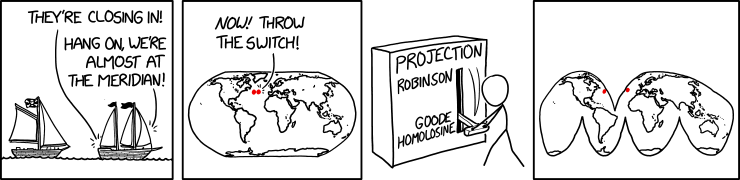
Sea Chase

There are two rules on this ship: Never gaze back into the projection abyss, and never touch the red button labeled DYMAXION.
05 Feb 00:25

GilvaSunner YouTube Channel Shuts Down Due To Copyright Strikes From Nintendo; Pokemon Releases Music

by Timothy Geigner

The Nintendo vs. GilvaSunner YouTube channel saga has come to an end. It had become sort of an annual thing for Nintendo to copyright strike large numbers of videos on that channel, which mostly has "videos" consisting of beloved video game music from Nintendo titles. Over 100 videos were struck in 2019. Then another swath of videos were struck in 2020. After taking 2021 off, Nintendo struck over 1,300 of GilvaSunner's uploads a few weeks ago. Now, while we've taking pains to point out that Nintendo can do this, as it owns that IP, it certainly didn't have to go this route. There were plenty of other alternatives, including offering this music on any relevant streaming platform itself, which it has always declined to do.

Well, as I said, it's over. The GilvaSunner channel is to be shutdown due to the volume of copyright strikes it received.

Following the strike though, Gilvasunner has announced they will be deleting their channel this Friday (February 4).

Writing on Twitter, they said: “Hi everyone, after the 1300 copyright blocks from Nintendo a few days ago, the YT channel received another 2200 blocks today (with likely many more to follow). After thinking about this a lot over the past few days, I’ve decided that at this point it’s really not worth it to keep the channel up any longer, and will therefore delete the GilvaSunner YouTube channel (or what’s left of it) this coming Friday.”

I'll point out again that GilvaSunner's channel did not compete with Nintendo in any way, going all the way back to 2019. Its videos didn't replace buying Nintendo games. The channel didn't compete with legit sources for Nintendo game music, since Nintendo declined to create any such legit sources. This was, for the past 3 years, simply Nintendo trying to stamp out a resource for Nintendo fans to celebrate Nintendo music, thereby expressing and solidifying their fandom.

But when it comes to this latest round of copyright strikes, it comes with a slight sliver of a difference.

So, while this is nothing like all of Nintendo making its game music available for streaming, it's at least a step in that direction. But think about this for a moment: for 3 years Nintendo has been warring with a YouTube channel celebrating its music without offering any real streaming alternative -- yes, some game music has been available to buy on iTunes for some time, but that's not the same thing -- and once the company managed to kill off that channel, one of its properties releases a site to both stream and download for free some of that same music.

Is that not both insane and annoying? Nintendo didn't have to release this site; GilvaSunner was doing it for free. But Nintendo is so in love with controlling all of its IP that this is where we somehow landed.

05 Feb 00:22

Congressional Staffers Are Trying to Unionize

by Marisa M. Kashino
Congressional staffers publicly declared their intent to form a union on Friday, saying in a statement that “meaningful changes to improve retention, equity, diversity, and inclusion on Capitol Hill” are required to better serve constituents. A unionized workforce on the Hill would mark a sea change for an institution long known as a place where […]
04 Feb 12:54

Next-gen USPS mail trucks are only capable of 8.6 mpg, EPA says

by Jonathan M. Gitlin
The proposed replacement USPS mail truck got a lot of attention for its odd looks, but the real crime is a pathetic 8.6 mpg fuel efficiency—barely any improvement on the current vehicles.

Enlarge / The proposed replacement USPS mail truck got a lot of attention for its odd looks, but the real crime is a pathetic 8.6 mpg fuel efficiency—barely any improvement on the current vehicles.

The United States Post Office's plan to replace its aging delivery vehicles has been heavily criticized by the Environmental Protection Agency and the White House Council on Environmental Quality. The letters, first published by The Washington Post on Tuesday, excoriate the decision to award a $482 million contract to Oshkosh Defense without properly examining the environmental impact, as required by law.

Specifically, the EPA says that the USPS's required environmental impact report "does not disclose essential information underlying the key analysis of Total Cost of Ownership (TCO), underestimates greenhouse gas (GHG) emissions, fails to consider more environmentally protective feasible alternatives, and inadequately considers impacts on communities with environmental justice concerns."

Or, as the Chair of the CEQ wrote in a letter to Postmaster Louis DeJoy, his "agency committed to walk down a path before looking to see where the path was leading," in contravention of longstanding practices and laws.

Read 4 remaining paragraphs | Comments

04 Feb 12:54

Vote on Biden’s FCC pick delayed; Sohn faces another hearing and rocky path

by Jon Brodkin
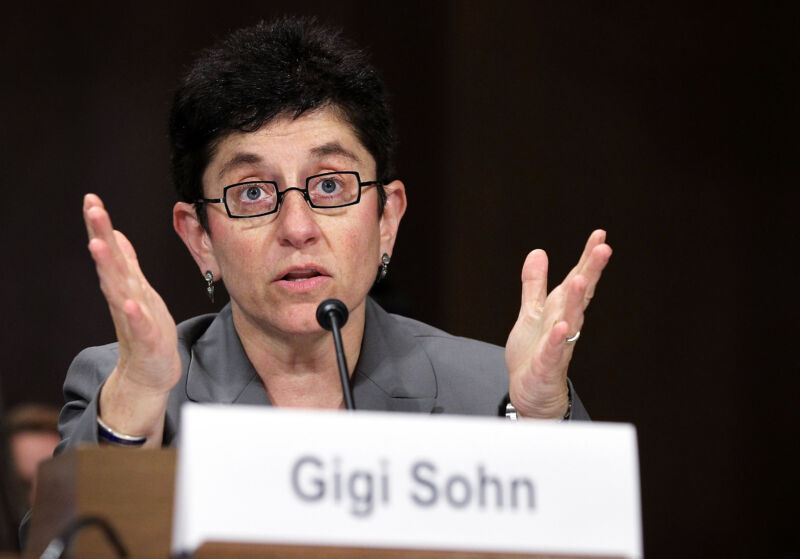
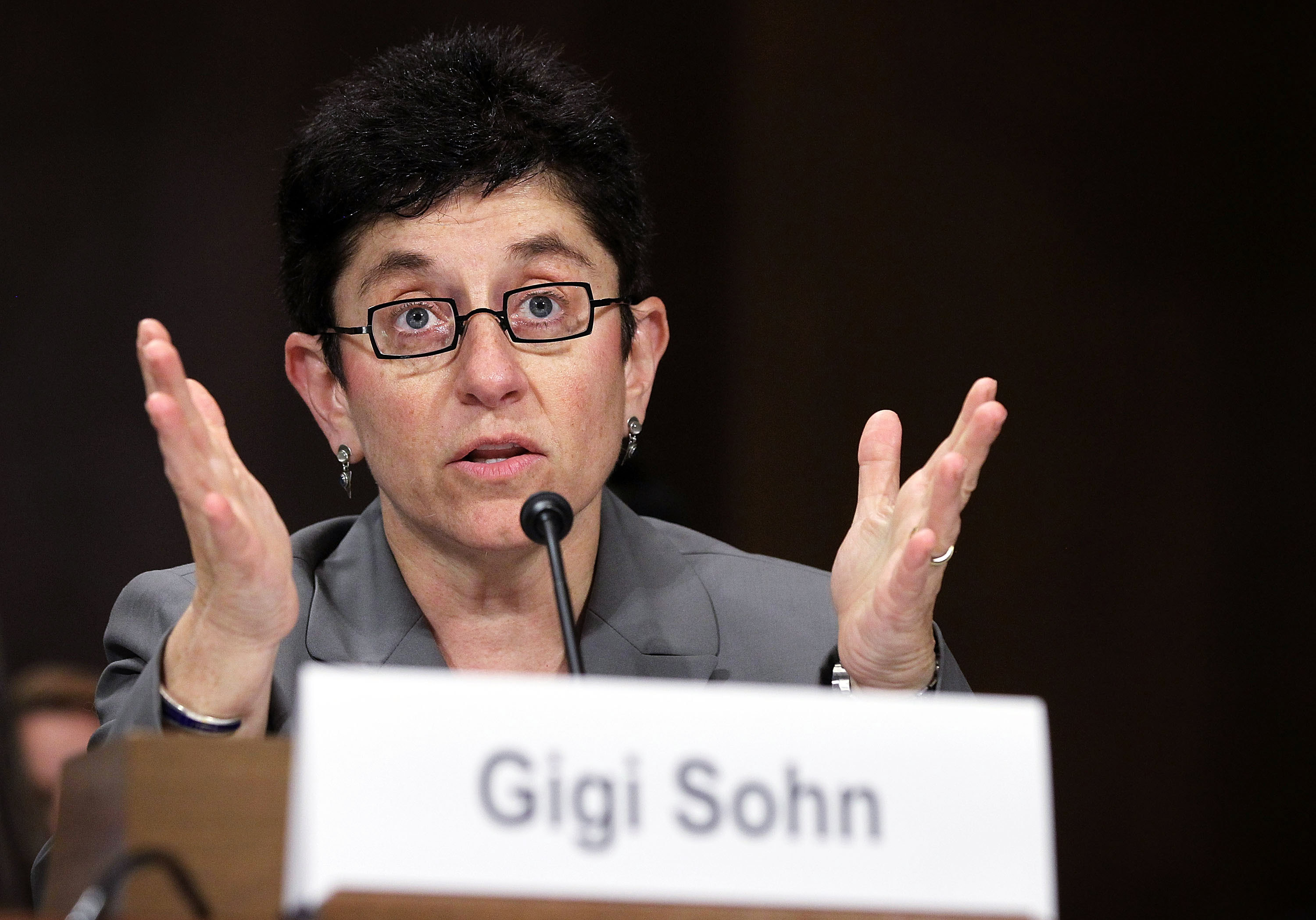
Gigi Sohn speaking and gesturing with her hands while testifying at a Senate hearing.

Enlarge / Gigi Sohn testifies during a Senate committee hearing on June 21, 2012. (credit: Getty Images | Alex Wong )

Although the Senate Commerce Committee was scheduled to vote yesterday on the nomination of Gigi Sohn to the Federal Communications Commission, it didn't happen. The vote on President Joe Biden's nomination of Sohn was delayed even as the committee voted to approve 10 other Biden nominations to various positions.

Yesterday's delay has a logical explanation: Sen. Ben Ray Luján (D-N.M.) suffered a stroke last week, and Sohn's confirmation needs his vote because of Republican opposition to the long-time consumer advocate who strongly supports reimposing net neutrality rules on broadband providers. Luján is expected to make a full recovery, but his absence could further delay Sohn's nomination and other Democratic priorities in the 50-50 Senate. "On Wednesday an aide said that the New Mexico senator could return to work in four to six weeks, barring any complications," The Wall Street Journal reported.

But Sohn's nomination was already in trouble even though the Senate had plenty of time to vote on it before Luján's health emergency. Biden nominated Sohn on October 26. The president made two other telecom choices on the same day, nominating FCC Chairwoman Jessica Rosenworcel for a new term and picking Alan Davidson to lead the National Telecommunications and Information Administration.

Read 19 remaining paragraphs | Comments

04 Feb 12:15

SHOP SAFE Will Stomp Out Online Sales of Used and Homemade Goods

by Katharine Trendacosta

The House of Representatives has inserted SHOP SAFE—a piece of legislation that would make it extremely difficult for any individual to sell things online and equally difficult for any online platform to compete with Amazon—into a 3,000-page trade bill. It cannot remain there.

The “Stopping Harmful Offers on Platforms by Screening Against Fakes in E-Commerce” (SHOP SAFE) is a bill that claims to be about protecting consumers but is more likely to enrich big brands at consumers’ expense. SHOP SAFE would force pretty much any online service that allows people to buy and sell items to institute a draconian trademark protection system. If they don’t, they risk crushing liability for the actions of their users.

Take Action

Tell Your Senators to Save Online Buying and Selling

Let’s say you want to sell something online. Some used baby clothes. Or let’s say you have a small side business selling baby clothes you make yourself online. In either case, you might list your items online, on a website like Craigslist or Etsy. Let’s say you describe what you are selling as “onesies.” Under SHOP SAFE, this will be a lot more difficult to pull off than you might expect.

Because, unbeknownst to you or to most people, Gerber has a trademark registration for the word “onesies.” Under SHOP SAFE, pretty much every website you might use to sell your used or homemade item will have to use an automated trademark filter that would prevent you from selling anything that had “onesies” as part of the description.

Furthermore, under SHOP SAFE, all of these websites would be required to have a three-strike system. So if you used “onesies” three times in one year, you would find your account terminated. And that would be that for your attempts to sell things online.

Even if the trademark filters don’t get you, SHOP SAFE will lead to plenty of other hoops for you to jump through, from providing the platform with a copy of your government-issued ID to including the country of manufacture in each listing. Hope you didn’t cut off those tags!

And let’s say you are a buyer looking to buy used items, whether you’re trying to save money or want to lower your carbon footprint. Suddenly, it’s much harder to find listings for used items. Let’s also say you are someone looking to do less shopping on the monolith that is Amazon. Suddenly, there are fewer and fewer alternatives, since other platforms can’t afford to comply with SHOP SAFE. Let’s also say you are trying to buy from local, independent, or small sellers rather than giant, multi-billion dollar brands. Once again, there are fewer and fewer sellers on sites like Etsy, as they fall victim to SHOP SAFE.

When SHOP SAFE passed out of committee last year, many elected officials expressed serious concerns about this bill. And yet, with no changes, we find it jammed onto page 1672 of the America COMPETES Act.

The good news is that SHOP SAFE isn’t in the Senate version of this trade bill. We need to tell our Senators to keep it out of the final bill. Tell them that SHOP SAFE is bad for consumers and sellers of all kinds.

Take Action

Tell Your Senators to Save Online Buying and Selling

03 Feb 18:04

Why young children have waited so long for Covid-19 vaccines

by Umair Irfan
Pre-K students at the Immanuel United Church of Christ in Shillington, Pennsylvania, line up to go outside on January 18, 2021. | Ben Hasty/MediaNews Group/Reading Eagle via Getty Images

Covid-19 vaccines for young children are coming. But it’s complicated.

Children under 5 years old, who make up one of the largest unvaccinated groups in the US, could soon become eligible to receive Covid-19 shots. The US Food and Drug Administration will consider whether to authorize two small doses of Pfizer/BioNTech vaccines for these children on an emergency basis, the companies announced this week.

Approval could come as soon as this month. But Pfizer and the FDA have a tricky needle to thread, moving quickly while trying to maintain public trust in the process.

Vaccines for young children would help constrain the spread of the virus, relieve stress on hospitals, and help schools stay open. They would also provide peace of mind to parents, caregivers, and teachers whose lives have been repeatedly disrupted as the highly transmissible omicron variant continues to rage. More than 20 million children in the United States fall into this age group, so an emergency use authorization (EUA) would close one of the biggest remaining gaps in vaccine eligibility.

But Pfizer’s own data showed that its vaccine generated less robust protection in some very young children with the first two doses. The company is still studying the impact of a third shot administered at least eight weeks later. Filing for approval at this stage is unusual, but company officials say they aim to give parents the option of starting to vaccinate kids sooner. That way they’re ready to receive a third dose by the time it’s greenlit.

“Ultimately, we believe that three doses of the vaccine will be needed for children 6 months through 4 years of age to achieve high levels of protection against current and potential future variants,” said Albert Bourla, chair and CEO of Pfizer, in a press release. “If two doses are authorized, parents will have the opportunity to begin a COVID-19 vaccination series for their children while awaiting potential authorization of a third dose.”

It’s a different process than what’s been used for vaccines in other age groups. Some doctors are concerned that if public health officials fumble the approval process and messaging, it could create more confusion and hesitancy around vaccines.

Health officials are already trying to reassure the public that regulators will not relax their standards. “This is the same rigorous process that was used to assess numerous vaccines long before the pandemic began,” said US Surgeon General Vivek Murthy at a press conference this week.

The Pfizer/BioNTech announcement comes at a time when new Covid-19 infections driven by the omicron variant are declining across the United States, but children are forming a larger share of infections and hospitalizations. Since the beginning of the pandemic, 10.6 million US children have tested positive for the virus. Children under 4 have accounted for 1.6 million of those cases, leading to 287 deaths in that age group as of January 29.

However, parents have shown so far that they are not as motivated to vaccinate kids — only about one-third of parents say they’ve started vaccinating their 5- to 11-year-olds, according to one poll — and physicians worry that Pfizer and BioNTech’s unusual vaccine approval application could deter them further. While closing gaps in eligibility is a key step toward more widespread immunity, this round of shots can only help bring the pandemic under control if people take them.

Why Pfizer/BioNTech’s latest application to the FDA is different

The FDA approval process usually aims to ensure that vaccines perform similarly across all ages. Since some very young children showed a weaker immune response than adults after two doses of their Covid-19 vaccine, Pfizer and BioNTech added a third dose to their study and expected to file for approval pending those results.

But the towering winter peak of Covid-19 cases may have spurred regulators themselves to get the ball rolling sooner, with the expectation that data would soon show that three Pfizer/BioNTech doses provide immune protection in kids that matches that in adults.

“Frankly, everybody in my field was a little surprised,” said Kristin Moffitt, an infectious disease physician at Boston Children’s Hospital. “It sounds like the FDA did outreach to Pfizer, likely driven by how much omicron transmission we’re seeing and the unbelievable impacts on all age groups.”

 Xinhua News Agency via Getty Images
Kindergarten children play in a classroom at Montara Avenue Elementary School in Los Angeles on August 16, 2021.

In clinical trials of more than 8,000 children between 6 months old and 12 years old, researchers saw that different age groups had varying immune responses, suggesting that not all were equally protected against the coronavirus. Children between 6 months and 2 years old showed stronger responses, Pfizer noted in December, comparable to the levels seen in 16- to 25-year-olds. But the response was weaker in 2-, 3-, and 4-year-olds.

Why the youngest children had a stronger immune response than older kids is a mystery. “I don’t know how that happens, but it happens,” said Janet Englund, a professor of pediatric infectious diseases at Seattle Children’s Hospital, who is helping administer the Pfizer study. “If you would’ve asked me would I have predicted that, I would have said ‘no.’”

Researchers are now investigating whether a third dose in young children would bolster the immune response. The results may be ready in March, at which point regulators will begin the review process again.

Why did it take so long to get here? One reason is the nature of Covid-19 itself, a disease that exacted its dearest toll from older adults while children faced a much lower rate of hospitalization and death. That made vaccine approval for adults a higher priority than for younger children.

Moving down in age groups also takes time. There’s an adage in medical research that children are not little adults. Their bodies respond in different ways to drugs, and researchers can’t just assume the same protocol will work as well or be just as safe across all ages. So clinical trials are conducted in stages by age groups, doses are tweaked, and the youngest children are almost always the last to be tested.

“Vaccine doses have historically been age-dependent,” Moffitt said. “It really has to do with the maturity of the immune system.”

For the Pfizer/BioNTech vaccine, the adult dose is 30 micrograms, children between 5 and 11 receive 10 micrograms, and children under 5 receive 3 micrograms.

Conducting research in younger age groups has additional complications. Children are much more finicky test subjects than adults. “As a pediatrician, I can tell you it’s incredibly difficult,” Englund said. Not only do children have to receive their shots spaced weeks apart, but in a clinical trial, they also have to show up for blood tests and follow-up exams. Attrition rates in clinical trials of kids can be high.

It gets even trickier to study children under 5 years old and keep track of their complications or concerns. “Five- to 11-year-olds can talk and complain,“ Englund said. “Doing this in kids less than 5 is more work.” So it’s that much harder to collect the amount and quality of data needed to satisfy the FDA.

Children are at lower risk, but they’re getting infected in large numbers

Thankfully, children have generally faced much lower rates of severe illness and death from Covid-19 compared to adults. But the rates are not zero, and with the spread of the highly transmissible omicron variant, more children are being hospitalized.

According to the American Academy of Pediatrics, children accounted for almost 23 percent of new Covid-19 cases by the end of January. More than 17 percent of all Covid-19 cases in children under 18 occurred in the last two weeks of January. Across the US, children made up between 1.6 percent and 4.4 percent of hospitalizations.

“The sheer number of cases of omicron has been associated with more pediatric hospitalizations than we have seen at any other time during this pandemic,” Moffitt said. “We were absolutely feeling this, and families were feeling this. A lot of these were otherwise healthy kids.”

Even if children don’t get severely ill, pediatric Covid-19 cases have ripple effects: They can shut down schools, disrupt learning, and require parents to take time off work to care for sick children. Infected kids can also transmit the disease.

Still, caregivers of children don’t seem to be racing to vaccinate kids. In November 2021, an emergency use authorization made 28 million children between the ages of 5 and 11 eligible to receive the Pfizer/BioNTech Covid-19 vaccine. But the uptake has been slow.

“In my community, we’ve been a little disappointed with the uptake,” Englund said. “In our 5- to 12-year-olds, we’re barely at 50 percent, despite the fact the vaccine is widely available at schools and vaccine clinics.”

The Kaiser Family Foundation reports that as of February 1, about 33 percent of US parents of 5- to 11-year-olds say their kids have received at least one dose of a Covid-19 vaccine. Only 30 percent of parents of kids under age 5 say they will vaccinate their kids as soon as possible.

Chart showing poll results of parents asked whether they would vaccinate children under 5. Kaiser Family Foundation
Parents appear more hesitant to vaccinate children under 5 years old against Covid-19.

Moffit said she’s encountered parents of very young children who are eager to have their kids vaccinated, and others who are hesitant and want to wait a while. Some want to wait for the vaccine to “graduate” from an EUA to full FDA approval, which could take months.

If the FDA approves two pediatric doses of the Pfizer/BioNTech vaccine, with the expectation that young children won’t get full protection until a third dose is approved down the road, health officials will have to be proactive about explaining this clearly to the public. Otherwise, the process could sow confusion and fuel hesitancy.

“I do worry if that approach ends up being taken, it may make it an even harder sell for vaccine uptake,” she said. “I think the FDA is going to have a tough call here.”

Researchers are also studying the Pfizer/BioNTech Covid-19 vaccine in babies as young as 2 months old. “We do see kids under 6 months hospitalized at our hospital,” Englund said. Scientists are also studying immunity in vaccinated pregnant people and their babies, to see how much immunity carries over to newborns. Whether babies under 6 months old will need Covid-19 shots will also depend on what variants are in circulation and the rate of transmission of the virus.

The FDA’s upcoming decision won’t be the last word on Covid-19 shots for young children. In time, doctors are hoping to see more Covid-19 vaccines authorized for use in children. “I think we need to have multiple vaccines available. ... I’d like to have three or four,” Englund said. “Maybe another vaccine might work better, or have less side effects, or be cheaper, or be more available in some places.”

03 Feb 18:01

Can We At Least Make Sure Antitrust Isn't Deliberately Designed To Make Everyone Worse Off?

by Mike Masnick

For decades here on Techdirt I've argued that competition is the biggest driver of innovation, and so I'm very interested in policies designed to drive more competition. Historically this has been antitrust policy, but over the past decade or so it feels like antitrust policy has become less and less about competition, and more and more about punishing companies that politicians dislike. We can debate whether or not consumer welfare is the right standard for antitrust -- I think there are people on both sides of that debate who make valid points -- but I have significant concerns about any antitrust policy that seems deliberately designed to make consumers worse off.

That's why I'm really perplexed by the push recently to push through the “American Innovation and Choice Online Act” from Amy Klobuchar which, for the most part, doesn't seem to be about increasing competition, innovation, or choice. It seems almost entirely punitive in not just punishing the very small number of companies it targets, but rather everyone who uses those platforms.

There's not much I agree with Michael Bloomberg about, but I think his recent opinion piece on the AICOA bill is exactly correct.

At the heart of the bill is an effort to prevent big tech companies from using a widespread business practice called self-preferencing, which is generally good for both consumers and competition. Think of it this way: An ice-cream parlor makes its own flavors and sells other companies’ flavors, too. Its storefront window carries a large sign advertising its homemade wares. In smaller letters, the sign mentions that Haagen-Dazs and Breyers are available, too. Should Congress force the ice-cream store owners to advertise Haagen-Dazs and Breyers as prominently as their own products?

That’s essentially what this bill would force a handful of the largest tech companies to do. For instance, Google users searching the name of a local business now get, in their search results, the option of clicking a Google-built map. But under the bill’s requirements, the search results would likely have to exclude the Google map. Similarly, Amazon would likely be prevented from promoting its less-expensive generic goods against the biggest brand names.

Lots of businesses offer configurations of products and services in ways that are attractive to customers, often for both price and convenience. Doing this can allow companies to enter — and potentially disrupt — new markets, to the great advantage of customers.

Yet the bill views such standard business conduct as harmful. It would require covered companies — essentially Amazon, Apple, Google, Facebook and TikTok — to prove that any new instance of preferencing would “maintain or enhance the core functionality” of their business. Failure to comply could lead to fines of up to 15% of a company’s total U.S. revenue over the offending period.

Now, I think there's a very legitimate argument that if a dominant company is using its dominant position to preference something in a manner that harms competition and the end user experience, then that can be problematic, and existing antitrust law can take care of that. But this bill seems to assume that any effort to offer your own services is somehow de facto against the law.

And whether or not that harms these companies is besides the point: it will absolutely harm the users and customers of these companies, and why should that be enabled by US competition policy? The goal seems to be "if we force these companies to be worse, maybe it will drive people to competitors," which is a really bizarre way of pushing competition. We should drive competition by encouraging great innovation, not limiting how companies can innovate.

Even if you don't think that the "consumer welfare" standard makes sense for antitrust, I hope most people can at least agree that any such policy should never deliberately be making consumers worse off.

03 Feb 12:46

Tonga in lockdown after COVID spread from wharf workers

by Beth Mole
This photo shows the Australian Navy's HMAS <em>Adelaide</em> docked at Vuna Wharf in the Tongan capital of Nukualofa on January 26, 2022. The <em>Adelaide</em> delivered aid following the January 15 eruption of the nearby Hunga Tonga-Hunga Ha'apai underwater volcano.

Enlarge / This photo shows the Australian Navy's HMAS Adelaide docked at Vuna Wharf in the Tongan capital of Nukualofa on January 26, 2022. The Adelaide delivered aid following the January 15 eruption of the nearby Hunga Tonga-Hunga Ha'apai underwater volcano. (credit: Getty | Mary Lyn Fonua)

The archipelago nation of Tonga went into lockdown Wednesday after detecting five cases of COVID-19 and its first community transmission. This happens amid recovery efforts from a massive underwater volcanic eruption and tsunami in mid-January that covered islands in ash and cut off communication.

The nation of 106,000 residents including 171 islands—45 of which are inhabited—has almost completely thwarted the pandemic virus to this point. The five new cases bring Tonga's total COVID-19 case count to six, including one case detected in a hotel quarantine in October.

But an outpouring of international aid following the eruption raised widespread concern that Tonga's COVID-free streak would be broken. The Australian navy ship HMAS Adelaide that docked last week was loaded with aid supplies and 23 known COVID-19 cases.

Read 8 remaining paragraphs | Comments

03 Feb 12:44

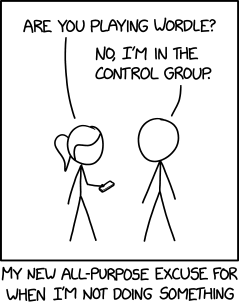
Control Group

Placeble 228 x/6n⬜⬜⬜⬜⬜n⬜⬜⬜⬜⬜n⬜⬜⬜⬜⬜n⬜⬜⬜⬜⬜n⬜⬜⬜⬜⬜n⬜⬜⬜⬜⬜
02 Feb 18:53

A deep freeze is coming to Texas, and no one knows if the power grid is ready

by Eric Berger
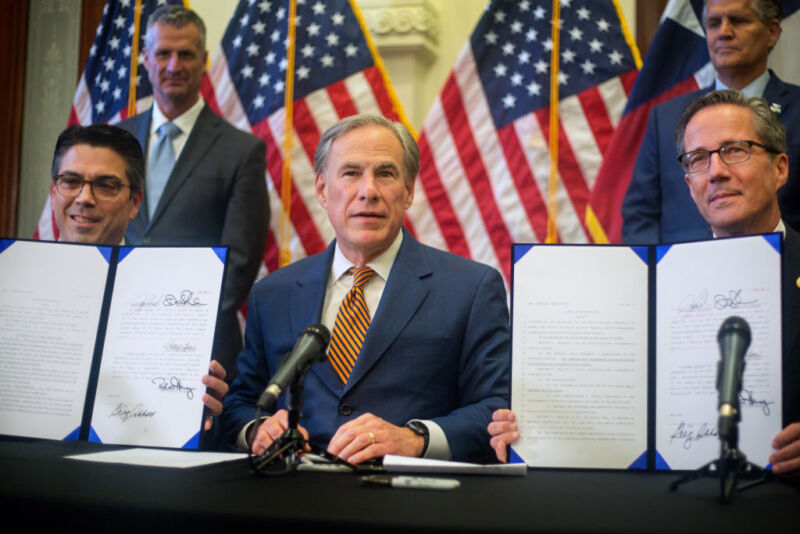
Texas Governor Greg Abbott, center, during a press conference at the Capitol on June 8, 2021, in Austin, Texas. He signed two bills into law to reform the Electric Reliability Council of Texas.

Enlarge / Texas Governor Greg Abbott, center, during a press conference at the Capitol on June 8, 2021, in Austin, Texas. He signed two bills into law to reform the Electric Reliability Council of Texas. (credit: Montinique Monroe/Getty Images)

Nearly one year ago, the state of Texas suffered a debilitating power outage to its independent power grid amidst one of the coldest Arctic freezes in decades.

During this power outage crisis, 246 people died, and homeowners and businesses suffered an estimated $200 billion in damages as pipes froze, melted, and then burst. In the aftermath of this crisis, the Republican-led legislature vowed to shore up the state's power grid. Critics, however, said the state officials only took care of the power companies at taxpayers' expense and left power-generating facilities at risk to extreme cold.

Now, we may be about to find out the truth of the matter.

Read 12 remaining paragraphs | Comments

02 Feb 18:52

This AI mechanic scans your car or tires to diagnose defects

by Jonathan M. Gitlin
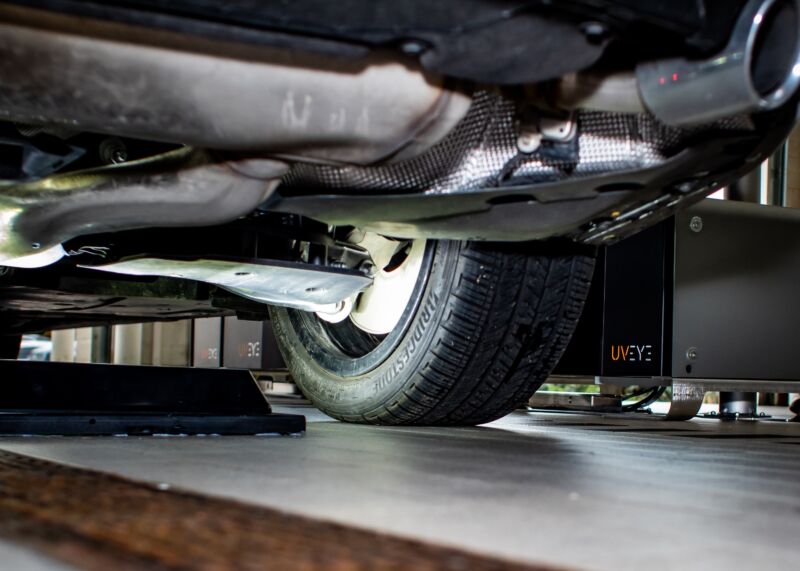
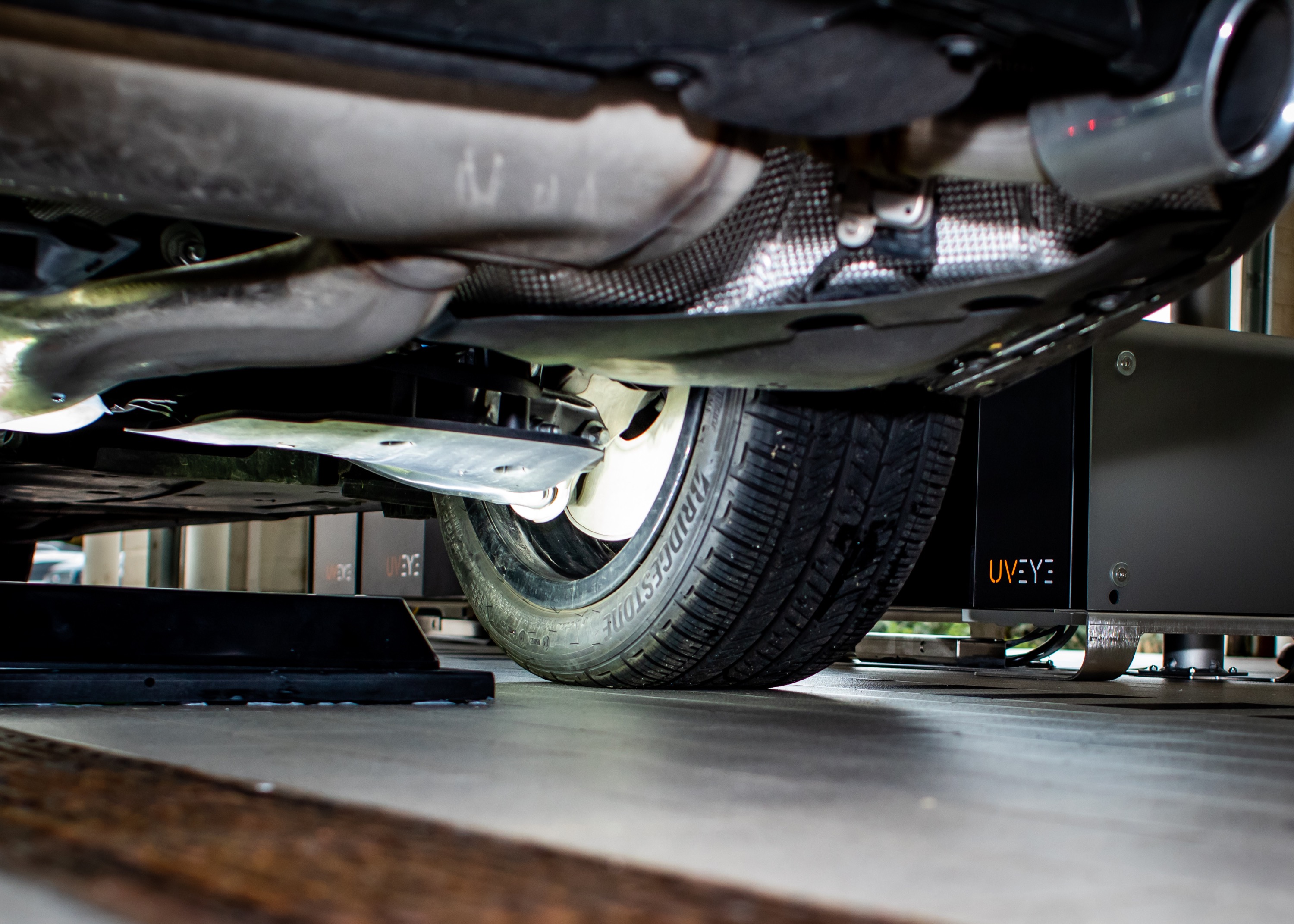
UVeye's technology uses scanners and AI to diagnose defects.

Enlarge / UVeye's technology uses scanners and AI to diagnose defects. (credit: UVeye)

Can you train an AI to take a breath, wince, and remark, "Well, it's going to cost you"?

That's probably easier than teaching one to diagnose problems with your car after a visual scan of its undercarriage, and yet the latter is what an Israeli company called UVeye has done. The company has developed what you might think of as a car scanner that can diagnose problems in just a few seconds. Drive past it, and it will image your car's panels, tires, or underbody, spotting dings, oil leaks, foreign objects, or other problems, flagging them for remedy.

It's another intriguing example of the civilian spinoffs that have emerged from Israel's national security sector over the last couple of decades as sensors and algorithms find new life on civvy streets.

Read 7 remaining paragraphs | Comments

02 Feb 18:51

Sen. Luján’s stroke may limit Democrats’ options in the evenly divided Senate

by Andrew Prokop
Ben Ray Luján, then a New Mexico representative, at a news conference in January 2020. | Tom Williams/CQ-Roll Call via Getty Images

Their agenda will depend on Republican support while the New Mexico senator is absent.

News that Sen. Ben Ray Luján (D-NM) had a stroke and was hospitalized last week throws Democrats’ agenda in the evenly divided Senate into question.

Luján’s office said in a statement that the senator is “expected to make a full recovery.” But no one knows for sure how long that will take, so Democrats could be down to just 49 senators for at least some time. (Luján aides estimate he’ll be back in four to six weeks, unless there are complications, according to Garrett Haake of NBC News.)

Unlike the House, which adopted “proxy voting” policies during the pandemic, senators must be present in person to vote. So a prolonged illness that renders a senator’s presence impossible can be a serious complication for a majority, as Democrats experienced in 2009 and 2010 with the health woes of then-Sens. Ted Kennedy (D-MA) and Robert Byrd (D-WV).

That doesn’t necessarily mean the Senate is grinding to a halt or shutting down, or that Senate Minority Leader Mitch McConnell is now in charge. Much of the chamber’s activity has been, and will continue to be, bipartisan. It’s Democrats’ partisan agenda — nominees who can’t get Republican support, and the stalled Build Back Better Act — that will be most harmed. Luján’s absence will essentially require bipartisanship for everything again. (Though not just yet; two Republican senators, Mitt Romney and John Hoeven, are out with Covid this week.)

What Luján’s absence means for nominations

Nominees need a majority of the senators present to get through. So far during Biden’s term, Democrats have had the ability to confirm nominees with their 50 votes alone, plus Vice President Kamala Harris’s tiebreaker if all Republicans are opposed. Luján’s absence means Democrats can no longer win such party-line votes, so long as all Republicans are present.

If Romney and Hoeven return and Luján remains absent, Republicans would theoretically have the power to block all of President Biden’s nominees. Still, there are reasons to doubt that will happen. The vast majority of Biden’s nominees have gotten at least some support from Republican senators; Vice President Harris’s vote has only been necessary to confirm eight nominees so far. GOP obstruction very well might increase now that Republicans actually can spike nominees, but so far they have not seen blanket obstruction as being to their strategic advantage.

Instead, the GOP will likely focus their opposition on a few nominees they deem controversial or unacceptable, or whom they see political advantage in blocking. Lifetime-appointment judgeships will surely be under scrutiny — for instance, Judge Holly Thomas, a Biden nominee to the Ninth Circuit Court of Appeals, was confirmed with zero Republican votes this month, with Sen. Ted Cruz (R-TX) calling her a far-left “activist advocate.” The White House may feel pressured to take controversial nominees off the table until Democrats have 50 solid Senate votes again, but they could also push them anyway and stoke high-profile showdowns.

And, of course, there’s that Supreme Court vacancy. Democrats have been optimistic that Biden’s nominee could win the votes of some moderate Republicans like Sen. Susan Collins (ME), but that will likely depend on who is chosen and how the debate over that nomination plays out. If Democrats are down a senator, that means Collins is the key swing vote they will have to win to get a justice confirmed. That could affect the White House’s calculations about whom to nominate in the first place.

What Luján’s absence means for legislation

For ordinary legislation, such as this month’s expected government funding bill, Luján’s absence probably won’t have much of an impact. Due to the filibuster, almost all bills in the Senate already required 60 votes, meaning all 50 Democrats and at least 10 Republicans. Luján’s absence bumps that up to 11 Republicans, but a substantial level of bipartisanship was already necessary.

But the Build Back Better bill — designed to go through the Senate’s special filibuster-proof budget reconciliation process, and with no hope of getting any Republican support — is more imperiled. Even if Sens. Joe Manchin (D-WV) and Kyrsten Sinema (D-AZ) are eventually won over, the passage of any reconciliation bill depends on having 50 Democrats present.

If Luján’s health problems stretch on and become a serious impediment to Democrats’ agenda, he may face some pressure to resign. New Mexico has a Democratic governor, so his replacement would also be a Democrat. However, that would trigger a special election for the seat (Luján won it in 2020), something Democrats would surely prefer to avoid.

That’s a question for the future, though. The main impact now is that until Democrats have 50 votes again, the Senate agenda has to be a bipartisan one.

02 Feb 18:16

Congress Introduces New Agricultural 'Right to Repair' Bill With Massive Farmer Support

by Karl Bode

Back in 2015, frustration at John Deere's draconian tractor DRM helped birth a grassroots tech movement dubbed "right to repair." The company's crackdown on "unauthorized repairs" turned countless ordinary citizens into technology policy activists, after DRM (and the company's EULA) prohibited the lion's share of repair or modification of tractors customers thought they owned. These restrictions only worked to drive up costs for owners, who faced either paying significantly more money for "authorized" repair (which for many owners involved hauling tractors hundreds of miles and shelling out thousands of additional dollars), or toying around with pirated firmware just to ensure the products they owned actually worked.

Seven years later and this movement is only growing. This week Senator Jon Tester said he was introducing new legislation (full text here, pdf) that would require tractor and other agricultural hardware manufacturers to make manuals, spare parts, and and software access codes publicly available:

"We’ve got to figure out ways to empower farmers to make sure they can stay on the land. This is one of the ways to do it,” Tester said. “I think that the more we can empower farmers to be able to control their own destiny, which is what this bill does, the safer food chains are going to be."

The legislation comes as John Deere recently was hit with two new lawsuits accusing the company of violating antitrust laws by unlawfully monopolizing the tractor repair market. In 2018 John Deere had promised to make sweeping changes to address farmers' complaints, though by 2021 those changes had yet to materialize. Tester's legislation also comes as a new US PIRG survey shows that a bipartisan mass of famers overwhelmingly support reform on this front.

Tester's proposal is just one of several new efforts to rein in attempts to monopolize repair, be it John Deere or Apple. More that a dozen state-level laws have been proposed, and the Biden administration's recent executive order on competition also urges the FTC to craft tougher rules on repair monopolization efforts. In an era rife with partisan bickering, it's refreshing to see an issue with such broad, bipartisan public support, resulting in an issue that only had niche support a half decade ago rocketing into the mainstream.

02 Feb 14:45

What causes long Covid? Scientists are zeroing in on the answer.

by Yasmin Tayag
A line of people wait in the rain to be tested for Covid in Los Angeles, California, on December 29. | Gary Coronado/Los Angeles Times via Getty Images

“We are really working day and night” to figure out long Covid, one researcher said.

Even as the number of new Covid-19 cases in the US is dropping, hundreds of thousands of Americans are still testing positive every day. More than 28 million new cases have been reported since Omicron emerged in the US just two months ago, and the variant now drives 99.9 percent of cases, as of January 22, according to the Centers for Disease Control and Prevention.

Thanks to vaccines, boosters, and increasingly available treatments, most people who get infected today won’t end up in the hospital or die. A big question, however, looms over the survivors: What about long Covid?

Long Covid is a condition that arises after acute infection and often includes shortness of breath, fatigue, and “brain fog” but can also involve a wide range of debilitating problems in the heart, brain, lungs, gut, and other organs. According to the World Health Organization’s working definition, long Covid usually occurs three months after symptomatic Covid-19 begins and lasts for at least two months. Sometimes, the symptoms just never go away after the initial infection. Occasionally, they appear months after recovery or after an asymptomatic case. This means that if you’ve recovered from Covid-19, you’re not necessarily in the clear.

No one knows exactly how many people have or had long Covid. Estimates so far are “wildly disparate” in part because researchers define the condition differently and because the people seeking care may only be a small portion of those affected, said Nahid Bhadelia, an associate professor at Boston University School of Medicine. Studies on the conservative end have found that 10 to 20 percent of Covid-19 survivors get long Covid, while others report 50 percent.

Scientists have proposed numerous hypotheses to explain long Covid’s myriad symptoms since research began in earnest after the first wave of cases in 2020. Early suspects included a weakened immune system, widespread inflammation, and even low sex hormone levels.

There are no firm answers yet, but there’s now greater consensus among researchers about the two leading theories and the ways they may be connected. Scientists also have a better understanding of the people who are susceptible to long Covid.

While many used to think that the condition only affected people with severe illness, patients now range from teens to older adults, some of whom had only mild or even asymptomatic illness, said Kathleen Bell, a professor in the department of physical medicine and rehabilitation at UT Southwestern Medical Center, on a recent press call. Early research is pointing to factors that may raise a person’s risk of long Covid, such as low levels of certain antibodies, reactivated viruses in the bloodstream, and existing conditions such as diabetes or asthma.

Amid pressure from patients and concerns that the vast numbers of omicron infections might drive a new wave of long Covid, researchers around the world are racing to understand what causes the condition and how it might be diagnosed and treated. “We are really working day and night,” Resia Pretorius, a professor of physiological sciences at Stellenbosch University in South Africa whose research is explaining the role of blood clots in long Covid, told me.

It’s too early to predict an omicron wave of long Covid, but scientists are cautious

Scientists I spoke to agreed that it’s too early to know whether omicron will lead to a new wave of long Covid because less than three months have passed since the variant emerged. But David Putrino, director of rehabilitation innovation at Mount Sinai Health System in New York City, is erring on the side of caution. “Right now, we have no reason to think any differently about long Covid.”

Whether different variants change the likelihood of developing long Covid is a fundamental question among researchers, Michael Peluso, an infectious diseases doctor who co-leads a long Covid research effort at the University of California San Francisco, told me. Severe initial Covid-19 infection, he noted, tends to correlate with who is at risk, so “it’s encouraging that early data suggest that omicron might be less severe, but obviously not enough time has passed.”

Still, long Covid can develop after mild or even asymptomatic Covid-19, too. “If you say omicron’s mild, it doesn’t say anything about long Covid,” Amy Proal, a microbiologist at the PolyBio Research Foundation, told me. “We don’t even know how mild omicron is.” The WHO has pushed back against calling omicron “mild,” but it seems to result in less severe illness, especially among the vaccinated. This may be because it’s better at evading the immune system, which isn’t a good thing because it raises the possibility that the virus is remaining in the body, Proal added.

Even if long Covid turns out to be less common among people who have been infected with omicron, the sheer number of cases right now means that millions may still develop the condition. “Even if it’s rare,” said Peluso, “it will affect a lot of people.”

“We’re worried,” said Proal. “It’s not being communicated to the public as one of the things to take into consideration in how to live these days. Not as much as it should be.”

Vaccination appears to offer some protection against long Covid, but it’s not clear how much. It certainly helps by preventing serious illness in the first place, and it may help clear the virus before it can lodge in the body for the long term. It also spurs the immune system to specifically target the virus, rather than raise defenses throughout the whole body, which could cause collateral damage elsewhere.

 Amy Osborne/AFP via Getty Images

People stand in line at the mass vaccination site at the Moscone Convention Center in San Francisco, California, on February 5, 2021.

An encouraging recent preprint from Israel shows that fully vaccinated people who had breakthrough Covid-19 between March 2020 and November 2021 report fewer long Covid symptoms than unvaccinated people who were infected, suggesting “that some ability to fight off the virus is helpful for long Covid as it is for acute Covid,” Leora Horwitz, director for the Center for Healthcare Innovation and Delivery Science at NYU Langone Health, told me.

The immune system likely plays a leading role in long Covid

The sheer range of symptoms reported by people with long Covid — more than 200 across 10 groups of organ systems, according to one patient-led survey — makes uncovering their biological origins a gargantuan task. There are likely several subtypes of long Covid, each with its own cluster of symptoms and cause. “We’re not talking about a monolithic, single entity,” said Horwitz.

Scientists have proposed many explanations for long Covid, but several I spoke to agreed that there are now two leading theories: that symptoms are driven by the immune system or by the persistence of the virus in the body. Importantly, these aren’t mutually exclusive, and it’s likely that both factors are at play and interconnected, together with a number of other mechanisms.

The immune theory suggests that Covid-19 turns the immune system against the body. This could explain symptoms like racing heart, dizziness, weakness, and microclots in the blood, said Putrino, whose research focuses on the former. A large proportion of his long Covid patients seem to have dysautonomia, a condition that interferes with processes like balance, heart rate, blood pressure, temperature, and digestion. With Yale University immunologist Akiko Iwasaki, Putrino is studying the blood of long-haulers for evidence of an abnormal immune response that might be throwing the autonomic nervous system off track.

Flurries of microclots — tiny blood clots — observed in the blood of people with acute and long Covid may be fueling the immune system’s reaction. Clots in healthy people usually break down easily, but those in people with long Covid resist digestion and continue to drift throughout the circulation. Pretorius’s team has discovered inflammatory molecules concealed inside these microclots that she thinks may spur the production of autoantibodies. Having clots in circulation can cause the whole vascular system to become inflamed, ultimately choking off the supply of oxygen to cells and leading to a range of issues throughout the body. “Many of the symptoms that are related to long Covid can actually be traced back to a general oxygen deprivation state,” she said.

One of the primary functions of the immune system is to keep pathogens in line — including those that live inside our bodies, like dormant viruses and normally benign gut bacteria. When it isn’t working properly, these pathogens can act up and cause illness. “Patients might clear [SARS-CoV-2] itself from tissue, but immune dysregulation might allow other viruses and pathogens to reactivate and then drive chronic systems,” said Proal. Epstein-Barr virus, for example, seems to be reactivated in people with Covid-19, and scientists are studying whether the herpes viruses and the common parasite Toxoplasma do the same.

It’s possible, too, that the reactivation of these pathogens contributes to autoimmunity. Research recently published in Science posited that prior infection with the Epstein-Barr virus drives multiple sclerosis, a chronic disease, by spurring production of autoantibodies. Proal suggested that a similar mechanism could be at play in long Covid. “What it really means is that overall, autoantibodies can be generated as part of the immune system response to infection,” she said.

Lingering virus may also be to blame

Proal is also investigating theories linked to viral persistence, the other overarching long Covid theory. The virus can remain in the body and brain long after acute infection, and its genetic material can persist up to 230 days after symptoms arise, as a recent National Institutes of Health preprint found. Lingering virus is often found not in the blood but in the tissues, an important consideration for researchers studying and developing diagnostic tools for long Covid, Proal and others emphasized.

It’s not fully understood what these so-called “viral reservoirs” do in the body. Proal’s previous work on myalgic encephalomyelitis (ME, also known as chronic fatigue syndrome), an illness that has substantial similarity with long Covid, suggests that persistent virus — Epstein-Barr virus, in the case of ME/CFS — can wreak havoc on the body long after acute infection.

In long Covid, viral reservoirs could continue to injure tissues directly. They may leak viral proteins into the bloodstream, where they can spur the formation of the aforementioned microclots and activate the immune system, leading to inflammation and further damage. Or they may do nothing at all.

One theory is that inflammation in tissues caused by persistent virus can trigger inflammation in the brain via the far-reaching vagus nerve, which runs the length of the spine and connects to the brainstem. A recent preprint from a team co-led by Yale’s Iwasaki showed that mice with mild Covid-19 had activated brain microglia cells and higher levels of some inflammatory molecules. One of those molecules has been observed at high levels in the brains of long-haulers experiencing cognitive issues like brain fog. “You can start to see a scope of connected symptoms that can really make someone ill,” said Proal.

Like the symptoms of long Covid, the research is all over the place. “It’s a mess — anyone who says they get it is lying,” said Putrino. But patterns in the data are steadily emerging, which many of the researchers I spoke to attributed to collaboration among long Covid research teams and patient advocacy groups. Organizations like the Long Covid Alliance and Survivor Corps have been instrumental in helping recruit participants and lobby for much-needed funding since research on the condition began, they said.

Recent research identifying the people who are most at risk is especially promising. A small study recently published in Cell named four factors that may put people at higher risk for long Covid: higher levels of SARS-CoV-2 RNA in the blood in the early stages of infection, Type 2 diabetes, reactivated Epstein-Barr virus (which infects over 90 percent of the global population), and the presence of certain autoantibodies — which target the body’s own cells as if they were intruders. Other risk factors could include low levels of antibodies called IgM and IgG3 and preexisting asthma, as a recent study in Nature Communications suggested. Bell cautioned, however, that such factors are for “research purposes only” and shouldn’t be viewed as metrics for diagnosis.

Fortunately, many researchers studying the basic science of long Covid already have treatment — and diagnosis — in mind. Putrino said that 70 to 80 percent of his patients respond well to intensive autonomic rehabilitation therapy, which involves coaching to improve breathing followed by physical exercises. With RECOVER, an NIH-funded nationwide study on long Covid, Horwitz is developing a list of medications and vaccines to test and put through clinical trials.

“I am quite optimistic that there will be things that will be helpful,” she said. Pretorius is developing a diagnostic tool for long Covid, and she’s trying to get funding for a clinical trial involving clot-busting drugs. “We’re not going to rest,” she said.

Yasmin Tayag is a science editor and writer. She has written for the Atlantic, the New York Times, and the Guardian, and she was previously the lead editor of the Medium Coronavirus Blog.

02 Feb 13:27

Gmail’s next big redesign starts rolling out next week

by Ron Amadeo
The new Gmail design. It has tweaked colors and an additional sidebar on the left for Google Chat and Google Meet.

Enlarge / The new Gmail design. It has tweaked colors and an additional sidebar on the left for Google Chat and Google Meet. (credit: Google)

Google will finally start rolling out the Gmail redesign it first showed off last year. The company is calling the interface in the update the "integrated view" because the goal is to integrate Google's latest messaging service, Google Chat (a Slack competitor and the successor to Hangouts) and Google Meet (a Zoom competitor) into Gmail. The main section will remain mostly the same, but there are plenty of changes coming to Gmail's navigation sidebar.

Currently, the Gmail sidebar houses the sections you would expect, like the Inbox, Drafts, Trash, and your list of labels. The redesign will add a second, new higher-level navigation panel to the left side of the page, letting users jump between Gmail, Google Chat, Spaces (Google Chat group chats), and Google Meet. Besides the four app-navigation options, the new sidebar also has a stack of icons at the bottom, and it's not entirely clear what they are. They look like chat profile pictures, so they could be either active chats or starred contacts. Since no one has tried this interface yet, we don't know many details.

Google's blog post has a detailed timeline for the rollout. Starting next week, February 8, the new interface becomes opt-in, and you can revert to "classic Gmail" in the settings (Google notes the update will take 15 days to roll out to everyone). In April, users will be automatically enrolled in the new interface. By "the end of Q2 2022," the interface will become the standard for Gmail, with no option to use the classic interface. Google says there will also be a "new streamlined navigation experience on Chat web (mail.google.com/chat)," which I assume means you'll get a similar sidebar setup where you can jump to Gmail right from Google Chat.

Read 5 remaining paragraphs | Comments

02 Feb 13:23

The Pixel 6 is a hit: Google touts “record sales” in Q4 2021

by Ron Amadeo
Promotional image of cutting-edge smartphone.

Enlarge / The Pixel 6 Pro. (credit: Google)

The Pixel 6 is one of the best phones Google has ever produced, and the market appears to be rewarding Google for it. Today in Alphabet's Q4 2021 earnings report, the company offered a rare comment on its hardware sales. CEO Sundar Pichai called out "a quarterly sales record for our Pixel phones." Technically, his statement includes the Pixel 6 and the cheaper Pixel 5a, but this is the Pixel 6's first quarter of availability, and the Pixel a series doesn't change much year to year.

Here's Pichai's statement from the earnings call:

In Q4, we set an all time quarterly sales record for Pixel. This came in spite of an extremely challenging supply chain environment. The response to Pixel 6 from our customers and carrier partners was incredibly positive.

Google never offers specific numbers on Pixel sales, and the company didn't change that habit today. According to the IDC, Google's highest number of phone shipments came in 2019, the year the Pixel a series first launched. Google shipped only 7 million devices for the entire year (the company would do a lot better if it actually tried to be a worldwide manufacturer). Pixel distribution is currently the worst it has ever been, with the Pixel 6 only available in nine countries, and the Pixel 5a is only for sale in two countries. A Samsung or Apple phone sells in 100+ countries, and both sell anywhere from 200-300 million phones a year.

Read 3 remaining paragraphs | Comments

02 Feb 13:14

YouTube Dusts Off Granular National Video Blocking To Assist YouTuber Feuding With Toei Animation

by Timothy Geigner

Hopefully, you will recall our discussion about one YouTuber, Totally Not Mark, suddenly getting flooded with 150 copyright claims on his YouTube channel all at once from Toei Animation. Mark's channel is essentially a series of videos that discuss, critique, and review anime. Toei Animation produces anime, including the popular Dragon Ball series. While notable YouTuber PewDiePie weighed in with some heavy criticism over how YouTube protects its community in general from copyright claims, the real problem here was one of location. Matt is in Ireland, while Toei Animation is based out of Japan. Japan has terrible copyright laws when it comes to anything resembling fair use, whereas Ireland is governed by fair dealing laws. In other words, Matt's use was just fine in Ireland, where he lives, but would not be permitted in Japan. Since YouTube is a global site, takedowns have traditionally been global.

Well, Matt has updated the world to note that he was victorious in getting his videos restored and cleared, with a YouTube rep working directly with him on this.

But shortly after, as Fitzpatrick revealed in a new video providing an update on the legal saga, someone “high up at YouTube’’ who wished to remain anonymous, reached out to him via Discord. Fitzpatrick said the contact not only apologized for his situation not being addressed sooner, but divulged a prior conflict between YouTube and Toei regarding his videos fair use status.

“I’m not going to lie, hearing a human voice that felt both sincerely eager to help and understanding of this impossible situation felt like a weight lifted off my shoulders,” Fitzpatrick said.

Hey, Twitch folks, if you're reading this, this is how it is done. But it isn't the whole story. Before the videos were claimed and blocked, Toei had requested that YouTube manually take Matt's videos offline. YouTube pushed back on Toei, asking for more information on its requested takedowns, specifically asking if the company had considered fair use/fair dealing laws in its request. Alongside that, YouTube also asked Toei to provide more information as to what and why Matt's videos were infringing. Instead of complying, Toei utilized YouTube's automated tools to simply claim and block those 150 videos.

The following week, a game of phone tag ensued between Toei, the Japanese YouTube team, the American YouTube team, Fitzpatrick’s YouTube contact, and himself to reach “some sort of understanding” regarding his copyright situation. Toei ended up providing a new list of 86 videos of the original 150 or so that the company deemed should not remain on YouTube, a move Fitzpatrick described as “baffling” and “inconsistent.” Toei, he concludes, has no idea of the meaning of fair use or the rules the company wants creators to abide by.

“Contained in this list was frankly the most arbitrary assortment of videos that I had ever seen,” he said. “It honestly appeared as if someone chose videos at random as if chucking darts at a dart board.”

While Matt regained control of his videos thanks to his work alongside the YouTube rep, he was still in danger of Toei filing a lawsuit in Japan that he would almost certainly lose, given that country's laws. Fortunately, YouTube has a method for blocking videos based on copyright claims in certain countries for these types of disputes. The Kotaku post linked above suggests that this method is brand new for YouTube, but it isn't. It's been around for a while but, somewhat amazingly, it appears to have never been used specifically when it comes to copyright laws in specific countries.

YouTube’s new copyright rule allows owners like Toei to have videos removed from, say, Japan’s YouTube site, but said videos will remain up in other territories as long as they fall under the country’s fair use policies. To have videos removed from places with more allowances for fair use, companies would have to argue their cases following the copyright laws of those territories.

And so Matt's review videos remain up everywhere except in Japan. That isn't a perfect solution by any stretch, but it seems to be as happy a middle ground as we're likely to find given the circumstances. Those circumstances chiefly being that Toei Animation for some reason wants to go to war with a somewhat popular YouTuber who, whatever else you might want to say about his content, is certainly driving interest publicly in Toei's products, for good or bad. This is a YouTuber the company could have collaborated with in one form or another, but instead it is busy burning down bridges.

“Similarly to how video games have embraced the online sphere, I sincerely believe that a collaborative or symbiotic relationship between online creators and copyright owners is not only more than possible but would likely work extremely well for both sides if they are open to it,” Fitzpatrick said.

That Toei Animation is not open to it is the chief problem here.

01 Feb 18:40

The New York Times in 1972 vs the New York Times in 2022

by Rob Beschizza

Fifty years ago yesterday, British soldiers shot 26 unarmed civilians during a protest march in Northern Ireland, killing 14 of them. Six of the dead on Bloody Sunday were minors. The soldiers killed people trying to help the wounded. They beat the survivors. — Read the rest

01 Feb 18:06

ID.me Finally Admits It Runs Selfies Against Preexisting Databases As IRS Reconsiders Its Partnership With The Company

by Tim Cushing

Tech company ID.me has made amazing inroads with government customers over the past several months. Some of this is due to unvetted claims by the company's CEO, Blake Hall, who has asserted (without evidence) that the federal government lost $400 billion to fraudulent COVID-related claims in 2020. He also claimed (without providing evidence) that ID.me's facial recognition tech was sturdy, sound, accurate, and backstopped by human review.

These claims were made after it became apparent the AI was somewhat faulty, resulting in people being locked out of their unemployment benefits in several states. This was a problem, considering ID.me was now being used by 27 states to handle dispersal of various benefits. And it was bound to get worse, if for no other reason than ID.me would be expected to handle an entire nation of beneficiaries, thanks to its contract with the IRS.

The other problem is the CEO's attitude towards reported failures. He has yet to produce anything that backs up his $400 billion in fraud claim and when confronted with mass failures at state level has chosen to blame these on the actions of fraudsters, rather than people simply being denied access to benefits due to imperfect selfies.

Another claim made by Hall has resulted in a walk-back by ID.me's CEO, prompted by increased scrutiny of his company's activities. First, the company's AI has never been tested by an outside party, which means any accuracy claims should be given some serious side-eye until it's been independently verified.

But Hall also claimed the company wasn't using any existing databases to match faces, insinuating the company relied on 1:1 matching to verify someone's identity. But this couldn't possibly be true for all benefit seekers, who had never previously uploaded a photo to the company's servers, only to be rejected when ID.me claimed to not find a match.

It's obvious the company was using 1:many matching, which carries with it a bigger potential for failure, as well as the inherent flaws of almost all facial recognition tech: the tendency to be less reliable when dealing with women and minorities.

This increased outside scrutiny of ID.me has forced CEO Blake Hall to come clean. And it started with his own employees pointing out how continuing to maintain this line of "1-to-1" bullshit would come back to haunt the company. Internal chats obtained by CyberScoop show employees imploring Hall to be honest about the company's practices before his dishonesty caused it any more damage.

“We could disable the 1:many face search, but then lose a valuable fraud-fighting tool. Or we could change our public stance on using 1:many face search,” an engineer wrote in a message posted to a company Slack channel on Tuesday. “But it seems we can’t keep doing one thing and saying another as that’s bound to land us in hot water.”

The internal messages, obtained by CyberScoop, also imply that the company discussed the use of 1:many with the IRS in a meeting.

Those messages had a direct effect: Blake Hall issued a LinkedIn post that admitted the company used 1:many verification, which indicates the company also relies on outside databases to verify identity.

In the Wednesday LinkedIn post Hall said that 1:many verification is used “once during enrollment” and “is not tied to identity verification.”

“It does not block legitimate users from verifying their identity, nor is it used for any other purpose other than to prevent identity theft,” he writes.

Hall's post hedges things quite a bit by insinuating any failures to access benefits is the result of malicious fraudsters, rather than any flaws in ID.me's tech. But this belated honesty -- along with the company's multiple failures at the state level -- has caused the IRS to reconsider its reliance on ID.me's AI. (Archived link here.)

The Treasury Department is reconsidering the Internal Revenue Service’s reliance on facial recognition software ID.me for access to its website, an official said Friday amid scrutiny of the company’s collection of images of tens of millions of Americans’ faces.

Treasury and the IRS are looking into alternatives to ID.me, the department official said, and the agencies are in the meantime attentive to concerns around the software.

This doesn't mean the IRS has divested itself of ID.me completely. At the moment, it's only doing some shopping around. Filing your taxes online still means subjecting yourself to ID.me's verification software for the time being.

A recent blog post on ID.me's site explains how the company verifies identity as well as names the algorithms it relies on to match faces, which include Paravision (which has been tested by the NIST) and Amazon's Rekognition, a product Amazon took off the law enforcement market in 2020, perhaps sensing the public's reluctance to embrace even more domestic surveillance tech.

This may be too little too late for ID.me. Its refusal to engage honestly and transparently with the public while gobbling up state and federal government contracts has expanded its scrutiny past that of the Extremely Online. Senator Ron Wyden wants to know why the IRS has made ID.me the only option for online filing.

I’m very disturbed that Americans may have to submit to a facial recognition system, wait on hold for hours, or both, to access personal data on the IRS website. While e-filing returns remain unaffected, I’m pushing the IRS for greater transparency on this plan.

But e-filing is affected. As the IRS's spokesperson noted in a statement to Bloomberg, ID.me is still standing between e-filers and e-filing.

[IRS spokesperson Barbara] LaManna noted that any taxpayer who does not want to use ID.me can opt against filing his or her taxes online.

It may be true that people with existing accounts might be able to route around this tech impediment, but new filers are still forced to interact with ID.me to set up accounts for e-filing. If spotty state interactions created national headlines, just wait until a nation of millions starts putting ID.me's tech through its paces.