Like a growing number of states, the FTC under Lina Khan continues to show it’s somewhat serious about protecting consumers’ rights to repair their own tech. In 2021 the agency issued a useful report busting a lot of lobbying myths about repairability, and over the last few years has been cracking down on companies that claim that using third-party parts or repair shops violates warranty coverage.
In 2022 the agency took action against Harley Davidson for saying the use of third-party repair parts and facilities violated motorcycle warranties. They took similar action against Weber Grills and Westinghouse. Such practices run afoul of the Magnuson-Moss Warranty Act (MMWA) enforced by the FTC.
“These warning letters put companies on notice that restricting consumers’ right to repair violates the law,” said Samuel Levine, Director of the FTC’s Bureau of Consumer Protection. “The Commission will continue our efforts to protect consumers’ right to repair and independent dealers’ right to compete.”
Countless companies across countless sectors work tirelessly to monopolize repair of their own products. Usually this involves claims that using third-party dealerships, repair centers, tools and parts will inherently result in safety issues for consumers (something the FTC’s 2021 study thoroughly debunked). Sometimes it even involves (falsely) claiming right to repair is a boon to scary hackers or sexual predators.
The FTC warned all eight companies to review their box stickers and promotional/warranty materials to ensure they don’t imply that warranty coverage is conditioned on the use of specific parts or services. The agency says it will monitor the companies and circle around with legal action if their demands aren’t met.
The federal government caring about consumer repairability remains a relatively new phenomenon, and comes as Oregon recently became the seventh state to pass state level right to repair restrictions. Outside of the FTC, actual enforcement has so far been scattershot at best.
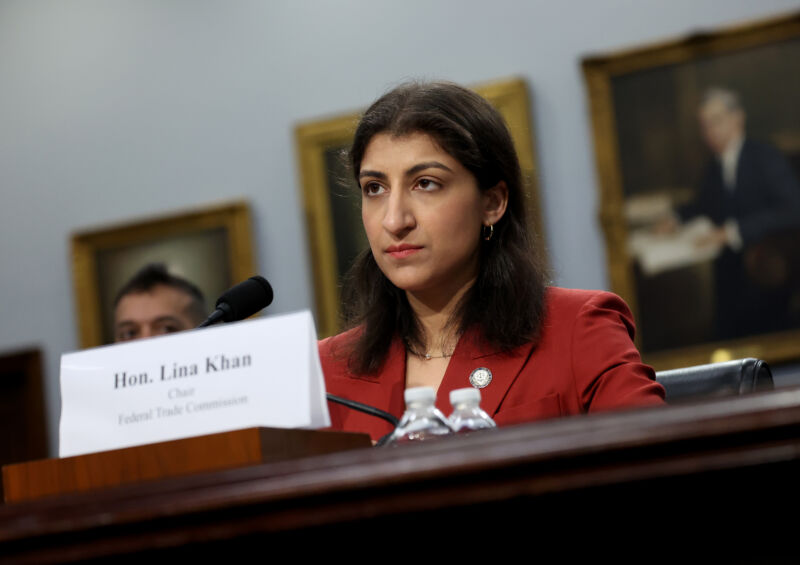
Enlarge / Lina Khan, chair of the Federal Trade Commission (FTC), testifies before the House Appropriations Subcommittee at the Rayburn House Office Building on May 15, 2024, in Washington, DC. (credit: Getty | Kevin Dietsch)
Firms that serve as intermediaries to negotiate and control prescription drug access in the US "wield enormous power," largely with "extraordinarily opaque" business practices, and may be "inflating drug costs and squeezing Main Street pharmacies" for profit, according to a searing interim report released Tuesday by the Federal Trade Commission.
Amid a national focus on America's uniquely astronomical drug costs, the FTC is taking aim at firms that largely work deep in the bowels of the country's labyrinthine health care system, well hidden from public understanding and scrutiny: pharmacy benefit managers (PBMs).
PBMs were initially hired by various payors—employers, health insurance companies, government health plans, and others—to manage prescription drug benefits through various plans. But PBMs have evolved over the years to also negotiate rebates from drugmakers, set reimbursements for dispensing pharmacies, and develop drug formularies (the list of drugs that a health plan covers.) While those functions alone grant PBMs a large amount of power, consolidation and integration over recent years has concentrated that power in troubling ways, according to the FTC report.
Enlarge / An American Airlines Boeing 737 MAX 8 aircraft approaches San Diego International Airport for a landing on June 28, 2024. (credit: Getty Images | Kevin Carter )
Boeing has agreed to plead guilty to a criminal charge and pay $243.6 million for violating a 2021 agreement that was spurred by two fatal crashes. The US government notified a judge of Boeing's plea agreement in a July 7 filing in US District Court for the Northern District of Texas.
"The parties have agreed that Boeing will plead guilty to the most serious readily provable offense," the Department of Justice said. If accepted by the court, the deal would allow Boeing to avoid a trial.
Families of victims said in a filing yesterday that they will urge the court to reject the deal at a plea hearing. "The families intend to argue that the plea deal with Boeing unfairly makes concessions to Boeing that other criminal defendants would never receive and fails to hold Boeing accountable for the deaths of 346 persons," their lawyers wrote.
You’ve probably noticed that the weather forecast can change a lot for predictions many days out. The amount of fluctuation changes depending on where you live. For the Washington Post, Niko Kommenda and Harry Stevens discuss why that is (hint: oceans) with a map and a searchable chart to see your city.
And then there’s the Supreme Court, perhaps the only branch of the United States government that is capable of speaking in complete sentences right now. But the most recent Supreme Court term, which ended last week, makes one thing clear: Don’t confuse the Court’s relative eloquence for competence.
If the justices did not wield such awesome power, and if lawyers who practice before them did not have to treat them with ritualized obsequiousness, most of the justices would be laughingstocks. Few people this famous are so ostentatiously bad at their jobs.
I used to believe that Trump and his followers and the Federalist Society, the conservative legal group that played an enormous role in choosing his judges, were two distinct authoritarian movements that shared power during Trump’s four years in office. The MAGA movement is a cult of personality that seeks to elevate a singularly chaotic man. The Federalist Society and its allies prefer a distinctly lawful tyranny that still follows predictable rules.
But then the Federalist Society’s picks took over the Supreme Court. And they have behaved so haphazardly, with such eagerness to smash institutions built over decades or even centuries, that it’s hard to see them as anything other than Donald Trump with a law degree. Unlike Trump, the Court’s Republican majority speaks in polished legal prose when they decide to hurl decades worth of settled expectations into the sun. But their behavior on the bench is no less chaotic than that of the insurrectionist president who appointed half of them.
Worse, the United States has what might be called a Dunning-Kruger Supreme Court — after the psychological phenomenon where incompetent people fail to recognize their own incompetence.
The justices aren’t just very bad at their jobs; they appear to be blissfully unaware of just how terrible they are at those jobs. How else can one explain, say, their decision to replace all of American Second Amendment law with a novel and impossible-to-apply legal test — one that led to astonishingly depraved results — and then to offer no new guidance to lower court judges, after all but one of the justices realized just how badly they’d screwed up?
The justices surround themselves with the trappings of competency. They have fancy degrees, and they are advised by law clerks with impressive resumes and stratospheric law school GPAs. They write opinions that make proper use of English grammar — something that, admittedly, neither major party’s presidential candidate appears capable of doing. As many as seven of them have not yet been implicated in what, in any other branch of government, would be a career-ending ethics scandal.
But, as the curtain falls on the Supreme Court’s most recent term, no one should think that this particular panel of judges is capable of doing their jobs.
The justices seem incapable of anticipating the consequences of their decisions
The Court’s inability to create sensible legal rules was on full display in its most closely watched decision of the term: Trump v. United States, the presidential immunity case.
The holding of Trump is truly shocking. One question that loomed over this case is, in the words of a lower court judge who earlier heard the Trump case, whether Trump could be prosecuted if he’d ordered “Seal Team 6 to assassinate a political rival.” Though the Trump opinion does not answer this question directly, it’s hard to read it as permitting such a murderous president to be prosecuted.
For starters, Trump holds “the courts have ‘no power to control [the president’s] discretion’ when he acts pursuant to the powers invested exclusively in him by the Constitution.” One of those powers is the ability to give orders to the military — the Constitution provides that the president “shall be commander in chief of the Army and Navy of the United States.”
As Justice Sonia Sotomayor writes in dissent, “When [the president] uses his official powers in any way, under the majority’s reasoning, he now will be insulated from criminal prosecution. Orders the Navy’s Seal Team 6 to assassinate a political rival? Immune. Organizes a military coup to hold onto power? Immune. Takes a bribe in exchange for a pardon? Immune. Immune, immune, immune.”
Elsewhere in the opinion, moreover, the Court concludes that presidents enjoy an extremely strong presumption of immunity to prosecution whenever they perform any of the myriad duties entrusted to the president. Under these circumstances, a president is immune “unless the Government can show that applying a criminal prohibition … would pose no ‘dangers of intrusion on the authority and functions of the Executive Branch.’”
The Court also established that immunity applies even if the president orders the Department of Justice to round up and prosecute all of his political enemies. As Chief Justice John Roberts wrote for the Court, “the Executive Branch has ‘exclusive authority and absolute discretion’ to decide which crimes to investigate and prosecute,” and thus a decision to use federal prosecutors for political ends falls within the president’s “conclusive and preclusive” authority.
When I first read the Trump opinion, which was joined only by the Court’s Republican appointees, I saw a blueprint for a dictatorship. I feared that the Republican justices responsible for this decision could not possibly have intended to authorize the president to murder his enemies unless creating such a dictatorship was their intent. But another decision handed down the same day as Trump casts doubt on this hypothesis.
The Court’s decision in Moody v. Netchoice, which was handed down just minutes before the Trump opinion, is as normal as the holding in Trump is aberrational. Briefly, Moody concerned two state laws, enacted by Republicans in Texas and Florida, that attempted to seize control over content moderation at major social media platforms. Writing for herself and five of her colleagues, Democratic Justice Elena Kagan makes it clear that these laws are not acceptable.
Moody stands for the unremarkable proposition that the government may not seize editorial control over the media. Kagan’s opinion was joined by Chief Justice Roberts and Justices Brett Kavanaugh and Amy Coney Barrett, three Republicans who also joined most or all of the Trump majority opinion.
Moody casts serious doubt on the thesis that at least three of the Court’s Republicans intended to pave the road to a MAGA dictatorship. If these justices intended to give Trump the power to kill or arrest his critics, why didn’t they also give Trump’s party the power to control the media — a less disruptive and less violent method of consolidating authoritarian rule?
I don’t know the answer to this question, but I can rule out the possibility that the Republican justices did what they did in Trump because “the law” required them to do so. There is no Presidential Immunity Clause in the Constitution, and what the Constitution does have to say about prosecuting high-ranking officials cuts strongly against the Court’s decision in Trump.
Nor does Roberts’s opinion really even try to make the case that presidential immunity can be found somewhere in the Constitution’s text. Rather, the opinion is grounded in a policy judgment that the president should not be chilled from taking, in Roberts’s words, “bold and unhesitating action” by “the threat of trial, judgment, and imprisonment.”
Nevertheless, the fact remains that the Court just gave presidents the power to kill or arrest their rivals and critics. The Moody decision suggests that the immunity decision was not made to usher in a Trump dictatorship. But that simply means that these Republican justices, whether through blundering or reckless disregard for the risks created by their decisions, unintentionally laid the groundwork for murder and oppression.
The justices create problems and then refuse to fix them
As a practical matter, however, these exceptions to state abortion bans are often worthless. Women have fled to blue states for abortions or been told to wait until they develop truly alarming symptoms because abortion providers are too afraid of being arrested if they perform a medically necessary abortion.
The reason why this is happening is clear. Because Roe v. Wade (1973) deactivated state abortion bans for half a century, state courts did not hear any cases clarifying when it is legal to perform abortions under state law. Indeed, many states enacted new abortion bans during the period when Roe was in effect that suddenly sprung to life when Roe fell, despite no court decisions whatsoever interpreting those laws.
Hospital lawyers, in other words, have no way to advise their clients on when it is legal to perform an abortion and when a doctor who performs one might face years in prison.
This situation is profoundly undemocratic. Every state agrees that abortion should be legal when necessary to save a life, and only about 11 percent of Americans believe abortion should not be legal under these circumstances. And it is rather obviously the Supreme Court’s fault. The Court eliminated Roe, a decision that gave doctors and patients a great deal of clarity about when abortions were legal, without giving any thought to how the law would operate in Roe’s absence.
This term, the Supreme Court was handed a golden opportunity to fix the abortion crisis that it created. Moyle v. United States asked the justices to enforce a federal law, the Emergency Medical Treatment and Labor Act (EMTALA), which requires nearly all hospitals to provide “such treatment as may be required to stabilize the medical condition” of “any individual” who arrives at the hospital’s ER with an “emergency medical condition.”
That includes patients who require an abortion to stabilize their condition because EMTALA contains no exception for abortions.
Had the Court ruled that EMTALA means what it says, that would have done a tremendous amount to clarify when abortions are lawful, even in very red states.
But the Supreme Court didn’t simply refuse to read EMTALA according to its plain text. It refused to decide the Moyle case altogether, kicking it back down to a lower court for what could be months of more litigation. The non-decision in Moyle means that at least another year is likely to pass before women can stop waiting to develop sepsis before they can receive emergency medical care — and that’s assuming the justices don’t create an unwritten abortion exception to EMTALA when the issue reaches them again in the future.
A similar drama played out in United States v. Rahimi, a case where a federal appeals court concluded that a remarkably violent man, who allegedly committed six different shooting crimes and threatened to kill two women, has a Second Amendment right to own a gun.
To their credit, eight of the nine justices agreed that allowing this man to be armed is unacceptable. But their decision in Rahimi did little to clarify a 2022 Supreme Court decision which seemed to compel lower courts to rule that even this exceptionally violent individual gets to own a gun.
The lower court that heard Rahimi struck down a federal law that disarms people who are subject to domestic violence restraining orders. But the worst part about this lower court’s decision is that it was correctly decided, at least if you take Bruen seriously. Violence between romantic partners, after all, existed in the 18th century. But there were hardly any laws addressing it, and no state made it a crime for married partners to beat their spouse until 1871.
And while Bruen compelled the immoral result reached by the lower court in Rahimi, its vague “historical tradition” test has baffled judges across the political spectrum, few of whom are trained as historians. Justice Ketanji Brown Jackson’s concurring opinion in Rahimi cited a dozen lower court opinions, all begging the Supreme Court to tell them how, exactly, Bruen is supposed to work.
But rather than offer clarity, the Court’s decision in Rahimi is pure gobbledygook. The new rule is that “a court must ascertain whether the new law is ‘relevantly similar’ to laws that our tradition is understood to permit,” whatever that means.
Rather than abandoning Bruen’s framework, which failed immediately and in spectacular fashion and which led a wide array of judges to take the unusual step of speaking out against the Supreme Court, the Court babbled about the history of gun laws for a few pages of an unusually short opinion, then left the lower courts to decide the fate of every gun law in the United States with no meaningful guidance whatsoever from the justices.
The Court has given itself more power than it can possibly handle
The Court’s just-completed term also featured one of the biggest power grabs in the Court’s recent history. Loper Bright Enterprises v. Raimondo makes the Supreme Court the final word on hundreds or even thousands of policy questions that Congress delegated to federal agencies like the EPA or the Department of Labor.
One bizarre thing about Loper Bright is that the Supreme Court already gave itself an unchecked veto power over anything involving what the Court calls a “major question” — that is, agency actions that involve a matter of “vast ‘economic and political significance.’” So the justices were already the final word on policy questions that sparked meaningful political disagreement. All that Loper Bright does is force the courts to decide many more less significant questions.
These are questions like how much residents of Kauai, Hawaii, should pay for cable television service, or whether a wastewater treatment plant in Taunton, Massachusetts, emits too much nitrogen — questions, in other words, that are both far beyond the expertise of the justices and so small they aren’t really worth the time of the nine most powerful officials in the most powerful nation that has ever existed.
Taken in aggregate, federal agencies have thousands or even tens of thousands of employees, many of whom have very specialized expertise and perform the very intensive fact-finding and information-gathering process that any responsible government must perform before it regulates.
The Supreme Court, by contrast, has nine justices, each of whom typically hires four law clerks to assist them. That’s nowhere near enough staff to handle the firehose of hypertechnical policy questions the Court just directed at federal courts, and ultimately at the justices themselves.
The unmanageable volume of cases headed the Court’s way will be further magnified by the Republican justices’ recent decision in Corner Post v. Federal Reserve, which effectively eliminates the six-year statute of limitations that used to apply to lawsuits challenging federal regulations.
Corner Post holds that this six-year clock begins to count not when an agency issues a new rule but when a new business is formed that is subject to that rule. Thus, any company under six years old is allowed to challenge any federal regulation that impacts it, even if that regulation has been on the books for decades.
So, thoughts and prayers to the justices, who will now have to deal with the unmanageable workload they’ve created for themselves, even as they are unable to handle the cases that are already on their docket in a competent manner.
This Court can’t even manage its own docket
As a young Reagan White House lawyer in the 1980s, future Chief Justice Roberts had a biting wit. “The generally accepted notion that the court can only hear roughly 150 cases each term,” Roberts wrote when he was just beginning his career, “gives the same sense of reassurance as the adjournment of the court in July, when we know that the Constitution is safe for the summer.”
Polls show that most Americans now feel the same way about the Supreme Court, but Roberts’s very good joke is also notable because it describes a Court that hears “roughly 150 cases each term.” This term, by contrast, the Court only decided 59 cases that received a full hearing and oral argument.
As lawyer and political scientist Adam Feldman has documented, the size of the Court’s workload has been in steady decline since the 1960s:
For anyone who wants a deep dive into why this is happening, I wrote about it here. For now, I’ll simply note that the Court’s shrinking docket has come largely at the expense of the kind of boring, relatively low-stakes legal disputes that the Court used to decide on a regular basis. The Court’s political docket, cases involving contentious issues that tend to split the two political parties, has not shrunk at all.
The Supreme Court, in other words, no longer really functions as a court. It spends less and less time deciding bread and butter legal issues that should be the core work of judges, and more and more time resolving political questions that often should be decided by people who hold elected office.
Yet, despite its ever-shrinking workload, the current slate of justices appear barely able to keep on top of their jobs. As the New York Times’s Adam Liptak wrote in mid-June, “The Supreme Court has been moving at a sluggish pace in issuing decisions this term, entering the second half of June with more than 20 left to go.” That’s a significant slowdown from the Court’s historic pace. This was also a rare term when the Court did not finish handing down decisions by the end of June.
So the justices are struggling to keep up on their work, even as that workload shrinks. It’s anyone’s guess how they will handle the expanded workload that is coming their way once lawyers start filing new suits under Loper Bright and Corner Post.
The Court’s ethics crisis
Finally, any evaluation of the Court’s competence must consider Justice Clarence Thomas and Samuel Alito’s loose relationship with judicial ethics.
Most government officials are subject to strict limits on their ability to accept gifts. Members of Congress and their staff, for example, are typically forbidden from accepting any gift valued at more than $50. Thomas, by contrast, has accepted millions of dollars worth of gifts from Republican-aligned billionaires. And Alito accepted a $100,000 private jet ride from Republican billionaire Paul Singer, before staying in a $1,000-a-day fishing lodge and reportedly drinking wine that costs over $1,000 a bottle.
Yet, after months of embarrassing news stories examining Thomas’s and Alito’s corruption, the Court responded with a toothless, largely unenforceable ethics code that does nothing to limit the justices’ ability to take similar gifts in the future.
Indeed, the primary effect of this ethics code appears to be giving the justices something they can cite to justify their ethical lapses. After Alito came under fire for flying flags conveying right-wing political messages outside of his two homes (Alito blames the flags on his wife), he cited the new ethics code — and specifically its statement that a justice is “presumed impartial” — to justify taking no corrective action.
These justices, moreover, continue to sit on corruption cases despite their own corruption. In Snyder v. United States, for example, they joined a majority opinion ruling in favor of an Indiana mayor who accepted a $13,000 gift from a trucking company, after the mayor’s city entered into a $1.1 million contract with that company.
So, the current Court is unable to write a coherent legal standard. It removes essential safeguards against tyranny and dictatorship. It can barely handle a shrinking caseload, yet appears determined to flood itself with some of the most difficult and low-stakes policy questions that come before the federal government. And it can’t even follow the most basic norms establishing that government officials should not be on the take.
We live in an age of babbling and incoherent leaders. The Supreme Court is no exception.
No matter where your Fourth of July plans take you, you can ride Metro rail and bus all around the area with more frequent service and free fares in the evening. Metro will be free from 5 PM until the system closes at midnight. You can also park for free at Metro-owned garages and lots […]
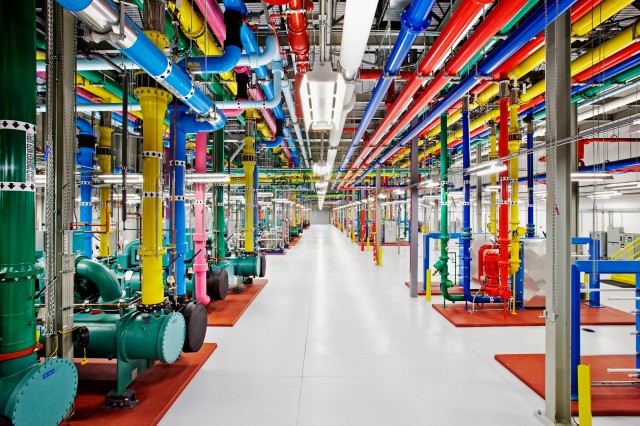
Cooling pipes at a Google data center in Douglas County, Georgia. (credit: Google)
Google’s greenhouse gas emissions have surged 48 percent in the past five years due to the expansion of its data centers that underpin artificial intelligence systems, leaving its commitment to get to “net zero” by 2030 in doubt.
The Silicon Valley company’s pollution amounted to 14.3 million tonnes of carbon equivalent in 2023, a 48 percent increase from its 2019 baseline and a 13 percent rise since last year, Google said in its annual environmental report on Tuesday.
Google said the jump highlighted “the challenge of reducing emissions” at the same time as it invests in the build-out of large language models and their associated applications and infrastructure, admitting that “the future environmental impact of AI” was “complex and difficult to predict.”
ProPublica is a nonprofit newsroom that investigates abuses of power. Sign up to receive our biggest stories as soon as they’re published.
In the wake of President Joe Biden’s poor debate performance, his opponents and most major media organizations have pointed out that he has done few interviews that give the public an opportunity to hear him speak without a script or teleprompters.
ProPublica obtained a rare interview with Biden on Sept. 29, nine days before the Hur interviews began. We released the video, which was assembled from footage shot by five cameras, on Oct. 1. We edited out less than a minute of crosstalk and exchanges with the camera people, as is customary in such interviews.
Today, we are releasing the full, 21-minute interview, unedited as seen from the view of the single camera focused on Biden. We understand that this video captures a moment in time nine months ago and that it will not settle the ongoing arguments about the president’s acuity today. Still, we believe it is worth giving the public another chance to see one of Biden’s infrequent conversations with a reporter.
The Interview With the Camera Focused on Biden
The Interview as Published
Conducting the interview was veteran journalist and former CNN White House correspondent John Harwood, who requested it and then worked with ProPublica to film and produce it.
He did not send questions to the White House ahead of time, nor did he get approval for the topics to be discussed during the interview.
Recording began as soon as Biden was miked and sitting in the chair that Friday at 2:50 p.m. Earlier that day, Biden’s press staff had said the president would have only 10 minutes for the interview, instead of the previously agreed upon 20 minutes. We requested that the interview go the full 20 minutes. You can hear during the unedited interview a couple of moments when White House staff interrupted to signal that the interview should come to a close. Biden seemed eager to continue talking.
ATLANTA, GEORGIA - JUNE 27: U.S. President Joe Biden walks off stage during the CNN Presidential Debate at the CNN Studios on June 27, 2024 in Atlanta, Georgia. President Biden and Republican presidential candidate, former U.S. President Donald Trump are facing off in the first presidential debate of the 2024 campaign. (Photo by Justin Sullivan/Getty Images)
A comatose Joe Biden would make a better president than Donald Trump. And the president’s capacity to lead the executive branch is, by most accounts, far greater than his capacity to speak in coherent, extemporaneous sentences on CNN.
But the idea that Joe Biden is the best possible standard-bearer for the Democratic Party this November has lost all plausibility.
At the first presidential debate in Atlanta Thursday night, Trump spouted an endless stream of deranged lies, painting a portrait of a nonexistent United States in which babies are summarily executed in maternity wards, undocumented criminals live in the penthouses of luxury hotels on Uncle Sam’s dime, and the world’s wealthiest nation has become “a Third World country.”
But Biden’s senescence spoke louder than Trump’s mendacity.
The president spoke in broken sentences through a soft, sometimes tremulous voice (Biden’s campaign said that he had a cold). At various points, his mind failed to keep pace with his lips, causing him to abandon a half-delivered talking point or else lose his train of thought entirely. In one excruciating early moment — while trying to advertise his administration’s efforts to cap the prices of prescription drugs for Medicare beneficiaries — Biden said that he had been “making sure that we’re able to make every single solitary person eligible for what I’ve been able to do with … the Covid … excuse me, with, um, dealing with everything we have to do with … uh … look … if … we finally beat Medicare.”
The president’s visual appearance was similarly unsettling, his skin pallid and his mouth hanging oddly agape during some of Trump’s answers.
This despairing spectacle — of a viciously dishonest insurrectionist turning in a debate performance that, if juxtaposed with anything but the president’s even more disjointed efforts would have seemed astoundingly rambling and incoherent — led many Democrats on social media and in private channels to call for Biden’s replacement.
Those calls are now irrefutable.
The case for Biden was weak even before the debate
When asked whether they plan to vote for a Democrat or Republican for Congress, voters favor Democrats by a margin of 45.6 to 45.1. In polls of battleground state electorates, Democratic Senate candidates routinely run far ahead of Biden. Democrats have plenty of political challenges as a party, but Biden had even more as a candidate even before the cameras started rolling in Atlanta.
The president is saddled with the misfortune of presiding over the highest inflation in four decades. This does not reflect any great economic mismanagement on his part; to the contrary, he has shepherded the US to the strongest recovery of any G-7 country. Yet, across the wealthy world, more or less every leader who presided over 2022’s inflation has suffered overwhelming public disapproval. For many voters, Biden is the personification of price increases. Even if he were in his prime as an orator, there would be a case for swapping him out merely because bad luck had damaged his brand.
But of course, Biden is not in his prime. He would be 82 years old at his second inauguration and 86 at the close of his second term. It strains credulity to claim that the person best suited to run the United States is an octogenarian. Were the Democratic nominee anyone else, Trump’s age — 78 — would be a significant liability for the Republicans. But Biden is three years older than Trump, andseems about a decade his senior.
Or so voters appear to think. In an ABC News poll from February, 86 percent of voters said that Biden was too old to serve another term.
Partly for these reasons, Biden has been trailing Trump in polls of virtually every swing state. And in both 2016 and 2020, the polls significantly overestimated Democratic support in the Electoral College’s battlegrounds. Before Thursday night, Nate Silver’s model gave Trump a 66 percent chance of winning.
Thus, there was already a solid case for Biden to step aside and let Kamala Harris or some other Democrat lead the party into November’s election, even before his dispiriting debate performance. By far the most likely consequence of staying the course was America’s reelection of a corrupt and authoritarian reactionary. Rolling the dice on a new candidate was plausibly the party’s best move.
Then, Biden went on national television and made it impossible for anyone to honestly say, “I am confident that the president will still be fit to serve in January 2029.”
It is not too late for Democrats to replace Joe Biden (with his cooperation)
There is no way for the Democratic Party to deny Biden the nomination at this point. But Democratic leaders could personally lobby the president to step aside and endorse his preferred successor, preempting the hazards of a contested Democratic convention in late August. Waiting months to anoint a presumptive nominee would be highly risky. Rallying around Biden’s handpicked heir now would be much less so.
If one wishes to minimize intra-party strife, then Biden could simply endorse his vice president, who already functions as his default replacement. Few consider Harris to be among her party’s best political talents, but she offers far more upside than the version of Biden we saw Thursday night.
If Democratic leaders believe that it would be possible for Biden to endorse a more electorally formidable candidate (perhaps Michigan Gov. Gretchen Whitmer?) without alienating key constituencies, then that might be the optimal course of action. Sticking with Biden, plainly, is not.
The president’s policy positions and governing record matter more than his current skills as a rhetorician. But precisely because of how much is substantively at stake in this election, Democrats cannot afford to wager it on American voters changing their minds and deciding that Biden isn’t too old for his job after watching him struggle to remember the topics of his own sentences.
Many aspects of Biden’s legacy are laudable. His best chance for preserving it would be to voluntarily end his presidency after one term before voters get the chance.
Two years after finishing and then abandoning its Amazon Fresh grocery store on Shady Grove Road, the internet behemoth has reversed course and decided to open this location after all. The store has been bustling with activity for several weeks, and an Amazon spokesman tells us it will be up and running shortly. This change of plans comes more than a year after Amazon put its grocery store chain on hold, and several months after the company confirmed that it had abandoned its once-promising “Just Walk Out” technology. The new store will use Amazon’s less-complex “Dash Cart” system, which allows shoppers to pay for each item as they roll along.
To be clear: SpaceX’s Starlink service can be a game changer for those completely out of range of broadband access. Getting several hundred megabits per second in the middle of nowhere is a decidedly good thing, assuming you can afford the $120 a month subscription cost and up front hardware costs.
But contrary to what many press outlets imply, it’s not magic. And it comes with a growing list of caveats.
Now some scientists warn that the steady parade of smaller low-Earth orbit satellites constantly burning up in orbit could release chemicals that could undermine the progress we’ve made repairing the ozone layer. Researchers at the University of Southern California’s Department of Astronautical Engineering issued a press statement explaining the challenges in greater detail (study here):
“Aluminum oxides spark chemical reactions that destroy stratospheric ozone, which protects Earth from harmful UV radiation. The oxides don’t react chemically with ozone molecules, instead triggering destructive reactions between ozone and chlorine that deplete the ozone layer. Because aluminum oxides are not consumed by these chemical reactions, they can continue to destroy molecule after molecule of ozone for decades as they drift down through the stratosphere.”
Much like concerns about space garbage, regulators generally have been so innovation cooed that they haven’t thought much about this. Starlink alone is slated to launch 42,000 low Earth orbit satellites, and other companies like Amazon are expected to soon join the parade. All of these cheaper, smaller satellites have less than a five year life span, so they’ll be consistently falling back to Earth.
The scientists found that satellites re-entering Earth orbit have already increased aluminum in the atmosphere by 29.5% over natural levels. They also say that by the time satellite constellations are complete, every year, 1,005 U.S. tons of aluminum will fall to Earth, releasing 397 U.S. tons of aluminum oxides per year to the atmosphere, an increase of 646% over natural levels.
Stripping away the Earth’s protection from harmful UV radiation is, to be clear, bad.
You might recall that the Trump administration tried to give Musk’s Starlink nearly a billion dollars in subsidies in exchange for delivering Starlink to some traffic medians and airport parking lots. The Biden FCC backtracked on a large chunk of those awards, noting that if taxpayers are going to fund broadband expansion, they should prioritize non-capacity constrained, affordable fiber access as much as possible.
Telecom experts say truly “bridging the digital divide” mostly involves deploying fiber as deeply into rural America as is practical, then filling in the remaining gaps with 5G and fixed wireless. Increasingly that’s involving communities building their own open access fiber networks to spur competition, whether a municipal network, cooperative, public-private partnership, or extension of the city’s electrical utility.
Services like Starlink certainly do play a niche role in this quest to fill in whatever access gaps remain (especially during emergencies or military campaigns), but it’s a growing question whether the growing list of trade offs are going to be worth it.
Enlarge / Julian Assange in an airplane in a photo posted by WikiLeaks on June 25, 2024. (credit: WikiLeaks)
WikiLeaks founder Julian Assange has agreed to plead guilty to a single criminal charge, ending a long extradition battle with the United States government. Assange will reportedly avoid further jail time and be allowed to return to his home country of Australia.
Assange won't have to travel to the continental United States. He is scheduled to plead guilty tomorrow in US District Court for the Northern Mariana Islands, a US territory in the western Pacific Ocean.
In a court filing in Saipan, the US government said:
Enlarge / Lars Fruergaard Jorgensen, chief executive officer Novo Nordisk A/S, during an interview at the company's headquarters in Bagsvaerd, Denmark, on Monday, June 12, 2023. (credit: Getty | Carsten Snejbjerg)
After some persuasion from Sen. Bernie Sanders (I-Vt.), the CEO of Novo Nordisk will testify before lawmakers later this year on the "outrageously high cost" of the company's diabetes and weight-loss drugs—Ozempic and Wegovy—in the US.
CEO Lars Jørgensen will appear before the Senate Committee on Health, Education, Labor, and Pensions (HELP), which is chaired by Sanders, in early September. The agreement came after a conversation with Sanders in which the CEO reportedly "reconsidered his position" and agreed to testify voluntarily. As such, Sanders has canceled a vote scheduled for June 18 on whether to subpoena Novo Nordisk to discuss its US prices, which are considerably higher than those of other countries.
The independent lawmaker has been working for months to pressure Novo Nordisk into lowering its prices and appearing before the committee. In April, Sanders sent Jørgensen a letter announcing an investigation into the prices and included a lengthy set of information requests. In May, the committee's investigation released a report suggesting that Novo Nordisk's current pricing threatens to "bankrupt our entire health care system."
Extreme heat has already proven deadly this year, and the toll could rise.
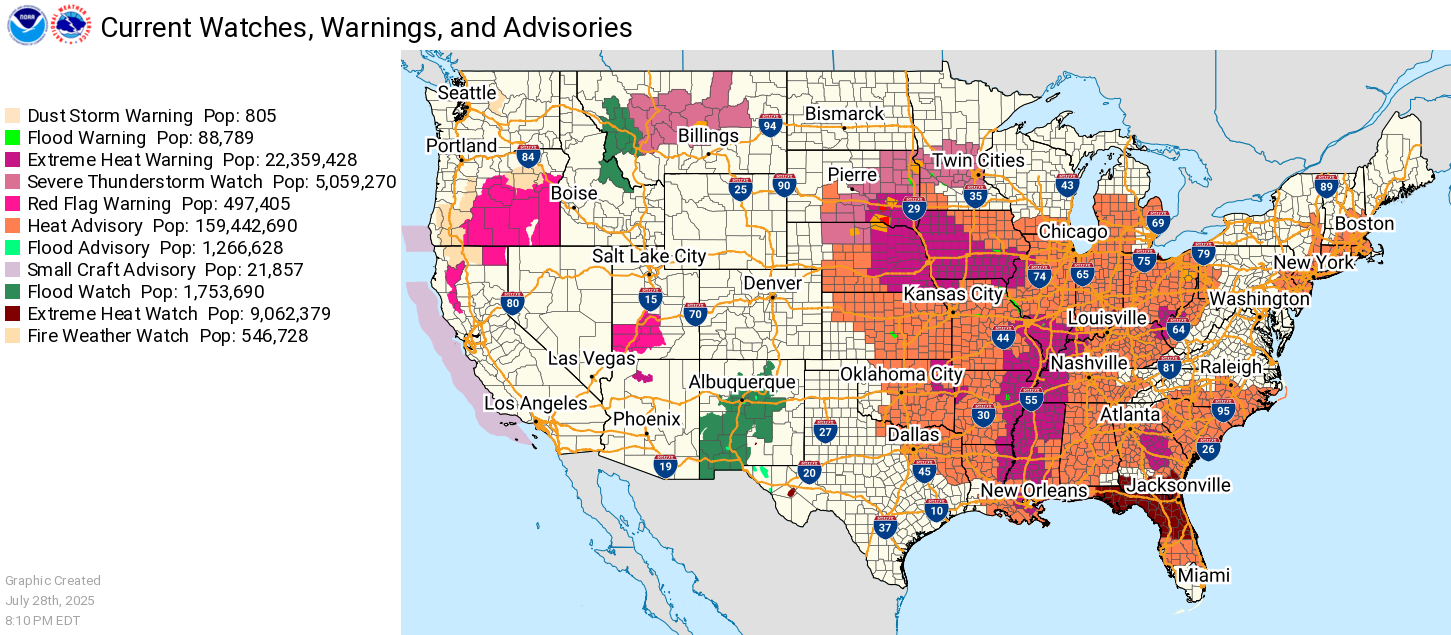
A massive heat wave is poised to bake huge swaths of the Eastern United States and set new temperature records over the Great Lakes, New England, and the mid-Atlantic regions in the next several days, according to the National Weather Service. Forecasters also expect triple-digit heat in California’s Central Valley through the weekend. As of Thursday morning, more than 100 million Americans faced some type of heat alert.
Cities and states are bracing for the health toll from the scorching weather, opening cooling centers and declaring emergencies. These dangers are likely to persist even after the sun goes down. “Record warm overnight temperatures will prevent natural cooling and allow the heat danger to build over time indoors without air conditioning,” the National Weather Service wrote in its bulletin.
Last year showed just how devastating extreme heat can be. Looking at data from the Centers for Disease Control and Prevention, the Associated Press found that roughly 2,300 people died in part due to excessive heat in 2023, the hottest year on record. Some of the deadliest heat was in the Southwestern US, a warning sign that there’s an upper limit to heat tolerance even in a region otherwise accustomed and adapted to hot weather.
And this year, deadly temperatures have already claimed dozens of lives around the world. In India, extreme heat has killed at least 60 people so far. Mexico has seen at least 61 deaths.
Amid these extraordinary, sweltering late spring temperatures, an old measure of heat risk is getting some renewed attention: the wet-bulb globe temperature (WBGT). It tracks temperature, humidity, and sunlight, and it’s shown that it can better warn against the dangers of hot weather than temperature alone. The upper limit wet-bulb temperature for human survival is considered to be 95 degrees Fahrenheit for young, healthy people, but in the recent heat wave in India, the WBGT reached 100 degrees.
Inside this story
• The rising threat of extreme heat.
• What the wet-bulb globe temperature is and why the military created a new way to gauge heat danger.
• Why our most powerful measurement of heat risk ends up being so dry and inaccessible.
• How heat impacts the body and how to evaluate your own risk.
Health authorities across states and the federal government are now racing to come up with ways to save lives as the temperatures in 2024 climb to even higher peaks. Last month, the US Department of Health and Human Services launched its Health and Heat Index to help communities plan for heat-related dangers. It uses temperature records and historical emergency room visits to measure the potential heat threats in every ZIP code, with the goal of helping communities prepare for scorching weather.
But the dangers aren’t spread evenly. Unlike disasters like tornadoes or torrential downpours, which can kill indiscriminately, the specific harms from extreme heat vary from person to person.
While people in a given region can feel the same warmth, whether that leads to just damp clothes or a trip to the ER depends on someone’s underlying health conditions, age, humidity, how long they’ve been outside, and even how strong a breeze is blowing.
That’s why the scientists who study the health risks from heat warn that thermometers are not enough. If the goal is to reduce the number of deaths from extreme heat, we need more sophisticated measurements of the weather and a better grasp of our individual vulnerabilities.
And critically, the people baking under this extreme heat need the education to grasp these hazards and the tools to cope.
How heat affects the body
To understand the dangers of extreme heat, it helps to know a little about physiology. Most human bodies operate within a narrow temperature band around 98.6 degrees Fahrenheit.
“All your biochemistry and physiology, the function, is optimized for that temperature,” explained W. Jon Williams, a research physiologist at the National Institute for Occupational Safety and Health.
Everything from the organ level (how well your heart pumps, how efficiently blood moves oxygen, how well kidneys filter waste) down to the molecular level (how proteins fold, how DNA replicates) works best within these thermal confines. As a consequence, the human body devotes a lot of resources to holding steady at this temperature. In fact, only about 20 percent of the calories from the food we eat fuel the work done by the body like moving muscles. “The rest is given off as heat, a byproduct of energy that’s not used for work,” Williams said. “That’s the source of our body temperature.” But as muscles start to do work, they use up energy, which generates even more heat.
When ambient temperatures — the kind you read on most thermometers or weather apps — are below the body temperature, any extra warmth can radiate away. The surrounding air can also carry away heat. If these mechanisms don’t cool the body off enough, it starts to produce sweat, which cools the skin as it evaporates.
“If it’s dry enough, if the humidity is low enough, it’s an extremely efficient way of taking body heat away to the environment,” Williams said.
However, as humidity increases, the cooling effectiveness of sweating decreases since sweat doesn’t evaporate as readily. If heat and humidity rise in tandem, that increases the chances of the body’s temperature rising too. And if surrounding temperatures are hotter than 98.6 degrees Fahrenheit, the body ends up absorbing heat from the environment.
Too much heat in the body can quickly lead to complications like heat exhaustion. This presents with symptoms like dizziness, fatigue, muscle cramps, clammy skin, and nausea. If the core body temperature rises past 104 degrees Fahrenheit, it can cause heat stroke, a life-threatening condition where organs shut down.
The warning signs of heat stroke are confusion, delirium, seizures, or passing out. It’s often accompanied by rapid breathing and a racing pulse. But there are some confusing symptoms as well: A victim’s skin can turn hot to the touch, flushed, and dry, but the skin can also be extremely sweaty and pale. Some people’s blood pressure will tank, while in others, it can surge. Nonetheless, if you suddenly experience these symptoms or notice them in someone else, call 911 immediately.
The added challenge is that the specific threshold where these complications set in can vary from person to person.
Older adults and young children tend to be more vulnerable to extreme heat. People with high blood pressure can experience adverse symptoms at lower temperatures than those with normal blood pressure. Medications like diuretics and psychotropic drugs can increase vulnerability to extremely hot weather. And the effects of heat can be cumulative: People who live and work under high temperatures day after day, and increasingly, night after night, face rising risks of heat-related illnesses.
That’s why a simple temperature reading doesn’t provide enough information to measure when it’s too dangerous to be outside. Truly figuring out when it’s too risky requires accounting for more variables in the environment and in the individual.
The wet-bulb globe temperature, explained
The search for a better way to gauge risks from heat isn’t new, and there are some metrics that go beyond just the thermometer. One of the more common measures is the heat index. It accounts for both temperature and relative humidity in a single number to convey how the conditions feel.
But the heat index still doesn’t tell the whole story. José Arturo González Mendoza, a 30-year-old farmworker, died last September harvesting sweet potatoes in North Carolina. On the day of his death, the heat index was 96 degrees Fahrenheit, which is considered to be below the danger threshold. “The National Weather Service doesn’t even issue their alerts until you’re over a hundred degrees into the heat index,” said Ashley Ward, who leads the Heat Policy Innovation Hub at Duke University.
Ward noted that the heat index is measured in the shade, so it doesn’t account for the added stress of sun exposure. And it doesn’t account for whether still, muggy air is pinning humidity in place or if wind is helping people stay cool.
A better metric, according to Ward, is the wet-bulb globe temperature, which was developed by the US military after World War II in response to a rash of heat-related deaths during training. According to the US Marine Corps, WBGT is “the most effective means of assessing the effect of heat stress on the human body.”
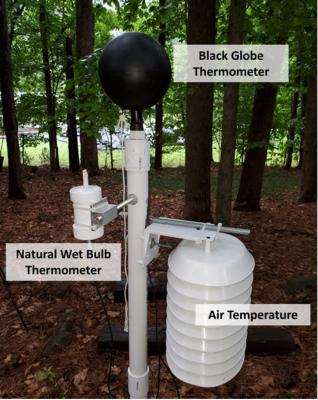
It’s often described as the reading on a thermometer with a damp sock around it, though the devices are a bit more sophisticated than that. WBGT integrates three distinct measurements: It measures open-air temperatures with a conventional thermometer. It measures temperatures inside a black globe to indicate what it’s like under direct sunlight. And yes, it measures temperatures with a thermometer wrapped in a wet cloth.
The point of the damp thermometer is to simulate how well sweat can evaporate under the present conditions. The longer the thermometer stays wet as temperatures rise, the more humid the surrounding air, and thus the more difficult it is to cool off by sweating.
These measurements are then plugged into a formula: The WBGT equals 10 percent of the air temperature plus 70 plus of the natural wet bulb temperature plus 20 percent of the black globe temperature. There aren’t as many WBGT monitoring stations as there are conventional thermometers, and coverage can be spotty. The National Weather Service has a prototype tool that can estimate WBGT near you.
Ward noted that when Mendoza died, the WBGT was above 90 degrees Fahrenheit, well into dangerous territory. Institutions like the US military and even North Carolina high schools consider a WBGT above 90°F to be “black flag” conditions, where all unnecessary outdoor activity must stop.
Ward said this could be a far more effective way to convey the threats from high temperatures, but it has yet to gain traction. Though the WBGT was developed in the US, it has gained more traction in other parts of the world. “When I was in Hong Kong, they reported the wet bulb globe on their nightly news like we report the heat index,” Ward said. “There needs to be broad scale public education around wet bulb globe in order for us to be able to use it effectively as a public health metric.”
Heat doesn’t have to be deadly or dangerous
A better heat risk measurement can’t do much unless people can act on it.
For one thing, a lot of people are compelled to work in the heat. Almost one-third of US jobs require workers to be outside, though people who work inside in places like factories, foundries, and kitchens can face extreme heat too. The Occupational Safety and Health Administration reported that 121 workers died from heat between 2017 and 2022.
Again, in the US, there is no federal workplace heat safety standard, though agencies are in the process of drafting a regulation. Five states — California, Oregon, Colorado, Minnesota, and Washington — do have their own workplace heat standards. Some cities are also enforcing their own heat rules and implementing policies to reduce ambient temperatures like cool roofs and green spaces to curb urban heat islands. But states like Florida and Texas are blocking local governments from setting stronger protections for outdoor workers, citing harms to businesses.
Ward said that one of her frustrations is that it’s actually not that difficult to reduce the risks from extreme heat. “It’s not as if we don’t know,” she said. Much of the conventional wisdom still holds: Stay hydrated. Stay in the shade. Take frequent breaks. There is in fact a whole suite of non-air-conditioning interventions that can keep people cool and save lives.
“Did you know that if you immerse your arms over your elbows or your feet up to your ankles [in water] that you can reduce your core body temperature by up to 3 degrees and save your life?” Ward said.
But increasing access to cooling and air conditioning also needs to be part of the solution. People who are experiencing homelessness or can’t afford cooling are at much greater risk of illnesses during heat waves.
Over the long term, humanity will also have to zero out its emissions of heat-trapping gasses that are warming the planet. But in the meantime, we can limit the suffering from extreme heat by giving people better information about when conditions are turning perilous and taking precautions. Many more hot days are ahead, but more people don’t have to die.
Update, June 20, 11:00 am: This piecewas originally published on June 17 and has been updated to include information about an ongoing heatwave across the United States.
MIAMI, FLORIDA - JULY 12: A "for rent" sign in front of a home on July 12, 2023 in Miami, Florida. The U.S. consumer price index report showed that inflation fell to its lowest annual rate in more than two years during June. (Photo by Joe Raedle/Getty Images)
DETROIT — The federal government is laying the groundwork for a potentially major change to the nation’s largest rental assistance program, aiming to test an idea that would allow low-income tenants to pay rent directly with cash, rather than use traditional housing vouchers.
On Wednesday afternoon in Detroit, at a national guaranteed income conference, HUD Deputy Assistant Secretary for Policy Development Brian McCabe announced that his agency is soon planning to solicit public comment on the prospect of testing whether distributing cash directly to tenants might work better for renters, landlords, governments and even taxpayers.
Officials are keenly aware of some of the stark challenges faced by participants of the 50-year-old federal voucher program. To get a voucher, a household first must prove eligibility. Then a public housing agency must issue the voucher subsidy to a landlord on the household’s behalf. The landlord must then accept that voucher, the unit must pass an inspection, and the landlord must sign a contract with the public housing agency.
Some renters, in turn, struggle to find anywhere to use their voucher, should they be one of the lucky few to even receive one. One federal study found that only about 60 percent of beneficiaries can find a landlord willing to rent to them.
HUD will specifically seek input on questions like whether landlords would be more willing to rent to low-income people if they could skip the government’s red tape, and whether there would be higher-quality housing available to renters using cash. More than two million families currently use the federal subsidy.
At the conference, McCabe also shared that HUD plans to soon issue guidance to housing agencies on how they could run these sorts of cash pilot programs. McCabe was referring specifically to agencies in Moving to Work, a federal program that allows certain public housing authorities to spend their dollars more flexibly than is permitted under the traditional voucher program. Moving to Work was established in 1996 and expanded by Congress in 2016.
McCabe’s announcement reflects a change in HUD’s position on cash assistance. Last year, HUD lawyers said housing agencies, including those in Moving to Work, lacked the legal authority to test cash aid in lieu of vouchers.
The shift came in part from advocacy by housing leaders over the last year, who’ve emphasized that they believe Moving to Work agencies do have congressional permission to pilot innovations like cash rental assistance. Vox reviewed one such letter sent on May 7 by four national housing groups, and another sent by public housing agency leaders, like Preston Prince, the executive director of the Santa Clara Housing Authority.
Providing cash assistance “could be really disruptive — in a good way,” Prince told Vox. “Cash could help us serve more families.” Santa Clara has some 37,000 people on its voucher waitlist, and leaders estimate that they’re currently serving just one in six eligible residents.
Prince acknowledges that a study testing cash rental assistance could evoke more criticism of the housing voucher program or even of housing authorities more broadly.
“I am petrified about doing this pilot project, that it might prove something I’ve been working on for 30 years is not effective,” he told me. “It could challenge the overall system. That’s the unnerving part. But it takes a little bit of courage to say in the end it’s not about me.”
Advocates for testing cash rental assistance stress that they’re just looking to improve the housing voucher program, not replace it wholesale. If cash proved effective and even helped save governments money, officials might be able to focus on providing more support services, producing new housing, and conducting research. Housing authorities spend 13.8 hours annually on average administering individual vouchers, with tasks like certifying a renter’s income and assets to ensure they are as destitute as they say.
That voucher fraud detection work exists to protect public funds, but can also be stigmatizing and degrading. “There’s been pressure to look at our families as broken and untrustworthy, and direct rental assistance could really say to people, ‘You are trustworthy and valuable and we are here to help you be successful,’” said Prince.
The federal government has taken steps in recent years to cut down on paperwork required to access housing aid. During the pandemic individuals seeking help under the $46.5 billion Emergency Rental Assistance Program could simply affirm, under penalty of perjury, details such as their income or address, rather than submitting official records.
More recently, HUD announced that housing agencies could allow people to self-certify their income for homeless program eligibility, a move that could expedite voucher access. In announcing the shift, HUD acknowledged that many people experiencing homelessness might not have Social Security cards or pay stubs to prove their income status.
While some renters might prefer vouchers, others may find cash easier and faster to use, especially in certain markets. “I suspect that renters being able to present themselves to landlords as paying like any other potential tenant could feel quite empowering,” Stefanie DeLuca, a sociologist at Johns Hopkins, told me in 2021. Several sources Vox spoke with confirmed there could be multiple cash rental assistance studies launched as early as this year.
Though housing leaders are pitching the research as a modest policy inquiry, officials involved are keenly aware of the potentially dramatic implications of this research, should the studies show that cash indeed works better. A small pilot could lead to a larger federally funded demonstration study, which could, officials say, then lead to asking Congress to make permanent changes to the big bipartisan program.
How the idea of cash rental assistance advanced
The road to McCabe’s announcements in Detroit traces its origins back to the 1970s, in a now largely forgotten nationwide study of cash rental assistance. Known as the Experimental Housing Allowance Program, 50,000 families across 12 US cities received cash subsidies for rent. Program evaluators found the subsidies were well-received and successfully administered, but policymakers shifted their attention to the new federal housing voucher program, then known as Section 8.
In 2017, Todd Richardson, a longtime HUD staffer whose team inadvertently discovered old reports of this federal experiment, proposed that those findings could inform the existing Moving to Work voucher program.
By September 2023, as Vox then reported, HUD officials began formally pitching philanthropies and basic income advocates on partnering to study this cash rental assistance idea. Part of their hope was that private charitable dollars might have fewer legal constraints than federal voucher funds, which HUD attorneys then still felt would be ineligible to use for the research.
Since then HUD has been meeting regularly with nonprofits, funders, and housing experts to figure out how to get this cash aid idea off the ground. The federal housing agency has been hosting monthly virtual meetings and in November convened an in-person event in Washington, DC.
James Riccio, with the national policy research group MDRC, has participated in those monthly calls led by HUD analyst Paul Joice, and he told Vox his nonprofit should know “within the next month” if they can move forward with officially designing a cash rental assistance study. If they get the go-ahead, Riccio thinks their design work could be completed by late summer or early fall.
“We’ve taken up the gauntlet that HUD has thrown down and are trying to build a demonstration that would inform HUD’s efforts,” he said.
MDRC’s goal is to conduct a two-year randomized control trial across five geographically diverse cities, studying 1,000 families. Half of those would pay for their housing with traditional vouchers, and the other half would use cash.
“We really don’t know how it’s going to turn out, if landlords would be more inclined to rent to people,” Riccio said. “It seems there’s very good reason to think it could be true, but it’s something we could learn.”
Basic income advocates see a major opportunity
The pilot program is especially exciting for advocates of guaranteed income, who believe that the government should provide individuals with unconditional cash payments to reduce poverty, promote economic stability, and ensure basic standards of living.
During the early years of the pandemic, federal emergency aid fueled some tests of this guaranteed income idea. But that money has largely run out, and the tens of billions in annually appropriated federal voucher dollars presents advocates with a much more potentially reliable funding stream.
For now, leaders in the movement emphasize that they see cash rental assistance as a complement, rather than a replacement, to other forms of housing aid.
“We don’t want to be providing impetus to strip HUD of funding for the voucher program, which along with other rental assistance lifts 900,000 people out of poverty every year,” said Nika Soon-Shiong, the executive director of the Fund for Guaranteed Income, which is currently fundraising for a cash rental assistance pilot. “It’s not about more or less government, it’s about what kinds of interactions officials are investing in. What if every call to verify a low-income renter’s income was instead, ‘Hey, I heard you needed a ride. I can drive you.’”
The Fund for Guaranteed Income, which has administered a dozen basic income pilots across the US, is hoping to launch a rental assistance study later this year. It would be less statistically precise than the one MDRC is pursuing, but Soon-Shiong says they’d be focused more on practical design questions and specifically helping individuals move into apartments more easily. Their smaller pilot would aim to study 100 people for one year who receive direct cash, compared with 100 people who receive a voucher off the waitlist.
“What we’re trying to pilot is the mechanisms to build that cash on-ramp, and what it looks like specifically to redesign the housing inspection form, and to make sure the contract they sign can be converted into a housing assistance payment contract,” Soon-Shiong told Vox. “Our particular intervention is focused on how we can solve one of the key problems of the program which is that people aren’t able to utilize their voucher.”
At the Detroit conference on Wednesday, McCabe gave a shout-out to the Fund for Guaranteed Income’s work and stressed that he sees many different variations of research as helpful to building an evidence base.
“I want to emphasize there are millions of different ways that this type of program could be developed, and they would test different things and address different issues in the voucher program,” he said. “But in the end, we’re thinking about what it would mean to give families cash to pay their rent.”
Some lawmakers are talking about turning back the clock on divorce law.
Before the 1960s, it was really hard to get divorced in America.
Typically, the only way to do it was to convince a judge that your spouse had committed some form of wrongdoing, like adultery, abandonment, or “cruelty” (that is, abuse). This could be difficult: “Even if you could prove you had been hit, that didn’t necessarily mean it rose to the level of cruelty that justified a divorce,” said Marcia Zug, a family law professor at the University of South Carolina.
Then came a revolution: In 1969, then-Gov. Ronald Reagan of California (who was himself divorced) signed the nation’s first no-fault divorce law, allowing people to end their marriages without proving they’d been wronged. The move was a recognition that “people were going to get out of marriages,” Zug said, and gave them a way to do that without resorting to subterfuge. Similar laws soon swept the country, and rates of domestic violence and spousal murder began to drop as people — especially women — gained more freedom to leave dangerous situations.
Today, however, a counter-revolution is brewing: Conservative commentators and lawmakers are calling for an end to no-fault divorce, arguing that it has harmed men and even destroyed the fabric of society. Oklahoma state Sen. Dusty Deevers, for example, introduced a bill in January to ban his state’s version of no-fault divorce. The Texas Republican Party added a call to end the practice to its 2022 platform (the plank is preserved in the 2024 version). Federal lawmakers like Sen. J.D. Vance (R-OH) and House Speaker Mike Johnson, as well as former Housing and Urban Development Secretary Ben Carson, have spoken out in favor of tightening divorce laws.
If this sounds outlandish or like easily dismissed political posturing — surely Republicans don’t want to turn back the clock on marital law more than 50 years — it’s worth looking back at, say, how rhetorical attacks on abortion, birth control, and IVF have become reality.
And that will cause huge problems, especially for anyone experiencing abuse. “Any barrier to divorce is a really big challenge for survivors,” said Marium Durrani, vice president of policy at the National Domestic Violence Hotline. “What it really ends up doing is prolonging their forced entanglement with an abusive partner.”
In the wake of the Dobbs decision, divorce is just one of many areas of family law that conservative policymakers see an opportunity to rewrite. “We’ve now gotten to the point where things that weren’t on the table are on the table,” Zug said. “Fringe ideas are becoming much more mainstream.”
Republicans in multiple states are eyeing divorce restrictions
Pushback against no-fault divorce dates back decades. In the 1990s and early 2000s, three states passed covenant marriage laws, allowing couples to opt into signing a contract allowing divorce only under circumstances like abuse or abandonment. Some backers of the laws intended them to send a larger anti-divorce message, the Maryland Daily Record reported in 2001. Speaker Johnson, then a lawyer in Louisiana, was an early adopter of covenant marriage, entering one with his wife Kelly in 1999.
More recently, high-profile conservative commentators have taken up the anti-divorce cause. Last year, the popular right-wing podcaster Steven Crowder announced his own unwilling split. “My then-wife decided that she didn’t want to be married anymore,” he complained, “and in the state of Texas, that is completely permitted.”
That could change. As Tessa Stuart noted in Rolling Stone, the Texas Republican party controls both chambers of the state legislature and the governor’s office, and could likely make its platform — the one calling on the state legislature to “rescind unilateral no-fault divorce laws” — a reality if it chose. The Louisiana and Nebraska Republican parties have also considered or adopted similar language.
And Ben Carson, secretary of housing and urban development under President Donald Trump who has been floated as a potential VP pick, wrote in his recent book that “for the sake of families, we should enact legislation to remove or radically reduce incidences of no-fault divorce.”
Ending no-fault divorce would have major consequences
Opponents of no-fault divorce argue that it is hurting families and American culture. Making divorce too easy causes “social upheaval, unfettered dishonesty, lawlessness, violence towards women, war on men, and expendability of children,” Deevers wrote last year in the American Reformer, a Christian publication. “To devalue marriage is to devalue the family is to undermine the foundation of a thriving society.”
It’s worth noting that though the no-fault laws initially led to spikes in divorce, rates then began to drop, and reached a 50-year low in 2019, CNN reports. But today, an end to no-fault divorce would cause enormous financial, logistical, and emotional strain for people who are trying to end their marriages, experts say. Proving fault requires a trial, something many divorcing couples today avoid, said Kristen Marinaccio, a New Jersey-based family law attorney. A divorce trial is time-consuming and costly, putting the partner with less money at an immediate disadvantage. It can also be “really, really traumatizing” to have to take the stand against an ex-partner, Marinaccio said.
There’s also no guarantee that judges will always decide cases fairly. In the days of fault-based divorce, courts were often unwilling to intervene in marriages even in cases of abuse, Zug said.
No-fault divorce can be easier on children, who don’t have to experience their parents facing each other in a trial, experts say. Research suggests that allowing such divorces increased women’s power in marriages and even reduced women’s suicide rates. A return to the old ways would turn back the clock on this progress, scholars say.
“We know exactly what happens when people can’t get out of very unhappy marriages,” Zug said. “There’s much higher incidences of domestic abuse and spousal murder.”
It’s unlikely that blue states would ban no-fault divorce, Marinaccio said, but if red states do, their residents would be stuck. Divorce laws generally include a residency requirement, which would make it difficult for people to cross state lines to get a divorce the way they sometimes do now to obtain an abortion. “Your state is the only access you have to divorce,” Marinaccio said.
Divorce is extremely common — more than 670,000 American couples split in 2022 alone. Any rollback to no-fault divorce would likely be politically unpopular, even in red states (some of which have higher divorce rates than the national average).
But perhaps emboldened by their victory in overturning Roe v. Wade, social conservatives have gone after other popular targets in recent months, from birth control to IVF. The drive to increase restrictions on divorce is part of the same movement, Zug said — an effort to re-entrench “conservative family values,” incentivize heterosexual marriage and childbearing, and disempower women. “They are all connected,” Zug said.
June 2023 did not seem like an exceptional month at the time. It was the warmest June in the instrumental temperature record, but monthly records haven't exactly been unusual in a period where the top 10 warmest years on record have all occurred within the last 15 years. And monthly records have often occurred in years that are otherwise unexceptional; at the time, the warmest July on record had occurred in 2019, a year that doesn't stand out much from the rest of the past decade.
But July 2023 set another monthly record, easily eclipsing 2019's high temperatures. Then August set yet another monthly record. And so has every single month since, a string of records that propelled 2023 to the warmest year since we started keeping track.
Yesterday, the European Union's Copernicus Earth-monitoring service announced that we've now gone a full year where every single month has been the warmest version of that month since we've had enough instruments in place to track global temperatures.
NEW YORK, NEW YORK - MAY 31: Former U.S. President Donald Trump enters a news conference at Trump Tower following the verdict in his hush-money trial at Trump Tower on May 31, 2024 in New York City. A New York jury found Trump guilty Thursday of all 34 charges of covering up a $130,000 hush money payment to adult film star Stormy Daniels to keep her story of their alleged affair from being published during the 2016 presidential election. Trump is the first former U.S. president to be convicted of crimes.
Donald Trump became America’s most prominent felon on Thursday, when a New York jury convicted him on 34 charges of falsifying business records.
That verdict has proven predictably controversial. New York’s case against Trump has attractedbipartisancriticism ever since Manhattan District Attorney Alvin Bragg indicted the former president last year. Of all the cases brought against Trump, New York’s charges have always looked both the least solid and the least serious.
The criticisms of Bragg’s case are worth taking seriously. And reasonable people can believe that Thursday’s verdict was wrong.
And yet, if New York’s case against Trump wasn’t a slam dunk, it wasn’t implausible either.
The prosecution’s argument rested on untested legal theories, not absurd ones. Contrary to the claims of prominent Republicans, Trump’s conviction does not prove that Democrats will stop at nothing to persecute their political adversaries. Rather, it proves that if a man perpetrates a wide variety of frauds over the course of decades — and routinely advertises his contempt for the rule of law — prosecutors may aggressively scrutinize the legality of his business records and get a bit creative in holding him legally accountable.
And the verdict also indicates that mounting an utterly incompetent defense can get such a man convicted of felonies, even when the prosecution’s case contains significant vulnerabilities.
It’s worth walking through the arguments for and against Bragg’s case to separate the reasonable objections from the delusional ones.
New York’s case against Donald Trump, briefly explained
On October 7, 2016, the world heard an audio recording of the Republican nominee bragging about how his star power allowed him to get away with grabbing women “by the pussy.” The next day, a representative for the adult film actress Stormy Daniels told the National Enquirer that she was prepared to speak about her own sordid and exploitative sexual encounter with Donald Trump.
Trump enjoyed close ties with the Enquirer, and the tabloid responded to Daniels by trying to broker a hush money agreement between her and Trump’s personal attorney Michael Cohen. To generate the cash necessary for quieting Daniels — and thus, averting a news story that would keep the Access Hollywood tape and Trump’s scummy sexual behavior in the headlines during the campaign’s home stretch — Cohen tapped his home equity and then routed the payment through a Delaware shell company. Later, Trump reimbursed Cohen for these payments, but he registered them as mere legal expenses.
In New York, it is a misdemeanor to falsify business records with “the intent to defraud.” And it is a felony to do so for the purpose of concealing another crime.
Prosecutors argued that Trump falsified various business documents in order to conceal the nature of his payments to Cohen with the the intention of defrauding others, and for the sake of concealing another offense — namely, a violation of an obscure New York state prohibition on conspiring “to promote or prevent the election of any person to a public office by unlawful means.”
Specifically, the prosecution argued that Cohen’s payment to Daniels was a de facto donation to Trump’s campaign, since the intention behind the payment was to abet his election by suppressing politically hazardous information. That payment’s size greatly exceeded the legal cap on individual donations to a candidate, and therefore constituted a violation of federal campaign finance law. And Cohen owned up to this crime when he pled guilty to campaign finance violations in 2018. Therefore, according to the district attorney’s office, Trump had conspired with Cohen to promote his own election by unlawful means.
The case against the case against Donald Trump
Critics of the prosecution took issue with nearly every element of this case. But their most prominent arguments can be summarized as follows:
1) Trump may have falsified business records, but he did not do so with an “intent to defraud,” in the legal sense of that term. As the National Review’s Andrew McCarthy argues, the Supreme Court recently confirmed that “intent to defraud” has a very specific and narrow legal meaning: It describes the intention to deprive someone of money, property, or some other concrete good through deception.
There is no evidence that Trump falsified business records for the sake of tricking any specific individual into giving him cash. But Bragg’s office argued that, under New York state law, “intent to defraud” can refer to deliberately misleading the government or voting public.
McCarthy argues that this is much too broad: If you can commit fraud without actually trying to “steal something in which people have a concrete interest,” then “any untrue statement a candidate makes” could be prosecutable fraud, since such statements deceive voters.
2) The claim that Trump falsified business records to conceal a separate crime rests on a dubious interpretation of an obscure and arguably inapplicable law. Legal analysts (from across the political spectrum) have long argued that the shakiest part of the prosecution’s case was the claim that Trump’s fraudulent paperwork was intended to cover up another crime.
After all, there is no law against paying your ex-lover not to speak with a tabloid about your sordid liaison. The prosecution’s case rested primarily on the assertion that the payment to Daniels violated federal campaign finance law.
There are two potential objections to this: First, as David French notes in the New York Times, the Department of Justice chose not to charge Trump with violating campaign finance law by arranging Daniels’s payoff, apparently concluding that the case would be difficult to win. Yes, Cohen did plead guilty to a campaign finance violation related to the Daniels payment. But a guilty plea does not have the same weight as a jury verdict, from the standpoint of legal precedent. And in any case, Cohen’s plea did not establish Trump’s guilt in the alleged scheme.
Second, Mark Pomerantz, a former prosecutor in the Manhattan DA’s office, has observed that it isn’t clear that a violation of federal law can qualify as “unlawful means” under New York state law. Before this trial, the question had simply never been adjudicated.
To its credit, Bragg’s office anticipated this problem, and argued that Trump not only promoted his own election through federal campaign finance violations, but also through other unlawful means, such as the falsification of separate business records and violations of tax law. But the validity of these supplementary charges is contested.
More fundamentally, some legal scholars argue that New York’s law against promoting a candidate’s election through unlawful means is preempted by federal law. “Federal election law, generally speaking, preempts state election law when it comes to a governing of federal elections, except there are exceptions whereby certain state election laws can come into play,” Jerry H. Goldfeder, a campaign finance lawyer, told CNN last year.
3) There is little evidence that Trump knew he had violated campaign finance laws, let alone that he knowingly tried to conceal having done so. Donald Trump does not have a reputation for being highly fluent in the details of public policy or the legal niceties of the political system.
As National Review’s McCarthy argues, “there is not a shred of evidence that Trump was even thinking about FECA (the Federal Election Campaign Act) in 2016-17, much less willfully transgressing it — which, to establish, prosecutors need to prove beyond a reasonable doubt that Trump was aware of a legal duty to comply with FECA’s contribution limits and reporting requirements, yet intentionally violated them.”
4) Even if Trump were guilty, the statute of limitations on his offense has already expired. The statute of limitations on misdemeanor business records falsification is two years; for the felony version, it’s five years.
Trump committed his alleged offense in 2017. But New York law holds that the clock on its statute of limitations stops when a defendant is “continuously” outside of the state. Therefore, it is plausible that the years Trump spent primarily in the White House and Mar-a-Lago do not count against the clock.
Still, even under this interpretation, Syracuse University law professor Gregory Germain argues that two years have certainly passed since Trump allegedly falsified records related to his hush money payment. In Germain’s view, it “is not clear whether the felony can stand when the misdemeanor is time barred” because the “felony statute requires showing that the misdemeanor was committed, since the felony is really a penalty enhancement on the misdemeanor.”
5) The prosecution was blatantly politically motivated, and the judge was politically biased. Finally, the prosecution’s skeptics point to all of its case’s dubious elements — and then to the surrounding political context — and argue that Trump has been politically persecuted. As former federal prosecutor Elie Honig notes in New York magazine, Alvin Bragg ran for district attorney on a promise to indict Donald Trump. And the judge in Trump’s trial, Juan Merchan, donated to “a pro-Biden, anti-Trump political operation,” in violation of a rule barring New York judges from contributing to political campaigns, according to Honig.
And there is indeed some evidence that Trump’s prosecution was highly selective. No state prosecutor has ever cited federal election laws as a predicate state crime. The Manhattan DA hardly ever brings cases in which the sole charge concerns the falsification of business records. And the statute prohibiting conspiracies to promote a person’s election through unlawful means has almost never been used: According to an analysis from the Washington Post, since 2000, no judge issued a single legal opinion concerning the statute until Trump’s trial began last year.
The jury is innocent
None of this necessarily means that the jury made a mistake. Indeed, some of Bragg’s harshest critics expected a guilty verdict, largely because Trump’s defense was wildly incompetent. As McCarthy wrote this week, “Team Trump has presented one of the most ill-conceived, self-destructive defenses I have ever seen in decades of trying and analyzing criminal cases.”
Rather than concentrating on refuting the weakest elements of the government’s case, Trump’s attorneys chose to contest obviously true claims that had no actual bearing on his guilt or innocence. For example, they sought to disprove the prosecution’s claims that Trump had engaged in an affair with Daniels and subsequently reimbursed Cohen for buying her silence.
Yet neither of those actions are illegal, in and of themselves. And the evidence that Trump did both those things is overwhelming. The likely GOP nominee has stated publicly, multiple times, that he reimbursed Cohen. And the idea that Trump would have agreed to pay $130,000 to bury an affair he didn’t have strains credulity.
By fighting these hopeless battles, Trump’s team gave the jury the impression that they were legally relevant — which would only be true if the shakiest parts of the prosecution’s case were valid.
Put simply, the former president prioritized brand management and political messaging above legal strategy. In the face of Trump’s bizarre and disorganized defense, an unbiased jury could easily have arrived at a guilty verdict — especially since the prosecution’s case was not as weak as many of its detractors suggest.
In defense of the prosecution
It is impossible to deny that Bragg’s office targeted Trump for investigation. Yet Trump gave New York plenty of reason for scrutinizing the legality of his business practices that have nothing to do with his politics. The mogul has been found civilly liable for fraud multiple times. There is copious public evidence that he committed tax fraud. And of course, he has demonstrated flagrant contempt for the rule of law in myriad contexts. It is not hard to argue that holding Trump accountable for any of his criminal offenses, even the most minor ones, is in the public interest.
The specific case brought against Trump in New York, meanwhile, is plausible enough.
First, although “intent to defraud” is construed narrowly under federal law, this is not the case under the laws of New York state. To the contrary, the Empire State’s jurisprudence has explicitly held that “In an indictment for first degree falsification of business records,” prosecutors are “not required to establish commercial or property loss.
As a team of legal analysts at the think tank Just Security note, New York courts have found “intent to defraud” in a wide range of false business records cases that did not involve financial damages to any individual, including instances in which defendants “made covert contributions to a political campaign, covered up an alleged rape, misled the relatives of a patient about the individual’s treatment, operated a motor vehicle without a license, obtained credit cards through false documents but with no proof of intention to miss payments, frustrated the regulatory authorities of the New York City Transit Authority, and much more.”
There is no denying that the prosecution’s attempt to convict Trump on the felony version of business record falsification required a legal theory with little established precedent. But there is a distinction between a theory that is contradicted by existing jurisprudence and one that is simply unprecedented. It is not clear that New York can cite a federal election law violation as a predicate offense in a state crime. But it isn’t clear that it can’t either. Trump will appeal the jury’s verdict, and higher courts will have the opportunity to settle the matter.
Similarly, it is possible that Trump never considered whether his payment to Daniels violated campaign finance law. But it is hardly inconceivable that this would occur to Cohen, a lawyer who had a personal interest in interrogating the legality of the payment that Trump aimed to arrange. And if it did occur to Cohen, he likely would have relayed this concern to his boss. Certainly, there is little question that both men understood that the payoff was politically motivated. The timing of the payment — coming right on the heels of the Access Hollywood tape and less than a month before Election Day — makes it plain that electoral calculation figured into the deal.
As for the statute of limitations, Gregory Germain is a legal scholar and I am not. But I have trouble understanding why there would be separate time limits on the misdemeanor and felony versions of business record falsification if the latter becomes unprosecutable once the statute of limitations on the former has expired.
There is no question that this criminal case was both the weakest and least serious that’s been brought against Trump since he exited the White House. One can reasonably argue, even after this week’s verdict, that New York’s charges against Trump should not have been brought. The same cannot be said, in my estimation, of the charges against Trump for mishandling classified documents, or manipulating state governments to subvert the 2020 election, or his role in the events of January 6, 2021. Unfortunately, he will not be brought to justice in any of those cases in advance of Election Day.
If the case against Trump in New York was not open and shut, it was not a world-historic travesty of justice either. And it certainly is not “evidence that Democrats will stop at nothing to silence dissent and crush their political opponents,” as House Speaker Mike Johnson has claimed.
State and federal prosecutors have brought myriad charges against Trump not because he is a Republican, but because he is a criminal. Other contenders for the 2024 Republican presidential nomination such as Ron DeSantis and Nikki Haley have not been hounded by Democratic district attorneys, even though they arguably would have been more formidable competitors to Biden than Trump himself.
Republicans have legitimate grounds for contesting Bragg’s case. But the notion that this week’s verdict indicts America’s entire judicial and political systems — and validates Trump’s self-conception as the helpless victim of baseless witch hunts — is ludicrous. Such charges should be dismissed.
When used to generate power or move vehicles, fossil fuels kill people. Particulates and ozone resulting from fossil fuel burning cause direct health impacts, while climate change will act indirectly. Regardless of the immediacy, premature deaths and illness prior to death are felt through lost productivity and the cost of treatments.
Typically, you see the financial impacts quantified when the EPA issues new regulations, as the health benefits of limiting pollution typically dwarf the costs of meeting new standards. But some researchers from Lawrence Berkeley National Lab have now done similar calculations—but focusing on the impact of renewable energy. Wind and solar, by displacing fossil fuel use, are acting as a form of pollution control and so should produce similar economic benefits.
Do they ever. The researchers find that, in the US, wind and solar have health and climate benefits of over $100 for every Megawatt-hour produced, for a total of a quarter-trillion dollars in just the last four years. This dwarfs the cost of the electricity they generate and the total of the subsidies they received.
Enlarge (credit: Digicom Photo/Science Photo Library via Getty)
The US government is nearing an agreement to bankroll a late-stage trial of Moderna’s mRNA pandemic bird flu vaccine, hoping to bolster its pandemic jab stockpile as an H5N1 outbreak spreads through egg farms and among cattle herds.
The federal funding from the government’s Biomedical Advanced Research and Development Authority, known as BARDA, could come as early as next month, according to people close to the discussions.
It is expected to total several tens of millions of dollars and could be accompanied by a commitment to procure doses if the phase-three trials are successful, they said.
Enlarge / The Clip attached to a late-90s vintage mountain bike. (credit: Eric Bangeman)
Shortly after World War II, a French manufacturer by the name of Solex started selling mopeds. These were not your "typical" moped that looks kind of like a motorcycle with pedals—the mopeds made by Solex were essentially bicycles with a small, two-stroke engine mounted over the front wheel that could propel the rider around 100 km on a single liter of gas mixture. The downside: Solex mopeds were loud and cumbersome to ride due to the weight distribution, and they never really caught on in North America.
Clip, a startup based in Brooklyn, New York, has come up with its own twist on the Solex. Its only product, the eponymously named Clip, is a friction drive unit that attaches to the front fork of any bicycle, turning it into an e-bike. At $499 for the Commuter model and $599 for the Explorer, it is a relatively inexpensive way to turn just about any bicycle into an e-bike for a fraction of the cost of a new one.
Weighing in at 8.8 lb (4 kg) for the Commuter model (the Explorer is a pound heavier), the Clip is at its essence a portable friction-drive. There's a detachable controller that mounts on the handlebar and the unit itself. The Explorer model, the one we reviewed, has a 192 Wh battery that takes an hour to fully charge. Its range is pegged at "up to 12 miles," a claim that is pretty accurate based on our testing, and the top speed is 15 mph. The Commuter model offers half the battery capacity, charge time, and range.
Finally some good news to report for the Rockville Town Square dining scene: Tacos and cookies are on the way. Little Miner Taco, a DMV-based food truck-turned-restaurant chain, will open this summer in the former Vie de France space on Maryland Avenue. Little Miner already has a following in Rockville/North Bethesda from its tenure at The Block food hall, which closed last month at Pike & Rose. Elsewhere on Maryland Avenue, cookie chain Dirty Dough just announced plans to take over the long-empty Berry Cup space. The Arizona-based company is known for its multi-layered cookies with gooey insides and flavors that rotate every week. We’re hearing buzz that more new tenants will soon be announced for Rockville Town Square — including a potential successor to the closing Dawson’s Market. (More on that here.)
This is the first in a series of stories on how factory farming shapes America. You can visit Vox’s Future Perfect section for future installments and more coverage of Big Ag. This series is supported by Animal Charity Evaluators, which received a grant from Builders Initiative.
In early 2023, Marielle Williamson emailed her Los Angeles high school principal requesting permission to protest milk.
A senior and president of the school’s Animal Awareness Club, Williamson wanted to set up a table outside the school cafeteria to distribute literature about inhumane conditions on dairy farms and the pollution they spew — and promote alternatives, like soy milk. It would be counterprogramming to the Got Milk? advertisements aired during the school’s morning announcements and plastered across the school’s hallways.
Williamson eventually got the green light from her principal, but with one confounding stipulation: She’d also have to promote the benefits of cow’s milk.
The school’s demand stemmed from a US Department of Agriculture (USDA) policy that states schools “must not directly or indirectly restrict the sale or marketing of fluid milk.” Doing so would violate the rules of its participation in the National School Lunch Program, which all public — and many private — schools heavily rely on to subsidize their meals, and could result in fines and other corrective actions.
The policy “goes to show the stranglehold that the dairy industry has over LAUSD [Los Angeles Unified School District], over schools that participate in the National School Lunch Program,” Williamson told me.“My principal is a great guy, but it was the policy that he just had to follow.”
Rather than acquiesce, Williamson protested the policy. Working with the Physicians Committee for Responsible Medicine (PCRM), a plant-based nutrition advocacy group, she sued the USDA, the Los Angeles Unified School District, and her school’s administrators, arguing her right to free speech had been violated.
Months later, the school district settled the lawsuit, affirming students’ right to criticize dairy. The district also accepted a donation from PCRM to gauge student interest in plant-based milk alternatives by holding taste-test events. (The USDA did not join the settlement and has sought to dismiss the lawsuit.)
Dairy’s stranglehold on school food began some 80 years ago and has only tightened since. It was built on the outdated idea that cow’s milk is essential for children’s health — an idea that has had immense staying power due to a vast and deep-pocketed marketing, lobbying, and research machine. That misconception has resulted in policies like the one Williamson was up against, and the nationwide requirement that milk must at least be offered, and in many schools must be served, to every student at every school meal.
In recent decades, though, milk consumption has rapidly declined while nutritionists have increasingly come to question milk essentialism. Most people of color — along with one-fifth of white people — can’t even properly digest it, and it’s not necessary to the maintenance of a healthy diet.
And it’s an unsustainable product, both environmentally and financially. In 2015, according to one estimate, a staggering 71 percent of dairy farmers’ revenue was dependent on government support.
The school cafeteria is the most important arena in which the debate around milk has played out. The National School Lunch Program accounts for a significant portion of milk sales and helps kids acquire a taste for the stuff — and the notion of its necessity — at an early age.
Williamson and others who want to reduce schools’ reliance on milk are fighting against decades of indoctrination. But the resistance she faced when proposing a simple protest shows how difficult it will be to break dairy’s grip over the government — and the rest of us.
A superfood is born
The story of milk as a children’s superfood begins in the early 1700s with a man in the London suburbs named Dr. Taylor, who claimed an all-milk diet had cured his and many of his patients’ epilepsy. Taylor’s diet never took off, but it did inspire another doctor: George Cheyne, a Scottish physician, writer, and religious mystic.
Cheyne, a vegetarian who considered cow’s milk as a kind of middle ground between meat and vegetables, recommended an adaptation of Taylor’s all-milk diet that included vegetables but no meat.
According to Anne Mendelson, author of Spoiled: The Myth of Milk as Superfood, Cheyne’s dietary regimen was “one of modern England’s first celebrity diets.” After he died, his belief in an “Edenic, blameless diet,” as Mendelson put it, was picked up by other physicians and applied in a new context: Humble cow’s milk came to be considered nature’s perfect food for children.
Why I wrote this
Our food environment — what we’re served at school, in restaurants, and on grocery store shelves — is shaped by federal policy. Through my years of reporting on animal agriculture, it became evident that dairy, and especially milk, has been foisted on us more than any other food, and often against common sense. That quickly became clear after tracing the history and marketing of milk since the 1700s.
“It acquired and never has lost a uniquely exalted status as a life-giving proxy for mother’s milk, a concept not closely related to any nutritional reality,” Mendelson wrote. It’s an aberration she considers — along with the belief that milk is an incomparably healthy food for adults — to be “probably one of the biggest mistakes in the history of modern nutrition.” (And to state the obvious but taken-for-granted fact of milk consumption, humans are generally the only species that drinks the milk of another species, and drinks milk past infancy; cow’s milk is designed for calves and therefore has a different nutrient profile from human breast milk.)
As demand grew, the US government took perhaps the most consequential actions in the history of milk: In 1862, it established the Department of Agriculture along with a slew of state and university agricultural research centers across the country.
The massive research effort was, and remains today, devoted to maximizing agricultural output from crops and livestock, including dairy cows. Eventually, crop scientists figured out how to preserve hay and other grasses to feed cows during the winter, and milk production moved from a seasonal to a year-round model.
As America’s milk sector industrialized and output kicked into high gear, creating enormous surpluses, the dairy industry found its biggest and most enduring base: schoolchildren.
How milk took over the market — and the school cafeteria
In 1946, Congress established the National School Lunch Program to subsidize school meals. The legislation had a dual purpose: to ensure ample calories and nutrition for children and to offload agricultural surpluses, including milk. Schools were required to serve students one cup of whole milk at every meal. The law was a win-win for industry: Overnight, it locked in arguably its biggest customer, and shedding some of its overproduction in turn raised prices for dairy producers.
Milk consumption peaked around this time and steadily fell in the following decades due to a confluence of factors, including the discovery of lactose intolerance among many people of color in the 1960s and the growing popularity of soda, juice beverages, bottled water, and, eventually, plant-based milks over the following decades.
In the 1970s and ’80s, there were also growing concerns over dietary saturated fat. The USDA — a longtime friend to industry — and the US Department of Health and Human Services dealt a painful blow to dairy’s superstar nutrition status when the first-ever federal dietary guidelines were published in 1980, in which experts advised Americans to eat dairy and other animal fats in moderation.
“The meat, milk, and egg people thought the USDA had stabbed them in the back,” Mark Hegsted, who oversaw human nutrition for the USDA at the time, said later.
“They thought or assumed the primary obligation of the USDA was to protect and promote agriculture,” not optimal human nutrition, Hegsted, who had begun to question milk’s nutritional value in the 1950s, later said. He was assigned to a new position the following year.
But things turned around for Big Dairy a few years later in what became the most consequential law for milk in recent decades.
In 1983, Congress passed legislation to create the National Dairy Promotion & Research Board, a semi-governmental organization overseen by the USDA with the singular goal of increasing dairy sales. In 1990, it created an equivalent entity just for milk. Both are funded by skimming off 15 to 20 cents from every 100 pounds of milk produced, which generates over $400 million annually for a sprawling web of advertising and research organizations. (The USDA has created such entities for over 20 agricultural products, but dairy is far and away the largest.)
That pot of money brought us the Got Milk? campaign of the 1990s and early 2000s, considered one of the greatest advertising campaigns in history, from the national Milk Processor Education Program, or MilkPEP, and the California Milk Processor Board. But it couldn’t stanch the bleeding. Milk consumption continued to decline and hit a new low in 2022. Over the decades, intensive consolidation in the dairy industry has driven tens of thousands of farmers out of business.
School cafeterias have been essential to helping milk hang on; today, schools alone purchase around 8 percent of the US fluid milk supply.
In recent years, the cool, casual Got Milk? slogan has been replaced with the nagging, anxiety-tinged Gonna Need Milk, which has been targeted squarely at Gen Z. The campaign has featured amateur athletes, Olympians, and e-sports stars. It’s even paid actress Aubrey Plaza to make fun of plant-based milks and star YouTuber MrBeast to talk up dairy sustainability. (Milk’s per-pound carbon footprint has gone down in recent decades, but plant-based milks are still vastly better for the environment.)
MilkPEP didn’t respond to an interview request for this story.
The quasi-governmental dairy promotion board, Dairy Management, Inc., has embedded dairy scientists in fast food companies to formulate new, extra-cheesy menu items, like Taco Bell’s grilled cheese burrito, which contains 10 times as much cheese as a typical taco, and has partnered with Domino’s to produce a specialty product for school lunch programs. While milk sales have crashed in recent decades, these efforts have helped cheese sales soar.
Dairy can certainly be part of a healthy diet. But incessant marketing and proactive initiatives to jam as much milk and cheese into schools and fast food restaurants as possible conflicts with the federal dietary guidelines, which recommend limiting sodium, saturated fat, and added sugar.
A Dairy Management, Inc., spokesperson said in an email that scientific research to develop new menu items will always be a part of restaurant business plans, “So, we wouldn’t be doing our jobs to champion dairy’s relevance if we didn’t find ways to ensure dairy is represented in food and beverage innovation.”
The USDA’s “nutrition and marketing missions and goals do not conflict,” an agency spokesperson said in an email. “USDA does not have a supporting role, but rather an oversight role in industry marketing efforts.”
“The nutrition community has bought that dairy foods are semi-essential without much critical thinking,” said Marion Nestle, a New York University nutrition professor and renowned author of numerous books on the food industry’s influence on nutrition research and policy.
That’s begun to change, with some nutrition leaders challenging industry’s efforts to foist dairy onto consumers and kids.
Questioning milk essentialism
Despite the lack of evidence — and the fact that so many Americans have difficulty digesting milk — the USDA, the dairy industry, and many in the nutrition community continue to repeat the narrative that we must consume copious amounts of dairy, citing its high calcium levels, to build strong bones and prevent fractures later in life.
During the 1990s and early 2000s, dairy industry representatives even warned of a “calcium crisis” and pushed a “3-a-day” servings advertising campaign. Eventually, they got their wish: In 2005, the government upped its recommended daily servings of dairy products from two or three, depending on the age, to three for everyone.
But the amount of calcium we need is in dispute, and it doesn’t need to come from dairy.
“Yes, you need calcium for healthy bones, there’s no question about that,” said Erica Kenney, an assistant professor of public health nutrition at Harvard University. But there’s a mismatch, Kenney said, between the accepted wisdom on milk, calcium, and bone density, and what the scientific literature says.
Kenney pointed to a 2020 paper published in the New England Journal of Medicine simply titled “Milk and Health,” co-authored by two of her Harvard colleagues: preeminent nutrition scholar and longtime dairy skeptic Walter Willett and pediatrics professor David Ludwig.
In the paper, they sort through decades of research to conclude that high milk consumption during adolescence and adulthood doesn’t reduce the risk of hip fracture later in life.
“Low dairy consumption is clearly compatible with low rates of hip fracture,” the authors write. High milk intake during adolescence may even “contribute to the high incidence of fractures.” That’s evident in parts of Europe, where some of the most milk-hungry countries have the highest rates of hip fractures. Meanwhile, much of Asia experiences low rates of hip fractures and consumes little milk.
Calcium needs are not universal and can be influenced by several dietary factors. For example, high Vitamin D intake helps the body absorb calcium, while high protein intake excretes calcium — what’s known as the “calcium paradox,” which could help to explain those differences between Europe and Asia.
It’s worth cautioning that much of the research on calcium, bone health, and fracture risk is correlative, not causal — as is the case with so much nutrition science. But the authors believe US government calcium recommendations — which are based on studies with “serious limitations” — are too high. For all age ranges, US recommendations are much higher than the United Kingdom’s, and for some age ranges, they’re higher than those of the World Health Organization.
However much calcium one requires, Kenney noted, it doesn’t need to come from milk. Other calcium-rich foods include nuts, beans, lentils, tofu, sardines, seeds, and dark leafy greens. Calcium is just one of several factors that determines bone health; exercising, avoiding smoking, minimizing alcohol consumption, and getting plenty of vitamin D can help build strong bones, too.
Overall, dairy’s impact on health outcomes is mixed. Its consumption is correlated with greater risk of some cancers, especially prostate cancer, but is inversely associated with the risk of colorectal cancer. In one large, multi-decade study, dairy consumption was associated with lower mortality than processed red meat and eggs but significantly higher mortality than plant-based protein.
“The current edition of the Dietary Guidelines, the 2020-2025 edition, is based on the preponderance of current scientific and medical knowledge,” a USDA spokesperson said in an email, adding that people can meet dietary recommendations with fortified soy products.
The guidelines’ recommendation may also stem from an inherent conflict in the USDA’s role. “The USDA has a dual mission of providing healthy food to children and supporting American farmers,” the agency’s website says.
“Those things are not always necessarily going to be perfectly aligned,” Kenney said.
Ending the USDA’s milk-crazed era
Marielle Williamson’s inability to simply criticize dairy at school shed light on the industry’s influence in school cafeterias. But she’s not alone in facing absurd USDA rules that govern school food.
About a decade ago, it came to USDA officials’ attention that some schools in Oklahoma and Kansas had hung posters in the cafeteria informing students that they could choose water instead of the milk that was offered to them.
Kids throw away an astonishing 41 percent of milk in schools, according to USDA research, so the signs could be interpreted as an innocuous means of reducing food waste. But the dairy industry wouldn’t tolerate it.
According to documents obtained by PCRM through a Freedom of Information Act request, in 2016 an executive from the International Dairy Foods Association (IDFA) complained to the USDA undersecretary that its members “have reported declining milk consumption in school districts that are encouraging students to take free bottled water instead of milk.”
“It’s appropriate for schools to offer water — they should be offering water to students, but certainly not in a way that conflicts with offering milk,” Matt Herrick, a spokesperson for IDFA, told me.
In 2018, the USDA sent a “clarification” memo to every child nutrition state director, warning them that water offered to students “should not be made available in any manner that interferes with selection of components of the reimbursable meal, including low-fat or fat-free milk.” The emails obtained through FOIA show that part of the memo was drafted by two large dairy companies — Prairie Farms and a company it owns a majority stake in and manages, Hiland Dairy — which had also complained to the USDA about the matter. Internally, the USDA committed to “increase monitoring of the beverage marketing practices across the nation.”
“Regarding the posters mentioned, our primary concern was to clarify the nutritional options available to students,” a Hiland Dairy spokesperson wrote in an email. “Providing accurate information about milk’s benefits and other hydration options like water helps students and their families make informed choices. Our goal has always been to support policies that promote children’s health, not to overreach or diminish other valuable components of their diet.”
Prairie Farms didn’t respond to an interview request for this story. The USDA did not respond to a question relating to the 2018 memo in time for publication.
So, what would a more reasoned, evidence-based milk policy look like? For starters, schools shouldn’t be required to serve it. It also shouldn’t be served at every meal. And when it is served, students should have a choice about whether to take it, said Nestle. Right now, around 20 percent of schools require elementary and middle school students to take milk every day.
A USDA spokesperson said that the agency encourages schools to offer, rather than mandatorily serve, milk to “reduce food waste and give students more choices with their meals.”
Kenney agreed with Nestle that milk should always be optional, especially because lactose intolerance is common among people of color, who now make up a majority of public school attendees. Milk is also the most common allergen among children.
“A lot of kids of color are having milk served to them and they can’t really eat it or digest it comfortably and without getting sick,” Kenney said. The ADD SOY Act, introduced in the US House and Senate, would expand access to soy milk in schools; currently, students face a burdensome process to get it — another issue Williamson wanted to raise awareness about in her school.
“USDA recognizes that the structure in place can be burdensome for families who wish to request a substitution or modification for fluid milk, whether for non-disability or disability reasons,” an agency spokesperson said. (The USDA said that lactose intolerance may be considered a disability.)
“USDA has acted within its authority to make the process less burdensome by broadening the scope of health professionals who can provide documentation to support a child’s need for a reasonable modification for a disability … USDA does not have the authority to require that milk substitutes be made available for all students nor to provide additional funding to encourage schools to do so. This would require Congressional action.”
Many nutrition groups, medical experts, and parents also want to see further limits or an outright ban on sugary flavored milks, like chocolate and strawberry milk, in schools. The USDA considered removing them from elementary and middle schools but recently declined to do so after dairy companies committed to reducing added sugar in flavored milk.
We would also be wise to rethink federal dietary guidelines on milk. One not-so-radical move would be to stop classifying dairy as its own food group, which Canada did in 2019.
On the US government’s MyPlate, a glass of milk is the beverage of choice, but in Canada, “the beverage of choice is water,” said Vasanti Malik, an assistant professor of nutrition at the University of Toronto. “Dairy still showing up to be recommended to be consumed on a daily basis [in the US], that’s where I think there’s some controversy or there’s not consensus.”
Historically, some of the experts who serve on the dietary guidelines committee have received funding from dairy companies and Dairy Management, Inc., the dairy advertising and research board overseen by the USDA. This remains the case for the committee advising the upcoming 2025-2030 guidelines and dairy nutrition research more broadly.
Big Dairy puts big dollars into making sure we’re bombarded with their products
Any reform efforts, whether in schools or the federal dietary guidelines, will be tough.
For some 160 years, industry and government have touted milk as a convenient, low-cost vessel for key nutrients, and they’re not wrong. But that talking point masks the reality that milk is only so convenient and affordable because the USDA, with taxpayer dollars, has made it so through intensive, sustained investments. At the same time, the industry has invested in government, giving millions of dollars to members of Congress annually.
It also invests in government personnel. Tom Vilsack first served as President Obama’s USDA secretary and left during the Trump administration to serve as president of the US Dairy Export Council — of which the USDA has oversight — until President Biden appointed him as USDA secretary. Karla Thieman, one of Vilsack’s chiefs of staff during his first term, lobbied for numerous dairy companies and associations in the years after she left the agency. Most of the lobbyists from the wealthiest dairy groups formerly worked in the federal government.
Companies and organizations that have large stakes in dairy also handsomely fund the nongovernmental but influential School Nutrition Association (SNA). Cargill, Dairy Farmers of America, Danone, Domino’s Pizza, Land O’Lakes, Kraft Heinz, and the National Dairy Council are all “patron” level donors, the highest level of support, which requires a $15,000 donation. The program is “designed to increase your organization’s interaction with school nutrition professionals,” according to the association. “As an SNA Patron, your company will enjoy greater exposure and access to school foodservice professionals nationwide.”
“Every company that sells to schools wants to sell more, and that’s really all you need to know,” said Nestle. “It’s really that simple. They will do whatever they can to get those products into the school, and they’ll do whatever they can to stop anything that stops them from getting those products into the schools.”
Update, May 31, 5:30 pm ET:This story has been updated to clarify the terms of the settlement between Williamson, PCRM, and the Los Angeles Unified School District and with a comment from Dairy Management, Inc.
Four backyard alpacas in southern Idaho have tested positive for highly pathogenic avian influenza (HPAI) H5N1, marking the first time bird flu has been detected in members of the fleecy camelid family, according to the US Department of Agriculture.
On Tuesday, the USDA announced that the agency's National Veterinary Services Laboratories confirmed the infection on a farm in Jerome County on May 16. While the infections are a first for the spitting llama relatives, the USDA said they weren't particularly surprising. The alpacas were in close contact with HPAI-infected poultry on the farm, which were "depopulated" this month. Of 18 alpacas on the affected farm, only four were found to be infected. There were no deaths documented, according to a report the USDA submitted to the World Organization for Animal Health.
Genomic sequencing indicates that the H5N1 virus infecting the alpacas (B3.13) matches both the virus currently circulating among US dairy cows and the virus that infected birds on the farm.
It should not be controversial to state that, as it stands today, YouTube’s ContentID platform for policing copyright on YouTube videos is hopelessly broken. The system is wide open to abuse from bad actors who might lay claim to content that simply isn’t theirs, sometimes to the tune of raking in millions of dollars. ContentID is also abused by some in law enforcement to prevent recordings of police from showing up on YouTube. And then of course there are all the times that ContentID simply flags content that it shouldn’t, such as the sound of a cat purring or plain white noise.
And so it isn’t much of a surprise that these issues keep popping up. YouTuber Albino took to social media to complain about how he received a copyright strike for a let’s play video because, well, a home appliance made a noise.
On May 27, 2024, Norwegian YouTuber ‘Albino’ revealed that one of his six-hour playthroughs of Fallout: New Vegas had been given a strike due to supposedly including the song ‘Done’ by music artist Aduego.
However, this track was never actually in Albino’s video. Instead, the audio that plays at that particular point in his playthrough was the jingle from a Samsung washing machine, which plays when a wash cycle is complete.
Sadly, it’s even dumber than that. Apparently this recording by this particular “artist” isn’t a song at all, but just an upload of that same washing machine jingle that’s been on YouTube for nearly a decade. So, some rando records his washing machine jingle, uploads it to YouTube, then registers it with ContentID, and goes around demonetizing other YouTube videos where the jingle plays. And, because of how ContentID is policed — or not —, none of this is caught by anyone at all.
Albino also pointed out the myriad of comments criticizing Aduego underneath his video, with one viewer writing: “Did you record the Samsung washer, then upload it to YouTube with a content ID?” At the time of writing, it appears that Adeugo’s video has been either privated or removed from YouTube.
“This is the most egregious example of the MANY outright fraudulent content ID claims I’ve gotten over the years,” he wrote. “Are you guys doing anything to prevent this? It’s completely out of hand.”
YouTube’s response was of standard fare. It indicated that Albino could dispute the strike and then Adeugo would have 30 days to respond. This of course would open Albino’s channel to the risk of being bounced off the platform completely. Whatever this is, it is obviously not good and sound enforcement of valid copyrights.
But we’ve had a million of these posts on the site over the years and it doesn’t seem to be getting any better. At some point, YouTube is going to have to come to terms that its Content ID system is broken and come up with something better. If all of this can occur because of a washing machine, after all, there’s no hope for far more nuanced copyright claims and issues.
Attention, DC panda lovers: we are so back. The Smithsonian’s National Zoo announced Wednesday that two giant pandas—Bao Li, a male, and Qing Bao, a female, both two years old—will be arriving in Washington by the end of the year. The announcement means that the National Zoo, which in partnership with China has hosted giant […]
MIAMI, FLORIDA - MAY 20: A low price sign hangs from a shelf at a Target store on May 20, 2024 in Miami, Florida. Target announced plans to cut prices on thousands of consumer basics as inflation cuts into household budgets.
Grocery retailers would like to make an announcement: They’re listening to customers and lowering their prices. The news that Target plans to cut prices on about 5,000 everyday items — things like bread, milk, and diapers — made an especially big splash last week. But the big-box retailer wasn’t alone. In early May, grocery chain Aldi said it would cut prices on over 250 items. Walmart has noted in recent earnings calls that it’s offering more discounts as well as lower prices in general on certain grocery items. (Retailers outside of the grocery business too, have made it known that they’ll be charging slightly less for their goods, including Ikea and Michaels.)
These announcements might have you believing that consumers will finally stop wincing in the checkout line. Consumer prices have gone up about 19 percent since 2021, but grocery prices have jumped by about 25 percent. While inflation, which measures the rate of price changes, is around 3.4 percent right now, way down from the peak of 9.1 percent we saw in June 2022, that hasn’t meant food prices (in most cases) have gone back down. Now, a flurry of headlines is heralding these price cuts as proof that companies are finally relenting to consumer fatigue with inflation prices. Relief is in sight.
But why is this happening now, when people have been feeling the pinch for years?
The answer to that might seem obvious, but it’s worth underscoring: It happens to be a ripe time for retailers like Target to turn the dial slightly down on profit margins in the hope of selling a higher volume of stuff. More than anything, declarations about cutting prices arouse a whole lot of media buzz that budget-conscious customers will pay attention to. It’s a savvy play for shifting perceptions of value, crucial for consumers in the decision-making process of where to shop for bread and eggs. Customers benefit by saving some money; retailers possibly benefit even more by being known as the company that magnanimously trimmed prices.
Where prices are getting snipped, and how much it will help
Target hasn’t rolled out all of its planned price cuts yet; so far, it has reduced prices on about 1,500 items. Examples of these cuts include a pound of Good & Gather Unsalted Butter — from Target’s private food label — selling for $3.79 instead of $3.99. Other private label reductions include its Good & Gather organic baby spinach, down to $2.99 from $3.29, and Good & Gather sea salt roasted nuts reduced to $5.29 from $6.89. But brand names are included in the price slashing too, including Clorox, Huggies, Pepperidge Farm, and Aveeno products.
Target says it’s homing in on frequently bought items like “milk, meat, bread, soda, fresh fruit and vegetables, snacks, yogurt, peanut butter, coffee, diapers, paper towels, pet food.” When asked for a more detailed list of Target products due for a price cut, a spokesperson declined to share more than the examples listed in the press release.
While a planned price reduction on 5,000 items isn’t nothing, it’s also a drop in the bucket compared to all the items sold by Target stores across the country. On the other hand, price cuts are a great opportunity for retailers to push their private labels, since these often enjoy cushier margins on these products and can also afford to price them more cheaply than other brand names. Target recently launched a budget-friendly private label called Dealworthy for everyday items like paper towels, toothbrushes, or charging cables, most of which are under $10. (Walmart and Aldi both also have their own ranges of affordable private label brands.)
“We’re not going to see the return of 2019 pricing”
Walmart noted in its most recent earnings call that it had lowered the price of its French bread back to $1 and that it had increased the number of rollbacks — the famous Walmart term for temporary discounts — by 45 percent compared to this time last year.
Earlier this month, Aldi also announced 250 price cuts throughout the summer. A pack of macarons is down to $4.19 from $4.59. A pound of USDA Choice Black Angus Sirloin Steak was $8.49 but is now $6.99, which is a meaty discount. But, crucially, some of these deals won’t last long; the fine print notes that the steak is only on sale through July 10.
This highlights another aspect of the recent price reductions: How long will these price cuts last? Are they permanent? “No one really knows the answer to that,” says Neil Saunders, managing director of retail at the consulting firm GlobalData. “I would think Target is making these reductions with the intention of having them be permanent.” But he notes that not all retailers are taking that approach. Some of these reductions, like Aldi’s, are clearly intended to be temporary. Amazon unveiled some price cuts from May 25 to June 19 on a bunch of their essentials, including their grocery products on Fresh.
“Eventually, prices will change — inevitably, that’s what happens,” notes Zak Stambor, senior analyst of retail and e-commerce at market research firm eMarketer. But Target’s cuts are probably in play for the next several months, at least.
Nor are the reductions going to drastically change your grocery bill. “They’re not going to slash prices, they’re just modestly bringing levels down,” says Saunders. “And of course, we’re not going to see the return of 2019 pricing.”
Why are prices coming down now?
No business would lower its prices if it didn’t think the move would benefit the company in some way. For Target, price cuts did a couple things. First, it got them positive attention ahead of what it knew would be a fairly disappointing earnings report a few days later.
“Their earnings weren’t particularly good,” says Stambor of Target’s performance in the first quarter of 2024, which showed a fourth consecutive drop in sales.
Part of Target’s problem is the brand is known for its wide array of home goods. The common joke about shopping at one of its stores is that you walk in needing one thing and walk out with three candles, two bottles of nice hand soap, a new set of bath towels, a throw pillow, and a welcome mat with a cutesy-cringe phrase on it.
“Target’s in a tough spot: They rely on discretionary spending, and consumers have largely pulled back on non-essential spending,” Stambor says. In its most recent earnings report, Target noted that its sales had fallen in the last quarter across multiple categories, including home goods and groceries. (Sales in its beauty segment, though, grew.) In an earnings call, executives discussed that consumers were still spending “cautiously, particularly in discretionary categories.” Timely price cuts that consumers will love are something the company could highlight in its earnings report to reassure investors. They’re also a step in the right direction for shifting customers’ value perception of the brand.
Its competitor Walmart, meanwhile, has drilled into consumers’ minds that it is all about low, low prices; its private label grocery line is called Great Value. Aldi, though much smaller than Walmart, is also a grocery favorite for offering surprisingly low prices. To keep up in a space that’s dominated by giants like Walmart and other low-priced options, Target wants an image shift: Its food and essential offerings can be cheap, too. Target has recently redoubled its efforts to gain sales in groceries and, earlier this year, it launched its affordable household goods brand Dealworthy.
The splashy price cuts, in other words, are “very much a Target response to a Target problem,” according to Saunders. Walmart, meanwhile, continues to offer discounts and lower prices to stay ahead in a competition it’s already winning.
For the past few years, several food and grocery retailers have embraced higher prices even at the expense of falling sales numbers. But the rush to signal that they’re now lowering prices may be a sign that the balance is tipping as companies chase higher sales over higher prices. It’s not just grocery chains, either. Giant food brands like PepsiCo and fast food chains like McDonald’s have seen their sales dip in the most recent quarter. Retail is extremely competitive right now as companies vie for market share among consumers who are being choosy about where they spend their tightly budgeted money.
Why the message matters
Most importantly, the theater of making grand pronouncements about lower prices is great for retailers’ reputations. Forget about all the price hikes grocery retailers and food brands implemented in the last few years — now companies would like consumers to focus on the savings they’re offering. “They’re all leaning into this inflation-oriented messaging,” says Stambor, which he notes is interesting because food inflation isn’t high at the moment. It’s the accumulation of past inflation that we’re still feeling the sting of; the prices just didn’t come down.
“They got headlines, they got my mom to call me and say, ‘Wow, Target is cutting prices’”
But framing counts for a lot in how people view a brand’s value, and so retailers are running with the narrative that they’re sensitive to consumers’ frustrations with “inflation.” Take the case of Wendy’s highly unpopular dynamic pricing fiasco from a few months ago: A comment from one of its earnings calls went viral, with the public interpreting it as Wendy’s implementing surge pricing for its burgers and fries. The reality was that it would probably use algorithmic pricing to suss out when and where to offer promotional deals that would drive more sales, but the negative press couldn’t be tamped down.
While the Wendy’s scandal shows what can happen when a company isn’t careful with its words and framing, positive write-ups about Target’s price cuts show the impact a carefully placed press release can make on a brand’s perception. It can conjure the aura that a brand is becoming a lot more affordable, even if that’s only true for a certain portion of its offerings or only for a limited time. The Biden administration has taken credit for Target’s latest move, pointing to the pressure it has placed on food and grocery retailers about high prices and corporate profiteering. Retailers, to no one’s surprise, very strategically announce any promotional deals or other price cuts they’re planning because they know it’ll create positive emotions. Earlier this year, Kroger declared that it would be able to offer lower prices after it merged with Albertsons, a deal the FTC has sought to block.
The biggest winner of Target’s price cuts is, in other words, Target. “They got headlines, they got my mom to call me and say, ‘Wow, Target is cutting prices,’” says Stambor.
RAFAH, GAZA - MAY 28: Palestinians packed up their tents and fled to safe areas with what they could take with them following the Israeli army attack on a refugee tent encampment in al-Mawasi area in Rafah, Gaza on May 28, 2024. The Israeli army had previously designated al-Mawasi area as a "safe zone" for displaced civilians in Rafah. (Photo by Ashraf Amra/Anadolu via Getty Images)
The calls for a ceasefire in Gaza are getting louder around the world. In Canada, Foreign Minister Melanie Joly just added her voice, saying “The level of human suffering is catastrophic.” The International Court of Justice has called on Israel to immediately halt its offensive in Rafah just a few days after Spain, Norway, and Ireland recognized an independent Palestinian state.
That happened just a few days before an Israeli airstrike in Rafah on Sunday killed dozens of Palestinian refugees. Israel called the strike a “tragic mishap” but says the strike also managed to kill two Hamas officials.
Israeli Prime Minister Benjamin Netanyahu has repeatedly said that a top goal of his war in Gaza is to eliminate the leadership of Hamas, but Israel is nowhere close to doing so. The top leadership of Hamas is still intact.
Today, Explained co-host Sean Rameswaram reached out to Mairav Zonszein, a senior Israel analyst with the International Crisis Group, to talk about the situation. Listen to the full conversation and follow Today, Explained on Apple podcasts, Spotify, Pandora, or wherever you find podcasts.
This conversation has been edited for length and clarity.
Sean Rameswaram
Can you tell us why Israel has failed to destroy top Hamas leadership?
Mairav Zonszein
When you get down to the nitty-gritty of how the Israel Defense Forces defines the war goals, they specifically talk about taking away the governing and military capabilities of Hamas. We’ve heard a lot of very incendiary rhetoric — destroying Hamas, destroying Gaza — but when you actually break it down, they want to remove Hamas as a power in the Gaza Strip. And they largely haven’t been able to do that.
There’s two main reasons for that.
One is that it’s very difficult to take apart a non-state terror group that has taken root inside a very small, urban, densely populated area when they’ve been there for almost 20 years. Hamas has taken many, many hostages; to this day there are over 100 hostages still in Gaza. It seems pretty likely that the Israeli military has had a difficult time getting to Hamas leadership and key players because they probably are surrounded by hostages. And as much destruction and devastation and killing that we’ve seen, I think there would have been probably even more if those hostages weren’t there and they wouldn’t have to worry about that collateral damage.
So that’s one main reason. The other is that Netanyahu specifically had a very clear policy of keeping Hamas in power and also of trying to contain Hamas, because Hamas is a very good excuse for Israel to continue on its path of settlement, expansion, occupation, and rejection of a Palestinian state.
As long as Hamas is there, Israel doesn’t have to get into any kind of peace process, any kind of serious political negotiation. It doesn’t have to take the Palestinian demands for a state, for liberation, for rights as seriously. Even if we assume that Netanyahu is committed to getting rid of Hamas, he has an interest in staying in power now, and the best way to stay in power is to keep the war going on and on.
Sean Rameswaram
Has it worked at all? Have they gotten any of Hamas’s top leadership?
Mairav Zonszein
They’ve gotten to some of the senior commanders in charge of certain aspects of the military wing of Hamas, but nobody in the inner circle who makes the decisions. And they are very interested in getting to those people, not just because they’re the people making the decisions, but because of revenge, that they need to take these people out in order to have at least a symbolic victory.
Sean Rameswaram
It sounds like you’re saying that it’s not really plausible to fully eradicate Hamas. Is that what you’re saying?
Mairav Zonszein
Yes, and there’s a few reasons for that.
First of all, you have the strongest military in the Middle East fighting for almost eight months now. Let’s say half of the casualties — which is over 35,000 — let’s say half of those are Hamas militants, it’s still not a number that can really take apart an organization necessarily. Maybe it’s enough to not allow Hamas to operate as a military anymore or to attack Israeli border communities anymore. That’s possible. I think the war goals and the rhetoric were way higher than Israel could have made good on. They promised things that they just couldn’t deliver on.
Sean Rameswaram
How does the United States feel about Israel’s strategy with Hamas at this point?
Mairav Zonszein
In some ways, President Biden has been talking out of two [sides] of his mouth. The US has fully supported Israel — diplomatically, politically, economically, militarily — throughout this war. It also purportedly supports Israel’s war goals of getting the hostages back and destroying Hamas. But how Israel has waged its war is where certain former generals and certain Biden administration people have said, you could do it in a different way.
As this war has gone on, I think the US — and to some extent in Israel as well — were probably surprised that they didn’t make more inroads. As the election year in the US started, they started to realize that they really need to at least provide the appearance of making things better on humanitarian issues.
The US has come out and said, You need to have a better plan, you have to figure out who’s going to take over. The US and pretty much all of Netanyahu’s war cabinet has come out saying, Even where you have been able to take out Hamas, you have nothing to fill that vacuum. There’s no alternative. You’ve rejected any kind of plan. I think the US is very frustrated with the fact that there’s no exit strategy, no end game, and no political postwar vision for Gaza.
Sean Rameswaram
How are Palestinians feeling about Hamas at this point?
Mairav Zonszein
We know that there’s rising popularity in polls that have been taken in the West Bank, where Palestinians are not directly involved with what’s happening in Gaza. But before October 7, the highest death rate for Palestinians in 20 years was happening in the West Bank. You have settler militias, you have total restrictions on freedom of movement. They’re in a very precarious and horrible place. And the Palestinian Authority that runs certain aspects of life in certain areas of the West Bank has become pretty much complicit in Israel’s occupation, so they don’t have anyone representing them.
So Hamas represents the only entity that has challenged Israel on its very violent and systematic repressive policies. Now, that doesn’t mean that people love all of Hamas’s tactics, but Hamas is the only entity that has stood up to Israeli impunity. I think in some ways Israel was hoping that the worse it got for Gazans, the more they would rise up against Hamas. Maybe they were hoping for chaos that would create such havoc that Hamas would have to concede power.
Sean Rameswaram
Is it all but certain that Hamas will still be standing come the end of this war?
Mairav Zonszein
It’s hard for me to predict because some people in Israel — even putting aside Netanyahu — are really committed to removing Hamas from power, even if it takes years, even if Israel has to be in rolling operations and some form of occupation for many years.
You have a real security issue and an internal domestic crisis, that Israelis have lost total confidence in the ability of the state to protect them. And that’s a real issue that the political and the military echelon need to deal with. So they’re committed to removing Hamas at some level. But there’s also a reality to deal with, and I think some military intelligence officials have already understood that Hamas will remain there on some level.
The question is, how do you leverage that, or maneuver that, in a way that works? Even if the Hamas current regime somehow surrenders or is exiled or removed at the end of this, there’s still going to be Hamas people, Hamas approaches, and Hamas ideology.
The Palestinian issue was pushed under the rug, US presidents have completely denied that it is an issue, Israeli prime ministers and consecutive governments and Israeli society have decided that it’s not an issue they need to deal with.
That hubris and that impunity led us in many ways to October 7, so that’s something that Israelis are going to have to reckon with now. The world is reacting very strongly to years of occupation with no price to pay and unfortunately, the price now is very, very high.