I’m hearing murmurs that the Venn diagram is making a comeback. Six Seconds made a pair-wise matrix to show the emotions that stem from combining the emotions from the Inside Out movie.
Tags: emotion, Inside Out
I’m hearing murmurs that the Venn diagram is making a comeback. Six Seconds made a pair-wise matrix to show the emotions that stem from combining the emotions from the Inside Out movie.
Tags: emotion, Inside Out
If you’re a swing state voter who thought AmericaPAC was helping you register to vote, think again. The Elon Musk-backed SuperPAC seems more interested in your personal info than your civic participation. It appears to be misleading visitors in order to collect all sorts of data, specifically on swing state voters, according to an incredible CNBC report.
I tend to think that the discourse around all three of the following things is overblown: the impact of SuperPACs on elections, concerns about “dark patterns,” and how much the owner of a social media platform can influence an election. But Elon Musk sure seems to be working overtime to change my mind on all three things.
Remember how Musk took over Twitter because he thought its leadership was managing the company in too political a manner? Indeed, while he was in the process of trying to buy the site, one of the things he said is that the site needed to be “politically neutral” to “deserve public trust.”

Since taking over Twitter, renaming it to X, and reinstating the worst people in the world, Elon continues to fall deeper and deeper into MAGA-fueled fantasyland, leading to his official endorsement of Donald Trump and turning ExTwitter into an all-day, every-day promotional campaign for the former President.
Around the same time that he endorsed Trump, it was announced that Musk would be donating to a SuperPAC that was created to support Trump. Some of the details have been disputed, but Musk admits he created a SuperPAC to support Trump.
“Now what I have done is that I have created a Pac or Super Pac or whatever you want to call it,” he said. “It is called the America Pac.”
Now, the whole thing with SuperPACs is that they’re supposed to be independent from the campaign. This is a convenient lie for everyone, so it’s rarely enforced. But, earlier this year, the Federal Election Commission said that the independence is really only around advertising. It said they can coordinate on canvassing.
That’s a very big deal, because these days canvassing and “get out the vote” campaigns appear to be the keys to winning elections.
And that brings us to the CNBC article, which notes that AmericaPAC has been running sketchy ads that then push users to a site where it claims it will help register them to vote. But how it handles users depends on where they live:
The website says it will help the viewer register to vote. But once a user clicks “Register to Vote,” the experience he or she will have can be very different, depending on where they live.
If a user lives in a state that is not considered competitive in the presidential election, like California or Wyoming for example, they’ll be prompted to enter their email addresses and ZIP code and then directed quickly to a voter registration page for their state, or back to the original sign-up section.
But for users who enter a ZIP code that indicates they live in a battleground state, like Pennsylvania or Georgia, the process is very different.
Rather than be directed to their state’s voter registration page, they instead are directed to a highly detailed personal information form, prompted to enter their address, cellphone number and age.
If they agree to submit all that, the system still does not steer them to a voter registration page. Instead, it shows them a “thank you” page.
So that person who wanted help registering to vote? In the end, they got no help at all registering. But they did hand over priceless personal data to a political operation.
This is… not normal. Yes, political campaigns do all sorts of things to collect data on potential voters, but that’s not supposed to involve actively misleading them. And targeting the enhanced data collection in swing states suggests that the PAC could seek to focus on activating likely Trump voters, while decreasing turnout of likely Harris voters.
Now, I’ve pointed out before that people freak out too much over claims of everything being “election interference,” but it kinda does seem that collecting a ton of personal data on someone, telling them that you’re helping to register them to vote, and then not actually registering them to vote… is a form of fraud, doesn’t it?
The report notes that people who end up on this page are not given any indication that the site they’re on is designed to support Trump. Instead, it’s made to look like a generic form to help you register to vote.
The PAC’s website offers no indication one way or another what the group’s political leaning is. But in its federal filings, the group discloses that all of its work is designed to either help Trump or hurt his opponent.
When you put all of this together, it’s fairly concerning. The PAC is not upfront with visitors, and then is potentially fraudulently suggesting that it’s helping them register to vote, when it’s actually just collecting a ton of valuable information on people in important swing states (while not actually registering them to vote). Combine that with the fact that the SuperPAC has been engaging in canvassing activities (where it can coordinate with the campaign) and the whole thing seems quite sketchy:
“What makes America PAC more unique: it is a billionaire-backed super PAC focused on door-to-door canvassing, which it can conduct in coordination with a presidential campaign,” Fischer said.
No wonder Elon is so quick to insist that others are engaged in attempts at election interference.
The state of New Jersey has been sued twice over its infant DNA program. Like the rest of the nation, New Jersey hospitals collect a blood sample from newborns to test them for 60 different health disorders. That part is normal.
But New Jersey is different. Rather than discard the samples after the testing is complete, it holds onto them. For twenty-three years. That’s unusual. And it’s a fair bet that almost 100% of New Jersey parents are unaware of this fact.
There’s a reason parents don’t know this and it has nothing to do with parents just not paying attention when this test is performed. According to the lawsuits, New Jersey healthcare professionals do what they can to portray the testing as mandatory, even though it isn’t. They also take care to keep parents uninformed, never once informing them that they are free to opt out of the testing for religious reasons.
The state, however, is fine with this. The biggest beneficiary of this program is state law enforcement, which can freely obtain these DNA samples without having to go through the trouble of obtaining a warrant. Warrants are needed to obtain DNA samples from criminal suspects, but there’s nothing stopping cops from searching the DNA database for younger relatives of the suspect whose DNA might still be in the possession of the state’s Health Department.
That’s why the state is facing multiple lawsuits, making it an anomaly in this group of 50 states we Americans call home. And that’s likely why the state’s health officials are trying to healthwash this by crafting a new narrative for this uniquely New Jersey handling of infant blood tests. Here’s Elizabeth Nolan Brown with a summary of the rebranding for Reason.
Mandatory genomic sequencing of all newborns—it sounds like something out of a dystopian sci-fi story. But it could become a reality in New Jersey, where health officials are considering adding this analysis to the state’s mandatory newborn testing regime.
Genomic sequencing can determine a person’s “entire genetic makeup,” the National Cancer Institute website explains. Using genomic sequencing, doctors can diagnose diseases and abnormalities, reveal sensitivities to environmental stimulants, and assess a person’s risk of developing conditions such as Alzheimer’s disease.
Ernest Post, chairman of the New Jersey Newborn Screening Advisory Review Committee (NSARC), discussed newborn genomic sequencing at an NSARC meeting in May. An NSARC subcommittee has been convened to explore the issue and is expected to issue recommendations later this year. It’s considering questions such as whether sequencing would be optional or mandatory, the New Jersey Monitor reported.
The state wants to take what’s already problematic and make it a privacy nightmare. But, you know, for the children. The framing encourages people to think this is about early detection and preemptive responses to expected long-term health problems.
And that’s not to stay it won’t have the stated effect. The problem is the state hasn’t been honest about its newborn DNA collection in the past and health care providers (whether ignorant of the facts or instructed to maximize consent) haven’t been exactly trustworthy either.
Now, the state wants to expand what it can do with these blood samples despite not having done anything to correct what’s wrong with the program as it exists already. This just opens up additional avenues of abuse for the government — something it shouldn’t even be considering while it’s still facing two lawsuits related to the existing DNA harvesting program.
The ACLU is obviously opposed to this expansion. The statement it gave to the New Jersey Monitor makes it clear what’s at stake, and what needs to happen before the state moves forward with gene sequencing of newborn blood samples.
If New Jersey adopts genomic sequencing, policymakers must create “a real privacy-protective infrastructure to make sure that genomic data isn’t abused,” said Dillon Reisman, an ACLU-NJ staff attorney.
“What we’re talking about is information from kids that could allow the state and other actors to use that data to monitor and surveil them and their families for the rest of their lives,” Reisman said. “If the goal is the health of children, it does not serve the health of children to have a wild west of genomic data just sitting out there for anyone to abuse.”
Maybe that will happen before this program goes into effect. But it seems unlikely. Given the history of the existing program, the most probable outcome is a handful of alterations as the result of court orders in the lawsuits that are sure to greet the rollout of this program. The state seems super-interested in getting out ahead of health problems. But it seemingly couldn’t care less about heading off the inherent privacy problems the new program would create.

The US government has reached a plea agreement with three defendants accused of planning the September 11 , 2001 terror attacks, including Khalid Shaikh Mohammed, the alleged mastermind. It’s the most significant development in the 9/11 case in years — one that may finally bring a sense of closure to some survivors and families of 9/11 victims, but that also highlights the broken legal system at Guantanamo Bay.
Though the Department of Defense has not yet released the details of the agreement — and the defendants have not formally entered into it — Mohammed, Walid bin Attash, and Mustafa al-Hawsawi will reportedly plead guilty to war crimes in exchange for life in prison. Previously, they faced the possibility of a death sentence if found guilty.
The plea agreement means that there will be no trial for the three at the prison’s notoriously slow military commissions, a justice system set up solely to try defendants at Guantanamo that’s been fraught with delays and complications.
It also means that, almost 23 years after the attacks, these cases will be resolved, though what will happen to the prison where 30 men are still held, even though most are cleared to be released, remains to be seen.
The three men are some of Guantanamo’s most notorious detainees.
Mohammed, also called KSM or Mukhtar, has been called the architect of 9/11 and claimed responsibility for its planning “from A to Z.” He is a 59- or 60-year-old member of the Baloch ethnic group and a Pakistani citizen.
He allegedly traveled to Afghanistan and joined al-Qaeda, the terror group responsible for the attacks, sometime after he graduated from a North Carolina college in 1986. Mohammed is alleged to have proposed the plan to fly planes into the World Trade Center to former al-Qaeda leader Osama bin Laden in 1996 and formally joined the group in 1998 or 1999. He’s also alleged to have trained some of the 19 hijackers. He was captured in Pakistan in 2003 before being held in CIA black sites in multiple countries for three years. There, he was subject to torture including waterboarding, forced nudity, and sleep deprivation, as the New York Times’s Carol Rosenberg wrote earlier this year.
The extensive torture Mohammed endured — he was waterboarded 183 times — made a fair trial impossible. In the US legal system, evidence produced under torture is inadmissible in court; that is not the case in the military commissions, though some judges there have adhered to US norms in rejecting evidence or cases obtained via torture. (That was one of the issues seen as complicating commission trials.)
Bin Attash, also known as Khallad, is a Yemeni citizen. According to Rosenberg, he left for Afghanistan at age 14 to partake in a civil war against the US-backed Northern Alliance. He is accused of training two of the hijackers, as well as doing research to coordinate flight times, and testing flight security by smuggling a knife on flights. The DoD also claimed he was bin Laden’s close associate and bodyguard (though he is missing part of a leg due to an injury in Afghanistan), and that he participated in the planning and execution of other attacks including one on the USS Cole.
According to bin Attash’s own testimony, he was also extensively tortured over nearly three and a half years at CIA black sites.
Mustafa al Hawsawi, also called Hashim ‘Abd al-Rahman, Zahir, Ayyub, and Muhammad Adnan, is the third man in the plea agreement. He is a Saudi citizen accused of conspiracy for financing some of the hijackers and helping with logistics. He was captured in Pakistan in 2003, and held at the black site the CIA operated at Guantanamo until 2004, when the site was forced to close. He was held in other black sites, where he was also tortured.
Two other men, Ammar al-Baluchi (Mohammed’s nephew) and Ramzi bin al-Shibh, were also part of the capital case, but are not part of the plea agreement.
Both former President Barack Obama and current President Joe Biden pledged to close the prison at Guantanamo Bay, which is notorious because the George W. Bush administration skirted international law both in opening it and in the treatment of prisoners there. Its continued operation, 23 years after the war on terror began, is in contradiction of international laws and norms that the US claims to uphold, like those against torture and wrongful detention.
That contradiction has been repeatedly on view during legal proceedings held there: “Every time the military commissions have to address a factual or legal issue, the United States government prioritizes covering up the torture and abuse of the detainees over getting to the truth, or ensuring justice and accountability for what happened on 9/11,” J. Wells Dixon, senior staff attorney at the Center for Constitutional Rights, told Vox in an interview.
The sentencing agreement will likely give the detainees the opportunity to speak, Dixon said — including about their roles in the attacks and the torture they endured— and will give victims’ families the opportunity to ask questions of the defendants. A date for the sentencing hearing has not yet been made public.
But agreement for the alleged plotters is just one part of the story. The other part is the effect it has had on survivors and the families of victims — some of whom are frustrated with the outcome and others who are relieved the process is nearly over.
“I feel like I am more aware of the fact that there will never be closure,” Leila Murphy, whose father was killed in the attacks when she was a young child and who is part of the advocacy group 9/11 Families for Peaceful Tomorrows, said in an interview. “But in a certain way, it’s like a closure on a chapter. This [trial] has just been dragging on for so long.”

Enlarge / Boeing's Starliner spacecraft is seen docked at the International Space Station on June 13. (credit: NASA)
It has now been eight weeks since Boeing's Starliner spacecraft launched into orbit on an Atlas V rocket, bound for the International Space Station. At the time NASA officials said the two crew members, Butch Wilmore and Suni Williams, could return to Earth as soon as June 14, just eight days later.
Yes, there had been some problems on Starliner's ride to the space station that involved helium leaks and failing thrusters. But officials said they were relatively minor and sought to downplay them. "Those are pretty small, really, issues to deal with," Mark Nappi, vice president and manager of Boeing's Commercial Crew Program, said during a post-docking news conference. "We’ll figure them out for the next mission. I don’t see these as significant at all."
But days turned to weeks, and weeks turned to months as NASA and Boeing continued to study the two technical problems. Of these issues, the more pressing concern was the failure of multiple reaction control system thrusters that are essential to steering Starliner during its departure from the space station and setting up a critical engine burn to enter Earth's atmosphere.

Enlarge (credit: Tony C. French/Getty)
A small study in Texas suggests that human bird flu cases are being missed on dairy farms where the H5N1 virus has taken off in cows, sparking an unprecedented nationwide outbreak.
The finding adds some data to what many experts have suspected amid the outbreak. But the authors of the study, led by researchers at the University of Texas Medical Branch in Galveston, went further, stating bluntly why the US is failing to fully surveil, let alone contain, a virus with pandemic potential.
"Due to fears that research might damage dairy businesses, studies like this one have been few," the authors write in the topline summary of their study, which was posted online as a pre-print and had not been peer-reviewed.

The process of making fentanyl might not be as complicated as one would hope. However, you might be surprised to know that illegal producers aren’t always consistent and can be sloppy, which is why tens of thousands of people die from overdoses. For Reuters, Daisy Chung, Laura Gottesdiener, and Drazen Jorgic explain the process of getting ingredients, producing the drug, and shipping to the United States.

As the Gaza war escalates in Lebanon and Tehran, Israel has been thrown into a new domestic crisis: a collapse of the rule of law that threatens to tear Israeli society apart.
The crisis centers on grave allegations of torture: that Israeli soldiers at the Sde Teiman base in southern Israel had physically and sexually assaulted Palestinian detainees. On Monday, Israel’s military police raided the base and detained 10 soldiers believed to be responsible for the torture of one detainee.
Shortly after the raid, far-right demonstrators — including some reserve soldiers and sitting parliamentarians from Israel’s current government — began rioting against the arrest.
The rioters tore down Sde Teiman’s exterior fence and entered its premises, hoping to free the detained soldiers by force. Footage showed Zvi Sukkot, a far-right member of the Knesset (Israel’s Parliament), amid the mob assailing the base. When they failed to find the soldiers, a mob attacked another military base — one that houses the headquarters of Israel’s military court system.
Eventually, Israeli authorities restored order without surrendering any soldiers to the mob (two were later released without charges). Yet multiple right-wing parties in the current ruling coalition issued statements condemning the soldiers’ arrest and even defending participation in the mob.
Even now, as a wider war with Hezbollah and Iran looms, Israel remains deeply divided over an incident that feels a lot like the US torture abuse scandal in Abu Ghraib and the January 6 riot rolled into one. Ahmad Tibi, a member of the Knesset (MK) from an Arab political party, asked during a parliamentary debate over the abuses at Sde Teiman if “inserting an explosive into the rectum of a person [is] legitimate.” In response, Hanoch Milvetsky — a member from Prime Minister Benjamin Netanyahu’s Likud party — said that when it came to Hamas commandos, “everything is legitimate.”
It’s a situation that reflects Israel’s basic bifurcation: a country that is simultaneously a democracy within its recognized borders and a lawless authoritarian state in the Palestinian territory it controls. It is an unbearable tension, one that has increasingly led the domestic democracy Israel is so proud of to begin resembling its authoritarian shadow.
The riot at Sde Teiman shows exactly how this process works — and why it has led even some sober Israeli analysts to begin fretting about civil war.
What happened at Sde Teiman this week is the consequence of two opposing legal systems crashing into each other.
After Israel seized the West Bank and Gaza Strip at the end of the Six-Day War in 1967, it faced a classic conqueror’s dilemma: How do you administer land where the majority of people who live there oppose your presence?
Israel’s solution was to forgo formally annexing the territories and instead set up a military regime that would “temporarily” govern until a more permanent solution could be found. A special department of the Israeli military called the Coordinator of Government Activities in the Territories, or COGAT, was charged with managing the governing tasks necessary for Palestinian civilian life to function. The Israeli general in charge of COGAT was in essence the governor of the West Bank: the head of a military regime whose legal system differed fundamentally from the one at work inside Israel.
Inside Israel proper, political leaders are determined by elections and citizens of all religions have basic rights, like freedom of speech and rights to due process. In Israeli-occupied Palestine, the leader is an unelected general who affords few basic rights to Palestinian civilians. Things that would be scandals if done to citizens in Israel, like torture of suspects in custody, are fairly common in the West Bank and have been so before the current war.
That doesn’t apply to the settlers, Israeli Jews who live in the West Bank. They are legally entitled to all the privileges attendant with Israeli citizenship, yet their interactions with Palestinians typically take place in land controlled by the military. While soldiers are empowered to arrest settlers who commit violence, the IDF prefers to delegate such tasks to the police. The result is that soldiers frequently turn a blind eye when extremist settlers bully, assault, and even kill Palestinians. Sometimes, they even join in.
Sde Teiman is not in the Palestinian territories; it’s in Israel proper, meaning domestic Israeli rules should apply. But it is a military base used to house Palestinians detained in Gaza, who seemed as though they’re being treated by West Bank standards — or potentially even worse. A UN investigation found that thousands of Palestinians have been detained since October 7 and kept in awful conditions.
“Detainees said they were held in cage-like facilities, stripped naked for prolonged periods, wearing only diapers. Their testimonies told of prolonged blindfolding, deprivation of food, sleep and water, and being subjected to electric shocks and being burnt with cigarettes,” the UN investigators write. “Some detainees said dogs were released on them, and others said they were subjected to waterboarding, or that their hands were tied and they were suspended from the ceiling. Some women and men also spoke of sexual and gender-based violence.”
In effect, the lawlessness of the West Bank and the Gaza war had moved into Israel. When reports of the abuse came to light, both in the American and Israeli press, the Israeli government decided that it needed to start applying Israeli domestic law on Israeli territory. Hence the raid that detained Israeli soldiers suspected of inflicting severe torture, including rape, of a Palestinian detainee.
This dynamic also explains the subsequent riot. The Israelis who attacked the base are hardline supporters of the Israeli settlement movement; Zvi Sukkot, the MK who broke into the base, is himself a settler who has been repeatedly arrested in connection with violence against West Bank Palestinians. They believe that Gazan detainees should be treated according to Occupation standards, not Israeli ones. If the law was going to accord them rights, then the law, not the abuse, was the problem.
This also may explain why the violence managed to spread to another base and continue for roughly 12 hours.
The Israeli police are controlled by the Ministry of National Security, which is currently led by Itamar Ben-Gvir — a far-right settler who has been convicted of crimes eight separate times. There are widespread suspicions that Ben-Gvir, who has been out front supporting the soldiers who allegedly tortured the Gazan detainee, intentionally obstructed the police response to the riots (not unlike Donald Trump’s reluctance to call in the National Guard on January 6). It’s serious enough that Yoav Gallant, the current minister of defense, has called for an inquiry into Ben-Gvir’s conduct.
What happened at Sde Teiman, in short, is what happens when Israel’s two legal systems are forced into conflict. When people like Sukkot and Ben-Gvir ascend to positions of power in the Israeli government, they expect the Israeli legal political system to change accordingly — to begin adopting the norms and procedures of the West Bank occupation. When it doesn’t, they try to make the system accommodate their lawlessness.
Typically, they do so through legal channels. But at Sde Teiman, they crossed the line into violence, helping lead a kind of minor insurrection against the Israeli state.
In my new book The Reactionary Spirit, I argue that Israel today resembles Abraham Lincoln’s description of the United States before the Civil War: “A house divided cannot stand.”
By this, Lincoln didn’t just mean that the United States was divided over slavery. He meant that slavery created two sets of laws, one for slave states and one for free ones, that would inevitably contradict each other. This tension, embodied by things like the Fugitive Slave Act, created a situation where one side would ultimately need to triumph over the other — bringing the citizens of the North and South into direct conflict over what the laws for the country should be. Which is precisely what happened.
Sde Teiman shows how Israel’s conflict with the Palestinians creates similar tensions. They were at the root of the fight over the judiciary that mobilized the largest protests in the country’s history prior to October 7, and they’ve only become more acute since the Gaza war began.
Rather than unifying Israel, the conflict has only shown where its fault lines lie.
After the riot, Yair Lapid — a centrist politician and current leader of the opposition — argued that it revealed an “existential” threat to Israel from within.
“The incursion into Sde Teiman is a despicable and dangerous crime by lawmakers who weaken and dismantle the IDF, weaken and dismantle the State of Israel, gnawing away at the foundations of our power,” he said. “The politicians who abandoned the hostages, abandoned security and destroyed Israeli society are now destroying the chain of command. The country is in existential danger if these people do not leave power and get out of our lives.”
But while politicians like Lapid are willing to condemn the excesses of people like Ben-Gvir, they are less willing to forthrightly pinpoint the root of the problem: Israel’s ongoing occupation of Palestinian land. Without a serious move toward both an end to the Gaza war and a two-state solution, the root causes of incidents like Sde Teiman will stay in place. And the struggle between the two Israels will intensify accordingly.
Where that ultimately leads is, at this point, anyone’s guess. But the chances are that it isn’t good.
Broken clocks may be accidentally correct twice a day, and sometimes those broken clocks save the internet. The House GOP has killed KOSA over unclear “concerns” about the version of KOSA that was approved earlier this week. There were rumors this might happen, but in a note at the bottom of a Punchbowl News Congressional roundup, there’s a short report that, effectively, KOSA is dead in the House:
Breaking news: The House Republican leadership won’t bring up the children’s online safety bill that the Senate passed with 91 votes on Tuesday.
A House GOP leadership aide told us this about KOSA: “We’ve heard concerns across our Conference and the Senate bill cannot be brought up in its current form.”
This is good news, though things can always change. But it seems the message about the serious problems with KOSA is getting across. It remains disappointing that Democrats broadly supported this bill that would have been used to suppress LGBTQ content. Of course, the worry is always that an even worse version of KOSA may reappear at some point.
Still, with the GOP killing it, it sounds like Senator Rand Paul’s really excellent letter laying out the reasons he couldn’t support the bill may have had an impact. That letter was quite clear and direct about the very real problems with the bill, and presented them in a non-partisan, non-culture war fashion. Once again, a portion of the letter:
KOSA would impose an unprecedented “duty of care” on internet platforms to mitigate certain harms associated with mental health, such as anxiety, depression, and eating disorders. While proponents of the bill claim that it is not designed to regulate content, imposing a “duty of care” on online platforms to mitigate harms associated with mental health can only lead to one outcome: the stifling of First Amendment protected speech.
Should platforms stop children from seeing climate-related news because climate change is one of the leading sources of anxiety amongst younger generations? Should they stop children from seeing coverage of international conflicts because it could lead to depression? Should pro-life groups have their content censored because platforms worry that it could impact the mental well-being of teenage mothers? This bill opens the door to nearly limitless content regulation.
The bill contains a number of vague provisions and undefined terms. The text does not explain what it means for a platform to “prevent and mitigate” harm, nor does it define “addiction-like behaviors.” Additionally, the bill does not explicitly define the term “mental health disorder.” Instead, it references the Fifth Edition of the Diagnostic and Statistical Manual of Mental Health Disorders or “the most current successor edition.” As such, the definition could change without any input from Congress.
We do not impose these types of burdens on any other sector of the economy. For example, the bill seeks to protect minors from alcohol and gambling ads on certain online platforms. However, minors can turn on the TV to watch the Super Bowl or the PGA tour and see the exact same ads without any problem.
This bill is a Trojan Horse. It claims to protect our children, but in reality, it stifles free speech and deprives Americans of the numerous benefits created by the internet.
Hopefully, arguments like these were why it was killed, rather than some nonsense about it not having more censorial powers.
I’m sure this isn’t over, given the forces that lined up in favor of KOSA. It’s always possible someone tries to bring it back to life toward the end of the year, but hopefully this means that KOSA is dead for this session of Congress.

Enlarge / Converting this street from two lanes in either direction to one lane in each direction with a turning lane in-between would make it much safer. (credit: Getty Images)
Although driving is a privilege, some Americans treat it more like a right. This entitlement leads them to get upset with policy proposals that try to increase road safety by prioritizing vulnerable road users over the wants of drivers. But a new study suggests that a common complaint—taking away lanes from cars makes emergency response times go up—about traffic calming isn't actually true.
American roads aren't particularly safe, and while much of the blame of late has been directed at ever-bigger trucks and SUVs, the problem is more complex than just big cars. Like the built environment, standard American road design, with a pair of lanes going in either direction, makes it very easy to drive much faster than the speed limit, which is often over 25 mph.
This is where road diets come in—they're a relatively cheap and simple way to slow traffic and significantly cut the accident rate along a stretch of road. You take a four-lane (two-way road) and repaint it so there are now three lanes for cars: one in each direction, with a center lane in the middle for turning. The remaining space on either side becomes bike lanes (physically protected ones, please).

The death of the US government's Affordable Connectivity Program (ACP) is starting to result in disconnection of Internet service for Americans with low incomes. On Friday, Charter Communications reported a net loss of 154,000 Internet subscribers that it said was mostly driven by customers canceling after losing the federal discount. About 100,000 of those subscribers were reportedly getting the discount, which in some cases made Internet service free to the consumer.
The $30 monthly broadband discounts provided by the ACP ended in May after Congress failed to allocate more funding. The Biden administration requested $6 billion to fund the ACP through December 2024, but Republicans called the program "wasteful."
Republican lawmakers' main complaint was that most of the ACP money went to households that already had broadband before the subsidy was created. FCC Chairwoman Jessica Rosenworcel warned that killing the discounts would reduce Internet access, saying an FCC survey found that 77 percent of participating households would change their plan or drop Internet service entirely once the discounts expired.
With a unanimous 5-0 vote, the FCC says it is moving forward with plans that should make unlocking your mobile phone easier than ever. According to a new FCC announcement, the agency say it will begin crafting new rules that will require that wireless carriers unlock customers’ mobile phones within 60
days of activation.
At various times unlocking your phone was deemed downright illegal under the Digital Millennium Copyright Act (DMCA). Things have eased some over the years; very often it’s now possible to unlock your device and change carriers if your phone is paid off and you’re no longer under contract.
But the FCC noted that the current guidelines surrounding unlocking are a mish mash of voluntary industry standards and more stringent unlocking requirements usually affixed to either merger conditions or the use of certain spectrum. The new rules should create some uniformity, and the FCC is contemplating whether they should even apply to users still under contract with their wireless carrier.
“You bought your phone, you should be able to take it to any provider you want,” Biden FCC boss Jessica Rosenworcel said in an announcement. “Some providers already operate this way. Others do not. In fact, some have recently increased the time their customers must wait until they can unlock their device by as much as 100 percent.”
The FCC’s Notice Of Proposed Rulemaking (NPRM) specifically singles out T-Mobile’s prepaid brand Metro, which the agency notes recently extended the number of days that users must wait to unlock their phone from 185 days to 365 days. As we’ve noted previously, T-Mobile lost most of its competitive spirit as a result of the 2020 merger with Sprint.
The wireless industry only appears to have a few complaints about the order, suggesting it won’t be that dramatic of a shift for the industry. The industry already had to be dragged kicking and screaming out of an era where it not only tried to lock down devices, but tried to block consumer choice as it pertains to apps, software and services (remember when Verizon wouldn’t let you use competing GPS apps?).
Chiseling away at the draconian DMCA as well as merger and spectrum purchase conditions already did most of the heavy lifting, and if the FCC’s rules are well crafted, they should help finish the job.

Enlarge / NASA’s Perseverance rover discovered “leopard spots” on a reddish rock nicknamed “Cheyava Falls” in Mars’ Jezero Crater in July 2024. (credit: NASA/JPL-Caltech/MSSS)
NASA's Perseverance rover has found a very intriguing rock on the surface of Mars.
An arrowhead-shaped rock observed by the rover has chemical signatures and structures that could have been formed by ancient microbial life. To be absolutely clear, this is not irrefutable evidence of past life on Mars, when the red planet was more amenable to water-based life billions of years ago. But discovering these colored spots on this rock is darn intriguing and has Mars scientists bubbling with excitement.
"These spots are a big surprise," said David Flannery, an astrobiologist and member of the Perseverance science team from the Queensland University of Technology in Australia, in a NASA news release. "On Earth, these types of features in rocks are often associated with the fossilized record of microbes living in the subsurface."

Enlarge (credit: Vithun Khamsong)
With the plunging price of photovoltaics, the construction of solar plants has boomed in the US. Last year, for example, the US's Energy Information Agency expected that over half of the new generating capacity would be solar, with a lot of it coming online at the very end of the year for tax reasons. Yesterday, the EIA released electricity generation numbers for the first five months of 2024, and that construction boom has seemingly made itself felt: generation by solar power has shot up by 25 percent compared to just one year earlier.
The EIA breaks down solar production according to the size of the plant. Large grid-scale facilities have their production tracked, giving the EIA hard numbers. For smaller installations, like rooftop solar on residential and commercial buildings, the agency has to estimate the amount produced, since the hardware often resides behind the metering equipment, so only shows up via lower-than-expected consumption.
In terms of utility-scale production, the first five months of 2024 saw it rise by 29 percent compared to the same period in the year prior. Small-scale solar was "only" up by 18 percent, with the combined number rising by 25.3 percent.
As we’ve said before, it’s quite easy to understand why there would be frustration, or even anger, when leaks over entertainment media occur despite every attempt to keep that content under lock and key. This happens with movies all the time. What continues to amaze me are two things, however. First, that movie studios’ response to leaks like this is far too often ham-fisted legal attempts to disappear all leaked content and in some cases even go after those suspected of circulating said leaked content. Going after fans for leaking content about which they are excited is never a good look. Second, it doesn’t fucking work. There is a reason why the Streisand Effect has become a part of the parlance of entertainment law. It would be better if studios took our advice about how to respond to these leaks, which generally amounts to sharing in the excitement of fans while reminding them that they aren’t seeing anything like a finished product.
It appears that this lesson needs to be re-learned, as some group out there has responded to some fairly minor leaks for the forthcoming Minecraft movie by rerunning the same old playbook.
Images showing Jack Black as Minecraft character Steve have leaked online, giving the internet an early look at how the upcoming Warner Bros-backed Minecraft movie plans to stylise Mojang’s blocky world.
The designs, which reportedly first surfaced via notorious webforum 4chan, are now being pulled from social media platform X by copyright claims, Eurogamer has noticed. The takedowns all but confirm the images’ legitimacy.
Photos show a bearded Jack Black wearing Steve’s trademark blue shirt and jeans, holding a blocky pickaxe. Other images show a mossy-looking Creeper, cuboid bee and a rather cross-eyed pink sheep.
Okay, so let’s dive into what’s going on here, as the details matter. To start, I am presuming that it was Warner Bros. that is behind the takedowns of the leaked content, as they are the studio publishing the film. I have not been able to view any of the disappeared content in a form where it says it was taken down via a DMCA complaint with the responsible complainer listed. Instead, there is a whole bunch of 404 errors like this one, or Twitter accounts that are fully suspended. It could also be Mojang taking these actions, but I’d bet good money that it’s Warner Bros.
But while most of the posts on this topic have focused on the leak in terms of Jack Black starring as the game character Steve, there is roughly zero chance that’s the issue here. Jack Black himself put out some social media content months ago that he was going to be in the film as Steve. Instead, this is all probably a result of what are becoming criticized images and plot details that were part of the leak as well.
The comments in the Reddit thread that leaked the image (which has since been removed via copyright strike, essentially confirming its validity) were less than complimentary about the film’s prospects.
“This will be a movie”, dryly stated one commenter. Another commenter was a bit more on the nose with their assessment, saying that “this will be the worst movie of all time and I am SO ready to watch it”.
This has all the look and feel of the reveal of what Sonic would look like in the Sonic the Hedgehog movie from years ago. Which brings us right back to what Warner Bros. should have said about all of this: “Hey! We’re stoked that you all are so excited about this movie. We are too! However, what you’re seeing is not a finished product. We can’t wait for you to check this movie out when it’s in its completed form, because you’re going to love it!”
Instead, the takedowns were issued. Which has led to much more discussion about the leaked content, the exact opposite of what Warner Bros. would have wanted if it indeed did issue the takedowns. And that has led to the proliferation of that leaked content elsewhere, as a game of whac-a-mole ensues.
Warner Bros. should know better at this point. And, no, this isn’t a situation where a studio is using the Streisand Effect to promote their product. None of this is a good look for the movie.

Enlarge (credit: Aurich Lawson | Getty Images)
On July 22, the New Zealand women's football (soccer) team was training in Saint-Étienne, France, for its upcoming Olympics matchup against Canada when team officials noticed a drone hovering near the practice pitch. Suspecting skullduggery, the New Zealand squad called the local police, and gendarmes located and then detained the nearby drone operator. He turned out to be one Joseph Lombardi, an "unaccredited analyst with Canada Soccer"—and he was apparently spying on the New Zealand practice and relaying information to a Canadian assistant coach.
On July 23, the New Zealand Olympic Committee put out a statement saying it was "deeply shocked and disappointed by this incident, which occurred just three days before the sides are due to face each other in their opening game of Paris 2024." It also complained to the official International Olympic Committee integrity unit.
Early today, July 24, the Canadian side issued its own statement saying that it "stands for fair-play and we are shocked and disappointed. We offer our heartfelt apologies to New Zealand Football, to all the players affected, and to the New Zealand Olympic Committee."

Scanning electron micrograph of Mycobacterium tuberculosis bacteria, which cause TB. (credit: National Institute of Allergy and Infectious Diseases)
"She's cured!"
Health officials in Washington state are celebrating the clean bill of health for one particularly notable resident: the woman who refused to isolate and get treatment for her active case of infectious tuberculosis for over a year. She even spent around three months on the lam, dodging police as they tried to execute a civil arrest warrant. During her time as a fugitive, police memorably reported that she took a city bus to go to a casino.
The woman, identified only as V.N. in court documents, had court orders to get treatment for her tuberculosis infection beginning in January of 2022. She refused to comply as the court renewed the orders on a monthly basis and held at least 17 hearings on the matter. The judge in her case issued an arrest warrant in March of 2023, but V.N. evaded law enforcement. She was finally arrested in June of last year and spent 23 days getting court-ordered treatment behind bars before being released with conditions.
All 25 high schools in the Montgomery County Public Schools system will offer pickleball as a varsity sport beginning this fall semester, the school system announced Monday. Last fall, the county became the first in the nation to have a varsity pickleball program, according to a MCPS press release, with 11 schools fielding teams. Pickleball […]
The post Varsity Pickleball Will Come to All Montgomery County High Schools This Fall first appeared on Washingtonian.
The leading candidate to head the FCC should Trump win re-election is facing calls for an investigation into Hatch Act violations after he helped co-author the controversial Project 2025.
Sixteen House Democrats have sent a letter to government officials arguing that Carr’s involvement in the openly political Project 2025 is a clear violation of the Hatch Act and should be investigated:
“The Misuse of Position Rule clearly prohibits federal employees from using their government positions, titles, or authority to sign letters, write op-eds, speak in their personal capacity, or—as it were—draft the blueprint for archconservatives to take over their agency.”
For his part, Carr claims he was only participating in the controversial project in his capacity as a citizen, and received the green light from FCC ethics officials before his participation. Even should he be investigated and found culpable, fines for Hatch Act violations are generally rather pathetic.
Project 2025 is, if you’re unfamiliar, a extremist proposal being circulated by key MAGA Republicans that calls for the mass firing of civil servants based on their ideological beliefs, a radical and undemocratic expansion of power for the president, the dismantling of the Department of Education, numerous new corporate tax cuts, draconian new abortion restrictions, and a ban on pornography.
FCC Commissioner Brendan Carr, who, you’ll recall, spends most of his time on cable news complaining about a company he doesn’t actually regulate (TikTok) in order to get attention, wrote a chapter about what should happen at the FCC under a second Trump term.
If you’re familiar with Carr there’s nothing too surprising here. Instead of proposing the agency do its actual job and protect competition and consumers from the whims of AT&T and Comcast, Carr instead calls for a dramatic expansion of the agency’s efforts to “rein in big tech” (which in Trump parlance means harassing any company that tries to moderate racist right wing political propaganda on social media).
Carr has a few sections of his chapter where he pretends he’s interested in “empowering consumers,” but again that mostly involves vaguely whining about tech companies and a dangerous dismantling of Section 230. It has nothing to do with “antitrust reform” or “reining in corporate power” and everything to do with bullying companies that don’t toe the increasingly unhinged authoritarian line.
Should Trump win the next election and Carr is appointed FCC boss, his biggest proposal will indisputably be a giant new telecom tax on tech companies. For half a decade now, AT&T, Comcast, Verizon and friends have used Carr as the spearhead for their plan to impose major new taxes on tech giants under the pretense of funding U.S. broadband deployment (sometimes called “sender pays”).
I’ve discussed (more times than how I can count) how this unserious policy is largely just a handout to subsidy-abusing regional telecom monopolies. It involves falsely claiming that tech companies get a “free ride on the internet” and should pay telecom giants billions of dollars for no coherent reason.
It’s a plan that drives up costs for consumers (since tech companies will simply forward the costs on to you) and effectively breaks the internet (just ask the Internet Society). In South Korea it drove companies like Twitch out of the country because they couldn’t afford to do business. All so telecom giants with a long history of subsidy fraud and abuse can get billions in additional subsidies.
I’ve written extensively on why Carr and AT&T’s call for a “big tech telecom tax” isn’t serious adult policy, but I’m still not entirely sure that “big tech” execs fully understand the scope. In the EU, telecoms have pushed proposals that would charge any internet service that accounts for over 5 percent of a telco’s average peak traffic billions of dollars in additional extra-government surcharges “just because.”
To be clear, the FCC’s Universal Service Fund (USF) program (which helps fund rural and school broadband) is in a dire need of a revamp, since the contributions historically came from levies on your home phone line.
And while Democrats and Republicans have flirted with the idea of including tech companies in that contribution base, I (as somebody that has studied this sector for decades) think it makes more sense to address widespread existing subsidy program fraud and abuse by industry giants and take direct aim at monopoly power (which is directly responsible for high broadband costs and stunted deployment).
That’s not stuff Carr is interested in because it’s not something AT&T and Comcast are interested in.
What Carr and AT&T are interested in is a big fat punitive, nontransparent, and badly managed tax that will be pocketed by subsidy-abusing telecom giants in exchange for fiber networks you’ll probably never actually see. And if Carr is Trump’s pick to head the FCC (a position Carr has been positioning himself for for the better part of a decade) it’s absolutely a policy that’s getting implemented on day one.

Airlines, payment processors, 911 call centers, TV networks, and other businesses have been scrambling this morning after a buggy update to CrowdStrike's Falcon security software caused Windows-based systems to crash with a dreaded blue screen of death (BSOD) error message.
We're updating our story about the outage with new details as we have them. Microsoft and CrowdStrike both say that "the affected update has been pulled," so what's most important for IT admins in the short term is getting their systems back up and running again. According to guidance from Microsoft, fixes range from annoying but easy to incredibly time-consuming and complex, depending on the number of systems you have to fix and the way your systems are configured.
Microsoft's Azure status page outlines several fixes. The first and easiest is simply to try to reboot affected machines over and over, which gives affected machines multiple chances to try to grab CrowdStrike's non-broken update before the bad driver can cause the BSOD. Microsoft says that some of its customers have had to reboot their systems as many as 15 times to pull down the update.

Michael Bloomberg last week gave $1 billion to his alma mater, Johns Hopkins University, to make medical school free for most students there.
It’s a well-meaning gesture, aiming to remedy America’s doctor shortages that have left more than 100 million Americans without access to regular primary care, particularly in rural and low-income communities. “By reducing the financial barriers to these essential fields, we can free more students to pursue careers they’re passionate about — and enable them to serve more of the families and communities who need them the most,” Bloomberg said in a statement.
But a donation to an elite, big-city medical school is unlikely to be much help, experts told me.
“If you have this pot of money and you could bestow it on health professional schools with the goal of improving geographic distribution, with the goal of getting more folks from historically underrepresented low-income backgrounds, I wouldn’t have chosen Hopkins,” said Janet Coffman, a health services researcher at University of California San Francisco.
Here is the fine print on Bloomberg’s billion: Beginning this fall, the Hopkins medical school — which is ranked second in the nation according to US News — will offer free tuition to any student pursuing an MD whose family has an annual income of less than $300,000. Students whose families make less than $175,000 will also qualify for free room and board. Nearly two-thirds of Hopkins’s current and entering students will be eligible for assistance under the new program, according to the school. Some of the money will also support financial aid for students in the Hopkins public health and nursing programs.
It’s part of a recent pattern of philanthropic intervention to make medical school, which costs $236,000 on average, more affordable. Earlier this year, Ruth Gottesman, a former professor at the Albert Einstein College of Medicine in New York City and the widow of a Wall Street investor, announced she would make a $1 billion donation to Einstein to make school free to all students pursuing a medical degree. Billionaire Kenneth Langone and his wife Elaine have given multiple donations to New York University’s medical schools, including a $200 million sum last year, to help provide free tuition to all students there.
But a review of early outcomes from NYU’s free tuition program found that it was doing very little to get more of its graduates into communities with the most need. “Unfortunately, on training primary care physicians or sending graduates to underserved areas, tuition-free medical school gets an F,” the University of Pennsylvania’s Ezekiel Emanuel and Matthew Guido wrote in April.
A real fix to America’s health care access crisis would require investing directly in those underserved communities and equipping their hospitals with the resources to train the next generation of physicians. To appreciate why, we have to better understand the problem that actually needs to be solved.
I have been hearing about the doctor shortage for the decade-plus that I have been covering health care. But the problem is more complex than it sounds.
When you hear there is a shortage of physicians, you probably think: Okay, I get it, America doesn’t have enough doctors overall. Right?
“That question in and of itself is not decided,” Gaetano Forte, assistant director of SUNY Albany’s Center for Health Workforce Studies, told me.
The US does have significantly fewer doctors per capita than some other wealthy nations, such as Germany and Sweden. But America’s physician-to-patient ratio is actually about the same as other developed countries — Canada, the United Kingdom, Japan, France — that still generally rank better on measures of health care quality than the US does. So aggregate numbers alone are not enough to explain the access problems that patients face, and experts disagree over whether we need to boost the overall supply of providers in the short term.
The bigger problem is misallocation in the US physician workforce, Coffman told me last year. We know that we don’t have enough doctors in certain important specialties: primary care, obstetrics, and psychiatry, for example. We also don’t have nearly enough providers in a broad swath of specialties practicing in rural and other low-income communities. Between 2010 and 2017, while large urban counties added 10 doctors per 100,000 people on average, rural counties lost three. As a result, metro regions had 125 doctors per 100,00 patients, while rural areas had 60.
America is littered with doctor deserts, areas where there are not enough primary care providers, much less specialists or hospital-level services. The federal government estimates that 80 percent of rural Americans live in medically underserved communities.
In the long term, the US will undoubtedly need more doctors in rural and urban areas alike. Groups like the Association of American Medical Colleges continue to project long-term workforce shortages, as boomer-generation doctors reach retirement age and the population of seniors requiring medical care swells.
It would be nice if simply paying for new doctors to go to school in Baltimore or New York City led to more physicians practicing in small towns of the Midwest or poor neighborhoods in other big cities. But America’s doctors don’t work like that.
Physicians tend to practice in communities similar in density and socioeconomic status to where they grew up. Over the years, some federal policies have tried to change that behavior — such as by repaying a new doctor’s medical school debts if they practice in a underserved community for a certain period of time — but the efforts have yielded limited results.
Making medical school free faces the same problem: Unless you change the pool of new doctors, the benefits to underserved communities are likely to be marginal. Coffman contrasted Bloomberg’s gift to Johns Hopkins with a hypothetical donation to a historically Black college or university, given that Black communities have striking gaps in their access to health care.
“If your goal is, ‘I wanna see more Hopkins students come out of Hopkins without a lot of debt,’ [Bloomberg’s gift] is excellent. If your goal is ‘Across the whole country, I want to address the problem of the maldistribution of physicians by geography, by specialty, I want more folks from historically underrepresented groups,’ I would choose other institutions,” Coffman told me. “In general, one of the challenges of relying on philanthropy, particularly philanthropy in the form of very well-off individuals donating from their own personal wealth, is that these are individuals like Mr. Bloomberg who have their own priorities and understandably their own attachments to particular institutions.”
State and local policymakers have explored setting up their own programs that recruit students directly from underserved communities. In California, a UC San Francisco program in the San Joaquin Valley is guaranteeing medical school admission to students from low-income areas, in the hopes that they will return to their communities or similar ones to practice after they graduate. But those efforts are necessarily small; some early returns have been promising, but their long-term impact is still undetermined.
Research has also consistently found that most doctors tend to practice near where they completed their residencies, the post-graduation period of supervised, hands-on work experience. Almost all residencies — 98 percent — are in large academic medical centers located in urban areas, like Johns Hopkins. There are some good reasons for that: Those facilities tend to be well-staffed, have experienced mentors, and see high caseloads that allow doctors in training to get a lot of experience quickly. But this system has left much of the country scrambling to find doctors to work in their communities.
That is the result of deliberate policy choices. Medicare funds most medical residencies in the US, and it has not meaningfully changed its funding structure since the 1990s, even as the maldistribution of the health care workforce has gotten worse. For example, the program does not pay for hospitals to set up their graduate residency programs, something large hospital systems are better equipped to do than undercapitalized rural hospitals that have a greater need for new doctors. Some large hospital systems even fund their own residencies alongside Medicare-funded slots because having residents is good business for them: They get a lot of young, cheap doctors who nevertheless get to bill for services like any other white coat.
Absent congressional action to expand them, the number of residency slots is limited. That makes the large academic centers, which are enormously influential with lawmakers, deeply invested in maintaining their hold on the medical training pipeline. More funding to help rural hospitals set up their own residency programs and more slots earmarked for rural facilities or understaffed specialties could help draw more young doctors to underserved areas — but sweeping reform is unlikely anytime soon.
Absent a systemic overhaul of the medical profession, the Bloomberg money may be better than nothing. Some young doctors do say that the high debts they carry from medical school discourage them from practicing in less wealthy areas. Maybe a few of the scholarship recipients will decide to practice in an underserved community, providing much-needed help to its residents. For those people, the former NYC mayor will have made a tremendous gift indeed.
But in the long term, we need “a multi-pronged approach” to fix the medical pipeline outside of well-funded and centrally located programs like Hopkins, Coffman said. We need to recruit and support medical students who come from the underserved areas in Wisconsin and Wyoming and Tennessee, as well as New York and California. We need far more equally distributed residency programs. We need to make family medicine and pediatrics as appealing to young doctors as the more glamorous and lucrative specialties.
These will be difficult and potentially expensive problems to solve. But it is necessary work. In the meantime, Bloomberg’s billion, and other donations like it, may be at best a Band-Aid on a broken system.
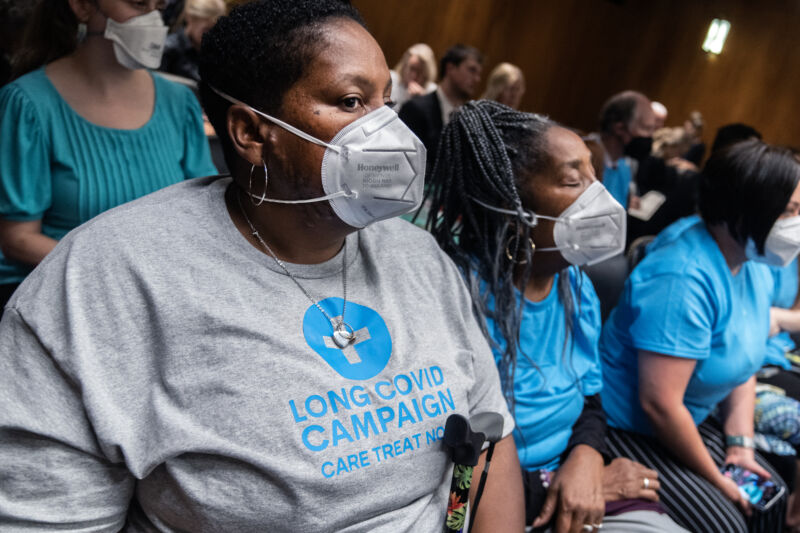
Enlarge / Long covid activists attend the Senate Appropriations Subcommittee on Labor, Health and Human Services, Education, and Related Agencies hearing on the "Fiscal Year 2025 Budget Request for the National Institutes of Health," in Dirksen building on May 23, 2024. (credit: Getty | Tom Williams)
As a summer wave of COVID-19 infections swells once again, a study published this week in the New England Journal of Medicine offers some positive news about the pandemic disease: Rates of long COVID have declined since the beginning of the health crisis, with rates falling from a high of 10.4 percent before vaccines were available to a low of 3.5 percent for those vaccinated during the omicron era, according to the new analysis.
The study, led by Ziyad Al-Aly, chief of research at the VA Saint Louis Health Care System, used data from a wealth of health records in the Department of Veterans Affairs. The researchers ultimately included data from over 440,000 veterans who contracted COVID-19 sometime between March 1, 2020, and January 31, 2022, as well as over 4.7 million uninfected veterans who acted as controls.
Al-Aly and colleagues divided the population into eight groups. People who were infected during the study period were divided into five groupings by the dates of their first infection and their vaccination status. The first group included those infected in the pre-delta era before vaccines were available (March 1, 2020, to June 18, 2021). Then there were vaccinated and unvaccinated groups who were infected in the delta era (June 19, 2021, to December 18, 2021) and the omicron era (December 19, 2021, and January 31, 2022). The uninfected controls made up the final three of eight groups, with the controls assigned to one of the three eras.
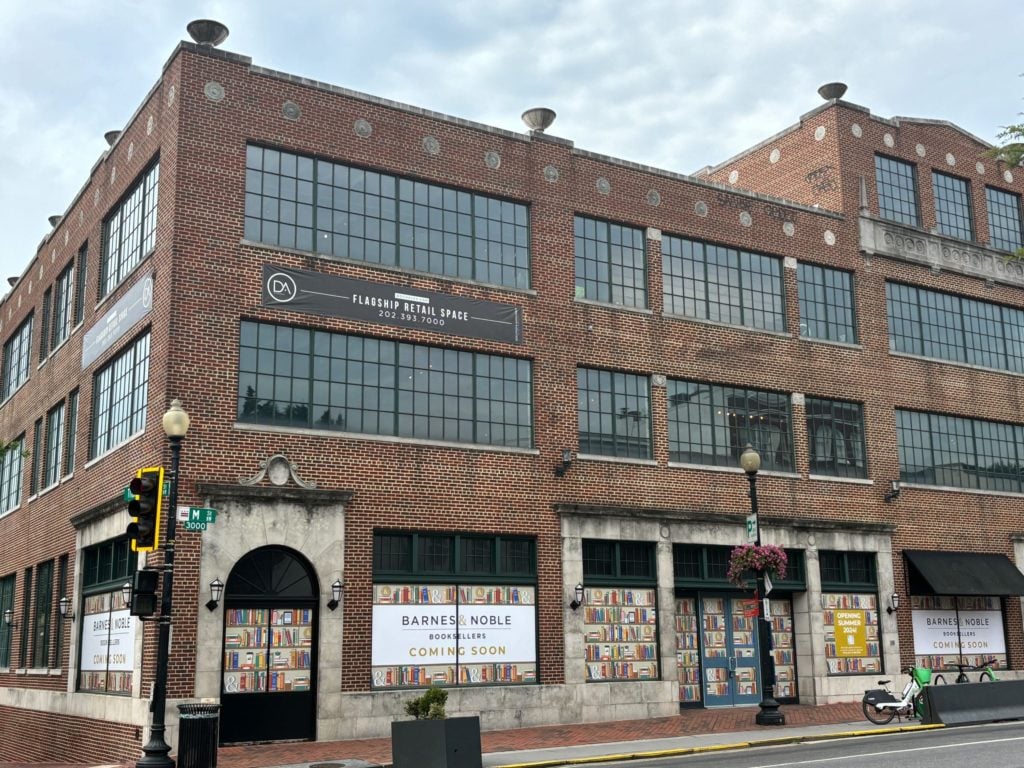
Barnes & Noble, 3040 M St., NW Barnes & Noble is having a renaissance. Under new CEO James Daunt, the bookstore chain is doing away with its cookie-cutter spaces stuffed with board games and toys, and giving its business model a new focus—books. The strategy: to make each existing and forthcoming location feel like a […]
The post Georgetown’s Three-Story Barnes & Noble Is Making a Comeback—But It’ll Be Very Different first appeared on Washingtonian.
One of the most important transitions taking place today in technology is the shift to electric vehicles (EVs). Most attention is focused on electric cars. That’s in part because they are big glamorous items, and they have high-profile cheerleaders like Elon Musk. But there is another side to this transition to electric power, less glamorous but arguably more important, at least in some parts of the world. This is the shift to electric bicycles — e-bikes.
According to a recent article in Bloomberg, battery-powered ebikes now outsell pedal-only models in several European countries. You might think that would be great for the local environment. But Philippe Crist, a micromobility researcher at the Paris-based International Transport Forum, the transportation arm of the OECD, points out why that might not be the case. Asked by Bloomberg whether e-bikes have demonstrably reduced emissions from transportation, he replied:
I don’t know for sure, but I suspect it has not. Again, most e-bike buyers [in Europe] — not all, but most of them — are replacing a bicycle, so they were biking already. Of course, lifecycle emissions from bikes of all kinds are far lower than from cars.
By contrast, the uptake of e-bikes in the US has real benefits:
Compared to Europe, in North America you have a greater population of people who’ve never cycled for everyday travel. For that reason there are more people in North America who are buying an e-bike as their first adult bicycle, or using the e-bike to get places or do chores that they’ve not used a bike for before. So the benefits of e-bike adoption in North America may be greater than in Europe, because more car trips could be replaced.
That’s good news for US cities. But in other parts of the world, the shift to ebikes has a more direct positive impact on the lives of people. For example, in Bangladesh e-rickshaws are widely used, but were illegal until a couple of months ago. An article on the Rest of the World site explains:
There are between 2 million and 4 million e-rickshaws in the country, which have operated without any regulations or monitoring. Once the new regulations come, e-rickshaws will rule Bangladesh’s roads, according to experts who have studied the vehicle’s usage.
Rickshaws powered by electric motors not only make the physically demanding job of a rickshaw driver easier. They open up the profession to women, with important knock-on benefits for their independence. CBC News reports on an example from India:
A faded battery-powered rickshaw weaves in and out of traffic in New Delhi’s northwestern Jahangirpuri neighbourhood on a weekday morning, looking for passengers before sputtering into a narrow space in a row of brightly-coloured three-wheelers to charge its dying battery.
Behind the wheel is Suman, a 36-year-old mother of four, who takes pride in her chosen profession. Suman, who like many Indians goes by only one name, fought against the wishes of her husband and extended family to drive an e-rickshaw to provide for her daughters, who range from four to 18 years old.
As Suman explained:
“The best thing about an e-rickshaw is that you are not working under someone,” Suman told CBC News. “You can make some money, then take a break when the kids need to be sent to school.”
These very basic e-rickshaws, which cost around $1,500 to buy in India, lack the massive impact — both metaphorical and literal — that ultra-heavy EVs have in the US. But they may well change for the better the lives of many more people.

Enlarge / Nissan's ProPilot Assist was one of two partially automated driving systems to be studied for crash safety improvements. (credit: Nissan)
Driver assists that help steer for you on the highway haven't contributed much to road safety, according to a new study from the Insurance Institute for Highway Safety and the Highway Loss Data Institute. That's in contrast to other features often bundled together as "advanced driver assistance systems," or ADAS, many of which have shown a marked reduction in crash and claim rates.
"Everything we’re seeing tells us that partial automation is a convenience feature like power windows or heated seats rather than a safety technology," said David Harkey, IIHS president.
However, we should note that, as a follow-up to a pair of earlier studies published in 2021, the new research by IIHS and HLDI focused on two older partially automated driving systems, model-year 2017–2019 Nissan Rogues with ProPilot Assist and model year 2013–2017 BMWs with Driving Assistant Plus.