Shared posts

27 Nov 19:04

She Recovered From a Severe Covid Vaccine Complication. Is the Government Doing Enough for Others Who Were Less Fortunate?

by Matt Ribel
She Recovered From a Severe Covid Vaccine Complication. Is the Government Doing Enough for Others Who Were Less Fortunate?

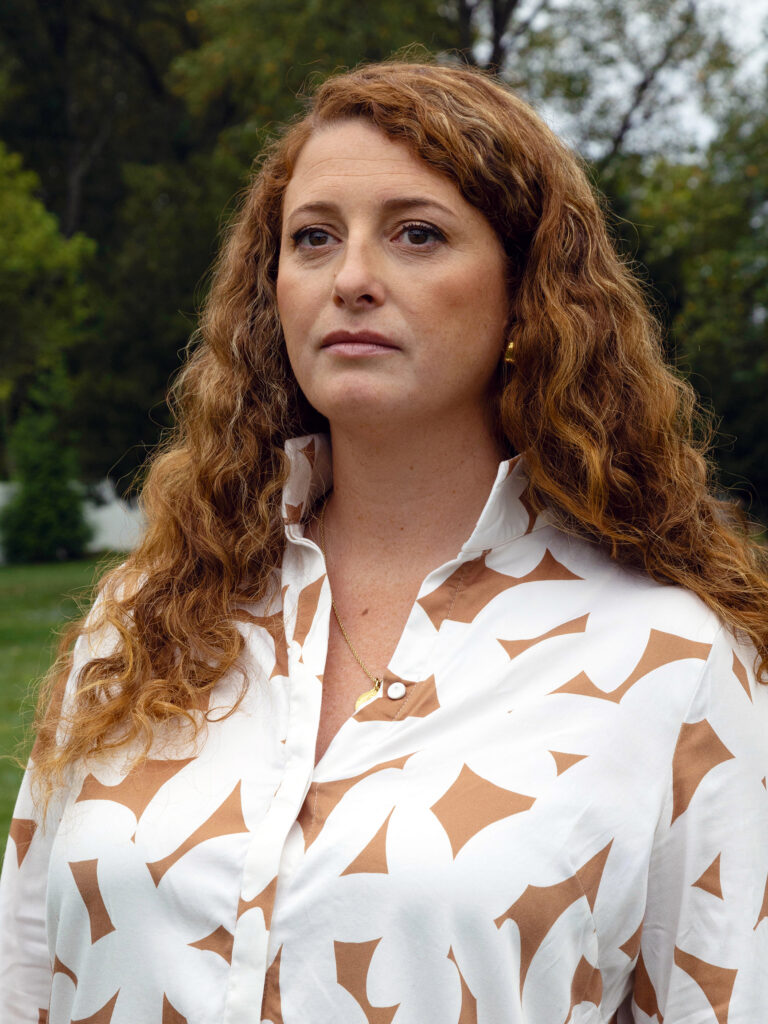
In 2021, Cristina Schoolmaster spent Easter Sunday laid up on the couch, forced to cancel the egg hunt planned for her seven-month-old son. The pain had begun on Friday morning, radiating across the right side of her face. Each day, the sensation crawled across her skull—from right to left and back again. The doctor at the urgent-care clinic felt confident her headache would subside with migraine medication. It did not.

Once the right side of her neck began throbbing, Schoolmaster visited an emergency room near her home in Potomac. CT scans revealed no obvious inflammation, abscess, or mass, and she was sent home with another prescription for migraine medicine.

She limped into a neurology office a week later. The doctor nodded along as Schoolmaster described the constant, blinding pain in her head, the useless pills she’d already been prescribed twice, and the creeping ache in her left leg. After a few minutes, the neurologist cut her off, ready to diagnose: Schoolmaster was experiencing a migraine, and she had probably strained her neck while holding her baby. Also, she should put some ice on her ankle.

By 7 o’clock the next morning, Schoolmaster was back in the ER, begging for more imaging. She spent several hours at the bottom of the triage list, and when her turn finally arrived, the radiology technicians were visibly irritated. “Why are you here?” one grumbled as he injected dye into her arm. “Your scans were fine.”

Not long after Schoolmaster emerged from the CT tube, hospital staff filed into her room. “You said you received a Covid vaccine two weeks ago?”

Schoolmaster nodded, and their expressions darkened.

“Which one?”


Like many people, School-master received the Johnson & Johnson vaccine because it was the only one available to her. “I tried to get an appointment for more than two months,” she says.

In late March, a time slot opened at a pharmacy on the Eastern Shore, and she was conflicted. Health officials had eased restrictions on public gatherings, and she was eager to get back to work planning full-size weddings. But she’d heard little about the Johnson & Johnson shot, except that it was less effective than Moderna and Pfizer. With gentle reassurance from her parents—a nurse and a dentist—she concluded it was better to receive the third-best than nothing at all.

Schoolmaster still wears a papally blessed cross that she had on when she first fell ill.

This was, in empirical terms, the right call. The Covid vaccines were nothing short of a miracle. Moderna and Pfizer conferred 90 to 95 percent protection against a never-before-seen virus, while slashing the risk of death to near zero. Though Johnson & Johnson was less impressive in clinical trials, it had two advantages: It was single-dose, and it didn’t require deep refrigeration. Those distinctions were the result of two slightly different approaches to immunity.

The Moderna and Pfizer vaccines were noteworthy for their use of messenger RNA (mRNA). These molecules carry schematics to our cellular assembly lines, instructing them to temporarily produce the spike protein found on the coronavirus. Once those proteins enter the bloodstream, immune cells learn to flag them as dangerous, then eliminate any virus carrying them. Compared with traditional vaccines, which require real viral particles, mRNA shots are easier to develop, cheaper to manufacture, and less likely to cause side effects. Companies are already developing next-generation mRNA vaccines for HIV, Lyme disease, norovirus, and a long list of cancers and metabolic diseases.

The Johnson & Johnson vaccine is a close cousin of the Moderna and Pfizer shots. Rather than injecting fragile mRNA straight into the bloodstream, Johnson & Johnson uses a modified strain of adenovirus, a common pathogen that can cause mild flu-like symptoms, to deliver those genetic instructions to their destination. In theory, this should do no harm, and scientists weaken the virus further by removing the gene that allows it to replicate inside the body. However, this type of vaccine had rarely been administered outside of clinical trials. When broad use began, an unforeseen complication arose: Some people are, essentially, allergic to adenovirus.


Schoolmaster’s remedial scans offered the worst kind of vindication. Her instincts were correct. She wasn’t suffering from a passing migraine. Blood clots appeared throughout her head, neck, and leg—and if they weren’t dissolved soon, she risked a massive stroke or cardiac arrest.

Pandemic politics, coupled with the early-aughts panic over vaccines and autism, have transformed the discourse around vaccine injury—and left many survivors of rare but debilitating side effects to fend for themselves.

Two days earlier, on April 13, federal health authorities had issued a nationwide pause on the Johnson & Johnson vaccine. Nearly 7 million people had already received it, almost all without a problem. But at least six women came down with an exceptionally rare and confounding condition: Blood clots formed in unusual places, and at the same time, their platelet levels plummeted, increasing the risk of fatal bleeding. One patient had already died, and another was in critical condition. The CDC and FDA urged physicians to stay vigilant. If providers encountered a case, they weren’t to administer heparin, the first-line treatment for blood clots, for fear that it would worsen the condition.

That evening, the hospital’s chief medical officer brought news to Schoolmaster: They didn’t know how to proceed, nor did they have specialists who could troubleshoot. In her exhausted state, she struggled to follow the conversation. Nurses begged her to stop crying, warning that it could spike her blood pressure. Her mother—a longtime nurse—pleaded with the administrator. “Do you have children?” she asked. “What would you do?”

They’d already called every hospital in the DC area. Those couldn’t help either.


Overnight, Schoolmaster unknowingly became the most intriguing patient in the country. Johns Hopkins caught wind of her case. Its hematology department was already studying blood from the other women who’d fallen ill. As soon as a bed opened, the hospital dispatched a transport team, which was selected by lottery due to overwhelming staff interest in the case.

Upon her arrival at Johns Hopkins Hospital, the blitz began immediately. “If they wanted more blood, I gave them more blood,” Schoolmaster says, recalling a dizzying array of tests—platelet counts, genetic panels, screenings for esoteric auto­immune diseases. Her blood was shipped to labs around the country, and federal health officials soon labeled Schoolmaster as Patient No. 10. Her condition: vaccine-induced immune thrombotic thrombocytopenia (VITT), an illness so new that it produced zero search-engine results.
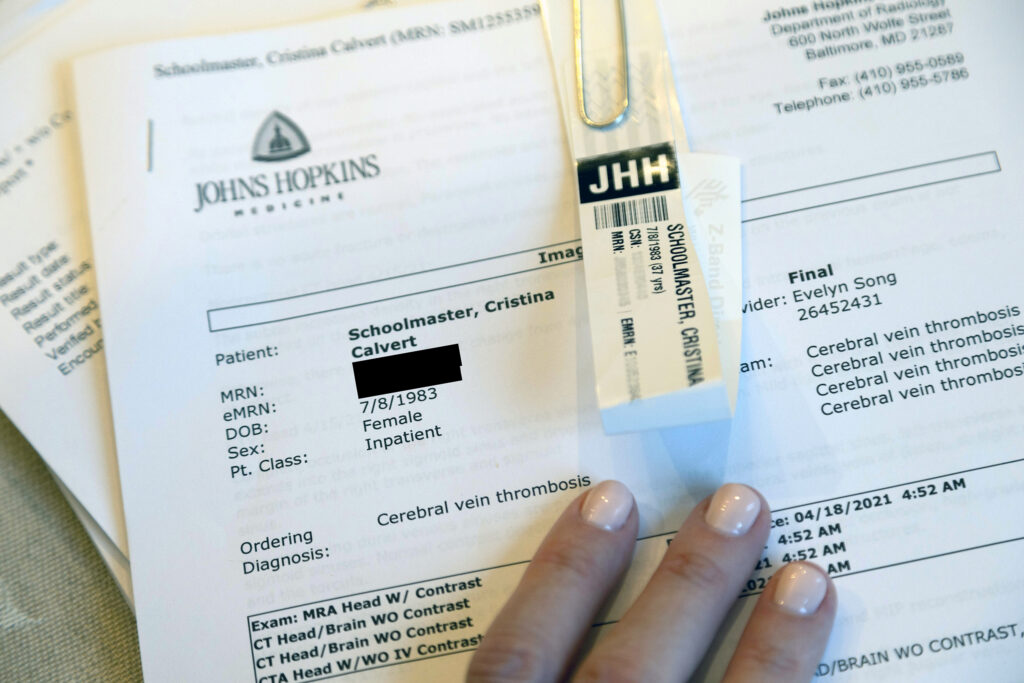
Doctors at Johns Hopkins Hospital scrambled to solve the mystery of Schoolmaster’s sudden, severe sickness—and to find an effective treatment.

The solitude quickly took a toll. Pandemic-era protocols prohibited most visitors. The nurses were habitually sunny, but face shields dimmed their light. Schoolmaster spent much of her time working through a long list of calls—first with her husband, her parents, her never-too-serious cousin. Then the wedding vendors in her contact list, to share passwords for various online accounts. And finally, her brides-to-be, to reassure them that “if I die, the vendors will take care of everything.”

On Schoolmaster’s third day of hospitalization, a breakthrough came: The lab had tested drug candidates on her blood samples, screening for adverse reactions. The lead hematologist on her case, Rakhi Naik, was cautiously optimistic about a cocktail of existing anticoagulants. But a small vial of blood cells can provide only so much assurance. Schoolmaster was handed a thick packet of consent forms, with a clear message: This treatment could be lifesaving. She could also bleed to death, lose oxygen flow to her brain, or experience sudden multiple organ failure.

Surrounded by anxious doctors and nurses, Schoolmaster took the pills, said an extended prayer, and gazed at photos of her family. Then she waited.

Later that day, surrounded by anxious doctors and nurses, Schoolmaster took the pills, said an extended prayer, and gazed at photos of her family. Then she waited. Gradually, her platelets began to climb, from 80,000 to 143,000, then to 180,000.

She was going to make it home.

Her recovery was long, complicated by three pulmonary embolisms in the days following discharge. It would be several months before she could hold her infant again, and a few more before she could chase him around the house. But today, Schoolmaster is in fine health, which makes her an outlier. The United States had 60 documented cases of VITT arising from the more than 18 million people who received the Johnson & Johnson vaccine, and nine of those people died. Many of the survivors are severely disabled and will never spend another day alone.

Biologists are still trying to understand what happened, but a working theory is coming together. A study earlier this year found that all VITT patients seem to share a rare variant of a gene, called IGLV3-21, that’s vaguely associated with immune function. As a result of that genetic defect, some feature of the adenovirus—perhaps a protein or sugar—seems to trigger an allergy-like auto­immune response. Cells begin producing antibodies that bind to a biomolecule called PF4, and the PF4 molecules bind to one another, and those clumps bind to platelets, which bind to other platelets, triggering runaway clotting that consumes platelets far faster than the body can replace them.

VITT—like Guillain-Barré Syndrome, a rapid-onset neuromuscular disorder that can cause paralysis—is a well-documented side effect of the Johnson & Johnson vaccine. For this reason, and others, the company voluntarily withdrew its product from the market, citing superior alternatives. But the politics of the pandemic, coupled with the early-aughts panic over vaccines and autism, have transformed the discourse around vaccine injury—and left many survivors of rare but debilitating side effects to fend for themselves.


For centuries, public trust has determined the success of mass-vaccination campaigns. In 1721, the 11,000-person city of Boston was nearing 20 years without a smallpox outbreak. Then in late April, mariners arrived from the West Indies with all the hallmarks of the red plague: delirium, fever, blindness, skin ulcers. While most residents fled to the countryside or isolated in their homes, Cotton Mather and Zabdiel Boylston—a fire-and-brimstone minister and a doctor with no medical credentials—carried out the country’s first known immunization campaign.

The idea of intentionally infecting people with the virus, regardless of how mild, was universally reviled. Clergymen called it a crime against God. Local physicians said it violated their oath to do no harm. Many people believed it was a plot to overthrow the white slave-owning class, because Mather had learned the technique from an enslaved man. Boylston was harassed by vigilante mobs, a bomb was chucked into Mather’s home, and newspapers called for their execution.

But their results were stunning. By the end of the epidemic, nearly 6,000 people had caught the virus and almost one in five had died. About 290 people received the inoculation—which conferred lifelong immunity—and only one in 50 died from related complications. Slowly, word spread throughout the Colonies. Other physicians tried to inoculate their towns, and many were met with continued resistance, if not outright violence.

It took decades for inoculation to enter the mainstream, a process that accelerated when General George Washington required every member of the Continental Army to undergo the procedure. Over the next century, various states implemented civilian mandates, which met with familiar arguments about individual liberty and bodily sovereignty. Governments framed immunization as part of the social contract, a necessary sacrifice we make on behalf of our neighbors. Opponents countered that the obligation ran both ways and that society must look after those harmed while carrying out their civic duty.


In 1986, the federal government codified this principle into law, following a wave of litigation concerning rare side effects from the diphtheria-tetanus-pertussis vaccine. Enormous damage awards were scaring companies out of the market, and by 1984, only one still manufactured the vaccine. So Congress passed a bill to absolve manufacturers of liability for adverse events. The reasoning: If a disorder affects only one in 300,000 people—as is the case with VITT—it’s unlikely to show up in vaccine safety trials, which rarely include more than 40,000 participants. Once a vaccination effort expands to an entire country, there’s simply no way to predict how each body will react.

At the same time, lawmakers created the National Vaccine Injury Compensation Program to pay people who experience severe illness, long-term disability, or death. Cases are heard in the US Court of Federal Claims, and the program is funded by a 75-cent tax levied on most vaccines. “[The VICP] has worked incredibly well for nearly 40 years,” says Renée Gentry, director of the Vaccine Injury Litigation Clinic at George Washington University Law School. Litigants are entitled to due process in a formal legal proceeding, common injuries receive expedited review, and payments can be quite generous, especially when someone requires lifelong care.

But right now, none of that applies to Covid-vaccine claims, which are evaluated through a separate process.

Following the SARS outbreak of 2003 and a string of bioterrorism scares, Congress passed the Public Readiness and Emergency Preparedness (PREP) Act in 2005. The law granted the Secretary of Health and Human Services authority to declare a public-health emergency—and, with it, extend liability waivers to any company developing new diagnostics, drugs, and vaccines. A new entity called the Countermeasures Injury Compensation Program would be responsible for adjudicating related injury claims, and it would be funded through the federal appropriations process.

For many years, CICP existed in obscurity, with no reason to employ more than three or four reviewers. From 2010 to 2020, fewer than 600 claims were filed, mostly concerning vaccines for H1N1, anthrax, and smallpox. Then Covid-19 was declared a public-health emergency, 270 million people received a new countermeasure in rapid succession, and the floodgates opened.

As of September 2024, more than 13,000 claims had been filed, alleging a vast spectrum of side effects, from diarrhea and erectile dysfunction to paralysis and sudden death. The program has reviewed only 3,260 of them, and most have been stuck in the backlog for years. Only 58 people have been deemed medically eligible for compensation, and just 16 have received payment, with the median award around $4,000. Not one VITT patient has received compensation to date. “It’s a black hole at the countermeasures program,” says Gentry. “I’ve known two people that have actually gotten ahold of a human.”

The staffing problem is improving. Recently, CICP received enough money to expand the team to 30 people. But funding alone won’t solve the problem, Gentry says. The program’s assessment criteria, prescribed by federal statute, are rigid and unforgiving. Claims are automatically tossed if they aren’t filed within a year. All cases are reviewed anonymously, in closed-door proceedings. There’s no option to appeal. The burden of proof is exceptionally high, and claimants must make their case without the assistance of counsel or expert witnesses. “I’ve done this for 23 years, and I still need to read some of the paragraphs that my experts write, like, three times,” Gentry says.

Several lawsuits have already been filed in federal court, alleging due-process violations and challenging the constitutionality of the program. It could take years for these to go to trial. Ultimately, Gentry believes the only way for these claims to receive fair consideration is to move them under the jurisdiction of the VICP. That’s never been done before, but there is a clear legal pathway. First, health authorities must recommend the vaccine for routine administration in children. (The CDC made this recommendation in June 2024.) Second, Congress must pass a bill or amendment to levy the 75-cent tax on all Covid vaccines. The odds of that happening are slim to none in a divided Congress, which Gentry says bodes poorly for future pandemics.

“The people you’re hanging out to dry are the same ones who were first in line to get the vaccine,” she says. “If you’re really worried about anti-vax sentiment, don’t let this program fail. It will be like throwing kerosene onto the fire.”


Schoolmaster isn’t particularly interested in compensation. Her desires are less tangible. She remains pro-vaccination but wants vaccine manufacturers to learn from her and others’ experience. She wants to share their stories without being dismissed as a crank or having their misfortune waved around like a bloody shirt in the political and cultural battles over the pandemic. She wants to feel seen and believed. “I felt like I was on a deserted island. I had this condition. I knew it happened, and it happened to 60 other people,” she says. “All I wanted was to connect with the others that went through this, because it wasn’t being talked about elsewhere.”

“The people you’re hanging out to dry are the same ones who were first in line to get the vaccine,” she says. “If you’re really worried about anti-vax sentiment, don’t let this program fail. It will be like throwing kerosene onto the fire.”

Finding them wasn’t easy. Schoolmaster contacted high-profile hematologists, who were sympathetic but legally prohibited from sharing patient information. Naik from Johns Hopkins directed Schoolmaster to the National Blood Clot Alliance, which maintains a sizable network of survivors. She sent emails to the office and left voicemails, all unanswered. When she tried to introduce herself in the NBCA Facebook group, explaining her intention to start a support group, moderators promptly deleted her post. Struggling to understand, she reached out to a page admin. “I think we could all help one another,” she wrote to him in a private message. “We are all warriors in the battle against blood clots.”

The moderator recognized Schoolmaster’s frustration, but he wasn’t sorry. The climate around Covid was too charged, and he feared nothing good would come from any discussion of vaccines. “Sadly, despite our good intentions of not making anything political, most people don’t follow those rules,” he wrote, noting that he would circle back with her as soon as possible. They didn’t speak again.

Schoolmaster has become close with the family of Monica Melkonian, a VITT victim who died.

In March 2022, Schoolmaster sent a shot-in-the-dark email to Stan Thomas, a Harley-Davidson enthusiast and occupational-safety officer from Oregon. A journalist had recently interviewed Thomas about losing his wife, Monica Melkonian, to a VITT-related brain hemorrhage.

When Thomas received the push notification, he was dining alone, dreading the one-year anniversary of Monica’s death. He read the subject line of the email, closed out his tab while choking back tears, and then spent many hours confirming he wasn’t the mark in some elaborate scam. A few days later, he finally replied. “We started talking, and things were just different for me,” Thomas says. “You’ve got family. You’ve got friends. But they don’t understand. Cristina and I understood each other.”

Schoolmaster and Thomas began talking every Tuesday, and eventually they added two more women to their core group. On their weekly calls, they spend little time ruminating on what could have been. Instead, they’re focused on finding joy in their remaining years. “We have families, we have dreams, we have things we want to do, and that’s all changed because of what happened,” says Thomas. “But that doesn’t mean we give up. That’s what this group is about.”


Last June, under a bluebird sky, Schoolmaster stood at the center of a ranch in Southern California, surrounded by three acres of olive groves and lavender fields. Monica Melkonian’s only child, Chad, would soon walk down the aisle. When Chad had proposed under the Eiffel Tower a year earlier, Schoolmaster had been among the first to see the photos—and the family all agreed she was the best person to plan the wedding.

Schoolmaster had already arranged 100 wooden chairs in a grassy clearing. She had lined the walkway with white flowers. She had sound-checked the microphone Thomas would use to officiate the ceremony. There was one more thing to do before guests arrived. Schoolmaster walked past the 14-foot hedges and disappeared into a thicket of bushes. She emerged with a white rose, placing it on a vacant seat in the front row.

This article appears in the November 2024 issue of Washingtonian.

The post She Recovered From a Severe Covid Vaccine Complication. Is the Government Doing Enough for Others Who Were Less Fortunate? first appeared on Washingtonian.

27 Nov 18:43

A Third Woman Died Under Texas’ Abortion Ban. Doctors Are Avoiding D&Cs and Reaching for Riskier Miscarriage Treatments.

by by Lizzie Presser and Kavitha Surana

by Lizzie Presser and Kavitha Surana

ProPublica is a nonprofit newsroom that investigates abuses of power. Sign up to receive our biggest stories as soon as they’re published.

Wrapping his wife in a blanket as she mourned the loss of her pregnancy at 11 weeks, Hope Ngumezi wondered why no obstetrician was coming to see her.

Over the course of six hours on June 11, 2023, Porsha Ngumezi had bled so much in the emergency department at Houston Methodist Sugar Land that she’d needed two transfusions. She was anxious to get home to her young sons, but, according to a nurse’s notes, she was still “passing large clots the size of grapefruit.”

Hope dialed his mother, a former physician, who was unequivocal. “You need a D&C,” she told them, referring to dilation and curettage, a common procedure for first-trimester miscarriages and abortions. If a doctor could remove the remaining tissue from her uterus, the bleeding would end.

But when Dr. Andrew Ryan Davis, the obstetrician on duty, finally arrived, he said it was the hospital’s “routine” to give a drug called misoprostol to help the body pass the tissue, Hope recalled. Hope trusted the doctor. Porsha took the pills, according to records, and the bleeding continued.

Three hours later, her heart stopped.

The 35-year-old’s death was preventable, according to more than a dozen doctors who reviewed a detailed summary of her case for ProPublica. Some said it raises serious questions about how abortion bans are pressuring doctors to diverge from the standard of care and reach for less-effective options that could expose their patients to more risks. Doctors and patients described similar decisions they’ve witnessed across the state.

It was clear Porsha needed an emergency D&C, the medical experts said. She was hemorrhaging and the doctors knew she had a blood-clotting disorder, which put her at greater danger of excessive and prolonged bleeding. “Misoprostol at 11 weeks is not going to work fast enough,” said Dr. Amber Truehart, an OB-GYN at the University of New Mexico Center for Reproductive Health. “The patient will continue to bleed and have a higher risk of going into hemorrhagic shock.” The medical examiner found the cause of death to be hemorrhage.

D&Cs — a staple of maternal health care — can be lifesaving. Doctors insert a straw-like tube into the uterus and gently suction out any remaining pregnancy tissue. Once the uterus is emptied, it can close, usually stopping the bleeding.

But because D&Cs are also used to end pregnancies, the procedure has become tangled up in state legislation that restricts abortions. In Texas, any doctor who violates the strict law risks up to 99 years in prison. Porsha’s is the fifth case ProPublica has reported in which women died after they did not receive a D&C or its second-trimester equivalent, a dilation and evacuation; three of those deaths were in Texas.

ProPublica condensed 200 pages of medical records into a summary of the case in consultation with two maternal-fetal medicine specialists and then reviewed it with more than a dozen experts around the country, including researchers at prestigious universities, OB-GYNs who regularly handle miscarriages, and experts in maternal health.

Texas doctors told ProPublica the law has changed the way their colleagues see the procedure; some no longer consider it a first-line treatment, fearing legal repercussions or dissuaded by the extra legwork required to document the miscarriage and get hospital approval to carry out a D&C. This has occurred, ProPublica found, even in cases like Porsha’s where there isn’t a fetal heartbeat or the circumstances should fall under an exception in the law. Some doctors are transferring those patients to other hospitals, which delays their care, or they’re defaulting to treatments that aren’t the medical standard.

Misoprostol, the medicine given to Porsha, is an effective method to complete low-risk miscarriages but is not recommended when a patient is unstable. The drug is also part of a two-pill regimen for abortions, yet administering it may draw less scrutiny than a D&C because it requires a smaller medical team and because the drug is commonly used to induce labor and treat postpartum hemorrhage. Since 2022, some Texas women who were bleeding heavily while miscarrying have gone public about only receiving medication when they asked for D&Cs. One later passed out in a pool of her own blood.

“Stigma and fear are there for D&Cs in a way that they are not for misoprostol,” said Dr. Alison Goulding, an OB-GYN in Houston. “Doctors assume that a D&C is not standard in Texas anymore, even in cases where it should be recommended. People are afraid: They see D&C as abortion and abortion as illegal.”

Hope visits his wife’s gravesite in Pearland, Texas. (Danielle Villasana for ProPublica)

Doctors and nurses involved in Porsha’s care did not respond to multiple requests for comment.

Several physicians who reviewed the summary of her case pointed out that Davis’ post-mortem notes did not reflect nurses’ documented concerns about Porsha’s “heavy bleeding.” After Porsha died, Davis wrote instead that the nurses and other providers described the bleeding as “minimal,” though no nurses wrote this in the records. ProPublica tried to ask Davis about this discrepancy. He did not respond to emails, texts or calls.

Houston Methodist officials declined to answer a detailed list of questions about Porsha’s treatment. They did not comment when asked whether Davis’ approach was the hospital’s “routine.” A spokesperson said that “each patient’s care is unique to that individual.”

“All Houston Methodist hospitals follow all state laws,” the spokesperson added, “including the abortion law in place in Texas.”

“We Need to See the Doctor” Hope and his two sons outside their home in Houston (Danielle Villasana for ProPublica)

Hope marveled at the energy Porsha had for their two sons, ages 5 and 3. Whenever she wasn’t working, she was chasing them through the house or dancing with them in the living room. As a finance manager at a charter school system, she was in charge of the household budget. As an engineer for an airline, Hope took them on flights around the world — to Chile, Bali, Guam, Singapore, Argentina.

The two had met at Lamar University in Beaumont, Texas. “When Porsha and I began dating,” Hope said, “I already knew I was going to love her.” She was magnetic and driven, going on to earn an MBA, but she was also gentle with him, always protecting his feelings. Both were raised in big families and they wanted to build one of their own.

When he learned Porsha was pregnant again in the spring of 2023, Hope wished for a girl. Porsha found a new OB-GYN who said she could see her after 11 weeks. Ten weeks in, though, Porsha noticed she was spotting. Over the phone, the obstetrician told her to go to the emergency room if it got worse.

To celebrate the end of the school year, Porsha and Hope took their boys to a water park in Austin, and as they headed back, on June 11, Porsha told Hope that the bleeding was heavier. They decided Hope would stay with the boys at home until a relative could take over; Porsha would drive to the emergency room at Houston Methodist Sugar Land, one of seven community hospitals that are part of the Houston Methodist system.

At 6:30 p.m, three hours after Porsha arrived at the hospital, she saw huge clots in the toilet. “Significant bleeding,” the emergency physician wrote. “I’m starting to feel a lot of pain,” Porsha texted Hope. Around 7:30 p.m., she wrote: “She said I might need surgery if I don’t stop bleeding,” referring to the nurse. At 7:50 p.m., after a nurse changed her second diaper in an hour: “Come now.”

Still, the doctor didn’t mention a D&C at this point, records show. Medical experts told ProPublica that this wait-and-see approach has become more common under abortion bans. Unless there is “overt information indicating that the patient is at significant risk,” hospital administrators have told physicians to simply monitor them, said Dr. Robert Carpenter, a maternal-fetal medicine specialist who works in several hospital systems in Houston. Methodist declined to share its miscarriage protocols with ProPublica or explain how it is guiding doctors under the abortion ban.

As Porsha waited for Hope, a radiologist completed an ultrasound and noted that she had “a pregnancy of unknown location.” The scan detected a “sac-like structure” but no fetus or cardiac activity. This report, combined with her symptoms, indicated she was miscarrying.

But the ultrasound record alone was less definitive from a legal perspective, several doctors explained to ProPublica. Since Porsha had not had a prenatal visit, there was no documentation to prove she was 11 weeks along. On paper, this “pregnancy of unknown location” diagnosis could also suggest that she was only a few weeks into a normally developing pregnancy, when cardiac activity wouldn’t be detected. Texas outlaws abortion from the moment of fertilization; a record showing there is no cardiac activity isn’t enough to give physicians cover to intervene, experts said.

Dr. Gabrielle Taper, who recently worked as an OB-GYN resident in Austin, said that she regularly witnessed delays after ultrasound reports like these. “If it’s a pregnancy of unknown location, if we do something to manage it, is that considered an abortion or not?” she said, adding that this was one of the key problems she encountered. After the abortion ban went into effect, she said, “there was much more hesitation about: When can we intervene, do we have enough evidence to say this is a miscarriage, how long are we going to wait, what will we use to feel definitive?”

At Methodist, the emergency room doctor reached Davis, the on-call OB-GYN, to discuss the ultrasound, according to records. They agreed on a plan of “observation in the hospital to monitor bleeding.”

A sonogram of Porsha’s firstborn on the fridge in the family home. She was excited to have a third child. (Danielle Villasana for ProPublica)

Around 8:30 p.m., just after Hope arrived, Porsha passed out. Terrified, he took her head in his hands and tried to bring her back to consciousness. “Babe, look at me,” he told her. “Focus.” Her blood pressure was dipping dangerously low. She had held off on accepting a blood transfusion until he got there. Now, as she came to, she agreed to receive one and then another.

By this point, it was clear that she needed a D&C, more than a dozen OB-GYNs who reviewed her case told ProPublica. She was hemorrhaging, and the standard of care is to vacuum out the residual tissue so the uterus can clamp down, physicians told ProPublica.

“Complete the miscarriage and the bleeding will stop,” said Dr. Lauren Thaxton, an OB-GYN who recently left Texas.

“At every point, it’s kind of shocking,” said Dr. Daniel Grossman, a professor of obstetrics and gynecology at the University of California, San Francisco who reviewed Porsha’s case. “She is having significant blood loss and the physician didn’t move toward aspiration.”

All Porsha talked about was her devastation of losing the pregnancy. She was cold, crying and in extreme pain. She wanted to be at home with her boys. Unsure what to say, Hope leaned his chest over the cot, passing his body heat to her.

At 9:45 p.m., Esmeralda Acosta, a nurse, wrote that Porsha was “continuing to pass large clots the size of grapefruit.” Fifteen minutes later, when the nurse learned Davis planned to send Porsha to a floor with fewer nurses, she “voiced concern” that he wanted to take her out of the emergency room, given her condition, according to medical records.

At 10:20 p.m., seven hours after Porsha arrived, Davis came to see her. Hope remembered what his mother had told him on the phone earlier that night: “She needs a D&C.” The doctor seemed confident about a different approach: misoprostol. If that didn’t work, Hope remembers him saying, they would move on to the procedure.

A pill sounded good to Porsha because the idea of surgery scared her. Davis did not explain that a D&C involved no incisions, just suction, according to Hope, or tell them that it would stop the bleeding faster. The Ngumezis followed his recommendation without question. “I’m thinking, ‘He’s the OB, he’s probably seen this a thousand times, he probably knows what’s right,’” Hope said.

But more than a dozen doctors who reviewed Porsha’s case were concerned by this recommendation. Many said it was dangerous to give misoprostol to a woman who’s bleeding heavily, especially one with a blood clotting disorder. “That’s not what you do,” said Dr. Elliott Main, the former medical director for the California Maternal Quality Care Collaborative and an expert in hemorrhage, after reviewing the case. “She needed to go to the operating room.” Main and others said doctors are obliged to counsel patients on the risks and benefits of all their options, including a D&C.

Performing a D&C, though, attracts more attention from colleagues, creating a higher barrier in a state where abortion is illegal, explained Goulding, the OB-GYN in Houston. Staff are familiar with misoprostol because it’s used for labor, and it only requires a doctor and a nurse to administer it. To do a procedure, on the other hand, a doctor would need to find an operating room, an anesthesiologist and a nursing team. “You have to convince everyone that it is legal and won’t put them at risk,” said Goulding. “Many people may be afraid and misinformed and refuse to participate — even if it’s for a miscarriage.”

Davis moved Porsha to a less-intensive unit, according to records. Hope wondered why they were leaving the emergency room if the nurse seemed so worried. But instead of pushing back, he rubbed Porsha’s arms, trying to comfort her. The hospital was reputable. “Since we were at Methodist, I felt I could trust the doctors.”

On their way to the other ward, Porsha complained of chest pain. She kept remarking on it when they got to the new room. From this point forward, there are no nurse’s notes recording how much she continued to bleed. “My wife says she doesn’t feel right, and last time she said that, she passed out,” Hope told a nurse. Furious, he tried to hold it together so as not to alarm Porsha. “We need to see the doctor,” he insisted.

Her vital signs looked fine. But many physicians told ProPublica that when healthy pregnant patients are hemorrhaging, their bodies can compensate for a long time, until they crash. Any sign of distress, such as chest pain, could be a red flag; the symptom warranted investigation with tests, like an electrocardiogram or X-ray, experts said. To them, Porsha’s case underscored how important it is that doctors be able to intervene before there are signs of a life-threatening emergency.

But Davis didn’t order any tests, according to records.

Around 1:30 a.m., Hope was sitting by Porsha’s bed, his hands on her chest, telling her, “We are going to figure this out.” They were talking about what she might like for breakfast when she began gasping for air.

“Help, I need help!” he shouted to the nurses through the intercom. “She can’t breathe.”

“All She Needed” Hope with his son (Danielle Villasana for ProPublica)

Hours later, Hope returned home in a daze. “Is mommy still at the hospital?” one of his sons asked. Hope nodded; he couldn’t find the words to tell the boys they’d lost their mother. He dressed them and drove them to school, like the previous day had been a bad dream. He reached for his phone to call Porsha, as he did every morning that he dropped the kids off. But then he remembered that he couldn’t.

Friends kept reaching out. Most of his family’s network worked in medicine, and after they said how sorry they were, one after another repeated the same message. All she needed was a D&C, said one. They shouldn’t have given her that medication, said another. It’s a simple procedure, the callers continued. We do this all the time in Nigeria.

Since Porsha died, several families in Texas have spoken publicly about similar circumstances. This May, when Ryan Hamilton’s wife was bleeding while miscarrying at 13 weeks, the first doctor they saw at Surepoint Emergency Center Stephenville noted no fetal cardiac activity and ordered misoprostol, according to medical records. When they returned because the bleeding got worse, an emergency doctor on call, Kyle Demler, said he couldn’t do anything considering “the current stance” in Texas, according to Hamilton, who recorded his recollection of the conversation shortly after speaking with Demler. (Neither Surepoint Emergency Center Stephenville nor Demler responded to several requests for comment.)

They drove an hour to another hospital asking for a D&C to stop the bleeding, but there, too, the physician would only prescribe misoprostol, medical records indicate. Back home, Hamilton’s wife continued bleeding until he found her passed out on the bathroom floor. “You don’t think it can really happen like that,” said Hamilton. “It feels like you’re living in some sort of movie, it’s so unbelievable.”

Across Texas, physicians say they blame the law for interfering with medical care. After ProPublica reported last month on two women who died after delays in miscarriage care, 111 OB-GYNs sent a letter to Texas policymakers, saying that “the law does not allow Texas women to get the lifesaving care they need.”

Dr. Austin Dennard, an OB-GYN in Dallas, told ProPublica that if one person on a medical team doubts the doctor’s choice to proceed with a D&C, the physician might back down. “You constantly feel like you have someone looking over your shoulder in a punitive, vigilante type of way.”

The criminal penalties are so chilling that even women with diagnoses included in the law’s exceptions are facing delays and denials. Last year, for example, legislators added an update to the ban for patients diagnosed with previable premature rupture of membranes, in which a patient’s water breaks before a fetus can survive. Doctors can still face prosecution for providing abortions in those cases, but they are offered the chance to justify themselves with what’s called an “affirmative defense,” not unlike a murder suspect arguing self defense. This modest change has not stopped some doctors from transferring those patients instead of treating them; Dr. Allison Gilbert, an OB-GYN in Dallas, said doctors send them to her from other hospitals. “They didn’t feel like other staff members would be comfortable proceeding with the abortion,” she said. “It’s frustrating that places still feel like they can’t act on some of these cases that are clearly emergencies.” Women denied treatment for ectopic pregnancies, another exception in the law, have filed federal complaints.

In response to ProPublica’s questions about Houston Methodist’s guidance on miscarriage management, a spokesperson, Gale Smith, said that the hospital has an ethics committee, which can usually respond within hours to help physicians and patients make “appropriate decisions” in compliance with state laws.

After Porsha died, Davis described in the medical record a patient who looked stable: He was tracking her vital signs, her bleeding was “mild” and she was “said not to be in distress.” He ordered bloodwork “to ensure patient wasn’t having concerning bleeding.” Medical experts who reviewed Porsha’s case couldn’t understand why Davis noted that a nurse and other providers reported “decreasing bleeding” in the emergency department when the record indicated otherwise. “He doesn’t document the heavy bleeding that the nurse clearly documented, including the significant bleeding that prompted the blood transfusion, which is surprising,” Grossman, the UCSF professor, said.

Patients who are miscarrying still don’t know what to expect from Houston Methodist.

This past May, Marlena Stell, a patient with symptoms nearly identical to Porsha’s, arrived at another hospital in the system, Houston Methodist The Woodlands. According to medical records, she, too, was 11 weeks along and bleeding heavily. An ultrasound confirmed there was no fetal heartbeat and indicated the miscarriage wasn’t complete. “I assumed they would do whatever to get the bleeding to stop,” Stell said.

Instead, she bled for hours at the hospital. She wanted a D&C to clear out the rest of the tissue, but the doctor gave her methergine, a medication that’s typically used after childbirth to stop bleeding but that isn’t standard care in the middle of a miscarriage, doctors told ProPublica. "She had heavy bleeding, and she had an ultrasound that's consistent with retained products of conception." said Dr. Jodi Abbott, an associate professor of obstetrics and gynecology at Boston University School of Medicine, who reviewed the records. "The standard of care would be a D&C."

Stell says that instead, she was sent home and told to “let the miscarriage take its course.” She completed her miscarriage later that night, but doctors who reviewed her case, so similar to Porsha’s, said it showed how much of a gamble physicians take when they don’t follow the standard of care. “She got lucky — she could have died,” Abbott said. (Houston Methodist did not respond to a request for comment on Stell’s care.)

It hadn’t occurred to Hope that the laws governing abortion could have any effect on his wife’s miscarriage. Now it’s the only explanation that makes sense to him. “We all know pregnancies can come out beautifully or horribly,” Hope told ProPublica. “Instead of putting laws in place to make pregnancies safer, we created laws that put them back in danger.”

For months, Hope’s youngest son didn’t understand that his mom was gone. Porsha’s long hair had been braided, and anytime the toddler saw a woman with braids from afar, he would take off after her, shouting, “That’s mommy!”

A couple weeks ago, Hope flew to Amsterdam to quiet his mind. It was his first trip without Porsha, but as he walked the city, he didn’t know how to experience it without her. He kept thinking about how she would love the Christmas lights and want to try all the pastries. How she would have teased him when he fell asleep on a boat tour of the canals. “I thought getting away would help,” he wrote in his journal. “But all I’ve done is imagine her beside me.”

First image: Hope now wears his and Porsha’s wedding rings around his neck. Second image: Porsha’s son plays with cards capturing memories of his mother. (Danielle Villasana for ProPublica)

Mariam Elba and Lexi Churchill contributed research.

27 Nov 18:42

Immigrants’ Resentment Over New Arrivals Helped Boost Trump’s Popularity With Latino Voters

by by Melissa Sanchez and Mica Rosenberg

by Melissa Sanchez and Mica Rosenberg

ProPublica is a nonprofit newsroom that investigates abuses of power. Sign up to receive our biggest stories as soon as they’re published.

At first, she didn’t think much about the Nicaraguan asylum-seekers who began moving into town a few years ago. Rosa was an immigrant too, one of the many undocumented Mexican immigrants who’d settled nearly 30 years ago in Whitewater, a small university town in southeast Wisconsin.

Some of the Nicaraguans had found housing in Rosa’s neighborhood, a trailer park at the edge of town. They sent their children to the same public schools. And they got jobs in the same factories and food-processing facilities that employed many of Rosa’s friends and relatives.

Then Rosa realized that many of the newcomers with ongoing asylum cases could apply for work permits and driver’s licenses — state and federal privileges that are unavailable to undocumented immigrants. Rosa’s feelings of indifference turned to frustration and resentment.

“It’s not fair,” said Rosa, who works as a janitor. “Those of us who have been here for years get nothing.”

Her anger is largely directed at President Joe Biden and the Democratic Party for failing to produce meaningful reforms to the immigration system that could benefit people like her. In our reporting on the new effects of immigration, ProPublica interviewed dozens of long-established Latino immigrants and their U.S.-born relatives in cities like Denver and Chicago and in small towns along the Texas border. Over and over, they spoke of feeling resentment as they watched the government ease the transition of large numbers of asylum-seekers into the U.S. by giving them access to work permits and IDs, and in some cities spending millions of dollars to provide them with food and shelter.

It’s one of the reasons so many Latino voters chose Donald Trump this election, giving him what appears to be Republicans’ biggest win in a presidential race since exit polls began tracking this data. Latinos’ increased support for Trump — who says he could use the military to execute his plans for mass deportations — defied conventional wisdom, disrupting long-held assumptions about loyalties to the Democratic Party. The shift could give Republicans reason to cater to Latinos to keep them in the party’s fold.

On the campaign trail, Trump singled out Whitewater after the police chief wrote a letter to Biden asking for help responding to the needs of the new Nicaraguan arrivals. While some residents were put off by Trump’s rhetoric about the city being destroyed by immigrants, it resonated with many of the longtime Mexican-immigrant residents we interviewed. They said they think the newcomers have unfairly received benefits that they never got when they arrived illegally decades ago — and that many still don’t have today.

Among those residents is one of Rosa’s friends and neighbors who asked to be identified by one of her surnames, Valadez, because she is undocumented and fears deportation. A single mother who cleans houses and buildings for a living, Valadez makes extra money on the side by driving immigrants who don’t have cars to and from work and to run errands. It’s a risky side hustle, though, because she’s frequently been pulled over and ticketed by police for driving without a license, costing her thousands of dollars in fines.

One day two summers ago, one of her sons found a small purse at a carnival in town. Inside they found a Wisconsin driver’s license, a work permit issued to a Nicaraguan woman and $300 in cash. Seeing the contents filled Valadez with bitterness. She asked her son to turn in the purse to the police but kept the $300. “I have been here for 21 years,” she said. “I have five children who are U.S. citizens. And I can’t get a work permit or a driver’s license.”

When she told that story to Rosa one afternoon this spring, her friend nodded emphatically in approval. Rosa, like Valadez, couldn’t vote. But two of Rosa’s U.S.-born children could, and they cast ballots for Trump. One of Rosa’s sons even drives a car with a bumper sticker that says “Let’s Go Brandon” — a popular anti-Biden slogan.

Rosa said she is glad her children voted for Trump. She’s not too worried about deportation, although she asked to be identified solely by her first name to reduce the risk. She believes Trump wants to deport criminals, not people like her who crossed the border undetected in the 1990s but haven’t gotten in trouble with the law. “They know who has been behaving well and who hasn’t been,” she said.

Immigrants seeking asylum arrive in Philadelphia in December 2022. They had been bused in from Texas, which has sent thousands of immigrants to cities around the country this way during the Biden administration. (Photo by Ryan Collerd/AFP via Getty Images)

In the months leading up to the presidential election, numerous polls picked up on the kinds of frustrations felt by Rosa and her family. Those polls indicated that many voters considered immigration one of the most pressing challenges facing the country and that they were disappointed in the Biden administration’s record.

Biden had come into office in 2021 promising a more humane approach to immigration after four years of more restrictive policies during the first Trump administration. But record numbers of immigrants who were apprehended at the U.S.-Mexico border began to overwhelm the system. While the Biden administration avoided talking about the border situation like a crisis, the way Trump and the GOP had, outspoken critics like Republican Texas Gov. Greg Abbott amplified the message that things at the border were out of control while he arranged to bus thousands of immigrants to Democrat-controlled big cities around the country. In Whitewater, hundreds of Nicaraguans arrived on their own to fill jobs in local factories, and many of them drove to work without licenses, putting a strain on the small local police department with only one Spanish-speaking officer.

While the Biden administration kept a Trump expulsion policy in place for three years, it also created temporary parole programs and an app to allow asylum-seekers to make appointments to cross the border. The result was that hundreds of thousands more immigrants were allowed to come into the country and apply for work permits, but the efforts didn’t assuage the administration’s critics on the right or left. Meanwhile, moves to benefit undocumented workers who were already in the country were less publicized, said Kathleen Bush-Joseph, a policy analyst at the nonpartisan Migration Policy Institute.

The White House did not respond to requests for comment.

Conchita Cruz, a co-founder and co-executive director of the Asylum Seeker Advocacy Project, which serves a network of around 1 million asylum-seekers across the country, said that because of either court challenges or processing backlogs, Biden wasn’t able to deliver on many of his promises to make it easier for immigrants who’ve lived in this country for years to regularize their status.

“Policies meant to help immigrants have not always materialized,” she said.

Cruz said that while the administration extended the duration of work permits for some employment categories, backlogs have hampered the quick processing of those extensions. As of September, there were about 1.2 million pending work permit applications, according to U.S. Citizenship and Immigration Services data, with many pending for six months or more. USCIS said the agency has taken steps to reduce backlogs while processing a record number of applications.

Biden’s attempts to push for broad immigration reform in Congress, including a proposal his administration sent on his first day in office, went nowhere. Earlier this year, in an effort to prevent a political win for Biden before the election, Trump pressured Republicans to kill bipartisan legislation that would have increased border security.

Camila Chávez, the executive director of the Dolores Huerta Foundation in Bakersfield, California, said Democrats failed to combat misinformation and turn out Latino voters. She recalled meeting one young Latina Trump supporter while she knocked on voters’ doors with the foundation’s sister political action organization. The woman told her she was concerned that the new immigrant arrivals were bringing crime and cartel activity — and potentially were a threat to her own family’s safety.

“That’s our charge as organizations, to make sure that we are in the community and educating folks on how government works and to not vote against our own self-interests. Which is what’s happening now,” said Chávez, who is the daughter of famed farmworker advocate Dolores Huerta and a niece of Cesar Chávez.

Trump has made clear he intends to deliver on his deportation promises, though the details of how he’ll do it and who will be most affected remain unclear. The last time Trump was elected, he moved quickly to issue an executive order that said no “classes or categories” of people who were in the country illegally could be exempt from enforcement. Tom Homan, who Trump has picked to serve as his “border czar,” said during a recent interview with Fox & Friends that immigrants who were deemed to be a threat to public safety or national security would be a priority under a new administration. But he said immigrants with outstanding deportation orders will also be possible targets and that there will be raids at workplaces with large numbers of undocumented workers.

The Trump campaign did not respond to a request for comment.

Mike Madrid, a Republican strategist, said it’s wishful thinking to believe Trump will give any special treatment to undocumented immigrants who have been living and working in the U.S. for a long time. But he’s heard that sentiment among Latino voters in focus groups.

“They believe that they are playing by the rules and that they will be rewarded for it,” Madrid said. “Republicans have never been serious about legal migration, let alone illegal migration. They’re allowing themselves to believe that for no good reason.”

Sergio Garza Castillo, who owns a gas station and convenience store in Del Rio, Texas, had long voted for Democrats. But his frustration with border policy led him to vote for Trump this year. (Gerardo del Valle/ProPublica)

The Republican Party’s growing appeal to Latino voters was especially noticeable in places like Del Rio, a Texas border town. As ProPublica previously reported, Trump flipped the county where Del Rio sits from blue to red in 2020 and won it this year with 63% of the vote.

Sergio Garza Castillo, a Mexican immigrant who owns a gas station and convenience store in Del Rio, illustrates that political shift. Garza Castillo said he came to the U.S. legally as a teenager in the 1980s after his father, a U.S. citizen, petitioned and waited for more than a decade to bring his family across the border.

Ever since Garza Castillo became a U.S. citizen in 2000, he has tended to vote for Democrats, believing in their promise of immigration reform that could lead to more pathways to citizenship for long-established undocumented immigrants, including many of his friends and acquaintances.

But the Democrats “promised and they never delivered,” Garza Castillo said. “They didn’t normalize the status of the people who were already here, but instead they let in many migrants who didn’t come in the correct way.” He believes asylum-seekers should have to wait outside the country like he did.

He said he began to turn away from the Democrats in September 2021, when nearly 20,000 mostly Haitian immigrants seeking asylum waded across the Rio Grande from Mexico and camped out under the city’s international bridge near Garza Castillo’s gas station. Federal authorities had instructed the immigrants to wait there to be processed; some remained there for weeks, sleeping under tarps and blankets with little access to water and food. Garza Castillo said he and other business owners lost money when the federal government shut down the international bridge, an economic engine for Del Rio.

Some of the Haitian migrants were eventually deported; others were allowed into the U.S. to pursue asylum claims and given notices to appear in court in a backlogged immigration system that can take years to resolve a case. “That to me is offensive for those who have been living here for more than 10 years and haven’t been able to adjust their status,” Garza Castillo said.

He hopes Trump seizes on the opportunity to expand support from Latino voters by creating a path to citizenship for undocumented immigrants who’ve been here for years. “If he does that,” he said, “I think the Republican Party will be strong here for a long time.”

Anjeanette Damon, Nicole Foy, Perla Trevizo and Gerardo del Valle contributed reporting.

27 Nov 18:38

Biased AI in health care faces crackdown in sweeping Biden admin proposals

by Beth Mole

The Biden administration on Tuesday issued sweeping health care proposals that would see Medicare plans greatly expand access to blockbuster GLP-1 weight-loss drugs, bar insurers from skipping out on paying certain claims that were granted prior authorization, and reinforce guardrails on the use of AI.

The proposals fit into the administration's existing aims to improve and protect access to care in Medicare and Medicaid programs. But, the future of the proposals is uncertain, as it will be up to the Trump administration to finalize the policies.

Anti-obesity drugs

The flashiest of the proposals is to reinterpret existing law in such a way as to allow Medicare and Medicaid coverage of anti-obesity drugs—particularly the extremely popular and pricy GLP-1 drugs Wegovy and Zepbound. Existing policy excludes coverage of drugs used for "weight loss" or "weight gain."

Read full article

Comments

26 Nov 20:04

You Problem

by Reza
23 Nov 21:53

Elizabeth Warren calls for crackdown on Internet “monopoly” you’ve never heard of

by Joel Khalili, WIRED.com

US Senator Elizabeth Warren of Massachusetts and Congressman Jerry Nadler of New York have called on government bodies to investigate what they allege is the “predatory pricing” of .com web addresses, the Internet’s prime real estate.

In a letter delivered today to the Department of Justice and the National Telecommunications and Information Administration, a branch of the Department of Commerce that advises the president, the two Democrats accuse VeriSign, the company that administers the .com top-level domain, of abusing its market dominance to overcharge customers.

In 2018, under the Donald Trump administration, the NTIA modified the terms on how much VeriSign could charge for .com domains. The company has since hiked prices by 30 percent, the letter claims, though its service remains identical and could allegedly be provided far more cheaply by others.

Read full article

Comments

22 Nov 11:58

Bark Social poops out

by Store Reporter

Dog park/gathering space Bark Social abruptly shut down this week after a three-year run at Pike & Rose. The company announced on social media that it could no longer stay in business after unexpectedly losing the support of its financial backers. Bark Social also had locations in Baltimore, Columbia, Alexandria and Philadelphia. All of them have closed.

The post Bark Social poops out appeared first on Store Reporter.

21 Nov 19:48

Android will soon instantly log you in to your apps on new devices

by Kevin Purdy

If you lose your iPhone or buy an upgrade, you could reasonably expect to be up and running after an hour, presuming you backed up your prior model. Your Apple stuff all comes over, sure, but most of your third-party apps will still be signed in.

Doing the same swap with an Android device is more akin to starting three-quarters fresh. After one or two Android phones, you learn to bake in an extra hour of rapid-fire logging in to all your apps. Password managers, or just using a Google account as your authentication, are a godsend.

That might change relatively soon, as Google has announced a new Restore Credentials feature, which should do what it says in the name. Android apps can "seamlessly onboard users to their accounts on a new device," with the restore keys handled by Android's native backup and restore process. The experience, says Google, is "delightful" and seamless. You can even get the same notifications on the new device as you were receiving on the old.

Read full article

Comments

21 Nov 15:22

Automatic braking systems save lives. Now they’ll need to work at 62 mph.

by Aarian Marshall, WIRED.com

The world is full of feel-bad news. Here’s something to feel good about: Automatic emergency braking is one of the great car safety-tech success stories.

Auto-braking systems, called AEB for short, use sensors including cameras, radar, and lidar to sense when a crash is about to happen and warn drivers—then automatically apply the brakes if drivers don’t respond. It’s a handy thing to have in those vital few moments before your car careens into the back of another. One industry group estimates that US automakers' move to install AEB on most cars—something they did voluntarily, in cooperation with road safety advocates—will prevent 42,000 crashes and 20,000 injuries by 2025.

Wired logo
A new report from AAA finds these emergency braking systems are getting even better—and challenges automakers to perfect them at even higher speeds.

Read full article

Comments

21 Nov 15:21

Niantic uses Pokémon Go player data to build AI navigation system

by Benj Edwards

Last week, Niantic announced plans to create an AI model for navigating the physical world using scans collected from players of its mobile games, such as Pokémon Go, and from users of its Scaniverse app, reports 404 Media.

All AI models require training data. So far, companies have collected data from websites, YouTube videos, books, audio sources, and more, but this is perhaps the first we've heard of AI training data collected through a mobile gaming app.

"Over the past five years, Niantic has focused on building our Visual Positioning System (VPS), which uses a single image from a phone to determine its position and orientation using a 3D map built from people scanning interesting locations in our games and Scaniverse," Niantic wrote in a company blog post.

Read full article

Comments

21 Nov 15:20

Google stops letting sites like Forbes rule search for “Best CBD Gummies“

by Kevin Purdy

"Updating our site reputation abuse policy" is how Google, in wondrously opaque fashion, announced yesterday that big changes have come to some big websites, especially those that rely on their domain authority to promote lucrative third-party product recommendations.

If you've searched for reviews and seen results that make you ask why so many old-fashioned news sites seem to be "reviewing" products lately—especially products outside that site's expertise—that's what Google is targeting.

"This is a tactic where third-party content is published on a host site in an attempt to take advantage of the host's already-established ranking signals," Google's post on its Search Central blog reads. "The goal of this tactic is for the content to rank better than it could otherwise on a different site, and leads to a bad search experience for users."

Read full article

Comments

21 Nov 15:19

Georgia Dismissed All Members of Maternal Mortality Committee After ProPublica Obtained Internal Details of Two Deaths

by by Amy Yurkanin

by Amy Yurkanin

ProPublica is a nonprofit newsroom that investigates abuses of power. Sign up to receive our biggest stories as soon as they’re published.

Register for our Nov. 21 virtual discussion, where our reporters take you inside ProPublica’s reproductive health coverage.

Georgia officials have dismissed all members of a state committee charged with investigating deaths of pregnant women. The move came in response to ProPublica having obtained internal reports detailing two deaths.

ProPublica reported in September on the deaths of Amber Thurman and Candi Miller, which the state maternal mortality review committee had determined were preventable. They were the first reported cases of women who died without access to care restricted by a state abortion ban, and they unleashed a torrent of outrage over the fatal consequences of such laws. The women’s stories became a central discussion in the presidential campaign and ballot initiatives involving abortion access in 10 states.

“Confidential information provided to the Maternal Mortality Review Committee was inappropriately shared with outside individuals,” Dr. Kathleen Toomey, commissioner of the state Department of Public Health, wrote in a letter dated Nov. 8 and addressed to members of the committee. “Even though this disclosure was investigated, the investigation was unable to uncover which individual(s) disclosed confidential information.

“Therefore, effective immediately the current MMRC is disbanded, and all member seats will be filled through a new application process.”

A health department spokesperson declined to comment on the decision to dismiss the committee, saying that the letter, which the department provided to ProPublica, “speaks for itself.” Georgia Gov. Brian Kemp’s office also declined to comment, referring questions to the health department.

Under Georgia law, the work of the maternal mortality review committee is confidential, and members must sign confidentiality agreements. Those members see only summaries of medical records stripped of personal details, and their findings on individual cases are not supposed to be shared with the public — not even with hospitals or with family members of women who died.

The health department’s letter states that there could be new steps to keep the board’s deliberations from public view. The letter said officials might change “other procedures for on-boarding committee members better ensuring confidentiality, committee oversight and MMRC organizational structure.”

Maternal mortality review committees exist in every state. They are tasked with examining deaths of women during a pregnancy or up to a year after and determining whether they could have been prevented.

Georgia’s had 32 standing members from a variety of backgrounds, including OB-GYNs, cardiologists, mental health care providers, a medical examiner, health policy experts and community advocates. They are volunteer positions that pay a small honorarium.

Their job is to collect data and make recommendations aimed at combatting systemic issues that could help reduce deaths and publish them in reports. The Georgia committee’s most recent report found that of 113 pregnancy-related deaths from 2018 through 2020, 101 had at least some chance of being prevented. Its recommendations have led to changes in hospital care to improve the response to emergencies during labor and delivery and to new programs to increase access to psychiatric treatment.

The health department’s letter states that the “change to the current committee will not result in a delay in the MMRC’s responsibilities.” But at least one other state has experienced a lag as a result of reshaping its committee. Idaho let its maternal mortality review committee legislation expire in July 2023, effectively disbanding the committee after lobbyist groups attacked members for recommending that the state expand Medicaid for postpartum women. Earlier this year, Idaho’s Legislature reestablished the committee, but new members weren’t announced until Nov. 15. There is now more than a yearlong delay in the review process.

Reproductive rights advocates say Georgia’s decision to dismiss and restructure its committee also could have a chilling effect on the committee’s work, potentially dissuading its members from delving as deeply as they have into the circumstances of pregnant women’s deaths if it could be politically sensitive.

“They did what they were supposed to do. This is why we need them,” said Monica Simpson, executive director of SisterSong, one of the groups challenging Georgia’s abortion ban in court. “To have this abrupt disbandment, my concern is what we are going to lose in the process, in terms of time and data?”

One objective of any maternal mortality review committee is to look at the circumstances of a death holistically to identify root causes that may be able to help other women in the future.

In the case of Candi Miller, the most prominent detail in a state medical examiner’s report of her death was that she had a lethal combination of painkillers in her system, including fentanyl. It attributed the cause of death to drug intoxication.

But the Georgia committee looked at the facts of the death with a different objective: to consider the broader context. A summary of Miller’s case prepared for the committee, drawn from hospital records and the medical examiner’s report, included that Miller had multiple health conditions that can be exacerbated by pregnancy, that she had ordered abortion pills from overseas and that she had unexpelled fetal tissue, which showed the abortion had not fully completed. It also stated that her family had told the coroner she didn’t visit a doctor “due to the current legislation on pregnancies and abortions.”

The committee found her death was “preventable” and blamed the state’s abortion ban.

“The fact that she felt that she had to make these decisions, that she didn’t have adequate choices here in Georgia, we felt that definitely influenced her case,” one committee member told ProPublica in September. “She’s absolutely responding to this legislation.”

For Miller’s family, the committee’s findings were painful but wanted. “It seems like that is essential information that you would share with the family,” said Miller’s sister, Turiya Tomlin-Randall, who was not aware of the committee’s work until ProPublica contacted her.

She also said it’s upsetting to hear that the committee’s members were dismissed partly as a result of her sister’s case being disclosed to the public. “I don’t understand how this is even possible,” she said.

The committee also investigated the case of Amber Thurman, who died just one month after Georgia’s six-week abortion law went into effect. The medical examiner’s report stated that Thurman died of “sepsis” and “retained products of conception” and that she had received a dilation and curettage, or D&C, and a hysterectomy after an at-home abortion.

When the committee members received a summary of her hospital stay, they saw a timeline with additional factors: The hospital had delayed providing a D&C — a routine procedure to clear fetal tissue from the uterus — for 20 hours, which Thurman needed for rare complications she’d developed after taking abortion medication. The state had recently attached criminal penalties to performing a D&C, with few exceptions. The summary showed doctors discussed providing the D&C twice, but by the time they performed the procedure it was too late. Committee members found that there was a “good chance” Thurman’s death could have been prevented if she had received the D&C sooner.

Doctors and a nurse involved in Thurman’s care did not answer questions from ProPublica for its September story. The hospital also did not respond to multiple requests for comment.

Thurman’s family also told ProPublica they had wanted the information about her death disclosed.

Some experts say that keeping the reports of maternal mortality review committees confidential is important for a committee to serve its purpose. They are set up not to assign blame but instead to create a space for clinicians to investigate broad causes of maternal health failures. But others say the lack of transparency can serve to obscure the biggest disruption to maternal health care in half a century.

“We know that the reports that have come out of that committee are anonymized and synthesized in order to provide a 50,000-foot view,” said Kwajelyn Jackson, executive director of Feminist Women’s Health Center in Atlanta, which provides abortion care. “But my worry is that in an effort to protect the state, there will be less information that will be available to people who could shift their actions, shift their protocols, shift their strategies, shift their behaviors in order to make a difference in maternal health outcomes.”

Two states did make shifts to their committees — Idaho, after members made a recommendation to expand Medicaid that Republicans opposed, and Texas, after a member publicly criticized the state.

In 2022, Texas committee member Nakeenya Wilson, a community advocate, spoke out against the state’s decision to delay the release of its report during an election year. The following year, the Legislature passed a law that created a second community advocate position on the committee, redefined the position and had Wilson reapply. She was not reappointed. The state instead filled one of the slots with a prominent anti-abortion activist.

Wilson said Georgia’s decision to dismiss its committee could cause greater harm.

“What message is being said to the families who lost their loved ones?” she said. “There’s going to be even less accountability for this to not happen again.”

Ziva Branstetter, Kavitha Surana, Cassandra Jaramillo and Anna Barry-Jester contributed reporting. Doris Burke contributed research.

19 Nov 02:29

a federal judge has blocked the new overtime rule

by Ask a Manager

This post was written by Alison Green and published on Ask a Manager.

A federal judge in Texas has blocked a new rule that would have expanded access to overtime pay to millions more salaried workers.

And not only that — the court also struck down the increase that already took effect on July 1 of this year.

The background: In the U.S., all workers are classified as exempt or non-exempt. Non-exempt workers must be paid overtime (time and a half) for any hours over 40 they work in a single week. Exempt workers are exempt from overtime requirements. To be exempt, you must earn a certain dollar amount or higher and perform relatively high-level work as your primary duties. (There are some exceptions to this, including teachers, doctors, and lawyers, who are always exempt.)

On July 1, the salary level that makes you exempt from overtime pay increased to $43,888 — meaning that anyone making under that was due overtime pay (unless they were one of the exceptions named above). The threshold was set to increase again on January 1, to $58,656.

On Friday, a U.S. District judge ruled that the Labor Department exceeded its authority with the new rule.

So now, the previous threshold of $35,568 — which was set in 2019 — is set to go back into effect.

It’s not yet clear if the Labor Department will appeal the decision. If they do, it’s possible that an appeals court could quickly reverse this ruling … but if the appeal is still pending when the new administration takes over on January 20, they’re unlikely to continue that appeal. (Something similar happened in 2016, when a court halted a similar rule just days before the hike was supposed to take effect, and then permanently blocked it a few months later.)

Notably, the judge this time cited the U.S. Supreme Court’s decision earlier this year to throw out the Chevron doctrine, which for decades had required courts to defer to “permissible” agency interpretations of the statutes they administer, “even when a reviewing court reads the statute differently.”

So, two questions that a lot of employers now face:

  • If they raised your salary to meet the July 1 threshold of $43,888, are they going to leave it a the higher level or lower it back? Most probably won’t lower salaries because of the morale hit it would cause, but some might.
  • If they were planning to raise salaries to meet the January 1 bump to $58,656, will they reverse course or stick with those plans? If they had planned a bump but hadn’t announced it, they’ll probably quietly cancel it. If they had already announced they planned to bump salaries then, they’ll face employee pressure to stick with that.
15 Nov 12:44

Woodley Gardens center back in business

by Store Reporter

The Woodley Gardens shopping center, on Nelson Street in Rockville, is up and running again after several weeks of repairs to its water and sewer pipes. All of the center’s tenants — including Carmen’s Italian IceHard Times Cafe and Z&Z Manoushe Bakery — had been closed since late October while workers tore up the parking lot. Everyone is back in business as of this week.

The post Woodley Gardens center back in business appeared first on Store Reporter.

14 Nov 22:24

Trump team puts EV tax credit on the block, Tesla is on board: Report

by Jonathan M. Gitlin

Some electric vehicles and plug-in hybrids are set to get less affordable from next year, it seems. As expected, the incoming Trump administration has set its sights on killing off the IRS clean vehicle tax credit, according to a report in Reuters this afternoon.

The clean vehicle tax credit was overhauled as part of President Joe Biden's signature climate legislation. Until then, the size of a plug-in vehicle's tax credit was based on its battery capacity, with a credit of up to $7,500 available. But from 2023 the rules changed, requiring a certain amount of domestic production to qualify, as well as adding price and income caps to address criticism that the tax credit mostly subsidized the already-wealthy.

Far fewer vehicles are now eligible for the rebate at time of purchase, particularly after the US Treasury Department got tougher about Chinese content, although a loophole means that none of these conditions apply to leased EVs.

Read full article

Comments

14 Nov 17:21

Private Prison Companies Are Absolutely Thrilled Donald Trump Won The Election

by Tim Cushing

Well, these entities deserve each other. The problem is we really don’t deserve either of them.

Trump spent a lot of his campaign touting a logistical nightmare of a policy that sounded a lot like an collapse-of-the-Weimar-Republic sort of thing: the mass detention and deportation of immigrants, whether they’re here legally or not. All that’s missing now are the rail cars and the genocide.

It’s an ugly plan that’s going to have extremely ugly outcomes, all based on bigotry and demonstrably false claims about the inherent “danger” posed by undocumented immigrants. Ignorance and hatred are going to be weaponized to tear apart families, destroy communities, and undermine the ideals this country used to hold dear.

More prisons, more beds, more detention facilities, more logistical support, more transport of detained immigrants — what looks like a horror show to many of us is being greeted with unrestrained glee by the CEOs of this country’s two largest private prison companies. Presumably, many of their shareholders are equally thrilled with this development as well, making them equally complicit in what’s to come.

Listening in on earnings calls was Matt Shuham, who has detailed the contents of these calls for the Huffington Post. It’s pretty harrowing to see something this awful being greeted with this much joy.

“The GEO Group was built for this unique moment in our company’s– country’s history, and the opportunity that it will bring,” George Zoley, GEO Group’s founder and executive chairman of the company’s board of directors, said on the call. 

[…]

Elsewhere in the call, he referred to a potential “sea change” in interior and border enforcement ― an “unprecedented opportunity” to assist with what he described as the “much more aggressive” policy framework from the incoming Trump administration. Speaking generally, he said, “We’re looking at a theoretical potential doubling of all of our services.”

Yep, sounds truly fantastic. The head of CoreCivic, which is infamous for running understaffed and under-supervised facilities that create dangerous situations for inmates, was equally thrilled to be a part of Trump’s nihilistic mass deportation plans.

“It feels like with this election this year, we’re heading into an era that we really haven’t seen, maybe only once or twice in the company’s history, where the value proposition of the private sector for both our state partners and our federal partners are going to be not only strong today, but even stronger as we go in the next couple of years,” Damon Hininger, CEO of CoreCivic, formerly known as Corrections Corporation of America, said on that company’s own earnings call.

It’s truly inspiring to hear private prison company CEOs gloat about their contribution to the misery of millions of people. In between the gloating are the details: just how much “growth” they can expect to profit from as Trump moves back into the Oval Office and his compliant party starts putting this plan in action.

GEO Group says it expects to increase the number of beds it supplies to ICE to jump from 13,500 to “over 31,000 beds,” with an expectation that number may hit as high as 85,000 once the program is fully implemented.

CoreCivic will also see its profits increase greatly, since it will possibly now be able to get into the ankle-monitor market now solely handled by GEO Group. ICE appears to believe it can’t rely on a sole source to handle the amount of monitoring it will be doing and is asking around (with its freshly posted Request for Information) to see what other companies might be able to contribute monitors and monitoring services to the mass deportation program. Presumably, ICE expects enough of an increase in need that it simply won’t be possible for GEO Group alone to handle it.

But it’s GEO Group that claims the prize for the most chilling response to what are likely to be some of the nation’s darkest days in American history:

“We believe we have the capabilities to expand the provision of these services to assist ICE in moving several hundreds of thousands of additional individuals if needed.”

Several hundreds of thousands of people being detained, moved, and ejected against their will solely because the incoming president and his administration believes they shouldn’t be here. And the response from these companies is that they’re excited they’re going to be able to profit directly from a program that’s based on nothing but vibes emanating from a cadre of extremely powerful bigots. Fuck them. And fuck Donald Trump. It’s great to know that if this country accelerates its slide toward fascism, it will partially be due to GEO Group and CoreCivic pushing the nation from the back.

14 Nov 17:20

Judge: Just Because AI Trains On Your Publication, Doesn’t Mean It Infringes On Your Copyright

by Mike Masnick

I get that a lot of people don’t like the big AI companies and how they scrape the web. But these copyright lawsuits being filed against them are absolute garbage. And you want that to be the case, because if it goes the other way, it will do real damage to the open web by further entrenching the largest companies. If you don’t like the AI companies find another path, because copyright is not the answer.

So far, we’ve seen that these cases aren’t doing all that well, though many are still ongoing.

Last week, a judge tossed out one of the early ones against OpenAI, brought by Raw Story and Alternet.

Part of the problem is that these lawsuits assume, incorrectly, that these AI services really are, as some people falsely call them, “plagiarism machines.” The assumption is that they’re just copying everything and then handing out snippets of it.

But that’s not how it works. It is much more akin to reading all these works and then being able to make suggestions based on an understanding of how similar things kinda look, though from memory, not from having access to the originals.

Some of this case focused on whether or not OpenAI removed copyright management information (CMI) from the works that they were being trained on. This always felt like an extreme long shot, and the court finds Raw Story’s arguments wholly unconvincing in part because they don’t show any work that OpenAI distributed without their copyright management info.

For one thing, Plaintiffs are wrong that Section 1202 “grant[ s] the copyright owner the sole prerogative to decide how future iterations of the work may differ from the version the owner published.” Other provisions of the Copyright Act afford such protections, see 17 U.S.C. § 106, but not Section 1202. Section 1202 protects copyright owners from specified interferences with the integrity of a work’s CMI. In other words, Defendants may, absent permission, reproduce or even create derivatives of Plaintiffs’ works-without incurring liability under Section 1202-as long as Defendants keep Plaintiffs’ CMI intact. Indeed, the legislative history of the DMCA indicates that the Act’s purpose was not to guard against property-based injury. Rather, it was to “ensure the integrity of the electronic marketplace by preventing fraud and misinformation,” and to bring the United States into compliance with its obligations to do so under the World Intellectual Property Organization (WIPO) Copyright Treaty, art. 12(1) (“Obligations concerning Rights Management Information”) and WIPO Performances and Phonograms Treaty….

Moreover, I am not convinced that the mere removal of identifying information from a copyrighted work-absent dissemination-has any historical or common-law analogue.

Then there’s the bigger point, which is that the judge, Colleen McMahon, has a better understanding of how ChatGPT works than the plaintiffs and notes that just because ChatGPT was trained on pretty much the entire internet, that doesn’t mean it’s going to infringe on Raw Story’s copyright:

Plaintiffs allege that ChatGPT has been trained on “a scrape of most of the internet,” Compl. , 29, which includes massive amounts of information from innumerable sources on almost any given subject. Plaintiffs have nowhere alleged that the information in their articles is copyrighted, nor could they do so. When a user inputs a question into ChatGPT, ChatGPT synthesizes the relevant information in its repository into an answer. Given the quantity of information contained in the repository, the likelihood that ChatGPT would output plagiarized content from one of Plaintiffs’ articles seems remote.

Finally, the judge basically says, “Look, I get it, you’re upset that ChatGPT read your stuff, but you don’t have an actual legal claim here.”

Let us be clear about what is really at stake here. The alleged injury for which Plaintiffs truly seek redress is not the exclusion of CMI from Defendants’ training sets, but rather Defendants’ use of Plaintiffs’ articles to develop ChatGPT without compensation to Plaintiffs. See Compl. ~ 57 (“The OpenAI Defendants have acknowledged that use of copyright-protected works to train ChatGPT requires a license to that content, and in some instances, have entered licensing agreements with large copyright owners … They are also in licensing talks with other copyright owners in the news industry, but have offered no compensation to Plaintiffs.”). Whether or not that type of injury satisfies the injury-in-fact requirement, it is not the type of harm that has been “elevated” by Section 1202(b )(i) of the DMCA. See Spokeo, 578 U.S. at 341 (Congress may “elevate to the status of legally cognizable injuries, de facto injuries that were previously inadequate in law.”). Whether there is another statute or legal theory that does elevate this type of harm remains to be seen. But that question is not before the Court today.

While the judge dismisses the case with prejudice and says they can try again, it would appear that she is skeptical they could do so with any reasonable chance of success:

In the event of dismissal Plaintiffs seek leave to file an amended complaint. I cannot ascertain whether amendment would be futile without seeing a proposed amended pleading. I am skeptical about Plaintiffs’ ability to allege a cognizable injury but, at least as to injunctive relief, I am prepared to consider an amended pleading.

I totally get why publishers are annoyed and why they keep suing. But copyright is the wrong tool for the job. Hopefully, more courts will make this clear and we can get past all of these lawsuits.

12 Nov 13:47

There are some things the Crew-8 astronauts aren’t ready to talk about

by Stephen Clark

The astronauts who came home from the International Space Station last month experienced some drama on the high frontier, and some of it accompanied them back to Earth.

In orbit, the astronauts aborted two spacewalks, both under unusual circumstances. Then, on October 25, one of the astronauts was hospitalized due to what NASA called an unspecified "medical issue" after splashdown aboard a SpaceX Crew Dragon capsule that concluded the 235-day mission. After an overnight stay in a hospital in Florida, NASA said the astronaut was released "in good health" and returned to their home base in Houston to resume normal post-flight activities.

The space agency did not identify the astronaut or any details about their condition, citing medical privacy concerns. The three NASA astronauts on the Dragon spacecraft included commander Matthew Dominick, pilot Michael Barratt, and mission specialist Jeanette Epps. Russian cosmonaut Alexander Grebenkin accompanied the three NASA crew members. Russia's space agency confirmed he was not hospitalized after returning to Earth.

Read full article

Comments

11 Nov 18:28

Space policy is about to get pretty wild, y’all

by Eric Berger

The global space community awoke to a new reality on Wednesday morning.

The founder of this century's most innovative space company, Elon Musk, successfully used his fortune, time, and energy to help elect Donald Trump to president of the United States. Already, Musk was the dominant Western player in space. SpaceX launches national security satellites and NASA astronauts and operates a megaconstellation. He controls the machines that provide essential space services to NASA and the US military. And now, thanks to his gamble on backing Trump, Musk has strong-armed himself into Trump's inner circle.

Although he may not have a cabinet-appointed position, Musk will have a broad portfolio in the new administration for as long as his relations with Trump remain positive. This gives Musk extraordinary power over a number of areas, including spaceflight. Already this week, he has been soliciting ideas and input from colleagues. The New York Times reported that Musk has advised Trump to hire key employees from SpaceX into his administration, including at the Department of Defense. This reflects the huge conflict of interest that Musk will face when it comes to space policy. His actions could significantly benefit SpaceX, of which he is the majority owner and has the final say in major decisions.

Read full article

Comments

09 Nov 20:50

Patents Nintendo Suing Palworld Over Confirmed, But, Damn, This Suit Is Weird

by Dark Helmet

If you’ve followed along with our coverage on the hit video game Palworld, developed by Pocketpair, you will know that Nintendo and the Pokémon Co. has sued Pocketpair for patent infringement. Prior to the suit, there had been a ton of speculation that a lawsuit would be filed, but that it would be a copyright infringement suit. That was because there was a clear inspirational element in Palworld harkening back to Pokémon properties, though we also argued that no direct copying had occurred, only concepts and ideas repurposed. For that reason, I was excited that any copyright suit would serve as a demonstration of the idea/expression dichotomy in copyright law. And I generally believed that such a suit would be filed, given the overtly litigious history of both Nintendo and The Pokémon Co.

Instead we got the patent infringement lawsuit. Speculation began immediately as to what patent or patents would be at the heart of that suit. Generally, said speculation landed on a parent and several divisional patents that involve throwing an object at an on-screen character or creature in a video game in order to capture it. That itself was somewhat perplexing, as games that are older than Pokémon have had similar mechanics to that in the past.

But now we have confirmation that that speculation was mostly correct.

“The Plaintiffs,” says Pocketpair, “claim that ‘Palworld,’ released by us on January 19, 2024, infringes upon the following three patents held by the Plaintiffs, and are seeking an injunction against the game and compensation for a portion of the damages incurred between the date of registration of the patents and the date of filing of this lawsuit.”

Looking up those patents, the first alludes to a system where a player aims and fires an “item” toward a character in a field, and in doing so triggers combat, and then dives into extraordinary intricacies about switching between modes within this. The second is very similar, but seems more directly focused on tweaking previous patents to including being able to capture Pokémon in the wild, rather than only during battle. The third, rather wildly, seems to be trying to claim a modification to the invention of riding creatures in an open world and being able to transition between them easily.

I’ll restate what I said in the previous post about these patents. These patents cover broad ideas. It’s a wonder to me why those patents were ever granted in the first place. The paperwork covering them, though rife with pretty diagrams and pictures, doesn’t exactly outline the sort of inventive content I was expecting. Instead, they appear to cover concepts of game mechanics, as though Nintendo or The Pokémon Co. could gobble up the right to use them in video games. The last of these patents in the quote above is perhaps the best example of this.

But it gets even starnger after that.

The statement also includes details on the damages Nintendo is seeking, for what it’s claiming is a violation of it intellectual property. The company wants 10 million yen to be equally split between Nintendo Co., Ltd., and The Pokémon Company. That works out to just under $33,000 each.

All of this for roughly $66,000? I’d have to think that any such award would be eaten into heavily by whatever time and monetary investment these two companies have made into this lawsuit. What can explain the desire by Nintendo and The Pokémon Co. to move forward with this suit when there is so little on the line?

The best I can come up with is that both of these companies just can’t help themselves when it comes to intellectual property. They seem to be more interested in getting their pound, or perhaps ounce, of flesh than making any sort of sound business decisions.

08 Nov 18:19

The voice of America Online’s “You’ve got mail” has died at age 74

by Benj Edwards

On Tuesday, Elwood Edwards, the voice behind the online service America Online's iconic "You've got mail" greeting, died at age 74, one day before his 75th birthday, according to Cleveland's WKYC Studios, where he worked for many years. The greeting became a cultural touchstone in the 1990s and early 2000s in the early Internet era; it was heard by hundreds of millions of users when they logged in to the service and new email was waiting for them.

The story of Edwards' famous recording began in 1989 when Steve Case, CEO of Quantum Computer Services (which later became America Online—or AOL for short), wanted to add a human voice to the company's Quantum Link online service. Karen Edwards, who worked as a customer service representative, heard Case discussing the plan and suggested her husband Elwood, a professional broadcaster.

Edwards recorded the famous phrase (and several others) into a cassette recorder in his living room in 1989 and was paid $200 for the service. His voice recordings of "Welcome," "You've got mail," "File's done," and "Goodbye" went on to reach millions of users during AOL's rise to dominance in the 1990s online landscape.

Read full article

Comments

08 Nov 12:01

Airborne microplastics aid in cloud formation

by Miriam Freedman and Heide Busee, The Conversation

Clouds form when water vapor—an invisible gas in the atmosphere—sticks to tiny floating particles, such as dust, and turns into liquid water droplets or ice crystals. In a newly published study, we show that microplastic particles can have the same effects, producing ice crystals at temperatures 5° to 10° Celsius (9° to 18° Fahrenheit) warmer than droplets without microplastics.

This suggests that microplastics in the air may affect weather and climate by producing clouds in conditions where they would not form otherwise.

We are atmospheric chemists who study how different types of particles form ice when they come into contact with liquid water. This process, which occurs constantly in the atmosphere, is called nucleation.

Clouds in the atmosphere can be made up of liquid water droplets, ice particles, or a mixture of the two. In clouds in the mid- to upper atmosphere where temperatures are between 32° and minus 36° F (0° to minus 38° C), ice crystals normally form around mineral dust particles from dry soils or biological particles, such as pollen or bacteria.

Microplastics are less than 5 millimeters wide—about the size of a pencil eraser. Some are microscopic. Scientists have found them in Antarctic deep seas, the summit of Mount Everest, and fresh Antarctic snow. Because these fragments are so small, they can be easily transported in the air.

Why it matters

Ice in clouds has important effects on weather and climate because most precipitation typically starts as ice particles.

Many cloud tops in nontropical zones around the world extend high enough into the atmosphere that cold air causes some of their moisture to freeze. Then, once ice forms, it draws water vapor from the liquid droplets around it, and the crystals grow heavy enough to fall. If ice doesn’t develop, clouds tend to evaporate rather than causing rain or snowfall.

While children learn in grade school that water freezes at 32° F (0° C), that’s not always true. Without something to nucleate onto, such as dust particles, water can be supercooled to temperatures as low as minus 36° F (minus 38° C) before it freezes.

For freezing to occur at warmer temperatures, some kind of material that won’t dissolve in water needs to be present in the droplet. This particle provides a surface where the first ice crystal can form. If microplastics are present, they could cause ice crystals to form, potentially increasing rain or snowfall.

Clouds also affect weather and climate in several ways. They reflect incoming sunlight away from Earth’s surface, which has a cooling effect, and absorb some radiation that is emitted from Earth’s surface, which has a warming effect.

The amount of sunlight reflected depends on how much liquid water vs. ice a cloud contains. If microplastics increase the presence of ice particles in clouds compared with liquid water droplets, this shifting ratio could change clouds’ effect on Earth’s energy balance.

Illustration showing energy transfer between Sun and Earth
The Earth constantly receives energy from the Sun and reflects it back into space. Clouds have both warming and cooling effects in this process.
Credit: NOAA

How we did our work

To see whether microplastic fragments could serve as nuclei for water droplets, we used four of the most prevalent types of plastics in the atmosphere: low-density polyethylene, polypropylene, polyvinyl chloride, and polyethylene terephthalate. Each was tested both in a pristine state and after exposure to ultraviolet light, ozone, and acids. All of these are present in the atmosphere and could affect the composition of the microplastics.

We suspended the microplastics in small water droplets and slowly cooled the droplets to observe when they froze. We also analyzed the plastic fragments’ surfaces to determine their molecular structure, since ice nucleation could depend on the microplastics’ surface chemistry.

For most of the plastics we studied, 50 percent of the droplets were frozen by the time they cooled to minus 8° F (minus 22° C). These results parallel those from another recent study by Canadian scientists, who also found that some types of microplastics nucleate ice at warmer temperatures than droplets without microplastics.

Exposure to ultraviolet radiation, ozone, and acids tended to decrease ice nucleation activity on the particles. This suggests that ice nucleation is sensitive to small chemical changes on the surface of microplastic particles. However, these plastics still nucleated ice, so they could still affect the amount of ice in clouds.

What still isn’t known

To understand how microplastics affect weather and climate, we need to know their concentrations at the altitudes where clouds form. We also need to understand the concentration of microplastics compared with other particles that could nucleate ice, such as mineral dust and biological particles, to see whether microplastics are present at comparable levels. These measurements would allow us to model the impact of microplastics on cloud formation.

Plastic fragments come in many sizes and compositions. In future research, we plan to work with plastics that contain additives, such as plasticizers and colorants, as well as with smaller plastic particles.

Miriam Freedman is professor of chemistry, Penn State and Heidi Busse is a PhD student in chemistry, Penn State

This article is republished from The Conversation under a Creative Commons license. Read the original article.

Read full article

Comments

08 Nov 11:59

Trump’s likely FCC chair wrote Project 2025 chapter on how he’d run the agency

by Jon Brodkin

The Republican who is likely to lead the Federal Communications Commission under President-elect Donald Trump detailed how he would run the agency when he wrote a chapter for the conservative Heritage Foundation's Project 2025. Carr, a longtime opponent of net neutrality rules and other broadband regulations, has also made his views clear numerous times when opposing rulemakings initiated by the current Democratic majority.

If Trump makes Carr the next FCC chairman after his inauguration, the FCC is likely to ditch consumer protection initiatives, like a recently announced inquiry into data caps, and attempt to regulate Big Tech companies while reducing regulation of Internet service providers. That could include forcing Big Tech companies to pay into a fund that subsidizes ISPs' broadband network construction.

A Carr-led FCC could also try to punish news organizations that are perceived to be anti-Trump. Just before the election, Carr alleged that NBC putting Kamala Harris on Saturday Night Live was "a clear and blatant effort to evade the FCC's Equal Time rule," and that the FCC should consider issuing penalties. Despite Carr's claim, NBC did provide equal time to the Trump campaign.

Read full article

Comments

08 Nov 11:58

After decades, FDA finally moves to pull ineffective decongestant off shelves

by Beth Mole

In a long-sought move, the Food and Drug Administration on Thursday formally began the process of abandoning oral doses of a common over-the-counter decongestant, which the agency concluded last year is not effective at relieving stuffy noses.

Specifically, the FDA issued a proposed order to remove oral phenylephrine from the list of drugs that drugmakers can include in over-the-counter products—also known as the OTC monograph. Once removed, drug makers will no longer be able to include phenylephrine in products for the temporary relief of nasal congestion.

"It is the FDA’s role to ensure that drugs are safe and effective," Patrizia Cavazzoni, director of the FDA’s Center for Drug Evaluation and Research, said in a statement. "Based on our review of available data and consistent with the advice of the advisory committee, we are taking this next step in the process to propose removing oral phenylephrine because it is not effective as a nasal decongestant."

Read full article

Comments

08 Nov 11:57

Could Trump’s Second Term Spell the End of Home Rule in DC?

by Ike Allen
Could Trump’s Second Term Spell the End of Home Rule in DC?

While a second Trump term presents existential questions for many Washingtonians, DC’s self-governance could be facing an existential threat.

Donald Trump has threatened to “take over” DC if elected, calling the city a “nightmare of murder and crime.” Emboldened by a decisive victory and full control of at least two branches of government, he could make good on his words. That’s even more likely if Republicans win the House of Representatives. 

“Washington, DC will be under assault in a way that we haven’t seen in a very long time,” says Eugene Kinlow, a veteran DC politician who served as mayor Bowser’s director of federal and regional affairs.

Efforts to erase DC’s self-determination, federalize its police force, weaken its gun laws, and change its social policies have been mounted in the past. Some have been quixotic long shots, others have been more successful. 

But this time, DC politicians see an overhaul of the city’s government as a real possibility—and maybe even a certainty.

Chuck Thies, a local political operative, puts it bluntly. “If the Republicans win control of Capitol Hill,” he says, “home rule as we know it is dead.”

Since the Home Rule Act passed more than 50 years ago, giving DC its first mayor and council, the District has often had to contend with incursions into local politics by congressional Republicans. DC’s troubled finances were under the control of a Congress-appointed board from 1995 until 2001, giving the feds de facto say over decisions made by the council and two successive mayors.

But Trump has taken a uniquely adversarial stance toward DC. Amid Black Lives Matter protests in 2020, Trump and his aides developed a plan for the federal government to take over DC’s police force, though it never came to fruition. 

It’s not hard to imagine one reason that the District draws his ire: he won less than 5.5 percent of the vote here in 2020, and even as other urban areas around the country shifted to the right on Tuesday, Democratic nominee Kamala Harris won over 90 percent of the vote in DC.  

Project 2025, the Heritage Foundation’s roadmap for governance during a second Trump term, makes some DC-specific recommendations: that Congress deregulate and expand a private school voucher program for DCPS students, and that the Uniformed Division of the United States Secret Service enforce laws in the district, which the document’s authors describe as “beholden to the trend of progressive pro-crime policies.” 

Although Project 2025 doesn’t get into eliminating home rule, that’s on the wish list of some local Republicans frustrated with the DC Council.

“Trump wants to do this, but he’s got other stuff to worry about,” says John Feehery, a former Republican congressional aide. “I’m not saying they’re going to take over the government, but God knows they need it.”

John Capozzi, a former shadow representative for DC, thinks abolishing home rule is a top priority for Republicans, who are eager to point to the city as a symptom of Democratic failures. Their interventions, Capozzi believes, could wreak havoc on the District, from its public schools to its law enforcement.

“This is going to go past anything people think,” Capozzi says. “There is nothing they can’t do, and there’s nothing they haven’t said they will do.”

Republicans would likely need a filibuster-proof Senate majority to abolish home rule altogether, and they have never presented a full-fledged plan for replacing DC’s imperfect but functional local government. Out-of-state lawmakers may imagine that federally-appointed commissioners, like the three who governed the District prior to home rule, could reduce crime or make other improvements. But running a city of 679,000 people—and actually being responsible for policy outcomes as opposed to criticizing those outcomes from the sidelines—is probably more work than they have in mind.

DC shadow senator-elect Ankit Jain isn’t sure that Congress would consider such a sweeping overhaul worth its while. 

“Do they want to become the municipal government for Washington DC?,” Jain says. “I don’t think that it’s in their interest to go forward with some of the more radical stuff that they’re talking about.”

Republicans could selectively manage DC politics, too. Congress can review and override any bills passed by the DC Council, as it did with the criminal justice reform bill last year. Federal lawmakers can also make their approval of DC’s budget contingent on policy changes, a method they used in 2015 to bar the legalization of recreational marijuana. Under Trump, Washingtonians can probably expect more where that came from.

Washingtonian couldn’t reach Utah Republican Senator Mike Lee, who introduced a bill to end home rule, for comment. Mayor Bowser’s office declined to comment on the issue until the mayor has finalized her public statement.  

The District often needs to bargain with the federal government. There’s a particularly big horse trading session coming soon: Bowser is seeking the chance to redevelop RFK stadium into a new football stadium, but the bill intended to offer DC the federal lease is held up in the Senate, and unlikely to move through during a lame duck session. 

Thies envisions those negotiations becoming far more painful next year, with congressional Republicans using the project as a bargaining chip. “You want a football stadium? Maybe we need to change gun control laws a little,” he says about a possible deal. “The mayor is very pragmatic. I could see her making some pragmatic decisions, but there are also red lines, like reproductive rights.”

For most Washingtonians, that kind of bargaining is a reminder that despite DC’s staunchly Democratic voting preferences, we are uniquely subject to the whims of whatever party holds the legislative majority. 

“This would be proving the fact that we’re actually a colony instead of a part of our democratic government of our country,” Capozzi says. “I think it’s up to every DC elected official to resist this.”

Jain thinks that Republican attacks would throw the DC’s lack of representation into stark relief, making it obvious to people outside of the District that it needs to become the 51st state.

“If you wouldn’t like the federal government coming in and taking control of your police force, setting policy on traffic safety, on emissions standards, on local legislation, around women’s right to choose,” Jain says, “[then] why would you want the federal government to do that to the people of Washington, DC?”

The post Could Trump’s Second Term Spell the End of Home Rule in DC? first appeared on Washingtonian.

08 Nov 11:56

Washington Post Tells Employees: It’s Time to Return to the Office

by Andrew Beaujon
Washington Post Tells Employees: It’s Time to Return to the Office
Photograph by Evy Mages .

The Washington Post has ordered employees to return to the office five days a week, according to a memo from Publisher Will Lewis. Managers will have to return beginning February 3, 2025, and all other employees will be expected in the office beginning June 2.

“I want that great office energy for us every day,” Lewis writes. “I am reliably informed that is how it used to be here before Covid, and it’s important we get this back.”

The Post sent employees home on March 10, 2020, as the magnitude of the Covid pandemic became clear. Employees have been required to be in office at least three days per week since spring of 2022.

There is a carve-out: If you’re out reporting, that counts as being in-office, as does making a sales call for the ad folks. “The change is that there is a presumption that between those key work or personal appointments, you will be office based,” Lewis writes,  “the same arrangements as you have had with the three day a week rule, but now for five days.”

In response, the Washington Post Guild, the union that represents many employees at the publication, sent an email to members with the subject line “RTO (Return to Organizing).” In the note, the union’s leaders say “Guild leadership sees this for what it is: a change that stands to further disrupt our work than to improve our productivity or collaboration.” The long time frame before Guild members are required to report five days a week, they say, “means we have time to organize a response.”

Here’s Lewis’s memo:


Hello,

Thank you all very much for your hard work and dedication in this significant week for America and the world.

We produced wonderful journalism for our customers and the office was a vibrant place to be. I want that great office energy for us every day. I am reliably informed that is how it used to be here before Covid, and it’s important we get this back.

You know how much we all must do to improve our company, and I do not believe we can do that successfully via zoom. We are really good when we are working together in person.

It is in this spirit that we will be returning to the office five days a week in the coming months.

By February 3, 2025, we want all managers to return to the office (that’s all people managers at all levels companywide). All other colleagues will be required to return to the office five days a week by June 2, 2025. These return-to-office plans also apply to those remote colleagues within commuting distance of either our DC or New York offices.

All other remote working arrangements, either continuing or new, will require departmental approval, and will be based on business needs, the nature of the role and related factors.

We know for some people this shift from three to five days in the office will be welcomed and a straightforward transition. For others, we know it will be an adjustment – you may need to adapt routines and rediscover old ways of managing work-life balance. This is why we are giving more than six months for many of our colleagues to work it through.

When we say return to the office, there is a lot that won’t change. If you are a reporter out on a story, a salesperson out selling, or a colleague going to a medical appointment – carry on as normal. The change is that there is a presumption that between those key work or personal appointments, you will be office based – the same arrangements as you have had with the three day a week rule, but now for five days.

You will likely have questions and will hear more from your own department heads soon. In the meantime, please direct any specific questions to wayne.connell@washpost.com or our HR team.

William

And here’s the Guild’s note:

Hi all-

Like many of you, we are distressed to learn that after four years of successful flexible work arrangements, The Post plans to institute an inflexible and outdated work-from-the-office policy that does not reflect the reality of our jobs or lives. Guild leadership sees this for what it is: a change that stands to further disrupt our work than to improve our productivity or collaboration.

Here’s the good news: The contract you all voted to approve in December includes a side letter for ample notice and management is readily conceding Guild-covered employees do not have to make any changes until June 2nd at the earliest. That means we have time to organize a response.

Disclosure: Washingtonian’s editorial staff, like the Post Guild, is represented by the Washington-Baltimore News Guild. 

The post Washington Post Tells Employees: It’s Time to Return to the Office first appeared on Washingtonian.

07 Nov 20:42

Secondhand EVs will flood the market in 2026, JD Power says

by Jonathan M. Gitlin

If you've been wanting an electric car but everything seems too expensive, there's some good news on the horizon. A whole lot of EV leases are due to expire in 2026, which should lead to something of a glut, according to data analyzed by JD Power.

We have the revised IRS clean vehicle tax credit to thank. This was revamped under the Inflation Reduction Act, and while tough new battery sourcing rules and a requirement for final assembly in North America have meant many fewer EVs are eligible for the tax credit when bought new, a loophole that considers a leased vehicle to be a commercial sale means any leased EV is eligible for the $7,500 incentive, which can now be subtracted from the price of the EV at the time of sale or leasing.

Since there's also no price cap on the EV or income cap on the buyer, leasing is often a better idea than purchasing outright when it comes to new EVs, particularly for people who are worried about long-term battery degradation. (In fact, this is an overblown fear that is not backed up by data from older EVs, other than the early Nissan Leaf, which does not have active battery cooling.)

Read full article

Comments

06 Nov 13:30

Kia says its new EV camper concept is the “ideal escape pod”

by Jonathan M. Gitlin

Whenever we write about electric vans, the comments reveal a growing but pent-up demand for a camper version. Well, it seems that those vibes are being felt at Kia. It has created a pair of concepts for the  Specialty Equipment Marketing Association (SEMA) automotive trade show, which got underway in Las Vegas today.

One of the two concepts will look more familiar—the EV9 ADVNTR is based on the popular electric three-row SUV. But the other is the PV5 WKNDR, a rugged off-road camper based on a forthcoming Kia electric van platform.

The EV9 ADVNTR makes good use of the existing EV9's angular design, with new sections filled in with protective cladding. There's a suspension lift and all-terrain tires, plus a roof rack, to distinguish it from lesser EV9s, but otherwise it's relatively stock.

Read full article

Comments

06 Nov 13:28

Presidential candidate preferences, by offbeat demographics

by Nathan Yau

You’ve seen the voting tendencies among standard demographic groups, but there is so much more to explore. For YouGov, David Montgomery has the breakdown for less standard groups.

It is so dumb yet so necessary.

Tags: demographics, election, YouGov

01 Nov 13:19

Halloween Candy Ratings by Cost and Love

by Nathan Yau

This is very important. How did your favorite candy rate?


The old FiveThirtyEight ran a head-to-head between Halloween candies years ago. I used the data for the above, which should be taken very seriously.

Tags: candy, Halloween