Shared posts

07 Jan 20:18

State Spending Machine Keeps on Rolling during Recession

by David Boaz

David Boaz

While other matters dominate the headlines, American governments continue to spend more money, despite the presumed effects of the Great Recession. Washington Post reporter Abha Bhattarai lays out the latest details:

State and local governments in Maryland, Virginia and the District spent $7.82 billion more than they collected in revenue between 2007 and 2012, during the throes of the economic downturn, according to data released from the U.S. Census Bureau last month….

State and local governments in Virginia spent $1.03 billion more than they took in between 2007 and 2012, while expenditures in Maryland outpaced earnings by $6.07 billion….

Nationally, state and local governments spent $118.15 billion more than they collected between 2007 and 2012. Total expenditures during that period increased by 18.2 percent, from $2.7 trillion to $3.2 trillion, while total revenue declined 3.2 percent over the same five-year period, from $3.1 trillion to $3.0 trillion.

Over that five-year period, plenty of businesses, families, and nonprofits found their revenue declining by more than three percent, and most responded by spending less.

Of course, it’s often said that governments spend when times are good and the tax revenue is rolling in, then find themselves over-extended and facing painful cuts when growth slows down. But the evidence above suggests that governments just keep spending even as the money stops rolling in. It’s exceedingly difficult to get governments to spend less, especially when every government dollar helps to create pro-spending constituencies who will resist cuts. Spending interests never rest; taxpayer groups have to work twice as hard just to hold the line.

One side note: The online headline for this article is

State, local governments continue to spend more than they earn

Actually, I don’t think governments “earn” money. Merriam-Webster defines “earn” as “to receive as return for effort and especially for work done or services rendered.” Governments don’t earn, they take. Just try saying “I don’t find your services worth the money, and I won’t be renewing my contract.”

For more on state government spending, see Cato’s latest “Fiscal Policy Report Card on America’s Governors.”


07 Jan 16:55

7 Common Calorie Myths We Should All Stop Believing

by Mark Sisson

Uncover The FactsMany people think weight loss is simply about cutting calories. They believe that to lose weight, you must reduce calories (either eat less or burn more), to gain weight you must add calories, and to maintain weight you keep calories constant. To these folks, calories in, calories out is the only thing that matters. They usually oppose the Primal Blueprint because they assume that we “deny” the importance of calories in weight loss.

Well, they’re wrong. I don’t deny the importance of calories. Calories absolutely count. And if someone has lost weight, they have necessarily expended more calories than they consumed. That said, there are some major misconceptions about calories, body weight, fat loss, and health. These calorie myths are often rooted in truth but presented in black-or-white terms that are useless at best, harmful at worst, and do little to help the average person lose body fat.

Let’s dig right in.

Calories in, calories out is all you need to know.

Simple is nice. Simple is good. But overly simple is dangerously inaccurate, so let’s break this statement down.

What does “calories in” refer to?

Calories in — what we eat. We can’t metabolize sunlight or oxygen. We can’t feast on the souls of the damned. The food we eat determines “calories in” entirely. Simple.

“Calories out” is where it gets confusing. There are several components to “calories out”:

  1. Resting energy expenditure — the energy used to handle basic, day-to-day physiological functions and maintenance
  2. Thermic effect of food — the energy used to digest food and process nutrients
  3. Active energy expenditure — the energy used during movement (both deliberate activity like lifting weights, jogging, and walking, plus spontaneous activity like shivering and fidgeting)

Not so simple, is it? There are a lot more variables to consider.

Oh, and about those variables…

Calories in and calories out are independent variables.

That would be nice. You could drop energy intake and maintain your resting metabolic rate while burning the same amount of energy digesting food (even though you’re eating less of it) and working out. The fat would melt off at a predictable, constant rate. Anyone with basic arithmetic skills (or a calculator) could become a successful weight loss coach and very few people would be overweight.

In reality, the amount and type of calories we eat affect the amount of energy we expend:

  • During calorie restriction, the body “defends” its body weight by lowering resting metabolic rate and reducing spontaneous physical activity. To keep weight loss going, you often have to lower food intake even more (to counteract the reduced metabolic rate) and remind yourself to fidget, tap your feet, twiddle your thumbs, and shiver (to recreate the missing spontaneous movement). And you have to do it again when the body readjusts.
  • Whole foods take more energy to process and digest than processed foods. In one example, subjects either ate a “whole food” sandwich (multigrain bread with cheddar cheese) or a “processed food” sandwich (white bread with cheese product). Both meals were isocaloric (same number of calories) and featured roughly identical macronutrient (protein, fat, carb) ratios. Those eating the multigrain sandwiches expended 137 calories postprandially (after their meal). The white bread group expended only 73 calories, a 50% reduction in the thermic effect of food.
  • Protein takes more energy to process and digest than other macronutrients. Compared to a low-fat, high-carb diet, a high-protein diet increased postprandial energy expenditure by 100% in healthy young women. And in both obese and lean adults, eating a high-protein meal was far more energetically costly (by almost 3-fold) than eating a high-fat meal.

Calories in affects calories out. The two variables are anything but independent of each other.

Weight gain is caused by eating more calories than you expend.

Calorie fetishists love pointing out that weight gain requires overeating. That is, everyone who gains weight necessarily ate more calories than they expended. Okay. We’ve established that everyone agrees on this. But it’s just restating the issue. It doesn’t tell us anything new or useful. It’s merely descriptive, not explanatory.

To show you what I mean, let’s do the same thing with other phenomena.

Why was Martin Luther King Jr. assassinated? Because someone pointed a sniper rifle at him and fired it.

Why did Usain Bolt win the 100 m final in the Beijing Olympics? Because he crossed the finish line first.

Why is the restaurant so crowded? Because more people entered than left.

These are technically true, but they ignore the ultimate causes. In King’s case, they fail to discuss racism, the civil rights movement, or the motivation of the shooter. They don’t mention Bolt’s training, genetics, or his childhood. They don’t discuss why the restaurant has attracted so many customers — new menu, Valentine’s Day, graduation? They simply restate the original statement using different words. They just describe what happened.

I’m interested in what truly causes us to eat more than we expend and/or expend less than we eat. I don’t care to merely describe weight gain because that doesn’t help anyone.

A calorie is a calorie.

Look. I loved Carl Sagan. Like everyone else, I got chills when he’d wax poetic about our place in the universe and our shared origins as “star-stuff.” But just because steak comes from the same star-stuff as a baked potato, isocaloric amounts of each do not have identical metabolic fates in our bodies when consumed.

We even have a study that examined this. For two weeks, participants either supplemented their diets with isocaloric amounts of candy (mostly sugar) or roasted peanuts (mostly fat and protein). This was added to their regular diet. After two weeks, researchers found that body weight, waist circumference, LDL, and ApoB (a rough measure of LDL particle number) were highest in the candy group, indicating increased fat mass and worsening metabolic health. In the peanut group, basal metabolic rate shot up and neither body weight nor waist size saw any significant increases.

Does this invalidate the relevance of energy balance? Of course not. Since the peanut group’s metabolic rate increased, they expended more calories in response to added calories, thus remaining in balance. But it does elegantly and definitively invalidate the simplistic notion that all calories, especially added calories, are treated equally by the body.

Weight loss and fat loss are the same thing.

People don’t want to lose weight. “Losing weight” is common parlance, but we really want to lose body fat and retain, or gain, muscle. And studies indicate that the macronutrient composition can differentially affect whether the weight lost is fat. It’s not just about total calories.

Take the 2004 study from Volek that placed overweight men and women on one of two diets: a very low-carb ketogenic diet or a low-fat diet. The low-carb group ate more calories but lost more weight and more body fat, especially dangerous abdominal fat.

Or the study from 1989 that placed healthy adult men on high-carb or high-fat diets. Even though the high-carb group lost slightly more body weight, the high-fat group lost slightly more body fat and retained more lean mass.

Just “weight” doesn’t tell us much. What kind of weight? Are we losing/gaining fat or muscle, bone, sinew, organ? Are we increasing the robustness of our colons and the number of bacterial residents (who, though small, carry weight and occupy space) from added prebiotic fiber intake? These factors matter for health. I’d argue that they’re the only factors that actually matter when losing or gaining weight because they offer insight into our health and body composition.

Exercise helps you lose weight only by burning calories.

Most people think of exercise as a way to mechanically combust calories. And that’s true, to a point. Exercise does “burn” calories, and this is a factor in weight loss. But it does lots of other cool things to our physiology that can assist with improving body composition, too.

Compared to something high intensity like burpees or something aerobic like running a 10k, lifting free weights doesn’t burn many calories when you’re lifting them. But it does improve insulin sensitivity, which reduces the amount of insulin we secrete for a given amount of carbohydrate and increases our ability to burn body fat. It increases muscle mass, which uses calories (protein). It strengthens connective tissue, which also uses calories. It even preserves metabolic rate during weight loss and boosts it for up to 72 hours post-workout. All these changes affect the fate of the calories we ingest.

If calories burnt were the most important factor, then the best way to lose weight would be to hammer it out with as much endurance exercise as you can withstand because that’s the most calorie intensive. But studies show that combination training — aerobic and resistance training — leads to greater reductions in body fat than either modality alone.

Even aerobic exercise isn’t just about mechanically burning calories. It also preferentially targets the reward regions of our brains, reducing the allure and spontaneously lowering our intake of junk food.

Counting calories allows us to accurately monitor food intake.

You’d think that, wouldn’t you? Most foods at the grocery store have labels. Even restaurants are beginning to emblazon menus with calorie counts for each item. As humans, we implicitly trust the printed word. It looks so official and authoritative, and it spells out with great specificity exactly how many calories we’re about to eat.

Except studies show that’s not the case. Whether it’s the nutritional information provided by restaurants, the calorie counts on supposedly “low-calorie” foods, or the nutritional labels on packaged foods, calorie counts are rarely accurate. Food manufacturers can even underreport calories by 20% and pass inspection by the FDA.

Maybe that’s why people have so much trouble sticking to their allotted number of calories. If only reality would bend to the will of the label!

You may roll your eyes at some of these ideas because they’re so preposterous, but consider where you’re coming from, where you’re reading this. This is how the general public – and, often, the experts and physicians advising their patients and writing policy — approaches the question of fat loss. Sure, not everyone immersed in conventional wisdom holds every one of these myths to be true. And when they’re actually faced with the statement, few will claim that a calorie of steak is metabolically identical to a calorie of white sugar or that weight loss is the same as fat loss. But when calories in, calories out is the first line of attack against excess body fat, these are the kind of myths that become entrenched.

It’s important to take them head-on.

No one wants to be fat. The obese know they’re obese. They’ve had “calories in, calories out” drummed into their heads for years. If it were really as simple as eating less and moving more, they wouldn’t be obese. And yet here we are. That might be the biggest danger of the continued propagation of these myths — they convince people that they’ve failed at something simple, basic, and central to being a healthy, moral human being.

Thanks for reading, everyone. Take care and be sure to let me know what you think of these calorie myths in the comment section. And check back soon. I’ve got more calorie myths on the way.

Prefer listening to reading? Get an audio recording of this blog post, and subscribe to the Primal Blueprint Podcast on iTunes for instant access to all past, present and future episodes here.

Primal Blueprint Expert Certification
07 Jan 15:05

Quotation of the Day…

by Don Boudreaux
(Don Boudreaux)

… is from page 328 of Bjorn Lomborg’s still-indispensable data-rich 2001 volume, The Skeptical Environmentalist:

[Al] Gore’s Litany about “a dysfunctional civilization” and the loss of a “direct experience with real life” reveals both a scary idealization of our past and an abysmal arrogance towards the developing countries of the world.

The fact is, as we have seen, that this [industrial] civilization has over the last 400 years brought us fantastic and continued progress.  Through most of the couple of million years we have been on the planet we had a life expectancy of about 20-30 years.  During the course of the past century we have more than doubled our life expectancy, to 67 years.

Infants no longer die like flies – it is no longer every other child that dies but one in twenty, and the mortality rate is still falling.  We are no longer almost chronically ill, our breath stinking of rotting teeth, with festering sores, eczema, scabs, and supperating boils.  We have far more to eat – despite the fact that the Earth is home to far more people: the average inhabitant in the Third World now has 38 percent more calories.

07 Jan 14:29

Extremist British Islamist Makes Excellent Case for an Unadulterated First Amendment, Free of Exceptions for "Hate Speech"

by Ed Krayewski

Anjem ChoudaryAnjem Choudary, cable news’ favorite radical Islamist booking, spared no time to use the deadly attack on the Charlie Hebdo offices in Paris, France, to push for more restrictions on freedom of expression in the United Kingdom. From Twitter:

If freedom of expression can be sacrificed for criminalising incitement & hatred, Why not for insulting the Prophet of Allah? #ParisShooting

— Anjem Choudary (@anjemchoudary) January 7, 2015

That’s probably the most succinct and solid argument I’ve seen in favor of America’s First Amendment and against attempts to carve out “hate speech” exceptions to it.

07 Jan 02:41

9 Reasons Libertarians Should Love Switzerland

By COREY IACONO
  1. Switzerland has the fourth-freest economy in the entire world and is only surpassed by Hong Kong, Singapore, and New Zealand.
  2. Considering that Switzerland has one of the most free-market economies on the planet, it’s no wonder the country has the ninth-highest per capita income in the world. Indeed, research suggests that the freer a market economy is, the faster it grows.
  3. The Swiss have the third-highest median household income in the world, which means the median Swiss household is slightly richer than the median American household.
  4. Switzerland has the fourth-lowest level of government spending as a share of the economy among the 34 OECD countries. (OECD refers to the Organisation for Economic Co-operation and Development, a group of developed countries.)
  5. The Swiss have genuine federalism and decentralized government. Their central government is responsible for around 15 percent of total government spending, which is lower than that of any other OECD country.
  6. The Swiss have a long history of armed neutrality and haven’t been involved in war since 1815. Switzerland is like a porcupine: it won’t bother you, but it would be a huge mistake to mess with it.
  7. Switzerland has the fourth-highest gun ownership rate in the world. It also has the 11th-lowest homicide rate in the world (out of 195 countries).
  8. Marijuana is decriminalized.
  9. Switzerland is the third-happiest country in the world.

The Swiss are rich, happy, gun-owning, peace-loving people. The country has one of the freest market economies in the world and a relatively small and very decentralized government that hasn’t waged war since the early 19th century. Switzerland just might be one of the most libertarian countries in the world.

An earlier version of this article appeared on Liberty.me.
31 Dec 15:36

Uber's Guide To Tonight's Peak "Surge" Pricing

by Tyler Durden

Via Uber,

With more than two million rides tonight, we expect New Year's Eve to be our busiest night ever! Busy nights require surge pricing to get enough cars on the road and ensure you always have a reliable ride.


*  *  *

Always good to manage expectations. So The Bottom Line appears to be - get home by midnight to avoid being surge-priced...

*  *  *

Apart from in Spain...

  • *UBER TEMPORARILY SUSPENDS UBERPOP IN SPAIN
31 Dec 14:19

Ancient Trees: Beth Moon’s 14-Year Quest to Photograph the World’s Most Majestic Trees

by Christopher Jobson

Heart of the Dragon

Criss-crossing the world with stops on almost every continent, San Francisco-based photographer Beth Moon spent the last 14 years seeking out some of the largest, rarest, and oldest trees on Earth to capture with her camera. Moon develops her exhibition prints with a platinum/palladium process, an extremely labor-intensive and rare practice resulting in prints with tremendous tonal range that are durable enough to rival the longitivity of her subjects, potentially lasting thousands of years. Moon’s collected work of 60 duotone prints were recently published in a new book titled Ancient Trees: Portraits of Time. From Abbeville Press:

This handsome volume presents sixty of Moon’s finest tree portraits as full-page duotone plates. The pictured trees include the tangled, hollow-trunked yews—some more than a thousand years old—that grow in English churchyards; the baobabs of Madagascar, called “upside-down trees” because of the curious disproportion of their giant trunks and modest branches; and the fantastical dragon’s-blood trees, red-sapped and umbrella-shaped, that grow only on the island of Socotra, off the Horn of Africa.

Moon is currently working on a new series of trees photographed by starlight called Diamond Nights. (via Huffington Post)

Avenue of the Baobabs

Bowthorpe Oak copy

Bufflesdrift Baobab 2-2 copy

Croft Chestnut 1 copy

Desert Rose (Wadi Fa Lang) copy

moon-2up-1

Sentinels Neg 2014

Wakehurst Yews

30 Dec 17:21

NYPD Punishes City by Not Citing, Arresting Citizens as Much. Oh, No!

by Scott Shackford

The citizens rejoiced. Then came the crippling donut shortage.Right now in New York City, guys selling black market cigarettes are much, much less likely to be harassed and arrested (or worse) by the New York Police Department. Apparently, or at least in the eyes of the New York Post, we’re supposed to see this as a bad thing (people not getting arrested is certainly a bad thing for the New York Post's reporting, anyway):

It’s not a slowdown — it’s a virtual work stoppage.

NYPD traffic tickets and summonses for minor offenses have dropped off by a staggering 94 percent following the execution of two cops — as officers feel betrayed by the mayor and fear for their safety, The Post has learned.

The dramatic drop comes as Police Commissioner Bill Bratton and Mayor Bill de Blasio plan to hold an emergency summit on Tuesday with the heads of the five police unions to try to close the widening rift between cops and the administration.

They provide an info box showing, in addition to the huge drop in minor offense summonses, a 94 percent drop in citations for traffic violations, a 92 percent drop in parking violation citations, and a 66 percent drop in overall arrests.

And there’s this paragraph:

The Post obtained the numbers hours after revealing that cops were turning a blind eye to some minor crimes and making arrests only "when they have to" since the execution-style shootings of Officers Rafael Ramos and Wenjian Liu.

Well, we can only hope the NYPD unions and de Blasio settle their differences soon so that the police can go back to arresting people for reasons other than "when they have to."

The NYPD’s failure to arrest and cite people will also end up costing the city huge amounts of money that it won’t be able to seize from its citizens, which is likely the real point. That’s the "punishment" for the de Blasio administration for not supporting them. One has to wonder if they even understand, or care, that their "work stoppage" is giving police state critics exactly what they want—less harsh enforcement of the city’s laws.

No doubt police are hoping that citizens will be furious when police don’t do anything about the hobo pissing on the wall in the alley or won't make the guy in apartment 3b turn down the racket at four in the morning. And they’re probably right to a certain degree. But if they think the city is going to turn into sheer anarchy over the failure to enforce petty regulations, they’re probably going to be disappointed. Over at the Washington Examiner, Timothy Carney challenged the assumption that police are all that stand between us and mayhem. He used the Washington, D.C., chief of police’s complaints that pulling officers away to deal with protesters kept police from preventing "homicides and shootings and violent crimes and robberies and burglaries right before the holidays." Carney noted:

In the week of Dec. 13 through Dec. 20 — the week when most of these protests happened, dragging MPD away from the neighborhoods — no homicides were reported. Not a single one. Only one homicide happened in D.C. in the two weeks following the grand jury decision to not indict the New York City police officer who killed Eric Garner with a chokehold — police say it happened on a Tuesday morning.

As a NYC cop pointed out to me, on Sept. 11, 2001, there was no upswing in crime. Nor immediately after Hurricane Sandy.

We obviously need police. But if anyone believes that our police, in their large numbers, their liberty to engage, and their military-style arsenals, are the only guards against bedlam, they might be misguided.

Presumably, next year, after this all dies down, the NYPD may note a big drop of crime in December entirely because they stopped finding reasons to charge people with crimes.

Police unions could use the experience to decry all the petty, unnecessary reasons they’re ordered to cite and arrest people in the first place, but that’s not going to happen because they love the drug war and the money that comes into the departments from fighting it.

30 Dec 15:47

New Study Finds More Evidence of Poverty Traps in the Welfare System

by Charles Hughes

Charles Hughes

A new study from the Illinois Policy Institute analyzes the welfare benefits package available at different levels of earnings in that state. The authors find that low-income workers have limited economic incentive to increase their earnings from the minimum wage, and at some higher levels of earnings these workers actually see a reduction in net income. America’s complex welfare system can too often create these perverse situations where beneficiaries are financially worse off as they increase work effort and earned income. In these poverty traps, lost benefits and increased taxes outweigh any additional earnings, making it harder for beneficiaries to escape from poverty and reach the middle class

Author Erik Randolph finds that a single mother with two children who increases her hourly earnings from the Illinois minimum wage of $8.25 to $12 only sees her net income increase by less than $400. For many low-income workers striving to climb the ladder of prosperity, our welfare system takes away almost all of their incentive to move up from an entry-level job as they do not get to realize almost any of these gains. Even worse, someone in this scenario who works hard and increases her earnings all the way to $18 an hour, a wage level which would place her in the middle class, would actually see her net income decrease by more than $24,800 due to benefit reductions and tax increases. Instead of making it easier for beneficiaries to become independent and achieve a level of prosperity, the welfare system traps them into low levels of earnings. This parent would have to increase her earnings all the way to $38 an hour in order to replace the lost benefits and achieve the same standard of living.

These findings echo some of the insights from our Work versus Welfare Trade-off paper, in which we compared the benefits available to a similar family in each state to the equivalent wage that family would have to earn to obtain the same level of net income. Our study found that the high level of benefits available combined with benefit cliffs created situations that would deter work. In 34 states, the parent would have to earn well above the minimum wage to achieve the same standard of living she had when not working.

This new report from the Illinois Policy Institute illustrates some of the biggest problems with our current welfare system and corroborates many of the findings of our past work. Work versus Welfare looked at two situations, one where the parent worked and one where she had no earned income. This new study from the Illinois Policy Institute provides valuable additional insight, as it looks at this tradeoff at different levels of earned income to analyze the poverty traps in place as beneficiaries move to higher levels of earned income. Instead of encouraging work, the current welfare system often takes away much of the incentive for low-income workers to increase work effort and earnings. As Randolph puts it, “[r]ather than providing a hand up, Illinois’ welfare system can become a trap,” and this is unfortunately the case throughout the country. This study shows yet another reason why our welfare system needs fundamental reform.  

Cato will host a conference in New York January 29th to further explore poverty and the welfare system. The conference agenda and registration information can be found here

30 Dec 14:40

Quotation of the Day…

by Don Boudreaux
(Don Boudreaux)

… is from page 236 of the 1997 Johns Hopkins University Press edition of H.L. Mencken’s indispensable 1956 collection, Minority Report:

Democracy in the United States wars violently against the one real value that it offers, to wit, the enhancement of the dignity of the individual.  It is always trying to reduce him to dependence and subservience.  The more resolutely he tries to be his own man, the greater are his difficulties.

Yes.  ”Progressives” fancy themselves to be progressive because they assume that their habit of supporting government programs with titles that announce good intentions to help others somehow makes them more advanced, intellectually and ethically, than are those who oppose such programs.  For “Progressives,” other people exist to be helped with gaudy, big ‘programs’ so that “Progressives” who design and support these gaudy, big programs can congratulate themselves on their imagined humanity for helping others.  ”Progressives” do not understand that no individual can be truly dignified if he or she is unfree and not responsible for his or her own successes and failures.

30 Dec 14:32

It Wasn't North Korea Or Russia: Sony Hack "Perpetrator" Said To Be Laid-Off, Disgruntled Employee

by Tyler Durden

First it was, with "absolute certainly", North Korea. Then, out of the blue, an even more ridiculous theory emerged about the origin of the Sony hackers: Russia. Now, we finally get the truth, and as it turns out it was neither of the abovementioned sovereign actors who had nothing better to do than to hack movie scripts and racist emails: it was Sony's own disgruntled worker who was the source of the hack. According to Politico, FBI agents investigating the Sony Pictures hack were briefed Monday by a security firm that says its research points to laid-off Sony staff, not North Korea, as the perpetrator."

Researchers from the cyber intelligence company Norse have said their own investigation into the data on the Sony attack doesn’t point to North Korea at all and instead indicates some combination of a disgruntled employee and hackers for piracy groups is at fault.

But... but just a week ago the FBI was so absolutely certain it was North Korea it released the following statement:

Today, the FBI would like to provide an update on the status of our investigation into the cyber attack targeting Sony Pictures Entertainment (SPE). In late November, SPE confirmed that it was the victim of a cyber attack that destroyed systems and stole large quantities of personal and commercial data. A group calling itself the "Guardians of Peace" claimed responsibility for the attack and subsequently issued threats against SPE, its employees, and theaters that distribute its movies.


The FBI has determined that the intrusion into SPE's network consisted of the deployment of destructive malware and the theft of proprietary information as well as employees' personally identifiable information and confidential communications. The attacks also rendered thousands of SPE's computers inoperable, forced SPE to take its entire computer network offline, and significantly disrupted the company's business operations.


After discovering the intrusion into its network, SPE requested the FBI's assistance. Since then, the FBI has been working closely with the company throughout the investigation. Sony has been a great partner in the investigation, and continues to work closely with the FBI. Sony reported this incident within hours, which is what the FBI hopes all companies will do when facing a cyber attack. Sony's quick reporting facilitated the investigators' ability to do their jobs, and ultimately to identify the source of these attacks.


As a result of our investigation, and in close collaboration with other U.S. Government departments and agencies, the FBI now has enough information to conclude that the North Korean government is responsible for these actions.

So will the humiliation ever end? Or does Obama have to launch a "preemptive" nuclear first in addition to taking down North Korea's internet and cell phone service before he too admits his false flag-based foreign policy is an epic disaster?

To be sure, the FBI says it is standing by its conclusions, "but the security community says they’ve been open and receptive to help from the private sector throughout the Sony investigation."

Norse’s senior vice president of market development said that just the quickness of the FBI’s conclusion that North Korea was responsible was a red flag.

“When the FBI made the announcement so soon after the initial hack was unveiled, everyone in the [cyber] intelligence community kind of raised their eyebrows at it, because it’s really hard to pin this on anyone within days of the attack,” Kurt Stammberger said in an interview as his company briefed FBI investigators Monday afternoon.


He said the briefing was set up after his company approached the agency with its findings.


Stammberger said after the meeting the FBI was “very open and grateful for our data and assistance” but didn’t share any of its data with Norse, although that was what the company expected.


The FBI said Monday it is standing behind its assessment, adding that evidence doesn’t support any other explanations.

Of course it is: otherwise it would look like a total idiot. It still will, but in time the FBI hopes nobody will remember this entire unfortunate embarrassing incident, and can just back away quietly with a small footnote explanation on page 18.

“When the FBI made the announcement so soon after the initial hack was unveiled, everyone in the [cyber] intelligence community kind of raised their eyebrows at it, because it’s really hard to pin this on anyone within days of the attack,” Kurt Stammberger said in an interview as his company briefed FBI investigators Monday afternoon.

Meanwhile, Norse is pretty adamant the FBI are a bunch of clowns:

"Whenever we see some indicators or leads that North Korea may be involved, when we follow those leads, they turn out to be dead ends,” Stammberger said. “Do I think it’s likely that [officials] have a smoking gun? … We think that we would have seen key indicators by now in our investigation that would point to the North Koreans: We don’t see those data points. So if they’ve got them, they should share some of them at least with the community and make a more convincing case.”

Bottom line: the hacker was a disgruntled employee, and the leaked email situation was promptly used by studio execs to dupe the idiot public into believing it was their sworn patriotic duty to watch a failed comedic flop, generating revenues of over $20 million for what would have been a total dud. Which is why expect none of this to get any media coverage.

In the meantime, Obama almost launched another war over yet another video. So generally par for the course, bad pun intended.

The humiliation, however, is that not only did North Korea troll Obama, it officially got the upper hand. End result, at least someone is having a laugh.

23 Dec 19:21

Amanda Marcotte Is Confused

by Jesse Walker

Amanda Marcotte has a history of misrepresenting the views of the people she criticizes. Today her strawman shares a name with me:

Every post deserves a soundtrack.It was entirely predictable that those in the "police can do no wrong" camp would blame the tragic murder of NYPD officers Wenjian Liu and Rafael Ramos, at the hands of Ismaaiyl Abdullah Brinsley, on the recent protests against police violence. But it was just as predictable that other, more clever rightwing sorts would use liberals denying that linkage as cover to excuse any and all rightwing terrorism, past or present, by blurring the distinctions between what Brinsley did and what other, more clearly ideological killers do.

The award for that move goes to Jesse Walker at Reason, who draws a false equivalence between Brinsley's actions and those of rightwing terrorist Scott Roeder, who killed abortion provider George Tiller in 2009. "Responsibility for a crime lies with the criminal," he says, suggesting that people who point to incendiary rhetoric that precedes a bout of violence will create a situation where "we aren't supposed to criticize anyone at all."

Here's the passage she's quoting:

Responsibility for a crime lies with the criminal. It was Ismaaiyl Brinsley who decided to pull that trigger two days ago, not anyone else. If Mayor de Blasio had gone on TV Friday night and urged the world to "go cop-hunting tomorrow," I could understand why someone would assign him partial blame for Liu and Ramos' deaths. But of course he did nothing of the sort, and neither did any of the other politicians being accused of inciting the crime, from Holder to Obama to Rand Paul.

When Scott Roeder killed the Kansas abortionist George Tiller in 2009, several commentators tried to blame the assassination on Tiller's many critics in the media and the anti-abortion movement. The maverick Marxist Brendan O'Neill then pointed out what this criticism implied: that "public debate should be watered down to the level of polite tea-party disagreements, lest any borderline cranks be agitated or inflamed by it." The same objection applies in Brinsley's case, except that this time most of the alleged inciters are already speaking in watered-down terms. (De Blasio's great crime, in his opponents' eyes, are some public remarks about telling his biracial son "to take special care" around "the police officers who are there to protect him." Not exactly fighting words.) By this standard, we aren't supposed to criticize anyone at all.

There is a lot more to her argument, and there is a lot more to mine. Curious readers can click through to our respective posts and decide how much they agree with her or with me. I just want to note that her core claim here—that I drew a "false equivalence" between Brinsley and Roeder—isn't accurate. For one thing, I wasn't actually comparing Brinsley and Roeder; I was comparing the rhetoric that supposedly inspired them. (Later in the post, I expressed doubt about whether the rhetoric in question inspired Brinsley at all.) More importantly, I didn't say they were equivalent. I explicitly said that the rhetoric coming from de Blasio, Holder, Obama, and Paul is watered-down in a way that the rhetoric of Tiller's critics was not.

The point is that if you don't think we should blame the anti-abortion movement writ large for Roeder's crime (and unlike Marcotte, I don't think we should), then it's even harder to make that kind of argument about Brinsley. Or as I put it in the post, "The same objection applies in Brinsley's case, except that this time most of the alleged inciters are already speaking in watered-down terms." The words are all there, Ms. Marcotte; you just have to pay attention to what they mean.

While I'm at it, I don't consider myself "rightwing." And no, the secret agenda of my post was not to "excuse any and all rightwing terrorism." It was nice of her to say I'm clever, though.

23 Dec 17:36

Weights: Better for your waistline than running...


Weights: Better for your waistline than running...


(Third column, 21st story, link)
Related stories:
23 Dec 14:33

Gun control PSA urges children to bring guns to school...


Gun control PSA urges children to bring guns to school...


(Third column, 4th story, link)

22 Dec 14:34

Forget Lost Decade, Japan Has Been 'Losing' Since WWII

by Tyler Durden

Forget lost decade (or two), Japan's economic growth trajectory has fallen, almost unbroken, since the end of World War II... just one more decade, we are sure is all it will take to revive this Keynesian catastrophe... (one way or another)...


Source: Goldman Sachs

Keep trying it though... Abenomics - FTMFW!!!


Any month, quarter, year, decade now...

22 Dec 14:10

Worst Congress Ever? You Must Be Kidding

by David Boaz

David Boaz

The Establishment media really love laws and government. NPR, the Washington Post, Huffington Post, Pew Research, NBC, Politico – they’re all lamenting the “least productive Congress” ever. Or more precisely noting that the just-concluded 113th Congress was the second least productive Congress ever, second only to the 2011-12 112th Congress. But what’s the definition of a “productive Congress”? One that passes laws, of course, lots of laws. Congress passed only 286 laws in the past two years, exceeded in slackerdom only by the 283 passed in the previous two years of divided government.

Now journalists may well believe that passing laws is a good thing, and passing more laws is a better thing. But they would do well to mark that as an opinion. Many of us think that passing more laws – that is more mandates, bans, regulations, taxes, subsidies, boondoggles, transfer programs, and proclamations – is a bad thing. In fact, given that the American people pondered the “least productive Congress ever” twice, and twice kept the government divided between the two parties, it just might be that most Americans are fine with a Congress that passes fewer laws. 

Is a judge “less productive” if he imprisons fewer people? Is a policeman less productive if he arrests fewer people? Government involves force, and I would argue that less force in human relationships is a good thing. Indeed I would argue that a society that uses less force is a more civilized society. So maybe we should call the 112th and 113th Congresses the most civilized Congresses since World War II (the period of time actually covered by the claim “least productive ever”).

Dana Milbank of the Washington Post ups the ante from “least productive” to “by just about every measure, the worst Congress ever.” Seriously? Since I am confident that Mr. Milbank is not historically ignorant, I assume he’s just being rhetorically provocative. But just in case any of his readers might actually believe that claim, let me suggest a few other nominees for “worst Congress ever”:

The 31st Congress, which passed the Fugitive Slave Act in 1850

The 5th Congress, which passed the Alien and Sedition Acts in 1798

The 21st Congress, which passed the Indian Removal Act in 1830

The 77th Congress, which passed Public Law 503, codifying President Franklin D. Roosevelt’s Executive Order 9066 authorizing the internment of Japanese, German, and Italian Americans, in 1942

The 65th Congress, which passed the Eighteenth Amendment (Prohibition), the Espionage Act, and the Selective Service Act, and entered World War I, all in 1917

Worst Congress ever? The 113th isn’t even in the running. 

19 Dec 22:13

Not just tolls: E-Z Pass keeping eye on speeders...

Jts5665

I've always wondered if they were doing something like this.


Not just tolls: E-Z Pass keeping eye on speeders...


(Second column, 2nd story, link)

19 Dec 17:38

State Science Institute Issues Report on Rearden Metal, err, Fracking

by admin

The similarity between the the text of the recent NY report on fracking and the fictional state attack on Rearden Metal in Atlas Shrugged is just amazing.

Here is the cowardly State Science Institute report on Rearden Metal from Atlas Shrugged, where a state agency attempts to use vague concerns of unproven potential issues to ban the product for what are essentially political reasons (well-connected incumbents in the industry don't want this sort of competition).  From page 173 of the Kindle version:

[Eddie] pointed to the newspaper he had left on her desk. “They [the State Science Institute, in their report on Rearden Metal] haven’t said that Rearden Metal is bad. They haven’t said that it’s unsafe. What they’ve done is . . .” His hands spread and dropped in a gesture of futility. [Dagny] saw at a glance what they had done.

She saw the sentences: “It may be possible that after a period of heavy usage, a sudden fissure may appear, though the length of this period cannot be predicted. . . . The possibility of a molecular reaction, at present unknown, cannot be entirely discounted. . . . Although the tensile strength of the metal is obviously demonstrable, certain questions in regard to its behavior under unusual stress are not to be ruled out. . . . Although there is no evidence to support the contention that the use of the metal should be prohibited, a further study of its properties would be of value.”

“We can’t fight it. It can’t be answered,” Eddie was saying slowly. “We can’t demand a retraction. We can’t show them our tests or prove anything. They’ve said nothing. They haven’t said a thing that could be refuted and embarrass them professionally. It’s the job of a coward.

From the recent study used by the State of New York to ban fracking (a process that has been used in the oil field for 60 years or so)

Based on this review, it is apparent that the science surrounding HVHF [high volume hydraulic fracturing] activity is limited, only just beginning to emerge, and largely suggests only hypotheses about potential public health impacts that need further evaluation....

...the overall weight of the evidence from the cumulative body of information contained in this Public Health Review demonstrates that there are significant uncertainties about the kinds of adverse health outcomes that may be associated with HVHF, the likelihood of the occurrence of adverse health outcomes, and the effectiveness of some of the mitigation measures in reducing or preventing environmental impacts which could adversely affect public health. Until the science provides sufficient information to determine the level of risk to public health from HVHF to all New Yorkers and whether the risks can be adequately managed, DOH recommends that HVHF should not proceed in New York State....

The actual degree and extent of these environmental impacts, as well as the extent to which they might contribute to adverse public health impacts are largely unknown. Nevertheless, the existing studies raise substantial questions about whether the public health risks of HVHF activities are sufficiently understood so that they can be adequately managed.

Why is it the Left readily applies the (silly) precautionary principle to every new beneficial technology or business model but never applies it to sweeping authoritarian legislation (e.g. Obamacare)?

19 Dec 14:53

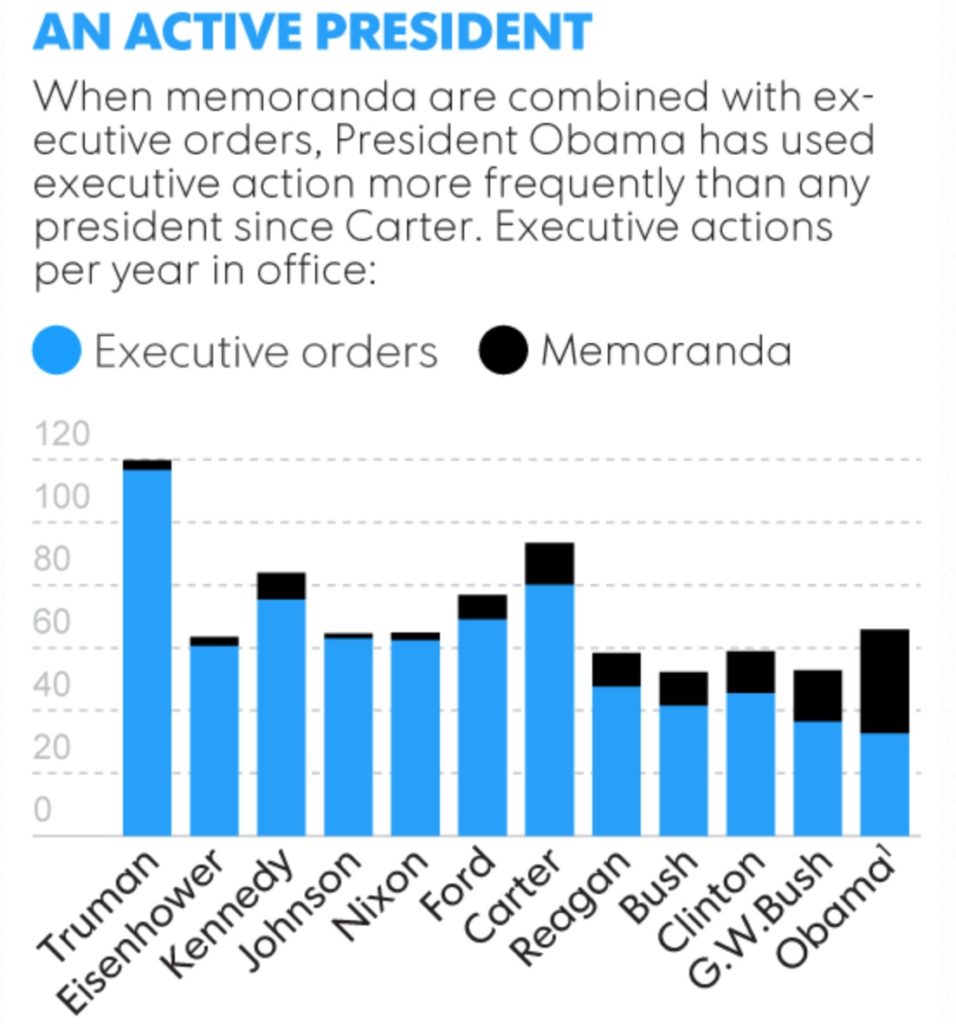
United States Of Newspeak – Obama Spins Executive Orders As "Presidential Memoranda" To Avoid Scrutiny

by Tyler Durden

Submitted by Mike Krieger via Liberty Blitzkrieg blog,

If there’s one thing we have learned about Barack Obama, it’s that he is a master of deception and absolutely loves to lie to the public. He seems to enjoy conning the plebs to such a degree, I think he actually receives blasts of dopamine every time he does it. The bigger the lie, the better the rush.

The latest example relates to his issuance of executive orders, or lack thereof, something that Obama Inc. has actively attempted to portray as evidence of his restraint when it comes to executive power. Here are a few examples from a USA Today article published earlier today.

First, from the man himself:

“The truth is, even with all the actions I’ve taken this year, I’m issuing executive orders at the lowest rate in more than 100 years,” Obama said in a speech in Austin last July. “So it’s not clear how it is that Republicans didn’t seem to mind when President Bush took more executive actions than I did.”

Harry Reid also proudly chimed in:

In a Senate floor speech in July, Majority Leader Harry Reid said, “While Republicans accuse President Obama of executive overreach, they neglect the fact that he has issued far fewer executive orders than any two-term president in the last 50 years.”

Finally, the message wouldn’t be complete without some words from Bootlicker in Chief Jay Carney:

“There is no question that this president has been judicious in his use of executive action, executive orders, and I think those numbers thus far have come in below what President George W. Bush and President Bill Clinton did,” said Jay Carney, then the White House press secretary, in February.

Nice spin, but what’s the truth? Also from USA Today:

WASHINGTON — President Obama has issued a form of executive action known as the presidential memorandum more often than any other president in history — using it to take unilateral action even as he has signed fewer executive orders.


Like executive orders, presidential memoranda don’t require action by Congress. They have the same force of law as executive orders and often have consequences just as far-reaching. And some of the most significant actions of the Obama presidency have come not by executive order but by presidential memoranda.


The Office of Legal Counsel — which is responsible for advising the president on executive orders and memoranda — says there’s no difference between the two.

With that in mind, how does Obama’s record stand up when you combine his issuance of executive orders and executive memoranda? Well, here you go:

Screen Shot 2014-12-17 at 11.31.49 AM

Oh, and let’s not forget this guy still has two years left to further separate himself from the pack.

More from USA Today:

WASHINGTON — President Obama has issued a form of executive action known as the presidential memorandum more often than any other president in history — using it to take unilateral action even as he has signed fewer executive orders.


Obama has issued executive orders to give federal employees the day after Christmas off, to impose economic sanctions and to determine how national secrets are classified. He’s used presidential memoranda to make policy on gun control, immigration and labor regulations. Tuesday, he used a memorandum to declare Bristol Bay, Alaska, off-limits to oil and gas exploration.


Like executive orders, presidential memoranda don’t require action by Congress. They have the same force of law as executive orders and often have consequences just as far-reaching. And some of the most significant actions of the Obama presidency have come not by executive order but by presidential memoranda.


Obama has made prolific use of memoranda despite his own claims that he’s used his executive power less than other presidents. “The truth is, even with all the actions I’ve taken this year, I’m issuing executive orders at the lowest rate in more than 100 years,” Obama said in a speech in Austin last July. “So it’s not clear how it is that Republicans didn’t seem to mind when President Bush took more executive actions than I did.”


Obama has issued 195 executive orders as of Tuesday. Published alongside them in the Federal Register are 198 presidential memoranda — all of which carry the same legal force as executive orders.

He’s already signed 33% more presidential memoranda in less than six years than Bush did in eight. He’s also issued 45% more than the last Democratic president, Bill Clinton, who assertively used memoranda to signal what kinds of regulations he wanted federal agencies to adopt.


Obama is not the first president to use memoranda to accomplish policy aims. But at this point in his presidency, he’s the first to use them more often than executive orders.


So even as he’s quietly used memoranda to signal policy changes to federal agencies, Obama and his allies have claimed he’s been more restrained in his use of that power.


In a Senate floor speech in July, Majority Leader Harry Reid said, “While Republicans accuse President Obama of executive overreach, they neglect the fact that he has issued far fewer executive orders than any two-term president in the last 50 years.”


“There is no question that this president has been judicious in his use of executive action, executive orders, and I think those numbers thus far have come in below what President George W. Bush and President Bill Clinton did,” said Jay Carney, then the White House press secretary, in February.


Executive orders are numbered — the most recent, Executive Order 13683, modified three previous executive orders. Memoranda are not numbered, not indexed and, until recently, difficult to quantify.

That’s precisely why Obama is utilizing them at a record clip.

Indeed, many of Obama’s memoranda do the kinds of things previous presidents did by executive order.


• In 1970, President Nixon issued an executive order on unneeded federal properties. Forty years later, Obama issued a similar policy by memorandum.


Presidential scholar Phillip Cooper calls presidential memoranda “executive orders by another name, and yet unique.”


The law does not define the difference between an executive order and a memorandum, but it does say that the president should publish in the Federal Register executive orders and other documents that “have general applicability and legal effect.”


There are subtle differences. Executive orders are numbered; memoranda are not. Memoranda are always published in the Federal Register after proclamations and executive orders. And under Executive Order 11030, signed by President Kennedy in 1962, an executive order must contain a “citation of authority,” saying what law it’s based on. Memoranda have no such requirement.


Whatever they’re called, those executive actions are binding on future administrations unless explicitly revoked by a future president, according to legal opinion from the Justice Department.


The Office of Legal Counsel — which is responsible for advising the president on executive orders and memoranda — says there’s no difference between the two.


Even the White House sometimes gets tripped up on the distinction. Explaining Obama’s memoranda on immigration last month, Press Secretary Josh Earnest said the president would happily “tear up his own executive order” if Congress passes an immigration bill.


Obama had issued no such executive order. Earnest later corrected himself. “I must have misspoke. I meant executive actions. So I apologize,” he said.

Not to fear, we just found out that Jeb Bush will be running for President in 2016. There’s always something to look forward to. For example:

Here’s your American “democracy.”

Screen Shot 2014-12-17 at 11.44.13 AM

19 Dec 14:05

Autoimmune Diseases and the Gut Biome

by Richard Nikoley

After posting this morning about "winding down," I ended up wanting to add a sub-section to the Autoimmune Diseases section in Chapter 8 of the book: The Gut Microbiome In Disease Pathology (html version). Thanks to Tim Steele for his major contributions to this as well. Hopefully you'll see that the intended style is layman accessible, but well referenced for the geeks. Didn't take the time to make it pretty for the blog (the link above has footnote links and links to citations), so here's just a plain text:

AUTOIMMUNE DISEASES

A well established aspect of the gut microbiome is its close relationship with host immunity, essentially comprising 70% of the immune system.[1] It’s no longer mere speculation that the composition of our gut microbes have a profound effect on the creation, training, maintenance, and actions of our immune system. An imbalance of intestinal microbes can cause an imbalance in our immune system, leading it to attack us instead of the pathogens it’s supposed to eradicate or keep in check. Here’s a partial list of autoimmune conditions that have been linked to disruptions in gut microbes:

* Addison's Disease
* Alopecia
* Ankylosing Spondylitis
* Antiphospholipid Syndrome (APS)
* Autoimmune Hepatitis
* Behcet's Disease
* Bullous Pemphigoid
* Castleman's Disease
* Celiac Disease
* Chronic Fatigue Syndrome
* Chronic Inflammatory Demyelinating Neuropathy (CIDP)
* Churg Strauss Syndrome
* Crohn's Disease
* Endometriosis
* Fibromyalgia
* Infertility
* Giant Cell Arteritis
* Glomerulonephritis (Autoimmune Kidney Disease)
* Graves' Disease
* Guillain-Barre Syndrome
* Hashimoto's Thyroiditis
* Idiopathic Pulmonary Fibrosis
* IgA Nephropathy
* Interstitial Cystitis
* Kawasaki Disease
* Lichen Planus
* Lupus
* Meniere's Disease
* Mixed Connective Tissue Disease (MCTD)
* Multiple Sclerosis
* Myasthenia Gravis
* Narcolepsy
* Pemphigus
* Pernicious Anemia
* Polyarteritis Nodosa
* Polymyositis
* Primary Biliary Cirrhosis
* Psoriasis
* Raynaud's Disease
* Reiter's Syndrome
* Rheumatoid Arthritis
* Sarcoidosis
* Scleroderma or CREST Syndrome
* Silicone Immune Toxicity Syndrome
* Sjogren's Syndrome
* Stiff-Man Syndrome
* Type 1 Diabetes
* Ulcerative Colitis
* Vascular Dementia
* Vasculitis
* Vitiligo
* Wegener's Granulomatosis

Those with one or more of these autoimmune conditions are likely to have a diet high in modern, industrial Frankenfoods or one lacking in sufficient fibers our gut bugs recognize as food—but most likely both. The immune system keeps the body healthy by providing a fine balance between attacking invaders and maintaining healthy tissues. In autoimmune diseases, this delicate balance fails and the immune system attacks healthy tissue.

Let’s take a brief look at a few autoimmune conditions positively identified with altered gut microbes.

Rheumatoid Arthritis -

In rheumatoid arthritis, the immune system attacks membranes that line the joints, causing painful swelling, stiffness, and a loss of function in fingers, wrists, or other joints. Often thought to be triggered by factors such as smoking and stress, it’s now known to be related to gut health; i.e., diet related, ultimately.

A specific type of gut bacteria, Prevotella copri, is found in over 75% of those newly diagnosed. When lab animals were implanted with Prevotella copri, they developed symptoms of rheumatoid arthritis. While this is not enough for scientists to develop a cure, it does give them clues toward developing new treatments, treatments that will almost certainly target gut microbial dysbiosis.

Ankylosing Spondylitis -

Ankylosing Spondylitis is an autoimmune disease that attacks the spaces between vertebrae in the spinal column, hip joints, and other locations throughout the body. It’s a disfiguring, painful disease that’s closely associated with the gut microbe Klebsiella pneumoniae. Beneficial microbes Bifidobacteria, Lactobacilli, and other core species prevent Klebsiella from turning invasive.

While Klebsiella pneumoniae is a normal inhabitant of the human gut, it’s often associated with urinary tract infections, upper respiratory tract infections, and wound site infections. When it grows uncontrollably in the respiratory tract it can lead to deadly pneumonia.

The microbe’s association with ankylosing spondylitis has a clear genetic factor, with 90% of patients expressing the HLA-B27 genotype.[2] One hypothesis put forth is that this genetic signal could trigger the disease by enhancing the growth and perpetuation of the Klebsiella microbes in the bowel. In an attempt to slow the growth of the now pathogenic bacteria, the immune system mistakenly attacks the human tissues, thus causing the disease. Strings of protein in Klebsiella bear resemblance to human joint tissue. This molecular mimicry is the underlying mechanism behind all autoimmune disease and a growing number of modern diseases that heretofore had no clear medical pathophysiology—such as essential hypertension.[3] [4]

A common treatment for ankylosing spondylitis is to restrict all fermentable fiber from the diet in order to starve the gut microbes, achieving results similar to the overuse of antibiotics, or the practice of very low carbohydrate and ketogenic diets.[5] [6] This approach may have short-term therapeutic value but an unforeseen drawback may be further damaged immunity and gut health in the long term, leading to unintended consequences. The immune system lines the entire gut and atrophies without butyrate and contact from the beneficial microbes that regularly consume fermentable fiber.[7]

Type 1 Diabetes Mellitus (T1D) -

Type 1 diabetes results from autoimmune destruction of insulin-producing beta cells in the pancreas. As has been harped on plenty, factors that influence gut health—for better or worse—are factors that ultimately influence the function of the immune system—for better or worse. It’s so closely tied together, it’s a testament to the intricacies of the gut, gut microbes, and our resulting immune system. Gut bugs modulate its function through what is essentially training the immune system—in particular T cells—as mentioned earlier.[8]

The gut and pancreas also share several critical links and so problems with the gut are often reflected in the pancreas. Altered gut microflora have been linked to T1D in animal and human studies, and are normally thought to be a function of intestinal inflammation, gut permeability, and food allergies.[9] Children with T1D are more susceptible to certain infections and do not normally develop tolerance to cow’s milk. These complex interactions are currently the target of new approaches to prevention and treatment.

Hashimoto’s Thyroiditis -

“Hashi’s” is a condition where the thyroid gland is attacked by a combination of immune processes that can manifest as high or low thyroid levels, but most usually the latter. It has the distinction of being the very first disease to be recognized as an autoimmune condition.

Mounting evidence suggests that not only intestinal pathogens, but symbiotic ones can influence an overblown immune response against thyroid tissue. And more recent studies reveal that not only the gut commensals, but also oral microorganisms such as periodontal bacteria, may play a role.[10]

To muddy the waters even further, an association between celiac disease or gluten sensitivity and autoimmune thyroid disorders is well established, with about ten times as many with gluten issues also having thyroid issues than is observed in the general population.[11] Curiously but not surprisingly, this link may exist due to a molecular similarity between gliadin, the protein portion of gluten and thyroid tissue.[12] In all, one intuitive way to regard the process is that a leaky gut, as addressed previously, allows gliadin into the bloodstream where it’s attacked by the immune system as a foreign invader, with “similar looking” thyroid tissue getting caught in the crossfire.

What remains to understand is which strains of intestinal flora help, and which hurt. As we’ve seen a number of times thus far, it’s not as simple as good guy vs. bad guy. “Good guys” can be bad if there are too many of them or they’re out of proportion with other “good guys.” And “bad guys” can be non pathologic if still other “bad guys” (or “good guys”) are keeping them in check. A 2012 paper demonstrates just how complex the picture is.

Multiple lines of evidence have demonstrated that probiotic organisms such as Bifidobacterium and Lactobacillus confer health benefits on the host. For instance, oral administration of probiotics to mice induced IL-10 production and prevented the development of autoimmune diseases including type 1 diabetes and colitis. This probiotic-induced anti-inflammatory effect is reportedly mediated by dendritic cells. However, series of in vivo and in vitro studies have demonstrated that certain probiotic strains exacerbated colitis and encephalomyelitis, enhanced interferon-γ (IFNγ) production and reduced regulatory T cell (Treg) activity, indicating that attention should be paid when choosing a probiotic strain to treat autoimmune disorders. In experimental autoimmune thyroiditis (EAT), a murine model of Hashimoto’s thyroiditis, probiotic strains Lactobacillus rhamnosus HN001 and Bifidobacterium lactis HN019, which had been shown to enhance splenocyte IFNγ production in mice, exhibited neither stimulatory nor inhibitory effect on the disease development. Taken collectively, the presence and the role of intestinal dysbiosis and the effect of alteration in the gut microbial composition remain to be investigated in Hashimoto’s thyroiditis.[13]

Unfortunately, the standard of treatment for low thyroid (hypothyroidism) is effective enough for most people by the administration of synthetic thyroid hormone to treat the symptom, that little has been done in the mainstream to investigate the underlying cause: in order to develop more fundamental therapies or recommended lifestyle changes for better management, or even a cure.
________________
[1] Wu, Hsin-Jung, and Eric Wu. "The role of gut microbiota in immune homeostasis and autoimmunity." Gut Microbes 3.1 (2012): 4-14.
[2] "HLA-B27 - Wikipedia, the free encyclopedia." 2004. 17 Aug. 2014 <http://en.wikipedia.org/wiki/HLA-B27>
[3] Schwimmbeck, PETER L, DT Yu, and MB Oldstone. "Autoantibodies to HLA B27 in the sera of HLA B27 patients with ankylosing spondylitis and Reiter's syndrome. Molecular mimicry with Klebsiella pneumoniae as potential mechanism of autoimmune disease." The Journal of experimental medicine 166.1 (1987): 173-181.
[4] Tervaert, JWC. "Hypertension: an autoimmune disease[quest] - Nature." 2011. <http://www.nature.com/hr/journal/v34/n4/full/hr201115a.html>
[5] "LOW STARCH DIET." 2012. 3 May. 2014 <http://www.spondylitis.org/about/low_starch_diet_summer2012_spondylitis_plus.pdf>
[6] Ebringer, A, and C Wilson. "The use of a low starch diet in the treatment of patients suffering from ankylosing spondylitis." Clinical rheumatology 15.1 (1996): 62-66.
[7] Rashid, T. "The Link between Ankylosing Spondylitis, Crohn's Disease ..." 2013. <http://www.ncbi.nlm.nih.gov/pmc/articles/PMC3678459/>
[8] Vaarala, O. "Gut microbiota and type 1 diabetes." The review of diabetic studies: RDS 9.4 (2011): 251-259.
[9] Jaimie Dalessio. "Gut Bacteria May Prevent Type 1 Diabetes - Digestive Health Center ..." 2013. 19 Jan. 2014 <http://www.everydayhealth.com/digestive-health/gut-bacteria-may-prevent-type-1-diabetes-2306.aspx>
[10] Mori, K. "Does the gut microbiota trigger Hashimoto's thyroiditis?." 2012. <http://www.ncbi.nlm.nih.gov/pubmed/23200063>
[11] Sategna-Guidetti, C. "Autoimmune thyroid diseases and coeliac disease." 1998. <http://www.ncbi.nlm.nih.gov/pubmed/9872614>
[12] "The Gluten-Thyroid Connection - Chris Kresser." 2011. 18 Dec. 2014 <http://chriskresser.com/the-gluten-thyroid-connection>
[13] Mori, K. "Does the Gut Microbiota Trigger Hashimoto's Thyroiditis ..." 2012. <http://www.discoverymedicine.com/Kouki-Mori/2012/11/27/does-the-gut-microbiota-trigger-hashimotos-thyroiditis/>

19 Dec 13:57

Quotation of the Day…

by Don Boudreaux
(Don Boudreaux)

… is from pages 214-215 of David Landes’s often brilliant but uneven 1998 volume, The Wealth and Poverty of Nations:

At the same time, the British were making major gains in land and water transport.  New turnpike roads and canals, intended primarily to serve industry and mining, opened the way to valuable resources, linked production to markets, facilitated the division of labor.  Other European countries were trying to do the same, but nowhere were these improvements so widespread and effective as in Britain.  For a simple reason: nowhere else were roads and canals typically the work of private enterprise, hence responsive to need (rather than to prestige and military concerns) and profitable to users.  This is why Arthur Young, agronomist and traveler, could marvel at some of the broad, well-drawn French roads but deplore the lodging and eating facilities.  The French crown had built a few admirable king’s highways, as much as to facilitate control as to promote trade, and Young found them empty.  British investors had built many more, for the best business reasons, and inns to feed and sleep the users.

These [British] roads (and canals) hastened growth and specialization.

The British state, in fact, did not build a great deal of ‘that’ – a fact that calls into question the notion that economic prosperity requires that infrastructure be built, or even financed, by government.

18 Dec 22:39

State of the Sanderson: December 2014

by Peter Ahlstrom

Introduction

Hello, all! I recently turned in Shadows of Self, the new Wax and Wayne Mistborn novel. (And, well, something else too. More on that below.) In addition, tomorrow is December 19th—known with fondness as “Koloss Head-Munching Day.” Also my birthday. (I’ll be 39.)

This seemed like a good chance to take a step back and give you all a long-form update on what I’ve been doing lately, and where I am looking for the future. I like to be accountable to you, my readers, for what I’m doing. You are the ones supporting me in this, my lifelong dream of being a professional writer.

2014 was an excellent year for me. Words of Radiance has been very well received, and enthusiasm for the Stormlight books is very high. As this series is my baby, it feels awesome to see people getting to know characters like Dalinar and Kaladin, whom I’ve known for decades. At the same time, I’ve been jumping back into teen books again after the Alcatraz books. (Which kind of fizzled back in 2010 or so, though we’re planning a relaunch.)

Having two publishers made for a very challenging tour schedule. I’ve been away from home far more than I want to be, mostly because of the need to add more touring (along with things like school visits and appearances at teacher/librarian conferences) for Steelheart and The Rithmatist.

I’m still struggling to find a balance I like. On one hand, I enjoy visiting you all and going cool places. On the other hand, my real love is writing the books—and I don’t want to get so busy that the stories fall by the wayside. Anyway, the following is an account of my 2014 writing experience for those who are curious.

What I spent 2014 doing

January–March 2014: Firefight

Though I had hoped to have Firefight (The Reckoners 2) done long before January, the touring last year made that impossible. It snuck over into 2014, which is why you’re getting the book in January 2015 instead of the originally scheduled fall of this year. In March, I also did the Words of Radiance tour, which really cut into my writing time.

April 2014: Legion: Skin Deep

In April, once all the chaos was done, I took the time to finish up Legion: Skin Deep (sequel to Legion from a few years back), which I’d been working on during plane flights the year before. If you haven’t checked these two novellas out, you might want to consider it! They’re very fun, though the second book is not yet out in the UK and associated territories such as Australia and New Zealand. (Note that in those territories, Legion 1 and The Emperor’s Soul were released together in a very handsome paperback.)

We will eventually have regular hardcover copies of Legion 2 available. That will probably come sometime in the first half of next year. Our contract with Subterranean Press, who produced the very attractive limited edition hardcovers of Legion 2, says that we’ll wait until their edition sells out before we release a competing one.

May 2014: The Aztlanian (Rithmatist 2)

Next, I dove into research for a sequel to The Rithmatist. This is going to be a tough book to write, as it takes place in a fantastical version of Central and South America, and deals with things from Aztec (Mexica) mythology. (In The Rithmatist, a lot of the geography is shifted around in bizarre ways.)

Dealing with another group’s culture in this way is rife with opportunities for stuffing my foot in my mouth, and so I wanted to be very careful and respectful. This meant spending time devoted exclusively to doing extensive research. I didn’t actually get any writing on the book done, though I read some very excellent history books.

(As an aside, if anyone out there is an expert in the Aztec/Mexica culture—particularly if you yourself are a Native American—I’d love to have your help on this book.)

At the end of the month, I decided I needed to do way more research than a month afforded, so I put the book off for now. I still intend to write it, but I need more time to do it right.

June 2014: Alcatraz

Having spent a month with no writing, I wanted to jump into something fun and quick to refresh me before moving on to my next book. So, I dug out my outline for the Alcatraz series and at long last did a rough draft of the fifth book. These are fast, fast books to write—as I improvise them—but they are very slow to edit.

I finished the book, and am pleased with it, but I have no firm date yet for when I’ll be publishing it. Tor is rereleasing the series starting next year with new covers and extensive interior art. I believe these launch starting about a year from now. (If you want them before then, your best bet for getting them is the UK omnibus of the first four.)

I’ll want to release the fifth one once the series has been rereleased, so maybe summer 2016. If you’ve never read these, they are very different from my other work. They’re bizarre and sarcastic comedies that are self-referential and offer commentary on fantasy as a genre along the way. Those who love them absolutely love them. Those who don’t tend to find them insulting. That dichotomy alone is part of what endears them to me.

July–December 2014: Mistborn

The last half of the year was dedicated to Shadows of Self, the new Mistborn novel. And I have a confession to make.

I also wrote the sequel.

Now, before you start wagging your finger at me for being a robot, there was a really good reason I did what I did. You see, I was having real trouble getting back into Shadows of Self. I had written the first third of it in 2012 between revisions of A Memory of Light. (I was feeling Wheel of Time overload.) However, it can be very hard for me to get back into a book or series after a long time away from it. (This is another issue with the Rithmatist sequel.)

So, jumping into Shadows of Self was slow going, and I found it much easier to go write the sequel to refresh myself on the world and characters. That done, I was able to move back to Shadows of Self and finish it up.

So a week or two back, I turned in two new Wax and Wayne Mistborn novels. They’re titled Shadows of Self and Bands of Mourning, and Tor decided to publish them in quick succession: the first in October 2015, the second in January 2016. So, if you have read the original trilogy but haven’t tried The Alloy of Law yet, you might want to give it a look! From the beginning, I’ve planned Mistborn to be a continuum series, showing off Allomancy in different time periods. I think you’ll find the Wax and Wayne books to be fun, quick reads—and they introduce some very, very big things coming in the Mistborn world.

There will be one more Wax and Wayne (early 1900s-era) Mistborn book. Back after I finished The Alloy of Law, I sat down and plotted out a trilogy with the same characters. The Alloy of Law was more of a happy, improvised accident. The follow-up trilogy is meant to be more intentional. So in the end, we’ll have four total. (The final one is tentatively called The Lost Metal.) From there, I might jump to the second “big” trilogy, which is 1980s tech. Or I might dally a little more in something 1940s-era instead. We’ll see.

Amusingly, doing these two Mistborn books together totaled only about half as much writing as a Stormlight book. Perhaps you can see why it takes even me quite a long time to finish Stormlight novels. (And it’s why you might want to lay off Pat Rothfuss a little. I believe The Wise Man’s Fear was even longer than Words of Radiance.)

Tor did their announcement about these books earlier today. You may now commence wisecracks about me secretly writing extra novels when nobody is looking.

Next Projects

I’ve now begun Calamity, last of the Reckoners series. My goal will be to rough-draft it over the next three months. I have a tour between now and then (for Firefight) and a trip to Taiwan as well, so who knows if I’ll make that deadline. We’ll see.

Once that is done, I will dive into Stormlight 3. I’m still waffling on whether this will be Szeth’s book, Eshonai’s book, or Dalinar’s book. The original outline calls for book 3 to have Szeth’s flashbacks, but I am feeling that another character might match the events better.

I did some exploratory scenes for it this summer, though these may or may not end up in the actual book. I have been tweaking the outline, and am starting to feel very good about it. Writing the book should consume the entire rest of 2015, with a 2016 release. I do plan the Stormlight books to be an every-other-year thing.

Follow along starting next spring as I write the book and post updates on my website. I’ll even try to do some screen capturing with Camtasia as I write, for those who are interested in watching for them.

That wraps up current and finished projects. 2014 was partially about me getting my feet underneath me after finishing The Wheel of Time and going right into Stormlight 2. I’ve caught my breath now, and feel good moving forward.

And, speaking of moving forward, it’s time for a State of the Sanderson tradition—we’re going to play “What about the sequel to this book I love, Brandon!”

Here comes the big list.


The big list of projects I want to do

Elantris sequels

The Emperor’s Soul is now two years old, so it is probably time to get back to Sel and do some more there. We should be releasing a trade paperback of Elantris in the next year or two, with revised (and new) maps and a better Ars Arcanum. (Read: an Ars Arcanum.)

The full sequels will need to be finished before I can do the contemporary (1980s tech) Mistborn novels because of behind-the-scenes Cosmere bits, so I will do my best to find a place to squeeze these in. At the very least, I will write them following the end of Stormlight 5. So, these are distant, but not too distant.

Nightblood (Warbreaker sequel)

This is still on the back burner, but it is coming. Probably after the Elantris sequels. I’ll squeeze it in someplace. I’m very excited about it, but now (while I’m juggling multiple teen series) is not the time.

Dark One

This is a series I’ve talked about for a long, long time about a boy who discovers he’s the “Dark One.” Basically, it’s the classic epic fantasy story told from the eyes of the dude destined to try to destroy the world instead of save it. I’ve made good progress on the setting, which is going to be awesome. I wouldn’t be surprised if this is the teen series I do once the Reckoners and the Rithmatist are both done.

As a note for fans, this is a Cosmere story.

Silence Divine (this will be renamed sometime)

I did readings from this on my last tour (you can probably find them on YouTube; it was the Words of Radiance tour). I only have a few pages done, playing with the primary concept. (Diseases grant magical talents for as long as you have the disease—you lose the power when you get over it.) This one has probably been downgraded from full novel to novella, as I feel that something more Emperor’s Soul-esque will do a better job with the themes I want to explore.

Legion 3

Legion 2 is out! Are you tired of me mentioning that yet? I’m sure that someday there will be a third adventure for Stephen and his aspects, but I don’t have an outline or plan yet.

The Lurker (now renamed Adamant)

I’ve finished a novella set in this science fiction world. For those who want more SF from me along the lines of my two novelettes, this should be coming someday. I don’t have time for revisions right now, but I plan to tinker with the story again next year sometime between Stormlight 3 drafts.

White Sand

The graphic novel adaptation of this Cosmere book is coming along very well. The first volume’s script adaptation is finished, and pencils for the first chapter are done. We should have pages to show you before too long. Expect a lot of talk about this on the blog come 2015.

Dragonsteel

Hoid’s backstory series is still going to be one of the last Cosmere sequences I do, so don’t expect this until Stormlight is completely done. (Both sets of five books.)


That’s the list of things people often ask me about. Unsurprisingly, I have other projects in the back of my mind. For example, I have two more Cosmere series that will need to be written before we can get to the third “big” Mistborn trilogy. (The sf one.) But that’s the long, long-term plan.

For now, my goal is to get Calamity and Stormlight 3 finished. As always, I appreciate all of the enthusiasm you show for this crazy thing that I have somehow managed to do with my life. Thank you for sharing my books with others, and for being willing to try the more unusual projects (like Legion) that I do.

I feel humbled to have a great crowd of fans who are willing to put up with my eccentricities as a writer—particularly my desire to not work on just one project, but to have an entire body of varying stories. You guys are awesome. May you have a happy holiday season, and do go munch some heads tomorrow in my name.

Brandon

p.s. If you aren’t on the newsletter mailing list, please consider signing up! In the summer, the newsletter included exclusive looks at some of the Stormlight 3 scenes I was working on. We plan to do more of this sort of thing in the future. As always, if you include your city, we’ll send you notifications when I’m going to be doing signings in the area.

18 Dec 22:25

Comstock Suspends Drilling In Eagle Ford Due To Plunging Oil Prices

by Tyler Durden

Shale 0 - Saudi Arabia 1

Following one after another major and shale company announcing plans to trim capex (even as they miraculously still get to keep their revenue and EPS projections intact, for now), the latest victory handed to Saudi Arabia on a silver platter comes courtesy of Comstock Resources (Total Debt/EBITDA 2.4x, EBITDA $421MM, CapEx $674MM) Comstock Resources said earlier today that in response to low oil prices, plans to suspend oil directed drilling activity in its Eagle Ford shale properties and in Tuscaloosa Marine shale.

It was not immediately clear how many high-paying oilfield jobs would be promptly terminated as a result of this unambiguously good development.

Full press release:

Comstock Resources, Inc. ("Comstock" or the "Company") (NYSE:CRK) announced that it has budgeted $307 million in 2015 for its drilling and completion activities.  In response to low oil prices, the Company plans to suspend its oil directed drilling activity in its Eagle Ford shale properties in South and East Texas and in the Tuscaloosa Marine shale in Mississippi.  Comstock has released its rig in the Tuscaloosa Marine shale and will postpone its drilling activity there until oil prices improve.  Comstock currently has four operated rigs drilling on its Eagle Ford shale properties.  The Company will release two of these rigs in early 2015 and will move the other two rigs to North Louisiana to start up a drilling program on its Haynesville shale natural gas properties. Comstock believes that improved completion technology, including longer laterals, will provide strong returns on drilling projects at current natural gas prices.


Comstock has budgeted to drill 19 (18.6 net) horizontal wells in 2015.  The Company expects to spend $161 million for drilling 14 (14.0 net) Haynesville/Bossier shale natural gas wells and $34 million for drilling five (4.6 net) wells on its East Texas and South Texas Eagle Ford shale acreage.  The 2015 budget includes $49 million for completion costs of 13 (11.9 net) Eagle Ford shale wells that were drilled in 2014 but will be completed in 2015 and $63 million on facilities, recompletions and for other capital projects.  Comstock plans to refrac ten of its existing Haynesville shale producing wells as part of the 2015 program.


Comstock estimates that the drilling program will generate Company-wide oil production of 3.5 to 3.9 million barrels in 2015 and natural gas production of 55 to 60 Bcf. 

The punchline:

After three years of natural gas production declines, 2015 will mark a turnaround for the Company's natural gas production.  The Company will continue to assess the oil and natural gas markets throughout 2015 and will adjust its drilling program to reflect the appropriate mix of oil and natural gas wells in order to maximize returns.

Good luck.

18 Dec 21:21

New York Bans Fracking Based on Fearful Uncertainties, Not Science

by Ronald Bailey

Andrew CuomoNew York Governor Andrew Cuomo has acquiesced to a ban of hydraulic fracturing (fracking) of shale to produce natural gas in his state based on "uncertainties" concerning the possible effects of the activity on public health. Essentially, the New York Department of Health (DOH) report Cuomo cites defaulted to the precautionary principle:

When an activity raises threats of harm to human health or the environment, precautionary measures should be taken even if some cause and effect relationships are not fully established scientifically. In this context the proponent of an activity, rather than the public, should bear the burden of proof.

Or as the report asserts: 

Based on this review, it is apparent that the science surrounding HVHF [high volume hydraulic fracturing] activity is limited, only just beginning to emerge, and largely suggests only hypotheses about potential public health impacts that need further evaluation....

...the overall weight of the evidence from the cumulative body of information contained in this Public Health Review demonstrates that there are significant uncertainties about the kinds of adverse health outcomes that may be associated with HVHF, the likelihood of the occurrence of adverse health outcomes, and the effectiveness of some of the mitigation measures in reducing or preventing environmental impacts which could adversely affect public health. Until the science provides sufficient information to determine the level of risk to public health from HVHF to all New Yorkers and whether the risks can be adequately managed, DOH recommends that HVHF should not proceed in New York State.

What sort of "evidence" did the DOH rely on for its ban recommendation? For example, the DOH study cited two epidemiological studies that purported to find adverse effects on birth outcomes near fracked wells. One found infants born closer to fracked wells had lower birth weights, but no increase in congenital defects. The other found an increase in congenital defects, but not lower birth weights. The DOH then noted:

Taken together, the relationship between maternal proximity to HVHF well pads during pregnancy and birth outcomes, if any, is unclear.

Well, yes. The DOH also reviewed a number of studies dealing with possible exposures to air pollutants from fracking and basically could find none in which pollutants exceeded regulatory limits. The DOH of review of the effects of fracking on drinking water supplies uncovered no substantial evidence for increased concerns about human health from that source.

The basic strategy of the DOH review seems to be to cite a bunch of studies - most of which find no significant problems or are inconclusive at worst - and then declare that their non-findings are insufficient to calm the regulators fears. Or as the report notes:

The actual degree and extent of these environmental impacts, as well as the extent to which they might contribute to adverse public health impacts are largely unknown. Nevertheless, the existing studies raise substantial questions about whether the public health risks of HVHF activities are sufficiently understood so that they can be adequately managed.

Pure precautionary principle. A simpler formulation of the precautionary principle is: Never do anything for the first time. Basically, ignorance can be used as an excuse to stop anything of which one disapproves. 

18 Dec 15:51

Someone Is Lying

by Tyler Durden

Yesterday, moments before the North Korea "hacking" tragicomedy escalated into full retard mode with Sony pulling The Interview, or a movie that absent the attention would certainly be a flop, Wired released an article titled: "North Korea Almost Certainly Did Not Hack Sony" (title subsequently changed to the one below as can be seen in the URL alias "http://www.wired.com/2014/12/north-korea-did-not-hack-sony-probs"), which however, and for the better, retains its content as it is quite critical in debunking the latest government "certainty."


Continue reading here for the full story, because moments after the Wired piece hit, we got this "confirmation" from the NYT:


It is quite clear that someone is lying (we leave it up to readers to decide who). The question is "why"?

16 Dec 17:19

Making Everyone a Criminal

by admin

From Atlas Shrugged:

Dr. Ferris smiled. . . . . ."We've waited a long time to get something on you. You honest men are such a problem and such a headache. But we knew you'd slip sooner or later - and this is just what we wanted."

[Hank Reardon:]  "You seem to be pleased about it."

"Don't I have good reason to be?"

"But, after all, I did break one of your laws."

"Well, what do you think they're for?"

Dr. Ferris did not notice the sudden look on Rearden's face, the look of a man hit by the first vision of that which he had sought to see. Dr. Ferris was past the stage of seeing; he was intent upon delivering the last blows to an animal caught in a trap.

"Did you really think that we want those laws to be observed?" said Dr. Ferris. "We want them broken. You'd better get it straight that it's not a bunch of boy scouts you're up against - then you'll know that this is not the age for beautiful gestures. We're after power and we mean it. You fellows were pikers, but we know the real trick, and you'd better get wise to it. There's no way to rule innocent men. The only power any government has is the power to crack down on criminals. Well, when there aren't enough criminals, one makes them. One declares so many things to be a crime that it becomes impossible for men to live without breaking laws. Who wants a nation of law-abiding citizens? What's there in that for anyone? But just pass the kind of laws that can neither be observed nor enforced nor objectively interpreted - and you create a nation of law-breakers - and then you cash in on guilt. Now, that's the system, Mr. Rearden, that's the game, and once you understand it, you'll be much easier to deal with."

Here is the same thing, Obama Administration style

Major U.S. corporations have broadly supported President Barack Obama's healthcare reform despite concerns over several of its elements, largely because it included provisions encouraging the wellness programs.

The programs aim to control healthcare costs by reducing smoking, obesity, hypertension and other risk factors that can lead to expensive illnesses. A bipartisan provision in the 2010 healthcare reform law allows employers to reward workers who participate and penalize those who don't.

But recent lawsuits filed by the administration's Equal Employment Opportunity Commission (EEOC), challenging the programs at Honeywell International and two smaller companies, have thrown the future of that part of Obamacare into doubt.

The lawsuits infuriated some large employers so much that they are considering aligning themselves with Obama's opponents, according to people familiar with the executives' thinking.

"The fact that the EEOC sued is shocking to our members," said Maria Ghazal, vice-president and counsel at the Business Roundtable, a group of chief executives of more than 200 large U.S. corporations. "They don't understand why a plan in compliance with the ACA (Affordable Care Act) is the target of a lawsuit," she said. "This is a major issue to our members."

At the exact same moment, one branch of the Administration is encouraging an activity that another branch is working to criminalize.

09 Dec 05:31

Quotation of the Day…

by Don Boudreaux
(Don Boudreaux)

… is from page 118 of H.L. Mencken’s,  A Second Mencken Chrestomathy (1995); it’s reprinted from an article that Mencken wrote for the July 21st, 1935, edition of Manchester, England’s Sunday Chronicle:

The human race detests thrift as it detests intelligence.  The man who accumulates more than he needs and saves the surplus is disliked by all who either can’t or won’t follow his example, and that means the great majority of his fellow men.  He makes them ashamed of themselves and they resent it.

09 Dec 05:29

Quotation of the Day…

by Don Boudreaux
(Don Boudreaux)

… is from page 248 of Burton Folsom, Jr.’s 2008 volume, New Deal or Raw Deal? How FDR’s Economic Legacy Has Damaged America:

Other nations recovered from the Great Depression more quickly than did the United States.  During the late 1930s, the League of Nations collected statistics from the United States and from many other nations on industrial recovery.  Much of that data supports [sic*] the idea that Roosevelt’s New Deal created economic uncertainty and was in fact uniquely unsuccessful as a recovery program.

Yep.  Robert Higgs has the details.  (See also here.)

* “Data” is plural, not singular.

09 Dec 05:28

Welcome to the American Republic, William Windsor

by David Boaz

David Boaz

The royals are coming, the royals are coming! In this case, the grandson of the Queen of England, along with his wife, who took a fairytale leap from commoner to duchess by marrying him. (Just imagine, Kate Middleton a duchess while Margaret Thatcher was only made a countess.) And once again Americans who have forgotten the American Revolution are telling us to bow and curtsy before them, and address them as “Your Royal Highness,” and stand when William enters the room.

So one more time: Americans don’t bow or curtsy to foreign monarchs. (If you don’t believe me, ask Miss Manners, repeatedly.)

This is a republic. We do not recognize distinctions among individuals based on class or birth. We are not subjects of the queen of the England, the emperor of Japan, the king of Swaziland, or the king of Saudi Arabia. Therefore we don’t bow or curtsy to foreign heads of state.

Prince William’s claim to such deference is that he is a 24th-generation descendant of William the Conqueror, who invaded England and subjugated its inhabitants. In Common Sense, one of the founding documents of the American Revolution, Thomas Paine commented on that claim:

Could we take off the dark covering of antiquity, and trace them to their first rise, that we should find the first [king] nothing better than the principal ruffian of some restless gang, whose savage manners or pre-eminence in subtility obtained him the title of chief among plunderers; and who by increasing in power, and extending his depredations, over-awed the quiet and defenceless to purchase their safety by frequent contributions….

England, since the conquest, hath known some few good monarchs, but groaned beneath a much larger number of bad ones; yet no man in his senses can say that their claim under William the Conqueror is a very honorable one. A French bastard landing with an armed banditti, and establishing himself king of England against the consent of the natives, is in plain terms a very paltry rascally original.—It certainly hath no divinity in it.

Citizens of the American republic don’t bow to monarchs, or their grandsons.


09 Dec 05:24

Some thoughts about Eric Garner’s death, over-criminalization, the regulatory superstate and the violence of the state

by Mark Perry

Here are what I think are three examples of especially insightful commentary about the death of Eric Garner, and what it teaches us about over-criminalization, government force, police brutality, the regulatory superstate, and the violence of the state (emphasis mine).

1. J.D. Tuccille writing on the Reason blog, “Eric Garner’s Murder Reveals the Ugly Core of Government and Law Enforcement“:

And also, let’s be clear, because when you unleash armies of thugs on the population to enforce every petty law, they’re soon going to acquire an attitude. Eventually, telling a cop, “Please just leave me alone,” as Eric Garner told the cops rousting him, becomes an unacceptable act of defiance. It’s interpreted as an invitation to swarm a man suspected of selling handfuls of untaxed cigarettes and wrestle him to the ground.

You want a society taxed and regulated toward your vision of perfection? It’s going to need enforcers. Those enforcers are going to interact on a daily basis with people who don’t share that vision of perfection, and who resent the constant enforcement attempts. They’ll push back to greater or lesser extents. And the enforcers will twist arms in return to frighten people into obedience. People will be abused and some will die.

Government, at its core, is force. The more it does to shape the world around it, the more it needs enforcers to make sure officials’ wills are done. “The law is the law,” says New York City Mayor Bill de Blasio, but it’s creatures like him who make so much damned law. And then they send the likes of Officer Daniel Pantaleo to make sure we comply. Or else they might kill us.

2. Randy Soave also writing on the Reason blog “Listen Up, Liberals: Make Everything Illegal, Create More Eric Garners“:

Look, police brutality has many underlying causes. One of them is undoubtedly racism; black people are disproportionately arrested and imprisoned. Another cause is the police incentive structure. Police have far more legal protections than non-police. They can get away with so much more. It’s difficult—often impossible—to punish police for bad behavior, which gives the bad apples free rein to abuse people.

You know what’s also a cause? Over-criminalization. And that one is on you, supporters of the regulatory super state. When a million things are highly regulated or outright illegal—from cigarettes to sodas of a certain size, unlicensed lemonade stands, raw milk, alcohol (for teens), marijuana, food trucks, taxicab alternatives, and even fishing supplies (in schools)—the unrestrained, often racist police force has a million reasons to pick on people. Punitive cigarette taxes, which disproportionately fall on the backs of the poorest of the poor, contribute to police brutality in the exact same way that the war on drugs does. Liberals readily admit the latter; why is the former any different?

If you want all these things to be illegal, you must want—by the very definition of the word illegal—the police to force people not to have them. Government is a gang of thugs who are paid to push us around. It’s their job.

3. Jonah Goldberg writing for National Review Online:

When you pass a law, you authorize law enforcement to enforce it. That’s actually why they’re called “law enforcement.” New York City declared war on tobacco a long time ago, and in the process City Hall has become addicted to Brobdingnagian cigarette taxes. That’s why law enforcement is enforcing the laws against bootleg smokes.

Without laws making cigarettes more expensive, Eric Garner would be alive today, period.

In the war on tobacco, like the war on drugs, if politicians will the ends, they must will the means. This is something that libertarians understand better than everyone else: The state is about violence. You can talk all day about how “government is just another word for those things we do together,” but what makes government work is force, not hugs.

If you sell raw-milk cheese even after the state tells you to stop, eventually people with guns will show up at your home or office and arrest you. If you resist arrest, something very bad might happen. You might even die for selling bootleg cheese.

Everyone agrees: No one should die for selling bootleg cigarettes. But if you pass and enforce a law against such things, you increase the chances things might go wrong. That’s a fact, whether it sounds callous to delicate ears or not.

The post Some thoughts about Eric Garner’s death, over-criminalization, the regulatory superstate and the violence of the state appeared first on AEI.