Shared posts

05 Dec 14:10

Zenefits in Utah: A classic case of regulatory capture causing government to protect producers at the expense of the public interest

by Mark Perry

A recent ruling by the Utah Insurance Department to protect traditional brick-and-mortar insurance companies by banning online competition from innovative startup Zenefits provides a classic case study example of what Marc Andreessen described on Twitter as “regulatory capture causing government to penalize consumers for the benefit of incumbents.” Here are some background facts:

1. Zenefits offers a free, online HR platform for small businesses to manage payroll, hiring, and benefits like health insurance. Without any obligation, Zenefits also offers its users health insurance for a fee through its HR platform, and it has quickly become one of the fastest growing insurance brokers in the country.

2. Traditional health insurance brokers have complained to state regulators, arguing that Zenefits online platform is “unfair competition.” In three states – Texas, Wisconsin, and Washington – state insurance regulators have sensibly closed their investigations without taking action against Zenefits.

3. Unfortunately for small businesses in Utah, the state’s Insurance Department recently sided with the traditional insurance brokers against Zenefits. Utah’s insurance commissioner Todd E. Kiser (himself a former insurance broker with 25 years of experience) has issued a decision to shut down Zenefits in the state. In his ruling, Kiser cited the need to protect “fair competition,” and he argued that the “ease of using Zenefits” to purchase health insurance made it “unfair” to traditional insurance brokers.

In other words, it’s classic government-enforced protectionism that protects existing, incumbent high-cost industries from the competition of efficient, low-cost startup rivals. And it’s also a classic case of “regulatory capture” defined here as:

The process by which regulatory agencies eventually come to be dominated by the very industries they were charged with regulating. Regulatory capture happens when a regulatory agency, formed to act in the public’s interest, eventually acts in ways that benefit the industry it is supposed to be regulating, rather than the public.

See the response from Zenefits’ president here and a related report from Tech Crunch, here’s an excerpt:

It turns out the Utah insurance community doesn’t like competing with free, and the commission there is pushing back as a result. The letter from Kiser (embedded below) states that by providing free, up-front services to all, Zenefits is violating Utah inducement and rebating laws for those who choose to have it manage their insurance as well.

For violating those laws, the department claims Zenefits can be assessed a penalty of $5,000 per violation and twice the profit gained from those violations. But the penalty itself is a small amount compared to the change in its business model if the local insurance department were to have its way. To comply with state laws, the department is urging Zenefits to stop advertising that it offers free HR cloud management services. More importantly, however, the regulator argues Zenefits should have to charge a “fair market value” for its services to ensure fair competition with other insurance licensees in the state.

That’s not something Zenefits wants to do, of course, and the company says it will fight the department’s ruling in the courts to ensure it isn’t shut down in the meantime. Zenefits is also urging Utah Governor Gary Herbert to intervene as part of his commitment to support tech innovation in the state.

This is a perfect opportunity to invoke the timeless wisdom of French economist Frederic Bastiat, who wrote this in 1850 four days before his death:

Treat all economic questions from the viewpoint of the consumer, for the interests of the consumer are the interests of the human race.

Regrettably, Utah Insurance Commissioner Kiser has ruled against the interests of the human race and the citizens and businesses of Utah in favor of an entrenched special interest group, to the great overall detriment of his state. Hopefully, Governor Herbert will side with the public interest and with Bastiat.

The post Zenefits in Utah: A classic case of regulatory capture causing government to protect producers at the expense of the public interest appeared first on AEI.

05 Dec 02:29

How To Get Elected In America (In 1 Cartoon)

by Tyler Durden

Divide & Conquer...


Source: Investors

04 Dec 16:09

Quotation of the Day…

by Don Boudreaux
(Don Boudreaux)

… is from page 229 of Michael Huemer’s 2013 book, The Problem of Political Authority (original emphasis):

Predatory behavior does not occur merely because human beings are selfish.  It occurs because human beings are selfish and some human beings are much more powerful than others.  Powerful, selfish people use their positions to exploit and abuse those much weaker than themselves.  The standard solutions to the problem of human predation all start by cementing the very condition most likely to cause predatory behavior – the concentration of power – and only then do they try to steer away from its natural consequences.  The alternative is to begin with an extreme decentralization of coercive power.

Of course, this alternative is ridiculed as ‘unrealistic’ by those who wield coercive power, as ‘unscientific’ by those who fancy themselves to be the intellectual sherpas of those who wield coercive power, and as ‘unfeeling’ by those naïve enough to believe the false promises to work for the public welfare typically issued by those who wield coercive power.

03 Dec 21:21

S&P 500 ties 1929 with 48 record closing highs...


S&P 500 ties 1929 with 48 record closing highs...


(Second column, 11th story, link)

03 Dec 16:28

Government regulation vs. the market

by Russ Roberts
(Russ Roberts)

Here is everything wrong with government regulation captured in a single story of how Nevada handles cab service from the airport. Amazing. Do not miss it. (HT: https://twitter.com/webbmedia)

02 Dec 16:58

No Joke: China's Broadcasting Authority Bans Puns And Wordplay

by Glyn Moody
Techdirt has often reported on the Chinese authorities' overt attempts to control the flow of information in the country, but this latest example in the Guardian seems to show a rather different approach:
The State Administration for Press, Publication, Radio, Film and Television says: "Radio and television authorities at all levels must tighten up their regulations and crack down on the irregular and inaccurate use of the Chinese language, especially the misuse of idioms."

Programmes and adverts should strictly comply with the standard spelling and use of characters, words, phrases and idioms -- and avoid changing the characters, phrasing and meanings, the order said.

"Idioms are one of the great features of the Chinese language and contain profound cultural heritage and historical resources and great aesthetic, ideological and moral values," it added.
That last comment is rather ironic, because as David Moser, academic director for CET Chinese studies at Beijing Capital Normal University, is quoted by the Guardian as saying, wordplay too is an important part of Chinese heritage. So banning it seems as likely to damage Chinese culture as to protect it. The article gives an example of what the new regulation wants to stamp out:
Replacing a single character in ke bu rong huan has turned “brook no delay” into “coughing must not linger” for a medicine advert.
If this move were merely about stopping such harmless wordplay in broadcasts, it would be of little significance -- it's hard to imagine the Chinese authorities coming down hard on someone who makes a pun in this way. But the Guardian reports Moser's guess as to what's really going on here:
"I wonder if this is not a preemptive move, an excuse to crack down for supposed ‘linguistic purity reasons’ on the cute language people use to crack jokes about the leadership or policies. It sounds too convenient."
That makes a lot of sense. Repeated crackdowns on Chinese blogs and social media have seen postings on "forbidden" topics erased almost as quickly as they appear. In response, the Chinese have developed a subtle and witty metaphorical approach, whereby the forbidden topics are replaced by apparently innocuous terms. One of the best examples of this is the "empty chair" meme, explained here by China Digital Times:
Writer and dissident Liu Xiaobo, who was sentenced to an 11-year prison sentence for "inciting subversion of state power" on December 25, 2009, was awarded the 2010 Nobel Peace Prize. Unable to attend the award ceremony in Oslo, the laureate was represented by his empty seat. Shortly thereafter, the term "empty chair" became a sensitive word in Chinese cyberspace.

Some bloggers who used the term "empty chair" in their posts had their accounts blocked, while others who participated in a campaign to post images of empty chairs saw their posts censored. Some accounts were deleted simply for posting the image.
As that shows, even using the phrase "empty chair" could get people into trouble. But for a while, this oblique reference provided a way for people in the Chinese online community to discuss extremely sensitive topics, and this trick is used quite widely to circumvent censorship. The new restrictions on puns and wordplay would give the Chinese authorities yet another way to clamp down on this technique, while claiming that they were simply enforcing a law about language purity.

Follow me @glynmoody on Twitter or identi.ca, and +glynmoody on Google+

Permalink | Comments | Email This Story


02 Dec 16:31

Carbon Dioxide Enrichment of Peach Trees: How Sweet It Is!

by Craig D. Idso

Craig D. Idso

In our all-too-politically-correct world, carbon dioxide (CO2) frequently gets a bad rap, demonized for its potential and unverified effects on climate. However, if the truth be told, carbon dioxide is a magnificent molecule, essential to nearly all life on Earth. It is the primary raw material from which plants construct their tissues and grow during the process of photosynthesis. Perhaps it should come as no surprise, therefore, that plants perform this essential function ever better as atmospheric CO2 levels climb ever higher, a fact demonstrated in literally thousands of laboratory and field studies (see, for example, the Plant Growth Database of the Center for the Study of Carbon Dioxide and Global Change). And because plants are the ultimate food source for animals and humans, we are all indebted to CO2 for its role in sustaining and promoting the growth of plants everywhere.

But there are other benefits to atmospheric CO2 enrichment beyond enhancing plant growth, as illustrated in the recent study of Xi et al. (2014). Publishing in the professional journal Food Chemistry, the six-member team of Chinese horticultural and food scientists “investigated the effectiveness of CO2 enrichment for improving fruit flavor and customer acceptance of greenhouse-grown peaches.” 

The rationale for their study stems from the fact that peaches are widely cultivated in greenhouses throughout northern China. Under such controlled conditions, the trees are afforded protection from the natural environment, including damaging low temperatures and high winds. But this protection does not come without a price—plant photosynthesis can cause CO2 levels inside closed greenhouses to decrease during daylight hours to values below 200 parts per million, which values are half or less than half the CO2 concentration of normal outside air. As a result, Xi et al. state these “low CO2 levels may be a limiting factor for the productivity of fruit trees cultivated in greenhouses,” and they may negatively impact the “development of fruit flavor quality” and aroma, which is not good for those in the peach growing business! Thus, the six scientists set out to explore how enriching greenhouse air with CO2 might mitigate these potential problems.

For their experimental design, Xi et al. (2014) divided a greenhouse into two parts using a hermetic barrier wall, supplying one side with CO2-enriched air and the other with ambient air to be used as the control. The enriched side of the greenhouse was maintained at an atmospheric CO2 value of 360 ppm (approximately twice that of the control) from 12:00 to 16:00 each day during the main CO2 shortage period, while “fruit sugar, organic acids, volatile contents and consumer acceptability were investigated, focusing on the period of postharvest ripening.”

With respect to their findings, the Chinese researchers report that net photosynthesis was significantly increased in the trees growing in the CO2-enchanced portion of the greenhouse despite their receiving only a mere 4 hours of CO2 enrichment per day above those growing in the ambient or control portion of the structure. Elevated CO2 also improved fruit flavor and aroma, significantly increasing dominant sugar levels (sucrose and fructose), fruity aroma compounds (lactones), and floral scent compounds (norisoprenoids), while decreasing compounds that contribute to fruit sourness and undesirable aroma volatiles (Table 1). 

Table1. Percent difference of various peach fruit compounds from trees grown in CO2 enriched air, relative to trees grown in ambient air, as measured in fruit picked on the day of harvest and five days after harvest.  Data derived from Table 1 of Xi et al. (2014).

Table1. Percent difference of various peach fruit compounds from trees grown in CO2 enriched air, relative to trees grown in ambient air, as measured in fruit picked on the day of harvest and five days after harvest. Data derived from Table 1 of Xi et al. (2014).

As a result of their findings, the authors conclude that “CO2 enrichment can significantly improve the flavor quality of ‘Zaolupantao’ peach fruits grown in greenhouse and their consumer acceptance.” And if it can do that from a mere four hours of CO2 enrichment per day in a greenhouse, imagine what 24 hours of enrichment might promise for other fruiting plants growing out-of-doors, in natural environments, under present-day global atmospheric CO2 concentrations of 400 ppm and above? Hinting at the possibilities, Xi et al. cite the work of researchers studying other fruits, where similar CO2 benefits have been reported for tomato (Shahidul Islam et al., 1996; Zhang et al., 2014), strawberry (Wang and Bunce, 2004; Sun et al., 2012), and grapes (Bindi et al., 2001).

Yes, truth be told, atmospheric CO2 is a magnificent molecule, and those who continue to demonize it based on potential and unproven climatic effects, should wake up and smell the peaches—or they should at least eat one and taste how sweet its biological benefits can be!


References

Bindi, M., Fibbi, L. and Miglietta, F. 2001. Free air CO2 enrichment (FACE) of grapevine (Vitis vinifera L.): II. Growth and quality of grape and wine in response to elevated CO2 concentrations. European Journal of Agronomy 14: 145–155.

Shahidul Islam, M., Matsui, T. and Yoshida, Y. 1996. Effect of carbon dioxide enrichment on physico-chemical and enzymatic changes in tomato fruits at various stages of maturity. Scientia Horticulturae 65: 137–149.

Sun, P., Mantri, N., Lou, H., Hu, Y., Sun, D., Zhu, Y., Dong, T. and Lu, H. 2012. Effects of elevated CO2 and temperature on yield and fruit quality of strawberry (Fragaria x ananassa Duch.) at two levels of nitrogen application. PLoS ONE e41000.

Wang, S. Y. and Bunce, J. A. 2004. Elevated carbon dioxide affects fruit flavor in field-grown

strawberries (Fragaria x ananassa Duch). Journal of the Science of Food and Agriculture 84: 1464–1468.

Xi, W., Zhang, Q., Lu, X., Wei, C., Yu, S. and Zhou, Z. 2014. Improvement of flavor quality and consumer acceptance during postharvest ripening in greenhouse peaches by carbon dioxide enrichment. Food Chemistry 164: 219-227.

Zhang, Z.M., Liu, L.H., Zhang, M., Zhang, Y.S. and Wang, Q.M. 2014. Effect of carbon dioxide enrichment on health-promoting compounds and organoleptic properties of tomato fruits grown in greenhouse. Food Chemistry 153: 157-163.

02 Dec 16:25

Google's Search "Monopoly"

by Simon Lester

Simon Lester

Last week, while we Americans were “unbundling” the various parts of our turkeys, the European Parliament was talking about unbundling Google’s various features:

Members of the European parliament voted overwhelmingly on a measure aimed at keeping companies, such as Google, from dominating the search engine market.

The motion “calls on the [European] Commission to consider proposals with the aim of unbundling search engines from other commercial services as one potential long-term solution” to ensure fair competition.

While the vote was largely symbolic, its outcome could put EU anti-trust commissioner Margrethe Vestager under pressure to pursue complaints against Google, which critics say squeezes out its competitors using unfair advantages.

The Economist weighed in with a bit of criticism:

The European Parliament’s Googlephobia looks a mask for two concerns, one worthier than the other. The lamentable one, which American politicians pointed out this week, is a desire to protect European companies. Among the loudest voices lobbying against Google are Axel Springer and Hubert Burda Media, two German media giants. Instead of attacking successful American companies, Europe’s leaders should ask themselves why their continent has not produced a Google or a Facebook. Opening up the EU’s digital services market would do more to create one than protecting local incumbents.

The good reason for worrying about the internet giants is privacy. It is right to limit the ability of Google and Facebook to use personal data: their services should, for instance, come with default settings guarding privacy, so companies gathering personal information have to ask consumers to opt in. Europe’s politicians have shown more interest in this than American ones. But to address these concerns, they should regulate companies’ behaviour, not their market power. Some clearer thinking by European politicians would benefit the continent’s citizens.

Building on these points, I’d go even further.  It seems to me there is pretty clear demand for a privacy-focused internet company.  But I don’t see why governments need to get involved here.  Instead, companies – European ones, and others, too – just need to recognize this demand, and jump into the market with some competing products.  There are fewer barriers to entry in this market than most other markets; someone just needs to be willing to take a risk.

24 Nov 23:28

Government Supply-Side Health Care Restrictions that Raise Costs

by admin

One of the least reported issues related to health care cost inflation is the existence of artificial government restrictions on health care supply, often called "certificates of need".

The COPN [certificate of public need] law is supply-side Obamacare: top-down, command-and-control restrictions on which providers can offer which services. A certificate of public need is, essentially, a government permission slip. Without one, a Virginia doctor can’t put an MRI machine in his clinic. A hospital can’t build a new wing. A hospital company can’t add a satellite campus. And so on.

Getting such permission slips is a long and costly process. The owner of a Northern Virginia radiology practice, for example, spent five years and $175,000 asking permission to buy a new MRI machine. The state said no.

One reason the process takes so long is that competitors often fight such requests. When Bon Secours proposed the St. Francis Medical Center in Chesterfield, rival chain HCA fought it vigorously, arguing there was insufficient demand. The hospital was approved and enjoys a robust business. You’d think state regulators would laugh off competitors’ arguments, but sometimes they’re actually taken seriously. When a Richmond radiology practice wanted to move—not add, but move—a radiation device to its Hanover offices, the state said no in part because Virginia Commonwealth University’s Massey Cancer Center worried the project “could take some of their business.”

This is cronyism and protection of incumbent competitors, pure and simple.  It is often justified by the economically-ignorant as reducing costs because it reduces expenditures on expensive machinery.  But in what industry can you think of does restricting supply ever reduce costs?

In any other industry, the proper response to that would be: So what? If Kroger sets up across the street from Food Lion, we consider that good for consumers: They have more choice. And if they migrate from Food Lion to Kroger, that’s not a bad thing. It means they’re getting more utility for their grocery dollar.

Studies of the COPN system around the country have confirmed what seems intuitively obvious. A joint examination by the Justice Department and the Federal Trade Commission found that COPN regulations hurt competition, fail to contain costs, and “can actually lead to price increases.” Restricting supply raises prices? Imagine that.

21 Nov 15:16

Government Shutdown Theater: Republicans Should Not Surrender to Obama's Blackmail

by Daniel J. Mitchell

Daniel J. Mitchell

Notwithstanding the landslide rejection of Obama and his policies in the mid-term election, I don’t think this will produce big changes in policy over the next two years.

Simply stated, supporters of limited government do not have the votes to override presidential vetoes, so there’s no plausible strategy for achieving meaningful tax reform or genuine entitlement reform.

But that doesn’t mean that there won’t be important fiscal policy battles. I’m especially worried about whether we can hold on to the modest fiscal restraint (and sequester enforcement) we achieved as part of the 2011 debt limit fight.
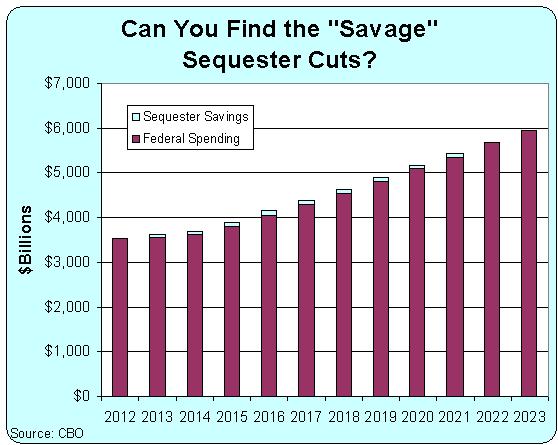
Part of that victory was already negotiated away as part of the Ryan-Murray budget deal, to be sure, but there are still remaining budget caps that limit how fast politicians can increase so-called discretionary spending.

According to the Congressional Research Service, budget authority for defense is allowed to rise from $552 billion in 2014 to $644 billion in 2021. And budget authority for domestic programs is allowed to climb from $506 billion to $590 billion over the same period.

I think that’s too much spending, but the interest groups, lobbyists, cronyists, politicians, bureaucrats, and other insiders in Washington would like much bigger increases. And you won’t be surprised to learn that the Obama Administration also wants to bust the spending caps.

This is why I’m very worried that some Republicans are undercutting their negotiating position by saying that there will be no government shutdowns.

Let me explain how these issues are connected. At some point next year, Republicans on Capitol Hill will be responsible for putting together spending bills for the following fiscal year. They presumably (or am I being too optimistic?) will put together budget bills that comply with the existing spending caps.

Obama will then say he will veto such legislation and demand that Republicans unilaterally surrender by enacting bigger spending increases and also gutting sequestration. The GOP will then have two options:

A) they can surrender.

B) they can continue to send the President spending bills that comply with the law.

But if they go with option B and the President uses his veto pen, then the government shuts down. And even though the shutdown only occurs because the President wants to renege on the deal he signed in 2011, Republicans are afraid they’ll get blamed.

The Washington Post reports on this fearful attitude, citing the anti-shutdown perspective of the incoming Senate Majority Leader.

A day after he won reelection and Republicans retook the Senate, Sen. Mitch McConnell (R-Ky.) left no doubt… “Let me make it clear: There will be no government shutdowns…,” McConnell said in a valedictory news conference in Louisville.

But that view irks some lawmakers who worry Obama will then have a blank check.

The first battle may revolve around immigration, but - as noted above - I’m more focused on fiscal fights.

But McConnell could be tripped up by the same conservative forces that have undercut Boehner since he became speaker in 2011. The issue this time is Obama’s expected executive action to overhaul the nation’s immigration system. …conservatives…have urged McConnell and Boehner to fight back by allowing only a short-term budget bill that would keep government agencies open until early next year. These conservatives believe that once Republicans hold both chambers of Congress next year, they can force Obama to accept a budget bill that would prohibit him from implementing his executive order on immigration.

At this point in the article, the reporter, Paul Kane, engages in some anti-factual editorializing.

…the days of brinkmanship could return with a vengeance, and the government could once again be shut down. That could provide a devastating blow to Republicans, hurting their chance to win back the White House and hold on to their relatively slim Senate majority in 2016.

Huh?!? Republicans just won a landslide, so why are we supposed to believe last year’s shutdown was “a devastating blow”?

Mr. Kane also refers to a shutdown later in the article as a “fiscal calamity” even though he shows no evidence (because there wasn’t any) that government shutdowns cause any damage.

But there is at least one person who is convinced by this narrative. And that person, Senator McConnell, is preemptively trying to convince other GOP Senators to give Obama the upper hand in any fiscal negotiations.

McConnell’s advisers are worried enough that by Friday evening they were circulating a memo showing how damaging last year’s shutdown was to the Republican Party — an effort designed to counter conservatives who point to this month’s triumphant election as proof that the shutdown did little damage. …The memo showed that in Gallup polling from late 2012 until this month, …Republicans held steady just a couple of points lower through 2012 and most of 2013 — until the 16-day shutdown of the federal government in October 2013. In just a few weeks, the McConnell chart shows, Republican favorability plummeted 10 points. It has taken a year for it to climb back to where it was before the shutdown.

But who cares about “favorability” ratings. The poll that should really matter to Republicans is the one that takes place on election day.

And that seemed to be good news for the GOP.

Here’s some of what I wrote in my post about lessons that could be learned from the 2014 elections.

Back in 2011, I explained that Republicans could play hard ball, largely based on what really happened during the 1995 government shutdown. And in 2013, I again defended a shutdown, pointing out that voters probably wouldn’t even notice that some government offices were closed, but they would remember that the GOP was branding itself as the anti-Obamacare party. The establishment, by contrast, thought the shutdown was a disaster for Republicans. …many…Republicans felt the same way, excoriating Senator Cruz and others who wanted a line-in-the-sand fight over government-run healthcare. The moral of the story isn’t that shutdowns necessarily are politically desirable, but rather that it’s very important for a political party to find visible ways of linking itself to popular causes (such as ending Obamacare, fighting big government, etc).

At least one person agrees with me. Jeffrey Lord, writing for the American Spectator, points out the GOP establishment was wrong about the political impact of the 2013 government shutdown.

The whole event was giving prominent Republicans in and out of office the political willies. …Republican senators, congressmen, governors, ex-office holders, potential presidential candidates, lobbyists and pundits…were spreading the word. That word? …it was some version of curtains for the GOP. The party would be toast. …they all got it wrong. Not just wrong, but Big Time Wrong. A week ago the Republican Party — barely a year away from the government shut down these folks were bewailing in various terms as bad strategy that “will lose more” for Republicans than Democrats — won a blowout election. …Will Republicans learn anything here?Do you think Mitch McConnell makes the connection between the government shutdown of 2013 and the fact that he is about to become Senate Majority Leader?

To be fair, we don’t know what would have happened if there wasn’t a shutdown in 2013, so maybe the GOP still would have taken the Senate.

But there’s also no doubt that the GOP benefited by having a big public fight about Obamacare. Voters didn’t remember the shutdown, but they did remember that Republicans were against the President’s government-run healthcare scheme and they remembered that Democrats were for it.

I have no idea whether that made a difference in one Senate race of six Senate races, but Obamacare clearly was an albatross for Democrats.

In closing, I want to point out that there are limits to a shutdown strategy.

Picking a fight (or, more accurately, refusing to surrender to Obama) in 2015 is almost surely a winning strategy. But having the same fight in October of 2016 probably wouldn’t be very smart, particularly since the establishment press would do everything possible to spin the fight in ways that advance Hillary Clinton (or some other left-leaning presidential nominee).

In other words, context matters. Pick the right fight.

But the bottom line is that Republicans - assuming they don’t intend to acquiesce on every single issue - must be prepared to let Obama veto spending bills and shut down the government.

Returning to the American Spectator story, Ted Cruz may not be very popular with some of his colleagues, but I think he made an unassailable point about what happens if the GOP unilaterally disarms.

Cruz…asked them for their alternative. Cruz paused, then said that the response he got was “the sound of crickets chirping.”

P.S. One reason why Republicans are skittish about shutdowns is that they think they last the 1995 fight with Bill Clinton. But if you lived through that battle (or if you look at contemporaneous news reports), it’s clear the Republicans had the upper hand.

P.P.S. Here are the five lessons I shared immediately after the 2013 shutdown fight.

P.P.P.S. If you want to enjoy some shutdown humor, click hereherehere, and here. And if you prefer sequester cartoons, click here, here, here, here, here, and (my favorite) here.

21 Nov 14:52

James Grant on The Forgotten Depression

by Don Boudreaux
(Don Boudreaux)

At lunchtime on Tuesday, Jim Grant will speak at the Cato Institute headquarters about his new book, The Forgotten Depression.  If you’re in the DC metro area, do consider attending.  I’ll be there.  Here’s the announcement:

Featuring the author James Grant, Publisher, Grant’s Interest Rate Observer; with comments by Jim Powell, Senior Fellow, Cato Institute; and Lawrence H. White, Professor of Economics, George Mason University, and Senior Fellow, Cato Institute; moderated by George Selgin, Director, Center for Monetary and Financial Alternatives, Cato Institute.

What happens if you throw a depression and nobody from the government shows up? No Quantitative Easers or fiscal stimulators or financial-firm rescuers? And what would happen if, instead of lowering interest rates and spending more to spur recovery, the government did nothing? The answer, in 1921 at least, is that the economy not only recovers but is “roaring” in less than two years. Was “The Crash that Cured Itself,” as the subtitle of James Grant’s fascinating new book refers to it, a fluke, or does it offer useful lessons for today’s erstwhile depression fighters?Join us to hear James Grant, Jim Powell, and Lawrence H. White discuss this and other important questions raised by Grant’s stimulating new book.

If you can’t make it to the Cato Institute, watch this event live online at www.cato.org/live and follow @CatoEvents on Twitter to get future event updates, live streams, and videos from the Cato Institute.

21 Nov 14:48

Quotation of the Day…

by Don Boudreaux
(Don Boudreaux)

… is from pages 428 of H.L. Mencken’s indispensable 1949 collection, A Mencken Chrestomathy; specifically, it’s the final paragraph of Mencken’s spectacularly good May 27, 1935, essay in the Baltimore Evening Sun entitled “The New Deal”:

Of such sort are the young wizards who now sweat to save the plain people from the degradations of capitalism, which is to say, from the degradations of working hard, saving their money, and paying their way.  This is what the New Deal and its Planned Economy come to in practice – a series of furious and irrational raids upon the taxpayer, planned casually by professional do-gooders lolling in smoking cars, and executed by professional politicians bent only upon building up an irresistible machine.  This is the Führer’s inspired substitute for constitutional government and common sense.

20 Nov 19:15

Environmentalists Break the Establishment Clause

by admin

Skeptics like myself often see parallels between environmentalism (as practiced by many people) and religion.  Now, they are going one step further to actually establish a state church:

Maryland Gov. Martin O’Malley made national news last year when he fought to pass and signed a tax bill that levied a tax on Marylanders, businesses and churches for the amount of “impervious surface” they have on their property.

Though the O’Malley administration calls it a “fee,” it is commonly called the “rain tax” throughout the state. It is wildly unpopular and the promise to fight to repeal the tax was a large factor in Maryland electing Republican Larry Hogan governor this month.

Now Prince George’s County is offering a way for churches to avoid paying the tax, which is estimated to be an average of $744 per year for them — preach “green” to their parishioners.

So far 30 pastors have agreed to begin “‘green’ ministries to maintain the improvements at their churches, and to preach environmentally focused sermons to educate their congregations” to avoid being hit with the tax, The Washington Post reports.

20 Nov 17:56

Uber Gets the Buzzfeed Treatment

Recently a dipshit editor named Ben Smith over at Buzzfeed ambushed Uber executive Emil Michael by taking out of context something Michael said at a private dinner and publishing it under a misleading headline.

It was such a clever ambush that Emil Michael couldn't hope to explain himself without inflaming things further. So he wisely issued a half-assed non-apology-sort-of-apology to make it all go away.

But he's stained. That stuff lives forever on the Internet. It was a total hit job and Buzzfeed pulled it off. As Buzzfeed's own article explains, they have a grudge with Uber over some privacy issues. I assume this was either payback or a . . . coincidence?

If only there was some independent observer of this outrage who once cared what the public thought of him but no longer does. Perhaps that person could say some of the things that I imagine Emil Michael wants to say but can't. And what if that independent observer woke up in a bad mood? How fun might that be?

Well, it's your lucky day.

Let's start with Buzzfeed's totally manipulative and misleading headline:

Uber Executive Suggests Digging Up Dirt On Journalists

Holy shit! Uber must be evil! They are trying to suppress freedom of the media!

Except. . . that isn't what happened, according to Buzzfeed's own reporting in the article with the misleading headline.

Michael didn't "suggest" doing anything. Nor did he - then or now - even want to dig up dirt on journalists. Assuming Buzzfeed's reporting of the details is accurate, all he did was make a dinner party intellectual comparison between the evil of the media that was unfairly attacking them (which I assume is true) and their own civilized response to the attacks.

Michael's point, as Buzzfeed reports it, was that horrible people in the media mislead readers and there is nothing a victim can do about it within the realm of reasonable business practices. The Buzzfeed business model is totally legal. But, as Michael explained, probably over a cocktail, the only legal solution to this problem would be to use freedom of the press to push back on the bad actors by giving them a taste of their own medicine.

But it was just private cocktail talk. It wasn't a plan. It definitely wasn't a "suggestion." It was just an interesting way to make a point. The point, as I understand it from Buzzfeed's own reporting, is that Uber DOES play fair in a fight in which the opponents (bad actors in the press) do not. I find that interesting. It is also literally the opposite of what the headline of the story "suggests" happened.

And Michael made his point in a room full of writers/media people. Obviously it wasn't a plan.

It's not as if Michael was talking about manipulating the Wall Street Journal or the New York Times. Those publications might get some facts wrong now and then, but they don't have a business model that involves intentionally taking things out of context to manufacture news. No one suggested trying to strong-arm the legitimate media. Michael was talking about the bottom-feeder types that literally manufacture news, hurt innocent people, damage the reputation of companies, and hide behind the Constitution and freedom of speech. You can't compare the bad actors in the press with the legitimate press. And in my opinion it makes interesting dinner conversation to speculate how one can stop the bad actors without breaking any laws.

And then Buzzfeed proved Michael's point by taking his words out of context and showing that Michael could do nothing about it but apologize for . . . Buzzfeed's misleading description of what he said.

That's called "news."

[Update: A commenter points out that this ugly situation is even uglier than I thought. An executive at Buzzfeed is in investor in Uber's competition. See this take on it.]

Disclaimer and biases
: I don't own any Uber stock. I had lunch with the founder once.

------------------------------------------------------
Scott Adams
Co-founder of CalendarTree.com     
Author of this book 

Twitter Dilbert: @Dilbert_Daily

Twitter for Scott: @ScottAdamsSays


20 Nov 14:02

Tennessee Drug Interdiction Officers Stomp All Over Traveling Couples' Rights En Route To Seizing Nothing At All

by Tim Cushing
More asset forfeiture to report on, albeit of the rarely-reported "attempted robbery forfeiture" variety. (via Overlawyered)

A couple (Lisa and Ronnie Hankins) traveling through Tennessee on their way home (to California) from a funeral was stopped by Tennessee drug interdiction agents as they traveled west on I-40 out of Nashville. What followed was a long fishing expedition, during which officers separated husband and wife in hopes of getting permission to search their vehicle without a warrant.
"You say there's not anything illegal in it. Do you mind if I search it today to make sure?" the officer asked.

Lisa responded, "I'd have to talk to my husband."

[...]

The agent continued, "I am asking you for permission to search your vehicle today -- and you are well within your rights to say no and you can say yes. It's totally up to you as to whether you want to show cooperation or not."

[...]

"You have to either give me a yes or no," he continued. "I do need an answer so I can figure out whether I need a dog to go around it or not."
Because the agent was unable to obtain consent from the couple, he decided to ask a dog. A drug-sniffing dog was brought in to examine the vehicle and, go figure, it alerted near the driver's side window (after ignoring the open passenger's side window). Finally having obtained "permission" for a warrantless search, the two agents went to work. An hour later -- and having disassembled the dashboard of the couple's new car -- they were unable to recover anything incriminating. But hey, no one's rights were violated because the drug dog told officers the car contained drugs, even though it didn't.

It also didn't contain any cash, which one agent told the Ronnie Hankins was far more likely to be hidden somewhere in the vehicle.
[W]hen Ronnie insisted there were no drugs, the agent confided he wasn't really expecting any.

"Well, I'll be honest with you, with you going this direction, I wouldn't think you'd have drugs in the car -- you would have a large amount of money," he said.
Apparently, drug interdiction agents are far less interested in stopping the flow of drugs than they are in intercepting outgoing cash. Otherwise, as Nashville's News 5 (which has been investigating the state's out-of-control asset forfeiture program for years) points out, it wouldn't be performing a majority of its stops on roads leading out of the state.
While drugs generally come from Mexico on the eastbound side of Interstate 40 and the drug money goes back on the westbound side, the investigation discovered police making 10 times as many stops on the so-called "money side."
The frustrated officers finally let the Hankins go, but not before making a last-ditch effort to redeem their futile efforts. The police report claims the interdiction agents found "marijuana debris" or "shake" on the floorboards of the vehicle. The Hankins claim the only thing on the floorboards was grass from the cemetery where Ronnie Hankins' grandfather was buried. Whether it was "grass" or grass, neither of the Hankins were charged or cited.

Tennessee's asset forfeiture laws are far worse than those in many states. 100% of the proceeds of any seizures go to the department that performed it. Legislative attempts to overhaul these laws have been mostly fruitless. A bill introduced in early 2013 aimed to eliminate this abuse by making seizures contingent on convictions. By the time the House and Senate had amended the bill, the only net gain was the prohibition of ex parte hearings. If Tennesee interdiction officers seize your money or other property, they now (the law went into effect at the beginning of this year) have to give you a date when you can show up and defend "forfeited" property from the accusations of law enforcement -- something of limited utility considering these officers tend to prey on drivers with out-of-state plates. Depending on what has been seized, it may be cheaper to allow the state to claim its ill-gotten goods rather than spending even more money to participate in a largely ceremonial process that often results in the state paying out only pennies on the dollar.

Permalink | Comments | Email This Story


14 Nov 14:26

And The Nation That Increased Prosperity The Most In The Last 5 Years Is...

by Tyler Durden

...Rwanda.


And the biggest collapse in prosperity since 2009 has occurred in Greece - stunningly outpacing war torn, sanctioned Syria to the downside.


Source: Prosperity.com

11 Nov 17:48

Indian women die, dozens critical after mass sterilization...


Indian women die, dozens critical after mass sterilization...


(Second column, 26th story, link)

11 Nov 17:38

ISIS Going Back To The "Gold Standard"

by Tyler Durden

It appears the terrorist organization known as Islamic State has been watching the fiasco of fiat money and reading Alan Greenspan and Ron Paul. As The Daily Mail reports, ISIS wants to introduce its own currency and plans to bring back solid gold and silver dinar coins in an attempt to solidify its makeshift caliphate. Around 1500 years after the Dinar was first introduced - made from pure gold and silver - ISIS plans to implement the change within a few weeks, changing changing from regular dinars and Lira to golden dinars and silver dirhams.


As The Daily Mail reports,

ISIS wants to introduce its own currency and plans to bring back solid gold and silver dinar coins, it has emerged.


The Middle East terror group apparently wants to introduce its own Islamic currency as part of its attempts to solidify its makeshift caliphate.


Militants are said to want to bring back the original dinar, which is an ancient currency from early Islam, and religious figures in Mosul and Iraq’s Nineveh province have apparently announced its return in mosques.


The currency known as the dinar, which once consisted purely of gold and silver coins, is today used by a variety of countries, but the coins are created from different materials to the originals.


However, the jihadi group is understood to be planning to return to the original gold and silver coins, which were first introduced during the Caliphate of Uthman in 634 CE.


...


While ISIS has yet to confirm the introduction of its currency, social media is awash with claims that leading religious figures announced the plans during recent prayers in Mosul and Nineveh province.


It is believed the terror outfit wants to use the independent currency in areas it controls as part of its war on the West.


The currency, which could be introduced within the next few weeks, will involve changing from regular dinars and Lira to golden dinars and silver dirhams.

*  *  *


It seems Alan Greenspan may have been on to something after all...

"Remember what we're looking at. Gold is a currency. It is still, by all evidence, a premier currency. No fiat currency, including the dollar, can match it."

*  *  *

Of course this will mean more physical demand - along with Russia and China - and so more price suppression by the West.

11 Nov 16:01

Drug Task Force in Rural Missouri Denies Own Existence

by Aaron Malin

Missouri's multi-jurisdictional drug task forces embody the very worst of the war on drugs. They're misguided, reckless, and they operate with basically no oversight. The state currently has 25 of these task forces, and over the past year I've succeeded in obtaining basic operational records from all but one of them as part of routine research using Missouri's Sunshine Law. The Northwest Missouri Interagency Team Response Operation (NITRO) has gone to extreme lengths to avoid disclosing any information about their operations.

Like all of the drug task forces in Missouri, NITRO receives funding through the state's Department of Public Safety, which in turn makes them legally subject to the Missouri Sunshine Law.

They disagree, and seem to feel they have the right to maintain absolute secrecy over every aspect of their task force. When I called NITRO's listed number to file a basic open records request, they outright lied to me and claimed to be someone else [listen to the recording here]:

 AARON MALIN: Hi, is this Eric McAllester?

NITRO OFFICER: No.

AARON MALIN: Is this the NITRO Drug Task Force?

NITRO OFFICER: ...Who is this?

AARON MALIN: My name is Aaron Malin.

NITRO OFFICER: Uh...who are you with?

AARON MALIN: I'm not with anybody. I was trying to call a listed number for the NITRO Drug Task Force.

NITRO OFFICER: Uh...nope, this isn't it...[chuckles]

AARON MALIN: Is this the sheriff's department, or...?

NITRO OFFICER: No, no no, this is just a...its a government building, but...

AARON MALIN: Okay...um...do you mind my asking which one?

NITRO OFFICER: Uh....this is- this is a government building...uh...who...who is this again?

AARON MALIN: Aaron Malin

NITRO OFFICER: Who do you need to speak with, Eric McAllester?

AARON MALIN: Eric McAllester, or somebody with the NITRO Drug Task Force. You really won't tell me what building you're in?

NITRO OFFICER: Well who are you wi-?

AARON MALIN: I'm not with anybody. I'm just trying-  I am an individual citizen trying to file an open records request.

NITRO OFFICER: Ok, well you're going to have to contact the Bureau of Alcohol Tobacco Firearms and Explosives Public Information Officer.

AARON MALIN: This is- man, this is literally the number they gave me to call. This exact number.

NITRO OFFICER: Well, I'm going to have to forward that request to that individual. I can give you the phone number and the person to contact.

AARON MALIN: That would be great, but can you tell me who I am talking to please, so I can tell them who forwarded me?

NITRO OFFICER: Uh...this is...this is...this is the task force...

The NITRO Task Force blatantly lies to folks who call their listed number and attempt to file open records request. This troubling lack of transparency is almost certainly a violation of Missouri's Sunshine Law, as it becomes impossible to file a request when NITRO pretends your calls (to a number listed on the Missouri State Highway Patrol website) are to the wrong number.

After my call with NITRO, I immediately double-checked the phone number. Upon confirming that I had indeed called the listed number for the NITRO Task Force, I gave them a call back, at which point they claimed to be exempt from state open records laws [listen to the recording here]:

NITRO OFFICER #2: We got your request, and we forwarded it on to the ATF office per our policy, and that's what was happenin'.

AARON MALIN: Are you not a state agency? Are you not under the highway patrol?

NITRO OFFICER #2: No. No...no. [chuckles].

AARON MALIN: Because they list you on their website.

NITRO OFFICER #2: Well I'm sorry. We're not- we don't have nothin' to do with the highway patrol.

AARON MALIN: Ok so, I'm just trying to get a little bit of background on -- on what exactly -- on who exactly oversees NITRO, I guess.

AARON MALIN: Is it [NITRO] -- it's not a state agency?

NITRO OFFICER #2: No, it is not a state agency.

AARON MALIN: It's not a federal agency?

NITRO OFFICER #2: No, its not a federal agency either. We are a task force, that its basically under ATF I guess I would say. We are under them. We go under their guidelines. We go by their policies. We're all commissioned federally. So we basically work for ATF, even though we're not paid by them.

AARON MALIN: Ok. So who pays you then? The state?

NITRO OFFICER #2: It's a grant situation.

He's right- it is a grant situation. The narcotics grants come from the Missouri Department of Public Safety (DPS). The federal government does provide some additional funding for these state task force grants to DPS, but a Missouri department directly controls task force funding. 

Because they are funded through the state, specifically through the Missouri Department of Public Safety, agencies like the NITRO Task Force are subject to Missouri's Sunshine Law, despite their claims to the contrary.

Missouri's Sunshine Law [RSMo 610.010] is very clear on the matter.

NITRO has a solution to that pesky Sunshine Law: They claim to be exempt from state laws because they are actually a federal agency. (This sounds a lot like a recent case in Florida where US Marshalls claimed local police records belonged to the feds to exempt them from state open records laws, except more specious.)

Given my firm belief that NITRO is required to comply with Missouri's open records law, I next contacted the Sunshine Complaint Unit within the Office of the Attorney General of Missouri. They recommended trying to file the request with the listed Project Director of NITRO, who is listed as the Grundy County sheriff. Upon doing so, the sheriff's office claimed they were unable to access the basic records I requested about the finances and operation of NITRO, and maintained ATF is responsible for maintaining the task force's records.

Despite my firm belief that the NITRO Task Force is required to respond to Sunshine Law requests, I did submit two FOIA requests through ATF, the first on April 30th, 2014 and another on June 21st, 2014 after being repeatedly told they would not comply with the Sunshine Law. Both were ignored, and a year after my research began, I have not received a single document from NITRO; they continue to operate in the dark. [The documents of interest are the disproportionately high number of search warrants NITRO is denied each year.]

Given NITRO's claim they are overseen by the ATF, I reached out to the Public Information Officer, John Ham, in the nearby Kansas City ATF Office. I gave him advance notice of my findings, along with an opportunity to comment. He too was apparently unable to get a straight answer from the NITRO Task Force (I wonder whom they pretended to be when he called). After attempting contact for two full business days, he was unable to provide me with comment because he was "still attempting to gather information relevant to [my] research." I emailed him six weeks later (and left multiple voicemails) to see what kind of progress he had made in obtaining information about NITRO, and I never heard from him again. If ATF can't even get a straight answer out of NITRO, what hope do the rest of us have? 

The lack of transparency displayed by the NITRO Task Force is shocking and disturbing. This is an organization that is empowered to execute no-knock search warrants and make arrests. This agency possesses broad powers and seems to operate with little to no transparency or accountability, and that makes for a dangerous combination.

10 Nov 21:26

It's So Easy to Steal Stuff With Civil Forfeiture That Cops Are Getting Picky

by Jacob Sullum

The New York Times listens in on recordings of civil forfeiture seminars and discovers that cops like to take people's stuff, especially if it's really nice:

In one seminar, captured on video in September, Harry S. Connelly Jr., the city attorney of Las Cruces, N.M., called [seizable assets] "little goodies." And then Mr. Connelly described how officers in his jurisdiction could not wait to seize one man's "exotic vehicle" outside a local bar.

"A guy drives up in a 2008 Mercedes, brand new," he explained. "Just so beautiful, I mean, the cops were undercover, and they were just like 'Ahhhh.' And he gets out, and he's just reeking of alcohol. And it's like, 'Oh, my goodness, we can hardly wait.'"

As that case illustrates, civil forfeiture—which allows police to take property allegedly linked to a crime without going to the trouble of charging, let alone convicting, the owner—is not just for drug offenses anymore. It also can be used to grab cars and other assets that police say are connected to offenses such as drunk driving, shoplifting, solicitation of prostitutes, and statutory rape. The opportunities for such legal theft are so numerous, in fact, that cops are getting picky:

The seminars offered police officers some useful tips on seizing property from suspected criminals. Don’t bother with jewelry (too hard to dispose of) and computers ("everybody’s got one already"), the experts counseled. Do go after flat screen TVs, cash and cars. Especially nice cars....

In New Jersey, the police and prosecutors are allowed to use cars, cash and other seized goods; the rest must be sold at auction. Cellphones and jewelry, [a New Jersey prosecutor] said, are not worth the bother. Flat screen televisions, however, "are very popular with the police departments," he said.

The Times notes that grabbing cars can result in "widely varied penalties," since "one drunken driver could lose a $100,000 luxury car, while another forfeits a $2,000 clunker." But under civil forfeiture law, losing your car, cash, boat, or house does not count as a penalty, which is why your guilt need not be proven (or even alleged). In fact, "prosecutors estimated that between 50 to 80 percent of the cars seized were driven by someone other than the owner." It's the property that stands accused, not the owner.

07 Nov 16:49

Why Matt Taibbi Thinks This Woman Is JPMorgan's "Worst Nightmare"

by Tyler Durden

In reality, there is nothing surprising in Matt Taibbi's latest piece since returning to Rolling Stone from the Intercept, as it tells a story everyone is by now is all too familiar with: a former bank employee (in this case Alayne Fleischmann) who was a worker in a bank's (in this case JPM) mortgage operations group, where she observed and engaged in what she describes as "massive criminal securities fraud" and who was fired after trying to bring the attention of those above her to said "criminal" activity.

The story doesn't end there, and as Carmen Segarra already showed, when she revealed that Goldman runs the NY Fed, once Alayne was let go and tried to "whistleblow" on the house of Jimon from the outside, she found the that US Department of Justice headed by Eric Holder is just as, if not more, corrupt, and in his desperate attempt to prevent discovery and bring JPM et al to justice, he would stretch the statue of limitations on frauds committed during the crisis long enough to where nobody had any legal recourse any more, up to and including the US taxpayer.

That is the 1 minute recap of yet another story in which the good guys lose, the bad guys bet everything on red, are bailed out when black hits, lie, never go to jail and instead use the same bailout funds to keep paying "settlement charges" to bribed government officials and avoid prison time. In short, the bad guys win.

And all with the help of every branch of the US government.

For those who want to read more, Taibbi's "The $9 Billion Witness: Meet JPMorgan Chase's Worst Nightmare" is a must read, even if, as noted, it says nothing that frequent Zero Hedge readers didn't already know. It does, however, have some great cartoons.

Taibbi's punchline:

... In September, at a speech at NYU, Holder defended the lack of prosecutions of top executives on the grounds that, in the corporate context, sometimes bad things just happen without actual people being responsible. "Responsibility remains so diffuse, and top executives so insulated," Holder said, "that any misconduct could again be considered more a symptom of the institution's culture than a result of the willful actions of any single individual."


In other words, people don't commit crimes, corporate culture commits crimes! It's probably fortunate that Holder is quitting before he has time to apply the same logic to Mafia or terrorism cases.


Fleischmann, for her part, had begun to find the whole situation almost funny.


"I thought, 'I swear, Eric Holder is gas-lighting me,' " she says.


Ask her where the crime was, and Fleischmann will point out exactly how her bosses at JPMorgan Chase committed criminal fraud: It's right there in the documents; just hand her a highlighter and some Post-it notes – "We lawyers love flags" – and you will not find a more enthusiastic tour guide through a gazillion-page prospectus than Alayne Fleischmann.


She believes the proof is easily there for all the elements of the crime as defined by federal law – the bank made material misrepresentations, it made material omissions, and it did so willfully and with specific intent, consciously ignoring warnings from inside the firm and out.


She'd like to see something done about it, emphasizing that there still is time. The statute of limitations for wire fraud, for instance, has not run out, and she strongly believes there's a case there, against the bank's executives. She has no financial interest in any of this, no motive other than wanting the truth out. But more than anything, she wants it to be over.


In today's America, someone like Fleischmann – an honest person caught for a little while in the wrong place at the wrong time – has to be willing to live through an epic ordeal just to get to the point of being able to open her mouth and tell a truth or two. And when she finally gets there, she still has to risk everything to take that last step. "The assumption they make is that I won't blow up my life to do it," Fleischmann says. "But they're wrong about that."


Good for her, and great for her that it's finally out. But the big-picture ending still stings. She hopes otherwise, but the likely final verdict is a Pyrrhic victory.


Because after all this activity, all these court actions, all these penalties (both real and abortive), even after a fair amount of noise in the press, the target companies remain more ascendant than ever. The people who stole all those billions are still in place. And the bank is more untouchable than ever – former Debevoise & Plimpton hotshots Mary Jo White and Andrew Ceresny, who represented Chase for some of this case, have since been named to the two top jobs at the SEC. As for the bank itself, its stock price has gone up since the settlement and flirts weekly with five-year highs. They may lose the odd battle, but the markets clearly believe the banks won the war. Truth is one thing, and if the right people fight hard enough, you might get to hear it from time to time. But justice is different, and still far enough away.

And the real punchline: nobody cares aobut justice as long as everyone is getting richer, if only on paper. It is what this nominal paper "wealth" disappears that things get scary for the Jamie Dimon's of the world, which is why the Fed will do everything to avert each and every market crash from now on until it finally loses control, because once people awake from the siren song of the printer, to realize they have nothing to show for years of labor and faith in a broken system, not to mention "Corzined" retirement funds that were invested in a Ponzi scheme, the only justice applicable, will be that of vigilantes.

07 Nov 16:45

A Decade Long Journey: How Primal Living Healed My Crohn’s Disease

by Guest

It’s Friday, everyone! And that means another Primal Blueprint Real Life Story from a Mark’s Daily Apple reader. If you have your own success story and would like to share it with me and the Mark’s Daily Apple community please contact me here. I’ll continue to publish these each Friday as long as they keep coming in. Thank you for reading!

real life stories stories 1 22Thank you so much for being a leader to a better way of life, an example to people like myself, and a genuine life changer. To understand where my gratitude comes from, I have to tell you my story, which began over 10 years ago.

I have Crohn’s Disease, but for the first fifteen years of my life, I had no idea I had it. What I did have was an aching feeling that there was a reason why I had brutal stomachaches nearly every day, why I could eat tons of junk food but never put on weight, and why everything became so much worse when I was stressed. I lived for years without answers, but at fifteen I was finally diagnosed and began a life dependent on medication. My treatment gave me slight relief for a the rest of high school, but every time I experienced stress, my symptoms would rear back up, causing me to leave class and miss important experiences.

The first time Crohn’s sent me to the ER, I was a freshman in college. In rehearsals for my first college play, I began to feel a pain in my abdomen that wouldn’t go away, unlike the cramping that I was used to. After three days in the hospital and receiving heavy doses of antibiotics and steroids, the episode resolved itself. And although I was incredibly weakened by three days of a liquid-only diet, I was still able to perform and return to school, much to my relief.

Little did I know, this episode was only the beginning of my struggle with my health—a struggle that would affect everything in my life. Sure, I had trouble putting on weight and I had the usual array of Crohn’s symptoms, but the real fight was between my disease and my dreams. I constantly wondered, “How am I going to pursue what I’m passionate about? Is Crohn’s really going to dictate how I live and what I can accomplish?”

For the next year or two, I carried on with the same medication (though the dosage sadly increased each year and after each doctor’s visit)…until my last semester of college.

Around New Year’s I began to feel a constant throbbing near my pelvis. My appetite decreased because of it, and I began to lose weight that I couldn’t afford to lose. I was prescribed a new medicine in addition to my original one in order to deal with the apparent inflammation, but it wasn’t enough to take away the crushing pain. For this, I was prescribed hydrocodone, which allowed my exhausted body to slip away into relief for four blissful hours at a time. I also saw a nutritionist, who in classic conventional wisdom, advised me to drink weight-gain “nutritional” supplements like Boost. Only after did I learn (from Mark’s site and books) how much worse this made things. So I dutifully drank them every day. Doped up on hydrocodone, I dealt with the pressures of finishing college, but my hope of graduating magna cum laude was destroyed.

anne marieThis is me at my college graduation. I was down to pounds and still taking Hydrocodone every four hours to deal with my Crohn’s pain.

In the middle of all of that, my dad was diagnosed with a terminal cancer and given only a couple of months to live. I felt like the world was conspiring against me. I lived in a constant state of pain and depression, and when I should have been there to give comfort to my father, I was only a shadow of myself—frail, broken, and unsure of how to be strong for him.

Two months after my graduation, on the day of my dad’s wake, I went for a check-up with my original gastroenterologist who had just received new blood work results. All that time that I had been quietly suffering—going from an already light 105 pounds to a concerning 73 (I should mention that I’m 5’8”)—it felt like no one understood how sick I was, or how much pain I was feeling all the time. Finally, I had concrete evidence. My inflammation markers, which in a healthy person should have been under 10, were at 97.

My doctor told me there was one last drug he wanted to prescribe, and if it didn’t work the next step would be surgery to remove the damaged part of my gut. He prescribed a powerful immune-suppressor called Humira. The syringes had to be overnighted on ice so I had to plan to be home to receive them every two weeks. I spent six months gaining back some of my strength and weight, and slowly coming to terms with what I wanted to do with my life. My dream of acting professionally had become a faint memory, but I knew I had to go for it while my health was on the upswing. I set a date to move to Los Angeles, just hoping that Humira would keep me ‘healthy’ long enough to give it a decent shot. But as with any drug of that strength, its side effects were equally as potent, including terrible eczema, dermatitis, hair loss, and infections; all awesome things for an actor just starting out. Those side effects waxed and waned every week, but I was still fortunate enough to book a role on an NBC show called Siberia. For any other actor this would have been the day they dreamt about their whole life: filming their first series regular role. For me it was a quick drop from extreme excitement to extreme worry. The show was going to film in Canada, and I had no idea how I was going to get my medicine across the border or what I would do if I ran out since it could not be shipped internationally. It seemed like no matter what I did my disease would always be pulling me down.

In the end, by jumping through a lot of TSA hoops, I was able to bring my Humira to Canada and film my television debut. And around the same time, my college sweetheart (and long distance boyfriend) proposed to me. So, while filming full days in negative 10 degree weather in Winnipeg, I was also planning a wedding in Louisiana set for a mere two days after my role wrapped. Needless to say, it was the perfect storm for stress, and one week after my honeymoon I was back in the ER with an inflamed and blocked intestine.

During our engagement, my husband heard Mark give an interview on a podcast that convinced him to buy The Primal Blueprint. He had changed his whole lifestyle after reading it, and when I was finally discharged from the hospital, I went completely Primal. It wasn’t an easy process. The eczema and psoriasis seemed to intensify at first, but I was vigilant and kept following the Primal guidelines. About six months later, when a paperwork mix-up on the part of my insurance lead to my Humira shipment being delayed, I was sure a flare was right around the corner. But that temporary delay turned into a week without my injection, then a month, and now a year.

anne marie afterThis is me now, after filming a scene for an independent film. I’m off all my medicines, feeling amazing and back to 110 pounds!

That’s right. It has been an entire year since I’ve been on medication of any kind! This is not only my letter to Mark and everyone at Mark’s Daily Apple, but also to myself. I am no longer beholden to a pill or a syringe. I am not controlled by my disease, and my body is happy and healthy for the first time in my life (every single Humira side effect has vanished).

I realize now that my career and my dreams don’t have to be put on pause due to my Crohn’s and for the first time my health isn’t fighting against my hope for a fulfilled life. And it feels amazing. No one should have to go through everything that I went through when the solution is possibly so simple. What you put into your body, affects your body. When the math is so clear-cut, how does anyone not treat themselves better? I want so much for my story to give hope to those who feel like they’re living in the dark, with no options left. Because there is a better way to live. Thank you for helping me see it.

Anne-Marie

pbcert video 540x701
06 Nov 22:27

Jupiter 'shepherds' the asteroid belt, preventing the asteroids from falling into the sun or accreting into a new planet.

06 Nov 20:09

Apocalypse Now! Climate Change "Deniers" Take Over Congress!

by Ronald Bailey

Climate Change DenialOver at RealClearScience, Alex Berezow has a nice take-down of progressive hand-wringing over the 2014 mid-term electoral ascent of Republican climate change "deniers" in the Senate. Exhibit one is Bad Astronomer Phil Plait. Berezow explains:

In Plait's words, the Republicans will "put a cohort of science-deniers [sic] into positions of authority," which "quite literally affects the future of humanity." Why? Because, now, the United States will no longer be able to address climate change, "the single greatest threat we as a species face today."

Well, maybe. But Berezow makes the salient point that when the Senate was chock-a-block with supposedly Democratic "science-affirmers" they did nothing about the "single greatest threat" either:

In the 111th Congress, the Democrats had a 60-seat, filibuster-proof majority in the Senate, and a large majority in the House. If the Democrats really wanted to do it, they could have passed climate change legislation. But, they did not. Instead, they did absolutely nothing. The House passed a cap-and-trade bill, 219-212, which then died in the Senate. Harry Reid, the Democratic Majority Leader, did not even call a vote on the bill.

Why is Phil Plait blaming Republicans, but not Democrats? Well, you can answer that question.

Yes we can.

The whole Berezow column is worth your attention.

Disclosure: I am happy to say that RealClearScience occasionally republishes some of my reporting.

05 Nov 15:40

IRS threatens 'miserable' tax season...

Jts5665

In other words: "give me your money or else..."

05 Nov 14:18

Free Staters Win 'At Least' 15 Seats in NH State House; Libertarian Leaners Win Many More

by J.D. Tuccille

Yesterday, I wrote that many libertarian-leaning candidates seemed well on their way to seats in New Hampshire's legislature. Well, it looks like a good number of them arrived safely. According to Ian Freeman at Free Keene, at least 15 explicit Free Staters—a record number—will be ushered in as lawmakers in the 424-seat body. Many more candidates from both major parties endorsed by the libertarian-friendly New Hampshire Liberty Alliance will also take seats.

Writes Freeman:

According to a handy list compiled by “Free State Project Watch“, a project by pro-state group “Granite State Progress“, at least 15 people they alleged to be Free State Project participants have won the 2014 general election!!!

This is huge news. The previous counts of Free Staters in the state house were 12 in 2010, 11 in 2012, and now at least 15! It’s impressive that so many have won elected office already and the official move for the Free State Project has yet to even happen. (The FSP move doesn’t officially start until we reach 20,000 participants and we’re currently over 16,000.)

It's interesting that Freeman relies on a list compiled by opponents of the Free State Project, but it's true that busybodies can be annoyingly well-organized—and people are often more strongly driven to number their enemies than count their friends.

Freeman adds, "the majority of New Hampshire Liberty Alliance-endorsed candidates won tonight as well!  (NHLA-endorsed candidates vote for liberty more often than not – they aren’t necessarily principled libertarians.)"

About the latter group, Dick Desrosiers, Chairman of the Hampton Democratic Committee, complained last month that they dominate the New Hampshire legislature and "introduce and pass legislation to remove any and all government impacts on liberty and property rights and diminished the importance of protecting and promoting the common good."

What better endorsement could you ask?

05 Nov 03:02

America's Rising Crime Problem: Feeding the Homeless; 90-Year-Old Criminal Arrested for It

by Brian Doherty

Whenever a criminal is daring to feed the homeless, America's finest are on it. The latest, out of Ft. Lauderdale, Florida, involved collaring a 90-year-old menace to society, as told by TV station KHON-2:

On Sunday, the city charged three people, including two ministers and a 90-year-old homeless advocate, and they could face up to 60-days in jail for their so-called crime.

“I fully believe that I am my brother’s keeper. Love they neighbor as thy self,” explained Arnold Abbott.

90-year-old Abbott prepares hundreds of meals each week for the homeless in the kitchen of the Sanctuary Church....

He faces possible jail time and a $500 fine for feeding the homeless after he was charged Sunday with violating a new ordinance that virtually outlaws groups from sharing food with the hungry in the city.

“One of police officers came over and said ‘Drop that plate right now,’ as if I was carrying a weapon,” Abbott said.

Also charged was a minister from Coral Springs and Sanctuary Church pastor, Wayne Black.

“We believe very strongly that Jesus taught us that we are to feed his sheep,” said Pastor Black.

Reason has alas had way too many occasions to blog about the national law enforcement war against feeding the homeless in this most Christian of nations.

Reason TV on Philadelphia's war on feeding the homeless:

04 Nov 22:45

It Begins: German Bank 'Charging' Negative Interest To Its Retail Customers

by Tyler Durden

Submitted by Simon Black via Sovereign Man blog,

Don Quixote is easily one of the most entertaining books of the Renaissance, if not all-time. And almost everyone’s heard of it, even if they haven’t read it.


You know the basic plot line- Alonso Quixano becomes fixated with the idea of chivalry and sets out to single-handedly resurrect knighthood.


His wanderings take him far across the land where he gets involved in comic adventures that are terribly inconvenient for the other characters.


He famously assaults a group of windmills, believing that they are cruel giants. He attacks a group of clergy, believing that they are holding an innocent woman captive.


All of this is based on Don Quixote’s completely delusional view of the world. And everyone else pays the price for it.


Miguel de Cervantes’ novel is brilliantly entertaining. But the modern-day monetary equivalent is not so much.

Central bankers today have an equally delusional view of the world. Just three months ago, Mario Draghi (President of the European Central Bank) embarked on his own Quixotic folly by taking certain interest rates into NEGATIVE territory.

Draghi convinced himself that he was saving Europe from disaster. And like Don Quixote, everyone else has had to pay the price for his delusions.

On November 1st, the first European bank has passed along these negative interest rates to its retail customers.

So if you maintain a balance of more than 500,000 euros at Deutsche Skatbank of Germany, you now have the privilege of paying 0.25% per year… to the bank.

We’ve already seen this at the institutional level: commercial banks in Europe are paying the ECB negative interest on certain balances.

And large investors are paying European governments negative interest on certain bonds.

Now we’re seeing this effect bleed over into retail banking.

It’s starting with higher net worth individuals (the average guy doesn’t have half a million euros laying around in the bank). But the trend here is pretty clear– financial repression is coming soon to a bank near you.

It almost seems like an episode from the Twilight Zone… or some bizarre parallel universe. That’s the investment environment we’re in now.

Bottom line: if you’re responsible with your money and set some aside for the future, you will be penalized. If you blow your savings and go into debt, you will be rewarded.

If we ask the question “cui bono”, the answer is pretty obvious: heavily indebted governments benefit substantially from zero (or negative) rates.

Case in point: the British government just announced that they would pay down some of their debt that they racked up nine decades ago.

In 1927, then Chancellor of the Exchequer Winston Churchill issued a series of bonds to consolidate and refinance much of the debt that Britain had racked up from World War I and before.

This debt is still outstanding to this day. And the British government is just starting to pay it down– about $350 million worth.

Think about it– $350 million was a lot of money in 1927. Thanks to decades of inflation, it’s practically a rounding error on government balance sheets today.

This is why they’re all so desperate to create inflation… and why they’ll stop at nothing to make it happen. (It remains to be seen whether they’ll be successful, but they are willing to go down swinging…)

What’s even more extraordinary is how they’re trying to convince everyone why inflation is necessary… and why negative rates are a good thing.

On the ECB’s own website, they say that negative interest rates will “benefit savers in the end because they support growth and thus create a climate in which interest rates can gradually return to higher levels.”

I’m not sure a more intellectually dishonest statement could be made; they’re essentially telling people that the path to prosperity is paved in debt and consumption, as opposed to savings and production.

These people either have no idea how economies grow and prosper, they’re outright liars, or they’re completely delusional.

I’m betting on the latter. Either way, this assault on windmills has only just begun.

As Don Quixote himself said, “Thou hast seen nothing yet.”

*  *  *

Our goal is simple: To help you achieve personal liberty and financial prosperity no matter what happens.

If you liked this post, please click the image below. You can watch a compelling video you'll find very interesting.

image

04 Nov 19:42

Warning for Obamacare enrollees: ‘Coverage doesn’t mean care’

by Mark Perry

I’ve written many times before about the Surgery Center of Oklahoma, the “free market-loving, price-displaying, state-of-the-art, AAAHC accredited, doctor owned, multispecialty surgical facility in central OK.” A few recent news reports have highlighted the Surgery Center’s fastest growing group of patients – Obamacare enrollees.

From an August Watchdog.org story “Oklahoma doctor making a run around Obamacare“:

About a year before the birth of Obamacare, Dr. Keith Smith, director of the Surgery Center of Oklahoma, posted all the prices for his center’s surgeries online. Today, he’s in expansion mode, looking to build two more operating rooms. His fastest-growing group of patients? Obamacare enrollees.

Though armed with Obamacare health insurance plans, the patients are saddled with high deductibles. Looking for alternatives, some of them fly from around the country to the Surgery Center of Oklahoma, where the cost of care and travel together amounts to less than their deductibles under their Affordable Care Act plans.

The Surgery Center of Oklahoma is a physician-owned operation that does not take Medicare or Medicaid and only selectively works with private insurance plans. Patients pay in cash or with cashier’s checks.

“Even if someone has an Obamacare insurance card in their pocket, they are soon going to find out that it’s worthless,” Smith said, citing both higher prices and doctor shortages under Obamacare. “Coverage doesn’t mean care.”

From a FOX 25 KOKH-TV (Oklahoma City) report yesterday “Patients with ‘Obamacare’ having a hard time paying with plans, doctor says“:

There is one group of patients growing faster than any other at the Surgery Center of Oklahoma. Medical Director Keith Smith says patients with ‘Obamacare,’ plans under the Affordable Care Act, are flocking to his facility.

“They’re not the largest part of our business but they’re definitely the fastest growing part of our business as patients discover they can actually buy their health care cheaper than they can buy their coverage,” Dr. Smith said. “We started with the idea we could do it better and cheaper than the hospitals and to say it’s been a success would be a wild understatement,” Smith said.

Now, Smith says, more and more Affordable Care Act patients are becoming attracted to this different approach to healthcare. “They can actually buy a hernia procedure here for instance, or a gallbladder procedure here, cheaper paying for it themselves rather than going through the insurance benefit paying,” Smith said.

Smith said that is because many people with these insurance plans have high deductibles and other out-of-pocket costs.  The prices he offers are actually smaller than these costs.

MP: I think that we can expect to see a lot more of this type of market-based, price-displaying, innovative disruption in the health care industry. As Dr. Smith says, Obamacare enrollees are quickly finding out that “coverage is not care,” and his center is offering an affordable solution. If the Surgery Center of Oklahoma can offer surgery prices below the high deductibles and other out-of-pocket costs for Obamacare patients, this type of health care, and not government-managed health care, could represent the future of medicine.

The post Warning for Obamacare enrollees: ‘Coverage doesn’t mean care’ appeared first on AEI.

03 Nov 19:10

It’s the greatest achievement in human history, and one you probably never heard about

by Mark Perry

Dartmouth economics professor Douglas Irwin has an excellent op-ed in today’s Wall Street Journal — “The Ultimate Global Antipoverty Program,” with the subtitle “Extreme poverty fell to 15% in 2011, from 36% in 1990. Credit goes to the spread of capitalism.” Here’s an excerpt:

The World Bank reported on Oct. 9 that the share of the world population living in extreme poverty had fallen to 15% in 2011 from 36% in 1990. Earlier this year, the International Labor Office reported that the number of workers in the world earning less than $1.25 a day has fallen to 375 million 2013 from 811 million in 1991.

Such stunning news seems to have escaped public notice, but it means something extraordinary: The past 25 years have witnessed the greatest reduction in global poverty in the history of the world.

To what should this be attributed? Official organizations noting the trend have tended to waffle, but let’s be blunt: The credit goes to the spread of capitalism. Over the past few decades, developing countries have embraced economic-policy reforms that have cleared the way for private enterprise.

The reduction in world poverty has attracted little attention because it runs against the narrative pushed by those hostile to capitalism. The Michael Moores of the world portray capitalism as a degrading system in which the rich get richer and the poor get poorer. Yet thanks to growth in the developing world, world-wide income inequality—measured across countries and individual people—is falling, not rising, as Branco Milanovic of City University of New York and other researchers have shown.

Capitalism’s bad rap grew out of a false analogy that linked the term with “exploitation.” Marxists thought the old economic system in which landlords exploited peasants (feudalism) was being replaced by a new economic system in which capital owners exploited industrial workers (capitalism). But Adam Smith had earlier provided a more accurate description of the economy: a “commercial society.” The poorest parts of the world are precisely those that are cut off from the world of markets and commerce, often because of government policies.

MP: From a December 2013 CD post, “the chart above could perhaps qualify as the ‘chart of the century’ because it illustrates one of the most remarkable achievements in human history: the 80% reduction in world poverty in only 36 years, from 26.8% of the world’s population living on $1 or less (in 1987 dollars) in 1970 to only 5.4% in 2006. (Source: The 2009 NBER working paper “Parametric Estimations of the World Distribution of Income,” by economists Maxim Pinkovskiy (MIT) and Xavier Sala-i-Martin (Columbia University).

In that post, I also featured the video below, where AEI president Arthur Brooks also makes the case that free markets, free enterprise, and capitalism are responsible for the remarkable reduction in world poverty over the last 40 years:

It turns out that between 1970 and 2010 the worst poverty in the world – people who live on one dollar a day or less – that has decreased by 80 percent (see chart above). You never hear about that. It’s the greatest achievement in human history, and you never hear about it.

So what did that? What accounts for that? United Nations? US foreign aid? The International Monetary Fund? Central planning? No.

It was globalization, free trade, the boom in international entrepreneurship. In short, it was the free enterprise system, American style, which is our gift to the world.

I will state, assert and defend the statement that if you love the poor, if you are a good Samaritan, you must stand for the free enterprise system, and you must defend it, not just for ourselves but for people around the world. It is the best anti-poverty measure ever invented.

The post It’s the greatest achievement in human history, and one you probably never heard about appeared first on AEI.