We are now in Advent, and so we naturally look forward to celebrating the birth of the Messiah. But we must do so as biblically based Christians—always building on the bedrock of the Word.
Sermon Video
The Text
“Moreover the LORD spake again unto Ahaz, saying, Ask thee a sign of the LORD thy God; ask it either in the depth, or in the height above. But Ahaz said, I will not ask, neither will I tempt the LORD. And he said, Hear ye now, O house of David; Is it a small thing for you to weary men, but will ye weary my God also? Therefore the Lord himself shall give you a sign; Behold, a virgin shall conceive, and bear a son, and shall call his name Immanuel. Butter and honey shall he eat, that he may know to refuse the evil, and choose the good. For before the child shall know to refuse the evil, and choose the good, the land that thou abhorrest shall be forsaken of both her kings” (Is. 7:10-16).
Summary of the Text
Through the prophet Isaiah, God invited King Ahaz to request a sign that he would in fact be delivered (vv. 10-11). But Ahaz shook his head and adopted a posture of faux-humility. He said that he would not tempt the Lord (v. 12). But refusing a gracious invitation is certainly tempting the Lord far more. Isaiah responded by pointing out that Ahaz was doing more than wearying men, but he was being tedious with God also (v. 13). So God decided to give a sign to Ahaz that the king had refused to ask for. A young woman will conceive, and bring forth a son named Immanuel (v. 14). He will be nourished on butter and honey, which will teach him discernment (v. 15). And before he comes to the age of that ethical discernment, the kings that so worried Ahaz would both be out of the picture (v. 16).
Background
King Ahaz of Judah was distressed over threats of a confederacy of Syria and Israel (vv. 1-2). Isaiah the prophet was sent to him with a message of encouragement. But before he gave his second oracle, he invited Ahaz to set some terms for it—to specify a sign so that he could know the truth of the oracle. A prophet of God invited Ahaz to stipulate a sign, but Ahaz refused to do so because he said that this would be tempting God. Isaiah responded that his refusal—if it was not tempting God—was certainly wearying Him. And so then Isaiah gave the sign, which was that a virgin would conceive, have a son, he would be called Immanuel, and that before this boy grew to years of ethical discernment, the kings that Ahaz was so worried about would both be gone.
Typology
Clearly the sign that Isaiah gave to Ahaz was a sign that in the first place was intended to be helpful to him. If this prophecy were about the birth of the Messiah only, this sign being a help would be difficult to understand. This Messiah was to be born about 700 years later. What good would it do for Ahaz to be told that by a particular point, many centuries later, the two threatening kings would be dead? So would Ahaz, and Isaiah, and lots of other people. A lot happens in 700 years. So it is obvious that Isaiah was prophesying that a woman at that time would conceive, would name her son Immanuel, and that by the time this boy was weaned, the kings would no longer be a threat.
But this means that the entire situation back then was a type of the Christ who was to come. Isaiah prophesied then, the fulfillment happened then, and that fulfillment was itself a typological prophecy of a great deliverance to come.
On the Authority of Matthew
What does Isaiah mean? How are we to take this prophecy? We should consider the words of Matthew (1:18ff). Matthew will tell us what it means.
“Now the birth of Jesus Christ was on this wise: When as his mother Mary was espoused to Joseph, before they came together, she was found with child of the Holy Ghost. Then Joseph her husband, being a just man, and not willing to make her a publick example, was minded to put her away privily. But while he thought on these things, behold, the angel of the Lord appeared unto him in a dream, saying, Joseph, thou son of David, fear not to take unto thee Mary thy wife: for that which is conceived in her is of the Holy Ghost. And she shall bring forth a son, and thou shalt call his name JESUS: for he shall save his people from their sins. Now all this was done, that it might be fulfilled which was spoken of the Lord by the prophet, saying, Behold, a virgin shall be with child, and shall bring forth a son, and they shall call his name Emmanuel, which being interpreted is, God with us. Then Joseph being raised from sleep did as the angel of the Lord had bidden him, and took unto him his wife: And knew her not till she had brought forth her firstborn son: and he called his name JESUS.”
Matt. 1:18-25 (KJV)
What are we to learn from this?First, the prophecy is applied by Matthew, unambiguously, to Mary and Jesus. Whatever the initial fulfillment centuries before had been, the primary fulfillment is here.
Second, the name Immanuel is equated with Jesus, and we are told the meaning of both. Immanuel means “God with us,” and Jesus means “saving the people from their sins.” These two names must be understood together. The kings of the earth who trouble us will be no more—because God-with-us will save us from our sins. Just as Ahaz did not need to worry about dire political threats, so also we need not worry.
Third, the Greek word for virgin here is parthenos, which means virgin, and nothing but virgin. The Hebrew word is almah, which is less specific. But in the LXX, a translation of Isaiah uses the word parthenos, and the translators rendered it this way centuries before Jesus was born. The Bible plainly teaches the virgin birth of Christ, and the Jews prior to Bethlehem were expecting a virgin birth.
Glory to God in the Highest
The virgin birth is an important handmaiden, pointing to the central miracle itself, which is the Incarnation. The thing that should stagger us is “God with us” part, and not the virgin birth. The virgin birth points to this great miracle. And because God is with us, thus we are saved. There is no other salvation, no other way.
“God with us” in one way would simply mean condemnation. But “God with us” in an incarnate form, going by the name of Jesus, means that we will be saved from our sinfulness, our sins, and our sinning. That is what His name means. An Immanuel who will save us actually means “Glory to God in the lowest.”
[This is one of the finalists in the 2024 book review contest, written by an ACX reader who will remain anonymous until after voting is done. I’ll be posting about one of these a week for several months. When you’ve read them all, I’ll ask you to vote for a favorite, so remember which ones you liked]
I had been living in Japan for a year before I got the idea to look up whose portraits were on the banknotes I was handling every day. In the United States, the faces of presidents and statesmen adorn our currency. So I was surprised to learn that the mustachioed man on the ¥1,000 note with which I purchased my daily bento box was a bacteriologist. It was a pleasant surprise, though. It seems to me that a society that esteems bacteriologists over politicians is in many ways a healthy one.
But it was the lofty gaze of the man on the ¥10,000 note that really caught my attention. I find that always having a spare ¥10,000 note is something of a necessity in Japan. You never know when you might stumble upon a pop-up artisanal sake kiosk beside a metro station staircase that only accepts cash and only opens one day a year. So over the course of my time in Japan I had come to know the face of the man on that bill rather well.
Editor’s note: I have added this picture for context.
In his portrait, gracefully curled back hair and expressive eyebrows sit above two wide eyes that communicate a kind of amused resignation. It is the face of someone watching from afar as a trivial misunderstanding blossoms into a full-fledged argument.
His name, I learned, was Yukichi Fukuzawa. And an English translation of his autobiography happened to be available in main stacks of the University of Tokyo library.
Fukuzawa was born into a low-ranking samurai family in Osaka in 1835. He is often described as a Japanese Benjamin Franklin. But with his knack for popping up at moments of great historical importance he also slightly resembles a Japanese Forrest Gump. When Japan opens its ports to American and European ships, he’s there. When Japan makes its first diplomatic missions abroad, he’s there. And when you dive into the history of Japan’s modern institutions—the police force, the universities, the banking system, the press—Fuzukawa is there as well.
He is most famous for translating, distilling, and disseminating Western knowledge in multiple fields through books such as An Encouragement of Learning and An Outline of a Theory of Civilization. But it is his autobiography, published just two years before his death in 1901, that offers the most comprehensive record of his life and thought.
We are lucky to have the book at all. As one of Fukuzawa’s students says in the preface, for years he rebuffed requests to set down his life story in writing. But when a visiting foreign dignitary began asking him some questions about his early childhood and education, Fukuzawa summoned a stenographer to record his answers. The book we have is an edited transcript of that impromptu oral history. And—as I found to my great surprise—it’s absolutely hilarious.
Abominable Numbers
Fukuzawa’s father is a frustrated scholar who wants nothing more than to study his Chinese classics in peace. However, due to his position as treasurer for the lord of Nankatsu, he must spend his days negotiating loans on his superior’s behalf.
Hoping to give his children a proper Confucian education, he sends Fukuzawa’s older siblings to calligraphy classes, only to be shocked to discover that they are also being taught math: “It is abominable,” he recalls his father saying, “that innocent children should be taught to use numbers—the instrument of merchants. There is no telling what the teacher may do next.”
When his father dies, the family moves to the small village of Nankatsu, where Fukuzawa proceeds to spend his childhood… not doing much of anything. He says he didn’t go to school because “there was nobody to force me to do so.” So instead he spends his time learning how to mend sandals and engaging in casual acts of blasphemy.
One day he inadvertently steps on a paper charm. After being upbraided by his brother for this breach of propriety, he decides to test the powers of these sacred charms by stealing one and deliberately trampling on it. When “heavenly vengeance” fails to manifest, he decides to up his impiety game by dropping the same charm in the stinky outhouse. When nothing happens again, he concludes that all religion is superstitious nonsense. He proceeds to replace the sacred stones in the local shrines with stones that he picks up along the side of the road. A little later, watching his neighbors make rice wine offerings to the shrines during a holy festival, he scoffs to himself: “There they are—worshipping my stones, the fools!”
From an early age he bristles at the hierarchical structure of Edo-period Japan. One objection is that feudalism forces people like his father into roles they have no interest in or aptitude for. But he also rails against the innumerable regulations, which make people behave in ridiculous ways. For example, there is a law banning samurai from attending theatrical performances (it was considered vulgar entertainment). To circumvent this ban, he says, “[m]any of the less scrupulous samurai would go to the plays with their faces wrapped in towels.” But these incognito samurai were not about to pay for their tickets like commoners, so instead they would break through the bamboo fence surrounding the theater. If the management of the establishment objected, the offending samurai would simply “utter a menacing roar and go striding on to take the best seats.”
Mostly, Fukuzawa resented the deferential attitude he had to adopt when interacting with higher-ranking samurai, especially if they were stupid. To be fair, he also expresses disdain for the sycophantic tones that peasants, artisans, and merchants were trained to assume when addressing samurai like him.
He decides to leave Nankatsu as soon as he can, in the hopes that the social atmosphere elsewhere might prove less stifling. But first he must finally attend to his education.
By the age of “fourteen or fifteen,” he says, “many of the boys of my age were studying… and I became ashamed of myself.” He finally begins going to school, which, in his case, involves reading aloud passages from Confucius and other Chinese sages in the morning and then debating the meaning of those same passages in the afternoons. Despite his late start, he learns Chinese, and proves himself a quick study. After a few years he graduates to the position of “zenza, or sub-master, in Chinese classics.”
Climbing by One’s Brush
When Fukuzawa was born, Japan was ruled by the Tokugawa shogunate—a hereditary military dictatorship founded in 1603. Under the rule of the shoguns, Japan enjoyed a remarkable two and a half centuries of peace. This was accomplished through a combination of techniques, including a policy of isolationism, the codification of a social hierarchy that granted privileges to the samurai warrior class (particularly those samurai whose ancestors had been allies of the first Tokugawa shogun), and the embrace of a Confucian ideology of duty and subservience.
Fukuzawa says that the arrival of Commodore Perry’s ships in 1853 and 1854 “made its impression on every remote town in Japan.” The resulting treaty, the Convention of Kanagawa, opened select Japanese ports to American ships. Harmless as such a treaty may sound, the Japanese had just watched Britain attack the Qing dynasty over domestic trade policy. Japan seemed destined to endure a similar loss of sovereignty now that the Americans had gotten a foot in the door.
Also worth remembering is the fact that the shogun’s formal title was sei’i-tai shogun, roughly “the general in charge of defeating the barbarians.” Given this was precisely what the shogun had failed to do in this instance, dissent was bound to grow.
Indeed, the failure of the shogun to expel the barbarians cast suspicion on every pillar of the Tokugawa regime. Far from protecting Japan, many perceived Japan’s isolationism as contributing to its technological stagnation. Moreover, the contradictions between Confucian teachings, which advocated meritocracy, and the reality of Tokugawa society, in which rank was determined by birth, threatened the intellectual rationale underpinning feudal society. This was particularly true among the samurai, whose relative status was largely determined by the side for which their distant ancestors had fought at the Battle of Sekigahara over 250 years earlier.
Finally, those who were dissatisfied with the status quo were quick to point out that the shogun nominally ruled at the pleasure of the emperor (who lived a cloistered life in Kyoto under the shogunate’s watchful eye). This imperial imprimatur had previously cemented the shogun’s legitimacy. But it suddenly seemed like a massive vulnerability. If the emperor had authorized the shogunate, the thinking went, he could also dissolve it.
These political matters seem to have hardly entered into the consciousness of the young Fukuzawa except for the fact that the intensified interest in Western learning represented a ticket out of Nankatsu.
For over two centuries, the sole point of contact between Japan and Europe had been an artificial island in Nagasaki called Dejima. The Dutch had occupied the island since 1641, exercising a carefully monitored monopoly in trade. As a result, the few Western books that entered Japan were generally written in Dutch. Any Japanese person who wanted to learn Western science therefore needed to gain fluency in that language (which, given the limited opportunities for interaction between the two groups, was not so easy).
Soon after Perry’s arrival, Fukuzawa’s older brother tells him that Japan needs more people to study Western science. He asks Fukuzawa: “Are you willing to learn the Dutch language?”
It is worth noting at this point that not everyone in Japan was thrilled at the prospect of studying Dutch.
Some of these objections were aesthetic in nature. One Japanese scholar complained that Dutch letters were simply too ugly to communicate civilized ideas. Whereas Chinese characters were “balanced and well-proportioned” like “beautiful women” and “deftly constructed” like “golden palaces and jade pagodas,” the letters of the Latin alphabet were “confused and irregular,” resembling nothing so much as “dried bones” and the “slime lines left by snails.”
Popular verse conveyed a similar message. “When the samisen string snaps,” one Japanese poet exclaimed, “it looks like a Dutch letter.”
Whether or not the scholars and poets had a point, such sentiments were also indicative of what the kids today would call “massive cope.” After the arrival of Perry’s ships, notions of Japanese supremacy had collided headlong with an unforgiving reality wherein Japan was at the mercy of powerful and predatory Western nations.
Of these consequential political developments, the young Fukuzawa seems to have been mostly unaware. Remembering this time near the end of his life, he says, “I would have been glad to study a foreign language or the military art or anything else if it only gave me the chance to go away.”
Undoubtedly, part of the attraction of such a course of action lay in the fact that the classroom formed a rare place in Japanese society where a parallel hierarchy based on competence could emerge. Despite never evincing a concern with acquiring a better social position, Fukuzawa could not have been totally ignorant of the fact that scholarship represented one of the few opportunities for upward social mobility in the shogunate—a phenomenon captured by the delightful phrase “climbing by one’s brush.” Schoolrooms were a rare place where he could leave his social betters in his dust; and by becoming a noted scholar he could force his superiors to acknowledge his abilities.
A Two-Sworded Man
After setting his mind to learning Dutch, Fukuzawa accompanies his brother on a business trip to Nagasaki.
Things begin smoothly enough. Soon after his arrival, he manages to get a position as an “eating guest” in the house of an expert on Dutch artillery. The son of his lord’s chancellor is also studying Dutch in Nagasaki and helps show him the ropes. But within a few months, Fukuzawa has become an indispensable assistant to his host. He earns his keep making handwritten copies of Dutch books and translating diagrams for operating field cannons.
Fukuzawa’s swift progress upsets the chancellor’s son, his social superior. In a fit of jealousy, the chancellor’s son asks his father to order Fukuzawa home.
Because defying such an order by staying in Nagasaki would be unthinkable, Fukuzawa decides to defy the order by leaving for Osaka instead. He fakes a letter of introduction for himself which earns him a stay in some hotels. By sailboat and by foot he gradually makes his way to his family’s storage office in Osaka where his brother has assumed their father’s role as treasurer.
In Osaka he resumes his studies of Dutch at a local academy. But before too much time has passed, Fukuzawa’s brother dies. Fukuzawa returns to Nankatsu to observe the mandatory fifty days of mourning. But upon his arrival, he finds that his relatives have decided on his behalf that he will assume his brother’s position—a role filled with obligations and responsibilities that would tie him down for life.
In order to return to his studies, Fukuzawa must now navigate a minefield of formal and informal rules. On the informal side, he must manage his family, who are all furious that he is even considering abandoning his post. He gets approval from his mother to return to Osaka, which overrides the objections of his other disgruntled relatives. But there is also the matter of attaining official sanction from his lord. Due to his new status as a household head, he must get a permit to travel “abroad” (in this case, to another city).
He writes a petition asking for permission to go study Dutch. The lord’s secretary reviews the petition and tells Fukuzawa flatly that it “will not be accepted.” The reasoning is simple: “in this clan,” says the secretary, “there has not been any precedent of a samurai leaving his duty for the purpose of studying Dutch culture.” But the solution is simple: Fukuzawa is to lie and say he is going to study artillery instead, because someone else has done that before. When Fukuzawa objects to such underhanded tactics, the secretary responds with a statement that is very culturally revealing: “It does not matter whether your statement is true to fact or not so long as it follows precedent.”
After rewriting his petition in the recommended fashion, Fukuzawa gets his permit and sets off again for Osaka. At this point the reader is treated to a detailed description of Japanese student life in the late 1850s.
There are sophomore hijinks, many of them involving alcohol (plus ça change): “I was pretty well behaved in most respects,” he says, “but in drink I was a boy without conscience.” At one point he decides to quit drinking. To ease his cravings, he takes up smoking instead. But after less than a month he relents (“my old love of wine—it would not be forgotten”) and finds himself a “‘two-sworded’ man”: a drinker and a smoker.
In summer, the students walk around drunk and naked (to the horror of the maids); in winter they leave their undergarments outside in the freezing cold to kill the hordes of lice that infest them. They threaten gatekeepers and rampage through the city’s dark streets and steal cups and trays from their favorite restaurants.
Nevertheless, Fukuzawa is keen to impress upon his readers that a lot of studying happened as well. There were sleepless nights spent practicing for the reading competitions that would determine their rank in the academy. As they copied out passages from chemistry textbooks and metallurgical texts they also engaged in haphazard experiments, occasionally producing sickening gases and noxious fumes. At one point, though, Fukuzawa and a group of friends bask in the triumph of having plated iron with tin using zinc chloride—“a feat beyond the practice of any tin craftsman in the land.”
Due to the fortuitous arrival of a new Dutch science book at the school’s library, Fukuzawa and his fellow students also become the country’s leading experts in electricity. Such were the times: because of their uncommon linguistic skills, their knowledge of the world outstripped that of any “prince or nobleman.” He says: “we students were conscious of the fact that we were the sole possessors of the key to knowledge of the great European civilization.”
To Edo and Beyond
Having become one of the best students in Osaka, Fukuzawa is invited by a leading advocate of Dutch culture to open a school in Edo. His timing is very good. Soon after his arrival the Ansei Treaties are signed, which open up more of Japan’s ports to foreign ships. Excited to communicate with real foreigners, he goes to Yokohama and begins speaking to some of the merchants in residence there. Only he is saddened to realize that communication is impossible. Nobody speaks Dutch.
Eventually he learns that the Dutch have ceased to be a naval superpower and that their language is not very widely spoken at all. “I had been striving with all my powers for many years to learn the Dutch language,” he says, “[a]nd now when I had reason to believe myself one of the best interpreters in the country, I found that I could not even read the signs of merchants who had come to trade with us from foreign lands.”
Rather than Dutch, he learns that English is now dominant. He realizes “that a man would have to be able to read and converse in English to be recognized as a scholar in foreign subjects.” There’s one big problem with this: nobody in Japan knows English.
He manages to find a Dutch-English dictionary and begins the difficult business of learning the new words. At first, he is fearful that English will prove to be as different from Dutch as Dutch is from Japanese. Happily, this turns out not to be the case. “In truth,” he says, “Dutch and English were both ‘strange languages written sideways’ of the same origin. Our knowledge of Dutch could be applied directly to English.”
While Fukuzawa is in Edo, the shogunate decides to send a diplomatic mission to the United States. It will be the first Japanese ship ever to cross the Pacific Ocean. Fukuzawa desperately wants to go, so he approaches the captain with a letter of introduction (a real one this time) and is accepted to become part of the crew.
What follows is an exquisite outsider’s view of nineteenth-century Californian society. Upon their arrival in San Francisco, the Japanese are shocked by the sight of horse-drawn carriages, wall-to-wall carpeting, and ice-filled champagne glasses. Fukuzawa is also amazed by the prices of groceries in California (plus ça change) and is even more astounded when a gentleman he meets says he does not know where George Washington’s descendants live (“I could not help feeling that the family of Washington should be regarded as apart from all other families”).
But Fukuzawa’s greatest joy comes from having his photograph taken. At the studio, he invites the photographer’s daughter to pose next to him, to which she readily agrees. After leaving San Francisco harbor, Fukuzawa shows his prize to his fellow crew members: “You all talk a lot about your affairs,” he jokes, “but how many of you have brought back a picture of yourselves with a young lady as a souvenir of San Francisco?” Fukuzawa basks in the crew’s “extreme envy of [his] relic.”
At one point, he reflects on the significance of this voyage, and the reader cannot help but agree with the general sentiment: “It was not until the sixth year of Kaei (1853) that a steamship was seen for the first time; it was only in the second year of Ansei (1855) that we began to study navigation from the Dutch in Nagasaki; by 1860, the science was sufficiently understood to enable us to sail a ship across the Pacific. This means that about seven years after the first sight of a steamship, after only about five years of practice, the Japanese people made a trans-Pacific crossing without help from foreign experts. I think we can without undue pride boast before the world of this courage and skill.”
Once back in Japan, Fukuzawa publishes his first book: a Japanese-English dictionary. Two years later, he is invited to join Japan’s first embassy to Europe as an interpreter. He purchases stacks of books in London, marvels at the size of the Hotel du Louvre (“the large party of our Japanese envoys was lost in it”), and faints while watching surgery performed in a St. Petersburg hospital.
Race-Fight
When Fukuzawa began studying Dutch, he says people often thought of it as an eccentric habit. They were more incredulous than anything that someone would choose to spend their time doing such a thing. But upon his return from Europe, he says the mood changed considerably. “All Japan was now hopelessly swept by the anti-Western feeling, and nothing could stop its force from rushing to the ultimate consequence.”
Of course, there had been precedents for such outbreaks of anti-foreign sentiment. In 1839, before Perry’s arrival, a group of scholars founded the “Barbarian Studies Group” to advocate for the study of Western culture. But when they criticized the shogunate’s aggressive attitude towards foreigners, they were charged with “planning to leave Japan”—a crime punishable by death. This event, known as the “Purge of the Barbarian Scholars” resulted in the three men committing suicide.
During the subsequent period, in a grim foreshadowing of the twentieth century, many politicians publicly embraced hostile rhetoric (the phrase “expel the barbarians” was popular) while acknowledging privately that such a course was untenable. Various radical groups, lacking the same discernment, embarked on a campaign of assassination against anyone perceived as pro-Western.
Fear was palpable. Fukuzawa says that “even some of the merchants engaged in foreign trade suddenly closed up their shops for fear of these lawless warriors.” One of his friends narrowly escapes assassination by jumping into a castle moat. Another manages to escape through the back door of his house when it is broken into. For all this, Fukuzawa says that he “could not think of giving up [his] major interest nor [his] chosen studies.” Nevertheless, for a period of about “thirteen or fourteen years,” he does “not once venture out of doors at night.” He becomes, by his own admission, a “recluse.”
As much as his social life may have suffered as a result of this isolation, he makes great progress on a number of translations. Among them is the first Western economics book translated into Japanese. In the course of this work, he encounters difficulties with the concept of “competition.” He decides to coin a new Japanese word, kyoso, derived from the words for “race and fight.” His patron, a Confucian, is unimpressed with this translation. He suggests other renderings. Why not “love of the nation shown in connection with trade”? Or “open generosity from a merchant in times of national stress”? But Fukuzawa insists on kyoso, and now the word is the first result on Google Translate.
Against this backdrop, the shogunate and supporters of the imperial house begin waging a civil war. Fukuzawa does not take sides. “After all, both parties seemed to be alike in their anti-foreign prejudice.” On the one hand, the end of the feudal society that Fukuzawa disliked so intensely was in sight. On the other hand, the opposing side had a habit of murdering people with his chosen profession. He does his best to stay out of it, and as war comes to the streets of Edo, he begins building a new school just as everyone else evacuates the city. So much the better, he says, for “all the carpenters and masons were delighted to get work then.” The school would form the basis of the institution that would eventually be named Keio University.
He goes on to found a newspaper and write many more books that are “accepted eagerly by the public.” Most writers of the time, he says, composed works that they hoped would earn them government posts (the nineteenth-century equivalent of publishing for tenure), and as a result, Fukuzawa “seemed to be alone in writing for popular causes.” His success leads people to assume that he must covet a post in the new imperial government anyway, and he delights in foiling these expectations.
Fukuzawa Sensei’s Guide to Life
The autobiography concludes with some remarks on his “household economy” and private life. Despite his drinking habit, he is happy to say that he has never acquired debts or lived beyond his means. The future success or failure of his school does not seem to bother him. If he could not afford to keep his teachers, he would simply “teach by [himself] as many students as [he] could handle alone.”
He explains his philosophy of childrearing in some depth, which entails encouraging “gentleness of mind and liveliness of body.” That seems to mean no physical punishment and taking the occasional piece of broken furniture or torn sliding door in stride. His unorthodox thoughts on educating children also deserve mention: “I do not show them a single letter of the alphabet until after they are four or five years old. At seven or eight, I sometimes give them calligraphy lessons.” Fukuzawa stresses that his “chief care is always for their physical health.” While “many parents are liable to be overanxious about their children’s studies,” he says, “in my house no child is praised for reading a book.” Instead, he rewards them “when they take an unusually long walk, or if they show an improvement in jujitsu or gymnastics.”
When his grown sons leave to study in America, he writes them every week—for six years. Before they go, he tells them: “I don’t want you to come back great scholars, pale and sickly. I would much rather have you come back ignorant but healthy.”
In his old age, he begins to wean himself off alcohol. “First I gave up my morning wine, then my noon wine.” In these times his “mouth and mind were always at war.” But he manages. He pounds rice and chops wood for exercise, walks four miles every day before breakfast, and dresses himself in simple cotton shirts. When the mood strikes, he composes poems about autumn dawns and temple bells.
But perhaps his greatest piece of advice is this one: “I never forget that all my personal worries and immediate concerns are but a part of the ‘comedy’ of this ‘floating world,’” and “our entire lives but an aspect of some higher consciousness.”
What Would Fukuzawa Do?
As I write this, the American president has accused the Japanese of xenophobia. As Fukuzawa’s story demonstrates, such sentiments have played a major role in Japanese history. Though I must say, having lived for nearly two years in Japan, I have never been treated poorly. On the contrary, I struggle to name another place in the world where people might have been so patient with a foreigner who can hardly speak the language and who understands so little of the local customs.
But Japan does have some problems.
The litany is familiar: a shrinking and aging population, low growth, falling productivity, a depreciating currency, static wages. Proposed measures to address these challenges (Abenomics, childcare allowances, etc) have had limited success. After reading his autobiography, I have to wonder: “What would Fukuzawa do?”
A man who dedicated himself to teaching people English may balk at the state of English language education in Japan, where only around 5% of the population are fluent. This arguably has some benefits, insofar as it insulates Japan from some of the silly ideas currently infesting the Anglosphere (though QAnon still seems to have made it through). But the link between English language fluency and global economic competitiveness seems pretty well established.
If I could summarize Fukuzawa’s primary skill in one clunky phrase, it would be “cultural arbitrage.” As a teenager he seemed to realize the vast world of information hidden in foreign languages. And with only a cursory grasp of global geopolitics, he saw that knowledge of English would be key to future success on the international stage. Becoming one of the first Japanese people fluent in English made him the gateway through which torrents of knowledge in every field entered Japanese society.
So what opportunities for cultural arbitrage exist today? How can Japan put Fukuzawa’s skillset to work?
One capacity that Japan enjoys that seems beyond the reach of their American counterparts is the operation of clean, safe, and dynamic cities. Some are so distraught by the state of American urban life that they are trying to build new countries in the cloud or secede from the U.S. Given the massive spike in urban crime after the pandemic, such ideas are understandable.
Japanese policymakers should look at this situation with Fukuzawa’s eyes. What would he see? I venture he might notice two things: 1) a country with a shrinking population but an unmatched capacity to build, and 2) a large group of wealthy and competent people desperately seeking a functional urban space to live and work.
Bring these things together, and you get Dejima 2.0: a new Japanese city for skilled foreigners fleeing urban dysfunction. Dejima 2.0, much like the first Dejima during the shogunate, would serve as an interface between Japan and the outside world, facilitating trade and offering a test bed for new technologies.
Imagine it: a new Hong Kong without the authoritarianism, a Próspera with better sushi. Many islands in Japan are now populated by more cats than people. There’s not a shortage of promising sites.
But the best thing of all, which I think should make it palatable to even the most conservative Japanese official: it follows precedent.
Russian oil company Bashneft, part of state-controlled giant Rosneft, has installed metal mesh at its refineries to protect them from drone attacks from Ukraine, Russian media reported on Friday, quoting Radiy Khabirov, the head of the Bashkortostan region where Bashneft is based.
“We don't stop there. There are a number of solutions there, which I won't talk about yet. They are classified. But believe me, we worry about this very much,” the Bashinform agency quoted Khabirov as saying.
This year, Ukraine has intensified attacks on oil refineries in Russia, which have reduced Russian refining capacity, and which, reportedly, have the White House concerned about rising international prices.
The United States has repeatedly urged Ukraine to halt its drone attacks on Russian oil refineries due to Washington’s assessment that the strikes could lead to Russian retaliation and push up global oil prices, the Financial Times reported last month, citing sources familiar with the exchange.
The drone attacks from Ukraine on Russian refineries could disrupt fuel markets globally, the International Energy Agency (IEA) said last week, estimating that up to 600,000 barrels per day (bpd) of Russia’s refinery capacity could be offline in the second quarter.
Russia has brought back online some oil refining units in recent weeks, reducing the capacity taken offline by Ukrainian drone hits to around 10%, from 14% at the end of March, calculations by Reuters showed earlier this week.
The refining capacity in Russia that is currently offline due to drone attacks is now estimated by Reuters at around 660,000 barrels per day (bpd), compared to 907,000 bpd offline at the end of March.
Still, maintenance and other outages at Russia’s refineries will actually raise the refining capacity that will be offline this month compared to March, according to Reuters’s data and calculations.
Russia said in early April it could repair all damaged units within two months. Russia’s Energy Minister Nikolai Shulginov has said that all damaged refineries in the country would be restarted by the beginning of June.
The U.S. Defense Department said Thursday that it will extend the deployment of up to 400 active-duty American troops at the U.S. southern border with Mexico until at least the end of September.
The Pentagon had pulled 1,100 troops from the border last month but extended the deployment of the remaining 400 soldiers.
"On Aug. 24, 2023, the secretary of defense approved an extension of up to 400 personnel providing support to Customs and Border Protection on the southwest border through Sept. 30, 2023," Pentagon spokesman Lt. Col. Devin Robinson told NBC News on Sept. 1.
Secretary of Defense Lloyd Austin approved in May the deployment of 1,500 active-duty troops to the southern border for 90 days to assist border officials with a possible influx of illegal immigration at the border.
The Pentagon said the troops will "fill critical capability gaps, such as ground-based detection and monitoring, data entry, and warehouse support" but will not directly participate in law enforcement activities.
The troops were intended to help back up border officials dealing with the end of Title 42, which allowed U.S. authorities to quickly expel tens of thousands of migrants from the country in the name of protecting Americans from COVID-19.
Spike in Illegal Border Crossings
Data released by Customs and Border Protection (CBP) on Aug. 18 showed that the U.S. Border Patrol recorded 132,652 encounters between ports of entry along the southwest border in July, up from 99,545 in June.
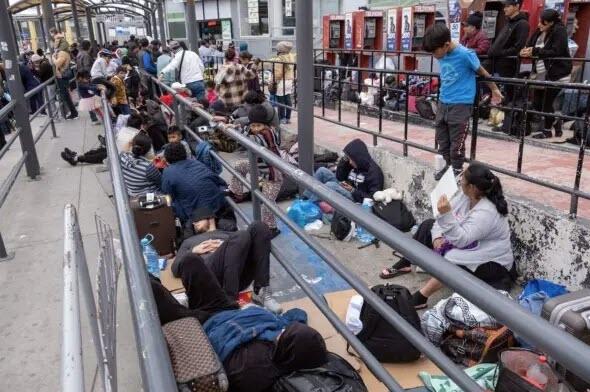
Migrants seeking asylum wait for U.S. Customs and Border Protection agents to allow them enter the United States at the San Ysidro crossing port on the US-Mexico border, as seen from Tijuana, Baja California state, Mexico on May 31, 2023. (Guillermo Arias/AFP via Getty Images)
According to CBP data, the U.S. Border Patrol encountered an average of 2,016 single adults per day in July alone, marking a 66 percent decrease from the 6,164 they encountered per day in the first 11 days of May.
"CBP's message for anyone who is thinking of entering the United States without authorization or illegally along the southwest border is simple: don't do it. When noncitizens cross the border unlawfully, they put their lives in peril," it stated.
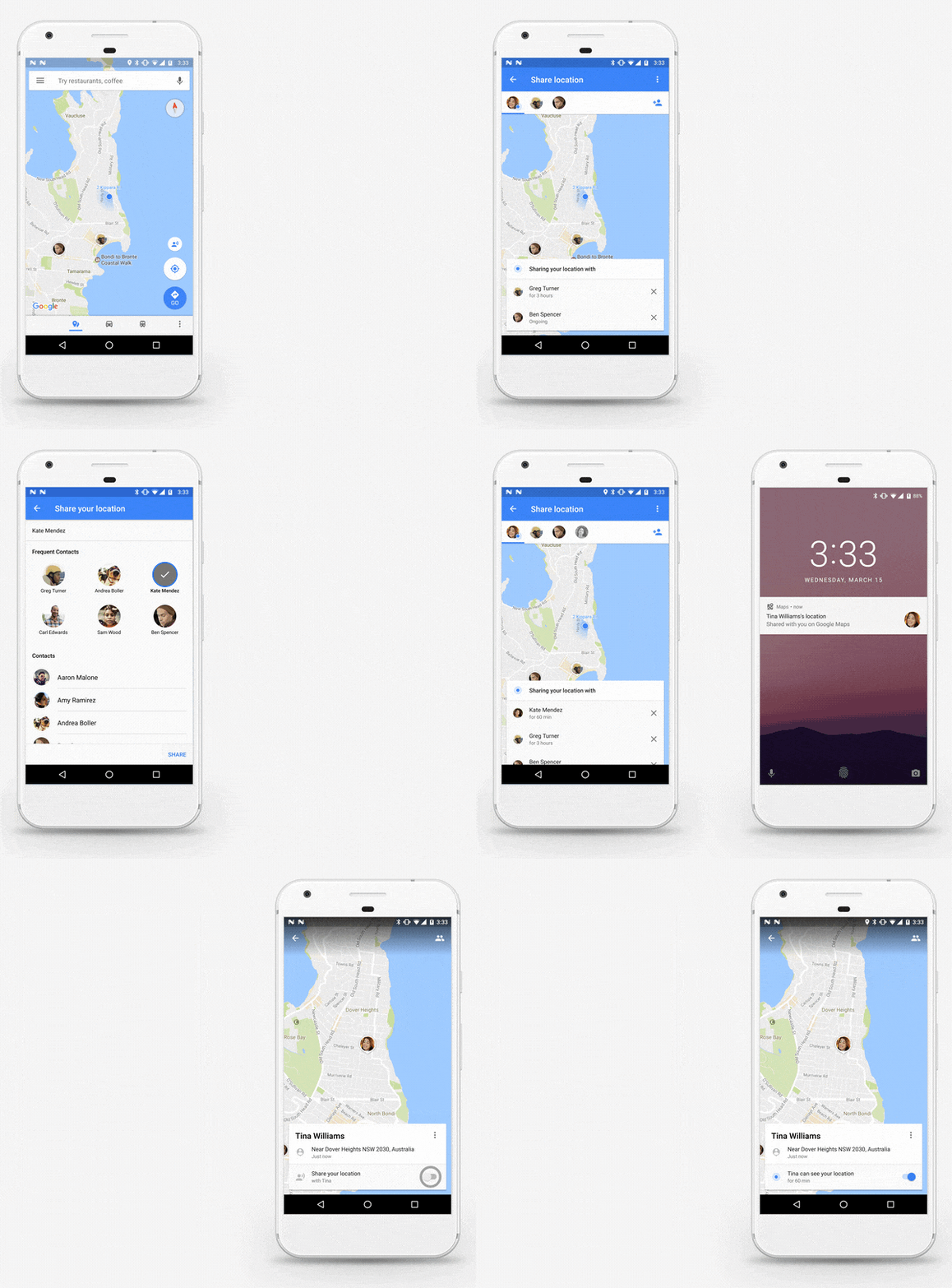
CBP One is for people of any nationality in central and northern Mexico entering the United States by land and seeking asylum or humanitarian parole.
Migrants must book an appointment through the app and show up to the appointment at U.S. ports of entry. If they don't have an appointment, they would be turned away.
Rep. Tom McClintock (R-Calif.) said on July 26 at the House Judiciary Committee hearing that the influx of people at the border has not decreased, noting that the CBP One app "allows migrants to bypass the southern border and enter directly in the United States’ ports of entry."
"Instead of bringing them to the southern border, you’re bringing them directly to ports of entry,” Mr. McClintock said.
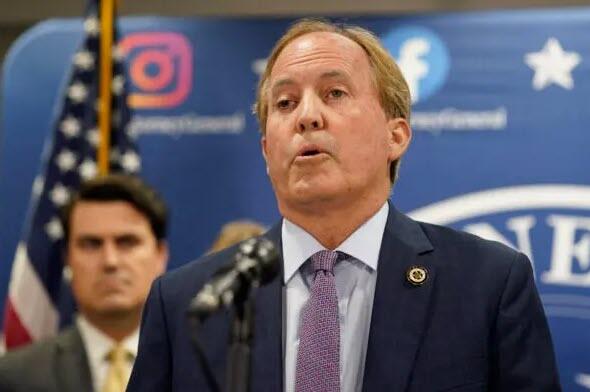
Texas Attorney General Ken Paxton makes a statement at his office in Austin, Texas, on May 26, 2023. (Eric Gay/AP Photo)
Texas Attorney General Ken Paxton filed a lawsuit against the Biden Administration on May 23 to challenge a rule that encourages illegal immigrants to use CBP One app to seek entry into the United States.
Mr. Paxton said the app encourages illegal immigration to the United States because it "cannot verify that an illegal immigrant would qualify for an exception, which would prevent them from being deported."
"The Biden Administration deliberately conceived of this phone app with the goal of illegally pre-approving more foreign aliens to enter the country and go where they please once they arrive," he said in a press release.
Let's discuss leverage and where we are in the investment cycle.
Despite huge stock market gains over the last decade, U.S. pensions are hundreds of billions of dollars short of what they expect to need to pay public worker retirement benefits.
The board of the nation’s largest pension fund voted Monday to use borrowed money and alternative assets to meet its investment-return target, even after lowering that target just a few months ago.
The move by the $495 billion California Public Employees’ Retirement System reflects the dimming prospects for safe publicly traded investments by households and institutions alike and sets a tone for increased risk-taking by pension funds around the country.
Without changes, Calpers said its current asset mix would produce 20-year returns of 6.2%, short of both the 7% target the fund started 2021 with and the 6.8% target implemented over the summer.
Board members voted 7 to 4 in favor of borrowing and investing an amount equivalent to 5% of the fund’s value, or about $25 billion, as part of an effort to hit the 6.8% target, which they voted not to change. The trustees also voted to increase riskier alternative investments, raising private-equity holdings to 13% from 8% and adding a 5% allocation to private debt.
Borrowing money to increase returns allowed Calpers to justify the 6.8% target while maintaining a more-balanced asset mix, concentrating less money in public equity and putting more in certain fixed-income investments, fund staff and consultants said.
I expect that the coming decade – and possibly even the next 12 months – will be a disaster for the U.S. stock market. Emphatically, our own investment discipline doesn’t require forecasts or rely on projections. Rather, our investment stance will change as valuations, market internals, and other observable factors change. My real concern is for passive investors – particularly charitable organizations whose missions would be compromised by a loss of over 50% in their equity investments (and whose missions might be enhanced by avoiding even part of that), and retirees who have barely enough to enjoy their future, but with most of it dependent on the temporarily bloated prices they see printed on a page or flashing on a screen.
Measured from current extremes, I expect that the unwinding of this bubble will drag S&P 500 total returns below Treasury bill returns for least a decade, and possibly two. Yet like other bubbles, I expect that most of the damage will come off the top, resulting in market conditions that are reasonably investable within a year or two. Presently, the valuation measures we find best correlated with actual subsequent market returns are at the most extreme levels in U.S. history. Moreover, as I’ve detailed before, the low level of interest rates does nothing to improve those prospective returns. For a review, see the section titled “The mapping between observable valuations and expected returns is independent of the level of interest rates” in Alice’s Adventures in Equilibrium.
Repeat Message
The thing is John has been saying these things for years. So have I but he has gotten more grief for it.
A few of Jeremy Grantham’s observations about speculative bubbles should not be missed. Not just because they agree with our own thinking, but because hearing the same concepts in different words, from a different speaker, can often deepen one's understanding.
“How high the peak is has no bearing at all on what the fair value is. What it does change is the amount of pain that you get to go back to fair value and below. I’ve been very clear about what I consider a definition of success – and that is only that, sooner or later, you will have made money to have sidestepped the bubble phase.”
This is a point I’ve emphasized often, but it can’t be repeated enough: amplifying a bubble doesn’t somehow avoid its consequences – it makes those consequences worse. Amplifying a bubble doesn’t even create “wealth” for the economy as a whole, only temporary opportunities for wealth transfer between individuals. That’s because the wealth isn’t in the price – it’s in the future stream of cash flows. If one holder sells, the next buyer has to hold the bag, and ultimately it’s the cash flows that matter. The only thing progressively higher valuations do is to progressively lower the long-term returns that investors will subsequently enjoy if they buy (or hold) at those valuations.
One of the things that you may have noticed is that our downside targets for the markets don’t simply slide up in parallel with the market. Most analysts have an ingrained ‘15% correction’ mentality, such that no matter how high prices advance, the probable maximum downside risk is just 15% or so (and that would be considered bad). Factually speaking, however, that’s not the way it works. The inconvenient fact is that valuation ultimately matters. That has led to the rather peculiar risk projections that have appeared in this letter in recent months. Trend uniformity helps to postpone that reality, but in the end, there it is. Given current conditions, it is increasingly likely that valuations will begin to matter with a vengeance. – John P. Hussman, Ph.D., March 7, 2000
I know that many of you believe that the current episode of speculative enthusiasm will persist forever –that the Fed will make it persist. We’ve already established that market returns are likely to be flat or poor even if the market achieves what Irving Fisher disastrously projected as a “permanently high plateau” in 1929, and valuations remain forever above extremes never seen before last year. Investors should also consider what might happen if valuations merely touch their historical norms – even 20 years from today – and growth in fundamentals matches that of the past 20 years. The simple arithmetic implies that the S&P 500 would actually lose value on a total return basis.
Will Hussman's Message Be Heard or Acted On?
The one word answer is "no".
The two word answer is that "It, can't" which many will miss.
Here's a longer more complete assessment that will have some puzzled: "It is mathematically impossible for Hussman's message to be heard and acted upon, in aggregate."
At an individual level, investors do have a choice. You or I or even a fund like Hussman's can indeed take action.
But given for every buyer there is a seller, someone must hold every stock, every bond, every dollar, every ounce of gold, and every Bitcoin, 100% of the time.
No Escape
In aggregate, there is no escape.
The bigger the pension plan, the harder it is to escape.
Rather than heed Hussman's warning, Calpers opted to double down with leverage. How long the strategy works is a mystery.
When the crash comes (and it will) it will be interesting to see how Congress acts.
The biggest risk to markets have always been policy mistakes by central banks and/or governments. The risks are rising as confusions about inflation abound. The reality is Central banks have tripped themselves – by assuring us inflation was transitory, they’ve pretty much nailed on its permanence!
Policy Mistake Risk and Inflation
Early doors y’day I was listening to Professor David “Danny” Blanchflower on the radio – ex Bank of England economist and Monetary Policy Committee member. He made a telling comment about the news BoE Governor Andrew Bailey is pushing for a rate hike at the November 4th MPC rate-setting meeting – dismissing every single rate hike since 2007 as a “policy mistake”. He’s spot on. He also reckons a deep recession is about to hit the US – based on his analysis of consumer anxiety and fears – and if the US catches a cold, then the UK will be thumped!
“Is the BoE about to make a policy mistake? Markets sure seem to think so”, says a senior portfolio manager at Allianz this morning in the FT: “Investors worry over potential BoE rates ‘mistake’. Hmm…. Imagine that.. and investor who has figured out rising rates aren’t necessarily good for his book? Who would have guessed.. ?
Policy mistakes are a massive market risk. Don’t believe Central Banks and Politicians are omnipotent. The issue is defining what would be a policy mistake and what is a POLICY MISTAKE.
For instance; Financial Assets remain seriously distorted by the consequences of the last 10 years of QE and ultra-low interest rates. It would be a policy mistake not to unravel the multiple negative market consequences of bad policy. However, to do so – by tapering QE purchases, raising interest rates, and causing investors to question the implicit put they think Central Banks have given markets – will likely trigger a market tumble, and thus be a policy mistake.
It becomes a Policy Mistake when Central Banks give up trying to pull the wool over our eyes about “transitory inflation” (the market equivalent of being a little bit pregnant), yet hike rates into the face of a supply chain recession, spurred on by Governments wanting to rein back debt by introducing austerity programmes and tax hikes. That’s a combined central bank policy mistake and a political Policy Mistake = triggering a run on the currency caused by rising competency fears about the debt they are trying to cut which will herald and imported inflation spike.. Etc, etc…
On the other hand, the most recent US retail sales data was exceptionally strong – was it a real spending splurge by consumers following the pandemic, or was it retail stocking up in the expectation of shortages to come?
Blanchflower and many other economists are still in the transitory inflation cap, citing US Lumber prices earlier this year – which spiked higher as builders hoarded timber on anticipated shortages, but quickly fell as the demand spike proved unsustainable.
Which leads to the question when does a price spike lead to transitory or long-term inflation? Retail Prices tend to demonstrate fluidity on the way up, but are notoriously sticky once they peak. Central banks might think the prices retail consumers encounter in the shops respond to stimulus like bond prices – they don’t.
Rising prices clearly colour expectations and purchase decisions. If folk accept inflation is transitory they will just keep buying – which means prices remain high.
Doh! – you see the problem…?
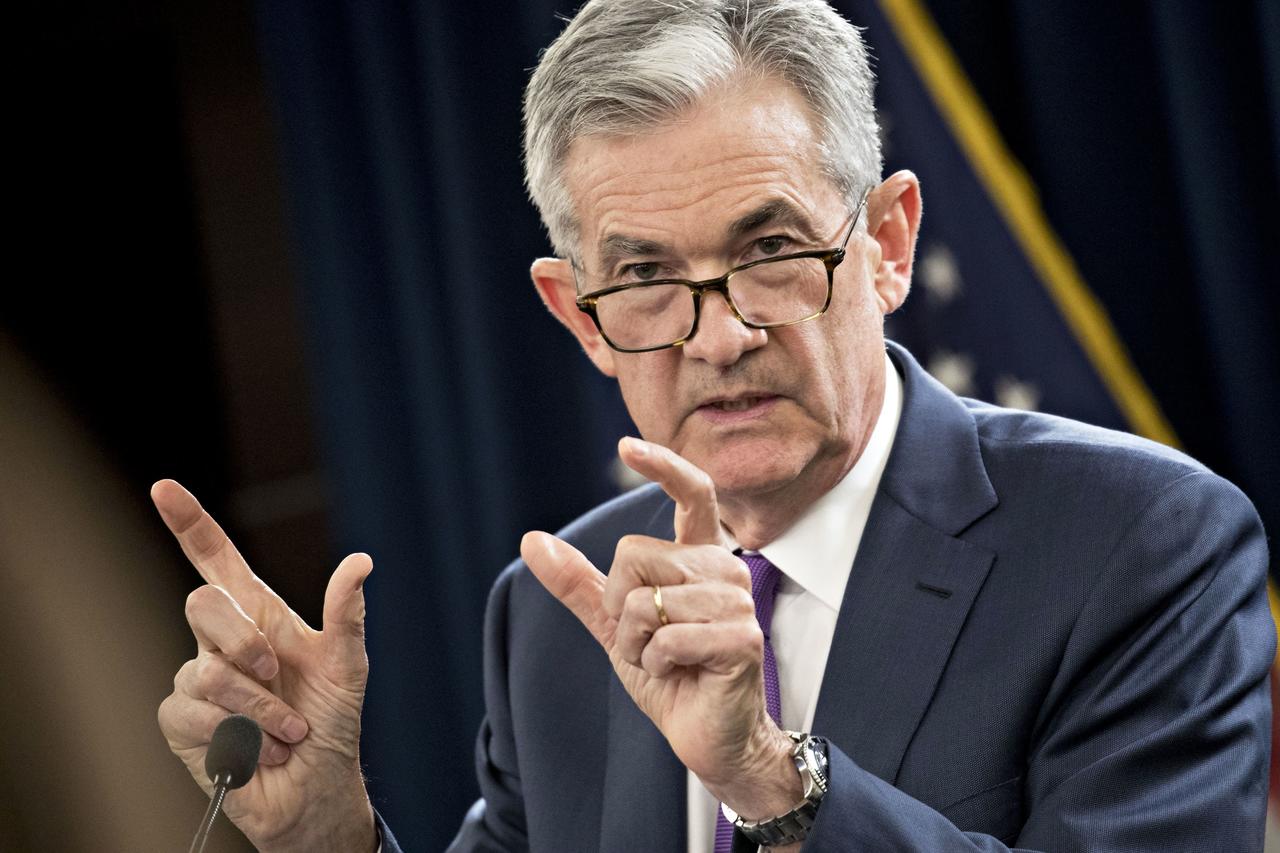
Belief in something being transitory is likely to make it permanent. If prices remain high that triggers wage inflation. Etc, Etc. Jay Powells comments on “Transitory Inflation” might just go down alongside Alan Greenspans “If you understood me, I misspoke” comments in the Big Book of Central Bank Moments.
I guess the coming holiday spending season will be .. interesting… Container ports around the globe remain clogged up, lorry drivers are scarcer than hen’s teeth, labour costs are under pressure (I’ll be intrigued to see what Amazon et al pay their Christmas hires this year..), and supply chain glitches put manufacturing under pressure… just how transitory do you expect it all to be?
Meanwhile, big trouble in big China
The market flow yesterday confirmed we are certainly living in interesting times…. China’s sub 5% growth raised recessionary fears around the globe… 4.9% growth would be considered stellar in most developed economies, but the fact China is struggling with supply chains, soaring energy costs, and the unfolding Evergrande debacle and potential contagion is illustrative.
I suspect our view of the implosion of the Chinese property sector is a bit like watching ducks on a windy day – serenely floating on the surface looking unperturbed, but furiously paddling below the waterline. It’s worse than it looks. The realisation of just how heavily dependent the economy is on property sales – looks unsustainable.
The consensus is $50 bln held by Evergrande bond holders will suffer most. Domestically, it’s a different tale; even as more property firms default the CCP will try to ensure the real estate sector is “stable and orderly”. Evergrande’s domestic liabilities of some $148 bln plus will no doubt be dealt with in order not to unleash a tide of domestic business defaults and retail pain – but it will have to be done in a manner that doesn’t look like a bailout.
It’s likely to get messy. The Chinese will find trying to micromanage the property sector by simultaneously disciplining banks on property company lending, while encouraging mortgage lending to mop up surplus supply creates all kinds of opportunities for speculators. Keep an eye on that space.. I suspect China will continue to contract. When China catches a cold, the rest of us will probably break out in pustules…
California restaurants are preparing for potential bacon shortages beginning January 2022, when a new law to improve farm animal conditions that could cause a decline in pork supply goes into effect.
Prime Meat Market, a butcher shop in Irvine, Calif., on Aug. 2, 2021. (John Fredricks/The Epoch Times)
One of the first international pancake houses in Orange County, Pancakes R Us, foresees a costly impact on its menu prices.
Abdullah Akbar, who runs the Costa Mesa restaurant, told The Epoch Times the eatery uses around 600 pounds of bacon per month. The restaurant is known for classic breakfast combos offering diners a few strips of bacon for nearly every meal.
“The prices will have [an] effect on us, and we have no choice but to increase our prices,” Akbar said.
In 2018, state residents voted to change farm animal confinement laws by passing Proposition 12. More than half of state voters ruled in favor of prohibiting the retainment of calves, pigs, veal, and hens in small areas, along with the sale of veal, uncooked pork, and shelled and liquid hen eggs.
“Prop 12 addresses some of the cruelest abuses ever inflicted on farm animals,” Josh Balk, vice president of Farm Animal Protection at the Humane Society of the United States, told The Epoch Times.
“The pork industry confines mother pigs in tiny cages so small they can never turn around. Shifting to more humane and cage-free conditions vastly improves the lives of these animals for egg-laying hens.”
As of now, the hens stand wing-to-wing with other birds in cages the size of microwaves, where they’re forced to sleep, eat, and lay eggs in the same spot, Balk said.
“In the pork industry, allowing these pigs to at least turn around is a big step, and that goes to show how poor these animals are treated,” he said.
“Mother pigs in a cage where they can’t turn around; they’re forced to live in what is their own coffin for their whole life. They’re forced to look straight ahead, and that’s it, and they go psychologically insane.”
With nearly 63 percent of Californians voting in favor of Prop. 12, the initiative received a lawsuit from the North American Meat Institute to halt the motion. In June 2021, the Supreme Court rejected the legal challenge.
“The Supreme Court’s outright rejection of the meat industry’s challenge to Proposition 12 is significant, and consistent with prior court rulings affirming that states have the right to pass laws protecting animals, public health and safety,” the Humane Society of the United States’ senior staff attorney, Rebecca Cary said in a June 28 statement.
“The meat industry should have focused on eliminating its cruel caging of animals rather than filing hopeless lawsuits trying to overturn extraordinarily popular, voter-passed animal cruelty laws.”
According to a study conducted by the Hatamiya Group, a decline in pork supply in the state by 50 percent would increase bacon prices by 60 percent in the Los Angeles market. Additionally, the report found that an increase in pork prices will decrease the overall demand if prices were to spike.
While animal cruelty organizations call for an end to the mistreatment of farm animals, restaurant associations statewide fear that potential price increases will hinder the industry amid the devastating economic impacts of the CCP (Chinese Communist Party) virus pandemic.
The Food Equity Alliance, a statewide coalition of state grocery stores, restaurants, businesses, and pork producers, wrote a letter to Gov. Gavin Newsom in May 2021, urging him to delay the effects of Prop. 12 by using his executive powers.
“Californians have been hit hard by the economic impacts of COVID-19 with consequences serious and far-reaching on restaurants, grocers, businesses, and hard-working families,” the letter reads.
“Another threat on the horizon is the implementation of Proposition 12.
“The Food Equity Alliance … is asking that you exercise your executive authority to delay the implementation of Proposition 12. It’s the only solution to protect the most vulnerable Californians, grocery markets, and restaurants from facing a pork shortage and skyrocketing price increases at a time when they are already struggling with the devastating impacts of COVID-19.”
As the implementation date of Prop. 12 is nearly half a year away, a Rabobank report estimates that California will fall 50 percent short of its pork needs.
Two dear friends introduced me to Douglas Wilson and Moscow, Idaho. Praise be to the Lord for my friends and the ministry of Doug. Since that introduction, I have viewed a handful of his sermons, lectures, and other discussion videos. I have a question I would like to ask Doug or another delegated leader regarding romantic relationships and pornography. Having heard Doug speak on this a number of times, I have yet to hear much concerning one certain aspect to this issue, which is what brings me here. Perhaps I am in the wrong place to ask such a question, and if so, may I be pointed in the proper direction? Otherwise, I would be quite grateful for wise council on the question, which is:
Need a man completely and utterly defeat this sin and affliction (porn) before entering into a relationship aimed at marriage with a woman? Furthermore—if that *ought* to be the case, how long and far removed must that man be before he (or both parties) can justify a relationship to commence?
I understand this question might not be answered soon or even at all. I suspect this question/topic is rather common, and thus a suitable answer might already exist.
Thank you for anything you can provide.
P
P, first, I would recommend this book for you. Second, you want to have defeated any kind of compulsive addicted behavior before getting into a relationship because no woman should be expected to have to put up with anything like that. But third, there is no such thing as “utterly” defeating temptations to lust in this life, and you don’t want to be in the position of only being able to get a loan from the bank if you prove to them that you don’t need it.
Thanks Much
When Bacteria Bleat—I just wanted to tell you I thought this article was some of your best work to date! I really enjoyed how clear you made the applying of Van Til’s apologetic without even batting an eye. This was great applied apologetics. I would love to see you write a whole book like this.
Very well done, thank you!
Jon
Jon, thanks very much.
Plagiarized Sermons
Could you address this [see below]in a future blog post? It seems to me lots and lots of pastors are either using sermon “services” or straight up plagiarizing other pastor’s work.
This is awful. I’m a Southern Baptist, and this is our leadership. What does this say about evangelicalism that we are okay with this?
Chris
Chris, thanks for the suggestion.
Civics in Between
On the ultra-cosmic level, the universe is an absolute monarchy, with God ruling directly and inscrutably. On the microcosmic level, the Christian nuclear family is an authoritarian monarchy, with the husband-father bearing the responsibility of leadership according to sound authoritative doctrine. Would it not follow that on the meso-cosmic level, the Christian nation state would aspire to be at least a constitutional monarchy; and that on the macro-cosmic level of international Christian civilization, an elected monarchy.
The same line of reasoning would follow for priesthood also. Christ is High Priest; and a father is priestly toward his children. Why not affirm priests on the meso-cosmic level of Christian communities; or on the macro-cosmic level of relations with the non-Christian world?
Do not republicanism and lay presidency at the altar suppose a disruption in the levels/spheres of moral order? That is, kings and priests are only acceptable in the most remote and immediate spheres, but not in between. How justifiably so?
Andrew
Andrew, that is an interesting question, and I do believe there is a serious argument there. Let me just note that I am not opposed to a constitutional monarchy, just as I am not opposed to a constitutional anything. The foundational thing would be the rule of law, a law that everyone knows. And I wouldn’t want to get hung up on terms either—a president of a powerful country can certainly have the gravitas of a king.
Don’t Forget Sir John Glubb
I recently listened to Plodcast podcast mentioning a book called the Fourth Turning.
This brought to mind a short paper called the Fate of Empires written by Sir John Glubb.
Here is the link, or you can do a search for a site you are comfortable with for a download.
John
John, yes, thanks. I read Glubb’s piece decades ago, and was persuaded by it. Thanks for the link.
Knowing and Actually Knowing
I agree with everything in this article, but what do you think should be the approach for the fool who believes all the same things as the atheist in your article and yet at the same time claims to subscribe fully to, say, the Baptist Faith & Message 2000?
Seth
Seth, subscription to a statement of faith is one thing, and honest and intelligent subscription to it is quite another.
A Theological Question
I very recently discovered you and your work as a whole, but instantly recognized your distinctive voice from years ago, listening to your address at Piper’s C.S. Lewis conference on the 50th anniversary of Lewis’ death. Your joke about buying Calvinism in 50-gallon drums stuck with me, and when I stumbled upon one of your Youtube videos a few weeks ago I immediately thought “Oh hey, it’s the weapons-grade Calvinist!”
Sir, thank you for your work on our Lord’s behalf, and your witness in His name.
I have a theological question for you, and apologize in advance if this was not the correct avenue to ask it.
My question assumes three premises.
– God’s divine nature is immutable
– Christ is fully God and fully human
– Human nature is more than our physical bodies
Assuming I have these three correct, does it not follow that the Second person of the Trinity was *always* human? As opposed to *becoming* a man during His physical incarnation?
Unless immutability is only a characteristic of the Father and the Son changed His nature at a specific point in time about 2000 years ago, this seems to be the logical conclusion.
If so, and the Word in the beginning was already man, and His humanity preceded the creation of the universe, then would making creatures “in our image” (Gen. 1:26) be referring to our race adopting the Son’s pre-existing humanity, rather than a more abstract interpretation (imposition of spirit on flesh)?
Does this also suggest that the Son, being our true progenitor, would have incarnated as our Lord regardless of the Fall, perhaps in happier circumstances? Had Adam and Eve not disobeyed, might the second Person of the Trinity have joined them and their descendants in the garden?
In Gratitude,
Nathan
Nathan, thanks for the kind words and, coming right to the point of your questioning, no. The Definition of Chalcedon teaches, rightly in my view, that the attributes of Deity can be predicated of the person, Jesus of Nazareth, and the attributes of humanity can be predicated of the person, but that the attributes of one nature cannot be predicated of the other. And what your suggestion would have to reduce to at the end of the day is the idea that humanity is Deity.
Some More Postmillery
I have two reoccurring issues within my conversations regarding the partial preterist postmil position.
1) My pastor, friends, and family have all been influenced on their eschatology through John MacArthur and Master’s Seminary. That being said they have roughly no idea what the postmil postion entails. They have done very little research on the topic themselves. Commonly in my interactions with them regarding postmill, they quickly dismiss it and state that “Revelation was written post A.D 70.” This answer seems to be the get out of jail free card for them. How would you respond and do you have recommended literature on this topic?
2) My second question regards the level of importance that our eschatological view should hold. In a recent conversation with the pastor of my brother’s church, we went back and forth for a brief time comparing the millennial positions. As I began showing the difference between natural interpretation and wooden, the conversation was dismissed with the reply, “In the end we are all Christians. These things have been debated forever.” This response was a way out of the conversation, but it left me with an unsettled feeling. Am I wrong to think that the position we hold has a huge impact on our life and hermeneutic? The postmill position has been extremely eye opening and a huge blessing for my wife and me. Our life has been changed through thinking generationally and seeing Christ as a victor over this world. Is it wrong for me to feel that this is a major topic that should have more weight and importance? Not something easily dismissed as “non-essential”?
Godspeed,
Denver
Denver, it is a very important topic, but don’t sour your friendships through too much argument over it. Living with this kind of hope is very attractive, especially as things continue to disintegrate around us. Have discussions, keep it friendly, and don’t expect the arguing to do anything. Let your life do more talking. And on the date of Revelation, I would recommend this book.
Keller’s Catechism
I just listened to your podcast on Tim Keller’s hands on the scales. I would like to know what you think of his New City Catechism? It seems to me like every time I am exposed to it I am confronted with some old subtle heresy now being masqueraded as doctrine.
Thanks for your hard work.
Tyrone
Tyrone, I don’t know enough about his catechism to say anything, one way or the other. But my big concerns have to do with how he engages with more recent doctrinal challenges—evolution, feminism, etc.
Lockdown Authority
Kindly comment on the moral necessity and/or utility of a referendum on prolonged lockdowns, and what threshold of acceptance or rejection would establish a mandate. Such a tool is strikingly absent.
I am keenly aware that in every debate, one side—at least invisibly—holds the guns, often receiving disagreement as from one who speaks “opinion to authority”.
Writing from Canada, I am stunned at the zeal of law enforcement in establishing international-level security measures between provinces (especially Manitoba-Ontario) as though traveling between Israel and Lebanon; and this without a peep from their conservative leaders about the need for regional referenda to establish legitimacy for the use of force imposing non-conservative policies on their very electors.
Thank you for speaking as a voice of sanity amidst the chaos.
Andrew
Andrew, I have been surprised at how much capitulation has gone on also.
When May Pastors Be Restored?
I am curious what you think is an appropriate timeline for a pastor to return to ministry after being caught in sexual sin. Let’s assume the sexual sin is adultery for example. I’ve heard some say as soon as the pastor is repentant, he is again qualified to return as a pastor. What about sexual abuse?
Josephine
Josephine, I think the general assumption ought to be that if a pastor commits adultery, or is guilty of sexual abuse, he should be done with the ministry for good.
Another Sabbath Resource
The Christian Sabbath | Another answer for Jonathan would be the book “The Christian Sabbath” by Dr. Robert Paul Martin”:
Trey
Trey, thank you.
More on Theocratic Free Speech
I wanted to ask a question about the recent articles you have been writing on the biblical necessity of free speech. I am in broad agreement with your position and I think theonomy is indeed biblical. One objection I anticipate goes like this;
Can’t the argument surrounding blasphemy also be applied to the right of the state to execute? The danger of letting the state punish blasphemy is that the state can abuse this and become the ultimate blasphemer. Can’t the state also abuse the right to execute criminals and become the ultimate murderer? If we don’t want the state to punish blasphemy then we should also want to prevent the state from having the power to kill. Or to state the objection more directly, just because the state can abuse its powers to punish blasphemy, it doesn’t mean that the state shouldn’t punish blasphemy when appropriate by biblical standards.
I am not sure how I would respond to this objection. I suspect that the person making this objection would be someone who is a more radical theonomist than yourself, and I don’t expect to meet any of them here in New Zealand, but, should I become a more radical theonomist than you?
Thank you for all your work, and I lack the ability to express how helpful your writing has been for me and everyone who has to put up with me.
Ethan
Ethan, I do think that the civil government has the responsibility to punish blasphemy at some point, as well as executing criminals at some point. I believe in free speech, not blasphemy/anarchy. In my thinking, it has to do with things like the burden of proof and emphasis. But more from me is coming on this in days to come.
Welcome to Moscow
RE: Kevin DeYoung and the Taxonomy of Conflict
This post really deserves to be a book, a kind of present-day Rushdoonian spiritual successor with handsome helpings of the Peterson-esque (or is J.P. Wilson-eqsue? huh) “Ha! Gotcha” humor from which you cannot seem to help yourself going there.
Speaking for my family, we were closet 4s. Every 4-ish murmur escaping from hearts to lips have been silenced and shamed and explained away by the numerous and more prestigious 3s we are presently surrounded by. Now we are on our way out of our current non-denominational, premillennial, dispensational circles that we got saved in and learned everything we know about the faith from – until we discovered the ministries and publishings of Christ Church. Not that we haven’t extensively surveyed the milieu of Evangelicalism and its thinking apart from you, but your reasoning – for all the reasons your article points out—stands apart, and so many times we have heard what you’ve had to say and thought, “That is exactly how we felt all along”—and were frustrated that we hadn’t been able to articulate it.
So to our surprise, we are now moving our family from Austin to Moscow, and we still don’t know whether we will wind up believing in postmillennialism, infant baptism, theonomy, sacramentalism, cold weather, and a whole host of issues we grew up believing were dividing lines. Yet in terms of pleasing God, we have vastly more in common with you in thinking and approach to obedience than our own theological camp, and the divide between us and our fellow 3s is beginning to feel like a chasm, fixed, with a metal curtain in the middle—and the Rich Brothers told Abraham his ideas aren’t welcome on their side because he quoted Lazarus. So when you say “4s are more ecumenical”—we present to you the tablets of our hearts as living proof, that in spite of the appearance of vastidious interwebital shunning you receive on a daily basis—the silent 4s, who may lack either the training chops or the pluck or a bit of both, God appears to be drawing together to take our stand.
Our personal calculus has come to reject “oh no, what will 1-3 think.” We want to avoid the opposite problem: even trying to resist the spirit of the age, we sense we have been so catechized by the deafening laugh track that we fear what David called our hidden sin most of all. We feel grave danger of losing all our rewards and watching our entire lives burned up like straw in the end for disobedience we learned to be bullied into, not even questioning. We know the Hebrews Cloud exists and urges us on, but at this point in time we feel we need to kind of surround ourselves in a Cloud of 4s to search our own lives and re-pattern our family after the Original and Most Hated 4 (He is actually a 7, as opposed to Bolz-Weber’s -2), our Lord Jesus Christ. Right now, Christ Church, her members and ministries are one of the only clear and unmistakable voices that shares our heart and thirst for unapologetic obedience, especially the kind of obedience that exposes manipulators. Praise God for that; on the other side of the online four-stompers are a whole lot of sheep like us who battle with great despair for our children, and God has set you all up as one city on a hill for many of us to gain clarity and be set free from the catechism of this nuclear waste site dumpster of a culture.
One bone to pick with your article—”I also hasten to add that you might [a 4] and still be a jerk.” I wholeheartedly agree there objectively exists a true moral concept, backed by the gold standard of the agreement of God the Father, of “jerk.” But the leftian boo track has the super-majority of airtime about what the word jerk means. In my pitch for turning this article into a book, what I’d like to read from you is a thorough gutting and filleting of all the twisted laugh track dictionary entries, followed by a sane, ackshually moral (as in holy (as in mimicking God)) definitions of the i-am-undone-for-the-3s-think-me-a-meanie words we are routinely handed to wear as Convention name badges.
And if you permit me one final request in this overlong blog post-sized letter, I urge you to make your first attempt of sane redefinitions where it concerns your use of the word “sketchy.” I thought the Rich Man told Abraham his experiences were pretty distinct, no lack of definition and clarity in that particular Conference.
Patrick
Patrick, we look forward to your arrival, as well as looking forward to the very first dictionary recalibration you will no doubt enjoy. I refer to a common term up here, that being “snow tires.”
Paleo Woke
“Paleo-Woke” In my last latter to you, I mentioned how I consider myself “paleo-woke”, but maybe a better term would be “theonomically woke.” Anyways, I mentioned that you should speak more sensible to the “woke” person and don’t treat us all the same. You mentioned that you believed the category I mentioned does exist but that you haven’t found calibrations on your part do much. I would like to say that THEY DO! I’m living proof! As someone who loves Eric Mason and the gospel work he’s doing in Philly, who loves his book Woke Church, (though I wouldn’t agree with everything or put it exactly the way he does.) I see how you’ve tried to reach out. I see how you’ve gone above and beyond in many ways. That spoke to me. When people, willfully or ignorantly misunderstand you I see that. Listen, the hood needs Doug Wilson. Ok, we don’t really, we need Jesus. But I’m still bringing you to the hood even if I don’t use your name. And just know that there is (based on De Young’s chart) someone who is a 1 or a 2, that loves Doug Wilson and even defends you to others. I love that you cut both ways and aren’t afraid of offending “both sides.” But in 800 years when you are long gone I believe your influence in the inner city will have blossomed. And I don’t want you to get tangled up in the petty squabbles with well known leaders to stop you from speaking to those of us that find ourselves in an entirely different context than Idaho and those of us who love Eric Mason but also who by a strange providence have found ourselves influenced and loving some random “lumberjack” guy in Moscow, Idaho. I see how you’ve been misunderstood and I still appreciate your gentle and irenic nature even though you aren’t afraid to get the sword out and start slayin dudes either. I’ve seen it through your online interactions and know that you won me over.
Keep doing what you’re doing. But know we are out there, and some of us are even putting our neck on the line in places you couldn’t imagine.
May God continue to bless your work and and may the fruit of your work, by God’s grace, multiply into an incalculable impact through the Gospel for the good of this world and for the glory of God, that in all things He might receive the honor and praise.
Ace Hartwick
Ace, thank you for such a gracious letter. You are asking me to spiritually budget for that part of my reading audience, and your exhortation is a good one. I will do so.
Ordained or Not?
Thank you for the edification and guidance you provide through the podcast. It has been a blessing to listen to!
I had a quick question for you. A while back you mentioned that many people spread false accusations about you online. I find you to be correct on this, as I see a plethora of people saying outlandish things that are easily proven wrong.
One accusation I see floating around is that you’re self-ordained and have taken the role of pastor without being examined. However, I researched your denomination’s (CREC) bylaws and it is very clear that examination is required to be a part of this group of churches.
So, my question is, is this claim that you’re self-ordained just another one of the silly myths that people try to spread about you? It seems like people will do anything to spread bad information, but I wasn’t sure if there was a reason that there’s controversy around your ordination.
Once again, thank you for all you do to spread the cause of the Gospel!
In Christ,
Jeremiah
Jeremiah, thanks for asking. A lot of people don’t. I was elected to be an elder by our congregation in the late seventies, under the general oversight of the EFree church that planted us. Our broad polity at that time was congregational and so consequently, once we had elders, our local body was ruled by elders. So I became the pastor of this congregation the way many men are called and established by a local congregation. The CREC did not exist at that time. But when the CREC was established, according to the CREC constitution, our congregation was brought into the CREC in a way that recognized all the existing ordinations. I was examined by the CREC later, as part of the Federal Vision controversy. You can actually listen to that exam if you like.
Born This Way?
Since I saw “On Earth as it is in Heaven” on YouTube I was intrigued by your message and have since watched many of your lectures and debates (as well as from Voddie Baucham, Bruce Gore, Jeff Durbin, Steve Gregg and others) and I feel blessed by God with the renewed and better understanding of his Word.
Especially the topic about LGBT+ interested me because in the past ten years I feel public opinion changed dramatically on this even though I think the Bible is clear on this topic.
However I came up with a theory (based on the Bible) which is maybe interesting to you as well.
I was thinking about Sodom and how it is mentioned that all the men (all ages) wanted to participate in these sodomic actions.
This triggered me to think that all men (and women) in Sodom were either born this way or it was their choice to participate.
Maybe the ‘born this way’ argument applies to all of us.
Maybe we were all born gay, lesbian, heterosexual and so on?
If not, then how could it be that all men in Sodom wanted to participate?
Looking at Wikipedia, so far no gay gene has been found and it points out that its a combination of factors and that social environment plays a role too.
Looking at the demographics of sexual orientation (also Wikipedia) it shows that over the years the LGBT+ population share is growing steadily.
“Notably, the generational group that has the highest percentage of people who identify as LGBT is the youngest — Generation Z (born 1997 to 2002) — with 15.9%. That compares to 9.1% of millennials (born 1981 to 1996), 3.8% of Generation X (born 1965 to 1980), 2% of baby boomers (born 1946 to 1964) and 1.3% of traditionalists (born before 1946).”
The question arises how is it possible that there’s a difference of 14,60% between Generation Z and the traditionalists generation?
How can this be if people are born this way?
If people are born this way the number would remain static and not increase.
So my theory is (based on the biblical story about Sodom) that if this continues, the population share of LGBT+ will continue to grow, 20%, 30%, 50%, who knows?
Especially since it’s being promoted at schools, work places, everywhere (even churches?).
This would answer the question why we care (besides that it conflicts with what God teaches us).
If the LGBT+ population share rises and it is proven so hard to change this sexual orientation, this will be destructive to the fertility of the US and many other western nations.
In that sense, this theory will be proven false or true in the coming decade.
Since the ‘born this way’ argument is such an important argument for many Christians to believe that its God’s will for them to behave this way, to have same-sex mirages and so on, I think it will be important to keep an eye on this population share statistic.
Soon our nations will turn (population wise) literally into Sodom?
I’m a Christian from the Netherlands, 31 year old father of three kids, married to a beautiful woman.
Forced by corona I’m working from my attic with a view at the high school where I always thought I’d send my kids to, until this week when I saw from my attic window the rainbow flag on top of the roof of this school.
It’s (in name) a Christian school—however they purposely avoid any reference to Christianity on their website and also at school itself (with Christmas no cross but only a tree).
I’m interested to hear what you think of my theory explained above?
I call it the “We are all born gay” theory since I think it emphasizes this point that, if we resist God’s will, we will all follow the way of Sodom and it makes it clear that it still, in essence, is a choice we make.
God bless you and your family.
Yours Faithfully,
Jelte
Jelte, I think you have a point, but I would modify it some. I believe that we are all born sexually broken, and I believe that lust is profoundly plastic. It wants to be infinitely plastic, but coming from a finite creature, it has to settle for deranged. The only way out is to be born again—to be “reborn this way.”
Critical of Dabney
I am reading Dabney’s Defense of Virginia and the South on your recommendation. In chapter 1, among some really good insights, he says,
“…for the African race, such as Providence has made it, and where He has placed it in America, slavery was the righteous, the best, yea, the only tolerable relation.”
I’m not so sure. It’s obvious that any slave needs a liberal education to prepare him for freedom, and the descendants of slaves still suffer today for the lack of such an education. It seems to me that a better long-term Christian approach to the problem of millions of slaves imported into the colonies by the British would have focused on education and evangelism. I hope that’s classical education, not modern democratic bias talking. I will read the rest of the book with interest, but I would love to know what Christian writers pick up the conversation from Dabney, accepting his insights but taking a less enthusiastic view of the righteousness of American slavery.
Thanks.
MB
MB, I am with you on that, although I would reverse the order—evangelism, and then education.
Todd, good stuff. My only disagreements would be under Article XVIII. I believe that in the case of serious contagious disease, the magistrate has the authority to quarantine, and that this authority can be biblically defended from Mosaic law.
Closet Sin
Just watched your video on Masculine Responsibility and the Covenant. I heartily agree with everything said there. I find the train of thought you laid out there very convicting whenever Satan attacks with the line of, “it’s ok to sin in (insert sin here) way because your wife / kids will never know.” But I want God to bless my wife / kids, so I will do my best to remain faithful in all aspects of life, whether they be public or private.
However, can we take this train of thought too far? If there is a family that seems like the father and mother are faithful in their parenting, but their kids turn out rebellious, does that mean that there was hidden sin in the life of the father? It pains me to think of someone like John Piper, a man whose ministry I’ve appreciated, has a wayward son out there. Does that mean that JP has some dark side we just don’t know about? Should I get rid of his books. I very much want to hold to the truth of I Tim 3:4-5. But I’m unsure of where the lines are at.
Roger
Roger, I agree with your concern about where to draw the line. I don’t believe the presence of hidden sin to be a rigid law, but I do believe that it is a real possibility—one that parents with a wayward child should at least check. But nobody should make accusations from the outside on the basis of this principle.
The Dry Twig Moment
Recently watched your Dry Twig interaction with Gary DeMar, for which I am thankful.
I grew up with the same osmosis and somewhat conviction and only have recently researched my own eschatological viewpoint. I am incredibly thankful it was last year where I started to dive in the deep end and the infamous algorithm of our Internet Media overlords plunged me to your channel (an act of Providence, no doubt). I kept hearing of this intriguing Postmillennial position from this doughty pastor in Idaho and godly raucous pastor in Arizona, [a position] I was always told was “just for the liberals.”
While I will admit I am not entirely convinced of the postmillennial school (I would consider myself an optimistic amillennial), I am not opposed to the posty’s. I quite enjoy them. Needless to say, I have seen your arguments come to life in my own readings of Scripture. Particularly it is Christ’s Discourse to His Disciples in John 14-17. In seeing the incredible power of Christ’s ascension and giving of the Spirit by the will of the Father, I see the postmillennial position a bit more clearly, and I am thankful for that.
Keep pressing on, brother. Thankful for you and your ministry.
X
X, thank you. Being postmill, I believe that amillennialism eventually turns into postmillennialism. But, then again, so does everything else.
Ed Welch has one geared specifically to men: “You believe that Jesus pursues you. You are letting go of old lies that suggest he doesn’t care and that you are forgotten. Because of Jesus, you no longer look for the easiest person to talk to when people gather. Instead, you move toward the quieter ones, the new person, and the outliers. Imagine a group of people who move toward each other—active more than passive, loving more than fearing rejection. They look glorious; they attract the world.”
Eddie looks at the situation in Brazil where there are isolated and unreached tribes.“’Brazil has put a former evangelical missionary in charge of its isolated indigenous tribes, provoking concern among indigenous groups, NGOs, anthropologists and even government officials, who fear the government of the far-right president, Jair Bolsonaro, is overseeing a new push to spread Christianity among Brazil’s indigenous people.’ So what?”
This article is both sad and beautiful. “I am a PCA pastor’s wife and a mother to four elementary-aged children. My mother was diagnosed with breast cancer at the age of thirty-three and passed away when she was forty. I was thirty-five at the time and I knew I carried a gene mutation which increased my risk for breast cancer. My doctors and genetic counselors strongly advised me to have a bilateral prophylactic mastectomy.”
Derek Thomas calls it like it is. “There is a manner of ministry that is more about self-service than self-sacrifice, self-indulgence than self-discipline, and self-promotion than self-denial. There is also giving that is designed for recognition—plaques on walls intended to be read by generations to come, or press releases informing the world of ‘generous donations’; prayers in pristine Cranmerlike language of the sixteenth century suggesting depths of personal piety; fasting that is shown via open-necked T-shirts revealing a ribbed torso.”
Should I want to suffer? It’s my desire to grow up in every way possible, to experience the greatest spiritual maturity. And, according to these trustworthy mentors, it seems like it can’t be had without pain.
More than the headline makers, it’s the daily life of the average Christian that ultimately forms the world’s perception of Christ and his gospel. —Jonathan Leeman
Kim Jong Un mounted a white horse again as North Korea announced on Wednesday it would soon convene a rare meeting of the ruling party's top leaders, steps analysts say signal preparations for a more confrontational stance.
I think we can sometimes feel guilty or disappointed when it comes to world missions, but here are a couple of things that are going very well. Like this: more people are becoming Christians than at any other time in history.
This matters: “Stifling our emotions because they don’t compare to the sorrow of another, isn’t necessarily always the obedient choice. We are free to feel and express our pain before God in a way that honours him—not because our pain is comparable to another, but because God has gifted us with the ability to feel those emotions. He has given us not hearts of granite, but hearts of flesh that feel stings, scrapes, bruises, and wounds. And we are free to place that before God.”
There’s both challenge and encouragement for parents here. “Christian parents rightly seek to share the Gospel (Good News) of salvation with their children and to lead them, at an early age if possible, to Jesus Christ as their personal Savior from sin. By God’s grace, some children do come to saving faith in Jesus early in life. But parents eager for their children’s salvation need to guard against assuming their kids have been saved simply because they’ve heard the Gospel and made some sort of an elementary profession such as ‘I asked Jesus into my heart’ or ‘I believe in Jesus.'”
Not surprisingly, our obsession with taking photos is changing the way we remember the past. Just consider this: “Importantly, selfies and many other photos are also public displays of specific attitudes, intentions and stances. In other words, they do not really reflect who we are, they reflect what we want to show to others about ourselves at the moment. If we rely heavily on photos when remembering our past, we may create a distorted self identity based on the image we wanted to promote to others.”
Christianity Today covers the situation in The Netherlands after pastors there adopted The Nashville Statement. “The conservative Christian proclamation hasn’t gone over smoothly in the Netherlands, which became the first country to legalize same-sex marriage in 2001 and where just 15 percent of the population believes in God. LGBT advocates in government buildings, businesses, and affirming churches and Christian colleges flew rainbow flags yesterday to oppose the Nashville Statement.”
Joe Carter explains this story: “A European court ruled that German authorities are allowed to forcibly remove children from their home if the parents homeschool. Could that happen in the United States?”
Here’s something to ponder: “The accomplishment of both Voyager probes is unparalleled. Still, astronomically speaking, they’ve only just stepped outside our front door, and barely entered the larger stellar neighborhood. It will take Voyager 2 another 40 thousand years to approach the nearest star to our sun—which together occupy only a fraction of the Orion Arm of the Milky Way galaxy. The Milky Way, in turn, is just one of at least 100 billion galaxies in the visible universe.”
If Satan cannot destroy a marriage, he will at least determine to weaken it. To neglect any of these 6 things is to invite his presence and to welcome his influence.
There can be no peace between you and Christ while there is peace between you and sin. —C.H. Spurgeon
Everyone knows medical care in the US is expensive even with insurance and prohibitively expensive without it. I have a lot of patients who are uninsured, or who bounce on and off insurance, or who have trouble affording their co-pays. This is a collection of tricks I’ve learned (mostly from them) to help deal with these situations. They are US-based and may not apply to other countries. Within the US, they are a combination of legal and probably-legal; I’ve tried to mark which is which but I am not a lawyer and can’t make promises. None of this is medical advice; use at your own risk.
This is intended for people who already know they do not qualify for government assistance. If you’re not sure, check HealthCare.gov and look into the particular patchwork of assistance programs in your state and county.
I. Prescription Medication
This section is about ways to get prescription medication for cheaper. If even after all this your prescription medication is too expensive, please talk to your doctor about whether it can be replaced with a less expensive medication. Often doctors don’t think about this and will be happy to work with you if they know you need it. They may also have other ways to help you save money, like giving you the free sample boxes they get from drug reps.
1. Sites like GoodRx.com. This is first because it’s probably the most important thing most people can do to save money on health care. For example, one month of Abilify 5 mg usually costs $930 at Safeway, but only $30 with a GoodRx coupon. There is no catch. Insurances and pharmacies play a weird game where insurances say they’ll only pay one-tenth the sticker price for drugs, and pharmacies respond by dectupling the price of everything. If you have insurance, it all (mostly) cancels out in the end; if you don’t, you end up paying inflated prices with no relation to reality. GoodRx negotiates discounts so that individual consumers can get drugs for the same discounted price as insurances (or better); they also list the prices at each pharmacy so you know where to shop. This is not only important in and of itself, but its price comparison feature is also important to figure out how best to apply the other features in this category. Even if you have insurance, GoodRx prices are sometimes lower than your copay.
2. Get and split bigger pills. Remember how a month of Abilify 5 mg cost $30 with the coupon? Well, a month of Abilify 30 mg also costs $30. Cut each 30 mg pill into sixths, and now you have six months’ worth of Abilify 5 mg, for a total cost of $5 per month. You’ll need a cooperative doctor willing to prescribe you the higher dose. Note that some pills cannot be divided in this way – cutting XR pills screws up the extended release mechanism. Others like seizure medication are a bad idea to split in case you end up taking slightly different doses each time. Ask your doctor whether this is safe for whatever medication you use. Do not ask the pharma companies or trust their literature – they will always say it’s unsafe, for self-interested reasons. Contrary to some doctors’ concerns, this is not insurance fraud if you’re not buying it with insurance, and AFAIK there’s no such thing as defrauding a pharmacy.
3. Mail order from Canada. Canada has lower prices than the US for various prescription drugs. Canadian pharmacies are unlicensed and illegitimate and you should never use them, according to the same people who tell you that marijuana is a gateway drug and porn will fill your computer with Russian viruses. According to everyone else, including most doctors I know, they are fine as long as you avoid obvious scams. They are technically illegal but the FDA has a policy not to prosecute people who buy drugs there for personal use. The Canadian Internet Pharmacy Association maintains a list of ones they consider safe. If I try really hard, I can find a way to get the month of Abilify 5 mg for $4.58 from canadapharmacy.com, but this isn’t really that much better than the best American option. Some other medications do seem to be better, especially ones that are still on patent; if I want a month of Saphris 10 mg, the best I can find on GoodRx is $620, but on canadapharmacy.com there’s a deal for $196.
4. Pharma company patient assistance programs. As part of their continuing effort to pretend they are anything other than soulless profit-maximizing bloodsuckers who will be first against the wall when the revolution comes, some pharma companies offer their drugs for cheap if you can prove you need them and can’t afford the regular price. These are most useful if for some reason you need a specific expensive brand-name drug; if you have any other options you’re better off just buying the generic. You can search for these programs at Partnership For Prescription Assistance, RXAssist, and NeedyMeds. Be very careful to read the fine print on these, because no matter what they pretend, drug companies are soulless profit-maximizing bloodsuckers who will be first against the wall when the revolution comes, and sometimes these are just small discounts that aren’t as good as using one of the other methods. Occasionally a company will give you a great discount that knocks a brand-name medication costing $300 down to only $150 without telling you that there is a similar generic that costs $5. But if you need one specific very expensive thing, and you are lowish-income, and you don’t have government help, this is still your best bet.
5. Get 90+ day supplies. If your insurance charges you a co-pay of $30 per prescription, and you get a 90-day supply instead of a one month supply, then you’re paying $30 once every three months, instead of once a month.
II. Therapy
This section is on ways to do therapy if you cannot afford a traditional therapist. There may also be other options specific to your area, like training clinics attached to colleges that charge “sliding scale” fees (ie they will charge you less if you can’t afford full price).
1. Bibliotherapy: If you’re doing a specific therapy for a specific problem (as opposed to just trying to vent or organize your thoughts), studies generally find that doing therapy out of a textbook works just as well as doing it with a real therapist. I usually recommend David Burns’ therapy books: Feeling Good for depression and When Panic Attacks for anxiety. If you have anger, emotional breakdowns, or other borderline-adjacent symptoms, consider a DBT skills workbook. For OCD, Brain Lock.
2. Free support groups: Alcoholics Anonymous is neither as great as the proponents say nor as terrible as the detractors say; for a balanced look, see here. There are countless different spinoffs for non-religious people or people with various demographic characteristics or different drugs. But there are also groups for gambling addiction, sex addiction, and food addiction (including eating disorders). There’s a list of anxiety and depression support groups here. Groups for conditions like social anxiety can be especially helpful since going to the group is itself a form of exposure therapy.
3. Therapy startups: These are companies like BetterHelp and TalkSpace which offer remote therapy for something like $50/week. I was previously more bullish on these; more recently, it looks like they have stopped offering free videochat with a subscription. That means you may be limited to texting your therapist about very specific things you are doing that day, which isn’t really therapy. And some awful thinkpiece sites that always hate everything are also skeptical. I am interested in hearing experiences from anyone who has used these sites. Until then, consider them use-at-your-own-risk.
III. Supplement Analogues
This section is for people who can no longer afford to see a doctor to get their prescription medication. It discusses what supplements are most similar to prescription medications. This is not an endorsement of these substitutions as exactly as good as the medications they are replacing, a recommendation to switch even if you can still get the original medication, or a guarantee that you won’t go into withdrawal if you switch to these. They’re just better than nothing. Make sure to get these from a trusted supplier. I trust this site, but do your own investigation.
This doesn’t include detailed description of doses, side effects, or interactions; you will have to look these up yourself. These are all either legal, or in a gray area of “probably legal” consistent with them being very widely used without punishment. I am not including illegal options, even though some of them are clearly stronger than these – but you can probably find them if you search.
1. Similar to SSRIs: 5-HTP. This is a serotonin precursor that can serve some of the same roles that selective serotonin reuptake inhibitors do, though this is still controversial and it is probably not as strong. Cochrane Review thinks that “evidence does suggest these substances are better than placebo at alleviating depression”. This may plausibly help with SSRI withdrawal, though not as much as going back on an SSRI. It can be dangerous if you are taking any other serotonergic medication, so check with the doctor prescribing it first. Cost is about $10/month. Definitely legal.
2. Similar to antidepressants in general: Tianeptine. This is a European antidepressant which is unregulated in the US, making it the only way I know to get an regulatory-agency-approved antidepressant without a prescription. Look up the difference between the sodium and the sulfate versions before you buy. Generally safe at the standard dose; higher doses carry a risk of addiction. Cost is about $20/month. Probably legal, widely used without legal challenges.
3. Similar to stimulants: Adrafinil. This is the prodrug of modafinil, a stimulant-ish medication widely used off-label for ADHD. Modafinil itself is Schedule IV controlled (though widely available online); adrafinil is unscheduled and also widely available. Look up the debate over liver safety before you use. Cost is about $30/month. Probably legal, widely used without legal challenges.
4. Similar to anxiety medications: GABA and picamilon. GABA is an endogenous inhibitory neurotransmitter, but it has questionable ability to cross the blood-brain barrier when taken orally (though see here for counterargument). Picamilon is the same neurotransmittor attached to a niacin molecule that helps it cross the BBB more readily. Both are sold as supplements. The evidence base is weak, and this is the entry on this list I am most skeptical of. Use at your own risk (of it not working; it’s probably pretty safe). Neither of these is as strong as a benzodiazepine and these will not significantly relieve acute benzodiazepine withdrawal. Cost is about $30/month. GABA is definitely legal. Picamilon is possibly legal; the FDA has tried to stop companies from selling it as a dietary supplement, but does not seem to be challenging users.
You can find a discussion of other supplements for depression at Part IV here and for anxiety at Part IV here. You can find a discussion of ways that supplements can play a very minor role in helping with psychosis in the second to last paragraph of Part 12 here, but please don’t rely on this. I no longer 100% endorse everything in those lists.
If you know other safe and legal ways to save money on psychiatric care, please mention them in the comments and I’ll add them as they come up.
The bodies of seven U.S. sailors missing after the USS Fitzgerald collided with the Philippines-registered ACX Crystal early Saturday were found in flooded compartments of US destroyer, which came close to sinking after the collision tore a gash under the warship's waterline, the U.S. Navy's Seventh Fleet commander said on Sunday.
A number of Sailors' remains that were missing from the collision between USS Fitzgerald (DDG 62) and a merchant ship have been found. As search and rescue crews gained access to the spaces that were damaged during the collision this morning, the missing Sailors were located in the flooded berthing compartments. They are currently being transferred to Naval Hospital Yokosuka where they will be identified.
The families are being notified and being provided the support they need during this difficult time. The names of the Sailors will be released after all notifications are made.
The navy added that the sailors names will be released after all notifications.
Speaking at a news conference, Vice Admiral Joseph Aucoin said the impact crushed berthing cabins below the waterline and ripped open a large hole in the vessel. Bodies of the missing sailors were found in the berthing cabins. Aucoin declined to say how many of the seven missing sailors had been recovered, but Japanese media said all had died.
“Out of concern for the families and the notification process, I will decline to state how many we have found at this time,” Aucoin told a news conference and added that the USS Fitzgerald could have foundered, or even sunk, if not for the crew's efforts to save the ship, he said (the full transcript of his speech can be found here).
"The damage was significant. There was a big gash under the water," Aucoin said at Yokosuka naval base, home of the U.S. Seventh Fleet, the docked Fitzgerald behind him. "A significant portion of the crew was sleeping" when the destroyer collided with the Philippine-flagged container ship, destroying the commander's cabin, he said.
The Fitzgerald is salvageable, he said, but repairs will likely take months. "Hopefully less than a year. You will see the USS Fitzgerald back," Aucoin said.
Multiple U.S. and Japanese investigations are under way on how a ship as large as the container could ram into the warship in clear weather.
Aucoin was asked if damage on the starboard side indicated the U.S. ship could have been at fault, but the Vice Admiral declined to speculate on the cause of the collision. According to maritime rules vessels are supposed to give way to ships on their starboard.
Meanwhile, according to Reuters Japanese media reported that local authorities were looking into the possibility of "endangerment of traffic caused by professional negligence", but it was not clear whether that might apply to either or both of the vessels. The U.S. Navy said the collision happened at about 2:30 a.m. local time (1730 GMT Friday), while the Japanese Coast Guard said it was 1:30 a.m. local time.
Japan's Nippon Yusen KK, which charters the container ship, ACX Crystal, said in a statement on Saturday it would "cooperate fully" with the Coast Guard's investigation of the incident. At around 29,000 tons displacement, the ship dwarfed the 8,315-ton U.S. warship. It was carrying 1,080 containers from the port of Nagoya to Tokyo. None of the 20 crew members aboard the container ship, all Filipino, were injured, and the ship was not leaking oil, Nippon Yusen said. The ship arrived at Tokyo Bay later on Saturday.
The waterways approaching Tokyo Bay are busy with commercial vessels sailing to and from Japan’s two biggest container ports in Tokyo and Yokohama. But such collisions at sea are rare in an age of advanced navigational technology.
Naval historians recall possibly the last time a warship was hit by a larger vessel in peacetime was in 1964 off the coast of Australia’s New South Wales. The HMAS Melbourne, an aircraft carrier, collided with the destroyer HMAS Voyager, shearing the much smaller vessel in half and killing 82 of the Voyager's crew.
Japan's Prime Minister Shinzo Abe sent a message to U.S. President Donald Trump on Sunday saying he was “in deep sorrow” over the Fitzgerald incident. He added that he “highly respects people involved in the U.S. military who every day make a big contribution for protecting peace for our nation and the region under the strong U.S.-Japan alliance.”
A spokesman for the Japanese coast guard said its investigation was continuing, and Filipino crew members of the ACX Crystal had been questioned. He declined to discuss further details of the probe.
The WSJ notes that collisions at sea for the U.S. Navy are extremely uncommon, said Bryan McGrath, a former destroyer captain, who said they occur only once or twice a decade, if that. He said he couldn’t remember a recent collision that was this consequential.
“There are 275 ships in the Navy and 100 are under way all over the world,” navigating “millions and millions of miles” every year, said Mr. McGrath, who retired in 2008 and is now a consultant. “This is very, very rare.”
U.S. naval history includes a number of notable mishaps. In 2005, the USS San Francisco, a Los Angeles-class submarine, hit a seamount or underwater mountain, injuring dozens of crew. In 2001, the USS Greeneville, another Los Angeles-class sub, performed an emergency ballast blow for special visitors aboard the vessel, surfacing quickly and hitting a Japanese fishing ship on the surface near Hawaii, killing nine crew members of the Japanese vessel.
In one of the Navy’s worst incidents, the aircraft carrier Wasp in April 1952 collided with the destroyer Hobson in the North Atlantic, killing 176 men.
Mr. McGrath declined to speculate as to what occurred or who or what might be to blame in the Fitzgerald incident. The collision occurred in darkness in a high-traffic area of the Pacific, he said. The most concerning aspect of the collision, from the destroyer’s point of view, is the damage to the Fitzgerald’s starboard side below the waterline, resulting from the container ship’s construction and the way its bow hit, he said.
As reported yesterday, the Fitzgerald collided with the merchant vessel more than three times its size some 56 nautical miles southwest of Yokosuka early on Saturday. Three people were evacuated to the U.S. Naval Hospital in Yokosuka after the collision, including the ship's commanding officer, Bryce Benson, who was reported to be in stable condition. According to Reuters, Benson took command of the Fitzgerald on May 13. He had previously commanded a minesweeper based in Sasebo in western Japan.
The Fitzgerald limped into port on Saturday evening, listing around 5 degrees, a U.S. Navy spokesman in Yokosuka said. The flooding was in two berthing compartments, the radio room and auxiliary machine room, he said. There were 285 crew onboard.
Among the many lingering questions that should be asked is why was the radar and communication system on the Fitzgerald turned off? Also, why was US navy fleet and related satellite coverage from Hawaii and Guam MIA, and with the ships on collision course, why nobody was alerted especially since 2AM in Japan means it was working hours in the USA. A separate question: what and who was on that Philippine flag containership heading into Tokyo?
“Where are you now?” and “What's your ETA?” Whether you’re heading to a party or meeting up for dinner, you probably hear questions like this pretty often from family and friends. Soon Google Maps users worldwide will be able to answer those questions in just a few taps, without ever leaving the app. On both Android and iOS, you’ll be able to share your real-time location with anyone. And the people you share with will be able to see your location on Android, iPhone, mobile web, and even desktop. Here’s how it works in a real-world scenario:
Whenever you want to let someone know where you are, just open the side menu or tap the blue dot that represents where you are. Tap “Share location” and then select who to share with and how long to share—and you're done! You can share your real-time location with your Google contacts, or even share with friends and family by sending a link on your favorite messenger apps. When you’re sharing your location, the people you’ve chosen to share with will see you on their map. And you’ll see an icon above the compass on your own map reminding you that you’re actively sharing your location. You can change your mind and stop sharing at any time—it’s entirely up to you.
Next time you’re on your way or running late, you can share your real-time location and trip progress from navigation as well. During your next trip, tap the “More” button on the bottom on the navigation screen, and then tap “Share trip.” When you share your trip with people, they’ll see your expected arrival time and can follow your journey as you head toward your destination. Sharing automatically ends when you arrive.
Location sharing on Google Maps is rolling out soon worldwide, and you’ll be able to quickly let your friends and family know where you are and when you’ll get where you’re going. The answer to “where are you?” is only a tap away.
In the nineteenth century, the Americans invented a new sport—baseball. At one time thought of by us Britons as a sort of “poor man’s cricket,” baseball eventually became an international sport and, at this point in time, in virtually any country in the world, the exclamation “Three strikes—you’re out” means to all and sundry that the individual in question is finished for the time being.
And the phrase is sometimes used in investment circles. One investor can be heard advising another, “Don’t buy that stock—they’re underfunded, have poor management and an unsustainable business plan. You’d have three strikes against you even before you started.”
If the investor receiving the advice is wise, he would, of course, avoid the stock as he would avoid a plague. Although there might be some chance of success, the odds are so thoroughly stacked against him that he’s almost certain to lose his money.
But what of an entire country where the investor has three strikes against him before he starts? What if some country were to pass a series of laws that were so draconian that, whilst it may be possible that the investor might survive, the odds are stacked so much against him that loss is almost a certainty?
An excellent example of such a country is the home of baseball—the USA. Once regarded worldwide as “the land of opportunity,” the US has declined precipitously in recent decades and, as developed countries go, has become one of the world’s dodgiest jurisdictions in which to retain wealth.
Strike One: Confiscation of Wealth
In 2010, the US government passed the massive (2,300 pages) Dodd-Frank Act. Ostensibly, Dodd-Frank was intended to end the excessive risk-taking that had led to the 2008 crash. Although Congress could simply have reinstated the Glass-Steagall Act of 1933 (a mere 37 pages, the 1999 repeal of which led to the crash), it passed Dodd-Frank. Many congressmen admitted that they had never even read it before passing it. Unfortunate. Buried in that bill was legislation that allowed the opposite of what the bill was claimed to have been meant to do. It allowed US banks to confiscate account holders’ deposits—in other words, it codified the bail-in process.
Although no confiscation has yet taken place, a trial balloon for confiscation was sent up in Cyprus in 2013 and the world accepted the concept. The path is now paved for similar confiscation in the US. In essence, this means that any funds that are entrusted to any bank in the US are unsafe.
Strike Two: Civil Forfeiture
The stated purpose of the civil forfeiture law is to seize property that may have been connected in some way to a crime. In the 1980s, the US Congress gave the green light to law enforcement agencies to retain the proceeds of their seizures. In addition, the traditional “innocent until proven guilty” principle was thrown out. The onus was now on the accused to prove that his property was not connected to a crime. If he could not do so, the authorities could keep the proceeds.
But the enforcement of this law has not been focused on wealthy drug kingpins. Nationwide, it has been focused on the average citizen, who is limited as to his ability for recourse. Typically, he’s stopped by police as he’s driving down the road. His possessions (particularly cash) are seized on the claim of a minor traffic offense. Another method of seizure is to raid a home or business premises. Often, anything of value is taken, under the assumption that it “may have been connected to a crime.” And often, the charges are trumped-up and the arguments flimsy.
The accused must then fight in court to regain his property, which happens rarely. Most cases never reach the courtroom. In many that do, the individual finds he cannot afford the legal fees, so he either gives up or settles. Abuses abound and in some jurisdictions, seizure has become a full-time activity, netting hundreds of millions in value, little of which is ever returned, even if no charges are ever filed against the accused.
Strike Three: Removal of Free Speech
In December of 2016, the US Congress passed the Countering Foreign Propaganda and Disinformation Act, following a television campaign warning that “fake news” created by Russia had increased support for presidential candidate Donald Trump, allowing him to defeat Hillary Clinton.
The law provides for the implementation of an Orwellian “Ministry of Truth” to counter “foreign disinformation and manipulation” that ostensibly threatens “security” and “stability.”
No single government agency has been charged with the enforcement of this law, which suggests that any government agency that objects to published information that disagrees with its own will have the power to take action. It may punish “the extensive and destabilising foreign propaganda and disinformation operations being waged against us.”
The upshot of this is that the US government will have the authority to crack down on any group or individual that it decides is disseminating “propaganda,” including punishing and/or shutting down any source it deems guilty of disseminating information that does not match its own propaganda.
And so, returning to our investor, he’s looking at a country in which he already has three strikes against him. He’s almost certain to lose. What will he do? Well, sad to say, human nature dictates that he’s most likely to simply put his head in the sand and continue on regardless. If he’s already neck-deep in the US investment game, he’ll be inclined to continue and hope for the best, much to his eventual regret.
Historically, whenever any country declines to the point that its government has removed the rights of property ownership and freedom of speech, most people do tend to just hang in there and ride the train to the bottom.
Very few choose to vote with their feet and decamp to another jurisdiction where the laws are not so draconian. For whatever reason, that which is so easy to understand in baseball is very hard to understand with regard to investment and residency.
* * *
Unfortunately most people have no idea what really happens when a government goes out of control, let alone how to prepare… The coming economic and political collapse is going to be much worse, much longer, and very different than what we’ve seen in the past. That’s exactly why New York Times best-selling author Doug Casey and his team just released an urgent video. Click here to watch it now.
We may take it as a settled principle that the more obvious impending judgment is, the less obvious it is. This clearly requires qualification. It is glaringly obvious to those who know how to read a story, and it is opaque to those whose behavior calling for judgment is the driving force of the story.
Why does the unexpected always happen?
When Odysseus is preparing to slaughter the suitors, nothing is more plain to the man with the book in his hands that the tension is building as is about to blow. Nothing is less obvious if you are one of the suitors.
In the 24th chapter of Matthew, the Lord is talking about the destruction of Jerusalem, but this pattern is one that He uses throughout all history — from Genesis to Revelation, and from Revelation to the end of the world. Those who live in sin while simultaneously saying “peace, peace,” are doing so when there is no peace. Those who see the unpeace that is unfolding may tell people all about it, Cassandra-like, and still not give away any secrets.
Noah was a preacher of righteousness. He did not build the the ark in a corner.
“For as in the days that were before the flood they were eating and drinking, marrying and giving in marriage, until the day that Noe entered into the ark, And knew not until the flood came, and took them all away; so shall also the coming of the Son of man be.” (Matthew 24:38–39).
Until the water came, “they knew not.”
A few verses down, the Lord adds this.
“Verily I say unto you, That he shall make him ruler over all his goods. But and if that evil servant shall say in his heart, My lord delayeth his coming; And shall begin to smite his fellowservants, and to eat and drink with the drunken; The lord of that servant shall come in a day when he looketh not for him, and in an hour that he is not aware of,” (Matthew 24:47–50).
In short, what ought not to have been a surprise comes as a total and complete . . . surprise.
The modern church has seers who prophesy with bags over their heads. We have theologians who grope along in judicially imposed darkness. We have priests who sit at ecumenical tables covered with vomit. We are totally unprepared for anything that might make our ears tingle.