Didier “Ice” Iceman
Shared posts
En Amazonie, la déforestation gagne du terrain
Didier “Ice” Icemanl'homme continue à s'autodétruire

Les épidémies au Nigeria, potentielle "bombe à retardement"
Didier “Ice” Icemanrassurez vous, on s'en occupera quand ça viendra près de chez nous, occidentaux

Siri, Alexa, and Google Assistant Can Be Controlled By Inaudible Commands
Didier “Ice” Icemanet quoi encore


Read more of this story at Slashdot.
Facial Recognition Tech Is Creepy When It Works—And Creepier When It Doesn’t
Didier “Ice” IcemanEt c'est loin d'etre une sécurité
USA: la Californie rend obligatoire les panneaux solaires sur les nouveaux bâtiments
Didier “Ice” IcemanIntéressant de voir ce que ca donnera

3 Americans Detained in North Korea Are Now Flying Back to the U.S. With Mike Pompeo, Trump Says
Didier “Ice” IcemanUne actualité en chasse une autre
(Washington) — Three Americans detained in North Korea for more than a year are on their way back to the U.S. with Secretary of State Mike Pompeo, President Donald Trump announced Wednesday in the latest sign of improving relations between the two longtime adversary nations.
Trump said on Twitter that Pompeo was “in the air” and was with “the 3 wonderful gentlemen that everyone is looking so forward to meeting.” The president, who had been hinting about an imminent release, said he would greet them at Andrews Air Force Base at 2 a.m. Thursday.
The release of the detainees came as Pompeo visited North Korea on Wednesday to finalize plans for a historic summit between Trump and the North’s leader, Kim Jong Un. Trump said on Twitter that there had been a “good meeting with Kim Jong Un,” adding: “Date & Place set.”
I am pleased to inform you that Secretary of State Mike Pompeo is in the air and on his way back from North Korea with the 3 wonderful gentlemen that everyone is looking so forward to meeting. They seem to be in good health. Also, good meeting with Kim Jong Un. Date & Place set.
— Donald J. Trump (@realDonaldTrump) May 9, 2018
Secretary Pompeo and his “guests” will be landing at Andrews Air Force Base at 2:00 A.M. in the morning. I will be there to greet them. Very exciting!
— Donald J. Trump (@realDonaldTrump) May 9, 2018
North Korea had accused Kim Dong Chul, Kim Hak Song and Tony Kim, all Korean-Americans, of anti-state activities but their arrests were widely seen as politically motivated and had compounded the dire state of relations over the isolated nation’s nuclear weapons.
They had been held for periods ranging between one and two years. They were the latest in a series of Americans who have been detained by North Korea in recent years for seemingly small offenses and typically freed when senior U.S. officials or statesmen personally visited to bail them out.
Pompeo, in his visit, discussed the agenda for a potential Trump-Kim summit in a meeting with Kim Yong Chol, vice chairman of the central committee of North Korea’s ruling party.
Later, Pompeo said the senior official had been a great partner in working to make the summit a success.
“For decades, we have been adversaries. Now we are hopeful that we can work together to resolve this conflict,” Pompeo said, adding that “there are many challenges along the way.”
Kim noted the improved relations between the Koreas, as well as the North’s policy to “concentrate all efforts into economic progress” in the country.
“This is not a result of sanctions that have been imposed from outside,” he added, citing the will of the Korean people. That contradicted Trump, who has said repeatedly that his pressure tactics brought North Korea to the negotiating table.
Pompeo’s trip, his second to North Korea this year, had not been publicly disclosed when he flew out of Washington late Monday aboard an Air Force jetliner. Trump announced the mission Tuesday afternoon as he laid out his case for withdrawing from a landmark nuclear deal with Iran, another bitter U.S. adversary.
Minutes later, Pompeo arrived in Japan to refuel before flying on to Pyongyang. Accompanying him were a handful of senior aides, a security detail and two journalists — one from The Associated Press and one from The Washington Post, both given roughly four hours’ notice of his departure.
When the flight arrived Wednesday morning in Pyongyang, North Korean officials were on hand to greet Pompeo. A motorcade took Pompeo and his delegation to the Koryo Hotel, the main hotel for foreigners in Pyongyang.
The trip came just days after North Korea expressed displeasure with Washington for comments suggesting that massive U.S. pressure had pushed Kim Jong Un to the negotiating table.
Pompeo, who first traveled to North Korea as CIA chief in early April, is only the second sitting secretary of state to visit the reclusive nation with which the U.S. is still technically at war. The first was Madeleine Albright, who went in 2000 as part of an unsuccessful bid to arrange a meeting between then-President Bill Clinton and Kim Jong Un’s father, Kim Jong Il.
“Plans are being made, relationships are building, hopefully a deal will happen and with the help of China, South Korea and Japan a future of great prosperity and security can be achieved for everyone,” Trump said at the White House as he announced Pompeo’s visit on Wednesday.
Pompeo’s first trip to Pyongyang, over Easter weekend before he was confirmed as secretary of state, was a closely held secret. News of it did not emerge until just before his Senate confirmation vote less than two weeks ago. Shortly afterward, the White House released photographs of Pompeo and Kim.
Pompeo told reporters that his first visit was to test the North’s seriousness of pledges to South Korea on easing tensions. This trip was “to put in place a framework for a successful summit,” he said.
The Trump-Kim meeting is expected later this month or in early June.
“I think it would be a great gesture if they would agree to do so,” Pompeo said, adding that it would be difficult to hold a leaders’ summit if the prisoners remained captive.
Pompeo’s visit to Pyongyang aimed to lock down the date and venue for a formal announcement. It came just a day after Kim returned from China, his second trip to the neighboring country in six weeks to meet with President Xi Jinping.
A Trump-Kim meeting seemed a remote possibility just a few months ago when the two leaders were trading threats and insults over North Korea’s development of nuclear weapons and ballistic missile tests. But momentum for diplomacy built this year as North and South Korea have moved to ease tensions, including with their own leaders’ summit late last month.
In March, Trump unexpectedly accepted an offer of talks from Kim after the North Korean dictator agreed to suspend nuclear and missile tests and discuss “denuclearization.” According to South Korea, Kim says he’s willing to give up his nukes if the United States commits to a formal end to the Korean War and pledges not to attack the North.
Kim was quoted by China’s official news agency Xinhua as saying on Monday, “I hope to build mutual trust with the U.S. through dialogue.” He added that a political resolution of tensions on the Korean Peninsula and denuclearization should proceed in stages, with all sides moving in concert.
But his exact demands for relinquishing weapons that his nation spent decades building remain unclear. Previous U.S. efforts to negotiate an end to the North’s nuclear weapons program failed under Presidents Clinton and George W. Bush.
Pompeo and officials traveling with him said the Trump administration would not repeat mistakes of the past, which they described as accepting gradual, incremental and long-term disarmament in exchange for immediate benefits.
“We will not relieve sanctions until such time as we have achieved our objectives,” Pompeo said. “We’re not going to do this in small increments where the world is essentially coerced into relieving economic pressure.”
Trump has said that withdrawing U.S. forces from South Korea is “not on the table.” Some 28,500 U.S. forces are based in the allied nation, a military presence that has been preserved to deter North Korea since the war ended in 1953 without a peace treaty.
After weeks of positive signals, though, North Korea on Sunday dismissed what it called “misleading” claims that Trump’s policy of maximum political pressure and sanctions are what drove the North to talks. A North Korean foreign ministry spokesman warned the claims are a “dangerous attempt” to ruin a budding detente on the Korean Peninsula after the summit between Kim and South Korean President Moon Jae-in.
____
Associated Press writers Jill Colvin and Ken Thomas in Washington contributed to this report.

Tool gives scientists a glimpse of real-time brain activity
Didier “Ice” IcemanOn sait tellement peu de choses sur notre cerveau
A new invention could give researchers a dynamic tool to study the brain’s role in various behaviors.
It’s a neuroscientist’s dream: being able to track the millions of interactions among brain cells in animals that move about freely, behaving as they would under natural circumstances. The new technology is a step towards realizing that goal.
Although designed for use with mice, information gleaned from the technology could someday shed light on neuronal activity in humans as well, says Alipasha Vaziri, who led the its development as head of the Laboratory of Neurotechnology and Biophysics at Rockefeller University. For example, it might allow us to better understand the neuronal basis of brain disorders such as autism and schizophrenia.
Vaziri says the tool provides an opening to an exciting range of discoveries. As an animal moves about its environment, for instance, some neurons direct spatial navigation while others receive sensory feedback from changes to the body’s position or the visual system.
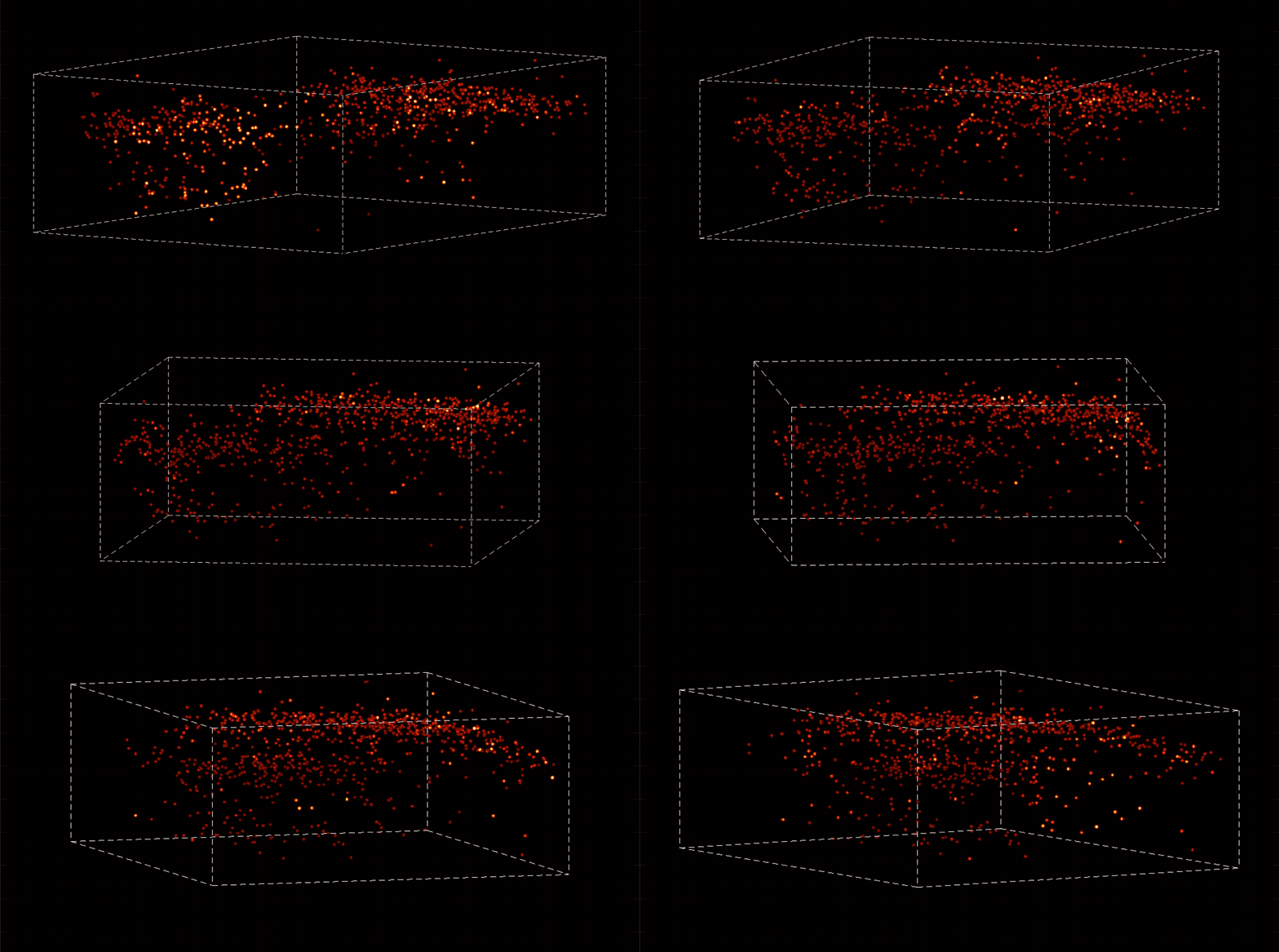
“Until now, no one has been able to detect how these different neurons, which can be located at different depths within a volume of brain tissue, dynamically interact with each other in a freely moving rodent,” says Vaziri. Similarly, the tool can be used to record the interplay among neurons when two animals meet and interact socially.
Light show
The technology consists of a tiny microscope attached to a mouse’s head and outfitted with a specialized group of lenses called a microlens array.
These lenses enable the microscope to capture images from multiple angles and depths on a sensor chip, producing a three-dimensional record of neurons blinking on and off as they communicate with each other through electrochemical impulses. (In the experiments, the mouse neurons are genetically modified to light up when they become activated.) A coaxial cable attached to the top of the microscope transmits the data for recording.
The head-mounted gear weighs only four grams, but Vaziri expects that planned modifications will make it even lighter.
Once the microlens array captures sensor images from within a volume of brain tissue, the next challenge is to process this raw data. Brain tissue is opaque, making it difficult to pinpoint the source of each neuronal light flash. Vaziri’s team solved this problem, which is the result of so-called scattering, by developing a new computer algorithm.
Scientists see neurons fire in brain of flying bat
“The algorithm utilizes the statistical properties of neurons’ distribution in space and in activity,” Vaziri explains, “while extracting additional information from the scattered emission light. This enables their activity to be simultaneously and faithfully recorded within a volume despite the highly scattering tissue properties.”
The result is a clear image that shows individual neurons flashing in sequence.
A better way
Vaziri’s lab has previously applied this algorithm, known by the acronym SID, in studies in which researchers secured the heads of the mice in fixed positions. Their latest research is the first to demonstrate that researchers can use these inventions together with a tiny microscope called the Miniscope, which a collaborating team at the University of California, Los Angeles developed, to measure neuronal activity volumetrically in unconstrained animals.
The technology, if widely adopted, could offer several advantages over two-photon microscopy, a broadly used neuroscience tool. For example, two-photon microscopy records neuronal activity within individual focal planes—thin, virtual “slices” of the sample—that then are combined to create a three-dimensional image.
Holographic brain device would edit our senses and memories
In contrast, Vaziri’s method immediately captures data in three dimensions over an entire volume of tissue, making it faster and more effective.
Vaziri plans to continue developing tools to record neuronal activity in even larger portions of the brain than currently possible, and at higher speeds and resolution.
“We hope this work will ultimately lead to a deeper understanding of how the brain processes information underlying the generation of behavior,” he says.
A paper describing the work appears in Nature Methods.
Source: Rockefeller University
The post Tool gives scientists a glimpse of real-time brain activity appeared first on Futurity.
How Talks with North Korea Convinced Trump to Scrap the Iran Deal
Didier “Ice” IcemanLa théorie du Chaos façon Trump est effectivement un risque en diplomatie
Moments after he declared the U.S. was pulling out of the Iran nuclear deal, President Trump seemed to abruptly switch topics to announce that Secretary of State Mike Pompeo was on his way to North Korea to prepare for Trump’s meeting with the nuclear-armed despot Kim Jong Un.
What seemed to be a jarring aside was actually part of Trump’s decision to reimpose U.S. sanctions against Iran.
Over the past two months, Trump has come to see his policy toward North Korea as a success and believes his unusual combination of insults and biting economic sanctions appears to have brought Kim to the table. Now, Trump wants run the same playbook against Iran.
“Today’s action sends a critical message: The United States no longer makes empty threats. When I make promises, I keep them,” Trump said, standing at a lectern in the White House’s Diplomatic Room. Then he brought up Pompeo’s trip: “In fact, at this very moment, Secretary Pompeo is on his way to North Korea in preparation for my upcoming meeting with Kim Jong Un. Plans are being made. Relationships are building.”
Foreign policy experts have warned for months that if Trump backs out of the Iran deal, it will make it harder to convince North Korea that the U.S. will live up to any commitments brokered as part of an agreement to remove nuclear weapons from the Korean Peninsula. But Trump and his aides disagree. Ditching the Iran deal, in their view, shows North Korea’s young despot that Trump won’t accept terms that allow for Kim to eventually restart a nuclear program.
“Another aspect of the withdrawal that was announced today is to establish positions of strength for the United States, and it will have implications not simply for Iran, but for the forthcoming meeting with Kim Jong Un of North Korea,” National Security Advisor John Bolton told reporters in the White House press room after the President spoke. “The message to North Korea is the President wants a real deal.”
While he’s on the ground in North Korea, Pompeo will be asking Kim to discuss returning to commitments North Korea made when it signed the South-North Joint Declaration on the Denuclearization of the Korean Peninsula, which included shutting down uranium enrichment and plutonium processing, among other things, Bolton said.
Non-proliferation experts said Trump may be generating a crisis where there wasn’t one. Iran has limited its capacity to enrich uranium, and by going back on the U.S. part of the bargain, Trump may be risking that. Trump’s action doesn’t automatically end the deal — China, Russia, Germany, France and the U.K. were also signatories of the deal and have said they would continue to adhere to the terms — but it exposes foreign companies to possible U.S. penalties for doing business in Iran.
Iran’s President Hassan Rouhani chastised the U.S. for not living up to its commitments, but indicated Iran may try to weather the restoration of U.S. sanctions, hoping to continue doing business with other signatories of the 2015 deal, also known as the Joint Comprehensive Plan of Action. “It is possible that we will face some problems for two or three months, but we will pass through this,” Rouhani said, adding that Iran would like to keep “working with the world and constructive engagement with the world.”
Trump’s negotiating skills — honed in the New York real estate world — are still being tested on the world stage. He hasn’t gotten any permanent concessions out of North Korea yet, and his saber rattling on trade has yet to show dramatic results for the U.S.
“It’s not clear that the Art of the Deal works,” said Mark Dubowitz, CEO of the Foundation for Defense of Democracies, who has advocated or fixing shortcomings in the Iran deal. “Obviously Trump has an appetite for risk that has led him to huge successes and four bankruptcies. This is clearly another example of a hugely risky negotiating strategy that could yield extremely positive results or be a potential disaster.”
The President’s decision to pull out from the deal is “foreign policy malpractice,” said Thomas Countryman, a 35-year career diplomat who retired last year after leading the State Department’s nonproliferation efforts. It creates a long list of concerns, he said, including provoking Iran to restart uranium enrichment, handicapping ongoing IAEA nuclear facility inspections, and stoking tensions in an already tumultuous region.
“It’s an unjustified decision with no explanation on how to improve the JCPOA or prevent Iran from obtaining a nuclear weapon,” Countryman said. “This is not a Trump Hotel where you can go to bankruptcy court and start all over again. Multilateral agreements don’t work that way.”
With reporting from W.J. Hennigan/Washington

You Can Now Run Linux Apps On Chrome OS
Didier “Ice” Icemanpas vraiment une bonne nouvelle?
Read more of this story at Slashdot.
The Price of Google's New Conveniences? Your Data
Didier “Ice” IcemanOn ne s'en doutait pas
How Pulling Out of the Iran Nuclear Deal Could Hurt the U.S. Economy
Didier “Ice” Icemanun point de vue
President Donald Trump promised crippling sanctions targeting Iran and anyone that helps develop its nuclear program as he announced the U.S. will withdraw from the Iran nuclear deal.
“We will be instituting the highest level of economic sanction,” Trump said in remarks at the White House. “Any nation that helps Iran in its quest for nuclear weapons could also be strongly sanctioned by the United States.”
But one country the sanctions could also hurt that he didn’t mention: the United States.
The new sanctions will target the Iranian oil sector, reducing energy companies’ business with Iran and increasing the price of oil. But the reduced Iranian supply could lead to sustained high oil prices and further geopolitical instability, in turn contributing to inflation and slowing economic growth at home.
“The consumers are going to shoulder the bill,” says Greg Sharenow, an executive vice president at PIMCO, an investment management firm. “The U.S. economy will face headwinds from prices that will come as a natural result of this.”
Read More: How Talks with North Korea Convinced Trump to Scrap the Iran Deal
The consequences of withdrawing from the agreement may not be clear in the short term. In fact, Iranian oil production will likely remain steady or even increase as foreign companies try to establish a higher baseline from which to negotiate reductions.
But the effect of sanctions will likely pick up as sanctions take effect, analysts say. A report from Barclay’s bank suggests that Iranian oil supply could be reduced by up to 600,000 barrels per day, approximately a third of its exports in 2016. The country was the world’s fifth greatest oil producer in 2017.
The prospect of losing Iranian oil supply is one of many factors that has led prices of the commodity to rise rapidly in recent months to more than $70 a barrel, up nearly 50% from over a year ago. Falling production in Venezuela amidst the country’s political upheaval, general geopolitical instability in the Middle East and cuts to production orchestrated by OPEC and Saudi Arabia have all contributed to high prices.
Energy companies in the U.S. could potentially make up for some the supply difficulties by increasing production of abundant shale and offshore oil. Indeed, some analysts say they expect the U.S. supply could stem the effects of lost Iranian supply.
But those companies face their own set of challenges. The U.S. oil and gas industry faces a labor shortage particularly in some of its high-growth regions and the industry has struggled to build the pipeline infrastructure necessary to ship their product around the country. The companies are likely to spend additional revenue from higher prices on share buybacks, distributions to shareholders and paying down debts, says Sharenow.
Americans consumers may soon notice the pinch. Retail gas prices have ticked up and are expected to be at the highest summer levels in four years, according to a projection from the Energy Information Administration. Consumers in the past have cut spending as gas prices eat into their discretionary budget.
The White House appears aware of the threat that rising oil prices pose to the economic growth of the Trump era. Trump himself targeted OPEC on Twitter in April as oil prices continued to rise.
Looks like OPEC is at it again. With record amounts of Oil all over the place, including the fully loaded ships at sea, Oil prices are artificially Very High! No good and will not be accepted!
— Donald J. Trump (@realDonaldTrump) April 20, 2018
Beyond tweets, the Administration could try to push Saudi Arabia and other oil rich allies to increase production. But Saudi Arabia benefits from increased prices and the IMF estimates that the country will need prices at $70 a barrel to break even. Saudi officials have said they would like to see prices continue upward. Indeed, the country orchestrated a production cut with OPEC and Russia to nudge prices in that direction. But Saudi officials also do not want prices to cross $100 a barrel, according to a Wall Street Journal report.
“The Saudis have signaled that they’re interested in continuing,” says Antoine Halff, a researcher at Columbia University’s Center on Global Energy Policy and the former chief oil analyst at the International Energy Agency. “Their price appetite is only increasing.”
That means a higher bill for the U.S. — and a new economic and geopolitical challenge for Trump.

Élections législatives au Liban : changer un peu pour que rien ne change
Didier “Ice” IcemanPour mieux comprendre

Aucun changement sérieux n'est attendu des élections législatives qui se dérouleront ce dimanche 6 mai pour renouveler la chambre des députés libanaise. Et pour cause : le pouvoir législatif a miné la loi sur la représentation proportionnelle par des dispositions qui l'ont vidée de toute capacité d'induire du changement. Paradoxalement, le pays est en ébullition pour un scrutin dont on s'attend seulement à ce qu'il soit contesté, en raison de débordements sans précédent qui l'entachent déjà.
Si une température élevée et le délire sont les symptômes de la fièvre, cela s'applique parfaitement à la situation libanaise. Et à l'approche du 6 mai, date des premières élections législatives depuis 2009, on est dans le pic de cette fièvre. Les bulletins d'information, les rapports sécuritaires et les « urgent » qui tombent en permanence sur les smartphones maintiennent le citoyen sous tension.
Urgent : une bombe désamorcée dans la ville d'Al-Mina
Urgent : des jeunes attaquent un bureau électoral à Beyrouth et s'affrontent avec les partisans d'un candidat X
Urgent : des portraits du candidat X brûlés à Saïda, affrontement avec les auteurs
Bataille à coups de couteau à cause de l'arrachage de portraits du candidat untel...
Un candidat arrêté pour détention de stupéfiants puis libéré
Ce n'est là qu'un petit aperçu des rumeurs sécuritaires qui circulent en « mobile » d'une région à l'autre ; certaines sont fabriquées pour des raisons électorales, d'autres sont le produit « naturel » d'une tension sociale qui existait déjà pour de nombreuses raisons. Et le fait que le pays se trouve sur la ligne de faille d'un possible séisme géopolitique régional n'est pas la plus importante des raisons.
À cela s'ajoutent des éléments surréalistes : par exemple, le ministre de l'intérieur qui supervise l'organisation des élections est lui-même candidat ! C'est le cas aussi de son chef de gouvernement et de 17 autres ministres, tous candidats en étant toujours en poste dans l'exécutif. Et ils n'hésitent pas à utiliser les moyens de l'État mis à leur disposition en tant que ministres.
Mélange des genres
Au Liban, le cumul de la fonction ministérielle avec celle de député est permis, tout comme être candidat à la députation et assurer en même temps la coordination de la Commission de supervision des législatives. Dans le nord du pays, le gouverneur accompagne le chef du Courant du futur dans ses tournées électorales. Les chaînes de télévision se sont transformées en canaux de publicité électorale, leur octroyant une place incroyable dans leurs programmes, en contradiction flagrante avec la loi.
Des consuls et des diplomates étrangers se mêlent des enjeux électoraux libanais avec une effronterie ahurissante. Certains d'entre eux, comme l'ambassadeur saoudien, se permettent de visiter des régions libanaises où vont se dérouler des batailles électorales pour soutenir des candidats, sans même prendre la peine d'en informer le ministère des affaires étrangères. Un découpage des circonscriptions élaboré en fonction des allégeances politiques aux gens du pouvoir et des appétits confessionnels. Une commission de supervision des élections sans efficacité, de l'aveu même de son président, car sans « prérogatives » et qui se retrouve contrainte par la loi à « coordonner » ses activités avec le ministre de l'intérieur, Nohad Machnouk, lui-même candidat.
La représentante de la société civile au sein de la Commission de supervision des législatives, Sylvana Lakkis1 a démissionné, en raison, a-t-elle dit, de « l'ingérence de Machnouk, de sa confiscation de certaines prérogatives de l'instance et du non-versement des fonds destinés à son fonctionnement. »
À cette situation chaotique s'ajoute la méconnaissance des citoyens du nouveau code électoral. Les Libanais n'ont pas assimilé une loi adoptée en juin 2017 en raison de nombreuses dispositions « complexes » élaborées pour permettre aux grandes forces politiques en place de rester au pouvoir. Et comme si cela ne suffisait pas, des fonctionnaires du ministère de l'intérieur chargés de former ceux qui auront la mission de faire le dépouillement des voix ont montré, eux-mêmes, qu'ils ne savaient que dire de certaines dispositions problématiques de cette loi « taillée »2 dans la précipitation en prévision des conférences de soutien au Liban, comme la Conférence de Rome 2 (organisée à la mi-mars) ou la Conférence économique pour le développement par les réformes et avec les entreprises (Cedre 1) à Paris, le 6 avril dernier.
Saison de la « redistribution des richesses »
L'observateur averti de la finalité de ces élections reste cependant perplexe sur les raisons d'une telle fièvre. Si la proportionnelle « libanisée » permet au pouvoir actuel de revenir pratiquement sain et sauf au Parlement, pourquoi toute cette agitation ? Les abus enregistrés jusqu'à présent sont amplement suffisants pour mettre en cause l'honnêteté de ces élections devant le Conseil constitutionnel avant même les opérations de vote, et c'est une situation sans précédent 3.
La réponse ? C'est « al-maoussem », la « saison » ! Le mot est utilisé aussi bien dans les médias qu'au niveau populaire pour désigner n'importe quel scrutin au Liban. Les élections, municipales ou législatives, constituent une occasion rare pour des citoyens appauvris par les politiques publiques successives d'obtenir un peu d'argent en contrepartie de leur vote. C'est une sorte de « réalisme désespéré ».
De nombreux Libanais pensent qu'il est vain d'essayer de changer un régime politique féroce et enraciné. Certains (la majorité ?) se disent qu'il faut au moins arracher quelques sous à l'occasion. Du coup, ceux qui font de l'esprit qualifient l'échéance des élections législatives de « saison de la redistribution des richesses ».
Une aubaine pour les télévisions
La « saison » est également une opportunité de travail pour de nombreux secteurs en situation de récession. Les imprimeries, par exemple, attendent avec impatience les élections municipales ou législatives. Outre les posters géants, les affiches et les banderoles de soutien tendues au-dessus des têtes dans les rues ou couvrant les murs des villes et des villages, les imprimeries confectionnent également les listes que les candidats tentent de mettre entre les mains des citoyens aux portes des bureaux de vote — chose que la nouvelle loi électorale interdit, la confection des listes étant strictement réservée au ministère de l'intérieur.
Pour les télévisions, le maoussem est une aubaine sonnante et trébuchante qui arrive à travers les publicités électorales et des programmes transformés en propagande politique déguisée (selon la commission de supervision des élections elle-même) pour compenser un marché publicitaire en reflux en raison d'une situation économique dégradée dans l'ensemble de la région. Quant à l'égalité de traitement entre les candidats dans les médias, les optimistes n'ont plus qu'à l'oublier.
Le secteur des transports n'est pas en reste. Le prix de la location des bus électoraux qui transportent les électeurs aux frais du candidat vers les bureaux de vote augmente. La réservation d'un bus pour une journée coûte entre 200 et 300 dollars (167 et 251 euros). Il faut compter également les bus que réservent les candidats fortunés pour transporter les gens aux meetings électoraux.
S'agissant de ceux qui ont les moyens, une des « perles » de la nouvelle loi électorale (article 58) fixe le plafond des comptes de campagne à 150 millions de livres libanaises (84 000 euros) pour chaque candidat et le même montant pour chacun des membres d'une liste électorale. Ce qui fait un montant cumulé de 200 000 dollars (180 000 euros). Une liste avec dix candidats peut ainsi entraîner des dépenses jusqu'à deux millions de dollars, en conformité avec la loi. Ce qui constitue une somme énorme et consacre légalement l'inégalité entre les candidats. Surtout si on y ajoute les 5 000 livres (2,78 euros) que le candidat a le droit de dépenser pour chaque électeur de sa circonscription, selon le même article 584.
Billets d'avion offerts aux électeurs
Un élément nouveau a été introduit dans la loi électorale avec le vote des expatriés dans les pays arabes (27 avril) et dans les autres pays (29 avril) où il existe des ambassades et des consulats libanais. Sur le plan formel, la disposition est excellente. Elle donne aux expatriés libanais, dont le nombre est le double des résidents, la possibilité de participer à l'avenir d'un pays qu'ils ont quitté ou qu'ils ont été amenés à quitter du fait des politiques menées par le pouvoir depuis l'accord de Taëf (30 septembre 1989) qui a mis fin à la guerre civile libanaise.
Les optimistes diront que cette disposition est de nature à limiter la corruption des expatriés avec le billet d'avion « pour rendre visite à la famille et… voter » — un billet payé, bien entendu, par le candidat. Mais c'était sans compter avec « l'alchimie libanaise ». La nouvelle loi sur les dépenses électorales énonce franchement une légalisation de cette forme de corruption électorale. La loi dispose en effet que le candidat a le droit de « prendre en charge le prix des billets d'avion de ses électeurs » afin qu'ils puissent venir au Liban pour voter malgré la disponibilité de bureaux de vote dans les pays où résident les expatriés libanais.
La palme en matière de ruse revient peut-être à quelqu'un qui complote contre le duo chiite Amal-Hezbollah dans la région de la Bekaa. Il a proposé tout simplement aux électeurs, majoritairement chiites, un billet d'avion gratuit pour visiter le mausolée de l'imam Hussein en Irak, un voyage aussi tentant que la visite du Vatican pour des catholiques fervents. Les électeurs ont relevé cependant une chose étrange : la date de la visite avec prise en charge totale coïncidait avec la date du 6 mai, le jour du déroulement du scrutin.
L'heure de l'amnistie générale
Comme c'est le maoussem, c'est donc un bazar ouvert à toutes les possibilités. Des parents des personnes faisant l'objet d'un mandat d'arrêt dans la Bekaa (à majorité chiite) ont bloqué la route à plusieurs reprises pour réclamer une amnistie générale. Ils ont été rejoints par les parents des islamistes (sunnites) arrêtés et poursuivis pour implication dans des actes terroristes et des agressions contre l'armée libanaise. Ces derniers ont organisé des sit-in mouvants dans le nord du pays et à Saïda pour réclamer, eux aussi, une amnistie générale pour leurs enfants, faute de quoi ils retireraient leurs voix aux « leaders » de ces communautés et à leurs candidats. Et voilà que les enseignants du secteur privé obtiennent également un engagement du ministre de l'éducation, candidat lui aussi, sur le paiement des augmentations de salaires avec effet rétroactif… sur le compte du trésor public !
La contagion est telle que le Comité des parents des personnes enlevées durant la guerre civile libanaise (1975-1989) a essayé à son tour de faire entendre ses exigences. Il a mené une campagne suivie d'une conférence de presse pour signifier que les familles des personnes enlevées (le chiffre évoqué est de 17 000 personnes enlevées, donc lire 17 000 familles) ne voteront que pour ceux qui promettent d'inscrire leurs revendications dans leurs programmes. Parmi ces revendications, la création d'une banque d'ADN afin que le sort des personnes enlevées ne soit pas oublié à la mort de leurs parents. Mais il est hautement improbable que la demande soit prise en compte par ceux qui sont au pouvoir actuellement, et pour cause : les plus puissants d'entre eux sont justement ceux qui ont participé à la guerre civile et sont responsables de la disparition de la plupart des ces personnes. Depuis qu'ils se sont accordé l'amnistie en mars 1991, ils refusent de reconnaître leur responsabilité et de révéler le sort de ces disparus.
Opportunisme de la classe politique
Si les citoyens saisissent l'opportunité de la « saison » pour obtenir satisfaction à certaines de leurs demandes, l'opportunisme a un autre goût s'agissant des partis en lice dans les élections. La manière dont sont confectionnées les listes constitue un spectacle très éloquent. On attend du système des listes la défense d'idées, de plans ou de programmes qui rassemblent et justifient une alliance. Or, la plupart des candidats libanais actuellement au pouvoir (ministres, députés, chefs de gouvernement) ne semblent avoir constitué leurs listes que dans un seul but : obtenir leur siège au Parlement par n'importe quel moyen. Pour cela, certains n'hésitent pas à s'allier avec ceux qu'ils considéraient il y a peu comme autant d'incarnations du diable. Ces alliances opportunistes ont accentué la confusion des Libanais, fortement soumis aux clivages communautaires pour des raisons électoralistes. Ils ne comprennent pas comment ils doivent avaler la couleuvre du nouvel « allié » qui était présenté comme le diable dans le passé et pour lequel ils doivent voter aujourd'hui ! Ni comment ils peuvent voter pour lui dans une circonscription et contre lui dans une autre.
Seul le rassemblement Koulouna Watani (Nous tous, mon pays), reste en dehors de ces pratiques immorales. En sont membres l'ancien ministre Charbel Nahas et son courant Mouwatinoun wa mouwatinat fi Dawla (Citoyens et citoyennes dans un État), le parti communiste libanais qui a refusé de s'allier aux partis du pouvoir. On y retrouve également des collectifs de la société civile qui ont émergé durant la « crise des ordures » comme Badna nhasseb (On veut des comptes), Tal3ate rihatkoum (Vous puez) et d'autres. Il est cependant improbable que ce rassemblement obtienne un nombre élevé de sièges en raison de cette loi électorale inique. Avec des moyens limités, ce groupe qui ne compte que sur son financement propre n'est pas parvenu à présenter des listes dans plusieurs des quinze circonscriptions.
Il y aurait beaucoup plus à dire sur les « merveilles » de cette nouvelle loi électorale qui exprime deux choses à la fois : la fertile imagination des profiteurs du statu quo, et leur capacité à imposer ce qu'ils veulent d'une part, et la grande impuissance citoyenne à provoquer un changement viable d'autre part.
Les élections vont donc avoir lieu à la date prévue. Les élus reprendront leurs sièges en faisant mine d'avoir changé et en laissant entendre que la majorité des citoyens ne veut pas les remplacer. Comme on dit quand on veut exprimer une situation d'impuissance : Allah Ghaleb ! (on n'y peut rien !)
#
Traduit de l'arabe par Hamid Larabi.
1Sylvana Lakkis préside l'Union des handicapés du Liban ; elle représente la société civile au sein de la commission de supervision des élections législatives.
2Dans un article publié par Al-Akhbar, Wafik Kanso a rapporté le constat fait par des chefs de bureau qui ont participé à des séances de coaching sur les opérations de dépouillement des voix en conformité avec la nouvelle loi. « Des chefs de bureau qui participaient à trois groupes différents ont découvert que leurs coaches du ministère de l'intérieur avaient donné trois réponses différentes à une même question ».
3Le Conseil constitutionnel fonctionne actuellement par défaut, le mandat de ses membres ayant pris fin depuis près de trois ans. Pour des raisons obscures, le conseil des ministres n'a pas pris d'initiative au cours des dernières années pour désigner de nouveaux membres, la chambre des députés non plus. Le Conseil constitutionnel est désigné de manière paritaire par les pouvoirs exécutif et législatif. Il continue ainsi à fonctionner sur la base de l'article 4 de son règlement intérieur (situation d'exception).
4La nouvelle loi électorale fixe en son article 58 les dépenses électorales. De nouvelles dispositions ont été introduites qui permettent aux candidats de payer les frais de transport des électeurs venant de l'étranger et les dépenses pour les sondages. D'anciennes dispositions permettant de couvrir les frais de transport des électeurs et des participants aux campagnes électorales ont été maintenues.
Cambodge. Gros coup dur pour la presse indépendante
Didier “Ice” IcemanLa purge continue

Le retour des Dr Folamour
Didier “Ice” IcemanL'Iran veut aussi un équilibre regiinal
Le président américain a décidé le 8 mai de rompre l'accord sur le nucléaire iranien, qui cherche à brider les ambitions nucléaires de la République islamique, mais contre lequel ferraille Donald Trump depuis plusieurs années, assisté de son compère israélien Benyamin Netanyahou. Et tant pis si, à quelques jours d'un sommet avec le Nord-Coréen Kim Jong-un, un désengagement des États-Unis devait plutôt apparaître comme un « mauvais signal »…
- Défense en ligne / États-Unis, Armement nucléaire, Iran, Diplomatie, France, GéopolitiqueAnti-fake-news algorithms
Didier “Ice” IcemanA mediter
The Mystical Underpinnings of Facebook's Anti-Fake-News Algorithms.
L’équipe de Trump aurait fait appel à une agence israélienne pour “salir” l’accord iranien
Didier “Ice” IcemanPourquoi ne suis-je pas étonné

Clap de fin pour Chromium et retour au bercail
Didier “Ice” IcemanJe n'ai quitté Firefox que sur une machine anémique mais c'est bon à savoir
Le président iranien condamne l'interdiction de la messagerie Telegram
Didier “Ice” IcemanCela rappelle la.complexité de la.démocratie iranienne

Blog-tuto : Et si j’étais intelligent… artificiellement
Didier “Ice” IcemanPas mon meilleur article...

Waymo's Self-Driving Car Crash Revives Hard Questions
Didier “Ice” IcemanMême si le véhicule n'est pas en cause. ..
Ressources de la planète: la France va vivre à crédit dès samedi
Didier “Ice” Icemande plus en plus tôt...

What should you do when Google gets into bed with the US military?
Didier “Ice” Icemanen tant que client, on sait déjà...
'Next Generation' Flaws Found on Computer Processors
Didier “Ice” IcemanPlus on cherche, plus on trouve
Read more of this story at Slashdot.
Test : Les nuages peuvent-ils être libre? Comparatif de solutions de Cloud grand-public
Didier “Ice” Icemanje le mets là aussi

Mobile Gaming Cements Its Dominance, Takes Majority of Worldwide Sales
Didier “Ice” IcemanOn s'en doutait un peu mais le jeu se passe sur les mobiles
Read more of this story at Slashdot.
California Leads States In Suing the EPA For Attacking Vehicle Emissions Standards
Didier “Ice” IcemanGuerre interne sur la pollution automobile US
Read more of this story at Slashdot.
Mark Zuckerberg Says It Will Take 3 Years to Fix Facebook
Didier “Ice” IcemanEt 3 secondes pour s'en passer
Firefox will show sponsored content that’s personalized but private
Didier “Ice” IcemanTriste

Enlarge / The Pocket recommendations on Firefox's New Tab page.
Mozilla plans to add sponsored content to its Firefox browser in a bid to increase and diversify its revenue stream.
Since the start of the year, the company has been showing some Firefox users links to recommended content on its New Tab page. Some proportion of the recommendations are sponsored, with content producers paying to be included in the list of recommendations. Those links are now also available in the nightly and beta releases. In Firefox 60, due to ship on May 9th, the feature will roll out to all Firefox users in the US.
The recommended links are personalized, with Mozilla saying that the links should be valuable content that's worth taking the time to read. Normally, such personalization raises privacy concerns because effective personalization requires the tracking of personal preferences and habits to ascertain what things a person is likely to be interested in. But Mozilla's personalization is different: it happens entirely on the client side. The browser will download a list of recommended links each day. Each link will also have a list of related websites, with similar kinds of content to that in the sponsored links. The browser will then compare these related sites to your browsing history; if there are lots of matches, Firefox will assume that you're interested in the recommended content and show it to you.
Read 3 remaining paragraphs | Comments
Are Google and Facebook Undermining Europe's Privacy Rules?
Didier “Ice” IcemanUne bonne question