Stair and Silo. From here.
I did my undergraduate thesis project at the Canadian malting Silos, they are impressive in person, and one of the last pieces of industrial history on the Toronto waterfront.
Stair and Silo. From here.
I did my undergraduate thesis project at the Canadian malting Silos, they are impressive in person, and one of the last pieces of industrial history on the Toronto waterfront.
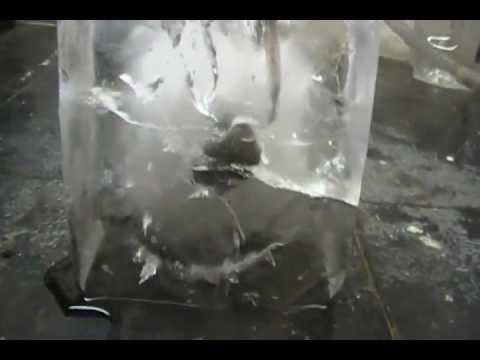
How do you get over a million YouTube views in just a couple of days?
1. Heat a nickel ball with a blowtorch until it's redhot
2. Put it on top of a block of ice
3. ???
4. Internet Profit!
Hit play or go to Link [YouTube]
firehoseI will die of everything


POST-CITY via NDLR
«Post-city», the theme proposed by the Luxembourg Pavilion for the XIII Biennale of Architecture in Venice requires a long process of reflection and research. Part of the «Common Ground» topic initiated by David Chipperfield, it must not be merely a striking slogan for the benefit of architects who have never reflected on this subject and whose sole concern is to «construct» as many parts of the town as possible… Already at the XIth biennale a similar topic was proposed to leading architects: «Architecture beyond building». This was interpreted as a kind of improvised vacation, an excursion into the unknown territory of Art by professionals whose main ( and legitimate ) interest was in constructing square kilometers of «buildings»


Technical drawings from the Centrifuge Brain Project
In this brilliantly fun mockumentary from German filmmaker Tim Nowak, a man named Dr. Nick Laslowicz from the Institue for Centrifugal Research (ICR) recounts his “achievements in the realms of brain manipulation, excessive G-Force and prenatal simulations,” stating unequivocally that “gravity is a mistake.” What follows is a series of increasingly terrifying and equally absurd roller coasters that fling passengers into the sky in an attempt to theoretically improve their cognitive function.
Watch the video here
firehosePaul Robertson autoshare

This and other awesome pet-themed pieces will be up or sale at Gallery Nucleus’ Press Paws charity art show in Los Angeles, which kicked off yesterday! This particular 18” x 32” digital print is priced at $450.
SEE ALSO More amazing stuff from Paul Robertson
By Megan Farokhmanesh on Feb 10, 2013 at 3:30p
House Minority Leader Nancy Pelosi isn't sold on the idea of violent video games, movies and TV shows as the reason for violent behavior in America, according to a recent interview with Chris Wallace of Fox News Sunday.
Research into the effect of violent video games has become a hot topic, with bills making their way back into Congress. According to Vice President Joe Biden, no one should "be afraid of the facts" of doing research.
Wallace, however, doesn't think that more study is necessary. A video of the interview was posted by The Huffington Post.
"As part of your plan, you call for more scientific research on the connection between popular culture and violence," Wallace said. "We don't need another study, respectfully. I mean, we know that these video games, where people have their heads splattered, these movies, these TV shows — why don't you go to your friends in Hollywood and challenge them? Shame them, and say, 'Knock it off?'"
Pelosi, however, disagreed that violent video games were the only cause.
"I understand what you're saying," Pelosi said. "I'm a mother. I'm a grandmother. But the evidence says that in Japan, for example, they have the most violent games than the rest and the lowest mortality from guns. I don't know what the explanation is for that except they may have good gun laws."

firehosefuck USAopoly

By Megan Farokhmanesh on Feb 10, 2013 at 5:30p
USAopoly is releasing several popular board games reimagined with video game franchises, including Mass Effect, Pac-Man and World of Warcraft, according to a recent press release.
Board games include Risk: Mass Effect Galaxy at War Edition for $49.95, Yahtzee: Pac-Man Collector's Edition for $24.95 and Trivial Pursuit: World of Warcraft for $24.95. All three games are expected to hit shelves in the fall. Meanwhile, Jenga: Space Invaders Collector's Edition, $29.95 and Monopoly: Skylanders, $39.95, will be available this summer.
The announcement came as part of the American International Toy Fair in New York City, which began today. Skylanders board games and a Pac-Man toyline have already been announced.
 |
| Seleen |
 |
| Gorpo |

 |
| SuperGroverFanClub |
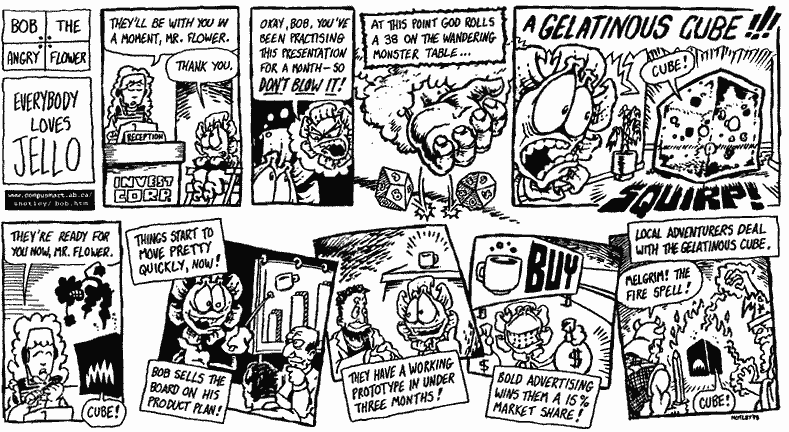
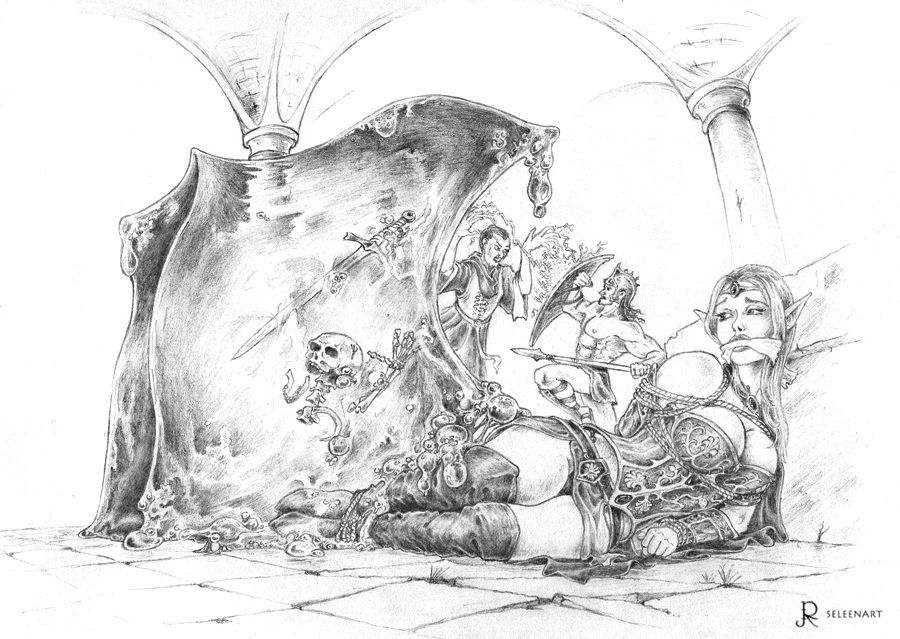
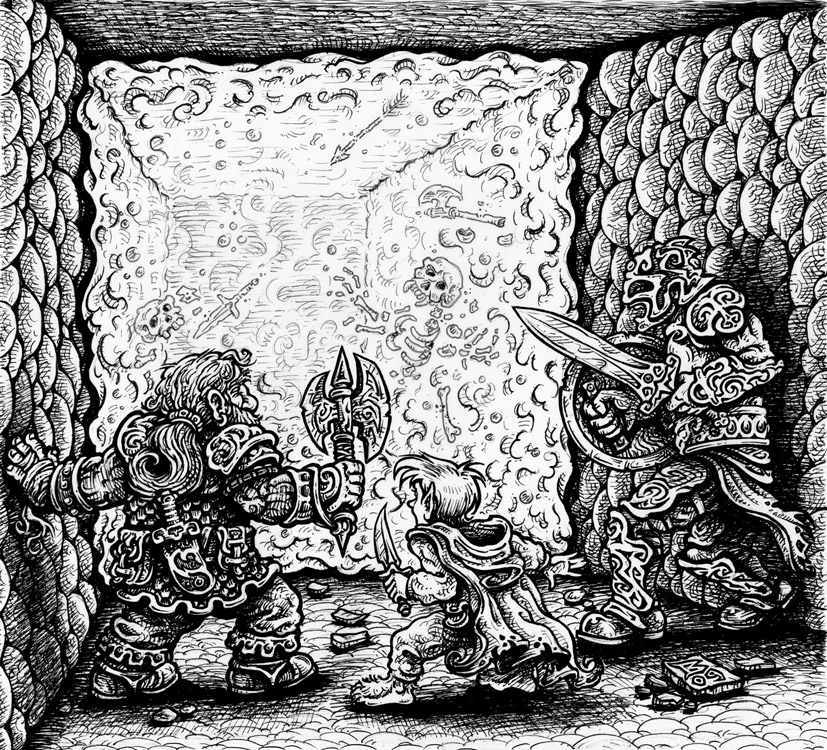
 The Gelatinous Cube
 | Number Encountered: | 1 | Attacks: | 1 |
| Alignment: | Neutral | Damage: | 2d4+special |
| Movement: | 60' | Save: | F2 |
| Armor Class: | 8 | Morale: | 12 |
| Hit Dice: | 4 | Hoard Class: | VII |
| Experience: | 245 |


”…We thought we were being very daring at the time: Lawrence and Omar…”
David Lean
 Editor’s Note: Reddit. Facebook. YouTube. Twitter. These days it’s difficult to go anywhere online without encountering an anonymous troll (or ten). Debates about trolling, which is best described as deliberately antagonistic or otherwise provocative online speech and behavior, have even seeped into congressional hearings. In research conducted between 2008 and 2012, Whitney Phillips @wphillips49 –who received her PhD in English with a Digital Culture/Folklore emphasis from the University of Oregon– investigated the origins and subcultural contours of online trolling. Using a combination of cultural studies, new media studies and ethnography, Whitney postulated that there is more to trolls and trolling behaviors than detractors might initially think.
The subject of Whitney’s research leads us to ask, how does one conduct ethnographic research on an anonymous, and at times malicious, online population? In the first post of her three-part guest series, Whitney shares with us how she tackled the ethical pitfalls of her groundbreaking research. She also discusses how these pitfalls allowed her to make larger claims about trolling, with particular focus on the striking overlap between trolling and mainstream behaviors. We look forward to her next post on her participant observation expeditions with trolls.
Check out past posts from guest bloggers.
___________________________________________________________
My name is Whitney Phillips, and I study trolls. Well, not just trolls. I’ve also written about meme culture, so-bad-it’s-good fan engagement (my essay on the kuso aesthetic in Troll 2 is forthcoming in Transformative Works and Cultures), and online shaming. But for the better part of five-ish years, my life has revolved around trolls and the trolls who troll them. The title of my dissertation—THIS IS WHY WE CAN’T HAVE NICE THINGS: The Origins, Evolution and Cultural Embeddedness of Online Trolling—pretty much says it all.
As I will discuss in this and several subsequent guest posts, my research experiences have been something of a mixed bag. Writing about trolls (to say nothing about working with trolls) has certainly been engaging, but has also proven to be the most consistently frustrating, challenging, and at times downright infuriating endeavor I have ever attempted. Which is one of the main reasons it has been so engaging, go figure.
Because in the end, it was the complications—the incomplete data sets, the trolls’ endless prevarications, the incessant march of subcultural change—that gave rise to my basic argument, the nutshell version of which can be found in my response to the Violentacrez controversy. As I argue, trolls are agents of cultural digestion; they scavenge and repurpose mainstream content, allowing one to extrapolate what’s going on in the dominant culture by examining what’s going on in the troll space. I could not have written my way into this argument if things had gone according to plan. I needed those roadblocks, even if at the time they made me want to rip out my hair.
The first and most initially intimidating of these roadblocks was the fact that my research subjects were anonymous. And not just anonymous (i.e. nameless), but in the case of trolls on 4chan’s /b/ board, Anonymous (i.e. the Internet Hate Machine, at least from the mid/late 2000s-around 2010).* Although this fact certainly sped up my IRB request (research conducted with anonymous subjects is designated exempt, so while I was required to submit a research protocol it was quickly and painlessly approved), it complicated everything else.
For one thing, and most obviously, I had no way of knowing who exactly I was dealing with. Who the trolls “really” were in real life—in terms of race, class, gender, sexual orientation, employment, level of education, and any other relevant information—was simply unverifiable. There is no trolling census; there is no stat box to click whenever you encounter some anon on 4chan. Sometimes the trolls would self-identify as this or that, but even these details were suspect. They were trolls, after all. Even during my research on Facebook, which was more directly participatory (on 4chan I was primarily an observer, while on Facebook I was able to embed myself within a group of RIP trolls), trolls would often joke about telling me nothing but lies in between telling me what they swore was the truth (Gabriella Coleman discusses a similar dynamic in her paper “The Ethnographers Cunning: The Return of the Arm Chair and Keyboard Anthropologist,” which she presented at the annual meeting of the American Anthropological Association in 2011). I can’t count the number of times a troll—even trolls I “knew” “well” from months and months of online interaction—would recount some involved personal trauma and then turn around and “lol jk” me. This was always much funnier to them than it was to me.
Trolls’ anonymity didn’t just hinder my ability to establish concrete demographics. It also made it almost impossible to reach out to potential research subjects, particularly while researching 4chan’s /b/ board, which is neither searchable nor archived (at least not on-site, though there are some third party archiving services like chanarchive that save backups of more popular threads). Questions of anonymity were thus compounded by questions of ephemerality. Not only would threads shuffle off the server coil within a half an hour, sometimes even faster, the identities of participants on each thread were, and could only be, a mystery. Though trolls on Facebook were somewhat easier to track down (I was sometimes able to get in touch with particular trolls with the help of existing collaborators), these trolls often operated behind a half dozen alt accounts, many of which were throwaway (i.e. created for one specific raid) and therefore not easily traceable.
One implication of having limited access to my research subjects was that questions of motivation were, and had to be, taken off the table. Not because I wasn’t interested in why trolls did what they did. Of course I was interested. But more often than not, I had no way of interacting with the troll(s) in question, and therefore no way of asking. Even when I could ask, there was no way to know if the trolls’ answers were genuine or merely part of the performance. Or maybe a little bit of both, as I suspect was usually the case.
Instead of trying to mine information that simply wasn’t available to me, I decided to focus on the information that was. My primary line of inquiry thus shifted from “what do trolls feel about what they do” to the much simpler “what do trolls do.” And what trolls do is engage in behaviors that are gendered male, raced as white, and marked by privilege. This demographic might not be literal, but it is symbolic—and more importantly, it is verifiable. Also verifiable are the ways in which trolls’ behaviors gesture towards, and in some cases directly parrot, ostensibly “normal” mainstream attitudes and behaviors. For example, trolls’ rhetorical and behavioral tactics—particularly in response to mass-mediated tragedy—echo precisely the sensationalism, spectacle, and emotional exploitation routinely deployed by corporate media outlets. Furthermore, their grotesque pantomime of masculine domination and white privilege call direct attention to remaining strongholds of institutionalized sexism and racism. This I could see, this I could confirm, and so this is what I chose to focus on — from which emerged my theory of cultural digestion, which is comparable to the process by which a scientist might infer an animal’s diet based on its –shall we say– “output” (just let the metaphor sink in; you’re welcome). In the process of grappling with what I couldn’t know, in other words, I stumbled upon a thesis.
Anonymity wasn’t the only solution wrapped in a roadblock wrapped in weird metaphors and a migraine. Even more difficult to navigate was the fact that the troll space kept changing. Not just in terms of the seemingly endless stream of memes either created or amplified by trolls, although those were slippery fishes unto themselves (for the basic and practical reason that by the time I’d written an explanation of a specific meme, the meme would have undergone further iterations). Additionally, and much more problematically, the subculture itself changed. Originally, I was writing about present-progressive behaviors: trolls on 4chan’s /b/ board and on Facebook were still doing the things I was discussing. By 2010, I found myself using the past tense more and more frequently (for an example, see my contribution to Henry Jenkins, Sam Ford and Joshua Green’s Spreadable Media). By mid-2011, past tense had become the default, particularly after Facebook began pushing back (and pushing back hard) against on-site trolling. At first I was reluctant to acknowledge this shift, because—well because I’d been working in the vein of present tense for so long. I couldn’t, and frankly wasn’t willing, to see past my original blueprint. But as much as I may have wanted to, I couldn’t ignore my own findings.
And so, as always, I improvised. The troll space was changing; trolling subculture was changing (but not disappearing, not exactly; trolling behaviors are as prevalent now as they were then. But a great deal of what emerged from the subcultural ooze in the early/mid 2000s, including a very specific understanding of the term “troll,” has since been folded into more mainstream internet culture, which is a discussion unto itself). Instead of fighting these changes, I decided to place them front and center. Though it had started as an examination of emergent online behavior, the dissertation had grown into a study of the subcultural lifecycle—hence the subtitle “The Origins, Evolution and Cultural Embeddedness of Online Trolling.”
However frustrating this decision might have been in the moment (again, sometimes a gif is worth a thousand words), this was the best thing that could have happened to me and to my project. For one thing, it forced me to consider the academic shelf life of my arguments. I had already encountered some resistance to my project on the grounds that it was a “novelty” topic; I needed to make sure the dissertation remained readable and relevant even in the face of profound subcultural change. For another, the painful realization that I was dealing with a moving target forced me to think carefully about the relationship between trolling subculture and the dominant culture, particularly in the United States. This lead me back to my theory of cultural digestion. If this theory were true, if trolls really were cultural scavengers, it would stand to reason that as mainstream culture changed, so too would trolling subculture–a theory born out by the changes I was (nervously) watching unfold, and which I decided to address in my seventh chapter, titled “The Lulz are Dead, Long Live the Lulz: From Subculture to Mainstream.” The connection between trolls and the culture that spawned them was already there, it’s just that I hadn’t yet realized what questions to ask, and therefore which dots to connect. I needed a catalyst, and it came in the form of a methodological crisis.
Needless to say, this wasn’t a pretty process. (A thousand blessings upon all those who tolerated my…let’s say fluctuating moods.) But by dismantling my project and rearranging all the pieces, I was able to build an infinitely stronger argument, one that ended up being as much a cultural postmortem as it was a subcultural case study. I could not have done this if I had not had ALL OF THE RUGS continuously pulled out from under me, and for that I am very grateful (if still somewhat bruised).
I’ll be expanding on that theme in my next post, which will focus on my role as participant observer within the troll space. SPOILER ALERT: it was weird. Till then, then…
*In recent years –I’d place the cutoff around late 2010– the already-nebulous mass noun “Anonymous” has become even trickier to characterize. What once was nearly synonymous with chaos and trollish disruption has taken on increasingly activist connotations, particularly post-Occupy. For more on this (still unfolding) transition, see Gabriella Coleman’s outstanding work on the political arm(s) of Anonymous.
(all gifs courtesy of PhD Stress, a very funny single-topic Tumblr)


 Editor’s note: While ethnographers sometimes encounter resistance from their research subjects, it’s not everyday that these subjects threaten to harm or otherwise humiliate the researcher. In her second guest post,Whitney Phillips @wphillips49 tells us how she responded to threats from the community she was studying. Whitney also shares with us how she adjusted her everyday life to her research, how she handled professors’ concerns, and how her analysis evolved over time.
Whitney also reflects on earlier criticisms of her work, giving us an intimate sense of how she negotiated her position within her fieldwork.
Her second post is a fantastic follow up to her riveting post from last month about her ethnographic work on an anonymous community, internet trolls.
Check out past posts from guest bloggers.
________________________________________________________________________
As promised in my last post, this post will discuss my role as a participant observer in the 2008-2012 troll space. It was weird, I hinted, which really is the only way to describe it. Because space is limited, I’m going to focus on three points of overlapping weirdness, namely troll blindness, real and perceived apologia, and ethnographic vampirism. There are other stories I could tell, and other points of weirdness I could discuss, but these are moments that taught me the most, for better and for worse.

It’s Just a Death Threat, Don’t Worry About It
For the first few years of my research project, I kept the lowest public profile possible. I had published a short thought piece on trolls’ relationship to 2009′s Obama/Joker poster, but otherwise was conducting my research in stealth mode. My friends knew what I was working on, sort of, and whenever I could I angled seminar papers towards my dissertation project (an especially neat trick in the Piers Plowman class I took during my third year of coursework). So my work wasn’t top secret, but it wasn’t something you could easily find just by Googling my name — which was exactly how I wanted it.
This changed after I started working on Facebook memorial page trolling (RIP trolling for short), which could run the gamut from harassing so-called “grief tourists,” people who post condolence messages onto the Facebook RIP pages of dead strangers, all the way to attacking the friends and family of murdered teenagers. By 2010, and spurred by that year’s series of gay teen suicides (the coverage of which trolls were more than happy to exploit), memorial page trolling was shaping into a pretty major news story. Because my University of Oregon student bio had recently been updated to include information about my research on the subject, media outlets began reaching out. I did one newspaper interview, which lead to another, which resulted in my name and information being posted onto 4chan’s /b/ board, one of the internet’s most notorious trolling hotspots (my article on /b/ can be found here).
I had been preparing for this, sort of, in the sense that I knew it was a possibility and had taken measures to avoid precisely that sort of exposure. Still, seeing my information on site—I’d been alerted to the thread’s existence by an anonymous troll who thought I at least deserved a heads-up—was nerve-wracking, as was reading through the trolls’ plan to email compromising, Photoshoped pictures of me to all my professors. They also threatened to rape and murder me, but that was pretty standard; I was mostly concerned about what they might cook up on Photoshop. In a moment of panic, I emailed all the professors whose classes I had taken, just in case. I saved the /b/ thread as a PDF and attached it to my message, along with the explanation that the trolls had threatened to kill me, but don’t worry, just let me know if you start receiving any weird emails or pictures.
At no point did it occur to me that one cannot simply walk into the Mordor that is trolling (particularly trolling on /b/) without experiencing a pretty major culture shock. I was so used to trolls and trolling behaviors that the violent, offensive language and images I’d just passed along to all my professors quite literally did not register—not until the next day, when I reopened the PDF I’d saved and noticed all the porn, not to mention the various points of trolling grotesquerie for which /b/ has become infamous. As you can imagine, this gave me a great deal of pause. Because at what point did that stuff become invisible to me? You’d think a person would notice when their brains stopped registering X-rated content. And yet there I was, not seeing the things I was seeing. This proved to be a recurring theme in my research.
inb4 apologist
A few months after I outed myself as a researcher to the RIP trolls I’d been observing, I was scheduled to appear on a radio program for a segment on Facebook memorial page trolling. While waiting for my call time, I opened Facebook chat. One of the trolls I knew –by that point I was embedded within a loose group of high-profile Facebook trolls, many of whom targeted memorial pages– was online, and I struck up a conversation.
After a few minutes, the producer called with the segment panel lineup. I told the troll that I would be afk (away from keyboard) while the producer and I discussed the show. The troll said ok, and I answered my phone. The producer greeted me, thanked me for agreeing to the interview, then explained that I’d be talking to the father of a recent teenage suicide whose RIP page had just been attacked by trolls. The father was distraught and wanted to know why his son had been targeted. He also wanted to know just how evil a person had to be in order to engage in that sort of behavior. Before I had a chance to respond, the producer thanked me again and said to hold tight; he’d call back once the interview was live (for radio interviews, the producer usually calls twice, once to prep you for your interview, and again a few minutes later to patch you into the broadcast).
I hung up and returned to my Facebook chat. The troll I was talking to asked me what happened, and suddenly nervous –there is a big difference between having an academic discussion about trolling and being asked to speak on behalf of all trolls to a grieving father– I explained what the producer had said. The troll was quiet for a few seconds. “Just remember,” he finally said. “It’s not your job to defend us.”
The troll’s reminder struck a nerve. One of the most consistent early critiques of my work (one example can be found here) was that I was an apologist for trolls, or at least that I wasn’t critical enough. This line of criticism was a source of constant anxiety, largely because it contained a kernel of truth. Several kernels of truth, in fact.
The first of these kernels had to do with the vast spectrum of trolling behaviors. As I quickly realized after starting my research, trolling takes many forms, some of which are grotesquely problematic, a point even many trolls would concede (the troll in the above example was disgusted by RIP trolling directed at friends and family of the deceased, and took aggressive steps against those who crossed what he saw as a clear ethical line).
Other forms of trolling are playful and interesting and occasionally even positive. Maybe not directly or deliberately positive, but certainly generative, particularly when trolling behaviors draw attention to racial and/or class bias in news coverage, or corporate greed, or any number of things that trolls seize upon as being unfair or worthy of coordinated retribution.
So, although I was unwilling to apologize for the most problematic trolling behaviors, I was similarly unwilling to condemn all trolling outright. This position was further complicated by my relationship to the trolls I was working with. These relationships were profoundly important to my research, and took a great deal of time to establish and even more energy to maintain. I worried—and it was a legitimate worry—that I would lose this access if I was too publicly critical, and worried—and it was a legitimate worry—that I would lose academic credibility if I was too publicly permissive. Finding the appropriate balance was a daily struggle, and I got things wrong more often than I would care to admit.
In hindsight, it isn’t surprising that I did. After all, while I didn’t set out to defend trolls, I did set out to understand them. In the process of learning their customs and their language, in the process of learning how to “pass” in order to better interact with research collaborators, the distance between myself and my research shrunk in ways that often made it difficult for me to see what I was seeing, as evidenced by my initial anecdote.
Not that I lost all critical faculties. It’s just that my vision would sometimes go fuzzy, and I wouldn’t notice until after the fact. On one hand, this allowed me to see things about the subculture I wouldn’t have noticed otherwise. On the other hand, it meant I constantly teetered on the edge of being too close to my subject.
This was disorienting, and didn’t stop being disorienting until I figured out not just what I wanted to argue, but how I wanted to argue it. Even then, I sometimes needed help recognizing (literally re-cognizing) the contours of my own work, and will forever be indebted to all those people—my PhD advisor Carol Stabile and UO Folklore Program Director Lisa Gilman in particular—for pressing me to keep looking.
You’re a Vampire, Whitney
On the evening on May 2, 2011, I received a text message from my mother saying that my aunt had died. Her death wasn’t a shock—she had been battling aggressive late-stage cancer for months—but like these things always are, it was still surprising. I put the television on mute and just sat there, because what else could I do.
Less than two minutes later, I received what I assumed was a follow-up message about funeral arrangements. Instead, it was a push notification from MSNBC—Osama bin Laden had just been killed, and President Obama was preparing to release an official statement. This was also surprising, though I reacted to this news much more emphatically, with a string of expletives. Not because of bin Laden himself, not because of the politics behind his death (those reactions would come later), but because it meant I had to go spend all night on 4chan and Facebook pouring over the RIP bin Laden/good night sweet prince pages I knew would start cropping up.
This was a solipsistic, knee-jerk reaction, but I didn’t have the space in my brain to deal with trolls, not that night anyway. Still, and as I later wrote in a blurry-eyed blog post, “this shit isn’t going to archive itself.” So I shuffled over to my computer—“dragged my sorry carcass,” as I described it at the time—and sat there for hours taking as many screencaps and notes as I could.
But other than having the wind knocked out of me by my aunt’s death, it was a pretty normal night. The difference was that, in my grief, I was suddenly aware of how abnormal my normal had become. Staring at a screen collecting hundreds of the most aggressive, upsetting images and mean-spirited scraps of conversation—what kind of job was this? The answer, of course, was “the one I signed up for,” which in that moment was very cold comfort.
By that point I had been studying trolls for three years, and was slowly, slowly establishing a theoretical and argumentative foothold. This didn’t mean the work was getting any easier. Because RIP behaviors followed and were spurred by mainstream disaster coverage, I needed to keep my eye on the news cycle; the second something horrible happened, I had to drop whatever I was doing, get myself to a computer, and start mapping the trolls’ responses, and the media’s responses to the trolls’ responses, and the trolls’ responses to the media’s responses to the trolls’ responses, until my head exploded. I would also reach out to my various research collaborators and try and figure out what raids were in the pipelines, and more importantly, who was responsible for what.
In itself, this push to gather information was value-neutral. At the very least, it served a basic practical utility. The more information I had, the stronger my analysis; the stronger my analysis, the better my dissertation; the better my dissertation, the rosier my future job prospects. The problem, of course, was that the information I was gathering wasn’t value neutral. This was tragedy. This was horrible. This was dead kids and teenage suicides and chortling, asshole trolls. That the data was awful, however, did not mitigate the fact that it was ethnographically rich. And that was a very unsettling feeling—appreciation for a dataset I wished didn’t exist.
More often than not, and especially during the height of memorial trolling activity (from March 2010 to mid-2011), my work made me feel like an ambulance-chasing ghoul. Because it wasn’t just that I was chronicling trolls’ responses to other people’s tragedies, I was becoming—and had to become, if I was to retain any shred of emotional equilibrium—hardened to bad news. It was research. It was something to use in my dissertation. Any other approach would have made the work impossible.
It was through these experiences that I began to understand—and begin to theorize—what I eventually came to describe as the mask of trolling, the process by which trolls affect emotional distance from their targets, allowing them to focus on and, ultimately, fetishize, the most exploitable aspects of whatever story. My mask may have been constructed from different stuff than the trolls I was researching—I wasn’t dissociating in order to attack anyone, but rather to do my job; I wasn’t fetishizing the most exploitable aspects of a given tragedy, but was committed to presenting the most illustrative case studies possible—but to put a very fine point on it, I had become a site of that which I sought to understand, and to more importantly, that which I sought to critique. Again.
So, in other words, yes. My research was pretty weird. I don’t think I realized just how weird until sitting down to write this post. I’m not sure how I feel about that.
In my third and final post I’ll be focusing on something decidedly less ambivalent, namely the pitfalls and benefits of academic discipline-jumping. I will be considering inter/transdisciplinarity in terms of my troll research and in my life as an academic who still isn’t sure how to describe her own work. So check your local listings, and see you next month.


firehoseRussian Sledges, re: last photo, RSS stockings (I know they're not but imagine)
Hiromi and Mabataki caught our eye as they were walking in Harajuku, and we stopped them for some quick street snaps.
Hiromi is 16 and he’s a student. He is wearing layered Ekam and Damir Doma outerwear with resale skinny pants and Lithium Homme zipper boots. His clutch is from MM6 by Maison Martin Margiela, and he’s wearing a triple ring. He told us his accessories are from Vivienne Westwood and Damir Doma. He gave us his Twitter, and told us that he really likes SNSD.
Mabataki is also on Twitter, and she’s 17. She is a student with cute pastel hair, worn here with a dog cap and glasses. She’s wearing a black sweater, which was a gift from her grandmother, with resale bottoms and an oversized coat from Uniqlo. Her Bart Simpson tote bag is from Joyrich and her rocking horse shoes with cross ankle straps are from Tokyo Bopper. Mabataki is wearing accessories from Bunkaya Zakkaten and she told us that Joyrich is her favorite brand. As for music, she likes Creephyp best.


Click on any photo to enlarge it.
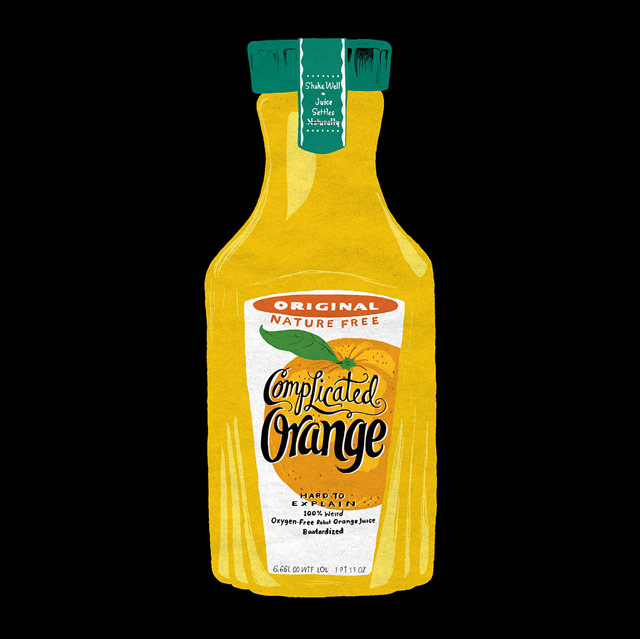
Simply Orange juice is actually not all that simple. The taste of the the Coca-Cola-owned brand is governed by a complex algorithm that allows for the 600+ juice flavors to be tweaked throughout the year to ensure consistency. I liked The Atlantic Wire's take on the news:
The explanation behind Coke's complicated new orange juice scheme is nothing short of ironic. Basically, all of their customers are realizing the soda is really bad for you, so demand is shifting to healthy -- or at least healthy-seeming -- alternatives like juice. Coke also figured out that people are willing to pay 25 percent more for juice that's not processed, that is, not made from concentrate. Enter Simply Orange. It is indeed just oranges, but boy have those oranges been through hell and back.
This is like White Zombie's More Human Than Human except More Orange Juice Than Orange Juice.
Note: Illustration by Chris Piascik...prints & more are available.
Update: I updated the post above to point to Businessweek's original report on Coke's OJ business.
Tags: Coca-Cola foodfirehoseh/t Tadeu
'imagine someone comes along and says,
“I’m really interested in learning to code, but I don’t plan to write any programs and I absolutely abhor tracing program execution. I just want to use applications that others have written, like Chrome and iTunes.”
You would laugh at them! And the first thing that would pass through your mind is either, “This person would give up programming after the first twenty minutes,” or “I would be doing the world a favor by preventing this person from ever writing a program. ..."
Unfortunately this sentiment is mirrored among most programmers who claim to be interested in mathematics. Mathematics is fascinating and useful and doing it makes you smarter and better at problem solving. But a lot of programmers think they want to do mathematics, and they either don’t know what “doing mathematics” means, or they don’t really mean they want to do mathematics. The appropriate translation of the above quote for mathematics is:
“Mathematics is useful and I want to be better at it, but I won’t write any original proofs and I absolutely abhor reading other people’s proofs. I just want to use the theorems others have proved, like Fermat’s Last Theorem and the undecidability of the Halting Problem.”
Of course no non-mathematician is really going to understand the current proof of Fermat’s Last Theorem, just as no fledgling programmer is going to attempt to write a (quality) web browser. The point is that the sentiment is in the wrong place.'


Dedicated to Tiger and Bunny – it’s their anniversary today. Happy anniversary, you two!
With thanks to Matt Groening and Yann Martel, two inspiring and talented guys. Here are more special guests.
aka “don’t forget to close your html tags”
I CAN’T BREATHE
HOLY SHIT
firehosewelp
 CBS News |
Reuters Crowds flood Bourbon Street on Mardi Gras Day in New Orleans, Louisiana February 12,. 1 of 21. Crowds flood Bourbon Street on Mardi Gras Day in New Orleans, Louisiana February 12, 2013. Credit: Reuters/Sean Gardner. Tue Feb 12, 2013 5:50pm EST ... Order of Myths Mardi Gras parade canceledal.com (blog) Live on Bourbon Street during Mardi GrasWGNO Floats rolled in the rain at Gulf Coast Carnival Association Parade in BiloxiSunHerald.com KSEE -Christian Science Monitor -NOLA.com all 665 news articles » |

The Makerbar, Hoboken’s Hackerspace, was in desperate need of a reflow oven. Hurricane Sandy did a number on a whole bunch of household appliances, so when [Kush] saw a neighbor throw out a broken toaster oven, the Makerbar crew sprung into action.
The storm waters shorted the electronics board, fried the existing controls, and basically turned the oven into a metal shell with heating elements. It was the perfect platform for a toaster oven – every part that was going to be thrown out was already destroyed.
[Zach] over at the Makerbar ordered the Sparkfun reflow toaster conversion kit along with a few arcade buttons and set to work. After plugging the heating elements into the mains power to make sure they still worked, [Zach] attached these elements to the relay on board the controller. Three arcade buttons were wired up to the controller, and a whole bunch of code was written.
With the included thermocouple, [Zach], [Kush], and the rest of the Makerbar gang now have a very accurate and reliable reflow oven. There’s also settings for Sculpey clay and shrinky dinks, just in case anyone at Makerbar is feeling a bit creative.


firehoseAccording to Bleszinski, the buff look of the characters wasn't his call, and his writing didn't include the day-to-day work.
"In hindsight having the characters yelling things like "Shit yeah" while in the midst of a life and death situation might not have been the best idea," Bleszinski wrote. "Still, it's things like this that were a signature of the game."
GO AWAY BROS

By Megan Farokhmanesh on Feb 10, 2013 at 11:30a
Launching Gears of War 2's online play was the biggest regret of former Epic Games design director Cliff Bleszinski, according to a recently posted FAQ on his Tumblr.
"It was a huge mistake for everyone involved, unfortunately," Bleszinski wrote. Bleszinski offered additional insight on Gears of War as a whole, including the characters' look and dialogue. According to Bleszinski, the buff look of the characters wasn't his call, and his writing didn't include the day-to-day work.
"In hindsight having the characters yelling things like "Shit yeah" while in the midst of a life and death situation might not have been the best idea," Bleszinski wrote. "Still, it's things like this that were a signature of the game."
According to Kotaku, the FAQ also included a now removed question on Epic's "Samaritan" demo that was shown at GDC in 2011.
"One day I'll be able to give the full story on that," Bleszinski wrote. "It's really a doozy. If journalists nag Epic enough and they give the OK I'd be glad to give details."
In response to questioning from Kotaku, Epic Games echoed Bleszinski in that it was a "doozy," and added that there is no new information about it.
Bleszinski left Epic Games in October 2012 to take a "much needed break" after 20 years in the industry. On his Tumblr, he added that "in becoming the overall 'master of the fun' as Design Director I didn't have 'my baby' project any longer, which was something that I really missed.
"I also had saved enough to just take some time off and roam the earth like Kane in Kung Fu," Bleszinski wrote.
firehoselololololololol

By Megan Farokhmanesh on Feb 10, 2013 at 9:30a
A Dead Space 3 mechanic that allows players to farm infinite resources otherwise available through microtransactions is no glitch, and Electronic Arts has no intention of changing it, GameFront reports.
Following the game's release, speculation arose that resource farming could be considered stealing in light of the microtransactions. Players can loot infinite material from lockers, chests and enemies for crafting, rather than purchasing them. But according to EA PR rep Jino Talens, the game's microtransactions are entirely optional.
"The resource-earning mechanic in Dead Space 3 is not a glitch," Talens said. "We have no plans to issue a patch to change this aspect of the game. We encourage players to explore the game and discover the areas where resources respawn for free. We've deliberately designed Dead Space 3 to allow players to harvest resources by playing through the game. For those that wish to accumulate upgrades instantly, we have enabled an optional system for them to buy the resources at a minimal cost ($1-$3)."
Dead Space 3 was released Feb. 5 for Xbox 360, PlayStation 3 and Windows PC.
firehosefuck your books + #gamerculture = TAL


Spotted at this weekend’s Wonder Festival show at Japan was this 1/8-scale figure of Fire Emblem: Awakening’s hex-happy Tharja, which will be produced by Max Factory.
Max Factory also has a “Marth” Figma figure in the works, and GSC showed off this Nendoroid for Animal Crossing: New Leaf’s secretary Shizue.
BUY Fire Emblem: Awakening, AC: New Leaf, other upcoming games
firehosedumbo reboot

In a study published this week in German science magazine Marine Biology, a team of marine biologists at Hokkaido University announced they have discovered that the neon flying squid (Ommastrephes bartramii) can fly through the air at up to 11.2 meters per second. They propel themselves by squirting water out at high pressure and can fly for a distance of about 30 meters (nearly 100 feet).
The squid are in the air for about three seconds and travel upwards of 30 metres, said (Jun) Yamamoto, in what he believed was a defence strategy to escape being eaten.
But, he added, being out of the ocean opened a new front, leaving the cephalopods vulnerable to other predators.
“This finding means that we should no longer consider squid as things that live only in the water. It is highly possible that they are also a source of food for sea birds.”
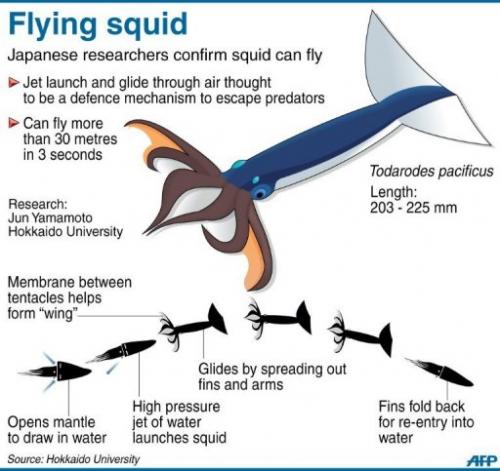
photo by Kouta Muramatsu, July 2011
image via AFP
Submitted by: Unknown (via Zen Pencils)
Tagged: hello , comics , inspirational , zen pencils , dating fails , g rated Share on FacebookNerdigste Spielerei der Woche: Ryan Werber von Beaglenetworks hat die Routing Hardware so konfiguriert, dass Anfragen auf 216.81.59.173 („AKA obiwan.scrye.net“) die Pre-Roll aus Star Wars ausspucken. Hier das Tumblr dazu, hier die Traceroute zum Live-Verfolgen.
TraceRoute from Network-Tools.com to 216.81.59.173 [fin]
Hop	(ms)	(ms)	(ms)	IP Address	Host name
1	0	0	0	206.123.64.42	-
2	63	0	0	64.124.196.225	xe-4-2-0.er2.dfw2.us.above.net
3	3	3	3	77.67.71.165	ae2-109.dal33.ip4.tinet.net
4	36	46	36	89.149.181.117	xe-1-2-0.atl11.ip4.tinet.net
5	36	38	37	77.67.69.158	epik-networks-gw.ip4.tinet.net
6	21	21	21	216.81.59.2	po0-3.dsr2.atl.epikip.net
7	56	66	59	10.26.26.102	-
8	57	55	56	206.214.251.1	episode.iv
9	60	56	58	206.214.251.6	a.new.hope
10	58	58	59	206.214.251.9	it.is.a.period.of.civil.war
11	56	57	60	206.214.251.14	rebel.spaceships
12	56	56	56	206.214.251.17	striking.from.a.hidden.base
13	55	60	57	206.214.251.22	have.won.their.first.victory
14	60	56	57	206.214.251.25	against.the.evil.galactic.empire
15	59	57	58	206.214.251.30	during.the.battle
16	58	59	59	206.214.251.33	rebel.spies.managed
17	62	60	60	206.214.251.38	to.steal.secret.plans
18	58	64	60	206.214.251.41	to.the.empires.ultimate.weapon
19	62	61	60	206.214.251.46	the.death.star
20	60	57	60	206.214.251.49	an.armored.space.station
21	62	61	62	206.214.251.54	with.enough.power.to
22	59	62	60	206.214.251.57	destroy.an.entire.planet
23	62	57	58	206.214.251.62	pursued.by.the.empires
24	59	61	61	206.214.251.65	sinister.agents
25	60	61	61	206.214.251.70	princess.leia.races.home
26	61	59	56	206.214.251.73	aboard.her.starship
27	61	62	61	206.214.251.78	custodian.of.the.stolen.plans
28	60	61	58	206.214.251.81	that.can.save.her
Trace complete
traceroute -m 100 obiwan.scrye.net (via Hacker News)