|
Space Daily A privately-owned unmanned US space capsule arrived at the International Space Station on Sunday, bringing to the space outpost food, scientific materials and other crucial equipment. The capsule named Dragon was captured -- with the help of a robotic ... and more » |
firehose
Shared posts
03 Mar 18:57
SpaceX's capsule arrives at ISS - Space Daily
03 Mar 18:56
Neil deGrasse Tyson On How To Stop a Meteor Hitting the Earth
by samzenpus
firehoseNDGT beat
"when do we start concerning ourselves with a budget to handle it? If it’s going to come in 100 years, what do you say? Ah, let our descendants worry about that in their Congress. You know, 88 percent of Congress faces reelection every two years…And so that's not a long enough time scale to match the time scales that matter for our survival."
An anonymous reader writes "Astrophysicist Neil deGrasse Tyson talks stopping extinction-level meteor hits: '...Here in America, we're really good at blowing stuff up and less good at knowing where the pieces land, you know...So, people who have studied the problem generally – and I'm in this camp – see a deflection scenario is more sound and more controllable. So if this is the asteroid and it's sort of headed toward us, one way is you send up a space ship and they'll both feel each other. And the space ship hovers. And they'll both feel each other's gravity. And they want to sort of drift toward one another. But you don't let that happen. You set off little retro rockets that prevent it. And the act of doing so slowly tugs the asteroid into a new orbit.'" 


Read more of this story at Slashdot.
03 Mar 18:52


Farscape, “Premiere”
by Alasdair Wilkins
firehosehey
“Premiere” (season 1, episode 1; originally aired 3/19/1999)
(Available on Hulu and Amazon Instant Video.)
“Each man gets his chance to be his own kind of hero. Your time will come and when it does, watch out. Chances are it’ll be the last thing you ever expected.”
When creating their characters, space-based science fiction shows often run into a problem of relatability. After all, James T. Kirk and Jean-Luc Picard are the captains of the Enterprise, the flagship of Starfleet and home to its most accomplished officers. They are brilliant tactical minds who can be counted on to emerge triumphant while routinely facing situations we would find utterly incomprehensible. Even when characters in sci-fi shows aren’t so explicitly the best of the best—like, say, the ragtag crew of Serenity—they all still possess a knowledge base vastly different from our own. Their history is different ...
Read more
03 Mar 18:39


Insurance companies and health care providers use video games to promote healthy living
by Megan Farokhmanesh
firehosennnh
By Megan Farokhmanesh on Mar 03, 2013 at 11:01a
Insurance companies and health care providers are finding more way to help promote healthy behavior or treat disease through video games, The Star Tribune reports.
The publication spoke with several different sources, including Susannah Fox of Pew Internet Research. Fox studies culture shifts in technology and health care.
"We're at a time of high need and high potential," Fox told the Minneapolis-based newspaper. "Two-thirds of American adults are overweight, we've got a lot of folks with chronic illnesses — many with things such as hypertension and diabetes that could benefit from tracking.
"The challenge for people developing games is to make it as easy as keeping track in your head and as enticing as Angry Birds," Fox said.
Games and gamification can help. UnitedHealth, for example, uses the Baby Blocks game site to help low-income pregnant women and new mothers. As they attend doctor's appointments or follow healthy steps for the first 15 months after the baby is born, they unlock blocks. Each goal comes with rewards such as gift cards or health items. Other goals include targeting obesity with games like Dance, Dance Revolution.
Video games have been used in the past to help treat various ailments and health problems. Stroke victims can improve mobility from Kinect use, while games like Rehabilium Kiritsu-kun can help deveop motor skills.
- Image Source
- Flickr (AnaleaGwendolyn)
03 Mar 18:36
"It turns out procrastination is not typically a function of laziness, apathy or work ethic as it is..."
“
- David Cain, “Procrastination Is Not Laziness” (via sociolab)
It turns out procrastination is not typically a function of laziness, apathy or work ethic as it is often regarded to be. It’s a neurotic self-defense behavior that develops to protect a person’s sense of self-worth.
You see, procrastinators tend to be people who have, for whatever reason, developed to perceive an unusually strong association between their performance and their value as a person. This makes failure or criticism disproportionately painful, which leads naturally to hesitancy when it comes to the prospect of doing anything that reflects their ability — which is pretty much everything.
But in real life, you can’t avoid doing things. We have to earn a living, do our taxes, have difficult conversations sometimes. Human life requires confronting uncertainty and risk, so pressure mounts. Procrastination gives a person a temporary hit of relief from this pressure of “having to do” things, which is a self-rewarding behavior. So it continues and becomes the normal way to respond to these pressures.
Particularly prone to serious procrastination problems are children who grew up with unusually high expectations placed on them. Their older siblings may have been high achievers, leaving big shoes to fill, or their parents may have had neurotic and inhuman expectations of their own, or else they exhibited exceptional talents early on, and thereafter “average” performances were met with concern and suspicion from parents and teachers.
”- David Cain, “Procrastination Is Not Laziness” (via sociolab)
03 Mar 17:04
Honest Movie Trailers: The Notebook by Screen Junkies
by Justin Page
firehose"the Olive Garden of love stories"
Screen Junkies presents an honest movie trailer for the 2004 romantic drama film The Notebook.
Just in time for Valentine’s Day comes the Honest Trailer for the sappy movie that reminds you, no matter how much you love one another, you’ll both grow old and die.
firehose and -1 others like this
03 Mar 16:31
petervidani: important work today
firehoseGIS: "Best guess for this image: nfl neck"


firehose likes this
03 Mar 16:19
You Are Boring
firehosesorry, everybody
Here’s the full text of a piece I wrote for The Magazine a few months ago. I really enjoyed writing it, and would like to thank Marco once again for publishing it there. If you haven’t checked out The Magazine yet, you should. Anyway, here’s why you’re a total snooze:
Everything was going great until you showed up. You see me across the crowded room, make your way over, and start talking at me. And you don’t stop.
You are a Democrat, an outspoken atheist, and a foodie. You like to say “Science!” in a weird, self-congratulatory way. You wear jeans during the day, and fancy jeans at night. You listen to music featuring wispy lady vocals and electronic bloop-bloops.
You really like coffee, except for Starbucks, which is the worst. No wait—Coke is the worst! Unless it’s Mexican Coke, in which case it’s the best.
Pixar. Kitty cats. Uniqlo. Bourbon. Steel-cut oats. Comic books. Obama. Fancy burgers.
You listen to the same five podcasts and read the same seven blogs as all your pals. You stay up late on Twitter making hashtagged jokes about the event that everyone has decided will be the event about which everyone jokes today. You love to send withering @ messages to people like Rush Limbaugh—of course, those notes are not meant for their ostensible recipients, but for your friends, who will chuckle and retweet your savage wit.
You are boring. So, so boring.
Don’t take it too hard. We’re all boring. At best, we’re recovering bores. Each day offers a hundred ways for us to bore the crap out of the folks with whom we live, work, and drink. And on the internet, you’re able to bore thousands of people at once.1
A few years ago, I had a job that involved listening to a ton of podcasts. It’s possible that I’ve heard more podcasts than anyone else—I listened to at least a little bit of tens of thousands of shows. Of course, the vast majority were so bad I’d often wish microphones could be sold only to licensed users. But I did learn how to tell very quickly whether someone was interesting or not.
The people who were interesting told good stories. They were also inquisitive: willing to work to expand their social and intellectual range. Most important, interesting people were also the best listeners. They knew when to ask questions. This was the set of people whose shows I would subscribe to, whose writing I would seek out, and whose friendship I would crave. In other words, those people were the opposite of boring.
Here are the three things they taught me.
Listen, then ask a question
I call it Amtrak Smoking Car Syndrome (because I am old, used to smoke, thought that trains were the best way to get around the country, and don’t really understand what a syndrome is). I’d be down in the smoking car, listening to two people have a conversation that went like this:
Stranger #1: Thing about my life.
Stranger #2: Thing about my life that is somewhat related to what you just said.
Stranger #1: Thing about my life that is somewhat related to what you just said.
Stranger#2: Thing about my life…
Next stop: Boringsville, Population: 2. There’s no better way to be seen as a blowhard than to constantly blow, hard. Instead, give a conversation some air. Really listen. Ask questions; the person you’re speaking with will respect your inquisitiveness and become more interested in the exchange. “Asking questions makes people feel valued,” says former Virgin America VP Porter Gale, “and they transfer that value over to liking you more.”
Watch an old episode of The Dick Cavett Show. Cavett is an engaged listener, very much part of the conversation, but he also allows his partner to talk as well. He’s not afraid to ask questions that reveal his ignorance, but it’s also clear he’s no dummy.2
Online, put this technique to use by pausing before you post. Why are you adding that link to Facebook? Will it be valuable to the many people who will see it? Or are you just flashing a Prius-shaped gang sign to your pals? If it’s the latter, keep it to yourself.
Tell a story
Shitty pictures of your food are all over the internet. Sites like Instagram are loaded with photo after photo of lumpy goo. What you’re trying to share is the joy you feel when the waiter delivers that beautifully plated pork chop. But your photo doesn’t tell the story of that experience. Your photo rips away the delicious smell, the beautiful room, the anticipation of eating, and the presence of people you love.
Instead, think of your photo as a story. When people tell stories, they think about how to communicate the entirety of their experience to someone else. They set the stage, introduce characters, and give us a reason to care. Of course, that’s hard to do in a single photo, but if you think in terms of story, could you find a better way to communicate your experience? How about a picture of the menu, or of your smiling dinner companions? Anything’s better than the greasy puddles you have decided any human with access to the internet should be able to see.
Expand your circles
Several years ago, my wife and I went on a long trip. We had saved a little money, and the places we were staying were cheap, so we could afford private rooms in every city but one. Guess where we made the most friends? In Budapest, where we were jammed into a big room with a bunch of folks, we were forced into situations we never would have sought out. I wouldn’t have met Goran, the Marilyn Manson superfan who was fleeing the NATO bombing of Belgrade on a fake Portuguese visa. Or Kurt, the Dutch hippie who let us crash on his floor in Amsterdam. Stepping out of your social comfort zone can be painful, but it’s one of the most rewarding things you can do.3
As you widen your social circle, work on your intellectual one as well. Expose yourself to new writers. Hit the Random Article button on Wikipedia. Investigate the bromides your friends chuck around Twitter like frisbees.
When you expand your social and intellectual range, you become more interesting. You’re able to make connections that others don’t see. You’re like a hunter, bringing a fresh supply of ideas and stories back to share with your friends.
The Big Bore lurks inside us all. It’s dying to be set loose to lecture on Quentin Tarantino or what makes good ice cream. Fight it! Fight the urge to speak without listening, to tell a bad story, to stay inside your comfortable nest of back-patting pals. As you move away from boring, you will never be bored.
-
Lots of books exist because of how boring you have made the internet. Books like The Information Diet focus on the consumption side of things: how are we, your readers and friends, supposed to deal with the junk you keep sending us? Instead, I’d like to look at the supply side: if you were more interesting, then there would be less junk out there that we would have to deal with. ↩
-
You don’t have to go back to the ’70s to find good listeners. My friend Jesse Thorn is a great interviewer who also listens in an engaged way. Check out his show, Bullseye. Or if you’d like to shoot for something a bit more academic, BBC’s In Our Time features great conversation led by another master, Melvyn Bragg. ↩
-
These folks make a great case for the potentially life-changing value of meeting new people: Nassim Taleb’s The Black Swan, and the previously-cited Porter Gale’s “Conversations with 4C.” ↩
Billtron, Kenny Vennard likes this
03 Mar 16:17


5 Things You Should Not Say to Your Kids
by Shelly Phillips
Current research shows that some of the most commonly used and seemingly positive phrases we use with kids are actually quite destructive. Despite our good intentions, these statements teach children to stop trusting their internal guidance system, to become deceptive, to do as little as possible, and to give up when things get hard. Here’s a list of the top five things to eliminate from your vocabulary NOW if you want your child to grow up to be kind, community-minded, and successful. I’ve also included alternatives so that you can replace these habitual statements with phrases that will actually encourage intrinsic motivation and emotional connection.
1 “Good Job!”
The biggest problem with this statement is that it’s often said repeatedly and for things a child hasn’t really put any effort into. This teaches children that anything is a “good job” when mom and dad say so (and only when mom and dad say so).
Instead try, “You really tried hard on that!” By focusing on a child’s effort, we’re teaching her that the effort is more important than the results. This teaches children to be more persistent when they’re attempting a difficult task and to see failure as just another step toward success.
2 “Good boy (or girl)!”
This statement, while said with good intentions, actually has the opposite effect you’re hoping for. Most parents say this as a way to boost a child’s self-esteem. Unfortunately, it has quite a different effect. When children hear “good girl!” after performing a task you’ve asked them for, they assume that they’re only “good” because they’ve done what you’ve asked. That sets up a scenario in which children can become afraid of losing their status as a “good kid” and their motivation to cooperate becomes all about receiving the positive feedback they’re hoping for.
Instead, try “I appreciate it so much when you cooperate!” This gives children real information about what you’re wanting and how their behavior impacts your experience. You can even take your feelings out of it entirely and say something like, “I saw you share your toy with your friend.” This allows your child to decide for himself whether sharing is “good” and lets him choose to repeat the action from his internal motivation, rather than doing it just to please you.
3 “What a beautiful picture!”
When we put our evaluations and judgments onto a child’s artwork, it actually robs them of the opportunity to judge and evaluate their own work.
Instead try, “I see red, blue and yellow! Can you tell me about your picture?” By making an observation, rather than offering an evaluation, you’re allowing your child to decide if the picture is beautiful or not, maybe she intended it to be a scary picture. And by asking her to tell you about it, you’re inviting her to begin to evaluate her own work and share her intent, skills that will serve her creativity as she matures and grows into the artist she is.
SEE ALSO: If your Childhood Sucked – It’s Time to Stop Blaming Your Parents!
4 “Stop it right now, or else!”
Threatening a child is almost never a good idea. First of all, you’re teaching them a skill you don’t really want them to have: the ability to use brute force or superior cunning to get what they want, even when the other person isn’t willing to cooperate. Secondly, you’re putting yourself in an awkward position in which you either have to follow through on your threats—exacting a punishment you threatened in the heat of your anger—or you can back down, teaching your child that your threats are meaningless. Either way, you’re not getting the result you want and you’re damaging your connection with your child.
While it can be difficult to resist the urge to threaten, try sharing vulnerably and redirecting to something more appropriate instead. “It’s NOT OK to hit your brother. I’m worried that he will get hurt, or he’ll retaliate and hurt you. If you’d like something to hit, you may hit a pillow, the couch or the bed.” By offering an alternative that is safer yet still allows the child to express her feelings you’re validating her emotions even as you set a clear boundary for her behavior. This will ultimately lead to better self-control and emotional wellbeing for your child.
5 “If you _____ then I’ll give you _____”
Bribing kids is equally destructive as it discourages them from cooperating simply for the sake of ease and harmony. This kind of exchange can become a slippery slope and if used frequently, you’re bound to have it come back and bite you. “No! I won’t clean my room unless you buy me Legos!”
Instead try, “Thank you so much for helping me clean up!” When we offer our genuine gratitude, children are intrinsically motivated to continue to help. And if your child hasn’t been very helpful lately, remind him of a time when he was. “Remember a few months ago when you helped me take out the trash? That was such a big help. Thanks!” Then allow your child to come to the conclusion that helping out is fun and intrinsically rewarding.
I hope you’ll try these out and let me know how they impact your child’s internal motivation as well as your connection to each other. I think you’ll find that the simple act of changing the language we use with our kids can greatly impact our connection for the better. A more connected child is almost always a more cooperative and empathetic child. Please share your story with us!
Goal: Kids don’t remember what you try to teach them. They remember what you are. Tweet and show your determination. Tweet
SEE ALSO: Parenting: 6 Myths You Should Know About
The post 5 Things You Should Not Say to Your Kids appeared first on Lifehack.
 |
 |
03 Mar 16:12


thinkanddiethinking: HOW TO DEAL WITH BEING CALLED OUT From the...
HOW TO DEAL WITH BEING CALLED OUT
From the January issue of
THINK AND DIE THINKING
Billtron, Lindsay Oliver and -1 others like this
03 Mar 15:47
Kristin Tercek started Cuddly Rigor Mortis as a series of plush characters and then decided to expand her character repertoire through the medium of paint. The change from plush to paint let her go from weirdly adorably mummies, werewolves and zombies to disturbing still lifes filled with smiling carnivorous plant roots, miserably limes sans wedge and homicidal onions. And a few familiar characters and cute critters get an unnerving makeover with a little help from Tercek's creepy doll eyes. Tercek's plush toys were cute, but painting gives her far more room to explore her macabre ideas. Even while riffing on similar themes and giving her characters those mismatched eyes, her paintings manage to surprise in ways that are sad (the earthbound dogwood), sweet (Little Kumquat and his Grandpa Ugli Fruit) and clever (the stuffed olive with the plastic sword through its eye, titled "Pimento Mori"). She has prints available at the Cuddly Rigor Mortis shop, and you can see more from her portfolio on her website.
Kristin Tercek Finds the Creepy Side Of Cute Critters And Cuisine [Art]
by Lauren Davis
firehoseskull pile autoshare
Mar 3rd 2013 By: Lauren Davis

Kristin Tercek started Cuddly Rigor Mortis as a series of plush characters and then decided to expand her character repertoire through the medium of paint. The change from plush to paint let her go from weirdly adorably mummies, werewolves and zombies to disturbing still lifes filled with smiling carnivorous plant roots, miserably limes sans wedge and homicidal onions. And a few familiar characters and cute critters get an unnerving makeover with a little help from Tercek's creepy doll eyes. Tercek's plush toys were cute, but painting gives her far more room to explore her macabre ideas. Even while riffing on similar themes and giving her characters those mismatched eyes, her paintings manage to surprise in ways that are sad (the earthbound dogwood), sweet (Little Kumquat and his Grandpa Ugli Fruit) and clever (the stuffed olive with the plastic sword through its eye, titled "Pimento Mori"). She has prints available at the Cuddly Rigor Mortis shop, and you can see more from her portfolio on her website.


firehose likes this
03 Mar 15:46
How an algorithm came up with Amazon's KEEP CALM AND RAPE A LOT t-shirt
by Cory Doctorow

You may have heard that Amazon is selling a "KEEP CALM AND RAPE A LOT" t-shirt. How did such a thing come to pass? Well, as Pete Ashton explains, this is a weird outcome of an automated algorithm that just tries random variations on "KEEP CALM AND," offering them for sale in Amazon's third-party marketplace and printing them on demand if any of them manage to find a buyer.
The t-shirts are created by an algorithm. The word “algorithm” is a little scary to some people because they don’t know what it means. It’s basically a process automated by a computer programme, sometimes simple, sometimes complex as hell. Amazon’s recommendations are powered by an algorithm. They look at what you’ve been browsing and buying, find patterns in that behaviour and show you things the algorithm things you might like to buy. Amazons algorithms are very complex and powerful, which is why they work. The algorithm that creates these t-shirts is not complex or powerful. This is how I expect it works.
1) Start a sentence with the words KEEP CALM AND.
2) Pick a word from this long list of verbs. Any word will do. Don’t worry, I’m sure they’re all fine.
3) Finish the sentence with one of the following: OFF, THEM, IF, THEM or US.
4) Lay these words out in the classic Keep Calm style.
5) Create a mockup jpeg of a t-shirt.
6) Submit the design to Amazon using our boilerplate t-shirt description.
7) Go back to 1 and start again.
There are currently 529,493 Solid Gold Bomb clothing items on Amazon. Assuming they survive this and don’t get shitcanned by Amazon I wouldn’t be at all surprised if they top a million in a few months.
It costs nothing to create the design, nothing to submit it to Amazon and nothing for Amazon to host the product. If no-one buys it then the total cost of the experiment is effectively zero. But if the algorithm stumbles upon something special, something that is both unique and funny and actually sells, then everyone makes money.
Dictionary + algorithm + PoD t-shirt printer + lucrative meme = rape t-shirts on Amazon
firehose and -1 others like this

03 Mar 14:34
A Map of Television Show Locations in America
by Rusty Blazenhoff

(larger)
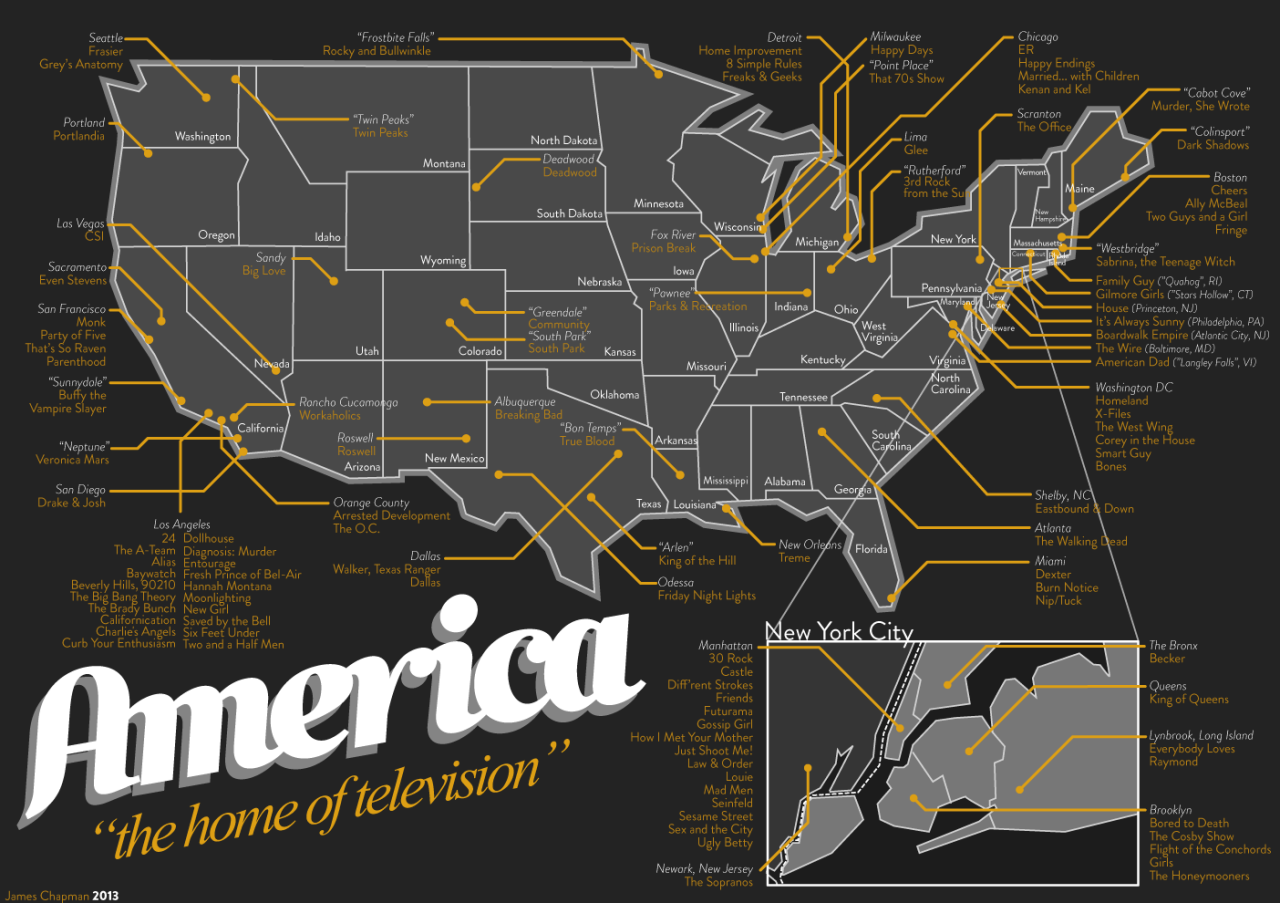
Graphic artist and physicist James Chapman has designed a detailed poster titled “AMERICA:the home of television” which is a map of television show locations in the United States. It’s available to purchase at his Etsy shop.
Have you ever wondered how far it is from Breaking Bad to Arrested Development? Or which coast has more crime drama? Or how many shows are set in Wyoming? (Spoiler alert, it’s none) Well, wonder no more.
Law & Order, Happy Days, Treme, Gossip Girl, Frasier, 30 Rock, Rocky & Bullwinkle, The Wire, Sabrina the Teenage Witch, Even Stevens, True Blood, Girls, Community, Friday Night Lights and many many many more.
Oh, yeah. Fictional towns (like “Quahog” from Family Guy) are included as well as real ones (Atlanta from the Walking Dead)
It looks great, you’ll impress your friends AAAAAND you might just learn something new about a show you like.
submitted via Laughing Squid Tips
firehose likes this
03 Mar 13:35
Filed under: news


High contrast laser etching
by Mike Szczys
firehoseclever~

The problem with laser etching dark materials is that the areas burnt away by the intense light don’t really stand out from the rest of the surface. [The 5th Fool] is taking a roundabout way of correcting this by topping his laser engravings with contrasting paint. The technique is still pretty simple and we think it looks great!
Basically he’s etching a layer of painter’s tape which becomes a stencil. But the surface it is masking also gets etched so the paint has an area below to the surface which it can fill in. We figure this will help with durability issues.
After etching the painters tape the design gets a few coatings of a high-contrast paint color and is left to dry. To remove the stencil, duct tape is applied to the entire area. This helps quite a bit in removing the tiny bits of tape from an intricate design.
Filed under: news
firehose likes this
03 Mar 13:32
Expanded Occupations: Maids! - Skortched Urf' Studios | Otherverse Games | Black Tokyo | RPGNow.com
firehosethere are days when I want to change the world
and then there are days when I want to burn it
Expanded Occupations: Maids! - Skortched Urf' Studios | Otherverse Games | Black Tokyo | RPGNow.com:
nnnaanannnaagghhgghh augghhhh
03 Mar 13:32

A lone soldier has been stranded in an alien world, filled with...
firehoseRDF beat
A lone soldier has been stranded in an alien world, filled with resources, literals and shifty anonymous nodes. Room upon room are filled with named graphs — can he find a way out? RDFRoom is an isometric RDF viewer. It gives the user ways to view and manipulate his RDF data that might make him see the data in a brand new perspective.
(via RDFRoom)

03 Mar 11:46
Did Steve Jobs Pick the Wrong Tablet Size?
by Soulskill
firehose"the iPad Mini surprisingly outsold its larger sibling by a substantial margin (as did 7-inch Android tablets from competitors)"
An anonymous reader writes "During the 2010 Christmas shopping season, Steve Jobs famously dissed the 7-inch tablets being rolled out by competitors, including Samsung's Galaxy, as being 'tweeners: too big to compete with a smartphone and too small to compete with the [9.7-inch diagonal] iPad,' adding that 'the current crop of 7-inch tablets are going to be DOA — dead on arrival.' A year later Jobs was dead, and the iPad Mini, with a 7.9-inch diagonal screen, was rolled out under his successor Tim Cook in October, 2012. Looking at industry-wide tablet sales numbers for January 2013, which show that the iPad Mini surprisingly outsold its larger sibling by a substantial margin (as did 7-inch Android tablets from competitors), Motley Fool's Evan Niu thinks that the 7.9-inch form factor was the correct size all along, contrary to Jobs' pronouncements (which, of course, was partly marketing bluster — but he chose the larger size in the first place). Of course the Mini is cheaper, but not by much — $329 vs. $399 for the larger iPad, for the baseline model with WiFi only and 16GB storage. Had Apple introduced the iPad with the smaller size to begin with, Niu argues, competitors would have faced a much more difficult task grabbing market share. While the Mini is currently available only with 'Super VGA' resolution (1024x768), rumors are afloat that Minis with the Retina display (2048x1536) are close to production." 


Read more of this story at Slashdot.
03 Mar 11:34
"I’ve always been interested in people, but I’ve never liked them."
“I’ve always been interested in people, but I’ve never liked them.”
- Henry James (via leslieseuffert)
- Henry James (via leslieseuffert)
Lindsay Oliver and -1 others like this




03 Mar 11:28

Mythbusters is amazing
firehoseeternal auto-reshare hall-of-famer
Mythbusters is amazing
Christopher Lantz, Tertiarymatt likes this

03 Mar 04:09
Seagate To Stop Making 7200rpm Laptop HDDs
by Soulskill
jones_supa writes "'We are going stop building our notebook 7200rpm hard disk drives at the end of 2013,' said David Burks, director of marketing and product management at Seagate Technology, during a conversation with X-bit labs. The mainstream market demand is expected shift to different products, such as hybrid drives. Users who need maximum performance and care about battery life have been choosing notebooks with SSDs for years now, whereas those who required capacity and moderate price do not really care about actual performance. With the introduction of third-generation solid-state hybrid drives later this year, Seagate will position them for performance- and capacity-demanding end-users. The company will also continue to offer 5400rpm HDDs for value notebooks." 


Read more of this story at Slashdot.
firehose likes this
03 Mar 04:07
Romney: 'It kills me' not to be in the White House - Boston Herald
 San Francisco Chronicle |
Boston Herald Faded GOP star Mitt Romney emerged from post-election seclusion in his first major TV appearance yesterday, holding the door open to a role in public life but denying a third run for the White House will be part of that. Romney admitted on Fox News that his ... Mitt Romney criticizes Obama, admits campaign mistakesLos Angeles Times Quoted: Ann Romney on turning down 'Dancing With the Stars'Washington Post (blog) Romney Offers Explanation for LossWall Street Journal Fox News -Politico (blog) -NBCNews.com (blog) all 230 news articles » |
03 Mar 04:07
First Ever White House Hackathon
by whitehouse
 |
First Ever White House Hackathon
On February 22nd, we welcomed 21 programmers and tech experts to the White House and invited them to spend the day working alongside seven members of our own... |
From:
whitehouse
Views:
15974
  300
ratings
300
ratings |
| Time: 01:53 | More in News & Politics |