Shared posts

18 Mar 21:00

Team Fortress 2 is Oculus Rift's first official game

by David Hinkle
firehose

that beats the hell out of Doom 3

Team Fortress 2 is Oculus Rift's first official game
Our pals at Engadget toured the Valve offices last week to check out virtual reality support in Team Fortress 2, something Valve programmer Joe Ludwig has been working on for quite a while now. Ludwig reveals that Team Fortress 2 will be Oculus Rift's first official game and that Valve will push a VR mode update to players "sometime within the next couple of weeks."

"This is a mode that everybody who has a Rift dev kit and access to Team Fortress 2 will be able to play, just on public and in the same servers that everybody else is playing in," Ludwig told Engadget. Initially, VR mode will be available to only Windows PC players - Mac OS X and Linux platforms are a possibility down the line, after Valve gets access to SDKs for those platforms. "We don't have a Mac or Linux SDK from Oculus quite yet, but once we get those, we'll get it ported over to those other platforms."

Ludwig will provide a talk on Valve's hurdles porting the free-to-play shooter over to virtual reality at GDC in San Francisco in two weeks. The Oculus Rift is an upcoming VR headset that was successfully funded through Kickstarter and ships to backers in April. Oculus Rift's 40 "pilot" dev kit prototypes will begin shipping this month and pre-orders are currently open through Oculus Rift's website.

JoystiqTeam Fortress 2 is Oculus Rift's first official game originally appeared on Joystiq on Mon, 18 Mar 2013 13:43:00 EST. Please see our terms for use of feeds.

Permalink | Email this | Comments
18 Mar 20:58

FBI says Gardner Museum heist thieves identified - Boston.com

by russiansledges
“The FBI believes with a high degree of confidence in the years after the theft the art was transported to Connecticut and the Philadelphia region and some of the art was taken to Philly where it was offered for sale by those responsible for the theft. With that confidence, we have identified the thieves, who are members of a criminal organization with a base in the mid-Atlantic states and New England,” Richard Deslauriers, the special agent in charge of the Boston office of the FBI said in a statement.
18 Mar 20:57

Now Proceed in an Orderly Fashion

18 Mar 20:57

pittsburg summer '75


18 Mar 19:10

A quantitative literary history of 2,958 nineteenth-century British novels: the semantic cohort method

by overbey
Very cool digital humanities experiment
18 Mar 18:18

Global children with their favorite toys

by David Pescovitz
NewImage

Toyssssss Gabriele Galimberti photographed children around the world posed with their favorite toys and possessions. At top, Pavel (Kiev, Ucraina). Above, Maudy (Kalulushi, Zambia) and Noel (Dallas, Texas). "Toy Stories"

18 Mar 18:09

Secret Power

by Brie Sheldon

When I began my participation in the gaming community online, it was easy to see the power dynamics. There are major game companies – Paizo, White Wolf, Wizards of the Coast, and so on. Then there are big names in Indie Gaming – Vincent Baker, Meguey Baker, Jason Morningstar, Luke Crane. Big names in LARP – Lizzie Stark comes to mind. And you know what? I expect power hierarchies. By day, I have a corporate job so status is a thing I get. And these big-people-little-people hierarchies are really just a matter of status – someone has power because they have status, and people recognize them as authorities.

With the increasing use of social networks to communicate with creators and fans alike, now the people who were once up high and unreachable are just a tweet, Facebook comment, or G+ post away. In spite of that, the status structure is still there, and so is the power. I didn’t realize how much that power would impact me. For one, I never thought I would start designing a game. Hell, I never thought I’d be writing about games. But, here I am, fingers to keys.

Offline, people often can easily determine when they are using their voice or language to show their importance or knowledge, to show power, to intimidate. Online, though? It’s not as easy for people to realize when their dominance shows. People don’t always notice when their name is dropped in conversation, or how easily someone can Google them and know all of the cool, exciting things they’ve done. For those of us on the bottom tier we know who we have to impress, and more than that, we know who we don’t want to criticize.

I generally criticize anyone. I’m not super tactful, and one of my first posts on Gaming as Women was flagging down Paizo and Pathfinder creators to talk about their content and art.  But, somehow, criticizing indie creators is scarier, because they’re closer to home. They have more impact. I’m familiar with some of them. It scares the hell out of me to discuss games, game design, or theory with them.

Maybe it’s just paranoia. If I’m aware of another person’s power – be it physical, social, political, privilege – it wiggles into my psyche. It doesn’t help that when people respond or post and they have power, it often seeps through their keyboard and onto my screen.

It certainly has affected how I speak on social media, and what I post here on Gaming as Women, because I am so anxious about the responses that mean to be helpful, informative, but instead coming across with carefully chosen words of authority, experience, age, and wisdom – comments that will make me feel like I should sign off, forget my thoughts, and perhaps reserve my feedback for someone who comes after me. Someday, I can talk about these things – when I’m older, more experienced, more wise, and have much more power than a n00b in an industry that’s so tightly wound with who-you-know that it is like untwisting the bindings of fate.

I have made posts about how I was using some different terms and definitions for gaming so I could understand things better, and half of the responses were arguments about semantics. Others referenced posts made by noted indie game designers with complex discussions of social footprint and counterproductive play. It’s great to have those references, yeah, and I’m going to try to learn what I can about game design by reading them. But, I often feel like they’re totally full of manufactured terminology and sometimes written or put across in ways that specifically exclude inexperienced people from understanding the concepts. Unnecessarily using what I have always referred to as “five-dollar words” to put a point across, especially when  trying to share knowledge, it can feel like  giving the appearance of sharing, but instead just keeping the knowledge locked up in a circle of followers. (Followers who, most likely, have had more time to read and commit to memory more material than someone new to the scene.)

This also ties into the “geek card”/”gamer card” mentality where people are not counted as geek enough, gamer enough, good enough because they haven’t played D&D Second Edition or they haven’t read a book by Robin Laws. Saying that you can’t discuss something with someone unless they’ve spent time studying and playing things they might not even enjoy just because it’s the way the gates are kept locked up tight? That sucks. It’s discouraging, and that kind of behavior does nothing good for innovation and new ideas.

There have been instances on Google+ where I joined discussions about gaming, or started them myself, and someone experienced or well-known responds. It’s great to have comments from important people, don’t get me wrong. I like hearing what they have to say. But if they disagree with me, even if I don’t think that their argument is sound or I just think that it’s a matter of using semantics or terminology to control how people think about something, I can’t really say much of anything.

Well, I can’t say anything and have it make a difference. Nothing I say is likely to change what people think about games or what they look for in games – even if I were to say something revolutionary, I know that unless I’m endorsed by a big-name and they agree with me, my words, my investment in design or theory? They don’t matter. That’s how it comes across when the responses from people are weighted with authority that may not always be justified. Some people are great designers, great artists, great people, but that doesn’t mean that they are always right – it just means that they had some good ideas and that they are hard working.

I’m not saying these people don’t deserve what they get – they do. And they were n00bs once, too. It’s easy to sound like you think you’re better than someone when all you are trying to say is, no, I don’t agree with you, you’re wrong. And there’s the rub, right? In gaming, we have right, wrong, story gaming, OSR, trad, sexism, racism, privilege, cries of censorship – it’s neverending the conflicts. So when someone who is more educated, more experienced, more worldly or even just older than someone like me and responds to my comments on gaming on social media sites and they type their words ever so carefully, to me, it is more like, oh, please, child, sit in your corner. I know who these people are. I know what they do. And I know that they know – or think they know – more than me. But my experiences are not so transparent, and I can say with certainty that everyone can be wrong even when they think they are the most right that there is.

Next time you talk to a n00b try to remember, you have the power. New people, inexperienced people? We know it. We expect it. But if our mentors or the people we aspire to be like abuse it, or just don’t bother to be aware, it can make us feel like we don’t belong or aren’t wanted. There are ways to be an expert and to share your knowledge without creating a barrier. Take the time to learn those skills if you want to see the hobby flourish.


ETA: I don’t mean for this post to be any sort of attack on the people mentioned, since I am not specifically talking about anyone in this instance. The names referenced are just to highlight that these people who are well known in each category actually exist, not that they are acting in any negative fashion. 

(Secret Power originally posted on Gaming As Women.)

Related posts:

  1. Power, privilege and English On Gaming as Women, we often discuss power, privilege, discrimination, who...
  2. Crunch vs Fluff: The Argument We’re Doin’ Wrong Well vetted dudes are blogging, currently, about dichotomy and stuff. I guess....
  3. Money Money Money – Gaming gets government funding in Sweden I’m not a Abba fan, but feel free to listen...
18 Mar 17:55

twista-at-sunset.mov (by alexanderpaul)


twista-at-sunset.mov (by alexanderpaul)

18 Mar 17:43

A Sorry Tale: EA Offering SimCity 4 To SimCity 5 Buyers!

by John Walker
firehose

"best of all is the SimCity 4 Deluxe edition, usually £20, that offers a fantastically detailed city building sim, along with an option for an offline regional game, where you can build multiple cities into one region, and have them share resources. The Deluxe version includes the Rush Hour expansion, and both let you terraform the land, design your own building types, and all sorts of other excellent features that you’d expect to find in a modern city-building simulation"

By John Walker on March 18th, 2013 at 4:52 pm.

EA wants to say “sooorweeeee”. For pretending the game had to be online for server computations, and then ignoring us when we asked why they’d said so when it wasn’t the case? No, not because of that! But for launching SimCity in the most extraordinarily inept fashion, with barely functioning servers, massive queues, frequent crashes, and everything else everyone in the whole world except EA and that one reviews editor predicted would happen. To make this up to everyone who’s activated a copy of the game, and rather madly to people who buy one any time up to the 25th March, there is a free game available. And they’re proper good ones, too. One of them is a rather fine city building game, called SimCity 4.

That EA is apologising to customers who’ve yet to even buy SimCity is pretty extraordinary. “We’re sorry you’re about to buy our broken game.” Perhaps they’re hoping this might boost some new sales too, but it’s still a fairly odd situation.

So what can you get? Here’s the list:

Battlefield 3 (Standard Edition)
Bejeweled 3
Dead Space 3 (Standard Edition)
Mass Effect 3 (Standard Edition)
MOHW (Standard Edition)
NFS Most Wanted (Standard Edition)
Plants vs. Zombies
SimCity 4 Deluxe Edition

If you want to gouge them for the maximum amount, Dead Space 3 still costs £40 on Origin. And you’d be mad to opt for Plants Vs. Zombies, which is only £7. Well, unless you want it, and this isn’t just about the graph EA execs will have to look at in a month’s time.

But best of all is the SimCity 4 Deluxe edition, usually £20, that offers a fantastically detailed city building sim, along with an option for an offline regional game, where you can build multiple cities into one region, and have them share resources. The Deluxe version includes the Rush Hour expansion, and both let you terraform the land, design your own building types, and all sorts of other excellent features that you’d expect to find in a modern city-building simulation.

If you’ve bought the game, or feel like you’re about to against your own will, you’ll get an email telling you when you can claim your game. You’ll need to do that before the 30th March, or it will be lost like a SimCity game on a crashing server.

18 Mar 17:42

New Study Names Hippest City in America | Carrie Russell

by russiansledges
It’s Somerville, Massachusetts.  Sorry San Franciscans.  You’ve gone yuppy gourmet and your coolest residents have moved to Oakland.  New Yorkers?  Your city is way too expensive for true hipness to flourish.  Weirdos in Austin?  Somerville’s got you beat on volume of both thrift shop and indie music purchases.  Washington D.C.?  You’re kidding, right?  No one thinks Washington D.C. is hip. Residents of Somerville spend more time in independent coffee shops than residents of any other city.  Surprised, Seattle?*  Residents of Somerville own more bespoke bicycles (and unicycles) than even the good people of Denver.  And, sorry L.A.  They know more about film, too.  Residents of Somerville are most likely to accurately predict Oscar winners for every category from Best Picture to Sound Mixing. What city has the highest ratio of adult sports league participation** to childhood sports league participation?  Somerville!  And what city has the highest incidence of ironic Superbowl parties?  The ‘Ville again.***
18 Mar 17:12

Photo


18 Mar 17:11

"“Everyone who complained missed the joke, it was satire,” Meron told The Hollywood..."

“Everyone who complained missed the joke, it was satire,” Meron told The Hollywood Reporter a t the GLAAD awards in Manhattan on Saturday.

Zadan added, ” It was not about the women that were mentioned, the song was about him being a bad host and him being a juvenile, which was why he was a bad host.”


-

OSCAR PRODUCERS: ‘Everyone Missed The Joke On Boobs Song’ - Yahoo! Finance

tl;dr: “We meant to do that! You’re all too stupid to get it!”

18 Mar 16:38

"It’s possible that Urban’s customers are taking risks on items like a patchwork dress or..."

“It’s possible that Urban’s customers are taking risks on items like a patchwork dress or neon shirt and then realizing that the items have no place in their daily wardrobes.”

- Hipsters Are Returning Urban Outfitters Clothing In Droves - Yahoo! Finance
18 Mar 16:36

Amazon discounts Dishonored, Assassin's Creed 3, NBA 2K13 and more

by Alexa Ray Corriea
firehose

AC3 for $30-$34, Oblivion PC for $12.50

By Alexa Ray Corriea on Mar 18, 2013 at 12:30p

Amazon is offering discounts between 25 and 50 percent today on select video games and hardware including Dishonored, Assassin's Creed 3 and NBA 2K13, according to the sale page.

Gamers can take advantage of bargains on the following games across PlayStation 3, Xbox 360, Wii, Wii U, Nintendo 3DS, PC and Mac:

  • Aliens: Colonial Marines for $36.27 (Xbox 360), $37.46 (PS3), Collector's Edition for $69.99 (PS3, Xbox 360)
  • Angry Birds Trilogy for $19.99 (PlayStation 3, Xbox 360, Nintendo 3DS)
  • Assassin's Creed 3 for $29.99 (PS3, Xbox 360) or $33.63 (Amazon download)
  • Diablo 3 for $44.99 (PC, Mac)
  • Dishonored for $39.99 (PS3, Xbox 360) or $39.43 (Amazon download)
  • Doom 3 for $19.99 (PS3, Xbox 360) or $9.99 (PC)
  • The Elder Scrolls 4: Oblivion for $12.49 (PC)
  • Just Dance 4 for $27.99 (PS3, Xbox 360, Wii)
  • NBA 2K13 for $39.99 (PS3, Xbox 360)
  • Wipeout 3 for $19.99 (Wii) or $29.99 (Wii U, Xbox 360)

Amazon is also offering the 250 GB PlayStation 3 Amazon Exclusive Family Entertainment bundle, which includes the console as well as PlayStation All-Stars Battle Royale and The Ratchet and Clank Collection, for $249.99. Gamers can also save between 20 and 60 percent on gaming headsets, including models from manufacturers Turtle Beach and Tritton.

18 Mar 16:31

Waaagh-Face: Slitherine Announce Turn-Based 40K Game

by Adam Smith
firehose

"PBEM multiplayer" :D

By Adam Smith on March 18th, 2013 at 3:31 pm.

First there was SPACE HULK SPACE HULK SPACE HULK SPACE HULK SPACE HULK and now there’s, erm, a turn-based Warhammer 40K strategy game of indeterminate nature a turn-based Warhammer 40K strategy game of indeterminate nature a turn-based Warhammer 40K strategy game of indeterminate nature! A few days ago, Games Workshop announced that they had made a deal with the developer but I didn’t expect news of a game to arrive so quickly.

In fairness, there isn’t much to say beyond the fact that the game will definitely be turn-based, will feature PBEM multiplayer, and is coming to PC and iPad. I’m not too worried about the multi-platform info since I’d rather have detailed stats and big maps than extreme close ups of explosions. More details may appear in the announcement thread and hopefully we’ll know more soon.

Have we done ‘waaagh-face’ already, by the way?

18 Mar 16:31

Note-Taking Service Google Keep Briefly Appears Before Disappearing Again | TechCrunch

18 Mar 16:30

Crusader Europe 1210 - 2013 by ~kasumigenx on deviantART

18 Mar 16:27

10 Fascinating Typographical Origins

by JFrater

A typographical character is simply a printed symbol—this includes letters, numbers, and punctuation marks. The ? is called a question mark; ( and ) are called parentheses; and ; is known as the semicolon. But you know that already, and I suspect you’re beginning to wonder how one could possibly wring drops of “fascinating” from the dry towel of typography. And that’s fair. But did you know the division sign has a name? What about the mysterious origins of the paragraph sign? Where did the % sign come from? ¿Why on Earth do Spanish-speakers put those upside-down question marks at the beginning of their sentences? Read on!

10 The Pilcrow—

Gazette Pilcrow

The pilcrow, also less elegantly called the “paragraph mark,” serves a number of purposes, most of which involve denoting the presence or location of a paragraph in one way or another. Most commonly, it’s used in word processing programs to indicate a “carriage return” “control character;” that is to say, a non-permanent mark showing where a paragraph ends. There is disagreement over the origin of the name; The Oxford English Dictionary, for one, likes to think it comes from a string of corruptions of the word “paragraph.” I prefer to side with the Oxford Universal Dictionary, which suggests that the sign itself looks a lot like a featherless crow—a “pulled crow.” The symbol itself derives from the letter C—you can still see it in there—which stood for the Latin “capitulum,” or “chapter.” The two lines that ended up vertically crossing the C were a sort of editorial note from the writer.

The pilcrow was used in the Middle Ages, in an earlier form, as a way of marking a new train of thought before the paragraph became the standard way of accomplishing this. Now, among its myriad uses are in academic writing (when citing from an HTML page), legal texts (when citing a specific paragraph), and in proofreading (an indication that a paragraph should be split in two).

9 The Ampersand—&

Ampersand-1

The ampersand is a logogram used to mean “and.” The symbol itself is based on a shorthand version of the Latin word for “and”—et—and in certain fonts, you can still clearly see an ‘e’ and a ‘t’ linked together (Adobe Caslon, for instance). The word ampersand has a somewhat unusual origin—it’s a corruption of the hard-to-parse, multilingual (English and Latin) phrase “& per se and,” which means “& by itself is ‘and.’” Confused? Don’t worry—that’s only natural. All it means is: “The symbol &, all by its little self, simply means and.” And where did this phrase come from? Well, in the early 1800s, & was considered the 27th letter of the English alphabet, and since saying “X, Y, Z, and” would be confusing, “and per se and” was said instead. It doesn’t take a major stretch of the imagination to fathom how this could quickly turn into ampersand, which it did by around 1837.

Because people like to make up urban legends based on everything, including stodgy ol’ typographical marks, there’s a vicious rumor floating around that French physicist and mathematician André-Marie Ampère used the mark so much that it eventually got called “Ampere’s and.” Don’t believe it for a second. In the end we’re left with a pretty little symbol that has more than a few variants.

8 Interrobang—!?, ?!, or ‽

Type-Talks-1

What?! You’ve never heard of the interrobang!? Really? Well, now you have, so all is forgiven. An interrobang is described as a “nonstandard punctuation mark” (it’s part of the punctuation counterculture), used to end sentences where you really want both the exclamation point and the question mark. While the use of both marks side by side had been prevalent for some time, it wasn’t until 1962 when an advertising executive named Martin K. Speckter decided that enough was enough—no longer would he withstand the tyranny of two separate punctuation marks when one would suffice. He asked readers to suggest names—rejecting such fine ideas as rhet, exclarotive, and exclamaquest—and ultimately settled upon interrobang, a combination of the Latin root “interro” (think “interrogate”), and “bang,” which is printer’s slang for the exclamation mark. The word is used to describe both the two side by side (!? or ?!), or the combined symbol ?.

7 At Sign—@

at_symbol800-640x360.jpg

What we know as @ has a lot of different monikers—including “at sign,” “at symbol,” “ampersat,” and “apetail”—but is unusual in that it doesn’t have a widely-accepted name in English. In Spanish, it is known as an arroba, and in French the arobase. @ has two primary usages—its original one, used in commerce to mean “at the rate of,” and more recently, “directed at” (primarily in email and in social media like Twitter). It has been claimed (by Italian professor Giorgio Stabile) that the symbol is actually over 500 years old, to represent an “amphora”—a unit of capacity used in commerce. It first made its way onto a typewriter as early as 1885, and has since found its way into our hearts.

A couple of fun facts:

- The Spanish arroba was a unit of weight equivalent to 25 pounds.
- The names for @ in other languages often derive from the idea that it looks like an animal. To wit: apenstaartje (Dutch for “monkey’s tail); papacy (Greek for “little duck); dalphaengi (Korean for “snail”); sobachka (Russian for “little dog”).

6 Guillemets—« »

Gui

Guillemets are what the French use instead of quotation marks. In addition to the physical differences, the usage differs as well—generally, guillemets open and close entire conversations or exchanges, rather than individual utterances. Amusingly, the guillemet is named after a French printer named Guillaume Le Bé from the 16th century; “Guillemet” is a diminutive of “Guillaume.” One can only assume that French people call our quotation marks “Willies,” “li’l Bills,” or “Mini Williams.”


5 Obelus—÷

Obelus

The Obelus, more commonly known as “the division sign” for reasons I can’t fathom, comes from an Ancient Greek word for a sharpened stick or other similar pointy object. It shares its roots with the word “obelisk.” The obelus was once used to denote sections of writing that were considered incorrect or suspicious; in other words, it would have been perfect for Wikipedia editors. It was first used to mean “division” in 1659 by Swiss mathematician Johann Rahn. While still used frequently in the US and in Britain, it is not commonly used to mean division in most of the rest of the world.

4 Inverted ? and !—¿ and ¡

Question Mark

In Spanish, when a sentence ends with a question mark or an exclamation point, it also starts with an inverted one. ¿Porque? Well, I’ll tell you porque. In 1754, the Spanish Royal Academy decided that the Spanish language had a dire problem: when you start reading a sentence, you often have no way of telling if it’s a question or not until you get to the very end.

Consider the sentence vas a ir a la tienda? (Are you going to go to the store?). Up until you get to the question mark, you are totally in the dark—is it a question, or simply a declarative sentence stating “you are going to go to the store”? In English, we have ways of indicating that a question is coming, so that proper inflection can be used, as well as to help with comprehension. In Spanish, you used to need contextual clues to help you out before the Royal Academy had its way. They also decided that the exclamation point would be lonely, so they advocated for its inverted use as well.

Though the language was slow to adopt this new convention, it is now a fully integrated part of the language. A few interesting usage notes:

- Short, unambiguous questions are often written without the inverted mark—Quien eres?
- In digital communication, the inverted mark is frequently left off (emails, instant messaging, texts).
- Some authors refuse to use inverted marks.
- Writers can get playful with the marks, including starting a sentence with a ¡ and ending it with a ?.
- ¿ can be used in the middle of a sentence if the whole sentence is not a question, but rather the final clause.
- Note that ¿ and ¡ are positioned differently than ? and !; they hang below the line.

3 Ditto mark

Quotes

File this under “things we use all the time but don’t know their name.” Ditto marks are those quotation-looking-guys you use to save your tired wrist from a few more seconds of writing, indicating that what’s directly above should be repeated. Though one might suspect (“one” being “me” before I researched it) that the word ditto may have been related to the Latin root “di” (meaning “two”, as in when you say “ditto” you mean “me too!”), it in fact derives from an early (c. 1620) form of the Italian word for “to say.” Originally, it was used to avoid needless repetition when writing a series of dates in the same month.

A “ditto mark” is a type of “iteration mark.” Other languages have their own, notably Chinese, Japanese, and Ancient Egyptian. It’s tough to fathom why Ancient Egyptian scribes might have needed a way to cut down on chiseling elaborate drawings into rock.

2 Percent Sign—%

M 506A91Feb7C37

Take a look at the percent sign. Look at each of the three individual marks—a circle, a line, a circle. Remind you of anything? Does it, perhaps, remind you of a certain number, with the digits rearranged and realigned? A very important number? Maybe . . . the number 100?

The % sign, of course, means that the preceding number should be understood as being divided by one hundred—”per cent.” The slash mark used to be straight across, with zeroes above and beneath, but it gradually became slanted—leading to what D.E. Smith, in 1925, called the “solidus form” of the percent sign. The solidus, aka slash, virgule, fraction bar, and other names, is this sign: /.

Because there is disagreement about everything, there is disagreement over whether there should be a space between the number and the % sign, over whether it should be per cent or percent, and when you should use the % symbol and when you should instead write out the word.

1 Upper Case and Lower Case letters

9 29 Upper & Lower Case

Once I learned the origins of the terms “upper case” and “lower case,” it seemed so obvious. I mused: does everyone know this but me? What else are my friends and family keeping from me? Instead, though, I decided to convince myself that legions of Listversers were in the dark like me, too embarrassed to say anything. Take comfort, fellow readers, for you may remain anonymous in your ignorance.

Now then: in the early days of printing, when each letter was set individually, the letters were kept in cases. The capital letters were kept in—you guessed it—the “upper case,” less convenient to the printer because of how relatively few capital letters are used, while the lower case letters were kept in the more accessible—wait for it—”lower case.” It’s as simple as that, really. This usage of the terms dates back to 1588.

Fun facts about cases:
- The use of two cases in a written language is called “bicameral script.” Languages with only one case are called “unicase.”
- So what were lower-case letters called before they used cases at all? Well, we have other words to describe them—Upper-case letters are called majuscules (and, of course, capitals), and lower-case letters are called minuscule. Note the spelling difference with the word miniscule.

The post 10 Fascinating Typographical Origins appeared first on Listverse.

18 Mar 16:23

Google Drive suffering from service outage

by Daniel Cooper

Google Drive suffering from service outage

If there's ever a great time for Google Drive to start having issues, it's first thing on a Monday morning. We've received a not-inconsiderable fleet of tips from readers saying their access to the cloud storage service has been flaky, and similar complaints can currently be found all over Twitter. Google's service website confirms that there's "an issue," but the company hasn't yet shared any specifics. We've reached out to Mountain View for more details, and we'll let you know if we learn more.

[Thanks to everyone who sent this in]

Filed under: Google

Comments

Source: Google

18 Mar 15:32

Photo


18 Mar 15:32

Same-Sex Marriage and Political Savvy - New York Times (blog)


TIME

Same-Sex Marriage and Political Savvy
New York Times (blog)
Bob Sodervick waves a rainbow flag outside the U.S. Courthouse in San Francisco on June 5 Robert Galbraith/ReutersBob Sodervick waves a rainbow flag outside the U.S. Courthouse in San Francisco on June 5, 2012. Anyone wondering why Republicans ...
Why support for gay marriage has risen so quicklyWashington Post (blog)
Joe Scarborough: People across the political spectrum still oppose gay marriageMSNBC
Hillary Joins the Compassionate Ones on SSMNational Review Online (blog)
Glamour (blog) -Huffington Post -ABC News
all 350 news articles »
18 Mar 14:57

How Not To Worry: A 1934 Guide to Mastering Life

by Maria Popova

“We must gain victory, not by assaulting the walls, but by accepting them.”

As far as vintage finds go, they hardly get more fortuitous than You Can Master Life (public library) — a marvelous 1934 compendium of sort-of-philosophical, sort-of-self-helpy, at times charmingly dated, other times refreshingly timeless advice on cultivating “the power to think, to create, to influence and be influenced by others, and to love,” in the spirit of the 1949 gem How To Avoid Work.

Though written by a Christian pastor named James Gordon Gilkey and thus a little too God-heavy for these corners of the internet, the slim volume shares a good amount in common with Alain de Botton’s modern-day advocacy of the secular sermon. Take, for instance, Gilkey’s advice in a chapter titled “Breaking the Grip of Worry.” He cites a “Worry Table” created by one of the era’s humorists — most likely Mark Twain, who is often quoted, though never with a specific source, as having said, “I’ve had a lot of worries in my life, most of which never happened.” The table was designed to distinguish between justified and unjustified worries:

On studying his chronic fears this man found they fell into five fairly distinct classifications:

  1. Worries about disasters which, as later events proved, never happened. About 40% of my anxieties.
  2. Worries about decisions I had made in the past, decisions about which I could now of course do nothing. About 30% of my anxieties.
  3. Worries about possible sickness and a possible nervous breakdown, neither of which materialized. About 12% of my worries.
  4. Worries about my children and my friends, worries arising from the fact I forgot these people have an ordinary amount of common sense. About 10% of my worries.
  5. Worries that have a real foundation. Possibly 8% of the total.

Gilkey then prescribes:

What, of this man, is the first step in the conquest of anxiety? It is to limit his worrying to the few perils in his fifth group. This simple act will eliminate 92% of his fears. Or, to figure the matter differently, it will leave him free from worry 92% of the time.

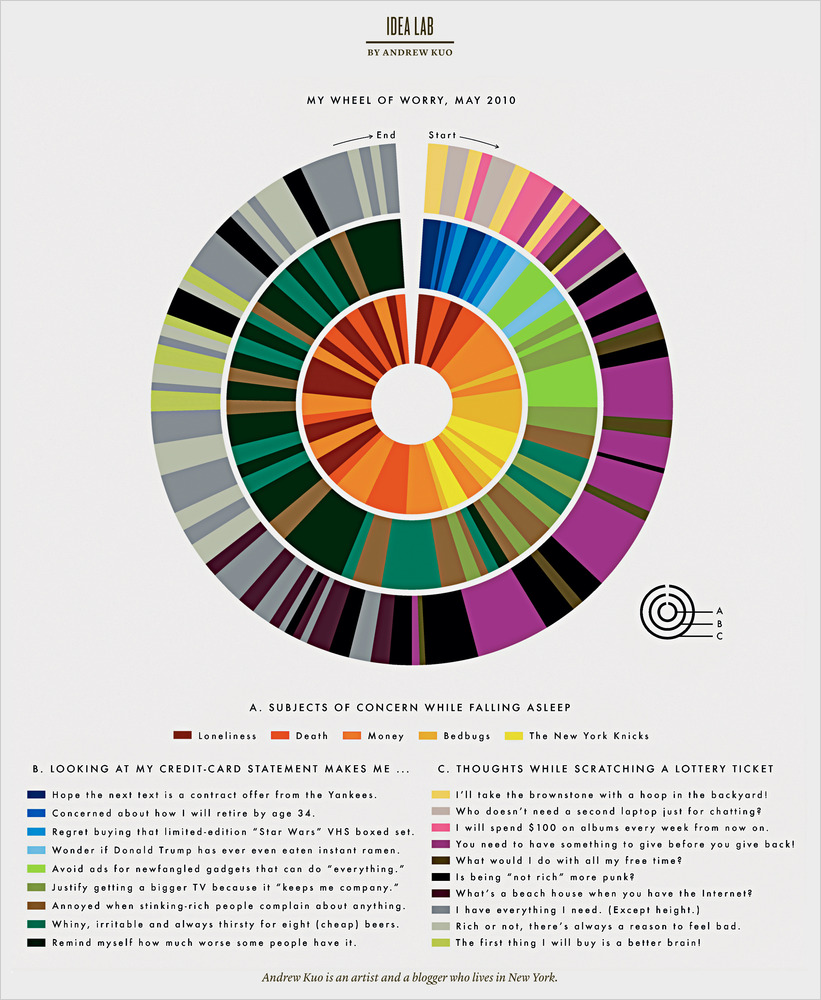
The concept of the worry table is strikingly reminiscent — and, one has to wonder, might have inspired — artist Andrew Kuo’s elaborate 2008 graphic My Wheel of Worry:

(Of course, F. Scott Fitzgerald intuited the basic premise of the table when he sent his daughter Scottie an itemized list of the things in life to worry and not worry about.)

In a later chapter, titled “Doing One’s Work Under Difficulties,” Gilkey offers some related advice which, on the one hand, bears that wise Buddhist-like mindset of living with sheer awareness but, on the other, makes a questionable case against introspection and the enormous enrichment of “living the questions”:

We should make ourselves stop trying to explain our own difficulties. Our first impulse is to try to account for them, figure out why what has happened did happen. Sometimes such an effort is beneficial: more often it is distinctly harmful. It leads to introspection, self-pity, and vain regret; and almost invariably it creates within us a dangerous mood of confusion and despair. Many of life’s hard situations cannot be explained. They can only be endured, mastered, ad gradually forgotten. Once we learn this truth, once we resolve to use all our energies managing life rather than trying to explain life, we take the first and most obvious step toward significant accomplishment.

In the following chapter, “Learning to Adjust,” Gilkey revisits the subject through the lens of aging:

Only as we yield to the inexorable, only as we accept the situations which we find ourselves powerless to change, can we free ourselves from fatal inward tensions, and acquire that inward quietness amid which we can seek — and usually find — ways by which our limitations can be made at least partially endurable.

[…]

Why is [this] so difficult for most people? because most of us were told in childhood that the way to conquer a difficulty is to fight it and demolish it. That theory is, of course, the one that should be taught to young people. Many of the difficulties we encounter in youth are not permanent; and the combination of a heroic courage, a resolute will, and a tireless persistence will often — probably usually — break them down. Bu tin later years the essential elements in the situation change. We find in our little world prison-walls which no amount of battering will demolish. Within those walls we must spend our day — spend them happily, or resentfully. Under these new circumstances we must deliberately reverse our youthful technique. We must gain victory, not by assaulting the walls, but by accepting them. Only when this surrender is made can we assure ourselves of inward quietness, and locate the net step on the road to ultimate victory.

Complement You Can Master Life with a contemporary counterpart of sorts, the wonderful and wonderfully useful How To Stay Sane, then wash down with a verse-by-verse neuropsychology reading of Bobby McFerrin’s “Don’t Worry, Be Happy.”

Donating = Loving

Bringing you (ad-free) Brain Pickings takes hundreds of hours each month. If you find any joy and stimulation here, please consider becoming a Supporting Member with a recurring monthly donation of your choosing, between a cup of tea and a good dinner:


♥ $7 / month♥ $3 / month♥ $10 / month♥ $25 / month


You can also become a one-time patron with a single donation in any amount:


Brain Pickings has a free weekly newsletter. It comes out on Sundays and offers the week’s best articles. Here’s what to expect. Like? Sign up.

Brain Pickings takes 450+ hours a month to curate and edit across the different platforms, and remains banner-free. If it brings you any joy and inspiration, please consider a modest donation – it lets me know I'm doing something right. Holstee

18 Mar 14:56

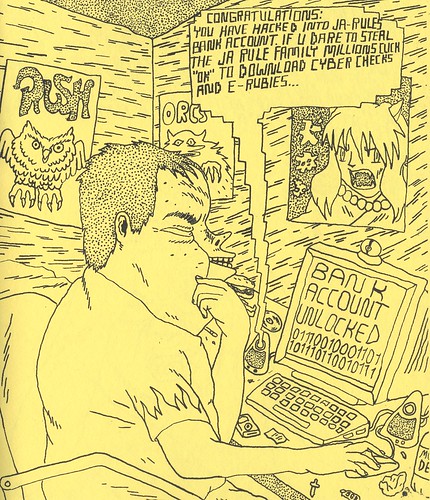
The Ja-Rule Family Millions (page from Slurricane #4)

by Will Laren
The Ja-Rule Family Millions (page from Slurricane #4) by willlaren
The Ja-Rule Family Millions (page from Slurricane #4), a photo by willlaren on Flickr.

Via Flickr:
Since this page was already in the sample pages of Slurricane #4 on Bigcartel I figured I might as well upload a better version that people could read. if you like this page, please consider buying the whole zine for only $5!

18 Mar 14:39

"Like so many people who defend Obama’s War on Terror policies and mock Paul’s..."

“Like so many people who defend Obama’s War on Terror policies and mock Paul’s filibuster, Krauthammer suggests that the very idea that the US government could treat a US citizen on US soil as an enemy combatant and thus punish them without due process is so absurd as to be paranoid to even raise the question. Does anyone remember the Jose Padilla case: in which the Bush administration, in 2002, detained this US citizen, on US soil; declared him to be an “enemy combatant”; and then proceeded to imprison him for the next 3 1/2 years without charges or trial - all with little public resistance and, ultimately, endorsement from a right-wing court? Was Charles Krauthammer objecting to any of that? Were all of the people now claiming that it’s paranoia to think that the US government would use war power theories against a US citizen on US soil marching in the streets in protest over this? The answer is: no. The US government has already asserted the very theory that many now mock Paul for asking about, and did so with very little resistance, including from the courts. It’s true that they did not kill Padilla, but the theory used to imprison him for years without charges - the president is empowered to declare anyone he wants to be an “enemy combatant” without charges and trial and then punish him as such: including US citizens found on US soil - is precisely the theory that would justify targeting US citizens on US soil for an Awlaki-type strike. Indeed, that is the theory invoked to justify the killing of Awlaki, and there is no cogent way to exclude US soil: since the entire globe is a battlefield, the president has the unilateral power to detain or kill anyone he wants, including citizens, without charges. To pretend that this is so beyond the pale of what US political culture would tolerate is to exhibit serious naïveté and/or ignorance of recent history.”

- Glenn Greenwald
18 Mar 14:37

littlehouseontheprisonfarm: conorchristopher: Keldur,...


littlehouseontheprisonfarm:

conorchristopher:

Keldur, Iceland

___

In a hole in the ground there lived…

18 Mar 14:36

superiorlemon: my favorite cosplays are when buff people cosplay madoka it always makes my day

superiorlemon:

my favorite cosplays are when buff people cosplay madoka it always makes my day

image

18 Mar 14:35

dannysauruswrecks: If you know what this is referring to…...


dannysauruswrecks:

If you know what this is referring to… You’ve been on Tumblr for too long.

This is the best “cosplay” I have ever seen

18 Mar 14:34

"There’s this issue you’re not allowed to discuss: that women are needy. Men can go for longer, more..."

firehose

source of that quote: http://www.scotsman.com/news/time-lad-scores-with-sex-and-daleks-1-1394833

(spoiler alert: it gets worse)

So, post-New Man, post-Lad, where does the male of the species stand now? "Well, the world is vastly counted in favour of men at every level - except if you live in a civilised country and you’re sort of educated and middle-class, because then you’re almost certainly junior in your relationship and in a state of permanent, crippled apology. Your preferences are routinely mocked. There’s a huge, unfortunate lack of respect for anything male."

Crikey. Who wants to grow up and be a man, accompanied by an accoutrement or not? Best to stay a boy and look forward to the return of - cue scariest theme music of all time - Doctor Who. Moffat is loving the writing process, a dramatic change from three-laughs-per-page in every sense. "There’s no need for character development, or chat, it’s straight into: ‘There’s something wrong here, let’s look into this deep, dark hole.’"

“There’s this issue you’re not allowed to discuss: that women are needy. Men can go for longer, more happily, without women. That’s the truth. We don’t, as little boys, play at being married - we try to avoid it for as long as possible. Meanwhile women are out there hunting for husbands.”

-

Steven Moffat on Female Characters. (x)

Think about this next time you decide to praise his “not sexist” writing.

(via nochancesatall)

18 Mar 14:30

History Channel's Satan Looks A Lot Like Barack Obama

The character is part of "The Bible," a ten-hour television series airing on the History Channel.
18 Mar 13:21

Missile Command's 31-Year-Old All-Time Record Has Fallen

Victor Sandberg is the new Missile Command world record holder, finishing with a score of 81,796,035 in 56 hours, 5 minutes, 53 seconds.