 msnNOW |
msnNOW Calling the melting-down of guns bought at buyback events a waste of money, the Republican-controlled Arizona Senate has passed a bill that would require cities to resell those firearms back to the public. The law would actually close a loophole in a 2012 ... and more » |
firehose
Shared posts
18 Apr 18:09
Arizona lawmakers demand bought-back guns be resold - msnNOW
firehoseR.O.F.CRYING
18 Apr 18:09

Osito for iPhone: can this minimalist Google Now clone make a splash before the real thing?
by Ellis Hamburger
There is no shortage of Google Now clones for iPhone, but none of them successfully emulate Google's concise and tasteful representation of data. Tempo focuses too much on being a "smart" calendar, cluttering your screen with email attachments related to your events, while Grokr soils results with restaurant recommendations. Osito, a free app launching today for iPhone, wants to do the opposite: provide you with only the most essential information like flight status, traffic updates, and an address for your hotel when your flight lands. Like Google Now, Osito plugs into your location, calendar, and email to provide alerts and updates — all within familiar design sensibilities iOS users have been clamoring for.
"Our app doesn't need to be on your home screen."
Osito is all about "predictive intelligence," according to CEO Bill Ferrell, a former Googler who worked on search ad quality. The app examines both your calendar and your location to figure out where you need to be and how long it will take you to get there. But even if your weekly piano lesson appointment isn't attached to a location, Osito can figure out where you're going after a few trips and alert you if there's traffic next time. At launch, Osito helps with several very specific things based on location and the time: your flight status and online check-in, a hotel reservation alert when your flight lands, traffic alerts for your commute or next appointment, and alerts when it's going to rain. Each alert offers "next step" buttons like online flight check in, directions, and weather forecasts. If you compare Osito's primary functionalities with Google Now's, the lists are nearly identical.
Osito for iPhone screenshots
But there's another side to Osito that's much larger in scale than sending traffic alerts. Ferrell plans to open up Osito to third-party developers and provide easy access to your location, if you choose to allow it. Ferrell hacked together a "trigger" so when Osito detects that he has arrived at work, lava lamps turn on around the office. "What we've really built is a trigger system for information based on your location," Ferrell says. A Google Now-esque interface is simply the first implementation of how you might want to use that data. You can imagine future integrations where Osito's API ties in with IFTTT to text your spouse when you've arrived at work or send a tweet when you're on the way home. You could set up Foursquare to ping you with recommendations when you land in a new city. "Our app doesn't need to be on your home screen," Ferrell says, and the company's future plans are a testament to that. But today, Osito feels more like Google Now.
"What we've really built is a trigger system for information based on your location."
Osito is still in its early stages, and the app's performance reflects that. During the two weeks I tested Osito, I received very few notifications from the app aside from alerts that it was about to start raining. Even though I took a few flights during the two-week period, Osito didn't recognized my semi-obscure travel agent company's emails as flight confirmations, and thus didn't add my flights. The app also didn't alert me about any traffic, but that's because I take the subway to work. "It's important that we don't send you information that's not relevant," Ferrell says. "We tried to be careful and only bite off a little at a time, and invest very heavily in platform behind the scenes."
While Osito isn't fully fleshed out, it avoids the pitfalls of many apps that burden you early on with their overzealous mistakes. Where other "assistant" or "ambient location" apps pester you with information, Osito might err on providing too little information, and that's not a bad thing for version one. "You don't need to think about us," Ferrell says. "We might not have something to tell you today, whether it's the first day or hundredth day of using Osito," and he's OK with that. The last thing we need is one more push notification buzzing our phones, but with Osito installed, you know it will be an important one. While it might not quench your thirst for a Google Now for iOS, it's the next best thing until the real deal hits the App Store.
- Related Items osito iphone apps apps google now
18 Apr 18:09
Fiber Optic Cables in California’s Humboldt County Repeatedly Cut by Mystery Vandals
by EDW Lynch
firehoseit's Suddenlink, so it's not like they were working anyway

In the Northern California county of Humboldt, fiber optic cables that provide the community with phone, Internet, and cable TV have been cut five times since March. Local authorities have so far not been able to identify any suspects. The fiber optic cable operator, Suddenlink, is offering a $10,000 reward for information leading to the arrest and conviction of the vandals.
From the Humboldt County Sheriff’s Office:
On 3-13-13 at about 1100 p.m. the Sheriff’s Office was contacted by Suddenlink and advised of vandalism to their Fiber Optic Cable. This is the fourth vandalism to Suddenlink’s Fiber Optic Service since March 8, 2013. The most recent vandalism is believed to have occurred in the 3400 block of Old Arcata Road however Suddenlink is still attempting to identify the exact location. The Sheriff’s Office responded to the area last night and did not locate any suspects or find obvious signs of where the cable was damaged.
Sheriff’s Investigators are currently on scene investigating this crime and Suddenlink personnel are working to repair the Fiber Optic Cable. Suddenlink previously estimated the repair costs to be approximately $10,000, per site. The vandalisms have occurred in the areas of Ferndale, Trinidad and now Bayside.
Suddenlink is offering a $5,000 cash reward for the arrest and conviction of the suspect(s) that are responsible for these crimes.
This is an on-going investigation and the Sheriff’s Office is working diligently to identify a suspect or suspects in these crimes and to stop further vandalisms and interruptions to Suddenlink’s services.
Anyone with information for the Sheriff’s Office regarding this case or related criminal activity is encouraged to call Detective Kirkpatrick of the Sheriff’s Criminal Investigations Division at 707-268-3640 or the Sheriff’s Tip Line at 707-268-2539.

photo by KLH/Arcata Eye
18 Apr 18:08
Engineering coffee: experiencing the Alpha Dominche Steampunk
by Dan Seifert
firehosecommercial appropriation of the word steampunk
As America has become increasingly infatuated with coffee and the myriad of ways it can be brewed and consumed, boutique coffee shops have enjoyed explosive growth. While K-Cup-like pod-based systems are now accounting for more than 25 percent of ground coffee sales to average consumers, coffee aficionados are constantly pursuing new ways to make the perfect cup of coffee — and coffee shop owners are equally trying to meet the demands of these particular drinkers. We've already taken a look at expensive, hand-made boutique coffee makers for the home, but I recently got to experience the Alpha Dominche Steampunk brewer, an American-made $15,000 machine designed to live behind the counter of your favorite coffee house.
The Steampunk is the brainchild of Khristian Bombeck, founder of Alpha Dominche and a coffee shop owner himself. The product of over four years of development, the Steampunk blends artful craftsmanship, premium materials, and innovative engineering into a machine that can produce world-class cups of coffee with repeatable accuracy. Though its name conjures up images of elaborate 1890s costumes and an abundance of copper, Bombeck told me that it made sense to call the machine the Steampunk because it is actually powered by steam.
The Steampunk's modern look and clean aesthetic would fit in any high-end coffee shop
But don't be fooled, the Steampunk has modern features and a clean aesthetic that would be comfortable in most any high-end coffee establishment. That's in part thanks to the team that Bombeck assembled to help design and build the machine, which features design-conscious architects and engineers.
Alpha Dominche Steampunk coffee machine pictures
What makes the Steampunk different from other coffee makers is its ability to quickly and repeatedly brew cups of coffee to exacting specifications. Bombeck describes the Steampunk as a "semi-automated single serve" machine, meaning that while it's not as automated as the Mr. Coffee on your kitchen counter, operating it only requires a few minutes of training. That's a stark difference to the years of training and experience it takes to become a skilled barista that can operate a complicated espresso machine well. Despite its simplicity of operation, the Steampunk can be configured to brew coffee in any style from French Press to pour over to siphon, with very granular controls over water temperature and pressure.
The Steampunk can brew up to four different coffees at once
The Steampunk 4.0, the version rolling out to coffee shops now, can brew up to four different coffees at once, giving a trained operator the ability to crank out 60 to 80 cups an hour. In the world of specialty coffee, where a single pour over-style cup can take upwards of five minutes on its own, that's quite impressive. (The one type of coffee that the Steampunk is not designed to do is espresso, so it is meant to complement the traditional espresso machine, not replace it.)

To see the Steampunk in action, I went to La Colombe Torrefaction in New York City. The owners of La Colombe were so smitten with the Steampunk demos last year, they demanded to be the first specialty coffee shop in the world to have it sitting on their coffee bar. The machine itself is quite impressive to behold: the four distinctive chambers (Alpha Dominche calls them "crucibles") sprout from the from the front of the Steampunk and are made of stainless steel and glass with wooden tap handles. The taps to dispense the coffee from the crucibles are actually repurposed beer taps and valves.
Recipes can control parameters such as temperature, pressure, and agitation
Splitting the four crucibles into two pairs is a touchscreen panel, which acts as the main control of the Steampunk. From here, coffee shop managers can input different recipes for various types of brews, with control over temperature, pressure, and agitation. Baristas can then start the machine by just choosing the recipe that they are brewing for and then filling the correct crucible with fresh ground coffee. For now, the recipes are entered by hand through a simple interface, but Bombeck says that a cloud-based system is in the works that can automatically update every machine with new recipes.
Once a recipe is selected and the coffee is loaded, things get really interesting. Powered by a 5700-watt heating element, the Steampunk uses steam to rapidly heat water up to a maximum of 212 degrees Fahrenheit . When the water is at the desired temperature, it is forced by steam up through the crucible to the upper chamber to mix with the coffee grinds. This transfer of water then creates a vacuum in the lower chamber. The crucible's piston can then be agitated up to three times during the brew process (determined by the programmed recipe) to ensure the coffee grinds are properly soaked.
After brewing in the upper chamber for a prescribed time — typically 45 to 60 seconds — a computer-controlled valve is released and the vacuum draws the coffee through the filter built into the base of the piston and into the lower chamber. The barista then uses the tap to dispense the brew into a cup or pitcher, pulls the piston from the top of the machine to dump the grinds and give it a quick rinse, and then runs an automated rinse cycle through the crucible to flush out the crucible and starts the process anew.
I was able to brew delicate and nuanced coffees in minutes
Bombeck promised me that operation of the Steampunk required minimal training, and sure enough, after a quick demo and a handful of instructions, I, an unexperienced barista, was able to brew delicate and nuanced cups of coffee from the machine in minutes. Simple operation and ease of use is crucial for a restaurant setting, where establishments don't necessarily have the time or budget to train experienced baristas, but still have patrons that demand high-quality coffee. Using the recipes programmed into the Steampunk by La Colombe's coffee masters, I brewed a sweet Panamanian coffee in the pour over style, and a darker Kenyan roast with a French Press emulation. Both coffees were excellent and showcased the range of styles that can be brewed with the Steampunk.
While the Steampunk 4.0 is available to coffee shops now, the company recently showed off the Steampunk MOD, a custom installation that hides the boiler and plumbing under the counter and only reveals the crucibles to the barista. The Steampunk will initially be in La Colombe's shops in the US, and Alpha Dominche plans to deploy it in coffee shops in Japan, Australia, and other parts of the world by the end of this year.
You and I still may have to deal with crappy drip machines or time-consuming single-serve methods at home, but coffee shops now have a better option, and a good-looking one at that.
- Related Items alpha dominche steampunk coffee brew machine la colombe pour over french press
18 Apr 18:08
The Cleaner: A True Story, Short Film Shows Masked Renegade Fra.Biancoshock Cleaning the Streets of Italy
by Rusty Blazenhoff
firehosevigilante city maintenance

With Milkshake Studio, Italian renegade fra.biancoshock has made The Cleaner: A true story, a short film that shows him cleaning up the streets of Milan without permission or pay. His approach is interesting, he wears a mask and shines his city clean but in a way that is most often thought of as the work of a street artist, almost a reverse-graffiti. He has been cleaning up the city for about two years now and says, “Well, my way of having fun is going out for a good cleaning.” He challenges others to follow suit. We have previously written about his work.
“Do you think the mess in the streets cleans itself?”
submitted via Laughing Squid Tips
firehose and -1 others like this
18 Apr 17:47
"v3.2.4 beta * New: Support for Tiny Tiny RSS (beta)"
“v3.2.4 beta * New: Support for Tiny Tiny RSS (beta)”
-
-
gReader app for Android to support Tiny Tiny RSS
18 Apr 17:46
corporate job placement moocs?
firehoseBilltron: "fuck this, fuck you"
i work in higher ed IT and there’s this “disruptive technology” thing going on called moocs (massive open online courses). i’m inundated with daily speculation about how moocs will dramatically change education as we know it and speculation about the various schemes for monetizing the courses.
but this thought just occurred to me:
what if… companies, as part of their recruitment and hiring processes, created moocs that you paid to (optionally?) take as part of the application process. applicants pay to earn mooc badges in order to be taken seriously for positions.
the companies earn a profit from your interest as a candidate, and you demonstrate skills/abilities to increase your viability/visibility.
this is heavily weighted toward the company’s interests, and could (would) become problematic pretty quickly for a variety of reasons, but it occurred to me that… given the financial upside for companies… it could happen.
and i just realized i’ve become a part of the speculation! *sigh*
</nerd>
firehose, Cooper Griggs likes this
18 Apr 17:39
Surgeon Simulator 2013 launches on Steam tomorrow
by Griffin McElroy
By Griffin McElroy on Apr 18, 2013 at 12:45p
Surgeon Simulator 2013, an expanded version of Bossa Studios's hilarious physics-based surgical game jam project, will launch on Steam tomorrow, the developer revealed this morning.
The title tasks you with using a single hand and a number of dangerous tools to perform increasingly complex surgical operations on an unfortunate patient. The original title featured a single operation in which the player must perform a heart transplant — the expanded version features a lot more organs to accidentally dismantle, including a brain surgery level which definitely, definitely shouldn't be completed by breaking a beaker over your patient's skull.
Check out the trailer above for a sneak peek at the title, which will cost $9.99 in the U.S., £6.99 in the U.K. and €9.99 in the rest of Europe.
- Source
- Bossa Studios on YouTube
firehose likes this

18 Apr 17:38
"George Washington High School recently hosted a conservative speaker, Pam Stenzel, who travels..."
firehosedo not want to send any kids to a school unless they are prepared to endlessly stir shit and flip over tables and get screamed at by assholes
“
-
George Washington High School recently hosted a conservative speaker, Pam Stenzel, who travels around the country to advocate an abstinence-only approach to teen sexuality. Stenzel has a long history of using inflammatory rhetoric to convince young people that they will face dire consequences for becoming sexually active. At GW’s assembly, Stenzel allegedly told students that “if you take birth control, your mother probably hates you” and “I could look at any one of you in the eyes right now and tell if you’re going to be promiscuous.” She also asserted that condoms aren’t safe, and every instance of sexual contact will lead to a sexually transmitted infection.
Campbell refused to attend the assembly, which was funded by a conservative religious organization called “Believe in West Virginia” and advertised with fliers that proclaimed “God’s plan for sexual purity.” Instead, she filed a complaint with the ACLU and began to speak out about her objections to this type of school-sponsored event. Campbell called Stenzel’s presentation “slut shaming” and said that it made many students uncomfortable.
GW Principal George Aulenbacher, on the other hand, didn’t see anything wrong with hosting Stenzel. “The only way to guarantee safety is abstinence. Sometimes, that can be a touchy topic, but I was not offended by her,” he told the West Virginia Gazette last week.
But it didn’t end with a simple difference of opinion among Campbell and her principal. The high school senior alleges that Aulenbacher threatened to call Wellesley College, where Campbell has been accepted to study in the fall, after she spoke to the press about her objections to the assembly. According to Campbell, her principal said, “How would you feel if I called your college and told them what bad character you have and what a backstabber you are?” Campbell alleges that Aulenbacher continued to berate her in his office, eventually driving her to tears. “He threatened me and my future in order to put forth his own personal agenda and make teachers and students feel they cant speak up because of fear of retaliation,” she said of the incident.
”-
High Schooler Protests ‘Slut-Shaming’ Abstinence Assembly
specifically
The high school senior alleges that Aulenbacher threatened to call Wellesley College, where Campbell has been accepted to study in the fall, after she spoke to the press about her objections to the assembly. According to Campbell, her principal said, “How would you feel if I called your college and told them what bad character you have and what a backstabber you are?”
followed by Wellesley tweeting to her:
Katelyn Campbell, #Wellesley is excited to welcome you this fall. http://bit.ly/13jqRet

18 Apr 17:37
How heavy metal is infiltrating higher education
by Amar Toor
firehoseattn: tOR
Heavy metal has long been relegated to the fringes, transgressing norms through guttural screams and chaotic walls of sound. But as the Wall Street Journal reports, the genre has recently spawned its own branch of academic study at Bowling Green State University in Ohio, where scholars, musicologists, and so-called "metallectuals" regularly convene to discuss the finer points of Black Sabbath and the anthropology of face paint. The rise of heavy metal studies hasn't come without controversy, but its proponents wouldn't have it any other way. "This is a great day for metal studies, and maybe even for metal," Jeremy Wallach, an associate professor at BGSU, told the Journal. "To be a metal-head in 2013 is to be part of a global community."
- Source The Wall Street Journal
- Image Credit Wikimedia Commons
- Related Items metal metal studies bowling green state university heavy metal music academia metallectual culture
firehose likes this
18 Apr 17:24
Yahoo! Weather, A Smartphone App That Enhances Forecasts With Photos From Flickr
by Kimber Streams


Yahoo! and Flickr have just released the Yahoo! Weather app, an iOS and Android app that provides Flickr photos from the Project Weather Group alongside traditional forecasts. Flickr users can submit their own geo-tagged photos to the Project Weather Group for inclusion in the app. Yahoo! Weather is currently available to download in the iTunes App Store and Google Play.


images via Yahoo!
18 Apr 17:23

“It’s a tradition for tourists to touch the foot of...
firehoseone of the first pieces of advice I got in Boston was about the pee
“It’s a tradition for tourists to touch the foot of John Harvard’s statue for good luck. A lesser known tradition is that Harvard students are supposed to pee on that foot before they graduate.”
(Cambridge, MA)
firehose likes this
18 Apr 17:23
"I still received interest from a few teams, and it didn’t have to be over,” Rolle told..."
““I still received interest from a few teams, and it didn’t have to be over,” Rolle told Lost Letterman. “Then I said to myself, ‘I can knock my head against the wall for 8-9 years or move on to medicine.’ I was leaving the game with no concussions and dexterity in both my hands, where I could be a neurosurgeon one day.””
- Myron Rolle Leaves NFL For Medical School | ThePostGame
- Myron Rolle Leaves NFL For Medical School | ThePostGame
firehose likes this



18 Apr 17:13
animalsinsweaters: rat by ashleyjuliette22 on Flickr.
firehosepaging Hilary

firehose likes this

18 Apr 17:09
Jon Stewart's Masterful Takedown Of CNN's Terrible Boston Bombing Reporting
CNN's reporting of an arrest having been made in connection with Monday's Boston Marathon bombing turned out to be stupendously wrong, but at least it allowed Jon Stewart to do what he does best: Tear into a so-called news network for royally screwing up its one job.
18 Apr 17:08
Google takes first swipe at Facebook comments with Google+ Blogger integration
by Chris Welch
firehosefuck this
fuck you
Facebook found a successful recipe when it launched a commenting system that could be incorporated on third-party websites, and now it appears Google+ is following its rival's footsteps — or at least starting to. Today Google is allowing Blogger users to integrate Google+ comments on their website. One benefit of the new functionality is deeper customization options for who will see a visitor's input — comments can be public or limited to select circles.
Beyond that, however, there's another major benefit: Google says that Blogger will also display discussions on Google+ that pertain to a user's post. "For example, if there's a public Google+ discussion about one of your blog entries, those comments and replies will also appear on your Blogger site. This way you can engage with more of your readers, all in one place," the company writes. Google's own announcement post serves as evidence of how this could be useful, already tallying over 100 responses. The integration looks fairly well executed, and though Google isn't revealing all of its cards today, it's not hard to imagine Google+ comments spreading to other blogging platforms and (eventually) perhaps the web at large.
18 Apr 17:08
Online witch hunt for Boston bomber leads to NY Post cover photo of innocent 'suspects'
by Ben Popper
firehoseLOL 4CHAN
LOL REDDIT
LOL LOL LOL
In the 48 hours that followed Monday's tragic bombing in Boston, no one came forward to claim responsibility for the attack and law enforcement did not name any suspects. The FBI and local Boston police did, however, ask the public to pass along their photos and video and to report any suspicious behavior. Into this vacuum of concrete evidence poured a flood of over eager do-gooders and amateur detectives from online communities such as 4chan and Reddit. They shared images and suspicions, focusing in on people from the crowd who seemed to be carrying black bags potentially filled with explosives.
One of these pictures found its way to the front page of the New York Post, which claimed two men who had been highlighted online as the key suspects being pursued by the FBI (as of this writing, the FBI has not released any photos to the press or public). This would quickly turn out to be a horrendous mistake.
As journalists like Anthony De Rosa reported, the crowdsourced detective work should have been treated with a grain of salt. "Since this work is being done over the internet, it's not being done in a professional capacity," said De Rosa. "There is potential for people photoshopping these images, there is potential for people having a cause, or an activist trying to push the investigation in a certain direction, whether its domestic or foreign. It's being done messy and in real time, and done by amateurs, so its interesting to look at, but you have to keep those things in mind, when you're looking at what conclusions they are coming to."
The New York Post apparently missed that memo. This morning its front page story focused on two men under the headline, "BAG MEN: Feds seek these two pictured at Boston Marathon." The image was of two men in track suits — one with a black backpack — both of whom appeared to be of Arab descent and had been highlighted by users on 4chan and Reddit as potential suspects. Users pointed out what they saw as suspicious behavior. The Post reported that their picture was being circulated among law enforcement as key suspects.

As it turns out the two men were a local high school track athlete and his coach who had come to watch the race. CBS reporter John Miller contradicted The Post, reporting that neither man is a suspect and that their pictures were not circulated by law enforcement.
The cautionary tale to keep in mind here is Richard Jewell, the security guard who was seen as a hero of the 1996 Olympic bombing until a report in The Atlanta Journal named him as a "person of suspicion." Reporters were quickly hounded him like "piranha on a bleeding cow" and while he was eventually cleared by the FBI, Jewell felt he could never really outrun the notoriety.
Reddit, meanwhile, furiously tried to backtrack and avoid further media scrutiny of the two men, having decided, after finding the younger man's Facebook, that they were in fact innocent after all. The subReddit dedicated to the Boston bombing went so far as to create an entire post begging the media not to use any of their work as factual evidence in future stories.
- Source NY Post
- Image Credit NY Post
- Related Items boston bomb ny post fbi 4chan reddit crowdsource boston bombing vigilante suspect innocent richard jewell
firehose likes this


18 Apr 17:04

grandst: Someone mounted a lens from 1902 onto a Canon 5D. It’s...
Someone mounted a lens from 1902 onto a Canon 5D. It’s like sewing Albert Einstein’s head onto Paris Hilton’s body—except way less visually cacophonous.
18 Apr 17:02

broke it against the Blazers
firehosemeanwhile, in Portland
broke it against the Blazers
firehose likes this
18 Apr 16:59
The Long Con
by Sam Machkovech
firehoseMonaco beat
Amherst College beat
By Sam Machkovech on April 18, 2013 at 12:00p
High in the wild with Monaco's Andy SchatzAndy Schatz's apartment in San Diego looks like the wild.
Or, at least, like its game-designing owner knows the wild through and through. A hand-crafted ram's head hangs above the living room television. A small, embroidered rug above the kitchen entrance is adorned with alpacas. Elephants can be found scattered everywhere else. Schatz's wife, Tierney Kurani, proudly points out each item's origin. Thailand. Ecuador. A vase from her family in Egypt. A relic from a ghost town in Mexico. Most of the animal-tinged decorations come from the couple's travels since they met six years ago. Same with the bookshelves, which are mostly full of travel volumes and foreign gallery collections. The exception is a single shelf, bookended by two indie game design awards. Kurani has taken on tour guide duties because Schatz is currently pulling his hair out in the office down the hall. Conveniently, the 35-year-old San Diego native's latest headache has to do with animals.
This is mid-February, and he thought he'd have put the final touches on his latest indie game, Monaco: What's Yours Is Mine, by now. However, a glitch involving a murder of crows has reared its head. Some game makers might consider removing such troublesome birds at this point; they're just background fluff.
Not Schatz. His game-designing career once revolved around the veritable Noah's Ark of inspirations around his home. His one-man design shop, Pocketwatch Games, turned out two well-received "wildlife tycoon" sim games in the '00s: Venture Africa, an Independent Games Festival Awards finalist in 2006, and Venture Arctic. The games' zeal about ecosystems borders on religious — and made him enough of an indie favorite to host the IGF Awards a staggering five times, including last month's ceremony — but that didn't translate into sales success.
In 2009, low on cash and high on frustration, Schatz played around with a lark of a game idea — at first, little more than a Pac-Man clone — as a last-ditch attempt before giving up his indie status and getting "a corporate job."
That single-week lark turned into 15 weeks. At the end of it, he had a playable prototype of Monaco, a stealthy, four-player heist adventure that turns Pac-Man into Ocean's Eleven.
It came out of nowhere to win two IGF awards — including the IGF's Seamus McNally Grand Prize — beating the likes of Super Meat Boy and Joe Danger. The game was unfinished, but its potential was clear: Monaco was a magnificent return to the four-player couch madness of '90s console games, and the formula still works.
It just needs to come out. And, well ... these crows.
At the end of it, he had a playable prototype of Monaco, a stealthy, four-player heist adventure that turns Pac-Man into Ocean's Eleven.
Schatz is soft-spoken when he curses at his computer, but the "fuck"s and "shit"s take aim at the code in the crows. These birds serve as another reminder that it's been a long time — 3 1/2 years, Kurani is quick to confirm — since Schatz has gone on the kind of international trip where he might find new, beast-inspired crafts for his floors and walls. Not while he's busy making the game.
But after years of blown deals, business missteps, medical scares and control freakdom, Schatz has finally finished Monaco — three years after it blew the IGF away — by ignoring the wisdom of the game's heist plot and trusting his unlikely accomplices.
Ultimate Frisbee
Ultimate Frisbee
"High Times ranked this as one of the ten best places in the nation to smoke weed," Schatz says with a laugh.
He gestures toward a local stoner at Balboa Park in San Diego, the city's biggest frisbee golf course. We're here because I asked Schatz to show me something local that he loves while I'm in town. Rest assured, it's not weed; Andy Schatz absolutely loves frisbee golf.
From a distance, Schatz might look like a local stoner himself. His thick head of short, curly brown hair sticks out of a nondescript hoodie sweater, and on this sunny, brisk day in February, he elects to wear shorts. Once he steps to the tee-off line at a Balboa Park hole, however, he doesn't much resemble a pothead.
His expressive face never squints as he sizes up his next throw, and he primes his shots by holding a frisbee with two hands toward his target, like a bowler approaching a lane. His spins and releases are controlled and tight — not surprising, considering how fit he looks, but the way he sends a frisbee sailing smoothly through the air, you'd think he used an automated turret.

Some game makers might consider removing such troublesome birds at this point; they're just background fluff.
It's a peculiar first impression for a game designer, a fact that Schatz cops to. He grew up playing a lot of sports — soccer, varsity swimming, even water polo — while maintaining a group of friends who were into video games and Dungeons & Dragons all the way through high school. "I was the popular kid amongst the super-nerdy people," he says. "I wasn't a bully, but I was definitely the alpha dog of that group."
Schatz grew up pretty well-to-do as the son of a geophysicist dad and a philosophy professor mom. That meant a lot of travel and interest in all things international, but it also meant access to a Commodore 64 at the age of four, and the very early discovery that he wanted to make his own video games.
At only seven years old, Schatz began drawing and designing his own maze games on graph paper, and his mother brought him coding magazines, which had sample scripts in BASIC that he could copy onto a computer to make simple, working games. By seventh grade, he had coded a C64 game from scratch, with the help of his code-loving father. His "Warlords-esque" game, named Servants of Darkness, had "randomized worlds and a bunch of different units," and it supported four players, so his mother, father and sister often helped him test it.
A bunch of his own games — and a winning entry in the California State Science Fair in 1995 — were enough to get him into Amherst College, where he split his time between computer science studies and a growing obsession with Ultimate Frisbee (he captained a team for 2 1/2 years). Though he considers himself "too old" to play it anymore, Schatz still talks about the game obsessively: "It's the perfect game designer sport. It's a sport where people haven't figured out all of the strategies yet."
Frisbee golf has been his compromise ever since, though thanks to Monaco, he hasn't played for about six months until this outing. You can tell a lot about a game designer from doing something like this — a fact Schatz may have known all along, in spite of his shoulder-shrug explanation of why he chose to share frisbee golf ("it's fun, and you can talk while you play"). His descriptions of the game were very clear, always anticipating first-timer challenges — in this case, things like throwing angle, use of the wrist and an emphasis of spin over power.
Unlike a stereotypical, aggressive coach, Schatz knew when to shut up and let me find my own way. That's not to say he sat back and watched me flounder. Rather, he strategically employed nonchalance. Here's an example: Schatz grabbed the scorecard at the outset of our 14-hole game. At first, we compared scores at the end of holes, and I saw him jot down our numbers, but by the end of the game, he admitted he'd "lost track."
I might've believed that lie if he hadn't begun crunching a few specific numbers about his performance on the way home. Schatz knew exactly how the game went, cataloguing everyone's performance in his head the whole time. However, just like in a good video game, he shared just enough information with the players. He kept the clutter out of my real-life UI, so that I could focus on learning, fun and discovery.
What's yours is mine
What's yours is mine
Translating that kind of game design wisdom to the final version of Monaco hasn't been so simple. In fact, that problem took years to solve.
In Monaco: What's Yours Is Mine, up to four ex-cons break out of a prison in a top-down, 2D perspective, and their missions usually revolve around breaking into and out of a treasure-loaded den of excess — a nightclub, a mansion, a yacht. Players immediately learn the game's basic truth: if you want to use it, push against it. Press the joystick towards a door, a computer or an alarm, and your hoodlum will unlock, hack or deactivate, respectively.

Schatz grew up pretty well-to-do as the son of a geophysicist dad and a philosophy professor mom.
It's a charmingly simple mechanic — and one rarely used in top-down games — yet a lot of depth has been built around it. For one, players eventually have a choice of eight playable criminals as they move on to bigger heists and crazier capers. The starting crew of four has simpler strengths: one picks locks faster; one can see guards through walls; one, er, has a helper monkey who gathers coins. Later characters can dig through walls, disguise themselves and even charm enemies into doing your bidding. The game has been designed to be playable — and fun — by solo crooks and four-strong bands of thieves, and each combination of characters has been scrutinized so deeply, Schatz feels like he has his own Team Fortress 2-caliber roster.
Guns, smoke bombs and other pickups get a little complicated, because they tie into the game's loot system. The optional coins, scattered around each classy location, aren't just meant for Pac-Man compulsives; every 10 coins adds one bullet or item to your ammo. In multiplayer matches, the coins (which reappear randomly when a level is replayed), don't increase in number. Expect to argue over the cash.
That's just one trick Monaco uses to make its stealthy action work as a couch game; once the shouts kick in between heisting friends, there's no point in comparing it to more serious fare like Thief or Splinter Cell. But Schatz obsesses over making sure players never stumble. He adds as much depth and strategy as possible without turning nuance into a hurdle, a fact that led to seemingly endless tuning of on-screen information like coin and health counts. And he flat-out admits that he still doesn't like the loot-for-ammo mechanic, because it "asks players to perform calculations."
But he has to ship the game, which means locking down the core gameplay. Bugs and crows await.
150 people doing nothing
150 people doing nothing
It makes sense that an element as simple as gizmos would trip Schatz up. After all, that hearkens back to his first game design job after college, coding on behalf of secret agent 007. Schatz returned to the west coast after Amherst to pick up a gig at TKO Software in Santa Cruz, Calif., a company best known for its contract work with EA, and he took on programming duties for Medal of Honor: Allied Assault: Breakthrough and GoldenEye: Rogue Agent.
He doesn't mince words about that output: "terrible games"; GoldenEye: RA's single player portion was "so bad, we all knew it was gonna flop." The working conditions didn't help. Schatz recalls that these games were made around the time of the EA Spouse controversy, and his own experience in 2004 matched up; EA required his entire contract team to relocate to Los Angeles for GoldenEye: RA's final four months, during which time at least one staffer had to "fight management to be able to go to Santa Cruz to visit his kids on [the] weekend."

Players would build their own home, set it up with traps, then log online to break into other players' homes.
Schatz is careful to note that he believes EA has made great strides in the years since, but at the time, he had mentally checked out: "I wanted out of AAA game development." But before leaving, Schatz had to grab a hard drive and folder full of the original concepts for Monaco.
"Before GoldenEye came in, we were between contracts. [TKO] had built a team of 150 people who were doing nothing," he says. So he asked permission to design and prototype a game idea, and he wound up completing a design document and playable 3D slice of a house-robbing game. Players would build their own home, set it up with traps, then log online to break into other players' homes.
TKO sent the prototype to Microsoft. The furthest it got was that Microsoft executives mentioned the game concept in interviews as an example of Xbox 360 online gaming, but nothing more. Fine by Schatz; when TKO folded years later, he retained the rights to his designs.
By then, he'd already returned to his hometown of San Diego to found Pocketwatch Games: really, a glorified name for his solo creations, like Trent Reznor's Nine Inch Nails. His first instinct was to build a game based on his life experience, drawn largely from his mother's love of traveling and his father's love of coding real-life simulations in software (which he did for an oil company in the '80s and '90s).
Pocketwatch's first game, Venture Africa, had players oversee an African savannah and take care of 11 species of wild animals. Its box originally came with a label reading "Wildlife Tycoon," an obvious overture to casual gamers who were gobbling up Zoo Tycoon at the time. But the "Tycoon" label missed the mark. Schatz's 2005 game ignored cash economies in favor of things like inter-species relationships, weather cycles and ecosystem impact. The result may have looked like a one-man production, but its fierce independence paid off, selling in the tens of thousands and enjoying many high-ranking indie game award nominations. Not bad for a debut solo venture, especially before Steam proved a viable indie option (Schatz partnered with casual game publisher MumboJumbo).
With a modest influx of cash, Schatz set out to make a bigger, better sequel, aiming his ecosystem sights at Antarctica. But in spite of more species and more in-game activities, Venture Arctic added complications that gamers were less willing to swallow with penguins than with lions and elephants. The game launched — and tanked — in 2007.
Before Schatz had to move back in with his parents, a windfall of cash appeared from an unlikely place: Gary Kremen, the founder of Match.com. Kremen was a fan of Venture Africa and its eco-friendly message, and he wanted to develop a web-browser game for kids that would reside at Green.com. Grudgingly, Schatz took on the gig — mostly because of the giant payday, he admits. He led a team that had "never made games like this before," and eventually presented the game to media magnate and online entrepreneur Barry Diller. Schatz says that Diller liked the idea, only to neuter its central gameplay conceit: "'You've gotta get rid of the eco thing!'"
"It's fun to sit and use the damn joystick, because it's fast and, like, wokka wokka wokka."
The contract at green.com dwindled, and Schatz's dream of building another Venture sequel — this time, Venture Dinosauria, a kind of Jurassic Park where "the dinosaurs wouldn't be monsters for once" — kept hitting a brick wall. Schatz's usual method of starting with a high-level inspiration, then working out game mechanics later, didn't shake out as anything fun this time; he likens his unrealized hopes to how Spore turned out. A year of work wound up filed away in a desk drawer.
Dejected, Schatz started from scratch in late 2009 to whip up a quick, simple game before giving up his independence and looking for studio work again. He taught himself how to use XNA, a coding language that could easily translate from PC to Xbox 360, and while the old Monaco idea was in the back of his mind, XNA proved to be a clean-slate way to ignore his old, high-level concepts and start with pure gameplay for once.
In one day, he coded a version of Pac-Man — with one key difference.
"Take the ghosts out of Pac-Man," Schatz says. "Don't expect this to be a full game, but take them out, and ask yourself, as you steer around this world, what's the fastest route to pick up all these pellets? It's at least fun for half an hour to play that game! It's fun to sit and use the damn joystick, because it's fast and, like, wokka wokka wokka."
Schatz had his foundation. Within a week, he added enemies, abilities and a lighting system. Then he grabbed his old Monaco notes.
The quieter Andy
The quieter Andy
Valve approached him with a handshake and an offer — let's get this game on Steam! — while Microsoft and Sony requested meetings. Since the game was at its best with four players in the same room, and it had already been coded in XNA, Schatz set his sights on Microsoft. A series of meetings in 2010 started with one manager asking to "fast-track" the game, but a higher-up at Microsoft Studios nixed the game on account of marketability.
Schatz persisted, saying he could clean the game up if they'd consider a re-pitch. Microsoft agreed, and Schatz got to work, adding enhancements like a vector-based lighting system and four more character classes. That process lasted a year, and Schatz survived thanks to a "no-risk loan" from IndiePub, the group that funded recent indie smashes Antichamber and Qube.
Unfortunately, Schatz's 2011 meeting with Microsoft turned out the same. Worse, plans to port the game to PlayStation 3 had just spun into motion, but within a month, hackers broke into PSN's unencrypted databases. Schatz, fearful of a bombing platform and lost sales, halted the port. "I got scared," Schatz admits. "I started waffling."
Really, if this story revolves around a crime video game, it's hard not to see the quiet kid as the Keyser Söze of the room.
Schatz's stubbornness about launching on a console — and his long-held fears of allying with a third-party publisher — froze him out. Good coincidence, then, that game-design novice Nguyen sent an email, wanting nothing more than a chance to make video games.
With a foot in Pocketwatch's door, Nguyen quit his job at Citibank. "I was reluctant to tell my parents, because I knew they would respond to it poorly," Nguyen says. Indeed, they did, upset that their son gave up consistent income and benefits. Perhaps they'd be proud of his enterprising nature, though: "I could just be complacent and do what Andy tells me, or I can go and do what he doesn't know that he needs." In that way, Nguyen inserted himself as a festival booth coordinator, then a merchandise guy and on up to a level designer and producer. And all of this without knowing how to code, program, animate or design.
His presence has been felt in the home stretch of the game's design, whether by pushing back about level design concerns or helping Schatz balance the final four characters. With that progress, Schatz regained the confidence to find a new route for Monaco, one he found by partnering with publisher Majesco, who agreed to launch the game on Xbox Live while Pocketwatch will self-release the game the same day — April 24 — on Steam. ("Most publishers wouldn't agree to [us publishing on Steam]," Schatz notes, "and we told them to go to hell.")
Ultimately, Nguyen's general silence makes sense, and when he speaks, it's with purpose. When Schatz veers off-topic, Nguyen will chip in reminders about a game design crisis to steer him back. And he'll ask pointed questions about myriad design decisions, as if he, too, is cataloguing every important detail to use in his career someday. Really, if this story revolves around a crime video game, it's hard not to see the quiet kid as the Keyser Söze of the room.
A terrible finisher
A terrible finisher
Nguyen seems pretty excited to have a guest at Schatz's home office, evident in the pointed questions he asks about my line of work. But that excitement is nothing compared to Tierney Kurani's.
After sleeping over at the couple's house, I woke to a poem tucked beneath the door, "written" by their cat in incredibly neat handwriting. "What is this, a red hair? Did you get a tabby, did you dare?!" It's but one of the playful or kind ways Kurani asserts herself during my visit. She has time to write poems and goof off while I'm visiting because she has recently quit her job as a professional shopper for a large retail chain. It's kinda-sorta Monaco's fault.
"I'm surrounded by people who are so inspired to be doing what they're doing," Kurani says, both about the Andys always at her house and the long-distance contributors to the game's music, art and more. "I feel like that's a necessary component in wanting to work hard at something."
But another factor may have played an even bigger part in her career transition. In the past few years, all during Monaco's development, Kurani succumbed to a cancer scare (now in remission) and a nasty bout with pneumonia. It's been long enough that she no longer appears sick in the least; the short and fit Kurani has a bounce to her step and is quick to laugh. Neither she nor Schatz talk much about the illness, acting as if it didn't factor into 3 1/2 years of the game's development.

Kurani laughs a little too long when she remembers that Monaco was "only supposed to take a few weeks."
Indeed, Schatz's obsessive design nature has been a constant ever since they started dating. Or, as Kurani clarifies, "I was hanging out in his office and testing [Venture Arctic], because he was doing nothing but working on it."
Ever since, some game project has hung over the house: Kurani laughs a little too long when she remembers that Monaco was "only supposed to take a few weeks." But she believes in the game, praising its accessibility (and appreciating that the Lookout character is based on her proclivity to rock climb and scale buildings). She likens Pocketwatch to a child, and she is hopeful that Monaco's launch will be the company's veritable college graduation: "Maybe then it'll have the potential for its own earnings and won't need to be nurtured quite as much," she says.
First, the game has to recoup, as Schatz seems to be paying a lot of royalties. IndiePub will want its $100,000 loan paid back, plus 10 percent of sales for the first two years. Andy Nguyen has worked for nearly two years with only a bit of cash up front and the promise of royalties to come. When asked whether the original schemer of this heist will wind up broke at the end, Schatz shrugs.
He'll also be the first to admit that the game could've turned out cheaper and quicker by targeting Steam from day one. "But I really wanted people to play on a couch!" he again asserts. It's easy to see why.
Schatz tends towards comedy, making off-the-cuff comments about the game industry that are intentionally unprintable, or blurting bad-sounding lines, as if trying to write his own headline. Upon missing a frisbee golf putt, he smiles and says, "I'm a great starter but a terrible finisher. Maybe that's why I'm still not done with Monaco!" (Cue a Fozzie Bear "Wocka wocka.")
The way Schatz tells it, Monaco has its roots not so much in heist movies, but in his love for the dark comedy of real-life heist stories: of one bank robber getting hit by a car running a red light, or another bumbling thief dying in a fire that he set himself. He's obsessed with translating these fantastically awful events into party-gaming stories, into moments of "emergent gameplay," his favorite phrase, where players walk away from a game remembering how a heist devolved into a mess, and who went through which part of the mansion to save the dead guy, and so on. He wants players to remember their stories from within his game and retell them.
"You need to make a game that is going to be someone's favorite game forever," he says to Nguyen. "If it's one person's favorite game ever, it's gonna be a lot of people's favorite game ever."
His own game design roots, on graph paper, or behind a Dungeon Master's board, or with family gathered around a Commodore 64, revolved around finding stories between the white spaces of game design that can also be retold. But Monaco also delivers a special appeal to a person like Andy Nguyen, a fact that is absolutely not lost on Schatz. Nguyen isn't just a business partner — or a guy who's already working on Pocketwatch's next game design concepts. Nguyen is a reminder of the days of game design that Schatz has sought for years.
"I just told Andy [Nguyen] this the other day: it's exciting that the nerdy kids today are growing up with Minecraft," Schatz says. "There's a 15-year segment where the gamer kids were growing up in love with games that they could never hope to make on their own. I was always sad to tell them, when they said what kind of games they really loved, they said they love Halo. Part of me wants to say, 'You won't love making Halo. Making Halo is not the experience you think you're having.' But those kids could make Minecraft. My junior high self could make my own version of Minecraft and show it to my parents and be super proud of it. That would be the coolest thing ever."
What about Monaco? "Yes, my junior high self could have made Monaco." Then he smiles huge, his cockiness showing through for one more laugh. "Well, maybe not what Monaco has eventually become, but similar. Absolutely." 
Illustration: Saul Gray-Hildenbrand
Design / Layout: Warren Schultheis
Editing: Russ Pitts, Matt Leone
18 Apr 16:52


This post also appears on Flavorpill, an Atlantic partner site.![]()
![]()
![]()
![]()
![]()
![]()
![]()
![]()
![]()
![]()
![]()
![]()
![]()
![]()
![]()
![]()
![]()
![]()
![]()
![]()
![]()
![]()
![]()
![]()
![]()
![]()
![]()
![]()
![]()
![]()
![]()


Portraits of Kids and Their Favorite Possessions, Across Cultures
by Emily Temple
What was your favorite toy as a child? In Gabriele Galimberti's wonderful series Toy Stories , which we recently spotted over at Feature Shoot, the Italian photographer traveled the world to photograph children with their most prized possessions, be they pink or blue, new or old, plentiful or scarce.
Decaying Food Porn
The Symmetry of Identical Twins
Inside the Dead Baby Unicorn Pop-Up Book
The resulting photo series is in turns haunting and funny, but Galimberti's reports from the field are equally interesting. "The richest children were more possessive. At the beginning, they wouldn't want me to touch their toys, and I would need more time before they would let me play with them," Galimberti says. "In poor countries, it was much easier. Even if they only had two or three toys, they didn't really care. In Africa, the kids would mostly play with their friends outside." Page through a few of our favorites from the series after the jump, and then be sure to head over to Galimberti's site to see many more.

Maudy -- Kalulushi, Zambia

Stella -- Montecchio, Italy

Chiwa -- Mchinji, Malawi

Pavel -- Kiev, Ucraina

Allenah -- El Nido, Philippines

Reanya -- Sepang, Malaysia

Puput -- Bali, Indonesia

Tangawizi -- Keekorok, Kenya

Keynor -- Cahuita, Costarica

Julia -- Tirana, Albania

Alessia -- Castiglion Fiorentino, Italy

Watcharapom -- Bangkok, Thailand

Botlhe -- Maun, Botswana

Arafa & Aisha -- Bububu, Zanzibar

Cun Zi Yi -- Chongqing, China
This post also appears on Flavorpill, an Atlantic partner site.
    
|
Jesshelga and -1 others like this
18 Apr 16:50


Desiccate Scrubs Personal Data from iTunes and Amazon-Bought Tunes
by Alan Henry

Windows: You may already know that when you buy music from iTunes, Amazon, and other digital music stores, some personal information like your account ID or username are embedded in the track metadata. Desiccate is a free Windows utility that scrubs them clean.
|
|
Tadeu, Jakewastaken and 2 others like this
18 Apr 16:49
Today’s Sandwich: Roast Beef Au Jus by Matt Moore
Ingredients (serves 6, prep 25 minutes, cook 60 minutes)








Step 10: Slice Meat




AoM Month of Sandwiches Day #13: Homemade Roast Beef Au Jus
by Matt Moore

Welcome to Day #12 of the AoM sandwich project. Last month we asked readers for their best sandwich recommendations. Out of 483 submissions, we picked 20 to highlight here on the site each weekday during the month of April. At the end, we’ll publish all the entries into an epic man-sandwich cookbook.
I invited AoM’s food writer, Matt Moore, to contribute a sandwich to our sandwich project, and strongly hinted that making something with roast beef and au jus would be pretty awesome. Well Mr. Moore came through in a big way. This looks delicious!
Today’s Sandwich: Roast Beef Au Jus by Matt Moore
Most often, life is better when you take the time to do things the right way – i.e., no short cuts. That lesson is especially true with this sandwich. Beloved by many, yet deemed too technical by most, the roast beef au jus sandwich is too often passed off by restaurants and home cooks with less than mediocre results. You know what I’m talking about — that concoction of dry, overcooked meat on stale bread served with a side of brown, salted water.
That doesn’t have to be so. With some love and attention (and a bit of time) you can deliver a homemade version of this manly meal that is sure to impress.
Ingredients (serves 6, prep 25 minutes, cook 60 minutes)

- 1 3lb eye of round beef roast
- Extra virgin olive oil (I suggest Georgia Olive Farms)
- 1 head of garlic
- Fresh thyme
- Kosher salt
- Fresh cracked pepper
- 8 cups beef stock
- 1 onion
- 6 hoagie rolls
Step 1: Prep Ingredients
Preheat oven to 400 degrees F. Smash and mince 6 cloves of garlic. Next, strip the leaves off of 4-6 thyme sprigs and finely chop.
Step 2: Season Meat & Let Sit at Room Temperature
Coat meat with a few tablespoons of olive oil. Next, add minced garlic and thyme, followed by a liberal sprinkling of kosher salt and fresh cracked pepper. Keep the meat out of the fridge! You want it to be at room temperature to create a nice sear and so it will cook evenly.
Step 3: Start Au Jus
Bring 8 cups of beef stock, remaining garlic, onion (chopped in half), and 4 sprigs of thyme to a slow simmer over medium heat.
Step 4: Prep Pan to Sear Meat
Pre-heat a seasoned cast iron skillet over medium-high heat on the stovetop for 1 minute. It’s a good idea to open a window or turn the vent fan on at this point.
Step 5: Sear Meat
Add meat to pan and sear on all four sides, about 2-3 minutes per side. Do not poke or prod the meat during this process. Allow it to maintain contact with the pan to develop a nice sear – this creates flavor.
Step 6: Roast Meat in Oven
Once the meat is seared, place it in the preheated oven and cook for 45-55 minutes, or until internal temperature reaches 125 degrees F for rare/medium rare.
Step 7: Rest Meat
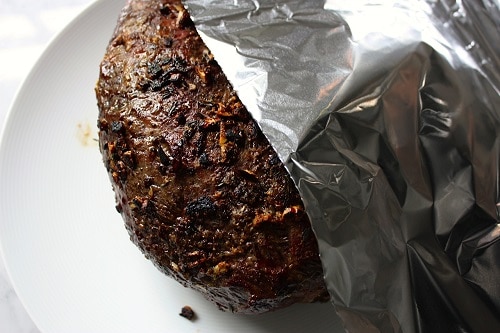
Once desired temperature is reached, remove meat from oven and place on a plate, tented with foil. This ‘resting’ process will allow the juices to redistribute into the meat – it will also keep cooking, raising the temperature, on average, by 5 degrees. Allow to rest for 10 minutes.
Step 8: Strain Au Jus
Use a skimmer or colander to strain ingredients from the au jus. Add any drippings from the meat into this pot.
Step 9: Reduce Au Jus
Place the strained pot of liquid back on the stove over medium-high heat, allowing the mixture to reach a boil in order to reduce by at least half – you should have about 2-3 cups of liquid remaining. Remove from heat, cover, and keep warm for service.
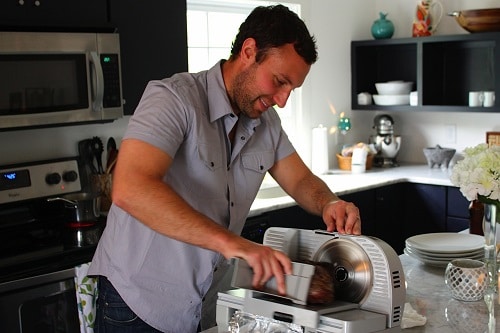
Step 10: Slice Meat
Other than my fine assortment of Wusthof knives, my most manly kitchen tool is my meat slicer. Over the top? Perhaps. Awesome? Most definitely. I realize it’s highly unlikely that you will have one of these in your kitchen, so take your best knife and slice the meat as thin as possible against the grain and on the bias (angle).

Step 11: Warm/Steam Bread
I prefer my hoagies soft and not toasted, so I like to cut them open lengthwise, wrap in foil, and warm in an oven.
Step 12: Assemble and Enjoy!
Remove warmed bread from oven and pile high with roast beef. Serve alongside warmed au jus for dipping.
Taster’s Notes
All-in-all, this sandwich is a home run. For added flavor and flair, whip up some horseradish mayo (8 parts mayo to 1 part prepared horseradish) and serve as a condiment. You can also add in slices of Gouda or provolone cheese, sautéed peppers and onions, or sliced dill pickles – whatever you fancy. Truthfully, I love the simplicity of the perfectly cooked meat, served with the savory dipping jus. Pair with a cold Yazoo Pale Ale and life is pretty darn good.
Related posts:
- AoM Month of Sandwiches Day #1: The Breakfast Reuben
- AoM Month of Sandwiches Day #10: Black Bean Veggie Sandwich
- How to Roast Pumpkin Seeds (And 5 Tasty Seasoning Blends to Try)
- AoM Month of Sandwiches Day #8: Three Cheese Italian Sandwich
- AoM Month of Sandwiches Day #9: The Broiled Masters Sandwich
|
|
James.galbraith, Sheptr and 3 others like this
18 Apr 16:45




Raspberry Pi colocation
by liz
Liz: Thor de Regt, from Amsterdam, emailed me back at the start of the month to tell me about the success his company has been having offering free Raspberry Pi colocation. There are a few companies around the world offering this service for free for Raspberry Pi users, and we were interested to find out how and why this was going on. Here’s what Thor had to say.
Free Raspberry Pi colocation – How it all began, our success and our findings
In late February we began giving people the opportunity to colocate their Raspberry Pi in our data center – for free. Now, almost two months later, we have over 400 people making use of the initiative with new signups still coming in daily. Of course this makes for a good story which we’re happy to share with you and the rest of the Raspberry Pi community!
The beginning
So, how did all this start? Well, it wasn’t a warm summer evening in ancient Greece (in fact it was a cold morning last winter in the Netherlands), when we thought it would be pretty cool to host a couple of Raspberry Pi’s in our data center. We were pretty confident that there would be at least some people interested. I remember getting excited by the thought of reaching enough people so we could end up hosting around 50 Raspberry Pi’s. Two days after the website went live that goal was quickly achieved though, but more on that later.
Raspberrycolocation.com
Before we could share the initiative with anyone we needed a platform, and thus raspberrycolocation.com was created. To keep our tone of voice in line with the Foundation we made the website as transparent as possible and people really seem to appreciate that. When people visit the website they can see for themselves that we have nothing to hide and that there is no hidden agenda. We believe this definitely contributed, in one way or another, to the popularity of the initiative so far. People just dig generous offers and our service is no different. I mean, where else can you get a 100 Mbit uplink, 500 GB bandwidth, power and the ability to boast about it to your friends for free?
One of the illustrations made for the website to give some pizazz to our applications page. In this illustration you can “clearly” see two raspberries chatting in fruit language.
Success
Just a few minutes after the website went live we knew we were in for something good. After having sent out a Facebook post and a tweet, we received close to 60 signups within two days. That amount more than tripled when we included the project in our not so monthly newsletter, and has been steadily increasing since. Every now and then the website gets shared on a popular forum or blog (like raspberrypi.org), usually resulting in a few thousand visitors for a day or two. At this moment we have received close to 450 signups, about 150 of which are currently operational. If we get all of them up and running we’re probably looking at three racks filled with Pi’s. Yum!
Our first rack, fully filled with Raspberry Pis. Quite a delicious sight!
Setbacks
The fact that the initiative has been so well received is great news of course, but also presented a few drawbacks. Because we had so many more signups than we first anticipated, our initial stock of Raspberry Pis and their necessary accessories were gone by the end of the first day. Thankfully, ModMyPi ships pretty fast (and their 5% profit donation is definitely a win), so getting new Raspberry Pis wasn’t that much of a problem. No: the real problem for us was the power adapters. For safety reasons, we wanted to supply the power adapters ourselves, but we quickly found out that the ones we had were no good and it took us quite a while to actually get a model we could trust. Ultimately, we went with the ones recommended by RS Components. Higher in price than we first set our sights on, but at least you can count on them!
Our setup
Currently we’re able to place 150 Raspberry Pi’s in a single rack. However, the method we use isn’t exactly the most efficient solution, as can be seen on the picture. For now it does get the job done though.

In order to make better use of the space we have, we are working on a few custom designed boards that should make it possible to place close to 500 Raspberry Pi’s in a rack; this setup will also give us the opportunity to reboot them from a distance, but unfortunately is quite expensive to fabricate in its current state.
The prototype consists of 32 outlets connected to a power supply of 45 amps. We’re currently working on getting the cost per outlet down and maybe increase the outlets per board to 48. With the increase, we could house close to 500 Raspberry Pis in a single rack.
Our findings
When we first started, we thought only a few people would actually buy a Raspberry Pi through us. To our surprise this was not the case, as 62% of all signups bought Raspberry Pi’s (80% 16 GB version, 20% 8GB version). This amount is much higher than we originally thought it would be, but actually makes sense when you think about it. If I was colocating a Pi, I know I would buy a new one because there is just no way I’d want to send my current one away. The people that did send their own Pi probably had it as an extra just lying around the house.
Another interesting thing is how they’re performing so far. Since we always monitor the power and bandwidth usage of our racks, monitoring the Raspberry Pi rack was pretty easy and gave us some great insights.
As of 9 April 2013, a total of 150 Raspberry Pis steadily used 4.5 Amps on average and about 1 TB of bandwidth last month. Now, most of them were only placed a few days or weeks before, so this may not be the most accurate picture ever; however, it does give a general idea on how they perform. Oh well, I guess we’ll just have to follow up on this post in the future!

Click to enlarge. As you can see, only 1 TB of bandwidth has been used by 150 Raspberry Pis. This number is quite conservative in our opinion.
The guys facilitating all this
That’s pretty much the journey we have had so far regarding the project. For anyone interested in who we are and what we do (I’ll keep it short): we’re PCextreme, a webhosting company from the Netherlands offering a wide range of online services at competitive prices, such as domain name registration, colocation services, web- and soon cloudhosting.
Should you want to help us out with the initiative, then feel free to share this post or the raspberrycolocation.com website with your friends so everyone can get in on the action. If you have any questions about us, the initiative or anything in general then feel free to ask them in the comments section. Thanks for reading!
firehose and -1 others like this
18 Apr 16:39
Supercut of Little Kids ‘Cursing’ and Being Really F*cking Cute
by Justin Page
The Huffington Post created a supercut video featuring a lot of little kids ‘cursing’ and being really f*cking cute.
According to a new book about the history of swearing, babies often learn to curse before they have mastered the entire alphabet. Most children know one swear by age 2, but bad language development “really ‘kicks off’ around the ages of 3 or 4,” TIME reports.
Well sh*t, that can’t be good.
firehose likes this