
firehose
Shared posts
20 Apr 21:25
the-absolute-best-gifs: This post has been featured on a...
hamatoyoshi, firehose and -1 others like this
20 Apr 21:25


The Oddest Soviet Ads From The Late 19th And Early 20th Century
by Vincze Miklós

Mad Men reintroduced us to the American advertising aesthetic of the 1960s, but they don't hold a candle to the visual wonder (and occasional oddity) of early Soviet and pre-Soviet print ads. Here are a few of our favorite ways advertisers peddled soap, tobacco, gunpowder, and more.
    
|
firehose likes this

20 Apr 21:19
"David Ortiz spoke from the heart at today’s Red Sox game. I stand with Big Papi and the people..."
“David Ortiz spoke from the heart at today’s Red Sox game. I stand with Big Papi and the people of Boston - Julius”
-
-
Twitter / FCC: David Ortiz spoke from the …
FCC officially excuses Big Papi saying “This is our fucking city.” (http://www.youtube.com/watch?v=AoTnGa-Dckw (0:35) )
Rosalind and -1 others like this




20 Apr 20:48
OK Glass, RIP Privacy
How’s this for synchronicity: Google Glass started shipping on the same week that CISPA passed the House, 3DRobotics unveiled their new site, and 4chan and Reddit pored over surveillance photos trying to crowdsource the identity of the Boston bombers.
20 Apr 20:48
Glenn Beck Claims Boston Marathon Attack Was A 'False Flag' Operation
firehosehe "is kindly giving President Obama until Monday morning to admit as such before he shares said evidence"
Glenn Beck claims that he has evidence that the Boston Marathon attack was an inside job and is kindly giving President Obama until Monday morning to admit as such before he shares said evidence.
Tertiarymatt, Russian Sledges likes this
20 Apr 20:40
2KHygLk.gif (400×224)
by bryanmatic

Launchlobsterdean, Randy Laue and 2 others like this
20 Apr 20:39


Hopscotch HD Introduces Kids to Programming
by Thorin Klosowski

iPad: Teaching kids programming is a bit of a daunting task, but Hopscotch HD is a new app for the iPad that hopes to eliminate the frustration by using kid-friendly syntax and brightly colored blocks.
|
|
20 Apr 20:39


The Grand Staircase at the, Musée National Gustave Moreau, Paris
Submitted by: Unknown
Tagged: architecture , design , stairs , destination WIN! , g rated Share on Facebook
Tertiarymatt, Russian Sledges and one other like this



20 Apr 20:35


YAY DINOSAURS!
Submitted by: Unknown
Tagged: car , dinosaurs , science , Recycled , g rated , School of FAIL Share on Facebook
firehose, Albener Pessoa and 3 others like this

20 Apr 20:33
Florida Becomes 4th State to Sue BP Over Oil Spill - ABC News
 CTV News |
ABC News The state of Florida filed a lawsuit Saturday against oil company BP and cement contractor Halliburton over the Deepwater Horizon oil spill, becoming the fourth state to seek damages for the 2010 disaster. The suit, among other things, faults BP for not ... Gulf Coast still waiting for funds after spill - USA TodayUSA TODAY Florida sues BP, Halliburton on three-year anniversary of Gulf oil spill, BP ...CTV News Florida sues BP on Deepwater Horizon anniversaryGlobalPost New York Times -NOLA.com -BBC News all 155 news articles » |
20 Apr 20:28



They ask him what he do and who he do it for And how he come up...
by ericisawesome
They ask him what he do and who he do it for
And how he come up with this shit up in the studio
PREORDER Animal Crossing: New Leaf, Prima AC:NL official game guide, upcoming games
firehose likes this
20 Apr 20:11
Google Gets Consumer Service Ultimatum From German Consumer Groups
by samzenpus
An anonymous reader writes "Google received an ultimatum Thursday from German consumer organizations that want it to start answering questions from its users via email. The Federation of German Consumer Organizations (VZBV) has asked Google to sign an undertaking that it will provide customer service by responding individually to users questions sent by email, said Carola Elbrecht, VZBV's project manager for consumer rights in the digital world at the VZBV. Signing such a document would expose Google to fines if it breached the undertaking. On the other hand, said Elbrecht, 'If Google does not sign it, we're going to court.'" 


Read more of this story at Slashdot.
20 Apr 20:10

Source Quicklinks
by Mihai Parparita
It occurred to me that I never blogged about my Source Quicklinks extension (source). I created it back in 2010, when I started working on the Chrome team, focusing on the WebKit side of things. I was spending a lot of time in Code Search trying to understand how things worked. Chromium's code search instance searches not just the Chromium repository itself, but also all its dependencies (WebKit, V8, Skia, etc.). A lot of times the only way to understand a piece of code was to look at the commit that added it (especially in WebKit code, where comments are scarce but the bug associated with the commit often provides the back story). I was therefore doing a lot of URL mangling to go from Code Search results to Trac pages that had "blame" (annotation) views.
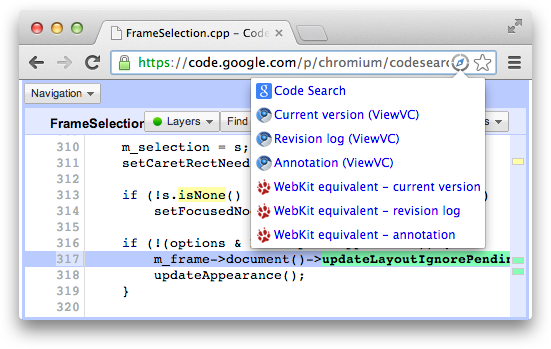
The extension made this process easier, adding a page action that provides back and forth links between Code Search, the Chromium repository (both the ViewVC and the Gitweb sites), WebKit's Trac setup and V8. Later, when the omnibox API became available, it also gained a "sql" search shortcut for the Chromium repository and commits.
Though I no longer work on Chrome, I still find myself going through those code bases quite often. For example, the best way to know whether something triggers layout in Blink/WebKit is by reading the code. I've therefore revved the extension to handle the Blink fork, in addition to cleaning up some other things that had started to bitrot. I also attempted to add cross-links between the WebKit and Blink repositories that takes into account the Blink reorganization, though we'll see how useful that ends up being as the codebases diverge more and more.
20 Apr 20:10
The market for paid iOS apps isn’t dead
firehosetl;dr: Competition is good, and great apps sell well. But "Pricing does skew the market in other areas, and the App Store’s poor design exacerbates much of the dysfunction in its dominant top-list culture."
I’ve seen lots of discussion about the paid-app market recently, but most of what I’ve read hasn’t sat quite right with me.
Lex Friedman’s piece tries to persuade customers to pay more, which is a nice sentiment, but it won’t achieve meaningful change. Nobody can yell loudly enough at enough people to change the app market’s pricing expectations and behavior. The market is far bigger than any of our audiences.
Chris Adamson argues that there’s effectively no market for paid apps, and most iOS-developer income comes from contract work:
Earth to MacWorld: It’s already too late. The market has spoken, and it refuses to pay for apps, even when the toxic side-effects of that are manifest. …
Of all the full-time iOS developers I know, almost none of them work primarily in writing apps for sale to end-users. Nearly all of them, myself included, work for clients for whom an app makes sense in some other business model.
Certainly, it’s easier to make a living working for other people than trying to make your own product. But that has always been true in the iOS market, and in fact, it’s true everywhere: iOS development, Mac development, Windows development, web development, and most other industries in the world.
When you work for someone else, they’re taking the risk (or already have). You get paid regardless. (Well, most of the time.) The downsides are that your earnings are effectively capped and you have far less control over what you make.
This is a good balance in most cases, including development, because there isn’t enough demand for individual mainstream apps from every developer capable of writing them. In other words, just because you can write and sell your own app doesn’t mean that there will be a substantial market for it. Imagine if 1,336,300 people in the U.S. alone each designed a new kitchen utensil: a few thousand may be useful to a good number of people, but the rest probably won’t be different enough to be noteworthy, will solve problems that too few people have, or will simply suck.
Michael Jurewitz’ excellent Understanding App Store Pricing series inspired both aforementioned articles. In Part 4, he details why not every app can command a high price:
Above all, build software to meet a need and don’t become a commodity or enter a commodity space. Not all needs are equal. I need air way more than I need another drink cozy. Weather apps and Twitter apps are fun, beautiful, and engaging, but they are also very difficult to earn sustainable revenue.
He’s right. The issue with the iOS market is about more than price: it’s about demand.
I currently have 91 non-Apple apps on my iPhone, but I only use about six of them frequently. The rest are mostly utilities for specific, occasional needs, or games that I played for a few hours a long time ago and don’t have the heart to delete. Six is probably below the average for frequently used apps, but I bet this ratio isn’t too far off the mark.
My Big Six — Instapaper, Downcast, Reeder, Tweetbot, Instagram, and Dark Sky — solve big problems exceptionally well, and with the exception of Instagram, these are problems I’ve used apps to solve for almost the entire time I’ve owned iPhones.
I haven’t always used these particular apps to solve these problems, but it takes a lot to change my mind on one. If you make another RSS reader or Twitter client, there are certainly a lot of people who could use it, but you’ll need to compete with very mature, established apps. Competing in these categories isn’t about price: it’s about relevance and attention. If you can’t find enough customers here, it’s probably not because you’re charging $2.99 instead of $1.99 or $0 — it’s because your app isn’t convincing enough people that it’s worth using over the alternatives.
For these “Big Six” apps, price is almost irrelevant. If your app is useful enough for many of its customers to use it almost every day, they’ll pay a decent price for it. (Not all of them will — but you don’t need all of them.) The challenge is either making your app that much better than the alternatives, or finding new app roles that are that useful to a lot of people.
If you eschew common app categories and try to address a smaller niche to give your app a better chance of standing out, you run a different risk: your niche might be a lot smaller than you think. Usually, this happens:
- Paid app isn’t gaining traction.
- Developer lowers the price to boost purchases and climb the ranks.
- App doesn’t sell much better, and developer just makes less money.
-
GOTO 2.
I’ve seen so many developers fall into this trap, even with good apps: an app can be good but not compelling enough to attract many customers. A game can be beautifully crafted but just not fun.
This isn’t a pricing problem.
Pricing does skew the market in other areas, and the App Store’s poor design exacerbates much of the dysfunction in its dominant top-list culture. And pricing can sometimes hinder an app’s chances of success by its nature: if your app has a substantial social component and it isn’t very useful without it, you need as many people as possible to start using it as quickly as possible, so social apps must almost always be free.
That’s not really a pricing problem, per se. It doesn’t matter what your price is — it only matters whether you charge at all, because that slows the rate of new users. This is complicated because you’re not giving people much value in the app itself: you’re relying on the customers to provide most of the app’s value to each other, and you probably need a lot of them to give substantial value to any of them. Social apps must therefore almost always seek indirect, deferred revenue because having as many users as possible is worth much more, long-term, than hindering growth with a paywall.
Since a few successful social products have been so big and high-profile in the last few years, many people mistakenly assume that the must-be-free rule is the new norm for all web and software markets, but that’s not the case. Even in social, it’s a massive gamble — since they rely so much on being extremely widespread to have much value, most social products don’t succeed. There’s not much of a “middle class” of social products. The big ones get bigger, and unsuccessful attempts become nearly worthless. Chris Adamson’s theory is actually correct in the social market, but these rules don’t apply to non-social categories.
In most categories, if you either solve a new problem that a lot of people have, or solve an old problem in a new and better way, you can sell a paid app today just as well as you could in 2008. In fact, the market is much bigger now. But, as with any maturing market, you’ll need to do more to get noticed since so many problems have already been solved so well.
The bar is higher, but the market is fine.
20 Apr 20:08
There Was A Virtual Pong Tournament On A Building Last Night
To kickoff Philly Tech Week, Drexel University Gaming Professor Dr. Frank Lee hosted a Pong game tournament on the north face of the 437-foot tall Cira Centre, making it one of the largest video game screens in the world.
firehose likes this
20 Apr 20:08
'Jesus + Mary' Make Headline Appearance In Anti-Abortion Bill Signing
firehose"the original anti-abortion power duo"
Kansas governor Sam Brownback signed the state's far-reaching anti-abortion bill Friday, surrounded by a smiling group of pro-life onlookers at a Statehouse ceremony. But among them, unseen, was the original anti-abortion power duo.
20 Apr 20:08
→ High Scalability: Scaling Pinterest
From High Scalability, condensing lessons from a talk by Pinterest engineers Yashwanth Nelapati and Marty Weiner:
When you push something to the limit, all technologies fail in their own special way. This led them to evaluate tool choices with a preference for tools that are: mature; really good and simple; well known and liked; well supported; consistently good performers; as failure-free as possible; free. Using these criteria they selected: MySQL, Solr, Memcache, and Redis. Cassandra and Mongo were dropped.
This is one of the smartest, most dense collections of web-scaling wisdom I’ve ever seen.1
Even at smaller scale, these lessons apply. An independent developer or small company can’t afford to waste time messing with flaky, overly complex, or high-needs server infrastructure.
At Tumblr, I used PHP, MySQL, and Memcache. I then built Instapaper with PHP, MySQL, and Memcache. When I needed to build a server back-end and CMS for The Magazine, I used PHP, MySQL, and Memcache. I’m now building a little sponsor-management tool for myself that will probably only ever be used by a maximum of four people, and I’m using… PHP, MySQL, and Memcache.
Using mature, reliable, widespread tools isn’t just about scaling more easily — it’s about being as low-needs as possible so you can spend more of your time and attention on things that matter more to you.
-
The last post I saw on this topic that was this good was FriendFeed’s schema-less MySQL technique, from which I took a lot of lessons that helped scale Tumblr. ↩
20 Apr 20:07

Life in Kowloon Walled City, the self-sustaining city of darkness
by Aaron Souppouris
After the Japanese invasion of Hong Kong during the Second World War, China reclaimed the rights to Kowloon Walled City, an ex-military fort. As refugees fled to the area, the Walled City became something of a diplomatic no-man's land — neither the Chinese government nor the British colonial administration were willing to intervene. Between 1945 and 1990, the population of the area raised from 2,000 to an estimated 50,000. An interconnected web of 14-story skyscrapers were erected with no input from architects or planners, and the largely triad-controlled city became infamous for lawlessness and squalor. At its peak, the city, which measured just 2.7 hectares (around 290,000 square feet), had a population density of 1.92 million per square kilometer (that's about 4.97 million per square mile)
A fascinating report from the South China Morning Post looks at what life in the Walled City was like, revealing a close-knit, self-sustaining community that loved their home, despite poor living conditions. Eventually demolished in 1993, the city is now a public park, but its ex-residents still have fond memories of their lives in Kowloon Walled City. "Even now, many people stay in touch with each other even though some old friends are overseas," one ex-resident said, "people who lived there were always loyal to each other. In the Walled City, the sunshine always followed the rain."
- Via Gizmodo
- Source South China Morning Post
- Image Credit Jidanni (Wikimedia Commons)
- Related Items kowloon hong kong new territories china british empire britain kowloon walled city colonialism demolition
20 Apr 20:07
Comic shops host creators after Boston Comic Con postponed
by JK Parkin
firehosea little late, but

With the Boston Comic Con being postponed due to the lockdown that was in place until last night as police searched for the Boston Marathon bombing suspects, several area comic shops are holding impromptu events this weekend with various creators. Here’s a rundown if you’re looking for something to do in Boston today, and if we missed any, please let us know in the comments section:
• As noted in CBR yesterday, Larry’s Comics in Lowell, Mass. is hosting a mini-con — Slum-Con? — featuring Mike Choi, Sean Gordon Murphy, Cesar Feliciano and many more. Check out the shop’s Twitter feed for a live stream of the event.
• Comicazi in Davis Square, Somerville, has announced that it will host a “Not-The-Boston-Comic-Con Get-Together,” with guests Tim Seeley, Tim Sale, Don Rosa, Agnes Garbowska, David Mack, Ming Doyle, Erica Henderson, and possibly some others on Saturday from 11 a.m. to 4 p.m.
• Friendly Neighborhood Comics in Bellingham will have a meet-the-artists event featuring Carlos Pacheco, Craig Rousseau, Kelly Yates, and others from 12-4 p.m. on Saturday.
• Studios at Porter Mills, in Beverly, will host a Beverly Comic Con from 4-9 p.m. on Saturday. “Tons of artists on hand (including many that would have been at Comic con) and a few special guests!”
• Comicopia will host Shelli Paroline and Braden Lamb, the artists for the Adventure Time comic, from 1-3 Sunday.
(Hat tip: Brigid Alverson)
firehose likes this
20 Apr 20:07
Bruce Schneier On the Marathon Bomber Manhunt
by timothy
Should Boston have been put in a state of lockdown on Friday as police chased down Dzhokhar Tsarnaev? Pragmatic Bruce Schneier writes on his blog: "I generally give the police a lot of tactical leeway in times like this. The very armed and very dangerous suspects warranted extraordinary treatment. They were perfectly capable of killing again, taking hostages, planting more bombs -- and we didn't know the extent of the plot or the group. That's why I didn't object to the massive police dragnet, the city-wide lock down, and so on." Schneier links to some passionate counterarguments, though. It doesn't escape the originator of a recurring movie plot terrorism contest that the Boston events of yesterday were just "the sort of thing that pretty much only happens in the movies." 


Read more of this story at Slashdot.
firehose likes this
20 Apr 20:03
Adafruit WebIDE – new alpha release available
by liz
News from across the pond arrived last night, UK time. Our good friends at Adafruit have been working on their web-based integrated development environment (IDE) – hence WebIDE – for the Raspberry Pi, and have made a number of changes based on your requests. This is a big update (“Huge!” says PT), and if you’re already using the WebIDE you’ll notice some changes.

We’re big fans of Adafruit’s WebIDE for the Pi. It offers a nicely structured, easy way to learn how to program, and there’s already lots of support for it (check out Adafruit’s materials or click on the picture above), even though it’s stil in alpha. Beginners should find the visualiser especially helpful; it’s a good way to work out how simple scripts really work, and allows you to see how objects are created, how processes are stacked and so on. We’ve found it’s a real aid to understanding how things fit together, and a great way to explain concepts to people who’ve only just started programming.
Please be aware that because the WebIDE is still a product under development, you may encounter bugs. If you do, please report them using the tool in the editor; user feedback’s really valuable when developing this stuff, and LadyAda, PT, Justin, Tyler and the team want to hear about your experiences.
PT says:
We now have a new offline mode that you can enable with an –offline flag when you install the WebIDE. This mode allows you to bypass using Bitbucket or Github, and should work when not connected to the internet.
We also have a new experimental GitHub mode that allows you to sign in with your GitHub account. This feature is for advanced users that want to use GitHub as their provider. This can be enabled with the –github flag during installation. Please note that GitHub mode does not do some of the automated things (git ssh key setup, etc) that the default installation mode will do.
You can now refresh the left navigator from within the WebIDE, as well as manually update any repositories you have by right-clicking on them, and choosing the option to “Update Repository”.
The full list of new changes for the 0.3.7 version of the WebIDE are as follows:
Github support
• Ability to enable with –github as the default
• Advanced setting
• Requires manual ssh key setup as of yet.
• Most commands are treated as manual mode for now (manual commits, etc).New Offline mode
• Ability to install with –offline as the default
• need to manually commit, and push changes (similar to the manual git setting)
• Bypasses bitbucket OAuth
• Ability to refresh directories from within the navigator• New option to clone repositories without updating remote to bitbucket
• New right-click context menu option to update repositories from remote (origin/master for now)
• New Report Bug Link added to footer
• New confirmation dialog for navigating away from unsaved changes…Save Files/Don’t Save/Cancel
• Editor is set to readOnly for any files that shouldn’t change (README, update notes), including empty editor window while navigating.
• Deleting a file or project will now also delete a corresponding scheduled job from the queue.
• Errors cloning repositories are sent to the front-end now.
• Error handling for most git commands now. Notifications visible in WebIDE for failures.
• New Error pages for any issues with the system failing to show pages. Links to ALS WebIDE FAQ for help.
• New Error page specifically for OAuth failures. Adds a button to execute a script to help set the date and time.
• Attempt to set the date on the Pi during installation to prevent OAuth errors.
• Creating files and folders will automatically open them in the editor and navigator.
• Uploaded files will always use the current working directory, instead of uploading to the parent directory now.
• git pull commands are now using the quiet (-q) flag.
• Editor setting for supporting adding a Make link in the editor action bar if a Makefile is detected in the cwd. Not enabled by default.
If you are already running v0.2.0 or higher, you will be able to upgrade (and may already have done) from inside the editor. If you’re running an earlier version, you’ll need to completely remove your old editor and reinstall again. You can find out more at Adafruit. Thanks so much for all your work on this, Adafruit folks – we continue to be bowled over by all the work you’ve been putting into the Pi platform, and we couldn’t be more grateful. We’re looking forward to seeing you when we’re next in NYC!
firehose likes this

