~Isabella Stengers
 |
rachel
shared this story
from  FiveThirtyEight: FiveThirtyEight:
|
| SPORTS |
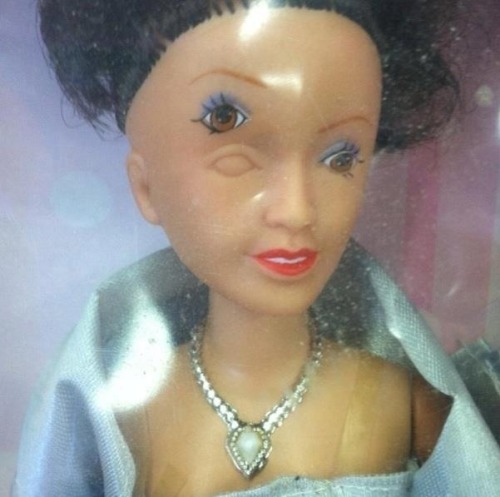
Yet another impossible standard for women
firehosethis. was. amazing


Read more of this story at Slashdot.

firehosecorpse flower beat

‘Corpse flower’ poised to bloom at OSU Biological Sciences greenhouse. [Image credit: Screenshot from TheScienceofReality]
- Watch the live feed of the bloom here.
- Live updates on flowers’ statuses here.
- Article via The Columbus Dispatch here.
“Spring is in the air, but Ohio State University’s greenhouse probably smells more like a rotting carcass. Researchers could not be more delighted. Called the “corpse flower” by those who know it best, the rare titan arum, which might have bloomed as soon as last night, earned its foul moniker for obvious reasons.‘It smells like road kill, maybe a little bit of sauerkraut, dead fish — kind of all mixed together,’ said Joan Leonard, the greenhouse coordinator. The flower’s stench attracts pollinators such as flesh flies and carrion beetles that are drawn to decaying flesh. And the flower has precious little time to do so. ‘It can bloom maybe two or three times,’ Leonard said. ‘The soonest it can bloom after it has bloomed once is maybe two to five years after, and that’s under optimal conditions. Or it may never bloom again.’
Woody, the nickname for the towering titan arum on the cusp of blossoming, bloomed just two years ago. Woody’s first bloom attracted more than 6,000 visitors. Last year, Jesse, another corpse flower at the greenhouse, blossomed and attracted another horde. In its native Sumatra, female and male corpse flowers bloom within days of each other, but the Ohio specimens must be pollinated by hand in order to obtain new titan arum seeds.
Many of the rare flowers have been destroyed by commercial agriculture and rainforest logging. The OSU greenhouse aims to stimulate the declining population by artificially nurturing them. Ohio’s climate is a far cry from Indonesia’s, but the greenhouse mimics a tropical environment, and Woody receives plenty of sun and fertilizer.
‘There have been less than maybe 175 blooms in the entire world since (the flower was) discovered in the late 1800s,’ she said. ‘The rare occasion that it does bloom just attracts in anybody who’s interested in the crazy world of science.’
That OSU will have had blooms three years in a row is a “miracle,” Rutkowski said. ‘We are incredibly fortunate,’ she said. ‘It takes someone who knows what they’re doing, and you have to have the proper facility.’
Woody has been growing by 4-5 inches a day since sprouting, Leonard said. Yesterday, the plant exceeded 70 inches tall. When the flower will blossom is anybody’s guess. ‘It’s kind of like expecting a baby,’ Leonard said yesterday. ‘It could be any day now.’”
firehoseetc.
Read more of this story at Slashdot.

Read more of this story at Slashdot.

firehoseA nice, short version of his Kobold Guide piece
This article was originally written for Fictorians.com and was pitched at people building their own worlds for novel writing, but the general process should be useful for a broad variety of world builders.
Let’s get one thing out of the way right now.
A map shouldn’t be pretty.
I know what you’re thinking – those posters of Middle Earth are gorgeous. Of course a map should be beautiful. But for worldbuilding purposes a pretty map is a Very Bad Thing. Beautiful things are precious, and we tend to want to leave precious things pristine and untouched. When we’re building worlds we need to break things, and often. So, out with any thoughts that we’re making a pretty map. We’ll be making a functional map. In fact we’ll be making many maps, one after the other. In exactly the same way that your notes are not the final manuscript, a map isn’t the final world. It’s a visual notepad, and you should be crossing things out, erasing sections and rebuilding from scratch as you go along.
So we won’t be needing photoshop today, we need a pad of scratch paper and a pencil. Right, let’s build a world.
First of all, think about the ‘world’ you need to build. In many cases this is a defined area that’s much smaller than the planet you’re on. Very few stories truly span a globe, so let’s begin by cutting down to the area that the story explores. This keeps the work focused on a reasonable area, and means there will always be distant and mysterious lands to explore down the line.
In your tale there will be nations, city states or power centers of some form. Start by making a note of their relationships to one another. Are they at war? Are they aloof? Do they feud over resources or are they closely allied? Think over the things that make them stand out. Are they famous for their expansive grain fields? Their iron? Their navy? I’m sure you can see the theme here. Nations are defined by the geography they inhabit as much as we define the geography by the nation. A nation with a large navy needs sea access, but it should also have natural defences like a mountain range that allows the nation to neglect other military forces in favour of it’s navy. Two countries at war need to be close, and need to have a means of attacking one another.
Focus on major terrain at this point – how much coastline and mountain ranges. Make notes about other terrain that comes to mind – the tulip fields of Alak’tor, the salt mines of Keshel – those will come in useful later.
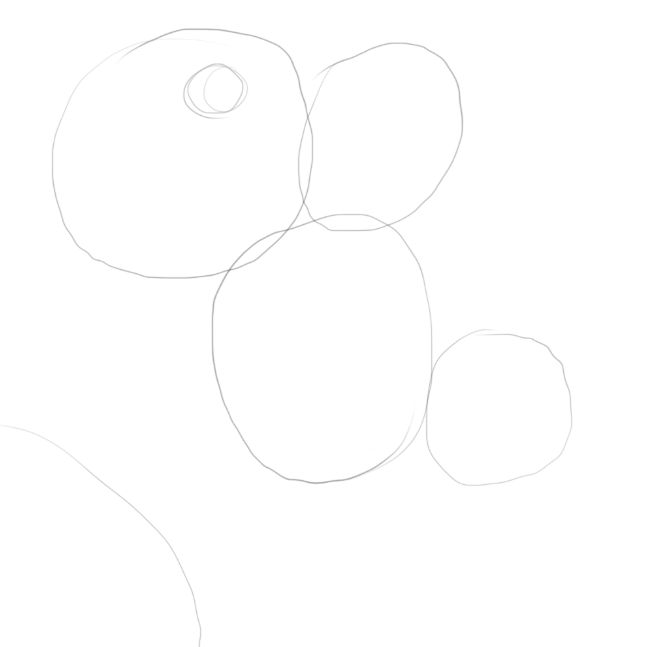
1. Rough shapes – these are six interconnected nations
It’s now time to start our map. Grab a pencil and faintly draw in circles where your nations are. Nations that are allies or at war should be close. Those that rarely interact should be further away, or will have an insurmountable natural barrier between them. Drawing circles on a map may sound easy, but this stage can take a few tries to get the relationships right.
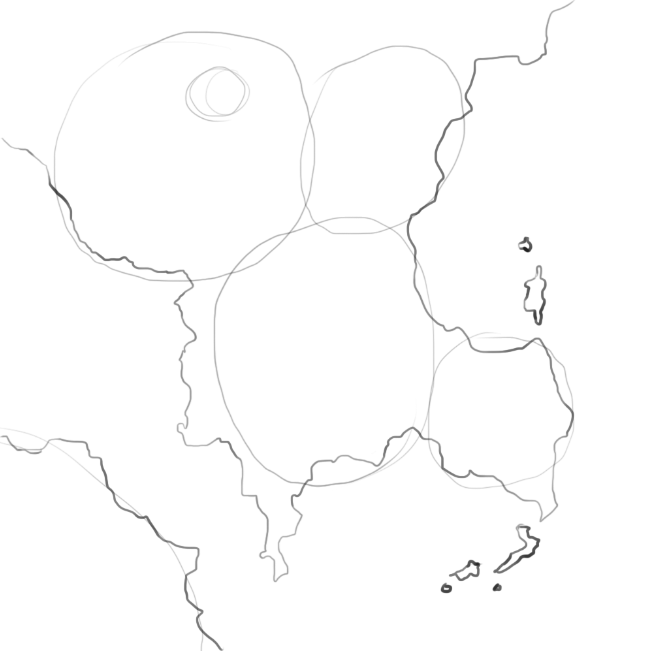
2. The coastlines. Keep them broken and random
But circles aren’t really a map. Let’s draw some coastlines. Think about which of your nations need large coastlines and which should be landlocked. Then let your pen wander. Really – avoid straight lines. Coastlines are jagged and broken things. If your line doesn’t look like it was plotted by a drunken ant, you’re doing it wrong.
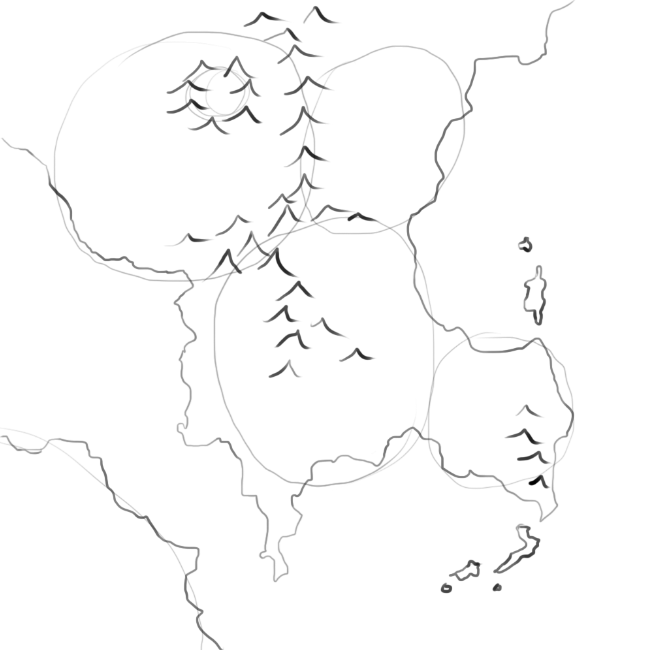
3. Mountains – they shouldn’t be pretty, inverted triangles do the job just fine
Now let’s lay in some mountains. Mountains tend to form ridges. Avoid the temptation to fill in whole blocks of land with mountains. Instead, lay them out in wavy lines. They often follow the edge of a coastline (think the Andes). From a story point of view, they form obstacles for your heroes and they create natural boundaries between nations, or between nations and the great unknown. Mountains also create boundaries between climates. So if you need a desert in one area and a jungle in the other, you’d better place a mountain range between them to stop the rain from the jungle getting to the desert.

4. As rivers run to the coast they only join, they never branch
Next up, we have rivers. Rain falls on mountains and runs downhill to the sea. It always flows to the lowest point – and there’s always one lowest point. This means that rivers don’t branch as they flow to the sea, they only join. So – no rivers going from coast to coast. At some point that requires water to flow uphill. No lakes that have two separate rivers leading to the sea – remember, only one lowest point leading out. Think of a river like a tree. There’s one trunk where it enters the sea, but a panoply of branches reaching towards the mountains.
Rivers are also strategically important. There’s hardly a rivermouth in the world without a town on it and most great cities lie on a river. If you know where your cities are going to be, make sure there’s a decent sized river flowing through them. Equally, rivers make great defences. It’s hard to build a wall all the way along your nation’s border, but it’s almost as hard to get an army over a well defended river as it is to have them scale a wall.
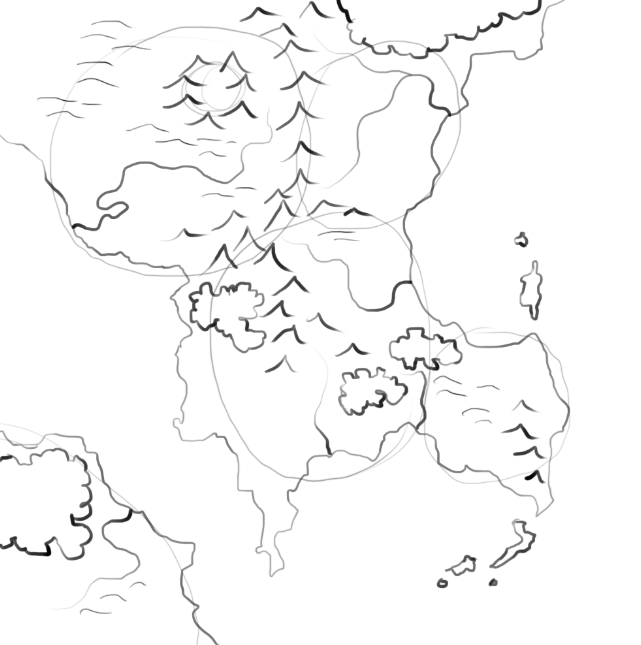
5. Hills and Forests, add them wherever you see fit. These are easily moved.
Add some hills to the edge of your mountain ranges. Lay in some forest and see how it looks. Remember, don’t be precious. If you don’t like it – start on a new sheet of paper. Sketch another coastline. Turn it upside down.
When you’re happy with the terrain, go over the pencil lines with pen, and erase the pencil – including your nation boundaries. Scan and photocopy the map. Go away and have some food.
When you come back, try the following experiment. Ignore your previous nations. Look at the virgin world with a new eye. If you were founding a country in the world, where would you start? What would be the key strategic choke points? Look at the world as if you were playing Civ. Where are the resources you need to defend, what lands would you try to annex? Use some coloured pencils to sketch in different nations and boundaries. Edit the rivers if you need to, move things around. You’ve got lots of copies of the map, experiment.
Once you have a layout you like, we’ll add cities.
Cities are where they are for a reason – they don’t just appear up in the middle of nowhere. Population centers need food, water, trade and security. Rivers can provide all of these, which is why towns and cities tend to spring up at river mouths. Locate your capitals in places that are easily defended and that have good transport connections to the rest of the nation. Place smaller cities in key locations, whether that’s in the heart of a mining community on the edge of a mountain range, at a key strategic river crossing, or a market town in the middle of leagues of prime cattle ranching land. At this point, also mark in major fortifications.

6. Place cities, towns and fortifications
With these indicated it’s a simple matter to place the roads. These will connect the major cities, the main food producing regions, and any other major trade routes.
You now have a perfectly functional map! But remember, nothing is set in stone. Each time you run through this process your map will be better. Each time you sketch the map you’ll have new ideas. As you continue to write about your world you’ll come up with new thoughts on what terrain you should have, how two countries relate across their border, where a great wilderness needs to be. Redraw the map – it’s there for you. Both your mapdrawing and your text will be better for the relationship between map and story.
And when your manuscript is ready to go from draft to final, your map will be ready to go from sketch to illustration. But that’s a post for another day.
This is a long post, but not as long as an article I wrote on a similar topic for the Kobold Guide to Worldbuilding. If you enjoyed this post and found it useful, then definitely consider picking up the book – it’s got lots of good stuff along these lines.
firehosegreat
Read more of this story at Slashdot.

firehosegreat
The Associated Press reported yesterday that the Justice Department conducted widespread surveillance of its reporters' phone calls, potentially revealing "communications with confidential sources across all of the newsgathering activities undertaken by the AP during a two-month period." But while the White House has denied knowledge of the data collection and privacy supporters have decried it, the Department of Justice itself appears unworried. New York Times reporter Charlie Savage has posted Deputy Attorney General James Cole's private response to a letter by AP CEO Gary Pruitt. In it, Cole defended the surveillance, saying that it was well within legal boundaries,
Cole reframed the AP's complaints to argue that relatively little data was collected. "The subpoenas were limited to a reasonable period of time and did not seek the content of any calls," he said. "Indeed, although the records do span two months, as we indicated to you last week, they cover only a portion of that two-month period." Subpoenas to collect records of outgoing calls and possibly other information, said Cole, were obtained only after "conducting over 550 interviews and reviewing tens of thousands of documents" to establish reasonable suspicion and exhaust other avenues.
"The subpoenas were limited to a reasonable period of time and did not seek the content of any calls."
The AP has not posted the original letter about the subpoena, and at this point, it seems unlikely that the Justice Department will reveal further information. The investigation, Cole said, is ongoing and involves classified material, limiting what can be released. "We strive in every case to strike the proper balance between the public's interest in the free flow of information and the public's interest in the protection of national security and effective enforcement of our criminal laws," he concluded. "We believe we have done so in this matter."


firehosevia multitasksuicide
'Since 2008, continued political interference has succeeded in curtailing metal events. “We started from 2008 but the government cancelled our event in that time and they didn’t allow any metal concert in Egypt for 5 years,” Usama says. “In 2011 we tried again but we postponed the event after the revolution, and our first event was in March 2011.” Even post-revolution, hosting metal shows has proved a tenuous affair, happening only by an appeal for support to all metal fans. “After the revolution we made many concerts until the government came back again and said that we are ‘satanists’ and they tried to do the same that they did in the past. But they didn’t succeed this time, the media and many entities was on our side." '
firehosegreat
Odds are increasing that Google will give us a peek tomorrow during the Google I /O Conference at the company's new subscription music services. Google has now signed licensing deals with Universal Music Group and Sony Music Entertainment for both YouTube and Google Play, music industry sources told The Verge.
Google plans to add separate music subscription services to YouTube and Google Play, the entertainment hub for the Android operating system. Earlier this year, Fortune magazine reported that Google had already struck similar licensing agreements with Warner Music Group, the smallest of the top three record labels. But landing Universal Music and Sony gives Google access to the two largest record companies, homes to such acts as Bob Dylan, Alicia Keys, Lil Wayne, Rihanna, and Jay-Z. Spokespeople from Sony and Universal declined to comment.
If Google rolls out the new services tomorrow at I/O, it would get the jump on Apple, which is also trying to launch a new streaming-music service. According to reports, Google's subscription services would resemble Spotify, and offer on-demand songs that would be streamed to their PCs and mobile devices. In contrast, Apple is working on an online radio service that is said to be more akin to Pandora, the top webcaster.
Google comes to these negotiations as a powerful player in music. While Google Play is still a relatively new service, insiders say YouTube is a juggernaut. The user-generated video site sees more than 800 million unique visitors a month and music videos are among the most popular fare.
Vivendi, Universal Music's parent company reported first quarter earnings today, and said that revenue was up 13 percent compared to the same period a year earlier. Digital music sales have now surpassed physical at Universal, with the split being 54 percent to 46 percent respectively. The addition of Universal's catalog, along with Sony's offerings, for the forthcoming Google product could have a significant impact on competitors Spotify and Rdio.
firehosevia Tertiarymatt
just in time for rye shopping
Here is your sneak preview of the top 10 whiskies from Whisky Advocate’s summer issue Buying Guide. The list begins with #10 and ends with the #1 whisky.
#10: Glen Garioch Cask #992 14 year old 1998, 54.6%, $100
Quite fragrant, with a thick, oily texture. Sweet notes (vanilla, sticky toffee), ripe barley, earthy peat, licorice root, and a hint of melon and citrus. Very clean and characterful. A lot of fun to drink. Nicely done! I can’t imagine a 14 year old Glen Garioch tasting any better than this. (A Julio’s Liquor Exclusive) —John Hansell
Advanced Whisky Advocate magazine rating: 90
#9: Breckenridge Bourbon, 43%, $40
WHACK! The spicy smack of the nose sends me to check the mashbill; sure enough, this is 38% rye. The nose fumes with youthful zest: cinnamon, bright mint, sun-warmed green grass. Pour some on the palate for more explosive entertainment; sweet cinnamon red-hots burst, corn pops, and the oak burns on into the rye-high finish. This is one excitable boy of a bourbon, and it’s got me humming along. Impressive.—Lew Bryson
Advanced Whisky Advocate magazine rating: 90
#8: Angel’s Envy Rye, 50%, $70
The folks at Angel’s Envy once again push the envelope with this 95% rye whiskey finished in Caribbean rum casks. Vibrant, spicy rye notes (cinnamon and mint) are tamed by rich maple syrup, graham cracker crust, nutty toffee, candy floss, subtle tropical fruit, and creamy vanilla. Warm, spicy, rummy finish. This is a mood whiskey—not one I would drink every day—but the flavors marry nicely and the sweetness tames this high-testosterone rye whiskey. Bonus points for uniqueness.—John Hansell
Advanced Whisky Advocate magazine rating: 90
#7: Cutty Sark Prohibition, 50%, $30
The Real McCoy! It’s said that during Prohibition Bill McCoy serviced the better speakeasies with proper Cutty Sark; hence the name. If this is a recreation of what they might have been drinking back then, you can see why they kept fighting over it. This is another bold, earthy, smoky blend with oily, industrial notes. There’s crabapple, smoke, bitter lemon, grapefruit, and even black currant. It would seem blended whisky is where it’s at right now! Great stuff.—Dominic Roskrow
Advanced Whisky Advocate magazine rating: 90
#6: Jura 1977 Vintage, 46%, $900
This vintage expression from Jura has been matured in three first-fill bourbon casks and then finished for one year in a ruby port pipe. Just 498 bottles have been released. Apricots, pineapple, caramel, butterscotch, sultanas, and white chocolate on the nose. The palate is warm and spicy, with subtle pine and citrus fruits, along with coconut and a hint of peat. Long in the finish with more vanilla before dried fruits and oak kick in. The delicate peat remains.—Gavin Smith
Advanced Whisky Advocate magazine rating: 90
#5: Paul John Single Cask Whisky P1-163, 57%, £60
Another hard to get Indian whisky, but further proof that the category isn’t a one-trick pony. This single cask release is the second from the John Distilleries and a significant step upward. An altogether more complex whisky with an earthy prickly peat at one level, and a rich pureed pear heart with orange fruit and berries. The combination is quite gorgeous and with a little water you get whisky’s answer to a summertime flower show. Impressive stuff.—Dominic Roskrow
Advanced Whisky Advocate magazine rating: 91
 #4: Kavalan Bourbon Oak, 46%, $100
Surprise, surprise. This is like the school’s best pitcher, who then steps onto the football team and throws for a game-winning touchdown. This is a whole new side to Kavalan. Remember Faith No More doing “Easy”? Having out-sherried and out-bourboned us with kickass rock n roll whisky, Kavalan goes for gentle and croony, with vanilla and honey. The coup de grace? Apple pie and cream morph into licorice and menthol. Exquisite.—Dominic Roskrow
Advanced Whisky Advocate magazine rating: 93
#3: Millstone Rye 100, 50%, €53
From the distillery that received last year’s World Whisky award comes another contender for the title in 2013. This is called 100 because it’s 100 percent rye distilled in pot stills, 100 proof, and 100 months old (a bit over eight years). It’s big, and perfectly balanced between honey and fruit, sparkling distinctive raunchy spice, and a dash of ginger biscuits. This is rye to die for. Superb.—Dominic Roskrow
Advanced Whisky Advocate magazine rating: 93
#2: Amrut Greedy Angels, 50%, $225
A whopping three-quarters of the spirit put in these casks was taken by greedy angels. It has a big waft of crystallized pineapple, tropical fruits, and spiky spice on the nose. On the palate, red licorice, syrupy jellied fruits, some mandarin, cherry lozenge, and tinned strawberries, and the same menthol rancio you’d kill for in a 30 year old scotch. This is Amrut’s oldest-ever whisky; it’s as rare as hen’s teeth…and just 8 years old. Awesome.—Dominic Roskrow
Advanced Whisky Advocate magaine rating: 94
#1: Lot No. 40 2012 Release, 43%, C$40
Distilled from 90% rye grain and 10% rye malt, Lot No. 40 boldly mingles the galvanizing piquancy of distilled rye grain with the soaring floral fragrance of malted rye, and a fruitiness born of age. It begins with hard, dusty, earthy rye, and sour rye bread, followed by a trio of baking spices: cloves, nutmeg, and blistering ginger. A farm-tinged sourness fades into citrus fruit with velvet tannins. (Canada only)—Davin de Kergommeaux
Advanced Whisky Advocate magazine rating: 94
firehosevia Christopher Lantz
firehosenever say no
firehosemeanwhile, in Seattle
via Snorkmaiden


Diem Chau, Seattle-based crayon-carver extraordinaire (previously featured here), just completed an awesome new series of Alphabet crayons. She carved 26 pairs of crayons, each pair made up of one letter and one figure representing that letter. They’re almost impossibly cute.
All 26 sets of crayons as well as new carved pencils will be exhibited in an upcoming solo show, A-Z: New Carved Pencils and Crayons, at the Packer Schopf Gallery in Chicago, IL from April 5th to May 18th.
[via My Modern Metropolis]
firehosetl;dr: "this fall, our resident star will reach the peak of its 11-year sunspot cycle"

In less than 24 hours, the Sun has unleashed a trio of X-Class solar flares. They are the first, second and third X-class eruptions of 2013, making them the most powerful of the year by a substantial margin. What's more, each burst has been more violent than the last. So uhh... what the hell is going on here?

    
|
The app itself is the work of one Los Angeles-based 26-year-old freelance programmer, Ivan Pardo, who has devoted the last 16 months to Buycott. “It’s been completely bootstrapped up to this point,” he said. Martinez and another friend have pitched in to promote the app.
Pardo’s handiwork is available for download on iPhone or Android, making its debut in iTunes and Google GOOG +0.97% Play in early May. You can scan the barcode on any product and the free app will trace its ownership all the way to its top corporate parent company, including conglomerates like Koch Industries.
Once you’ve scanned an item, Buycott will show you its corporate family tree on your phone screen. Scan a box of Splenda sweetener, for instance, and you’ll see its parent, McNeil Nutritionals, is a subsidiary of Johnson & Johnson JNJ +1.23%.
Even more impressively, you can join user-created campaigns to boycott business practices that violate your principles rather than single companies. One of these campaigns, Demand GMO Labeling, will scan your box of cereal and tell you if it was made by one of the 36 corporations that donated more than $150,000 to oppose the mandatory labeling of genetically modified food.
firehosegpoy/ifacom
firehosealternate interpretation of catbus

firehose"How many of your friends’ profile photos are either barely recognizable from poor lighting or angle choices (if you’re under age 25), or have become pictures of babies instead (if you’re 25 or older)?"
Ben Thompson:
Design is about identifying, understanding, and ultimately feeling your end users’ needs, and then meeting those needs. Facebook Home, like countless SV startups, looked beautiful, worked elegantly, and didn’t meet any needs.
I’d go a bit further and say it’s actually designed badly. Facebook Home rested on two major assumptions:
OK, show of hands:
Facebook Home was flat-out badly designed: it’s designed for optimal input and failed to consider real-world usage.
And it looks like demand for Home was from the same imaginary world as their perfect input.



Peter Dinklage with his Daughter in NYC