Shared posts

18 Jun 21:23

Dark Horse Presents New Fraction, Vachss And 'Buffy' In Milestone 25th Issue [Extended Preview]

by Andy Khouri
firehose

meanwhile, in Portland and Milwaukie

A nominee for this year's Eisner Award for Best Anthology (and last year's winner), Dark Horse Presents has been one of ComicsAlliance's favorite titles since it was relaunched in 2011 to continue the classic and influential series' tradition of showcasing emerging talent alongside some of the best established writers, artists and cartoonists mainstream and underground comics has to offer. Each issue comes with quirky, undiluted excursions into the minds of uniquely talented creators, usually with immersive new serials or idiosyncratic short stories but also in the form of recurring, cult favorite characters and properties for which Dark Horse has served as caretaker for many years.

On sale this week is the 25th issue of DHP, which the publisher has stuffed with 80 pages of new material including the first Dark Horse work by Matt Fraction, who offers a trippy time-travel story with mind-bending artwork by Christian Ward. DHP #25 also features the start of a new Buffy The Vampire Slayer serial by longtime Buffy writer Jane Espenson and artists Karl Moline & Andy Owens; and "Underground," a violent new serial conceived by author Andrew Vachss. And of course new episodes of Fred Van Lente and Freddie Williams II's sixties superhero revival "Brain Boy"; Ron Randall's cyberpunk "Trekker," Mike Baron and Steve Rude's political space opera "Nexus"; Dan Jolley and Leonard Kirk's resurrected DC project "Bloodhound"; and more.

Dark Horse Presents #25 goes on sale tomorrow (Wednesday, June 19), but below you'll get an extended preview of the auspicious issue that includes never-before-seen pages.

Dark Horse Presents #25 cover by Steve Morris


I asked Dark Horse Presents' Associate Editor Jim Gibbons to tell us a little about this kind of anniversary issue of the new series, and here's what he had to say:

Dark Horse Presents #25 is not only a landmark issue, but also a prime example of what DHP represents: a sampling of all the great kinds of comics Dark Horse has to offer. This issue features an original tale by one of the industry's top writers ("The Time Ben Fell in Love" by Matt Fraction with art by Christian Ward), one of our most successful licensed comics (Buffy the Vampire Slayer by Jane Espenson, Karl Moline, and Andy Owens), a creator-owned superhero story (Dan Jolley's Bloodhound with Leonard Kirk and Robin Riggs art), two company-owned superhero stories (Fred Van Lente and Freddie Williams II on Brain Boy and Frank Barbiere on Blackout), a story adapting work from crime fiction writer Andrew Vachss' (Underground, illustrated by Dominic Reardon), a fantasy tale (Peter Hogan's King's Road with Phil Winslade), a true crime story (City of Roses by Phil Stanford and Patric Reynolds), all new tales from comics classics like Ron Randall's Trekker and Baron and Rude's Nexus, plus a short from 15-year-old cartoonist Emma T Capps -- her first time in print (well, beyond her awesome self-published collections)! It's an issue with newbies and legends, novelists and tv writers, beautifully painted art and crisp of linework, spies, vampires, criminals, time travelers, and more!

Ideally, there's something for everyone in each issue of Dark Horse Presents and #25's is no different.


Pages from "Buffy The Vampire Slayer: Love Vs. Life" Part One by Jane Espenson, Karl Moline & Andy Owens and Michelle Madsen (click to enlarge)

Page from "The Time Ben Fell In Love" by Matt Fraction and Christian Ward

Pages from "Underground" by Andrew Vacchs, Mike Richardson and Dominic Reardon and Jeremy Colwell (click to enlarge)

Pages from "Brain Boy" by Fred Van Lente and Freddie Williams II and Ego (click to enlarge)

Pages from "Trekker" by Ron Randall Jeremy Colwell (click to enlarge)

Page from "King's Road" by Peter Hogan and Phil Winslade

Pages from "Crime Does Not Pay: City of Roses" by Phil Stanford, Patric Reynolds and Bill Farmer (click to enlarge)

Pages from "Nexus" by Mike Baron, Steve Rude and Glenn Whitmore (click to enlarge)


Page from "Bloodhound' by Dan Jolley, Leonard Kirk & Robin Riggs and Moose Baumann
Page from "Blackout" by Frank Barbiere and Micah Kaneshiro


Dark Horse Presents #25 goes on sale Wednesday digitally and from finer comics shops.
18 Jun 21:13

Humble Bundle 6 adds Android to PC lineup: Aquaria, Stealth Bastard

by Jessica Conditt
Humble Bundle with Android! 6
Humble Bundle 6 lasts for two weeks and includes PC, Mac, Linux and Android versions of five games for the low, low price of "anything": Aquaria, Fractal, Organ Trail: Director's Cut, Stealth Bastard Deluxe and Pulse. Pulse is the outlier, available for Android only.

Pay more than the average and snag Frozen Synapse and Broken Sword: Director's Cut. Frozen Synapse is in late beta on Android and has some known issues, and it's best played on tablets, the developer notes. All games come with their respective soundtracks, too.

Currently the Humble Android Bundle's average is below $5, so act fast and get seven games for less than one single-digit piece of American money. Or, knowing that you can allocate your money among charity, the developers and Humble itself, you can pay the equivalent of a double-digit piece of money. Or triple-digit. All of these games would cost $95 separately, and it's safe to expect more additions before the sale ends in two weeks. Because that's how Humble Bundles roll.

JoystiqHumble Bundle 6 adds Android to PC lineup: Aquaria, Stealth Bastard originally appeared on Joystiq on Tue, 18 Jun 2013 16:00:00 EST. Please see our terms for use of feeds.

Permalink | Email this | Comments
18 Jun 20:55

A start-up’s plan to make US health care cheaper: Tell people what it costs

by Tim Fernholz
In this Feb. 18, 2011 photo, a patient waits in the halls of the trauma unit of the emergency room at Grady Hospital in Atlanta. A federal regulator says Atlanta's safety net hospital could lose its Medicare funding early next year if it doesn't take steps to correct problems found by investigators. But the hospital's CEO says those problems have already been fixed. )

The problem is that US health care costs too much. The solution could be telling people what they’re paying for, if only the government would come clean.

We know that Americans spend more money on health care than anyone else:

Screen Shot 2013-06-18 at 11.42.10 AM

Part of the reason is that most Americans don’t pay for their health care directly. Insurers or the government pick up the tab, so consumers can’t really compare prices or quality and competing providers don’t really compete. Many consumers assume that paying more would be paying for the best, but studies show no correlation between the cost and quality of basic procedures, like childbirth. Indeed, some of the most expensive care is the worst, and vice versa:

Screen Shot 2013-06-18 at 11.35.29 AM

That chart is from a young San Francisco company called Castlight, a big data firm that launched a service to help big employers, from companies like Safeway to the state of Indiana, cut health insurance costs. Castlight uses each employer’s historical data on insurance claims and payments to develop price and quality comparisons for local health-care providers, from physicians to pharmacists. That data is provided to people on the insurance plan, who use web and mobile apps to find the best combination of cost and quality for their needs. That can mean big savings if the cost of a procedure like a colonoscopy varies by as much as a factor of seven:

Screen Shot 2013-06-18 at 12.21.38 PM

Right now, 4 million people use Castlight’s service, and the company is set to grow. But it can do better, according to its CEO and co-founder, Dr. Giovanni Colella, if it gets more data from the government.

The 2010 US health care reform, a.k.a. Obamacare, required the Department of Health and Human Services to make public certain data on how much people have paid for various medical procedures. The department is six months late in doing so. And only 12 states maintain their own public databases showing price comparisons. Most allow health-care providers to enter contracts with insurance companies to keep their costs secret.

Perhaps most importantly, though, Castlight wants access to the vast repository of data in Medicare, the government health-insurance program for senior citizens. Today, Colella told the lawmakers responsible for Medicare as much at a public hearing of the US Senate’s finance committee. The committee chairman, Max Baucus, asked to hear the argument against Medicare releasing that data; no one had an answer.

“The providers don’t want that,” Colella told Quartz after the hearing. The cozy relationship between American physicians and Medicare administrators gives them “incredible influence” over what is released, he said. The reason for their resistance is obvious: More transparency about what medical care costs would mean lower billing.

The good news for American consumers and taxpayers is that the country’s health-care inflation is already coming under control. Today, the government reported that health-care prices fell for the first time in decades, and PricewaterhouseCoopers released a report suggesting that the trend will continue. The main reason is that employers, in an attempt to keep down health insurance costs, have been passing more of the costs on to consumers (in the form of higher premiums and deductibles.) That’s made consumers look for cheaper services. But to keep that trend going consumers will need a better idea of how to spend their money most efficiently—and companies like Castlight may be best positioned to do it.


18 Jun 20:12

Cat Repeatedly Sticks Its Tongue Out at Tape Measure

by Kimber Streams
firehose

Russian cats beat

A cat repeatedly sticks its tongue out in response to the sound of a tape measure in this video uploaded by Kobetoll. Previously, we posted about another cat sticking its tongue out at a robot claw toy.

via Nothing To Do With Arbroath

18 Jun 20:11

2013 U.S. Wireless Network Tests: AT&T Fastest, Verizon Most Reliable

by Soulskill
firehose

"The tests recorded the fastest download speed (66.11 Mbits/sec) in New Orleans" on AT&T LTE

"T-Mobile's HSPA network to have the worst Average-Time-To-First-Byte"

"some cities (in Sprint's) LTE network speed averaged less than T-Mobile's HSPA network speed"; in Portland, Sprint LTE averages 3.5Mbps to T-Mobile's 10.78Mbps (which itself is just a few Mbps behind AT&T LTE and faster than Verizon's LTE, but holy fuck two-second delay)

adeelarshad82 writes "For the fourth year running, PCMag sent drivers out on U.S. roads to test the nation's Fastest Mobile Networks. Using eight identical Samsung phones, the drivers tested out eight separate networks for four major carriers across 30 cities evenly spread across six regions. Using Sensorly's 2013 software, a broad suite of tests were conducted every three minutes: a 'ping' to test network latency, multi-threaded HTTP upload and download tests including separate 'time to first byte' measures, a 4MB single-threaded file download, a 2MB single-threaded file upload, the download of a 1MB Web page with 70 elements, and 100kbps and 500kbps UDP streams designed to simulate streaming media. Nearly 90,000 data cycles later, the data not only revealed the fastest networks (AT&T) and the most consistent (Verizon), but also other interesting points. The tests recorded the fastest download speed (66.11 Mbits/sec) in New Orleans and the best average in Austin (27.25 Mbits/sec), both for AT&T's LTE network. The tests also found T-Mobile's HSPA network to have the worst Average-Time-To-First-Byte, even when compared with AT&T HSPA network. Also according to the tests, Sprint's LTE network didn't even come close to competing with other LTE networks, to the point that in some cities its LTE network speed averaged less than T-Mobile's HSPA network speed."

Share on Google+

Read more of this story at Slashdot.


18 Jun 20:08

Ridiculous Fishing creator reeling from Apple Design Award, talks TU

by Jessica Conditt
Ridiculous Fishing creator reeling from Apple Design Award, talks update
Vlambeer founders Rami Ismail and Jan Willem Nijman didn't think Ridiculous Fishing would win an Apple Design Award. Sure, it was in the running, but it was a long shot, and they had other places to be during the ceremony at WWDC on June 10 (E3, anyone?). Just in case, they asked Ridiculous Fishing collaborator and indie extraordinaire Zach Gage to go to the show, and he did. In flip flops. And shorts. And Ridiculous Fishing won.

"Holy shit," Ismail laughed during our chat at E3. He was still getting over the fact that Ridiculous Fishing won an Apple Design Award, and that Gage collected it in what's commonly considered summer beach attire.

So far Ridiculous Fishing sales have hit the "hundreds of thousands," Ismail said, and after the Design Award, sales spiked again. Even Elijah Wood got hooked on Ridiculous Fishing - or, as Ismail put it, "The Hobbit played it!"

Continue reading Ridiculous Fishing creator reeling from Apple Design Award, talks TU

JoystiqRidiculous Fishing creator reeling from Apple Design Award, talks TU originally appeared on Joystiq on Tue, 18 Jun 2013 15:00:00 EST. Please see our terms for use of feeds.

Permalink | Email this | Comments
18 Jun 19:54

The US government lets sugar farmers charge inflated prices, and now it’s paying them too

by Gwynn Guilford
Colorful jelly beans are displayed inside Economy Candy on the Lower East Side in New York, Tuesday, Oct. 7, 2008. The store was opened in 1937 by the father of current co-owner Jerry Cohen. (AP Photo/Kathy Willens

The US has grown itself too much sugar. It has done so for years—and yet cane and beet farmers produced record amounts of sugar again this year, says the US Department of Agriculture (USDA).

If this were a free market that would be terrible news for the US’s 5,000 or so beet and cane growers. But it’s not. In fact, the USDA just agreed to spend $38 million on buying sugar in order to prop up the prices. That’s adding a tax bill to a sugar aid program that already costs US consumers $3.5 billion each year, according to research by Iowa State University.

Grasping why the government is doing this reveals a complicated—some would say insane—lattice of price controls, import quotas and government lending to prop up both sugar growers and sugar refiners. Here’s how it works.

The argument made for sugar aid is that at market prices, US sugar refiners wouldn’t buy from US farmers, because lower foreign labor costs make imported sugar so much cheaper—and that’s even with import tariffs. But the government doesn’t subsidize sugarcane and beet farmers, the way it does with grains. Instead it sets an artificially high price for raw sugar. It then loans money to sugar refiners to buy the sugar from US growers at that price.

The sugar they refine acts as their collateral for the loan from the government. The refiners can either repay the loan with interest after selling the refined sugar, or “forfeit”—meaning that they give the USDA a heaping pile of collateralized refined sugar. That’s not a “forfeiture” in the sense we usually think of it, though. It just means that if a refiner can’t get a higher price in the market, it can give the sugar back to the government, taking a bath on refining costs but not much else.

At the same time, the US government restricts sugar imports using tariffs; if it didn’t, imported sugar would undercut the USDA-set market price. But then these limits on imports apparently make life too difficult for sugar refiners. So they are issued “import credits”, which are licenses to import some foreign raw sugar as long as they export an equivalent amount of refined sugar.

But now, with production at an all-time high and raw sugar flooding the market, prices have been driven below the government-set threshold and refiners are struggling to find buyers who will pay more than the government loaned them. That means forfeitures—an estimated $700 million worth, in fact.

Since the forfeiture scheme has seldom been tested, it’s not clear what exactly the government would do with all that sugar. The Wall Street Journal notes that the last time this happened, in 2000, it donated the stuff to prisons and assisted-living facilities (paywall). New laws require it to sell the sugar to ethanol manufacturers—but no one’s sure how that would work.

Instead, the government has gone for a cheaper option. It will give farmers $38 million for raw sugar, and then sell it to refiners. The refiners won’t pay the government in cash, however, but in import credits. Confused? Never mind: the point is that this will have the effect of reducing imports and thus tightening US sugar supply. The plan will mop up about 300,000 tons (272,000 tonnes) of sweet stuff from the US market, says the USDA.

Part of the reason that the USDA’s knotty sugar scheme has been allowed to go on for so long is probably that it’s not a subsidy in the conventional sense, so it’s thought to cost taxpayers nothing. And strictly speaking, that’s true. But while keeping prices artificially high doesn’t hurt taxpayers, it does hurt consumers—who are, of course, to a large extent the same people. American sweet-tooths coughed up nearly $0.70 per pound for sugar in the last fiscal year; global consumers paid around $0.28 per pound.

Put another way, US taxpayers will end up paying $38 million to protect a system that already charges them an extra $3.5 billion a year. Talk about salting the wound.


18 Jun 19:52

emmyc: neilcicierega: TWO TRUCKS. Get it for a one dollar bill...

firehose

Bongo Superduty supports homomodel trucks finding happiness and getting married ('hitched')


emmyc:

neilcicierega:

TWO TRUCKS. Get it for a one dollar bill on Bandcamp

~NSFW~ unless your workplace is a garage, then I think all the other mechanics would enjoy it

18 Jun 19:51

emmyc: limekle: My niece just had her first birthday, and I...


emmyc:

limekle:

My niece just had her first birthday, and I decided it was about time she had her very own batmobile. It doubles as a convertible!

I saw a few of these floating around the net a couple years ago and knew someday I would have to make one. So I bought a Cozy Coupe from a local consignment shop, and decided to go all out instead of just putting the logo on the side. It was a fun little project!

cool neighbor alert

18 Jun 19:51

(via Emmy Cicierega, Im a cannibal and youre looking good enough...

18 Jun 19:25

LinkedIn Has A Stalker Problem

For victims of sexual harassment, assault, and domestic violence, looking for work means exposing themselves to their assailants. And LinkedIn offers no protections.
18 Jun 19:23

They need champagne.


They need champagne.

18 Jun 19:02

Microsoft's social network updated with animated GIF feature and other creation tools

by Tom Warren
firehose

Microsoft has a social network? lol

Microsoft opened the doors to its Socl social network back in December, but the company has kept fairly quiet about its plans for the site ever since. After launching as a limited beta, Socl's mix of Facebook and Pinterest-like features has left Microsoft's social experiment as simply a project from its research group. Microsoft is aiming to keep Socl somewhat relevant, with the addition of some new creation tools to help users share video and image content on the service.

The first addition is a Blink feature that uses an app for Windows 8 or Windows Phone to create short animated GIFs. The GIFs, or Cliplets as Microsoft calls them, can then be shared on Socl. Microsoft has a dedicated section for Blink, alongside three other creation tools. The Collage tool has been updated with a method to collage together images, links, and videos from the web or those uploaded directly to the service. Pictotale is another addition to the service, acting as a meme-generator to overlay text on popular images. The final addition is Video Party, that simply creates a playlist of videos to share with other Socl users.

Microsoft doesn't appear to have any ambitious plans for Socl, instead it's clearly using the service as a test bed for individual social-related research projects. The new Blink feature originally debuted on Windows Phone after the Microsoft Research projected created an app to take multiple photos and create an animated GIF. If the individual features prove to be popular then it's possible we'll see them more tightly integrated into Microsoft's devices and services in the future.

18 Jun 19:02

Amazon rejects Netflix's model, won't release all episodes of original shows simultaneously

by Chris Welch

When Amazon debuts its original series Alpha House this fall, it won't be releasing the entire season all at once. That's according to executive producer Jonathan Alter, who told The Wrap that while Amazon hasn't yet finalized a release structure for the show, it's already decided not to follow the signature approach of streaming rival Netflix. "It hasn’t been entirely determined how they’ll put it out," he said. "But it will be a different model" than the binge-friendly delivery method Netflix has employed for House of Cards, Arrested Development's fourth season, and other original programming. Will Amazon adhere to the staggered schedule of traditional cable, or come up with its own strategy? The company has time to decide; Alpha House (starring John Goodman) — just one of several shows being produced for Amazon Prime subscribers isn't slated to debut until November.

18 Jun 19:02

Inside Pocket: how a startup beat its rivals to build the 'DVR for everything'

by Casey Newton
firehose

'The company says items saved in Pocket convert to sales at a surprisingly high rate; e-commerce features largely in Pocket's future plans.'
great

The day before he turned 27, Nate Weiner drove from San Francisco to Mountain View for the most important meeting of his life. Weiner — he pronounces it "WINE-er," and yes, junior high was a rough time for him — made a mixtape for the occasion, something to boost his confidence before he sat down at his first negotiating table. As Sam Sparro's "Black and Gold" played over the car speakers, he went through the slide deck in his head once again.

It was April 22nd, 2011. Weeks before, an executive at the remember-everything service Evernote had contacted him out of the blue with an offer to acquire Read It Later, now known as Pocket, which Weiner began building in 2007. What started as a Firefox extension designed to save articles he didn't have time to read had become, to Weiner's own surprise, an actual business: More than 3 million users at the time of the meeting, many of whom paid to download its apps for iOS and Android.

Now Evernote wanted to bring Read It Later into the fold. The companies were already close partners: Aside from email, Evernote was the top place Read It Later users stored the articles, videos, and webpages they saved. The volume of things Read It Later users saved was substantial and growing: 7.5 million items per month at the time of the meeting.

"I'm never working on someone else's api again."

Ken Gullicksen, then Evernote's head of corporate development, made Weiner an offer "in the low millions." But Weiner thought it deserved more — "six times more," to be exact — and traveled to Evernote's old offices in Mountain View to make his case. Evernote's address on Evelyn Avenue, he noted, was 333. It happened to be his lucky number.

The Idea Shower
Headshot

Like many things in Weiner's early career, Pocket began as a side project. His working life up until that point had been a series of experiments, restlessly abandoned. As a teen he built websites for local real estate agents and created walkthrough videos for GoldenEye 007. In college he studied criminal justice, but quit and moved to Colorado to work on 3D animation for an extreme-sports television station.

By 2007 Weiner was living in Minneapolis, doing freelance web development and thinking about making commercials. As he built websites he often collaborated with his girlfriend, Nikki Will, a designer who worked at an ad agency in the city. In his spare time Weiner worked on his blog, called Idea Shower, where he kept a running list of projects. One was a forerunner of the quantified self movement that tried to automate logging data about your day; another analyzed Twitter's firehose in real time to identify surging news topics. Three days after Weiner got it to work, Twitter cut off open access to its firehose. "It was like, I'm never working on someone else's API again," he said.

Weiner taught himself how to code, for the most part using tutorials he found on the web. In August he wrote his first Firefox extension, which when clicked presented two "obscenely large buttons" — one to save articles to read for later, and one to access the list of everything you had saved. On Aug. 16, 2007, he emailed his friends and asked them to try it out.

Attracting fans, and a nemesis

Inside Evernote headquarters, Weiner sat down in a conference room with Gullicksen and Phil Libin, the company's founder and CEO. Weiner walked them through his slides, telling them how Read It Later had attracted millions of users, and was earning hundreds of thousands of dollars in revenue. Will, who he had married in 2011, helped him with the app's look and feel; Max Weiner, his identical twin brother, built the Android app. Nate Weiner was still the company's only full-time employee.

The bookmarklet Weiner hacked together in his bedroom had attracted attention like nothing he had created before. A couple months after its release, the extension made the front page of Digg, a major source of traffic at the time. Lifehacker wrote about it shortly thereafter. He steadily added features: the ability to read articles offline; syncing articles across browsers; an iPhone app. The app, which usually sold for $2.99, provided the company's revenues. In 2010 he moved to San Francisco to work on it full time.
Typesofcontent Almost from the start, he had competition. In January of 2008, Tumblr developer Marco Arment released Instapaper, which Arment argues was the first "true" read-it-later service. From the start, Instapaper offered support across browsers, a syncing service, a parser to clean up the text, and an offline reading mode — "the essential ingredients that make a read-later service," Arment put it. While Read It Later would attract other rivals, notably Readability, Arment was the most vocal in his disdain. "Weiner systematically copied almost every major Instapaper feature over the first few years of Instapaper’s existence," he said. Weiner denies copying Instapaper.

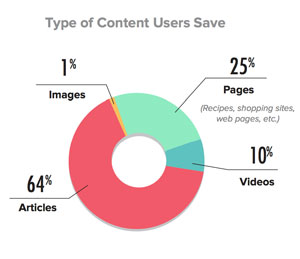
As Read It Later grew in popularity, so did Weiner's ambitions. He saw that his app was useful for much more than saving tutorials — it was also home to video, recipes, travel research, and even shopping. (The company says items saved in Pocket convert to sales at a surprisingly high rate; e-commerce features largely in Pocket's future plans.)

Meanwhile, his competitors tended to build for single platforms or operating systems. At the time of the Evernote meeting, Instapaper was unavailable on Android. Apple's Reading List feature, which would come out a few months later, is limited to the Safari browser. Weiner knew that most people worked across browsers and platforms, and that his company had to do the same. "Users don't want 10 buckets of these things," Weiner said. "They want one place that goes across everything."

Libin and Gullicksen listened intently as Weiner made his pitch. Libin, Weiner recalls, seemed enthusiastic about the prospect of working together. Read It Later was for saving things temporarily; Evernote was for saving things forever. It felt like a match. But Gullicksen was skeptical they could meet his price. Afterwards, they all shook hands and Weiner arrived back in San Francisco feeling hopeful. He and his wife had a pizza delivered. "We tried to absorb what had happened," Will said. "What is this new chapter of our life?"

Two days later, Gullicksen called back. Evernote still wanted to buy Read It Later, he said — but at the original price.

Becoming a verb

How much the company is eventually worth depends on whether time-shifting the internet becomes as popular as time-shifting television. Pocket belongs to the class of startups whose business model is essentially to create a new verb. Facebook brought us the like, Twitter the tweet, and Foursquare the check-in. Pocket aims to bring us the save, and to make money by working with publishers, retailers and everyone else whose stuff the company is saving.

The Pocket team thinks of itself as a sister to companies like Evernote and Dropbox, services that allow you to save something in one place and access it later from anywhere. But those companies, founded around the same time, have grown much more quickly. Evernote has more than 60 million registered users; Dropbox has more than 100 million and says it is profitable. Meanwhile, Pocket has more than 9 million users and expects to hit 10 million this summer. After making its app free last year, the company has no revenues.
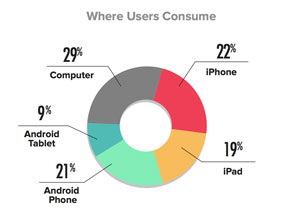
Whereusersconsume

Weiner suspects that the problem that millions are using Pocket to solve will only grow more thorny. When he started, he wanted only to save articles within a browser. The original iPhone, which came out the month before Weiner's Firefox extension, helped turn mobile devices into a primary reading destination. Then came tablets, Google Glass, and other wearable computers. The world is transforming into screens, Weiner says, and Pocket will be the way we move things around them.

Telling Evernote "no"

All of which is why, when Gullicken called, Weiner declined the acquisition offer. He had come to feel that Evernote saw Read It Later as a feature inside its product, as opposed to a full-fledged product of its own. Using a slightly modified version of his Evernote pitch deck, Weiner went out to raise venture capital. Jonathan Bruck, a startup adviser he had met online while working in Minnesota, made the necessary introductions. Two weeks later, they had a term sheet and the valuation they were seeking from Evernote. Pocket has now raised $7.5 million from investors including Foundation Capital, Baseline Ventures, Google Ventures, and Founder Collective.

For the first time, Weiner was able to hire a staff. The company now consists of 13 people — the same number Instagram had when it sold to Facebook — and includes Will as lead designer and Max Weiner as Android developer. Last year, after a bruising internal debate, the team re-branded Read It Later as Pocket — a warmer, friendlier name, they hoped, and something that reflected the fact that Pocket was designed for more than reading.

After a bruising internal debate, the team re-branded Read It Later as Pocket

In April, in a post on his blog, Marco Arment announced that he had sold Instapaper to Betaworks. He had lost enthusiasm for the product over the past year, he said, as he later explained on a podcast, had allowed it to fall into neglect. Ultimately, Arment came to the same conclusion about his product that Weiner had about Pocket: "To really shine, it needs a full-time staff of at least a few people."

Betaworks, the minds behind the new Digg, Bitly, Chartbeat, and Dots, will provide that staff. But at Betaworks, there is no talk of creating new verbs; the business model is downright old-fashioned by comparison. "It makes money when people download it, and it makes money when people subscribe to it," said Andrew McLaughlin, senior vice president at Betaworks and CEO of Digg and Instapaper. "We're focused on justifying to users that the tool is sufficiently awesome from the get-go. That's the business model that worked really well for Marco, and that's the one we want to build on."
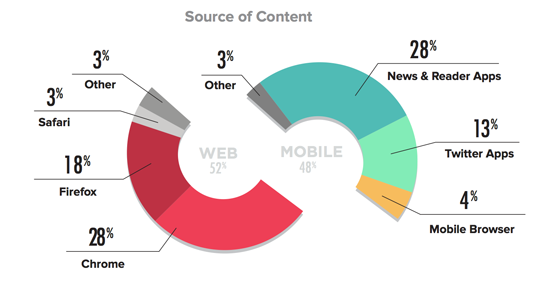
Sources

Hacking on growth

On Friday, the Pocket team gathered at their offices on Market Street in San Francisco to share the results of a week spent hacking. Together and in teams, Pocket employees presented new ideas for sharing Pocket with the world. The theme of the week was as simple as it was urgent: Make Pocket grow faster.

For many who use Pocket, it feels indispensable. Users save 1.3 million items a day from more than 400 apps that connect to the service. But to the average person, setting up Pocket can still be overwhelming. Someone just buying a smartphone would have to install a bookmarklet, download Pocket, download partner apps, log in to Pocket on those apps, then figure out how to save to Pocket from each one.

During hack week, employees worked on reducing that friction. "As soon as you understand it and you start to use it — we get these comments all the time: 'I don't know how I lived without it,'" Max Weiner said. "But there's a learning curve in between finding out about Pocket and getting to that point."

It's the kind of challenge that often leads young founders to sell their companies. At some point Pocket will need to start generating revenues — through affiliate links, deals with publishers, or other means. For now, though, Weiner says Pocket is thriving as an independent company. Luck and timing have given him the rare chance to build a product used at a massive scale. "To find yourself at the forefront of a fast-evolving industry is an amazing experience," he said. "All I ever wanted was to have people use my stuff."

18 Jun 18:51

sanya-anwar: fairytalemood: 1001 cover art by Sanya Anwar 1001...

by OnlyMrGodKnowsWhy
firehose

full clickthrough report: looks lovely, would keep reading

Brief clickthru report: looks good, will read


sanya-anwar:

fairytalemood:

1001 cover art by Sanya Anwar

1001 is a reimagining of the life of Scherezade, the heroine of One Thousand and One Nights. Read issues #1 and #2 here.

follow Sanya Anwar on tumblr

:D

This is fabulous stuff (literally). Go read it.

Original Source

18 Jun 18:49

Say goodbye to the company’s summer softball tournament—and all those emails about practicing for it

by Commentary
firehose

"most sports teams tend to attract those who already are young and physically fit"

Corporate summer softball

Nearly two-thirds of major US companies offer wellness programs, and more keep adding them every year. Yet the grandaddy of health is less and less popular in Corporate America.

The number of workers playing on employer-sponsored basketball or baseball teams has declined since 2009, those good ol’ days when 25% of organizations fielded one. Now the number is down to 16%, according to the Society for Human Resource Management’s new Benefits Survey Report (pdf). That means more employers now offer legal assistance services (23%) or on-site lactation rooms (34%) than a summer softball team.

Sports teams got kicked out amid employers’ concerns about work-life balance or fairness in offering the same benefits at all their sites, for all their people, says Deborah Berman, a principal in Keller Benefit Services in Bethesda, Maryland.

The thinking: “We need to have something that can reach everybody,” says Berman. And she notes: most sports teams tend to attract those who already are young and physically fit .

Then one client decided workers were spending too much work time coordinating practices, schedules and snacks with “emails flying around,” she recalls. So the CEO shut down the corporate team.

The competition for time—and especially staffers with families or elders to care for or their own children’s teams—also may contribute to the slide in team sports.

While team sports are declining, the SHRM report identified some other benefits that have gained traction: contraceptive coverage grew from 66% of employers to 82% in five years. Some 43% of employers give rewards or bonuses to workers who complete health and wellness programs, almost double  the level of five years ago. And more companies have on-site fitness classes too.

This year, the biggest growth in benefits are likely to come from programs to stop smoking and retirement planning. Despite Yahoo’s ban on employees working from home, 4% more companies expect to allow telecommuting, joining the 58% of employers already doing so.

And maybe those who used to play on an employer softball team will find another kind of coach—a health and lifestyle one, who works with them on email or in person. Almost half of US employers now offer them, the survey notes, up from a third five years ago.

Follow Vickie Elmer on Twitter @WorkingKind .  We welcome your comments at ideas@qz.com.


18 Jun 18:48

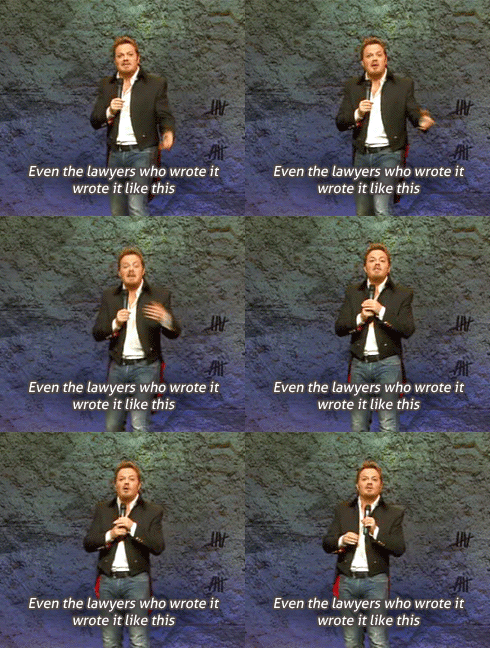
Eddie Izzard [Stripped] | Terms & Conditions

firehose

via Snorkmaiden


Eddie Izzard [Stripped] | Terms & Conditions

18 Jun 18:44

LEGO Announces Mars Curiosity Rover Set

by Kimber Streams
firehose

get some mindstorms parts up in that motherfucker

LEGO Curiosity

LEGO has approved the Mars Curiosity Rover set created by LEGO CUUSOO user Perijove, a mechanical engineer who worked on the actual Curiosity Rover at NASA’s Jet Propulsion Laboratory. The final product is still in development and no price or release date have been set yet. LEGO also provided updates on two other sets that were up for review, a Star Wars Sandcrawler and a Thinking With Portals set based on the Portal video game. The Sandcrawler was denied approval because of LEGO’s ongoing relationship with Lucasfilm on the LEGO Star Wars sets, and the Thinking With Portals set is still pending approval.

images and video via LEGO CUUSO

via The Brothers Brick

18 Jun 18:42

Photo

firehose

via Kara Jean


18 Jun 18:28

Creator Of Mario Reveals His 'Bad' Game

firehose

tl;dr: Zelda II, mostly because the concept couldn't fit in the hardware

"I have to ask, Mr. Miyamoto, you said you have made a bad game. What was the bad game you made?"
18 Jun 18:20

3D opera, Shakespeare on Twitter, and donkeys on Google+: How the performing arts got wired

by Leo Mirani
firehose

'The performance will last three days—from Friday night (midsummer night) through to Sunday, matching the timeline of the script—but most of it won’t be in front of a physical audience.

Instead the action will be broadcast on a “virtual stage”, an accretive layer of activity unfolding online as characters important and peripheral blog about what’s going on, post video clips, and interact with each other—and the public—on Google+. The only more-or-less conventional part of the performance will be the wedding scene between Theseus and Hippolyta—and that will take place at a huge party open to the public at the company’s home town of Stratford-upon-Avon.'

Video projection used to its full potential can be magical, as in the opera "Dr. Dee."

On Friday, June 21, the longest day of the year, the Royal Shakespeare Company will launch its latest production of “A Midsummer Night’s Dream.” It will be no ordinary show. The performance will last three days—from Friday night (midsummer night) through to Sunday, matching the timeline of the script—but most of it won’t be in front of a physical audience.

Instead the action will be broadcast on a “virtual stage”, an accretive layer of activity unfolding online as characters important and peripheral blog about what’s going on, post video clips, and interact with each other—and the public—on Google+. The only more-or-less conventional part of the performance will be the wedding scene between Theseus and Hippolyta—and that will take place at a huge party open to the public at the company’s home town of Stratford-upon-Avon.

Keeping your fairies and lovers in separate circles seems wise. RSC

The idea behind the production, which the RSC has titled “Midsummer Night’s Dreaming,” is to recreate the online chatter that surrounds any event in the real world, such as breaking news or an unfolding scandal, says Geraldine Collinge of the RSC. The experiment is one of a spate of recent efforts to fuse digital technology with the performing arts. The company tried something similar in 2010, when it produced “Such Tweet Sorrow,” a retelling of Romeo and Juliet through Twitter. (It received mixed reviews.)

Opera, often seen as a fusty relic for pensioners and one-percenters, is also embracing new technologies. Michel van der Aa, a Dutch composer, teamed up this spring with the novelist David Mitchell to make “Sunken Garden,” which uses 3D film as an important part of the production. Video projection can be found in everything from modern opera such as Philip Glass’s “Satyagraha” to re-interpretations of classics, such as Terry Gilliam’s mind-bending production of Berlioz’s “The Damnation of Faust.”

Technology has long been to make live theater and opera reach more people. It started with the recording and broadcasting of performances on TV radio. The internet opened up new possibilities: On December 30, 2006, New York’s Metropolitan Opera live-streamed Mozart’s “The Magic Flute” in high definition to cinemas across the world, and its productions now reach 60 countries this way. Britain’s National Theatre took up a similar approach with NT Live, which allows many thousands of people to watch a single evening’s work.

Now, though, technology is being used not just to broaden the audience, but to create depth in the production. Putting a 3D film in an opera may sound gratuitous and the very idea of Oberon, Titania and Puck trading quips on Google+ may sound perfectly ghastly, but the reasoning is sound. “Culture should hold a mirror up to society,” says Tom Uglow from Google, which is working alongside the RSC for Midsummer Night’s Dream. “So if you’re a contemporary mirror, you should use contemporary tools to do this.”

Through the glass, down the hole

Live singers interact with characters and events on 3D film in Michel van der Aa’s “Sunken Garden.” Mike Hoban

“We all grew up with technology—it’s so much part of our daily lives,” says Michel van der Aa, who composed and directed “Sunken Garden”. “I don’t see it as an extra layer but I find it a very organic thing to embed in my work.” Van der Aa has been mixing digital technology into his productions for much of his career. His 2006 opera “After Life” combined film projection interacting with live artists, a trick he repeated in different form with ”Up Close,” a 2010 cello concerto.

His latest work, “Sunken Garden,” is about a place between heaven and earth. It also relies on mixing live opera singers with recordings, but at scale: the entire backdrop turns into a giant screen showing a 3D film of the eponymous garden and its inhabitants. With 3D glasses on, it is easy to forget that half the characters aren’t actually in the hall.

Perhaps less obvious as a tool for adding richness to a production, but no less ambitious, is video projection, which has become increasingly common over the past few years. A particularly impressive example is “Dr. Dee,” created by director Rufus Norris and the musician Damon Albarn, which ran at the English National Opera last year. Telling the story of an Elizabethan scientist and mathematician (and also a bit of a loon), “Dr. Dee” used elaborate video projections to communicate the visions and calculations of Dee’s mind. The projection received as much acclaim as the rest of the opera.

It was well deserved. The projection, designed by Lysander Ashton, was a character in its own right and involved a tremendous amount of work to get right. “At the heart of it is a media server, which is a computer that does a lot of graphic compositing live,” says Ashton. “We break the artwork down into multiple layers that can be laid up in real time each time a show is done.” At the other end of the hall, Ashton responded to what was happening on stage, controlling two projectors that beamed video on moving targets like sheets of cloth flying across stage.

Ashton is a part of 59 Productions, a film and new media production house in London that, among many other projects, did “Dr. Dee” and has worked on video in ballet, theatre and operas like “Satyagraha” and Nico Muhly’s “Two Boys” (itself a story about internet friendships), as well as the supersize projections in the London Olympics opening ceremony.

Nearly a billion people watched 59 Productions’ video projections during the London 2012 Olympics opening ceremony. 59 Productions

59 Productions uses a lot of different media in its projections—video, text, animation—and getting it all right takes a lot of computing power. Yet Ashton says his ambition is to make the technology responsible for his work disappear.

According to Andrew Dickson, theatre editor at The Guardian, ”Digital projection is just one tool that theatre directors can use, just as they would use a lighting box. It is almost part of the furniture.” That suggests Ashton may be succeeding in his goal. Social networks and 3D film face bigger hurdles before they can become commonplace. But the same could probably have said of masques when Shakespeare started including them in his plays, says the RSC’s Collinge, because it challenged the way people thought and gave the actors new ways to express themselves.

Technology pervades the arts. From moving sets to mechanized lighting, a modern production has dozens of tools at its disposal that Shakespeare could only have dreamed of. Yet we barely notice most of them. The ideal result for experiments like the RSC’s or productions like van der Aa’s would be if we stopped noticing the technology there too.


18 Jun 18:13

BioShock creator Ken Levine writing 'Logan's Run' remake screenplay

by Michael McWhertor
firehose

great

BioShock series creative director Ken Levine has signed on to pen the screenplay for Logan's Run, a long-in-development remake of the 1976 dystopian sci-fi film of the same name, reports Deadline.

The remake has been in production at studio Warner Bros. in various forms under directors Bryan Singer (X-Men, Superman Returns) and Nicolas Winding Refn (Drive, Only God Forgives). Deadline reports that Levine's screenwriting duties won't pull him away from BioShock Infinite developer Irrational Games, which is currently in development on downloadable content for the game.

Levine has a background in writing for film and theater, a pursuit he followed before joining Looking Glass Studios to work on System Shock 2 and Thief. For more on Levine's background as a screenwriter and playwright, read our in-depth feature on BioShock's creative director.

Polygon has reached out to Levine for details on his work on Logan's Run.

18 Jun 18:12

EA layoffs continue company-wide restructuring

by Samit Sarkar

Electronic Arts laid off a small number of employees recently, an EA source confirmed to Polygon.

One individual who joined EA in April as an analyst, evaluating in-development games, said her "whole department just got cut" in the layoffs.

According to the EA source, less than 20 employees were affected by the most recent cuts. The source also pointed us to EA's previous statements on the company-wide restructuring that began in late April and resulted in approximately 900 job cuts — about 10 percent of the company's workforce.

18 Jun 18:08

Map of place name origins proves that we all secretly live in a fantasy novel

by Jess Zimmerman
firehose

via Tertiarymatt

Click to embiggen.
Stephan Hormes and Silke Peust
Click to embiggen.

Unlace your bodice, put down your bastard sword, and stop trying to genetically engineer that goat into a unicorn — it turns out all you need to experience the thrill of living in a fantasy novel is to look at this map of place name etymological origins.

Click to embiggen.
Stephan Hormes and Silke Peust
Click to embiggen.

Suddenly, instead of having a conference in New Orleans, you have it in New Golden One, Land of the Warriors. You’re not from Jersey — you inhabit the Isle of Spears. Your European vacation might take you on a quest through the Fire-Cleared Land to Lightstone. And of course, we all dream of a getaway to the Islands of the Monkey God* (*the one with the strong maxillaries). At least, we do now.

Click to embiggen.
Stephan Hormes and Silke Peust
Click to embiggen.

The Atlas of True Names is a project of cartographers Stephan Hormes and Silke Peust, and you can buy a physical map to hang on your wall and make every mundane business trip or holiday homecoming into an epic adventure.

Click to embiggen.
Stephan Hormes and Silke Peust
Click to embiggen.

Filed under: Cities
18 Jun 17:29

Would you copy your mind to a robotic body-double?

by George Dvorsky
firehose

if I did I'd go with a better wig at least

Would you copy your mind to a robotic body-double?

A central theme of the recently concluded GF2045 Congress was the idea of achieving a kind of immortality by transferring our minds to avatars or robots. Indeed, as Japanese professor Hiroshi Ishiguro’s presentation clearly showed, our robotic doppelgangers will truly be made to look and act like the real thing.

Read more...


18 Jun 17:28

Pay Phone Graveyard in Manhattan

by EDW Lynch

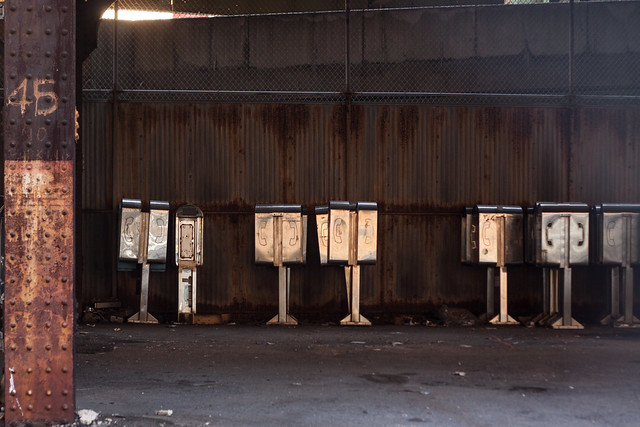
Pay phone graveyard

New York City photographer Dave Bledsoe recently discovered a spooky pay phone graveyard under an elevated highway on the west side of Manhattan.

Underneath the elevated West Side Highway at 135th and 12th Avenue I found this telephone graveyard. At least a one hundred old, battered pay phones were locked behind a fence near the Park’s Department building. I almost took these on my iPhone, but my irony levels are dangerously low these days.

This Technology Has Been Disconnected or is No Longer In Service

This Technology Has Been Disconnected or is No Longer In Service

This Technology Has Been Disconnected or is No Longer In Service

photos by Dave Bledsoe

via Gothamist

18 Jun 17:26

Music: Great Job, Internet!: This Kanye West commercial (ahem, short film) spoofs American Psycho

by Josh Modell

With the Kanye West machine in overdrive this week—Yeezus officially comes out today, perhaps you've heard—some things were bound to go slightly off the rails. The album is audacious and a little scary, not unlike Bret Easton Ellis' American Psycho, and its filmic companion, directed by Mary Harron. In some sort of homage to the film's Huey Lewis scene, Kardashian adjuncts Jonathan Cheban and Scott Disick star in this commercial—uh, short film—to promote the record. They are not good actors, and this video doesn't do the album any favors. Couldn't he have just written some lyrics about Patrick Bateman? The rhyme possibilities are endless.

Read more
18 Jun 17:09

Beach ball, no more: Chatology aims to fix OS X's messaging misfortune

by Ellis Hamburger
firehose

the NSA can't search your iMessages, and neither can you

Searching for people or messages inside Apple's Messages for Mac can be downright unbearable. Typing anything into the app's search bar is liable to slow your computer to a halt, even after some tweaks Apple made in its latest OS X update. Flexibits, the makers of Fantastical, thinks it has a fix: Today the company is launching Chatology, an app for searching through all the instant messaging logs on your Mac. If you've hooked up iMessage, it will search through those messages, too.


A simple way to search for instant messages that won't crash your Mac

Poring through old IMs isn't something most people do every day, but if you often find yourself digging around for that conversation you had with a colleague over AIM, or those dinner plans you made with a friend over Google Talk, Chatology works very well. It plugs directly into Messages for Mac's conversation database, and offers a variety of features like the ability to export conversations to plain text, sort conversations by date, and filter the content of a conversation by text, images, or links. Effectively, this feature provides an easy way to view a complete history of images and links you've shared with someone, which is both useful and fun. Most importantly, the app is fast.

The biggest issue with Chatology is OS X itself, which does a poor job organizing your instant messages and iMessages. It's not uncommon to find duplicate and empty conversations with odd dates in Chatology, and unfortunately's there's not much anyone can do about it. The app also doesn't support Adium or any other third-party chat apps you might use on your computer, but Flexibits says it's considering adding compatibility. If you don't find yourself perusing old chat logs too often, it could be easy to forget about the app — but fortunately, activating it is as simple as pressing Command F to search inside Messages for Mac, just like you normally would. Still, the app's $19.99 price tag is out of reach for many, but if you frequently search for old messages on your Mac, Chatology is invaluable.

18 Jun 17:07

From Gezi Park

by Brian Felsen
firehose

via Christopher Lantz

A protester runs through tents covered by tear gas in Gezi park in Istanbul's Taksim square June 15, 2013. Turkish riot police stormed a central Istanbul park on Saturday firing tear gas and water cannon to evict hundreds of anti-government protesters, hours after an ultimatum from Prime Minister Tayyip Erdogan. REUTERS/Yannis Behrakis

I've been attending the Gezi Park protests since arriving in Turkey on June 6.

Thousands of people have camped at the park in Taksim Square, traditionally a gathering place for all kinds of meetings and protests, to prevent Prime Minister Erdoğan from razing the park to remove the place of assembly and erase some of the last green space in Istanbul to turn it into an Ottoman barracks shopping mall.

On the morning of the 11th, the protesters in the park were peaceful; in Taksim Square below, they were throwing fireworks and rocks and it was being responded to with tear gas and sonic booms and water canon blasts.

By nightfall, the square was becoming filled with people coming home from work, and at 7:30PM, the police gassed the square, driving the protesters into the park. I retreated into the center of the park, at which point the police completely surrounded the park, so that nobody could leave. Then they gassed the whole park.

People were passing out, puking, crying, and nobody was able to breathe or see. The police no longer were trying to get people to disperse - they were torturing them. They even gassed the ambulances outside waiting to carry away the injured protesters.

Although I was gassed several times, the final assault was so thorough that there was nowhere to go to get breathable air. In addition to the burning in my eyes and mouth, it felt like drowning.

But the crazy thing is that even after all that, I've become addicted to going to Gezi Park. Maybe it's the sense of community and purpose there - with free food, cigarettes, music, accommodations, books, education, and healthcare.

Maybe it's the joyous, resilient mood of the Turks - who, the second the gas attacks stopped, were cheering and applauding the fact that they held their ground, even while people were gagging and vomiting and it was bleak and horrible. Maybe it's because in the protests, the biggest cultural differences and partisan conflicts are forgotten, as arch political enemies and rival soccer teams are joined together in song, arm around arm.

Maybe it's because it's a rare opportunity for genuine, protracted conversation and interaction between people from all walks of life - rather than the small, unrepresentative group of looters and thugs as Erdogan characterized, the "capulcus" came from all classes, ages, political parties, and sexual orientations.

And maybe it's that I find it surreal to be walking around yesterday's battle zone as if it were a movie or stage set. But probably the real reason I keep coming back, even after being tear gassed and hearing Erdogan's "final warning" to the protestors, is that there's probably nothing more emblematic of the human condition than to be dancing in the street with a gas mask around your neck.