Shared posts

01 Aug 23:45

Early Delivery: A Look At Ninja Pizza Girl

by Cara Ellison

By Cara Ellison on July 31st, 2013 at 9:00 pm.

NINJA PIZZA!
A cyberpunk kid ninja freerunning is across city roofs, there’s always a Daft Punk beat behind the straining leaps she takes over yawning blackness below: one two, jump, land, one two, jump, land, duck, now admittedly, she pants, this Daft Punk soundtrack is because 2001 me is listening a lot to Discovery, and Harder, Better, Faster, Stronger plays, often, everywhere…. one two, jump, land, one two, jump, land, duck – VAULT. VAULT.

But those were silly daydreams and twenty-seven year old me laughs at her and thinks, hah, sixteen year old me, now I can play two levels of a prototype side-scrolling action platformer Ninja Pizza Girl, a year before it comes out, and it’s the platformer you always speculated should happen. Here are my first impressions of a little teenage fantasy.

Set in a dystopian near-future, Ninja Pizza Girl is a side-scrolling action platformer that follows a teenage girl and her family Pizzeria’s struggle for independence against the uncontested might of the pizza mega-corporations. Follow Gemma as she navigates a world where slums teeter on top of skyscrapers, where people live out their lives without seeing the ground, where powerful mega-corporations exploit the skills and aspirations of the poor to maximise their profit margins. In a culture twisted by corporate propaganda, Gemma must fight to keep her ideals, her family and their business intact in face of the most merciless enemies known to any teenage girl – other teenagers.

NINJA PIZZA!

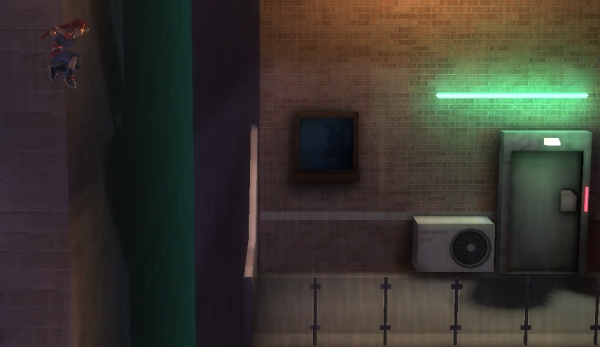
The idea is that you have to run over rooftops to deliver pizza, using your teen ninja skills to overcome obstacles and enemies and Extremely Large Gaps. You are timed, though it seems currently to be incidental. You use A/D to run, space to jump and right click to slide and crouch. Jump actions also include bopping sneering teen ninjas who call you a loser on the head. Then you deliver pizza to some trouserless wonder, one of whom really resembles a grumpy, semi-naked man I once unpleasantly had to share a pizza restaurant with in Manila.

NINJA PIZZA!

In short, all of the art is very evocative of a dark-scorched city dystopia. Ninja Pizza Girl’s world certainly is pleasing to look at. It’s like the neo-noir future I always picture when I read the title of that James Lee Burke book, Neon Rain (though that book is not about the future). The three-person team at Disparity Games is composed of Jason Stark, a veteran art director who has worked for Rare, Animal Logic and Microsoft, his wife, the animator Nicole Stark who was one of the first women developers in Brisbane, and their sixteen year old daughter Raven Stark, who, besides sounding like a dark-worded heroine from Game of Thrones does the 2D art in the game and all the promotional materials. With such an art focussed team it’s not a surprise that the game looks beautiful and that the animation (particularly of the bad-ass flipping over stuff) is wonderful.

NINJA PIZZA!

In this year-early build my ninja girl is capable. I was supplied with the first two short tutorial levels, one that was composed of fairly simple boxes and pipes to jump over and under, slopes to slide down gracefully, air conditioning units to flip up and over. The second level included trampolines to bounce gleefully off, and a few fun wall jumps to help you get to a rooftop with ninja boys to defeat. Though the jumping and sense of freedom was rewarding, and the levels felt vast, controls sometimes felt slow to respond, or perhaps it is the animations that look a little stiff, and sometimes the context-sensitive edge-flips could have been faster. In short, the flow of the thing needs a little work, I think, for it to be a great game, and not just wish-fulfilment on my part. But it’s such an early prototype that I’m pretty sure it will get Harder Better Faster Stronger. And I liked the rave-vibe music. It was, as teen me would have said shrugging, pretty cool.

NINJA PIZZA!

Most interesting of all is that the team is planning on tracking Gemma’s self esteem, not her health, so that when you are knocked down by ninja bullies your self-esteem is knocked instead. I think this is a touch of genius.

The cute teen humour though, was interesting – ‘I thought you were a ninja?!’ ‘I googled it!’ is sort of sweet, and it mainly just creates in me a sense of jealousy that, at sixteen years old, I couldn’t just have been called Raven and have sat around making videogames with my parents. ‘For honour. For Family. For Pizza,’ almost seems like a better House Stark motto, anyway.

Track Ninja Pizza Girl‘s progress here.

01 Aug 02:03

Behold, The Innards Of A Spacesuit

The innermost workings of an astronaut's outerwear.
31 Jul 23:05

NSA director addresses Black Hat, says there have been “zero abuses” of data

by Peter Bright
NSA Director General Keith Alexander.

LAS VEGAS—At the Black Hat security conference today, National Security Agency (NSA) Director Keith Alexander defended the NSA's data collection programs and described at a high level what data is collected and how it's used.

His presentation covered two programs, both revealed by Edward Snowden: telephone metadata collection and a program of collecting from the computer industry data relating to foreign nationals, of which PRISM is a component. According to Alexander, the phone metadata collection, authorized under FISA section 215, was both limited and tightly controlled. The NSA collects only the time and date of a call, the phone numbers involved in a call, the duration of a call, and the service provider that captured the information. Notably, he said that names, address information, and location information were not captured. Nor was any conversation data collected, such as the contents of voice calls or text messages.

While this data was collected, Alexander said that access to the information was tightly restricted. Free-for-all queries weren't permitted. Instead, numbers had to be individually approved by one of 22 people at the NSA, and only 35 analysts within the agency were authorized to run queries on those numbers. In 2012, he said that fewer than 300 numbers were added to the list.

Read 7 remaining paragraphs | Comments


31 Jul 23:05

Fans Of Green Screens, Incredibly Fake-Looking Things Express Love For Modern Cinema

NEW YORK—Self-proclaimed fans of artificially sleek movies that at no point appear as though they contain real human beings onscreen in real locations doing real things expressed their ongoing appreciation for modern filmmaking today, sources confir...
31 Jul 23:05

See Kazu Kibuishi’s final ‘Harry Potter’ cover, plus boxed set

by Kevin Melrose

See Kazu Kibuishi’s final ‘Harry Potter’ cover, plus boxed set

At a special event held today at The Scholastic Store in New York City, the publisher premiered cartoonist Kazu Kibuishi’s new cover for Harry Potter and the Deathly Hallows, the seventh and final book in J.K. Rowling’s blockbuster fantasy series. Announced in February, the new covers by the acclaimed creator of Copper, Daisy Kutter and [...]
31 Jul 22:17

The Hipster Logo Design Guide on How To Create an Artisanal Logo

by Rusty Blazenhoff

Hipster Logo Design Guide

Six easy steps. No concept necessary!

The Hipster Logo Design Guide” by San Francisco-based designer Tim Delger is described as “a handy guide for creating an artisanal logo.” Prints are available in a variety of sizes at Society6.

via DesignTAXI

31 Jul 22:15

Liberal Saudi Web Forum Founder Sentenced To 600 Lashes and 7 Years In Prison

by Soulskill
cold fjord writes "Some reformers travel a harder road than others. The Seattle Times reports, 'The founder of a liberal-minded website in Saudi Arabia has been sentenced to seven years in prison and 600 lashes after angering Islamic authorities in the ultraconservative kingdom. ... Raif Badawi, through his website known as Free Saudi Liberals, had urged Saudis to share opinions about the role of religion in the country, which follows a strict form of Islam that includes harsh punishments for challenging customs. A judge in the Red Sea port of Jiddah imposed the sentences but dropped charges of apostasy, which could have brought a death sentence, the Al-Watan newspaper reported. Badawi has been held since June 2012.' More at details are available at the BBC, which informs us that 'The judge ordered that the 600 lashes be administered 150 at a time.' 'The lashes could be spread out but in Sharia this is a sign that the judge wants to insult him,' Badawi's lawyer said."

Share on Google+

Read more of this story at Slashdot.


31 Jul 22:11

classictrek: startrekships: stealing the Enterprise gifs Star...


classictrek:

startrekships:

stealing the Enterprise gifs

Star Trek III: The Search for Spock

There were too many shots in the sequence to include within the 10 image limit, so I split them up and will have another gifset soon that focuses on the Excelsior’s pursuit.

Not going to even pretend: my heart beats faster just seeing these gifs. This may be my favorite sequence in the first six movies.

Also: fun fact: the janitor at the lounge is played by The Search For Spock’s director of photography, Charles Correll.

…My first love. :)

31 Jul 22:10

The Hobbit: The Even-Fucking-LONGER-Somehow Edition

by Bobby Roberts

Below is a scene cut from the theatrical version of The Hobbit: An Unexpected Journey, which came out roughly seven months ago and had all the lasting impact of a hairy footprint in dry sand. The breeze from the blockbusters that followed buried that print, and that won't do; there's still two more movies left to be wrung out of J.R.R. Tolkien's goofy children's story about a homebody hanging out with a group of slobs and a sneaky old fart who shoots fireworks out of his magic stick. So how best to remind people? Release an extended blu-ray that shoves even more useless padding into a film already stuffed with noisy pointlessness, like a mattress made of Furbys.

For example:

That this minute-long clip feels like three is a real testament to the pursuit of bloat Jackson's chosen to take on this return-trip to Middle-Earth.

Is there any real reason for an extended cut of 1/3rd a story that takes longer to watch than reading the entirety of the book it's based on? No. So why is it happening? Because that's how they did it on Lord of the Rings, so that's how we'll do it here. It's the same logic that painfully stretchesThe Hobbit across three movies like William Wallace.

BUT: Just in case you liked the movie, or you're simply a completist who needs to buy it because otherwise your blu-ray shelf will feel imbalanced somehow (i.e. the reason most childless adults still have copies of the Star Wars prequels) the blu-ray will be available October 22nd, in a variety of options, including a five-disc 3D set with an MSRP of $54.99. You'd be fool of a Took not to get one (ugh).

[ Subscribe to the comments on this story ]

31 Jul 20:29

How 'One Weird Trick' Conquered The Internet

firehose

attn: otters

What, I wonder, makes the tricks so weird? How come only one trick (or sometimes "tip"), never more? Why are the illustrations done by small children using MS Paint? I’ve never pursued these questions, though, because a fear of computer viruses and identity theft has always stayed my hand. One curious click, I imagine, and I could wake up hogtied on an oil tanker headed to Nigeria.
31 Jul 20:28

nudiemuse: labillustration: “If you are a woman. If you are a...

firehose

Margaret Cho "panto-raped a Katy Perry look-alike on stage with Amanda Palmer once"? the fuck?

Courtney shared this story from ~(*cute erotic hell*)~:
also she panto-raped a Katy Perry look-alike on stage with Amanda Palmer once. FEMINISM.


nudiemuse:

labillustration:

“If you are a woman. If you are a Person of Colour. If you are gay, lesbian, bisexual, transgender, if you’re a person of size, if you’re a person of intelligence, if you’re a person of integrity, then you are considered a minority in this world. And it’s gonna be really hard to find messages of self-love, and support anywhere, especially women’s and gay men’s culture. It’s all about how you have to look a certain way or else you’re worthless. You know when you look in the mirror, and you think, ‘Ugh, I’m so fat, I’m so old, I’m so ugly’, don’t you know that’s not your authentic self, but that is billions upon billions of dollars of advertising, magazines, movies, billboards, all geared to make you feel shitty about yourself so that you will take your hard-earned money and spend it on some turnaround cream that doesn’t turnaround shit.

When you don’t have self-esteem, you will hesitate before you do anything in your life. You will hesitate to go for the job you really wanna go for. You will hesitate to ask for a raise. You will hesitate to report a rape. You will hesitate to defend yourself when you are discriminated against because of your race, your sexuality, your size, your gender. You will hesitate to vote. You will hesitate to dream.

For us to have self-esteem is truly an act of revolution. And our revolution is long-overdue.”

Inspirational Women I Love —> Margaret Cho

I used to really be a huge Margaret Cho fangirl.

Now not so much.

I can’t say precisely why. Sometimes in the past few years she’s said things that bother me on some level that I can’t quite articulate.

she told some fat negative jokes when I saw her do comedy last year. I left and cried in my car because I’d trusted her not to.

31 Jul 20:25

Computer chips in your mouth will know what you're saying

by Annalee Newitz
firehose

everything is always watching beat

Computer chips in your mouth will know what you're saying

Tiny computer chips installed on your teeth could one day allow you to monitor everything from the chemical composition of what you're eating, to your ratio of talking to chewing. This technology could be part of your "quantified self" regimen, or a whole new system of surveillance.

Read more...


31 Jul 20:25

Photo

firehose

say hello to my pika pi~


31 Jul 20:23

Bullseye

firehose

"It’s like Readability, but you get to just tell it which part is the good stuff."
can't get it to work, can someone confirm it's not my shitty combo of work Firefox and play Chromium?

Bullseye:

A handy bookmarklet that “lets you quickly select lets you click a section of a webpage and “Markdownify" just that content".

31 Jul 20:19

Photo

firehose

sorry, everybody


31 Jul 20:19

John Wilkes Booth killed Lincoln… but who killed John Wilkes Booth?

by Jesse Hicks

This is the story Nate Orlowek had learned, too: of a killer’s mad act, his flight from justice, and his small, pathetic death. Even before he’d learned that official story, though, he’d seen The Prisoner of Shark Island, about Dr. Samuel Mudd, who, the film contends, was scapegoated by a vindictive Northern government. After mending Booth’s broken leg on the night of the assassination, Mudd was tried as an accomplice and imprisoned on the titular island.

The film, directed by John Ford, plays fast and loose with history, but even at seven years old, Orlowek says, "I was outraged when I saw what they did to Dr. Mudd, and I had the sense that I wanted to go back in time." Much like the heroes of another favorite story: The Time Tunnel, a sci-fi TV show in which two scientists’ malfunctioning time machine sent them hurtling through history, righting wrongs along the way. In one episode, of course, they foiled an assassination plot against Lincoln.

Even at his youngest, Nate Orlowek had a strong sense of justice and a belief in the mutability of history. The Lincoln assassination became one of his many historical interests. But despite all he read, he never doubted the official story until he was 15. It was August, 1973. He was visiting a friend’s house one afternoon when he noticed a book; its spine bore the familiar presidential silhouette and the title, Web of Conspiracy: The Complete Story of the Men Who Murdered Abraham Lincoln.
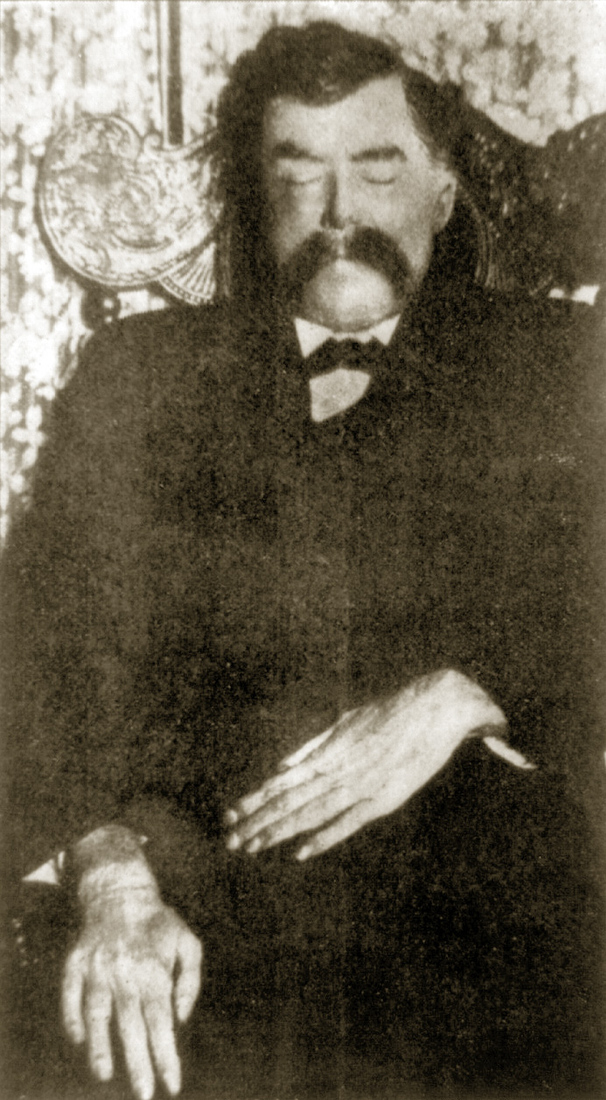
David_e_george

David E. George, a drifter who’d poisoned himself with strychnine in the frontier town of Enid, Oklahoma, in 1903. Courtesy of the Library of Congress.

He paged through it, flipping to the final illustrated plate. There he saw the familiar face of John Wilkes Booth juxtaposed with a picture of a dead man sitting in a chair. The dead man’s eyes were closed, his face draped with a thick mustache. In the right cast of mind you might see a resemblance between the two, accede that the dapper, 25-year-old star on the right could have sagged and drooped over 40 years to become the swollen, mummified body on the left. And that’s exactly what the book claimed.

"Puzzle for history," it read, introducing the dead man as David E. George, a drifter who’d poisoned himself with strychnine in the frontier town of Enid, Oklahoma, in 1903. As the story went, George had several times confessed to being John Wilkes Booth, even going so far as to admit, "I killed the best man that ever lived." After his grisly, self-inflicted exit from the stage, George’s body was embalmed by the local mortician, who assumed government officials would come to examine it. They didn’t, but the remains became a local attraction, mentioned in newspapers and promoted by civic boosters. A lawyer named Finis L. Bates eventually claimed the body, and later wrote a book, The Escape and Suicide of John Wilkes Booth, detailing how he’d come to know David E. George, how the man had confessed, and how his tale offered "a correction of history."

As 15-year-old Nate Orlowek held Web of Conspiracy in his hands and gazed into the "puzzle for history," he could see only dimly the story he’d spend the rest of his life pursuing. It was as though a quest had opened before him, this bookishly serious but charismatic young man. He had found not just a puzzle, but an opportunity to set things right. From his father, who had marched for civil rights and against the Vietnam war, who when watching sports always rooted for the underdog, and who unapologetically believed that one man could save the world — from him Orlowek learned that when something is wrong, you should try to change it. "There are a lot of things that are not the way they’re supposed to be," he says, "and we should not accept things as they are if they’re not the way they’re supposed to be. We should fight to change them."

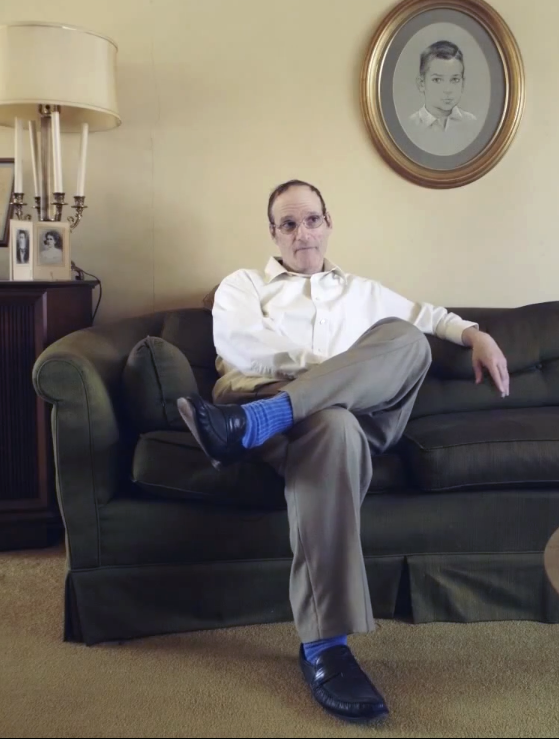
"A lot of people ask me, ‘Why John Wilkes Booth?’" he says now, looking back, sitting on a couch in the living room of his childhood home in Silver Spring, Maryland. After his parents passed, he moved back here; the coffee table is scattered with papers he’s recovered from his basement, mementos and clippings of his time wandering the lonely labyrinth of counter-history, searching for the truth in a jungle of rumor and misinformation.
Screen_shot_2013-07-30_at_6

Nate Orlowek has spent 40 years investigating whether Booth died in the barn — or escaped to Oklahoma.

Family photographs flank the couch. Behind him, in gold, oval frames, hang line portraits of two young boys: the Orlowek brothers, Nate’s younger self gazing over his shoulder as he speaks. He’s 55 now, thinned by age and time, lightly tinted glasses resting on his nose, yarmulke crowning his head. You could wonder whether it has consumed him, this quest to correct history. But he denies that; says it’s really been a small, if persistent, part of his life. When he warms to the subject he speaks quickly, punctuating his points with a defiantly raised finger, his tales digressive, his facts precise.

So why John Wilkes Booth? "Really, that was what floated by," he says. Like his father he wanted a cause bigger than himself; like his father he wanted to save the world. "I wasn’t able to save the world when I was 15. I wasn’t able to march for civil rights or work Social Security," the institution to which his father devoted his idealistic energies as a lawyer. "But this thing with John Wilkes Booth was a way of doing something that made a difference, something that impacted people."

He took to his cause with the zeal of an idealistic teenager. He recruited friends. He combed archives. When the Library of Congress told him he was too young to do research there, he cornered his senator in an elevator and, soon enough, got his access. Not only that, but he gained entrance to the rare books room.

The media flocked to him. Local television, newspapers, and radio. A lot of radio. And then, in July 1976, Rolling Stone. Tim Crouse’s skeptically supportive feature — opening with the axiom, "The infuriating thing about nut theories is that there’s always that million-to-one shot that an irrefutable piece of evidence is out there somewhere, half-buried, as it were, just waiting for someone to stoop down and dig it up" — lifted the tale to a new strata of attention. Orlowek soon signed on as a consultant for The Lincoln Conspiracy, billed as "a story every American has the right to know."

Jwb_belongings

John Wilkes Booth's diary. Courtesy of the Library of Congress.

Working on a movie was new and exciting, even if Orlowek clashed with the producers over a fraudster selling the allegedly missing pages of Booth’s diary. But while the finished film, released in 1977, alleged Booth did not die in the barn, it also claimed Lincoln’s own secretary of war had conspired with the head of the Secret Service to kill the president — a plot supposedly revealed in the missing diary pages. Even in a post-JFK assassination, post-Watergate era, with audiences deeply cynical about government, the theory had limited popular appeal. Historians were appalled.

Afterward, Orlowek found himself drifting away from the work. Because what more could he do? Continue digging through history, hoping to find that one irrefutable piece of half-buried evidence? What were the chances of that? He’d done his best, got the story out there. He turned to more tangible goals, petitioning President Carter to clear the name of Dr. Samuel Mudd.

Only after another researcher contacted him a dozen years later, in 1989, did Orlowek again take up his case in earnest. He traveled to Enid, Oklahoma, where locals had tried to interest the wildly popular TV series Unsolved Mysteries in a story about their famous mummy. His zeal renewed, Orlowek signed on to help.

Soon enough, Nate Orlowek reached the next stage of his quest: bringing up the body

Two years later, the segment aired: a full 20 minutes devoted to the now-mysterious body in the barn. Host Robert Stack solemnly intoned, "Those who question the official account believe that in the confusion following the Civil War, critical evidence may have been mistakenly recorded or perhaps covered up. Other(s) dismiss these theories as revisionist nonsense." Orlowek appeared and summarized The Escape and Suicide of John Wilkes Booth. Opposite him, historian James O. Hall cantankerously dismissed this "evidence" as poorly sourced, speculative, or contradicted by more persuasive evidence. He finally scoffed, "I see no mystery about it at all."

But a show called Unsolved Mysteries was unlikely to agree. Instead, a concluding voiceover described Booth’s final interment in an unmarked grave in Baltimore, Maryland’s Green Mount Cemetery. Over an image of the marble stele marking the family plot, Stack pondered, "Perhaps there lies the definitive proof to this unsolved mystery." The implication couldn’t be clearer.

Soon enough, Nate Orlowek reached the next stage of his quest: bringing up the body.

A family affair

Nate Orlowek chose to seize the Booth mystery. Joanne Hulme, however, was born into it. She’s the great-great-great granddaughter of Jane Booth, aunt to John Wilkes Booth. That bloodline meant hearing from an early age that the assassin had escaped Union justice, and that the body buried in Green Mount Cemetery did not belong to her family. The official history was trumped by her family’s story.

Booths_acting

Photograph of (left to right) John Wilkes Booth with brothers Edwin and Junius in a production of Julius Caesar.

She first heard about it in the summer before sixth grade, when her mother told her she was being dramatic, just like her relatives. That meant Edwin Booth, and, yes, his brother, John Wilkes Booth, who Hulme until then had known as a presidential assassin, not a distant relative. Her mother warned that she’d be hearing the official story in school, but that the family knew better; Booth had escaped the barn and lived for many, many years. The family had always known it, and Edwin provided money for him.

The news astounded her, but most of the family never talked about their infamous relative, leaving her to ponder on her own. Her mother even forbade discussion with her siblings. But like young Nate Orlowek, Joanne Hulme was interested in history. She’d begun to devour stories about Nicholas II, the last emperor of Russia, whose entire family was executed by the Bolsheviks in 1918. For decades afterward, rumors lingered that Nicolas’ youngest daughter, Anastasia, had survived the killings, with several women claiming to be the orphaned princess.

Forensic DNA testing recently identified the remains of the entire royal family, but at the time Hulme connected the "family mystery" of Anastasia’s possible survival to that of her newly discovered relative. She was intrigued, both to know that she belonged to a family of actors and to know the mind of someone who could kill a president. She found a family biography called the The Mad Booths of Maryland and began using stories from it to pry more information out of her relatives. Much of what she heard made her proud, and she tried to share that pride. The assassination was a horrible crime, yes, but John Wilkes Booth wasn’t a monster, she’d argue; the family name shouldn’t be forever marred by his history-changing act. "There’s a massive legacy before that terrible day in April, and there’s a massive legacy afterward," she says. "I wish history were kinder to the talent and the legacy of the Booths."

The family name shouldn’t be forever marred John Wilkes Booth's history-changing act

As for John Wilkes Booth, she heard that after his escape from the barn — where he had stayed, but never been cornered by Union troops — he met up with supporters who spirited him out of the country. He went to Sri Lanka, India, the Hawaiian islands. After four years or so, he returned to the states. Similar stories had long circulated, painting Booth’s supposedly posthumous exploits as those of a swashbuckler, a Reconstruction era Zelig who always found himself among the day’s most interesting world shakers. In the legends, he was a romantic figure: the killer doomed to exile, yet still living an enviable adventure.

Joanne Hulme grew up knowing that there was more to history than the official story. But like Nate Orlowek, there wasn’t much she could do other than tell her story. There was evidence, much of it unpersuasive to skeptics, including almost all historians. ("I think historian is a self-appointed title," she says.) Only after Unsolved Mysteries did another possibility present itself.

After appearing on the show in 1991, Nate Orlowek and his new research partner, Arthur Ben Chitty, a historiographer and professor at the University of the South, were contacted by the Smithsonian Institution. It offered to back an exhumation of whoever was buried in Booth’s grave. There were no dental records, and after almost 130 years, the skeleton was likely to be severely degraded. But with a technique called video superimposition — essentially overlaying a photographic image on an unidentified skull to check for a match — it seemed possible to prove whether the body in Green Mount Cemetery was John Wilkes Booth. As a stage star he’d had hundreds of photos taken. For the superimposition all they needed was a skull.

The Booth descendants at first resisted the idea, but Orlowek’s evidence persuaded many of them. Joanne Hulme’s mother, Virginia Eleanor Humbrecht Kline, signed on to the project, along with Lois W. Rathbun, Booth’s great-great-grand niece. Backed by the Smithsonian, having rallied the family, recruited a young up-and-coming lawyer named Mark Zaid, and with the support of Baltimore’s state’s attorney, by 1994 Orlowek and company would finally know just who was buried in Booth’s grave. Everything was going to plan.

Then the cemetery balked.

  1. 1992-1994

    With media interest in the story at a new peak, Orlowek and his team begin preparing a legal brief to exhume the body of the "John Wilkes Booth" buried in Green Mount Cemetery, in Baltimore, Maryland. Of the 22 living Booth descendants, 21 support the project, along with the local district attorney. After exhuming the body, Orlowek and the descendants plan to use photographic superimposition to determine whether it’s really John Wilkes Booth.

  2. October 1994

    The president of Green Mount Cemetery and a group of historians go to court to block the exhumation, bringing more attention to the case.

  3. Jwb_grave

    May 1995

    The judge denies the exhumation request, finding no compelling reason to disturb the grave site.

  4. 2007-2009

    Orlowek and his team begin looking into potential DNA testing. With exhumations blocked in Green Mount Cemetery, they focus on Booth’s brother Edwin, buried in Boston. The new plan calls for comparing DNA from Edwin’s body with that contained in a vertebrae belonging to the man shot in Garrett’s barn. That specimen, however, belongs to the National Museum of Health and Medicine, a government archive that’s unlikely to allow testing.

  5. January 2013

    Orlowek and his team submit their proposal through their local congressman and begin to wait.

  6. March 2013

    The NMHM responds that it will not allow any testing of the vertebrae, as it "would significantly deplete the material and destroy both the physical integrity of the object and the evidence of the trauma suffered at the time of injury." At this point, it seems, Orlowek has no recourse.

History on Trial

History on trial

Green Mount Cemetery knew Nate Orlowek. He’d asked permission for an exhumation several times in 1992, but the cemetery president saw no reason to grant the request. He considered The Escape and Suicide of John Wilkes Booth an opportunistic fraud perpetrated by Finis L. Bates, or, perhaps worse, a joke played on the lawyer by the man who’d claimed to be Booth. And Orlowek’s case rested heavily on the story told by Bates’ book and a few scraps of testimony contradicting the official story. Green Mount wasn’t about to disturb the cemetery based on such flimsy evidence.

So Orlowek returned with a lawyer, and with Booth’s distant relatives acting as plaintiffs against the cemetery. That attracted plenty of media attention, which Green Mount alleged as the true motive behind the case. The would-be exhumers wanted to make the trial a venue for airing the escape story drawn from Bates’ book; Green Mount responded that its duty remained to Mary Ann Booth, who’d interred her son’s body there after the government returned it to her in 1869. She’d entrusted the cemetery with his remains, and it required "that substantial, credible, and objective historical and scientific evidence be presented to the court in response to the amended petition in order to prevent disturbing the remains of the deceased for frivolous or unsubstantial reasons." To win exhumation, in other words, the plaintiffs would have to convince a judge that Booth really might have escaped, and that digging up "Booth" could prove it.

Green Mount wasn’t about to disturb the cemetery based on such flimsy evidence

The trial took place in May 1995, with Green Mount’s lawyers planning to eviscerate the escape theory. They treated it as an identification case, calling historians to testify that John Wilkes Booth had been positively identified at every part of his long journey from Ford’s Theater to Green Mount Cemetery. Union troops had seen Booth at the farmhouse; they’d taken his body aboard the USS Montauk, a Union Navy ship, where it was further identified. When the body was returned in 1869, Green Mount’s witnesses testified, even family members had agreed it was John Wilkes.

The cemetery even called Dr. James Starrs, a law professor and exhumation expert already famous for digging up the five victims of "Colorado Cannibal" Alfred Packer, and who would go on to exhume famous outlaw Jesse James and Albert DeSalvo, alleged to be the Boston Strangler. Starrs, perhaps coyly seeking to sabotage a high-profile forensic exhumation that wasn’t his, some speculated, testified that no one could predict the condition of the "Booth" body after more than a century. Other experts agreed, citing unfavorable soil and water conditions. Even if the skeleton was reasonably intact, they said, video superimposition remained an experimental method — Orlowek and his team wanted to test the body for months, with no guarantee of success.

That was, of course, if the cemetery could even find the body. On the trial’s second day, a woman called the judge’s office to say that a co-worker of hers was related to John Henry Weaver, the undertaker who’d transferred the alleged Booth body to Green Mount. She said it was not buried in the family plot, but in an unmarked grave somewhere on the grounds. The judge took this into consideration. Later, though, the cemetery president testified that Weaver’s relative had told him that the body was, in fact, in the family plot. This uncertainty, paradoxically, strengthened the cemetery’s case, given the possibility that digging up the graves might not even yield the right body. Maryland law does not look kindly on impromptu archaeological expeditions through its cemeteries.

The court heard further testimony designed to discredit The Escape and Suicide of John Wilkes Booth. Michael W. Kauffman, the historian who later wrote American Brutus: John Wilkes Booth and the Lincoln Conspiracies, compared the 1903 photo of the mummified David E. George with those of Booth. Soon he had the judge pointing out discrepancies: the eyes were wrong, the hair was wrong — despite aging another 40 years, George appeared to have gained hair on his head. Kauffmann even mentioned that, according to a newspaper interview with the embalmer, Finis L. Bates had asked to make George look like Booth.

The judge’s conclusion was blunt. "To summarize," he wrote,

the alleged remains of John Wilkes Booth were buried in an unknown location some one hundred twenty-six (126) years ago and there is evidence that three infant siblings are buried on top of John Wilkes Booth's remains, wherever they may be. There may be severe water damage to the Booth burial plot and there are no dental records available for comparison. Thus, an identification may be inconclusive. A distant relative is seeking exhumation and any exhumation would require that the Booth remains be kept out of the grave for an inappropriate minimum of six (6) weeks. The above reasons coupled with the unreliability of Petitioners' less than convincing escape/cover up theory gives rise to the conclusion that there is no compelling reason for exhumation.

Orlowek and the Booth descendants appealed, but the court’s decision was upheld. There’d be no digging in Green Mount Cemetery.

Can DNA solve the puzzle?

With any exhumations at Green Mount Cemetery ruled out, it looked as though Orlowek and his team had finally hit an obstacle they couldn’t overcome. Without the body, they certainly couldn’t carry out the photographic superimposition. There didn’t seem to be any other option. They needed that skull, and they weren’t going to get it.

But over the years, DNA testing technology advanced. Orlowek started seeing it used in criminal cases. In 2009, he and his team decided to try another approach. If all the Booth family remains in Baltimore were untouchable, maybe they could find DNA elsewhere. There was one Booth who wasn’t in Green Mount: Edwin Booth, older brother to John Wilkes, buried in Mount Auburn Cemetery in Boston, Massachusetts. Lois Trebisacci, Edwin’s great-great-granddaughter, agreed to an eventual exhumation. With her permission, they could bring up the bones of her great-great-grandfather and retrieve Edwin’s DNA.

Without the body in Green Mount Cemetery, though, where could they find a DNA sample for comparison?

That alone wouldn’t prove anything; after all, there was no controversy over who was buried in his grave. But by comparing it to the DNA of the man in the barn, they could say whether the two were blood relatives. Edwin and John Wilkes Booth, being brothers, would of course be related. And if the results showed that, yes, the two bodies belonged to the same family, Orlowek admits he’d concede defeat. (Joanne Hulme is not so sure.)

Without the body in Green Mount Cemetery, though, where could they find a DNA sample for comparison? An elegant if unorthodox solution presented itself: after the government removed Booth’s body from the farmhouse, army doctors conducted an autopsy. Though authorities returned the body to the Booth family in 1869, the army kept three cervical vertebrae surrounding the path Boston Corbett’s bullet had taken. Today, those neck bones belong to the National Museum of Health and Medicine (NMHM), located almost too conveniently in Nate Orlowek’s hometown of Silver Spring, Maryland. (Philadelphia’s Mütter Museum also has a tissue sample allegedly from the autopsied body, but its provenance is less certain, and decades spent in an unidentified preservation fluid have likely made DNA testing impossible.)

Orlowek and his team began building a proposal to compare DNA from the vertebrae against that of Edwin Booth. They worked quietly, eager to avoid a repeat of the Green Mount trial, where prominent historians had blocked their efforts.

In 2011 Orlowek began talking to Krista Latham, director of the University of Indianapolis Molecular Anthropology Laboratory and an assistant professor of biology and anthropology. She specializes in skeletal DNA analysis, with a background in forensic science. Their first conversations revolved around hypotheticals, about what they could do given different scenarios, different materials. Latham immediately embraced the project, seeing it as the only scientific way to solve the mystery. If there was a test to be done, she wanted to do it. "I never wrote this off as a crazy conspiracy theory," Latham says, "I think it's kind of exciting. In today's world, you don't have mysteries like this."

"The need to preserve these bones for future generations compels us to decline the destructive test."

Latham prepared a proposal outlining the recent advances in forensic science. She cited the example of Anastasia and the Romanov family, whose remains had been identified nearly a century after their deaths thanks to skeletal DNA analysis. She proposed that two independent labs take samples from the Lucite-encased vertebrae in the NMHM’s care; the minimally destructive procedure, requiring less than 0.2 grams of powderized bone material for each lab. Compared to the DNA extracted from Edwin Booth’s bones, it could put the mystery of John Wilkes Booth’s fate to rest. The National Museum of Health and Medicine just had to give the go-ahead.

In early 2013 they submitted their proposal and settled in to wait. The response came quicker than they expected, and without the answer they’d hoped for. "Although the results might be intriguing, and the temptation to exploit emerging technologies is strong," replied Carol Robinson, of the US Army Medical Command, which oversees the museum, "the need to preserve these bones for future generations compels us to decline the destructive test." Given current technology, destroying those 0.4 grams is the only way to do such a test. Yet even if the NMHM allowed harvesting a sample, the letter continued, the unique artifact would be altered and "DNA testing may or may not yield the information desired." The museum, which did not respond to multiple requests for comment, described itself as protecting the integrity of its collection, preserving those artifacts for future generations.

But according to the bone-keepers, until there exists a non-destructive method of examining the vertebrae, there will be no test.

Forward into the past

Journalist Ron Rosenbaum once spent some time in Dallas, Texas among JFK assassination buffs — who one might less-charitably call conspiracy theorists. He climbed up the grassy knoll around Dealey Plaza, and even down into the dark bowels beneath the street to look out of a storm drain, lowering himself bodily into one of the many suspected sniper positions. He looked out on Elm Street through a small rectangle of light, gaining just the perspective one buff wanted him to see. It made a handy metaphor for his benevolent skepticism toward the people for whom the assassination, then 25 years gone, now closer to 50, was much more than history. "I want you to know my attitude toward these people," he wrote, "which can be summed up by saying that I’ll go down into the manhole with them but I won’t pull the cover over my head."

But what struck him most about the buffs was not their imaginative ability to fill the plaza with ghostly snipers, or to weave disparate, tenuous facts into coherent if outlandish narratives. It was the quality of their grief. Decades later, they still mourned for a handsome and charismatic young man gunned down in public on a bright November day — a man who also happened to be president. "They are mourners," Rosenbaum wrote. "Their investigation of the assassination is a continuation of his last rites that they can’t abandon. Unlike the rest of us, they haven’t stopped grieving." Their search for a truth could never end, even as it spiraled out to take in more and more of the world. It served the same function as the eternal flame on Kennedy’s grave, keeping his story — a story — in living memory.

Lincoln hasn’t inspired that same sense of personal connection. Whether it’s because he’s receded too far in time to be recognizably human, becoming only an idealized figure of America’s Greatest President, or, conversely, because unlike Kennedy he lived before celebrity culture swallowed politics as it has everything else, providing the (stage-managed, focus-grouped) illusion of intimacy with even the president, Lincoln’s death does not move people to grief. As Secretary of War Edwin Stanton supposedly said upon hearing of Lincoln’s death, "Now he belongs to the ages;" a towering martyr-figure immortalized in Georgia white marble, his words carved into rock around him.
Booths_acting

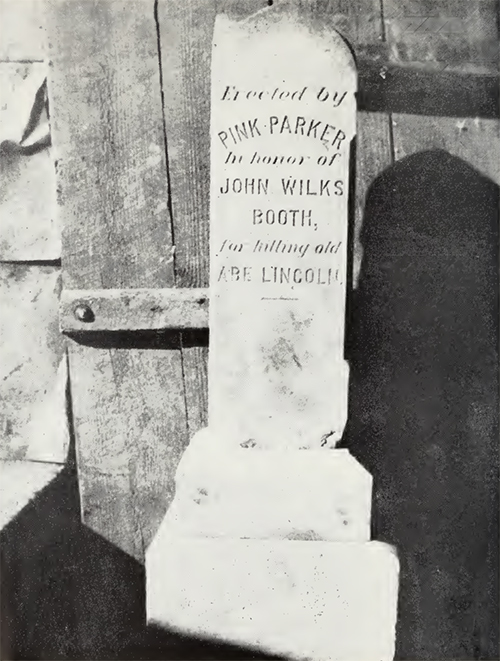
The Monument to Memory of John Wilkes Booth erected by "Pink" Parker..

Booth got his own monument, erected in 1906 by a Confederate veteran in Troy, Alabama. The 3-foot stone read, "Erected by Pink Parker in honor of John Wilks Booth [sic] for killing Old Abe Lincoln." Denied his request to place the monument in front of the local courthouse, Parker instead placed it in his own yard. It was refashioned into his headstone when he died 15 years later.

The picture of a Union preserved but never truly united

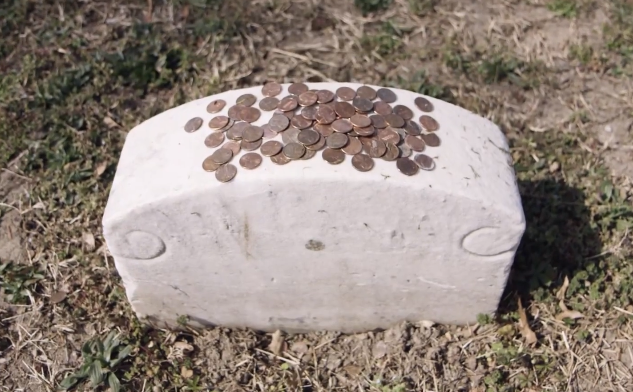
That may seem anomalous, a trivial historical curiosity. Yet even today, if you visit Booth’s grave in Maryland, you’ll recognize Americans declaring their allegiance. In a corner of the family plot a white footstone rises from the ground. Because it’s unmarked, visitors often assume it’s John Wilkes Booth’s final resting place. On a recent visit, it was covered with pennies, dozens of tiny Abraham Lincoln portraits resting in the sun. They even perched in the family stele, tucked into the center of the double "o" in "Booth." And until recently, if you visited the site of Booth’s death, leaving the highway and traipsing into the overgrown median, you’d find his picture waiting in the woods above a wreath and a black ribbon. There were benches, and in the ground a plaque reading, "Let your peace fall upon the soul of John Wilkes Booth. The Twenty-First Century Confederate Legion." On the plaque lay pennies, placed face down. The picture of a Union preserved but never truly united.

This unfinished past haunts Joanne Hulme; she says the Booth family saga has given her 50 years of angst. She lives in a comfortable artist’s apartment in Philadelphia, where she carries on her mother’s work to prove that John Wilkes is buried in the family plot. She doesn’t want to pass such responsibility on to the next generation. For her, the question is not about correcting history, but setting right the story of her family. "I try to let my siblings know — don’t be like these historians," she says, "Don’t let John Wilkes Booth be the person who has wrecked the legacy of many generations."

Asked whether this recent setback has brought his quest to an end, Nate Orlowek responds, "At every step of the way I felt like the story, had, so to speak, ended, because my goal always was to just do the best I could. The only people who lose are the ones who don’t try." He’s appealing to the public, hoping to put pressure on the National Museum of Health and Medicine. He wants other people to take up the fight. And maybe there are other options: the Mütter Museum’s tissue sample, maybe, or some as-yet-undiscovered non-destructive test. Don’t give up, he says: "In the end we can all win, if we get the truth."

And there’s still that mummy, poor old David E. George. Maybe if it could be found, its DNA could match Edwin Booth’s. But only a few people — maybe no one, actually — knows where the mummy currently rests. After touring the country for decades, it disappeared in the mid-1970s, last seen in Pennsylvania. Rumor has it the mummy belongs to a private collector who’s keeping it a secret, right under Nate Orlowek’s nose. Just another undead piece of American history, ready to rise up again when you least expect it.

31 Jul 20:19

What would Kelly Sue DeConnick do? Sends girls to camp

by JK Parkin
firehose

"She donated her commissions from each sale to the Girls Leadership Institute." www.girlsleadershipinstitute.org

What would Kelly Sue DeConnick do? Sends girls to camp

WeLoveFine.com recently debuted a new Captain Marvel shirt featuring the heroine punching a dinosaur with the slogan “WWCMD?” — What Would Captain Marvel Do? — beneath it. But maybe it should have read, “WWKSDD?” Captain Marvel and Pretty Deadly writer Kelly Sue DeConnick began curating a T-shirt collection at WeLoveFine.com a few months ago, bringing [...]
31 Jul 20:11

A Chinese woman accused of painting Washington, D.C. monuments green isn’t just another tourist behaving badly

by Lily Kuo
Green's not Lincoln's color.

A 58-year-old Chinese woman traveling on an expired tourist visa has been charged with splashing green paint on a cathedral in Washington, D.C. and linked to the vandalism of other national sites in America’s capitol. The woman, Tian Jiamei, is the latest embarrassment for Beijing, which has been trying to rein in the behavior of millions of Chinese nationals who travel abroad every year.

As we’ve reported, Chinese tourists behaving badly has become all too common. There were the parents who let their children urinate in the middle of restaurants, others who ignored attire rules for entering Buddhist temples in Thailand, and those who left their mark for causing general pandemonium in Singapore. In May, a 15-year-old from Nanjing etched “Ding Jinhao was here” on an ancient Egyptian temple along the Nile.

But Tian’s case is different. If the allegations are true, she appears to have been deliberately and somewhat systematically defacing landmarks rather than acting inappropriately because of a culture gap. On Friday, July 26, green paint had been found splattered on the Lincoln Memorial. When Tian was arrested the following Monday inside the Washington National Cathedral, she was holding a can of green paint. A pipe organ inside the church was covered in the paint, as well as urine and feces, police said. Prosecutors said another monument in downtown Washington was found to have green paint on it as well; a witness said she had seen Tian attend church in the area. Symbols in green paint were also found on the Smithsonian museum in the National Mall.

In China, news of Tian’s case—she is currently in jail in Washington, awaiting trial—has spread across online news sites and forums. On Sina Weibo, bloggers have posted over 800 comments about Tian. Several bloggers questioned whether something darker motivated Tian. One wrote, “Yes, Tian’s actions were wrong and she should take responsibility for her behavior, but what’s behind the action? Had she suffered some injustice before?”

It’s a good question. Municipal police and other authorities have been making headlines in China for handling lawbreakers too harshly—in one case police beat a watermelon vendor to death. Just last week, a man in a wheelchair set off a bomb in Beijing’s airport, in protest of a beating by police that left him paralyzed years ago. (He had been running an unlicensed motorcycle taxi service.) The cynicism of other comments about Tian also seem to reflect a bitterness about the state of justice in China now. One blogger wrote, “She really didn’t want to come back and this was her way out.” To which another said, “Staying in jail is still better than returning home.”

Referring to the heavy police presence in Tiananmen Square in Beijing the site of democracy demonstrations in 1989, one blogger said, “She couldn’t vandalize in Tiananmen so she had to go to the US.” If convicted, Tian faces up to 10 years in prison and a fine of $5,000.


31 Jul 20:09

Film: Tolerability Index: This week we're barely putting up with 2 Guns

by Amelie Gillette
firehose

Mangria

31 Jul 20:09

Film: Newswire: Several people from TV shows you like are joining Haley Joel Osment's Sex Ed

by Mike Vago
firehose

he grew up but his face didn't
naturally uncanny valley

Three years ago, we reported that Haley Joel Osment was taking on his first big-screen role as an adult in Sex Ed, a film that would find him teaching middle schoolers about sex, despite being a virgin himself. (Apparently, "I see dead people" isn't a great pick-up line) Unfortunately for Osment, the movie has had a strict abstinence-only policy since, as the actor waited and waited to finally consummate his relationship with the camera.

But now it appears he's finally a step closer to opening night, as the movie has added Lamorne Morris (New Girl), Retta (Parks and Recreation) and Matt Walsh (Veep) to its supporting cast. Back in 2010, Osment's character was going to meet "an unlikely mentor in a blues bar, a ruthless enemy in the local PTA, and a gorgeous Polish girl for whom English is a second language." We can only assume Morris ...

Read more
31 Jul 20:08

Government Study Finds TSA Misconduct Up 26% In 3 Years

by Soulskill
firehose

I have to fly again tomorrow

rullywowr writes "CNN reports that a recent government study found TSA misconduct has risen sharply in three years. Most have heard of the problems such as stealing, but the report also notes that some employees are sleeping on the job, taking bribes, and letting friends/family through the checkpoints without screening."

Share on Google+

Read more of this story at Slashdot.


31 Jul 20:07

A Year of Linux Desktop At Westcliff High School

by Unknown Lamer
firehose

'Windows XP is a victim of its own success. It works fairly well from a user point of view, it's been around practically forever, and people don't like change, even some students'

jrepin writes "Around a year ago, a school in the southeast of England, Westcliff High School for Girls Academy (WHSG), began switching its student-facing computers to Linux, with KDE providing the desktop software. The school's Network Manager, Malcolm Moore, contacted us at the time. Now, a year on, he got in touch again to let us know how he and the students find life in a world without Windows." And they didn't even meet much resistance: "Younger students accept it as normal. Older students can be a little less flexible. There are still a few that are of the view that I can get rid of Microsoft Word when I can pry it from them. Staff are the same (although it is surprisingly not age-related). Some are OK and some hate it. Having said that, an equal number hate Windows 7 and nobody liked Windows 8. I think the basic problem is that Windows XP is a victim of its own success. It works fairly well from a user point of view, it's been around practically forever, and people don't like change, even some students, oddly."

Share on Google+

Read more of this story at Slashdot.


31 Jul 20:05

Burger Week: Pause's $5 Smoked Cheddar Burger

by Chris Onstad
firehose

Onstad + burgers + MWIP = TAL

This announcement is part of our 2013 Burger Week (Aug 5-11), where we team with local restaurants and vendors to bring you $5 gourmet hamburgers!

Pause Kitchen and Bar has been a personal favorite for years. I chose it for my first date with my girlfriend, after a lengthy and soul-searching conversation about the best cheeseburger in town. A friend announced his engagement over dinner there. My first child was born there.* The point is, Pause hand-crafts some seriously solid food, and now that their legendary cheeseburger is only $5, it's time you discovered this neighborhood gem.

The crew at Pause doesn't tout how much of their menu is made from scratch on site, though by all rights they should. Whole sub-primals of beef are ground in-house for their monolithic patties. They cure their own pastrami, grow their own vegetables, and pickle their pickles. Tender, finely-textured sausages are seasoned and stuffed in-house, and they smoke a variety of meats in owner Mike Raleigh's custom-built smoker, which is made from a converted antique refrigerator.

Pause’s Burger Week creation is: A thick, charred, medium-rare 1/2-lb house-ground Painted Hills chuck patty, house-smoked Tillamook cheddar, homegrown roasted jalapeño aïoli, house pickles, lettuce, and a Portland French Bakery bun. They cold-smoke the cheddar in house, and it infuses the meat with an irresistibly primal BBQ quality. The jalapeño aïoli is mild, and showcases the flavors of the pepper over its spice. That's all they were willing to do to gussy up their meticulously-prepared beef, and I admire them for it. Order it with their house-cut fries and a draft pint or cocktail, sit outside on their spacious and sunny patio, and get to know one of Portland's most finely-tuned comfort items.

* This is not true, though children are welcome once they have been wiped off and named.

Pause Kitchen and Bar
5101 N Interstate Ave
Mon-Sat 11:30 am - 1 am, Sun 12 pm - 12 am

Portland Mercury Burger Week on Facebook

[ Subscribe to the comments on this story ]

31 Jul 20:03

Cops: NBA Player Stomped on Homeless Man's Leg After Yelling "Wake Up"

by Denis C. Theriault
firehose

meanwhile, in Portland

The Portland Police Bureau just put out a disturbing press release about a local boy seemingly done good: Terrence Jones, a Jefferson High alum playing for the NBA's Houston Rockets, has been charged with harassment after a sergeant reported seeing him stomping on a sleeping homeless man's leg in Old Town early this morning.

Jones, 21, was just written up favorably in the Oregonian, in a story that praised his athletic development. The alleged stomping happened near Tube. When revelers aren't coursing around Old Town's nightclub district, the neighborhood's doorways are a mostly quiet place for dozens of men and women to bunk down for the night.

Dirk VanderHart points out that Jones has not tweeted about his arrest yet.

Here's the release from the cops.

On Wednesday July 31, 2013, at 2:04 a.m., Central Precinct officers arrested 21-year-old Terrence Alexander Jones in Old Town after Jones was seen stomping on a sleeping homeless man's leg. After the arrest, officers learned that Jones is currently on the roster of the Houston Rockets NBA team.

A sergeant patrolling the area saw a large group of people exit the Tube nightclub, located at 18 Northwest 3rd Avenue, and spill out into the street and sidewalk. An officer patrolling the area used a PA system to tell the crowd to get out of the street and get back onto the sidewalk. The sergeant pulled around the block to assist in case there was any further crowd issue.

While watching the group walk away from the bar, the sergeant observed a man, later identified as Terrence Jones, walk by a doorway where two homeless men were sleeping. Jones yelled, "Wake up," then raised his leg and stomped down on one of the men's legs. The men were sleeping in the doorway of 114 Northwest 3rd Avenue.

Officers contacted Jones among the group of approximately eight people about a half a block away and took him into custody.

The victim, 46-year-old Daniel John Kellerher, received a minor leg injury and did not require immediate medical attention.

Jones was transported to Central Precinct then to the Multnomah County Jail on a charge of Harassment.

[ Subscribe to the comments on this story ]

31 Jul 19:59

British Police Recover $1.84 Million Violin Stolen After Two Year Search...

firehose

via Russian Sledges


There are only 400 violins like it in the world, and after about two years of seperation, one of these Stradivarian wonders has finally made it home. More from Billboard:

British police say they have recovered a £1.2 million ($1.84 million) antique violin that was stolen from an acclaimed musician in 2010 when she stopped for a snack in London.

South Korean violinist Min-Jin Kym was eating inside a sandwich shop in November 2010 when she noticed that her black violin case containing the 300-year-old Stradivarius was missing.

Police said the violin was found with minimal damage and its two corresponding, £67,000. bows. Two people have been arrested for the crime.


Read and comment. From thedailyswarm.com.
31 Jul 19:52

Why it’s so difficult to figure out what Larry Summers is thinking

by Zachary M. Seward
firehose

this fucking guy

"it will be downright maddening if Summers is appointed to a position for which the chief task is sometimes described as saying as little as possible in as many words.

Which, come to think of it, might be his best qualification for the role."

this fucking job

Larry Summers on CBS's "Face the Nation"

Trying to figure out what Larry Summers thinks can be like measuring the location of an electron. As soon as you observe it, the opinion scurries away to another spot. The man can’t easily be pinned down.

Call it the Summers Uncertainty Principle. His inscrutability is now complicating the task of journalists and investors trying to discern Summers’s view on monetary policy, now that he’s the leading candidate to be the next chairman of the US Federal Reserve. It’s not that his views aren’t known, but the way he puts them is often intentionally obfuscating.

I have followed Summers and taken an interest in his rhetorical quirks for the past nine years, dating back to his now-infamous speech musing about why so few women become science professors at elite universities. Those unscripted remarks were hedged every which way, though it didn’t much temper the reaction, which was mostly critical.

In speeches and informal talks over the last few years, Summers has developed a new kind of disclaimer before commenting on controversial subjects. He often prefaces his remarks by saying something along the lines of, “If, at the end of this, you feel like you’ve understood me completely, then you have misunderstood me.” It’s a riff on what Alan Greenspan, who served as Fed chair for more than 18 years, famously told Congress in 1987.

The effect, or at least the intent, is to inoculate his comments from the pitfalls of certainty. A statement can be contentious, but an equivocation is harder to assail. And it steels the listener for a loquacious loop-the-loop.

“Summers Hedges Doubts on Bond Buys,” reads the headline on the cover of today’s Wall Street Journal (paywall). Of course he does. The article seems informed by Summers himself or his advocates, who want to make it clear that he wouldn’t make a hasty exit from the quantitative easing policies pursued by the current Fed chair, Ben Bernanke, however skeptical he may be of them.

It’s hardly surprising that Summers wouldn’t immediately reverse course, jolting markets that have come to depend on easy money. Whether that tells us anything about what kind of monetary policy Summers would pursue is less clear, but that’s not the point. He’s shifting the position slightly, like a subatomic particle, as to suggest that measuring it is futile.

A new piece from Politico, which also reads like it was informed by Summers’s closest allies, argues that while the specifics of his views on quantitative easing may be unknown to us, president Obama “knows exactly where Summers stands on monetary policy.” Perhaps, but that would be a departure for Summers, whose associates say can be just as circumspect about his views in private as in public.

That rhetorical style stands in contrast to the conventional view of Summers as a brilliant, if arrogant, academic with unwavering views. What’s in his head, I wouldn’t dare to guess, but what comes out of his mouth is actually quite far from absolutism. And that’s probably informed by his long history of lighting fires with his words.

It’s not as though Summers is a blank slate. His broad views on a variety of economic and fiscal issues are well known, many of them documented in columns he wrote for the Financial Times. What gets confused are the subtle nuances of Summers’s positions—because, of course, nuance is where controversy is generated.

All of that makes it extremely difficult to discern Summers’s views on the direction that the Fed should take to shore up the US economy. But if you think it’s tough now, it will be downright maddening if Summers is appointed to a position for which the chief task is sometimes described as saying as little as possible in as many words.

Which, come to think of it, might be his best qualification for the role.


31 Jul 19:51

#villains

by hodad
firehose

celebrating the magic of R2K

31 Jul 19:46

Photo

firehose

via Rosalind


31 Jul 19:45

You Were Staring at the Booby, Weren't You?

firehose

via Rosalind

31 Jul 19:45

A Jump for the Ages

firehose

via Rosalind

A Jump for the Ages

Submitted by: Unknown (via Gifak)

Tagged: epic , jump , turtle , funny