
firehose
Shared posts
21 Oct 21:36
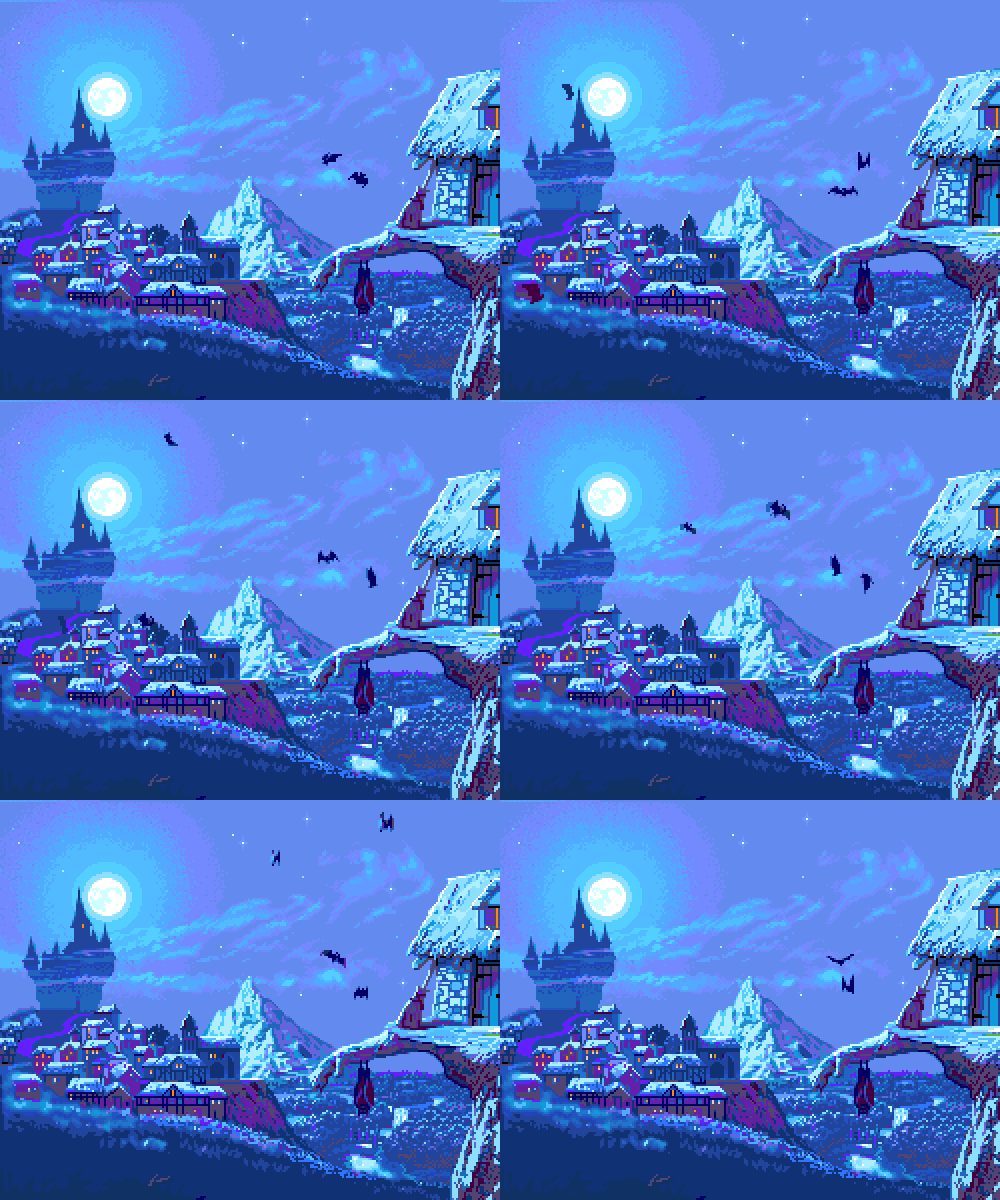
Super Cauldron (Titus - Amiga - 1993)
Super Cauldron (Titus - Amiga - 1993)
Russian Sledges, firehose likes this
21 Oct 21:36
It's Better That You Don't Remember Coby Because It Just Went Under
You know those gadgets that you can buy at drugstores? Back in the early 2000s it was all portable CD players and PC speakers. Now it's MP3 players with 2GB of storage and wimpy tablets. And if you've ever done last minute Christmas shopping at a Walgreens you know that the brands start to become recognizable for their no-name-ness. Coby was a staple in that lineup until recently. Now a titan of cheap, sometimes questionable electronics has fallen.
firehose likes this
21 Oct 21:35
Future of Storytelling Course | Education. Online. Free. | iversity
by gguillotte
Are you interested in the mechanics of current fiction formats? Do you want to know how stories are told? Do you want to analyze, understand, contextualize and create stories and narratives? Then join our MOOC and share our passion for storytelling!
21 Oct 19:53


Australia’s climate-change denying prime minister gets burned by apocalyptic bush fires
by Todd Woody
As Australia’s worst bush fires in a half-century threaten to merge into a mega-fire and march on Sydney, new conservative prime minister Tony Abbott’s plans to scrap the country’s carbon tax face growing opposition.
Abbott, leader of the Liberal-National coalition that controls Australia’s house of representatives, is a climate change denier-turned-skeptic who made overturning the previous Labor government’s carbon market a top campaign promise. But the conflagrations raging across New South Wales, Australia’s most populous state, have made concrete the reality of climate change in the world’s driest inhabited continent.

While scientists are loath to link specific events to climate change, they have long warned that rising temperatures—2013 is set to be the hottest year on record in Australia—will lead to more frequent devastating bush fires in a country where fire is a natural part of the landscape. As firefighters struggle to prevent the spreading fires west of Sydney from coalescing into a super firestorm, officials were warning the city’s 4.5 million people that the heavy smoke blanketing the city could pose a deadly health threat. Fears are growing that if the three main fires burning west of Sydney merge, they could move toward the city’s heavily populated western suburbs.
“It’s not about the day or the day before the bush fire,” climate change scientist Andrew Pitman told Australia’s ABC News on Monday. “It’s about the three or four months of winter that were enormously warm in part due to global warming leading to an environment particularly conducive to fire.”
The bush fires have given new ammunition to opponents of Abbott’s plan to ditch Australia’s carbon tax, which was set to be replaced by a carbon trading market next July. The opposition Australian Labor Party has promised to fight the plan. The Australian Greens, which currently control the balance of power in the Australian senate, meanwhile have stepped up their social media campaign against Abbott in the wake of the bush fires.
Why Tony Abbott’s plan means more bushfires for Australia & more pics like this of Sydney http://t.co/bXFaAT6kLf http://t.co/tJyljLIGp4
— Adam Bandt (@AdamBandt) October 17, 2013
“It’s October and we’re having a tragic bush fire, and meanwhile, Tony Abbott and his ministers have been out every day this week saying that they’re going to take Australia backwards when it comes to combating global warming,” Adam Bandt, the deputy leader of the Greens, told ABC News.
21 Oct 19:45
Pedometer++, An iPhone 5s App For Tracking Your Daily Steps
by Kimber Streams


Pedometer++ is an app for iOS that uses the new M7 motion co-processor in the iPhone 5s to dynamically track users’ steps in a day or week. The app is currently available to download for free from the iTunes App Store.
images via Pedometer++
21 Oct 19:44
#sprots (JPEG Image, 626 × 472 pixels)
by OnlyMrGodKnowsWhy

firehose and -1 others like this
21 Oct 19:44


Help crowdfund an anthology of fictional Kickstarter campaigns!
by Charlie Jane Anders
There's something inherently a bit weird about Kickstarter campaigns, where someone puts a very personal goal on the Internet and hopes to make a polished enough pitch to get your money. So a brand new anthology project, of science-fictional Kickstarter campaigns, is just taking that strangeness to its logical extreme.
    
|
21 Oct 19:44
libawr: kailaetc: Dr. Neil deGrasse Tyson has an important...

Leonardo Moulin Franco, Adam Victor Brandizzi likes this

21 Oct 19:04
Birthday Traditions


60+ Family Tradition Ideas
by Brett & Kate McKay
firehosethe only tradition is family game night
all others are bullshit
seriously, baseball? gtfo
Last week we published an article that discussed why and how to establish family traditions. Traditions offer numerous benefits: they strengthen your family’s bonds, enrich the life you share together, contribute to your children’s well-being, and create lasting memories. For this reason, they form one of the three pillars of family culture.
Today we offer a list of over 60 specific family tradition ideas. You can incorporate some of these directly into your family, or use them as inspiration for creating your own traditions.
Before we get started, let’s cover a few things that will help ensure that your establishment of new traditions will be met with success:
- While it’s tempting to go crazy with starting lots of traditions, shoot for quality over quantity. If you do a couple from within each category, you’re gold.
- Choose traditions that most resonate with you. Having said that, as you review the list, try not to immediately write off some as silly or not elaborate enough. This isn’t only about what appeals to you as a jaded adult, but what will appeal to your kids. If you think back to your childhood, some surprisingly silly and simple stuff was a lot of fun and created great memories.
- Traditions need to be practiced regularly to be effective. It’s easy to throw a tradition out the window when life gets busy and you’ve had a long day. Commit to the tradition and do your best to be as consistent as possible with it.
The ideas below come from The Book of New Family Traditions, from mine and Kate’s respective families, from our friends’ families, and from those we’ve come up with for our own family.
Daily Connection Traditions
Daily Connection Traditions are the small things you do every day to reinforce family identity and values. Without thought and intentionality, your family’s daily “traditions” can devolve into everyone surfing the internet on their own devices. So be sure to incorporate some rituals that bring you together face-to-face and allow you to re-connect each day.
Secret Handshake. Secret handshakes have been used by groups for millennia to distinguish members and non-members. Make one up for your own family. It can be elaborate and complex or simple but meaningful. An example of the latter comes from a family profiled in The Book of New Family Traditions. This family had the tradition of squeezing each others’ hands three times to signal the three words “I love you.” On the day the daughter got married, the father squeezed her hand three times as he walked her down the aisle. “Only she knew that this was happening, a tiny personal ritual lodged invisibly within one of the grandest and most public, and she says it was one of the most moving moments of her life.”
Family Meal. Countless studies have shown the positive influence that sharing a meal together as a family (it doesn’t have to be dinner) has on children. We’ll be dedicating an entire post to how to get the most out of family meals, but in the meantime, consider these suggestions to turn the breaking of bread into a cherished tradition:
- First: no TV, no cellphones, and no tablets.
- Begin with grace. If you’re not religious, have everyone share something that they’re grateful for that day.
- Family news: everyone takes turns sharing something positive and negative that has happened to them during the day.
- “Got any stories?” This is a tradition that Kate and I have had for a few years. Each person is expected to bring something interesting to the table that they’ve read or heard during the day.
Family Prayer. For religious families, prayer is an important ritual. Family prayer doesn’t have to be just a dinnertime thing. You can pray as a family before everyone leaves in the morning, before everyone goes to bed, or both. Our family has prayers at night. Everyone takes turns saying the prayer, including Gus.
Family Singing Time. There’s something about singing that unites humans on a primal level. What’s more, through song, you can pass on your values and cultural heritage to your children. Our family always sings a song or two when we put Gus to bed. It’s something we’ve done since he was an infant, and you can tell it makes him feel comforted, loved (we often sing songs about being a family), and relaxed. It’s been cool to watch him slowly learn the words and start singing along with us.
I really hope that Gus or Scout is interested in taking piano lessons, as I have a very fond dream of one day standing around the piano singing Christmas carols together.
The “What We Learned Today” Journal. “Buy a fancy, leather-bound journal. Each night before bed, every member of the family needs to write something they learned during the day. Parents can transcribe for little children. Entries don’t have to be long or profound. It can be as simple as, “If you touch a turtle, he puts his head back in his shell.” This is a great way to foster a love of lifelong learning in your children.
Surprise Daily Drawing/Note. There’s a guy here in Tulsa who drew little comics or wrote inspiring quotes on the napkins he put in his daughters’ school lunches. Napkin Dad was born. I want to do something like this when my kiddos start school.
Family Hugs. Kate and I try to get in one family hug a day. Afterwards, we usually put in our hands and say, “Three, two, one,” before lifting them up and shouting “McKays!” Yeah, it’s kind of cheesy, but Gus loves it, and the idea is to really drive home our family identity.
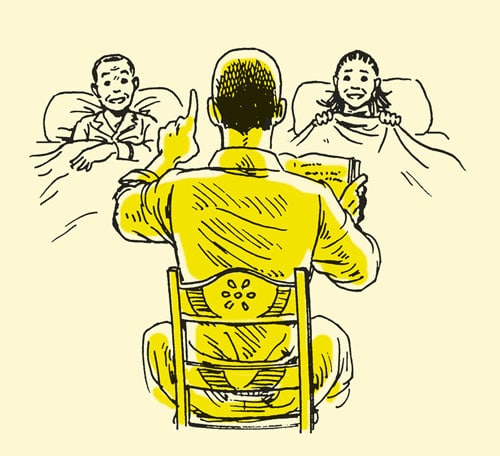
Bedtime Story. Children who have parents that read to them regularly typically do better in school and have larger vocabularies than children who don’t. Reading with your child will not only make them smarter, but it’s a great way to bond. There’s something really comforting about hearing your dad read aloud to you. For inspiration, check out this dad and daughter who read together every night for 3,128 days straight until the daughter was in college.
Evening Walks. Not only can walking help solve problems, but it can also strengthen families. Evening walks are a great time to get some fresh air and digest the day’s events along with your dinner.
Family Call-and-Response Motto. When they were growing up, brothers Jim and John Harbaugh (the coaches of the NFL’s San Francisco 49ers and the Baltimore Ravens respectively) didn’t have much. But their father always made them feel like they had everything they needed. To reinforce this feeling, he would ask his boys, “Who’s got it better than us?” To which they would respond: “Nooo-body!” Jim now uses the same call and response to build the unity of his football team.
Weekly Connection Traditions
Family Game Night. Analog games, from cribbage to Apples to Apples, are a fun and cheap way to bond and have fun together as a family. Tamp the competition down and ramp the laughter up. I personally can’t wait to play Boggle with Gus and Scout.
Movie Night. Let the kids take turns picking a movie to watch, and do an occasional dad’s choice night as well to introduce your progeny to classics like Back to the Future and Raiders of the Lost Ark while waxing poetic about how movies were just plain better in the 80s. Have fun with the snacks too – come up with dad’s special popcorn recipe or occasionally take the kids to the drugstore and let them each pick out their own candy.
Saturday Football. There’s something incredibly relaxing and comforting about watching college football with your family on a Saturday afternoon in the fall. Pass down your alma mater pride as you cheer on your team together.
Pizza Night. Everyone loves pizza, and it’s nice to be able to look forward to having it on a certain night each week. Skip the delivery now and again and make your own – allowing the kids to decide how to top their own super simple mini pizzas.
Don’t like pizza? How about Taco Tuesday? We love Taco Tuesday around here.
Family Home Evening. Mormons are encouraged to set aside one night per week (usually Monday night) for Family Home Evening. A typical Family Home Evening includes a fun activity and a short lesson or devotional on some virtue or scripture. FHE is usually capped off with a special treat.
The goal of Family Home Evening is to teach your children the principles and values you want them to carry with them as adults, all within an informal and loving atmosphere. FHE can be adapted by families of any religious stripe or even families who aren’t religious. There’s no formula for Family Home Evening. Just corral the kids for 30 minutes one night a week for fun, discussion, and eats.
Family Vinyl Dance Party. AoM contributor Cameron Schaefer shared a fun family tradition in his post on getting started in vinyl record collecting. On Friday nights the Schaefer family gathers in their family room for a Vinyl Record Dance Party. A family member selects a soundtrack for the night, and they all dance until they collapse on the floor.
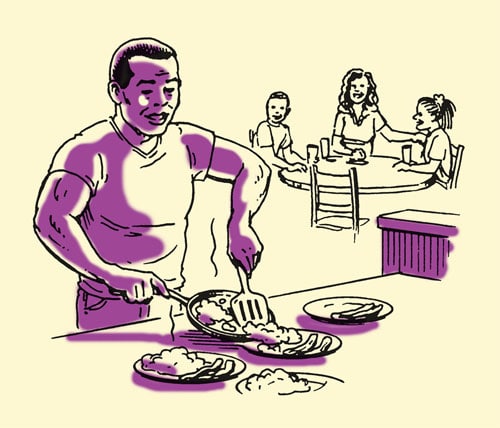
Special Saturday/Sunday Morning Breakfast. Lots of families have special Saturday/Sunday morning breakfast traditions. For some it’s pancakes or cinnamon rolls, for others it’s a giant breakfast casserole. Dads and breakfasts just go together, so work on coming up with your own specialty.
Breakfast need not be a solely in-home tradition, however. I take Gus to Braum’s every Saturday morning for breakfast. Pancakes and milk for Gus. Sausage, egg, and cheese biscuit for dad. We’ve been doing this since Gus was about 10 months old, and we’ve rarely missed a Saturday. It’s a hoot to see Gus get all excited about “Breakfast at Braum’s” on Friday night.
Dinner & Grocery Shopping. Every Monday we go as family to a grocery store that also has their own little restaurant. We eat dinner there first and then do our shopping. Doesn’t sound really exciting, but we all look forward to it.
Weekly Family Meeting. Your family is an organization. And like any successful organization, you need to plan, discuss issues, and synchronize schedules. Enter the weekly family meeting. I’ll be dedicating an entire post on how to run a successful family meeting in the future. Stay tuned.
Monthly Connection Traditions
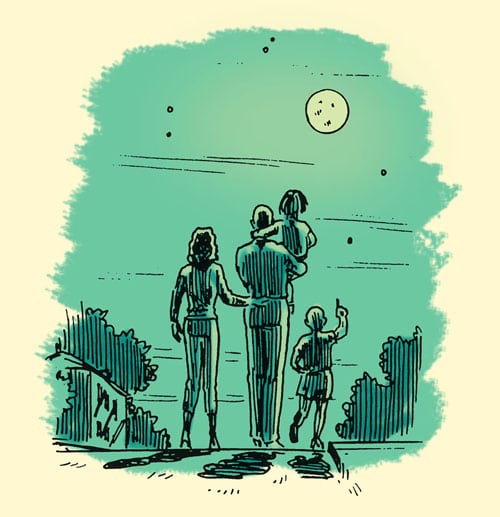
Full Moon Walks. A full moon occurs roughly every 29 days. While you may have gotten used to seeing them, they really are a magical sight – especially for kids who haven’t lost their sense of wonder. Whenever a full moon has risen, take a walk outside at night as a family to have a look at it. Get into the woods sometimes if you can in order to experience the awe of nature at night. This is a great way to get your kids keyed in to the rhythms and cycles of our world.
Box of Goals. An important life skill for your children to develop is how to set and work towards a goal. What better way to teach this than with a family tradition? Get a cigar box or fancy wooden box and on the first day of each month, have your family members write down one goal they want to accomplish that month on a piece of paper and place it in the box. When next month rolls around, take out the pieces of paper and review the goals to see how everyone did. Then write new goals for the next month. Rinse and repeat.
Daddy Date. We have a friend who has three daughters. Ever since they were knee-high to a grasshopper, he took one of them each month on a “Daddy Daughter Date.” Rules were simple. The daughter he spent the evening with got to pick the activity they took part in. He didn’t care what they did. His goal was to give each one of his kids one-on-one time with dad.
The monthly date with dad isn’t just for daughters. You can do something similar with your sons as well.
Family Service Day. If creating a culture of service is part of your family mission statement, put that goal into action with a monthly Family Service Day. Designate one Saturday or Sunday to serving others. It could mean spending a morning at the homeless shelter or cleaning the garden of an elderly neighbor or sorting clothes at Goodwill.
Life Changes/Milestone Traditions
Milestone traditions celebrate events that may occur only a few times, or even just once for your immediate family. But they become traditions as they are passed down from one generation to the next.
New Home Traditions
New Home Dedication. Buying a home is a momentous occasion and thus a great time for instituting a family tradition. Some religious folks hold ceremonies in which they dedicate the home (and all those who dwell in it) to God.
In the Jewish tradition, it’s customary to hold a Chanukat Habayit (home dedication) party. At this gathering, words from the Torah are spoken and family and friends use the occasion to express their blessings and wishes for a fruitful and happy stay in this new home.
New Muslim homeowners will often host a feast in their new house and those that enter are to leave their blessing.
Differing Christian denominations have their own unique new home dedication rituals, but they typically involve a dedicatory prayer and a reading from the Bible. For some ideas on which scriptures to read check out this list. I know many Christian families that will place a plaque near their home’s entryway with the famous verse from Joshua 24:15 (“As for me and my house…”) after a home dedication ceremony.
“It’s a Wonderful Life” Blessing. In the classic holiday movie, It’s a Wonderful Life, George Bailey and his wife, Mary, give a nice housewarming gift/blessing to a family that just moved into a new house:
Mary: Bread… that this house may never know hunger.
[Mary hands a loaf of bread to Mrs. Martini.]
Mary: Salt… that life may always have flavor.
[Mary hands a box of salt to Mrs. Martini.]
George Bailey: And wine… that joy and prosperity may reign forever. Enter the Martini Castle.
[George hands Mr. Martini a bottle of wine.]
You don’t need to know a thoughtful couple like the Baileys to experience this tradition. Just do it yourself when you move into your home. Make some focaccia maybe, and enjoy it with wine for mom and dad and grape juice for the kiddos.
Mortgage Burning Party. This one is for you Dave Ramsey “gazelles” out there. Once you pay off your home mortgage, throw a party with your family and ceremoniously burn your mortgage agreement. Mortgage burning parties were actually once a common tradition in America, but due to changing mores and the increasing mobility of Americans (thus making it less likely a homeowner will live long enough in a home to pay it off), Mortgage Burning Parties are pretty much unheard of today. I think it’s a tradition well-worth resurrecting.
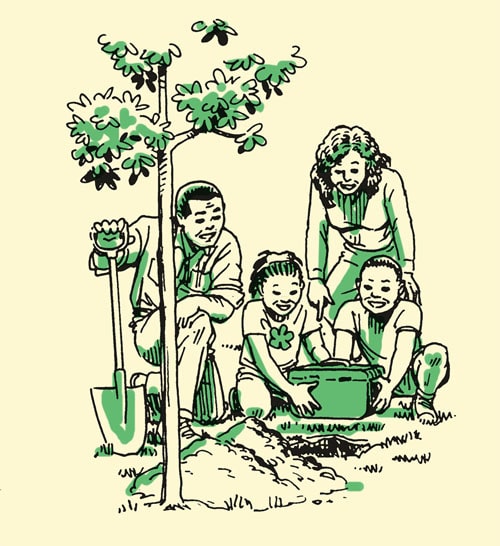
Family Time Capsule. Bury a family time capsule when you move into what you think will be your “forever home.” Fill the capsule with some of your family’s favorites things, notes, and items that represent the time period. Then open in it up in 20 or 30 years. Make sure you exhume it if you end up moving sooner than you thought you would.
School-Related Traditions
First Day of School Photos. On the first day of every school year, take your kiddos to the front of the house and snap a picture of them for posterity. You’ll enjoy looking back at how they’ve grown through the ages. I remember looking forward to this little ceremony as a kid. It was my chance to show off my cool new backpack and Air Force One high-tops.
First Day of School Chalk Pep Talk. Kids can sometimes be a little nervous on the first day of school. Give them a nice surprise by writing messages of encouragement on the driveway with chalk the night before. It will put a smile on their face when they walk out the door the next day.
Parent/Teacher Conference Note. Whenever Kate’s parents came in for parent/teacher conferences, they would leave a note for her in her desk, telling her how neat her desk was, how nice her artwork on the wall was, and a nice thing the teacher had said about her. Kate says she really looked forward to finding the note and that it was cool to think her parents had been there.
College Acceptance Celebration. One family I know would celebrate their kids’ college acceptance letters by buying everyone in the family a t-shirt or sweater with the school’s logo and then having a barbeque with the university’s fight song playing in the background. The mom would then snap a pic of the whole clan dressed in their school colors, frame it, and pack it in their kiddo’s stuff when he or she shipped off to college. Cheesy? A little bit, but I always thought it was a nice gesture.
Wedding Traditions
Night-Before-Wedding Roast. We have another friend whose family always stayed together at a hotel the night before one of the kids got married. They’d hang out and do a good-natured roast of the bride or groom-to-be. They had a big enough immediate family (5 kids) to make this fun. If your family is smaller, invite close extended family to take part too.
Birthday Traditions
Most families have traditions for celebrating birthdays. Cake, presents, dinner at the Cheesecake Factory. You know, the usual. Below are some birthday traditions you may not have thought about.
First Cake Cut Wish. I picked this one up from Kate’s family. In addition to getting a wish for blowing out the candles, the birthday boy or girl gets another wish for making the first cut into the birthday cake. Two wishes, one cake. Can’t beat that.
New Privilege/New Responsibility Cards. Amidst all the fun and hoopla, remind your kid that with age comes greater power and with greater power comes greater responsibility. In addition to birthday presents, present your child with two envelopes. One envelope is labeled, “New Privilege”; the other, “New Responsibility.” Provide an age appropriate privilege and responsibility each year.
8th/ 18th Birthday Time Capsule. On your child’s 8th birthday have him fill a time capsule with some of the things he likes and a note to himself. Open it a decade later on his 18th birthday.
Nose Grease. This birthday tradition comes from our friendly neighbors north of the border. In Canada (particularly the Atlantic Coast providences) it’s common for the birthday boy or girl to get ambushed by friends or family members and have their nose greased with butter for good luck. The buttered nose supposedly makes the person too slippery for bad luck to catch them. This tradition is said to come from Scotland. I think I’m going to have to adopt this one as it hails from my ancestral homeland of Nova Scotia.

The Yearly Measurement on the Door Frame. Many families have a doorframe where they keep rough pencil lines marking off the height of their kiddos as they age. Make it a tradition to take the measurement on birthdays.
Miscellaneous Traditions
Hunting Traditions. Our hunter/gatherer ancestors developed meaningful traditions to celebrate the life-giving hunt. While hunting is no longer essential for survival, many families continue to have traditions that surround their yearly hunt. A few include celebrating the first kill by having the new hunter share his harvest with those in the group, the Hunting Beard, and the after-hunt breakfast or dinner. There are many more. I’d love to hear yours in the comments.
Meteor Watching Party. Once a year or so (use this handy calendar) get everybody up in the pre-dawn hours, dress warmly, drive out to a spot where there’s less light pollution, lie down on a blanket, and pour cups of cider or cocoa from a thermos as you watch for meteors and point out different constellations to your kids.
Welcome to Fall Dinner. Usher in the first day of the indisputably best season of the year by having a harvest-y dinner: turkey, stuffing, apple crisp, and the like. It’s something my mom did in my family growing up and I really enjoyed it.
Baseball Opening Day. While football has overtaken baseball as America’s favorite sport, there’s still something about celebrating America’s pastime by attending a game on opening day that resonates with me. It’s a chance to connect with your kiddos over a sport that’s connected generations of American families.
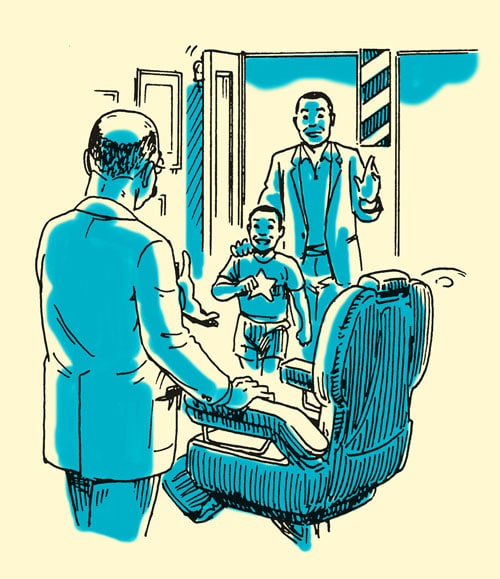
Barbershop Visit with Dad. Every man should frequent the barbershop. So should every little boy. Instill in your strapping little lad the time-honored, manly tradition of visiting the barbershop by making his first visit a big deal. Take pictures of him getting his ears lowered and then take him out for breakfast or lunch afterwards. From then on, get your haircuts together.
Annual Camping Trip. Inspire a love of the great outdoors in your kids by taking them camping at least once a year. If you find a campsite you love, return to it again and again as you build special memories around that place.
Another fun tradition is to pick a day each year that you go backyard “camping” with your kid.
Holiday Traditions
The holidays are the most tradition-rich time of the year. There are a lot of great classic traditions out there from making cookies for Christmas to doing an egg hunt on Easter. Here are some holiday traditions you may not have thought of.
Easter
Easter Basket Scavenger Hunt. Instead of setting out the Easter baskets by their bed or in the living room, have your kids do a fun hunt for them. Leave the first clue by their beds, and have them follow one clue to the next until they find their baskets.
An important note: adding a scavenger hunt to anything turns it into an awesome, memorable tradition. I’m not sure there’s anything more fun as a kid than a scavenger hunt.
Egg Wars. The fun of dyeing Easter eggs doesn’t have to end when you pour out the food coloring. On Easter Day, commence the egg wars. Two people each hold an egg and on the count of three, they hit the end of their eggs together. Whoever’s egg cracks loses; the winner goes on to another battle. You can offer a prize to whoever has the egg that lasts the longest. During the Great Depression, Kate’s grandfather’s family was so poor, that the prize was keeping the other person’s egg.
Halloween
Pumpkinfest. Make the classic tradition of pumpkin carving extra special by finding a nice pumpkin patch that you return to each year, taking a hayride while there, and making a whole pumpkin-themed meal to precede the carving (pumpkin soup, pumpkin bread, pumpkin pie…).
Tombstone Rubbing and Ghost Stories. Tombstone rubbing used to be a popular pastime with folks. It’s still popular among genealogists searching for info about ancestors. Basically, you just get some butcher paper, place it over the face of the tombstone, and then rub charcoal or crayon on it so that the lettering on the tombstone is transferred to the paper.
To make this activity a bit spookier, visit an old cemetery at night and have a contest to see who can get the oldest tombstone rubbing. (Make sure to bring flashlights!) Afterwards, tell ghost stories while sitting in the cemetery. Spoooky!
Candy Swapping Wizard. This is a good one if you’re not crazy about your kids grazing on their trick-o-treat candy for the next 6 months, but want to do something about it that’s more fun than curmudgeonly. Tell your kids to select X number of pieces of candy they get to keep, and then to place the rest of their booty outside the door to their room. During the night, a wizard comes and swaps their candy for a gift.
Jack O’ Lantern Burial. After serving valiantly on Halloween Night, a carved Jack O’Lantern typically experiences an ignoble end by slowly wilting away on the front porch and eventually being tossed in the trash. One family featured in The Book of New Family Traditions didn’t think their Jack O’ Lanterns deserved such an anticlimactic demise. So they decided to give their carved pumpkins a proper burial the day after Halloween. They have a small patch in their backyard that’s designated as the “Pumpkin Graveyard.” The day after Halloween the family brings their respective Jack O’ Lanterns to the graveyard and offer a short eulogy that goes thusly:
“We are gathered here to pay homage to our dearly departed Jack O’ Lanterns. Throughout their short lives our Halloween Pumpkins have brought both us and our Trick-or-Treaters much joy. We now consign them to the earth where they first came. May they rest in peace.”
All of this is done, of course, with tongue firmly placed in cheek.
Says the mother of this family, “The Great Pumpkin would be proud.”
Thanksgiving
Thankful Box. As they hang out before dinner begins, family members are encouraged to take time to anonymously write down a few things they are grateful for on slips of paper, which are then placed in a decorated shoebox. Later on as the family eats dessert, the box is passed around the table and each person draws a slip and reads it aloud until the box is empty. The fun comes both in hearing family members offer heartfelt (and occasionally humorous) thank yous, and in guessing who wrote what.
Turkey Bowl Football Game. For families that have huge extended family gatherings at Thanksgiving, a morning of touch football is a great way to work up an appetite for turkey and pumpkin pie later that day.
Watching the Lions Lose. No Thanksgiving would be complete without the family gathered around the TV to watch the Detroit Lions lose. It would be like Thanksgiving without pumpkin pie or the Macy’s Thanksgiving Day Parade.
Christmas
Out with the Old, In with the New. To teach your kids to live just a bit more simply, to accumulate less stuff, and not to hold onto what they have too tightly, require that for however many gifts they get for Christmas, they have to get rid of the same number of their old toys/clothes. Throw away or donate what they discard.

Glass Wax Stencils. This is a tradition from Kate’s family that we plan to carry into ours. Glass wax is a liquid window cleaner that comes out pinkish and dries with a white frost. By blotting it with a sponge over stencils, you can, as the makers of glass wax used to tout, “turn you window into a winter wonderland!” Stenciling with glass wax used to be popular decades ago, but has almost entirely disappeared, making both the stencils and the wax hard to find. Look for the stencils on ebay and the glass wax at the Vermont Country Store.
Pickle on the Christmas Tree. Legend has it that during the Civil War, Private John C. Lower was being held at a prison camp and was given a pickle on Christmas Eve by one of the guards. Starving, he believed the pickle helped save his life, and after the war he began a tradition of hiding a pickle on the Christmas tree on Christmas Eve for his family to find the next morning. Other origin stories for this 19th century American tradition are floated as well. Nowadays, a pickle ornament is hung on the tree on Christmas Eve and whoever finds the pickle first the next morning gets an extra gift or is promised a year of good fortune.
Countdown to Christmas with Books. There are a lot of fun ways to count down to Christmas with your kids, from making a paper chain to opening the doors of an advent calendar. Here’s a new one I picked up from The Book of New Family Traditions: wrap 24 books about Christmas, and open and read one each night during December. On the 24th, the book that is opened is The Night Before Christmas.
Run a Marathon Before Opening Presents. The parents of a family we know who are very ambitious, gung-ho about life, and love physical challenges would make their kids run a marathon before they got to open presents. Not individually, mind you! The 26 miles was split between the parents and their 4 kids, depending on age and ability. Quite a way to teach delayed gratification.
New Year’s Eve
Rent a Hotel Room. Staying at a hotel is terribly exciting when you’re a kid. Rent a room on New Year’s Eve, bring board games and snacks, let the kids swim, and have a family slumber party to ring in the new year.
Banging on Pots and Pans at Midnight. The tradition of noisemakers at midnight originates from the belief that it would scare away bad luck and evil spirits. Let your kids run down the streets banging on pots and pans when the clock strikes twelve.
Eating Chinese. I’m not sure why we associate New Year’s Eve with Chinese food, since the Chinese New Year is on a different date, but Kate and I have started a tradition of going out for Chinese food on December 31. Just seems lucky somehow.
If you’re feeling more ambitious, try your hand at making our own fortune cookies and creating personalized fortunes for your family.
Putting Regrets to the Fire. Have each family member write down and then share one of their regrets from the past year. Then throw the regrets into the fireplace to symbolize a fresh start.
Despite the size of this list, there are tons of other great traditions out there – we didn’t even mention all the specific religious/ethnic/cultural traditions that exist! Tradition ideas are limited only by your creativity. Please share your family’s traditions in the comments!
Illustrations by Ted Slampyak
Related posts:
- Creating a Positive Family Culture: The Importance of Establishing Family Traditions
- Balancing Work and Family
- Merry Christmas 2009 from the Art of Manliness
- 10 Holiday Date Ideas
- Fathering With Intentionality: The Importance of Creating a Family Culture
|
|
kevin.k.woo, Tehsaint and 4 others like this
21 Oct 17:54


Watch Gotham play Metropolis in the Batman vs. Superman football game
by Meredith Woerner
Watch Gotham City University take Metropolis State University on the Batman Vs. Superman movie set. Is it weird (or awesome) that this is the second fake town superhero football team we've seen?
|
|
firehose likes this
21 Oct 17:23

Top US credit bureau reportedly sold social security numbers to Vietnamese scammer
by Jacob Kastrenakes
firehoseall credit bureaus suck forever
One of the top US credit bureaus was scammed into selling social security numbers to a Vietnamese hacker for months, according to a report from Krebs on Security. Experian — one of the three national US credit bureaus — reportedly sold SSNs through its subsidiary, Court Ventures, to Hieu Minh Ngo, who allegedly operated an identity theft service called SuperGet.info. The site also sold drivers license, bank account, and credit card numbers along with other personal data, though it's not clear how much of it came from Experian. Ngo has since been indicted in New Hampshire following his entry into the US.
The alleged fraudster posed as a private investigator
Though Experian holds highly personal information so that it can issue credit reports, it may at times sell that information to other ostensibly discreet parties that offer services such as fraud prevention. By posing as a US-based private investigator in need of such information, Ngo was able to gain access to Experian's data through Court Ventures, reports Krebs. But while Court Ventures only discovered the mishap after it was alerted by the US Secret Service, Krebs writes that the company didn't catch odd inconsistencies with Ngo's story, such as his monthly payments coming through wire transfers from Singapore.
In a statement to Krebs, Experian acknowledges the general details of the report, including that Court Ventures was selling data to Ngo, who appeared to be engaged in illegal activities. Though Experian says that its credit files weren't accessed, it doesn't clarify exactly what information was exposed. While Krebs writes that it's still unclear if Experian will see any repercussions for its role or potential negligence, it also reports that similar cases have brought about lawsuits from the FTC.
- Image Credit Social Security cards from Shutterstock
- Related Items social security fraud experian court ventures security identity theft credit bureau
firehose likes this
21 Oct 17:22
Verizon glitch appears to have exposed texting data from any number
by Russell Brandom
firehoseall carriers suck forever
A rudimentary URL hack may have exposed texting data for tens of millions of Verizon customers, according to a new report from security researcher Prvsec. The vulnerability was reportedly fixed in September, a month after Prvsec privately disclosed it to the carrier, but before it was addressed it allowed Verizon subscribers to pull metadata on the recent texts of any other number on the Verizon network. Verizon did not respond to a request for comment.
The hack centers on the Verizon website's "download to spreadsheet" function, which allows subscribers to download a CSV file of the time, date, and recipient of their recent texts. Unfortunately, the URL for that download contained the subscriber's phone number, and simply changing the phone number in the URL would let a user download that number's spreadsheet. As recently as August, there were no safeguards to ensure that the person downloading the spreadsheet owned that number, potentially exposing tens of millions of Verizon customers' contact lists and texting habits.
Speaking to The Verge, Prvsec's Cody Collier emphasized that he had disclosed the vulnerability responsibly, making sure it did not become public before the carrier had a chance to fix it. "I'm a Verizon customer myself," Collier says, "so I wouldn't want my own data exposed this way." At the same time, the story leaves lingering concerns over Verizon's security practices. the post complains of a lengthy and intricate process simply to contact the security team, and months going by with no updates as to the status of the bug. Collier says Verizon still hasn't reached out with a reward for reporting the vulnerability but, in a reference to Yahoo's famously stingy vulnerability payouts, he "can't wait to receive my free t-shirt."
firehose likes this
21 Oct 17:18
The Dark Mod 2.0 Standalone: Id Tech 4 GPL Yields a Free Thief-a-Like Game
by Unknown Lamer
firehose"the art assets are all CC BY-NC-SA 3.0 Unported which means it, unfortunately, cannot be distributed by even Debian"
lol debian
An anonymous reader writes "After nine years of development, The Dark Mod is now a standalone game. Thief fans can now enjoy over 60 fan made missions which capture the essence of the Thief 1 / 2 games. Originally created as a reaction to Thief 3; with the upcoming release of Thief 4, many are comparing what was done here (a faithful extension of the old gameplay) to what Eidos has shown thus far. Can a little Doom 3 mod compete against a blockbuster AAA title? Should we even compare them?" All code in the The Dark Mod is GPLv3+, and the art assets are all CC BY-NC-SA 3.0 Unported which means it, unfortunately, cannot be distributed by even Debian. Still, an impressive feat! 


Read more of this story at Slashdot.
Ronald.phillips and -1 others like this
21 Oct 17:18
BT To Test Huawei 1Gbps Broadband Over Copper
by Unknown Lamer
firehosegonna laugh so hard if copper DSL laps copper cable
judgecorp writes "BT is testing a different fiber broadband topology FTTdp (Fiber to the distribution point) and G.FAST, which could give 1Gbps broadband speeds at its research site Adastral Park in Britain. FTTdp pushes the network fiber closer to the user's premises than FTTC (Fiber to the Cabinet). In many cases this is less than 250m, a distance at which it's possible to get 1Gbps over the copper phone network using G.FAST, a new variation of VDSL broadband ." 


Read more of this story at Slashdot.
21 Oct 17:15

Patagonia Common Threads Worn Wear Program
by Elizabeth Mollo
Just in time for the temperatures to start dropping, Patagonia recently announced its Worn Wear program where customers can bring in their used Patagonia clothing for store credit, as well as buy used Patagonia clothing. Portland is only one of four locations in the U.S. to offer this program, with Seattle, Palo Alto, and Chicago being the others. Items accepted for trade-in include Patagonia shells, fleece, down and synthetic insulation, and ski and alpine pants. Clothing must be clean and in good condition and customers can earn trade-in credit valued at 50 percent of the price of the item, which will then be sold through the store’s Common Threads Worn Wear™ section. Credit can be redeemed for purchases in store or online. Patagonia has always been at the forefront of sustainability, and the Worn Wear program takes them even further. More about the program:
“Worn Wear started as a pilot program in our Portland, Oregon store in October 2012 and over the last year we’ve seen remarkable demand and interest in the program,” said Vickie Achee, Patagonia’s head of retail marketing. “We are excited to provide more customers with the opportunity to join us in the Common Threads Partnership and keep their Patagonia clothing in circulation by trading it in through the Worn Wear program.”
Worn Wear™ is part of Patagonia’s Common Threads Partnership with its customers to take mutual responsibility for the stuff Patagonia makes and people purchase. The partnership is founded on the basic Four R’s: Reduce, Repair, Reuse and Recycle. Over 60,000 customers have taken the Common Threads Pledge by which customers agree to buy only what they need, repair what breaks, reuse and share what they no longer need and recycle the rest. On Patagonia’s part, the Company pledges to build useful things that last, help find a home for Patagonia gear people no longer need, repair what breaks and recycle items that have come to the end of their useful life.
With consumers being increasingly aware of how their clothing is manufactured, I think it's great that more and more clothing companies are taking the incentive to be part of the solution and not part of the problem. By giving consumers an incentive to be mindful of what they purchase and what they do with their clothing when it's no longer needed, it creates a win-win scenario for the consumer, the retailer, the economy, and the environment. Here's hoping that more apparel companies adopt this sort of program.

21 Oct 17:14

While discussing movies and the future...
by MRTIM
firehoseeternal dystopia

firehose likes this
21 Oct 17:13
bohemianhomes: Handmade homes from around the world
firehosevia Kara Jean
yurt beat

firehose likes this
21 Oct 17:12


How Utah Turned Its Unpopular Public Transit System Into a Hit
by Eric Jaffe
firehosevia saucie
trains~
also, surprise! shit doesn't go over budget and schedule when some effort's put into convincing nimbys that transit helps everyone!
It wasn't always the case that Utah was in a hurry to build public transit. In 1992, voters rejected a tax measure that would have funded a light rail line in Salt Lake Valley. In 1997, at the groundbreaking for what would become the successful TRAX system, protestors held up signs that read: "Light Rail Kills Children." Not exactly a warm welcome.
Today, however, TRAX and transit are such integral parts of the Salt Lake metro that it's hard to imagine life without them. In 2006, voters easily approved a quarter-cent sales tax hike (64-36) so that the expansion (dubbed FrontLines 2015) could finish up by 2015 instead of 2030. And that $2.5 billion, five track project was completed this August — a full two years early.
"We have a backbone that serves a majority of the state's population."
That's 70 miles in 7 years, more than doubling the length of the Utah Transit Authority system, at $340 million under budget. How does a region once opposed to light rail perform a feat that would be impressive any day, but especially in times of transit cutbacks? The key, says Steve Meyer, chief capital development officer of UTA, is gathering broad support among stakeholders.
"We had a strong spirit of cooperation," says Meyer. "We tried to get … everybody on the 'us' side."
Oddly enough, one of UTA's most effective strategies for uniting people was targeting those who don't use public transit. The agency and its advocates pointed out that TRAX ridership saves 29,000 trips — or two full freeway lanes — in the Interstate-15 corridor every day. Road-reliant businesses like UPS ran ads explaining that FrontLines would help residents get their packages quicker by reducing traffic.
UTA also worked hard to create what Meyer calls an "inter-local agreement" among cities up and down the Salt Lake Valley corridor. Transit officials explained the basic infrastructure that would be put in place in every city and told local officials that they would have to pay for any extra amenities themselves. That early clarity prevented cities from withholding support unless they got a better deal than others.
"This eliminated some of that one-upsmanship you see," he says.
UTA helped itself in those discussions by securing 175 miles of right-of-way from the Union Pacific Railroad in 2002. That foresight meant UTA could build in the corridor with or without the permission of individual cities. And the unique nature of the area also limited dissent: today nearly four out of five Utah residents live in what's called the Wasatch Front, a 120-mile region that encompasses the state's major metros, including Salt Lake City.
"We have a backbone that serves a majority of the state's population," says Meyer.

Utah's transit unity has been aided by Envision Utah, a government-affiliated planning coalition that emerged in the late 1990s to champion sustainable long-term growth in the region. Today the group continues to champion transit-oriented development along the light rail corridor. The U.S. Department of Housing and Urban Development has called "broad buy-in and significant public engagement" a key pillar of Envision Utah's success.
Even so, FrontLines 2015 might not have been possible without outside help. Federal transit funding accounted for 20 percent of the total cost, according to Meyer. With Washington less and less inclined to pay for transportation projects, rallying local support will be even more important than it's been in the past.
"I think those days where a majority of that cost is covered by the federal government, for the initial capital, those days probably are gone," says Meyer. "We need to look for creative ways."
Top image courtesy of Flickr user Garrett.
|
|
Tertiarymatt and -1 others like this
21 Oct 17:08
Monday Cute: Baby Wombat Uses Cat Door
by Susana Polo
firehosevia saucie
Ruby is an orphaned baby Wombat being raised by Australian YouTuber Matt Hill, and her video leaves me with one pressing question: if a wombat is using it, is it still a cat door?
(via Laughing Squid.)
Previously in Cute
Are you following The Mary Sue on Twitter, Facebook, Tumblr, Pinterest, & Google +?
Rickenbacker69, Tertiarymatt likes this
21 Oct 17:08

Hobbitat Spaces
by Christina Nellemann
firehosevia saucie
Bill Thomas of Hobbitat Spaces in Maryland developed a passion for small spaces after 30 years of working in the historic restoration and custom home business. With the change in the housing market came a change in his focus of building and he began to develop small, custom homes that are constructed inside and out of the harsh Northeastern winters.

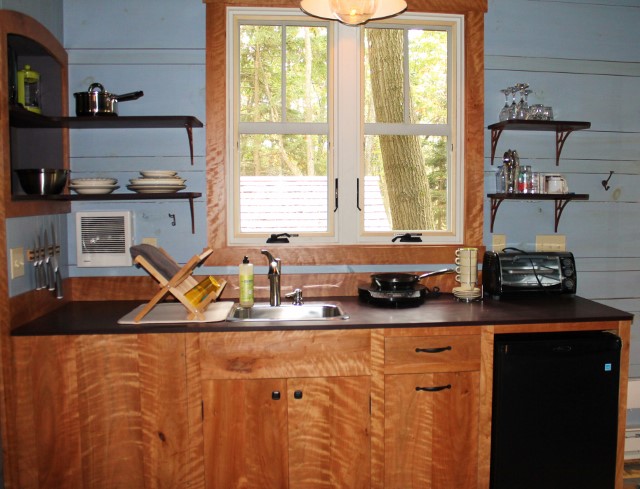
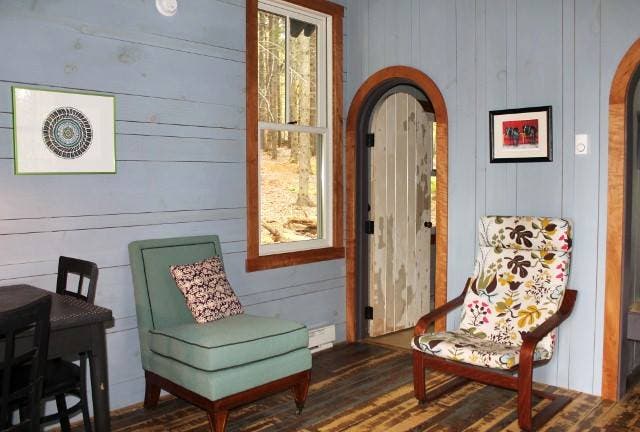
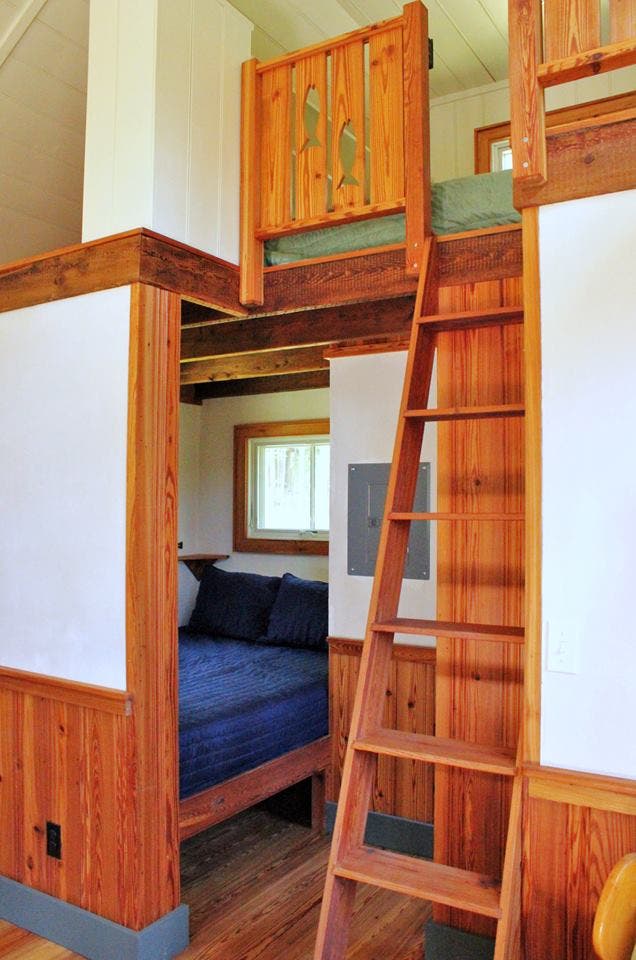
The first Hobbitat (or “Hob”, as they are affectionately called) was constructed using materials from Bill’s grandfather’s barn, windows from his childhood cabin and other reclaimed doors and materials. Hobbitat Spaces then built 13 Hobs for Blue Moon Rising, an ecotourism retreat in western Maryland. Each of the cabins were built with recycled, reclaimed and local materials, giving them a distinct look and feel.
Hobbitat Spaces is now in the process of taking individual orders for their small, hand-crafted homes. Each of the homes are built in a shop and all utilities are contained within the building envelope under insulation. The Homes are built to Maryland State building and energy codes and take about six weeks to complete.

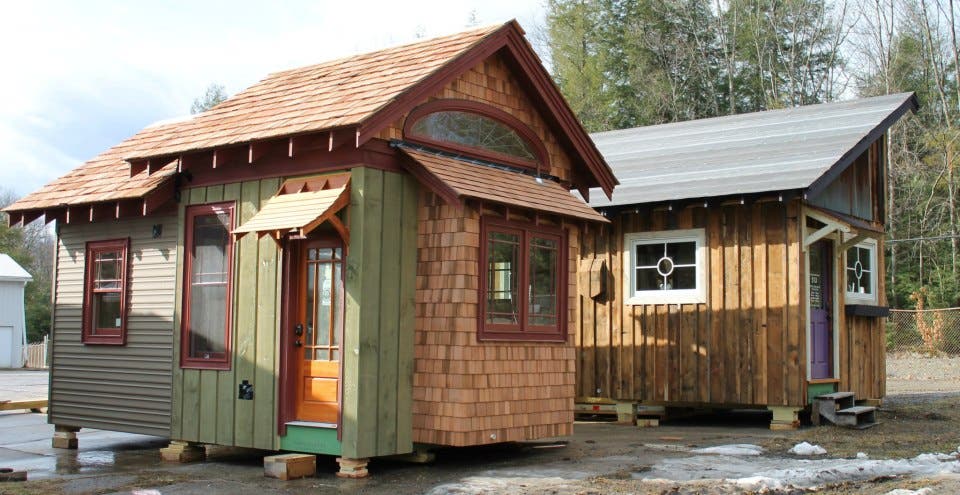

Each Hobbitat contains the following:
• A complete structural framework, built to IRC code, with a Zip system exterior wall sheathing.
• An enclosed floor system that rests on six piers, installed before the building arrives.
• A roof system of hand cut framing or engineered trusses designed to carry a 40 lb. /sq. ft. snow load.
• A 30 gallon electric hot water heater.
• A 100 amp breaker panel and wiring to conform to the current code. Many outlets and light switches as per code.
• Andersen thermal windows. Your choice of 400 or Architectural series.
• A complete thermal cocoon of 2 lb. foam. R-38 for ceilings R23 for side walls and R30 in the floor system.
• A fresh air intake system with an Airetrak 1A control for indoor air quality.
• A plumbing system that allows you to very easily drain the building and walk away for weeks or months.
• Panasonic brand exhaust fans.


Photos by Hobbitat Spaces
By Christina Nellemann for the [Tiny House Blog]
21 Oct 17:06
Vaccine deniers: inside the dumb, dangerous new fad
by Lessley
firehose'Questioning authority is an impulse that can often serve you well. And that truth is held in particularly high regard in the Bay Area. After all, this is the land where Apple computer was born and “Think Different” became a mantra. Where the expression “disruption” became the tech-term-du-jour to describe companies that were either breaking or skirting the law. Where Bradley Manning was elected Grand Marshal of the San Francisco Gay Pride Parade. Time and time again, you get the message: rewards come to those who think out of the box.
But when well-educated, high-performing people choose to engage in risky, self-serving medical behavior, it also begs the question: what made them feel so alienated from mainstream Western medicine to begin with?'
In San Francisco’s upscale Pacific Heights neighborhood, some 200 students from kindergarten to the eighth grade attend classes at the private San Francisco Waldorf School. On any given afternoon outside of the cheerful, modern white building, parents congregate to wait for their kids. Chit-chat includes the typical fodder like play dates and birthdays, or who was cast in the school play. But occasionally the topic of illness arises — which is where things can take a turn towards the atypical. You might, for instance, hear about “chicken pox parties,” where healthy kids come over to sick kids’ houses to catch the disease.
Of course, there’s a vaccine for chicken pox. It’s been available since 1995, and is part of every state’s recommended vaccine schedule, which the majority of US children receive. But SF Waldorf represents an unusual population: only 35 percent of incoming kindergarteners are up to date on all their vaccinations, one of the lowest rates in San Francisco for a school of its size and vastly lower than the national average of 95 percent. Which puts SF Waldorf firmly in the crosshairs of a national debate.
A vast minority of parents across the country, around 1.8 percent, opt out of vaccines by citing either religious or philosophical reasons. And these non-vaccinators have, in recent years, been the subject of intense media scrutiny. In part, you can blame a former Playboy bunny: Jenny McCarthy, who ABC recently hired as a new host on The View, has waged an ardent, vocal campaign against “toxins” in vaccines that she believes were responsible for causing her son’s autism.
Recent outbreaks of preventable illnesses have only added more fuel to the fire. This year, 16 states have reported cases of measles, making 2013 the second worst year for the disease since 2000. In August, the illness struck 21 people linked to a single Texas megachurch that eschewed vaccinations. And just last week, a new study concluded that vaccine refusals were largely to blame for a 2010 outbreak of whooping cough in California.
Anti-vaccinators are typically branded as naïve simpletons, while pro-vaccinators are slammed as being reactionary reductionists
The issue of vaccination invariably provokes polarized debates, often manifesting in online comment sections and on Twitter and Facebook. Often, the levels of savagery and vitriol are on par with those surrounding debates about abortion and gun control. Anti-vaccinators are typically branded as naïve simpletons, while pro-vaccinators are slammed as being reactionary reductionists.
The reality, like most things, is more nuanced. At the SF Waldorf School parents are educated, liberal-leaning, wealthy enough to afford the $20,200 a year for kindergarten, and often working in technology, law, and other white-collar professions that demand critical thinking skills. But some of them are also treating flawed, precarious medical advice as gospel — and disregarding the health of an entire community in so doing. Looking at the decisions of these parents to stray from standard medical advice, and also at the community of doctors and educators who support them, provides a unique window into one of our country’s most taboo topics.
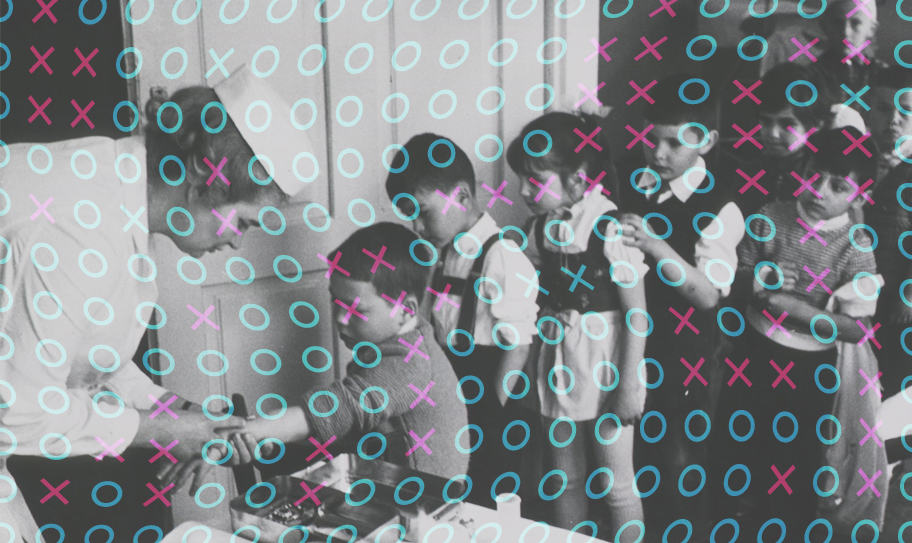
‘Not fully proven on some level’
When Rebecca* and Mike became pregnant with their daughter, Laura, the issue of whether to give her the standard childhood vaccinations seemed like a choice between life and death. But not in the way you might assume.
Rebecca, who asked that her name and the names of her family members be changed, has a family history of autoimmune dysfunction. Her father died of scleroderma, and her sister suffered from PXE — both rare but serious diseases that manifest in the skin. Rebecca was afraid that vaccines, which by design stimulate the body’s immune response, might unintentionally trigger a disease that Laura may have been predisposed to inherit.
“I was afraid that her immune system was at risk of reacting against her,” Rebecca says. “And my questions about that were not answered in a convincing way by the medical establishment.”
"It’s my responsibility to be very vigilant."
Rebecca and Mike didn’t vaccinate Laura for anything. When she enrolled at SF Waldorf, they signed what is known as a “personal belief exemption” or a PBE — a piece of paperwork that allows parents to opt out of some or all of the vaccines required by the state for entrance into kindergarten. In the US, 18 states offer PBEs and 22 offer exemptions based on religion.
Laura’s parents say they did not take the decision lightly.
“As someone who has chosen a different path, it’s my responsibility to be very vigilant,” Rebecca says. At the slightest sign of illness, her daughter goes right to bed, is fed bone broth, and stays there. Rebecca doesn’t take Laura on trips to countries with high incidence of serious disease, like polio or measles. (This year, the United States has had 173 cases of measles. By contrast, the Republic of Georgia had 7,000.)
Health concerns weren’t the only factor behind Rebecca’s decision: she’s also suspicious about the true motives of pharmaceutical companies that profit from the sale of vaccines. “It makes it hard to feel there are neutral, trustworthy sources of information,” she says.
Rebecca’s fears about government and Big Pharma collusion, along with her theory that vaccines trigger autoimmune disorders, are not uncommon among her fellow parents at SF Waldorf. Although the more infamous fear that vaccines cause autism isn’t as much of a concern (more about that in a minute), parents do worry that the shots might trigger allergies, asthma, and even type 2 diabetes.
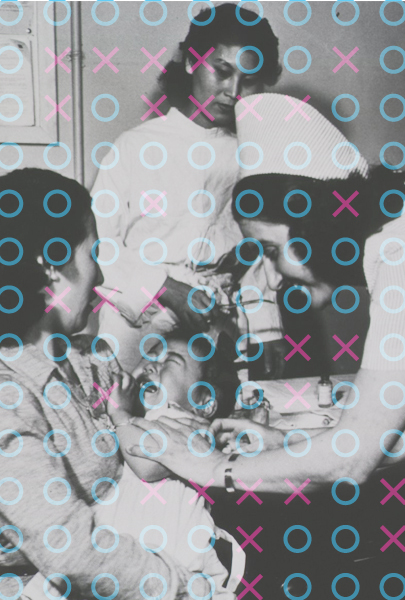
Waldorf is an educational system developed by Rudolf Steiner, an early 20th-century Austrian philosopher, which espouses to create well-rounded children through experiential learning and “age appropriate” content. Children are taught the arts and handicrafts, like woodworking and weaving, along with their academic subjects. The use of computer and TV screens at SF Waldorf is, if not forbidden, strongly disfavored — so no Angry Birds or Mickey Mouse, even at home. Team sports are discouraged until the sixth grade.
There is nothing intrinsically Waldorfian about opting out of vaccines, and the school takes no official stance on the issue. (In fact, several parents and school administrators complained that connecting the issue with the school was unfair and misleading, and objected to the premise of this story.) And yet, it is true that SF Waldorf tends to attract parents who trend towards organic food and alternative health care — acupuncture, herbal medicine, and homeopathy — and who prescribe to the adage of the body-as-temple. For some of them, vaccines are — at best — a necessary evil. And at worst, they’re just evil.
“I was very influenced by naturopathic medicine,” says John, an SF Waldorf parent who also asked that his name be changed. “They talk about: vaccines are going to be very strong in supplanting the body’s natural ability to develop immunity.” John and his wife did vaccinate against polio, measles, mumps, and rubella, but they opted out of chicken pox and flu vaccines for their two kids. “They should still be exposed to some things,” John says. Both of his children partook in chicken pox parties: they were sent to the home of a child with the illness, shared a lollipop, and soon after came down with chicken pox themselves.
Parents like John vaccinate selectively, while other parents space shots out rather than follow the vaccination schedule prescribed by the Centers for Disease Control and Prevention (CDC). Others delay vaccinations by several years, believing the more mature their kids’ immune systems are, the better they’ll be able to withstand the onslaught of foreign agents.
“I delayed vaccinations until my kids were crawling,” says Jane*, an SF Waldorf parent with three children. “I believed that while my children were cocooned in the nice little lair of my sling that they didn’t need vaccinations, and if there was any potential for some kind of injury that it was just better to wait.” Jane’s kids are now fully vaccinated.
By skipping or delaying vaccinations, parents put their own kids — as well as fellow SF Waldorf students and community members — at risk of serious illness. But the school “supports the parents’ right to choose,” says Cory Powers, the grade-school administrative coordinator at SF Waldorf. Administrators also take great pains, Powers adds, to communicate that parents who opt out of vaccinations should prepare for heavy responsibilities: someone infected with measles will face a minimum 18-day quarantine, as recommended by the San Francisco Department of Public Health. That’s a lot of days to take off work to care for a sick kid.
“When the parent comes and signs a personal belief exemption, we tell them that if you make that choice, it’s not a frivolous or casual one,” Powers says. But for the most part, she notes, parents who choose to skip or delay vaccinations are the opposite of frivolous. Rather, she describes them as “choosing extremely consciously and holistically.”
“These are people who are also questioning GMOs,” Powers says. “Things that are not fully proven on some level.”
What science says
But there’s a big difference between not eating GMOs and not getting a vaccine. If I don’t eat a corn chip at my local taqueria because I have doubts about the lack of research on GMOs and believe it’s because science and the government are in Monstanto’s pocket, I’m not going to put my dining companions at risk of disease. But if I decide not to vaccinate my kid, I make him a potential carrier. He may be able to fight off measles, mumps, rubella, and other illnesses — but what if he spreads a disease to somebody who, for whatever reason, isn’t so lucky?
If I decide not to vaccinate my kid, I make that kid a potential carrier
Much like any medication, vaccines aren’t 100 percent effective or 100 percent safe. Even the CDC spells this out right on its website. But they exist (and are widely used) because the potential harms of not using them are far greater than any associated hazard. Take, for instance, the MMR (measles, mumps, rubella) vaccine. The CDC estimates that for every 1,000 children in a developed nation who get measles, 1–2 will die. By comparison, for every 3,000–4,000 cases of MMR vaccination, the CDC estimates there will be a “small increased risk” of febrile seizures among children under seven.
The medical establishment, to date, has found no evidence of neurological or autoimmune disorders having been caused by vaccines. The most famous claim, that the MMR vaccine causes autism, was intensively studied and debunked. Andrew Wakefield, the British surgeon behind the original hypothesis, was long ago discredited and stripped of his medical license. Other parents have worried that thiomersal, a preservative containing mercury that was used in vaccines until 2001, causes autism. The preservative was removed from most vaccines as a purely precautionary measure, and subsequent studies have failed to find a shred of evidence for the thiomersal–autism link.
Chicken pox parties also lack medical backing. The idea that it’s healthier to become immune by catching an illness, rather than getting a vaccine, isn’t supported by scientific research. “There is absolutely no evidence for — good science or any theoretical evidence for — the idea that a natural infection makes your body stronger,” says John Schwartzberg, a clinical professor at the UC Berkeley School of Public Health. “Natural infection challenges the body with a lot more foreign protein than a vaccine, so it’ll put a lot more stress on the body. Becoming very ill is not good for the body.”
But decades of research, statistics, and ongoing assurances from scientists and government agencies still can’t convince some parents. Politicians can be bought, the thinking goes. The peer review system in scientific journals is corrupted by Big Pharma influence. Scientists aren’t studying vaccines hard enough, because the money lies in convincing the public that they’re safe when they’re actually not.
“It becomes a question of faith,” says Colin Phipps, a chiropractor in San Francisco who doesn’t believe in vaccines and speaks on panels about the topic. “Do you have faith in the CDC? The FDA? Big pharma? Science not driven by profit or motive? Do politicians have our best intentions at heart? Or do you have faith that the body is built to deal with pathogens in the universe?”
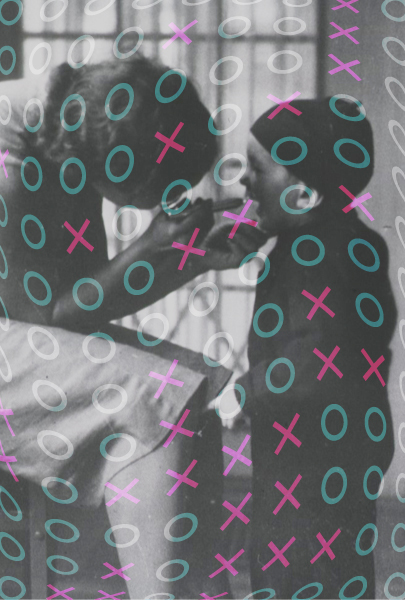
For at least some physicians in San Francisco, addressing the vaccination fears of parents has become a difficult balancing act. “I think vaccines have become a scapegoat for our fears about medicine, the government, and mistrust of authority,” says Dr. Julia Getzelman, whose pediatric practice attracts some vaccine skeptics. Getzelman perceives vaccines as “one of the 20th century’s greatest health successes,” and considers the concerns of parents to be “nebulous” in nature.
But that doesn’t mean she forces vaccines on her patients: some of the children Getzelman sees follow an amended vaccine schedule, one that’s contrary to CDC recommendations. “Nobody in the mainstream supports the alternative vaccine schedule — there’s no science behind it,” Getzelman admits. “But when you’re on the front line of trying to individualize care, it doesn’t necessarily always fit with the mainstream.”
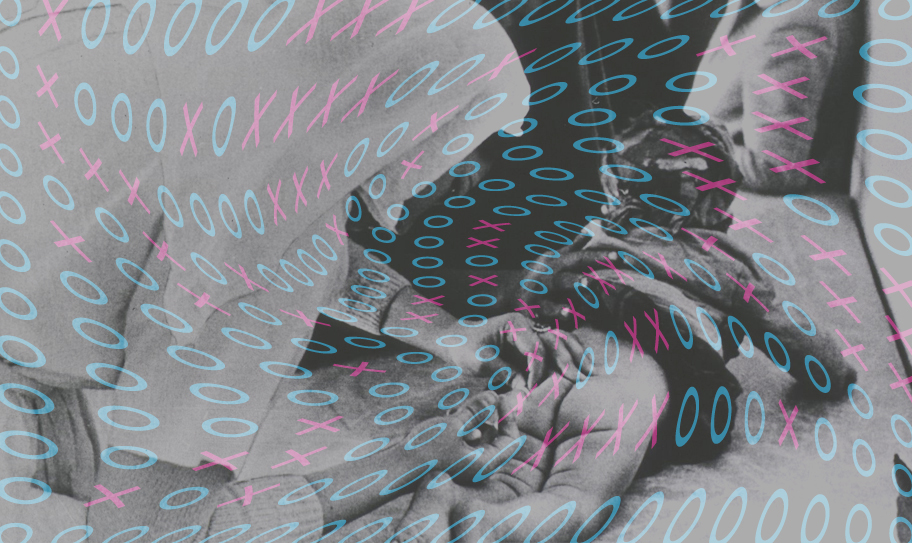
The guy in the iron lung
In America, we live in a pax romana with regards to disease. It might not seem that way sometimes, what with our rising rates of autism, cancer, kids dying from peanut allergies, and so on. But as recently as 50 years ago, there were no preventative measures for mumps, which can make men sterile. Or rubella, which can cause serious birth defects if contracted by a pregnant woman in her first trimester. Measles killed hundreds of people a year, and hospitalized 20 percent of those who caught it — most of them children. Those who grew up in the 1950’s remember going to the county fair and gawking at “the guy in the iron lung” paralyzed from polio. The specter of disease was real and present.
Today, we have what’s known as “herd immunity.” That is, enough people have been vaccinated that they protect the unvaccinated, or those whose vaccinations fail. The chances of an American getting these formerly common childhood illnesses are very slim. The chances of dying from them are even slimmer. Not because the diseases aren’t serious, but because they aren’t nearly as prevalent.
In fact, herd immunity is actually why some parents don’t vaccinate. “When you think of it that way, it’s hard to want to get vaccinated when you hear anecdotally about things going wrong from vaccines,” says Dr. Justin Davis, a San Francisco physician.
Time and time again, you get the message: rewards come to those who think out of the box
Davis also points out an irony he perceives among his patients. Many of them consider themselves “global participants” — they bike, recycle, and generally take proactive measures to protect the environment. But when it comes to vaccines and immunity, these parents utilize resources more selfishly. He is somewhat sanguine about this. “I take longer showers than I should, and I drive a car and take airplanes. Who am I to say how people of privilege should choose to use the resources available to them?” Davis says. Of course, there’s an inherent problem with that position: “If everybody were to [opt out of vaccinations],” he admits, “there would be huge ramifications.”
One of the tenants of a Waldorf education is to teach self-reliance, independence, and critical thinking skills. “They’re saying, be educated before you just go along with the herd,” says one parent. Clearly, this same type of impulse also leads some parents to question the status quo with regards to vaccines.
“People on the pro-vaccinations side think that people who don’t vaccinate, or vaccinate selectively, are crazy and uninformed,” says John, the parent whose kids got chicken pox from the lollipop. “I think that the people who make these decisions are actually the most well-informed parents, and they’re generally working with their healthcare providers to make these decisions.”
Questioning authority is an impulse that can often serve you well. And that truth is held in particularly high regard in the Bay Area. After all, this is the land where Apple computer was born and “Think Different” became a mantra. Where the expression “disruption” became the tech-term-du-jour to describe companies that were either breaking or skirting the law. Where Bradley Manning was elected Grand Marshal of the San Francisco Gay Pride Parade. Time and time again, you get the message: rewards come to those who think out of the box.
But when well-educated, high-performing people choose to engage in risky, self-serving medical behavior, it also begs the question: what made them feel so alienated from mainstream Western medicine to begin with?
The answer, according to vaccine advocate Dr. Paul Offit, largely comes down to how medical practitioners are perceived. In his takedown of alternative medicine, Do You Believe In Magic, he writes:
“Practitioners of modern medicine can appear callous and insensitive. Patients feel more like a number than a person. That’s where alternative healers come in: they provide individual care, because they care … Where modern medicine is spiritless and technological … alternative medicine is spiritual and meaningful.”
It is not surprising that a class of person deeply involved in searching for and expressing their own individual uniqueness — and that of their children — would be turned off by a cookie-cutter approach to health. And it’s not surprising that in their disaffection, they’d turn away and seek, as one parent put it, “other modalities.”
And that’s when the doubts begin to creep in.
21 Oct 16:58
New Study Finds Human Beings Were Never Meant To Wake Up From Sleep
firehoseNEJM beat
BOSTON—According to a new study published in The New England Journal Of Medicine this week, human beings were never meant to wake up after falling asleep, but were rather supposed to remain in a deep, peaceful slumber until eventually expiring.


|
|
firehose likes this
21 Oct 16:57


Newswire: Weekend Box Office: Carrie scares up big busin—nah, just kidding, Gravity wins again
by A.A. Dowd
firehose"Silly Carrie. They only asked you to October to laugh at you."
That Carrie White just can’t catch a break. Tormented by her classmates and tortured by her religious-nut mother, the telekinetic teen now faces the indignity of appearing in the only Halloween-friendly movie opening wide this month and still not winning the weekend. Despite a complete lack of fright-flick competition, the horror remake Carrie made only $17 million these last three days, landing in a humiliating third place and earning the cruel scorn of its teenage demographic. In terms the title character could understand, that’s like getting a pity invitation to the prom from Jigsaw’s boyfriend, only to have those ornery poltergeists from Paranormal Activity dump a bucket of pig’s blood on your head. Silly Carrie. They only asked you to October to laugh at you.
Speaking of old things that apparently no one cares about anymore, the combined box-office draw of Sylvester Stallone and Arnold Schwarzenneger ...
Read more|
|
21 Oct 16:51
Awesome
firehosevia THANKGODYOUREHERE: "THIS IS THE BEST THING IVE SEEN ON A MONDAY IN FOREVER"
CONFIRMED: IT DELIVERS
Awesome
firehose likes this


