What those symbols on the dashboard mean.
What those symbols on the dashboard mean.

Adriaen Collaert after Ambrosius Francken, Cleansing of human hearts with the blood of Christ, late 16th century or early 17th century

Hendrik Goltzius, Christ holds a heart-shaped basket and tips out the deadly sins, while retaining the virtues, ca. 1578

Gustave Doré, Don Quixote de la Mancha, A knight comes to a lake of boiling pitch inhabited by gruesome monsters, 1863

Tyrese could be getting his own Green Lantern ring if what he’s teasing is true. Apparently during an interview with ET, he teased that he’d already taken the oath as well as a meeting or two with folks over at Warner Bros. Earlier this year, Tyrese posted a bunch of photos of himself as John Stewart to his Instagram account, inspiring a fan campaign to have him play the character in a Green Lantern movie.
Tyrese was incredibly coy with addressing the rumor. He said:
There are certain things I can’t speak on. But I will say, however this works out, it’s definitely the fans’ fault. I was at home minding my own business and fans start creating these fan-made videos of me as Green Lantern and I looked into it. I’ve been a fan of the Green Lantern. I took the oath, and I had a meeting at Warner Bros. and certain things were said and talked about. We’ll just see what happens.
There are also rumors that this next Green Lantern movie will feature more than one Green Lantern. Chris Pine is (you guessed it) rumored to play Hal Jordan. Judging by their past work, these two might have some real fun on-screen chemistry together. Tyrese sums it all up as best he could when he said, “I just think I deserve a shot at suiting up and becoming the Green Lantern.”
Indeed you do. What do y’all think?
(via Comic Book Resources)
—Please make note of The Mary Sue’s general comment policy.—
Do you follow The Mary Sue on Twitter, Facebook, Tumblr, Pinterest, & Google +?
October 2008: Rows of tiki mugs at Forbidden Island in Alameda. A bit about that day's tiki crawl here.
firehosenah

With Jurassic World doing exceptionally well at the box office, other Michael Crichton properties are being eyed for adaptation. The latest is Micro, which Dreamworks Pictures optioned, with Frank Marshall set to produce.

firehosevia Toaster Strudel
firehose'On average, just 2% of technology workers at seven Silicon Valley companies that have released staffing numbers are black; 3% are Hispanic.
But last year, 4.5% of all new recipients of bachelor's degrees in computer science or computer engineering from prestigious research universities were African American, and 6.5% were Hispanic, according to data from the Computing Research Association.
The USA TODAY analysis was based on the association's annual Taulbee Survey, which includes 179 U.S. and Canadian universities that offer doctorates in computer science and computer engineering.
"They're reporting 2% and 3%, and we're looking at graduation numbers (for African Americans and Hispanics) that are maybe twice that," said Stuart Zweben, professor of computer science and engineering at The Ohio State University in Columbus.
"Why are they not getting more of a share of at least the doctoral-granting institutions?" said Zweben, who co-authored the 2013 Taulbee Survey report.'
Behind Silicon Valley’s self-critical tone on diversity, a lack of progress @ The New York Times.
It is as if these large tech companies are all reading from the same public relations playbook, delivering slight variations on the same self-effacing message. But while they all seem to acknowledge that there is much improvement to be made, the repetition of the statements like Facebook’s last week provide a reminder that there has been little progress so far.
…“If these companies can create self-driving cars and bring Internet to the entire world, it’s not that hard to hire more than one black woman per year,” said Catherine Bracy, director of community organizing at Code for America, a nonprofit that promotes the use of technology and design in the public sector.
“It’s not enough to say you care about it,” Ms. Bracy said. “You have to know and clearly state your goals. You have to truly invest in it.”
It’s would be good to the tech companies set a specific goal and metrics for success, measuring something, usually improves it, goals are good.
Related
Catalyst research “Why Diversity Matters” (PDF)
Tech jobs: Minorities have degrees, but don’t get hired
Few minorities in non-tech jobs in Silicon Valley, USA TODAY finds
firehose100% pure portland cyclist
I praise you for having the courage to ride freely bare naked once a year to show off your goods to the world while your body freely goes against the wind. But as a cyclist the Naked Bike Ride has lost its meaning. As a everday cyclist it's the day I tend to shake my head the most. The Naked Bike Ride should be a change for the better as in cycling laws. But for me it's just now a side show that I avoid. The majority of riders tonight do not contend with downtown traffic, drivers that run stop signs, or the normal northwest weather. How can we try to change for the better when you don't know your route, cycling laws or even being safe with a helmet or none the less not having bike lights. Good for you yes you get traffic corked off and yes you don't get a ticket for being naked tonight. But tonight shouldn't be the only day you ride your bike. Body image is an empowering force but you shouldn't just be noticed tonight because you are naked. You should be noticed everday as a avid cyclist that wants change.
BBC News |
Dalai Lama Joins Patti Smith on Glastonbury Festival Stage New York Times LONDON — One of the most talked-about appearances at Britain's Glastonbury music festival wasn't a singer or rocker — it was the Dalai Lama. The exiled Tibetan spiritual leader joined singer Patti Smith on stage Sunday, where she led the crowd to sing ... The Dalai Lama celebrated his birthday with Patti Smith at GlastonburyThe Verge Patti Smith at Glastonbury 2015 review – feeling her rageThe Guardian Dalai Lama finds joy in Glastonbury 'people's' festivalReuters BBC News -NDTV all 262 news articles » |
firehoseunending asshole
ABC News |
Mike Huckabee Compliments President Obama's Singing Voice, Criticizes Parts ... ABC News Republican presidential candidate Mike Huckabee called parts of President Barack Obama's eulogy for the pastor killed in the Charleston church shooting two weeks ago “brilliant” and jokingly praised his singing voice – but also criticized the president for ... Huckabee: County clerks with 'conscientious objection' should be excused from ...Washington Post (blog) Mike Huckabee Says His White House Would Have a Nativity SceneBloomberg Huckabee questions a bit of Obama's Pinckney eulogyPolitico IJ Review -Raw Story -The Hill all 12 news articles » |
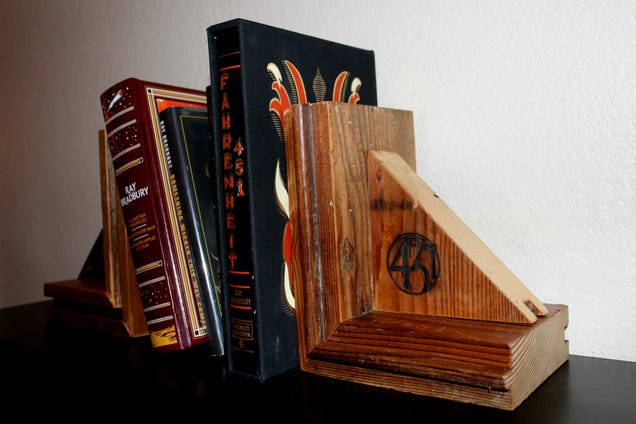
Ray Bradbury’s home was demolished earlier this year, but the home will live on in a very fitting manner: parts of his house were turned into bookends and sold to support Center for Ray Bradbury Studies at Indiana University.

firehoseSafe for work, but not from an arrow in the heaAAACK


 |
popular
shared this story
from  Restricted Data. Restricted Data.
|
Confession: I once told my students something I knew wasn’t true. It was during a lecture on the Space Race, on Sputnik 2, which carried the dog Laika into space in November 1957. I told them about how the Soviets initially said she had lived a week before expiring (it was always intended to be a one-way trip), but that after the USSR had collapsed the Russians admitted that she had died almost immediately because their cooling systems had failed. All true so far.
But then one bright, sensitive sophomore, with a sheen on her eyes and a tremble in her voice, asked, “But did they at least learn something from her death?” And I said, “oh, um, well, uh… yes, yes — they learned a lot.”
Which I knew was false — they learned almost nothing. But what can you do, confronted with someone who is taking in the full reality of the fact that the Soviets sent a dog in space with the full knowledge it would die? It’s a heavy thing to admit that Laika gave her life in vain. (In subsequent classes, whenever I bring up Sputnik, I always preempt this situation by telling the above story, which relieves a little of the pressure.)
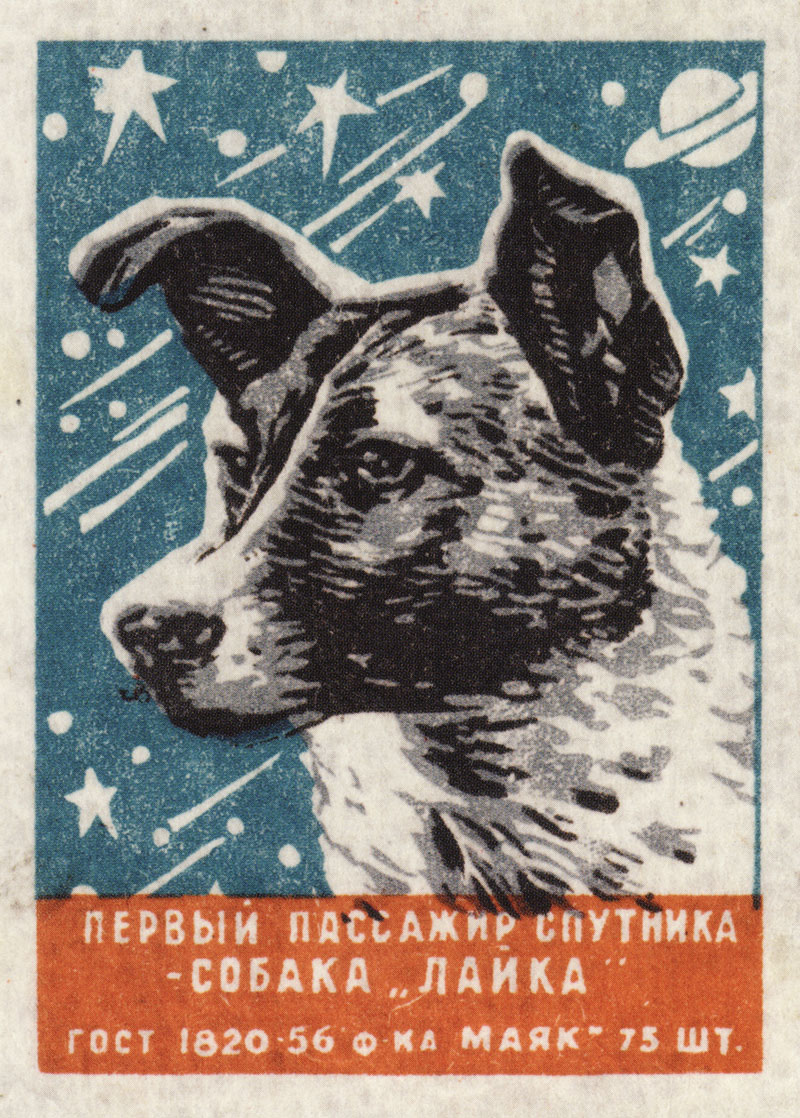
A Soviet matchbox with a heroic Laika, the first dog in space. Caption: “First satellite passenger — the dog, Laika.” Want it on a shirt, or a really wonderful mug?
I’m a dog person. I’ve had cats, but really, it’s dogs for me. I just believe that they connect with people on a deeper level than really any other animal. They’ve been bred to do just that, of course, and for a long time. There is evidence of human-dog cohabitation going back tens of thousands of years. (Cats are a lot more recently domesticated… have been around a mere thousand years… and it shows.) There are many theories about the co-evolution of humans and dogs, and it has been said (in a generalization whose broadness I wince at, but whose message I endorse) that there have been many great civilizations without the wheel, but no great civilizations without the dog.
So I’ve always been kind of attracted to the idea of dogs in space. The “Mutniks,” as they were dubbed by punny American wags, were a key, distinguishing factor about the Soviet space program. And, Laika aside, a lot of them went up and came back down again, providing actually useful information about how organisms make do while in space, and allowing us to have more than just relentlessly sad stories about them. The kitsch factor is high, of course.
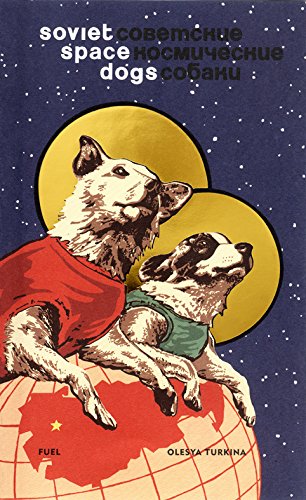
A friend of mine gave me a wonderfully quirky and beautiful little book last holiday season, Soviet Space Dogs, written by Olesya Turkina, published by FUEL Design and Publishing. According to its Amazon.com page, the idea for the book was hatched up by a co-founder of the press, who was apparently an aficionado of Mutnikiana (yes, I just invented that word). He collected a huge mass of odd Soviet (and some non-Soviet) pop culture references to the Soviet space dogs, and they commissioned Turkina, a Senior Research Fellow at the State Russian Museum, to write the text to accompany it. We had this book on our coffee table for several months before I decided to give it a spin, and I really enjoyed it — it’s much more than a lot of pretty pictures, though it is that, in spades, too. The narrative doesn’t completely cohere towards the end, and there are aspects of it that have a “translated from Russian” feel (and it was translated), but if you overlook those, it is both a beautiful and insightful book.
First off, let’s start with the easy question: Why dogs? The American program primarily used apes and monkeys, as they were far better proxies for human physiology than even other mammals. Why didn’t the Soviets? According to one participant in the program, one of the leading scientists had looked into using monkeys, talking with a circus trainer, and found out that monkeys were terribly finicky: the training regimes were harder, they were prone to diseases, they were just harder in general to care for than dogs. “The Americans are welcome to their flying monkeys,” he supposedly said, “we’re more partial to dogs.” And, indeed, when they did use some monkeys later, they found that they were tough — one of them managed to worm his way out of his restraints and disable his telemetric equipment while in flight.
The Soviet dogs were all Moscow strays, picked for their size and their hardiness. The Soviet scientists reasoned that a dog that could survive on the streets was probably inherently tougher than purebred dogs that had only lived a domesticated life. (As the owner of a mutty little rescue dog, I of course am prone to see this as a logical conclusion.)
The Soviet dog program was more extensive than I had realized. Laika was the first in orbit, but she was not the first Soviet dog to be put onto a rocket. Turkina counts at least 29 dogs prior to Laika who were attached to R-1 and R-2 rockets (both direct descendants of the German V-2 rockets), sent up on flights hundreds of miles above the surface of the Earth starting in 1951. An appendix at the back of the book lists some of these dogs and their flights.
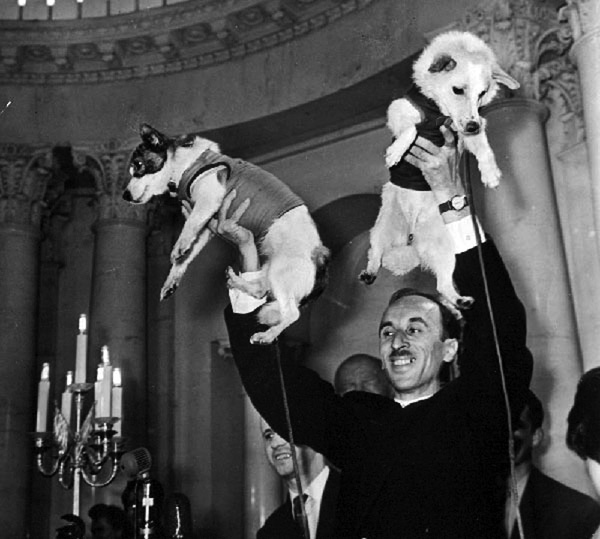
Oleg Gazenko, chief of the dog medical program, with Belka (right) and Strelka (left) at a TASS press conference in 1960. Gazenko called this “the proudest moment of his life.”
Many of them died. Turkina talks of the sorrow and guilt of their handlers, who (naturally) developed close bonds with the animals, and felt personally responsible when something went wrong. Some of the surviving dogs got to live with these handlers when they retired from space service. But when the surviving dogs eventually expired, they would sometimes end up stuffed and in a museum.
I had thought I had heard everything there was to hear about Laika, but I was surprised by how much I learned. Laika wasn’t really meant to be the first dog in space — she was the understudy of another dog who had gotten pregnant just before. Laika’s death was a direct result of political pressures to accelerate the launch before they were ready, in an effort to “Sputnik” the United States once again. The head of the dog medical program, when revealing Laika’s true fate in 2002, remarked that, “Working with animals is a source of suffering to all of us. We treat them like babies who cannot speak. The more time passes, the more I’m sorry about it. We shouldn’t have done it. We did not learn enough from the mission to justify the death of the dog.”
The Soviets did not initially focus on the identity of Laika. Laika was just listed as an experimental animal in the Sputnik 2 satellite. Rather, it was the Western press, specifically American and British journalists, that got interested in the identity, and fate, of the dog. The Soviet officials appear to have been caught by surprise; I can’t help but wonder if they’d had a little less secrecy, and maybe ran this by a few Americans, they’d have realized that of course the American public and press would end up focusing on the dog. It was only after discussion began in the West that Soviet press releases about Laika came out, giving her a name, a story, a narrative. And a fate: they talked about her as a martyr to science, who would be kept alive for a week before being painlessly euthanized.
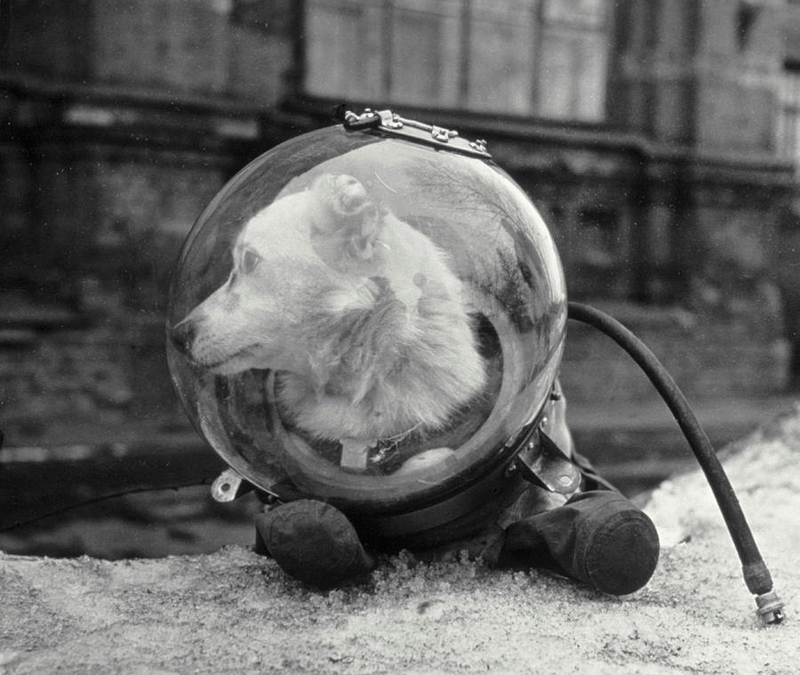
Staged photo of Belka in a space suit.
In reality, Laika was already dead. They had, too late, realized that their cooling mechanisms were inadequate and she quickly, painfully expired. The fact that Laika was never meant to come back, Turkina argues, shaped the narrative: Laika had to be turned into a saintly hero, a noble and necessary sacrifice. One sees this very clearly in most of the Soviet depictions of Laika — proud, facing the stars, serious.
The next dogs, Belka and Strelka, came back down again. Belka was in fact an experienced veteran of other rocket flights. But it was Strelka’s first mission. Once again, Belka and Strelka were not meant to be the dogs for that mission: an earlier version of the rocket, kept secret at the time, exploded during launch a few weeks earlier, killing the dogs Lisichka and Chaika. These two dogs were apparently beloved by their handlers, and this was a tough blow. The secrecy of the program, of course, pervades the entire story of the Soviet side of the Space Race, and serves as a marked contrast with the much more public-facing US program (the consequences of which are explored in The Right Stuff, among other places).
When Belka and Strelka came back safely, Turkina argues, they became the first real Soviet “pop stars.” Soviet socialism didn’t really allow valorization of individual people other than Stakhanovite-style exhortations. The achievements of one were the achievements of all, which doesn’t really lend itself to pop culture. But dogs were fair game, which is one reason there is so much Soviet-era Mutnikiana to begin with: you could put Laika, Belka, and Strelka on cigarettes, matches, tea pots, commemorative plates, and so on, and nobody would complain. Plus, Belka and Strelka were cute. They could be trotted out at press conferences, on talk shows, and were the subjects of a million adorable pictures and drawings. When Strelka had puppies, they were cheered as evidence that biological reproduction could survive the rigors of space, and were both shown off and given as prized gifts to Soviet officials. So it’s not just that the Soviet space dogs are cool or cute — they’re also responsible for the development of a “safe” popular culture in a repressive society that didn’t really allow for accessible human heroes. Turkina also argues that Belka and Strelka in particular were seen as paradoxically “humanizing” space. By coming back alive, they fed dreams of an interstellar existence for mankind that were particularly powerful in the Soviet context.
Yuri Gagarin reported to have joked: “Am I the first human in space, or the last dog?” It wasn’t such a stretch — the same satellite that Belka and Strelka rode road in could be used for human beings, and gave them no more space. A friend of mine, Slava Gerovitch, has written a lot about the Soviet philosophy of space rocket design, and on the low regard the engineers who ran the program had for human passengers and their propensity for messing things up. Gagarin had about as much control over his satellite as Belka and Strelka did over theirs, because neither were trusted to actually fly a satellite. The contrast between the engineering attitudes of the Soviet Vostok and the American Mercury program is evident when you compare their instrument panels. The Mercury pilots were expected to be able to fly, while poor Gagarin was expected to be flown.
Soviet Space Dogs is a pretty interesting read. It’s a hard read for a dog lover. But seeing the Soviet space dogs in the context of the broader Soviet Space Race, and seeing them as more than just “biological cargo,” raises them from kitsch and trivia. There is also just something so emblematic of the space age about the idea of putting dogs into satellites — taking a literally pre-historic human technology, one of the earliest and most successful results of millennia of artificial breeding, and putting it atop a space-faring rocket, the most futuristic technology we had at the time.
firehosevia ThePrettiestOne
firehosevia Toaster Strudel
didn't know I needed a Willy Wonka remake with these two


Erykah Badu and Janelle Monae speak onstage at the Genius Talks presented by AT&T during the 2015 BET Experience at the Los Angeles Convention Center on June 27, 2015 in Los Angeles,
firehosevia Osiasjota
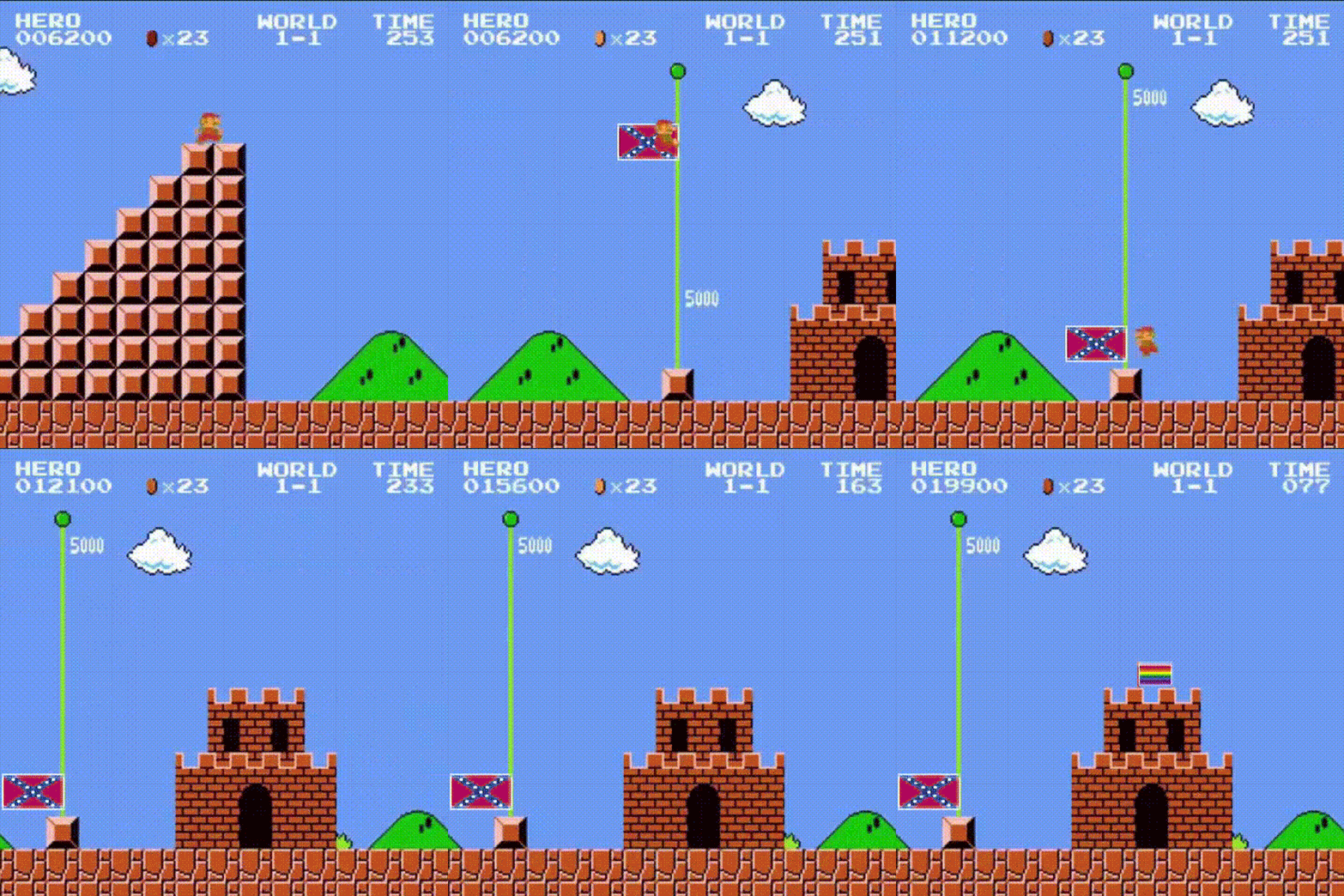
On Friday, Mother Jones shared a cartoon by the Southern Poverty Law Center that pretty much sums up this incredible week (below). Could it get any better? Yes. Some genius knew exactly what that comic strip looked like and created the GIF shown above.

firehosevia ThePrettiestOne
can we officially call these sorts of hypocritical repbulicans First Stone Republicans?


GOP Hypocrisy: screw as I say, not as I screw
This is probably my biggest problem with conservatives (aside from the racism, xenophobia, sexism, and homophobia): the fact that they spend all their time lecturing the rest of us on morality and yet can’t live up to their own ridiculous standards.
Bristol Palin having kids, whether she’s married or not? Don’t give a fuck. Bristol Palin having kids out of wedlock when both she and her mother are outspoken advocates for abstinence and shaming those who dare to view sex as anything more than a baby factory? Not cool.
firehosesorry: it's Counter Culture
Scientist and part-time filmmaker Tyler Hulett created this beautiful springtime time-lapse video of Mount Hood, the highest mountain in Oregon, as part of his ongoing Discover Oregon video series.
Experience the diverse moods of Oregon’s magnificent Mt. Hood! From starry night timelapse to gorgeous macro wildflower cinematography – ‘Mt. Hood in Spring’ showcases this gem of the Cascades on all scales. ‘Mt. Hood in Spring’ was shot April through May 2015 on the edge of Oregon’s upper Hood River Valley.

When Robert Altman directed his final film, 2006’s A Prairie Home Companion, he posited a bright, utopian world, one in which cornpone overlord Garrison Keillor finally stepped down from his dark, Powdermilk Biscuit-covered throne and relinquished his hold on America’s radio waves. Now, the light Altman hurled into the future may finally be allowed to shine, as the 72-year-old Keillor revealed during a recent taping that his exit strategy from A Prairie Home Companion has finally been put in place.
Keillor announced that he plans to phase himself out of the show during its 2015-2016 season, departing the program he first founded back in 1974. Hosting duties—along with the mysterious measurement devices that ensure that all of Lake Wobegon’s children remain above average, on pain of death—will pass to mandolinist and singer Chris Thile, of Nickel Creek and Punch Brothers, a repeat guest in The ...