|
submitted by iampondscum [link] [33 comments] |
firehose
Shared posts
11 Jan 01:49
Just FYI, Portland rock band Red Fang will be performing on David Letterman tonight.
firehoseRed Fang is blowing up?
Russian Sledges, firehose likes this

11 Jan 01:14
Lola Monetz by John Millar Watt. read more about Lola!
firehoseWP: 'At Castlemaine in April 1856, she was "rapturously encored" after her Spider Dance in front of 400 diggers (including members of the Municipal Council who had adjourned their meeting early to attend the performance), but drew the wrath of the audience by insulting them following some mild heckling.
She earned further notoriety in Ballarat when, after reading a bad review in The Ballarat Times, she attacked the editor, Henry Seekamp with a whip. The "Lola Montes Polka" composed by Albert Denning was later rumoured to have been inspired by this event, but as the song was published in 1855 and the incident with Seekamp occurred months later in February 1856, this is scarcely probable. She departed for San Francisco on 22 May 1856, having had her fill of the turbulent Australia.'

firehose likes this
11 Jan 00:04
Opinion: Son, You’ll Thank Me For Pushing You This Hard When You’re 37 And Miserable (by Keith Sanderson)
By Keith Sanderson


|
firehose and -1 others like this
11 Jan 00:04
Portland pimp sues Nike for $100 million for lack of warning label after beating victim with Jordans
 |
submitted by Hwy30West [link] [48 comments] |
11 Jan 00:01

prayer - Shadow Land (Namco/Now Production - arcade - 1987)
firehoseyo is it?
prayer - Shadow Land (Namco/Now Production - arcade - 1987)
firehose likes this
11 Jan 00:00

'Black Widow' #1 and the Hawkeyzation of Marvel Solo Titles [Review]
by Andrew Wheeler

Hawkeye has led the way for a solo title renaissance at Marvel. The publisher had of late placed an emphasis on team books — mostly iterations of the Avengers and the X-Men — and scaled back on solo titles, even reducing Spider-Man to just two books (one double shipping).
Then Hawkeye came along, and things changed. Thanks to the unique voice and style of the creative team, Matt Fraction and David Aja, a character who seemed unlikely to sustain a solo title became both a critical and commercial hit. Marvel has been trying to recapture that magic ever since, and the first of a new wave of solo titles hit stores this week; Black Widow #1 by Nathan Edmondson and Phil Noto.
If there’s a formula to Hawkeye’s success, it’s “let the creators be themselves.” Fraction and Aja did not produce the kind of superhero book that they could plug any hero into. Aja created a visual language that spoke to marksman Hawkeye’s perception of space and time. Fraction paced and framed his story as the everyday adventures of a blue collar man. If Marvel has a “house style” it’s a broad one, and even then Hawkeye sits far wide of it.
So the challenge for Marvel is to create other solo books that are just as quintessentially different, just as completely true to their lead characters, and yet somehow also Hawkeye. The brain-breaking internal memo might read, “Let’s create a dozen new books that are unique just like that one.”
Many of the first wave of Marvel Now solo books felt like well executed examples of traditional superhero fare, typically starring dependably commercial leading men. Aaron and Ribic’s grandly epic Thor and Spurrier and Huat’s X-Men: Legacy stood out as bespoke products.
The “all-new” wave of Marvel Now solo books is much more obvious in its desire to seed new Hawkeyes in the market. The original line had eleven solo titles, six of them starring Marvel heroes with current solo movie franchises. All-New Marvel Now has fourteen solo titles (and counting), and none of them can claim that kind of marquee support.
Like Hawkeye, these are second-stringers, and like Hawkeye they’ve been given creative teams that might impose a strong authorial vision: Felipe Smith and Tradd Moore on Ghost Rider; Zeb Wells and Mike Del Mundo on Elektra; Warren Ellis and Declan Shalvey on Moon Knight; G. Willow Wilson and Adrian Alphona on Ms Marvel; Dan Slott and Mike Allred on Silver Surfer. In every case the book seems to exist because of the talent attached; and might even cease to exist when that talent leaves.
And in every case the artist is at least as important as the writer. That feels like a departure for Marvel, which only a few years ago hailed its writing talent as “architects” of its universe. Now it seems that designers are just as important. There is no such book as “Matt Fraction’s Hawkeye”; it is absolutely David Aja’s Hawkeye as well, even when a guest artist takes over, because his influence is a constant presence. My hope and expectation is that we’ll see a similar sense of a signature look from Tradd Moore, Mike Del Mundo, Declan Shalvey and all the rest.
And so we come to Black Widow #1, which relaunches the solo adventures of Russian superspy Natasha Romanova.

This is a book that absolutely claims the benefit of an artist with a unique and instantly recognizable style. Phil Noto doesn’t seem like the obvious choice for a Black Widow solo series; his subjects often have a delicate, ephemeral quality to them. One fears they would collapse like underbaked souffles if forced to undertake an action sequence.
Yet it’s the vulnerability in his work, the fragility of it, that makes Black Widow #1 effective. His painted art evokes a 70s cinema world of honeyed sunlight and faded palettes. It creates stillness, a suspended space where the reflexively ferocious Widow can excel.
As realized by Noto, the world of the Black Widow is cold when it needs to be, warm when it needs to be, and most of all hard when it needs to be. Much of the storytelling occurs through a gauzy filter, but the blacks stiffen when the pace or action demands it. In the book’s key fight scene the color also flashes to danger-red as Widow takes down a team of goons — but the black-ink intensity is just as emphatic when she’s walking with purpose to an elevator shaft or “remembering” a painful past that supposedly is not real.
The pains of the past are crucial to this series — Natasha’s need to atone for her wrongs is the driving force of writer Nathan Edmondson’s narrative — and yet the facts of Natasha’s past remain mysterious. There’s a tension here between motive and mystery, and it’s not clear which way Edmondson will go. If he reveals too much, it may take away some of the character’s edge. Too little, and the story becomes abstract.
This first issue hints that the veracity of anything we learn may be left ambiguous, which would be a cunning way to play it, and an apt device for a book that steers readers away from the clarity of Black Widow the Avenger towards the uncertainty of Black Widow the covert operative.

That’s the pitch laid out in Black Widow #1. It’s not as immediately arresting or as different in feel as Hawkeye #1 was back in 2012, but it’s an intriguing premise and a promising start for the Hawkeyzation of Black Widow, and for fans of Phil Noto — old and new — it’s a superb showcase of his talents. If Marvel has another half dozen books on the horizon that capture their artists’ styles so perfectly, it’s going to be a very good year.
firehose likes this
10 Jan 23:59
Seasons Four and Five of Sherlock Are Already “Plotted Out,” Will Hopefully Air Before 2050

10 Jan 23:59
Little Girl Who Took Australia to Task for Not Inventing Dragons Finally Gets Her Wish
firehose'The dragon, named Toothless per Sophie’s request (if it were a boy it would be Stuart), was 3D printed from titanium and officially—yes, officially, don’t argue with me here—belongs to the species Seadragonus giganticus maximus. Via CSIRO’s blog:
“Being that electron beams were used to 3D print her, we are certainly glad she didn’t come out breathing them … instead of fire,” said Chad Henry, our Additive Manufacturing Operations Manager. “Titanium is super strong and lightweight, so Toothless will be a very capable flyer.” '

10 Jan 23:57


Why Americans Stopped Moving to the Richest States
by OnlyMrGodKnowsWhy
In 1865, Horace Greeley said "go west, young man," and, for a century and a half, men and women, young and old, were keen to listen. Even into the early 2000s, the sunbelt stretching into the suburban southwest fattened with new housing developments—ultimately, to disastrous effect. But in the last decade, the ambition to go west has been replaced with a lazier notion—to "stay put."
"Americans are moving far less often than in the past, and when they do migrate it is typically no longer from places with low wages to places with higher wages," Tim Noah wrote in Washington Monthly. "Rather, it’s the reverse." Why America lost her wanderlust is not entirely clear—perhaps dual-earner households make long moves less likely; perhaps the Great Recession pinned underwater homeowners on their plots—but those still wandering aren't going to the right cities.
When Greeley suggested a westward move, he wasn't making an argument for sun and gold. He was, above all, suggesting that young people escape from areas with expensive housing:
Washington is not a place to live in. The rents are high, the food is bad, the dust is disgusting, and the morals are deplorable. Go West, young man, go West and grow up with the country.
Well ... plus ca change. Today, the aversion to high rental costs is perhaps the most important driver of national migration. According to Atlas Van Lines' annual survey of household moves, many dense, high-income states are bleeding people, while many poorer states with plentiful land continue to add families. Here is 2013's map, with ORANGE states losing more people and BLUE states gaining...

Americans aren't simply moving to the states with the lowest unemployment (Oregon, Tennessee, and North Carolina all have jobless rates above the national average). More importantly, we aren't moving to states with the best records for low-income families getting ahead. In fact, we're often fleeing the best places for a upwardly mobile middle class.
According to Harvard’s Equality of Opportunity Project, the states with the most upwardly mobile cities include Pennsylvania (with five of the top 12 cities), New York and New Jersey (Albany, Newark, and New York are in the top 30). All three states are seeing net emigration, according to the Atlas map. Five of the 11 worst cities for poor children to move into the top quintile are in Tennessee and North Carolina—two of the few states to see more inbound moves in 2013.
This doesn't make much sense if you envision American families rushing to the most promising metros. It does make sense if you see American families rushing to the most affordable homes.
Some of America's most productive cities for medium- and low-income families—Boston, Honolulu, San Jose, New York—are also the most expensive. This is often due to (or at least, exacerbated by) exclusionary zoning and housing regulations that limit the number of available units, which drives up the price of housing, ensuring that low-income families can't afford to live there. The sad irony is that density is a good predictor of upward mobility, but sunbelt cities with affordable housing often sprawl deep into the exurbs, where families aren't anywhere near the best jobs. The very thing that makes those cities attractive places to get to also makes them bad places to get ahead.
In the map above, every state had fewer inbound moves in 2013 than in 2004, except for two small states with relatively little traffic: Oklahoma and North Dakota. But the problem isn't just that Americans aren't moving as much as they used to. It's that the allure of cheaper housing—famously celebrated by Horace Greeley, himself!—often leads families to cities with the worst social mobility. The instinct to "go west" might doom families to go nowhere, at all.
This post originally appeared on The Atlantic.
|
|
firehose likes this
10 Jan 23:56
Newswire: Justin Bieber symbolically signals his artistic rebirth by egging his neighbor's house
Serious artist Justin Bieber—amid the scurrilous rumors spread by a provincial gutter press, based on their narrow-minded adherence to photographs and words—recently announced his retirement from music, signaling his embarking on a new career in broader, even more obnoxious forms of art.
Of late, Bieber’s more confrontational, avant-garde explorations in being irritating have included: peeing in a mop bucket, challenging the conventional notion of mop buckets not having some kid’s piss in them; spray-painting monkey and penguin graffiti, representing the idea that celebrities are trapped just like zoo animals, and also that Justin Bieber thinks penguins are dope; and haunting a Brazilian brothel dressed as a spooky ghost, a stand-in for the lingering specter of society’s prudishness about prostitution, and the classic Freudian connection between death and banging bitches. It also included not actually retiring from ...
firehose likes this
10 Jan 23:53
Valve Talks SteamOS And Diretide, Defends Communication
by Nathan Grayson
firehose'The thing is, if you feel something is wrong and your customers tell you something should be fixed, the right response is to fix it – not to tell them, “Yeah, at some point in time we’ll fix it.” Because that’s expectation. And if you’re ultimately not able to fix it, then that only makes people even more angry.'
...
> People clearly care, and they get upset when they’re rewarded with total silence. It gives a general impression that Valve is listening except when you’re really not. It makes the proposition of offering feedback less appealing.
Jan-Peter Ewert: Well, I think those are different things. When it comes to people, we will not discuss them. We will not stand in their way or [air their dirty laundry]. When it comes to hardware or software, I think we do talk to our community. We read our forums and we post in our forums.
So should there be a big PR announcement around everything? We don’t have a huge PR department. Everyone at Valve deals with issues [individually] as they come up. Whether it’s one of us reading a blog post, knowing he’s working on that, and answering a forum post or people just doubling down on finishing something [in reaction to said blog post], it’s obvious we’ll always try to make the right choice.
[Event staff motions that time's up.]
By Nathan Grayson on January 10th, 2014 at 9:00 pm.

Valve is a strange company. The mega-dev has always paddled against the inundating current of conventional wisdom, but it gets especially odd when it defies its own internal logic. Oh yeah, also infuriating. As we’ve observed on multiple occasions, the house that Newell built is often extremely open, responsive, and communicative… except when it’s really, really not. Half-Life 3, a recent bout of (still-unexplained) layoffs, Diretide, etc. These lapses don’t make Valve a Bad Guy or anything, but they do strain the developer’s relationship with its 65-million-strong audience. It’s an odd dichotomy that’s more relevant than ever with the evolution of Steam Machines and SteamOS apparently in the community’s hands. So I decided to ask Valve a simple question: What gives?
RPS: So the general plan for the future of SteamOS and Steam Machines is to listen to community feedback and evolve them from there. How hands-on is that process for you? How often are you in direct communication with users?
I think the right response around SteamOS or anything we do will be what we did with Diretide.
Jan-Peter Ewert, business development: We don’t really ask. It’s more that they tell us. Literally, I’ve seen [Valve] people pick up a magazine article with pros and cons and go, “OK, we have to address those cons.” More often than that, it’s our customers. We read our own forums. They complain to each other, and we try to fix that.
RPS: And it does often seem like Valve is listening – at least, from a distance. But it doesn’t feel like a two-way street. Even if you’re always listening, you don’t respond much, and in some cases the lack of direct communication leaves your community in the dark. DOTA 2′s Diretide event is the most recent example. While you ultimately gave fans another Diretide, they spent days angry when Valve opted not to respond initially, assuming you just didn’t care. Valve could’ve informed fans that there wouldn’t be a Diretide event when the decision to forgo it was originally made, too. I mean, I appreciate good surprises and all, but only when they’re not, you know, bad. Why not let fans see what’s going on behind-the-scenes just a little more?
Jan-Peter Ewert: I don’t think there is a lot of improvement to be made there. The thing is, if you feel something is wrong and your customers tell you something should be fixed, the right response is to fix it – not to tell them, “Yeah, at some point in time we’ll fix it.” Because that’s expectation. And if you’re ultimately not able to fix it, then that only makes people even more angry.

So I think the right response around SteamOS or anything we do will be what we did with Diretide, which is to bring out the thing people want [if it works out behind-the-scenes], not just tell them we’ll fix it.
Jeff Cain, business development: Reactions start even if people don’t hear anything. We’re listening. Things happen.
RPS: But especially in those cases, is it really so difficult to say, “Hey, we’re working on this. It might not end up being super successful, and we might not release it, but we’re trying”? I think gamers are warming to that mentality, especially now that crowdfunding has made open development so popular. Not that Valve should go fully open, but maybe just keep people in the loop a bit better.
Louis Barinaga, hardware engineer: So hardware-wise, at least in the hardware betas, there’s a lot of that going back-and-forth. That’s all I can speak to, though.
Jeff Cain: I just think people would rather see action. They don’t necessarily care if we tell them we’re working on something so much as they see the results.

RPS: Again, though, what about reactions to things like Half-Life – a third episode of which you told them to expect years ago – and Diretide and even your recent round of lay-offs? People clearly care, and they get upset when they’re rewarded with total silence. It gives a general impression that Valve is listening except when you’re really not. It makes the proposition of offering feedback less appealing.
Jan-Peter Ewert: Well, I think those are different things. When it comes to people, we will not discuss them. We will not stand in their way or [air their dirty laundry]. When it comes to hardware or software, I think we do talk to our community. We read our forums and we post in our forums.
So should there be a big PR announcement around everything? We don’t have a huge PR department. Everyone at Valve deals with issues [individually] as they come up. Whether it’s one of us reading a blog post, knowing he’s working on that, and answering a forum post or people just doubling down on finishing something [in reaction to said blog post], it’s obvious we’ll always try to make the right choice.
[Event staff motions that time's up.]
RPS: Thank you for your time.
10 Jan 23:49
Ride One or Ride the Other
by Anonymous
Hey, it's cool that you ride a bike. I do too sometimes. Other times, I ride the train. Here's the thing: I do one or the other. I don't cram my bike onto the train at rush hour.
If you have your bike, ride it. If you're taking MAX, leave the bike at home. If you do need to shove your bike onto a crowded train, it might be best to say "excuse me", or "can I hang this" instead of just using it as a battering ram while glowering at people.
And if it is standing room only, you have to wait. You can't shoehorn your bike into a shoulder to shoulder crowd. If both hangers are taken, you can't stand there with your bike blocking all circulation. But the best thing would be just to ride the damn thing.
firehose likes this
10 Jan 23:47
Physicists Claim First Observation of a Quantum Cheshire Cat
by Soulskill
KentuckyFC writes "Last year, a group of theoretical physicists suggested a bizarre experiment based on a quantum phenomenon known as weak measurement. Unlike ordinary measurements that always change the state of a quantum object, a weak measurement extracts such a small amount of information that it leaves the quantum state intact. For example, a weak measurement can detect the presence of a photon by the deflection it causes when it bounces off a mirror. However, this does not change the photon's quantum state. The new idea was to make two weak measurements on a quantum system that is in a superposition of states, the goal being to separate the location of this quantum system from its properties, like a Cheshire cat. Now a group of experimentalists say they've observed a quantum Cheshire cat for the first time in an experiment involving neutrons. They passed a beam of neutrons through a magnetic field to align their spins and then sent them through an interferometer in which the neutrons pass down both arms of the experiment at the same time. They then used weak measurements to locate the neutrons in one arm while measuring their magnetic properties in the other. Voila! A quantum Cheshire cat." 


Read more of this story at Slashdot.
10 Jan 23:47

The New Orleans Saints once again got their Popeyes, this time at the airport before playing Seahawks
by Rodger Sherman
firehose"They sent it in an ARMORED TRUCK"
' "As a direct result [of Popeyes chicken], they won their first playoff road game," the President tells us ... adding, "They have a 100% win rate in the playoffs when they eat Popeyes." We're told the guys will be getting 125 three-piece meals (90 spicy meals, 35 mild) which include mashed potatoes and cajun gravy, red beans and rice, and biscuits.'
After one Popeyes-related playoff victory, the New Orleans Saints got ready to take on the Seahawks with more fried chicken. This time, the chain sent the team their fix -- in an armored truck.
As enormous fans of Popeyes, we've been covering the Saints' ongoing fried chicken-fueled playoff run. After eating Popeyes on the road during the 2009 season, when they won the Super Bowl -- and consequently losing three road playoff games in which they were not given Popeyes -- the Saints have Louisiana's premier fast foodstuff on their side again. This is last week in the locker room in Philly:
The entire #Saints locker room is eating Popeyes . @Fox8Nola pic.twitter.com/9uB9BsjFWf
— Garland Gillen (@garlandgillen) January 3, 2014
And this time around, they got the stuff delivered straight to the airport. From Thursday:
Popeyes Chicken at the airport #WhoDat #Saints #BeatTheSeahawks pic.twitter.com/XdtJ1fFtPH
— Thomas Morstead (@thomasmorstead) January 9, 2014
Sean Payton tweeted too:
"WHO DAT" pic.twitter.com/rvTePvpZeH
— Sean Payton (@SeanPayton) January 9, 2014
TMZ -- yes, we're sorry, but, TMZ -- provides the details:
Now, the President of Popeyes Chicken tells TMZ Sports ... the company is putting the entire weight of the Louisiana-based organization behind the Saints and have provided them with 375 pieces of chicken to hold the guys over during the flight from N.O. to Seattle. "As a direct result [of Popeyes chicken], they won their first playoff road game," the President tells us ... adding, "They have a 100% win rate in the playoffs when they eat Popeyes." We're told the guys will be getting 125 three-piece meals (90 spicy meals, 35 mild) which include mashed potatoes and cajun gravy, red beans and rice, and biscuits.
They sent it in an ARMORED TRUCK:
You can never be too prepared with the team's special goods. Let's keep the spice going! #BringTheChicken #WhoDat pic.twitter.com/NpS6b3LrCs
— Popeyes Chicken (@PopeyesChicken) January 9, 2014
First of all, what are they thinking sending ANY mild meals? Mild doesn't win championships.
However, we'll stand by the exact same thing we wrote last week.
I'm not a betting man -- just a man who is passionate about his fried chicken, and thinks Popeyes is so much better than KFC that I'm not sure how KFC manages to remain in business. But if I was a betting man, I'd put some money on the Saints, because Popeyes = victory. Always.
It worked once!
firehose likes this


10 Jan 23:41
Type Globe Made Out of an IBM Selectric Typewriter ‘Golf Ball’
by EDW Lynch
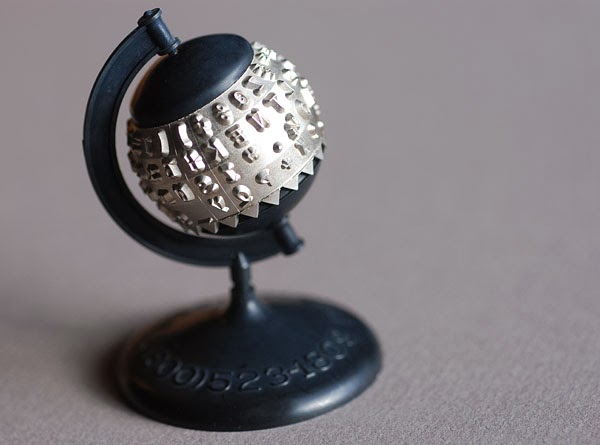
This awesome type globe was recently purchased by typography enthusiast Jennifer Kennard. The globe was never intended to be a decorative object—it is an interchangeable type ball or “golf ball” for the IBM Selectric typewriter. The ball allowed Selectric users to rapidly swap in different fonts, scripts (Hebrew, Thai, etc.), even choreography symbols known as Labanotation.
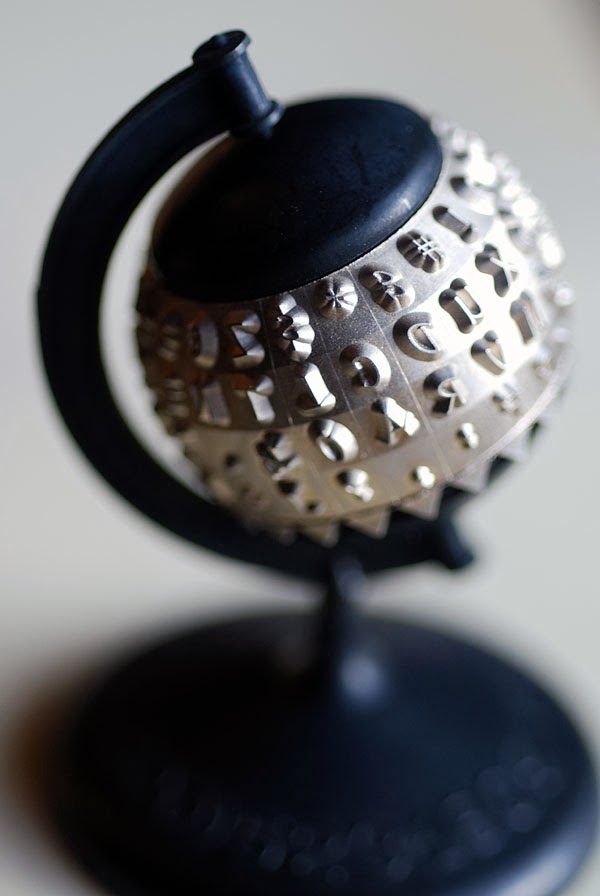

photos by Jennifer Kennard
via Nerdcore
firehose likes this
10 Jan 23:37
Vacationing Man Excited To Try Fast Food Franchise Not Found In Hometown
VIRGINIA BEACH, VA—Having driven to Virginia Beach to visit his sister for a brief vacation, fast food consumer and Pennsylvania native Don Turnbee expressed his interest Friday in eating at Carl’s Jr., a fast food chain not readily available ...


|
|
firehose likes this
10 Jan 23:33
Let’s Be Real: Online Harassment Isn’t ‘Virtual’ For Women
by OnlyMrGodKnowsWhy
 OnlyMrGodKnowsWhy
#triggerwarning: law school
What does an online landscape look like when the women most able to tolerate it are the same ones who are best capable of bucking up and shutting parts of themselves down?
(Click through for)
“Stock Photo: Beautiful Business Woman Scared Using Laptop Looking At Screen.” on Shutterstock
Jill Filipovic – | 12741
In January 2006, I was a student at NYU School of Law, home for holiday break. I had just gotten my wisdom teeth out. I remember that, because I was on a lot of painkillers, and I kept thinking that maybe my cloudy brain just wasn’t comprehending what I was reading on an anonymous message board created for law students, called AutoAdmit. There were hundreds of threads about me, with comments including:
"Official Jill Filipovic RAPE thread"
"I want to brutally rape that Jill slut"
"I'm 98% sure that she should be raped"
“that nose ring is fucking money, rape her immediately”
“what a useless guttertrash whore, I hope that someone uses my pink, fleshy-textured cylindrical body to violate her”
“she deserves a brutal raping”
“Legal liability from posting pic of Jill fucking?”
“she’s a normal-sized girl that I’d bang violently, maybe you’d have to kill her afterwards”
Stuck at home and going swiftly down an online rabbit hole, I spent hours reading posts that extended beyond commenting on my rape-ability into users posting dozens of photos of me, commenting on my body, rating my physical attractiveness and listing my contact information. And halfway down one of those threads, I got to this:
“I actually happen to have met her before. She’s extremely pretty in person.”
It was an innocuous comment, even a kind one. But more followed, in other threads – people who claimed to know me in real life, or said they had at least met me, or seen me, or maybe talked to an ex boyfriend of mine. They had details about what I wore to class and what I said. I felt very suddenly like there wasn’t enough oxygen in the room to fill my lungs.
The only thing I really remember when I returned to school a few days later is my head feeling detached from my body. I had a bizarre mental image of myself walking around with my skull in a fishbowl, separated from my shoulders, like a deranged skeletal astronaut. It was partly the painkillers. But it was also a mental shortcut -- a short-circuit -- to protect my own mind from the trauma that quickly ate away at my confidence, my intelligence and my basic sense of safety.
This week, Amanda Hess published an extraordinary piece in Pacific Standard on gender harassment online. She weaves her own experience with a Twitter stalker into a broader narrative of incompetent law enforcement, inadequate laws and dismissive online communities. She quotes feminist bloggers who left their homes to hide from stalkers, and police officers who don’t know what Twitter is. She breathes life into the statistic that some three-quarters of online abuse targets women, and that the very act of going online with a female name often means sexually violent comments are lobbed in your direction. She outlines legal challenges to the status quo. And she points to the psychic cost of living in a world where you are constantly told you’re a target for violence.
“When people say you should be raped and killed for years on end, it takes a toll on your soul,” Hess quotes feminist writer Jessica Valenti as saying.
We want to believe that the Internet is different from “real life,” that “virtual reality” is a separate sphere from reality-reality. But increasingly, virtual space is just as “real” as life off of the computer. We talk to our closest friends all day long on G-Chat. We engage with political allies and enemies on Twitter and in blog comment sections. We email our moms and our boyfriends. We like photos of our cousin’s cute baby on Facebook. And if we’re writers, we research, publish and promote our work online. My office is a corner of my apartment, and my laptop is my portal into my professional world. There’s nothing “virtual” about it.
For me, it has been almost eight years to the day since I sat at that old desktop and read through those AutoAdmit posts. I have since graduated law school. I worked as a corporate lawyer for almost four years, and now I have the privilege of writing full time and pursuing a career and a life that I love. I’ve been running a feminist blog for almost a decade. I’m a 30-year-old woman who has been writing online long enough to be called every name in the book – I get so many insults I’ve even turned it into a contest on my blog (all-time favorite: “lesbian ham-beast”).
And yet writing about AutoAdmit, Googling the old posts to pull up the insults and the comments and the threats — essentially re-living that trauma from years ago — has my stomach in knots.
Imagine going to work and every few days having people in the hallway walk up to you and say things like, “Die, you dumb cunt” and “you deserve to be raped” and, if you’re a woman of color, adding in the n-word and other racial slurs for good measure. Consider how that would impact your performance and your sense of safety. But you still love your job and your co-workers. That’s how the Internet feels for many of us.
I know how quickly the lines between the “real” and the virtual can blur. Before I discovered the AutoAdmit threads, I had already been blogging about feminism for a little while, and rape and murder threats weren’t new. It remains standard for people to leave comments like, “Here, babycakes, let me give you some roofies and fuck you up the ass, in the ear and up your nose until you weep and bleed” on my site. For the first year or two they shook me up. Then I learned how to roll my eyes, copy and paste them into a dedicated folder and hit the delete key. I did what all the male bloggers told me to do: I ignored the bullies, I grew such thick skin that now I worry about my lack of a fight-or-flight fear reflex, my ability to eat whatever shit is put in front of my face, how in real-life arguments with loved ones and moments of trauma I go stone-cold and it’s almost like my heart shuts off. But I bucked up. I knew how to be tough on the Internet.
And then, the summer after I graduated and was studying for the bar exam, one of the AutoAdmit posters showed up at my door.
To be more specific, he showed up at the door of my clinic office, where I was studying on a nearly empty floor at the law school. I’m keeping details spare, but he was there, and he was having a psychological breakdown for which he was later hospitalized, but of course I didn’t know that at the time. He was ranting about AutoAdmit, how I misunderstood him, how I was sending him coded messages and how he knew that I had told the whole Internet he was a bad person. I had no memory of ever seeing this person before, and I couldn’t figure out if he had come in from the street or if he was a student. He was a big dude and he was blocking the doorway, and a friend of mine and I were inside the room, she sitting at her desk, paralyzed, and me standing with him towering over me, his pupils dilated and his fists clenched and his face bright red and sweaty, and I remember very calmly thinking: “This is how it happens. This is what happens right before someone hits you.” I was doing the calculations in my head: No one will hear me if I scream, so how fast can I get to the phone before he grabs me? What number do I even call? It’s an NYU phone – what’s NYU security’s number? Do I have to dial 9 before I call 911?
He didn’t hit me. When he took a breath from yelling, I interrupted him and said I didn’t think we had actually met, and that my name was Jill, and what was his? He was confused, and eventually he backed down and he left. I went home. I became more careful about locking the door.
He showed up again last year, this time in the Feministe comment section and later in my email inbox. This time, he was threatening to kill a variety of people. This time, he threatened the wrong person – not me – and this time, he was arrested.
Of course, he’s not the only one. There was the guy who showed up my law school to tell my professors how terrible I was, and who later emailed my entire law firm at least a dozen times in an attempt to get me fired. The endless anonymous Twitter accounts set up to harass feminist bloggers. The phone calls from strangers. The comments, still, on blogs and the ones I’m sure get left on the sites of bigger publications but that my editors now mercifully delete – because deleting awful comments is someone’s actual job, now.
Most of the time, it’s fine. Delete. Ignore. Retweet for a laugh. But every once in a while, when someone says something a little too personal or that suggests they know too much, I feel like that fishbowl-headed law student again.
Trauma affects the brain in a lot of different ways, and here’s how those AutoAdmit threads affected mine: I don’t remember most of law school, except for the sharp retreat inward. As a college student, I was a self-confident loud-mouth. By that second semester of law school, nothing terrified me more than speaking in class – not only because I knew whatever I said would show up on the message board, although that was true, but because the people on the message board were probably right: I was a fat idiot, a dumb cunt who had no business being here. I wore a lot of hoodies to school because they shielded my face. I skipped classes if I suspected I would be called on. I glared at anyone who made eye contact with me. I made no friends.
As a practicing attorney, the inward turn faded a little, but it never completely went away. I avoided professional events, feeling immediately self-conscious if someone looked at my name tag a little bit too long – the legal world is small, so did they know me from the AutoAdmit boards? I dreaded the thought of clients or other counsel Googling me. I felt like an impostor, too dumb for the job I was given, a stupid interlocutor into the legal world, and someone who any day now would be discovered as a fraud.
It crept into my ability to interact rationally online and off. I knew how to take a fighter’s stance, but not how to back down. I knew how to turn my insides into steel, to weather any blow and keep going without crying or really without thinking. I figured out how to almost entirely disassociate with what was being said to me or about me. And every two or three years, something small would set me off, and it was like I had spent so long turning my entire body into ice that suddenly someone stuck a pick in me and I was cracking and splintering into thousands of little shards.
I’d take a few days off, pledge to do better on the self-care front, drink a lot of wine and put myself back together. I’d be back online with only little time lost.
I’d go to therapy, I’d go to yoga, I’d even go to a spinal surgeon who coolly informed me that law school related stress had pulled two discs in my neck out of place and contributed to a nice case of spinal arthritis, which could be managed but would cause me physical pain for the rest of my life.
I’d go back online.
I know these harassment stories are ubiquitous to the point of being boring. “Women get rape threats” is not news. Amanda Hess helpfully details the actual costs of these threats: The hours of work lost to tracking someone down online, to reporting someone to the police, to developing self-protection mechanisms when the police fail, to, in extreme cases, hiring professional enforcement for speaking gigs. For me, the costs included a law school education, professional contacts, and a robust work life.
But what about the things you can’t put a price on? How many stories weren’t written because the women who could best tell them were too afraid? How many people like me, damaged and lashing out, paid their online cruelties forward? How many women look back at the person they were before their skin thickened, before they learned how to deal, when they were a little more sure-footed, and how many of them grieve a little bit for all the good things that got lost in the process of surviving?
What does an online landscape look like when the women most able to tolerate it are the same ones who are best capable of bucking up and shutting parts of themselves down?
Jill Filipovic is a regular columnist for the Guardian's Comment is free and a blogger at Feministe. She holds a JD and BA from New York University.
--
"Stock Photo: Beautiful Business Woman Scared Using Laptop Looking At Screen." on Shutterstock
10 Jan 23:31


Coalition to fight mass Internet surveillance declares global day of action, Feb 11
by Cory Doctorow
A broad coalition of organizations -- including Boing Boing -- have joined forces to declare February 11 a day of action in memory of Aaron Swartz and against NSA Internet spying and mass surveillance. Just as we did with the SOPA fight, we're asking people who care about this to make their own personal expressions of resistance, and take the case for caring about this and fighting back to the people closest to them. Each of us knows the arguments that will convince our friends and loved ones.
The Day We Fight Back sets out a number of ways you can participate, small and large. This is a fight we can win.
David Segal, executive director of Demand Progress, which he co-founded with Swartz, said: "Today the greatest threat to a free Internet, and broader free society, is the National Security Agency's mass spying regime. If Aaron were alive he'd be on the front lines, fighting back against these practices that undermine our ability to engage with each other as genuinely free human beings." According to Roy Singham, Chairman of the global technology company ThoughtWorks, where Aaron was working up until the time of his passing:
"Aaron showed us that being a technologist in the 21st century means taking action to prevent technology from being turned against the public interest. The time is now for the global tribe of technologists to rise up together and defeat mass surveillance."
The Day We Fight Back - February 11th 2014 
|
|
Sofía Henao, Cooper Griggs likes this
10 Jan 23:31
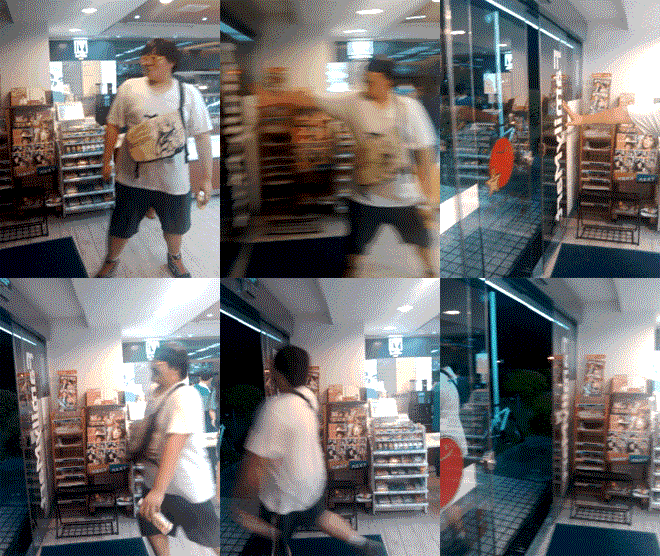
here-on-this-island: teyaberri: akuthekoboldthatcould: lukethr...
firehosevia Vjuliao
This is me all the time.
I CAN’T EVEN HANDLE THAT WALK
This pretty perfectly sums up conventions.
IT GOT BETTER

Nylonthread, Adam Victor Brandizzi and one other like this
10 Jan 23:30


Newswire: Chevy Chase and Beverly D'Angelo reuniting, again, for an ABC sitcom
firehosethe show "will mark the first TV series Chevy Chase hasn’t quit yet in a while"
Aiming to combine the comedic chemistry of the National Lampoon’s Vacation movies with the comedic chemistry of those National Lampoon’s Vacation ads for Old Navy, Chevy Chase and Beverly D’Angelo are reuniting, again, to develop a new family sitcom for ABC. Though they were recently waylaid along their path toward reconvening as Clark and Ellen Griswold—whereupon New Line shouted “Fuck yo mama” to their planned Vacation reboot—the two nevertheless realized they still shared an interest in getting paid. So they’ll couple up again, this time playing sixty-somethings whose golden years are interrupted after they’re forced to take over raising their grandchildren, whose youthful rambunctiousness and sexting on their Xboxphones will cause Chase to get hurt a lot. The show already has a production commitment under the direction of The Neighbors’ Aaron Kaplan, and will mark the first TV series Chevy Chase hasn’t ...
10 Jan 23:28

Newswire: Red Hot Chili Peppers added to Super Bowl halftime show in an attempt to appeal to "older" viewers
In an attempt to appeal to "older viewers," according to the L.A. Times, Bruno Mars has reportedly asked the wrinkled, leathery husks of the Red Hot Chili Peppers to join him during this year’s Super Bowl halftime show. While the majority of people who like the Red Hot Chili Peppers probably aren’t rocking chair-ready just yet, it’s worth noting that both Flea and Anthony Kiedis are 51 years old, making them absolutely eligible to receive all the discounted coffee and driving safety courses AARP membership allows. Drummer Chad Smith is 52, putting him that much closer to death and 4 p.m. dinner.
There’s no word yet about just how the Peps will contribute to the Pepsi halftime show, but the merger is expected to be officially announced on Fox during Saturday’s playoff game between the New Orleans Saints and the Seattle Seahawks.
Russian Sledges, firehose likes this
10 Jan 22:34
Bowie's in space in this Moonbase Alpha video
by Dave Tach
firehoseMoonbase Alpha TTS beat
surprisingly good
Moonbase Alpha player Mike Cothren extracted some David Bowie from NASA's space simulator game and published the results on YouTube this week.
The result is "Moonbase Oddity," a cover of Bowie's "Space Oddity" created using Moonbase Alpha's built-in text-to-speech capabilities. Check out the video above to see the cover of the 1969 song, which is probably best known for its first line, "Ground control to Major Tom." If you like what you hear, you can find a link to download "Moonbase Oddity" on the video's YouTube page.
It was also covered last year by Commander Chris Hadfield aboard the International Space Station. You can download Moonbase Alpha, which tasks players with colonizing the moon, for Windows PC through Steam.
firehose likes this
10 Jan 22:32
Why can't CES quit booth babes?
by Adrianne Jeffries
Maybe it’s the economy; maybe it’s the political climate. Maybe it’s the 40 percent increase in the number of exhibitors from China, as one attendee suggested to The Verge. Just as suddenly as she left, the CES booth babe is back. DTS, 808, and Canon had dancers, GoDirectInc had girls in fuzzy lion outfits with bare midriffs, and the convention center was riddled with girls in tight dresses.
— Must be female— Upbeat, friendly demeanor— Able and willing to stand up for long periods of time
The Consumer Electronics Association (CEA) doesn’t track the gender ratio at its annual trade show, but in 2014 it still draws an overwhelmingly male crowd. The number of female attendees is increasing, but CES is still a boys’ club. There’s the Japanese businessman; the bald, white American IT guy; and the nerdy college student, all yearning for a pretty girl to talk to them about technology.
Janelle Taylor was wearing a tiny silver skirt, neon pink heels, and a tiny string bikini top when I met her at the booth for Xtreme, an accessories company. She has an MBA and was attending trade shows for her marketing company when she decided to make a slight career change. "I saw girls being booth babes and I thought wow, I would be amazing at that," she says. "I get to work with amazing companies and travel and basically be their billboard."
Good booth babes know the product, and they know how to entertain. Taylor has to look good, pose for pictures, and lure people into the booth, while diplomatically deflecting their amorous advances. She believes discipline is the most important quality in a booth babe. "There’s a lot of girls that are flaky, and I think that sets a bad name for booth babes," she says. "It takes a lot. Usually we’re on our feet for about 10 hours."
I talked to about a dozen booth models at CES 2014 and observed them making small talk with attendees about where they go to school and how often they do things "like this." The booth models for CES and other Vegas conventions come from all over: some are professional models, some are students, some are locals picking up extra cash, others are actors from LA. They all complained about the same two things: having to stand all day, and getting hit on.
The perfect blonde at the TCL booth in Central Hall didn’t have to worry about the latter, however — her job came with a stool. She was not a booth babe, she insisted, although "I know exactly what you’re talking about." Her agency had gotten her the gig and all she had to do was walk visitors into meetings with executives.
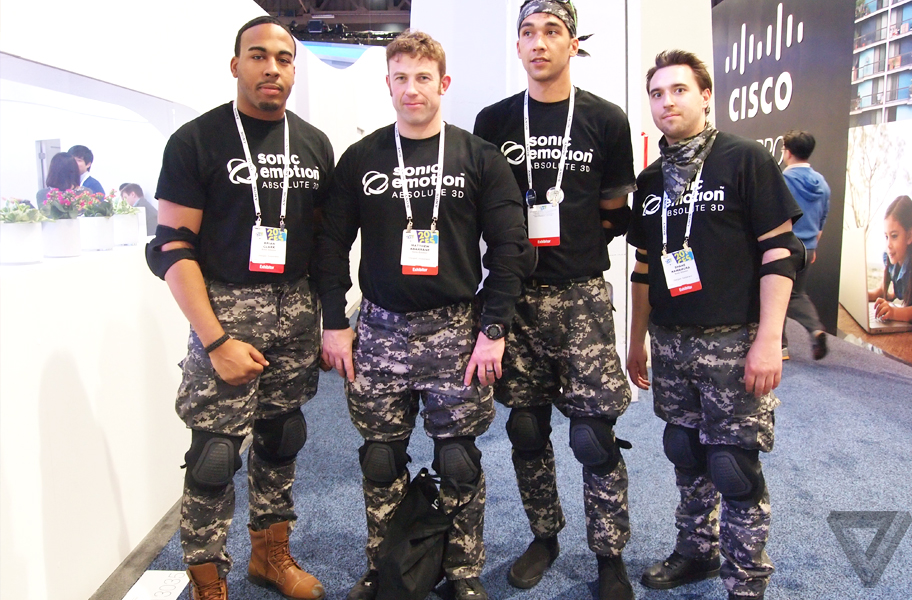
The models at Sonic Emotion, who had been recruited through Facebook, agencies, and friends, had it much harder. This year’s CES has a significant contingent of booth bros — shoutout to the studs at the Samsung booth dressed as galactic soccer players — and Sonic had employed equal numbers of male and female models for a traveling skit: groups of soldiers crawled around the show floor until they were rescued by a group of nurses handing out prescriptions for "soundicide."
Looking for male models for a VIP CES Event. You'd be handling check in along with several other models. Call time is 7:30PM. End time is 1am. $40/HR. Must be reliable, handsome, and well spoken.
The hardest part was the crawling, the bros say, though by the end of the day they’d replaced that part of the sketch by sort of lying face down in plank position. One soldier was planking like this when a woman sat on him. He didn’t break character and never saw her face. "I saw her scarf," he says.
The nurses were actually dressed rather conservatively for booth babes, their legs covered by stockings. Guys had still been coming on to them all day. "You can’t be nasty to them, obviously," they tell me. "You just laugh it off. ‘Okay, enjoy the rest of your CES!’ Then exit."
The hardest part of being a booth babe is marketing to women, the nurses tell me, especially if they have boyfriends. "They don’t want to talk to you at all. They’ll just walk around you."
I stopped by the booth for Hampoo, where three booth babes in red dresses were dusting off tablets and preparing to go home. I apologized and asked for a photo; they obliged, posing and smiling. I thanked them and turned, only to have a fat man with a high voice leap in front of me. "My turn, my turn!" he said, holding up his point-and-shoot. Suddenly a gaggle of men appeared beside him, gawking at the Hampoo girls. Two pulled out their cameras.
Looking for brand ambassadors who carry great sex appeal to attract potential clients to our booth with the ability to provide them with a brief description of the features and benefits of our brand.
The CEA actually discouraged the use of booth babes this year after a petition circulated proposing a ban on them. "The International CES’ diverse attendee base should be taken into consideration when choosing your booth talent," the exhibitor guidelines now say. "Recent news articles show that ‘booth babes’ can reflect poorly on your exhibit, so we ask that you give this thoughtful consideration, to avoid alienating or offending various audience segments." The CEA tells us that it has a "new policy in place for handling complaints, and we received no complaints during the show," adding "what we've noticed this year is more innovation, more cool new tech."
The era of the booth babe may be waning anyway as we enter the era of the booth bot. Walking around the convention center, I noticed that robots — whether they were telepresence robots that look like an iPad on top of a vacuum cleaner or gyroscopic robots that ride bikes and unicycles — easily make the best ambassadors, drawing small crowds and genuine interest. Put a robot in the corner of your booth, and you’ll get just as much attention as you would by hiring a pretty woman. The best thing about a robot? It’s impossible to dehumanize.
10 Jan 22:32
Scanadu Scout, the handheld medical 'tricorder' that measures my hangover
by Ben Popper
After his son suffered a severe brain injury in a fall, Walter De Brouwer spent nearly a year in the hospital watching over his child's recovery. The daily routine inspired him to create a simple mobile device that could assess the same vital signs nurses checked each day on his son. "As a big Star Trek fan, I wanted to challenge myself to build something that made the 'tricorder' a reality." And so Scanadu was born.
The company went on to set a record with its $1.6 million Indiegogo campaign, followed by $14 million in venture capital funding. At CES this year it showed off its new prototype for the tricorder, which it calls the Scanadu Scout. You place the device on your temple and it measures your heart rate, temperature, oxygen levels, blood pressure, and gives an electrocardiogram reading. The information is sent via Bluetooth and displayed on a smartphone app which can track your health over time and send you alerts if a vital sign looks troubling.
I tested the Scanadu Scout and was impressed with the immediacy. The second I touched it to my temple it fed back a reading for temperature and heart rate that I could see live in the app. The other vital stats took a few seconds longer to register but nothing that felt like a wait. It was a light plastic, nothing especially impressive in terms of design, but the device was easy to place and the metal felt cool and soothing when pressed against my temple, throbbing from a hangover.
Scanadu plans to begin shipping units to Indiegogo backers in March, but unfortunately they won't be available for retail for a while. The company is seeking FDA approval and is using its Indiegogo backers as a test cohort. In the meantime you can try and get in early on the waiting list for its next product, the Scanaflo, a high-tech urine-testing kit the company hopes people will use at home to monitor their health.
- Related Items health startup tricorder scanadu scanadu scout quantified self medical device scanaflo
10 Jan 22:18
Grand Opening of Soma: A Kombucha Speakeasy in St. Johns tonight
firehoseWelcome to Portland