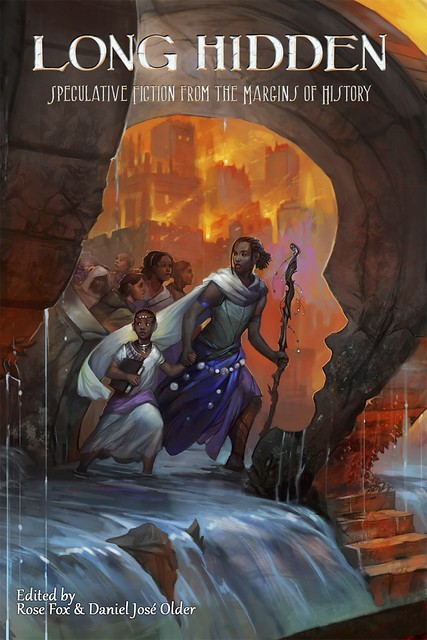
When editors Rose Fox and Daniel José Older started out to create their anthology Long Hidden: Speculative Fiction from the Margins of History, they did so with a mission: To offer stories with more than the “usual suspects” of fantasy characters and tropes — to give space to stories and people outside of the expected. Here’s how they went about doing it, and how they went about getting the means to make the anthology happen.
ROSE FOX AND DANIEL JOSÉ OLDER:
How do you transform a longstanding vacancy into an opportunity? How do you take an empty, unfriendly space, air it out, and make it welcoming? These are the challenges we faced when we set out to edit Long Hidden: Speculative Fiction from the Margins of History.
The vacancy, of course, exists in the hallowed halls of fiction—specifically historical and speculative fiction. Here we find one dominant narrative, that same singular narrative that Chimamanda Ngozi Adichie warned us about: the story of the anointed white heterosexual cisgender man saving the world. We’re over it. We’ve seen it countless times. It’s boring. And what good is a solitary thread to depict a world that’s a vast, complex, multicolored quilt?
Where one story reigns supreme, thousands and thousands of others languish untold. This is not accidental, though it’s also not always conscious. Marginalization of people and stories doesn’t come out of thin air. It’s created by a thousand decisions on the part of writers, agents, editors, publishers, librarians, and booksellers:
- “I don’t want to write marginalized characters because I worry about getting it wrong.”
- “An egalitarian culture wouldn’t be realistic.”
- “I invited submissions from authors who were already notable in the field, because their names will help sell the anthology.”
- “We’re looking for books that we know will do well in the current marketplace.”
- “Readers won’t pick up a book with a character like that on the cover.”
- “I have no idea how to promote this story. It’s really cool, but who would read it?”
- “Boys don’t read as much as girls do, so we need to encourage them with more books about boys doing boy things.”
Collectively, over a period of decades, these individual decisions steamroll non-dominant voices right off the map.
Meanwhile, our author friends have been saying very different things:
- “My story was rejected because the editor ‘couldn’t relate’ to the main character.”
- “I built a story around something that happened to me, and was told that things like that don’t happen anymore.”
- “I wanted to submit to that magazine until they published a story that was full of stereotypes about my culture.”
- “My professor told me that people like me don’t write SF/F.”
- “My fantasy novel, set in a world that’s completely different from ours, was shelved under ‘African-American Literature’ just because I’m Black.”
We decided it was time—really, long past time—to take part in the fight against the dominant narrative and make space for the truths that have gone untold. We wanted to tell the truth about our histories, not the stories that make it into textbooks, and we wanted to decolonize speculative fiction. That was the big idea that became Long Hidden.
With the expert guidance and support of our publishers, Bart Leib and Kay Holt at Crossed Genres, we set out to create an atmosphere of bravery with precision and gentleness, free from deception. Our submission guidelines (http://longhidden.com/submissions/) asked for care and empathy, because we knew we would be seeing stories of violence and sorrow as well as bravery and triumph. We couldn’t pretend away the pain that oppression has caused throughout history. We weren’t interested in narrative of the privileged savior and we said so; we also asked authors to approach the concept of revenge with subtlety and caution, knowing that the truth of history is more complex than the tables being turned. We asked for stories of friendship and family and community, because in hard times those personal connections are both threatened and vital. And we encouraged speculative elements that incorporated real-world religion, superstition, and folklore, because the supernatural has its dominant narratives too.
We invited everyone to contribute, not just big names, because we know how hard it is for even tremendously talented authors to break in. We were intentional about reaching out into communities that don’t usually see calls for submissions for speculative fiction anthologies. We extended our call out far beyond the traditional boundaries of mainstream SF/F. We approached writers who had never published before and writers who had never written speculative fiction before. We explicitly requested and welcomed stories from women, writers of color, queer and trans* writers, and disabled writers, knowing that it takes a clear invitation to overcome the general feeling in the industry that such authors and their stories are unwelcome. We offered SFWA pro rates to honor the hard work it takes to write a story of the painful past, and asked the wider community of readers to fund our project through Kickstarter so we could afford to pay our authors and artists something close to what they were worth.
The response was tremendous. Submissions and pledges poured in. In a few days, the Long Hidden Kickstarter met its goal, and soon after we’d doubled it. By the end, we’d shot far past the initial goal and beyond what any of us had thought possible. People gathered en masse to declare that this was a space that needed to be opened in the closed ranks of both speculative and historical fiction.
Twenty-seven stories emerged from the many, many amazing ones we’d been sent. They were stories that collectively held a vast range of voices, scopes, characters, and unspoken truths. They were from authors around the world. They were heartbreaking and hilarious and true in the way all great fiction is. They were challenging. And most of all, they were in conversation with one another, despite depicting many different people, places, and eras. We enlisted artists with diverse backgrounds and styles to give them the illustrations they deserved.
Each story challenged our assumptions, privileges, stereotypes, doubts, fears, and uncertainties. As we worked with the authors and artists and each other, we were profoundly moved and changed by these tales of struggle, survival, triumph, and pain.
The “long hidden” stories have been here all along, as have the voices that tell them, but the industry hasn’t been listening. We’re thrilled that social media and crowdfunding have opened up new avenues for untold narratives to get their due, and we look forward to a great many more emerging into the light. Long Hidden isn’t the beginning, or the end.
—-
Long Hidden: Amazon|Barnes & Noble|Createspace
Read a story excerpt with commentary by contributor Sunny Moraine. Visit the book’s Web site. Follow editor Rose Fox on Twitter. Follow editor Daniel José Older on Twitter.





 Feminist Ideals from a Fiesty Feline:




 Mercatur projection on top of a globe, so some differences are unavoidable. Map credits: National Geographic | Reddit Baseball
 English Premier League