/https%3A%2F%2Fblueprint-api-production.s3.amazonaws.com%2Fuploads%2Fstory%2Fthumbnail%2F34144%2F4eb59f7e-705e-4e12-8707-849e1a18a55f.jpg)


The educational kids toy 'KUBO' uses an intuitive puzzle-based design to help kids learn coding, math, language and music. Read more...
More about Robots, Robot, Real Time Video, Real Time, and Robot Coding
The educational kids toy 'KUBO' uses an intuitive puzzle-based design to help kids learn coding, math, language and music. Read more...
More about Robots, Robot, Real Time Video, Real Time, and Robot Coding
The Nintendo Wii U era was a time period that the gaming company would rather soon forget. It was the worst-performing console in its history and it indicated a dark time for the company as it tried to compete against its competitors. With the coming of the Nintendo Switch, the company hopes that they learned their lessons from the Wii U and that consumers will respond better to their new consoles.
As further proof that the company wants to put the Wii U behind them, Nintendo of America President Reggie Fils-Aime announced that the upcoming Zelda: Breath of the Wild game will be the last game they make that will be compatible with the Nintendo Wii U, according to Polygon.
“From a first-party standpoint, there’s no new development coming after the launch of the legend of Zelda: Breath of the Wild,” he said. “We really are at the end of life for Wii U.”
He added that Nintendo did indeed take many valuable lessons from its time with the Wii U. One of the main lessons was that they realized that they need to make products that consumers can unitedly define what that product is.
“Even today when I ask people, ‘so what was Wii U all about?’ I get a wide variety of responses. In managing the business, that’s just not good.”

With Nintendo’s financial results briefing for the 2012-13 fiscal year, the company’s late president Satoru Iwata analyzed that they were unable to “solidly communicate the product value of Wii U” to their market. “Some have the misunderstanding that Wii U is just Wii with a pad for games, and others even consider Wii U GamePad as a peripheral device connectable to Wii.”
Additionally, by the name and the marketing of the console, the Wii U appeared to be the original Wii with added accessories rather than a brand new console. The Switch feels more like a brand new console over the Wii more than the Wii U ever did; at least that’s what Nintendo hopes their market sees.
“What third parties want [is] a large, growing install base, a development environment that’s easy for them to work in, they want the ability to monetize their content, whether on the initial sale or downloadable content,” Fils-Aime told ProJared. “That’s what they want. And we were not able to deliver that fully on the Wii U.
The Wii U having a second screen did not make things any easier for third-party game developers. It is likely that having to adjust their games to make use of the second screen on the controller turned many developers away from the Wii U, as the extra work that they needed to comply with the console’s specifications wasn’t worth it.
Even first-party Wii U games themselves are not receiving much support from the company beyond this point. Nintendo indicated that the Switch console will not be backwards compatible, meaning that it will be unable to play games from previous generations of Nintendo consoles, says Kotaku UK.

With the Wii U now behind us, it will be interesting to see how the market reacts to the Nintendo Switch one it releases. DFC Intelligence, a video game industry analyst firm, predicted that the new console would sell 40 million hardware units by the end of 2020. That would be nearly triple the amount compared to the Wii U in the same amount of time, according to GamesIndustry.biz.
If the actual numbers end up being close to that prediction, chalk that up as a win for Nintendo. One thing is for sure: there is more excitement in the Switch than there ever was with the Wii U.
[Featured Images by Nintendo]
Nintendo Wii U: Death Of A Console As ‘Zelda Breath Of The Wild’ Will Be Its Last Game is an article from: The Inquisitr News
Kids often have their first exposure to robots in school using Lego Mindstorm kits. Now Lego is rolling out Boost — a robotic kit targeting all Lego builders from 7 years old and up. The kit is scheduled to be on the market later this year (it appeared at the recent CES) and will sell for about $160.
[The Brothers Brick] had a chance to try the kit out at CES (see the video below) and you might find their review interesting. The kit provides parts and instructions to build five different models: a cat, a robot, a guitar, a 3D printer, and a tracked vehicle. You can check out the official page, too.
 The system communicates with an Apple or Android tablet via Bluetooth. The review notes that the programming language is a bit simplistic, allowing actions to occur due to stimulus, but no real conditional tests and branches. In addition to motor control, the device comes with blocks that can sense motion and color (see right). Builders can integrate the blocks with other Lego designs, too.
We’ve seen lots of additions and enhancements to Mindstorms (along with lots of interesting applications). It will be interesting to see what hacks appear for Boost.



You’re hurrying along the sidewalk on the way to work, running late and not in the greatest mood, when you see a sign in the adjacent field that simply reads “PLEASE WAIT HERE, YOUR FUTURE SELF WILL MEET YOU SHORTLY.” How does that affect your day? Little moments like these can bring some much-needed levity to the world around us, especially in dark times.


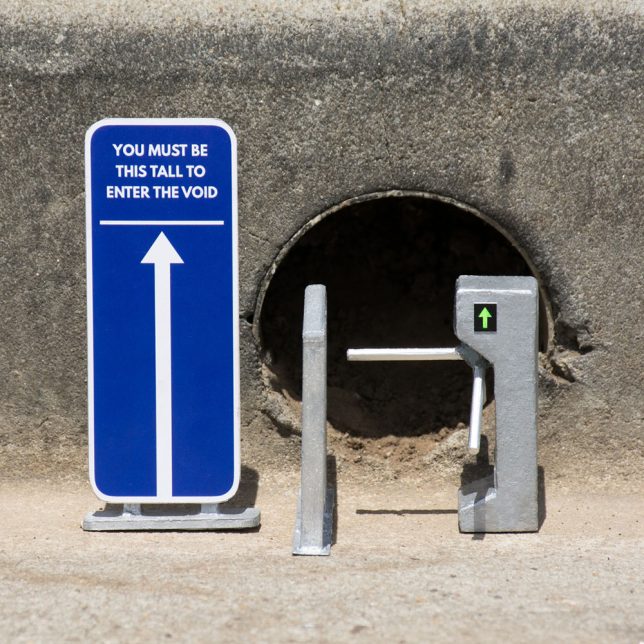
Impeccably produced, often enticing you to push a button or take a card, these guerrilla installations look pretty legit until you stop to read what they say. They’re easy to miss, if you’re hustling too quickly and tuning out your surroundings – but if you take a moment to notice them, they might just make you smile.




Artist Michael Pederson (aka Miguel Marquez Outside) creates these little interventions and puts them up all over his home city. Sometimes they’re site-specific, referring to things that can be found in the local environment, like a hole in the curb or a sidewalk that ends abruptly.
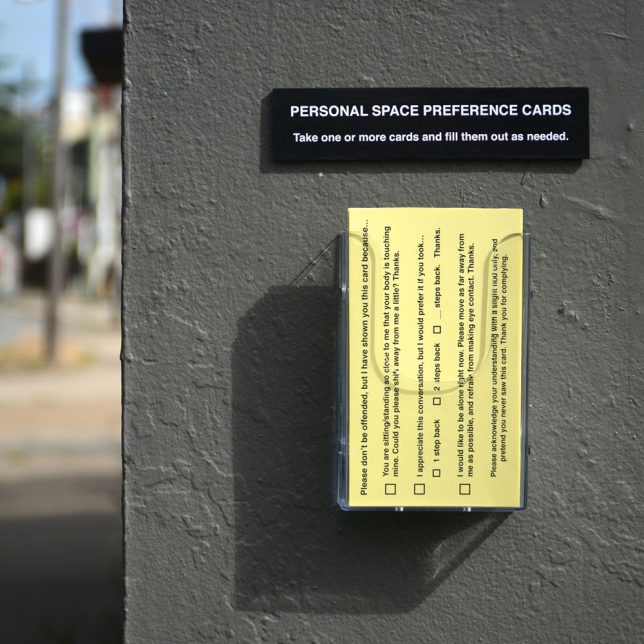
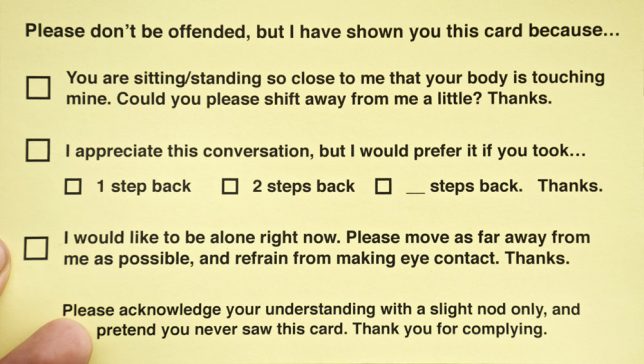
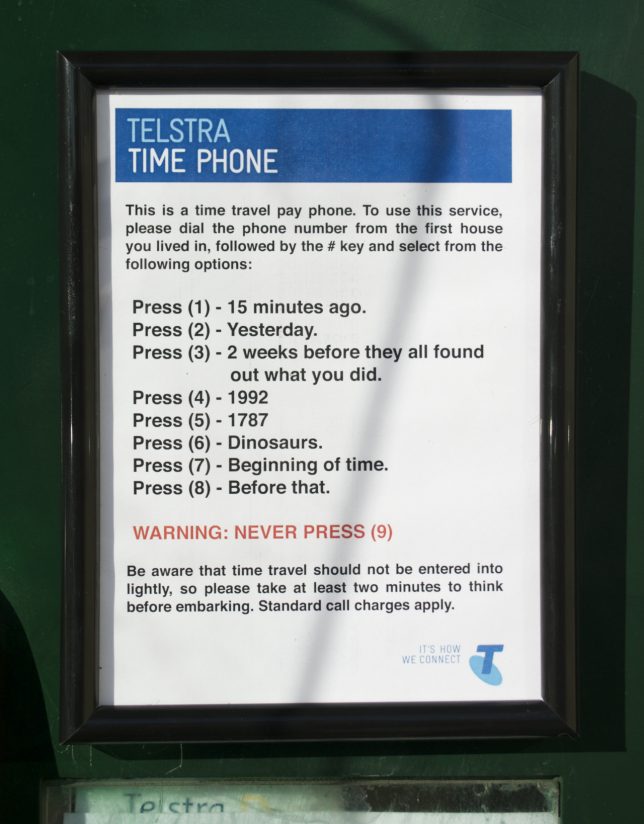
The personal space cards would actually be pretty handy, and who wouldn’t be tempted by a time travel pay phone? Check out more of Pederson’s work at his tumblr and Instagram.
It’s all too easy to get stuck in a routine, walking through the city on autopilot without even noticing what’s around you. Urban guerrilla street artists seek to shake things up, force you ...
How much more welcoming would a city environment seem if it were filled with friendly creatures? German artist Timm Schneider is filling Weisbaden with very strange beings that are not only ...
Everyday objects and imperfections in the urban surfaces of Paris become part of strange and unexpected scenes as French artist Levalet incorporates them into life-sized street art. A bull head ...




Many people surf the internet everyday but give little thought to the fact that people are continually uploading graphic content to the web, including videos of torture and violence, animal cruelty, footage of terrible accidents, and child pornography. There are people that are employed to specifically review content and deem it appropriate or inappropriate, and remove inappropriate content, reporting it to the appropriate authorities as in the case of child exploitation. In some cases, it can be a fine line between what is inappropriate and what is graphic but newsworthy and should be available to the public. Individuals are employed to make these decisions everyday.
Now two former Microsoft employees are suing because they claim they have developed Post-Traumatic Stress Disorder (PTSD) from viewing graphic content over prolonged periods, according to mashable. Both men are suing Microsoft for damages, alleging disability discrimination, negligence, and violation of the Consumer Protection Act.

The two men, Greg Blauert and Henry Soto, say that they were required to view graphic videos and child pornography for long periods in order to remove it to keep internet sites safe. Over time, they said, they became stressed and disturbed by the nature of the work, and asked their supervisors for help in dealing with the mental trauma that watching such footage had caused. However, the men say they were offered no type of counseling or employee assistance, but rather told to “limit exposure to depictions, take more walks and smoke breaks, and redirection of thoughts by playing video games.”
Microsoft does provide mental healthcare to members of the Digital Crimes Unit but does not extend the same healthcare to members of the Online Safety Team, where Blauert and Soto worked. Both men applied for workers compensation benefits and were denied, according to the lawsuit against Microsoft filed in court on December 30.

Microsoft denies the allegations made by Blauert and Soto, although they do not directly comment on their individual suits.
“Microsoft applies industry-leading, cutting-edge technology to help detect and classify illegal images of child abuse and exploitation that are shared by users on Microsoft Services. Once verified by a specially trained employee, the company removes the image, reports it to the National Center for Missing & Exploited Children, and bans the users who shared the images from our services. We have put in place robust wellness programs to ensure the employees who handle this material have the resources and support they need.”
The men claim that they suffer from debilitating mental and physical symptoms that have affected their ability to work, their family relationships, and contributed to the decline of their quality of life.
Henry Soto says he never wanted to work for that particular department, but had moved to Washington to work for Microsoft and was “involuntarily transferred” to the Online Safety Team within a matter of months, where his suit claims he was exposed to disturbing and graphic footage nonstop.
“…horrible brutality, murder, indescribable sexual assaults, videos of humans dying and, in general, videos and photographs designed to entertain the most twisted and sick-minded people in the world…Many people simply cannot imagine what Mr. Soto had to view on a daily basis as most people do not understand how horrible and inhumane the worst people in the world can be…He suffered from an internal video screen in his head and could see disturbing images, he suffered from irritability, increased startle, anticipatory anxiety, and was easily distractible.”
Both men are suing for discrimination, lost wages, and to have Microsoft change their policies regarding mental healthcare for those that work in the Online Safety Team Department. The monetary figure they are seeking is to be announced in court.
[Featured Image by David Ramos/Getty Images]
Former Microsoft Employees Are Suing For Exposure To Graphic Content, Developing PTSD is an article from: The Inquisitr News
Emulators are a great way to reminisce about games and software from yesteryear. [Jorj Bauer] found himself doing just that back in 2002, when they decided to boot up Three Mile Island for the Apple II. It played well enough, but for some reason, crashed instantly if you happened to press the ‘7’ key. This was a problem — the game takes hours to play, and ‘7’ is the key for saving and restoring your progress. In 2002, [Jorj] was content to put up with this. But finally, enough was enough – [Jorj] set out to fix the bug in Three Mile Island once and for all.
The project is written up in three parts — the history of how [Jorj] came to play Three Mile Island and learn about Apple IIs in the first place, the problem with the game, and finally the approach to finding a solution. After first discovering the problem, [Jorj] searched online to see if it was just a bad disk image causing the problem. But every copy they found was the same. There was nothing left for it to be but problem in the binary.

It’s a tale of disassembly and dredging though decades-old scanned literature. The key to the bug was found in a copy of the Micro 6502 Journal from June 1980. If you don’t want the story spoiled, stop here — the problem came about when someone copied an Apple DOS 3.1 version of the game to an Apple DOS 3.3 disk. The disk formats aren’t backwards compatible, so the 3.3 disk version would only play on a DOS 3.3 machine. However, the game’s code uses bytecodes in the save routine that refer to DOS 3.1 functions that had changed in DOS 3.3. It was by searching for this bytecode that the journal popped up on Google with a hint. The article mentions the changes in bytecodes between DOS versions, giving [Jorj] the clue he needed to solve the mystery.
In the end, to get the game to function properly under DOS 3.3, all that was required was to change the code to point to the proper register for DOS 3.3. With this done, the finishing touch was a modified title screen highlighting [Jorj]’s hard work. Credit where credit is due.
Kindly, [Jorj] has uploaded the fixed game for the world to enjoy (.gz file download)! It’s always great to see people still working with and enjoying these old systems. The Apple IIGS even got itself an OS update at age 29.


/https%3A%2F%2Fblueprint-api-production.s3.amazonaws.com%2Fuploads%2Fcard%2Fimage%2F339804%2Fe3d7e370-f216-43a8-880f-cc46c5223a39.jpg)
LAS VEGAS — The classic Polaroid camera just got revamped for the modern day.
While Polaroid has previously launched instant print cameras mixed with digital such as with the Polaroid Snap, its newest project, Polaroid Pop, mashes digital and analog in a way that actually makes sense.
The digital camera features a 3.97-inch touchscreen LCD for framing shots and menu navigation. Boasting a 20-megapixel CMOS sensor, the pictures will definitely be clearer than the classic camera's, but some things will look the same.

Image: LILI SAMS/MASHABLE
Polaroid is ditching its mini film for the Pop and bringing back the nostalgic 3x4” picture format most people associate with the brand. The classic border logo will fit around the picture, so aside from quality, it will look like a classic polaroid. However, the Pop uses ZINK Zero Ink paper, which is water- and tear-resistant and has a sticker back. Read more...
More about Polaroid Pop, Polaroid, Ces 2017, Tech, and Watercooler


Read more of this story at Slashdot.
 For over a year, the government has worked to establish secure connections to all federal websites, protecting visitors from malware and tracking. And although it didn’t meet the White House goal of having all federal websites served over secure HTTPS connections by Dec. 31, 2016, the government has made significant progress, outstripping the private sector in its adoption of… Read More
 We've explored such a small part of the ocean that we know more about the moon and Mars. This new three-dimensional map can help us get more acquainted with the body of water that occupies most of our planet, though. It sorts water masses around the...
/https%3A%2F%2Fblueprint-api-production.s3.amazonaws.com%2Fuploads%2Fcard%2Fimage%2F335567%2Faa93b9e1-ad04-418d-a076-38b45367b799.jpg)
LAS VEGAS — Smart devices have a problem. Most of their magic requires that they connect to the internet, but the internet can be a dangerous place.
Malware is everywhere, and when it infects connected gadgets, it can be a problem for everybody.
But a new class of device is rising to combat this trend, and it's on full display at CES 2017.
SEE ALSO: 10 tech trends that will rule CES 2017
Late last year the term "botnet" became a buzzword thanks to a major cyberattack on Dyn, one of the companies that provides some of the basic infrastructure of the internet. Hackers were able to employ a network of infected smart devices — thermostats, security cameras, routers and who knows what else — from all over the world — to act as one in a DDoS attack, which crippled many well-known services, including Twitter. Read more...
More about Bitdefender, Wi Fi, Norton, Routers, and Ces 2017 Fresh air? Sunlight? Who needs that mess when your kid can get all the exercise they need while exploring the Great Indoors? Here at CES, Fisher-Price debuted its Think & Learn Smart Cycle. If you think it looks like a tiny $150 SoulCycle bike wi...
French visual effects artist Maxime Causeret took a track from Max Cooper’s album Emergence and created these wonderful biologically inspired patterns and interactions.
Maxime also shows us a section of animated reaction-diffusion patterns, where simple chemical feedback mechanisms can yield complex flowing bands of colour — these forms of system were originally thought up by Alan Turing, and were part of the early seeds of the field of systems biology, which seeks to simulate life with computers, in order to better understand the systems producing the complexity we see in the living world. They were also the starting point of my main research area many years ago before I got lost in music! (where I began with the question of what patterns could be produced via reaction-diffusion forms of system as opposed to gene-regulatory network controlled patterning).
There’s a blue brain coral pattern at the 1:30 mark and a neuron-ish pattern at 2:30 that I wish would go on forever. Headphones recommended, psychoactive drugs optional. (via colossal)
Tags: biology Max Cooper Maxime Causeret mesmerizing music videoA teardown analysis of the Samsung Note 7 claims that the ill-fated phablet was doomed by a design flaw that squeezed its battery pack to unsafe pressure levels.…

Kanye West seems to be recovering nicely after falling ill at his own concert earlier this month. He’s about to kick off a five-night stint in California, then he’ll basically be performing through the end of the year. Clearly, this is a man who bleeds—or at least endures nausea—for his fans and art. That kind of dedication is usually the stuff of biopics, but not for West. If and when his life is dramatized for the big screen, the Life Of Pablo rapper wants a humorous take on it. That’s according to Metro, which cites a Daily Star report that West not only wants a comedic biopic, but he wants Will Ferrell to play him in the film.
The U.K. publication’s source is supposedly a Kanye West insider, who claims that the platinum-selling artist is eschewing a preachy rendition of his life in ...

When Double Dare premiered in 1986, it became an instant kid-friendly sensation. Hosted by Marc Summers, the gak-soaked Nickelodeon game show aired in some form or another on the network until 1993. Although the show would return years later as Double Dare 2000 with host Jason Harris, the Summers years were the show’s glory days, a bacchanal of gloppy intensity and genial after-school gaming, something that former viewers, now in their 30s or middle-aged, have come to remember with increasing fondness as the years have gone by.
This Wednesday night, Nickelodeon will air a special commemorative episode of Double Dare celebrating the show’s 30th anniversary year. Summers will return, along with announcer John Harvey and production assistant Robin Russo. In the spirit of that super sloppy reunion, The A.V. Club set out to discover the origins of the obstacle course, the show’s most memorable and popular ...
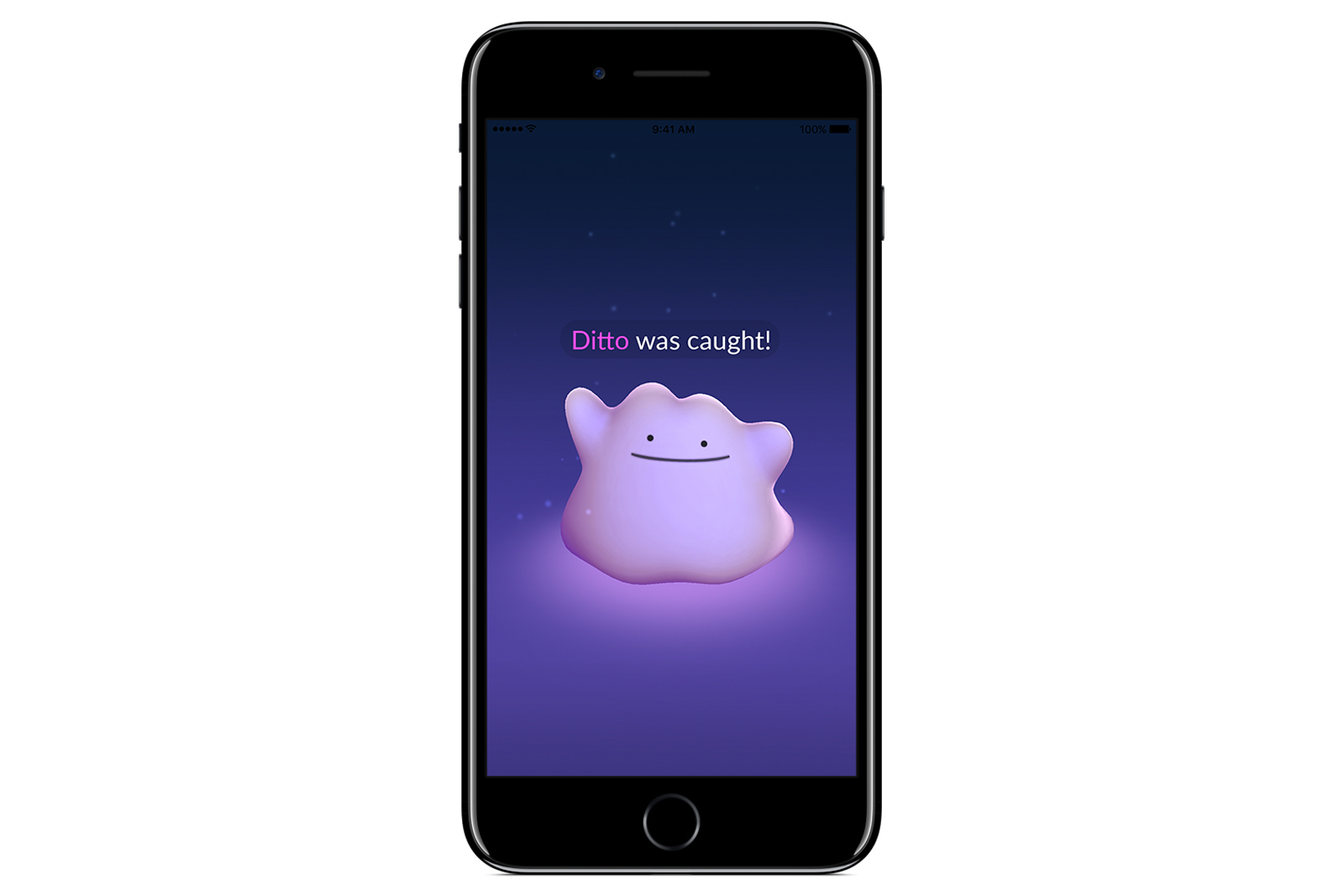 That didn't take long. Mere days after leaks hinted that Pokémon Go would get more monsters, Niantic and The Pokémon Company have rolled Ditto into the game. The critter is a shape-shifter that won't reveal its true form until you captu...