Shared posts

27 May 11:45

Áttűnés: Privát kód

by Studiolum

Sok évvel ezelőtt Tbilisziben vezettem először automata sebváltós autót. Hogy ne a városi forgalomban kelljen gyakorolnom az új technikát, először Lloyd ült a volánhoz, aki odahaza, az Államokban sokat vezetett, de Európában még soha. Az első kereszteződéshez érve megkérdezte: „Mit jelent az a piros tábla a fehér vonallal? Meg kell állni?” „Nem, Lloyd. Behajtani tilos.” Aztán: „És az a sárga rombusz?” „Főútvonal, nekünk van elsőbbségünk.” „De hát minek azt kiírni, inkább a keresztutcába tennének ki STOP-táblát.” A sokadik kérdésre gyanút fogtam, és megkérdeztem: „Nektek hány oldalas a KRESZ-könyvetek?” „Hát vagy húsz. Nálunk ilyen táblák nincsenek. Mindenkitől elvárják, hogy józan ésszel vezessen, és ha kétséges, kiírják szöveggel.”

Tapasztalatom szerint a tbiliszi sofőrök is Lloyd bölcs elvei alapján vezetnek. Nem sokat adnak a közúti táblákra, sokkal inkább privát kódokkal élnek: hangjelzéssel, villogással, kézjelekkel, átkiabálással. És az autókon olyan egyedi jelzésekkel, amelyek egyetlen KRESZ-ben sem szerepelnek, de minden közúti táblánál fontosabb információkat adnak a tulajdonosról és szándékairól.

Tbiliszi, zsidó negyed. Az utolsó hetesre vagy nem tellett, vagy olyan tökéletes rendszám csak a Messiásnak jár.

Ellenségem ellensége

Tulajdonvédelem grúz módra


in English
07 Dec 02:20

Jobs: University Professor, Leopold-Franzens-Universität Innsbruck

The University of Innsbruck invites applications for the position of University Professor of Translation Studies with a focus on Interpreting at the Department of Translation Studies of the Faculty of Humanities 2 (Language and Literature). The position will be based on a permanent civil-law employment contract with the University. Responsibilities: - Representing the subject of “Translation Studies” both in research and teaching. - A main research focus in the area of interpreting stu
20 Dec 01:35

Adjective Foods

Contains 100% of your recommended daily allowance!
11 Dec 09:59

Artist scans her own body to make ‘boob and butt’ mugs (NSFW)


Alice Lang, an artist based in Brisbane, Australia, makes utterly unique mugs that resemble anatomically correct body parts of the female form.

What sets the mugs apart is that Lang uses herself as a model. She uses 3D scanners to commit the exact contours...

14 Sep 20:30

Lazing away the summer: Some dormice start their hibernation early

Dormice (Glis glis) spend about eight months on average in hibernation. Wildlife biologists have shown for the first time that these animals can hibernate for up to 11.4 months, suggesting that this might, in fact, be a world record.
13 Dec 12:22

2013-11-29 Spike activity

by vaughanbell

Quick links from the past week in mind and brain news:

Science News reports on a ‘brain training’ app that actually seems to be a data gathering tool for big data neuropsychology research. Interesting if not a bit ethically dubious.

The US Military’s science wing DARPA wants to fix broken brains and restore lost memories. Interview with deputy director in Science.

Wired Science launches a new neuroscience blog called Brain Watch written by Mind Hacks alumnus Christian Jarrett.

Important piece in Nature about the Many Labs Project which did a mass replication of psychology studies find 10 out of 13 held up.

Slate has an excellent, explicit discussion of the results from the UK’s National Survey of Sexual Attitudes and Lifestyles.

Neurobonkers has an excellent piece reviewing the psychological biases that affect forensic science analyses.

Robots, the ‘uncanny valley’ and identity. Interesting piece in The Telegraph.

The Las Vegas Sun reports on a couple being released from prison after 21 years as evidence for ‘ritual satanic abuse’ based on ‘recovered memories’ and un-validated physical examinations is deemed to be flawed.

A new NeuroPod podcast has hit the wires – this one being a special from the 2013 Society for Neuroscience conference.

Discover magazine reports on a study finding that surprisingly, the more two negotiators match each other’s language styles, the worse things are likely to go.


24 Oct 08:05

Scraping the bottom of the biscuit barrel

by vaughanbell

As a wonderful demonstration how media outlets will report the ridiculous as long as ‘neuroscience’ is mentioned, I present the ‘Oreos May Be As Addictive As Cocaine’ nonsense.

According to Google News, it has so far been reported by 209 media outlets, including some of the world’s biggest publications.

That’s not bad for some non-peer reviewed, non-published research described entirely in a single press release from a Connecticut college and done in rats.

The experiment, described in five lines of the press release, is this:

On one side of a maze, they would give hungry rats Oreos and on the other, they would give them a control – in this case, rice cakes. (“Just like humans, rats don’t seem to get much pleasure out of eating them,” Schroeder said.) Then, they would give the rats the option of spending time on either side of the maze and measure how long they would spend on the side where they were typically fed Oreos…

They compared the results of the Oreo and rice cake test with results from rats that were given an injection of cocaine or morphine, known addictive substances, on one side of the maze and a shot of saline on the other. Professor Schroeder is licensed by the U.S. Drug Enforcement Administration to purchase and use controlled substances for research.

The research showed the rats conditioned with Oreos spent as much time on the “drug” side of the maze as the rats conditioned with cocaine or morphine.

Needless to say, South American drug lords are probably not shutting up shop just yet.

But this is how you make headlines around the world and get your press release reported as a ‘health story’ in the international media.

As we’ve noted before, the ‘as addictive as cocaine’ cliché gets wheeled out on a regular basis even for the most unlikely of activities but this really takes the biscuit (“Bad jokes addictive as cocaine” say British scientist’s readers).

However, the alternative conclusion that ‘Cocaine is no more addictive than Oreos’ seems not to have been as popular. Only Reason magazine opted for this one.

The reason that this sort of press release makes headlines is simply because it agrees with the already established tropes that obesity is a form of ‘addiction’ and is ‘explained’ by some vague mention of the brain and dopamine.

The more easily we agree with something, the less critical thinking we apply.
 

Link to a more sensible take from Reason magazine.


14 Oct 18:10

Ayn Random

In a cavern deep below the Earth, Ayn Rand, Paul Ryan, Rand Paul, Ann Druyan, Paul Rudd, Alan Alda, and Duran Duran meet together in the Secret Council of /(b[plurandy]+b ?){2}/i.
11 Oct 08:56

Christopher Columbus was awful (but this other guy was not)

by Matthew Inman
Christopher Columbus was awful (but this other guy was not)

Happy Bartolomé Day.

View
03 Sep 08:15

Why the other queue always seem to move faster than yours

by tomstafford

Whether it is supermarkets or traffic, there are two possible explanations for why you feel the world is against you, explains Tom Stafford.

Sometimes I feel like the whole world is against me. The other lanes of traffic always move faster than mine. The same goes for the supermarket queues. While I’m at it, why does it always rain on those occasions I don’t carry an umbrella, and why do wasps always want to eat my sandwiches at a picnic and not other people’s?

It feels like there are only two reasonable explanations. Either the universe itself has a vendetta against me, or some kind of psychological bias is creating a powerful – but mistaken – impression that I get more bad luck than I should. I know this second option sounds crazy, but let’s just explore this for a moment before we get back to the universe-victim theory.

My impressions of victimisation are based on judgements of probability. Either I am making a judgement of causality (forgetting an umbrella makes it rain) or a judgement of association (wasps prefer the taste of my sandwiches to other people’s sandwiches). Fortunately, psychologists know a lot about how we form impressions of causality and association, and it isn’t all good news.

Our ability to think about causes and associations is fundamentally important, and always has been for our evolutionary ancestors – we needed to know if a particular berry makes us sick, or if a particular cloud pattern predicts bad weather. So it isn’t surprising that we automatically make judgements of this kind. We don’t have to mentally count events, tally correlations and systematically discount alternative explanations. We have strong intuitions about what things go together, intuitions that just spring to mind, often after very little experience. This is good for making decisions in a world where you often don’t have enough time to think before you act, but with the side-effect that these intuitions contain some predictable errors.

One such error is what’s called “illusory correlation”, a phenomenon whereby two things that are individually salient seem to be associated when they are not. In a classic experiment volunteers were asked to look through psychiatrists’ fabricated case reports of patients who had responded to the Rorschach ink blot test. Some of the case reports noted that the patients were homosexual, and some noted that they saw things such as women’s clothes, or buttocks in the ink blots. The case reports had been prepared so that there was no reliable association between the patient notes and the ink blot responses, but experiment participants – whether trained or untrained in psychiatry – reported strong (but incorrect) associations between some ink blot signs and patient homosexuality.

One explanation is that things that are relatively uncommon, such as homosexuality in this case, and the ink blot responses which contain mention of women’s clothes, are more vivid (because of their rarity). This, and an effect of existing stereotypes, creates a mistaken impression that the two things are associated when they are not. This is a side effect of an intuitive mental machinery for reasoning about the world. Most of the time it is quick and delivers reliable answers – but it seems to be susceptible to error when dealing with rare but vivid events, particularly where preconceived biases operate. Associating bad traffic behaviour with ethnic minority drivers, or cyclists, is another case where people report correlations that just aren’t there. Both the minority (either an ethnic minority, or the cyclists) and bad behaviour stand out. Our quick-but-dirty inferential machinery leaps to the conclusion that the events are commonly associated, when they aren’t.

So here we have a mechanism which might explain my queuing woes. The other lanes or queues moving faster is one salient event, and my intuition wrongly associates it with the most salient thing in my environment – me. What, after all, is more important to my world than me. Which brings me back to the universe-victim theory. When my lane is moving along I’m focusing on where I’m going, ignoring the traffic I’m overtaking. When my lane is stuck I’m thinking about me and my hard luck, looking at the other lane. No wonder the association between me and being overtaken sticks in memory more.

This distorting influence of memory on our judgements lies behind a good chunk of my feelings of victimisation. In some situations there is a real bias. You really do spend more time being overtaken in traffic than you do overtaking, for example, because the overtaking happens faster. And the smoke really does tend follow you around the campfire, because wherever you sit creates a warm up-draught that the smoke fills. But on top of all of these is a mind that over-exaggerates our own importance, giving each of us the false impression that we are more important in how events work out than we really are.

This is my BBC Future post from last Tuesday. The original is here.


01 Sep 18:56

Can You See Your Own Brain Waves?

An intriguing new paper in the Journal of Neuroscience introduces a new optical illusion - and, potentially, a new way to see ones own brain activity. The article is called The Flickering Wheel Illusion: When α Rhythms Make a Static Wheel Flicker by Sokoliuk and VanRullen. Here's the illusion: It's a simple black and white "wheel" with 32 spokes. To see the illusion, get the wheel in your peripheral vision. Look around the edge of your screen and maybe a bit beyond - you shou
16 Aug 11:09

The arcuate fasciculus and word learning: a critique

by deevybee
The arcuate fasciculus is a white matter tract linking areas in the temporal lobe involved in interpreting speech with areas in the frontal lobe that control motor movements. Its role in language was established years ago when it was proposed that conduction aphasia, characterised by poor repetition despite good understanding and fluent spontaneous speech, was a disconnection syndrome resulting from lesions of the arcuate fasciculus.

Compared with apes and monkeys, humans have much stronger structural connections between temporal and frontal regions of the brain, suggesting that evolution of the arcuate fasciculus played a key role in language evolution.

Study of white matter tracts in the brain has advanced rapidly since the advent of diffusion tensor imaging (DTI). DTI makes it possible to measure parameters such as fractional anisotropy and radial diffusivity, indirect measures of myelination and/or axonal density within white matter.

Use of DTI has revealed an intriguing aspect of the arcuate fasciculus: it shows wide individual variation. In most people, the left arcuate fasciculus is larger than the right, but in some a more bilateral pattern is seen, and in others, a right arcuate fasciculus may not be visible on DTI. This immediately raises the question of whether this individual variation corresponds to functional differences in language ability. Two studies considered whether the degree of lateralisation of the arcuate fasciculus related to language level, but they obtained conflicting results. Lebel and Beaulieu (2009) found that laterality of the arcuate fasciculus, measured on diffusion tensor imaging, was modestly correlated (r = 0.32) with receptive vocabulary in 68 children, with the highest scores for those with strong left lateralization. However, a study of adults found no relation between left lateralization of the arcuate fasciculus and vocabulary; instead, higher verbal memory was found to be associated with weak lateralisation.

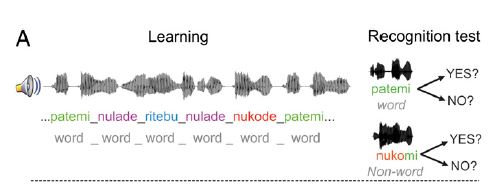
A couple of weeks ago, López-Barroso et al published a paper in the Proceedings of the National Academy of Sciences claiming that structural and functional  measures of the left arcuate fasciculus predicted word learning ability. The authors started with 27 young adults who had brain scans that yielded measures of structural and functional connectivity between temporal and frontal language areas of the brain. Twenty of these individuals also did a learning task while in the scanner. They heard a rapid sequence of novel words, each consisting of three syllables, and were asked to concentrate on them, as they would be asked to recognise them later. After this learning phase, they were presented with the same nonwords mixed in with other nonwords made from the same syllables in a different order, and were asked to make a left or right keypress to indicate if each item was familiar or not. Their responses were transformed into a measure called d-prime, which indicates how well the person discriminates between familiar and unfamiliar items.
Figure 1A from López-Barroso et al, showing the learning task 

From previous research, one might have expected to see an association between nonword learning and lateralisation of the arcuate fasciculus. This was not found, but accuracy in the nonword learning task was significantly correlated with structural and functional measures of strength of connectivity in the left hemisphere. The authors’ conclusion is given in the title of the paper: “Word learning is mediated by the left arcuate fasciculus”.

Given what we know about the arcuate fasciculus, this is a plausible finding, but how robust is the evidence? I think there are at least three problems with this study, which lead me to be cautious about accepting its claims.

First, there is the perennial problem of multiple comparisons. The authors considered three different DTI measures (number of streamlines, fractional anisotropy and radial diffusivity) for left and right sides of four tracts (arcuate long, arcuate anterior, arcuate posterior, and inferior fronto-occipital fasciculus). They used, however, a Bonferroni correction appropriate for 8 correlations (p = .0062) rather than for 24 correlations (.002).  None of the reported correlations is significant if the appropriate correction is used.

Second, the authors emphasised that the correlation between word learning and radial diffusivity was significant only for the direct arcuate tract in the left hemisphere. This, however, confuses difference in significance levels with significance of differences: as Nieuwenhuis et al (2011)  remarked: "when making a comparison between two effects, researchers should report the statistical significance of their difference rather than the difference between their significance levels". Table 1 shows the correlations of radial diffusivity with nonword learning for different regions, with 95% confidence intervals added, and it is clear that there is overlap between these. In other words, these correlations do not differ significantly from one another. See here for further discussion of these issues.
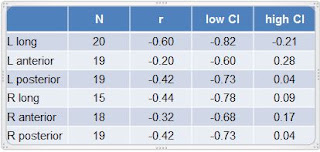
Table 1: Correlations (r) between nonword learning and radial diffusivity in different pathways, with 95% confidence intervals
In this study, the problem is compounded by the fact that different subsets of individuals are included in the correlations for different brain regions. It is not unusual to have to exclude participants from DTI studies because of measurement difficulties, but this does mean that when comparing one brain region with another one is not comparing like with like. And since statistical significance depends on sample size, if this varies from brain region to brain region, this further complicates interpretation. This is evident from Figures 2 and 3 of the López-Barroso et al paper; in both cases the absolute value of the correlation is .42, yet for radial diffusivity of the right posterior segment, this is dismissed as nonsignificant (with N = 19), whereas for the  fMRI analysis it is heralded as significant (with N = 25).

To establish what results would look like if the same subset of participants was used in all analyses, I requested the raw data for radial diffusivity from the first author, who kindly provided it. There were just 13 participants with DTI data for all brain regions: if analysis was restricted to them, then just one of the correlations with word learning was significant by the authors' criterion, that with the right posterior arcuate fasciculus (r = .73, p = .005). This analysis does not prove that this pathway is important: rather, it emphasises that a similar pattern of associations is seen in all pathways, and the study  is underpowered to detect reliable associations, particularly if the interest is in selective associations with one pathway and not another.

Perhaps of greatest concern, though, is the measure of ‘word learning’. For a start, this was not word learning in the usual sense, as the participants were not required to associate speech sounds with meanings. Instead, they had to recognise familiar strings of meaningless sounds. There is a serious oddity about the results. Measures of d-prime usually range from zero (no ability to discriminate familiar from unfamiliar items, i.e. chance performance) to 2 or 3 (highly significant ability to discriminate familiar from unfamiliar items). But in this study, five of the twenty participants obtained negative values of d-prime. A negative value means performance is below chance: i.e., the person was more likely to treat the unfamiliar items as familiar, and vice versa. This is frankly weird, and makes one wonder whether some participants simply got confused about which key corresponded to which response. The authors give a different explanation: “Negative values indicate discrimination is achieved but individuals segmented incorrectly, classifying nonwords as words of the artificial language.” I find this unconvincing, as it would only make sense if the distractor items were made by taking sequences from the original input that crossed word boundaries: this does not seem to have been the case. But even if it were the explanation, does it make sense to treat those who discriminate the nonwords, but segment them wrongly, as doing worse on word learning than those who don’t discriminate the nonwords at all?

Does this matter? I re-ran the correlations excluding four participants with a negative d-prime value of less than -0.42 (which as far as I can work out corresponds to below chance performance). The correlations no longer reached conventional levels of statistical significance, and the largest value was now for a right-sided pathway. This is pretty meaningless, however, because the sample size, already small, becomes so tiny that one cannot do an adequately powered test of the association. The best one can say is that ‘further data are needed’.

I hope the authors will look further at this issue, as the role of the arcuate fasciculus in language  learning is fascinating and potentially important. One possibility would be to look at the associations between vocabulary level and analogous connectivity measures in the sample of 50 adults reported by Catani et al (2007), where the same DTI methods were used.

After I had drafted this critique, I Googled to see if anyone else had blogged about this study. I didn’t find blogs, but I did find extensive media coverage. I was astonished to see that, in discussing implications of this study, one of the authors, Marco Catani, a respected expert in tractography, appeared to be channeling Susan Greenfield. He was quoted as claiming that children’s vocabularies will be restricted by their use of iPads. The newspapers have picked up on these quotes, coming out with headlines such as: “Experts say too much time is spent learning via tablets and computers. Children's vocabulary could be stunted because they listen to teachers and parents less.”  For further sensationalist and misleading accounts, see here and here.

Just to be clear, this was a study looking at structural and functional brain connectivity in relation to a task that involved extracting syllabic patterns from auditory input. It did not feature children, vocabulary learning or iPads.

It really does a disservice to families of children with language learning problems to come out with scaremongering claims about modern technology on the basis of no hard evidence. And, for the record, auditory input is not the only way to learn new words: reading provides an  increasingly important route for vocabulary learning as children grow older.


Reference López-Barroso D, Catani M, Ripollés P, Dell'acqua F, Rodríguez-Fornells A, & de Diego-Balaguer R (2013). Word learning is mediated by the left arcuate fasciculus. Proceedings of the National Academy of Sciences of the United States of America, 110 (32), 13168-73 PMID: 23884655

19 Jul 18:34

Chomsky and Foucault: Was their 1971 debate the worst blind date of all time?


Snippets of this classic debate between Noam Chomsky and Michel Foucault have been wafting about online for ages, but I think it’s only been posted in full relatively recently, and is well, well worth a thorough viewing…

Which is not to say that it’s a great debate exactly. Initially, indeed, it’s a veritable orgy of awkwardness, resembling something like the worst blind date of all time. The interlocutors come across as chalk and cheese, both philosophically and personally. And despite a fair showing of professional courtesy in what they say, their expressions (while the other is talking) tell another story : Chomsky tending to eye Foucault as if the latter is a louche and ludicrous fraud, and seeming to be constantly having to swallow a smirk, while Foucault, accordingly, gazes at Chomsky as if near stupefied by the intellectual credulity of this American super-ninny.

There is some more elevated fun to be had here, too, mind. Both thinkers offer very lucid formulations of their fundamental outlook, and these outlooks do seem peculiarly, pointedly inverse, so much so in fact that for some time they can’t even seem to engage with one another (as is tediously emphasized by the strange Dutch commentator figure, who introduces it and then twice inexplicably bobs up to be incredibly boring straight at the camera for three or four minutes—just warning you about that one).

Once they get into the topics of morality and politics, however, the discussion comes to life, and so much so that, by the end, Chomsky’s looking at Foucault in an entirely different fashion—namely, as if the latter might just be some kind of moral monster.

Best of all though, is the audience, which seems composed entirely of members of krautrock group Can in various, slight, shifting disguises.
 

19 Jul 17:33

SpecGram—The Far Side of the Real, Part I—Trouble like Nobody’s Business—Paul Cain

The call came as I was listening to Lou Christie’s one-man performance of Lucia di Lammermoor. While it’s not as polished as Frankie Valli’s version of Norma, it afforded him a fine showcase for the whiff of insanity lurking in all his songs. I had a copy as partial payment for a case I’d cracked tracking down the mastermind behind a bootleg edition of the Scratch’n’Sniff Edition of the Cantatas of J.S. Bach; a grateful academic music publisher arranged me and my external hard drive access to the archives of one of the larger university music schools. The recording was a plum of the haul. Back in the salad days of the 70s, a rich alum with a taste for bel canto and a weakness for falsetto pop-meisters had commissioned a series of recordings of his favorite operas as a showcase for the singers he loved and the student orchestra he tolerated to keep their pots boiling; in a fit of inspiration, he had all the roles in each opera sung by one man as a way of ensuring greater artistic cohesion, unity of musical language, and suchlike guff. A solitary record of each performance was pressed during the fellow’s lifetime for his personal collection, but after his death the school, seeing a gold mine, released Del Shannon’s version of La Cenerentola onto the market. After it sank like a lump of pyrite and passed from view faster than a box set of Latvian viola concertos, the school archived the rest of the recordings and soon forgot about them.
19 Jul 17:25

Flashback Friday: Self-surgery -- not for the faint of heart.

Today's post isn't exactly funny, but it is bizarre, awe-inspiring, and a little frightening. Here are three cases of DIY surgery. And we aren't talking about removing an ingrown nail; these are major surgeries. Although the excerpts of each article are longer than our usual fare, they are definitely worth reading! Auto-appendectomy in the Antarctic: case report "The ship Ob, with the sixth Soviet Antarctic expedition on board, sailed from Leningrad on 5 November 1960. After 36 days at sea
18 Jul 19:34

Why you think your phone is vibrating when it is not

by tomstafford

Most of us experience false alarms with phones, and as Tom Stafford explains this happens because it is a common and unavoidable part of healthy brain function.

Sensing phantom phone vibrations is a strangely common experience. Around 80% of us have imagined a phone vibrating in our pockets when it’s actually completely still. Almost 30% of us have also heard non-existent ringing. Are these hallucinations ominous signs of impending madness caused by digital culture?

Not at all. In fact, phantom vibrations and ringing illustrate a fundamental principle in psychology.

You are an example of a perceptual system, just like a fire alarm, an automatic door, or a daffodil bulb that must decide when spring has truly started. Your brain has to make a perceptual judgment about whether the phone in your pocket is really vibrating. And, analogous to a daffodil bulb on a warm February morning, it has to decide whether the incoming signals from the skin near your pocket indicate a true change in the world.

Psychologists use a concept called Signal Detection Theory to guide their thinking about the problem of perceptual judgments. Working though the example of phone vibrations, we can see how this theory explains why they are a common and unavoidable part of healthy mental function.

When your phone is in your pocket, the world is in one of two possible states: the phone is either ringing or not. You also have two possible states of mind: the judgment that the phone is ringing, or the judgment that it isn’t. Obviously you’d like to match these states in the correct way. True vibrations should go with “it’s ringing”, and no vibrations should go with “it’s not ringing”. Signal detection theory calls these faithful matches a “hit” and a “correct rejection”, respectively.

But there are two other possible combinations: you could mismatch true vibrations with “it’s not ringing” (a “miss”); or mismatch the absence of vibrations with “it’s ringing” (a “false alarm”). This second kind of mismatch is what’s going on when you imagine a phantom phone vibration.

For situations where easy judgments can be made, such as deciding if someone says your name in a quiet room, you will probably make perfect matches every time. But when judgments are more difficult – if you have to decide whether someone says your name in a noisy room, or have to evaluate something you’re not skilled at – mismatches will occasionally happen. And these mistakes will be either misses or false alarms.

Alarm ring

Signal detection theory tells us that there are two ways of changing the rate of mismatches. The best way is to alter your sensitivity to the thing you are trying to detect. This would mean setting your phone to a stronger vibration, or maybe placing your phone next to a more sensitive part of your body. (Don’t do both or people will look at you funny.) The second option is to shift your bias so that you are more or less likely to conclude “it’s ringing”, regardless of whether it really is.

Of course, there’s a trade-off to be made. If you don’t mind making more false alarms, you can avoid making so many misses. In other words, you can make sure that you always notice when your phone is ringing, but only at the cost of experiencing more phantom vibrations.

These two features of a perceiving system – sensitivity and bias – are always present and independent of each other. The more sensitive a system is the better, because it is more able to discriminate between true states of the world. But bias doesn’t have an obvious optimum. The appropriate level of bias depends on the relative costs and benefits of different matches and mismatches.

What does that mean in terms of your phone? We can assume that people like to notice when their phone is ringing, and that most people hate missing a call. This means their perceptual systems have adjusted their bias to a level that makes misses unlikely. The unavoidable cost is a raised likelihood of false alarms – of phantom phone vibrations. Sure enough, the same study that reported phantom phone vibrations among nearly 80% of the population also found that these types of mismatches were particularly common among people who scored highest on a novelty-seeking personality test. These people place the highest cost on missing an exciting call.

The trade-off between false alarms and misses also explains why we all have to put up with fire alarms going off when there isn’t a fire. It isn’t that the alarms are badly designed, but rather that they are very sensitive to smoke and heat – and biased to avoid missing a real fire at all costs. The outcome is a rise in the number of false alarms. These are inconvenient, but nowhere near as inconvenient as burning to death in your bed or office. The alarms are designed to err on the side of caution.

All perception is made up of information from the world and biases we have adjusted from experience. Feeling a phantom phone vibration isn’t some kind of pathological hallucination. It simply reflects our near-perfect perceptual systems trying their best in an uncertain and noisy world.

This article was originally published on BBC Future. The original is here.


18 Jul 12:10

Too many recent Japanese loanwords in English?

by Victor Mair

In "Chinese loans in English" and in "Too many English loanwords in Japanese?" we examined the propositions that Chinese borrowings into English in recent times have been very few, while English borrowings into Chinese and Japanese have been relatively numerous.  Some commenters even made the assertion that the age of borrowing is past.

In this post, I would like to suggest that — unlike Chinese, and contrary to those who believe that the age of borrowing is largely over — there has been a substantial amount of borrowing from Japanese into English going on in recent decades.  As to why this is happening in the Japanese case, but not in the Chinese case, and why there are numerous borrowings from English into Chinese and Japanese, and into many other languages as well, these are questions that might be good to take up in the comments to this post.

As a reference point, this Wikipedia article seems to offer a pretty good list of new and old Japanese borrowings into English.  See also this article in Japanese.

For our present purposes, I will consider only those terms that are fairly recent, say within the last 30 years or so.  I have not checked exact dates of borrowing, so some of these terms may have entered English more than 30 years ago, but my impression is that — for the most part — they do not go back half a century or more.  A few of the words may initially have come into English as much as a century or more ago, then lain submerged for decades, but have been revivified in recent decades.  Still, I avoid words like "yakuza", "judo", and "karate", which, though known to most Americans nowadays, I suspect of having been introduced more than half a century ago.

The Japanese terms are given in their usual American newspaper spelling, not in their proper romanization as pronounced in Japanese.

Here (below) are just a few common words that come to mind and that I personally know without having to look them up in any sort of reference work.  I believe that most literate, cultured Americans also know these words, and that they are familiar to large segments of the American population in general.  I could mention dozens of other Japanese words that are known mainly only to certain groups of Americans (e.g., chemists, biologists, physicists, etc.), but will refrain from doing so to avoid needless bloating of the list.

Note that I do not include in this list the very large numbers of new English words coined by Japanese that have worldwide circulation, words such as "walkman", "discman", "camcorder", "Betamax", "VHS", "Betacam", "Triniton Picture Tube", "Sony", "HDTV" (dating to the mid-1960s in Japan)", "Mini Disc" (abbrev. "MD"), "Pac-Man" (wildly popular when my son was in his teens), Hello Kitty (I have one hanging from the window of my office, and a colleague at Academia Sinica in Taiwan has hundreds in his office), and so forth.

I do include Japanese brand and product names, since they have become household words that are known to Americans of all classes and walks of life.

Here goes, in no particular order, though many of the words do fall into rough groups or categories (forgive me for unintentional duplicates):

  • anime
  • manga
  • karaoke
  • shiatsu
  • tsunami (probably older, but very much in the news in recent years)
  • sudoku (almost as prevalent on trains and planes at crossword puzzles, perhaps more so nowadays)
  • shiba inu
  • kudzu
  • teppanyaki
  • a(d)zuki bean
  • mikan (orange)
  • nashi (type of pear)
  • natto (slimy, sticky, stinky, fermented soybeans)
  • bento
  • ramen
  • sushi
  • sashimi
  • wasabi (could be older, but it's so popular in restaurants and at sushi / sashimi stands that I couldn't resist entering it here)
  • edamame
  • konbucha
  • Datsun
  • Honda
  • Isuzu
  • Kawasaki
  • Mazda
  • Mitsubishi
  • Nissan
  • Subaru
  • Suzuki
  • Toyota
  • Yamaha
  • Minolta
  • Nikon
  • Olympus
  • Seiko
  • Canon
  • Casio
  • Fujitsu
  • JVC
  • NEC
  • Panasonic
  • SEGA
  • Sony
  • Sharp
  • Toshiba
  • Yamaha (again)
  • Aiwa
  • Citizen
  • Daihatsu
  • Fuji
  • Hitachi
  • Konica
  • Matsushita
  • Maxell
  • National
  • Pioneer
  • Ricoh
  • Sanyo
  • TDK
  • Victor
  • Yashica
  • YKK
  • VAIO
  • Uniqlo
  • Bandai  (maker of monster toys like Diakron, marketed in the USA by Hasbro as "Transformer")
  • Pokémon
  • MITI (Ministry of International Trade and Industry)
  • Minamata disease
  • Yukawa particle
  • Kikuchi lines

Of course, everybody knows Nintendo, and they may think that "Atari" (Japanese for "a hit") is also a Japanese name, but it was actually coined by an American, Nolan Bushnell.

Naturally, there are numerous military and martial arts terms that are current in English, but I think that most of them go back to WWII, if not earlier, so I do not list them here.

Readers may also find this article by Margaret Pine OTAKE to be of interest:  "English Loanwords from Japanese:  A Survey of the Perceptions of American English Speakers" (PDF, esp. Table 1).

On the other side, i.e., E > J loanwords, this has always intrigued me greatly: a list of recent loanwords deemed important but not well understood by the National Institute for Japanese Language and Linguistics may be found here.  Click on a word to get its proposed Japanese translation, explanation, and degree of popular comprehension. For example, clicking ākaibu アーカイブ ("archive") reveals hozon kiroku 保存記録 ("conserved / saved records").

The quantity of English borrowings in Japanese is almost endless.  Sometimes I feel that virtually ANY English word can, upon occasion, be called upon for use in Japanese.  For example, here are just a few of the English words that Cecilia Segawa Seigle noticed in her reading of this morning's newspaper:

gurōbaru (global); kūru bejitaburu (cool vegetable); randamu dejitto daiyaringu (random digit dialing); reshipi shirīzu (recipe series); hōmu pēji (home page); manyuaru (manual); webbusaito (website); anaunsā (announcer); pasokon (personal computer); sutōkā (stalker); shinku tanku (think-tank); kīpāson (key person); pawāappu (power up); pātonāshippu (partnership); sumūzu (smooth); kappuru (couple; married couple, etc); haiburiddo (hybrid); daietto (diet — for food); terebi (television)

To show the extent to which such borrowings of English may go in Japanese, I once saw the following sign on the side of a truck in Kyoto:

Matsumoto   hausu   kurīningu   sābisu

マツモト  ハウス      クリーニング  サービス

I figured out immediately what it meant:  "Matsumoto House Cleaning Service".  But I was perplexed that the entire sign was written in katakana and that, aside from the surname of the proprietor (the surname might have been written in kanji as 松本 [I can't remember clearly, though I have often seen Japanese surnames written in kana]), the other words were all katakanized English!  Surely, I thought, they must be able to say "house", "cleaning", and "service" using Japanese words.

For "cleaning service", I suppose one could say something like seisō-gyō 清掃業, but that would make it sound "traditional", not "modern" like hausu kurīningu sābisu ハウス   クリーニング   サービス.  The latter is THE standard way to say "house cleaning service", and even Google Translate yields that.

In Japan, dry cleaners are customarily called kurīningu-ya クリーニング屋

As Nathan Hopson puts it:

I have told my Japanese students a million times: goods/services = katakana

That's why shirts in catalogs are burū ブルー ("blue") and reddo レッド ("red"), not ao 青 ("blue") and aka 赤 ("red").  How gauche!  What a faux pas!  The latter two terms sound so old, stuffy, and uncool!

In "Too many English loanwords in Japanese", I had suggested that "Japanese students learning English have a foot up at the start, since they already know thousands of English borrowings in their own language".  Jim Breen agrees that this is generally true, but with a few caveats:

  • the pronunciations are often mangled by the katakanaization, and if the learner can't adapt, the results are unintelligible;
  • quite often a loanword takes on a nuance which is quite missing from the original. For example, a feminisuto フェミニスト (from "feminist") is usually a male who does things like being polite to women;
  • there are masses of Wasei eigo 和製英語 ("Japanese-made English"), often concocted from fragments of loanwords. All too often a learner will trot them out under the illusion that they are real English words;
  • then there are the loanwords that are not from English. Saying "randoseru" in English won't get you far (it's from the Dutch "ransel".) Most Japanese (just like most English speakers) are happily unaware of etymology.

In response to the question "Too many English loanwords in Japanese?", another reader asked:  "How many are too many?  I mean, numerically."  To which I would reply that I don't think there can ever be any such thing as "too many loanwords."  The speakers of a language borrow as many words from other languages as they think are necessary and useful.  Loanwords enrich and empower a language, even though they may amount to 60% or more of the vocabulary of that language.

[Thanks to Bill Hannas, Linda Chance, Jim Unger, Frank Chance, Nathan Hopson, and Miki Morita]

18 Jul 12:09

First they came for the trisomies....

A new opinion piece in The New England Journal of Medicine is titled A New Era in Noninvasive Prenatal Testing. It is free, so I commend you to read the whole thing. But this is the key section, "A new, noninvasive prenatal test is poised to change the standard of care for genetic screening. Cell-free fetal DNA (cfDNA) testing requires only a maternal blood sample, can be performed as early as 9 weeks of gestation, and outperforms standard screening tests for trisomies 21, 18, and 13 in high-ris
17 Jul 12:18

Bilingual children have a two-tracked mind

Scientists have discovered insights that indicate children can learn two native languages as easily as they can learn one.
17 Jul 12:09

Inner speech speaks volumes about the brain

Whether you're reading the paper or thinking through your schedule for the day, chances are that you're hearing yourself speak even if you're not saying words out loud. This internal speech -- the monologue you "hear" inside your head -- is a ubiquitous but largely unexamined phenomenon. A new study published in Psychological Science looks at a possible brain mechanism that could explain how we hear this inner voice in the absence of actual sound.