28 Jun 14:49
by Junyi Lai, Liming Chang and Gaoqing Yuan

Organic Letters
DOI: 10.1021/acs.orglett.6b01412

28 Jun 14:27
by Zhixiong Ruan, Sebastian Lackner and Lutz Ackermann

ACS Catalysis
DOI: 10.1021/acscatal.6b01120

27 Jun 10:52
by Reji N. Nair and Thomas D. Bannister

Organic Process Research & Development
DOI: 10.1021/acs.oprd.6b00128

27 Jun 07:59
Org. Biomol. Chem., 2016, 14,6683-6686
DOI: 10.1039/C6OB01172A, Communication
Wei Wang, Xiangqing Feng, Haifeng Du
Metal-free hydrogenation of 2,7-disubstituted 1,8-naphthyridines was realized to furnish 1,2,3,4-tetrahydro-1,8-naphthyridines in high yields with up to 74% ee.
The content of this RSS Feed (c) The Royal Society of Chemistry

23 Jun 07:37
by Patricia Zhang, Chi “Chip” Le and David W. C. MacMillan

Journal of the American Chemical Society
DOI: 10.1021/jacs.6b04818

22 Jun 09:41
by Carla Alamillo-Ferrer, Marianna Karabourniotis-Sotti, Alan R. Kennedy, Matthew Campbell and Nicholas C. O. Tomkinson

Organic Letters
DOI: 10.1021/acs.orglett.6b01253

21 Jun 06:59
by Ben Gold, Robert Smith, Quyen Nguyen, Julia Roberts, Yan Ling, Landys Lopez Quezada, Selin Somersan, Thulasi Warrier, David Little, Maneesh Pingle, David Zhang, Elaine Ballinger, Matthew Zimmerman, Véronique Dartois, Paul Hanson, Lester A. Mitscher, Patrick Porubsky, Steven Rogers, Frank J. Schoenen, Carl Nathan and Jeffrey Aubé

Journal of Medicinal Chemistry
DOI: 10.1021/acs.jmedchem.5b01833

17 Jun 10:28
by Alaina M. Forbes, G. Patrick Meier, Ebenezer Jones-Mensah, Jakob Magolan
A procedure for the synthesis of biaryl ketones by a palladium-catalyzed Suzuki–Miyaura cross-coupling reaction between phenyltrifluoroborates and benzoyl chlorides is described. Organotrifluoroborates are unique to other cross-coupling reagents as they have a high functional-group tolerance and are moisture-stable. Moderate to excellent yields were obtained for all substrates tested.

A procedure for the synthesis of biaryl ketones by a Pd-catalyzed Suzuki–Miyaura cross-coupling reaction between phenyltrifluoroborates and benzoyl chlorides with moderate to excellent yields is described. Organotrifluoroborates are unique to other cross-coupling reagents as they have a high functional-group tolerance and are moisture-stable.
17 Jun 09:45
by Neeraj Kumar Mishra, Jihye Park, Miji Choi, Satyasheel Sharma, Hyeim Jo, Taejoo Jeong, Sangil Han, Saegun Kim, In Su Kim
The rhodium(III)-catalyzed tandem C–H olefination and cyclization of benzamides with various alkenes is described. This protocol provides direct access to highly substituted phthalides, which are known as crucial frameworks of biologically active compounds. In particular, the amide directing group containing a benzimidazole group facilitates the activation of aromatic ortho-C–H bonds leading to olefination intermediates, and is spantaneously converted into an acid moiety, which can further undergo the intramolecular annulation process.

The site-selective rhodium(III)-catalyzed C–H olefination and cyclization of benzamides with various alkenes by C–H bond activation is described. These transformations allow the generation of an array of C3-substituted phthalides known to be crucial scaffolds of biologically active compounds.
17 Jun 09:43
by Bowman Potter, Emma K. Edelstein and James P. Morken

Organic Letters
DOI: 10.1021/acs.orglett.6b01580

13 Jun 10:38
by Kai-Jiong Xiao, Ling Chu, Gang Chen and Jin-Quan Yu

Journal of the American Chemical Society
DOI: 10.1021/jacs.6b04660

13 Jun 10:37
by Luisruben P. Martinez, Shigenobu Umemiya, Sarah E. Wengryniuk and Phil S. Baran

Journal of the American Chemical Society
DOI: 10.1021/jacs.6b04816

12 Jun 13:10
by Megan H. Shaw
The use of sp3 C–H bonds—which are ubiquitous in organic molecules—as latent nucleophile equivalents for transition metal–catalyzed cross-coupling reactions has the potential to substantially streamline synthetic efforts in organic chemistry while bypassing substrate activation steps. Through the combination of photoredox-mediated hydrogen atom transfer (HAT) and nickel catalysis, we have developed a highly selective and general C–H arylation protocol that activates a wide array of C–H bonds as native functional handles for cross-coupling. This mild approach takes advantage of a tunable HAT catalyst that exhibits predictable reactivity patterns based on enthalpic and bond polarity considerations to selectively functionalize α-amino and α-oxy sp3 C–H bonds in both cyclic and acyclic systems.
Authors: Megan H. Shaw, Valerie W. Shurtleff, Jack A. Terrett, James D. Cuthbertson, David W. C. MacMillan
10 Jun 10:44
by Joseph P.A. Harrity, Benjamin Allen, Matthew Connolly
Abstract
A readily available cyclic carbamate 1 functions as a general precursor to a range of functionalized piperidine products via a new Pd-catalyzed annulation strategy. An asymmetric catalytic variant provides a rapid and efficient means to access these heterocycles with high to excellent levels of enantiocontrol. Finally, these richly functionalized compounds are amenable to further chemoselective elaboration.

To cut a long story short… A cyclic carbamate functions as a general precursor to a range of functionalized piperidine products through a new Pd-catalyzed annulation strategy. An asymmetric catalytic variant provides a rapid and efficient means to access these heterocycles with high to excellent levels of enantiocontrol.
08 Jun 10:21
Org. Biomol. Chem., 2016, 14,6197-6200
DOI: 10.1039/C6OB00941G, Communication
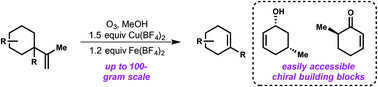
David Huang, Alexander W. Schuppe, Michael Z. Liang, Timothy R. Newhouse
An improved protocol for the formal elimination of propene from organic substrates is reported.
The content of this RSS Feed (c) The Royal Society of Chemistry

07 Jun 18:54
by Kazimer L. Skubi, Travis R. Blum and Tehshik P. Yoon

Chemical Reviews
DOI: 10.1021/acs.chemrev.6b00018

07 Jun 18:51
by Xing-Ping Zeng, Zhong-Yan Cao, Yu-Hui Wang, Feng Zhou and Jian Zhou

Chemical Reviews
DOI: 10.1021/acs.chemrev.6b00094

01 Jun 12:32
by Hongtao Lu, Zhiyue Geng, Jingya Li, Dapeng Zou, Yusheng Wu and Yangjie Wu

Organic Letters
DOI: 10.1021/acs.orglett.6b01274

31 May 14:48
by Joshua P. Barham, Graeme Coulthard, Katie J. Emery, Eswararao Doni, Florimond Cumine, Giuseppe Nocera, Matthew P. John, Leonard E. A. Berlouis, Thomas McGuire, Tell Tuttle and John A. Murphy

Journal of the American Chemical Society
DOI: 10.1021/jacs.6b03282

03 May 14:01
by Shuguang Zhou, Jinhu Wang, Feifei Zhang, Chao Song and Jin Zhu

Organic Letters
DOI: 10.1021/acs.orglett.6b00949

28 Apr 14:22
by Xiaoming Jie, Yaping Shang, Xiaofeng Zhang and Weiping Su

Journal of the American Chemical Society
DOI: 10.1021/jacs.6b01337

27 Apr 07:20
by Liangbing Fu, David M. Guptill and Huw M. L. Davies

Journal of the American Chemical Society
DOI: 10.1021/jacs.6b01941

26 Apr 12:18
by Tiago Rodrigues

Nature Chemistry.
doi:10.1038/nchem.2479
Authors: Tiago Rodrigues, Daniel Reker, Petra Schneider & Gisbert Schneider
Natural products are a prime source of innovative molecular fragments and privileged scaffolds for drug discovery and chemical biology. Advanced machine-learning approaches can help analyse and design synthetically accessible, natural-product-derived, compound libraries and provide insight into the high selectivity of such compounds.
20 Apr 07:53
by Ren-Rong Liu, Bao-Le Li, Jun Lu, Chong Shen, Jian-Rong Gao and Yi-Xia Jia

Journal of the American Chemical Society
DOI: 10.1021/jacs.6b01214

19 Apr 12:05
by Julien C. Vantourout, Robert P. Law, Albert Isidro-Llobet, Stephen J. Atkinson and Allan J. B. Watson

The Journal of Organic Chemistry
DOI: 10.1021/acs.joc.6b00466

No more posts. Check out what's trending.