26 Jul 08:48
by Laura Nunes Silva, Karine Rigon Zimmer, Alexandre José Macedo and Danielle Silva Trentin

Chemical Reviews
DOI: 10.1021/acs.chemrev.6b00184

22 Jul 11:12
by Anne L. Schöffler, Ata Makarem, Frank Rominger and Bernd F. Straub
Abstract
A dinuclear N-heterocyclic carbene (NHC) copper complex efficiently catalyzes azide–alkyne cycloaddition (CuAAC) “click” reactions. The ancillary ligand comprises two 4,5-dimethyl-1,3-thiazol-2-ylidene units and an ethylene linker. The three-step preparation of the complex from commercially available starting compounds is more straightforward and cost-efficient than that of the previously described 1,2,4-triazol-5-ylidene derivatives. Kinetic experiments revealed its high catalytic CuAAC activity in organic solvents at room temperature. The activity increases upon addition of acetic acid, particularly for more acidic alkyne substrates. The modular catalyst design renders possible the exchange of N-heterocyclic carbene, linker, sacrificial ligand, and counter ion.
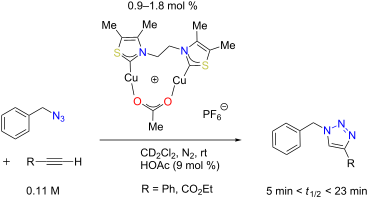
Beilstein J. Org. Chem. 2016, 12, 1566–1572. doi:10.3762/bjoc.12.151
21 Jul 13:42
by Basuli Suchand and Gedu Satyanarayana

The Journal of Organic Chemistry
DOI: 10.1021/acs.joc.6b01064

XJ, cxl and 3 others like this
21 Jul 09:44
by Satoru Arimitsu and Makoto Nakasone

The Journal of Organic Chemistry
DOI: 10.1021/acs.joc.6b01334

21 Jul 09:40
by Zhao-Jing Liu, Xi Lu, Guan Wang, Lei Li, Wei-Tao Jiang, Yu-Dong Wang, Bin Xiao and Yao Fu

Journal of the American Chemical Society
DOI: 10.1021/jacs.6b05788

XJ, cxl and 4 others like this
20 Jul 15:19
by Peng Wang, Marcus E. Farmer, Xing Huo, Pankaj Jain, Peng-Xiang Shen, Mette Ishoey, James E. Bradner, Steven R. Wisniewski, Martin D. Eastgate and Jin-Quan Yu

Journal of the American Chemical Society
DOI: 10.1021/jacs.6b04966

19 Jul 14:44
by Mylène Roudier, Thierry Constantieux, Adrien Quintard and Jean Rodriguez

ACS Catalysis
DOI: 10.1021/acscatal.6b01102

19 Jul 07:33
by Mikhail O. Konev, Elizabeth R. Jarvo

Alkyl with alkyl: A significant development in alkyl–alkyl cross-coupling reactions, namely the nickel-catalyzed decarboxylative Negishi coupling of N-hydroxyphthalimide esters, was recently reported by Baran and co-workers. This method enables the synthesis of various highly functionalized compounds, including natural product derivatives.
18 Jul 13:34
by Emily B. Corcoran
Over the past two decades, there have been major developments in transition metal–catalyzed aminations of aryl halides to form anilines, a common structure found in drug agents, natural product isolates, and fine chemicals. Many of these approaches have enabled highly efficient and selective coupling through the design of specialized ligands, which facilitate reductive elimination from a destabilized metal center. We postulated that a general and complementary method for carbon–nitrogen bond formation could be developed through the destabilization of a metal amido complex via photoredox catalysis, thus providing an alternative approach to the use of structurally complex ligand systems. Here, we report the development of a distinct mechanistic paradigm for aryl amination using ligand-free nickel(II) salts, in which facile reductive elimination from the nickel metal center is induced via a photoredox-catalyzed electron-transfer event.
Authors: Emily B. Corcoran, Michael T. Pirnot, Shishi Lin, Spencer D. Dreher, Daniel A. DiRocco, Ian W. Davies, Stephen L. Buchwald, David W. C. MacMillan
18 Jul 12:45
by Alexander J. Wagner, Shawn M. Miller, Ryan P. King and Scott D. Rychnovsky

The Journal of Organic Chemistry
DOI: 10.1021/acs.joc.6b00816

18 Jul 08:23
by Hiroki Shigehisa, Takuya Ano, Hiroshi Honma, Kousuke Ebisawa and Kou Hiroya

Organic Letters
DOI: 10.1021/acs.orglett.6b01662

18 Jul 07:10
by Masaki Hayashi, Shoshana Bachman, Satoshi Hashimoto, Chad C. Eichman and Brian M. Stoltz

Journal of the American Chemical Society
DOI: 10.1021/jacs.6b02120

18 Jul 07:03
by Paul A. Cox, Andrew G. Leach, Andrew D. Campbell and Guy C. Lloyd-Jones

Journal of the American Chemical Society
DOI: 10.1021/jacs.6b03283

18 Jul 06:58
by Matthew N. Grayson and K. N. Houk

Journal of the American Chemical Society
DOI: 10.1021/jacs.6b05074

15 Jul 13:25
by Chris Nottingham, Helge Müller-Bunz, Patrick J. Guiry
Abstract
Readily available chiral diol scaffolds are useful as sources of chirality for asymmetric synthesis, however, few such scaffolds are readily available in enantiopure form. Reported herein is a cheap and modular synthesis of a novel family of chiral ferrocenyl diols in excellent yields with excellent enantio- and diastereoselectivity (>99 % ee and 99 % de). These diols possess not only planar and central chirality, but also axial chirality around the central iron atom. Characterization of these diols by X-ray crystallography revealed intra- and intermolecular hydrogen-bond networks depending on substitution at the carbinol positions. The potential of these diols as catalysts was subsequently demonstrated in an asymmetric hetero-Diels–Alder reaction which provided cycloadducts in up to 84 % yield with ee values ranging from −92 to +72 %.

Triple crown of chirality: Reported is the synthesis of a novel family of chiral ferrocenyl diols possessing planar, central, and axial chirality. X-ray crystallography reveals dense intra- and intermolecular hydrogen-bond networks. The potential of these diols as organocatalysts was demonstrated in an asymmetric hetero-Diels–Alder reaction, thus providing cycloadducts in up to 84 % yield with ee values ranging from −92 to +72 %.
14 Jul 10:25
by Kun Zhao, Shibo Xu, Chongqing Pan, Xianwei Sui and Zhenhua Gu

Organic Letters
DOI: 10.1021/acs.orglett.6b01790

12 Jul 07:16
by Xing-Ping Zeng and Jian Zhou

Journal of the American Chemical Society
DOI: 10.1021/jacs.6b05601

11 Jul 08:42
by Yang Yang
Enantioenriched alcohols found in an array of bioactive natural products and pharmaceutical agents are often synthesized by asymmetric nucleophilic addition to carbonyls. However, this approach generally shows limited functional-group compatibility, requiring the use of preformed organometallic reagents in conjunction with a stoichiometric or substoichiometric amount of chiral controller to deliver optically active alcohols. Herein we report a copper-catalyzed strategy for the stereoselective nucleophilic addition of propargylic and other alkyl groups to ketones, using easily accessible (poly)unsaturated hydrocarbons as latent carbanion equivalents. Our method features the catalytic generation of highly enantioenriched organocopper intermediates and their subsequent diastereoselective addition to ketones, allowing for the effective construction of highly substituted stereochemical dyads with excellent stereocontrol. Moreover, this process is general, scalable, and occurs at ambient temperature.
Authors: Yang Yang, Ian B. Perry, Gang Lu, Peng Liu, Stephen L. Buchwald
11 Jul 07:05
by Aymeric P. Colleville, Richard A. J. Horan, Sandrine Olazabal and Nicholas C. O. Tomkinson

Organic Process Research & Development
DOI: 10.1021/acs.oprd.6b00117

11 Jul 06:59
by Zhao Li, Carol Gelbaum, William L. Heaner, Jason Fisk, Arvind Jaganathan, Bruce Holden, Pamela Pollet and Charles L. Liotta

Organic Process Research & Development
DOI: 10.1021/acs.oprd.6b00180

06 Jul 13:33
by Christoph Patzelt, Alexander Pöthig and Tanja Gulder

Organic Letters
DOI: 10.1021/acs.orglett.6b01658

05 Jul 08:08
by Qiang Wang, Tian-Ren Li, Liang-Qiu Lu, Miao-Miao Li, Kai Zhang and Wen-Jing Xiao

Journal of the American Chemical Society
DOI: 10.1021/jacs.6b04414

04 Jul 13:30
by Kenichi Hiramatsu, Hirokazu Tamamura
A mild fluorination method for pyrroles, based on anionic phase-transfer catalysis by using Selectfluor, a lipophilic phosphoric acid, and a base in an apolar solvent is described. The thus obtained fluorinated pyrroles bearing a wide variety of functional groups are attractive building blocks for medicinal chemistry.

A mild fluorination method for pyrroles has been developed, which is based on anionic phase-transfer catalysis by using Selectfluor, a lipophilic phosphoric acid, and a base in an apolar solvent. The thus obtained fluorinated pyrroles, bearing functional groups, are sought-after building blocks in medicinal chemistry.
04 Jul 12:58
by Monica D. Lotz, Nicole M. Camasso, Allan J. Canty and Melanie S. Sanford

Organometallics
DOI: 10.1021/acs.organomet.6b00437

04 Jul 12:56
by Fabrice Gallou, Pengfei Guo, Michael Parmentier and Jianguang Zhou

Organic Process Research & Development
DOI: 10.1021/acs.oprd.6b00190

03 Jul 15:17
by Xiaoning Song, Shuangquan Tian, Ziming Zhao, Dongsheng Zhu and Mang Wang

Organic Letters
DOI: 10.1021/acs.orglett.6b01567

02 Jul 14:05
by Tanja Schirmeister, Jochen Kesselring, Sascha Jung, Thomas H. Schneider, Anastasia Weickert, Johannes Becker, Wook Lee, Denise Bamberger, Peter R. Wich, Ute Distler, Stefan Tenzer, Patrick Johé, Ute A. Hellmich and Bernd Engels

Journal of the American Chemical Society
DOI: 10.1021/jacs.6b03052

29 Jun 10:14
by Alexey L. Trifonov, Artem A. Zemtsov, Vitalij V. Levin, Marina I. Struchkova and Alexander D. Dilman

Organic Letters
DOI: 10.1021/acs.orglett.6b01641

28 Jun 12:51
by Sourav Kumar Santra, Arghya Banerjee, Prakash Ranjan Mohanta and Bhisma K. Patel

The Journal of Organic Chemistry
DOI: 10.1021/acs.joc.6b01170

27 Jun 10:49
by Jaan Pesti and Gerald L. Larson

Organic Process Research & Development
DOI: 10.1021/acs.oprd.6b00124


