Shared posts

24 Apr 00:28

Recaps of West, Texas

by Erik Loomis

A few key pieces as the West, Texas disaster settles down.

Mike Elk has an editorial at the Post really getting after the media for its nonexistent coverage of the disaster. Asking the fundamental question of why the media focused almost exclusively on Boston and completely ignored West, despite the fact that far more people died in West, Elk writes:

So why is it that the media choose to cover around the clock a terrorist bombing that killed fewer people and is extremely rare, while all but ignoring an industrial explosion that killed more people, is far more common and is far easier to prevent? Aaron Albright, who worked on failed mine safety legislation in the wake of the Upper Big Branch mine as an aide to Rep. George Miller (D-Calif.), joked on Twitter that the media opted to focus almost exclusively on the Boston bombings because the two stories were like “CSI/Mission Impossible vs.[a] PBS documentary.” The story of alleged terrorists with Chechen links seems far more exotic and threatening than the story of a workplace disaster that would have been preventable if the company followed the rules.

Also very much worth noting is this:

Yet, death in the workplace is a much more real possibility for almost all Americans than death at the hands of a terrorist. In 2011, 4,609 Americans were killed in workplace accidents while only 17 Americans died at the hands of terrorists — about the same number as were crushed to death by their televisions or furniture. One could argue that terrorists get more attention because they intentionally aim to kill people, but disasters like at Upper Big Branch are also the result of companies violating workplace safety laws.

Again, when workers die because of massive negligence by owners, those owners need to be charged with some form of a murder crime, perhaps equivalent to a fatal drunk-driving charge. Instead, the owners themselves are often seen as victims, including at West.

John Protevi has a piece along the same lines as Elk, thinking about the deeper cultural and economic reasons behind the disparity in coverage. A few of his points:

1. The affective charge of “random murder” trumps that of bad luck. The Boston bombings were deliberate, while the Texas explosion and the roadway deaths were accidents.

1a. It increases the horror of Boston to know that the victims weren’t chosen. They had a kind of bad luck, but the cause of the death was deliberate, not accidental. So they were victims of “random murder.” When this is called “terrorism,” it is ripe for political exploitation.

2a. The victims of Boston were of the right type — middle class spectators of an athletic event — as opposed to the multiple everyday murder victims who never make the national news. Why not? Well, for one thing, some of the victims can be dismissed as gang bangers. Secondly, there’s just nothing new any more about an everday dispute, domestic or neighborhood, that escalates to murder.
3. To return to the Texas explosion, of course there are factors that influence the probability of accidents; the explosion was an event that crystallized a network of multi-scale factors. But the complexities of multiple and dispersed decisions concerning zoning, right-to-work, and regulatory capture / weakening made over decades that increased the probability — and bad effects — of the Texas explosion doesn’t fit a simple narrative, nor does it have the affective charge of random murder. So there’s an effect of normalization here, such that shoulders are shrugged and we mutter “industrial accidents happen.”

3a. We also can’t overlook the geography of wealth factors here. Poor folks live next to fertilizer plants in West, Texas but middle-class folk go watch the finish of the Boston Marathon. So there’s class identification at work here, both in the news producers of the cable networks, and in their target viewerships.

I think this gets at some pretty important issues behind how we as a society rationalize and think about violence.

23 Apr 14:26

A Pre-Tenderized Meal

by Andrew Sullivan
Brian Stouffer

Let freedom ring!!!

Montana recently made moves to legalize eating roadkill. Nicola Twilley consults the rest of the country’s laws:

Florida is the most permissive: according to Marketplace, “If you hit a deer, it’s legal to take it home and do whatever you want with it. You don’t need permission.” Most states with roadkill bills do require drivers to notify the authorities; for example, in New York state, residents can salvage deer, moose, or bear from the highway, but only if the collision is reported and deemed to be accidental. A handful of other states expressly forbid the collection and consumption of roadkill, including, somewhat counter-intuitively, that well-known home of guns, “freedom,” and feral hogs, Texas. In some rural counties in Alaska and Vermont, you can even add your name and number to roadkill phone trees: the state game warden will give you a call when there’s a fresh moose or deer “that’s not too smooshed.”

Update from a New Zealand reader, who identifies the above bird and offers advice on eating roadkill:

The bird in your post a Pukeko, a prolific New Zealand waterfowl species that gets run over often. It does not get run over in Montana though.

Roadkill is ok to eat, but it depends on where it is hit. Rabbits and hares that get run over by a wheel are too badly bruised, but those that stick their heads up and get hit by the underside of the grill are fine. Birds can be good, but preferably if they come off the windscreen obliquely, rather than getting hit by the grill. Pheasants usually hit the windscreen and are not too badly damaged.

Pukeko is not regarded as a table bird in New Zealand, as it has suffered from the adage boil it with a rock and throw the pukeko out and eat the rock. It is ok to eat but you don’t get much meat, and it is tough if it is not allowed to settle in a fridge for about two weeks to allow the proteins to break down.

(Photo by Lee Taylor)


23 Apr 04:03

What Military Hardware Could Buy

by Andrew Sullivan

Sixty years ago in his “Chance for Peace” speech, Eisenhower listed what we could be buying with the ballooning defense budget. A sample:

Every gun that is made, every warship launched, every rocket fired signifies, in the final sense, a theft from those who hunger and are not fed, those who are cold and are not clothed. This world in arms is not spending money alone. … We pay for a single fighter plane with a half-million bushels of wheat. We pay for a single destroyer with new homes that could have housed more than 8,000 people.

John Ismay updates the comparison:

According to the National Association of Realtors, the national median price for a single family home (each houses four people) is $173,600, as of February 2013. Building enough of them to house 8,000 people would cost $347,200,000. Or put a different way, about a quarter of the cost of the Navy’s current Flight IIA DDG-51 Arleigh Burke-class destroyer. The money spent on a single DDG, roughly $1.5 billion, would put durable roofs over the heads of more than 34,000 Americans. The proposed “Flight III” Burkes have an estimated delivery cost of $3 billion to $4 billion apiece. Or another way, it is enough to rebuild all the homes in New Jersey damaged by Hurricane Sandy.


20 Apr 03:05

The Obama Administration And Torture

by Andrew Sullivan

cat

Hard to put it better than the above image, via Greenwald, from the ACLU’s Kade Crockford. Yes, today is the anniversary of Ronald Reagan’s signing of the UN Convention Against Torture. The Obama administration’s refusal to investigate or prosecute anyone in the US government for war crimes is a violation of that Convention.

What Obama and Holder have done (or rather not done) is illegal.


18 Apr 23:29

Cool Ad Watch

by Andrew Sullivan

Well, not exactly cool, but powerful:

Copyranter wonders if it’s “the best gun control commercial ever produced.”


18 Apr 04:35

Ready for my closeup

Cheetah taking a poop on a safari jeep - AnimalsBeingDicks.com

Beauty can be seen in all things, seeing and composing the beauty is what separates the snapshot from the photograph. – Matt Hardy

15 Apr 20:58

Why the Rhee Scandal Matters

by Scott Lemieux
Brian Stouffer

Yeah, if you demand somebody brings you $50,000 by midnight or you'll kill their spouse, do you really expect them to acquire the money by legitimate means?

Yglesias:

But while I have no problem with the idea that there should be consequences for Beverly Hall or Michelle Rhee or any other school chancellor who presides over cheating, I’m genuinely puzzled by what anti-reform people think these cheating scandals prove.

Well, first of all, the Rhee scandal seems directly relevant to the claims of the “reform” movement given that the alleged gains in student achievement under her tenure were often cited in defense of “reform,” and Rhee herself remains a highly influential figure in “reform” circles. The fact that the alleged gains in achievement under her tenure were almost certainly the product of cheating seems highly relevant to whether her “reforms” are effective to me.

This also seems like missing the point:

Now if you wanted to say that these cheating scandals prove that we’re never going to come up with a workable control system for organizations as large as big city public school systems and so we need to move to an all-charter system, I’d say that’s an idea I’m sympathetic to.

Although perhaps some people have made this argument, I don’t think it’s the central issue. Since it’s possible for national tests to have high degree of integrity, I’m not sure why it’s impossible for local ones to. The point of the Rhee scandal is that the lack of testing oversight wasn’t just incidental incompetence. Rhee 1)used high-stakes tests as the sole criteria for bonuses for ongoing employment for many teachers and administrators, and perhaps even more importantly 2)rather than using high-stakes testing to measure progress towards incremental improvements over time used them to demand ludicrously implausible immediate improvements in student performance. So of course there was going to be widespread cheating. Not only did educators and administrators need it to save their jobs, Rhee needed the cheating because without it she couldn’t have claimed the phony massive immediate improvements that made her a star.

There’s no reason that it’s impossible to have fair, well-monitored testing in a large school system. There is good reason to doubt whether extremely high-stakes tests will be applied with integrity, but since Rheeism is largely based on extremely high-stakes tests meant to show flashy immediate gains in some cases and results that can justify mass firings in other cases, this seems relevant to whether Rheeism is a good idea.

And finally, a classic fallacy of the excluded middle:

What about the fact that some people respond to performance-based systems by cheating should make me think that pure seniority systems are good?

I concede the point: the Rhee cheating scandal cannot prove that there should be no attempt at all to evaluate the performance of teachers beyond showing that they’re competent enough to get tenure. What I do certainly dispute is whether the only alternatives are “evaluating teachers using high-stakes testing as the sole criterion” or using a “pure seniority system.” Using standardized testing as part of a fair, well-constructed comprehensive system of evaluating teachers is a perfectly good idea. But that’s not what Rhee-style “reform” generally consists of.

…related:

Undeterred by the release of John Merrow’s report of widespread cheating on her watch, Michelle Rhee traveled to South Carolina to attack teachers. She said they were defenders of the status quo. She said they were protecting their self-interest. She said they ride a “gravy train.”

The average teacher’s salary in SC is $46,306.67.

Rhee is paid $50,000 for lecturing and taking questions for an hour.

15 Apr 16:54

Hivemined is now my full time job

by raisins
Brian Stouffer

I've had my heart broken too many times to get too excited, but here's to hope triumphing over experience.

image

Good news everyone! Hive is now my legit job.

Special thanks to my current employer Tivix, who is sponsoring me and this project. For the next month I will be working on Hive with Tivix and all it’s resources are at my disposal.

What does this mean for Hivemined?

I can now focus on this 100% and get it out the door asap. (get yourself ready)
I will be bringing in at least one other person who is 100% focused on Hive as well.
I also will be getting help from some of the most talented people I know and already work with.
With their help, along with my full attention, you can get it in your hands way faster and hopefully with fewer bugs.

This is super exciting news. I couldn’t ask for anything better. HUGE thanks to Tivix for giving me this opportunity and resources to see Hive come to life. (I think they got tired of me always talking about it and spending all my free time on it, lol)

To you, the community: thanks for sticking with me! This is now happening without a doubt and should arrive way faster. Expect more updates, we want to be very open about what’s happening and keep you in the loop.

Lastly, the answer to Beta keys is soon. I’ll have a more concrete answer hopefully late next week.

I can’t wait, it’s gonna be awesome.

http://hivemined.org/

15 Apr 16:53

A Vatican Spring?

by Andrew Sullivan
Brian Stouffer

It's too soon to see if it's for real, but I too am heartened by the idea of Vatican perestroika.

francisshadow

That was Hans Kung’s hope before the recent Conclave. It seemed somewhat naive to me at the time – but naivete in the face of the workings of the Holy Spirit is a good thing for Catholics to have. And we will certainly have to wait some time before we can assess whether the signs of reform become reality in any tangible fashion.

But we can say this much: almost every single action and statement from the new pontiff signals a radical departure from the past 44 years of the Wojtila-Ratzinger church. My favorite unofficial story about the new Pope was relayed to me by hearsay. But at the moment before he was to appear as the new Pope, he was allegedly presented with the papal mozzetta – the big red cape his predecessor loved to wear and an increasing must for any aspiring priest of bishop for the last decade (it had seasonal variations). He turned to the Vatican official who tried to put it on him, waved him away with one hand and said, simply, “Carnevale e finito.” The carnival is over.

Is it? That is the question. Is the Wojtila-Ratzinger era of reaction coming to an end?

You can see the theoconservative religious project from 1979 – 2013 rather as you might the neoconservative political project in the same years. After a major and arguably necessary course correction in the 1980s, by the first decade of the new millennium, the two isms had ended where isms always do: on earth. The theoconservative project ended in a collapse of the church’s moral authority inside the beadazzled Liberace outfits of its intellectual architect, Joseph Ratzinger. The neoconservative project ended in the blood and sands of Mesopotamia.

Benedict claimed he’d bring Europe back to the faith using the sublime, pristine self-evidence of a “new” natural law and the total authority of the Bishop of Rome. But after global rock-star version of the papacy under John Paul II had faded, the increasingly extremist and fastidious orthodoxy that he and Ratzinger had innovated lost altitude fast. It had been propped up by charisma, an evanescent form of authority. And when the prissy Inquisitor, Benedict XVI – with no popular appeal – inherited this mess, he gradually, gaffe after gaffe, fashion accessory after fashion accessory, disappeared beneath his meticulous vast wardrobe. He resigned for reasons we may never fully know – but after an internal dossier on church abuse – financial and sexual – had laid out his failure in stark terms. But he had ceased exercising any moral authority for most Catholics long before that.

All of that project required re-establishing the papacy as something the Second Council had explicitly disavowed: a near-dictator in theological and political and social debate. Conversations were silenced; debates ended; theologians silenced. Vatican II’s insistence on equal authority for scripture and for the laity of the church alongside the papacy were slowly downplayed, while restoring the Pope as some kind of medieval queen – down to the ermine and jewels and over-starched lace – was the objective. In his early years, John Paul II carried all before him in a sweep of drama. But he was to the papacy what Diana was to the monarchy. In the end, he was a dazzling distraction from reality, not a reinvention of it. It was under John Paul II that the rape of children became truly endemic, the cover-up the worst.

The establishment of a global council of advisers – a kind of global cabinet to counteract the Vatican bureaucracy and take the Pope down a notch or two is, in that context, a huge move:

The Italian church historian Alberto Melloni, writing in the Corriere della Sera, called it the “most important step in the history of the church for the past 10 centuries”. For the first time, a pope will be helped by a global panel of advisers who look certain to wrest power from the Roman Curia, the church’s central bureaucracy. Several of the group’s members will come to the job with a record of vigorous reform and outspoken criticism of the status quo. None has ever served in the Italian-dominated Curia in Rome and only one is an Italian: Giuseppe Bertello, the governor of the Vatican City State.

You need not have dramatic doctrinal change – and I don’t expect any on the issues that the Western laity has already moved on from. But you could have real institutional change. Here are my benchmarks: if Bergoglio closes or insists on total transparency for the Vatican Bank; if he defrocks leading bishops and cardinals who have been implicated in any way in the cover-up of child molestation, regardless of statutes of limitations; and if he allows the question of priestly celibacy to be revisited. He has chosen a collegial manner, but he is well known as a decisive man who makes up his own mind and exhibits few qualms about enforcing it.

All of this requires some patience and vigilance. But I fail to see how this new Pope could have more dramatically demonstrated that he intends to move the church away from the last forty years. Where he will lead it is anyone’s guess. But I’m merely relieved there seems to be a recognition that the Benedict path was, in many ways, a dead end. And the church must find new life again – in service to the poor, the sick, the lonely, the imprisoned and the outsider. It must get out of itself and into the world. And it’s happening.

(Photo: Pope Francis stands in the pontiff’s library on April 11, 2013 at the Vatican. By Alessandro Di Meo/AFP/Getty Images.)


15 Apr 16:48

The Left’s Gun Fetish

by Erik Loomis

When I was going through my hate campaign from the NRA, there was a weird set of internet anarchists also hoping I would lose my job. Calling myself and others who were defending me “statist leftists,” they thought guns were central to their hope of fomenting their fantasy revolution and that leftists who supported gun control were delusional defenders of state oppression. As a symbol of that state oppression through opposing uncontrolled gun ownership, I was part of the oppressive machine that needed to be overthrown.

I recalled this oddity reading this Truthout essay by Arun Gupta where he tries to distance himself from the gun fetish of a certain sector of lefty.

Before you equate radical with bomb-thrower, realize Americans, with few exceptions, support state violence. Yet some support gun rights and some oppose it. Many leftists are in the former camp. To confirm this, I asked a couple thousand Facebook “friends” if they opposed gun control and their reasons why. The responses came pouring in:

“Is a state monopoly on arms in the best interests of the working class?”

“Gun laws, much like drug laws, are used to oppress the poor and people of color.”

“We can’t have a revolution without them.”

“Governments already have too much of a monopoly on violence and we will one day have to bring this one down.”

“I’ll be damned a cop can have a gun but I can’t.”

“Gun control laws … are another step down the incline to a full-fledged police state.”

“[I support] the right to bear arms – because I’m horrified that racist whites are heavily armed in areas of the country that oppose democratic rights.”

Judging from these comments, many leftists agree with the right that the biggest threat to society is not mentally ill shooters like Adam Lanza. It’s the state. The implication is that the solution to a society with too many guns is more guns. That’s why leftists tend to shrug off gun control. They see it as impinging on their freedom, or at least as something that doesn’t affect them.

We’ve all known these people, wearing their Che shirts, talking a big game about revolution and the need for violence, even though they’ve probably never held a gun themselves. There’s a romanticization of violence among many on the far left, a line that starts with Lenin, goes to Castro and Che, the PLO and Mao, and then back to the United States through Malcolm X, the Black Panthers, and the American Indian Movement.

Although a lot of these leftists would claim (perhaps rightfully) a commitment to gender equality, there’s a strongly masculine ideology behind the leftist using violence to overthrow a state. Che’s sexiness and Malcolm’s rhetoric reinforce highly masculine cultures of the left, a gendered division of revolutionary labor that most certainly flowed through the movements themselves at the time.

The left’s embrace of violence today is largely held by its anarchist side, which unfortunately makes up a large percentage of younger activist leftists. Here, the individual has the right to engage in violent behavior outside of a chain of authority and can not be concerned about the consequences. We’ve this in real time, both in the WTO protests in Seattle and Occupy protests in New York and Oakland.

The moral case for using violence in complex and contingent upon the situation. We can all think of cases where violent resistance was not only justified and necessary. There is some history of success against a colonial power whose real interests and will to fight to death in a place far from the home country may be limited. Within the United States however, it’s a total disaster. We might make an argument that the Black Panthers were justified in embracing violent self-defense. Urban African-Americans in the 1960s were completely ignored by the state, received almost no social services, and most importantly suffered from massive and sustained police violence. The same goes for Native Americans in the cities; AIM began in Minneapolis as a reaction to police brutality.

But the reality was that threatening violence was a complete disaster. It not only led to the state suppression of these movements. It led to a tremendous amount of violence and death from intra-movement conflicts. Resisting violence “by any means necessary” might have meant the white state, but Malcolm also came out of a movement more than happy to use any means necessary to eliminate dissenters in its own ranks, including Malcolm himself. The Weather Underground was a complete failure. In Germany, the Baader-Meinhof gang were sociopaths who did nothing good for society.

Ultimately, the problem with violent tactics within the United States today is fairly simple (outside of the rather obvious point that while the US might be messed up in very real ways, it’s hardly bad enough to convince any more than an extreme fringe to use violence). You will lose. Leftists might point to Castro in 1958 as an example of a romantic violent revolution overthrowing a corrupt state, but the US in 2013 is a very different place than Batista’s Cuba. Surveillance technologies are far superior to any time in the past. So are ways of co-opting a population. Who is really going to commit to revolution if they can afford cable television? Even if you managed to gain enough weapons and not have your movement infiltrated before you managed to do something, the federal government has something called air power. You don’t.

There’s simply no good strategic argument for using violence. Who knows what the future holds. But supporting gun control in 2013 is not going to stop your fantasy revolution from coming true. Largely because if you use your gun against the state, you are going to die very quickly or be put in a deep dark hole for the rest of your life. If we really believe in emancipating people from the shackles of oppression, one really good way to do that is to help keep them alive. Another is to help make them not scared of being shot.

12 Apr 14:06

Kerry wins a case of beer from Canada

by Josh Rogin
Brian Stouffer

Anything other than a case of Unibroue is a declaration of war.

Let no one say Secretary of State John Kerry hasn't scored any diplomatic victories in his short time in office - today in London Kerry won a case of beer from Canadian Foreign Minister John Baird.

The case of Molson Canadian was Baird's way of settling a bet with Kerry over the world women's hockey championship game April 9, in which the U.S. narrowly defeated Canada by a score of 3-2. Kerry and Baird exchanged the beer during a break in the G8 ministerial meetings in London.

This is the second time Baird has lost a hockey bet to the U.S. secretary of state. He was forced to don a New York Rangers' jersey after Secretary of State Hillary Clinton's team defeated the Ottawa Senators in the NHL championships last year.

The State Department put out the photos of the beer exchange on its own Tumblr, which is subtitled "Diplomacy in action." Commenters felt the choice of beer could have been better.

"Molson Canadian? Who really won and who really lost here?" read one comment.

"They could have at least given him a decent beer. A Boreale at the least," read another.

There was also another bet on the game betwee White House Press Secretary Jay Carney and Canadian Prime Minister Spokesman Andrew MacDougall that played out on Twitter.

"@PMO_MacDougall Canada wins: I buy u 2 tix to #Sens-#Caps in Ottawa on 4/18. US wins: u buy tix to #Caps-#Sens in DC 4/25 for my son & me," Carney tweeted April 9.

"@PressSec ready to settle the bet. Nosebleeds fine, I presume?" MacDougall responded today.


12 Apr 05:37

How to win Snake

Brian Stouffer

Oh, right. Why didn't I just do that on my old Nokia phone?

How to win Snake
12 Apr 05:34

Yglesias - If McDonald's Wants Friendlier Service It Should Spend More on Hiring

Brian Stouffer

Yeah, I don't really share Matt's optimism. I sort of see this as a death spiral for working conditions. I can't really foresee how a slight upturn in the economic outlook is going to change this new normal.

Yglesias - If McDonald's Wants Friendlier Service It Should Spend More on Hiring:

I’m relatively bullish on the American economy, but I do worry that the prolonged downturn has created some odd mental blocks among American CEOs. Today, for example, the Wall Street Journal has a long story about how even though McDonald’s did fairly well at the depths of the recession they’re now having problems with the quality of the customer service they provide. I’m no management genius, but even I know that how much you pay people is relevant to how demanding you can be about the quality of the work they do. The Journalwrites that “achieving speed and friendliness of service across the chain has been a particularly elusive goal” but it seems obvious that if you want people to work faster and better you’re going to have to be willing to shell out more money.

I would just dismiss this as bad journalism, but it comes on the heels of a remarkable article about how Wal-Mart is selling lots of stuff but can’t keep the shelves stocked in which “hire more people to stock the shelves” doesn’t seem to be under consideration as a corporate option. Strange stuff.

But as I say, I’m bullish. Part of what you’re seeing here is that the prolonged weak labor market has in some ways been a sweet ride for managers. As things bounce back, it gets tougher. You might need to add staff. And to add high-quality staff you might need to offer better wages and working conditions. It’s tough out there. But someone will figure it out.

12 Apr 05:20

Indian officials fortify elephant-vulnerable polling stations

by Colin Daileda
Brian Stouffer

Last line is transcendent. Fight elephants with elephants!

In India, elephants are revered as the living incarnation of the Hindu god Ganesh -- but that doesn't mean Indians want the huge animals showing up at voting booths. State elections are slated to take place across the country this year, and the Hindu reports today that 68 polling stations are thought to be "vulnerable for elephant attacks."

To address the proble, the country's election commission has enlisted the help of the Forest Department, whose buses will cart election staff to "areas where man-elephant conflict is rampant" -- mainly polling stations in Alur, Arkalgud, and Sakleshpur. The department will also teach officials and police officers the "dos and don'ts" of avoiding an elephant encounter in the region.

The Forest Department has been protecting poll-goers in this manner ever since the big mammals began disrupting elections in the 1990s. In April 2009, for instance, the department sent guards to the northeastern region of Meghalaya to protect voters after a rampaging elephant killed four people there the month before, according to the Times of India. The guards were armed with "self defense weapons" -- drums, cymbals and even some elephants of their own.

11 Apr 03:26

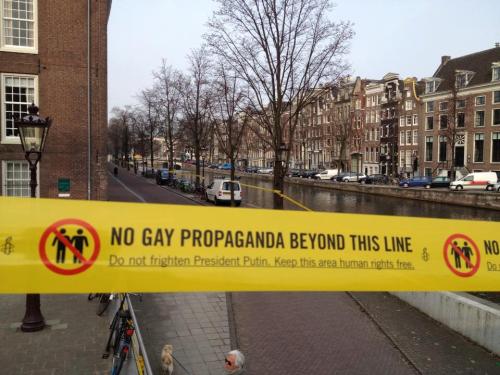
hey-assbutt-its-a-parade: finndicate: vjezze: Amsterdam is...


hey-assbutt-its-a-parade:

finndicate:

vjezze:

Amsterdam is turning rainbow for a visit of the Russian president Putin. The council of the city of Amsterdam has decided to hang out the gay pride flag on all council owned buildings and offices, in protest to Russia’s new anti-gay law.

there’s several of these as well;image

pretty sure Amsterdam is now the sass capital of the world

09 Apr 16:58

The Iron Lady vs Today’s GOP

by Andrew Sullivan
Brian Stouffer

Good take by Sullivan. I would add, though, that "is not a member of the 2013-vintage American Republican party" is damning with the faintest possible praise. Here you go, Iron Lady: http://25.media.tumblr.com/4d5cd64140fc2fb18264473883e0bf1a/tumblr_mke9vigS6C1s8bvjqo1_500.jpg

James West recalls Thatcher’s speech at the 1990 Second World Climate Conference:

[H]er speech laid out a simple conservative argument for taking environmental action: “It may be cheaper or more cost-effective to take action now,” she said, “than to wait and find we have to pay much more later.” Global warming was, she argued, “real enough for us to make changes and sacrifices, so that we do not live at the expense of future generations.”

The Iron Lady’s speech makes for fascinating reading in the context of 2013′s climate acrimony, drenched as it is in party politics. In the speech, she questioned the very meaning of human progress: Booming industrial advances since the Age of Enlightenment could no longer be sustained in the context of environmental damage. We must, she argued, redress the imbalance with nature wrought by development.

“Remember our duty to nature before it is too late,” she warned. “That duty is constant. It is never completed. It lives on as we breathe.”

David Frum reprints some of the speech as well. Thatcher cited the IPCC and her skepticism was not to be confused with the denialism now at large in America’s know-nothing rump:

The IPCC report is very honest about the margins of error. Climate change may be less than predicted. But equally it may occur more quickly than the present computer models suggest. Should this happen it would be doubly disastrous were we to shirk the challenge now. I see the adoption of these policies as a sort of premium on insurance against fire, flood or other disaster. It may be cheaper or more cost-effective to take action now than to wait and find we have to pay much more later.

While I’m at it, some other discomforting facts for today’s American right. Thatcher was a firm believer in international law – and opposed the US invasion of Grenada and Argentina’s invasion of the Falklands as a violation of that order. She was a strong supporter of nuclear deterrence and containment – as opposed to pre-emptive war. She wanted UN support for any intervention in Iraq, and inisted it be limited to restoration of the old borders. She cut taxes but, unlike the GOP under Reagan and the second Bush, she also cut spending seriously. She didn’t have any time for the loopy idea that cutting taxes would increase net revenues.

She inherited and handed over a fully socialized medical system, and, while tearing apart the government’s control of the economy, did not undo the welfare state in any profound way. “The National Health Service Is Safe With Us” was her constant refrain. Her policies on healthcare make Obama’s modest private sector-based reform look positively right-wing. She loathed Europe but signed the Maastricht Treaty, and deepened British ties to the Continent. She was the first Cold Warrior to respond to Gorbachev. In all this, she remains pragmatically alien to the current Southern-based GOP. And her undemonstrative Methodism was never worn on her sleeve.

Like Reagan, in other words, she could never be a contender in today’s GOP. She was far too conservative, in the proper sense of that word. She preferred order to revolution – and her own revolution was about the restoration of civic order, not its dissolution.


09 Apr 03:26

Britain debates: Is it OK to celebrate the death of Margaret Thatcher?

by Marya Hannun
Brian Stouffer

I've decided it's only acceptable to celebrate a fellow human being's death if they have a lifetime political appointment, so I suppose the answer is a begrudging no.

Perhaps nothing speaks to how polarizing a figure Margaret Thatcher was (and continues to be) than the varied reactions to her passing. As the day comes to a close, many in Britain have mourned the former prime minister's death, including current Prime Minister David Cameron, who cut a European trip short to lead a somber tribute to her. But others have been downright giddy.

Critics of Thatcher took to the streets (the Glasgow City Council dispersed a social media-organized "party" in a public square, citing safety concerns) and the Twittersphere to hail her death:

Margaret Thatcher is dead! Whose celebrating with a "wicked witch is dead" party on Saturday? #nowthatchersdead

— Jake Welsh (@veganfishcake) April 8, 2013


Others were more political in their forms of celebration. Referring to the miners whose unions Thatcher vigorously battled during her time as premier, British comedian Sarah Millican tweeted:

A lot of miners are discovering they can dance today.

— Sarah Millican (@SarahMillican75) April 8, 2013


Meanwhile, the irreverent website IsThatcherDeadYet.co.uk, which was set up in 2010, updated its homepage after three years to read:


And even as the creators have received threats on Twitter, the page has garnered more than 200,000 Facebook likes and launched the trending hashtag #nowthatchersdead (alarming many a Cher fan).

All of this has led the British media to debate whether it's appropriate to celebrate the death of the nation's first female prime minister.

In an op-ed for the conservative Telegraph, British journalist and author Toby Young writes:

[I]f it hadn't been for Thatcher, these same Left-wing gadflies might well be rotting in a Soviet prison camp somewhere east of the Urals. That sounds like an exaggeration, but we shouldn't forget her contribution to ending the Cold War.

Writing in the more liberal pages of the Guardian, the American journalist Glenn Greenwald argues that Thatcher's transgressions -- which include her denunciation of Nelson Mandela and the ANC as terrorists as well as her friendship with "brutal tyrants" like Chile's Augusto Pinochet -- should not be overlooked in the rush to lionize her:

To demand that all of that be ignored in the face of one-sided requiems to her nobility and greatness is a bit bullying and tyrannical, not to mention warped. As David Wearing put it this morning in satirizing these speak-no-ill-of-the-deceased moralists: "People praising Thatcher's legacy should show some respect for her victims. Tasteless."

Greenwald goes on to note that Western media offered more balanced and critical coverage after the death of Venezuelan President Hugo Chávez.

Whether Thatcher's death is cause for celebration or sadness, it has made one thing clear: As Guardian sports columnist David Conn tweeted earlier today, "one major legacy was a divided country, divisions being furiously reinforced today."

08 Apr 13:06

Obligatory Musical Interlude

by Scott Lemieux
Brian Stouffer

I mean, just because it's a good song.

R.I.P.

…[Erik] In case you need a whole soundtrack of anti-Thatcher songs.

[DB]: even more music, with analysis.  I think I’d rather be in the UK for this coverage, as it promises to be somewhat more balanced than here.

08 Apr 04:26

Frozach Submitted

08 Apr 03:38

Yet Another Example of Why We Shouldn’t Privatize Basic Services

by Erik Loomis
Brian Stouffer

Hooray capitalism.

Like many school districts, Attleboro, Massachusetts privatized its school meals, hiring the Whitsons Culinary Group. Then this happened:

Students at an Attleboro, Massachusetts, middle school went hungry this week, if they had a negative balance on their pre-paid lunch cards.

Five cents of debt was enough for cafeteria employees at the Coehlo Middle School to instruct kids at least one day this week to dump out the food they would have normally eaten, CNN affiliate WJAR in Rhode Island reported.

About 25 children left the lunchroom with empty stomachs, said Whitson’s Culinary Group in a statement. The company runs the school’s cafeteria.

The company is blaming the individual employees. We can believe that if we want; I am skeptical. Of course, we have to teach our poor kids the important lessons before the reach the age of 14: pay up to your corporate overlords or starve.

08 Apr 01:46

Extremely Rare Recommendations

by Erik Loomis
Brian Stouffer

I like populism, even from the likes of a wiener like Douthat.

Recommending a Ross Douthat column is like seeing an ivory-billed woodpecker. You know that it is probably impossible, but theoretically one could emerge once every century. Amazingly, today is the day, as Douthat writes about the Ivy League existing to reproduce privilege. Of course, Douthat seems to just prefer that no one talks about it, even as he is teasing the idea. But that’s fine, simply repeating that the overall structure of the Ivy League is one that trains the next generation of elites is worth saying since so many Americans continue to believe in a fantasy meritocracy over class politics. Sure, the Ivies not let in a superficial number of non-whites to talk about diversity. And there’s probably like 4 poor people admitted each year. Otherwise, it’s the next George W. Bush.

This all matters for a reason Douthat doesn’t touch. The idea that smart white people don’t get into Harvard and Yale because of anti-white racial discrimination is strong. In fact, they don’t get in because they belong to the wrong class. Take Suzy Lee Weiss, a Pittsburgh high school student, suddenly famous because she got a letter published in the Wall Street Journal denouncing the elite colleges who did not accept her:

What could I have done differently over the past years?

For starters, had I known two years ago what I know now, I would have gladly worn a headdress to school. Show me to any closet, and I would’ve happily come out of it. “Diversity!” I offer about as much diversity as a saltine cracker. If it were up to me, I would’ve been any of the diversities: Navajo, Pacific Islander, anything. Sen. Elizabeth Warren, I salute you and your 1/32 Cherokee heritage.

Of course, the right wingers love it.

I don’t know if Weiss is wealthy or not. Presumably to access the WSJ, one would suspect some wealth in the family. But in any case, notice the easy move to blame racial diversity as the reason she didn’t get in. Regardless of her own politics, plenty of liberals believe this too. Many of us have probably had these conversations with families about colleges. Inevitably race comes up. Inevitably, I have to say that race is overrated as an admissions factor.

To sum up, the Ivy League (and a handful of other elite colleges) largely exist to reproduce elite social classes. They benefit greatly from America’s national fear of (largely nonexistent) racial advantage given to non-whites to hide this fact.

…..In fact, Weiss’ sister used to be the features editor for the Wall Street Journal. So I guess that solves the question of the family wealth. Sounds more like she considered herself a member of the elite and was outraged to find out that she wasn’t elite enough.

07 Apr 20:21

The new frontier in life-tracking devices: human rights

by Elizabeth F. Ralph

There's the FitBit for fitness fanatics, the Pebble Watch for people who think their cell phones are too big, and Google Glasses for fancy sportsmen or irritating entrepreneurs. And now, there are high-tech life-trackers for human rights activists too -- devices that might save their lives. 

Designed by Civil Rights Defenders (CRD), these high-tech bracelets -- dubbed the "The Natalia Project" after activist Natalia Estemirova who, in 2009, was abducted from her home in Chechnya and murdered for her activism -- are designed to serve as the first assault alarm system for human rights defenders at risk of being kidnapped or killed, according to a press release published by the organization on Friday.

When triggered -- either by the wearer or by the device being forcibly removed -- the durable bracelet/personal alarm uses GPS and smartphone technology to send a message with the time and the bracelet's location to the phones of colleagues in close proximity and to CRD headquarters in Stockholm. In an interesting social media twist, CRD will also notify anyone around the world who has signed up to receive distress signal alerts via SMS, Facebook, and Twitter. The organization hopes that those who have signed up to monitor the activists' safety will in turn spread the word via social media, raising awareness and putting pressure on those responsible for the attack or kidnapping.

It's a life-tracking device that could very well live up to its name.

[h/t: BBC]

07 Apr 20:05

At least 28 of Max Baucus's former aides are now tax lobbyists

by Ezra Klein
Brian Stouffer

A coaching tree that rivals Bill Parcells.

Sen. Max Baucus (D-Mont.) is chairman of the Senate Finance Committee. That means he's the guy in the Senate charged with writing any overhaul of the nation's tax laws. And that means that anyone who has ever worked for him is in high demand in Washington's lobbying shops:

Restaurant chains like McDonald's want to keep their lucrative tax credit for hiring veterans. Altria, the tobacco giant, wants to cut the corporate tax rate. And Sapphire Energy, a small alternative energy company, is determined to protect a tax incentive it believes could turn algae into a popular motor fuel.

To make their case as Congress prepares to debate a rewrite of the nation's tax code, this diverse set of businesses has at least one strategy in common: they have retained firms that employ lobbyists who are former aides to Max Baucus, the chairman of the Senate Finance Committee, which will have a crucial role in shaping any legislation.

No other lawmaker on Capitol Hill has such a sizable constellation of former aides working as tax lobbyists, representing blue-chip clients that include telecommunications businesses, oil companies, retailers and financial firms, according to an analysis by LegiStorm, an online database that tracks Congressional staff members and lobbying. At least 28 aides who have worked for Mr. Baucus, Democrat of Montana, since he became the committee chairman in 2001 have lobbied on tax issues during the Obama administration — more than any other current member of Congress, according to the analysis of lobbying filings performed for The New York Times.

That's from Eric Lipton in the New York Times. His story echoes a report from Washington Post reporter Jerry Markon, who last month documented the growing army of corporate and other lobbyists seeking to influence any tax overhaul.

Sean Neary, spokesman for Baucus, does an able job defending his boss, offering examples of times when ex-Baucus aides lobbied for tax changes that Baucus ultimately rejected. And Neary is right: Baucus doubtlessly ignores endless entreaties from former staffers and current contributors.

But the point of hiring Baucus's former aides isn't that they can seamlessly insert any language they want into the final legislation. It's that they have a direct line to Baucus, and to the people around Baucus, and that gives them a huge advantage. The fact is that human beings are more likely to find arguments convincing when they're coming from friends rather than strangers or enemies.

That's the key to most of the lobbying in Washington. It's not about leveraging bribes so much as it's about leveraging relationships -- and that makes it harder to stamp out. I wrote about this in the New York Review of Books awhile back:

If someone walks up to you with a bag full of money and asks you to vote to make coal companies more profitable, that's not a very persuasive argument. Even if you take the money, you're going to feel dirty the next day. And most people don't like to feel dirty. But if one of your smartest, most persuasive friends, a friend you agree with on almost everything, is explaining to you that those environmentalist nuts are going too far again—they're always doing that, aren't they?—and they have sneakily tucked a provision into a bill that would make it more expensive for your constituents to buy electricity, that's very persuasive. And if it's also in your self-interest to listen to him—and lobbyists are good at nothing if not making sure it is in a politician's long-term self-interest to listen to them—then all your incentives are pointing in the same direction. You'll listen.

The outcome of this is a disproportionate number of people who have access to politicians, and who are owed favors by politicians, are lobbyists. And so those politicians are listening to a lot of lobbyists—lobbyists who are being paid by a client to invest in their relationships with politicians in order to advance the client's interest. On some level, the politicians know that. But it doesn't feel that way to them. It feels like they're listening to reasonable arguments by people they like and respect on behalf of interests they're already sympathetic to. And what's so wrong with that?

The answer, of course, is that players with money are getting a lot more representation than players without money, not in sacks of cash delivered in the middle of the night, but through people a politician listens to and trusts and even likes having lunch with in the bright light of the day. That's why savvy and well-funded players will contract with a number of different lobbyists at a number of different firms. Every lobbyist will have legislators he's close to and legislators he isn't. Some lobbyists, like Abramoff, specialize in conservatives. Others are more connected among liberals. Some firms have the former chief of staff to the chairman of the Senate Finance Committee. Others can offer the former legislative director to the chairman of the House Ways and Means Committee. If all a client needed was the money, all he would need to do is cut a big check to one lobbyist. But what you need isn't the money. It's the relationships. And each lobbyist only has so many of those.

Which is why it's so damn difficult to actually kill off lobbying. Outlawing bribes is easy. Outlawing relationships isn't.


02 Apr 23:59

The Televised Underclass

by Doug Allen
Brian Stouffer

"Indeed the inevitable logical conclusion of Capitalism is a world where we sing karaoke while being dunked into pools full of snakes on television." -Karl Marx, Das Kapital, 1867

by Doug Allen

Drew Gardner views reality TV shows like Killer Karaoke - “essentially a mash-up of American Idol and Fear Factor” – as microcosms of the current capitalist economy:

Capitalist economic systems require one central point of internal logic for them to function; in order to constantly expand profits, workers must be paid less than the value their work creates, ideally as little as possible, as little as the labor market will bear. In classical economic theory, new value only comes from one place, labor. In order to concentrate wealth for owners, shareholders and managers, this surplus value is then concentrated into financial instruments and forms of rent that charge the workers who created the value in the first place. It is a parasitic relationship.

Reality TV contestants are an excellent object for this kind of relationship, because they are a disposable, easily replaced group of workers. Because their working conditions are not regulated by the Screen Actor’s Guild, contestants can work unusually long hours. … Most agree to work for food and shelter during the time they are being filmed, in hopes that the exposure might lead to some future opportunity, if not just for the sheer narcissistic reward of appearing on television.

Alyssa Rosenberg adds:

Hotels, big-box stores, and other employers that rely heavily on low-wage workers increasingly seem to have tested, and found, the floor for what they can ask employees to do and still find a steady stream of labor without provoking union organizing drives. But unlike reality television, low-wage American jobs were never going to offer massive prizes to a few workers to defuse more general discontent about compensation and working conditions. In the lottery that is the American economy, if you promise millions of dollars to a single person, you’ll be able to take many millions more from even those who know they’re getting played for suckers—particularly if you’re asking them to participate in one bad subset of the economy because the one they long to escape is worse.


30 Mar 20:35

The Trader Joe's Lesson: How to Pay a Living Wage and Still Make Money in Retail

by Sophie Quinton
Brian Stouffer

It would be nice if strong evidence emerged for it being economically optimal for companies to invest in paying their employees a living wage. That said, I think that companies should pay their employees a living wage regardless of whether or not that's the case, so it's all pretty much moot to me.

traderjoes.jpg

Reuters

The average American cashier makes $20,230 a year, a salary that in a single-earner household would leave a family of four living under the poverty line. But if he works the cash registers at QuikTrip, it's an entirely different story. The convenience-store and gas-station chain offers entry-level employees an annual salary of around $40,000, plus benefits. Those high wages didn't stop QuikTrip from prospering in a hostile economic climate. While other low-cost retailers spent the recession laying off staff and shuttering stores, QuikTrip expanded to its current 645 locations across 11 states.

Many employers believe that one of the best ways to raise their profit margin is to cut labor costs. But companies like QuikTrip, the grocery-store chain Trader Joe's, and Costco Wholesale are proving that the decision to offer low wages is a choice, not an economic necessity. All three are low-cost retailers, a sector that is traditionally known for relying on part-time, low-paid employees. Yet these companies have all found that the act of valuing workers can pay off in the form of increased sales and productivity.

"Retailers start with this philosophy of seeing employees as a cost to be minimized," says Zeynep Ton of MIT's Sloan School of Management. That can lead businesses into a vicious cycle. Underinvestment in workers can result in operational problems in stores, which decrease sales. And low sales often lead companies to slash labor costs even further. Middle-income jobs have declined recently as a share of total employment, as many employers have turned full-time jobs into part-time positions with no benefits and unpredictable schedules. 

QuikTrip, Trader Joe's, and Costco operate on a different model, Ton says. "They start with the mentality of seeing employees as assets to be maximized," she says. As a result, their stores boast better operational efficiency and customer service, and those result in better sales. QuikTrip sales per labor hour are two-thirds higher than the average convenience-store chain, Ton found, and sales per square foot are over 50 percent higher. 

Entry-level hires at QuikTrip are trained for two full weeks before they start work, and they learn everything from how to order merchandise to how to clean the bathroom. Most store managers are promoted from within, giving employees a reason to do well. "They can see that if you work hard, if you're smart, the opportunity to grow within the company is very, very good," says company spokesman Mike Thornbrugh.

The approach seems like common sense. Keeping shelves stocked and helping customers find merchandise are key to maximizing sales, and it takes human judgment and people skills to execute those tasks effectively. To see what happens when workers are devalued, look no further than Borders or Circuit City. Both big-box retailers saw sales plummet after staff cutbacks, and both ultimately went bankrupt.

As global competition increases and cheap, convenient commerce finds a natural home online, the most successful companies may be those that focus on delivering a better customer experience. Ton's research on QuikTrip and other low-cost retailers--now a Harvard Business School case--is applicable across a variety of industries, she says. Toyota's production system, for example, gives all employees--including workers on the assembly lines--a voice in improving products.

But for a publicly traded company under pressure to show quarterly earnings, it's tempting to show quick profits by cutting labor costs. The bad economy has also made workers willing to take lower-paid positions rather than join the ranks of the unemployed. New employer-sponsored health insurance requirements under the Affordable Care Act are only going to give employers an additional incentive to shift workers to a part-time schedule. 

There are also trade-offs to investing in employees. Businesses that spend more on their workers have to cut costs elsewhere. Trader Joe's streamlines operations by offering a limited number of products and very few sale promotions. Costco stocks products on pallets, as a warehouse would. And the QuikTrip model requires investors to have the fortitude to accept possible short-term drops in profits. "You have to take a loss for a little bit," says Maureen Conway, executive director of the Economic Opportunities Program at the Aspen Institute. "You have to pay above market. You have to change how you do business."

At the upper echelons of the American workforce, salaries have soared. Companies are accustomed to thinking of their highest-level employees as "talent," and fighting to hire and reward people who will help grow the company. Now Trader Joe's and QuikTrip are proving that lower-level employees can be assets whose skills improve the bottom-line as well.


30 Mar 20:07

I’ve been handing out a lot of these cookies these days. I...


I’ve been handing out a lot of these cookies these days. I guess that’s a good thing.

30 Mar 16:48

The Rewards of Being Very Serious

by By PAUL KRUGMAN

A while back, before moving to Slate, Matthew Yglesias had what I considered a brilliant insight into the incentives facing small-country political leaders:

Normally you would think that a national prime minister’s best option is to try to do the stuff that’s likely to get him re-elected. No matter how bleak the outlook, this is your dominant strategy. But in the era of globalization and EU-ification, I think the leaders of small countries are actually in a somewhat different situation. If you leave office held in high esteem by the Davos set, there are any number of European Commission or IMF or whatnot gigs that you might be eligible for even if you’re absolutely despised by your fellow countrymen. Indeed, in some ways being absolutely despised would be a plus. The ultimate demonstration of solidarity to the “international community” would be to do what the international community wants even in the face of massive resistance from your domestic political constituency.

How small does the country in question have to be? Maybe not very: Nicolas Sarkozy’s road from the Elysée to private equity. As it turns out, Sarkozy’s money-making plans may be on hold due to a strange combination of legal troubles and the possibility of a political comeback thanks to Hollande’s timidity. But it remains true that Keynes’s dictum — “Worldly wisdom teaches that it is better for reputation to fail conventionally than to succeed unconventionally” – is probably even more true for politicians than it is for bankers. And this probably helps explain the persistence of the austerity cult despite years of failure.

This entry passed through the Full-Text RSS service — if this is your content and you're reading it on someone else's site, please read the FAQ at fivefilters.org/content-only/faq.php#publishers. Five Filters recommends: Jousting With Toothpicks - The Case For Challenging Corporate Journalism http://www.medialens.org/index.php/alerts/alert-archive/alerts-2013/719-jousting-with-toothpicks-the-case-for-challenging-corporate-journalism.html.

30 Mar 16:39

Parody Ad of the Day: The First Honest Cable Company

Extremely Decent Films pokes fun at the problem of oligopoly in the broadband Internet access industry with a clever parody commercial for "the first honest cable company."

Submitted by: Unknown (via YouTube)

Share on Facebook
28 Mar 23:18

calvinandhobbesgifs.tumblr.com https://www.facebook.com/CalvinAnd...

27 Mar 01:21

Coal Companies Destroying Workers’ Healthcare and Lives

by Erik Loomis

Mike Elk has a very disturbing story about Patriot Coal, a spinoff of industry giant Peabody Coal, going to bankruptcy court to divest itself of the pension and healthcare obligations guaranteed to workers in contracts Peabody signed with the United Mine Workers of America.

There’s exactly one reason for Patriot to do this–to maximize profit on the backs of the poor. Peabody created Patriot in order to manufacture a bankruptcy crisis; by giving the new company more retirees than active workers, it set the stage for bankruptcy relief of contractual obligations.

But in the UMWA’s eyes, Peabody is the real villain. According to union estimates, 90 percent of Patriot’s retirees are former Peabody miners who “never worked a day in their life” for Patriot. The UMWA charges that Peabody created Patriot as a vehicle to shed its retiree obligations. As evidence, the union cites the fact that when Peabody spun off Patriot Coal in 2007, it handed Patriot three times as many retirees as active workers and $557 million in retiree healthcare obligations. Within five years, Patriot had filed for bankruptcy.

We’ve already seen a disturbing decline in pensions around the country in the public sector. Eliminating hard-fought pension gains in the private sector, not even for the future but for already retired workers, will push working-class retirees into poverty. Slashing healthcare is an even bigger deal in the mining industry. The specter of black-lung disease haunts underground miners, including those working today. What are these people supposed to do?

On a related note, read Dave Jamieson’s piece on how the Senate’s kneecapping of the National Labor Relations Board has hurt the lives of workers. Once again focusing on the coal industry (coal companies really are the worst), Jamieson shows how the lack of a functioning NLRB allows companies to do almost anything they want to workers with no realistic legal recourse that will be resolved in less than a decade. Once again, what are these workers supposed to do?