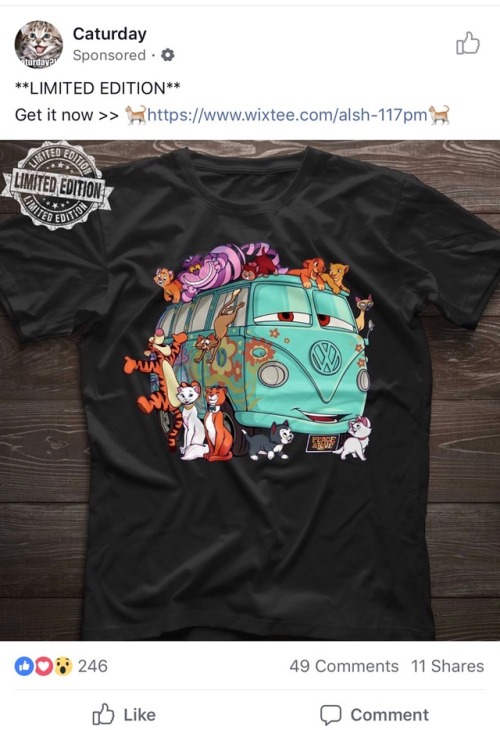
What does the van have to do with cats? Did I miss something?
Terence note: I keep going back to this in my inbox and I really don’t understand anything
P U S S Y
W A G O N
i fucking hate being alive
What does the van have to do with cats? Did I miss something?
Terence note: I keep going back to this in my inbox and I really don’t understand anything
P U S S Y
W A G O N
i fucking hate being alive
sunshinestatic asked: Is it racist if someone doesn’t find a certain skin color very physically attractive? I mean, it’s not like they hate the actual race. They are just more physically attracted a certain color more than another. So does that really seem racist?
First of all, do you know how fucking stupid you have to be to be “attracted to a certain color"? You ever notice that people who say stupid shit like that are always using it to justify their racist beliefs about what certain races look like, and to reinforce the racist-ass standards of beauty set forth by our shitty culture? You’re not fooling anyone, go hump a piece of construction paper if “color" is what gets you off, you fucking shithead.
when you play the game of thrones, remember to have fun and be yourself
Erin DeelThis made me deeply uncomfortable.
Erin DeelIs it crazy that I would TOTALLY play the crap out of this game?
I met Joel Clark and Tavit Geudelekian in Joel's Bushwick loft. They were talking, as people so often do in these situations, about a work of great literature. Joel's well-worn copy of Moby Dick was on the coffee table, next to an Apple laptop. The computer was displaying images from the card game that they have developed based on the novel. It is called "Moby Dick, or, The Card Game."
They created the project with Andy Kopas, Mark Perloff, and John Kauderer. Today it went live for fundraising on Kickstarter, with a goal of $25,000. The game mechanics combine luck and skill, much like a 19th century whaling hunt. Sailors die constantly, casualties of stoved boats, whale charges, and other tragedies. The game culminates in a battle against the White Whale. It's brutal, smart, and strangely endearing.
Obviously, I had some questions.
Originally, this was going to be a video game. Why isn't it?
Tavit: We first started talking about adapting Moby Dick into a video game two or three years ago. I worked in the industry making TripleA games, and EA had just released "Dante's Inferno." We were both super passionate about Moby Dick, and we loved the idea of bringing the epicness of Melville's work into something that you could hold and interact with.
Joel: I was really into the idea of the open world. In the video game, you would run the narrative of the book, and then you would enter this nexus of the ocean. But we realized that no one would put $20 million behind that because the crossover of the hard-core gamer to the hard-core literature enthusiast basically doesn't exist.
The circles of "high-concept card game player" and "epic novel reader" are probably much closer to concentric.
Joel: Yeah. And a card game has a more classic feel.
Tavit: We had been having late-night jamming sessions talking about the video game. We were sitting around one day with our other partner, Andy, and he suggested a strategy card game. It was like a light bulb switched on in all of our heads. It felt right. The card game is an anti-video game. It's incredibly literate. It's very, very wedded to the concept of the literature that it comes from, which has been Joel's huge undertaking. But it works. The pacing and the social aspect of playing with your friends is kind of like a book club or a reading club.
Joel: It was also more attainable. When we were talking about making a video game, Tavit said he knew the perfect guys to make the water, but it would cost like $4 million or something absurd. Now, we can get art that really pops because there is so much amazing documentation from that time period. We're using daguerreotypes, ambrotypes, and other old photo processes. For the most part, it's public domain. We licensed some images through agreements with universities.
 Where did you get the art?
Joel: About 20 percent is coming from the New Bedford Whaling Museum. They are excited. They are going to have the game in the gift shop. That's cool because they have the best collection.
You spent a lot of time trying to be faithful to the text and spirit of the book. Are you worried that will keep people who haven't read it away?
Joel: Absolutely. Everything gets checked against the book at every step. We would have rule conversations and there would be an impasse where I would say, "it cannot be this way [because it wouldn't make sense in the Moby Dick universe]." Some rules make the game so esoteric, and people who haven't read the book will ask why.
Tavit: We worry that it won't be applicable to people who haven't read the book, but I'm learning that the fundamentals of the game create a space for exploring the concepts in the book. Reading it is always going to be the best way to take it in, but the game can help. This is a bit of an apples to oranges comparison, but when Guitar Hero came out as a video game, people connected with the songs that were in the video games in a very different way because it was interactive. I was listening to music out of the game that I wouldn't have if I hadn't jammed on it in the game. In that same way, we're hoping that with this project, those weird esoteric rules become questions in peoples' minds and pull them closer to the text.
I can see how those rules would set the entry barrier higher, but maybe ultimately make it more rewarding if people stuck with the game.
Joel: Melville's whole project was to explain every little detail to people who had never been whaling. That's what's so hard about the book. There are huge sections of it that explain things like what the rope does in detail. And it's really, really important that you know exactly what it does because it really matters later. Ishmael, as a character, disappears. He's just describing the scene. Melville wants to put you in the whale boat. A game is the perfect way to put you in a whale boat and to make you feel those feelings.
Building a gaming system, especially one this complex, seems like an impossible task. How did you do it?
Tavit: It was painfully slow. We've been working on this for nine months. It starts out with genial, 50,000-foot conversations about what type of game it is. It's a card game, but do we need a board? We'd throw concepts at the wall. We tried to get it to a playable prototype, and then we added and subtracted features. We're in the third full-on version of the game now. There have been elements that have carried through all of them, but it's really a matter of creating features, testing features, and seeing how those mechanics interact with each other. We had one really cool working version of the game but there was a moment where we realized that we weren't communicating with the sailors. There was no feeling. Without that identity, we lost the highest part of the concept. That's when we revised. We always knew that the goal of the game was to be the survivor, not the winner. Players don't win this game; they simply survive it. That had to stay consistent.
Joel: No one was going to kill Moby Dick.
Tavit: No way. Moby Dick always kills you.
Joel: We all would have walked out. There was nobody pushing for that.
 The gameplay is totally brutal. Characters are constantly dying, which is frustrating but I suppose pretty consistent with the reality of whaling?
Joel: There are highs and lows. That's one thing I love about it. It really is fateful. There are times when you are riding high and nothing can stop you, but then in the blink of an eye, you're so low. But then you're back again. It swings violently. It really is life on the sea.
Tavit: It's really interesting to be working on a game that is based on something that has such a strong intellectual property. Everyone knows Moby Dick, so we get immediate reactions. Either "That's really cool!" or "That's really boring." If we can create the same dialectic split that Melville did with his polarizing work I think we've succeeded, at least in the high-concept sense.
Joel: We talked a lot about softening the bottom. The game is devastating. It had to be devastating. We all agreed that it needed to be very, very difficult, but we rounded the bottom so you always take your shot. Because why not? If you're brought low, you'll be back before you know it. That way, it's fun. When you succeed, it's triumphant, and when you fail, it's desolate but you're right back to succeeding again.
Tavit: One of the core concepts of the game design was that there shouldn't be too many times when not all of the players were invested in what was happening. There might be a time where not everyone is controlling their actions, but most of the things that happen in the game affect the entire crew. It's definitely competitive, but there's a cooperative nature to it. In the game, we are all sailors aboard the Pequod and we all have a linked fate, which is doom. But along the ride, there are so many opportunities to help your fellow sailors.
Why did you turn to Kickstarter for funding?
Tavit: I used to work with Killscreen Magazine, and we had a lot of success launching products that way. We learned that Kickstarter was a great platform not only for promoting your products, but also for selling them. We've bootstrapped our last nine months—doing the design and getting the art—but we are at a crossroads where to functionally make a game at the quality that we want to is going to require a wholesale order.
Joel: I feel like there's a renaissance of tabletop games, and it's a crossover, too. People go on Kickstarter looking for a new game.
Don't take this the wrong way, but are you worried this is the most Brooklyn thing ever?
Tavit: [Laughs] No. I'm from Harlem. You can quote me on that. But yeah, it feels like it belongs in a coffee shop or a bookstore. I can totally see this being a Brooklyn hipster thing, but hopefully the IP will carry it out of there. Moby Dick is timeless.
Joel: And we're not exploiting the fiction. There are a lot of pieces of art that get created out of Moby Dick...
Tavit: Like EmojiDick.
Joel: And I think that we have endeavored to make a lasting product. Even more than a video game, a card game won't date itself. I think there's something exciting about that.
The challenge of creating the Ishmael character seems especially daunting.
Joel: The big failing of any film or television adaptation is that sense of your presence. They always put Ishmael on the screen. Everyone has their own vision of Ishmael. He's almost blurred. Peter Mendelsund wrote a piece about being able to hear Ishmael's words more than you can see his face, and I think that applies. When there's a film and Ishmael is walking around as the main character, it feels strange. I don't think Melville ever intended for Ishmael to be described. That's why I'm so excited about our Ishmael card. I think it really encapsulates the omniscient narrator. All the sailor cards are portraits, except for Ishmael's. His is a sailor on the top mast seen from a distance. He's an obscured figure. His in-game ability is to copy another ability. That way, he describes his fellow sailors, he never describes himself. When the Ishmael card dies, he passes to the left. He's always there. He's on every hunt. For all the Melvillians out there, I think that's a signifier that we took this very seriously.
Moby Dick, or, The Card Game has funding levels from $5 to $10,000, which gets you a whaleboat.
Noah Davis (@noahedavis) fears that he would be a truly horrendous whaler. He's not much better at the game.
---
See more posts by Noah Davis
Erin DeelSo, now I know what I'm making for dinner tonight.
Erin DeelI will be eating this every day this summer, thanks.
Serves 2 to 4
Total time: 15 minutes || Active time: 15 minutes

I love that zucchini can be cut into noodly strips and called “raw pasta.” But I also love that you can make a raw zucchini salad!
Despite what a lifetime of overcooked zucchini might have you believe, zuke actually has flavor. It’s delicate, yes, but fresh and verdant. When eaten raw, it’s delightfully crunchy, and perfect for a light lunch or alongside a sandwich or veggie burger.
I dressed it really simply, but don’t be deceived, it still has flavor to spare. There’s lots of garlic; like, enough to ward of kisses for at least several days. A touch of olive oil and some fresh tomato dress it beautifully. And basil makes everything pop like a springtime garden in your mouth.
Sometimes it’s the simple things. Enjoy!

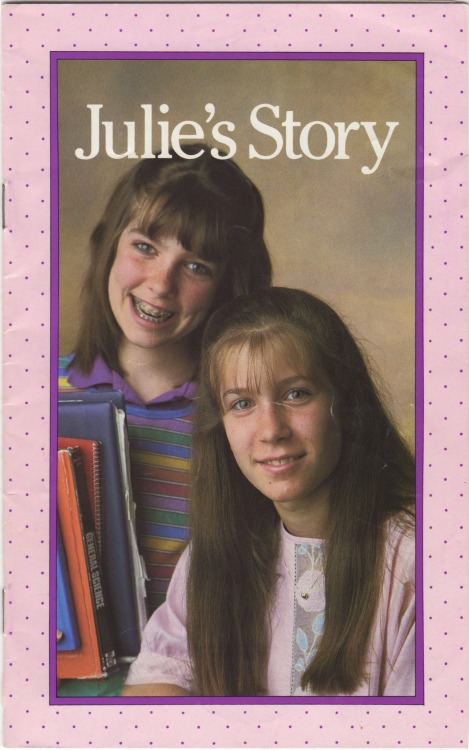
Fourth grade. The inaugural year for the maturation videos. Girls in one room, boys in another. You are 10 years old and have just viewed Kimberly-Clark Corporation’s sexual education magnum opus: Julie’s Story. You are freaking the shit out. You thought the greatest offense you would suffer would be hair on your privates but no, you will also BLEED OUT OF YOUR VAGINA BUT DON’T WORRY YOU CAN STILL RIDE A BICYCLE. The video is scary. What if you are like Julie and you bleed into your pants during modern dance tryouts and you have to put toilet paper in your undies and wait in the library for your loudmouthed friend Tracy and your dance teacher to arrive and talk about maturation in a public place? What if Steve is there and he tells the whole bus on the way home from school?
You watch the video in a daze, scared to look around in case anyone is watching you to see your reaction, but it’s not a problem because exactly zero girls want to make eye-contact with anything except their shoes. You glance at your pamphlet during the post-video discussion. You can barely pronounce any of the words defined in the margins like “menstruation” and “endometrium” and “hypothalamus” so you flip to the back to the glossary and the first word is “anus” so you quickly flip back a few pages to some drawings of the inside of a girl’s body, which is actually more mortifying that someone thinking you are looking up the definition of “anus”. Except you keep staring at the drawings because they don’t make sense. There’s a full-on, front-view of the uterus, which seems somewhat self-explanatory, but then there’s this side-view drawing that looks like a spelunking map for a cave with arrows drawn to different passageways and circular rooms and you’re trying to figure out where you pee and where the baby comes out. And you will spend 6 more years looking at this side-view both within the Julie’s Story pamphlet and the pamphlet that comes in the tampon box as you try to figure out exactly how to use tampons because all the illustrations are shown from a side-view of a woman’s hip and how come nobody could just show a simple drawing of the front of a woman’s body and a tampon going in with arrows? Would that be so hard? Why do all the illustrations have to appear as if a woman’s private parts are all accessible through the side of her hip? You later realize it’s no wonder guys don’t understand women’s bodies if even girls only have these ridiculous side-view illustrations to go by and the unhelpful alternative of getting out a mirror and figuring out for themselves what’s going on down there. And why isn’t there more information on tampons? Like what it feels like when you’re putting one in and how far they go in and where they are in your body and how they won’t get loose and float up in your intestines? Super confusing.
The pamphlet/modern dance teacher goes on to explain that sometimes you may skip a period if you start a new school or move or do something exciting and you are not sure if this also applies to running for student council or having a birthday. You also learn that there are different types of “sanitary pads” to wear when you have your period. Some stick in your underwear and some are worn with a belt. You wonder if this is like when you have braces and wear neck gear. Like, do you wear a belt with your jeans and a pad hooks into it? Will everyone see the hooks? Could you just use suspenders instead? Can you wear a belt you already have or is there a belt that comes in a box with the pads? You look again into your pamphlet and see all the different types of pads. Some are thin, some are medium and some are thick. You think you will never remember all the rules. Thankfully, the school nurse says that the belts are outdated and you will only have the stick-on pads to use. Then you see a big pink text box about something called T.S.S. It says you may throw up and have diarrhea or faint or can even die if you use tampons! WHAT. SOMEONE CAN DIE FROM THEIR PERIOD. THIS IS WORSE THAN YOU THOUGHT. You flip another page in the pamphlet. WHAT. SOMETIMES PEOPLE CAN SMELL YOU ON YOUR PERIOD. You are officially on a European bullet puberty train heading straight for mortification central and you want it to smash straight into a mountainside. DOUBLE WHAT. YOU MAY FORGET A PAD AT SCHOOL AND HAVE TO BUY ONE IN THE BATHROOM OR ASK TO GO TO THE NURSE TO ASK HER FOR ONE. No. No way ever. When you get this period, you are going to stay home from school. Probably forever. At least until you graduate and go to college.
But then you flip another page and see this really cool ad for New Freedom Thin Unscented Maxi Pads with Funnel-Dot Odor Protection. The ad features these two popular looking girls. One is wearing turquoise overalls, a red and white striped t-shirt, yellow socks and a red baseball cap and she’s drinking a coke and holding a bag with Mrs. Grossman’s stickers on it. Her friend is trying on jeans and applying lipstick in a mirror while a hairbrush sticks out of her back pocket. The ground around them is littered with lots of plastic bracelets and boxes of clothes and some records. Hmph. Maybe getting your period will make you more popular. You turn a few more pages. You see another ad that features seven different boxes of pads and two girls dancing in raincoats with rainboots and umbrellas. They look like they’re having a pretty good time. Maybe they’re on their periods and they like it. Maybe getting your period just makes you feel cool. You’re still not entirely convinced.
But the class is over now. When you reconvene in home room, you are under strict instruction not to discuss with the boys what you’ve learned and to definitely not share your pamphlet with the pencil drawing of that side view of the naked girl with her anus coming out of her hip. You nervously and quickly shove your pamphlet into the back recesses of your desk, happy you don’t have to be exposed to this again until the 5th grade maturation video. And then your friend Steve runs in to the room and shouts, “A GIRL’S PRIVATE IS CALLED A VIRGINIA!”
“You are officially on a European bullet puberty train heading straight for mortification central”

h/t to my man JD
I’m really tired and this made me laugh all high-pitched and crazy like someone you would not want to stand near on public transportation
Erin DeelLOLing over here.
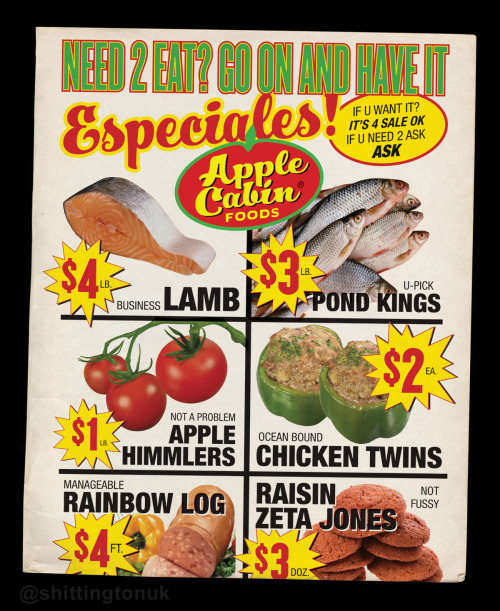
LiarTownUSA: Apple Cabin Foods No. 4
Check out the whole set. They made me laugh so hard I almost party beefed. Reminds me a lot of one of my favorite old fake commercials for Pathway Foods and a classic Mr. Show sketch called The Fairsley Difference.





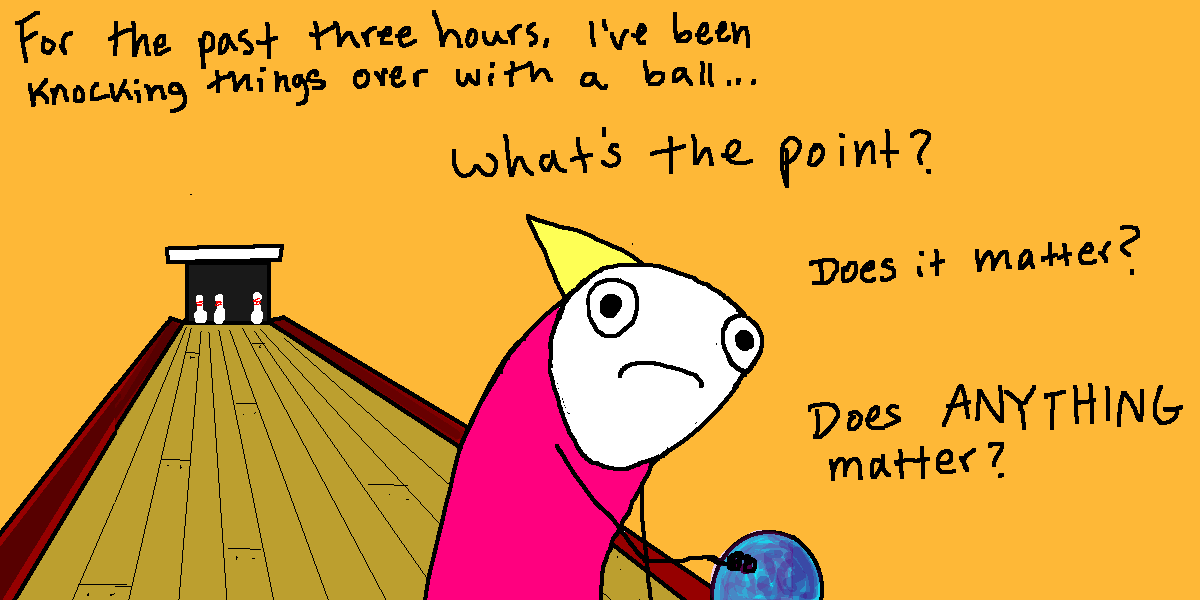

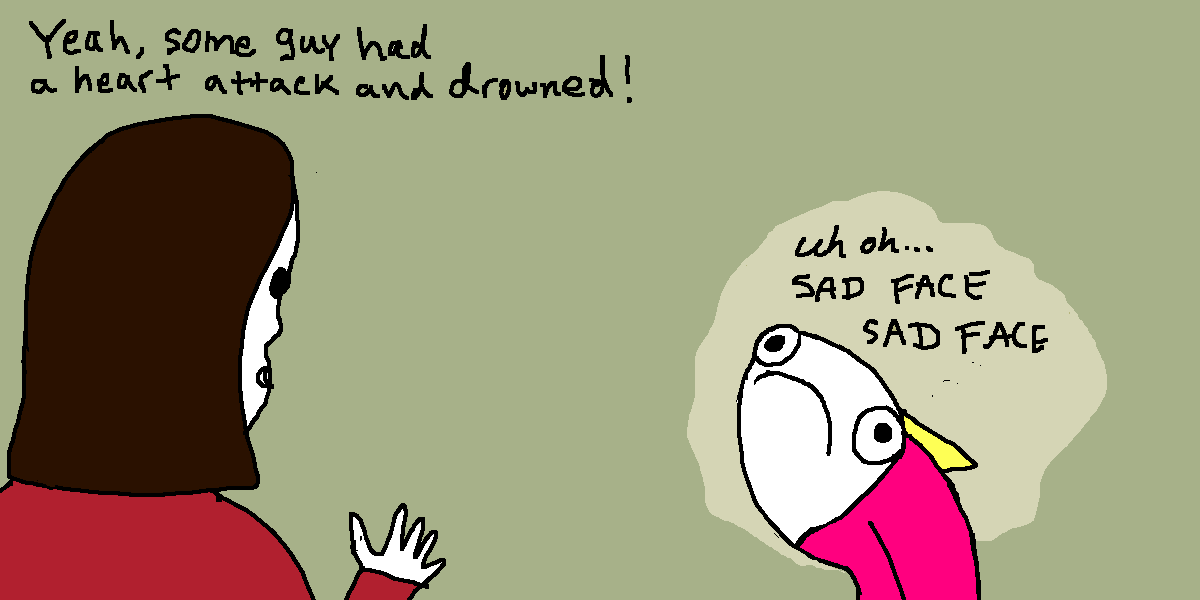

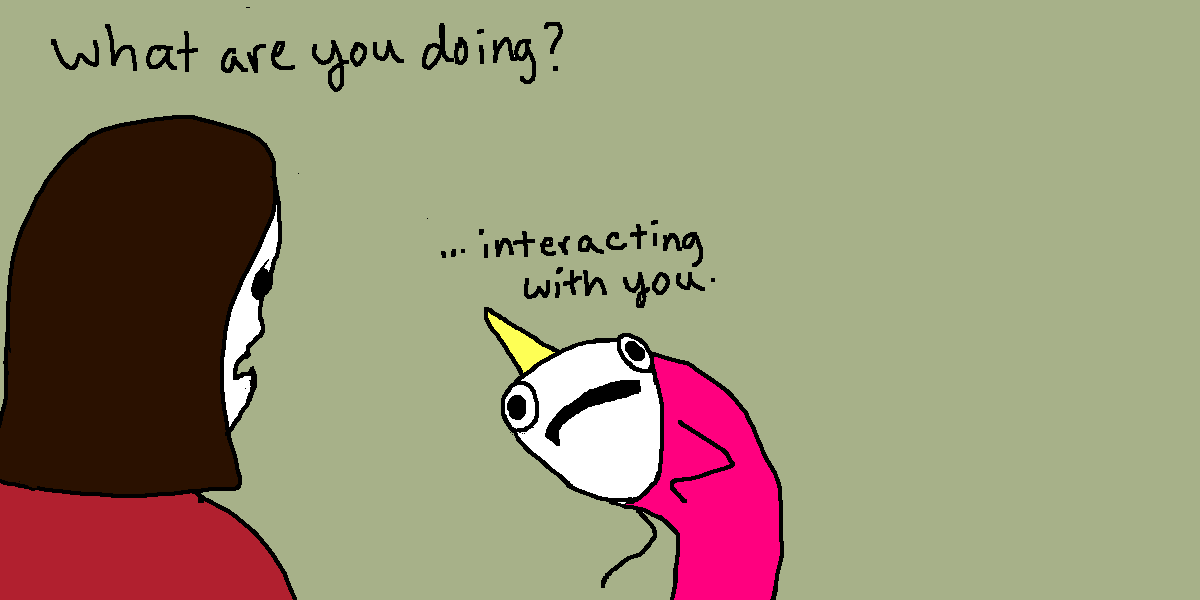



























Erin DeelI never want this Hairpin series to end.
 SE: Should we start by acknowledging our reluctance, perhaps? Or maybe by confessing our embarrassments?
AHP: Yes, I think we can begin by situating her, more than perhaps any other, as a Lilith Fair performer who was so much of that time and moment that she’s completely, wholly out of fashion now. She’s not your mom’s well-loved cardigan that’s now just vintage and refined; she’s the embarrassing Gap overalls.
SE: Oh my god. She has all these albums I’ve never even heard of and don’t especially want to listen to, even for the purposes of our art. But she is nonetheless a crucial figure, because she was positioned as the face of Lilith Fair in the festival’s first season:
Analyzing why she would have been chosen for a Lilith Fair cover story is like shooting misogynist fish in a gender studies barrel, though, right?
AHP: But Simone, it’s not even that she was just the cover lady — she was, apparently, the HEADLINER, and rest were just her gang? That’d be like renaming The Babysitters Club as “Stacey and Her Less Good Looking Losers.” (SE: Well . . .?) Also please analyze: “macho” vs. “empathy,” but “empathy” that is still “hot.”
SE: MISOGYNIST FISH. GENDER STUDIES BARREL. I suspect the subtext here is the Warped Tour, which started in 1995; in ’97 Lilith Fair was the highest-grossing traveling festival. (I am deeeep in Lilith Fair research, y’all.) So this formulation, besides its obviously problematic whatever whatever about gender and feeeeeeelings, is always already about money and profit. But I also don’t even know that I would define the music of the Ladies Of Lilith (LOLOLOLOL) as particularly empathetic — in what way is it about understanding the pain of other people more than it is about an artist dissecting her pain and the audience identifying with it?
Is empathy what I’m supposed to get from “You Were Meant For Me”? “So I picked up a paper, it was more bad news/ More hearts being broken or people being used”? “Same old story, not much to say/ Hearts are broken every day”? Thanks for the insight, lady. Is that the hot empathy Time identified?
Speaking of both my mom and Gap overalls (mine were from Old Navy), I bought myself Pieces of You for my 14th birthday. (I also bought Jagged Little Pill, though, so maybe karmically that makes a difference.) I feel like I should explain here, finally, that my mom had these Draconian standards as to what kinds of media I could consume. Until I bought myself these CDs, the only music in my house was smooth jazz and classical radio, a playlist of classic rock that met my mother’s lofty aesthetic standards, and the entire Steely Dan catalog, minus Pretzel Logic. When I asked for the Billy Joel Greatest Hits I and II set for my 18th birthday, she refused on the grounds that Billy Joel was “too subversive.” (If you don’t like her opinions re: Pretzel Logic, take it up with the dead lady.)
AHP: By contrast, my MOM bought both Pieces of You and Jagged Little Pill, which I promptly “borrowed,” which is to say “stole and never gave back and eventually allowed them to be stolen from the backseat of my car when I was a sophomore in college.” My subversive music purchasing was in the form of Dr. Dre’s The Chronic, with its giant pot leaf on the cover just begging to force a horrible conversation about marijuana, revealing that my 8th grade self didn’t even know what that leaf represented, let alone that I should be hiding it under my bed. IDAHO GIRLS: either very sheltered or very not.
SE: If I were the kind of person to use the abbrev “smh” I would use it here. But yes, it’s true: I listened, wholeheartedly and unironically, to Jewel. The lead single was, of course, “Who Will Save Your Soul?”
Thoughts: A) I am digging/wondering about this mid-to-late ’90s obsession with voyeurism as expressed in music videos. B) I still kind of like this song, though in retrospect it was some real sleight of hand to make this the lead single, sort of like if you read that one reasonably good poem I wrote as a teenager and made some assumptions about my possessing any kind of talent at all, and then you got to my lengthy lyric meditation on an old woman eating lunch at the Chinese buffet or the one about how roses have thorns and how that’s just like life. Like, one could be convinced on the basis of this decent song that the rest of the album is pretty good. But is it? Is it pretty good, or is it all cliche poems about dewy rose petals at dawn?
AHP: I think I used to transcribe Jewel lyrics into my journal, turn the page, then write my prose poems “inspired” by Jewel’s lyrics, and the results were no better or worse than my work uninspired by Jewel’s lyrics. Which is all to say: you’re right.
But I think there’s something to the fact that Jewel’s poetry book, A Night Without Armor, has become a talisman of innocent, earnest youth. In college, my best friend and I continually cited it to each other as a means to distance our own just-okay poetry from the poetry we wrote/consumed during our teen years. Earlier this year, Lena Dunham Instagrammed a photo of her copy because of course she did. The poems in that book (and the lyrics to her songs) aren’t good, aren’t all that different or inspired — but they seemed somehow just good enough, just better enough than my own stuff, that I admired them fiercely.
I’m going to share my theory about “Foolish Games,” which is this: I think the video demonstrates that Jewel was really trying to get horsey girls on board with her. Because otherwise this video is visually illegible.
AHP: Is it weird that I can’t distinguish this from a fan video made by an 8th grader? All I see is blue filter, frosty make-up, and the up-do with chunky front sections that characterized 80% of prom up-dos from the period.
SE: Jewel’s never not thinking about the 8th grader. I asked Horsey Girl Nicole Cliffe about this, and she said, and I quote, “Jewel ALWAYS had the horsey girls.” The Misty of Chincoteague set aside, I also think that, more than most other Ladies of Lilith, Jewel’s songs are supposed to be an imaginative, projective exercise for the listener. Like, you copy Jewel’s poetry into your journal and then you think about what it would be like to find a boyfriend who seems like he could have stepped out of a Jewel song. In “Foolish Games” I think she thinks she’s describing someone really edgy and cool: “You took your coat off and stood in the rain/ You're always crazy like that.” Isn’t that craaaaazy? And he, what else, oh, he likes Baroque music, Mozart, “philosophy,” cigarettes, and coffee? What a goddamned catch.
AHP: But just ENUMERATING those things somehow seemed edgy — or maybe just edgy to a certain swath of teenage/early 20s girls who hadn’t yet put together that liking philosophy and cigarettes is not the same thing as being a person of integrity and curiosity? Like I’m just wondering what my MOM was thinking of all this earnest, wrongheaded projection.
SE: It’s just, ugh, if only I couldn’t see into the future and KNOW that some Jewel fan would get scorched by a dude with lank, greasy hair and a smelly army jacket who’s “really into philosophy.”
AHP: But it’s a very distinct erotic projection — and very much in line with the erotic fetishization of grunge. Pieces of You came out in 1995 — the same year that the Nirvana Unplugged album won a GRAMMY. It was also the year of Hootie and the Blowfish, which is another way of saying it was the year of blanketing, banal mediocrity. [Ed. – WHAT?! Oh my god.] I feel like Jewel’s voice rang out like a hot, emotional bell.
Which is why Pieces of Me (You) (Everyone We Know) You went PLATINUM FIFTEEN TIMES and became “one of the best selling debut albums of all time.”
SE: To me, one of the most interesting things about Jewel is this very public media construction of a working-class identity. When she first broke, her biography was constructed to aggressively position her as a rags-to-riches success story: grew up in rural Alaska without indoor plumbing, performed duets in bars with her dad, sold her poetry to make money while she was at the Interlochen Arts Academy (where, according to Dan Kimpel’s seminal How They Made It, "70 percent of Jewel's tuition was paid for by a vocal scholarship, with the remainder of the expenses raised at what turned out to be Jewel's first solo concert” in her hometown of Homer, AK, lived in her car while traveling around the country performing. In interviews, she said things like “When poverty bites you hard at a young age, you don't forget it” and "I grew up with dirt under my nails . . . you never get over that.”
This mythology of poverty strikes me as being specifically about claiming a working-class identity, one in which her success comes in spite of a lack of cultural capital. But. I mean, her poverty was real, but also I’m pretty sure that was the case because her parents were back-to-the-landers. I mean, her grandfather was a delegate to the Alaska State Constitutional Convention. Her family’d been there for a long time and had roots, at least, and probably some resources.
And there’s also the thing with her teeth. You know about the thing with her teeth?
AHP: All I remember is that she had bad teeth, she smiled with her mouth closed all the time, and at some point they were fixed. But this was before I really recognized that teeth were such an obvious marker of class in the United States — I didn’t understand that “crooked, broken, ravaged gum lines” was code for “no health or dental care” and “un-Fluoridated well water.”
I had grown up solidly upper middle-class, and had been so thoroughly immersed in it through the first 13 years of my life, that when I hit junior high and was suddenly surrounded by evidence of working class-ness, when a third of my class was getting free lunch, when kids were talking about “doing crank” (read: meth) I was just clueless. I wasn’t stupid — I knew things were different — I just hadn’t ever been taught to recognize class as difference. I was friends with those kids. We talked on the phone. Their parents gave me rides home from practice. But my position made the privilege of my white and painfully braced teeth invisible to me.
That’s a digression and by no means an excuse — more of a testimony to the ways the pervasive myth of classlessness gets propagated. And Jewel’s case seems to be a 1990s case of class fetishization — here was the poor kid made good, the American Dream in artistic action. And the elision of her family’s historical privilege/cultural capital was nothing new: the studios reframed the biographies of dozens of classic Hollywood stars in order to make their success signify as both the product of “hard work” and the logistics of the American meritocracy.
SE: Nice SoCH tie-in. I’ve always admired how you manage your Personal Brand. (AHP: Scandals of Classic Hollywood IS LIFE.) BUT ALSO, you know who had a hard luck story similar to hers and yet did not have multiple biographies written about her when she was 24 years old nor warrant mention in multiple young reader books about celebrities? Tracy Goddamned Chapman, that's who. Born to a single mom in Cleveland, on scholarship at a boarding school where they took up a collection to buy her her first guitar, started out busking. I think it is only a rhetorical question when I ask why it is Jewel who gets this treatment, not our beloved TC.

AHP: EASY PRIVILEGE ANSWER, SIMONE: white people love books about white people triumphing over the system. Black people, especially black people who still sing about racism and domestic violence and ‘the rape of the world,’ [I’m talking about you, Tracy] ... that’s terrifying.
But back to this drawing that seems like it’s from a Driver’s Ed workbook: When I see sentence structures like this in my students’ drafts, I make a little comment in Google Docs that says “sophisticate syntax.” But I’m fascinated that A) these young adult novels are apparently available in full text online for you to screenshot them, and B) she was accessible/popular with audiences younger than 12? The fact that readers of this book would need to know how to say ‘parents’ seems to indicate ... age five? Are kids age five concerned with who will save their souls? [DIGRESSION: I learned while teaching at Gifted & Talented Camp that one of early indicators of ‘giftedness’ = existential crises, a.k.a. wondering what will happen to the earth, who will save the polar bears, WHO WILL SAVE YOUR SOUL, etc. et. al. But readers of this book don’t know how to say ‘fame’ so bygones.]
But also segue: who was Jewel’s audience? Only teenage girls? Because the thing about Lilith Fair is that it had to appeal to both teens who could blast their babysitting money/allowances on a ticket and merch AND “older” [read: 20- and 30-something] ladies who could do the same, but also buy alcohol. Was Jewel the counter-programming to, say, The Indigo Girls? Was she there to bring in the young, naive, philosophy-dude-loving non-feminists?
SE: Maybe? I mean, this sort of raises an interesting question/problem. We have such trouble in this culture distinguishing among things that celebrate women, prominently feature women, and are actually feminist. Lilith Fair was the first two, but I am pretty sure it wasn't the third. I think.
The event billed itself as "a celebration of women in music," and the implication was that it was somehow feminist, that having an event for women artists was itself feminist. But was it? If feminism is just about parity of representation, sure. But if you look at Jewel's songs, they're all about kinda codependent heterosexual fantasies of longing and need. Like if Riot Grrl : Lilith Fair::Shulamith Firestone : Gloria Steinem, Jewel is not even Gloria Steinem. She's like, okay, she's not Phyllis Schafly, but she's TEPID. So: not feminist?
I don't know. I am definitely at that cranky point in my life where I DO NOT HAVE A PROBLEM saying that some things ARE NOT FEMINIST (yes, I am the Feminist Police, see my badge?) just because they involve women. But maybe the Ladies are all on a continuum of feminism, and maybe that's something that becomes clearer when we examine how their careers developed after the Vag Fest ended. After Pieces of You came Spirit.
AHP: I always feel bad for sophomore albums. I want to start a support group for sophomore albums. I listen to them more than they deserve and try to love them more than they merit. And 16-year-old AHP really tried with Spirit. There’s a sweet little song called “What’s Simple Is True,” the video for which is, in a move of remarkable foresight, set North of the Wall in Game of Thrones.
But the earnestness of Pieces of You, now smoothed out and synthed out, now seemed a bit overripe. “Hands” makes me feel like I’m listening to an After School Special and “Fat Boy” is just horrible. Fucking HORRIBLE. Tonedeaf song about bullying horrible. But there was a hidden track and you know how I feel about hidden tracks, so I’m pretty sure it stayed in heavy rotation until Lauryn Hill arrived in my life and Jewel became the Velveteen Rabbit of my musical collection, only this Velveteen Rabbit gets lost in the glove compartment, scratched to shit, and thrown in the wastebasket of a Wyoming gas station in 2003.
SE: This seems like an excellent time to bring up this crucial 1999 SPIN magazine review by . . . Sarah Vowell? She says, "once an artist crosses into that seven-zeros zone, the spotlight twists away from her onto her audience. . . In an age of fracture and exasperation, she's selling union and hope, and the worn out American public can't sling their money across record store counters fast enough."
AHP: … Which brings us back to the overarching palatability of Lilith Fair as a whole, a point we’ve discussed at some length. Vowell’s basically touching on the emotive engine of Lilith Fair, a sort of feel-good girl-power that steers clear of alienation or indictment [unless, of course, you’re Tracy Chapman]. It’s somewhat disturbingly close to postfeminism. Or is it postfeminism? Was Lilith Fair just as postfeminist as Spice Girls and Sex and the City?
I mean, we’re past mere representation, right? Like it’s not “enough” just to be a woman and represented in a position of power. Otherwise Condoleezza Rice and Sarah Palin might be considered feminists, even as their policies work to dismantle some of feminism's long-fought battles. Headlining a festival and playing guitar does not a feminist make. But as you allude to, I’m not sure if that matters so much as how Lilith Fair, regardless of its softcore, apolitical, non-castrating quasi-feminism eventually engendered a bunch of feminist politics. Or did it not have that effect on people who were not AHP and SE? [Please help us with this continued quandary in the comments.]
SE: Right, does Jewel herself (or, if I want to make myself laugh, which I always do, “Jewel qua Jewel”) matter? Does the (confused) individual message matter? Does it matter if, after 1999, Jewel did or not develop as an artist in a way that continued to make some sort of claim on feminism or on the story she told about being a singer/songwriter willing to live in her van with her guitar in order to have a shot at telling her stories? I am not going to lie to you, AHP — I couldn’t, I never would — that I recently listened to this cut from 2001’s This Way on the bus and cried lady tears:
And if you want to know why I cried “lady” tears, why I gendered the tears, it is because after 2001, Jewel began transitioning her career in a way that seemed so baldly about marketing and commercial success that whatever mild transgression she tried to push was completely undermined. I am talking, of course, about “Intuition,” which has a (surprisingly) anticapitalist message (“You learn cool from magazines/ You learn love from Charlie Sheen” seems, I don’t know, weirdly prescient for 2003), but is just . . . weird.
She then made this transition from poppy adult contemporary to country to, I don’t know, total confusion. Because here she is dueting “Proud Mary” with Beyonce, who has invited her to do it “nice and divalicious,” and, well, you’ll see:
Just . . . I don’t know. Part of 16-year-old me, the weirdly naive part of me that still thinks that institutions should actually align themselves with the values they espouse — that part of me wants to believe that artists should (be able to?) retain some part of whatever their core motivation was, even when they (like us) grow and change. That even if I want to throw the part of myself that bought Pieces of You to the wolves, complete with her sloppy cotton Old Navy sweaters and her poor personal hygiene and all photos taken of me between the ages of 10 and 23, I still want Jewel — the “old” Jewel, the “real” Jewel — to be out there doing her thing in a way I recognize. Because if Jewel can do it, maybe I can also find a way to keep hanging out with whatever part of 14-year-old Simone is still knocking around in here. Maybe I can also find a way to honor whoever it is she (Younger Me, not Jewel Kilcher, obviously) helped me become, make my past selves legible to, connected to, my present self. I just don’t want Jewel to throw out the overalls. Hers or mine.
AHP: Holy hell, Simone, there’s no way I can top that. So I’ll just put this Jewel paperback quiz question here for us all to ponder:

THE 1990s: drops mic, walks away.
Previously: Natalie Merchant
With five academic degrees between them, Anne Helen Petersen and Simone Eastman can no longer simply "enjoy" anything. They don’t know what to tell you about their accumulating stacks of Jewel-related trade paperbacks.
---
See more posts by Anne Helen Petersen and Simone Eastman
Erin DeelYesssssss
 HUFFLEPUFF
Joe Biden
Jimmy Carter
Bo Obama*
Buddy Clinton*
RAVENCLAW
Barack Obama
Michelle Obama
SLYTHERIN
Dick Cheney
Hillary Clinton ("the good kind of Slytherin")
Socks Clinton**
GRYFFINDOR
Rahm Emanuel
Nancy Pelosi
Bill Clinton
SQUIB
George W. Bush
DEMENTOR
Newt Gingrich
TROLL
Glenn Beck
REPUBLICAN PARTY'S PATRONUS
Ronald Reagan
HORCRUX
Mitt Romney
MITT ROMNEY'S HOUSE-ELF
Paul Ryan
* All dogs are Hufflepuffs.
** All cats are Slytherins.
While this list was in progress, the group agreed that it was one of the most DC conversations ever. Also, that Lincoln is Dumbledore
---
See more posts by The DC Hairpinners
Erin DeelOh I love this.
Scott "The (2) Chain (z)" Melker, of The Melker Project, stirs "A DJ Saved My Life Tonight" into Daft Punk's new single, "Get Lucky," and this is how it turned out. Last night a DJ got lucky, etc.
Previously, magically: Skeetwood Mac.
---
See more posts by Edith Zimmerman
Erin DeelThis sounds goooood but don't think I'm not buying a carton of Simply Orange instead of individually juicing fruits for booze time.

My intent was to make this taste like a 50-50 bar, and? Nailed it. Here’s how you achieve the effect.
TANGELO COOLER
- Juice of one Tangelo (or orange)
- 1/2 shot Amaretto
- 1/2 shot Cointreau
- 1 shot vodka
Put a few ice cubes in your glass, add the booze, and squeeze in the juice of a Tangelo. Stir until the drink is chilled, sip, and try not to drink the rest in a single gulp. Seriously, maybe have a glass of water first.
Here’s to the water warming up, the light through the trees, and the guy at the fruit stand who always makes sure you get a good watermelon.
What are you toasting this week?
I’m making 100 cocktails as part of my Life List. This is number fifteen. Here are the rest:
1. Shots in ‘Cots 2. Avocado Bourbon Shake 3. The Vacation 4. Sassy Lassi 5. Cherry Bing 6. The ABC 7. Toddy Shots 8. Cafe Picante 9. Gin and Juice (Box) 10. The Neighbor 11. Halloween Spiked Cider 12. Bloodthirsty Mulled Wine 13. Killer Bloody Mary 14. Bourbon Pumpkin Shake
The post Mighty Thirst: Tangelo Cooler appeared first on Mighty Girl.

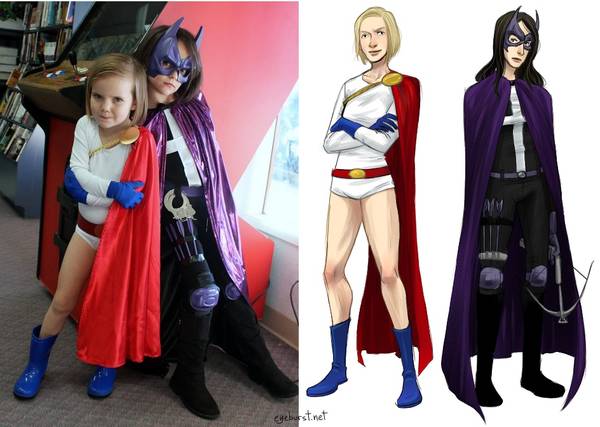
Alex Law's "little girls R better at designing heroes than you" is a great, occasionally updated Tumblr that features illustrations of superheroes based on the hero costumes little girls have made for themselves.
Kids are more impressionable than you, but kids can also be less restricted by cultural gender norms than you. Kids are more creative than you, and they're better at making superheroes than you.
This is a mini art project where I draw superheroes based on the costumes worn by little girls.
little girls R better at designing heroes than you (via MeFi) 
    
|
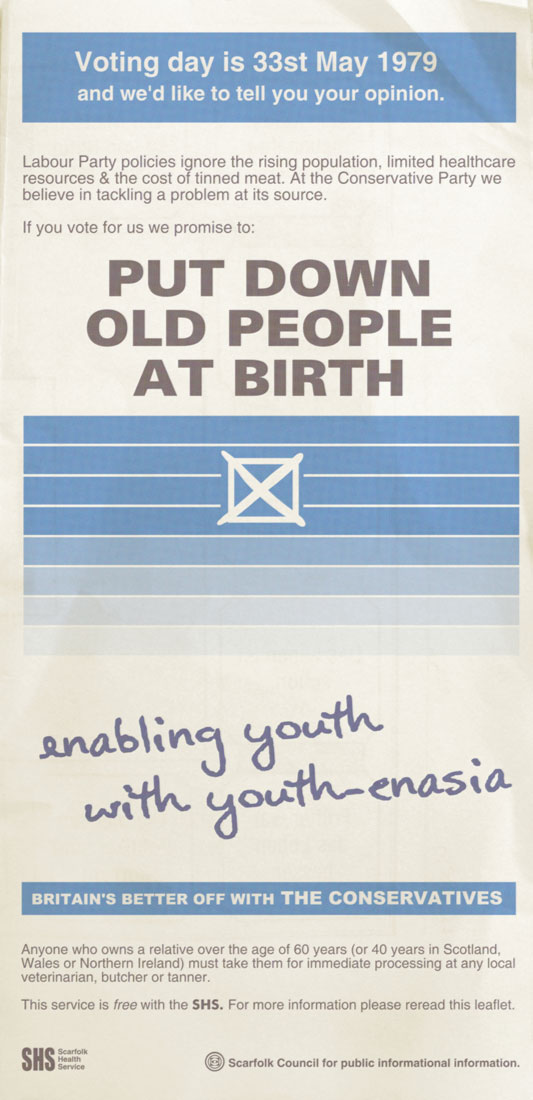
I'm loving the Scarfolk site, where "Dr R Littler" chronicles the mysteries of an English town stuck in a Wyndham-esque loop betwen 1969 and 1979. It's full of the most lovely horrors. It's all so perfectly wrought and so grisly and freaked out and perfectly aged. If only we could all retire to Scarfolk and never grow old!
Scarfolk is a town in North West England that did not progress beyond 1979. Instead, the entire decade of the 1970s loops ad infinitum. Here in Scarfolk, pagan rituals blend seamlessly with science; hauntology is a compulsory subject at school, and everyone must be in bed by 8pm because they are perpetually running a slight fever. "Visit Scarfolk today. Our number one priority is keeping rabies at bay." For more information please reread.
Scarfolk Council (via Die Puny Humans) 
|
|