Probably a good thing that I don't live out in the country anymore... I'd probably lose a finger or two trying to make one of these out of one of the old chainsaws lying around.
There are many ways to keep critical appliances running during a power outage. Maybe a UPS for a computer, a set of solar panels to charge your phone, or even a generator to keep your refrigerator or air conditioning working. This modification to a standard blender will also let you ride through a power outage while still being able to make delicious beverages. It runs on gasoline.
The build uses an old chainsaw to power the blades of the blender. [Bob] was able to design and build an entirely new drivetrain to get this device to work, starting by removing the chainsaw chain and bar and attaching a sprocket to the main shaft of the motor. A chain connects it to a custom-made bracket holding part of an angle grinder, which supports the blender jar. Add in a chain guard for safety and you’ll have a blender with slightly more power than the average kitchen appliance.
The video of the build is worth watching, even if your boring, electric-powered blender suits your needs already. The shop that [Bob] works in has about every tool we could dream of, including welders, 3D printers, band saws, and even a CNC plasma cutter. It reminds us of [This Old Tony]’s shop.
Christi Belcourt, “The Wisdom of the Universe,” 2014, acrylic on canvas 71 x 114 x ½ x 3 ⅜ inches (courtesy Art Gallery of Ontario)
MINNEAPOLIS — Upon first arrival to Hearts of Our People: Native Women Artists, the feature exhibition at Minneapolis Institute of Art, visitors are greeted by a 1985 Chevy El Camino parked in the center of the gallery. “Maria” (2014), was conceptualized by Rose B. Simpson, alongside the exhibition advisory board. Simpson describes “Maria” as an “empowered vessel,” similar to a pot or basket, with its rounded corners and “black on black” interior and exterior. While bold, the decision to place “Maria” at center stage, was both a measured pronouncement of the exhibition terms and an impracticality. However, Jill Ahlberg Yohe, the institute’s Associate Curator of Native American Art, insists that it was easy to get the car into the building. On my first visit, I circled the car with Ahlberg Yohe, pausing from time to time to eavesdrop on people, particularly men, who were admiring its interior and new engine. On my second visit to the exhibition, I found myself subconsciously disinterested, being that I am not much of a car person, skipping the installation altogether, in order to move onto the “art.”
Rose B. Simpson, Santa Clara Pueblo “Maria” (2014) 1985 Chevy El Camino 117 x 74 x 56] (courtesy Collection of Rose Simpson)
The car, as an object, is initially framed in distracting codes of machismo messaging and a ploy for engagement. According to Simpson, the car as art object represents the legacy of agency and power endowed by the Santa Clara Pueblo female experience. As a challenge to Western perception, “Maria” introduces a new dimension to the role of Native women’s art in the cultural and institutional landscape. The car, and its charged position, is both a tool for unlearning and expanding interpretations.
In a 2013 conversation between Ahlberg Yohe and independent curator and beadmaker, Teri Greeves of the Kiowa Nation, the pair considered, why hadn’t there been an exhibition dedicated to Native women artists? Hearts of Our People: Native Women Artists sought to answer this question. To make it happen, Ahlberg Yohe, Greeves, and research assistant Dakota Hoska collaborated with an advisory board comprised of 21 Native women artists, as well as scholars, curators, and historians on Native North America. As the board convened, one central and more specific question was posed, “Why do Native women artists create?”
Kiowa artist, “Cradleboard” (1890) Wood, leather, venetian glass beadwork 43 ½ x 11 ½ x 10 ½ inches (courtesy Denver Museum of Nature and Science)
After three years of extensive meetings, phone calls, and emails with the advisory board, Greeves and Ahlberg Yohe narrowed down the exhibition into three themes, including several sub-themes: Legacy, or the continuum of resilience as it relates to children and ancestors; Relationship, or further, the Indigenous concept of interconnectivity and relationships called Kincentricity as well as Collaboration; and Power, which encompasses Honor/Diplomacy (certainly as it relates to land sovereignty) along with Dignity, Grace, and Balance. These themes uphold the confluence of spirituality and practice within Indigenous organizing structures, producing an exhibition that includes 115 diverse works spanning 1,000 years, with an impressive 70% of the ancestral art identified by name. This model is a crucial guide for dismantling more general ideas around diversity and inclusion in traditional curatorial practice. Both curators were dedicated to presenting the show through an immersive collaboration process that centered Indigenous values, rather than the translation of these values into palatable white supremacist standards.
Ancient Pueblo artist, “Pot (Olla)” (c. 1000–1300) Clay, pigments (courtesy Minneapolis Institute of Art, The Putnam Dana McMillan Fund)
The predominance of Native art is attributed to pottery, beadwork, and textiles. Ahlberg Yohe has observed that Native women contribute roughly 90% of the art found within Native and Indigenous collections. Much of this work is craft, an artistic practice that is ingrained from birth. Given that these practices are usually intended for domestic use, Native art is typically perceived as “primitive novelties” or souvenirs. These creative methods, however, need not be relegated to oversimplified defining concepts such as “creative outlets” and “functional craft,” especially as they relate to the history of colonization and subsequent Western trade and market production. As Ahlberg Yohe puts it, “it is important for experience and artistry to be on equal terms.”
Given this duality, along with the breadth of the exhibition, Hearts of Our People will probably require a second look for most visitors. It is a massive undertaking with a substantial collection of art from Native North America. Containing sculpture, textiles, paintings, photographs, collage, video, audio, and music, the depth of the exhibition gives the viewer the sense of a retrospective survey, breathing new life into these works of art.
Louisa Keyser (“Dat so la lee”), Washoe, “Beacon Lights basket” (July 1, 1904–September 6, 1905) Willow, dyed bracken fern root, western redbud (courtesy Fenimore Art Museum, Cooperstown, New York, Gift of Eugene Victor Thaw Art Foundation, Thaw Collection of American Indian Art)
The impressive 343-page exhibition catalogue further contextualizes the exhibition. It includes scholarly articles and personal essays from members of their advisory board and artists with work in the exhibition. In their essay, “Encircles Everything: A Transformative History of Native Women Arts,” Janet Catherine Berlo, Professor of Art History at the University of Rochester and Ruth B. Phillips, Professor of Art History at Carleton University in Ottawa, recall Abe and Amy Cohn as major players in the colonization of Washoe baskets. Their intent was to collaborate, but instead the Cohns exploited the basket weaving artist Louisa Keyser by giving her the name “Dat-so-la Lee”, making her fame a distraction from the broader community of basket weavers. Keyser’s “Beacon Lights Basket” (1904) is representative of the artist’s signature degikup style — the rounded curve of the baskets is formed through a meticulous style of taut weaving, resembling rows of corn. Washoe baskets were known for their shape and the ability to hold water. According to Berlo and Phillips, “[the Cohns’] propagandistic misinformation has until recently obscured the artists’ greatest achievements in providing a critical economic and artistic resource for their communities at a time of cultural upheaval so great that it threatened their very survival.”
Lea S. McChesney, curator of ethnology at the Maxwell Museum of Anthropology and director of the Alfonso Ortiz Center for Intercultural Studies at the University of New Mexico, uses the term “soft power,” in her essay “Carrying On: Gender and Innovation in Historic Pueblo Pottery, to further elaborate on the significance of women’s pottery and makers. McChesney believes that through aesthetics, women’s pottery can influence and transform space and relationships.
While clay and pottery have unquestionable links to women within Indigenous cultural practice, the expansiveness of gender is more clearly recognized within these communities. The Native concept of gender is configured much differently than biologically focused structures found in the West. Often, in the framing of artistic production of pre- and post-colonial work that is not rooted in the West, artists with gender identities that do not fit within a binary or linear framework are either lumped into the category of “woman” without distinction, or disregarded. The artist Arroh-a-och is described as k’u kweemu, or “like a woman and sister/brother” by Laguna community member Max Early and utilized she/her/hers pronouns and Laguna female gender words. Though little is known about the artist, Arroh-a-och, her “Storage Jar” is widely recognized as a signature piece of Pueblo pottery.
The debut of Hearts of Our People occurs at a particular watershed moment in the art world, when several shows centered around women artists have opened or are forthcoming, thus producing a further examination of the concept of endangerment. Many of these shows had been in the works for years prior to the lead up to the 2016 election, a fact highlighted by the foolhardy name of a recent New York Times article, “Female Artists Are (Finally) Getting Their Turn.” This recent surge of art shows dedicated to women artists offers the retrospective sense of preservation, at a time when our physical bodies are at stake, a critical shift in power at an uneasy juncture in history.
Cherish Parrish, Grand Traverse Bay Anishinaabe, “The Next Generation – Carriers of Culture” (2018) Black ash and sweet grass 23 x 12 x 14” (courtesy Gun Lake band of Pottawatomi)
Edmonia Lewis, the neoclassical sculptor, is another example of an under-recognized woman artist in this show. Lewis was of Haitian, Mississauga and African American heritage and trained and lived in Rome, Italy. One of her most famous sculptures, “The Old Arrow Maker,” is on view in the exhibition; it depicts Henry Wadsworth Longfellow’s poem, “The Song of Hiawatha.” Widely known for her sculpture “Forever Free,” which represents two freed slaves, Lewis was known for creating narratives of Black and Indigenous people as a dogged means of inclusion. However, in spite of her efforts and mastery of Western sculpture, Lewis is rarely included in contemporary discussions of neoclassical art, even when these discussions are centered on women artists.
Edmonia Lewis, Mississauga and African American, “The Old Arrow Maker” (modeled 1866, carved c. 1872) Marble, 20 x 14 x 14 inches, (courtesy Crystal Bridges Museum of American Art Bentonville, Arkansas; photo: Sotheby’s)
Hearts of our People addresses this categorical denial in a signature painting from the exhibition, “The Wisdom of the Universe” (2014), by Christi Belcourt of the Michif tribe. The painting displays an ornate midnight covered in coiling, rooted vines. Birds, flowers, and golden stars are nestled into the foreground, and upon an even closer look, round-faced clover, berries, hanging spiders and fresh herbs can be seen. The pastoral impression of the work seems familiar on first look; it is in the presence of such vibrance and lushness that one could experience both possibility and prosperity, somewhat disguising the sinister absence coursing its way throughout the piece. Unless you read the wall text, it would be hard to discern that every element of animal or plant life in the painting is either nearing extinction or endangered. The viewer, now privy to Belcourt’s knowledge, can more adequately perceive the intuition of the painting, and experience the connection between life and art, with measurable injustice in between. The future, while ominous, is also ongoing within this context.
From the advisory council who gathered for long-term curatorial visioning, to the engagement with ancestral artistic inheritance, Hearts of Our People has developed new traditions within the institutional complexity of the fine art world. Hearts, a prescient title, is an appropriate front-facing sentiment as both a mode and a context for looking.
Hearts of Our People: Native Women Artists is now on view at the Minneapolis Institute of Art through August 18. The exhibition was curated by Jill Ahlberg Yohe and Teri Greeves, with the Native Exhibition Advisory Board, a panel of 21 Native artists and Native and non-Native scholars from across North America, fully credited here. The exhibition will travel to the Frist Museum in Nashville September 27, 2019–January 12, 2020, to the Renwick Gallery of the Smithsonian American Art Museum, Washington, D.C. February 21, 2020–May 17, 2020, and to Philbrook Museum of Art, Tulsa June 28, 2020–September 20, 2020.
As part of a masterplan reimagining Cody Dock in East London, architect Thomas Randall-Page was inspired to create a modern version of the retractable rolling bridges first invented during the Industrial Revolution. The small-scale pedestrian bridge will use a system of hand-operated mechanisms and counterweights to rotate a full 180 degrees, accommodating boats and barges that need to pass underneath it.
"Rolling parallel to the channel it crosses, this design owes much to its Victorian forbears. They knew that moving large heavy structures efficiently requires that they are a balanced system and my design works on this same principle," Randall-Page says. "Finished in painted steel the bridge design aims to be understated in its rest position but celebratory and playful in its movement creating a memorable event for spectators when operated."
Teeth alongside the railings enable the bridge to be moved in a steady gear-like motion, while counterweights built into the rounded square frame add further stability and prevent it from getting stuck in a particular position. A single cable will attach the structure to a crank handle, allowing just one person to invert the bridge. All in all, it'll be much easier to operate than other movable bridges.
Despite the nod to Victorian-era engineering, the project looks forward to the future of motion-based architecture, as Fast Company already noted, also citing the operable roof of New York City's Shed museum as a recent example of the latest trends in kinetic architecture and responsive urban design.
Randall-Page has launched a crowdfunding campaign to raise funds for construction which will be part of a larger masterplan for the area—a former industrial neighborhood that hopes to become a new hub for creatives—by PUP Architects. The bridge will connect walking and biking paths on either side of the canal, increasing connections between planned artist studios, exhibition spaces, and fabrication workshops along the banks of the Lea River.
Concept: The Art of War, released as a coffee table book with the title in a friendly ‘live laugh love’ font across the front and and some appealing, inoffensively artsy cover design. Military strategy for stay-at-home moms.
I recall them showing their paper koi about a year ago -- now it's a product...
Some updates on the paper koi lanterns that I’ve been designing! I’ve been working with a manufacturer for the past months to find the right paper to make these out of. The existing paper they offered ripped too easily and I didn’t want people to break the koi while assembling it.
I also tried out a plastic material for outdoor water proof use and it’s working well :D you can see it in the first few photos of the translucent koi. I’ve also been designing lotus flowers to go with the koi, I’ll be showing some photos soon :)
I still don’t have a date for the diy kit release, but I’ll keep you posted! For those not familiar these, the koi are made without glue or tape, everything interlocks like a 3D puzzle :)
*releases pack of dads into home depot* go……be free
invasive species encroach on lesbian territory
This is a common misconception because they’re such similar environments, but you should be aware that dads are native to Home Depot, while lesbians are actually native to Lowe’s. At this point, however, both dads and lesbians have made themselves at home in both Home Depot and Lowe’s to the point that trying to separate them back into their original ranges would probably do more harm than good to the delicate ecosystem of large chain hardware stores.
A properly raised and socialized Dad will be perfectly comfortable cohabiting with Lesbians. Its not really “encroaching on another’s territory”. You wouldn’t say that about foxes in a forest that also homes bobcats, would you? No. It’s just two different species that have both evolved to live in similar/the same environment. As long as they recognize each other as equals, Dads and Lesbians are more than capable of cohabitation.
Now, if you were to release a pack of Lumberjacks into a Lowes or Home Depot, that’s where chaos will reign. Being adapted to a far harsher and more demanding environment, the Lumberjacks would simply push Dads and Lesbians both out and also consume far more than a sustainable amount of resources. It would be like releasing bears at a country club.
As a former timber-harvester… I feel this is potentially accurate in theory. But highly improbable in actuality.
Lumberjacks, like most megafauna species generally require more space than the average hardware store, even a big box store could provide. The misconception is that Lumberjacks are a social species because of how they often work and live together.
This is a matter of necessity, not preference, and a survival technique for thriving under the LogBoss.
A “pack” of Lumberjacks, if not under the environmental pressure of a LogBoss will naturally disperse until they each have a wide territory.
Lumberjacks rarely fight for territory.
One on one, a Lumberjack could drive out a Dad or Lesbian, however the latter tend to travel in social packs.
Lumberjacks will passively retreat on the presence of large numbers of people. Kind of like Sasquatch.
Getting a “pack” of Lumberjacks assembled would be hard enough unless they were forced into a Hardware Store by a LogBoss. In that case, they would already be in a heightened and potentially agitated state far above their natural behavior. This artificial scenario can be likened to a circus animal running amok. If it had been in the wild, the incident would not have occurred.
Free-roaming Lumberjacks are the cryptids of the Hardware ecosystem. They are surprisingly quiet and unobtrusive.
Please stop labeling Lumberjacks as dangerous roving social predators. They are intermediate level omnivores and remarkably peaceful unless threatened.
As a hardware store worker I can say that this is all 100% accurate.
Wouldn’t it be nice to hang out on a quiet beach on some exo-planet somewhere, listening to Ursula K. Le Guin? Yes it would. Failing that, don’t forget to tune in to PBS tomorrow night for the documentary Worlds of Ursula K. Le Guin, which features a trove of archival footage of the eponymous genius, along with the thoughts of Neil Gaiman, Margaret Atwood, and many more on why Le Guin is, in fact, a genius. Here’s a teaser:
Badass! from her wikipedia entry: After medical care and social attitudes towards AIDS improved, she lived and worked in Florida as a fishing guide and funeral director.[2] In 2012, Burks suffered a stroke and had to relearn many skills, including how to talk, read, feed herself and write; she attributes the stress of caring for victims of the AIDS crisis as a plausible influencing factor.[2] The stroke also led to memory loss.[10] That year, she moved back to Rogers, Arkansas, both in order to be closer to her family and because health insurance would no longer cover her after her stroke.[2][10] In 2013, she advocated for three foster children who were removed from school due to rumors that one might be HIV-positive.[7] After she appeared on TV as an HIV advocate for the children, the community blackballed her, the funeral home she had previously worked at rescinded her standing job offer, and other businesses refused to hire her, with the local Walmart allegedly removing a chair she sat in after finding out she did work with HIV advocacy.
“In 1984, when Ruth Coker Burks was 25 and a young mother living in Arkansas, she would often visit a hospital to care for a friend with cancer.
During one visit, Ruth noticed the nurses would draw straws, afraid to go into one room, its door sealed by a big red bag. She asked why and the nurses told her the patient had AIDS.
On a repeat visit, and seeing the big red bag on the door, Ruth decided to disregard the warnings and sneaked into the room.
In the bed was a skeletal young man, who told Ruth he wanted to see his mother before he died. She left the room and told the nurses, who said, “Honey, his mother’s not coming. He’s been here six weeks. Nobody’s coming!”
Ruth called his mother anyway, who refused to come visit her son, who she described as a "sinner” and already dead to her, and that she wouldn’t even claim his body when he died.
“I went back in his room and when I walked in, he said, “Oh, momma. I knew you’d come”, and then he lifted his hand. And what was I going to do? So I took his hand. I said, “I’m here, honey. I’m here”, Ruth later recounted.
Ruth pulled a chair to his bedside, talked to him
and held his hand until he died 13 hours later.
After finally finding a funeral home that would his body, and paying for the cremation out of her own savings, Ruth buried his ashes on her family’s large plot.
After this first encounter, Ruth cared for other patients. She would take them to appointments, obtain medications, apply for assistance, and even kept supplies of AIDS medications on hand, as some pharmacies would not carry them.
Ruth’s work soon became well known in the city and she received financial assistance from gay bars, "They would twirl up a drag show on Saturday night and here’d come the money. That’s how we’d buy medicine, that’s how we’d pay rent. If it hadn’t been for the drag queens, I don’t know what we would have done”, Ruth said.
Over the next 30 years, Ruth cared for over 1,000 people and buried more than 40 on her family’s plot most of whom were gay men whose families would not claim their ashes.
For this, Ruth has been nicknamed the ‘Cemetery Angel’.”— by Ra-Ey Saley
When I was a kid I would get all excited when mom took the back road and I got to see this windmill...
The Davidson Windmill is in Lakeside, Wis., about 20 miles southeast of Duluth and six miles east of Superior on Wisconsin Highway 13. It was built between 1900 and 1904 by Jacob Davidson on his 80-acre homestead. The mill operated until 1926. It was added to the National Register of Historic Places in 1979 and donated to the Old-Brule Heritage Society in 2001.
The grounds are open to the public, and guided tours inside the windmill and the adjacent Eskolin dove-tailed loghouse are available periodically.
In its series The Slice, WDSE-TV presents short “slices of life” that capture the events and experiences that bring people together and speak to what it means to live up north.
How have I never heard of Kotera's twine ball? Lake Nebagamon is right next to where I grew up -- it's where you went if you wanted Dairy Queen in the summer.
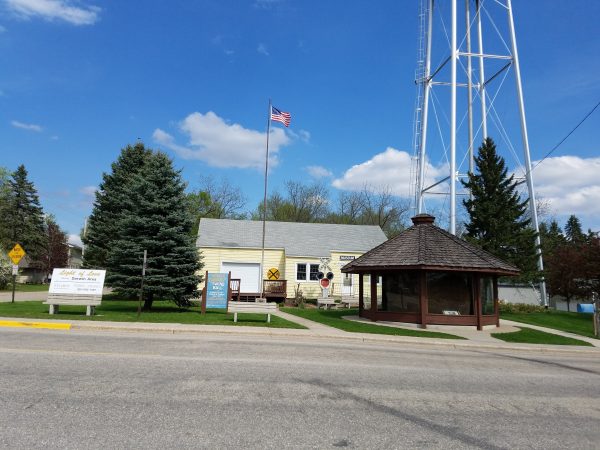
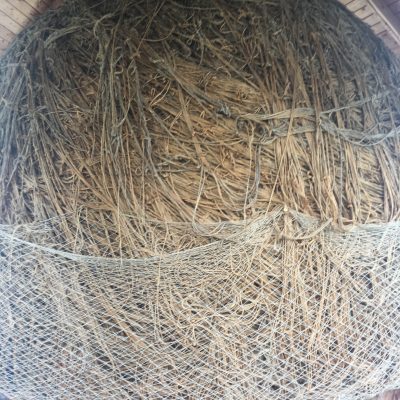
About an hour west of St. Paul, is a tiny little city called Darwin, and it isn’t the kind of place you’d expect to find a great wonder of the world. The main street is only three blocks long — there’s a bank, a water tower, and a nine-ton ball of twine entombed in a plexiglass gazebo.
Darwin twine ball in plexiglass gazebo. Photo by Grace Le
The ball is the pride of Darwin — but before Courtney Johnson moved here, she had never even heard of it. “When I first came to the area I didn’t know anything about the twine ball,” says Johnson. Her husband had grown up in Darwin and is a distant nephew of Francis Johnson, the man who rolled the Darwin twine ball.
Francis Johnson next to his twine ball
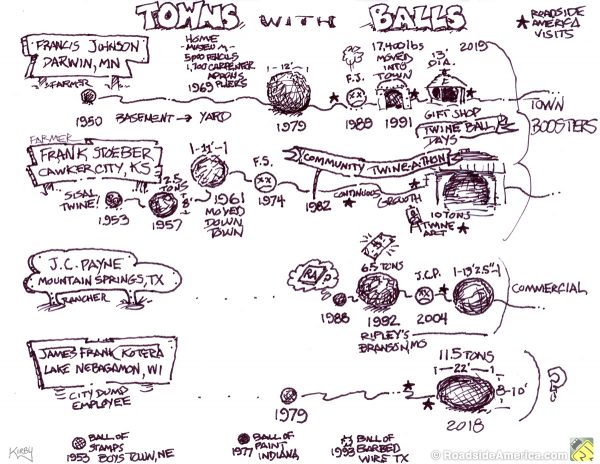
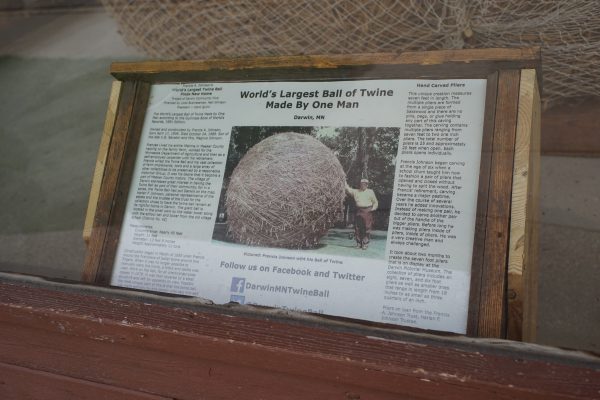
Francis Johnson was a farmer, and his farm was lousy with loose twine. One day, in 1950, while cleaning up after his nephew Harlan, Johnson started rolling some of that extra twine into a little ball. “So he, of course, picked up the twine yelling out Harlan that he’s just young and needs to start picking up after himself.[…] Before you know it, he had a six-inch twine ball, and the six-inch twine ball would get to a foot,” explains Courtney Johnson. And for reasons unknown even to himself, Johnson rolled that twine ball for the next 29 years. The twine ball was easy enough to roll in its early stages. Johnson would work on it in the basement But as it got bigger he had to move the ball outside or it would get stuck down there for good.
Francis Johnson
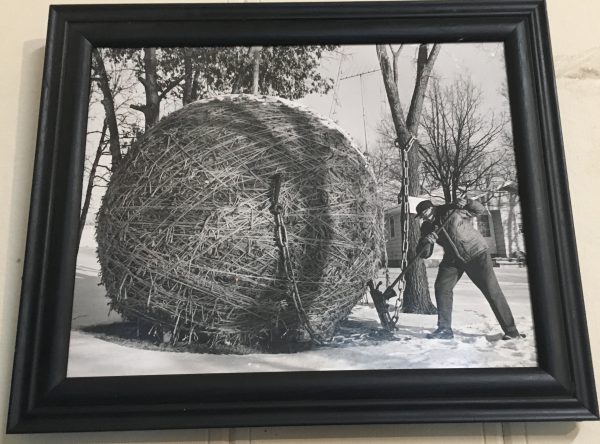
Eventually, the ball got so big that he couldn’t roll it around his yard anymore with his body weight. Johnson invented an ingenious method to rotate the ball using railroad jacks. He would tuck a jack under the ball and use it to nudge the ball forward. He would have something on the other side to stop it from rolling too far, and then wrap twine around the ball. He repeated this process over and over. Rolling the ball, adding twine. Rolling the ball, adding more twine.
The ball attracted a lot of attention both in and out of Darwin. At one point in the late 1950s, Johnson and the twine ball — now five feet tall — were even flown to New York to appear on television. By 1958, Francis’s twine ball was absolutely massive. It had to be the largest ball of twine in the world, so that’s what he called it… until someone did.
Francis Johnson with his twine ball chained to a tree
Frank Stoeber
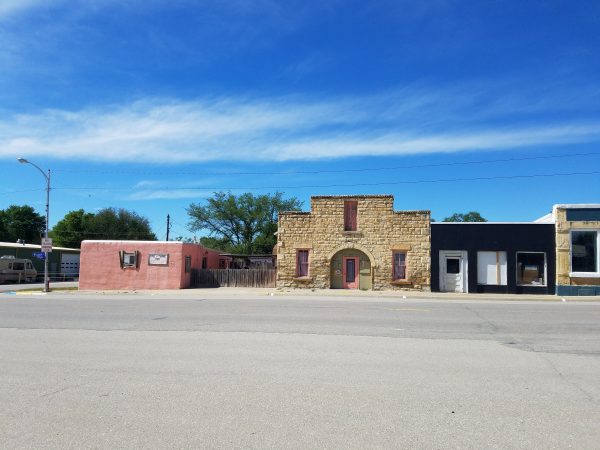
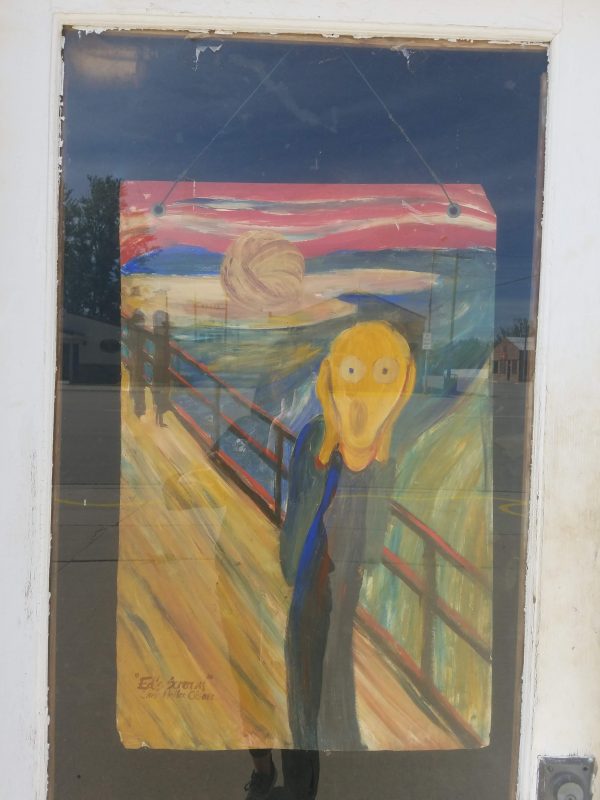
Cawker City downtown. Photo by Grace LeCawker City rendition of The Scream
Cawker City is about 500 miles south of Darwin. Cawker City’s population is a little larger than Darwin’s, but walking around you wouldn’t guess that. It almost feels like an empty set of a western movie. In some of the windows of the abandoned storefronts, there’s twine-ball inspired artwork — the ‘Mona Lisa’ holding a twine ball, and one of Georgia O’Keeffe’s flowers with a twine ball at the center.
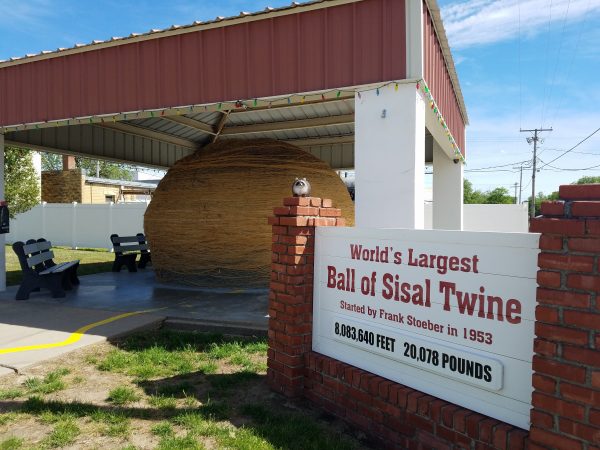
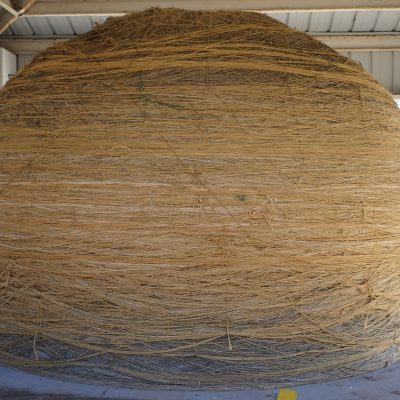
The Cawker City twine ball is looked after by a woman named Linda Clover. Unlike its counterpart in Darwin, which is trapped behind glass, this twine ball you can walk right up to and touch. “We want people to be able to smell it,” explains Clover, “because twine has its own fragrance.”
Cawker City twine ball. Photo courtesy of Grace Le
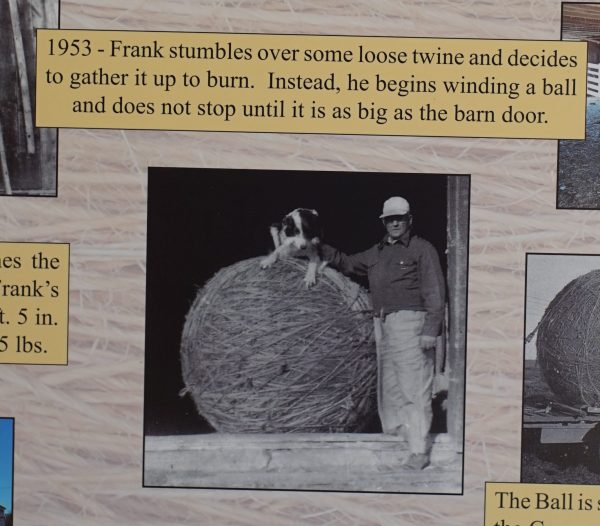
Linda Clover may be the caretaker for the Cawker City twine ball, but it was rolled by a man named Frank Stoeber in 1953. Stoeber was a farmer, just like Francis Johson, and he got started rolling his ball of twine in basically the exact same way that Johnson did. “He started it because he was cleaning up his barn. And the man just was picking up the twine because it was on his barn floor thinking he would roll it into a ball [and] put it into a tub to get it out of the way,” says Clover. Stoeber and Johnson were both raised with a depression-era reluctance to waste anything at all. Anything that could be useful in the future was saved.
Frank Stoeber with his twine ball.
Stoeber may not have been the first person to try to roll the world’s biggest twine ball, but he certainly had a talent for it. By 1956, just 3 years in, Steober’s ball was already 7 1/2 feet tall and weighed over 4,000 pounds—nearly the size of the Darwin twine ball. Doug Kirby is the co-founder of Roadside America, and he says that the two twine balls have become much more than a silly competition. “I think it starts with people making fun of them because it’s such a ludicrous thing,” says Kirby, “but then you quickly realize there’s something about them that somebody took what should have been insignificant little pieces of twine or string or garbage and they’d made something that’s essentially made them immortal.”
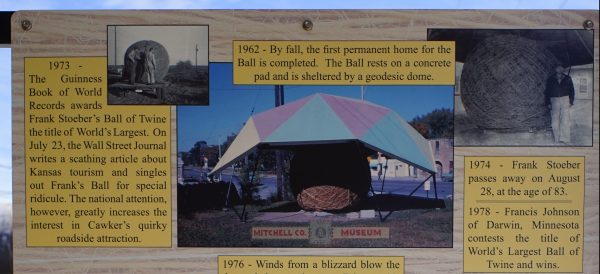
Kirby’s been tracking the status of the balls for a long time, and he says that for a stretch of time, it looked like Stoeber’s ball in Cawker City might have taken the lead. By 1961, Stoeber’s ball was already eleven feet tall. Stoeber’s ball in Cawker City had become a popular attraction in the Kansas area — he would take it to local fairs and people would try to guess the weight. It was such a hit that town officials asked Stoeber if he could bring the twine ball into town to put on permanent display. Officials from the Guinness Book of World Records came to Cawker City, Kansas in 1973 and declared Stoeber’s ball the official World’s Largest Ball of Twine at eleven feet in diameter. Unfortunately, his glory was short-lived because he died the following year in 1974.
Meanwhile, up in Darwin, Minnesota, Francis Johnson was still alive and kicking and rolling twine. He kept going until he surpassed Stoeber’s ball and dethroned Cawker City for the Guinness World Record just a few years later. And, without anyone left to challenge his place in history, Johnson retired from twine ball rolling. He died ten years later, from emphysema at the age of 85. Courtney Johnson says that it’s widely believed that the twine ball was actually the cause of his death. “A lot of people say it was a lung disease that did kill him,” says Johnson, “[If] you look at family history, there is no history of it. A lot of people say it was inhaling twine and chemicals throughout those years it probably was the reason for his death.”
The Community Vs. The Great Man Theory
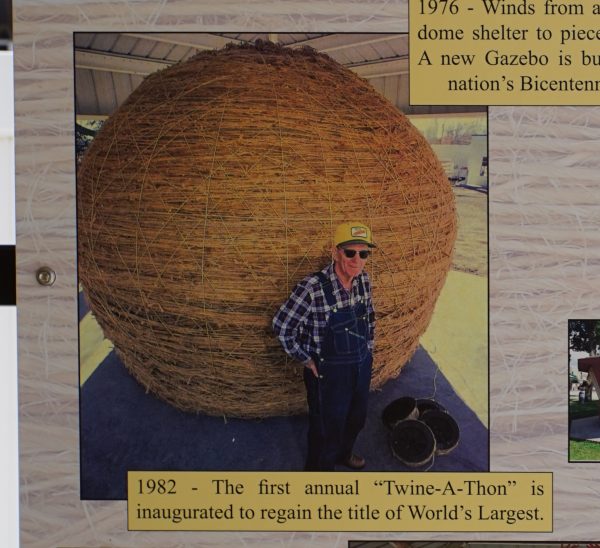
The story could have ended there with two dead twine men, the largest ball of twine in the world, and the second-largest ball of twine in the world… but Cawker City wasn’t finished yet. Stoeber had left the twine ball to the city after he died, and for a few years, it just sat there in the downtown gazebo — a tribute to the second greatest twine ball roller in history. But then the town decided they didn’t want to settle for second best. “We decided let’s have some fun and we started having what we call our annual Twine-a-Thon,” says Cawker City’s Linda Clover.
Residents of Cawker City decided to jump in and start adding more twine to Stoeber’s ball to see if they could beat the record again. This time it wouldn’t be the product of one man, but an entire community. Cawker City started holding twine-a-thons once a year where everyone in town would gather to help grow the town twine ball. And eventually, they started allowing visitors to wrap twine on the ball on a daily basis. Getting to wrap the twine ball became the reason to visit Cawker City.
The latest estimate has it at 20,500 pounds, over 2,500 pounds heavier than Johnson’s. And when you see it in person, it is unquestionably larger in circumference. But not everyone agrees that rolling twine balls should be a group project, especially in Darwin. Courtney says that Johnson’s ball is particularly impressive, not just because of it’s perfectly round shape, but because it was the sole accomplishment of one man. Also, Francis Johnson had his own special technique for rolling a perfectly symmetrical sphere. The people of Cawker City don’t have that. They have no way to wrap the top and bottom of the ball, and so it keeps getting wider and wider. In fact, it’s not even really a ball anymore, more of an oval with a flat bottom. So, Cawker City’s ball might be bigger, but the Darwin ball is definitely retained its spherical form over the years.
“It’s an accomplishment like climbing Everest,” says Edward Meyer, of the Darwin twine ball. Meyer is the former Vice President of Exhibits and Archives with Ripley’s Believe it or Not, and author of the book Buying the Bizarre: Confessions of a Compulsive Collector. It was literally Meyer’s job to find the weirdest things in the world and put them on display, and back in the early 90s, he had his eye on Darwin’s giant twine ball.
As luck would have it, Johnson’s nephew had inherited his entire estate — including the twine ball. Johnson’s nephew asked if Meyer wanted to come to Darwin and possibly purchase the ball for Ripley’s. Meyer was asked to pitch the town on the idea of putting Johnson’s twine ball in a Ripley’s museum in Orlando. Meyer had thought there was no better way to honor Johnson’s accomplishment than to put it on display where possibly thousands of people a week would see it, but that’s not how it turned out.
“I gave a presentation and told them that I wanted to buy it. And the reaction was you know over our dead body. It was probably one of the most uncomfortable evenings of my entire life… I was not sure how this was going to end,” recounts Meyer. The people of Darwin thought the twine ball could bring in tourism to the area, but more importantly, the ball had become a part of Darwin’s identity.
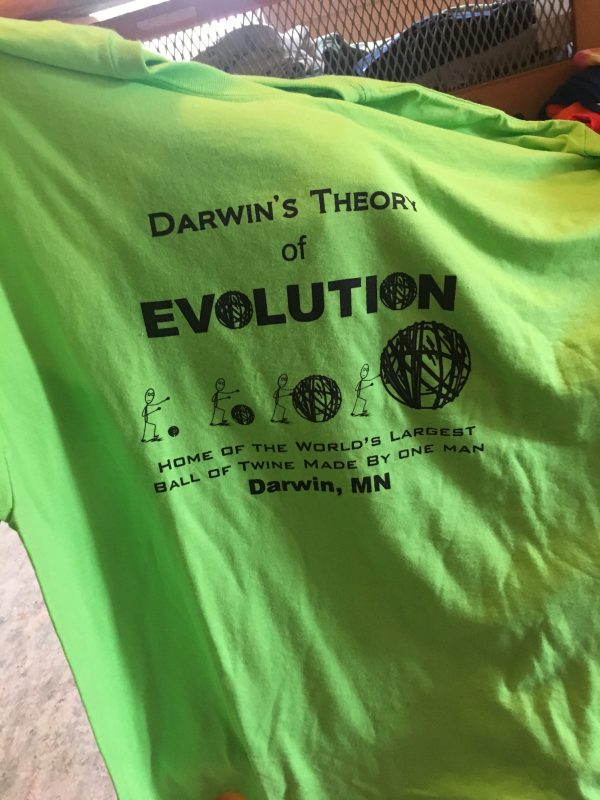
Josh Johnson is the major of Darwin, and he explains that the ball is more than just a large ball of twine. “[The] twine ball is a good analogy — we say ‘it’s the twine that binds.’ It represents not only how we support that, but our support of each other.” The town had adopted the ball as their own, and even started an annual tradition called Darwin Twine Ball Day, which includes a number of twine ball related activities. They pass out candy to kids, roll miniature versions of the twine ball down the street and have a parade, and people come from all over to celebrate with them.
Francis Johnson’s ball had become central to life in Darwin, and Darwin made it clear that if Meyer wanted a giant twine ball for Ripley’s, he would have to get it from some other town… which is exactly what Edward Meyer did.
Saturday in Darwin – Twine Ball Days – Always Somethin' came alive with the engine rebuilt. Oliver Twist had it best runs of the year. Abbie made it 5 first place finishes in a row in the 950 class!
As it turned out, while Darwin and Cawker City were battling it out in their public twine ball arms race, a third ball was rapidly growing, in Texas at the hands of a man named J.C. Payne. Payne was a retired brick mason who was the type of guy who was always in search of a new project. And, in the late 1980s, he found one. Payne had read about the battle of the balls in Darwin and Cawker City and had a clear favorite in the race.
“From the beginning, J.C. Payne did not want cawker city to beat Francis Johnson,” explains Meyer. Apparently, Payne was not a fan of the fact that the Cawker City community effort was about to beat Johnson’s solo project. “He thought you know that it was a shame that Cawker City was going to soon be bigger than Darwin’s because the whole town was involved in it. He thought that this was […] cheating, […] and said you know if Francis isn’t going to be the world’s biggest then I’m going to be the world’s biggest.”
J.C. Payne’s twine ball in the Ripleys Believe It or Not!
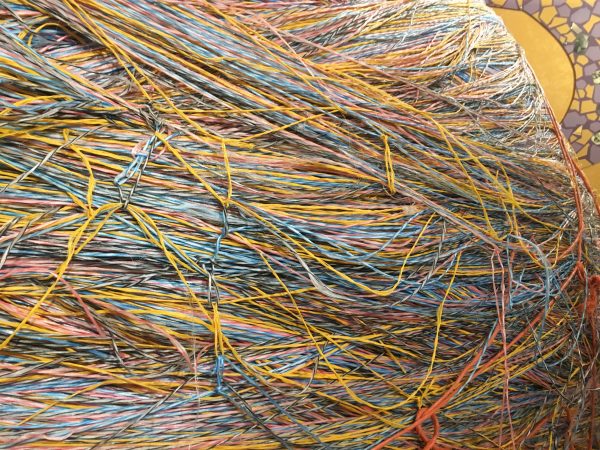
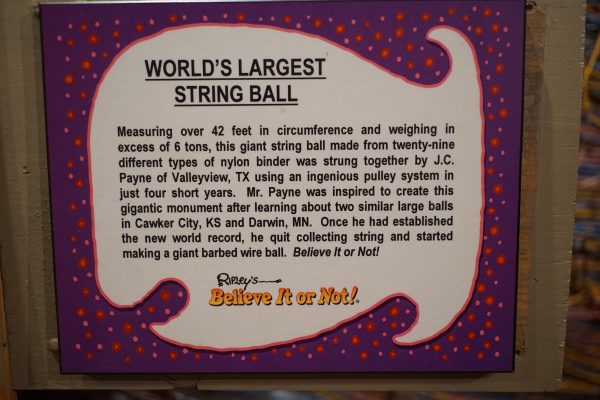
Payne didn’t start rolling his ball until 1987 – a full 37 years after Johnson, but by 1992, the Guinness Book of World Records declared it the largest ball in the world. In a few short years, Payne managed to create a ball that was 42 feet in circumference, 13 feet tall and weighed six tons. The main gripe about J.C. Payne’s ball was that he used artificial, colored nylon twine, while Johnson and Stoeber both used sisal twine. Sisal is an earthy-colored, plant-based material and has that has a classic farm feel to it, whereas nylon feels more manufactured and inauthentic. Nylon also weighs less making Payne’s ball much lighter than both Cawker City and Darwin’s.
Meyer ended up flying to Texas to meet Payne in person and see the ball for himself. At first, it looked pretty good but was beaten up during its transport to the new Ripley’s location opening up in Branson, MO. Still, this misshapen monster of a ball was going to be the pièce de resistance of the new Ripley’s museum. The ball was so large that the building had to be constructed around it. If for any reason they ever need to move it out of there, they’ll either need to take the roof off the or blast a hole in the wall. On top of that, the placard in front of Payne’s twine ball at the Branson Ripley’s Believe it or Not indicates that it’s the “World’s Largest String Ball,” with no mention of the word “twine.”
The World Famous Twine Man
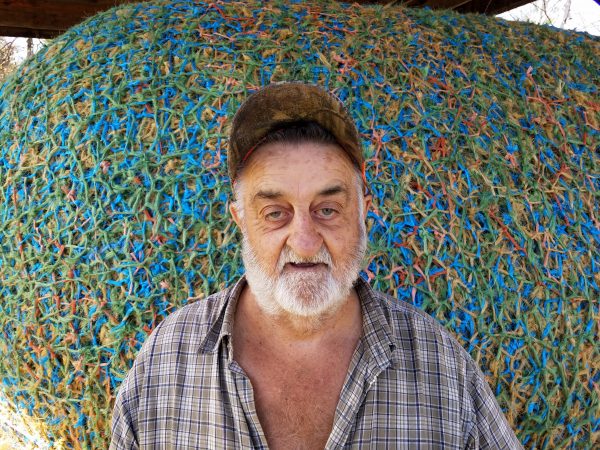
James Frank Kotera (JFK). Photo by Grace Le.
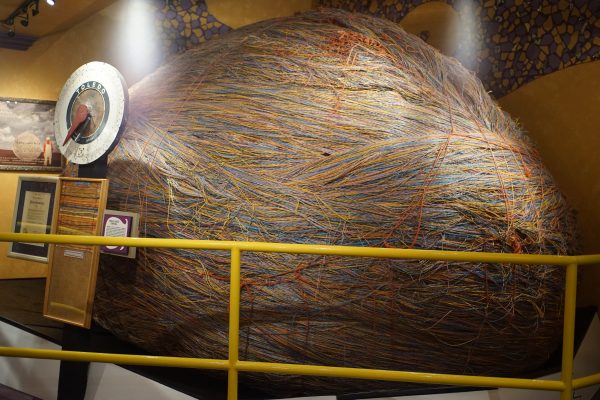
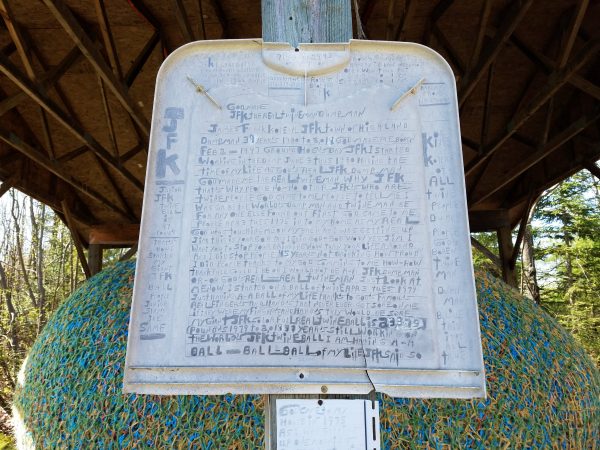
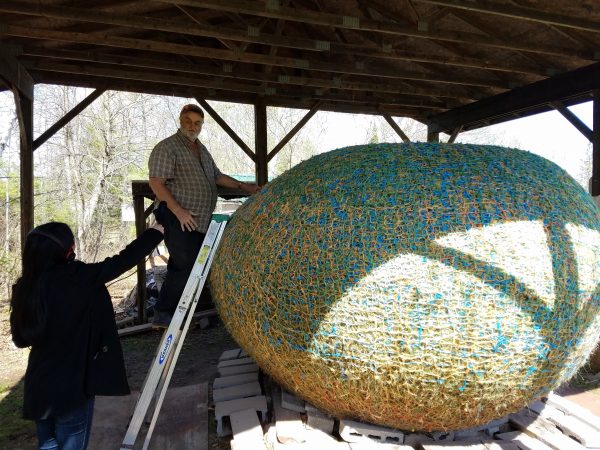
Deep in the Northwoods of Wisconson is a man named James Frank Kotera — or “JFK” as he prefers to be called. Kotera has been quietly working on his own version of the world’s largest ball of twine. There are hand-made signs posted all of his property with the story of his ball. As he tells it, one night in 1975, God came to him and told him that he was to stop drinking, turn his life around, and become a world-famous twine man. And that’s more or less what he did.
Hand-written signs on James Frank Kotera’s property
Kotera’s ball is a little different from the rest. He takes small segments of colorful twine and weaves and tucks the individual pieces into the ball so the surface resembles a net. It’s also harder for him to reach the top too, so it’s a lot wider than it is tall. JFK also claims that his ball is the largest by using a different metric — weight — at 23,375 pounds. Based on his calculations, it’s nearly 3,000 pounds heavier than Cawker City’s. He says he knows this because before adding twine to the ball he puts it in a garbage bag, weighs it, then adds the total to his overall measurements. If he’s correct, his is definitely the heaviest of all four twine balls.
James Frank Kotera and his twine ball. Photo by Grace Le
But JFK’s isn’t interested in having the ball measured by the Guinness Book of World Records, because no matter what anyone else says — his ball is the largest according to his own standards. He doesn’t need some outsider to come and tell him what he already believes. So, for now, a careful balance is intact. The four largest twine balls exist peacefully alongside one another—each content with its own version of superiority.
“Towns With Balls” original cartoon by Doug Kirby
Learn more about The World’s Largest Collection of the Smallest Versions of the Worlds Largest Things from the coda here.
*This episode originally reported that Darwin is about an hour east of St. Paul, MN — it’s actually about an hour west.
Déjà vu, from French, literally “already seen”, is the phenomenon of having the strong sensation that an event or experience currently being experienced has been experienced in the past, regardless of whether it has actually happened.
Jamais vu (from French, meaning “never seen”) is a term in psychology which is used to describe any familiar situation which is not recognized by the observer.
Presque vu (from French, meaning “almost seen”) is the sensation of being on the brink of an epiphany, such as when attempting to recall a word or name.
Déjà entendu, (literally “already heard”) is the experience of feeling sure that one has already heard something, even though the exact details are uncertain or were perhaps imagined.