Because people have asked, here’s my theyfriend’s dog Huevo ✨🥚✨
Also the event was in LA 🏳️🌈🏳️⚧️
It makes me so happy that this post blew up and somehow didn’t attract the attention of transphobes?? Like, so many people out there just want the best for queer children and that’s everything TuT
Melanocetus johnsoniispecimen found 2 km off the coast of Tenerife while a group of researchers were observing pelagic sharks. It is currently unknown why the specimen was so close to the surface, being that anglerfish normally live in the bathypelagic and mesopelagic zones (200-2000 meters deep)
Reminds me of this: The Wyoming Senate will debate a bill called the “What Is A Woman Act” after a vetting committee advanced it by a unanimous vote Thursday, but not before some fireworks between a male legislator and a Casper woman who addressed him as “Madame Chairman.”
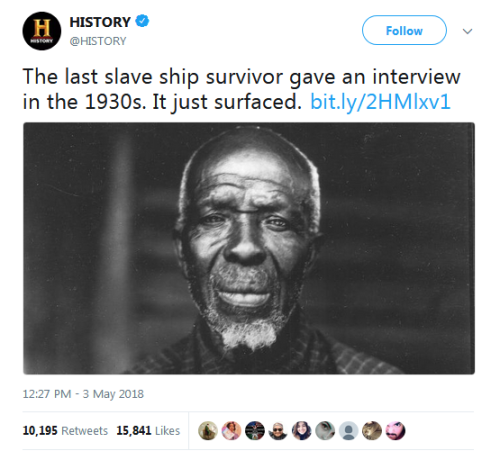
It’s so significant too that this narrative was collected by Zora Neale Hurston, one of the greatest authors and anthropologists of her time. She was shunned by the “gatekeepers” of both of these professions, largely because of her Blackness, her womanhood, and her uncompromising commitment to honoring and showcasing both in her works. She died penniless and alone in a state-run institution in 1960. All of her works had gone out of publication by then. It took more than a decade before she was rediscovered. A young author by the name of Alice Walker had come across her work and was deeply inspired by it. “In 1973, after an exhaustive search, Walker came across Hurston’s unmarked grave in Ft. Pierce, Fla. She purchased a headstone for Hurston’s tomb and had it inscribed “A Genius of the South.“”
It is through Zora Neale Hurston’s pioneering sacrifice, and the acceptance of that inheritance by Alice Walker that we have found this missing piece of our history. Without the courageous and unfailing work of Black women, we wouldn’t have Cudjo Lewis’s story. We are slowly regaining a narrative that’s been hidden from us, one that continues to be lied about. Trust Black women to lead the way.
I would like to add The Birdcage (1996) to this list of drag queen movies (mind you, it’s based on a French stage play from 1973).
Which starred Nathan Lane as a drag queen just two years after he had voice Pumba in “The Lion King”:
And we ESPECIALLY need to remember Victor Victoria from 1982 (during the REAGAN administration) which is SET IN THE 1930S and stars everyone’s favorite curtain-sewing nanny as a struggling soprano who decides to pretend to be a boy doing drag (DOUBLE THE DRAG FOR YOUR MONEY). I mean look at this photo:
Count Victor Grazinski isn’t putting up with your transphobia (or you being a dick to Robert Preston).
Unfortunately, the representation of drag and female impersonation (as it was often called pre-Stonewall) is scant in mainstream American cinema due to the Hayes Code. There are definitely more, but these are biggest, “family-friendly” names I can think who have starred in major motion pictures as drag performers.
can I add another?
Some Like It Hot (1959), it got in trouble with censors and still went ahead, but it featured a lot of Gender and a character getting really into this whole “being a girl for real” thing, as well as the implication of a a gay engagement being on the table
but like? It has Marilyn Monroe in it and banger music and it’s a classic! I only know from my mother bringing it up and also a tiny bit of exposure to russian tv channels, but I think it was also popular in the Soviet Union? So she’d seen it as a child and loved it so much she watched it with me when I was also just a child.
(not to mention big traditions of children’s theatre with drag performance)
you go inside and there’s an opossum on the counter and you order a footlong chicken teriyaki and it uses its mouth to pile various sticks, acorns, leaves and bugs onto 12 inches of mossy damp tree bark. It’s the best subway you’ve ever had
Starting next Wednesday, February 26th, Amazon isn’t going to let users download the ebooks they’ve purchased, forcing users to keep everything within the corporation’s proprietary ecosystem.
As covered in The Verge, the mega-corporation is removing a feature that lets ebook readers do what they want with their purchases, including back-up their books, or convert them to different formats, or transfer them to a non-Amazon e-reader. There are a lot of reasons why you may want to download your ebooks, but the basic argument for it is simple: if you buy something, you should be able to do what you want with it.
Amazon’s downloading process has always been a little obscure, requiring a lot of clicks. And if you want to move books to non-Kindle devices, you have to convert the books out of Amazon’s proprietary file type, which can also be tricky. But even this too-onerous process is giving away too much to its customers for Amazon.
This move isn’t terribly surprising coming from Amazon, a bad company that’s getting worse, and being led by a fascist-fascinated billionaire who looks like Mr. Clean’s uncle — the one who is no longer invited to Thanksgiving. This isn’t just an issue of forcing users to cede ownership and keep everything within Amazon systems — Amazon has demonstrated in the past that it’s not a trustworthy librarian. The company has deleted books that it said were offered for sale by mistake or replaced books with new versions without alerting readers. Amazon’s also not interested in selling their ebooks or audiobooks to libraries, keeping a monopolistic hold on some titles. This is most egregiously the case for “Audible Exclusive” audiobooks, which won’t be available to borrow from libraries or to purchase from other services.
Tech companies selling books, music, and movies have long treated digital purchases more like rental agreements, which is nice for saving space on shelves and hard drives, but means that you’re locked in a strange, almost feudal relationship. The solution is to not give them your business — services like Bookshop.org and Libro.fm not only let you download your own, non-DRM-locked copies of what you buy, but also let you support independent bookstores with your purchases.
If you’ve already bought ebooks from Amazon, you’ve got a week to back them up before the feature disappears. The process seems like it involves a lot of clicking, especially if you have a larger library, but writer Craig Mod shared a tool that apparently helps automate things a bit:
In case you were looking to backup your kindle books (since Amazon is removing the option to download them on the 26th), this script works quite well in minimizing the click-pain of downloading them individually: gist.github.com/spf13/1fee1e…
One of my celebrity brushes with greatness... Peter Falk opened up the door and told my sculpture class to shut up (he had a painting class across the hall)
This is the grave of Peter Falk.
Born in 1927 in The Bronx, Falk grew up in a fairly typical Jewish family of that time. His dad owned a dry goods store. Falk grew up with a weird look. He had eye cancer at the age of 3 and had his right eye removed. He wore a glass eye but squinted a lot. Now, you would think, well, OK, this isn’t going to have a massive impact on someone’s life or ability to make a living, but they probably aren’t’ going to go into the movies. I’d think that too. But as everyone here knows, Falk chose that harder path.
The family moved up to Ossining like any number of good white New Yorkers getting out of the city by the 40s. He managed to play baseball in school (once dropping his glass eye into an ump’s hand when he was called out to show just how bad a call that was!!!) and was in high school theater productions. He went to Hamilton College after trying but failing to join the military, based on his eye of course. He still however dropped out of Hamilton and got the Merchant Marine to take him, working as a cook. He ended up back at Hamilton, then went to the University of Wisconsin for a bit, and finally ended up at the New School, where he received a degree in 1951.
But this was a kid looking for adventure. He nearly fought in the first war between Israel and Egypt, barely caring which side, but wanting some action. It ended before he could work that out. But after his college, he worked on railroads in Yugoslavia. He then went to Syracuse University and got a Masters in Public Administration, but admitting that he had no idea what he wanted to do with his life except that anything to do with that degree was out of luck. So he tried to join the CIA. But he was rejected because while at sea, he had been a member of the far left Marine Cooks and Stewards Union and this the Cold War and redbaiting workers was still at its height; this despite the fact that Falk did it work on the boat, not because he cared about the politics.
So Falk stumbled into actually using his degree and got a job as an analyst with the Connecticut State Budget Bureau. But he hated it and so for fun, because doing community theater. He did well and got recommendations and people told him to go to New York. So in 1956, he did. He started getting off-Broadway roles pretty quickly, actually was on Broadway by the end of the year in a small part, and became a pretty key person in the New York theater scene by the end of the 50s.
Falk wanted to do movies, but his eye got in the way. He had a screen test for Columbia, but Harry Cohn totally dismissed a guy with a squint because of a blind eye. But he got a few small roles and then a bigger one in 1960s’ Murder Inc., where he got the best reviews in what was generally considered a mediocre picture. In fact, he was nominated for Best Supporting Actor and that would put the real charge into his career. Frank Capra immediately cast Falk in what would be the director’s last film, 1961’s Pocketful of Miracles. He later wrote how much he loved both Falk’s performance and how undiva he was, unlike Glenn Ford, who he wanted to murder.
Still, Falk was not going to be a featured actor much. He did a ton of small movie parts and a ton of TV. He was the star of a Twilight Zone episode where he played a Castro like revolutionary who begins to see his murderer in the mirror (subtle script writing there!) and he won an Emmy for his guest starring appearance in an episode of The Law and Mr. Jones.
This all leads us to the two things Falk is most remembered for today. The first, of course, is Columbo. In fact, that’s probably one of the all time iconic TV roles. The show was on consistently in movie of the week spots from 1971 to 1978 on NBC and then it migrated to ABC as the occasional TV movie. He played the role all the way to 2003. His hardboiled but friendly detective ways and his iconic look with the squint and the overcoat made him an icon if not a star exactly. The show was also interesting in that it lacked suspense–they always showed the killing happening first and who did it. Then you’d watch Columbo put the pieces together.
The second big piece of Falk’s career is his work with John Cassavettes. He starred in Husbands, A Woman Under the Influence, and, in a smaller role, Opening Night. Not being much of a Cassavettes fan, I’ve only seen all of these more than once, and it is hard to be anything but “hey, it’s Columbo!” at first. Falk also showed up in Wings of Desire, more or less playing the Columbo character which was more or less playing himself anyway. It’s one of the weirdest casting choices I’ve ever seen, as he plays that role as an angel who gave up his immortality and lived on Earth because being an angel is boring. And he’s Columbo doing that. OK. But it works, somehow.
Really though, Falk was everywhere. Why wouldn’t you cast him in The Great Muppet Caper? Kind of perfect. The Princess Bride? Also perfect. He played Shelley Levine in productions of Mamet’s Glengarry Glen Ross in Boston and LA. Would love to see that. He occasionally worked in theatre back in New York as well. Later in life, he did some holiday movies that were bad, but they were work and he was fine in them. He published his autobiography in 2006. Falk died in 2011. He was 83 years old. The last couple of years were dominated by a rapidly advancing dementia, which yuck.
Peter Falk is buried in Westwood Memorial Park, Los Angeles, California. Shera is his widow, the actress Shera Danese. Unfortunately, Danese had stopped his daughters from seeing him in those last years when he was ill and didn’t even tell them when he died. This led to California passing what became known as the Peter Falk Law in 2015 that gave family members rights when their family members had remarried.
For context this was in response to someone saying their cybertruck was heavy duty
oh no no NO no no I am sorry my dear @thebirdtm you are NOT underselling one of the most seminal pieces of television of my entire childhood like that on MY watch.
“How is claiming they drowned a Hilux possibly underselling it” GREAT question.
To start with a little disclaimer, Top Gear’s Hilux did not start off, as in the video above, in pristine condition. It started off with nigh-on 300k kms (for you yankees, that’s about 8.4 million Boeing 737 wingspans) and a condition to match.
And it’s only once careless driving around town yielded zilch in given shits…
(look, I found a local newspaper picturing it being driven around!)
…that they decided to drown it. Now, the underselling part: if you told me that they drowned a pickup the first place my mind would go to would be “driving it through a river a bit too deep for it, perhaps as deep as its height, until it stalls and then tugging it back out. You will concede that’s rather different from tying it down on the seashore with the second highest tide in the world…
…and leaving it there until it engulfs the whole truck…
…only for the ropes to snap…
…and for the truck to be lost to the tides for FIVE HOURS.
(and for those wondering, yes, just as promised, well within an hour and the mandatory limits of basic tools and no spare parts, up the mechanic made the thing fire and away the presenter drove it - I must imagine doing a number on his clothes in the process.)
Oh also I would have mentioned the caravan.
Or at least the wrecking ball.
But hey, at least the fire was mentioned.
Still, I feel it’s criminal to leave out how they celebrated it surviving all it did: by parking it at the top of a 23 story building for all to see! :)
Wait NO-
Well, that was uncalled for. Given what it survived, it deserved to rest in a museum instead of being unceremoniously cleared out with the other chunks of public housing that buried it.
Or at least, given that buried it wasn’t…
…to be tumbled down from the rubble utop which it sat…
…and be fueled up.
"be fueled up”, pfft, what for?, I hear you say. And you are right.
Look at that thing, you say.
Let’s be serious now, however pretty of a story it would be that’s not a truck that will do anything remotely in the ballpark of firing up, let alone running.
And again, you are right.
The battery was disconnected.
Sorted that, tho
“You can’t be serious.” Oh darling I sure can! “Well the presenters can’t then” no no, I assure you, it lived. Go see it for yourself! It’s at the National Motor Museum in Beaulieau, England!
I grew up watching Top Gear and it shaped me in many ways. My adoration of old Toyota Hiluxes is one of them.
The Toyota Hilux is absolutely the small god of endurance and defiance (and possibly masochism).
yes I’m reposting about a small god truck are you kidding me
The ‘This is fine’ meme is way older than anyone had expected. This 14th-century manuscript illustration shows the legendary 5th-century British king Vortigern in his burning castle.




ALT