We are determined to squeeze every second out of summer while it's here, starting with a slice of this crispy grilled pizza topped with fresh sweet corn and tomatoes and ending with a bowl of tangy, lemony ice cream. You also won't want to miss our fizzy fresh peach soda from this week or how to make an fresh, zesty gremolata to spoon over grilled vegetables and chicken. We also shared lots of S'mores fixings, with birthday cake marshmallows and S'mores inspired by Key lime pie. Take a look at all our summer-lovin' recipes from this past week right here!
More
    
|




CaryI remember that photo from when I was a kid...

Children circle around an ultraviolet lamp to get a dose of vitamin D in Murmansk, Union of Soviet Socialist Republics, August 1977.
Photograph by Dean Conger, National Geographic

Designer and illustrator Rachel Ignotofsky created these wonderfully quirky and creative anatomical posters. These are really fun for a kids room, especially if you don’t want real human anatomy up on their walls. You can purchase them over at Rachel’s Etsy site!


View more of Rachel’s work at rachelignotofskydesign.com!
[via MOSHITA]

As the literature of the mid-1900’s greatest matrimonial minds tells us, a man is always one wrinkled shirt away from leaving. Eyes open and mouth shut ladies. It’s about to get real.
Ahoy Sailors and YouTubers!
Hope you’re doing fine in this Summer (?!) perhaps! because it’s already autumn in Sweden!
About three weeks ago, I wrote a rather harsh (in many opinions) article, comparing Sailfish to other newbie operating systems and it turned out to be our most viewed and commented and interesting article in the history of our website! The numbers of people who shared it and viewed it were humongous and it blew my mind thanks to you all for sharing it 
Right, Nixie Pixel! The OS geek of YouTube whom as she claims, “Does Linux” and she is indeed a Linux and Open Source huge fan as you might saw the amount of enthusiasm and excitement in her videos.
Lately, she has done some showdowns of these new operating systems that has recently been available for mobile devices such as our beloved Sailfish, Ubuntu Touch, Tizen and Firefox OS and during all of those one by one showdowns she promised a final showdown to choose the best newbie OS to date which was called “Best Mobile OS – The Final Showdown” which became very interesting to us as she chose Sailfish OS at the end despite the fact that she said it’s ugly! Well it may be ugly in some opinions and we’re not here to do nitpicking or anything but we are here to show you the video if you haven’t watched it till now.
Anyhow, thanks to Nixie for the great video she posted and thanks for choosing Sailfish as your future OS!
Here is the video, I hope you enjoy. And make sure to share your opinion with us in the comment section.
Sepehr Noori (James)
Cheers.
CaryNeed to combine with Yoda... Do or do not -- there is no try.
If we did all the things we are capable of, we would literally astound ourselves. – Thomas A. Edison
You only live once, and life is tragically short. It’s easy to look at people who are happy and assume they don’t understand your pain. The older you get, the more you realize that happiness takes work. People who smile in public have been through every bit as much as people who cry, frown, scream, etc. They just have the courage and strength to smile through it anyway. So how do you ensure you’re living life to the fullest? Here are some tips to help you out:
The post Daily Quote: Do All the Things You are Capable of appeared first on Lifehack.
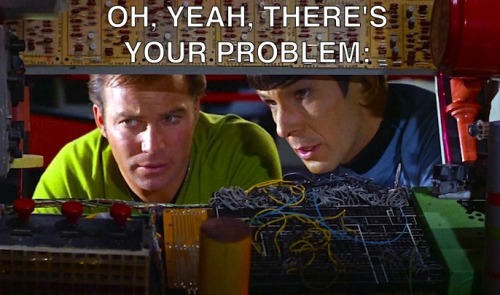

The more I see of the inner workings of the Enterprise, the more I’m convinced it runs on rainbows and the spirit of adventure.
I mean, like, are those kidney beans glued to expired library cards? Is that a kazoo coming out of half a pinball machine? Is that a pile of unconnected silly string on top of a broken Fender Super Champ? (Yes, and everything is beautiful.)
CaryBong is my little hometown's, Poplar Wi, claim to fame...
On the morning of August 6th, 1945 — 68 years ago today — the “Little Boy” atomic bomb was dropped on Hiroshima, Japan, by the American B-29 bomber, the Enola Gay.

In the last year, I’ve written about the bombing of Hiroshima quite a bit on here already in many different modes:
68 years later and we’re still grappling with the meaning of that legacy. We’re still debating it, still arguing about it, still researching it. It seems like one of those issues that will be hotly contested as long as people feel they have some stake in the outcome. As the generation that lived through World War II passes into history, I wonder how our views on this will evolve. Will they become more detached from the people and the events, and will that result in more hagiography (“Greatest Generation,” etc.) or its opposite? It will be interesting to see, in the decades to come.
Historical memory is skittish in its attentions. Our understanding of what was important about the present and past changes rapidly. Neal Stephenson, one of my favorite science fiction authors, has a wonderful conceit in his novel Anathem, whereby one group of scholars writes a history of their times once a year and then, every decade, forward it on to another group of scholars. They pare them down to the things that still seem important, and then, every century, forward ten of those on to another group of scholars. Those scholars (who are essentially isolated from all other news of the world) then pare out everything out that no longer seems important, and every thousand years, forward on their histories to another isolated group. I find this a wonderful illustration of the paring that time has on our understanding of the past, and how much that once seems so important is soon viewed as irrelevant.
One need only look through the newspapers that broke the news of Hiroshima (that is, those from August 7th, 1945, because of time zones and deadlines for morning editions) to see how much this is the case. Not all are as blatant as this sad tie-in from The Boston Daily Globe (August 7, 1945, page 4):
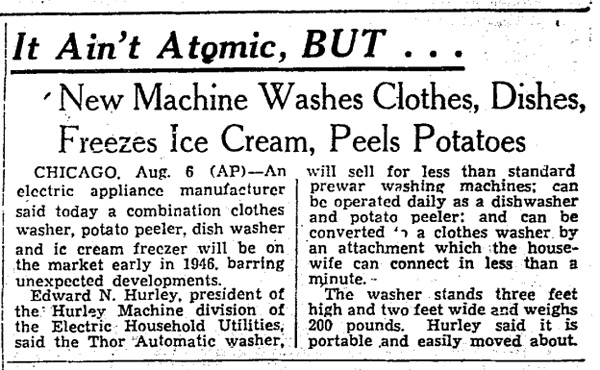
In defense of whomever chose that headline, they had to fill page space, and it’s clear they recognized how insipid this “new machine” was when nestled amongst war news. But there are other story decisions that are in some ways much more striking in retrospect.
Take, for example, the headlines above the fold of the Los Angeles Times (August 7):
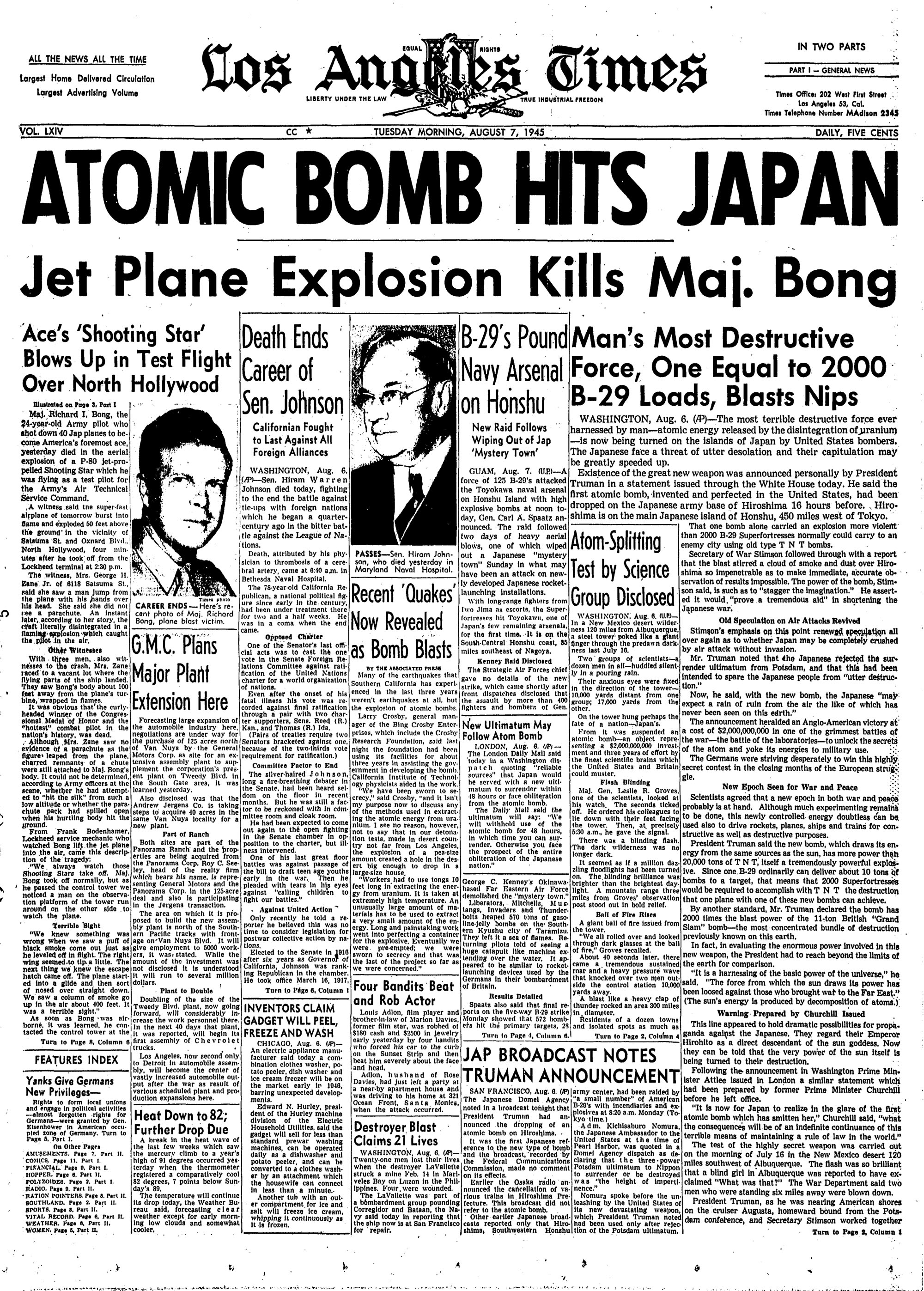
Most of the headlines are devoted to the atomic bomb. Most of those about the bomb itself are either verbatim copies of, or derived from, the press releases and stories distributed by the Manhattan Project’s Public Relations Organization (yes, they had such a thing!). The one bomb story on there that is not from there is, tellingly, completely incorrect: a report that earthquakes in Southern California from the past three years were “the explosions of atomic bombs.” Um, not exactly. (There were large tests of chemical explosives at the Navy’s China Lake facility in Southern California, as part of Project Camel, but no atomic bomb tests out there, obviously.) The other big stories of the day are two deaths. One was of the Senator Hiram Johnson, an isolationist who bitterly opposed American foreign entanglements — there’s something appropriate with him passing away just as the United States was entering into a new era of such.
The other was the death of Major Richard Bong, a death so important at the time that its headline is only a tiny bit smaller than the news of Hiroshima itself. As the article explains, Richard I. Bong was a 24-year-old fighter pilot, the highest-scoring U.S. fighter ace of World War II, having shot down at least 40 confirmed Japanese planes. He died on familiar soil, as a test pilot in North Hollywood. His plane, an experimental P-80 Shooting Star, the United States’ first jet fighter, exploded a few minutes after takeoff. Bong attempted to abandon the plane, but it exploded and killed him.
Major Bong’s death got front billing in all of the major national newspapers. It was understandably most prominent in Los Angeles, where it was local news. But even the venerable New York Times, who had some of the thickest bomb coverage on account of their Manhattan Project-embedded reporter, William L. Laurence, slipped him on there, at the top, in the same size headline that they described the Trinity test:
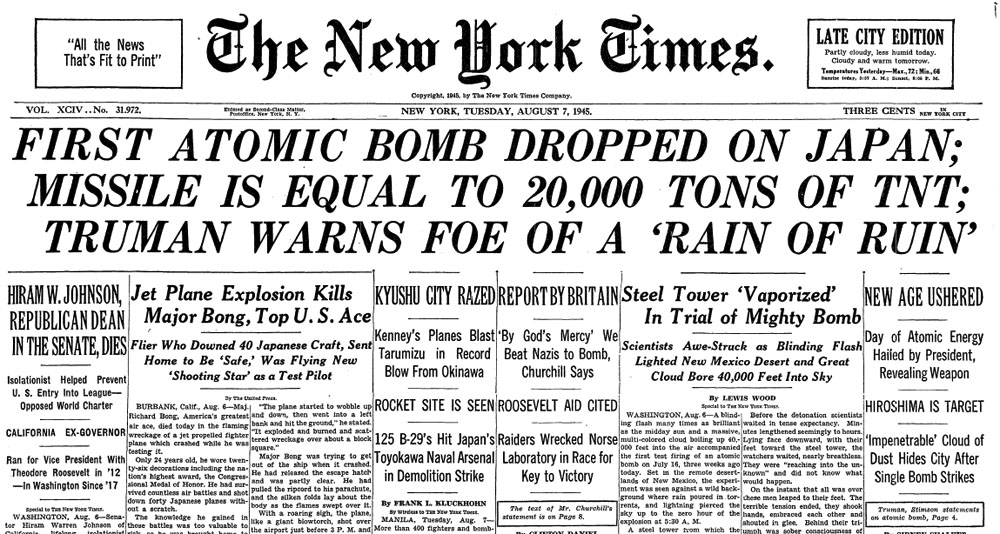
Today, practically nobody has heard of Major Bong. I occasionally bring him up as an example of how many of the top news stories of today are going to be unheard of in a few years. The reaction I usually get is disbelief: 1. Surely “Major Bong” is a made-up name, and 2. Really, he shared the headlines with Hiroshima?
One gets this sensation frequently whenever one looks through the newspapers of the past. When my wife teaches her high school students about World War II, she prints out front pages of newspapers for various “famous events” of the day and has her students look at them in their entirety. It’s a useful exercise, not only because it makes the past feel real and relatable (hey, they wrote puff stories about new, dumb inventions, too!), but because it also emphasizes how disconnected the front pages of a newspaper might be with how we later think about a time or event, or with the later evaluation of a President, or with an understanding of a war. It is an exercise that also illustrates how a careful understanding of the past encourages a careful understand of the present — what story of today will be the Major Bong of tomorrow? And who is to say that Major Bong’s story shouldn’t be better known, and less overshadowed by other events of the time? There is nothing like steeping yourself in the news of a past period, to see how both strange and familiar it is, and to see how the grand and the mundane were always intermingled (as they are clearly today).
Personally, while I think Hiroshima is worth talking about — obviously — I think we put perhaps too much emphasis on it, and doing so remove it from its context. Other headlines on the same day talk about other bombing raids, including firebombing raids — the broader context of strategic bombing, and the targeting of civilians, of which the atomic bombs were only a part. I think, on the anniversary of Hiroshima, we should of course think about Hiroshima. But let’s not forget all of the other things that happened at that time — even on the same day — that get overshadowed when we hold up one event above all others.
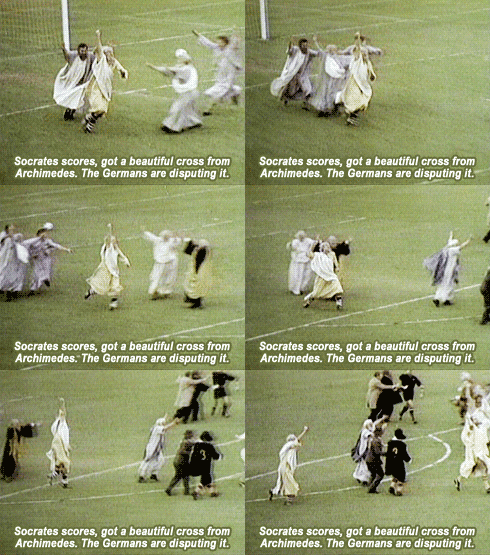
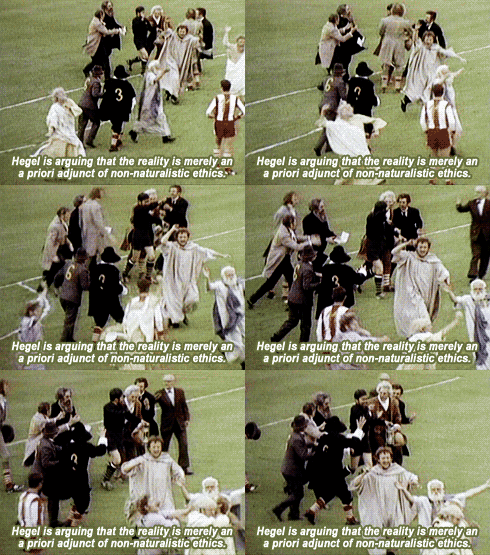

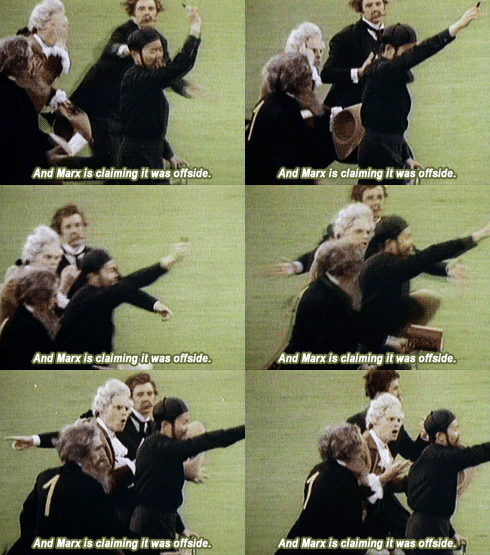
But Confucius has answered them with the final whistle, it’s all over. Germany, having trounced England’s famous midfield trio of Bentham, Locke and Hobbes in the semi-final, have been beaten by the odd goal.
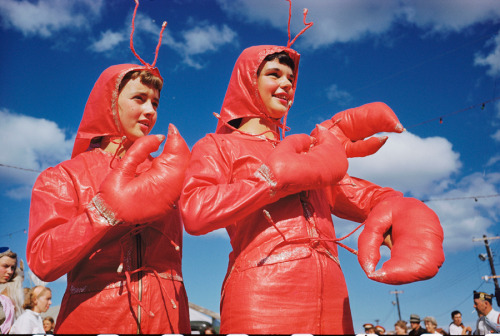
Two girls dressed as lobsters participate in the Lobster Festival in Rockland, Maine, September 1952.Photograph by Luis Marden, National Geographic
 Bradley Manning (Wikipedia) Wikileaks source convicted on most charges (BBC News) There’s hope for Manning yet (Daily Beast)
CaryI bought one a couple of months ago... I guess that it is time to finally install it.
The only thing worse than paying out the tuchus for unreliable internet from Time Warner Cable and Comcast is being forced pay a monthly rental fee for a modem you need to access that crappy internet. Happy New Year! The fees on both TWC and Comcast are going up yet again. Here's how to buy your own modem so you can save some money.


|
|
CaryI recall seeing the same thing at a store...
At the time I was attracted to pure science — physics — where you could speculate and be creative. It’s equivalent to being an artist. If you get the chance, and the cards fall right, there’s no difference. The intellectual play and spirit are the same.
– David Byrne (interviewed by Timothy Leary), 2000

I’ve commented more than once here on the myth of the Mad Scientist: contrary to popular belief, there are no easy shortcuts to scientific greatness. It’s true that some of our creative processes are subconscious, that we sometimes come up with ideas on vacation or after a good night’s sleep. No one, however, becomes a great scientist by just sleeping a lot. Our subconscious faculties only become engaged after we’ve studied the problem and thought about it extensively, often to the point of exhaustion. They don’t kick in every time, and when they do, their input is not even always useful. (I’ve woken up many times with shiny new ideas that did not hold up on inspection.) Excitement, inspiration and quality vacationing can make it easier to put in the sustained, disciplined work of constructing correct and complete mathematical arguments, but does not replace it. As for the relation to actual mental illness, I’ve linked before to a relevant interview with John Nash.
I didn’t get any disagreement on that from math and science types. We understand well enough how the creative process works. We know that being all fired up to prove the Riemann hypothesis is different from actually doing it. Imagine my surprise, then, when I attended a discussion on art and science in the “Philosopher’s Cafe” series a few weeks ago. Scientists and mathematicians came in good numbers, and many of them professed exactly the same kind of misconceptions about art that they would dismiss outright with regard to science. Art, if you believe them, is all about feelings. When a work of art evokes strong emotions, we assume that the artist was overwhelmed accordingly at the moment of creation, leaving no room for intellectual mediation or for calculated, deliberate activity. In other words, the artist experiences an intense feeling, whips himself into a state of rapture, and bang, a painting or whatever materializes in front of him in a puff of magic dust. The Mad Artist swipes his cape and takes a bow, in all his fictional glory.
I’m a research mathematician of some renown. (The regulars here know that, but I’ll say it explicitly anyway, for those who might find this post via links and google searches.) I’m also an amateur photographer (see my Google+ page for samples), and I’ve been attracted to visual arts all my life in some way or other. I’m finding in my own practice that the creative processes in art and in mathematics are often more similar than it might first appear, and I’ve had plenty of confirmation of that from both sides of the aisle. This post is about that, with emphasis on the mathy and sciencey side of art. (Time permitting, there will also be a follow-up post in the converse direction.)
This is not a post about “mathematical art.” Honestly, I have little interest in most of it. I write research papers about fractals, but I find neither mathematical insight nor artistic value in the rainbow-coloured pictures of fractals usually found at math art exhibitions. Don’t even think about sending me links to math rap songs, either. I don’t need art to talk to me about mathematics. I want it to speak to me as art, on its own merits, with no special bonus points for math themes or content.
I’m interested in the less obvious but more organic similarities on the level of the creative process. I’m hardly the first to observe them. Just last year, I attended an artist talk where a painter spoke of his work in terms of “solving the mathematical equation.” Yet, it was plainly in evidence in that discussion a few weeks ago that too many scientists think of art as a softer, lower grade kind of creative endeavour where the concepts of logical thinking and problem solving are pretty much unknown. In that regard, here are a few points to consider.
I’ll be talking mostly about photography, and to some extent about painting, because that’s what I know best. If you think it’s different in other arts, I’ll refer you to Ursula Le Guin’s excellent description of a physicist’s creative process in The Disposessed; I can’t find a link now, but I recall reading somewhere that it was based on her own experiences with writing. If you think that it’s just me thinking that way, that’s very easy to check. There are many artists out there who have blogs, public Facebook or Google+ pages. They might post pictures of work in progress, talk about their influences, recount how a particular piece came about. They might be using different, less “scientific” language, but you will still find a good deal of premeditation, problem solving and analytic thought in what many of them do. And if you tell me that not all art is that great… well, yeah. Not every math paper is a towering pinnacle of intellectual achievement, either. We all do what we can.
Knowing your subject. This is pretty basic, but should be mentioned anyway: an artist needs to know his or her subject. How well? Ancient Greek sculptors spent centuries studying human anatomy and learning to depict it in statues. Both Leonardo da Vinci and Michelangelo studied human anatomy by dissecting corpses. Leonardo in particular produced hundreds of pages of notes and drawings, including studies of the human skeleton, muscles, internal organs, the cardiovascular system. He documented facial expressions, effects of age and illness. He was not just both an artist and a scientist; his art and science blended into each other, both being manifestations of the same curiosity about all things human.
Here’s a less known but perhaps even better example. Take a look at this gallery of paintings of horses by the Polish painter Juliusz Kossak, a horse buff who spent a great deal of time hunting, visiting stables, even hanging around abattoirs in order to study equine anatomy. Note in particular the third image, from 1868. Why is the date important? Because at the time, it would have been disputed whether this pose was even possible. There was no agreement on the exact details of a horse’s trot or gallop, the motion being too quick for the human eye to break down. Most artists painted a horse in trot with at least one foot on the ground, and in gallop with both front legs extended forward and both hind legs extended to the rear. Eventually, however, the arguments were settled by a series of photographic studies starting in 1872. Kossak was totally vindicated. The artist beat the scientists to figuring it out.
Seeing. When you paint or take photographs, what do you want to depict? If “what I see” is what you’re thinking, here’s why this is not really an answer.
The human eye does not work like a camera lens. It is, in fact, not an especially good optical instrument. The image formed on the retina is at best fragmented and incomplete. The detailed, continuous picture we think we see is believed to be a product of our brain instead, stacking and editing multiple images, combining optical input with prior knowledge and educated guesswork. This process is known as “unconscious inference,” a term that goes back to Hermann von Helmholtz in the 19th century.
Exactly how this happens is not yet fully understood, but several partial theories have been proposed. Gestalt psychology suggests that we organize visual data according to patterns such as similarity, closure or continuity. We group similar objects together. We perceive geometric shapes (circles, triangles) as complete even when parts of them are missing. We choose to see them as continuous rather than broken, symmetrical rather than arbitrary. Well known optical illusions corroborate the theory. M.~C.~Escher’s paradoxical drawings invite the viewer to indulge her temptation to attach a familiar meaning to the visual stimuli, then turn the tables on her when an impossible object is revealed.
We classify visual input according to broad templates and interpret it based on probabilities. Often, we only take a quick glance at an object before we allow the part of our brain that handles sensory perception to go on autopilot. We expect a house to have a door, windows, roof, so we take them for granted. Afterwards, we will be sure that we have seen them, but we will have no recollection of their shape or colour. On the other hand, unlikely or incongruent events tend to go unnoticed even when we believe that we are paying close attention. The Simons Lab at the University of Illinois at Urbana-Champaign has a series of mind-blowing videos demonstrating just how much visual information we can miss. People walk in and out of the room, objects get rearranged, one actor gets substituted for another in mid-action, and we remain oblivious to it all, never realizing that anything has ever been out of order.
Researchers have examined and confirmed the notion that our perception of the world depends strongly on our relationship to it. In experiments, hills appear steeper when we are carrying a heavy backpack, and distances seem larger when we are cheated into perceiving our bodies as smaller.
There are lessons here for the photographer. For one thing, it explains many cases where my photos did not turn out the way I’d expected: I had made lazy assumptions and did not take the time to really look at what I was shooting. “Look with your eyes,” Syrio Forel tells Arya Stark in Game of Thrones, and indeed when I do that, I see more. Fortunately, it is a skill that can be learned and practiced. But this is also where we get to art as problem-solving.
Solving the puzzle. What should a photograph capture? In light of the last few paragraphs, there is no reason for the answer to be obvious. Should we aim for “objective” truth, whatever that might be? Should we maximize the amount of information included, try to capture the mood, account for our own feelings? Should we try to make the hill look steeper depending on the weight of our backpack?
Would an unedited image shot on automatic settings be “natural”? Consider for instance what happens when some parts of the scene are much brighter than others. Our eyes compensate for this, adjusting the aperture constantly by dilating and shrinking the pupils, so that we see the details of both the bright and the dark objects. In photography, though, the aperture is fixed. To mimic the way we process the scene in real life, the photographer might edit the image or blend several exposures. She might also, however, leave the photo unedited, with parts of the scene underexposed. That could still be a fine image, but it would not necessarily look more “natural” to us than the edited one.
We don’t even look at the photograph the same way that we look at its subject. Take landscapes. In real life, a landscape surrounds us, and we explore it gradually as the eye wanders from one object to the next one, changing focus, taking the time to cross the spaces between them. All of this can be lost easily in a small two-dimensional image. Good photography restores the order and the empty spaces that would otherwise collapse in the loss of a dimension, establishes and explores visual relations between objects. It does so through the tools of art: framing, composition, light, focus, colours, contrast.
Artistic creativity and vision are forced on us when we try to simply depict the world as it is and discover that this, in fact, is generally not possible. Any rendering of the view before us as a photograph is a format conversion that calls for artistic choices.
Here’s a very small example to illustrate what I have in mind. The photo at the top of this post shows the view from Reef Bay, Mayne Island, with Mount Baker in the background. Mount Baker is about 110 km from Reef Bay in a straight line. It looks like a mirage, as it probably should (I’ve made a back-of-the-envelope calculation to the effect that, while in principle it could be visible from that far, it should not be as prominent as it is). It’s just barely visible in most photographs (trust me, I’ve tried), a vague outline blending into the background; nonetheless, when you’re there in person, it attracts attention to the point of dominating the landscape. How can I get that on camera?
The first point is that the photographs are probably true to the actual optical reality. Our own in-person perception is far more subjective; if our attention centres on Mount Baker, that’s likely because we’re so eager to place it there. The second point is, how to induce a similar effect in a photograph? This is where the knowledge of Gestalt theories, optical illusions and other such can come in handy. In this particular case, when I saw the bleached drift logs by the entrance to the beach, I figured I had what I needed. With the two whitish objects near the bottom of the image, the viewer would look for a third one higher up as a counterpoint, and sure enough he would find it.
I’m mentioning all this because it’s not necessarily obvious, to a bystander, that this aspect of art even exists. I’m not sure that I understood it myself before I took up photography. But there it is, presenting you with a puzzle, demanding your problem-solving skills.
Once we realize this and accept that there is, in fact, a puzzle to solve, it’s easy to draw broad parallels with other endeavours requiring similar intellectual work, from mathematics research to occupations usually not thought of as creative. There’s inquiry and curiosity. There’s constructing a solution, reconciling competing demands, making the pieces fit together. There’s the same process of gradual improvement over time, setbacks, learning from mistakes, getting better with practice.
It also becomes apparent that, contra the Mad Artist, art is work that often involves planning and strategizing. I’ve learned a good deal from both reading up on science related to vision and spending time around art and paintings. My knowledge of the subject, mostly the Pacific Northwest and its nature, informs the process, starting with where and when I choose to go shooting. I have, for example, driven to specific locations at specific times of day and year because of prior knowledge of what the light would be like. There’s room for happy surprises and unexpected coincidences, but to quote Louis Pasteur, “chance favours the prepared mind,” in photography as it does in science.
On the shoulders of giants. Here’s another misconception: unlike researchers, who always build on the work of others and contribute to a greater body of knowledge, artists create each piece as a self-contained object, pretty much independently of everything else in the universe. That, at least, is how I understood what some of the folks at Philosopher’s Cafe were saying.
I suppose an argument could be made that we don’t need to study the history or theory of art to enjoy a particular piece, but even that might be a bit flimsy. Concepts such as beauty and harmony are very much culture-dependent (our modern culture has one ideal of female beauty, but others have been known to see it differently), and additionally, each art form has its own conventions that can be impermeable for those outside the culture. I don’t, for example, understand kabuki theatre. Along the same lines, someone else might be looking at the Mona Lisa and not seeing the big deal.
On the artist’s side, though, the argument breaks down altogether. If we view art, as I do, as (among other things) the study of human perception of reality, then it only makes sense to rely on the accumulated body of knowledge. Today’s painters don’t spend their time reinventing the wheel linear perspective. They can draw on what’s available. It doesn’t have to be a matter of deciding “I want to paint like X.” More likely, it’s “I want to paint seascapes. Now, X, Y and Z also painted seascapes, and I really like the way X and Y did it, so I’ll look carefully at what they did just so I have a starting point.” This is much like what we do in math research: when we start working on a problem, the first thing we often do is find out who has worked on similar questions, what they proved and how they did it.
Photography did not even exist until the 19th century, either as art or as technology, so one might think it was totally invented out of whole cloth at the time. Except that’s not true. It is all but forgotten today that early photography aimed explicitly to imitate paintings. This was done through composing images carefully, adjusting focus and exposure, manipulation of colour and contrast in developing the negatives. Long before the invention of Photoshop, photographs were being airbrushed and had details sketched into them. Multiple negatives were combined into one photograph, often through literal cutting and pasting. Edward Steichen, often considered to be the first fashion photographer in history, wrote in 1903:
In the very beginning, when the operator controls and regulates his time of exposure, when in dark-room the developer is mixed for detail, breadth, flatness or contrast, faking has been resorted to. In fact, every photograph is a fake from start to finish, a purely impersonal, unmanipulated photograph being practically impossible. When all is said, it still remains entirely a matter of degree and ability.
Both painting and photography have evolved a great deal since then. And yet, the rules of composition in photography are basically identical to those in painting. (Abstract paintings possibly excluded, so that we’re comparing apples to apples.) Incidentally, if you do click through or look for other similar links, you’ll find that many of the rules are reminiscent of the Gestalt theories I mentioned earlier: using leading lines, geometric shapes, repetitions and patterns. You’ll also find that painters did all this and more long before the term “Gestalt psychology” was even coined. I learned a good deal of it just by having been exposed to the European art canon since I was a little kid.
The “rules” are only a toolkit. They’re not absolute, and they’re pretty much worthless when not backed up by genuine intellectual and emotional engagement with the subject. Cheap prescriptivism doesn’t work. This applies especially to the more “mathematical” rules, such as the rule of thirds or any similar numerical recipes. I’ve seen arguments to the effect that such recipes should make the resulting work more interesting to me as a mathematician, because I should like numbers and equations, shouldn’t I? In reality, they’re just as likely to do the exact opposite. But I’ve said that already.
How do we know, then, which rules to follow and which ones to ignore? If you substitute “method” for “rule,” that’s the same question that calculus students ask us every year in class. The answer is the same, too. It’s analyzing the problem until one truly understands it. It’s practice, experience, judgement, trial and error. It’s something that I, as a mathematician, can actually connect with.
(Revised on September 3 because I was not happy with the middle part.)


MSNBC host Chris Hayes mocked Bill O’Reilly on Tuesday, parodying the Fox News host’s claim “black culture” was fundamentally violent.
The segment began with Hayes showing a video clip of white teens rioting in California this month. The MSNBC host said the mainstream media was covering up the “white riot” in Huntington Beach because of political correctness.
“The sad truth is that the white power structure in this country has no clue, no clue how to solve the problems within the white community,” Hayes said. “Look, I don’t want people to be suspicious of white men, but the Huntingon Beach riot underlies a stark truth about white culture. The fact is 84 percent of white murder victims are killed by other white people.”
He demanded that the white community ask itself how to deal with the problem of white crime and lamented that “moderate whites” weren’t speaking out.
His guest, Cord Jefferson of Gawker, also joined in the fun. Jefferson said exposing violence and decadence in the white community was just “tough love.” He insisted he wasn’t anti-white, noting he had white friends. His prom date in high school was “very white,” Jefferson explained, because “she rode horses and did that whole thing.”
Earlier this month, O’Reilly denied that socioeconomic factors such as unemployment and lack of education could account for crime levels in predominately African American communities. He said violence was the result of black people listening to rap music, using drugs, and making the “personal decision” to have children out of wedlock.
Watch video, uploaded to YouTube, below:
An official from St. Petersburg, Russia has declared that the country’s new anti-LGBT laws will apply to guests and athletes at the 2014 Winter Olympics in Sochi. In an interview with The Echo of Moscow radio, Vitaly Milanov, author of the St. Petersburg “anti-LGBT propaganda law,” said that he has no reason to suspect that guests and athletes will be granted exceptions under the rule. He also went on to vouch for the sterling heterosexual credentials of the men of Russia’s figure skating team.
While the International Olympic Committee said in a statement on Friday, “The IOC has received assurances from the highest level of government in Russia that the legislation will not affect those attending or taking part in the Games,” Milonov said that he didn’t know where the person making the statement got the authority to flout national law. Nor, he said, should athletes expect to be able to openly express their sexuality if it deviates from what Russia has deemed to be the “traditional,” i.e., heterosexual model.
Milanov told the Echo (via Google Translate) that the anti-LGBT law “applies to the whole of the Russian federation” and that even “(i)f you run well,” he said, “it does not mean that you can seduce children.”
When the Echo correspondent asked Milanov about the possibility of LGBT tourists at the games, he replied, “Are we saying that some people can seduce children and some can not? I think that no one should seduce children. Therefore, the law can not be overruled by government decree. Federal law applies to the whole territory of the Russian Federation, and nobody has the right to suspend it.”
Milanov went on to say that while the government may say it’s fine for LGBT athletes to compete, “It will not be so fine.” Only if the athlete is “normal,” he said, should they be allowed to participate in the Olympic games. LGBT athletes, he said, are not strong because their orientation excuses their weakness. “I am running bad,” he claimed the athletes will say, “because I am not a man and not a woman.”
The Echo interviewer pointed out that there are many openly gay champion male figure skaters, to which Milanov replied, “You know, I can tell you that the best figure skating is the Soviet school of figure skating. We have a completely traditional team. I am personally acquainted with many Olympic champions. Not only that, I actually grew up among these families. And I can say that this is not the case. Russian figure skaters are perfectly normal people, interesting, traditional people with large families.”
As part of its statement on Friday, the IOC said, “The International Olympic Committee is clear that sport is a human right and should be available to all regardless of race, sex or sexual orientation. The Games themselves should be open to all, free of discrimination, and that applies to spectators, officials, media and of course athletes. We would oppose in the strongest terms any move that would jeopardise this principle.”
[image of Vitaly Milanov via Wikipedia]